
Arindam Mukherjee 
Pune C++ and Boost Meetup 
C++11 MOVE SEMANTICS
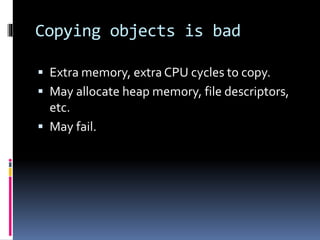
Copying objects is bad 
 Extra memory, extra CPU cycles to copy. 
 May allocate heap memory, file descriptors, 
etc. 
 May fail.
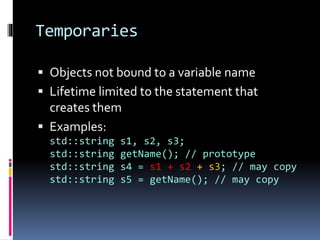
Temporaries 
 Objects not bound to a variable name 
 Lifetime limited to the statement that 
creates them 
 Examples: 
std::string s1, s2, s3; 
std::string getName(); // prototype 
std::string s4 = s1 + s2 + s3; // may copy 
std::string s5 = getName(); // may copy
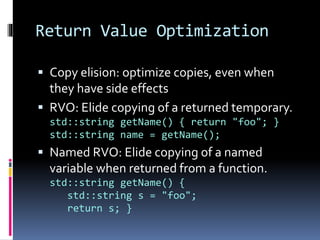
Return Value Optimization 
 Copy elision: optimize copies, even when 
they have side effects 
 RVO: Elide copying of a returned temporary. 
std::string getName() { return "foo"; } 
std::string name = getName(); 
 Named RVO: Elide copying of a named 
variable when returned from a function. 
std::string getName() { 
std::string s = "foo"; 
return s; }
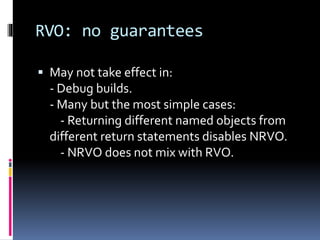
RVO: no guarantees 
 May not take effect in: 
- Debug builds. 
- Many but the most simple cases: 
- Returning different named objects from 
different return statements disables NRVO. 
- NRVO does not mix with RVO.
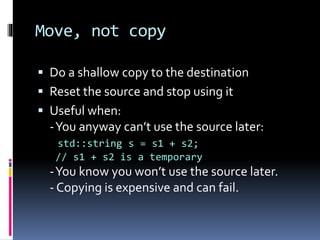
Move, not copy 
 Do a shallow copy to the destination 
 Reset the source and stop using it 
 Useful when: 
- You anyway can’t use the source later: 
std::string s = s1 + s2; 
// s1 + s2 is a temporary 
- You know you won’t use the source later. 
- Copying is expensive and can fail.
l-value, r-value 
 l-values: expressions with durable address. 
May not be ok to move from. 
int x = 5;foo(x); 
char arr[16];arr[5] = 20; 
 r-values: expressions without a durable 
address – temporaries – always ok to move 
from. 
const string& s = string("Foo"), s2, s3; 
setName(getName()); 
s3 = s + s2;
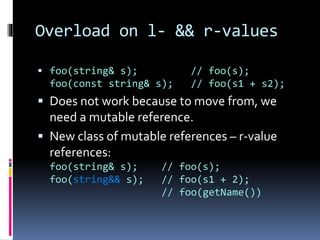
Overload on l- && r-values 
 foo(string& s); // foo(s); 
foo(const string& s); // foo(s1 + s2); 
 Does not work because to move from, we 
need a mutable reference. 
 New class of mutable references – r-value 
references: 
foo(string& s); // foo(s); 
foo(string&& s); // foo(s1 + 2); 
// foo(getName())
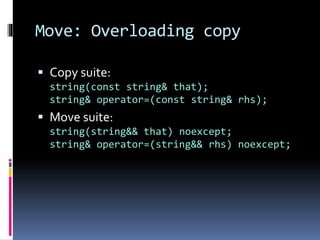
Move: Overloading copy 
 Copy suite: 
string(const string& that); 
string& operator=(const string& rhs); 
 Move suite: 
string(string&& that) noexcept; 
string& operator=(string&& rhs) noexcept;
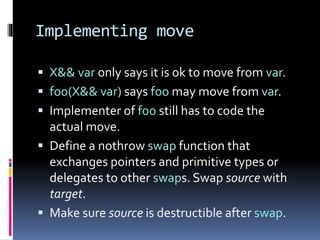
Implementing move 
 X&& var only says it is ok to move from var. 
 foo(X&& var) says foo may move from var. 
 Implementer of foo still has to code the 
actual move. 
 Define a nothrow swap function that 
exchanges pointers and primitive types or 
delegates to other swaps. Swap source with 
target. 
 Make sure source is destructible after swap.
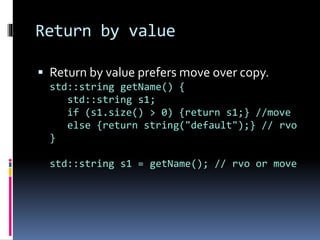
Return by value 
 Return by value prefers move over copy. 
std::string getName() { 
std::string s1; 
if (s1.size() > 0) {return s1;} //move 
else {return string("default");} // rvo 
} 
std::string s1 = getName(); // rvo or move
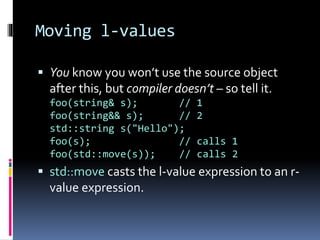
Moving l-values 
 You know you won’t use the source object 
after this, but compiler doesn’t – so tell it. 
foo(string& s); // 1 
foo(string&& s); // 2 
std::string s("Hello"); 
foo(s); // calls 1 
foo(std::move(s)); // calls 2 
 std::move casts the l-value expression to an r-value 
expression.
Thank you! 
 Q & A 
 Thomas Becker’s C++ Rvalue references 
explained: http://bit.ly/1ACRnAe

C++11 move semantics

  • 1.
    Arindam Mukherjee PuneC++ and Boost Meetup C++11 MOVE SEMANTICS
  • 2.
    Copying objects isbad  Extra memory, extra CPU cycles to copy.  May allocate heap memory, file descriptors, etc.  May fail.
  • 3.
    Temporaries  Objectsnot bound to a variable name  Lifetime limited to the statement that creates them  Examples: std::string s1, s2, s3; std::string getName(); // prototype std::string s4 = s1 + s2 + s3; // may copy std::string s5 = getName(); // may copy
  • 4.
    Return Value Optimization  Copy elision: optimize copies, even when they have side effects  RVO: Elide copying of a returned temporary. std::string getName() { return "foo"; } std::string name = getName();  Named RVO: Elide copying of a named variable when returned from a function. std::string getName() { std::string s = "foo"; return s; }
  • 5.
    RVO: no guarantees  May not take effect in: - Debug builds. - Many but the most simple cases: - Returning different named objects from different return statements disables NRVO. - NRVO does not mix with RVO.
  • 6.
    Move, not copy  Do a shallow copy to the destination  Reset the source and stop using it  Useful when: - You anyway can’t use the source later: std::string s = s1 + s2; // s1 + s2 is a temporary - You know you won’t use the source later. - Copying is expensive and can fail.
  • 7.
    l-value, r-value l-values: expressions with durable address. May not be ok to move from. int x = 5;foo(x); char arr[16];arr[5] = 20;  r-values: expressions without a durable address – temporaries – always ok to move from. const string& s = string("Foo"), s2, s3; setName(getName()); s3 = s + s2;
  • 8.
    Overload on l-&& r-values  foo(string& s); // foo(s); foo(const string& s); // foo(s1 + s2);  Does not work because to move from, we need a mutable reference.  New class of mutable references – r-value references: foo(string& s); // foo(s); foo(string&& s); // foo(s1 + 2); // foo(getName())
  • 9.
    Move: Overloading copy  Copy suite: string(const string& that); string& operator=(const string& rhs);  Move suite: string(string&& that) noexcept; string& operator=(string&& rhs) noexcept;
  • 10.
    Implementing move X&& var only says it is ok to move from var.  foo(X&& var) says foo may move from var.  Implementer of foo still has to code the actual move.  Define a nothrow swap function that exchanges pointers and primitive types or delegates to other swaps. Swap source with target.  Make sure source is destructible after swap.
  • 11.
    Return by value  Return by value prefers move over copy. std::string getName() { std::string s1; if (s1.size() > 0) {return s1;} //move else {return string("default");} // rvo } std::string s1 = getName(); // rvo or move
  • 12.
    Moving l-values You know you won’t use the source object after this, but compiler doesn’t – so tell it. foo(string& s); // 1 foo(string&& s); // 2 std::string s("Hello"); foo(s); // calls 1 foo(std::move(s)); // calls 2  std::move casts the l-value expression to an r-value expression.
  • 13.
    Thank you! Q & A  Thomas Becker’s C++ Rvalue references explained: http://bit.ly/1ACRnAe