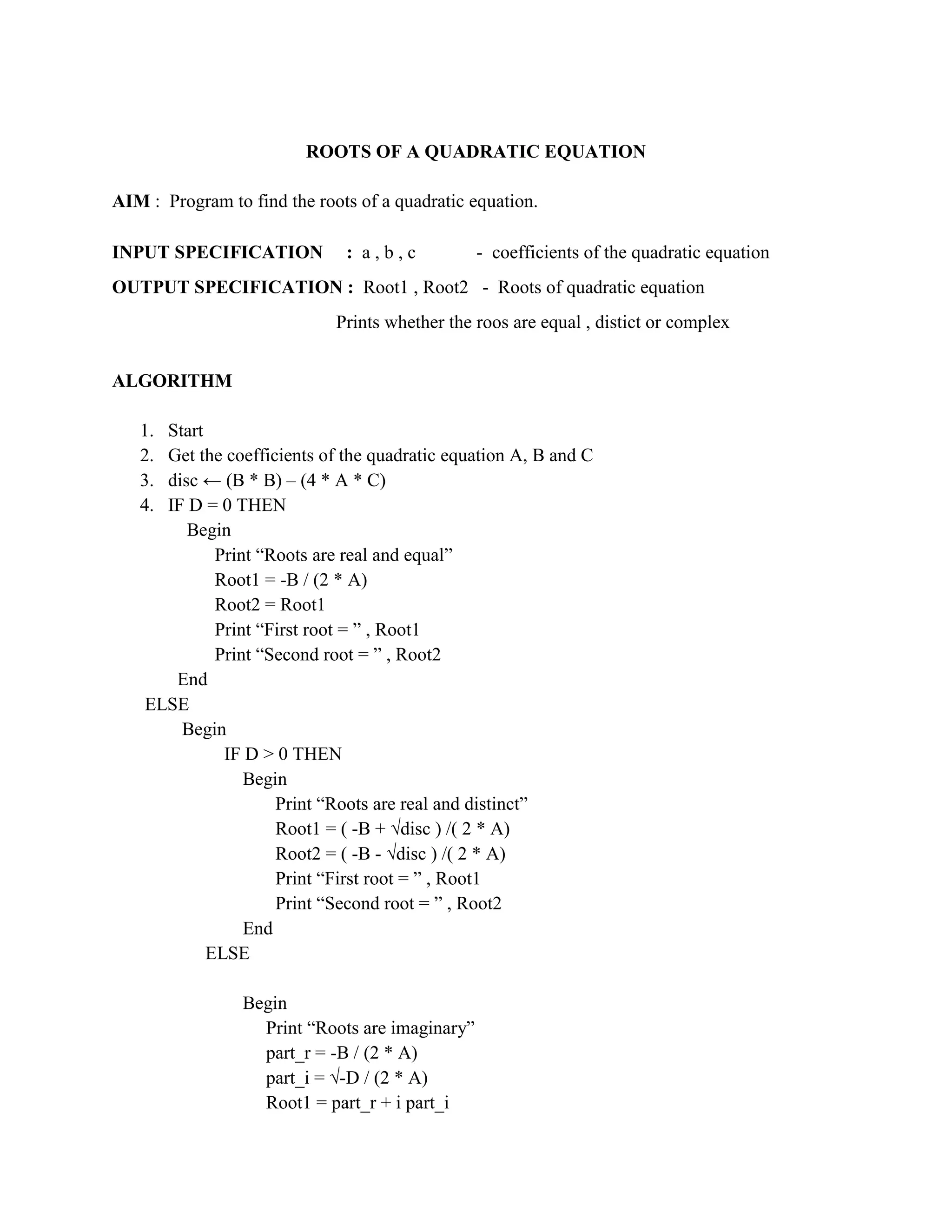
ROOTS OF A QUADRATIC EQUATION

AIM : Program to find the roots of a quadratic equation.

INPUT SPECIFICATION           : a,b,c            - coefficients of the quadratic equation
OUTPUT SPECIFICATION : Root1 , Root2 - Roots of quadratic equation
                             Prints whether the roos are equal , distict or complex


ALGORITHM

   1. Start
   2. Get the coefficients of the quadratic equation A, B and C
   3. disc ← (B * B) – (4 * A * C)
   4. IF D = 0 THEN
         Begin
             Print “Roots are real and equal”
             Root1 = -B / (2 * A)
             Root2 = Root1
             Print “First root = ” , Root1
             Print “Second root = ” , Root2
       End
    ELSE
        Begin
              IF D > 0 THEN
                 Begin
                     Print “Roots are real and distinct”
                     Root1 = ( -B + √disc ) /( 2 * A)
                     Root2 = ( -B - √disc ) /( 2 * A)
                     Print “First root = ” , Root1
                     Print “Second root = ” , Root2
                 End
            ELSE

                 Begin
                   Print “Roots are imaginary”
                   part_r = -B / (2 * A)
                   part_i = √-D / (2 * A)
                   Root1 = part_r + i part_i
Root2 = part_r - i part_i
                     Print “First root = ” , Root1
                     Print “Second root = ” , Root2
                  End
           End
    5. Stop


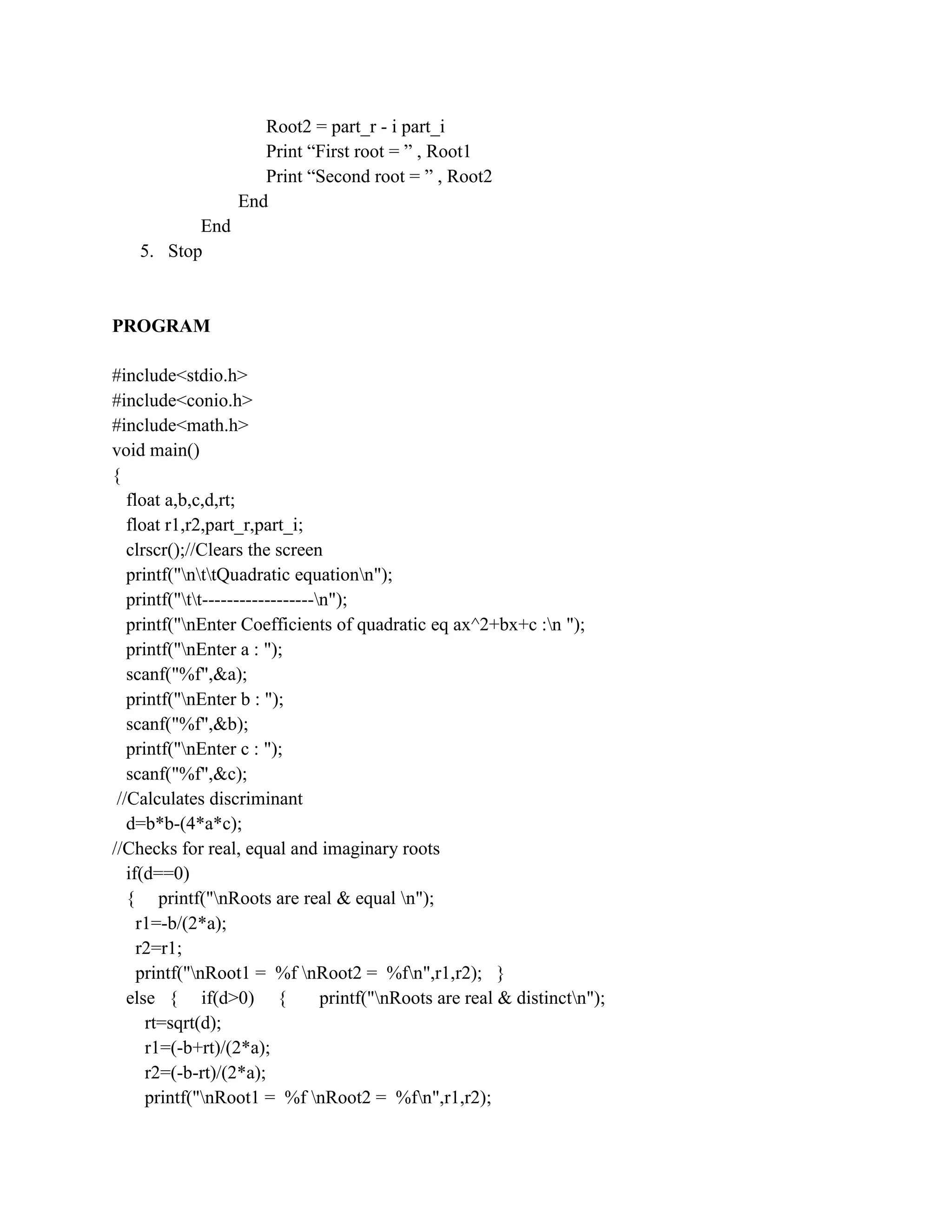
PROGRAM

#include<stdio.h>
#include<conio.h>
#include<math.h>
void main()
{
   float a,b,c,d,rt;
   float r1,r2,part_r,part_i;
   clrscr();//Clears the screen
   printf("nttQuadratic equationn");
   printf("tt------------------n");
   printf("nEnter Coefficients of quadratic eq ax^2+bx+c :n ");
   printf("nEnter a : ");
   scanf("%f",&a);
   printf("nEnter b : ");
   scanf("%f",&b);
   printf("nEnter c : ");
   scanf("%f",&c);
 //Calculates discriminant
   d=b*b-(4*a*c);
//Checks for real, equal and imaginary roots
   if(d==0)
   { printf("nRoots are real & equal n");
     r1=-b/(2*a);
     r2=r1;
     printf("nRoot1 = %f nRoot2 = %fn",r1,r2); }
   else { if(d>0) {               printf("nRoots are real & distinctn");
      rt=sqrt(d);
      r1=(-b+rt)/(2*a);
      r2=(-b-rt)/(2*a);
      printf("nRoot1 = %f nRoot2 = %fn",r1,r2);
}   else {
    printf("nRoots are complexn");
    part_r=-b/(2*a);
    part_i=sqrt(fabs(d));
    printf("nRoot1 = %.2f + i %.2f n",part_r,part_i);
    printf("nRoot2 = %.2f - i %.2f n",part_r,part_i);
   } } getch();
}//End of the program


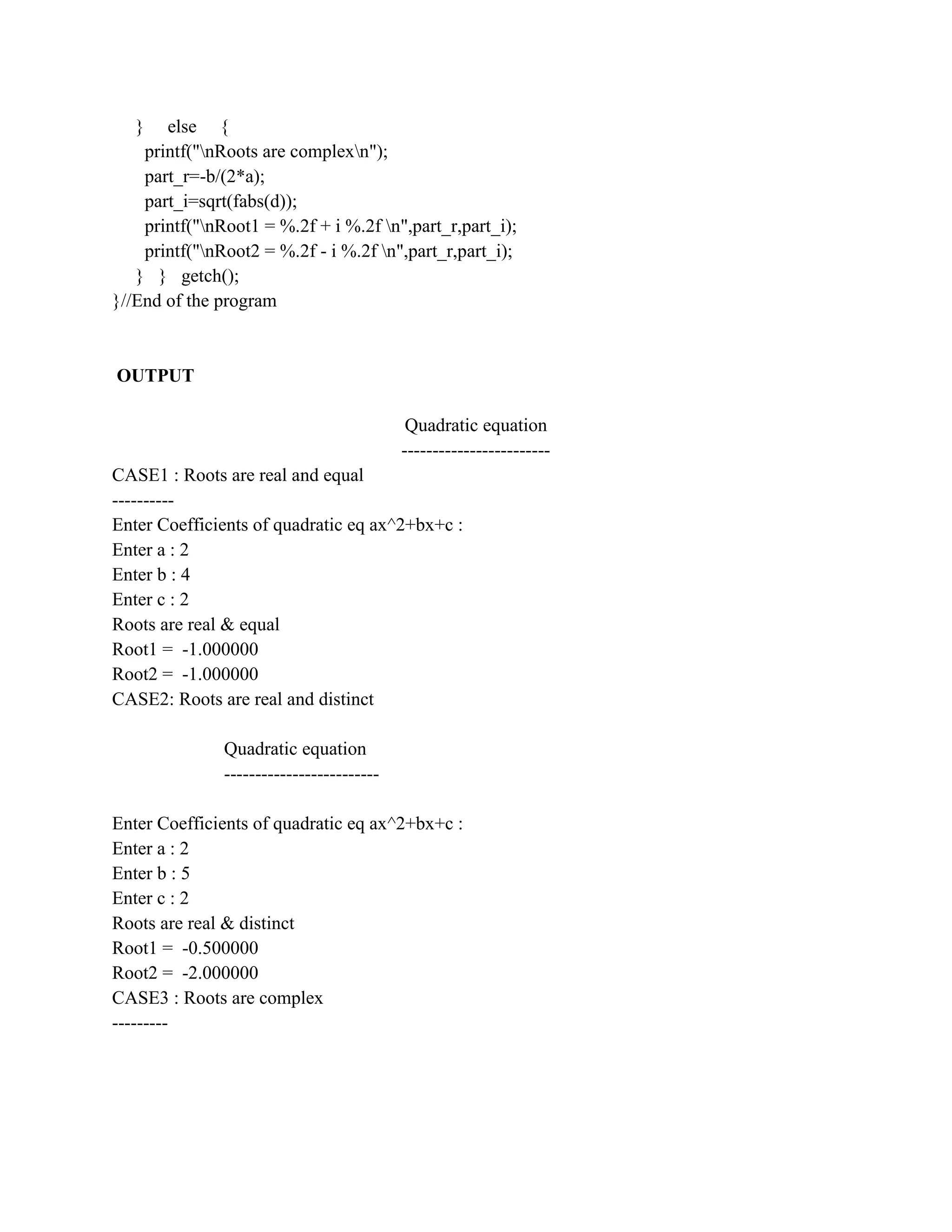
OUTPUT

                                            Quadratic equation
                                           ------------------------
CASE1 : Roots are real and equal
----------
Enter Coefficients of quadratic eq ax^2+bx+c :
Enter a : 2
Enter b : 4
Enter c : 2
Roots are real & equal
Root1 = -1.000000
Root2 = -1.000000
CASE2: Roots are real and distinct

               Quadratic equation
               -------------------------

Enter Coefficients of quadratic eq ax^2+bx+c :
Enter a : 2
Enter b : 5
Enter c : 2
Roots are real & distinct
Root1 = -0.500000
Root2 = -2.000000
CASE3 : Roots are complex
---------
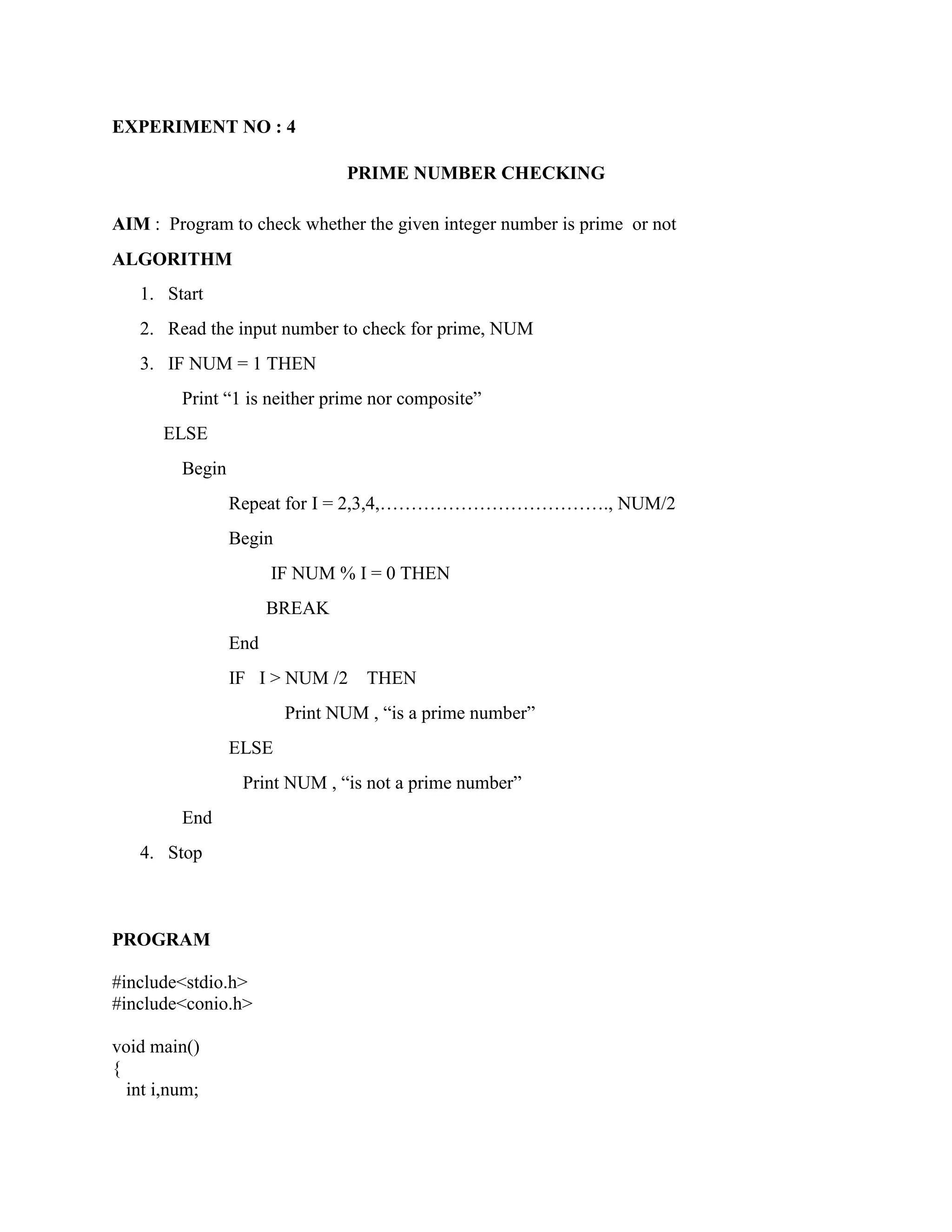
EXPERIMENT NO : 4

                                PRIME NUMBER CHECKING

AIM : Program to check whether the given integer number is prime or not
ALGORITHM
   1. Start
   2. Read the input number to check for prime, NUM
   3. IF NUM = 1 THEN
         Print “1 is neither prime nor composite”
       ELSE
         Begin
                 Repeat for I = 2,3,4,………………………………., NUM/2
                 Begin
                       IF NUM % I = 0 THEN
                       BREAK
                 End
                 IF I > NUM /2     THEN
                         Print NUM , “is a prime number”
                 ELSE
                  Print NUM , “is not a prime number”
         End
   4. Stop


PROGRAM

#include<stdio.h>
#include<conio.h>

void main()
{
  int i,num;
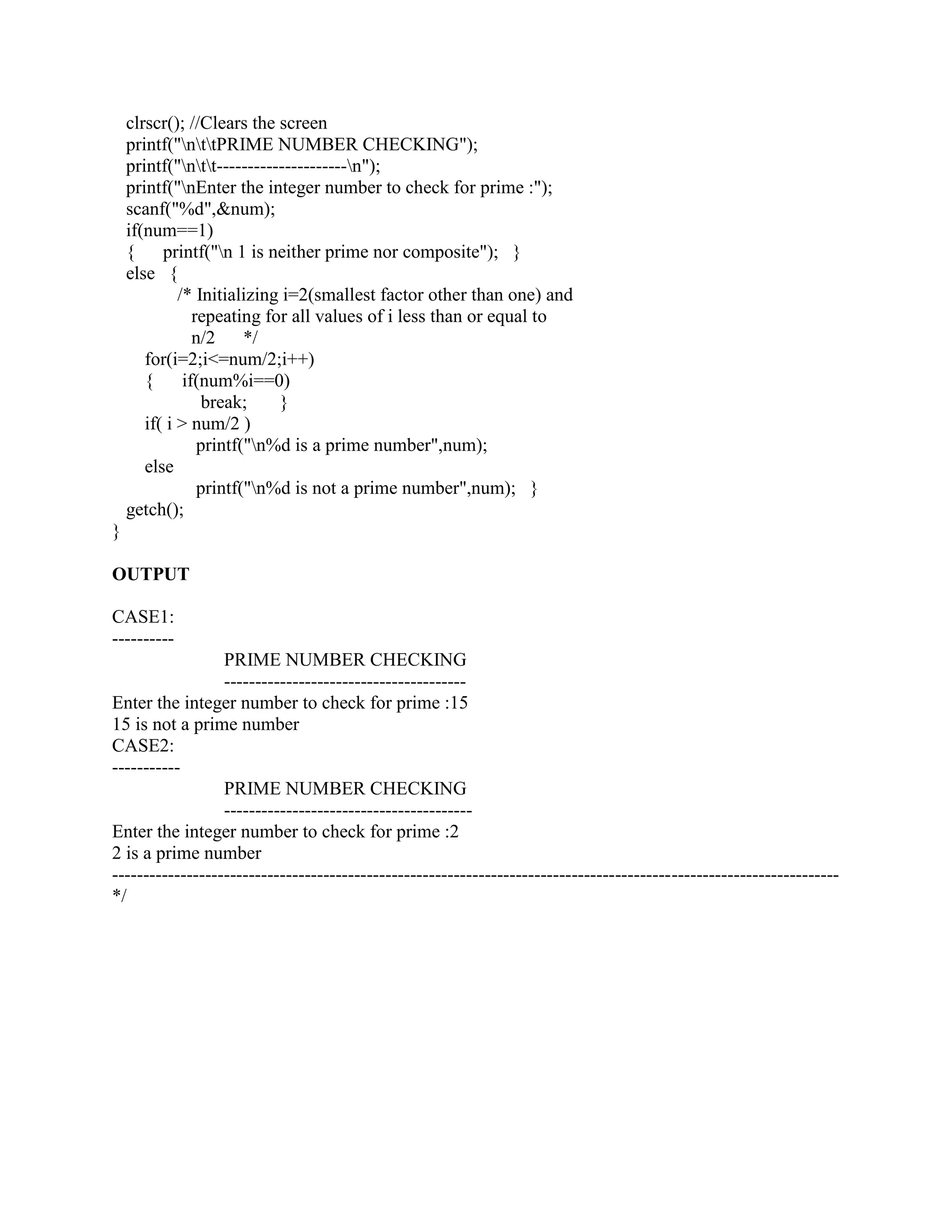
clrscr(); //Clears the screen
    printf("nttPRIME NUMBER CHECKING");
    printf("ntt---------------------n");
    printf("nEnter the integer number to check for prime :");
    scanf("%d",&num);
    if(num==1)
    {     printf("n 1 is neither prime nor composite"); }
    else {
             /* Initializing i=2(smallest factor other than one) and
                repeating for all values of i less than or equal to
                n/2     */
       for(i=2;i<=num/2;i++)
       {      if(num%i==0)
                  break;    }
       if( i > num/2 )
                 printf("n%d is a prime number",num);
       else
                 printf("n%d is not a prime number",num); }
    getch();
}

OUTPUT

CASE1:
----------
                  PRIME NUMBER CHECKING
                  ---------------------------------------
Enter the integer number to check for prime :15
15 is not a prime number
CASE2:
-----------
                  PRIME NUMBER CHECKING
                  ----------------------------------------
Enter the integer number to check for prime :2
2 is a prime number
---------------------------------------------------------------------------------------------------------------------
*/
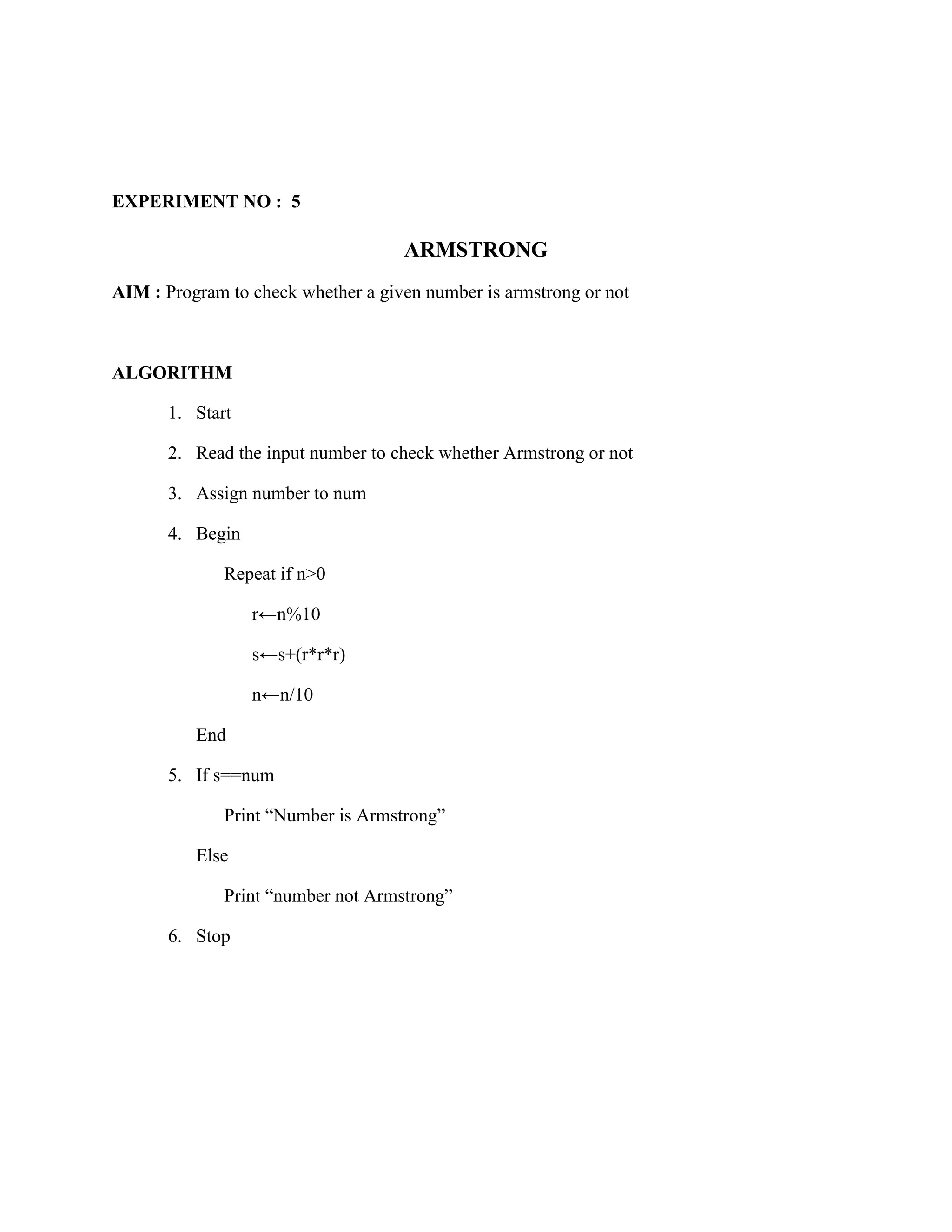
EXPERIMENT NO : 5

                                    ARMSTRONG
AIM : Program to check whether a given number is armstrong or not


ALGORITHM

       1. Start

       2. Read the input number to check whether Armstrong or not

       3. Assign number to num

       4. Begin

              Repeat if n>0

                  r←n%10

                  s←s+(r*r*r)

                  n←n/10

          End

       5. If s==num

              Print “Number is Armstrong”

          Else

              Print “number not Armstrong”

       6. Stop
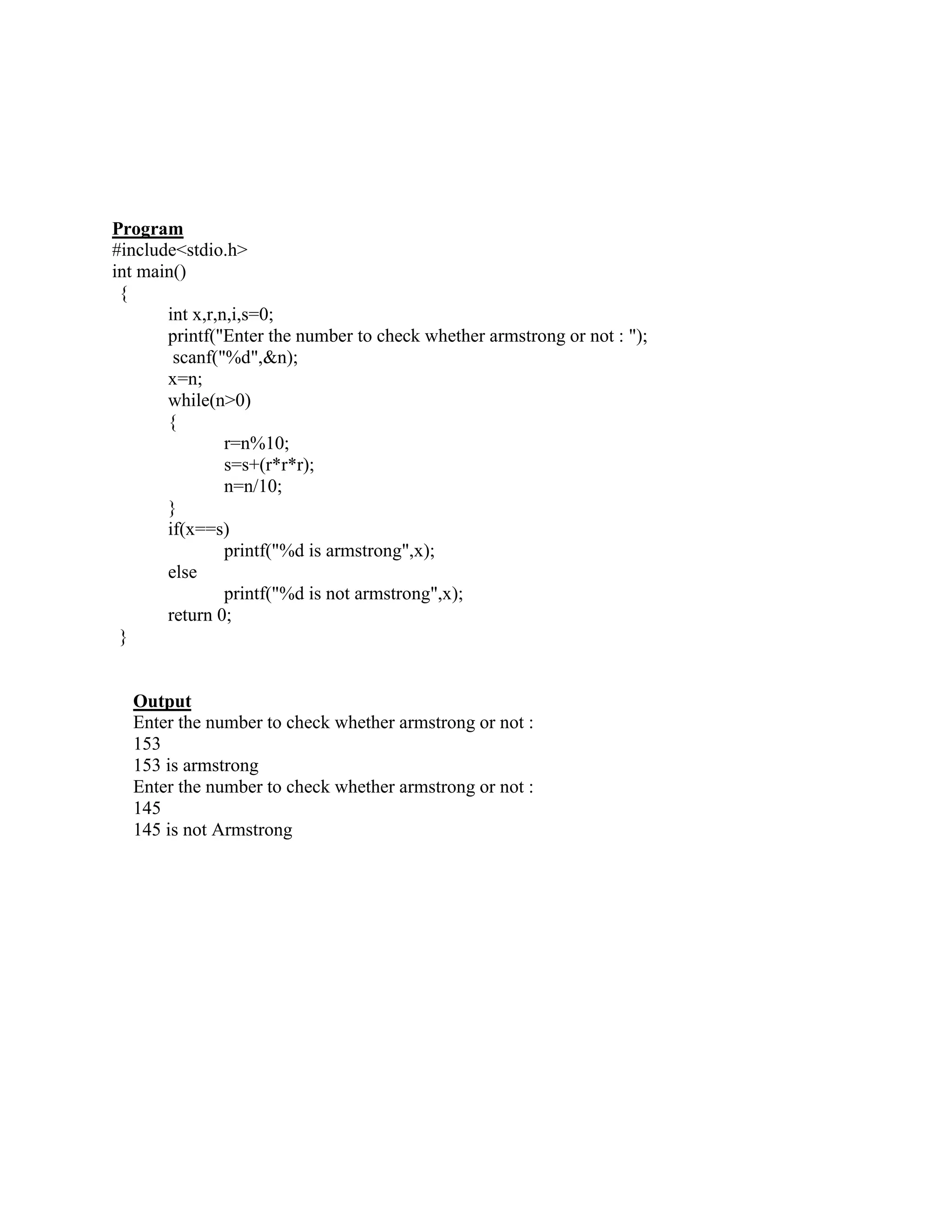
Program
#include<stdio.h>
int main()
 {
       int x,r,n,i,s=0;
       printf("Enter the number to check whether armstrong or not : ");
        scanf("%d",&n);
       x=n;
       while(n>0)
       {
                r=n%10;
                s=s+(r*r*r);
                n=n/10;
       }
       if(x==s)
                printf("%d is armstrong",x);
       else
                printf("%d is not armstrong",x);
       return 0;
 }


  Output
  Enter the number to check whether armstrong or not :
  153
  153 is armstrong
  Enter the number to check whether armstrong or not :
  145
  145 is not Armstrong
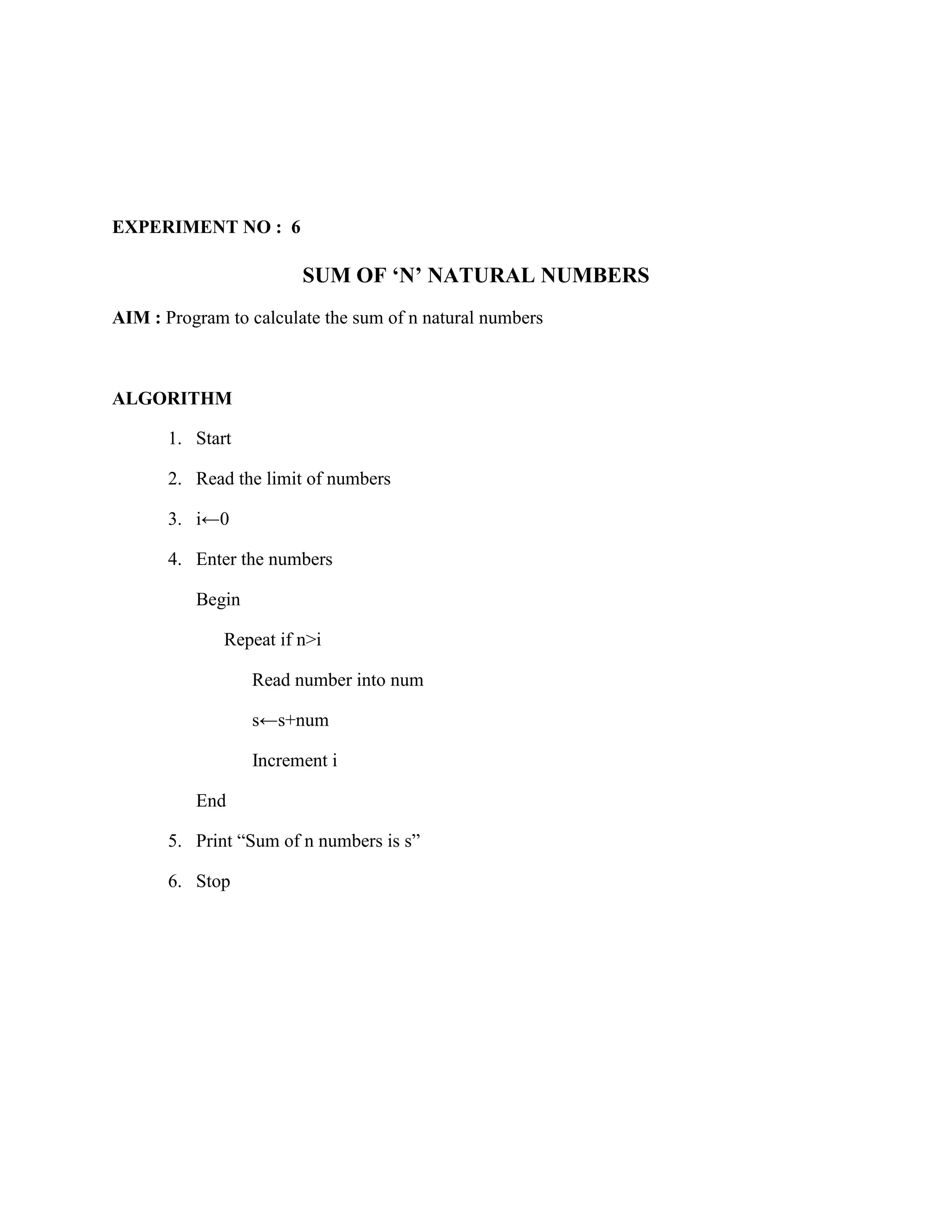
EXPERIMENT NO : 6

                        SUM OF ‘N’ NATURAL NUMBERS
AIM : Program to calculate the sum of n natural numbers


ALGORITHM

       1. Start

       2. Read the limit of numbers

       3. i←0

       4. Enter the numbers

          Begin

              Repeat if n>i

                  Read number into num

                  s←s+num

                  Increment i

          End

       5. Print “Sum of n numbers is s”

       6. Stop
Program
  #include<stdio.h>
  #define max 50
  int main()
  {
      int i=0,n,s=0,a[max];
      printf("Enter the number of natural numbers to find the sum : ");
      scanf("%d",&n);
      printf("nEnter numbersn");
       while(i<n)
      {
              scanf("%d",&a[i]);
              s=s+a[i];
              i++;
      }
      printf("nnSum of the numbers entered is %d",s);
      return 0;
  }


Output
  Enter the number of natural numbers to find the sum : 5
  Enter numbers
  1
  2
  3
  4
  5
  Sum of the numbers entered is 15
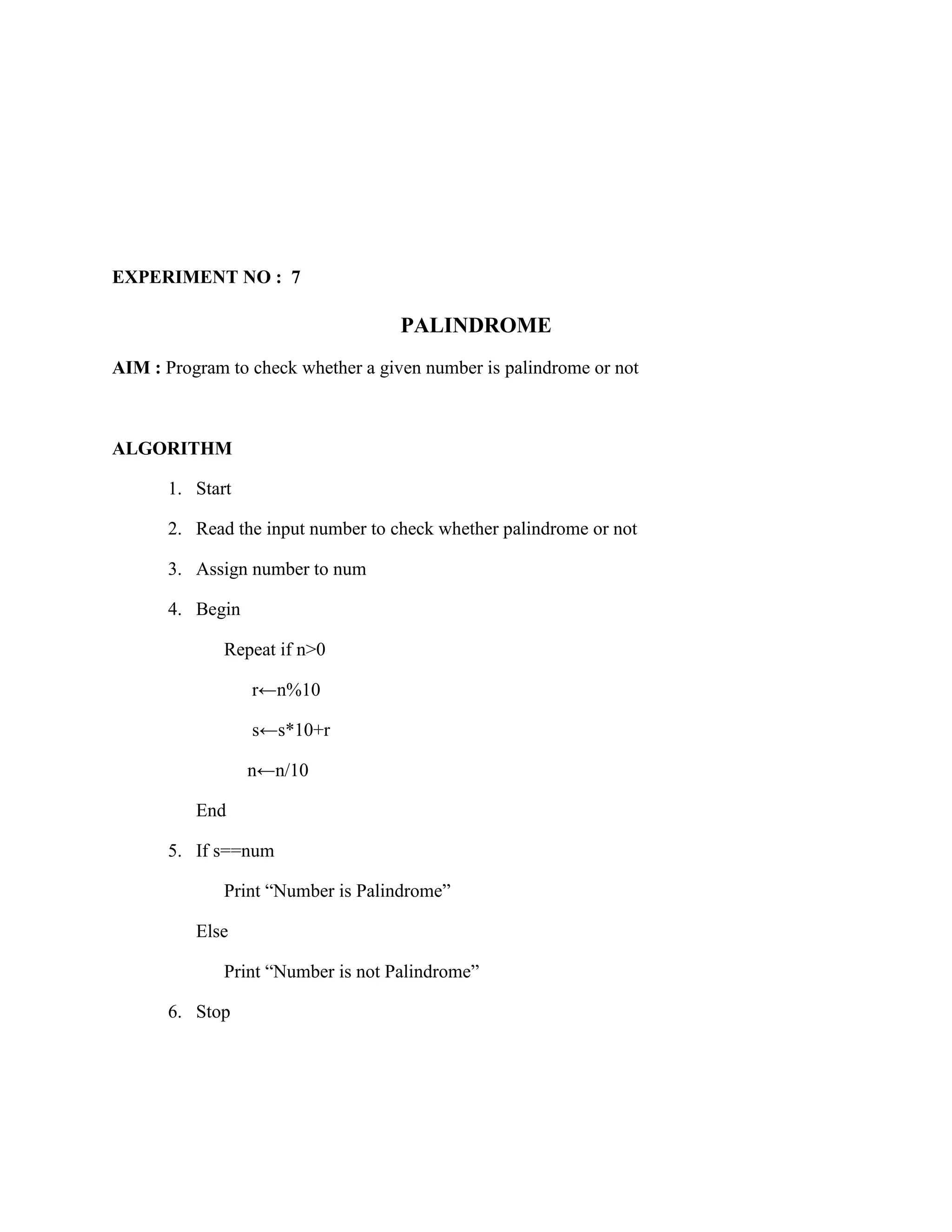
EXPERIMENT NO : 7

                                    PALINDROME
AIM : Program to check whether a given number is palindrome or not


ALGORITHM

       1. Start

       2. Read the input number to check whether palindrome or not

       3. Assign number to num

       4. Begin

              Repeat if n>0

                  r←n%10

                  s←s*10+r

                  n←n/10

          End

       5. If s==num

              Print “Number is Palindrome”

          Else

              Print “Number is not Palindrome”

       6. Stop
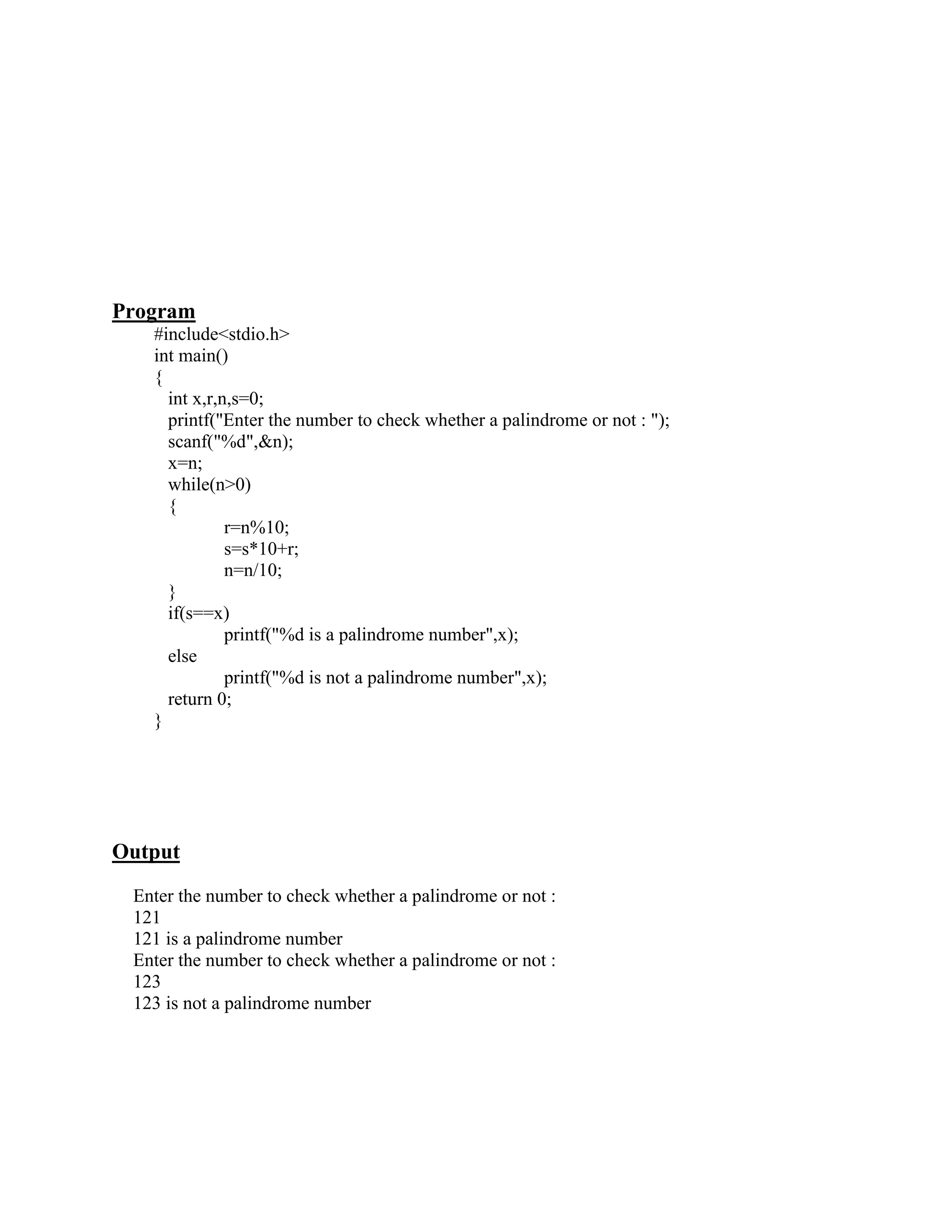
Program
   #include<stdio.h>
   int main()
   {
     int x,r,n,s=0;
     printf("Enter the number to check whether a palindrome or not : ");
     scanf("%d",&n);
     x=n;
     while(n>0)
     {
              r=n%10;
              s=s*10+r;
              n=n/10;
     }
     if(s==x)
              printf("%d is a palindrome number",x);
     else
              printf("%d is not a palindrome number",x);
     return 0;
   }


Output
 Enter the number to check whether a palindrome or not :
 121
 121 is a palindrome number
 Enter the number to check whether a palindrome or not :
 123
 123 is not a palindrome number
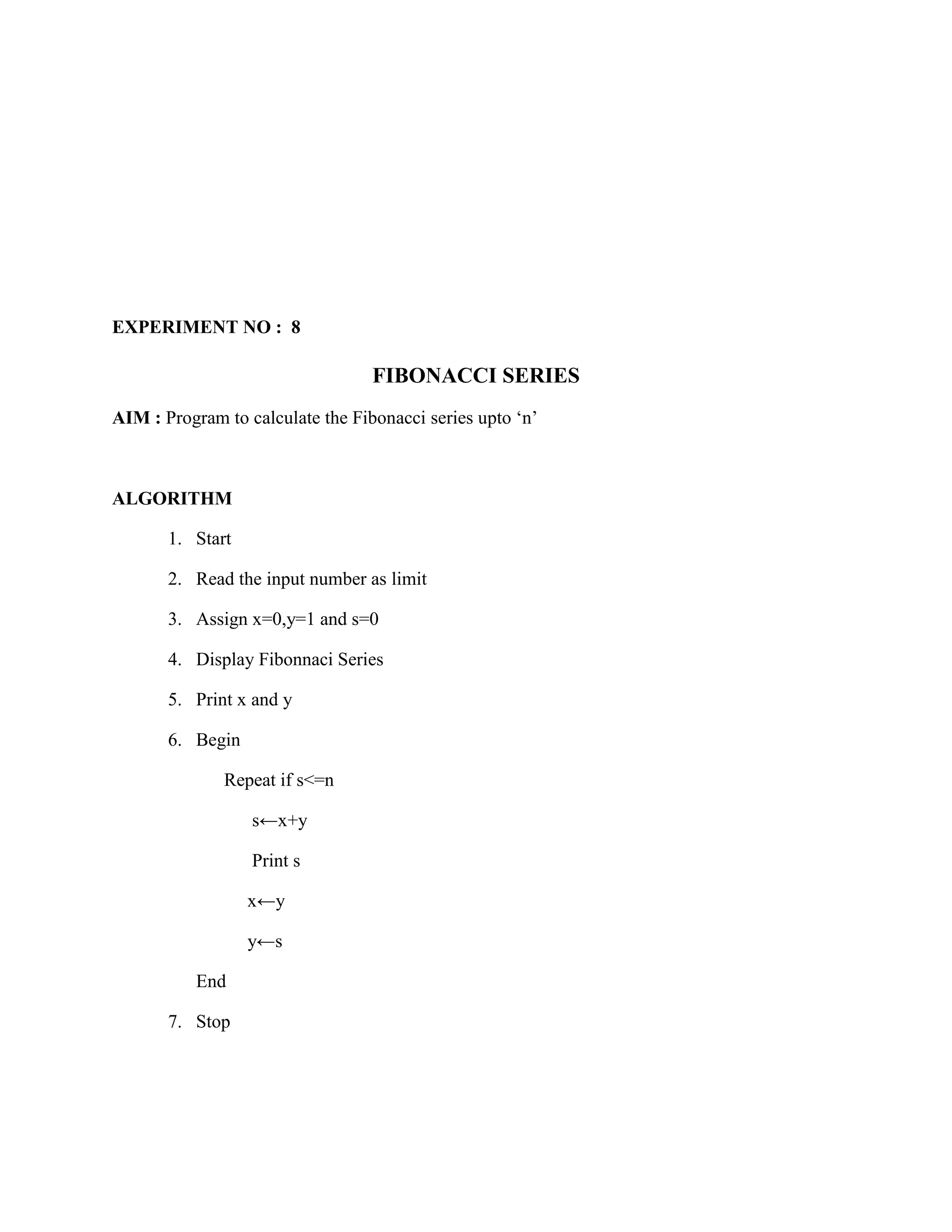
EXPERIMENT NO : 8

                                  FIBONACCI SERIES
AIM : Program to calculate the Fibonacci series upto „n‟


ALGORITHM

       1. Start

       2. Read the input number as limit

       3. Assign x=0,y=1 and s=0

       4. Display Fibonnaci Series

       5. Print x and y

       6. Begin

              Repeat if s<=n

                  s←x+y

                  Print s

                  x←y

                  y←s

           End

       7. Stop
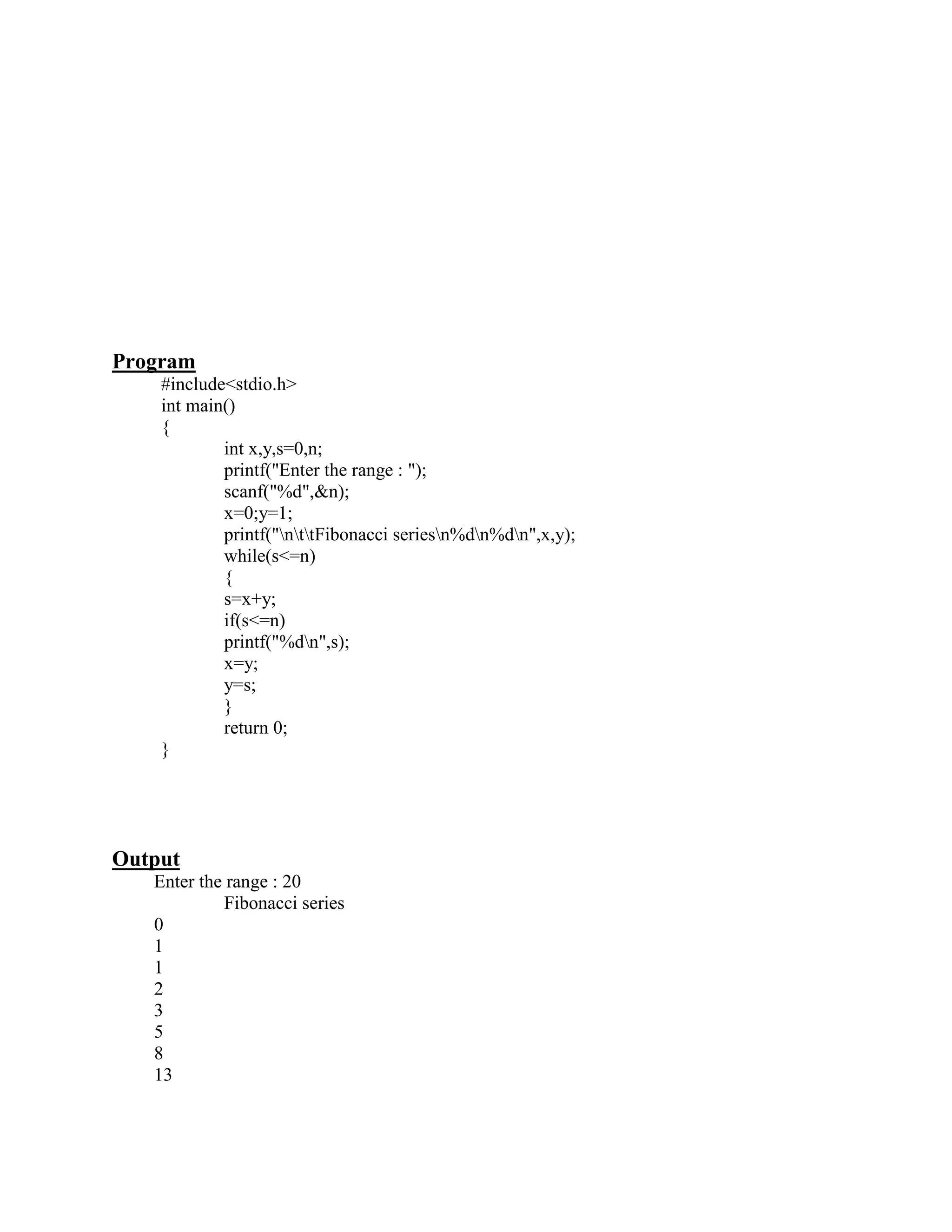
Program
    #include<stdio.h>
    int main()
    {
            int x,y,s=0,n;
            printf("Enter the range : ");
            scanf("%d",&n);
            x=0;y=1;
            printf("nttFibonacci seriesn%dn%dn",x,y);
            while(s<=n)
            {
            s=x+y;
            if(s<=n)
            printf("%dn",s);
            x=y;
            y=s;
            }
            return 0;
    }


Output
   Enter the range : 20
            Fibonacci series
   0
   1
   1
   2
   3
   5
   8
   13
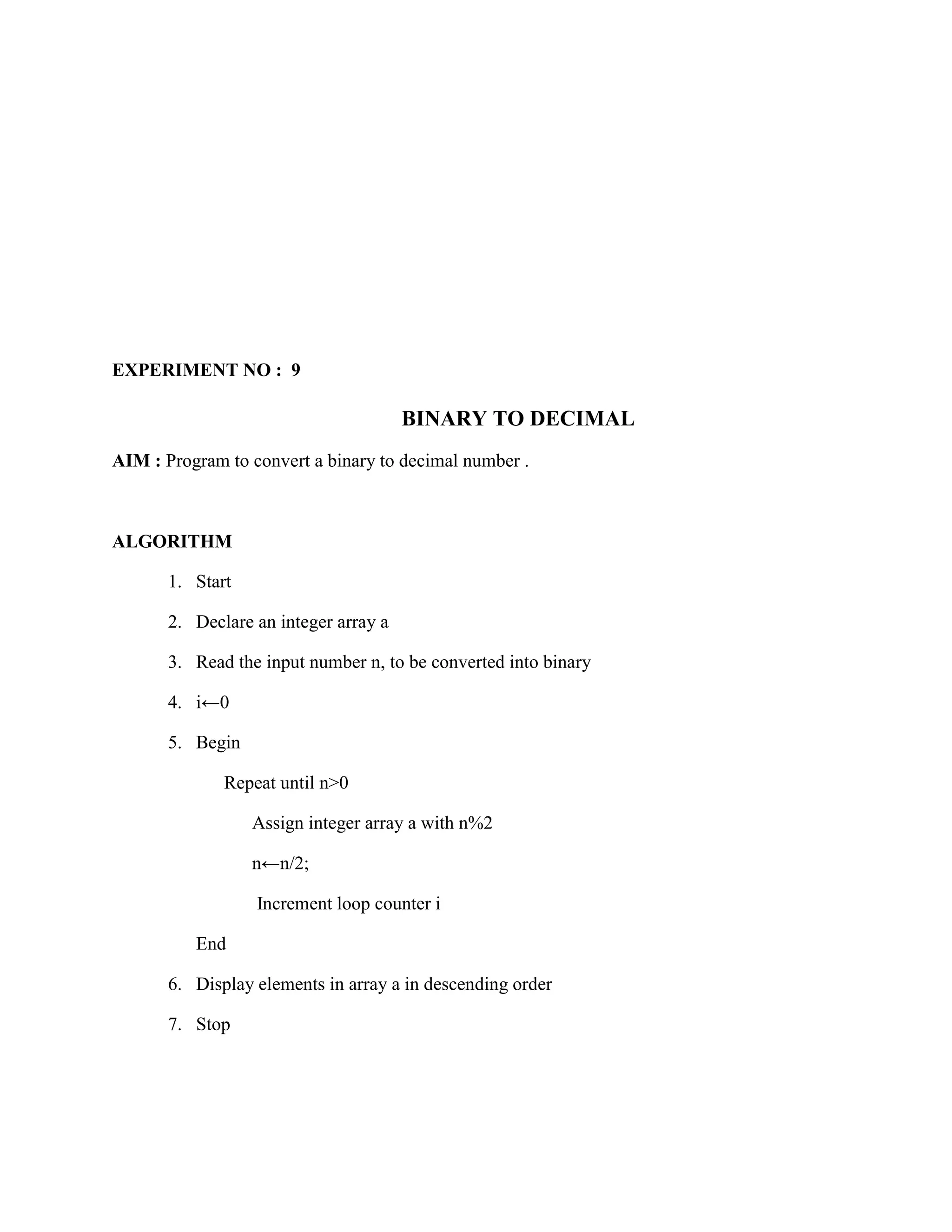
EXPERIMENT NO : 9

                                       BINARY TO DECIMAL
AIM : Program to convert a binary to decimal number .


ALGORITHM

       1. Start

       2. Declare an integer array a

       3. Read the input number n, to be converted into binary

       4. i←0

       5. Begin

              Repeat until n>0

                  Assign integer array a with n%2

                  n←n/2;

                  Increment loop counter i

          End

       6. Display elements in array a in descending order

       7. Stop
Program
   #include<stdio.h>
   int main()
   {
     int n,i,a[20],j,c;
     printf("Enter the decimal number to convert to binary : ");
     scanf("%d",&n);
     printf("Binary equivalent of %d is ",n);
     i=0;
     while(n>0)
     {
              a[i++]=n%2;
              n=n/2;
     }
              for(j=i-1;j>=0;j--)
              printf("%d",a[j]);
     return 0;
   }


Output
    Enter the decimal number to convert to binary : 12
    Binary equivalent of 12 is 1100
    Enter the decimal number to convert to binary : 32
    Binary equivalent of 32 is 100000
EXPERIMENT NO : 10

                         TRACE AND NORM OF A MATRIX
AIM : Program to calculate trace and norm of a matrix


ALGORITHM

       1. Start

       2. Declare integer arrays a,b and d

       3. Decalre variables r,c as number of rows and columns respectively

       4. Declare trace,trace1,sum_a,sum_b

       5. Initialize loop counter i and j as 0

       6. Read the order of matrices a and b

       7. Read values into matrix a using for loop

       8. Begin

                  Repeat until i<r and j<c

                    sum_a←sum_a+a[i][j]*a[i][j];

          End

       9. Read values into matrix b using for loop
10. Begin

            Repeat until i<r and j<c

                sum_b←sum_b+b[i][j]*b[i][j];

   End

11. Display matrix a and b

12. Add the matrices

   Begin

       Repeat while i<r and j<c

            d[i][j]←a[i][j]+b[i][j]

               Increment loop counter i and j

   End

13. Display array d

14. Display norm of matrix a sqrt(sum_a)

15. Display norm of matrix a sqrt(sum_b)

16. If r==c calculate trace of both matrix a and b

17. Trace of matrix a

18. Begin

     Repeat until i<r and j<c

     if i==j

         trace←trace+a[i][j]

19. Display trace of matrix a

20. Trace of matrix b

21. Begin

     Repeat until i<r and j<c

     if i==j
trace←trace+b[i][j]

     22. End


Program
  #include<stdio.h>
  #include<conio.h>
  #include<math.h>
  void main()
  {
     int i,j,a[10][10],b[10][10],d[10][10],r,c,trace=0,trace1=0,flag=0;
     float sum_a=0,sum_b=0;
     clrscr();
     printf("Enter the order of matrices A and B : ");
     scanf("%d%d",&r,&c);
     if(r==c)
               flag++;
      printf("nEnter elements of matrix A n");
     for(i=0;i<r;i++)
     {
               for(j=0;j<c;j++)
                       scanf("%d",&a[i][j]);
     }
     printf("nEnter elements of matrix B n");
     for(i=0;i<r;i++)
     {
               for(j=0;j<c;j++)
                       scanf("%d",&b[i][j]);
     }

     printf("nttDisplaying elements");
     printf("nElements of matrix An");
     for(i=0;i<r;i++)
{
          for(j=0;j<c;j++)
          {
                  printf("%d",a[i][j]);
                  sum_a+=a[i][j]*a[i][j];
          }
          printf("n");
   }
   printf("nElements of matrix Bn");
for(i=0;i<r;i++)
{
           for(j=0;j<c;j++)
           {
                    printf("%d",b[i][j]);
                   sum_b+=b[i][j]*b[i][j];
           }
   printf("n");
}
// Adding matrices
for(i=0;i<r;i++)
{
           for(j=0;j<c;j++)
                   d[i][j]=a[i][j]+b[i][j];
}
printf("nSum of matrix A and Bn");
for(i=0;i<r;i++)
{
           for(j=0;j<c;j++)
                   printf("%d",d[i][j]);
           printf("n");
}
//norm calculation
printf("Norm of matrix A is %fn",sqrt(sum_a));
printf("Norm of matrix B is %fn",sqrt(sum_b));
//trace calculation
if(flag>0)
   {
           for(i=0;i<r;i++)
           {
                   for(j=0;j<c;j++)
                   {
                           if(i==j)
                                    trace+=a[i][j];
                   }
           }
           printf("nTrace of matrix(sum of diagonals) of matrix A : %d ",trace);
for(i=0;i<r;i++)
                {
                        for(j=0;j<c;j++)
                        {
                                if(i==j)
                                         trace1+=b[i][j];
                        }
                }
                printf("nTrace of matrix(sum of diagonals) of matrix B: %d ",trace1);
         }
      else
         printf("nTrace can be only determined for square matricesn ");
      getch();
  }


Output
        Enter elements of A
        123
        456
        789
        Enter elements of B
        100
        010
        001

                                      Displaying elements

        Enter elements of A
        123
        456
        789
        Enter elements of B
        100
        010
        001

        Sum of matrix A and B
        223
        466
        7 8 10
        Norm of matrix A is 16.881943
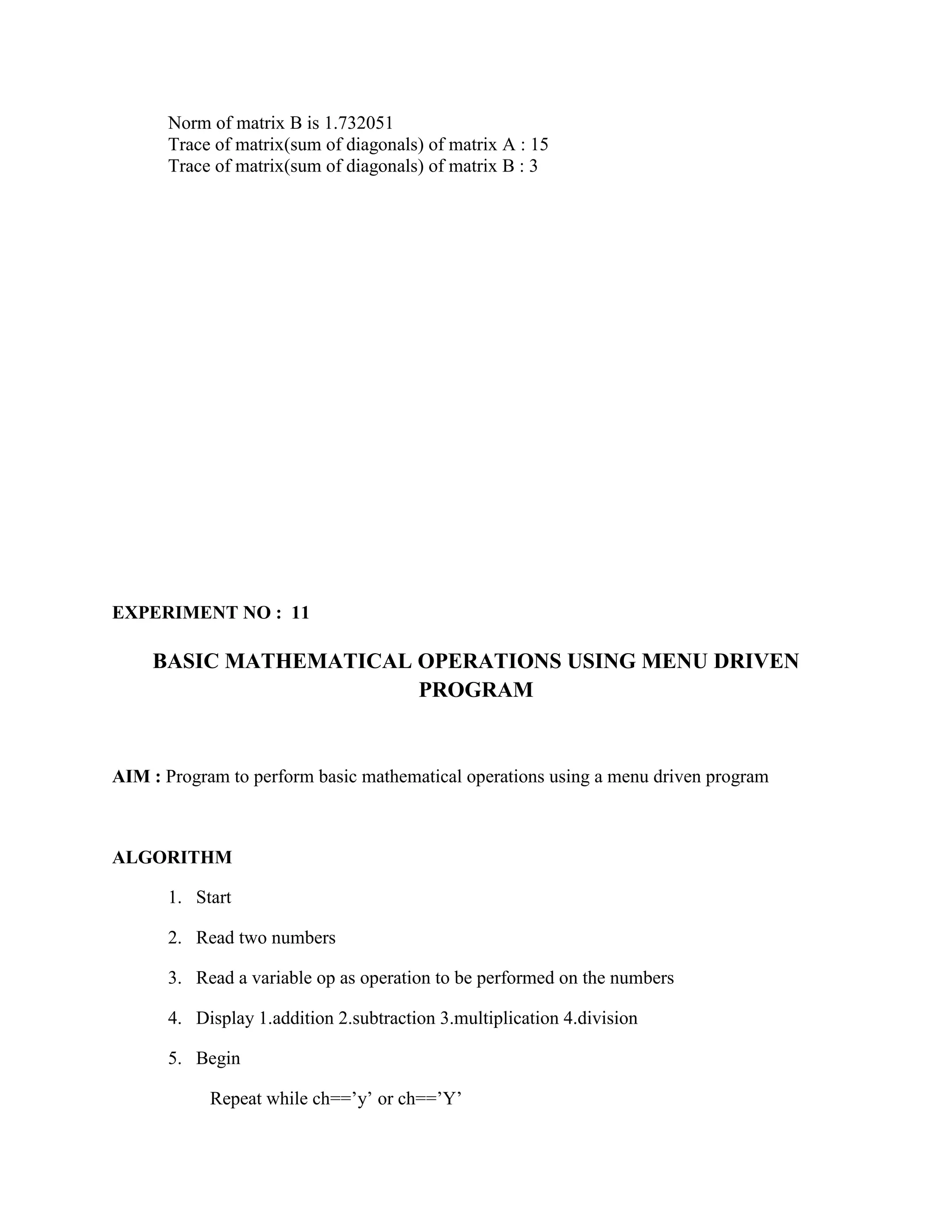
Norm of matrix B is 1.732051
      Trace of matrix(sum of diagonals) of matrix A : 15
      Trace of matrix(sum of diagonals) of matrix B : 3


EXPERIMENT NO : 11

     BASIC MATHEMATICAL OPERATIONS USING MENU DRIVEN
                        PROGRAM


AIM : Program to perform basic mathematical operations using a menu driven program


ALGORITHM

      1. Start

      2. Read two numbers

      3. Read a variable op as operation to be performed on the numbers

      4. Display 1.addition 2.subtraction 3.multiplication 4.division

      5. Begin

            Repeat while ch==‟y‟ or ch==‟Y‟
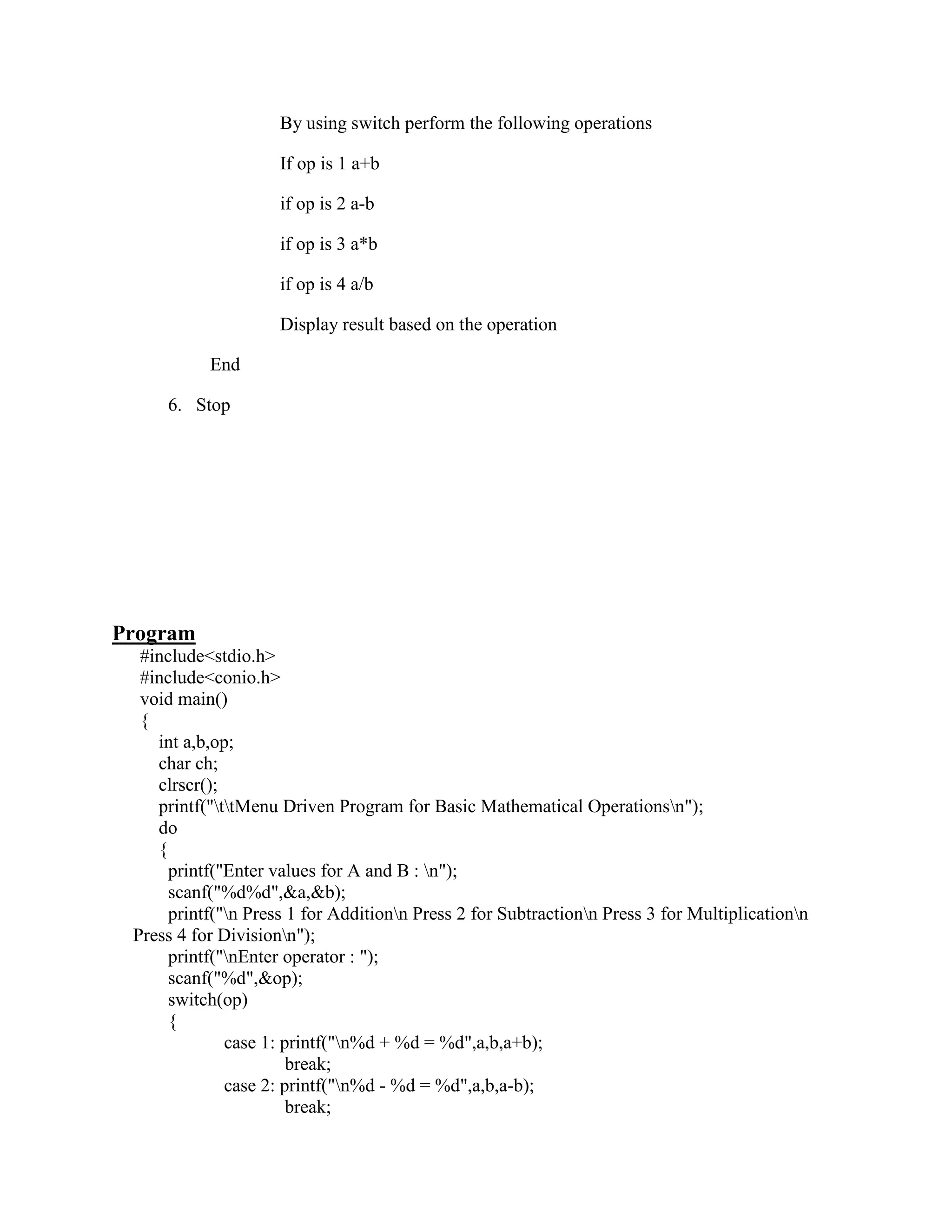
By using switch perform the following operations

                     If op is 1 a+b

                     if op is 2 a-b

                     if op is 3 a*b

                     if op is 4 a/b

                     Display result based on the operation

           End

     6. Stop


Program
  #include<stdio.h>
  #include<conio.h>
  void main()
  {
    int a,b,op;
    char ch;
    clrscr();
    printf("ttMenu Driven Program for Basic Mathematical Operationsn");
    do
    {
      printf("Enter values for A and B : n");
      scanf("%d%d",&a,&b);
      printf("n Press 1 for Additionn Press 2 for Subtractionn Press 3 for Multiplicationn
 Press 4 for Divisionn");
      printf("nEnter operator : ");
      scanf("%d",&op);
      switch(op)
      {
              case 1: printf("n%d + %d = %d",a,b,a+b);
                       break;
              case 2: printf("n%d - %d = %d",a,b,a-b);
                       break;
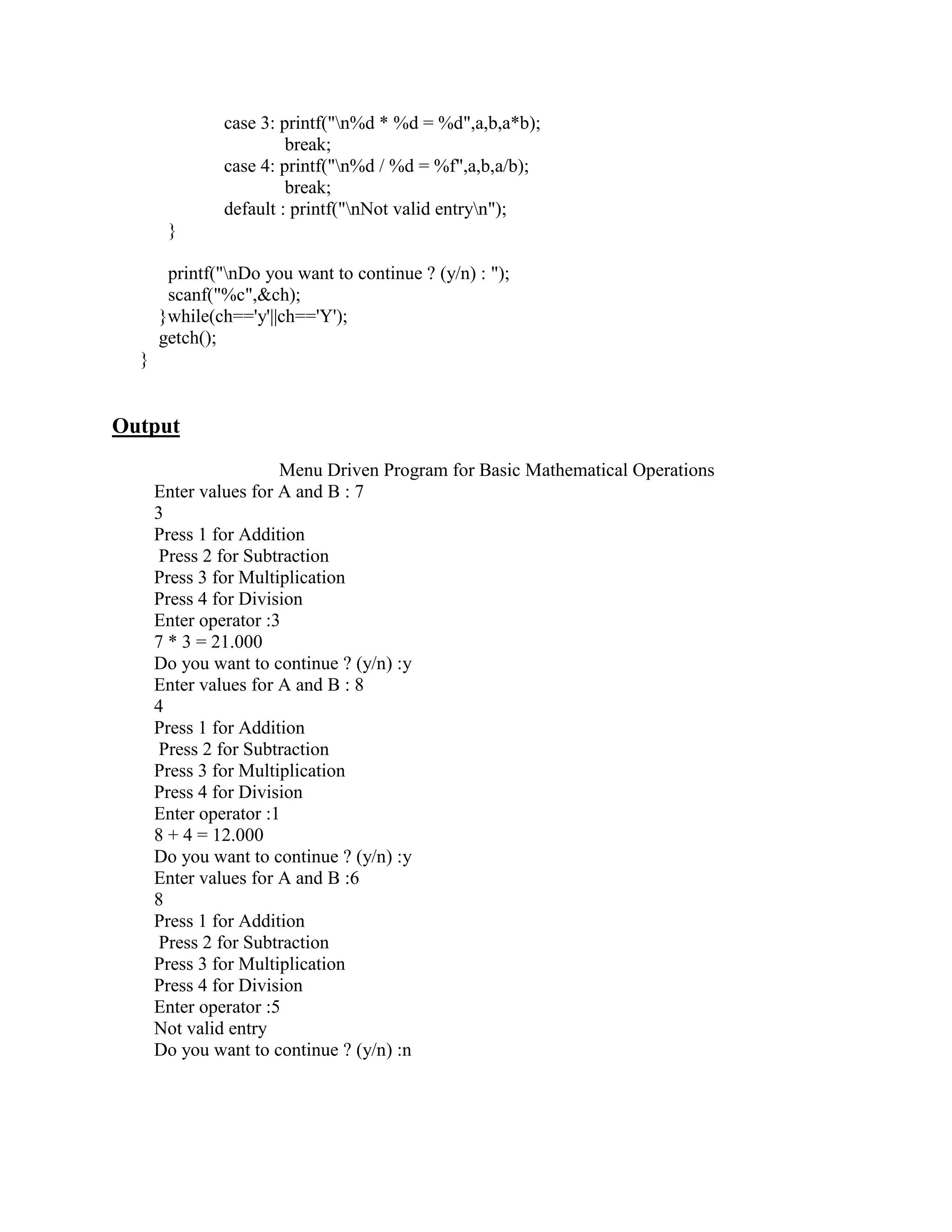
case 3: printf("n%d * %d = %d",a,b,a*b);
                       break;
              case 4: printf("n%d / %d = %f",a,b,a/b);
                       break;
              default : printf("nNot valid entryn");
       }

       printf("nDo you want to continue ? (y/n) : ");
       scanf("%c",&ch);
      }while(ch=='y'||ch=='Y');
      getch();
  }


Output
                       Menu Driven Program for Basic Mathematical Operations
      Enter values for A and B : 7
      3
      Press 1 for Addition
      Press 2 for Subtraction
      Press 3 for Multiplication
      Press 4 for Division
      Enter operator :3
      7 * 3 = 21.000
      Do you want to continue ? (y/n) :y
      Enter values for A and B : 8
      4
      Press 1 for Addition
      Press 2 for Subtraction
      Press 3 for Multiplication
      Press 4 for Division
      Enter operator :1
      8 + 4 = 12.000
      Do you want to continue ? (y/n) :y
      Enter values for A and B :6
      8
      Press 1 for Addition
      Press 2 for Subtraction
      Press 3 for Multiplication
      Press 4 for Division
      Enter operator :5
      Not valid entry
      Do you want to continue ? (y/n) :n
EXPERIMENT NO : 12


AIM: Write a program to convert a number from binary to decimal.

ALGORITHM

       1. Start

       2. Declare an integer array bi

       3. Read the input binary number num, to be converted into decimal

       4. p←0

       5. Begin

                Repeat until num>0

                   Assign integer array bi with num%10

                      num=num/10

                      p=p+1

          End loop

       6. q=p-1

       7. r=0

       8. Repeat loop until q>=0

                a. r=r+(bi[q]*pow(2,q));

                b. q=q-1

       9. display the values of r.

           End

PROGRAM
    #include<stdio.h>
    #include<conio.h>
    #include<math.h>
    void main()
{
    int i,j,a[10][10],p,q,l,s;
    clrscr();
    printf("Enter the order of matrix:");
    scanf("%d%d",&p,&q);
    printf("nEnter elements of matrix A n");
    for(i=0;i<p;i++)
    {
             for(j=0;j<q;j++)
                    scanf("%d",&a[i][j]);
    }


    printf("nttDisplaying elements");
    printf("nElements of matrix An");
    for(i=0;i<p;i++)
    {

           for(j=0;j<q;j++)
           {
                  printf("%d",a[i][j]);

           }
           printf("n");
    }
    l=0;
    s=a[0][0];
    for(i=0;i<p;i++)
    {
           for(j=0;j<q;j++)
           {
                  if(l<a[i][j])
                  l=a[i][j];
                  if(a[i][j]<s)
                  s=a[i][j];

           }
    }
    printf("biggest value: %d",l);
    printf("lowest value: %d",s);
getch();
}

OUTPUT

Enter binary no:1010
Decimal: 10


EXPERIMENT NO : 13


AIM: Write a program to find the largest and smallest values of a matrix.

ALGORITHM:


    #include<stdio.h>
    #include<conio.h>
    #include<math.h>
    void main()
    {
       int i,j,a[10][10],p,q,l,s;
       clrscr();
       printf("Enter the order of matrix:");
       scanf("%d%d",&p,&q);
       printf("nEnter elements of matrix A n");
       for(i=0;i<p;i++)
       {
                 for(j=0;j<q;j++)
                         scanf("%d",&a[i][j]);
       }


       printf("nttDisplaying elements");
       printf("nElements of matrix An");
       for(i=0;i<p;i++)
       {

               for(j=0;j<q;j++)
               {
                       printf("%d",a[i][j]);
}
           printf("n");
   }
   l=0;
   s=a[0][0];
   for(i=0;i<p;i++)
   {
           for(j=0;j<q;j++)
           {
                   if(l<a[i][j])
                   l=a[i][j];
                   if(a[i][j]<s)
                   s=a[i][j];

            }
    }
    printf("biggest value: %d",l);
    printf("lowest value: %d",s);
getch();
}

OUTPUT

          Enter the order of matrix: 2 2
          Enter elements of matrix A
          1234
          Displaying elements
          Elements of matrix A
          12
          34
          Biggest value:4
          Lowet value:1
Cycle-2

EXPERIMENT NO : 1

                                 VOWELS IN A STRING


AIM : Program to calculate the number of vowels in a given string


ALGORITHM

       1. Start

       2. Declare character array c and character variable ch

       3. Initialize loop counter k and a,e,i,o,u vowel counters to 0

       4. Enter the string into a character array

       5. ch←c[k]

       6. Begin

            Repeat until ch!=‟0‟

                      Read character from character array one by one

                      Using switch increment counters a,e,i,o,u on encounter of a,e,i,o,u in the
                      given string

                      Increment loop counter k

            End

       7. Display counter a,e,i,o,u to display number of a‟s e‟s i‟s o‟s and u‟s in the given
          string

       8. Stop
Program

    #include<stdio.h>
    int main( )
    {
      char ch,c[50];
      int k=0,a=0,e=0,i=0,o=0,u=0;
      printf("nEnter the string to find the number of vowels : n");
      scanf("%s",c);
      ch=c[k];
      while(ch!='0')
      {
              switch(ch)
              {
                      case 'a' : a++;
                                 break;
                      case 'e' : e++;

                                 break;
                     case 'i' : i++;
                                 break;
                     case 'o' : o++;
                                 break;
                     case 'u' : u++;
                                 break;
                     default: printf(“nNo vowels in string”);
              }
              ch=c[++k];
       }
       printf("nNumber of vowel a is %dn",a);
       printf("nNumber of vowel e is %dn",e);
       printf("nNumber of vowel i is %dn",i);
       printf("nNumber of vowel o is %dn",o);
       printf("nNumber of vowel u is %dn",u);
       return 0;
   }

Output
 Enter the string to find the number of vowels :
 dictionary
 Number of vowel a is 1
 Number of vowel e is 0
 Number of vowel i is 2
Number of vowel o is 1
  Number of vowel u is 0

  Enter the string to find the number of vowels :
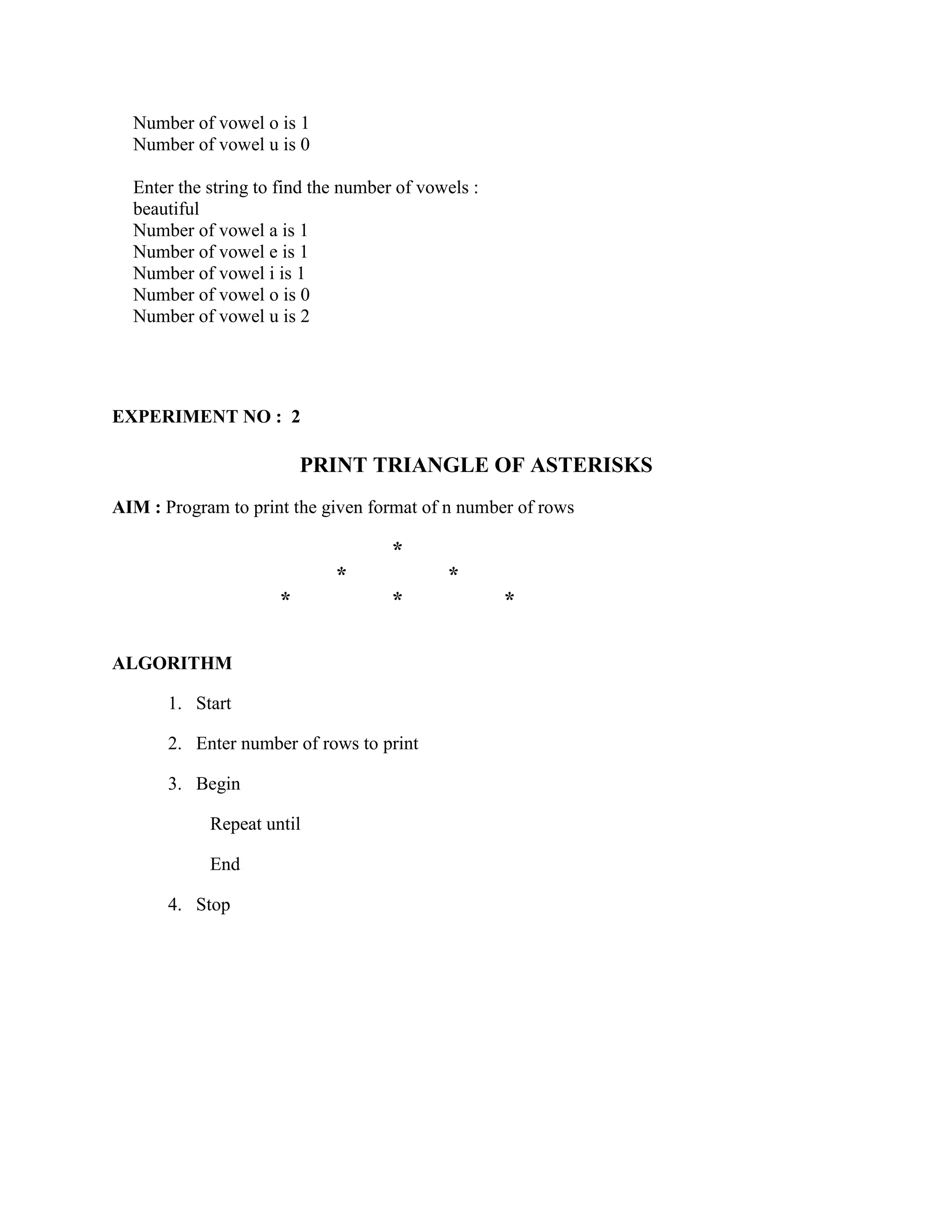
  beautiful
  Number of vowel a is 1
  Number of vowel e is 1
  Number of vowel i is 1
  Number of vowel o is 0
  Number of vowel u is 2


EXPERIMENT NO : 2

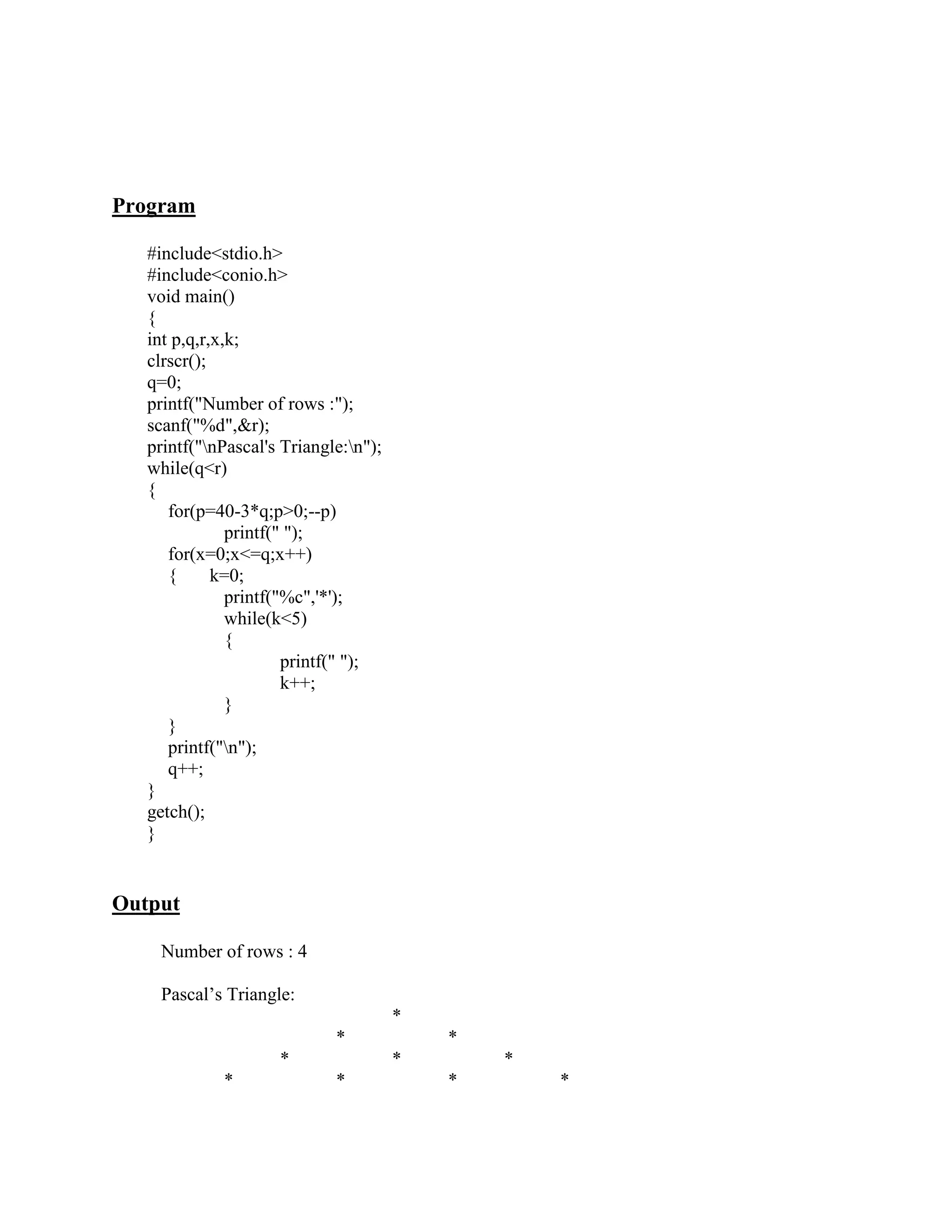
                         PRINT TRIANGLE OF ASTERISKS
AIM : Program to print the given format of n number of rows

                                     *
                             *              *
                     *               *              *

ALGORITHM

       1. Start

       2. Enter number of rows to print

       3. Begin

            Repeat until

            End

       4. Stop
Program

   #include<stdio.h>
   #include<conio.h>
   void main()
   {
   int p,q,r,x,k;
   clrscr();
   q=0;
   printf("Number of rows :");
   scanf("%d",&r);
   printf("nPascal's Triangle:n");
   while(q<r)
   {
      for(p=40-3*q;p>0;--p)
               printf(" ");
      for(x=0;x<=q;x++)
      {      k=0;
               printf("%c",'*');
               while(k<5)
               {
                       printf(" ");
                       k++;
               }
      }
      printf("n");
      q++;
   }
   getch();
   }


Output

    Number of rows : 4

    Pascal‟s Triangle:
                                       *
                             *             *
                     *                 *       *
             *               *             *       *
EXPERIMENT NO : 3

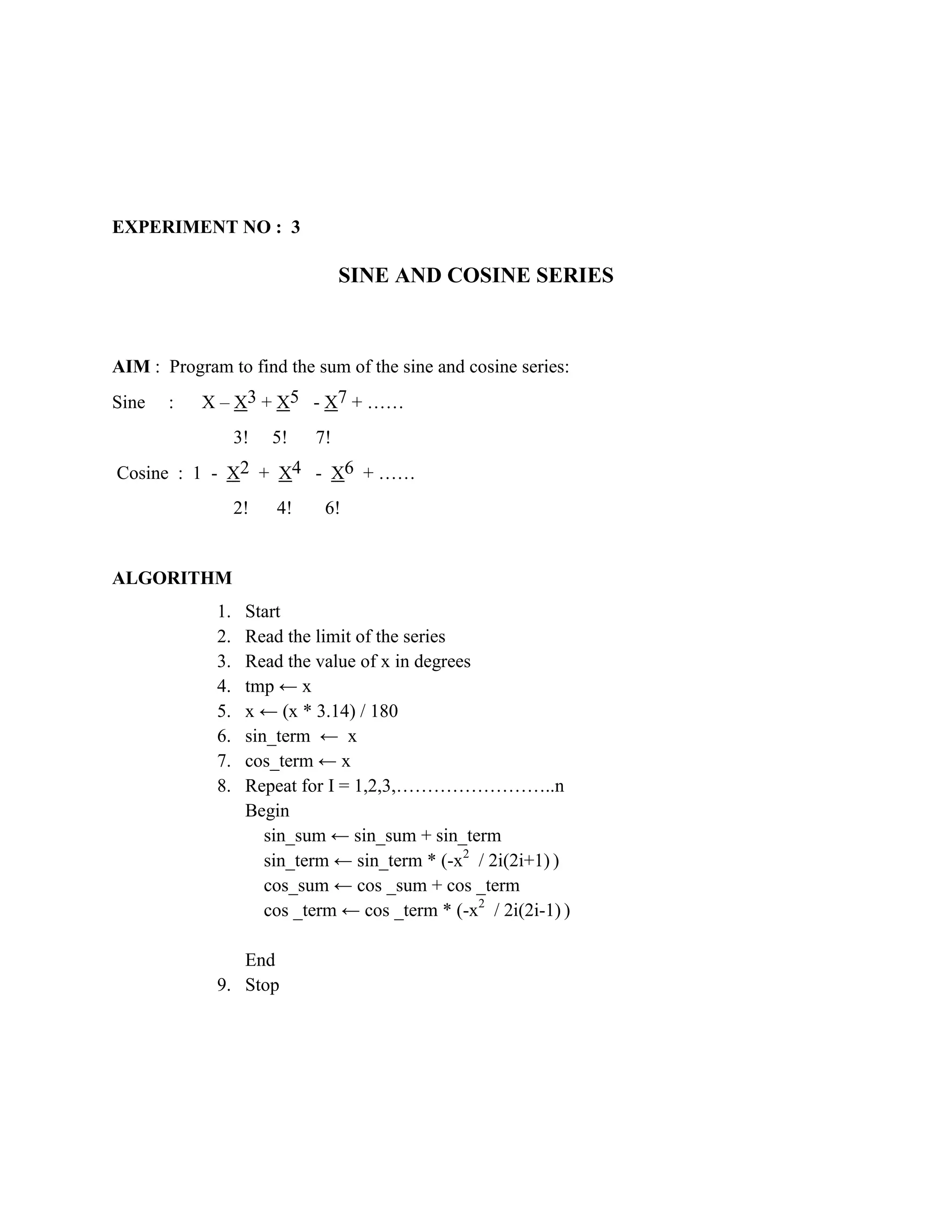
                                 SINE AND COSINE SERIES


AIM : Program to find the sum of the sine and cosine series:
Sine   :   X – X3 + X5 - X7 + ……
                  3!   5!   7!
Cosine : 1 - X2 + X4 - X6 + ……
                  2!   4!    6!


ALGORITHM
             1.    Start
             2.    Read the limit of the series
             3.    Read the value of x in degrees
             4.    tmp ← x
             5.    x ← (x * 3.14) / 180
             6.    sin_term ← x
             7.    cos_term ← x
             8.    Repeat for I = 1,2,3,……………………..n
                   Begin
                      sin_sum ← sin_sum + sin_term
                      sin_term ← sin_term * (-x2 / 2i(2i+1) )
                      cos_sum ← cos _sum + cos _term
                      cos _term ← cos _term * (-x2 / 2i(2i-1) )

                End
             9. Stop
Program
#include<stdio.h>
#include<conio.h>
#include<math.h>
void main()
{
  int i,n;
  float sin_sum=0,cos_sum=0,x,term,tmp,sin_term,cos_term;
  clrscr();
  printf("nnttSUM OF SINE AND COSINE SERIESn");
  printf("nnEnter the limit of the series : ");
  scanf("%d",&n);
  printf("nnEnter the value of x in degrees : ");
  scanf("%f",&x);
  tmp = x;
  //Converts x into radians
  x= (x * 3.14) / 180;
  //First term of sine and cosine series
  sin_term = x;
  cos_term = 1;
  for(i=1;i<=n;i++)
  {
    sin_sum += sin_term;
    sin_term *= - x*x / ( 2*i * (2*i+1) );
    cos_sum += cos_term;
    cos_term *= - x*x / ( 2*i * (2*i-1) );
  }

    printf("nnSine(%f) = %f",tmp,sin_sum);
    printf("nnnCosine(%f) = %f",tmp,cos_sum);
    getch();

}


Output
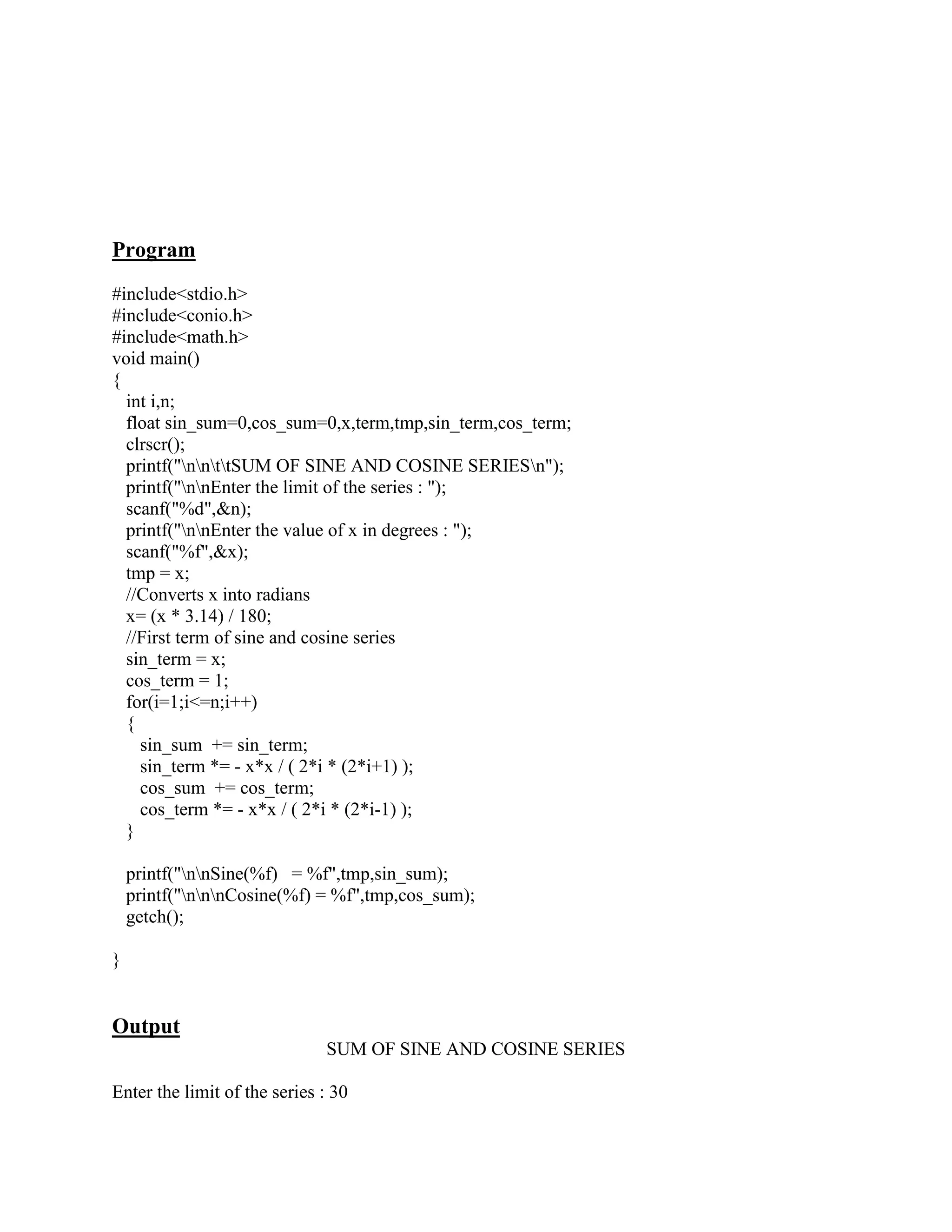
                              SUM OF SINE AND COSINE SERIES

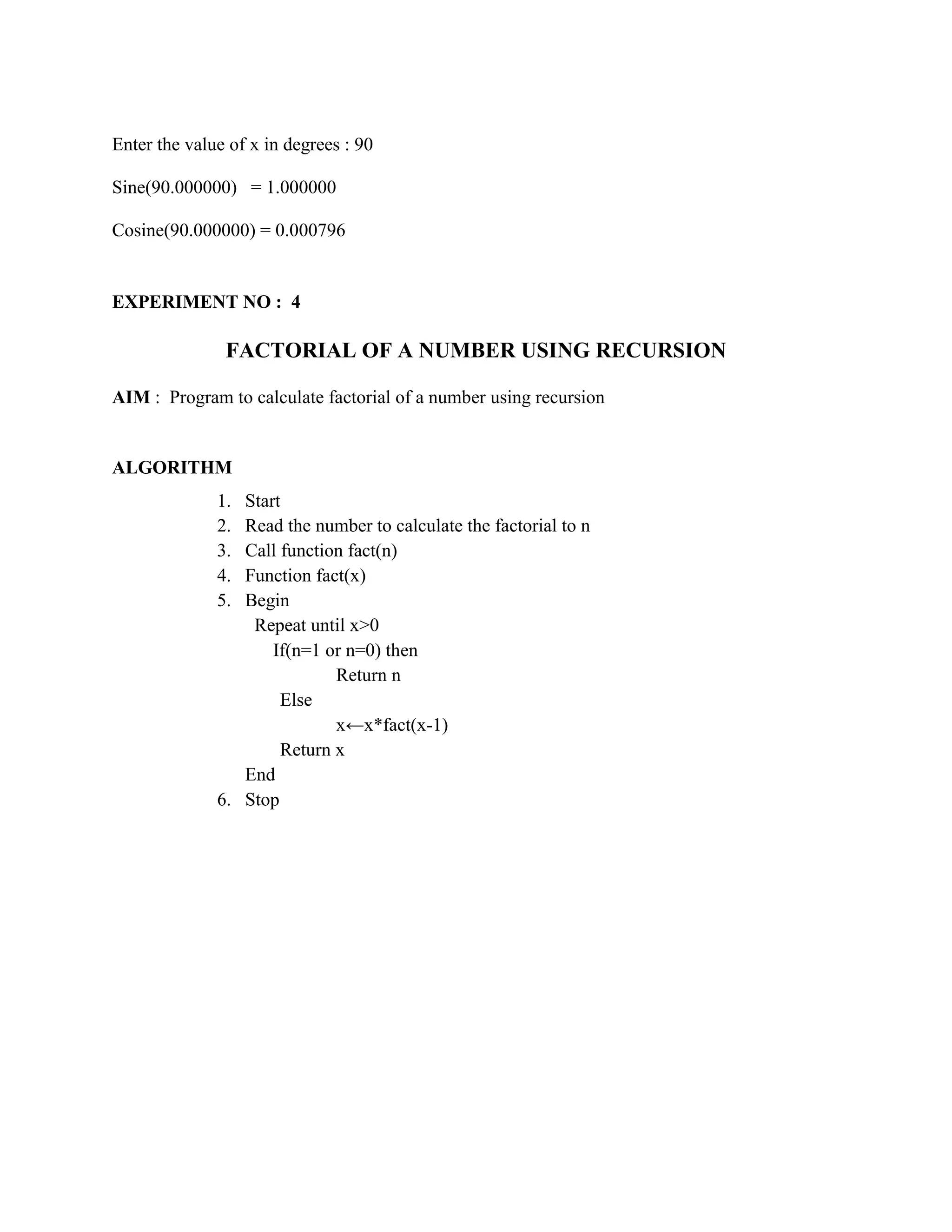
Enter the limit of the series : 30
Enter the value of x in degrees : 90

Sine(90.000000) = 1.000000

Cosine(90.000000) = 0.000796


EXPERIMENT NO : 4

               FACTORIAL OF A NUMBER USING RECURSION

AIM : Program to calculate factorial of a number using recursion


ALGORITHM
              1. Start
              2. Read the number to calculate the factorial to n
              3. Call function fact(n)
              4. Function fact(x)
              5. Begin
                  Repeat until x>0
                     If(n=1 or n=0) then
                             Return n
                      Else
                             x←x*fact(x-1)
                      Return x
                 End
              6. Stop
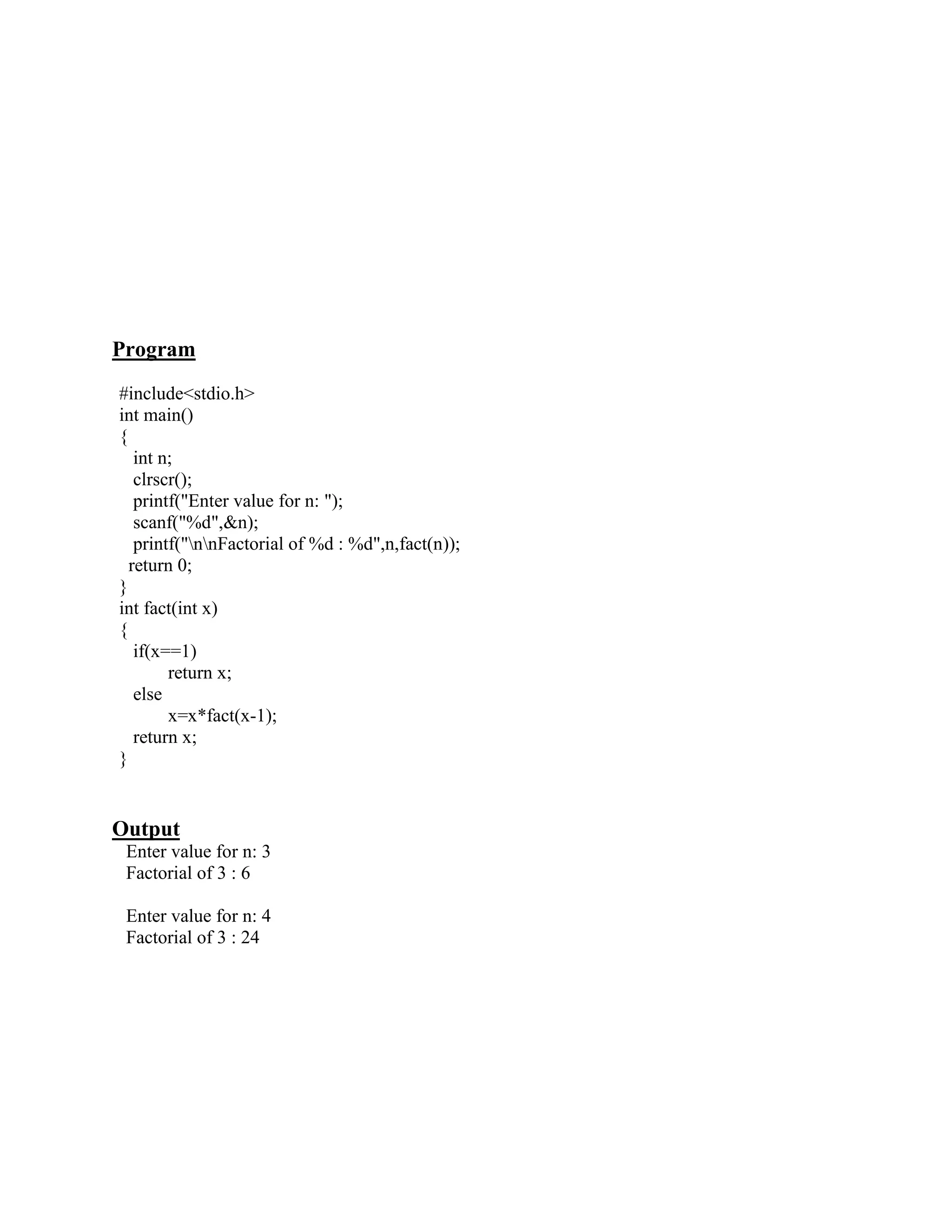
Program
#include<stdio.h>
int main()
{
   int n;
   clrscr();
   printf("Enter value for n: ");
   scanf("%d",&n);
   printf("nnFactorial of %d : %d",n,fact(n));
  return 0;
}
int fact(int x)
{
   if(x==1)
        return x;
   else
        x=x*fact(x-1);
   return x;
}


Output
 Enter value for n: 3
 Factorial of 3 : 6

 Enter value for n: 4
 Factorial of 3 : 24
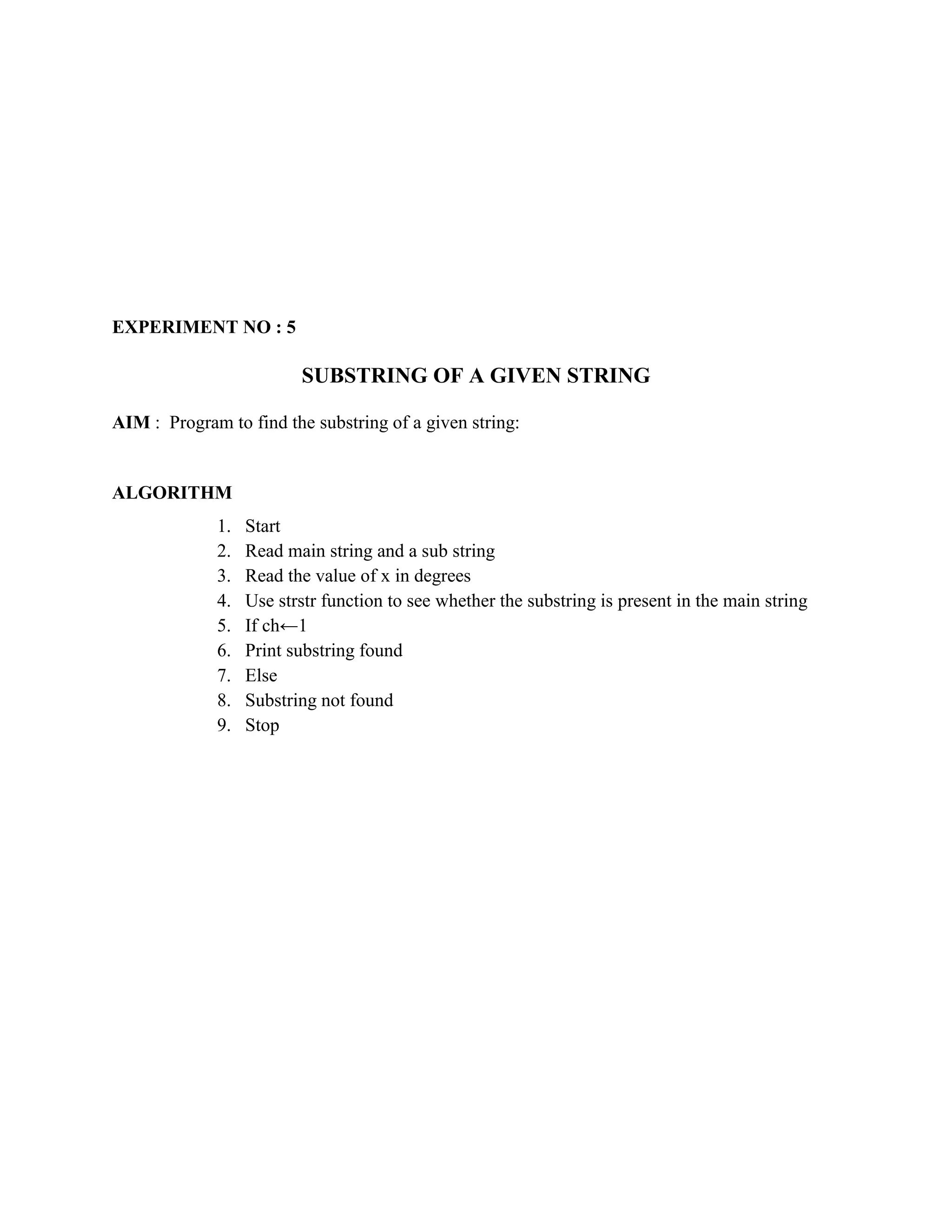
EXPERIMENT NO : 5

                         SUBSTRING OF A GIVEN STRING

AIM : Program to find the substring of a given string:


ALGORITHM
             1.   Start
             2.   Read main string and a sub string
             3.   Read the value of x in degrees
             4.   Use strstr function to see whether the substring is present in the main string
             5.   If ch←1
             6.   Print substring found
             7.   Else
             8.   Substring not found
             9.   Stop
Program
#include <string.h>
#include <stdio.h>
int main()
{
  char *ch;
  char str1[15],str2[10];
  printf(“Enter main string:n”);
  scanf(“%s”,str1);
  printf(“Enter substring:n”);
  scanf(“%s”,str2);
  ch = strstr(str1,str2);
  if(ch==1)
         printf(“nSubstring found”);
   else
         Printf(“nSubstring not found”);
   getch();
   }


Output
Enter main strings
Where there is a will, there is away
Enter sub string
will
Substring found

Enter main strings
Where there is a will, there is away
Enter sub string
many
Substring not found
EXPERIMENT NO : 6

       CONCATENATE TWO STRINGS WITHOUT USING STRING
                         FUNCTIONS


AIM : Program to perform concatenation of two strings without using built in functions


ALGORITHM
             1. Start
             2. Read two strings into arrays str1 and str2
             3. Initialize loop counters i,j counters c and c1 to 0
             4. Read characters one by one from individual arrays and increment counter c
                and c1
             5. Begin
                 Repeat until c1>i
                              str1[c]←str2[i]
                     Append 0 to str1
                End
             6. Print string str1
             7. Stop
Program
#include<stdio.h>
int main()
{
  char str1[30],str2[30];
  int i=0,j=0,c=0,c1=0;
  printf("Enter two strings n");
  scanf("%s%s",str1,str2);
  while(str1[i]!='0')
  {
        c++;
        i++;
  }
  while(str2[j]!='0')
  {
        c1++;
        j++;
  }
  for(i=0;i<c1;i++)
  {
        str1[c]=str2[i];
        c++;
  }
  str1[c]='0';
  printf("%s",str1);
  return 0;
}


Output
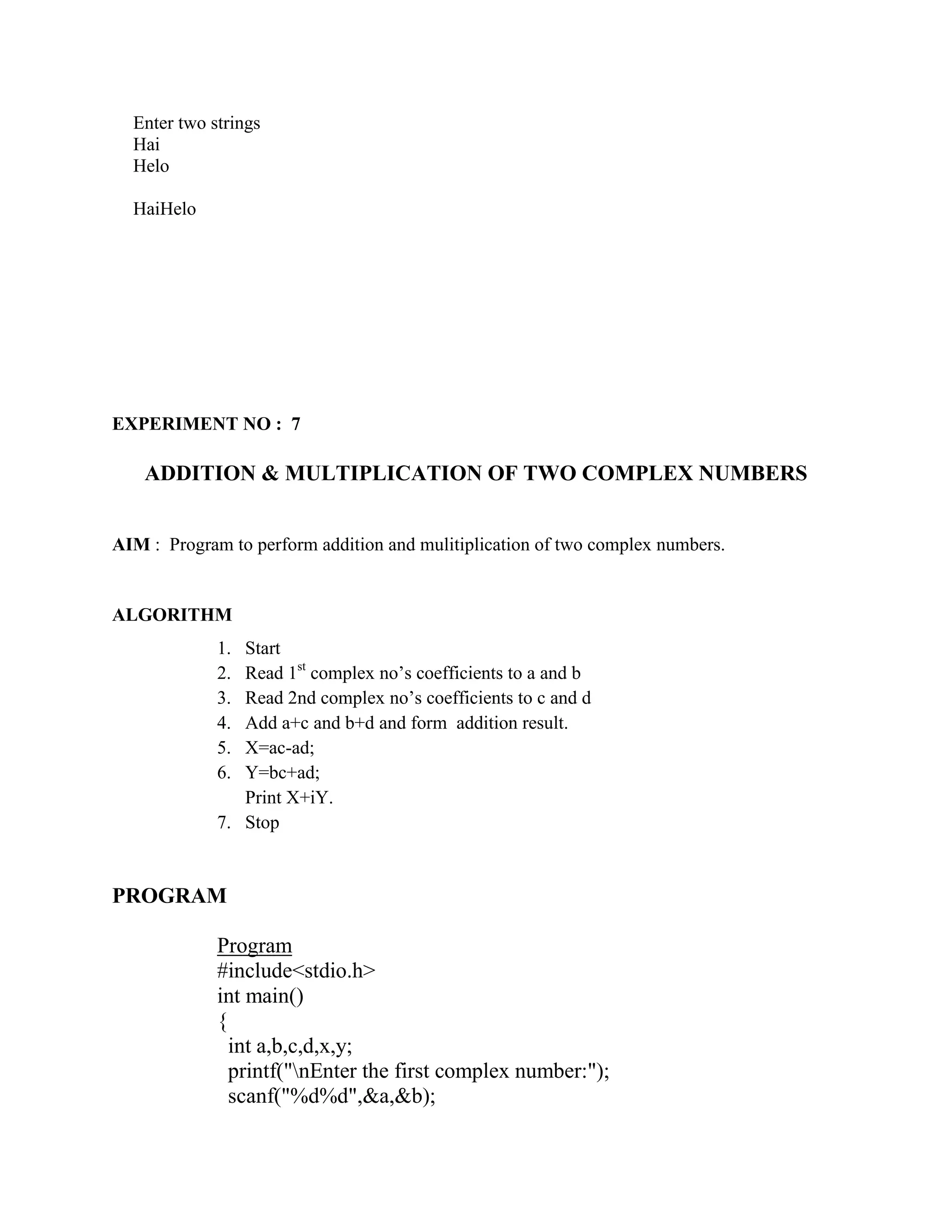
Enter two strings
  Hai
  Helo

  HaiHelo


EXPERIMENT NO : 7

    ADDITION & MULTIPLICATION OF TWO COMPLEX NUMBERS


AIM : Program to perform addition and mulitiplication of two complex numbers.


ALGORITHM
             1. Start
             2. Read 1st complex no‟s coefficients to a and b
             3. Read 2nd complex no‟s coefficients to c and d
             4. Add a+c and b+d and form addition result.
             5. X=ac-ad;
             6. Y=bc+ad;
                Print X+iY.
             7. Stop


PROGRAM

             Program
             #include<stdio.h>
             int main()
             {
               int a,b,c,d,x,y;
               printf("nEnter the first complex number:");
               scanf("%d%d",&a,&b);
printf("nEnter the second complex number:");
 scanf("%d%d",&c,&d);
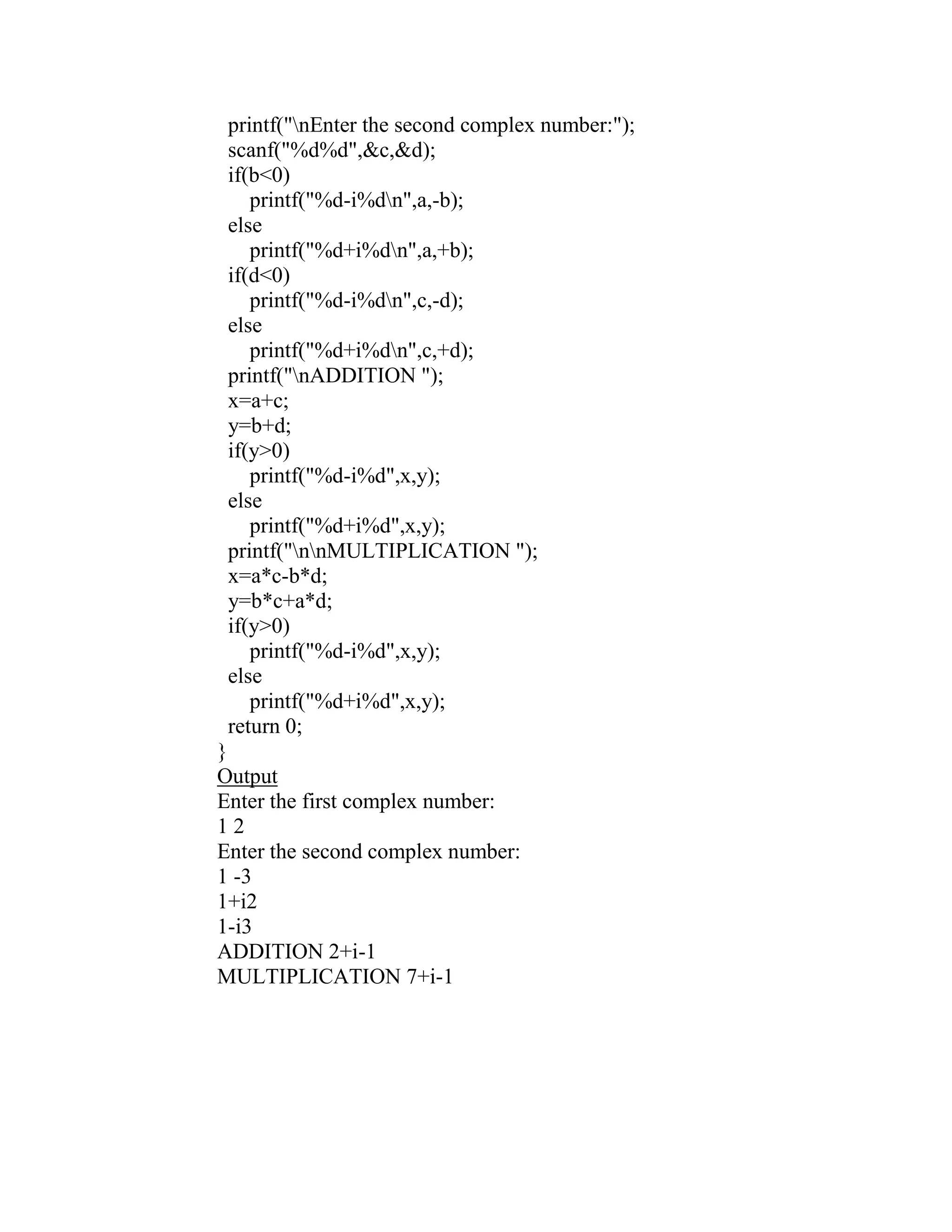
 if(b<0)
    printf("%d-i%dn",a,-b);
 else
    printf("%d+i%dn",a,+b);
 if(d<0)
    printf("%d-i%dn",c,-d);
 else
    printf("%d+i%dn",c,+d);
 printf("nADDITION ");
 x=a+c;
 y=b+d;
 if(y>0)
    printf("%d-i%d",x,y);
 else
    printf("%d+i%d",x,y);
 printf("nnMULTIPLICATION ");
 x=a*c-b*d;
 y=b*c+a*d;
 if(y>0)
    printf("%d-i%d",x,y);
 else
    printf("%d+i%d",x,y);
 return 0;
}
Output
Enter the first complex number:
12
Enter the second complex number:
1 -3
1+i2
1-i3
ADDITION 2+i-1
MULTIPLICATION 7+i-1
8.Write a program to accept the employee details and calculate
each of the employee commission. Given commission is 20% of the salary.
         Program
         #include<stdio.h>
         #include<conio.h>
         void main()
         {
          struct employee
          {
                 int empno,salary;
                 char name[15],sex[10];
                 float comm;
          }emp[10];

         int lim,i=0;
         printf("Enter the number of employees :n");
         scanf("%d",&lim);
         while(i<lim)
         {
         printf("Enter the employee details: ");
         printf("nEmployee number :");
         scanf("%d",&emp[i].empno);
         printf("nEmployee name : ");
         scanf("%s",emp[i].name);
         printf("nSex : ");
scanf("%s",emp[i].sex);
 printf("nSalary : ");
 scanf("%d",&emp[i].salary);
 i++;
 }
 for(i=0;i<lim;i++)
 {
 emp[i].comm=emp[i].salary*.2;
 printf("nCommission of employee %d is %f",i+1,emp[i].comm);
 }
 getch();
}
Output
Enter the number of employees :2
Enter the employee details:
Employee number :1
Employee name :anu
Sex :female
Salary :30000
Enter the employee details:
Employee number :2
Employee name :manu
Sex :male
Salary :25000
Commission of employee 1 is 6000.000000
Commission of employee 2 is 5000.000000
9. Write a program to print the student record. Accept name,
register nos. and marks in three subjects for each student and compute the
class average of each subject
         Program
         #include<stdio.h>
         #include<conio.h>
         void main()
         {
          int i=0,lim,p=0,c=0,m=0;
          float avg1,avg2,avg3;
          struct student
          {
                 char name[10];
                 int regno,phy,chem,maths;
          }s[10];
          clrscr();
          printf("nEnter the number of students whos details to be entered : ");
          scanf("%d",&lim);
          while(i<lim)
          {
                 printf("Enter student name : ");
                 scanf("%s",s[i].name);
printf("nEnter regno : ");
       scanf("%d",&s[i].regno);
       printf("nEnter the marks for physics : ");
       scanf("%d",&s[i].phy);
       printf("nEnter the marks for chemistry : ");
       scanf("%d",&s[i].chem);
       printf("nEnter the marks for maths : ");
       scanf("%d",&s[i].maths);
       i++;
 }
 for(i=0;i<lim;i++)
 {
        p=p+s[i].phy;
        c=c+s[i].chem;
        m=m+s[i].maths;
 }
 avg1=p/lim;
 avg2=c/lim;
 avg3=m/lim;
 printf("nClass average of physics : %.3f",avg1);
 printf("nClass average of chemistry : %.3f",avg2);
 printf("nClass average of maths : %.3f",avg3);
 getch();
}
Output

Enter the number of students whos details to be entered :5
Enter student name : Mini
Enter regno : 25
Enter the marks for physics : 47
Enter the marks for chemistry : 39
Enter the marks for maths : 42

Enter student name : Akhil
Enter regno : 33
Enter the marks for physics : 40
Enter the marks for chemistry : 35
Enter the marks for maths : 41

Enter student name : Mathew
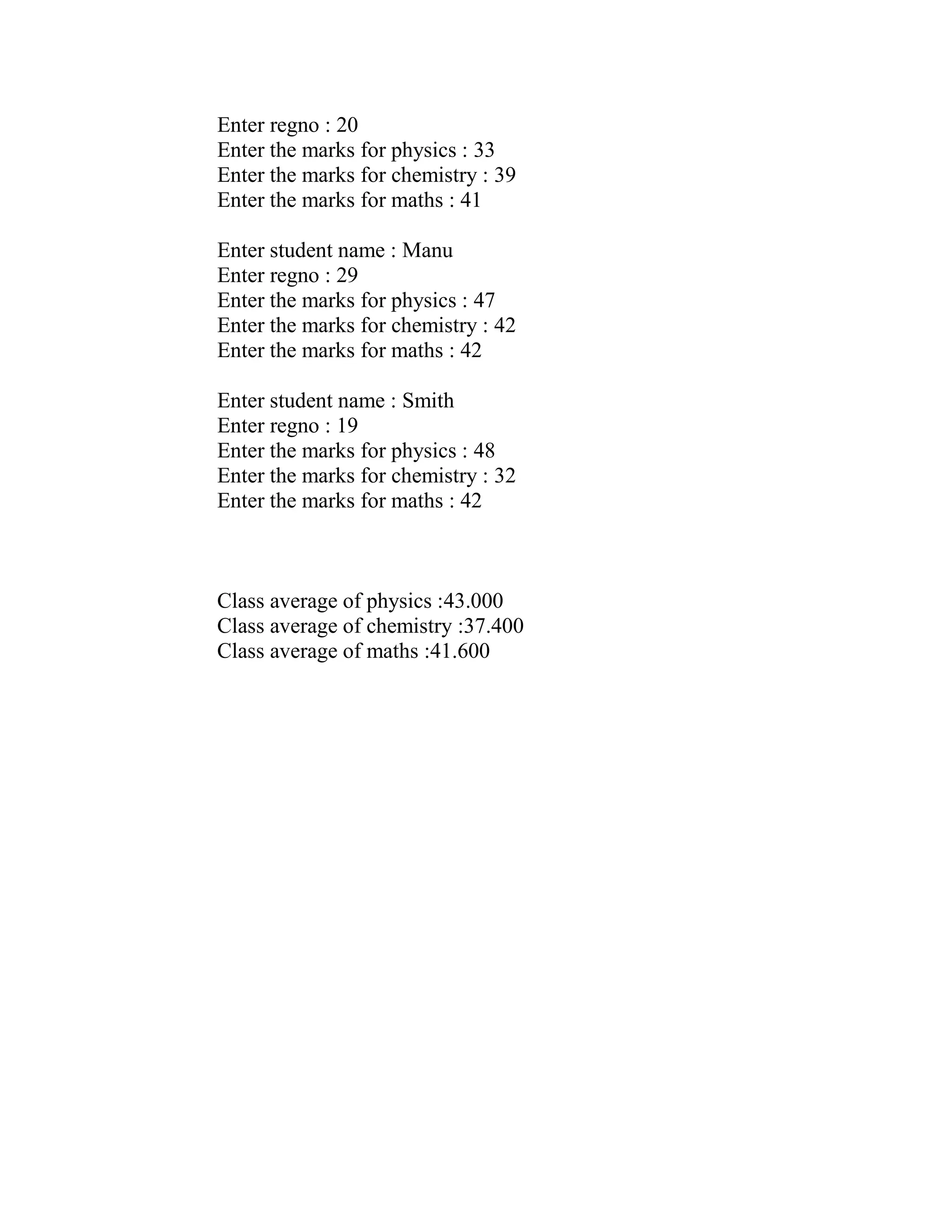
Enter regno : 20
Enter the marks for physics : 33
Enter the marks for chemistry : 39
Enter the marks for maths : 41

Enter student name : Manu
Enter regno : 29
Enter the marks for physics : 47
Enter the marks for chemistry : 42
Enter the marks for maths : 42

Enter student name : Smith
Enter regno : 19
Enter the marks for physics : 48
Enter the marks for chemistry : 32
Enter the marks for maths : 42


Class average of physics :43.000
Class average of chemistry :37.400
Class average of maths :41.600
10.Write a program to search an element in an array using binary
search method.
        Program
        #include<stdio.h>
        #include<conio.h>
        void main()
        {
        int i,j,x,n,t;
        int low,high,mid,a[20];
        clrscr();
        printf("Enter the n value:");
        scanf("%d",&n);
        printf("nEnter the numbers");

        for(i=0;i<n;i++)
         scanf("%d",&a[i]);
        //sorting elements....
        for(i=0;i<n;i++)
        {
         for(j=i+1;j<n;j++)
         {
                if(a[i]>a[j])
{
             t=a[i];
             a[i]=a[j];
             a[j]=t;
      }
 }
}
// printf("nSorted arrayn");
for(i=0;i<n;i++)
 printf("%d",a[i]);
printf("nEnter the search element:");
scanf("%d",&x);
low=0;
high=n;
while(low<=high)
{
mid=(low+high)/2;
if(x<a[mid])
{
high=mid-1;
}
else if(x>a[mid])
{
low=mid+1;
}
else if(x==a[mid])
{
printf("n Number obtained at position %d",mid+1);
break;
}
else
 printf(“n Number not found”);
}
getch();
}
Output

Enter the n value:4
Enter the numbers 56 78 23 45
Sorted array 23 45 56 78
Enter the search element:78
         Number obtained at position 4


         Enter the n value:3
         Enter the numbers 44 70 21
         Sorted array 21 44 70
         Enter the search element:87
         Number not found


                                         Cycle-3
         1. Write a program to create a file to store details of n students – A
file named student.dat contain information such as rollno, name, and total
marks
         Program
         #include<stdio.h>
         #include<conio.h>
         void main()
         {
          FILE *fp;
          int i=0,lim;
          struct student
          {
                 char name[10];
                 int rollno,phy,chem,maths;
                 float tot_marks;
          }s[10];
          clrscr();
fp=fopen("student.dat","w");
         printf("nEnter the number of students whos details to be entered : ");
         scanf("%d",&lim);
         printf("nEnter the following details : Name of student,Rollno of
student,Marks of subjects n");
         while(i<lim)
         {
                printf("nEnter student name : ");
                scanf("%s",s[i].name);
                printf("nEnter rollno : ");
                scanf("%d",&s[i].rollno);
                printf("nEnter the marks for physics : ");
                scanf("%d",&s[i].phy);
                printf("nEnter the marks for chemistry : ");
                scanf("%d",&s[i].chem);
                printf("nEnter the marks for maths : ");
                scanf("%d",&s[i].maths);
                s[i].tot_marks=s[i].phy+s[i].chem+s[i].maths;
                printf("nTotal marks : %fn",s[i].tot_marks);

                i++;
          }
          for(i=0;i<lim;i++)
                fprintf(fp,"%s %d %fn",s[i].name,s[i].rollno,s[i].tot_marks);
          getch();
         }
         Output
         Enter the number of students whos details to be entered 3

           Enter the following details : Name of student,Rollno of student,Marks
of subjects
          Enter student name :Anu
          Enter rollno :101
          Enter the marks for physics :46
          Enter the marks for chemistry :47
          Enter the marks for maths :49
          Total marks : 142.000000
          Enter student name :Veena
          Enter rollno :102
          Enter the marks for physics :39
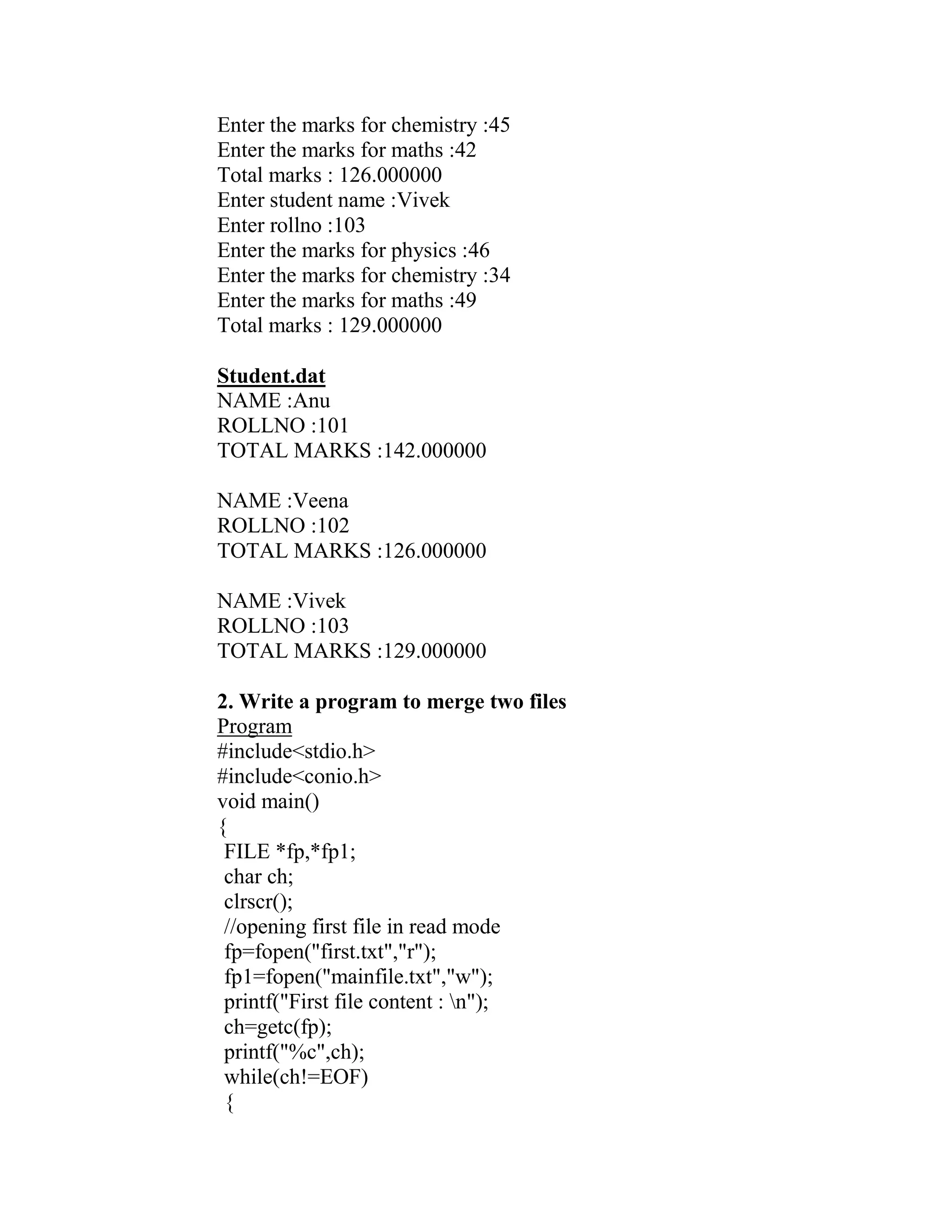
Enter the marks for chemistry :45
Enter the marks for maths :42
Total marks : 126.000000
Enter student name :Vivek
Enter rollno :103
Enter the marks for physics :46
Enter the marks for chemistry :34
Enter the marks for maths :49
Total marks : 129.000000

Student.dat
NAME :Anu
ROLLNO :101
TOTAL MARKS :142.000000

NAME :Veena
ROLLNO :102
TOTAL MARKS :126.000000

NAME :Vivek
ROLLNO :103
TOTAL MARKS :129.000000

2. Write a program to merge two files
Program
#include<stdio.h>
#include<conio.h>
void main()
{
 FILE *fp,*fp1;
 char ch;
 clrscr();
 //opening first file in read mode
 fp=fopen("first.txt","r");
 fp1=fopen("mainfile.txt","w");
 printf("First file content : n");
 ch=getc(fp);
 printf("%c",ch);
 while(ch!=EOF)
 {
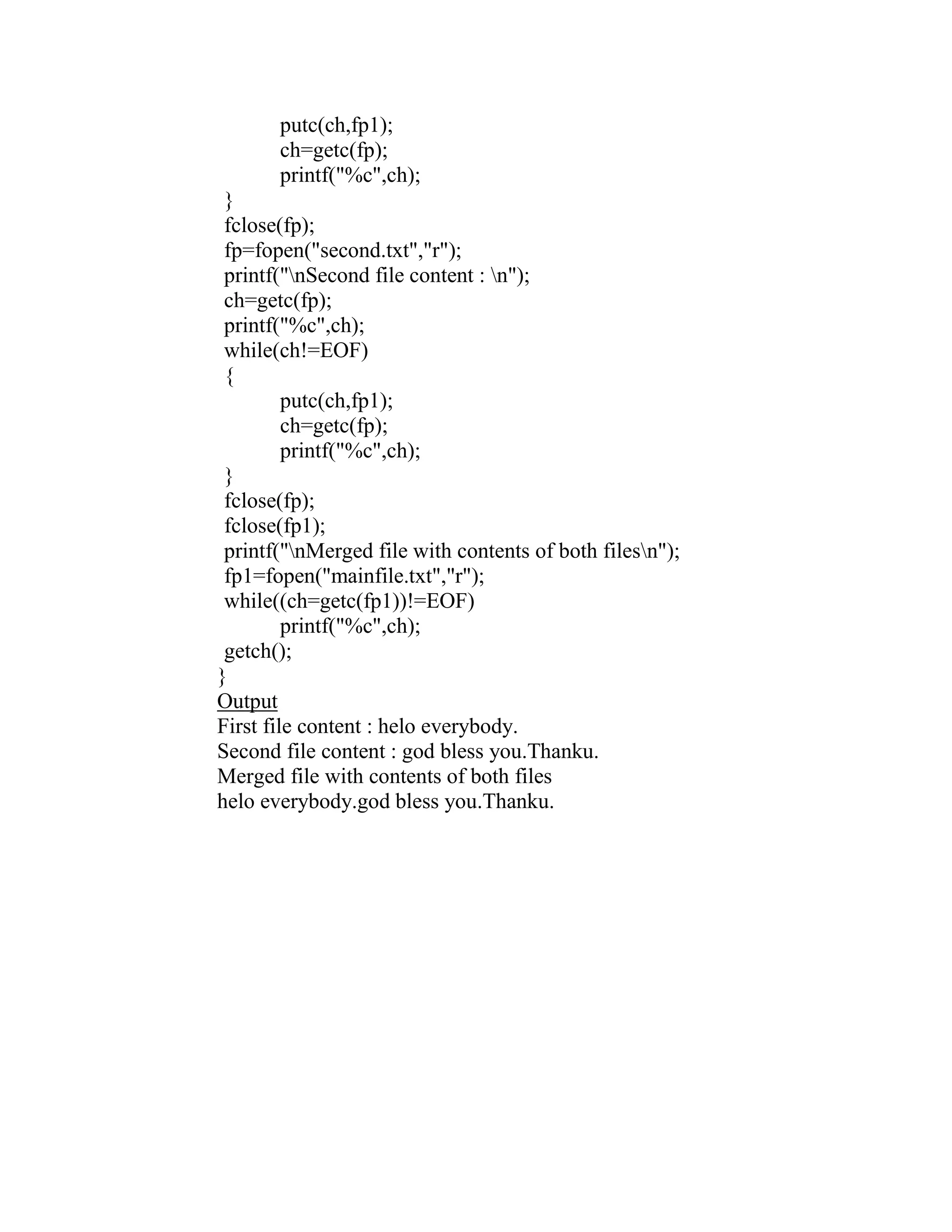
putc(ch,fp1);
       ch=getc(fp);
       printf("%c",ch);
 }
 fclose(fp);
 fp=fopen("second.txt","r");
 printf("nSecond file content : n");
 ch=getc(fp);
 printf("%c",ch);
 while(ch!=EOF)
 {
         putc(ch,fp1);
         ch=getc(fp);
         printf("%c",ch);
 }
 fclose(fp);
 fclose(fp1);
 printf("nMerged file with contents of both filesn");
 fp1=fopen("mainfile.txt","r");
 while((ch=getc(fp1))!=EOF)
         printf("%c",ch);
 getch();
}
Output
First file content : helo everybody.
Second file content : god bless you.Thanku.
Merged file with contents of both files
helo everybody.god bless you.Thanku.
3. Write a program to apply linear search to a set of n numbers by
using function
         Program
         #include<stdio.h>
         #include<conio.h>
         int i,n,c;
         void main()
         {
          int a[10],m;
          c=0;
          printf("nEnter the size of an array");
          scanf("%d",&n);
          printf("nEnter the elements of the array");
          for(i=0;i<n;i++)
          {
           scanf("%d",&a[i]);
          }
          printf("nThe elements of an array are");
          for(i=0;i<n;i++)
          {
           printf(" %d",a[i]);
          }
          printf("nEnter the number to search");
          scanf("%d",&m);
          c=lin_search(m,a);
           if(c>0)
             printf("nThe number is found");
           else
              printf("nThe number is not in list");
          getch();
         }
         int lin_search(int m,int a[])
         {
            int x;
           for(i=0;i<n;i++)
          {
           if(a[i]==m)
             {
x=1;
   break;
  }
 }
 return x;

}
Output

Enter the size of an array 5

Enter the elements of the array 49 58 23 37 10

The elements of an array are 49 58 23 37 10

Enter the number to search 23

The number is found

Enter the size of an array 5

Enter the elements of the array 34 56 12 89 90

The elements of an array are 34 56 12 89 90

Enter the number to search 91

The number is not in list
4. Write a program to find the largest and smallest element in an
array using pointers
         Program
         #include<stdio.h>
         #include<conio.h>
         void main()
         {
          int a[20],i,lim;
          int *p,*l,*s;
          clrscr();
          printf("Enter limit :");
          scanf("%d",&lim);
          printf("nEnter values : ");
          for(i=0;i<lim;i++)
                 scanf("%d",&a[i]);
          p=a;
          *l=0;
          *s=a[0];
          for(i=0;i<lim;i++)
          {
                 if(*l<*p)
                         *l=*p;
                 if(*s>*p)
                         *s=*p;
                 p++;

         }
         printf("nLargest element : %d",*l);
         printf("nSmallest element : %d",*s);
         getch();
        }

        Output
        Enter limit :5
Enter values :32
67
12
90
06
Largest element : 90
Smallest element : 6
5. Write a program to read a file and find the number of sentences,
words, and vowels
        Program
        #include<stdio.h>
        #include<conio.h>
        void main()
        {
         FILE * fp;
         char ch;
         int w=0,v=0,s=0;
         clrscr();
         fp=fopen("helo.txt","r");
         printf("T E X T : ");
         ch=getc(fp);
         while(ch!=EOF)
         {
             printf("%c",ch);

               if(ch=='.')
                   {s++;w++;}
               else
if(ch=='a'||ch=='e'||ch=='i'||ch=='o'||ch=='u'||ch==‟A‟||ch==‟E‟||ch==‟I‟||ch==‟O‟||
ch==‟U‟)
                   v++;
               else if(ch==' ')
                   w++;
               ch=getc(fp);
            }
            printf("nThe total number of sentences is %d words is %d and vowels
is %d",s,w,v);
            getch();
          }
          Output
T E X T : Hai.helo everybody.U need to work hard.God bless
    you.Thankyou.
            The total number of sentences is 5 words is 12 and vowels is 19


                    CHECK A GIVEN YEAR IS A LEAP YEAR OR NOT.

AIM : Program to find out whether a given year is a leap year or not.

INPUT SPECIFICATION             : year        - An year to check whether it‟s a leap year
OUTPUT SPECIFICATION : Printing whether the year is a leap year or not.


ALGORITHM

    6. Start
    7. Reading a year, year
    8. Checking whether year%4 equal to 0 and year%100!=0 or year%400 is equal to 0
    9. Then given year is a leap year and go to 6.
    10. Otherwise the given year is not a leap year.
    11. Stop.

PROGRAM DESCRIPTION

        The year is said to be a leap year if it is divisible by 4 and not divisible by 100 or
divisible by 400. Using this idea we have check whether the given year is a leap year or not.

PROGRAM

#include<stdio.h>

int main()

{
       int year;

       printf(" Enter a yearn");

       scanf(" %d",&year);
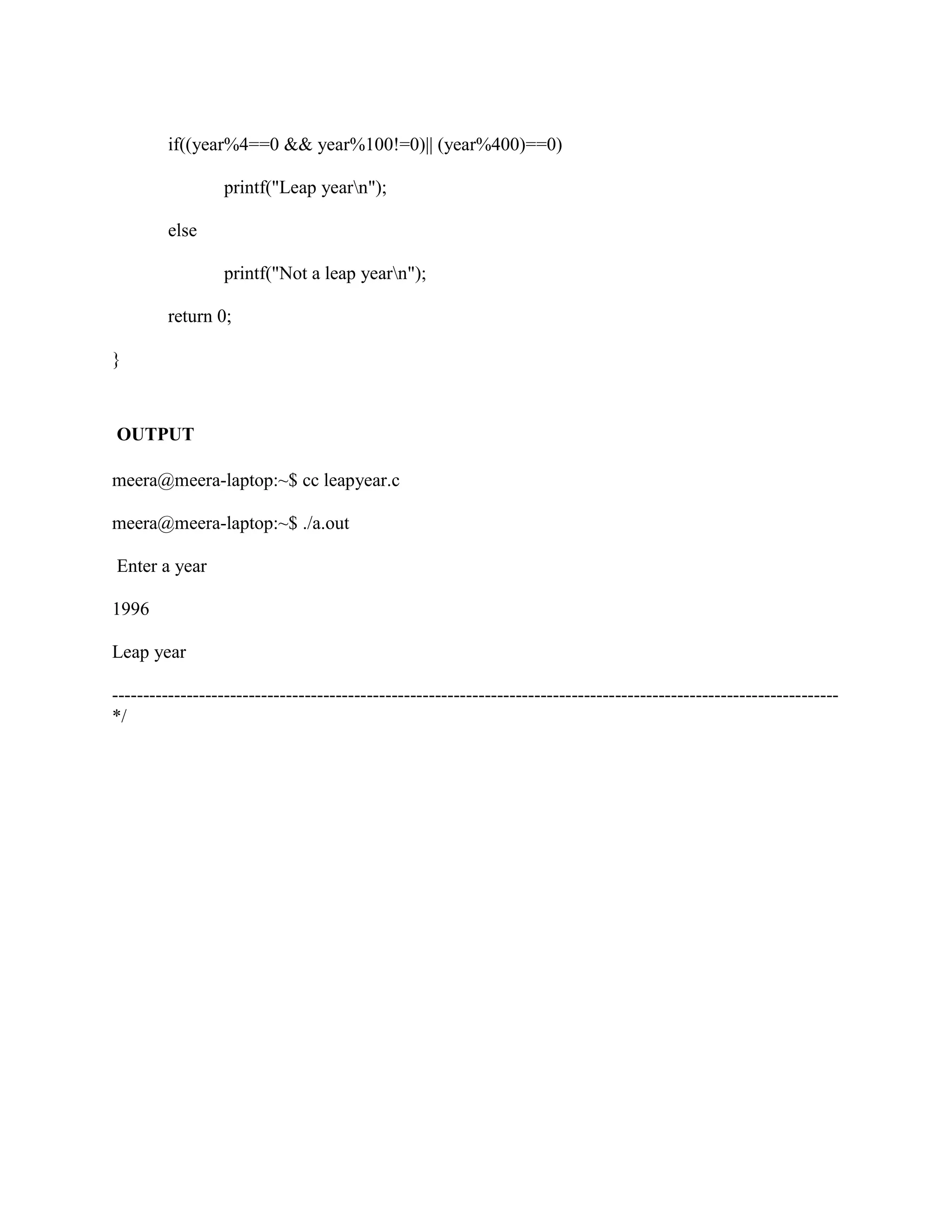
if((year%4==0 && year%100!=0)|| (year%400)==0)

                  printf("Leap yearn");

         else

                  printf("Not a leap yearn");

         return 0;

}


OUTPUT

meera@meera-laptop:~$ cc leapyear.c

meera@meera-laptop:~$ ./a.out

Enter a year

1996

Leap year

---------------------------------------------------------------------------------------------------------------------
*/
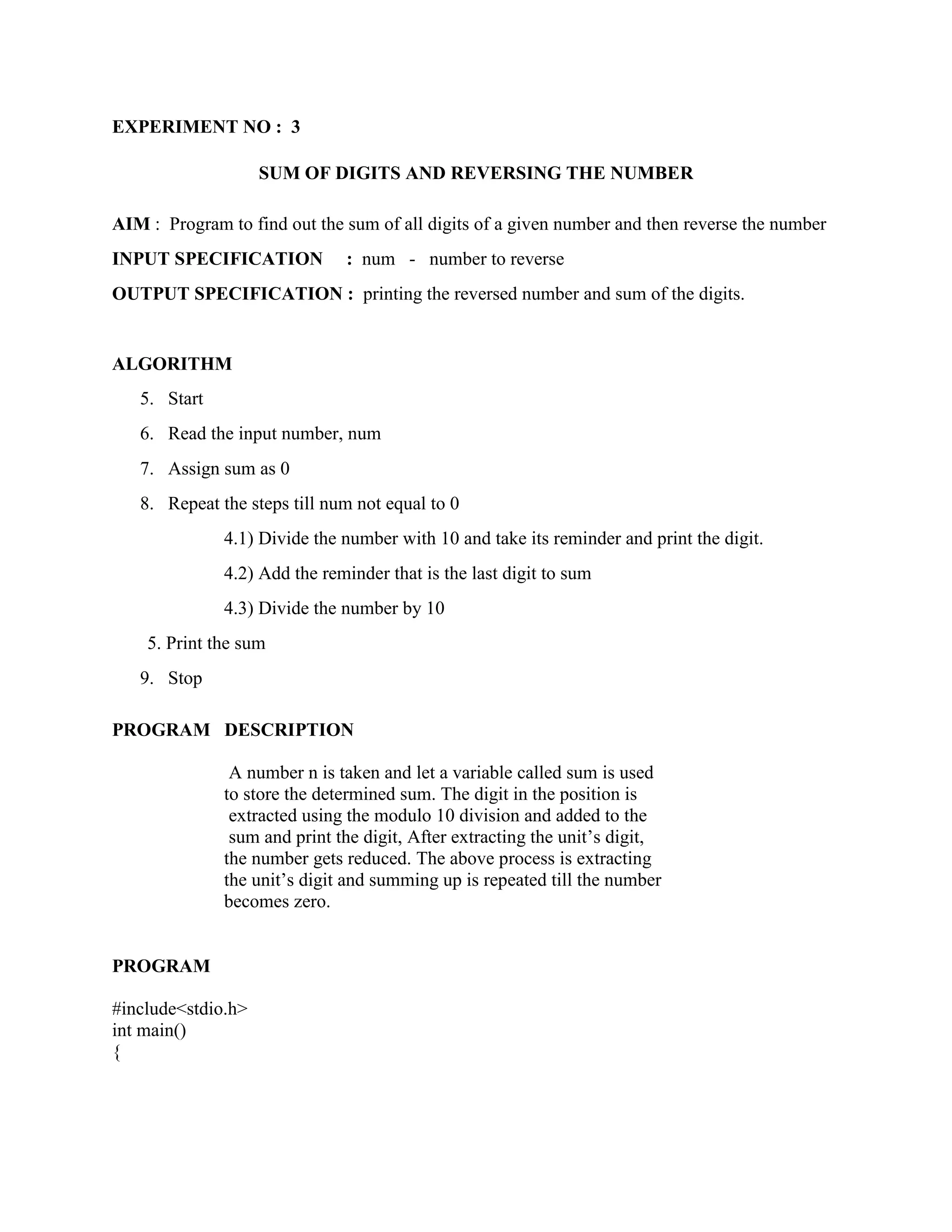
EXPERIMENT NO : 3

                    SUM OF DIGITS AND REVERSING THE NUMBER

AIM : Program to find out the sum of all digits of a given number and then reverse the number
INPUT SPECIFICATION           : num - number to reverse
OUTPUT SPECIFICATION : printing the reversed number and sum of the digits.


ALGORITHM
   5. Start
   6. Read the input number, num
   7. Assign sum as 0
   8. Repeat the steps till num not equal to 0
              4.1) Divide the number with 10 and take its reminder and print the digit.
              4.2) Add the reminder that is the last digit to sum
              4.3) Divide the number by 10
    5. Print the sum
   9. Stop

PROGRAM DESCRIPTION

               A number n is taken and let a variable called sum is used
              to store the determined sum. The digit in the position is
               extracted using the modulo 10 division and added to the
               sum and print the digit, After extracting the unit‟s digit,
              the number gets reduced. The above process is extracting
              the unit‟s digit and summing up is repeated till the number
              becomes zero.


PROGRAM

#include<stdio.h>
int main()
{
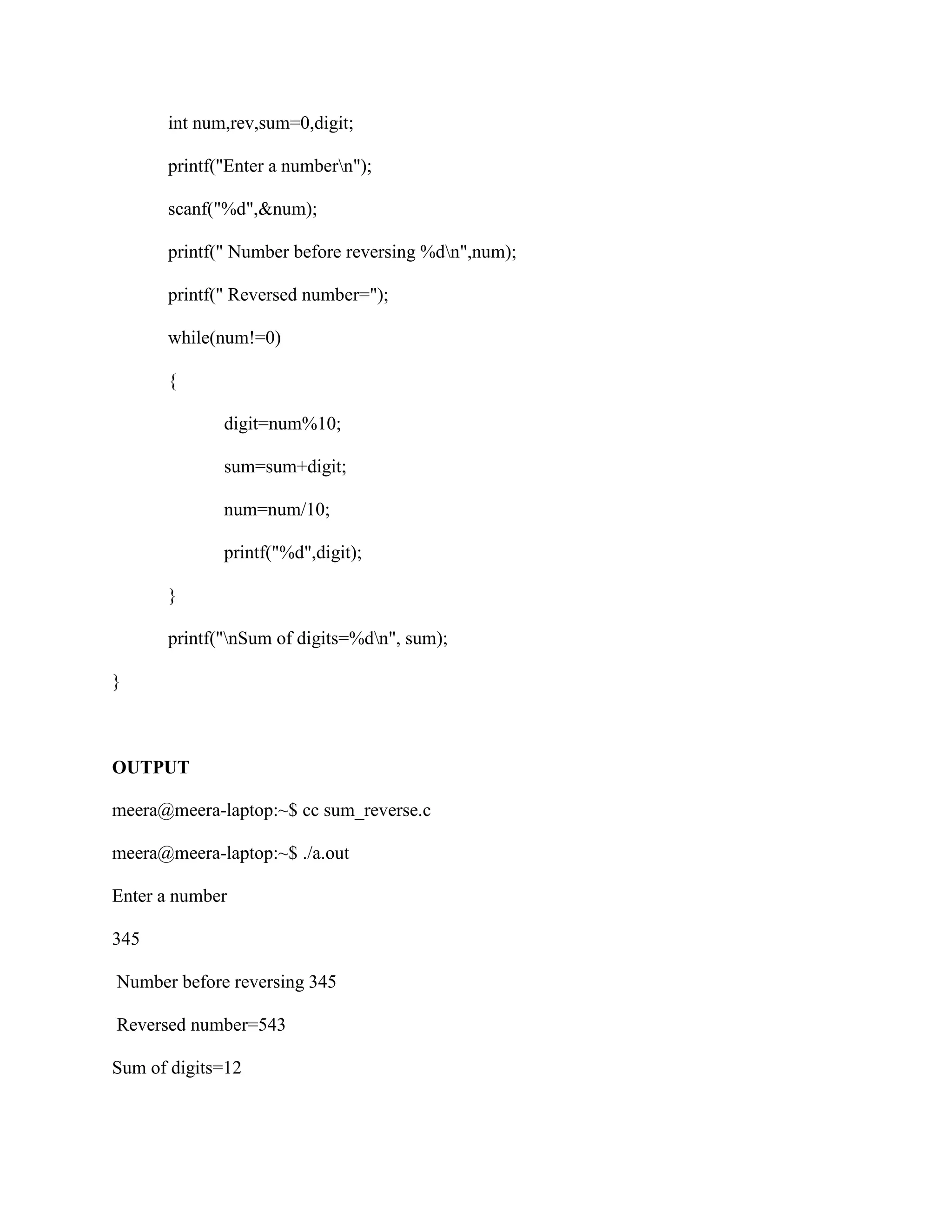
int num,rev,sum=0,digit;

      printf("Enter a numbern");

      scanf("%d",&num);

      printf(" Number before reversing %dn",num);

      printf(" Reversed number=");

      while(num!=0)

      {

             digit=num%10;

             sum=sum+digit;

             num=num/10;

             printf("%d",digit);

      }

      printf("nSum of digits=%dn", sum);

}


OUTPUT

meera@meera-laptop:~$ cc sum_reverse.c

meera@meera-laptop:~$ ./a.out

Enter a number

345

Number before reversing 345

Reversed number=543

Sum of digits=12
---------------------------------------------------------------------------------------------------------------------
*/

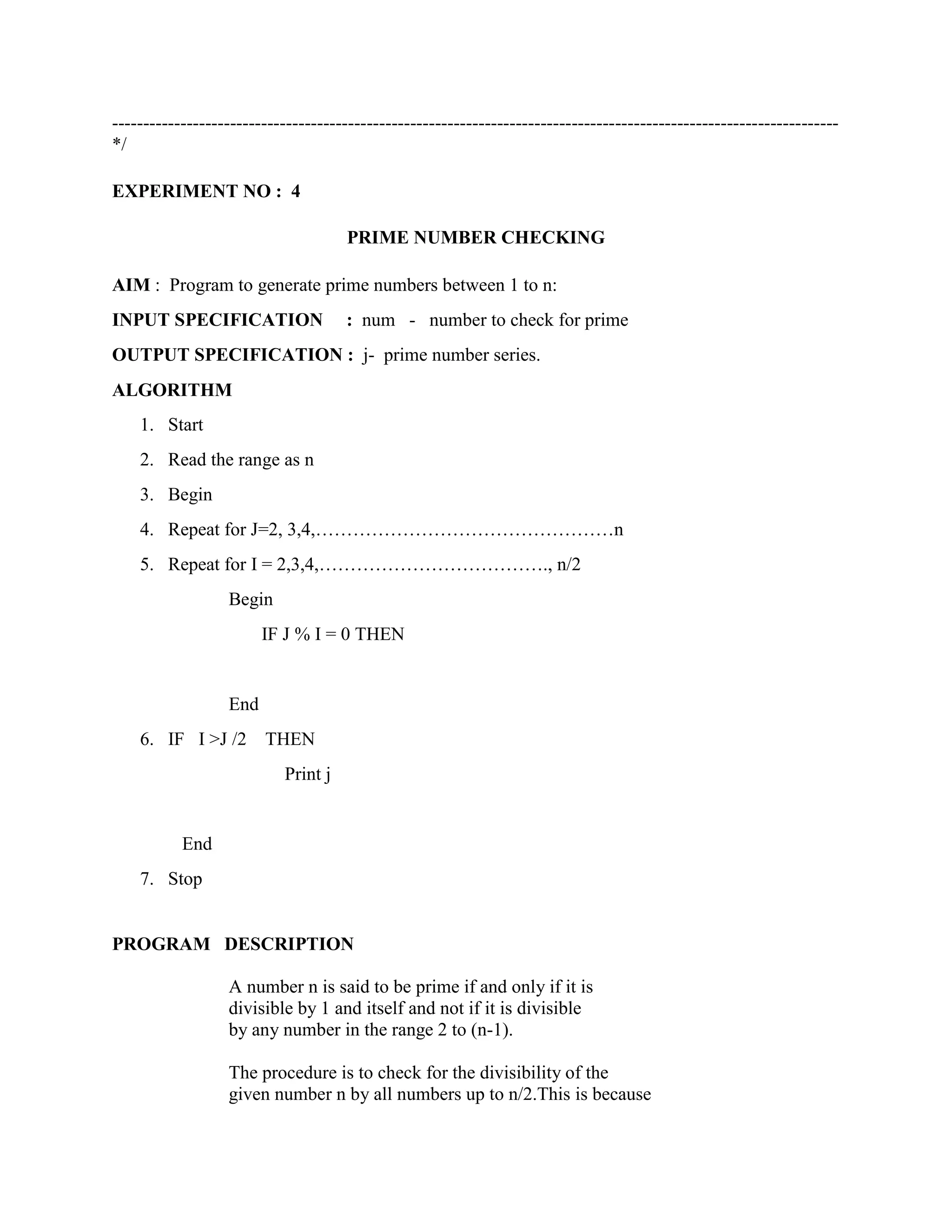
EXPERIMENT NO : 4

                                     PRIME NUMBER CHECKING

AIM : Program to generate prime numbers between 1 to n:
INPUT SPECIFICATION                  : num - number to check for prime
OUTPUT SPECIFICATION : j- prime number series.
ALGORITHM
    1. Start
    2. Read the range as n
    3. Begin
    4. Repeat for J=2, 3,4,…………………………………………n
    5. Repeat for I = 2,3,4,………………………………., n/2
                  Begin
                        IF J % I = 0 THEN


                  End
    6. IF I >J /2       THEN
                           Print j


           End
    7. Stop


PROGRAM DESCRIPTION

                  A number n is said to be prime if and only if it is
                  divisible by 1 and itself and not if it is divisible
                  by any number in the range 2 to (n-1).

                  The procedure is to check for the divisibility of the
                  given number n by all numbers up to n/2.This is because
a number n is never divisible by a number greater than n/2.


                    Testing for divisibility is done repeatedly under the
                    control of a counted loop structure.Here the program
                    control may come out of the loop normally after completing
                    all the iterations or abnormally after a successful
                    testing for division.

                    When the control comes out normally ,the loop control
                    variable will be greater than (n/2) and the the given
                    integer will be a prime number (as it was not divisible
                    by any numbers in the range 2 to (n/2)) rather 2 to (n-1)

                    When the control comes out abnormally , the loop control
                    variable will be less than or equal to (n/2) and the given
                    integer will not be a prime number and exit from the loop.

PROGRAM

#include<stdio.h>

int main()

{

       int j,i,n;

       printf(" Enter the value of nn");

       scanf("%d",&n);

       printf(" Prime numbers are:-n");

       for(j=2;j<=n;j++)

       {

                for(i=2;i<=j/2;i++)

                           if(j%i==0)

                                   break;

                           if(i>j/2)
{

                                    printf("%dt",j);

                           }

         }

         printf("n");

         return 0;

}

OUTPUT

meera@meera-laptop:~$ cc prime.c

meera@meera-laptop:~$ ./a.out

Enter the value of n

12

Prime numbers are:-

2        3        5        7        11

---------------------------------------------------------------------------------------------------------------------
*/
EXPERIMENT NO : 5

                          FIBNOCCI SERIES

AIM : Program to generate fibnocci series between 1 to n.

INPUT SPECIFICATION             : range - The number of elements
OUTPUT SPECIFICATION : Print the fibnocci series upto the range,c.
ALGORITHM
    1. Start
    2. Read the range, range.
    3. Assign a←0 and b ← 1
    4. Print a and b.
    5. Repeat for I =0,1,2,3,…………….range
    6. Begin
    7. c← a+b
    8. print c
    9. a←b
    10. b←c
    11. End
    12. Stop


PROGRAM DESCRIPTION

                    „a‟ and „b‟ be the first and second terms to bigin with.
                         The third term obtained with adding a and b.
                    For generating the fourth term, made a as b and b as c.
                 This procedure is repeated n times for generating the n terms.

PROGRAM

#include<stdio.h>
int main()

{

       int i,range,a=0,b=1,c;

       printf(" Enter the number range of fibnacci seriesn");
scanf("%d",&range);

         printf("Fibnocci series of range %d aren",range);

         printf(" %d %d ",a,b);

         for(i=3;i<=range;i++)

         {

                  c=a+b;

                  printf("%d ",c);

                  a=b;

                  b=c;

         }

         printf("nn");

         return 0;

}

OUTPUT

meera@meera-laptop:~$ cc fibnacci.c

meera@meera-laptop:~$ ./a.out

Enter the number range of fibnacci series

10

Fibnocci series of range 10 are

    0 1 1 2 3 5 8 13 21 34

---------------------------------------------------------------------------------------------------------------------
*/
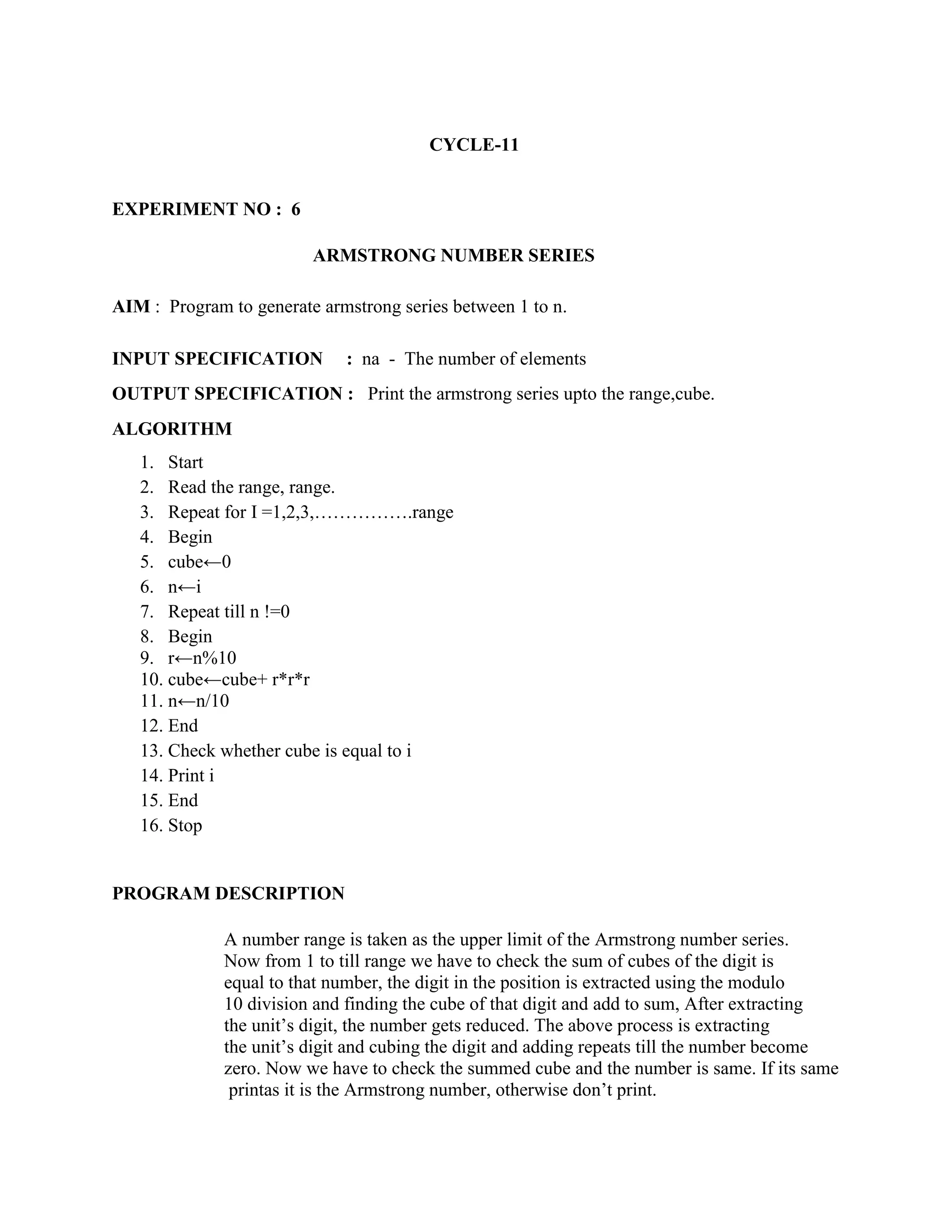
CYCLE-11


EXPERIMENT NO : 6

                         ARMSTRONG NUMBER SERIES

AIM : Program to generate armstrong series between 1 to n.

INPUT SPECIFICATION          : na - The number of elements
OUTPUT SPECIFICATION : Print the armstrong series upto the range,cube.
ALGORITHM
   1. Start
   2. Read the range, range.
   3. Repeat for I =1,2,3,…………….range
   4. Begin
   5. cube←0
   6. n←i
   7. Repeat till n !=0
   8. Begin
   9. r←n%10
   10. cube←cube+ r*r*r
   11. n←n/10
   12. End
   13. Check whether cube is equal to i
   14. Print i
   15. End
   16. Stop


PROGRAM DESCRIPTION

              A number range is taken as the upper limit of the Armstrong number series.
              Now from 1 to till range we have to check the sum of cubes of the digit is
              equal to that number, the digit in the position is extracted using the modulo
              10 division and finding the cube of that digit and add to sum, After extracting
              the unit‟s digit, the number gets reduced. The above process is extracting
              the unit‟s digit and cubing the digit and adding repeats till the number become
              zero. Now we have to check the summed cube and the number is same. If its same
               printas it is the Armstrong number, otherwise don‟t print.
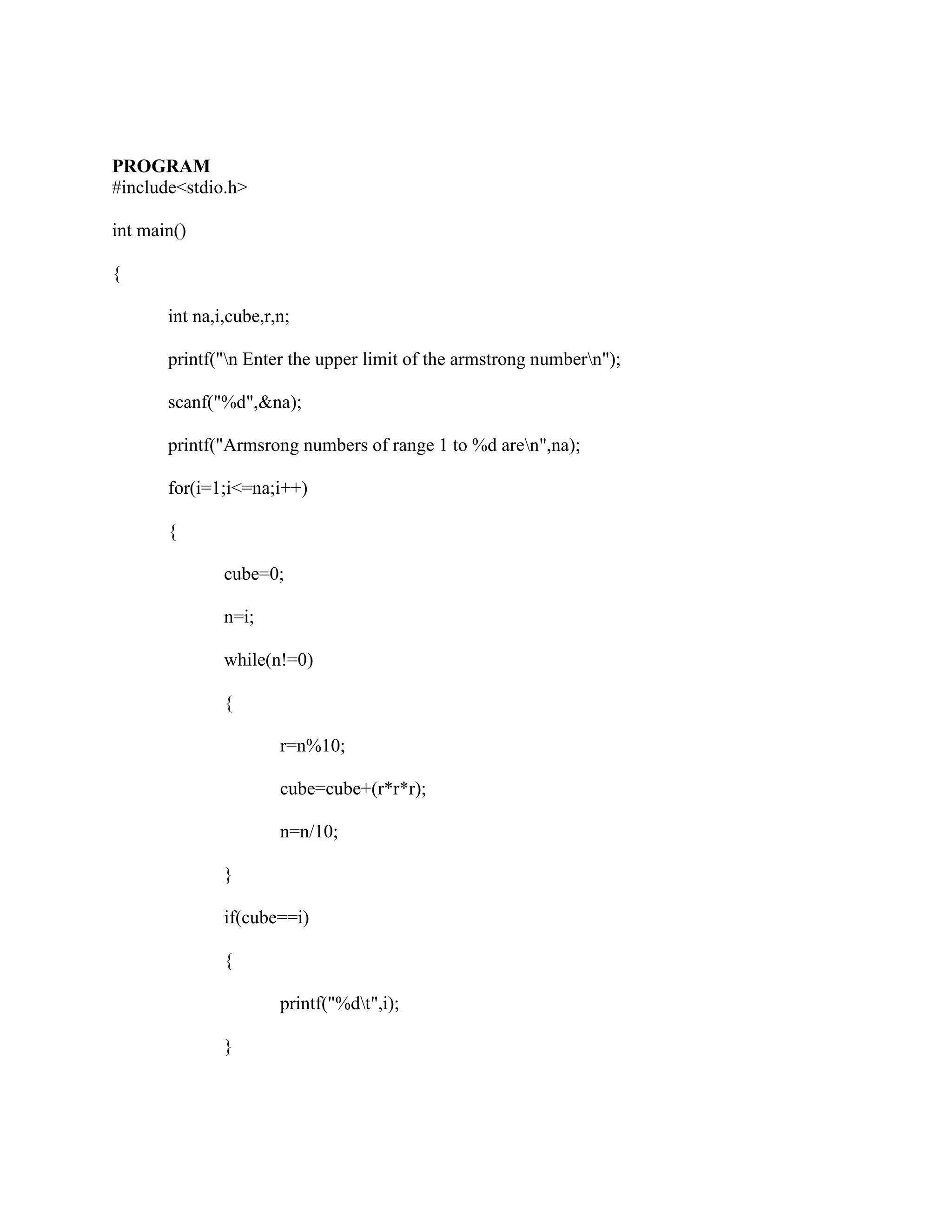
PROGRAM
#include<stdio.h>

int main()

{

       int na,i,cube,r,n;

       printf("n Enter the upper limit of the armstrong numbern");

       scanf("%d",&na);

       printf("Armsrong numbers of range 1 to %d aren",na);

       for(i=1;i<=na;i++)

       {

               cube=0;

               n=i;

               while(n!=0)

               {

                       r=n%10;

                       cube=cube+(r*r*r);

                       n=n/10;

               }

               if(cube==i)

               {

                       printf("%dt",i);

               }
}

         printf("n");

         return 0;

}

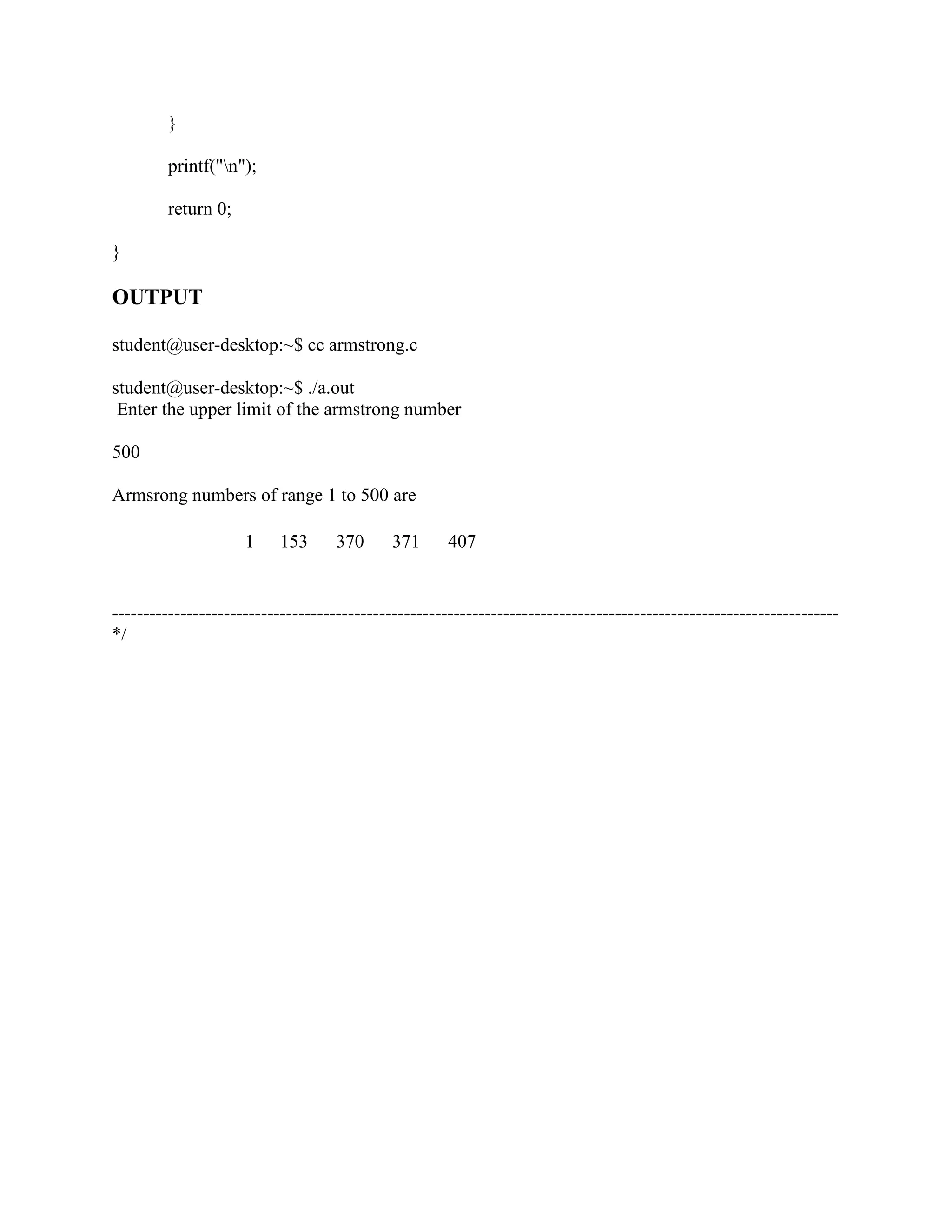
OUTPUT

student@user-desktop:~$ cc armstrong.c

student@user-desktop:~$ ./a.out
 Enter the upper limit of the armstrong number

500

Armsrong numbers of range 1 to 500 are

                     1     153      370      371      407


---------------------------------------------------------------------------------------------------------------------
*/
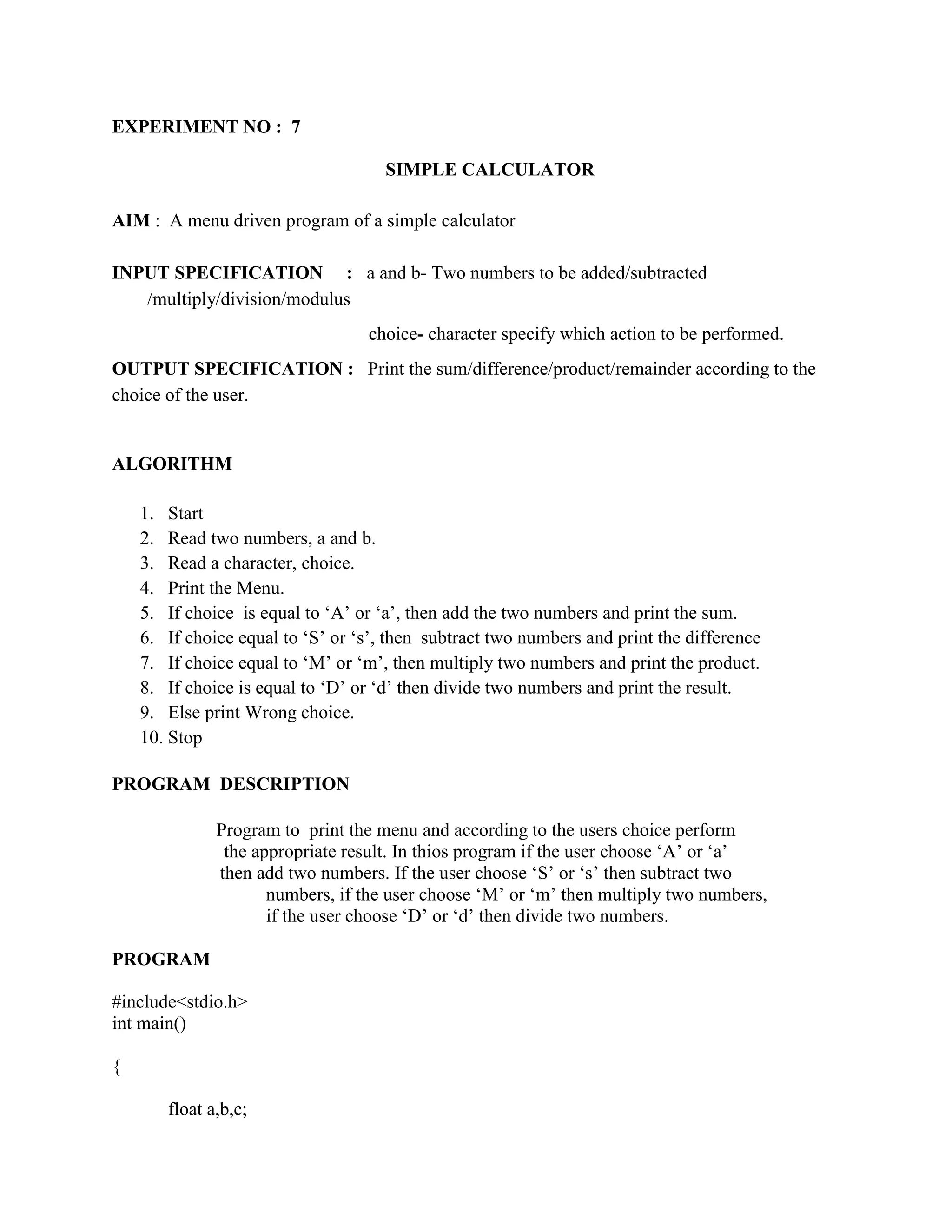
EXPERIMENT NO : 7

                                     SIMPLE CALCULATOR

AIM : A menu driven program of a simple calculator

INPUT SPECIFICATION : a and b- Two numbers to be added/subtracted
   /multiply/division/modulus
                                  choice- character specify which action to be performed.
OUTPUT SPECIFICATION : Print the sum/difference/product/remainder according to the
choice of the user.


ALGORITHM

    1. Start
    2. Read two numbers, a and b.
    3. Read a character, choice.
    4. Print the Menu.
    5. If choice is equal to „A‟ or „a‟, then add the two numbers and print the sum.
    6. If choice equal to „S‟ or „s‟, then subtract two numbers and print the difference
    7. If choice equal to „M‟ or „m‟, then multiply two numbers and print the product.
    8. If choice is equal to „D‟ or „d‟ then divide two numbers and print the result.
    9. Else print Wrong choice.
    10. Stop

PROGRAM DESCRIPTION

              Program to print the menu and according to the users choice perform
               the appropriate result. In thios program if the user choose „A‟ or „a‟
              then add two numbers. If the user choose „S‟ or „s‟ then subtract two
                     numbers, if the user choose „M‟ or „m‟ then multiply two numbers,
                     if the user choose „D‟ or „d‟ then divide two numbers.

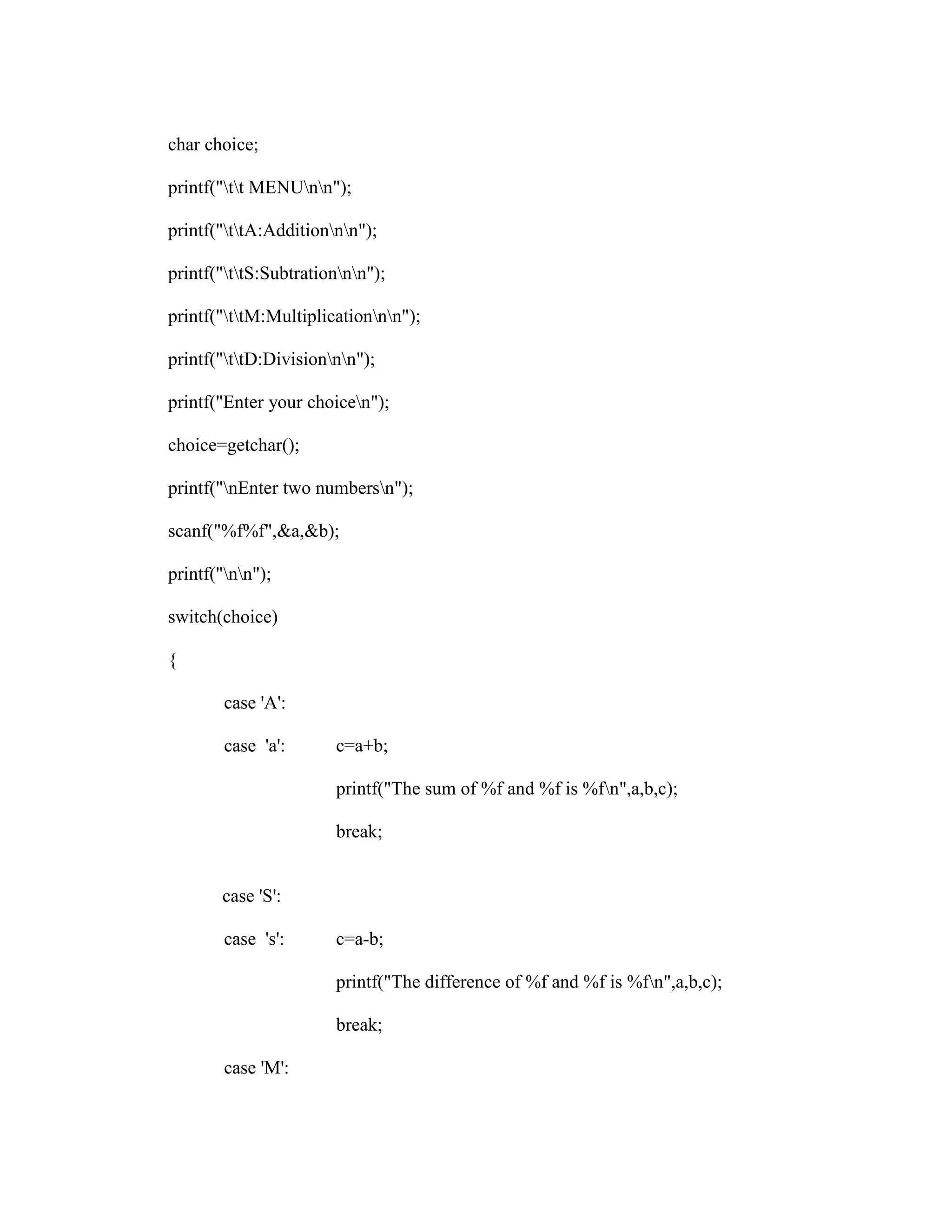
PROGRAM

#include<stdio.h>
int main()

{

       float a,b,c;
char choice;

printf("tt MENUnn");

printf("ttA:Additionnn");

printf("ttS:Subtrationnn");

printf("ttM:Multiplicationnn");

printf("ttD:Divisionnn");

printf("Enter your choicen");

choice=getchar();

printf("nEnter two numbersn");

scanf("%f%f",&a,&b);

printf("nn");

switch(choice)

{

        case 'A':

        case 'a':      c=a+b;

                       printf("The sum of %f and %f is %fn",a,b,c);

                       break;


       case 'S':

        case 's':      c=a-b;

                       printf("The difference of %f and %f is %fn",a,b,c);

                       break;

        case 'M':
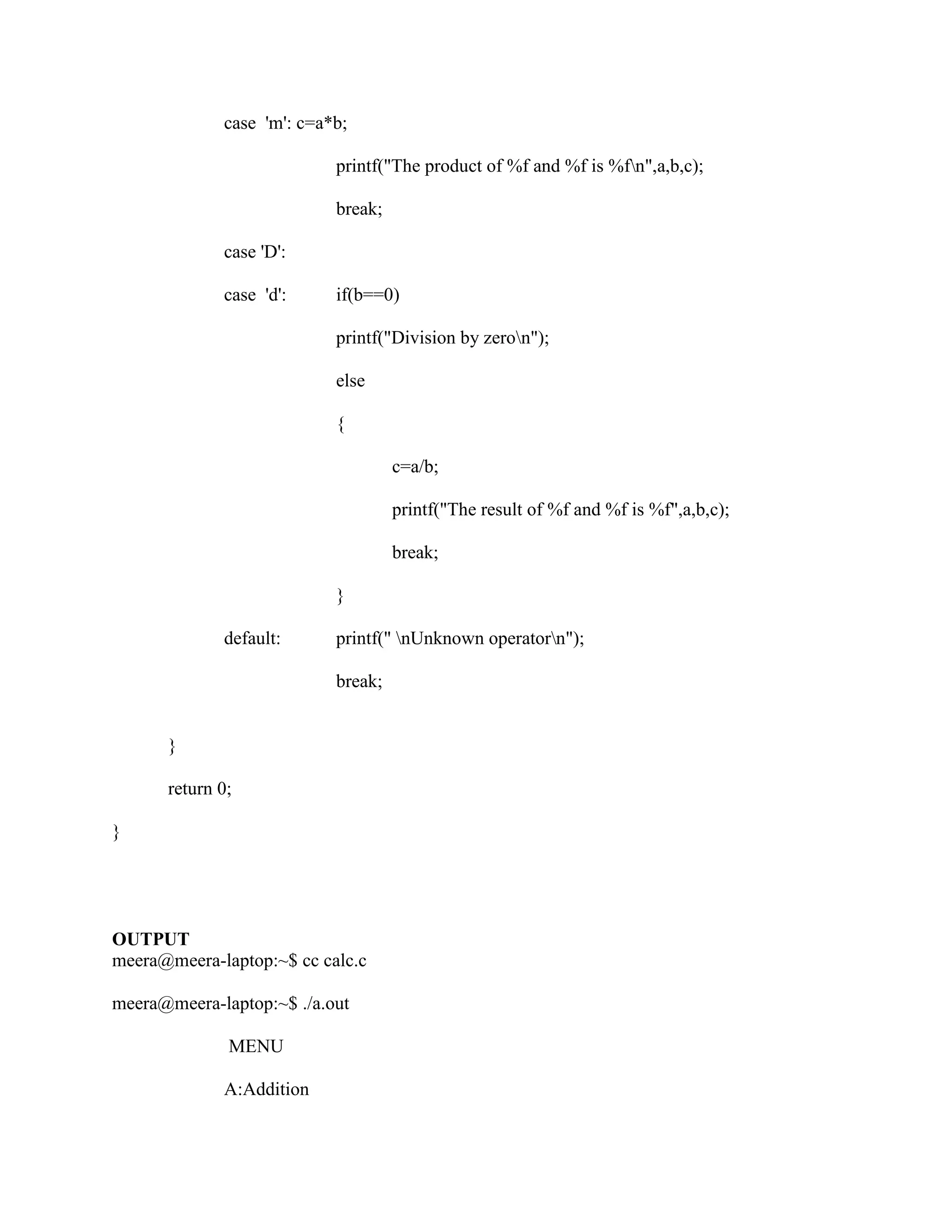
case 'm': c=a*b;

                           printf("The product of %f and %f is %fn",a,b,c);

                           break;

             case 'D':

             case 'd':     if(b==0)

                           printf("Division by zeron");

                           else

                           {

                                    c=a/b;

                                    printf("The result of %f and %f is %f",a,b,c);

                                    break;

                           }

             default:      printf(" nUnknown operatorn");

                           break;


      }

      return 0;

}


OUTPUT
meera@meera-laptop:~$ cc calc.c

meera@meera-laptop:~$ ./a.out

              MENU

             A:Addition
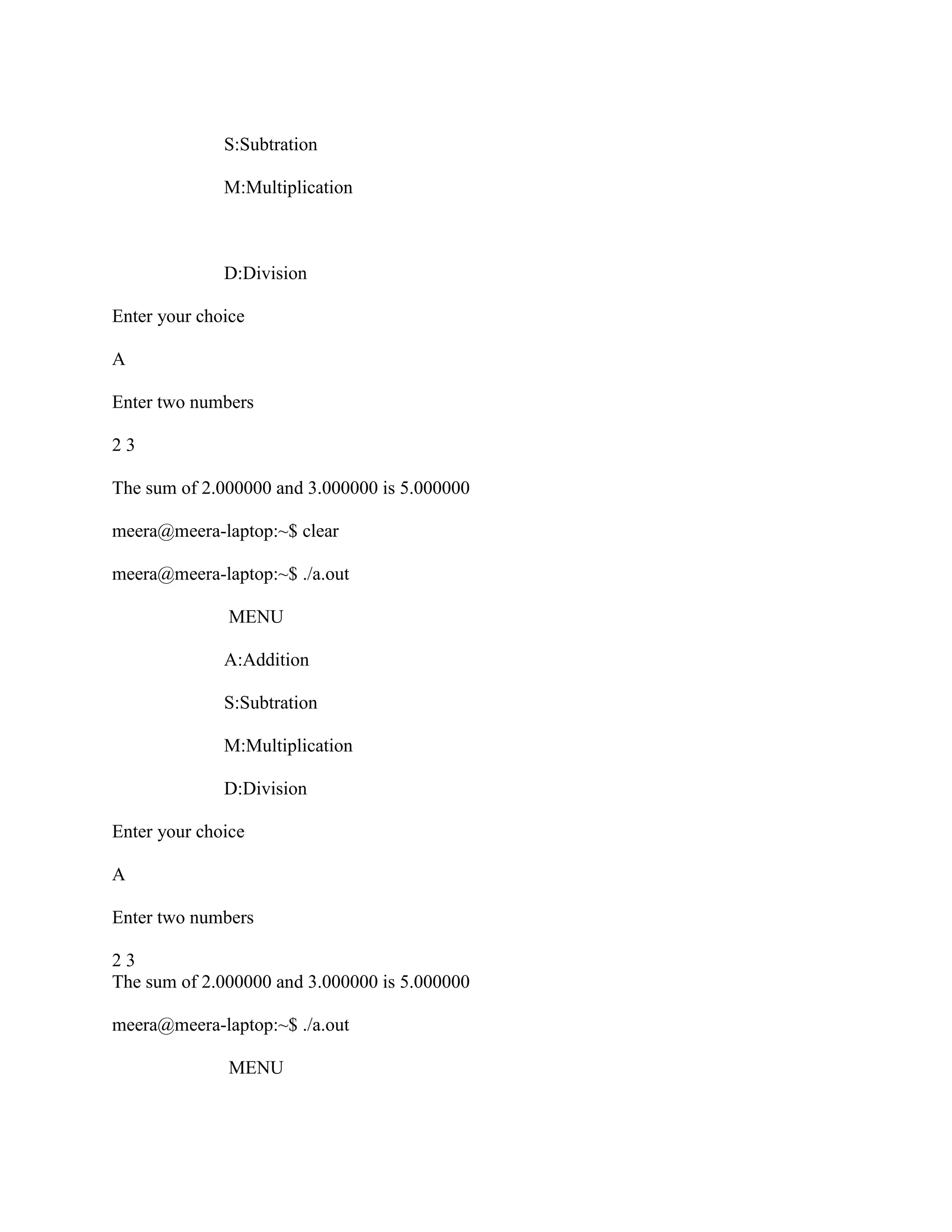
S:Subtration

              M:Multiplication


              D:Division

Enter your choice

A

Enter two numbers

23

The sum of 2.000000 and 3.000000 is 5.000000

meera@meera-laptop:~$ clear

meera@meera-laptop:~$ ./a.out

              MENU

              A:Addition

              S:Subtration

              M:Multiplication

              D:Division

Enter your choice

A

Enter two numbers

23
The sum of 2.000000 and 3.000000 is 5.000000

meera@meera-laptop:~$ ./a.out

              MENU
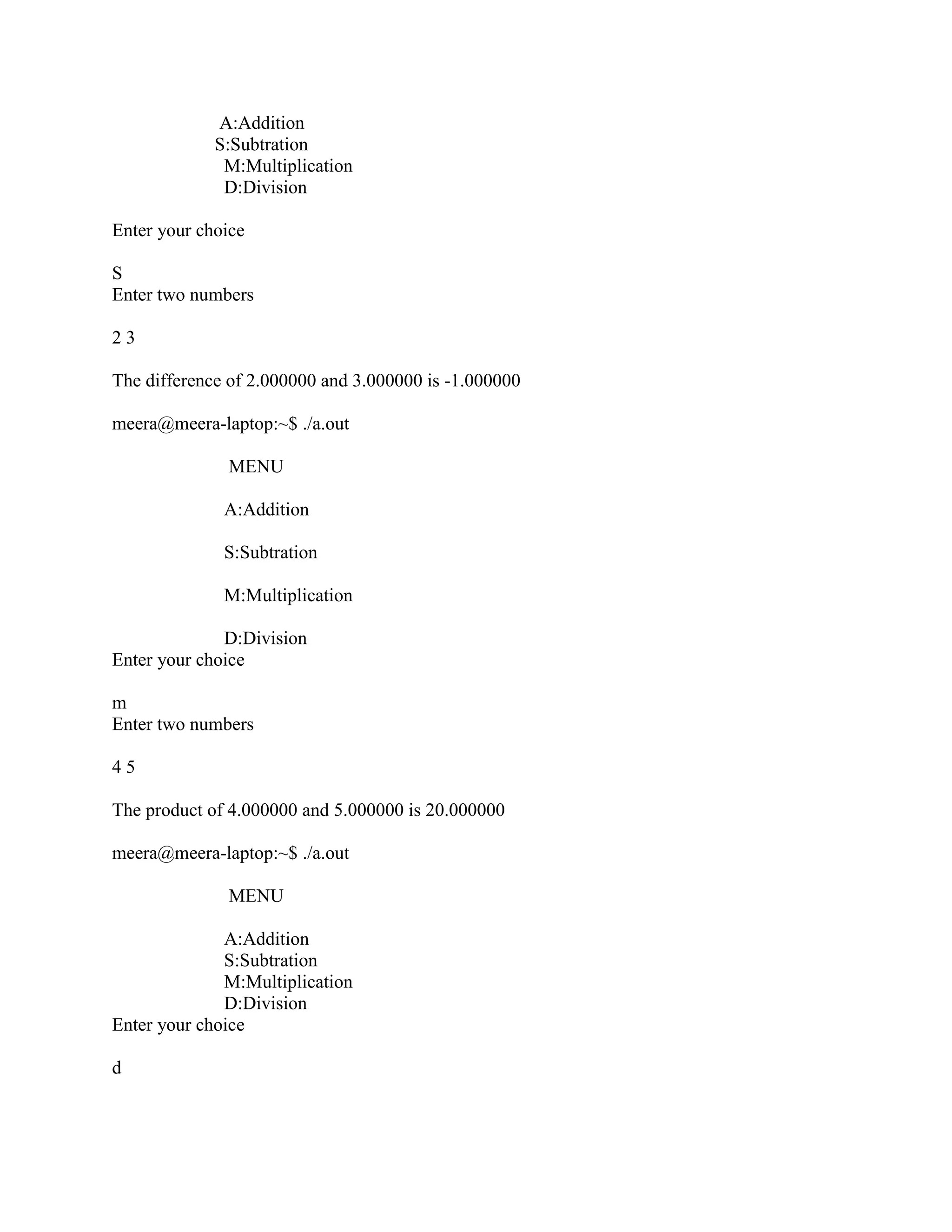
A:Addition
             S:Subtration
              M:Multiplication
              D:Division

Enter your choice

S
Enter two numbers

23

The difference of 2.000000 and 3.000000 is -1.000000

meera@meera-laptop:~$ ./a.out

              MENU

              A:Addition

              S:Subtration

              M:Multiplication

              D:Division
Enter your choice

m
Enter two numbers

45

The product of 4.000000 and 5.000000 is 20.000000

meera@meera-laptop:~$ ./a.out

              MENU

              A:Addition
              S:Subtration
              M:Multiplication
              D:Division
Enter your choice

d
Enter two numbers

45
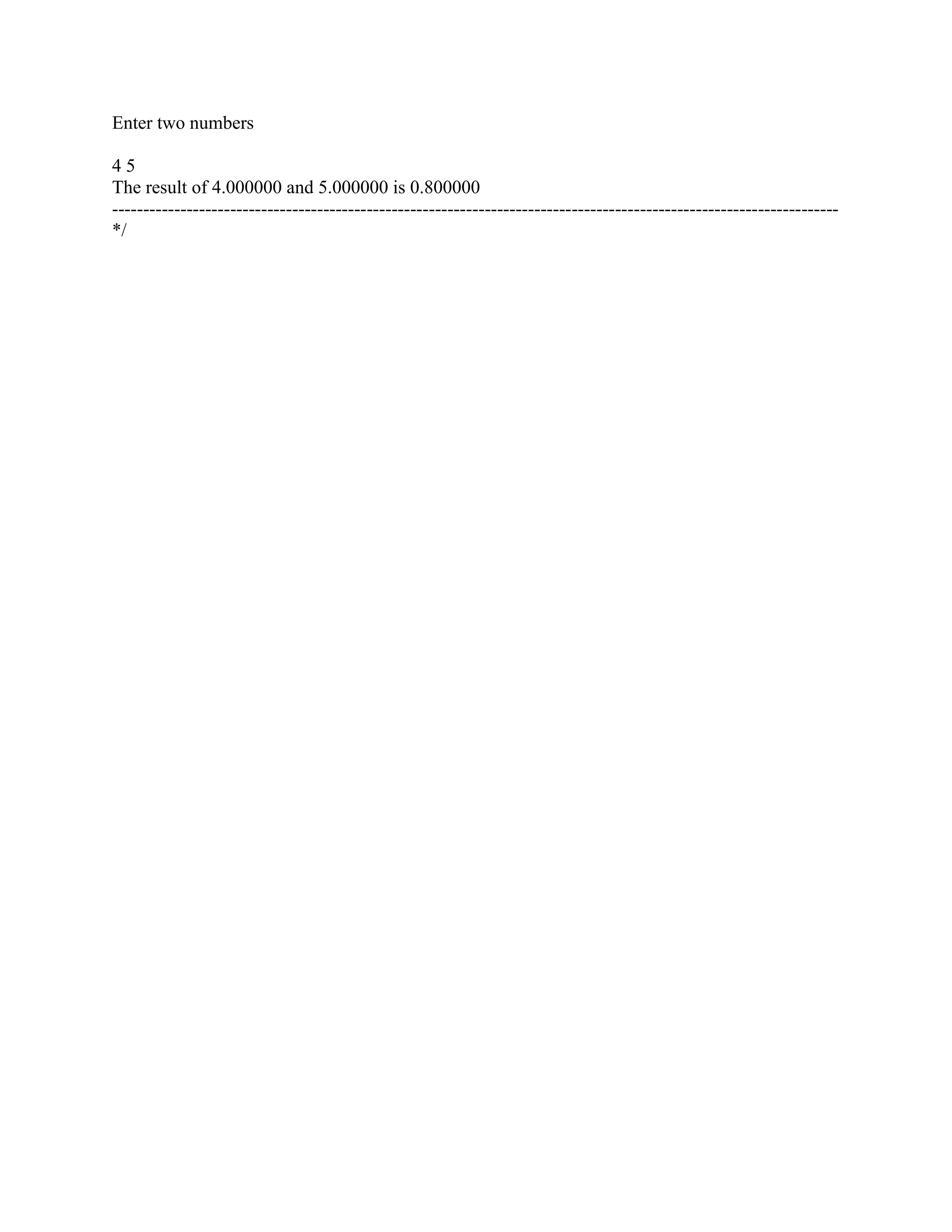
The result of 4.000000 and 5.000000 is 0.800000
---------------------------------------------------------------------------------------------------------------------
*/
EXPERIMENT NO : 8
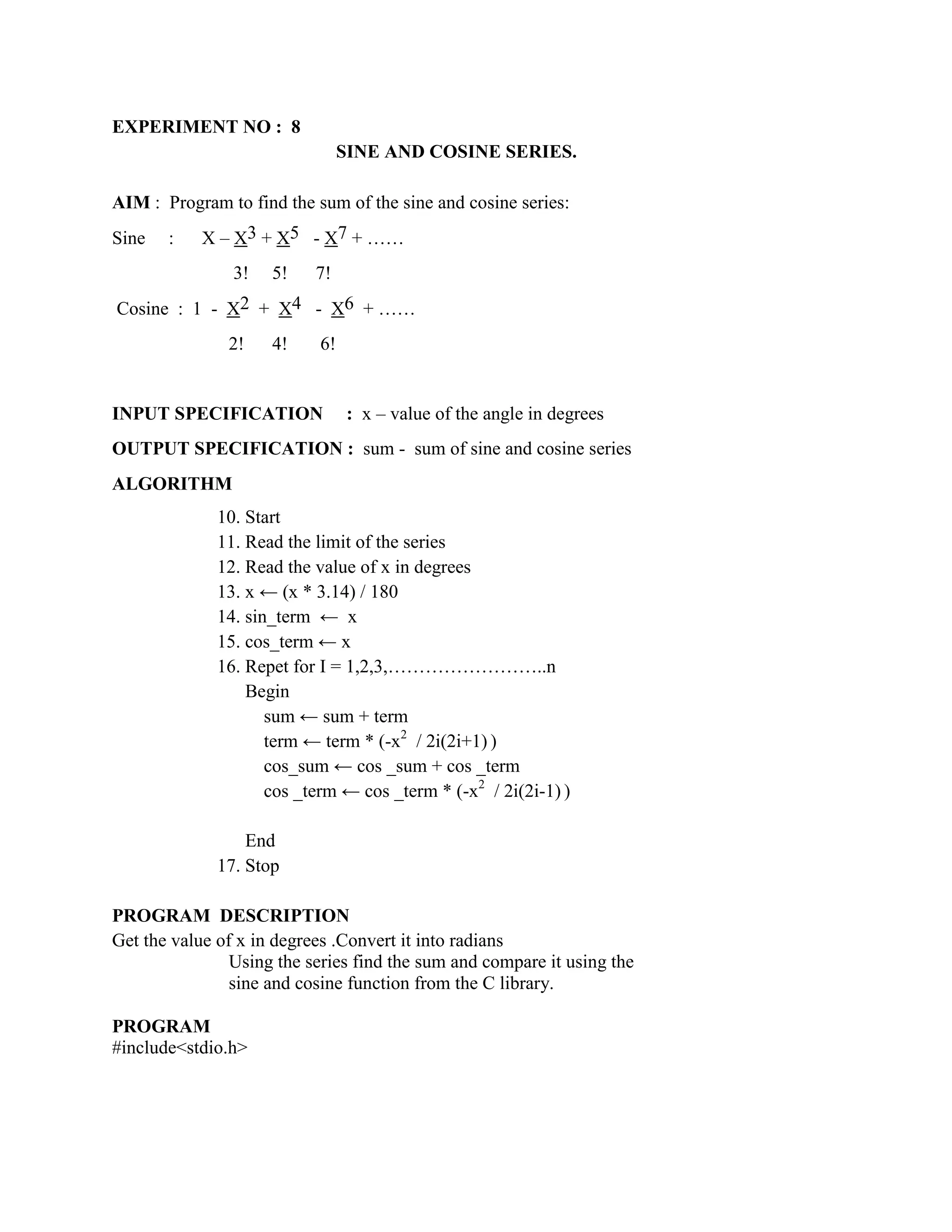
                                 SINE AND COSINE SERIES.

AIM : Program to find the sum of the sine and cosine series:
Sine   :    X – X3 + X5 - X7 + ……
                3!   5!    7!
Cosine : 1 - X2 + X4 - X6 + ……
               2!    4!     6!


INPUT SPECIFICATION              : x – value of the angle in degrees
OUTPUT SPECIFICATION : sum - sum of sine and cosine series
ALGORITHM
              10. Start
              11. Read the limit of the series
              12. Read the value of x in degrees
              13. x ← (x * 3.14) / 180
              14. sin_term ← x
              15. cos_term ← x
              16. Repet for I = 1,2,3,……………………..n
                  Begin
                     sum ← sum + term
                     term ← term * (-x2 / 2i(2i+1) )
                     cos_sum ← cos _sum + cos _term
                     cos _term ← cos _term * (-x2 / 2i(2i-1) )

                  End
              17. Stop

PROGRAM DESCRIPTION
Get the value of x in degrees .Convert it into radians
                Using the series find the sum and compare it using the
                sine and cosine function from the C library.

PROGRAM
#include<stdio.h>
#include<math.h>

int main()

{

       int n,i,x,c=3,f=1,l,sign;

       float sum;

       printf(" enter the value of x and nn");

       scanf("%d%d", &x,&n);

       sum=x;

       for(i=3;i<=n;i+=2)

       {

               f=1;

               if(c%2!=0)

               {

                       for(l=1;l<=i;l++)

                                f=f*l;

                       sum=sum-pow(x,i)/f;

               }

               else

               {
                       for(l=1;l<=i;l++)

                       f=f*l;

                       sum=sum+pow(x,i)/f;

               }
c++;

         }

         printf(" Sum of sine series=%f", sum);

         sign=1;

         sum=1;

         for(i=2;i<=n;i+=2)

         {

                   f=1;

                   sign=sign*-1;

                           for(l=1;l<=i;l++)

                                    f=f*l;

                           sum=sum+sign*pow(x,i)/f;

         }

         printf(" Sum of the cosine series= %f", sum);

         return 0;
}

OUTPUT
student@user-desktop:~$ ./a.out

enter the value of x and n

2

5

Sum of sine series=0.933333
Sum of the cosine series= -0.333333


---------------------------------------------------------------------------------------------------------------------
*/
EXPERIMENT NO : 9

                         SIMPSON’S AND TRAPEZOIDAL METHOD

AIM : Program to find the integral f(x) using Simpson‟s and trapezoidal method.

INPUT SPECIFICATION           : a and b- Values of a and b
OUTPUT SPECIFICATION : ans- Trapezoidal and simpson‟s integral result.
ALGORITHM
   1.   Start
   2.   Read the two values- a and b.
   3.   h← (b-a)/n
   4.   y[0] ←F(a)
   5.   ans←y[0]
   6.   x[0] ←a
   7.   Begin
   8.   Repeat for I=1,2,3,4………………20
               x[i] ←x[i-1]+h

              y[i] ←F(x[i])

              ans←ans+2*y[i]
   9. End.
   10. y[n] ←F(b)
   11. ans←ans+y[n]
   12. ans←ans*h/2
   13. Print the ans- Trapezoidal
   14. h← (b-a)/n
   15. y[0] ←F(a)
   16. ans←y[0]
   17. x[0] ←a
   18. Begin
   19. Repeat for I=1,3,5………………19
               x[i] ←x[i-1]+h

              y[i] ←F(x[i])

              ans←ans+4*y[i]
   20. End.
   21. Repeat for I=2,4,6………………20
              x[i] ←x[i-1]+h
y[i] ←F(x[i])

                 ans←ans+2*y[i]
    22. End.
    23. y[n] ←F(b)
    24. ans←ans+y[n]
    25. ans←ans*h/3
    26. Print the ans- Simpson‟s
    27. Stop


PROGRAM DESCRIPTION

        Finding the sum of integral f(x) with the help of simpson‟s and trapezoidal rule.

PROGRAM
#include<stdio.h>

# define F(x) (1/(1+x))

#define n 10

int main()

{

       float a,b,h,x[20],y[20],ans;

       int i;

       printf("enter the values of a and bn");

       scanf("%f%f",&a,&b);


       /* TRAPEZOIDAL METHOD*/

       h=(b-a)/n;

       y[0]=F(a);

       ans=y[0];

       x[0]=a;
for(i=1;i<n;i++)

{
       x[i] ←x[i-1]+h;

          y[i] ←F(x[i]);

          ans←ans+2*y[i];

}

y[n] ←F(b);

ans←ans+y[n];

ans←ans*h/2;

printf(" Trapezoidal answer=%fn",ans);


/* SIMPSON'S METHOD*/

h=(b-a)/n;

y[0]=F(a);

ans=y[0];

x[0]=a;

for(i=1;i<n;i+=2)

{

          x[i]=x[i-1]+h;

          y[i]=F(x[i]);

          ans=ans+4*y[i];

}

for(i=2;i<n;i+=2)
{

                  x[i]=x[i-1]+h;

                  y[i]=F(x[i]);

                  ans=ans+2*y[i];

         }

         y[n]=F(b);

         ans=ans+y[n];

         ans=ans*h/3;


         printf(" simpson's answer=%fn",ans);

}

OUTPUT
student@user-desktop:~$ cc simpson_trapezoidal.c

student@user-desktop:~$ ./a.out

enter the values of a and b

2

3

Trapezoidal answer=0.288690

simpson's answer=0.287698

      ---------------------------------------------------------------------------------------------------------------
------*/
EXPERIMENT NO : 10


                                      SELECTION SORTING

AIM : Program using function to sort a given unsorted array using selection sort method.

INPUT SPECIFICATION             : n - The number of elements
                                  a - The array to store the numbers
OUTPUT SPECIFICATION : Print the sorted list.


ALGORITHM

   1.   Start
   2.   Read the value of number of elements of the array, N
   3.   Read the array elements, A
   4.   Repeat for I = 1, 2, …………N-1
            Begin
                       MIN← I
                       Repeat for J = 2, …………N
                       Begin
                              If a[J]<A[ MIN]
                              MIN = j
                       End
                              TEMP=A[I]
                              A[I]=A[M]
                              A[M]=TEMP
            End

   5. Print the sorted array
   1. Stop

PROGRAM DESCRIPTION

Program to find the list of unsorted array to a sorted one using selection sorting method.

PROGRAM
#include<stdio.h>
int main()

{
       int a[20],i,n,m,temp;

       printf(" Enter the number of elementsn");

       scanf("%d",&n);

       printf("Enter the numbersn");

       for(i=0;i<n;i++)

       {

               scanf("%d",&a[i]);

       }

       printf(" The unsorted array isn");

       for(i=0;i<n;i++)

       {

               printf("%dt", a[i]);

       }

       printf("n");

       for(i=0;i<n-1;i++)

       {

               m=min(a,n,i);

               temp=a[i];

               a[i]=a[m];

               a[m]=temp;

       }
printf("Sorted Arrayn");

        for(i=0;i<n;i++)

        printf("%dt",a[i]);

        printf("n");

        return 0;
}

int min(int a[20],int n,int i)

{

                int temp,min,j;
                min=i;
                for(j=i+1;j<n;j++)
                if(a[j]<a[min])
                min=j;
                return min;

}


OUTPUT

student@user-desktop:~$ ./a.out

Enter the number of elements

6

Enter the numbers

43

21

34

67

42
1


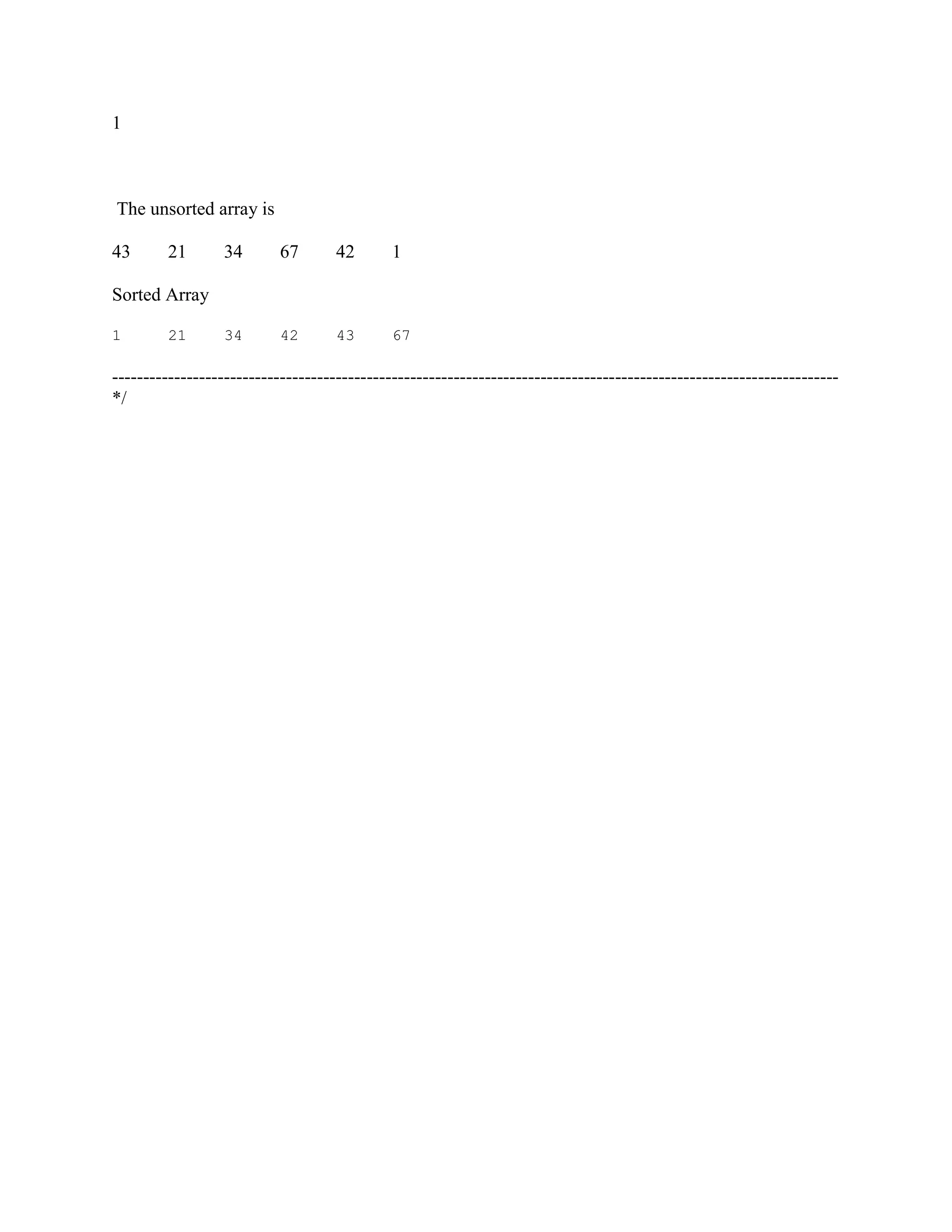
The unsorted array is

43       21       34       67       42       1

Sorted Array

1        21       34       42       43       67

---------------------------------------------------------------------------------------------------------------------
*/
CYCLE-111

EXPERIMENT NO : 11

         NUMBER OF SENTENCES,WORDS ,LETTERS IN A LINE OF TEXT

AIM : Program to find the number of sentences, words, letter in the text

INPUT SPECIFICATION            : text – the line of text
OUTPUT SPECIFICATION : sen_count                - Prints the number of sentences in the text
                              word_count - Prints the number of words in the text
                              letter_count - Prints the number of letters in the text
ALGORITHM
   1. Start
   2. Set sen_count=0,word_count=0,letter_count=0
   3. Get the line of text and store it in „text‟
   4. len = strlen(text)
   5. i=0
   6. Is i < n
             Then goto step 7
             Else go to step 10
   7. If text[i] is . or ?
                           Then sen_count = sen_count + 1

   8. If text[i] is space or .     or t or ! ,
                         Then      word_count = word_count + 1

   9. If ( text[i] >= 65 and text[i] <= 90) or
       ( text[i] >= 97 and text[i] <= 122))
                          Then letter_count = letter_count + 1
   10. Print sen_count , word_count and letter_count
   11. Stop


PROGRAM DESCRIPTION

              sentence count - checks for ? and .
               word count     - checks for ? . , ! t and space
               letter count - Checks the ASCII value
PROGRAM

#include<stdio.h>
#include<conio.h>
#include<string.h>

void main()
{
  char text[100];
  int i,len;
  int sen_count=0,word_count=0,letter_count=0;
  clrscr();

  printf("nttCounts the no: of sentences, words and lettersn");
  printf("tt----------------------------------------------n");

  printf("nnEnter a line of text : ");
  scanf("%[^n]s",&text);

  len = strlen(text);

  //Computes the number of sentences,words and letters.

  for(i=0;i<len;i++)
  {
       if(text[i] == '.' || text[i] == '?')
                sen_count = sen_count + 1;

       if(text[i] == ' ' || text[i] == '.' || text[i] == 't' ||
         text[i] == '!' || text[i] == ','|| text[i] == '?')
                word_count = word_count + 1;

       if((text[i] >= 65 && text[i] <= 90) ||
         (text[i] >= 97 && text[i] <= 122))
                letter_count = letter_count + 1;
  }


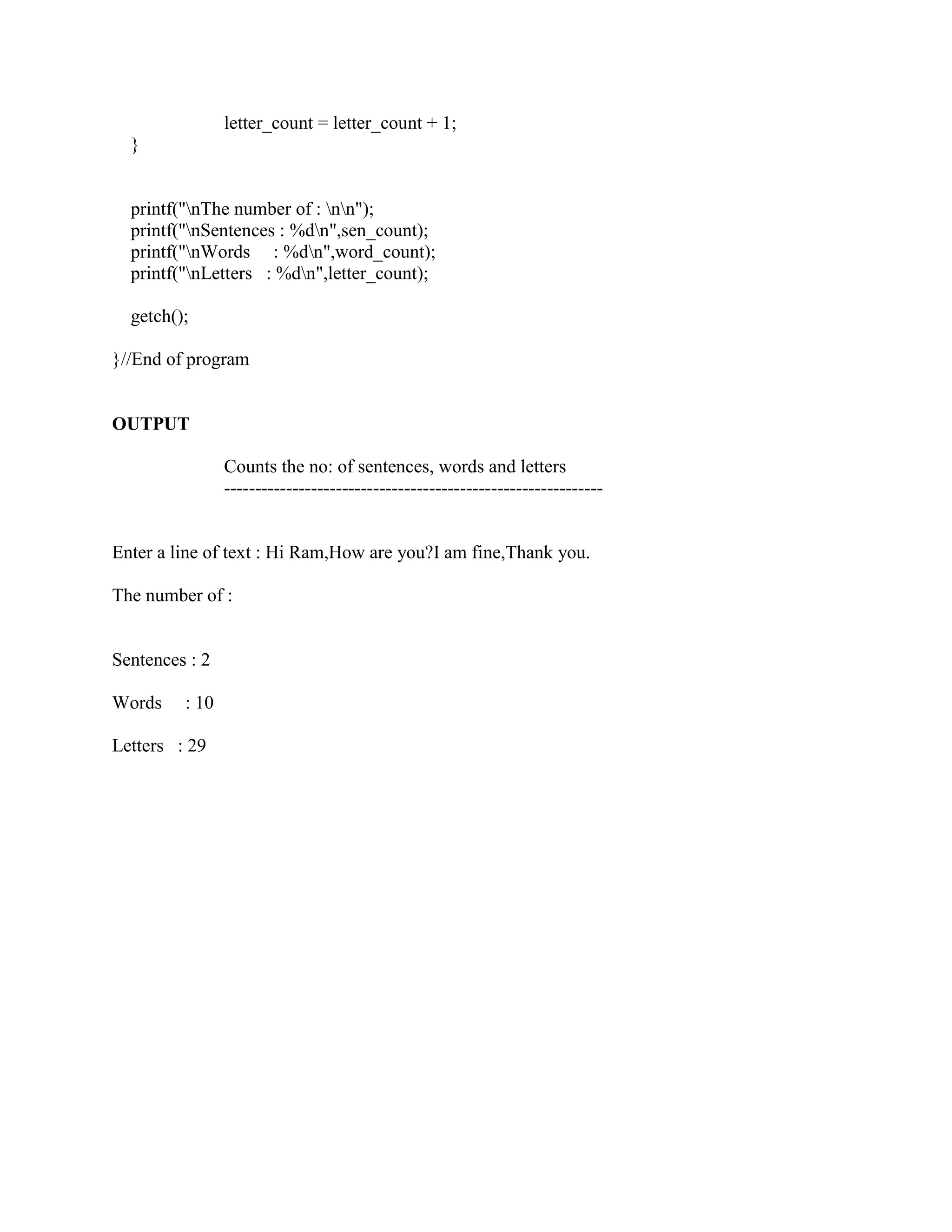
  printf("nThe number of : nn");
  printf("nSentences : %dn",sen_count);
  printf("nWords : %dn",word_count);
  printf("nLetters : %dn",letter_count);

  getch();
}//End of program


OUTPUT

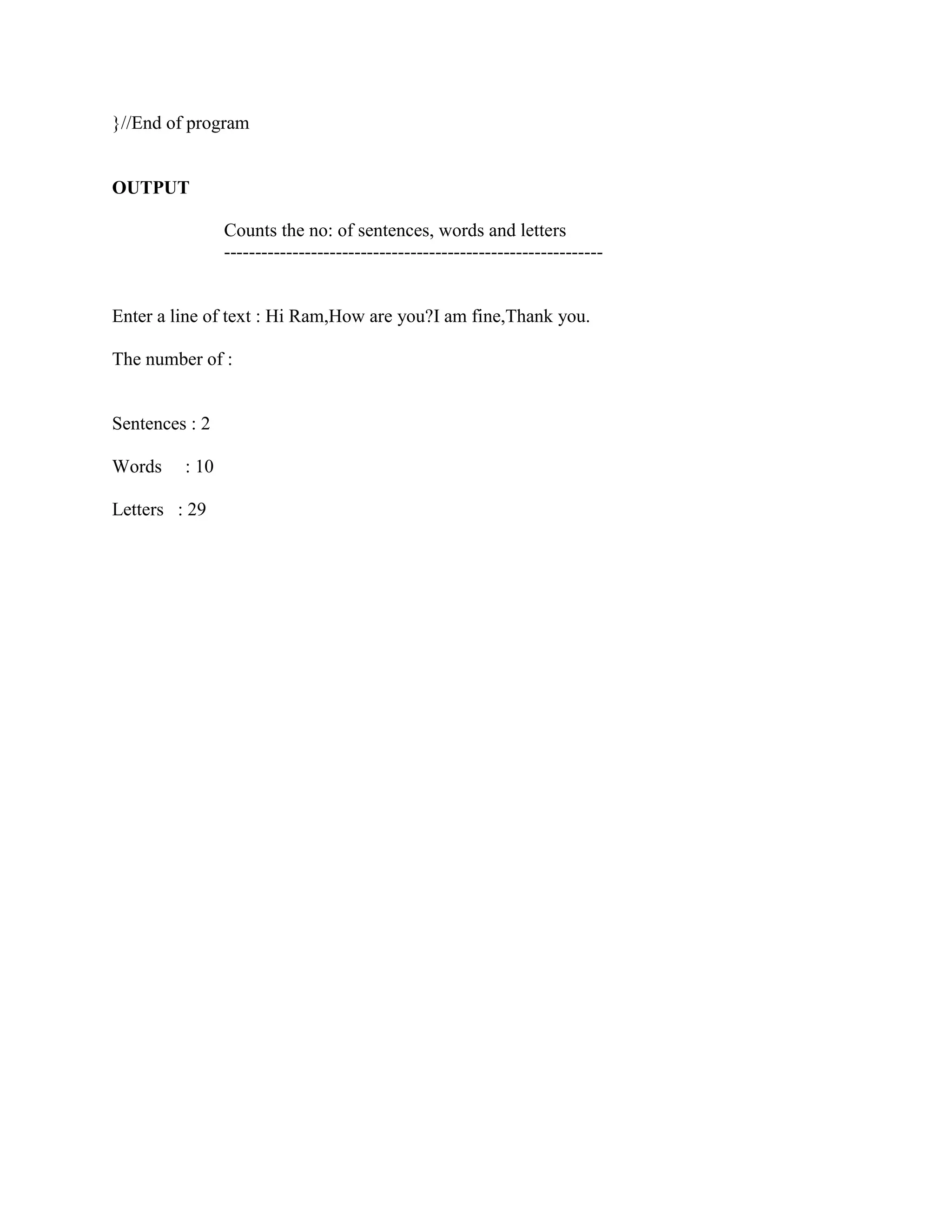
                Counts the no: of sentences, words and letters
                -------------------------------------------------------------


Enter a line of text : Hi Ram,How are you?I am fine,Thank you.

The number of :


Sentences : 2

Words    : 10

Letters : 29
EXPERIMENT NO : 12

                                     SORTING OF NAMES

AIM : Program to read „n‟ names and to sort them in alphabetical order.

INPUT SPECIFICATION           : limit - The number of elements
                                 name - The array to store the names
OUTPUT SPECIFICATION : print the number in the sorted order
ALGORITHM

   1. Start
   2. Read the value of number of names, limit
   3. Read the array names, A
   4. Repeat for I= 1, 2, …………N-1
          Begin
              Repeat for J = 1, 2,…………….N-1
                     Begin
                             IF name[I] > name[I+1] THEN
                                   Begin
                                           TEMP = name[I]
                                           name[I] = name[I+1]
                                           name[I+1] = TEMP
                                   End
                     End
         End
   5. Print “ The Sorted names are “
   6. Repeat for I = 1, 2, …………………….N
              Begin
                     Print name[I]
              End
   7. Stop
PROGRAM DESCRIPTION

Program to sort n names in ascending order using bubble sort


PROGRAM

#include<stdio.h>

#include<string.h>

int main()

{

       char name[10][10],temp[20];

       int i,j,limit;

       printf("Enter the upper limit not more than 10n");

       scanf("%d",&limit);

       printf("Enter the namesn");

       for(i=0;i<limit;i++)

       {

               scanf("%s",name[i]);

       }

       printf(" The unsorted array of names aren");

       for(i=0;i<limit;i++)

       {

                        puts(name[i]);

                        printf("n");

       }
printf("The sorted array of names aren");

        for(j=0;j<limit-1;j++)

        {
               for(i=0;i<limit-1;i++)

                       if(strcmp(name[i],name[i+1]) >0)

                       {
                                 strcpy(temp,name[i]);

                                 strcpy(name[i],name[i+1]);

                                 strcpy(name[i+1],temp);

                       }
        }

        for(i=0;i<limit;i++)

        printf("%sn", name[i]);
        printf("nn");
        return 0;
}

OUTPUT

meera@meera-laptop:~$ cc name_sort.c

meera@meera-laptop:~$ ./a.out

Enter the upper limit not more than 10

6
Enter the names
meera
meena
deepa
deepu
seena
teena

The unsorted array of names are

meera
meena
deepa
deepu
seena
teena
---------------------------------------------------------------------------------------------------------------------
*/
EXPERIMENT NO : 13


                       MATRIX ADDITION AND DIFFERENCE


AIM : Program to add and difference of two matrix.

INPUT SPECIFICATION          : (r1,r2) The order of the matrix
                               A , B ,the input matrices whose sum and difference has to be
    found
OUTPUT SPECIFICATION : C , the output matrix which stores the sum and difference A
   and B
ALGORITHM


   1. Start
   2. Read the order fo the matrics (r1,c1)
   3. READ_MATRIX A
      Begin
            Repeat for I = 1,2,………………….m
            Begin
                 Repeat for J = 1,2,………………….n
                     Read a[i][j]
             End
      End
   4. READ_MATRIX B
      Begin
            Repeat for I = 1,2,………………….m
            Begin
                 Repeat for J = 1,2,………………….n
                     Read b[i][j]
             End
      End


   5.    WRITE_MATRIX A
        Begin
             Repeat for I = 1,2,………………….m
              Begin
                   Repeat for J = 1,2,………………….n
                      Write a[i][j]
              End
        End
6.  WRITE_MATRIX B
      Begin
           Repeat for I = 1,2,………………….m
            Begin
                 Repeat for J = 1,2,………………….n
                    Write b[i][j]
            End
      End
   7. ADD_MATRIX
      Begin
           Repeat for I = 1,2,………………….m
            Begin
                 Repeat for J = 1,2,………………….n
                         C[i][j] ← A[i][j] + B[i][j]

            End
      End
   8. SUBTRACT MATRIX
      Begin
           Repeat for I = 1,2,………………….m
            Begin
                 Repeat for J = 1,2,………………….n
                         C[i][j] ← A[i][j] - B[i][j]

             End
       End
   9. Print matrix C
   10. Stop

PROGRAM DESCRIPTION

Addition and subtraction of two matrices a and b.

PROGRAM

#include<stdio.h>
int main()
{
       int i,j,a[10][10],b[10][10],c[10][10],r1,c1;
       printf("Enter the order of Matrix A and B up to 10*10:n");
       scanf("%d%d",&r1,&c1);
       printf(" Enter the elements in Matrix An");
       for(i=0;i<r1;i++)
       {
                 for(j=0;j<c1;j++)
                 scanf("%d",&a[i][j]);
}
printf(" Enter the elements in Matrix Bn");
for(i=0;i<r1;i++)
{
        for(j=0;j<c1;j++)
        scanf("%d",&b[i][j]);
}
printf(" The elements in Matrix An");
for(i=0;i<r1;i++)
{
        for(j=0;j<c1;j++)
        printf("%dt",a[i][j]);
        printf("n");
}
printf(" The elements in Matrix Bn");
for(i=0;i<r1;i++)
{
        for(j=0;j<c1;j++)
        printf("%dt",b[i][j]);
        printf("n");
}
printf(" Matrix Additionn");
        for(i=0;i<r1;i++)
        {
                for(j=0;j<c1;j++)
                c[i][j]=a[i][j]+b[i][j];
        }
for(i=0;i<r1;i++)
{
        for(j=0;j<c1;j++)
        printf("%dt",c[i][j]);
        printf("n");
}
printf(" Matrix Subtractionn");
for(i=0;i<r1;i++)
        {
                for(j=0;j<c1;j++)
                c[i][j]=a[i][j]-b[i][j];
        }
for(i=0;i<r1;i++)
{
        for(j=0;j<c1;j++)
        printf("%dt",c[i][j]);
        printf("n");
}
return 0;
}


OUTPUT

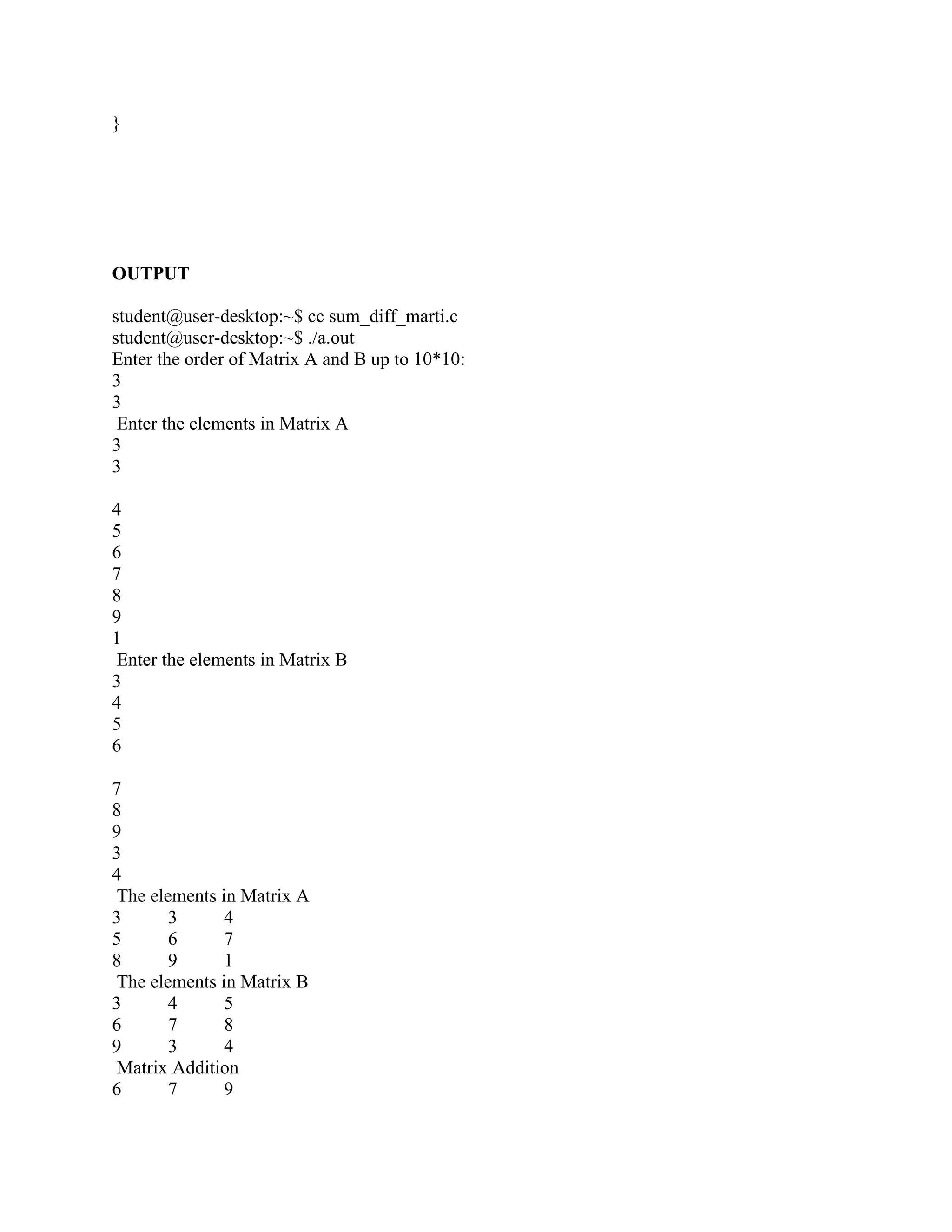
student@user-desktop:~$ cc sum_diff_marti.c
student@user-desktop:~$ ./a.out
Enter the order of Matrix A and B up to 10*10:
3
3
 Enter the elements in Matrix A
3
3

4
5
6
7
8
9
1
 Enter the elements in Matrix B
3
4
5
6

7
8
9
3
4
 The elements in Matrix A
3       3      4
5       6      7
8       9      1
 The elements in Matrix B
3       4      5
6       7      8
9       3      4
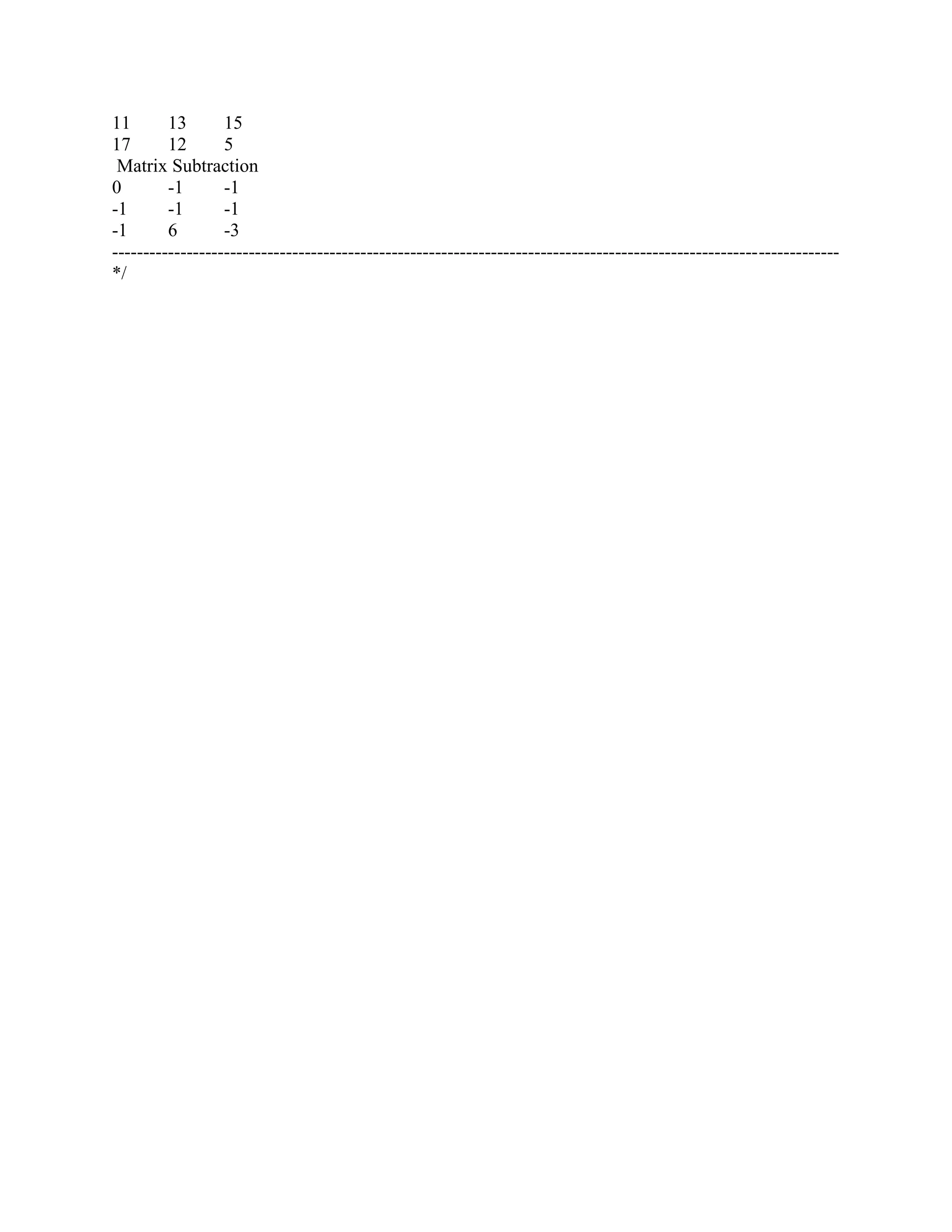
 Matrix Addition
6       7      9
11       13       15
17       12       5
 Matrix Subtraction
0        -1       -1
-1       -1       -1
-1       6        -3
---------------------------------------------------------------------------------------------------------------------
*/
EXPERIMENT NO : 14


                             MATRIX MULTIPLICATION


AIM : Program to multiply two matrix.

INPUT SPECIFICATION         : (r1,c1) The order of the matrix A
                               (r2,c2) The order of matrix B
                               A , B ,the input matrices whose product has to be found
OUTPUT SPECIFICATION : C , the output matrix which stores the product of A and B
ALGORITHM


   1. Start
   2. Read the order of the matrics (r1,c1) A
   3. Read the order of the matrices (r2,c2) B
   4. READ_MATRIX A
      Begin
            Repeat for I = 1,2,………………….r1
            Begin
                 Repeat for J = 1,2,………………….c1
                     Read a[i][j]
             End
      End
   5. READ_MATRIX B
      Begin
            Repeat for I = 1,2,………………….r2
            Begin
                 Repeat for J = 1,2,………………….c2
                     Read b[i][j]
             End
      End


   6.    WRITE_MATRIX A
        Begin
             Repeat for I = 1,2,………………….r1
              Begin
                   Repeat for J = 1,2,………………….c2
                      Write a[i][j]
              End
        End
7.    WRITE_MATRIX B
         Begin
              Repeat for I = 1,2,………………….r2
               Begin
                    Repeat for J = 1,2,………………….c2
                       Write b[i][j]
               End
         End

    8. Repeat step 9 until i<r1,j<c2,k<c1
    9.d[i][j]=0;
    10. c[i][j]=c[i][j]+a[i][k]*b[k][j]
    11.Set a loop to print matrix values.
    12.Print matrix value c[i][j]
    13. Stop.

PROGRAM DESCRIPTION

Product of two matrices a and b.

PROGRAM
#include<stdio.h>

int main()

{

         int i,j,a[10][10],b[10][10],c[10][10],r1,c1,r2,c2,sum,k;

         printf("Enter the order of Matrix A up to 10*10:n");

         scanf("%d%d",&r1,&c1);

         printf("Enter the order of Matrix B up to 10*10:n");

         scanf("%d%d",&r2,&c2);

         printf(" Enter the elements in Matrix An");

         for(i=0;i<r1;i++)

         {

                for(j=0;j<c1;j++)

                scanf("%d",&a[i][j]);
}

printf(" Enter the elements in Matrix Bn");

for(i=0;i<r2;i++)

{

       for(j=0;j<c2;j++)

       scanf("%d",&b[i][j]);

}

printf(" The elements in Matrix An");

for(i=0;i<r1;i++)

{

       for(j=0;j<c1;j++)

       printf("%dt",a[i][j]);

       printf("n");

}

printf(" The elements in Matrix Bn");

for(i=0;i<r2;i++)

{

       for(j=0;j<c2;j++)

       printf("%dt",b[i][j]);

       printf("n");

}

if(c1!=r1)

{
printf("Matrix cannot be muliplicablen");

           //exit(1);

    }

    printf(" Matrix Multiplicationn");

           for(i=0;i<r1;i++)

           {

                   for(j=0;j<c2;j++)

                   {

                           sum=0;

                           for(k=0;k<c1;k++)

                                     sum+=a[i][k]*b[k][j];

                           c[i][j]=sum;

                   }

           }

    for(i=0;i<r1;i++)

    {

           for(j=0;j<c2;j++)

           printf("%dt",c[i][j]);

           printf("n");

    }

    return 0;

}
OUTPUT

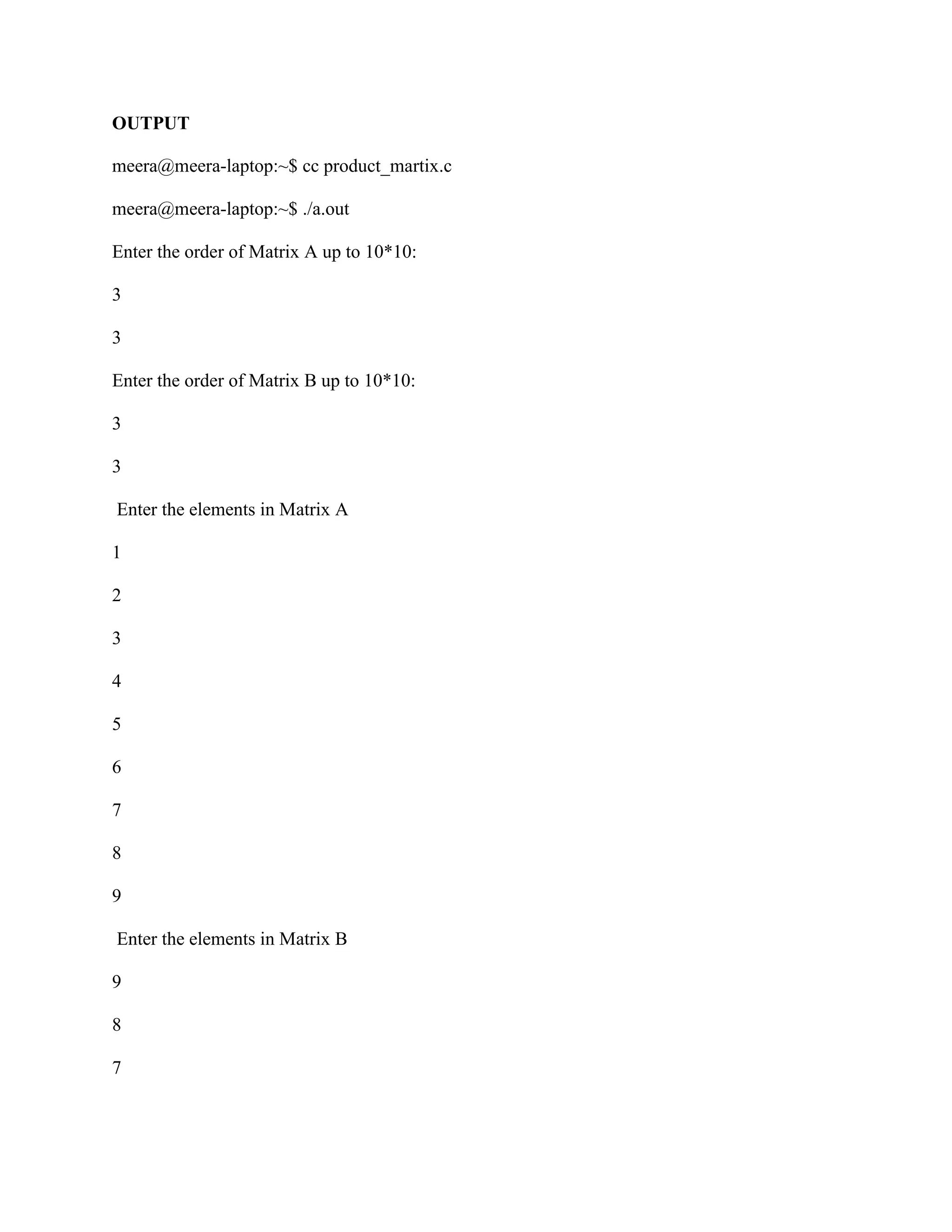
meera@meera-laptop:~$ cc product_martix.c

meera@meera-laptop:~$ ./a.out

Enter the order of Matrix A up to 10*10:

3

3

Enter the order of Matrix B up to 10*10:

3

3

Enter the elements in Matrix A

1

2

3

4

5

6

7

8

9

Enter the elements in Matrix B

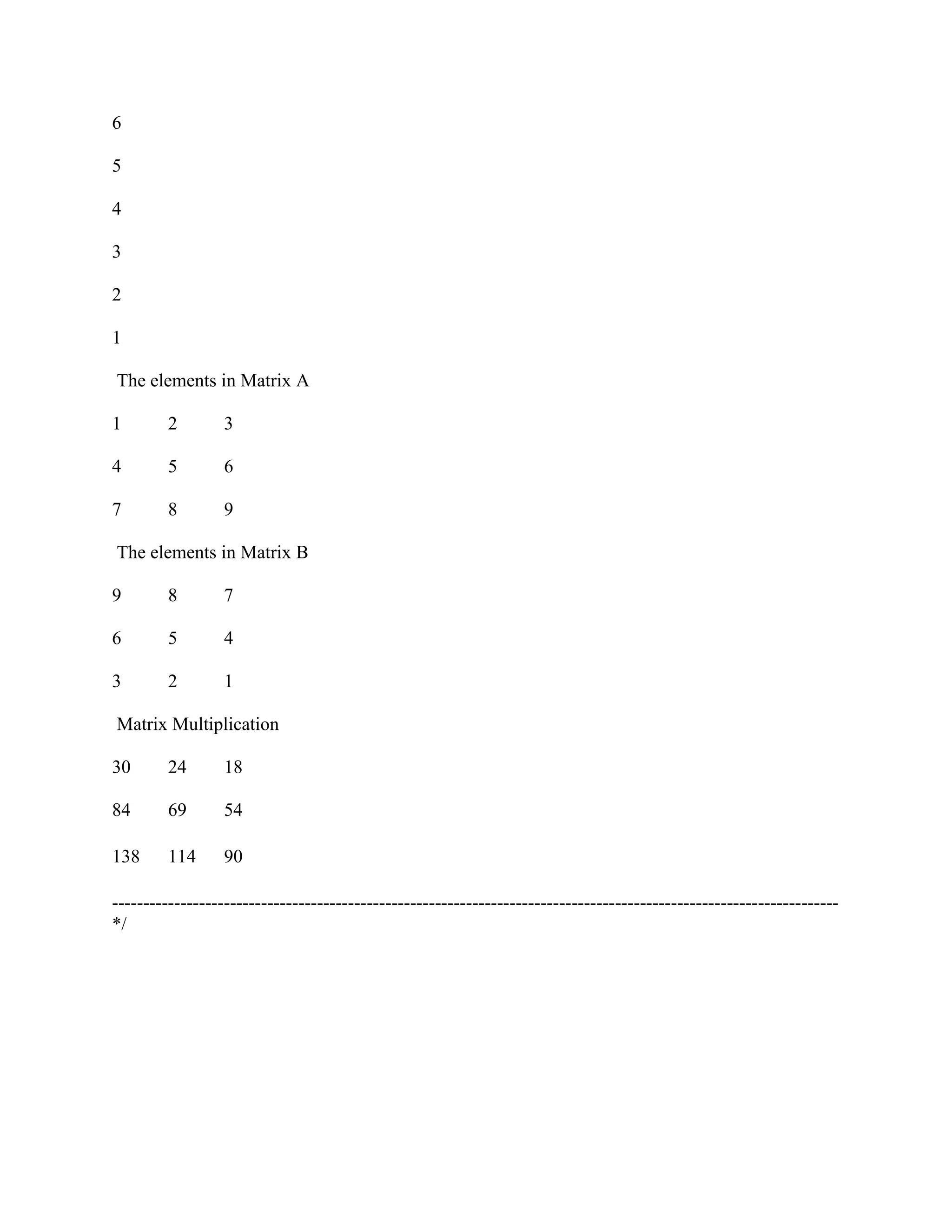
9

8

7
6

5

4

3

2

1

The elements in Matrix A

1        2        3

4        5        6

7        8        9

The elements in Matrix B

9        8        7

6        5        4

3        2        1

Matrix Multiplication

30       24       18

84       69       54

138      114      90

---------------------------------------------------------------------------------------------------------------------
*/
EXPERIMENT NO : 15

                          SEARCHING USING BINARY SEARCH
AIM : Program to search an integer in the unsorted array using binary search.

INPUT SPECIFICATION            : n - The number of elements
                                 a - The array of elements
                                 key- Element to be searched
OUTPUT SPECIFICATION : print the successful if the element is there in the list
                                  Print unsuccessful if element is not found
ALGORITHM

   1. Start
   2. Read the value of number of elements, n
   3. Read the array names, a
   4. Repeat for I= 1, 2, …………N-1
          Begin
             Repeat for J = 1, 2,…………….N-1
                     Begin
                            IF a[I] > a[I+1] THEN
                                    Begin
                                            TEMP = a[I]
                                            a[I] = a[I+1]
                                            a[I+1] = TEMP
                                    End
                     End
         End
   5. high=n-1
   6. low=0
   7. Repeat for low<=high
             Begin
                     mid=(low+high)/2;

                      if key=a[mid]
                      print success
                      else key>a[mid]
                      low=mid+1
                      else
                      high=mid-1
              End
8. Print Unsuccessful if the key not found in a
    9. Stop


PROGRAM DESCRIPTION

Program to search an element using binary search method

PROGRAM

#include<stdio.h>

int main()

{

       int i,n,a[20],low,high,mid,key,j,temp;

       printf("Enter the value for nn");

       scanf("%d",&n);

       printf(" Enter the %d elementsn",n);

       for(i=0;i<n;i++)

               scanf("%d",&a[i]);

       printf(" enter the element to be searchedn");

       scanf("%d", &key);

       printf(" The Elements are n");

       for(i=0;i<n;i++)

               printf("%dt",a[i]);

       for(j=0;j<n-1;j++)

       {

               for(i=0;i<n-1;i++)
{

                if(a[i]>a[i+1])

                {
                         temp=a[i];

                         a[i]=a[i+1];

                         a[i+1]=temp;

                }
         }
}

printf("nn The Sorted lists aren");

for(i=0;i<n;i++)

printf("%dt",a[i]);

high=n-1;

low=0;

while(low<=high)

{

         mid=(low+high)/2;

         if(key==a[mid])

                break;

         else if(key>a[mid])

                low=mid+1;

         else

                high=mid-1;

}

if(a[mid]==key)
{

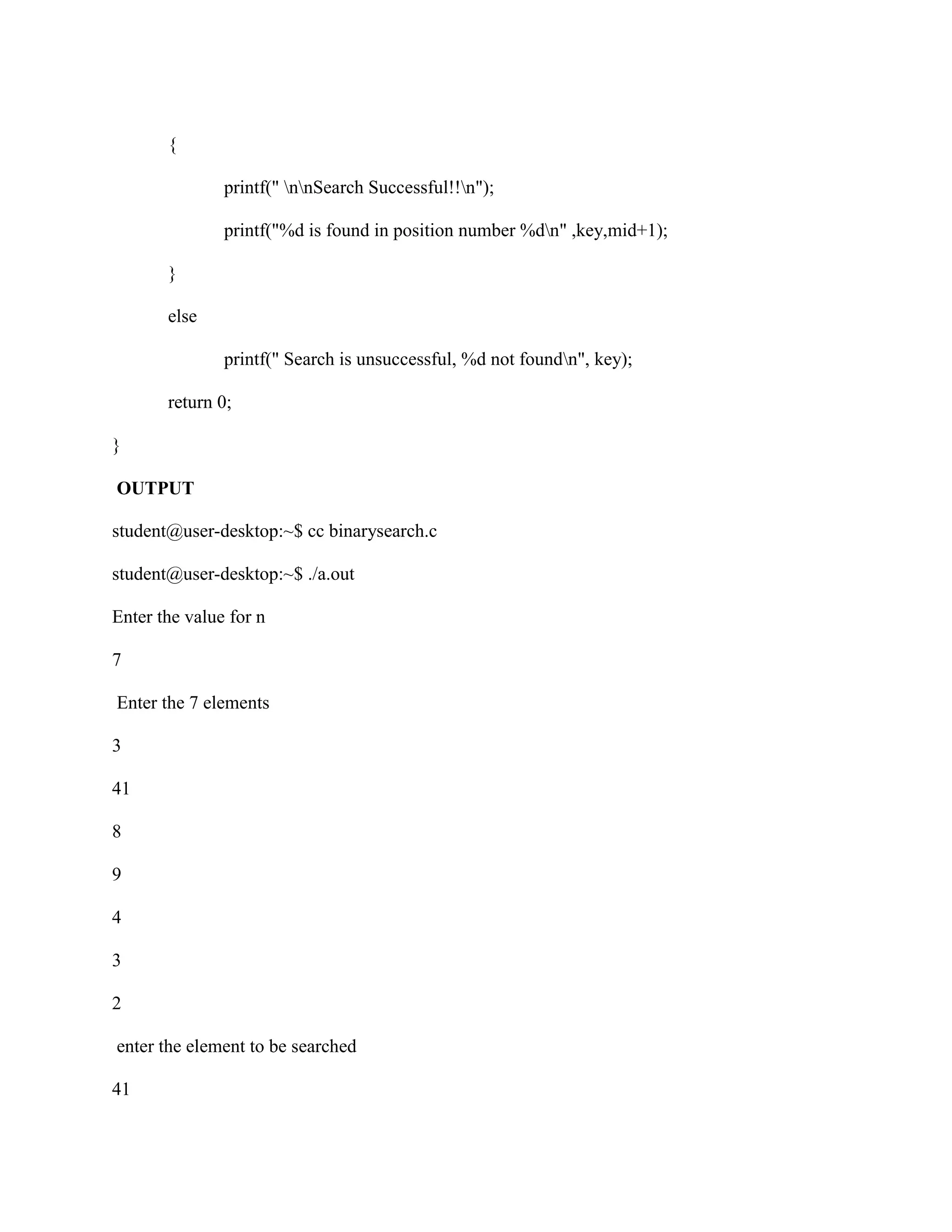
               printf(" nnSearch Successful!!n");

               printf("%d is found in position number %dn" ,key,mid+1);

       }

       else

               printf(" Search is unsuccessful, %d not foundn", key);

       return 0;

}

OUTPUT

student@user-desktop:~$ cc binarysearch.c

student@user-desktop:~$ ./a.out

Enter the value for n

7

Enter the 7 elements

3

41

8

9

4

3

2

enter the element to be searched

41
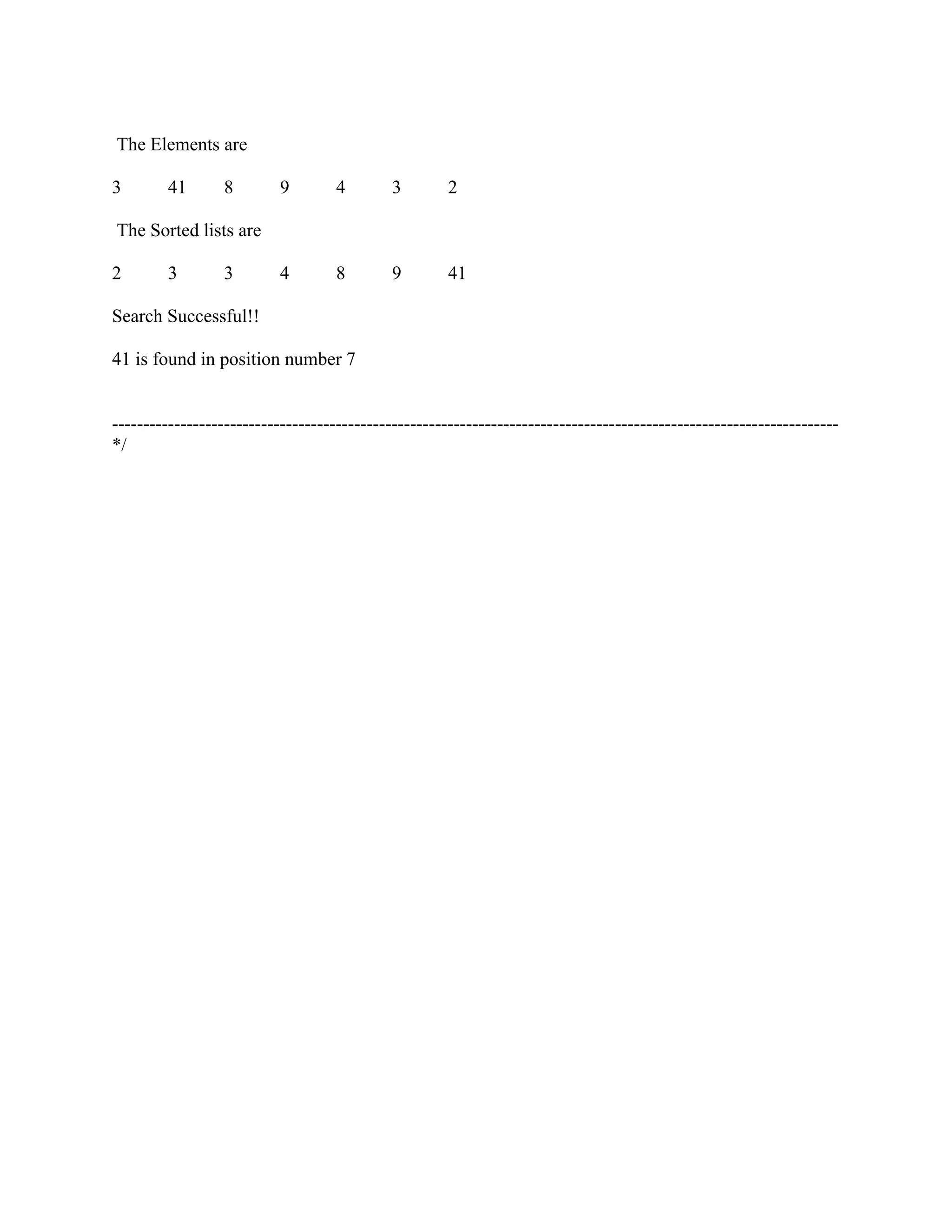
The Elements are

3        41       8        9        4        3        2

The Sorted lists are

2        3        3        4        8        9        41

Search Successful!!

41 is found in position number 7


---------------------------------------------------------------------------------------------------------------------
*/
EXPERIMENT NO : 16


                     SUM OF ALL ELEMENTS IN ARRAY USING POINTERS

AIM : Program to find the sum of all elements in an array using poinetrs.

INPUT SPECIFICATION                : N - the number of elements in the array
                                     A – the array elements
OUTPUT SPECIFICATION : sum- sum of all elements
ALGORITHM

     1. Start
     2. Read the number of elements of the array N
     3. Read the array elements A
     4. *p ← A
     5. Repeat for I = 1,2,…………………..upto N
        Begin
              sum=sum+*p
        End
     6. Print sum
     7. Stop


PROGRAM DESCRIPTION

Sum of all the elements in an array using pointers.

PROGRAM

#include<stdio.h>

int main()

{
          int i,n,sum=0,a[10];

          int *p;

          printf(" Enter the value of nn");

          scanf("%d",&n);
printf(" Enter %d elements to array an", n);

       for(i=0;i<n;i++)

              scanf("%d",&a[i]);

       printf(" The address of a");

       for(i=0;i<n;i++)

       printf("= %un", &a[i]);

       printf(" The elements aren");

       for(i=0;i<n;i++)

              printf("%dn",a[i]);

       for(p=a;p<a+n;p++)

              sum+=*p;

       printf(" n Sum = %dn", sum);


       return 0;

}


 OUTPUT
student@user-desktop:~$ cc sum_pointers.c

student@user-desktop:~$ ./a.out

Enter the value of n

4

Enter 4 elements to array a

1

2

3
4

The address of a= 3214194172

= 3214194176

= 3214194180

= 3214194184

The elements are

1

2

3

4

Sum = 10

---------------------------------------------------------------------------------------------------------------------
*/
CYCLE - IV


EXPERIMENT NO : 16


                         SWAP TWO VARIABLES USING POINTERS

AIM : Program to swap the contents of two variables using pointers and function.

INPUT SPECIFICATION            : a and b- two elements to be swapped
OUTPUT SPECIFICATION : print the contents of a and b after swapping
ALGORITHM

   1.   Start
   2.   Read a,b – the numbers for swapping
   3.   Print the values of a and b before swapping
   4.   Call the function swap(&a,&b)
   5.   Print the values of a and b after swapping
   6.   Stop


// swap function

   1.   Declaring a variable temp,temporary variable
   2.   temp = *x
   3.   *x = *y
   4.   *y = temp
   5.   return


PROGRAM DESCRIPTION

Swap the contents of two variables using pointers.

PROGRAM
#include<stdio.h>

int main()

{

       void swap(int *x,int *y);

       int a,b;

       printf("Enter the values of a and bn");

       scanf("%d%d",&a,&b);

       printf("nnThe values of a a and b before swapping a=%d and b=%dn",a,b);

       swap(&a,&b);

       printf("nThe values of a a and b after swapping a=%d and b=%dn",a,b);

}

void swap(int *x,int *y)

{
       int temp;

       temp=*x;

       *x=*y;

       *y=temp;

       return;
}


 OUTPUT
student@user-desktop:~$ cc swap_fn_pointer.c

student@user-desktop:~$ ./a.out

Enter the values of a and b

23
56

The values of a a and b before swapping a=23 and b=56

The values of a a and b after swapping a=56 and b=23

---------------------------------------------------------------------------------------------------------------------
*/

EXPERIMENT NO : 17


     CREATE LINKED LIST, INSERT THE ELEMENT, ADD A NEW ELEMENT AND
                                DELETION

AIM : Program to create a linked list, insert the element, Add a new element to a position and
delete the element from the linked list. Also display and count the elements in the linked list.

INPUT SPECIFICATION                  : info- element to be inserted
                                       Choice- what operation to be performed- insertion, display,
     deletion or counting
OUTPUT SPECIFICATION : print the contents in the linked list and also the count the
   number of nodes
ALGORITHM

   1. Start
   2. Start with the first node.
   3. Repeat
               Print the current item
               Advance to the next node.
   4. If the list is empty
               Insert the new node as the head node.
   5. Else
             Insert the new node as the last node
   6. Else
             Insert the new node in the body of the list.
   7. For deleteting a node form the list check if the list is empty then,
               Node cannot be deleted
      Else
               If the node to be deleted is the first node then make the head to point to the second
node
      Else
               Delete the node from the body of the list.
   8. Display all the values of the node and display the counted number of nodes nodes.
6. Stop

PROGRAM

#include<stdio.h>

#include<malloc.h>

#include<stdlib.h>

#define NULL 0

struct list_element

{
        int item;

        struct list_element *next;
};

typedef struct list_element node;

int main()

{
        node *first;

        int key,c;

        int choice;

        int menu();

        node *create();

        node *insert();

        node *delete();

        void display();

        int count();

        do

        {
choice=menu();

switch(choice)

{
       case 1:
                  printf("Press -999 to STOPn");

                  first=create(first);

                  printf("nn Created listn");

                  display(first);

                  continue;


       case 2:

                  first=insert(first);

                  printf("nLISTn");

                  display(first);

                  continue;


       case 3:

                  first=delete(first);

                  continue;


       case 4:
                  c=count(first);

                  printf("Number of elements in the list=%d",c);

                  continue;

       default:

                  printf("nEnd of Executionn");
}

       }while(choice!=5);

}


int menu()

{
       int choice;

       do

       {
               printf("nn Main Menun");

               printf("1- Create the linked listn");

               printf("2- Insert an itemn");

               printf("3- Delete an itemn");

               printf("4-Counting numbern");

               printf("5- Endn");

               printf(" Enter your Choice (1,2,3,4,5) : n");

               scanf("%d",&choice);

               if(choice<1 || choice>5)

                         printf("n Invalid Choice-try againn");

       }while(choice<1 || choice>5);

       printf("n");

       return(choice);

}
/*creating a linked list*/

node *create(first)

node *first;

/*first point to the current node*/

{

        int info;

        node *temp,*prev;

        prev=first=NULL;

        printf("n Data Itemn");

        scanf("%d",&info);

        while(info!=-999)

        {
                /*Allocate memory space for the next node*/

                temp=(node *)malloc(sizeof(node));

                temp->item=info;

                temp->next=NULL;

                if(first==NULL)

                        first=temp;

                else

                        prev->next=temp;

                prev=temp;

                printf("Data Item:n");

                scanf("%d",&info);
//printf("%d",info);

        }

        return(first);

}

/*Display the linked list recursively*/

void display(first)

node *first;

{
        int c=0;

        if(first!=NULL)

        {
                   printf("->%d",first->item);
                   display(first->next);
                   c++;
        }
        return ;
}

/*Add one element to linked list and return pointer to beginning of modified list*/

node *insert(first)

node *first;

/* first points to first node*/

{
        node *newnode;

        node *temp;

        int newitem;

        int position;

        int i;
printf(" New data itemn");

scanf("%d",&newitem);

do

{

       printf("n Position of insertionn");

       scanf("%d",&position);

}while(position<=0);

if((position==1) || (first==NULL))

{
       newnode=(node *)malloc(sizeof(node));

       newnode->item=newitem;

       newnode->next=first;

       first=newnode;
}
else
{
       i=1;
       temp=first;
       while((i<position-1)&&(temp->next!=NULL))

       {

              temp=temp->next;

              i++;

       }

       newnode=(node *)malloc(sizeof(node));

       newnode->item=newitem;

       newnode->next=temp->next;

       temp->next=newnode;
}
       return(first);

}

/*delete one omponent fom linked list*/

node *delete(first)

node *first;
{
       node *temp;

       node *prev;

       int target;

       printf("Data item to be deletedn");

       scanf("%d",&target);

       if(first==NULL)

               printf(" LIST IS EMPTY- CANNOT DELETEn");

       else

       {
               prev=NULL;

               temp=first;

               while((temp!=NULL)&&(temp->item!=target))

               {
                        prev=temp;

                        temp=temp->next;
               }

               if(temp==NULL)

                        printf("Element not foundn");

               else
{

                           if(prev==NULL)

                                   first=first->next;
                           else

                                   prev->next=temp->next;

                           printf("nLISTn");

                           display(first);
                   }

        }

        return(first);
}
int count(first)

node *first;

{
        int c=0;

        while(first!=NULL)

        {

                   first=first->next;

                   c++;
        }

        return c;
}

OUTPUT

student@user-desktop:~$ ./a.out


 Main Menu
1- Create the linked list
2- Insert an item
3- Delete an item
4-Counting number
5- End
 Enter your Choice (1,2,3,4,5) :
1

Press -999 to STOP

 Data Item
2
Data Item:
3
Data Item:
8
Data Item:
9
Data Item:
4
Data Item:
-999


 Created list
->2->3->8->9->4

 Main Menu
1- Create the linked list
2- Insert an item
3- Delete an item
4-Counting number
5- End
 Enter your Choice (1,2,3,4,5) :
2

 New data item
67

 Position of insertion
6

LIST
->2->3->8->9->4->67

 Main Menu
1- Create the linked list
2- Insert an item
3- Delete an item
4-Counting number
5- End
 Enter your Choice (1,2,3,4,5) :
4

Number of elements in the list=6

 Main Menu
1- Create the linked list
2- Insert an item
3- Delete an item
4-Counting number
5- End
 Enter your Choice (1,2,3,4,5) :
3

Data item to be deleted
2

LIST
->3->8->9->4->67

 Main Menu
1- Create the linked list
2- Insert an item
3- Delete an item
4-Counting number
5- End
 Enter your Choice (1,2,3,4,5) :
5


End of Execution
---------------------------------------------------------------------------------------------------------------------
----
EXPERIMENT NO : 18

            NUMBER OF CHARS, SPACES, TABS AND NEW LINES IN A FILE

AIM : Program to find the number of chars, spaces, tabs and new lines in a file

INPUT SPECIFICATION            : fp – file having the input
OUTPUT SPECIFICATION : noc - Prints the number of characters in the file
                                   nob - Prints the number blanks in the file
                                   not - Prints the number of tabs in the file
                                   nol- print number of lines in the file
ALGORITHM
   12. Start
   13. Set noc=0 nob=0,nol=0,not=0
   14. Get the line of text and store it in „text‟
   15. len = strlen(text)
   16. i = 0
   17. Is i < n
              Then goto step 7
              Else go to step 10
   18. If text[i] is ‘ ‘
                            Then nob = nob+ 1

   19. If text[i] is ‘n’ ,
                          Then nol    = nolt+ 1

   20. If  text[i] is „t‟
                Then not= not+ 1
   21. Print noc, not, nol, nob
   22. Stop

PROGRAM

#include<stdio.h>
int main()
{
       FILE *fp;
       char ch;
        int nol=0, not=0, nob=0, noc=0;
        fp= fopen(“PR1,c”, “r”);
       while(1)
       {
ch= fgetc(fp);
                  If(ch== EOF)
                         break;
                  noc++;
                  if(ch==‟ „)
                         nob++;
                  if(ch==‟n‟)
                         nol++;
                  if(ch==‟t‟)
                         not++;

        }
 Fclose(fp);
printf(“ Number of characters= %dn”, noc);
printf(“ Number of blanks= %dn”, nob);
printf(“ Number of tabs= %dn”, not);
printf(“ Number of lines= %dn”, nol);
return 0;
}

OUTPUT

Number of characters=125
 Number of blanks= 25
Number of tabs=13
Number of lines=22
---------------------------------------------------------------------------------------------------------------------
*/
EXPERIMENT NO :           19


AIM : TO FIND THE DETAILS OF THE STUDENTS USING STRUCTURE

ALGORITHM


 1. Start
 2. Create a structure student with the details rollno,studname,sub1,sub2,sub3,total marks and
    percentage
 3. Read the student details
 4. List the studname who have scored more than 60% marks in 3 subjects.
 5. Print the details
 6. Stop

PROGRAM DESCRIPTION

    Read the details of student,calculate percentage and list the studname who have scored
more than 60% marks in 3 subjects.

PROGRAM

#include<stdio.h>
struct student
{
         char name[30];
         int sub1;
         int sub2;
         int sub3;
         int total;
         float percent;
};

int main()
{
       int i,n;
       struct student s[20];
       printf(“Enter the number of studentsn”);
       scanf(“%d”,&n);
for(i=0;i<n;i++)
       {
               printf(“Enter the student namen”);
               gets(s[i].name);
               printf(“Enter the marks of sub1 and sub2 and sub 3n”);
               scanf(“%d”,&s[i].sub1);
               scanf(“%d”,&s[i].sub1);
               scanf(“%d”,&s[i].sub1);
       }
       Printf(“List of Students name who have scored more than 60% of marksnn”);
       For(i=0;i<n;i++)
       {
               s[i].total=s[i].sub1+s[i].sub2+s[i].sub3;
               s[i].percent=s[i].total/3.0;
               if(s[i].percent>=60)
       printf(“%st%ft”,s[i].name,s[i].percent);
       }
}

OUTPUT
Enter the number of students
 2

Enter the student name
Ann
Enter the marks of sub1 and sub2 and sub 3
80
80
80
Enter the student name
Binu
Enter the marks of sub1 and sub2 and sub 3
20
34
21
List of Students name who have scored more than 60% of marks
Ann 124
EXPERIMENT NO : 2

                          MEAN VARIANCE STANDARD DEVIATION

AIM : Program to calculate the mean, variance and deviation of a given set of numbers.

INPUT SPECIFICATION           : n - The number of elements
                             a - The array to store the numbers
OUTPUT SPECIFICATION : Print mean , variance and standard deviation
ALGORITHM


   13. Start
   14. Read the value of number of elements, N
   15. Read the array elements, A
   16. Set MEAN ← 0
   17. Set VARIANCE ← 0
   18. Set STDDEV ← 0
   19. Repeat for I = 1, 2, …………N
         Begin
             SUM = SUM + A[I]
         End
   20. MEAN = SUM/N
   21. SUM ← 0
   22. Repeat for I = 1, 2, …………..N
          Begin
             SUM = SUM + (A[I] – MEAN)2
          End
   23. VARIANCE = SUM/N
   24. STDDEV = √ (VARIANCE)
   25. Print “ Mean =”, MEAN
   26. Print “ Std Deviation =”, STDDEV
   27. Print “ Variance =”, VARIANCE
   28. Stop
PROGRAM DESCRIPTION

Program to calculate the mean,variance and stddev of
           a given set of numbers.

PROGRAM

#include<stdio.h>
#include<conio.h>
#include<math.h>

void main()
{
  int n,i;
  float sum = 0, a[25];
  float mean,variance,stddev;
  clrscr();
  printf("nttMEAN VARIANCE AND STANDARD DEVIATIONn");
  printf("tt------------------------------------n");

 printf("nEnter the value of number of elements : ");
 scanf("%d",&n);

 printf("nEnter the array elements : ");
 for(i=0;i<n;i++)
   scanf("%f",&a[i]);

//Calculate mean

 for(i=0;i<n;i++)
    sum = sum + a[i];
 mean = sum/n;

//Calculate variance

 sum = 0;
 for(i=0;i<n;i++)
    sum += (a[i]-mean) * (a[i]-mean);
 variance = sum/n;

//Calculate standard deviation

 stddev=sqrt(variance);

 printf("nMean           = %f",mean);
 printf("nVariance        = %f",variance);
printf("nStandard deviation = %f",stddev);

    getch();
}


OUTPUT

                 MEAN VARIANCE AND STANDARD DEVIATION
                 ------------------------------------------------------------------

Enter the value of number of elements : 5

Enter the array elements : 10 20 30 40 50

Mean          = 30.000000
Variance       = 200.000000
Standard deviation = 14.142136
EXPERIMENT NO : 3


                  MAXIMUM AND MINIMUM USING LINEAR SEARCH

AIM : Program to find the smallest and largest numbers in an array of integers using
     linear search.

INPUT SPECIFICATION           : n - The number of elements
                             a - The array to store the numbers
OUTPUT SPECIFICATION : Print the smallest and the largest number


ALGORITHM

   11. Start
   12. Read the value of number of elements of the array, N
   13. Read the array elements, A
   14. Set MIN ← A[I]
   15. Set MAX ← A[I]
   16. Set POS_MAX ← 1
   17. Set POS_MIN ← 1
   18. Repeat for I = 1, 2, …………N
           Begin
              IF MIN > A[I] THEN
                      Begin
                             MIN = A[I]
                             POS_MIN = I
                      End
              IF MAX < A[I] THEN
                      Begin
                             MAX = A[I]
                             POS_MAX = I
                      End
           End
   19. Print “Minimum = “, MIN
   20. Print “Position of minimum = “, POS-MIN
21. Print “Maximum = “, MAX
   22. Print “Minimum = “, MIN
   23. Stop

PROGRAM DESCRIPTION

Program to find the maximum and minimum among given n integer numbers using linear
search method.

PROGRAM

#include<stdio.h>
#include<conio.h>

void main()
{
  int n,i,min=0,max=0,pos_min=0,pos_max=0,a[25];
  clrscr();
  printf("nttMaximum and Minimumn");
  printf("tt-------------------n");
  printf("nEnter the value of the number of elements in an array : ");
  scanf("%d",&n);
  printf("nEnter the array elements : ");
  for(i=1;i<=n;i++)
     scanf("%d",&a[i]);

 /*Initially the first element is assumed to be both minimum(min) as
  well as maximum(max) */

 min=a[1];
 max=a[1];
 pos_min=1;
 pos_max=1;

 // To find the minimum as well as maximum

 for(i=2;i<=n;i++)
 {
    if(min > a[i])
    {
        min=a[i];
        pos_min=i;
    }
    if(max < a[i])
    {
        max=a[i];
pos_max=i;
        }
    }

    printf("nMinimum = %d tPosition = %dn",min,pos_min);
    printf("nMaximum = %d tPosition = %d",max,pos_max);

    getch();
}


OUTPUT

                                    Maximum and Minimum
                                   --------------------------------

Enter the value of the number of elements in an array : 7

Enter the array elements : 13 74 95 2 17 45 32

Minimum = 2        Position = 4

Maximum = 95 Position = 3
EXPERIMENT NO : 4

                              SORTING USING BUBBLE SORT

AIM : Program to sort n numbers in ascending order using bubble sort.

INPUT SPECIFICATION           : n - The number of elements
                                a - The array to store the numbers
OUTPUT SPECIFICATION : print the number in the sorted order
ALGORITHM

   8. Start
   9. Read the value of number of elements, N
   10. Read the array elements, A
   11. Repeat for J = 1, 2, …………N-1
           Begin
               Repeat for I = 1, 2,…………….N-1
                      Begin
                              IF A[I] > A[I+1] THEN
                                      Begin
                                            TEMP = A[I]
                                            A[I] = A[I+1]
                                            A[I+1] = TEMP
                                      End
                      End
          End
   12. Print “ The Sorted elements are “
   13. Repeat for I = 1, 2, …………………….N
               Begin
                      Print A[I]
               End
   14. Stop
PROGRAM DESCRIPTION

Program to sort n numbers in ascending order using bubble sort

PROGRAM

#include<stdio.h>
#include<conio.h>

void main()
{

 int n,i,j,a[25],temp=0;

 clrscr();
 printf("nttSorting using Bubble sortn");
 printf("tt-------------------------n");

 printf("nEnter the value of the number of elements in the array : ");
 scanf("%d",&n);

 printf("nEnter the array elements : ");
 for(i=1;i<=n;i++)
   scanf("%d",&a[i]);

 //Sorting using bubble sort

 //This loop performs required number of passes
 for(j=1;j<n;j++)
 {
   //This loop performs all comparisons in a pass
   for(i=1;i<n;i++)
   {
         //Sorts if two consecutive numbers are not in the required order

        if( a[i] > a[i+1] )
        {
           temp = a[i];
a[i] = a[i+1];
                a[i+1] = temp;
            }
        }
    }

    // Sorted elements

    printf("nThe sorted elements are .......nn");
    for(i=1;i<=n;i++)
      printf(" %d ",a[i]);

    getch();
}


OUTPUT


                                         Sorting using Bubble sort
                                       ----------------------------------

Enter the value of the number of elements in the array : 5

Enter the array elements : 5 4 3 2 1

The sorted elements are .......

1 2 3 4 5
EXPERIMENT NO : 5

         NUMBER OF SENTENCES,WORDS ,LETTERS IN A LINE OF TEXT

AIM : Program to find the number of sentences, words, letter in the text

INPUT SPECIFICATION            : text – the line of text
OUTPUT SPECIFICATION : sen_count               - Prints the number of sentences in the text
                              word_count - Prints the number of words in the text
                              letter_count - Prints the number of letters in the text
ALGORITHM
   23. Start
   24. Set sen_count=0,word_count=0,letter_count=0
   25. Get the line of text and store it in „text‟
   26. len = strlen(text)
   27. i = 0
   28. Is i < n
              Then goto step 7
              Else go to step 10
   29. If text[i] is . or ?
                            Then sen_count = sen_count + 1

   30. If text[i] is space or .   or t or ! ,
                          Then    word_count = word_count + 1

   31. If ( text[i] >= 65 and text[i] <= 90) or
        ( text[i] >= 97 and text[i] <= 122))
                           Then letter_count = letter_count + 1
   32. Print sen_count , word_count and letter_count
   33. Stop
PROGRAM DESCRIPTION

                sentence count - checks for ? and .
                 word count     - checks for ? . , ! t and space
                 letter count - Checks the ASCII value


PROGRAM

#include<stdio.h>
#include<conio.h>
#include<string.h>

void main()
{
  char text[100];
  int i,len;
  int sen_count=0,word_count=0,letter_count=0;
  clrscr();

  printf("nttCounts the no: of sentences, words and lettersn");
  printf("tt----------------------------------------------n");

  printf("nnEnter a line of text : ");
  scanf("%[^n]s",&text);

  len = strlen(text);

  //Computes the number of sentences,words and letters.

  for(i=0;i<len;i++)
  {
       if(text[i] == '.' || text[i] == '?')
                sen_count = sen_count + 1;

       if(text[i] == ' ' || text[i] == '.' || text[i] == 't' ||
         text[i] == '!' || text[i] == ','|| text[i] == '?')
                word_count = word_count + 1;

       if((text[i] >= 65 && text[i] <= 90) ||
         (text[i] >= 97 && text[i] <= 122))
letter_count = letter_count + 1;
  }


  printf("nThe number of : nn");
  printf("nSentences : %dn",sen_count);
  printf("nWords : %dn",word_count);
  printf("nLetters : %dn",letter_count);

  getch();

}//End of program


OUTPUT

                Counts the no: of sentences, words and letters
                -------------------------------------------------------------


Enter a line of text : Hi Ram,How are you?I am fine,Thank you.

The number of :


Sentences : 2

Words    : 10

Letters : 29
EXPERIMENT NO : 6


               MATRIX ADDITION AND MULTIPLICATION USING FUNCTION


AIM : Program to add two matrices using function.

INPUT SPECIFICATION          : (m,n) The order of the matrix
                               A , B ,the input matrices whose sum has to be found
OUTPUT SPECIFICATION : C , the output matrix which stores the sum of matrix A and B


                               MATRIX ADDITION
ALGORITHM


   11. Start
   12. Read the order fo the matrics (m,n)
   13. Call function READ_MATRIX (A,m.n)
   14. Call function READ_MATRIX (B,m.n)
   15. Call function ADD_MATRIX (A,B,C,m.n)
   16. Call function WRITE_MATRIX (A,m.n)
   17. Call function WRITE _MATRIX (B,m.n)
   18. Call function WRITE _MATRIX (C,m.n)
   19. Stop
READ_MATRIX(mat[][10],m,n)
       Begin
            Repeat for I = 1,2,………………….m
             Begin
                  Repeat for J = 1,2,………………….n
                     Read mat[i][j]
             End
       End

          WRITE_MATRIX(mat[][10],m,n)
       Begin
            Repeat for I = 1,2,………………….m
             Begin
                  Repeat for J = 1,2,………………….n
                     Write mat[i][j]
             End
       End


       ADD_MATRIX(A[][10], B[][10], C[][10],m,n)
       Begin
            Repeat for I = 1,2,………………….m
             Begin
                  Repeat for J = 1,2,………………….n
                          C[i][j] ← A[i][j] + B[i][j]

              End
        End

PROGRAM DESCRIPTION

Functions read_martix() and write_matrix() are used to input and output the input matrices and
sum of the matrices. The user defined function add_matrix computes the sum of the two
matrices.

PROGRAM

#include<stdio.h>
#include<conio.h>

void main()
{
  //Declaration
  int a[10][10],b[10][10],c[10][10];
  int m,n;
//Function prototypes
    void read_matrix(int mat[][10],int m , int n);
    void write_matrix(int mat[][10],int m , int n);
    void add_matrix(int a[][10],int b[][10],int c[][10],int m , int n);

    clrscr();

    printf("nttADDITION OF MATRICESn");
    printf("tt--------------------n");

    printf("nnEnter the order of the matrices A and B : ");
    scanf("%d%d",&m,&n);

    printf("nEnter the elements of matrix A nn");
    read_matrix(a,m,n);      //Calling the function 'read_matrix'

    printf("nEnter the elements of matrix B nn");
    read_matrix(b,m,n);

    add_matrix(a,b,c,m,n);

    //Prints matrix A , B and C using the function write_matrix

    printf("nnMatrix A................nn");
    write_matrix(a,m,n);
    printf("nnMatrix B................nn");
    write_matrix(b,m,n);
    printf("nnSum of A and B .........nn");
    write_matrix(c,m,n);

  getch();
}//End of main function


//Function to read a matix

void read_matrix(int mat[][10],int m ,int n)
{
  int i,j;

    for(i=0;i<m;i++)
     for(j=0;j<n;j++)
          scanf("%d",&mat[i][j]);
    return;
}
//Function to print a matix

void write_matrix(int mat[][10],int m , int n)
{
  int i,j;

    for(i=0;i<m;i++)
    {
      printf("n");
      for(j=0;j<n;j++)
           printf(" %d ",mat[i][j]);
    }
    return;
}

//Computes the sum of the matrices A and B

void add_matrix(int a[][10],int b[][10],int c[][10],int m , int n)
{
   int i,j;
    for(i=0;i<m;i++)
         for(j=0;j<n;j++)
          c[i][j] = a[i][j] + b[i][j];
   return;
}


OUTPUT

                                       ADDITION OF MATRICES
                                       -----------------------------------


Enter the order of the matrices A and B : 3 3

Enter the elements of matrix A

123456789

Enter the elements of matrix B

987654321


Matrix A................
1 2 3
4 5 6
7 8 9

Matrix B................


9 8 7
6 5 4
3 2 1

Sum of A and B .........


10 10 10
10 10 10
10 10 10


                              MATRIX MULTIPLICATION

ALGORITHM:

    1.Start fuction
    2.Read rows and columns limit for matrices m,n,p,q
    3.Check p is equal to n else goto step 12
    4.Set a loop to get A matrix values.
    5.Read matrix value a[i][j]
    6.Set a loop to get B matrix
    7.Read matrix value b[i][j]
    8.Repeat step 9 until i<m,j<n,k<p
    9.d[i][j]=0;
    10. d[i][j]=d[i][j]+a[i][k]*b[k][j]
    11.Set a loop to print matrix values.
    12.Print matrix value d[i][j] goto step 13
    13.Print the number of rows and columns should not be equal
    14.Stop the fuction

PROGRAM

#include <stdio.h>
#include <conio.h>
void main ()
{
 int a[10][10],b[10][10],d[10][10];
 int i,j,p,q,m,n,k;
 clrscr ();
 printf ("Enter the size of the A matrix:");
 scanf ("%d%d",&p,&q);
 printf ("Enter the size of the B matrix:");
 scanf ("%d%d",&m,&n);
 if (p==n)
 {
 printf ("Enter the elements of A matrix.n");
 for (i=0;i<p;i++)
 {
 for (j=0;j<q;j++)
 scanf ("%d",&a[i][j]);
 }
 printf ("Enter the elements of B matrix.n");
 for (i=0;i<m;i++)
 {
 for (j=0;j<n;j++)
 scanf ("%d",&b[i][j]);
 }
 for (i=0;i<m;i++)
 {
 for (j=0;j<n;j++)
 {
 d[i][j]=0;
 for(k=0;k<p;k++)
 d[i][j]=d[i][j]+a[i][k]*b[k][j];
 }
 }printf ("Multiplication of A andB matrix:n");
 for (i=0;i<m;i++)
 {
 for (j=0;j<n;j++)
 printf ("%5d",d[i][j]);

printf ("n");
 }
 }
 else
 printf ("The no. of rows and columns should not be equal");
 getch();
 }
OUTPUT

Enter the size of the A matrix:2 2
Enter the size of the B matrix:2 2
Enter the elements of A matrix.
1234
Enter the elements of B matrix.
12 2 3 4
Multiplication of A andB matrix:
  18 10
  48 22


EXPERIMENT NO : 10


                                     nCr USING FUNCTION

AIM : A program to find nCr using function
                                            n!
                                 nCr = -------------
                                          r! (n-r)!


INPUT SPECIFICATION             : Get the values of n and r
OUTPUT SPECIFICATION : Print nCr
ALGORITHM

                 1. Start
2.   Read the values of n and r
                   3.   nCr = factorial(n) / ( factorial(r) * factorial(n-r) );
                   4.   Print nCr
                   5.   Stop

                 //Function factorial

                    factorial(num)
                    begin
                              1. fact = 1
                              2. i = 1
                              3. Repeat step 4 and 5 until i < = num
                              4. fact = fact * i
                              5. i = i+1
                              6. return(fact)
                              7. Stop

                    end

 PROGRAM DESCRIPTION
                 n!
              ---------
               r! (n-r)!


PROGRAM

#include<stdio.h>
#include<conio.h>

void main()
{
  int n,r;
  long int nCr;
  clrscr();
  printf("nnnttt n! n");
  printf("ttt---------n");
  printf("tttr! (n-r)!n");
  printf("nnEnter the value of n and r : ");
  scanf("%d%d",&n,&r);

  nCr = factorial(n) / ( factorial(r) * factorial(n-r) );
printf("nn%dC%d = %ld",n,r,nCr);
   getch();
}//End of main function
int factorial(int num)
{
  int i;
  long fact = 1;
  for(i=1;i<=num;i++)
    fact = fact* i;
  return fact;
}


OUTPUT
                          n!
                       ---------
                       r! (n-r)!


Enter the value of n and r : 5 2


5C2 = 10


EXPERIMENT NO : 11


                                       POLYNOMIAL ADDITION

AIM : Program to add two polynomials using function.

INPUT SPECIFICATION                :
OUTPUT SPECIFICATION :
ALGORITHM
        1. Start
        2. Read the maximum power of first and second polynomial ,d1,d2
        3. d3 ← sum_poly(p1,p2,p3)
4. display the two input polynomials and the resultant
5. Stop


sum_poly(p1[],p2[],res[])
Begin
    if(d1 < d2)
       Begin
          Repeat for I = 0,1,2,………………………d1
                res[i] = p1[i] + p2[i]
          Repeat for I = d1+1 up to d2
              Begin
                    res[i] ← p2[i]
                    p1[i] ← 0
              End
                return d2
       End
       Else
        Begin
               Repeat for I = 0,1,2,………………………d2
                            res[i] = p1[i] + p2[i]
               Repeat for I = d2+1 up to d1
                Begin
                         res[i] ← p1[i]
                         p2[i] ← 0
                End
                return d1
         End
 End
PROGRAM DESCRIPTION
Get the degrees of two polynomials d1 and d2.
Get the polynomials and add it and display the result.

PROGRAM

#include<stdio.h>
#include<conio.h>

int d1,d2;

void main()
{
  int i,d3,p1[20],p2[20],res[20];

 void read_poly(int poly[],int n);
 void display_poly(int poly[],int n);
 int sum_poly(int p1[],int p2[],int res[]);

 clrscr();

  printf("nttSUM OF TWO POLYNOMIALSnn");
  printf("tt----------------------nn");
  printf("nnEnter the maximum power of 1st and 2nd polynomial : ");
  scanf("%d%d",&d1,&d2);
  printf("nnEnter the coefficients of the 1st polynomial n");
  read_poly(p1,d1);
  printf("nnEnter the coefficients of the 2nd polynomial n");
  read_poly(p2,d2);
//Calls the function sum() to add the 2 polynomials.
  d3 = sum_poly(p1,p2,res);

 printf("nnnPolynomial 1 ...................nnn");
 display_poly(p1,d3);

 printf("nnnPolynomial 2 ...................nnn");
 display_poly(p2,d3);

 printf("nnnSum of the 2 polynomials .......nnn");
 display_poly(res,d3);

  getch();
}
void display_poly(int poly[],int n)
{
  int i;
for(i=n;i>=0;i--)
    {
      printf("%d X^%d ",poly[i],i);
      if(i!=0)
       printf(" + ");
    }
}
void read_poly(int poly[],int n)
{
  int i;
  for(i=0;i<=n;i++)
   {
     printf("nEnter x^%d : ",i);
     scanf("%d",&poly[i]);
   }
}
 int sum_poly(int p1[],int p2[],int res[])
 {
     int i;
     if(d1 < d2)
     {
            for(i=0;i<=d1;i++)
              res[i] = p1[i] + p2[i];

            for(i=++d1;i<=d2;i++)
            {
              res[i] = p2[i];
              p1[i] = 0;
            }
            return(d2);
     }
     else
     {
            for(i=0;i<=d2;i++)
              res[i] = p1[i] + p2[i];

            for(i=++d2;i<=d1;i++)
            {
              res[i] = p1[i];
              p2[i] = 0;
            }
            return(d1);
     }
}
OUTPUT

                                      SUM OF TWO POLYNOMIALS
                                     -------------------------------------------

Enter the maximum power of 1st and 2nd polynomial : 2 1

Enter the coefficients of the 1st polynomial

Enter x^0 : 1
Enter x^1 : 2
Enter x^2 : 3

Enter the coefficients of the 2nd polynomial

Enter x^0 : 6
Enter x^1 : 4

Polynomial 1 ...................
3 X^2 + 2 X^1 + 1 X^0

Polynomial 2 ...................
0 X^2 + 4 X^1 + 6 X^0

Sum of the 2 polynomials .......

3 X^2 + 6 X^1 + 7 X^0


EXPERIMENT NO : 12


                                   FIBONACCI SERIES RECURSIVELY

AIM : Program to generate fibonacci series recursively.

INPUT SPECIFICATION                  : n – the limit of the series
OUTPUT SPECIFICATION : Print the Fibonacci series
ALGORITHM

    1. Start
    2. Read the limit of the series ,n
    3. Repeat for I = 0,1,2,…………………….up to N
       Begin
             Call function fib(i)
       End
    4. Stop


    function fib(i)
     Begin
         if(i=1 or i=0) then
           return i
         else
           return (fib(i-1)+fib(i-2))
     End


PROGRAM DESCRIPTION
The Fibonacci series is generated using the recursion method.

PROGRAM
#include<stdio.h>
#include<conio.h>

void main()
{

 int i,n;

 clrscr();

 printf("nttFIBONACCI SERIES USING RECURSIONn");
 printf("tt--------------------------------n");

 printf("nnEnter the limit of fibonacci series : ");
 scanf("%d",&n);

 printf("nnThe fibonacci series is ..............nnn");

 for(i=0;i<n;i++)
   printf(" %d ",fib(i));

 getch();
}//End of main function


int fib(int i)
{
  if(i==1 || i==0)
     return(i);
  else
     return(fib(i-1)+fib(i-2));
}


 OUTPUT

                                 FIBONACCI SERIES USING RECURSION
                                ---------------------------------------------------------


Enter the limit of fibonacci series : 10


The fibonacci series is ..............


 0   1    1   2    3   5    8     13     21    34


EXPERIMENT NO :                 13


AIM : TO FIND THE DETAILS OF THE EMPLOYEE USING STRUCTURE

ALGORITHM


 7. Start
8. Create a record employee with the details id ,name,basic salary,netsalary,hra,da and ta
 9. Read the employee details
 10. Sort the employee details based on employee id
 11. Print the details
 12. Stop

PROGRAM DESCRIPTION

 Read the details of employees,calculate net salary and print all details and finally sort employee
details with
 respect to employee id.

PROGRAM

#include<stdio.h>
#include<conio.h>

struct employee
{
  int id;
  char name[25];
  long int bs;
  float ns;

 struct salary
 {
   float hra;
   float da;
   float ta;
 }s;

}e[25],tmp;

void main()
{
  int i,j,n;
  clrscr();
  printf("nttEMPLOYEE DETAILSn");
  printf("tt----------------nn");

 printf("nEnter number of employees : ");
 scanf("%d",&n);
//Details of the employee

    for(i=0;i<n;i++)
    {
       printf("nn<< Employee %d >>n",i+1);
       printf("nEmployee Id : ");
       scanf("%d",&e[i].id);
       printf("nName          : ");
       scanf("%s",&e[i].name);
       printf("nBasic salary : ");
       scanf("%ld",&e[i].bs);
    }
    //Calculates the net salary of the employee
    for(i=0;i<n;i++)
    {
      e[i].s.da = e[i].bs * 0.15;
      e[i].s.ta = e[i].bs * 0.5;
      e[i].s.hra= e[i].bs * 0.1;
      e[i].ns = e[i].bs + e[i].s.da + e[i].s.ta + e[i].s.hra ;
    }
    //Sort the details based on employee id

     for(i=0;i<n-1;i++)
     for(j=0;j<n-1-i;j++)
     {
       if(e[j].id > e[j+1].id)
       {
           tmp=e[j];
           e[j]=e[j+1];
           e[j+1]=tmp;
       }
     }
     //Outputs the employee details along with the salary
     for(i=0;i<n;i++)
     {
        printf("nn<< Employee %d >>n",i+1);
        printf("nEmployee Id : %d",e[i].id);
        printf("nName         : %s",e[i].name);
        printf("nBasic salary : %ld",e[i].bs);
        printf("nNet salary : %f",e[i].ns);
        printf("nn");
     }
    getch();
}

OUTPUT
Name        : qq
Basic salary : 23

<< Employee 2 >>

Employee Id : 2
Name        :q
Basic salary : 12

<< Employee 3 >>

Employee Id : 1
Name        : qw
Basic salary : 345

<< Employee 1 >>

Employee Id : 1
Name        : qw
Basic salary : 345
Net salary : 603.750000

<< Employee 2 >>

Employee Id : 2
Name        :q
Basic salary : 12
Net salary : 21.000000

<< Employee 3 >>

Employee Id : 3
Name        : qq
Basic salary : 23
Net salary : 40.250000


                          CYCLE-1V


EXPERIMENT NO :14
STRING PALINDROME OR NOT


AIM : Program for checking the string is palindrome or not

INPUT SPECIFICATION              :Give the string

OUTPUT SPECIFICATION                :Display the string is palindrome or not


ALGORITHM

        1.    Start
        2.   Read the string
        3.   Check the length of the string
        4.   Check each charater of the string from each side.
        5.   If the string is equal then the string is palindrome else not palindrome
        6.   stop

PROGRAM DESCRIPTION

Program to check the string is palindrome or not

PROGRAM

#include<stdio.h>
#include<string.h>
Main()
{
 Int i,l,f=0;
Char a[80];
Printf(“n Enter the string:”);
Gets(a);
L=strlen(a);
For(i=0;i<l;i++)
{
If(a[i]!=a[l-i-1])
{
F=1;
Break;
}
}
If(f==1)
{
Printf(“n the string is not palindrome “);
}
Else
Printf(“n string is palindrome”);
}

OUTPUT

                                     STRING IS PALINDROME OR NOT

enter the string : malayalam

string is palindrome

enter the string : happy

string is not palindrome


EXPERIMENT NO : 15
SORT NAMES USING POINTERS

AIM : Program to sort names using pointers.

INPUT SPECIFICATION             : N – the number of names to be sorted
                                  A - Array to store the names
OUTPUT SPECIFICATION : Display the array A in sorted order.


ALGORITHM

      1.   Start
      2.   Read how many names N
      3.   Read the array elements A
      4.   Cll the function REORDER (n,names)
      5.   Print “the names in alphabetical order “
      6.   Stop

           function REORDER(N, *X[])
           Begin
                Repeat for i = 0,1,……………………upto N-1
                Begin
                      Repeat for j = 0,1,…………………upto n-1-i
                      Begin
                            if ( stringcompare( X[ j ] , X[ j+1 ] ) > 0 )
                            Begin
                                   tmp ← X[j]
                                   X[j]    ← X[j+1]
                                    X[j+1] ← tmp
                             End
                      End

                 End
           End
PROGRAM DESCRIPTION

To sort the names alphabetically in ascending order

PROGRAM

#include<stdio.h>
#include<conio.h>

void reorder(int n, char *x[]);

void main()
{
  int i,n;
  char *name[15];

    clrscr();

    printf("nttSORT NAMES USING POINTERSn");
    printf("tt-------------------------nn");
    printf("Enter how many names : ");
    scanf("%d",&n);
    for(i=0;i<n;i++)
      name[i]=(char*)malloc(10*sizeof(char));
    printf("nnEnter names nnn");
    for(i=0;i<n;i++)
      scanf("%s",name[i]);
    reorder(n,name);
    printf("nName in alphabetical order nnn");
    for(i=0;i<n;i++)
      printf("%sn",name[i]);
    getch();
}

void reorder(int n , char *x[])
{
  char *temp;
  int i,j;
  for(i=0;i<n-1;i++)
  for(j=0;j<n-1-i;j++)
   if(strcmp( x[j] , x[j+1] ) > 0 )
   {
         temp = x[j];
         x[j] = x[j+1];
         x[j+1] = temp;
   }
}

OUTPUT

                             SORT NAMES UING POINTERS
                             ------------------------------------------

Enter how many names : 5

Enter names

Shyam
Bittu
Bunty
Anu
Bittu

Name in alphabetical order

Anu
Bittu
Bittu
Bunty
Shyam
EXPERIMENT NO : 16


                         SWAP SMALLEST & LARGEST NUMBER

AIM : Program to exchange smallest and largest numbers using pointers.

INPUT SPECIFICATION           : N - the number of elements in the array
                             A – the array elements
OUTPUT SPECIFICATION : larg               - Largest element in the array
                             small    - Smllest element in the array
                             A       - Array elements after sorting
ALGORITHM

     8. Start
     9. Read the number of elements of the array N
     10. Read the array elements A
     11. *p ← A
     12. larg ← *p
         small ← *p
     13. Repeat for I = 1,2,…………………..upto N
         Begin
              if( *(p+i) > larg)
              Begin
                   larg ← *(p+1)
                   pl ← i
              End

              if( *(p+i) < small)
              Begin
                   small ← *(p+1)
                   ps ← i
              End
        End

     14. Print “Largest number ” ,larg
         Print “Smallest number ”,small
     15. tmp     ← *(p+ps)
        *(p+ps) ← *(p+ps)
*(p+ps) ← tmp

    16. Print “Array elements after swapping the largest and smallest ”
    17. Repeat for I = 0,1,……………….upto N
        Begin
             Print A[i]
        End
    18. Stop


PROGRAM DESCRIPTION

Exchanges the smallest and largest numbers in an array using pointers

PROGRAM

#include<stdio.h>
#include<conio.h>

void swap(int *x,int *y);
void main()
{
  int a[100],n,i,larg,small,pl=0,ps=0,tmp;
  int *p=a;
  clrscr();
  printf("nttEXCHANGE SMALLEST AND LARGEST NUMBERn");
  printf("tt------------------------------------n");

 printf("nnEnter the number of elements in the array : ");
 scanf("%d",&n);

 printf("nnEnter the array elements : ");
 for(i=0;i<n;i++)
    scanf("%d",&a[i]);

 //Variables for storing the largest and smallest number
 larg = *p;
 small= *p;

 /* Computes the largest and smallest number and also
   its array position */

 for(i=1;i<n;i++)
 {
   if(*(p+i) > larg)
   {
larg = *(p+i);
          pl = i;
     }


     if(*(p+i) < small)
     {
          small = *(p+i);
          ps = i;
     }
    }
    printf("nArray elements before swapping : ");
    for(i=0;i<n;i++)
       printf(" %d ",a[i]);

    printf("nnnLargest number = %dn",larg);
    printf("nSmallest number = %d",small);

    //Swaps the smallest and largest number

    tmp = *(p+ps);
    *(p+ps)=*(p+pl);
    *(p+pl)=tmp;

    //Array elements after swapping

    printf("nnnArray elements after swapping : ");
    for(i=0;i<n;i++)
       printf(" %d ",a[i]);
      getch();

}

OUTPUT

                        EXCHANGE SMALLEST AND LARGEST NUMBER
                       ---------------------------------------------------------------------

Enter the number of elements in the array : 6

Enter the array elements : 7 3 1 9 4 8

Array elements before swapping : 7             3    1    9    4     8

Largest number = 9
Smallest number = 1
Array elements after swapping : 7           3   9   1   4   8


EXPERIMENT NO :             17

                                            MERGE TWO FILES

AIM : A PROGRAM TO MERGE TWO FILES

ALGORITHM
  1. Start
  2. Open file1
  3. Write data into the file
  4. Close the file
  5. Open file2
  6. Write data into the file
  7. Close the file
  8. Open file3
  9. Open file1
  10. Open file2
  11. Write data of first file into file3
  12. Write data of second file into file3
  13. Close all the files
  14. Stop


PROGRAM

#include<stdio.h>
void main()
{
 char s;
 FILE *f1,*f2,*f3; //File pointers
 clrscr();// Clears the screen
 f1=fopen(“first.dat”,”w”); //Opens the 2 files in the write mode
 f2=fopen(“second.dat”,”w”);


//Writes data into the 1st file
 printf(“Enter first data --- “);
 while((s=getchar())!=EOF)
{ putc(s,f1);
 }
 fclose(f1); //Closes the file


//Writes data into the 1st file
 printf(“nEnter second data --- “);
 while((s=getchar())!=EOF)
 { putc(s,f2);
  }
 fclose(f2); //Closes the file


f1=fopen(“first.dat”,”r”); //Opens the 2 files in the read mode
f2=fopen(“second.dat”,”r”);
f3=fopen(“merge.dat”,”w”);//Opens an output file in the write mode


// Copies the first file into the output file
while(!feof(f1))
{ s=getc(f1);
   putc(s,f3);
  }
// Appends the second file to the end of the output file
 while(!feof(f2))
 { s=getc(f2);
   putc(s,f3);
  }
//Closes the files
fclose(f1);
fclose(f2);
fclose(f3);


f3=fopen(“merge.dat”,”r”);//Opens the output file for reading


//Prints the merged file
printf(“nMerged data ---n “);
while(!feof(f3))
{ s=getc(f3);
  printf(“%c”,s);
 }


fclose(f3);//Closes file


 getch();//Accepts a character
}//End of the program

OUTPUT

      Enter the first data : computer
      Enter the second data :science
      Merged data
      computerscience
MODEL & VIVA QUESTIONS


1. Write a program to print the nature of roots and calculate the roots of the quadratic equation
      ax^2+bx+c=0.

2. Write a program to generate Fibonacci series between 10 and 100.

3. To check whether a given number is palindrome or not.
4. Write a program to print Armstrong numbers within a given range.
5. Write a program to check whether the given number is prime or not. If so generate the
     Fibonacci series up to that number.
6. Write a program to print the numbers in following formats

        a.      1
                2      3
                4      5       6
                7      8       9           10


        b. 1                                   c.                   1
                                       2            2                       2 3 2
                                   3           3        3                 3 4 5 4 3
                               4           4        4       4           4 5 6 7 6 5 4

7.    Write a program to generate the series –1,5,-9,13……….to n terms.

4.    Write a program to display all prime numbers between 200 and 500.

5.    Write a program to convert the given Binary number to its Decimal equivalent.

6.    Write a program to print all Armstrong numbers between 10 and 400.

7.    Write a program to count the number of spaces, lines, new lines, and tabs in the input.

8.    Write a user defined function to raise a number to an exponent.

9.    Write a program to compute the mathematical function f (x) =x-x^3/3! +x^5/5! -………

10. Write a program to generate the series 1, 2,6,24,120 to n terms using recursion.

11. Write a program to sort an array of numbers and find the second largest.
19. Write a program to search an element in an array using Binary search method.
20. Write a program to sort words in a line of text in alphabetical order.

12. Write a program to divide a list of numbers into two halves and then sort each half in
     ascending order

12. Write a recursive function to evaluate S=1+x+x^2+…………….up to x^n.

13. Write a function to evaluate nCr=n! / ((n-r)!*r!).

14. Write a program to find the sum of diagonal elements of a matrix and its transpose.

15. Write a program to check whether the given string is palindrome or not.

16. Write a program to count the number of occurrences of a given character in a sentence.

17. Write a program to swap 2 characters using a function.
18. Write a program to generate Fibonacci series recursively.

18. Define a structure called DATABASE with members name, code, and basic pay using
     „DATABASE‟. Read an array employee with 5 elements .Write a program to read
     information about all the employees and print them.

19. Write a program to implement a structure called PROGRESS with following members
     name, rollno, cpmark, lsdmark and sse mark. Read data into the structure and print grade
     based on the following.
     If percentage>80 „A‟
     If percentage >60 „B‟
     If percentage>40 „C‟
     Else „FAIL‟

20. Write a program to print all prime number leap years from 1901 to 2000.

21. Write a program to condense a number to a single digit by summing its individual
     digits.(hint:149 becomes 5 (1+4+9=14=1+4=5))

22. Write a program to count the number of vowels present in a given string.

23. Write a program to check if the element of the main diagonal is one.

24. Write a program to find the largest element in the given matrix.
25. Define a structure called „automobile‟ with the following members model, owner, number
     and a nested structure year with members manufacture.lastMODdone,nxtMODdone.Write a
     program to declare a structure car of type automobile and read elements into it and print it.

26. Write a program to sort a single string in alphabetical order.ie.if “adishankara “ is entered
     the output should be “aaaadhiknrs”.

27. Write a program to concatenate two strings without using the function strcat().

28. Write a program to read consumer number, name and total number of units and generate an
     electricity bill depending on the following criteria.
     If units<=100            rate=Rs.2.50/unit
     If units>100 and <=200     rate=Rs.3.50/unit (Rs.2.50 for first100 units)
     If units>200             rate=Rs.4.00/unit (Rs.2.50 for first 100,Rs.3.50 for 100 to 200)

29. Write a program to find the row wise sum of m x n matrix.
     Write a program to read an array of numbers and split it into two arrays of odd and even
     numbers.


30. Write a program to write student information stored in a structure into a file and again read

    the file to display the same. Use fscanf and fprintf function.

31. Write a program to automate a change conversion machine that converts a given amount

    into appropriate change using denominations of 100,50,5 and 1.eg:if Rs.257 is given, then

    the output should be

    No of Rs.100 notes required: 2

    No of Rs.50 notes required: 1

    No of Rs.5 noted required: 1

    No of Re.1 coin required: 2

32. Read the year and first day of the year from keyboard (say „1975‟ January is

    „Monday‟).Print the calendar of the year.

33. Write a program to read a hexadecimal number and convert it into a decimal number.
34. Read a paragraph. Count number of words. Read a keyword from keyboard and replace it

    with another word.


35. Write a program to produce the following output using looping statements.


               6        6       6       6
                    4       4       4
                        2       2
                            0

36. Write a program to read a string and a key and encode or decode it based on a user choice.

    Use „Offset Cipher Cryptography‟ method for encryption and decryption. For eg.the string

    „college team‟ encoded with a key value 4 becomes „gsppiki xieq‟.


37. Write a program to copy the contents of a source file to s destination file. All the
    lower-case letters of the source file should appear as upper-case letters in the
    destination file.

38. Write a program to merge two arrays into a single array avoiding repetition.

39. Write a program to read a number and convert it into words Eg. 342 should produce Three

    Hundred Forty Two.

40. WAP to find the saddle point of a matrix.

41. WAP to print all combinations of a string of 4 characters.

42. WAP to check whether the given matrix is triangular. If so, find whether it is upper

    triangular or lower triangular.

43. WAP to read polling details of 5 candidates (1, 2, 3, 4, 5) and calculate the number of votes

    obtained by each candidate using array. 0th element will be allotted for invalid polls.

44. WAP to find the trace and norm of a matrix. Trace is defined as the sum of principal

    diagonal elements. Norm is defined as the square root of the sum of squares of all the
    elements in a matrix.
45. WAP to input a matrix, determine if it is symmetrical matrix (a matrix is said to be

      symmetrical when A=A^T)

46. WAP to calculate the total salary of an employee and who gets the highest salary.

      DA = 20% of basic

      HRA = 30% of basic

47. WAP to extract a substring from the given string.

48. WAP to check whether a given string is palindrome or not.

49. WAP to find the sum of two matrices using pointers.
50.     Write a program to reverse the given string using command line arguments.

50.   Difference between variable & constant.

51. Size of data types int, double, char.

52. Difference between declarative statement & executable statement

53. Control statements

54. Initialization of elements into 2 X 3 matrix.

55. What is an array?

56. Characteristics of a string.

57. What is sorting?

58. What is a function?

59. Categories of function.

60. Difference between actual & formal parameters.

61. Scope of variables.

62. What is recursion?
63. Difference between recursion & iteration.

64. Difference between call by value & call by reference with example swap.

65. What will be the output of the following program?

      main ()

      {

              printf (“This is C”);

              display ();


      }

      void display ()

      {

              printf (“Program”);

      }

66.       What will be the output of the following program?

          main ()

          {

              int i=5;

              int a;

              a = fun (i);
              printf (“%d”,a);

          }

          fun (int x)

          {

              if (x>=4)

                       x = x*x;
              else
x =x*2;

                return (x);

      }


67. What is a preprocessor? Which preprocessor is used to define a macro?
68. Difference between a function declaration * function definition.
69. What is the purpose of return statement?
70. What do you mean by function prototyping?
71. What is a pointer?

72. Array access Pointer Equivalent

      Arr [0]                                              ?
      Arr [2]                                              ?
      Arr[n]                                               ?

73. Difference between Ptr (*) & ampersand (&) operator.
74.   Difference between pre-increment and post increment.
75.   Difference between pointer and array.
76.   Use of typedef.
77.   What is a structure?
78.   Difference between structure and union.
79.   Difference between structure and array.
80.   Explain use of structure with functions.
81.   What are the two methods used to access the structure elements using pointers.
82.   Write a structure definition having elements : name, roll no, class, sex, height,
      weight for 50 students.
83.   What are files?
84.   Types of memory allocations.
85.   Dynamic allocation and deallocation functions.
86.   Write a simple program to demonstrate the use of dynamic memory allocation              fn
      malloc()
87.   Create a structure student with members roll no, name, subject marks. Define its   variable
      for 5 students and initialize its values.
      88.       Different methods passing structure members to functions.
89.       String handling functions.
90.    Advantages of arrays.
91.    Bitwise operations.
92.    Difference between linear search & binary search.
93.    Difference between selection sort & bubble sort.
94.    Different types of preprocessors.
95.    Explain about pointer arithmetic.
96.    Functions related to random accessing of files.
97.    Basic data types.
98.    Input & output statements.
99.    Structure of a C Program.
100. Different types of operators.
101. Statements to read a line of text.
102. Statements to read paragraphs.
103. What will be the output of the following?

       void main ()
       {
          start: printf (“WELCOME TO GEC”);
           goto start;
       }
104. How break and continue statements work in repetitive statement?
105.    What are conditional statements?
106.    What is the difference between a while and do-while loop.
107.    What is the difference between conditional & unconditional goto statements?
108. How a switch-case statement can be differentiated from multiway-if-else statement?
109.    What will be the output of the following?


        Sum=0;
        For (i=1; 1<10; i++)
        {
             sum+=i;
}
110.         Steps to read a list of strings.
111. What are subscripts?
112. What is macro?
113. Different types of macros.
114. How pointers can be used with the string of characters?
115. int a, b, *ptr;
        ptr=&a;
        a=9;
        b=*ptr;
        a++;
        What is the value of a, b, *ptr?
116.     WAP segment to exchange a string from one variable to another using pointer.
117.     What will be the o/p of the following program segment?
    void main()
    {
         int a=2;
         switch (a)
    {
                   case 1:
                             printf (“One”);
                             break;
                   case 2:
                             printf(“Two”);
                   case 3:
                             printf(“Three”);
                             default:
printf(“Invalid”);
}
}
118.    Purpose of header files.
119.    Explain about type casting.
120.    What is compiler?
121.    What is Size, range.
122.    What are the parts of loop expression in „for‟ loop?
123.    What are the differences between object oriented programming & structured
        programming?
124.    What is command line argument?
125.    What are the different modes to open a file?
126.    WAP segment to read all character from a file.


                                            REFERENCES


1.     Programming with C                      -   Byron .S. Gottfied, Tata Megraw Hill

2.     Computer Programming in C               -   Kerninghan &Ritachic, PHI

3.     Let us C                                -   Yeshwanth Karetkar

4.     Pointers in C                           -   Yeshwanth Karetkar

5.     Programming with C                      -   Schaum‟s Outline Series

C programs

  • 1.
    ROOTS OF AQUADRATIC EQUATION AIM : Program to find the roots of a quadratic equation. INPUT SPECIFICATION : a,b,c - coefficients of the quadratic equation OUTPUT SPECIFICATION : Root1 , Root2 - Roots of quadratic equation Prints whether the roos are equal , distict or complex ALGORITHM 1. Start 2. Get the coefficients of the quadratic equation A, B and C 3. disc ← (B * B) – (4 * A * C) 4. IF D = 0 THEN Begin Print “Roots are real and equal” Root1 = -B / (2 * A) Root2 = Root1 Print “First root = ” , Root1 Print “Second root = ” , Root2 End ELSE Begin IF D > 0 THEN Begin Print “Roots are real and distinct” Root1 = ( -B + √disc ) /( 2 * A) Root2 = ( -B - √disc ) /( 2 * A) Print “First root = ” , Root1 Print “Second root = ” , Root2 End ELSE Begin Print “Roots are imaginary” part_r = -B / (2 * A) part_i = √-D / (2 * A) Root1 = part_r + i part_i
  • 2.
    Root2 = part_r- i part_i Print “First root = ” , Root1 Print “Second root = ” , Root2 End End 5. Stop PROGRAM #include<stdio.h> #include<conio.h> #include<math.h> void main() { float a,b,c,d,rt; float r1,r2,part_r,part_i; clrscr();//Clears the screen printf("nttQuadratic equationn"); printf("tt------------------n"); printf("nEnter Coefficients of quadratic eq ax^2+bx+c :n "); printf("nEnter a : "); scanf("%f",&a); printf("nEnter b : "); scanf("%f",&b); printf("nEnter c : "); scanf("%f",&c); //Calculates discriminant d=b*b-(4*a*c); //Checks for real, equal and imaginary roots if(d==0) { printf("nRoots are real & equal n"); r1=-b/(2*a); r2=r1; printf("nRoot1 = %f nRoot2 = %fn",r1,r2); } else { if(d>0) { printf("nRoots are real & distinctn"); rt=sqrt(d); r1=(-b+rt)/(2*a); r2=(-b-rt)/(2*a); printf("nRoot1 = %f nRoot2 = %fn",r1,r2);
  • 3.
    } else { printf("nRoots are complexn"); part_r=-b/(2*a); part_i=sqrt(fabs(d)); printf("nRoot1 = %.2f + i %.2f n",part_r,part_i); printf("nRoot2 = %.2f - i %.2f n",part_r,part_i); } } getch(); }//End of the program OUTPUT Quadratic equation ------------------------ CASE1 : Roots are real and equal ---------- Enter Coefficients of quadratic eq ax^2+bx+c : Enter a : 2 Enter b : 4 Enter c : 2 Roots are real & equal Root1 = -1.000000 Root2 = -1.000000 CASE2: Roots are real and distinct Quadratic equation ------------------------- Enter Coefficients of quadratic eq ax^2+bx+c : Enter a : 2 Enter b : 5 Enter c : 2 Roots are real & distinct Root1 = -0.500000 Root2 = -2.000000 CASE3 : Roots are complex ---------
  • 4.
    EXPERIMENT NO :4 PRIME NUMBER CHECKING AIM : Program to check whether the given integer number is prime or not ALGORITHM 1. Start 2. Read the input number to check for prime, NUM 3. IF NUM = 1 THEN Print “1 is neither prime nor composite” ELSE Begin Repeat for I = 2,3,4,………………………………., NUM/2 Begin IF NUM % I = 0 THEN BREAK End IF I > NUM /2 THEN Print NUM , “is a prime number” ELSE Print NUM , “is not a prime number” End 4. Stop PROGRAM #include<stdio.h> #include<conio.h> void main() { int i,num;
  • 5.
    clrscr(); //Clears thescreen printf("nttPRIME NUMBER CHECKING"); printf("ntt---------------------n"); printf("nEnter the integer number to check for prime :"); scanf("%d",&num); if(num==1) { printf("n 1 is neither prime nor composite"); } else { /* Initializing i=2(smallest factor other than one) and repeating for all values of i less than or equal to n/2 */ for(i=2;i<=num/2;i++) { if(num%i==0) break; } if( i > num/2 ) printf("n%d is a prime number",num); else printf("n%d is not a prime number",num); } getch(); } OUTPUT CASE1: ---------- PRIME NUMBER CHECKING --------------------------------------- Enter the integer number to check for prime :15 15 is not a prime number CASE2: ----------- PRIME NUMBER CHECKING ---------------------------------------- Enter the integer number to check for prime :2 2 is a prime number --------------------------------------------------------------------------------------------------------------------- */
  • 6.
    EXPERIMENT NO :5 ARMSTRONG AIM : Program to check whether a given number is armstrong or not ALGORITHM 1. Start 2. Read the input number to check whether Armstrong or not 3. Assign number to num 4. Begin Repeat if n>0 r←n%10 s←s+(r*r*r) n←n/10 End 5. If s==num Print “Number is Armstrong” Else Print “number not Armstrong” 6. Stop
  • 7.
    Program #include<stdio.h> int main() { int x,r,n,i,s=0; printf("Enter the number to check whether armstrong or not : "); scanf("%d",&n); x=n; while(n>0) { r=n%10; s=s+(r*r*r); n=n/10; } if(x==s) printf("%d is armstrong",x); else printf("%d is not armstrong",x); return 0; } Output Enter the number to check whether armstrong or not : 153 153 is armstrong Enter the number to check whether armstrong or not : 145 145 is not Armstrong
  • 8.
    EXPERIMENT NO :6 SUM OF ‘N’ NATURAL NUMBERS AIM : Program to calculate the sum of n natural numbers ALGORITHM 1. Start 2. Read the limit of numbers 3. i←0 4. Enter the numbers Begin Repeat if n>i Read number into num s←s+num Increment i End 5. Print “Sum of n numbers is s” 6. Stop
  • 9.
    Program #include<stdio.h> #define max 50 int main() { int i=0,n,s=0,a[max]; printf("Enter the number of natural numbers to find the sum : "); scanf("%d",&n); printf("nEnter numbersn"); while(i<n) { scanf("%d",&a[i]); s=s+a[i]; i++; } printf("nnSum of the numbers entered is %d",s); return 0; } Output Enter the number of natural numbers to find the sum : 5 Enter numbers 1 2 3 4 5 Sum of the numbers entered is 15
  • 10.
    EXPERIMENT NO :7 PALINDROME AIM : Program to check whether a given number is palindrome or not ALGORITHM 1. Start 2. Read the input number to check whether palindrome or not 3. Assign number to num 4. Begin Repeat if n>0 r←n%10 s←s*10+r n←n/10 End 5. If s==num Print “Number is Palindrome” Else Print “Number is not Palindrome” 6. Stop
  • 11.
    Program #include<stdio.h> int main() { int x,r,n,s=0; printf("Enter the number to check whether a palindrome or not : "); scanf("%d",&n); x=n; while(n>0) { r=n%10; s=s*10+r; n=n/10; } if(s==x) printf("%d is a palindrome number",x); else printf("%d is not a palindrome number",x); return 0; } Output Enter the number to check whether a palindrome or not : 121 121 is a palindrome number Enter the number to check whether a palindrome or not : 123 123 is not a palindrome number
  • 12.
    EXPERIMENT NO :8 FIBONACCI SERIES AIM : Program to calculate the Fibonacci series upto „n‟ ALGORITHM 1. Start 2. Read the input number as limit 3. Assign x=0,y=1 and s=0 4. Display Fibonnaci Series 5. Print x and y 6. Begin Repeat if s<=n s←x+y Print s x←y y←s End 7. Stop
  • 13.
    Program #include<stdio.h> int main() { int x,y,s=0,n; printf("Enter the range : "); scanf("%d",&n); x=0;y=1; printf("nttFibonacci seriesn%dn%dn",x,y); while(s<=n) { s=x+y; if(s<=n) printf("%dn",s); x=y; y=s; } return 0; } Output Enter the range : 20 Fibonacci series 0 1 1 2 3 5 8 13
  • 14.
    EXPERIMENT NO :9 BINARY TO DECIMAL AIM : Program to convert a binary to decimal number . ALGORITHM 1. Start 2. Declare an integer array a 3. Read the input number n, to be converted into binary 4. i←0 5. Begin Repeat until n>0 Assign integer array a with n%2 n←n/2; Increment loop counter i End 6. Display elements in array a in descending order 7. Stop
  • 15.
    Program #include<stdio.h> int main() { int n,i,a[20],j,c; printf("Enter the decimal number to convert to binary : "); scanf("%d",&n); printf("Binary equivalent of %d is ",n); i=0; while(n>0) { a[i++]=n%2; n=n/2; } for(j=i-1;j>=0;j--) printf("%d",a[j]); return 0; } Output Enter the decimal number to convert to binary : 12 Binary equivalent of 12 is 1100 Enter the decimal number to convert to binary : 32 Binary equivalent of 32 is 100000
  • 16.
    EXPERIMENT NO :10 TRACE AND NORM OF A MATRIX AIM : Program to calculate trace and norm of a matrix ALGORITHM 1. Start 2. Declare integer arrays a,b and d 3. Decalre variables r,c as number of rows and columns respectively 4. Declare trace,trace1,sum_a,sum_b 5. Initialize loop counter i and j as 0 6. Read the order of matrices a and b 7. Read values into matrix a using for loop 8. Begin Repeat until i<r and j<c sum_a←sum_a+a[i][j]*a[i][j]; End 9. Read values into matrix b using for loop
  • 17.
    10. Begin Repeat until i<r and j<c sum_b←sum_b+b[i][j]*b[i][j]; End 11. Display matrix a and b 12. Add the matrices Begin Repeat while i<r and j<c d[i][j]←a[i][j]+b[i][j] Increment loop counter i and j End 13. Display array d 14. Display norm of matrix a sqrt(sum_a) 15. Display norm of matrix a sqrt(sum_b) 16. If r==c calculate trace of both matrix a and b 17. Trace of matrix a 18. Begin Repeat until i<r and j<c if i==j trace←trace+a[i][j] 19. Display trace of matrix a 20. Trace of matrix b 21. Begin Repeat until i<r and j<c if i==j
  • 18.
    trace←trace+b[i][j] 22. End Program #include<stdio.h> #include<conio.h> #include<math.h> void main() { int i,j,a[10][10],b[10][10],d[10][10],r,c,trace=0,trace1=0,flag=0; float sum_a=0,sum_b=0; clrscr(); printf("Enter the order of matrices A and B : "); scanf("%d%d",&r,&c); if(r==c) flag++; printf("nEnter elements of matrix A n"); for(i=0;i<r;i++) { for(j=0;j<c;j++) scanf("%d",&a[i][j]); } printf("nEnter elements of matrix B n"); for(i=0;i<r;i++) { for(j=0;j<c;j++) scanf("%d",&b[i][j]); } printf("nttDisplaying elements"); printf("nElements of matrix An"); for(i=0;i<r;i++)
  • 19.
    { for(j=0;j<c;j++) { printf("%d",a[i][j]); sum_a+=a[i][j]*a[i][j]; } printf("n"); } printf("nElements of matrix Bn"); for(i=0;i<r;i++) { for(j=0;j<c;j++) { printf("%d",b[i][j]); sum_b+=b[i][j]*b[i][j]; } printf("n"); } // Adding matrices for(i=0;i<r;i++) { for(j=0;j<c;j++) d[i][j]=a[i][j]+b[i][j]; } printf("nSum of matrix A and Bn"); for(i=0;i<r;i++) { for(j=0;j<c;j++) printf("%d",d[i][j]); printf("n"); } //norm calculation printf("Norm of matrix A is %fn",sqrt(sum_a)); printf("Norm of matrix B is %fn",sqrt(sum_b)); //trace calculation if(flag>0) { for(i=0;i<r;i++) { for(j=0;j<c;j++) { if(i==j) trace+=a[i][j]; } } printf("nTrace of matrix(sum of diagonals) of matrix A : %d ",trace);
  • 20.
    for(i=0;i<r;i++) { for(j=0;j<c;j++) { if(i==j) trace1+=b[i][j]; } } printf("nTrace of matrix(sum of diagonals) of matrix B: %d ",trace1); } else printf("nTrace can be only determined for square matricesn "); getch(); } Output Enter elements of A 123 456 789 Enter elements of B 100 010 001 Displaying elements Enter elements of A 123 456 789 Enter elements of B 100 010 001 Sum of matrix A and B 223 466 7 8 10 Norm of matrix A is 16.881943
  • 21.
    Norm of matrixB is 1.732051 Trace of matrix(sum of diagonals) of matrix A : 15 Trace of matrix(sum of diagonals) of matrix B : 3 EXPERIMENT NO : 11 BASIC MATHEMATICAL OPERATIONS USING MENU DRIVEN PROGRAM AIM : Program to perform basic mathematical operations using a menu driven program ALGORITHM 1. Start 2. Read two numbers 3. Read a variable op as operation to be performed on the numbers 4. Display 1.addition 2.subtraction 3.multiplication 4.division 5. Begin Repeat while ch==‟y‟ or ch==‟Y‟
  • 22.
    By using switchperform the following operations If op is 1 a+b if op is 2 a-b if op is 3 a*b if op is 4 a/b Display result based on the operation End 6. Stop Program #include<stdio.h> #include<conio.h> void main() { int a,b,op; char ch; clrscr(); printf("ttMenu Driven Program for Basic Mathematical Operationsn"); do { printf("Enter values for A and B : n"); scanf("%d%d",&a,&b); printf("n Press 1 for Additionn Press 2 for Subtractionn Press 3 for Multiplicationn Press 4 for Divisionn"); printf("nEnter operator : "); scanf("%d",&op); switch(op) { case 1: printf("n%d + %d = %d",a,b,a+b); break; case 2: printf("n%d - %d = %d",a,b,a-b); break;
  • 23.
    case 3: printf("n%d* %d = %d",a,b,a*b); break; case 4: printf("n%d / %d = %f",a,b,a/b); break; default : printf("nNot valid entryn"); } printf("nDo you want to continue ? (y/n) : "); scanf("%c",&ch); }while(ch=='y'||ch=='Y'); getch(); } Output Menu Driven Program for Basic Mathematical Operations Enter values for A and B : 7 3 Press 1 for Addition Press 2 for Subtraction Press 3 for Multiplication Press 4 for Division Enter operator :3 7 * 3 = 21.000 Do you want to continue ? (y/n) :y Enter values for A and B : 8 4 Press 1 for Addition Press 2 for Subtraction Press 3 for Multiplication Press 4 for Division Enter operator :1 8 + 4 = 12.000 Do you want to continue ? (y/n) :y Enter values for A and B :6 8 Press 1 for Addition Press 2 for Subtraction Press 3 for Multiplication Press 4 for Division Enter operator :5 Not valid entry Do you want to continue ? (y/n) :n
  • 24.
    EXPERIMENT NO :12 AIM: Write a program to convert a number from binary to decimal. ALGORITHM 1. Start 2. Declare an integer array bi 3. Read the input binary number num, to be converted into decimal 4. p←0 5. Begin Repeat until num>0 Assign integer array bi with num%10 num=num/10 p=p+1 End loop 6. q=p-1 7. r=0 8. Repeat loop until q>=0 a. r=r+(bi[q]*pow(2,q)); b. q=q-1 9. display the values of r. End PROGRAM #include<stdio.h> #include<conio.h> #include<math.h> void main()
  • 25.
    { int i,j,a[10][10],p,q,l,s; clrscr(); printf("Enter the order of matrix:"); scanf("%d%d",&p,&q); printf("nEnter elements of matrix A n"); for(i=0;i<p;i++) { for(j=0;j<q;j++) scanf("%d",&a[i][j]); } printf("nttDisplaying elements"); printf("nElements of matrix An"); for(i=0;i<p;i++) { for(j=0;j<q;j++) { printf("%d",a[i][j]); } printf("n"); } l=0; s=a[0][0]; for(i=0;i<p;i++) { for(j=0;j<q;j++) { if(l<a[i][j]) l=a[i][j]; if(a[i][j]<s) s=a[i][j]; } } printf("biggest value: %d",l); printf("lowest value: %d",s);
  • 26.
    getch(); } OUTPUT Enter binary no:1010 Decimal:10 EXPERIMENT NO : 13 AIM: Write a program to find the largest and smallest values of a matrix. ALGORITHM: #include<stdio.h> #include<conio.h> #include<math.h> void main() { int i,j,a[10][10],p,q,l,s; clrscr(); printf("Enter the order of matrix:"); scanf("%d%d",&p,&q); printf("nEnter elements of matrix A n"); for(i=0;i<p;i++) { for(j=0;j<q;j++) scanf("%d",&a[i][j]); } printf("nttDisplaying elements"); printf("nElements of matrix An"); for(i=0;i<p;i++) { for(j=0;j<q;j++) { printf("%d",a[i][j]);
  • 27.
    } printf("n"); } l=0; s=a[0][0]; for(i=0;i<p;i++) { for(j=0;j<q;j++) { if(l<a[i][j]) l=a[i][j]; if(a[i][j]<s) s=a[i][j]; } } printf("biggest value: %d",l); printf("lowest value: %d",s); getch(); } OUTPUT Enter the order of matrix: 2 2 Enter elements of matrix A 1234 Displaying elements Elements of matrix A 12 34 Biggest value:4 Lowet value:1
  • 28.
    Cycle-2 EXPERIMENT NO :1 VOWELS IN A STRING AIM : Program to calculate the number of vowels in a given string ALGORITHM 1. Start 2. Declare character array c and character variable ch 3. Initialize loop counter k and a,e,i,o,u vowel counters to 0 4. Enter the string into a character array 5. ch←c[k] 6. Begin Repeat until ch!=‟0‟ Read character from character array one by one Using switch increment counters a,e,i,o,u on encounter of a,e,i,o,u in the given string Increment loop counter k End 7. Display counter a,e,i,o,u to display number of a‟s e‟s i‟s o‟s and u‟s in the given string 8. Stop
  • 29.
    Program #include<stdio.h> int main( ) { char ch,c[50]; int k=0,a=0,e=0,i=0,o=0,u=0; printf("nEnter the string to find the number of vowels : n"); scanf("%s",c); ch=c[k]; while(ch!='0') { switch(ch) { case 'a' : a++; break; case 'e' : e++; break; case 'i' : i++; break; case 'o' : o++; break; case 'u' : u++; break; default: printf(“nNo vowels in string”); } ch=c[++k]; } printf("nNumber of vowel a is %dn",a); printf("nNumber of vowel e is %dn",e); printf("nNumber of vowel i is %dn",i); printf("nNumber of vowel o is %dn",o); printf("nNumber of vowel u is %dn",u); return 0; } Output Enter the string to find the number of vowels : dictionary Number of vowel a is 1 Number of vowel e is 0 Number of vowel i is 2
  • 30.
    Number of vowelo is 1 Number of vowel u is 0 Enter the string to find the number of vowels : beautiful Number of vowel a is 1 Number of vowel e is 1 Number of vowel i is 1 Number of vowel o is 0 Number of vowel u is 2 EXPERIMENT NO : 2 PRINT TRIANGLE OF ASTERISKS AIM : Program to print the given format of n number of rows * * * * * * ALGORITHM 1. Start 2. Enter number of rows to print 3. Begin Repeat until End 4. Stop
  • 31.
    Program #include<stdio.h> #include<conio.h> void main() { int p,q,r,x,k; clrscr(); q=0; printf("Number of rows :"); scanf("%d",&r); printf("nPascal's Triangle:n"); while(q<r) { for(p=40-3*q;p>0;--p) printf(" "); for(x=0;x<=q;x++) { k=0; printf("%c",'*'); while(k<5) { printf(" "); k++; } } printf("n"); q++; } getch(); } Output Number of rows : 4 Pascal‟s Triangle: * * * * * * * * * *
  • 32.
    EXPERIMENT NO :3 SINE AND COSINE SERIES AIM : Program to find the sum of the sine and cosine series: Sine : X – X3 + X5 - X7 + …… 3! 5! 7! Cosine : 1 - X2 + X4 - X6 + …… 2! 4! 6! ALGORITHM 1. Start 2. Read the limit of the series 3. Read the value of x in degrees 4. tmp ← x 5. x ← (x * 3.14) / 180 6. sin_term ← x 7. cos_term ← x 8. Repeat for I = 1,2,3,……………………..n Begin sin_sum ← sin_sum + sin_term sin_term ← sin_term * (-x2 / 2i(2i+1) ) cos_sum ← cos _sum + cos _term cos _term ← cos _term * (-x2 / 2i(2i-1) ) End 9. Stop
  • 33.
    Program #include<stdio.h> #include<conio.h> #include<math.h> void main() { int i,n; float sin_sum=0,cos_sum=0,x,term,tmp,sin_term,cos_term; clrscr(); printf("nnttSUM OF SINE AND COSINE SERIESn"); printf("nnEnter the limit of the series : "); scanf("%d",&n); printf("nnEnter the value of x in degrees : "); scanf("%f",&x); tmp = x; //Converts x into radians x= (x * 3.14) / 180; //First term of sine and cosine series sin_term = x; cos_term = 1; for(i=1;i<=n;i++) { sin_sum += sin_term; sin_term *= - x*x / ( 2*i * (2*i+1) ); cos_sum += cos_term; cos_term *= - x*x / ( 2*i * (2*i-1) ); } printf("nnSine(%f) = %f",tmp,sin_sum); printf("nnnCosine(%f) = %f",tmp,cos_sum); getch(); } Output SUM OF SINE AND COSINE SERIES Enter the limit of the series : 30
  • 34.
    Enter the valueof x in degrees : 90 Sine(90.000000) = 1.000000 Cosine(90.000000) = 0.000796 EXPERIMENT NO : 4 FACTORIAL OF A NUMBER USING RECURSION AIM : Program to calculate factorial of a number using recursion ALGORITHM 1. Start 2. Read the number to calculate the factorial to n 3. Call function fact(n) 4. Function fact(x) 5. Begin Repeat until x>0 If(n=1 or n=0) then Return n Else x←x*fact(x-1) Return x End 6. Stop
  • 35.
    Program #include<stdio.h> int main() { int n; clrscr(); printf("Enter value for n: "); scanf("%d",&n); printf("nnFactorial of %d : %d",n,fact(n)); return 0; } int fact(int x) { if(x==1) return x; else x=x*fact(x-1); return x; } Output Enter value for n: 3 Factorial of 3 : 6 Enter value for n: 4 Factorial of 3 : 24
  • 36.
    EXPERIMENT NO :5 SUBSTRING OF A GIVEN STRING AIM : Program to find the substring of a given string: ALGORITHM 1. Start 2. Read main string and a sub string 3. Read the value of x in degrees 4. Use strstr function to see whether the substring is present in the main string 5. If ch←1 6. Print substring found 7. Else 8. Substring not found 9. Stop
  • 37.
    Program #include <string.h> #include <stdio.h> intmain() { char *ch; char str1[15],str2[10]; printf(“Enter main string:n”); scanf(“%s”,str1); printf(“Enter substring:n”); scanf(“%s”,str2); ch = strstr(str1,str2); if(ch==1) printf(“nSubstring found”); else Printf(“nSubstring not found”); getch(); } Output Enter main strings Where there is a will, there is away Enter sub string will Substring found Enter main strings Where there is a will, there is away Enter sub string many Substring not found
  • 38.
    EXPERIMENT NO :6 CONCATENATE TWO STRINGS WITHOUT USING STRING FUNCTIONS AIM : Program to perform concatenation of two strings without using built in functions ALGORITHM 1. Start 2. Read two strings into arrays str1 and str2 3. Initialize loop counters i,j counters c and c1 to 0 4. Read characters one by one from individual arrays and increment counter c and c1 5. Begin Repeat until c1>i str1[c]←str2[i] Append 0 to str1 End 6. Print string str1 7. Stop
  • 39.
    Program #include<stdio.h> int main() { char str1[30],str2[30]; int i=0,j=0,c=0,c1=0; printf("Enter two strings n"); scanf("%s%s",str1,str2); while(str1[i]!='0') { c++; i++; } while(str2[j]!='0') { c1++; j++; } for(i=0;i<c1;i++) { str1[c]=str2[i]; c++; } str1[c]='0'; printf("%s",str1); return 0; } Output
  • 40.
    Enter two strings Hai Helo HaiHelo EXPERIMENT NO : 7 ADDITION & MULTIPLICATION OF TWO COMPLEX NUMBERS AIM : Program to perform addition and mulitiplication of two complex numbers. ALGORITHM 1. Start 2. Read 1st complex no‟s coefficients to a and b 3. Read 2nd complex no‟s coefficients to c and d 4. Add a+c and b+d and form addition result. 5. X=ac-ad; 6. Y=bc+ad; Print X+iY. 7. Stop PROGRAM Program #include<stdio.h> int main() { int a,b,c,d,x,y; printf("nEnter the first complex number:"); scanf("%d%d",&a,&b);
  • 41.
    printf("nEnter the secondcomplex number:"); scanf("%d%d",&c,&d); if(b<0) printf("%d-i%dn",a,-b); else printf("%d+i%dn",a,+b); if(d<0) printf("%d-i%dn",c,-d); else printf("%d+i%dn",c,+d); printf("nADDITION "); x=a+c; y=b+d; if(y>0) printf("%d-i%d",x,y); else printf("%d+i%d",x,y); printf("nnMULTIPLICATION "); x=a*c-b*d; y=b*c+a*d; if(y>0) printf("%d-i%d",x,y); else printf("%d+i%d",x,y); return 0; } Output Enter the first complex number: 12 Enter the second complex number: 1 -3 1+i2 1-i3 ADDITION 2+i-1 MULTIPLICATION 7+i-1
  • 42.
    8.Write a programto accept the employee details and calculate each of the employee commission. Given commission is 20% of the salary. Program #include<stdio.h> #include<conio.h> void main() { struct employee { int empno,salary; char name[15],sex[10]; float comm; }emp[10]; int lim,i=0; printf("Enter the number of employees :n"); scanf("%d",&lim); while(i<lim) { printf("Enter the employee details: "); printf("nEmployee number :"); scanf("%d",&emp[i].empno); printf("nEmployee name : "); scanf("%s",emp[i].name); printf("nSex : ");
  • 43.
    scanf("%s",emp[i].sex); printf("nSalary :"); scanf("%d",&emp[i].salary); i++; } for(i=0;i<lim;i++) { emp[i].comm=emp[i].salary*.2; printf("nCommission of employee %d is %f",i+1,emp[i].comm); } getch(); } Output Enter the number of employees :2 Enter the employee details: Employee number :1 Employee name :anu Sex :female Salary :30000 Enter the employee details: Employee number :2 Employee name :manu Sex :male Salary :25000 Commission of employee 1 is 6000.000000 Commission of employee 2 is 5000.000000
  • 44.
    9. Write aprogram to print the student record. Accept name, register nos. and marks in three subjects for each student and compute the class average of each subject Program #include<stdio.h> #include<conio.h> void main() { int i=0,lim,p=0,c=0,m=0; float avg1,avg2,avg3; struct student { char name[10]; int regno,phy,chem,maths; }s[10]; clrscr(); printf("nEnter the number of students whos details to be entered : "); scanf("%d",&lim); while(i<lim) { printf("Enter student name : "); scanf("%s",s[i].name);
  • 45.
    printf("nEnter regno :"); scanf("%d",&s[i].regno); printf("nEnter the marks for physics : "); scanf("%d",&s[i].phy); printf("nEnter the marks for chemistry : "); scanf("%d",&s[i].chem); printf("nEnter the marks for maths : "); scanf("%d",&s[i].maths); i++; } for(i=0;i<lim;i++) { p=p+s[i].phy; c=c+s[i].chem; m=m+s[i].maths; } avg1=p/lim; avg2=c/lim; avg3=m/lim; printf("nClass average of physics : %.3f",avg1); printf("nClass average of chemistry : %.3f",avg2); printf("nClass average of maths : %.3f",avg3); getch(); } Output Enter the number of students whos details to be entered :5 Enter student name : Mini Enter regno : 25 Enter the marks for physics : 47 Enter the marks for chemistry : 39 Enter the marks for maths : 42 Enter student name : Akhil Enter regno : 33 Enter the marks for physics : 40 Enter the marks for chemistry : 35 Enter the marks for maths : 41 Enter student name : Mathew
  • 46.
    Enter regno :20 Enter the marks for physics : 33 Enter the marks for chemistry : 39 Enter the marks for maths : 41 Enter student name : Manu Enter regno : 29 Enter the marks for physics : 47 Enter the marks for chemistry : 42 Enter the marks for maths : 42 Enter student name : Smith Enter regno : 19 Enter the marks for physics : 48 Enter the marks for chemistry : 32 Enter the marks for maths : 42 Class average of physics :43.000 Class average of chemistry :37.400 Class average of maths :41.600
  • 47.
    10.Write a programto search an element in an array using binary search method. Program #include<stdio.h> #include<conio.h> void main() { int i,j,x,n,t; int low,high,mid,a[20]; clrscr(); printf("Enter the n value:"); scanf("%d",&n); printf("nEnter the numbers"); for(i=0;i<n;i++) scanf("%d",&a[i]); //sorting elements.... for(i=0;i<n;i++) { for(j=i+1;j<n;j++) { if(a[i]>a[j])
  • 48.
    { t=a[i]; a[i]=a[j]; a[j]=t; } } } // printf("nSorted arrayn"); for(i=0;i<n;i++) printf("%d",a[i]); printf("nEnter the search element:"); scanf("%d",&x); low=0; high=n; while(low<=high) { mid=(low+high)/2; if(x<a[mid]) { high=mid-1; } else if(x>a[mid]) { low=mid+1; } else if(x==a[mid]) { printf("n Number obtained at position %d",mid+1); break; } else printf(“n Number not found”); } getch(); } Output Enter the n value:4 Enter the numbers 56 78 23 45 Sorted array 23 45 56 78
  • 49.
    Enter the searchelement:78 Number obtained at position 4 Enter the n value:3 Enter the numbers 44 70 21 Sorted array 21 44 70 Enter the search element:87 Number not found Cycle-3 1. Write a program to create a file to store details of n students – A file named student.dat contain information such as rollno, name, and total marks Program #include<stdio.h> #include<conio.h> void main() { FILE *fp; int i=0,lim; struct student { char name[10]; int rollno,phy,chem,maths; float tot_marks; }s[10]; clrscr();
  • 50.
    fp=fopen("student.dat","w"); printf("nEnter the number of students whos details to be entered : "); scanf("%d",&lim); printf("nEnter the following details : Name of student,Rollno of student,Marks of subjects n"); while(i<lim) { printf("nEnter student name : "); scanf("%s",s[i].name); printf("nEnter rollno : "); scanf("%d",&s[i].rollno); printf("nEnter the marks for physics : "); scanf("%d",&s[i].phy); printf("nEnter the marks for chemistry : "); scanf("%d",&s[i].chem); printf("nEnter the marks for maths : "); scanf("%d",&s[i].maths); s[i].tot_marks=s[i].phy+s[i].chem+s[i].maths; printf("nTotal marks : %fn",s[i].tot_marks); i++; } for(i=0;i<lim;i++) fprintf(fp,"%s %d %fn",s[i].name,s[i].rollno,s[i].tot_marks); getch(); } Output Enter the number of students whos details to be entered 3 Enter the following details : Name of student,Rollno of student,Marks of subjects Enter student name :Anu Enter rollno :101 Enter the marks for physics :46 Enter the marks for chemistry :47 Enter the marks for maths :49 Total marks : 142.000000 Enter student name :Veena Enter rollno :102 Enter the marks for physics :39
  • 51.
    Enter the marksfor chemistry :45 Enter the marks for maths :42 Total marks : 126.000000 Enter student name :Vivek Enter rollno :103 Enter the marks for physics :46 Enter the marks for chemistry :34 Enter the marks for maths :49 Total marks : 129.000000 Student.dat NAME :Anu ROLLNO :101 TOTAL MARKS :142.000000 NAME :Veena ROLLNO :102 TOTAL MARKS :126.000000 NAME :Vivek ROLLNO :103 TOTAL MARKS :129.000000 2. Write a program to merge two files Program #include<stdio.h> #include<conio.h> void main() { FILE *fp,*fp1; char ch; clrscr(); //opening first file in read mode fp=fopen("first.txt","r"); fp1=fopen("mainfile.txt","w"); printf("First file content : n"); ch=getc(fp); printf("%c",ch); while(ch!=EOF) {
  • 52.
    putc(ch,fp1); ch=getc(fp); printf("%c",ch); } fclose(fp); fp=fopen("second.txt","r"); printf("nSecond file content : n"); ch=getc(fp); printf("%c",ch); while(ch!=EOF) { putc(ch,fp1); ch=getc(fp); printf("%c",ch); } fclose(fp); fclose(fp1); printf("nMerged file with contents of both filesn"); fp1=fopen("mainfile.txt","r"); while((ch=getc(fp1))!=EOF) printf("%c",ch); getch(); } Output First file content : helo everybody. Second file content : god bless you.Thanku. Merged file with contents of both files helo everybody.god bless you.Thanku.
  • 53.
    3. Write aprogram to apply linear search to a set of n numbers by using function Program #include<stdio.h> #include<conio.h> int i,n,c; void main() { int a[10],m; c=0; printf("nEnter the size of an array"); scanf("%d",&n); printf("nEnter the elements of the array"); for(i=0;i<n;i++) { scanf("%d",&a[i]); } printf("nThe elements of an array are"); for(i=0;i<n;i++) { printf(" %d",a[i]); } printf("nEnter the number to search"); scanf("%d",&m); c=lin_search(m,a); if(c>0) printf("nThe number is found"); else printf("nThe number is not in list"); getch(); } int lin_search(int m,int a[]) { int x; for(i=0;i<n;i++) { if(a[i]==m) {
  • 54.
    x=1; break; } } return x; } Output Enter the size of an array 5 Enter the elements of the array 49 58 23 37 10 The elements of an array are 49 58 23 37 10 Enter the number to search 23 The number is found Enter the size of an array 5 Enter the elements of the array 34 56 12 89 90 The elements of an array are 34 56 12 89 90 Enter the number to search 91 The number is not in list
  • 55.
    4. Write aprogram to find the largest and smallest element in an array using pointers Program #include<stdio.h> #include<conio.h> void main() { int a[20],i,lim; int *p,*l,*s; clrscr(); printf("Enter limit :"); scanf("%d",&lim); printf("nEnter values : "); for(i=0;i<lim;i++) scanf("%d",&a[i]); p=a; *l=0; *s=a[0]; for(i=0;i<lim;i++) { if(*l<*p) *l=*p; if(*s>*p) *s=*p; p++; } printf("nLargest element : %d",*l); printf("nSmallest element : %d",*s); getch(); } Output Enter limit :5
  • 56.
    Enter values :32 67 12 90 06 Largestelement : 90 Smallest element : 6
  • 57.
    5. Write aprogram to read a file and find the number of sentences, words, and vowels Program #include<stdio.h> #include<conio.h> void main() { FILE * fp; char ch; int w=0,v=0,s=0; clrscr(); fp=fopen("helo.txt","r"); printf("T E X T : "); ch=getc(fp); while(ch!=EOF) { printf("%c",ch); if(ch=='.') {s++;w++;} else if(ch=='a'||ch=='e'||ch=='i'||ch=='o'||ch=='u'||ch==‟A‟||ch==‟E‟||ch==‟I‟||ch==‟O‟|| ch==‟U‟) v++; else if(ch==' ') w++; ch=getc(fp); } printf("nThe total number of sentences is %d words is %d and vowels is %d",s,w,v); getch(); } Output
  • 58.
    T E XT : Hai.helo everybody.U need to work hard.God bless you.Thankyou. The total number of sentences is 5 words is 12 and vowels is 19 CHECK A GIVEN YEAR IS A LEAP YEAR OR NOT. AIM : Program to find out whether a given year is a leap year or not. INPUT SPECIFICATION : year - An year to check whether it‟s a leap year OUTPUT SPECIFICATION : Printing whether the year is a leap year or not. ALGORITHM 6. Start 7. Reading a year, year 8. Checking whether year%4 equal to 0 and year%100!=0 or year%400 is equal to 0 9. Then given year is a leap year and go to 6. 10. Otherwise the given year is not a leap year. 11. Stop. PROGRAM DESCRIPTION The year is said to be a leap year if it is divisible by 4 and not divisible by 100 or divisible by 400. Using this idea we have check whether the given year is a leap year or not. PROGRAM #include<stdio.h> int main() { int year; printf(" Enter a yearn"); scanf(" %d",&year);
  • 59.
    if((year%4==0 && year%100!=0)||(year%400)==0) printf("Leap yearn"); else printf("Not a leap yearn"); return 0; } OUTPUT meera@meera-laptop:~$ cc leapyear.c meera@meera-laptop:~$ ./a.out Enter a year 1996 Leap year --------------------------------------------------------------------------------------------------------------------- */
  • 60.
    EXPERIMENT NO :3 SUM OF DIGITS AND REVERSING THE NUMBER AIM : Program to find out the sum of all digits of a given number and then reverse the number INPUT SPECIFICATION : num - number to reverse OUTPUT SPECIFICATION : printing the reversed number and sum of the digits. ALGORITHM 5. Start 6. Read the input number, num 7. Assign sum as 0 8. Repeat the steps till num not equal to 0 4.1) Divide the number with 10 and take its reminder and print the digit. 4.2) Add the reminder that is the last digit to sum 4.3) Divide the number by 10 5. Print the sum 9. Stop PROGRAM DESCRIPTION A number n is taken and let a variable called sum is used to store the determined sum. The digit in the position is extracted using the modulo 10 division and added to the sum and print the digit, After extracting the unit‟s digit, the number gets reduced. The above process is extracting the unit‟s digit and summing up is repeated till the number becomes zero. PROGRAM #include<stdio.h> int main() {
  • 61.
    int num,rev,sum=0,digit; printf("Enter a numbern"); scanf("%d",&num); printf(" Number before reversing %dn",num); printf(" Reversed number="); while(num!=0) { digit=num%10; sum=sum+digit; num=num/10; printf("%d",digit); } printf("nSum of digits=%dn", sum); } OUTPUT meera@meera-laptop:~$ cc sum_reverse.c meera@meera-laptop:~$ ./a.out Enter a number 345 Number before reversing 345 Reversed number=543 Sum of digits=12
  • 62.
    --------------------------------------------------------------------------------------------------------------------- */ EXPERIMENT NO :4 PRIME NUMBER CHECKING AIM : Program to generate prime numbers between 1 to n: INPUT SPECIFICATION : num - number to check for prime OUTPUT SPECIFICATION : j- prime number series. ALGORITHM 1. Start 2. Read the range as n 3. Begin 4. Repeat for J=2, 3,4,…………………………………………n 5. Repeat for I = 2,3,4,………………………………., n/2 Begin IF J % I = 0 THEN End 6. IF I >J /2 THEN Print j End 7. Stop PROGRAM DESCRIPTION A number n is said to be prime if and only if it is divisible by 1 and itself and not if it is divisible by any number in the range 2 to (n-1). The procedure is to check for the divisibility of the given number n by all numbers up to n/2.This is because
  • 63.
    a number nis never divisible by a number greater than n/2. Testing for divisibility is done repeatedly under the control of a counted loop structure.Here the program control may come out of the loop normally after completing all the iterations or abnormally after a successful testing for division. When the control comes out normally ,the loop control variable will be greater than (n/2) and the the given integer will be a prime number (as it was not divisible by any numbers in the range 2 to (n/2)) rather 2 to (n-1) When the control comes out abnormally , the loop control variable will be less than or equal to (n/2) and the given integer will not be a prime number and exit from the loop. PROGRAM #include<stdio.h> int main() { int j,i,n; printf(" Enter the value of nn"); scanf("%d",&n); printf(" Prime numbers are:-n"); for(j=2;j<=n;j++) { for(i=2;i<=j/2;i++) if(j%i==0) break; if(i>j/2)
  • 64.
    { printf("%dt",j); } } printf("n"); return 0; } OUTPUT meera@meera-laptop:~$ cc prime.c meera@meera-laptop:~$ ./a.out Enter the value of n 12 Prime numbers are:- 2 3 5 7 11 --------------------------------------------------------------------------------------------------------------------- */
  • 65.
    EXPERIMENT NO :5 FIBNOCCI SERIES AIM : Program to generate fibnocci series between 1 to n. INPUT SPECIFICATION : range - The number of elements OUTPUT SPECIFICATION : Print the fibnocci series upto the range,c. ALGORITHM 1. Start 2. Read the range, range. 3. Assign a←0 and b ← 1 4. Print a and b. 5. Repeat for I =0,1,2,3,…………….range 6. Begin 7. c← a+b 8. print c 9. a←b 10. b←c 11. End 12. Stop PROGRAM DESCRIPTION „a‟ and „b‟ be the first and second terms to bigin with. The third term obtained with adding a and b. For generating the fourth term, made a as b and b as c. This procedure is repeated n times for generating the n terms. PROGRAM #include<stdio.h> int main() { int i,range,a=0,b=1,c; printf(" Enter the number range of fibnacci seriesn");
  • 66.
    scanf("%d",&range); printf("Fibnocci series of range %d aren",range); printf(" %d %d ",a,b); for(i=3;i<=range;i++) { c=a+b; printf("%d ",c); a=b; b=c; } printf("nn"); return 0; } OUTPUT meera@meera-laptop:~$ cc fibnacci.c meera@meera-laptop:~$ ./a.out Enter the number range of fibnacci series 10 Fibnocci series of range 10 are 0 1 1 2 3 5 8 13 21 34 --------------------------------------------------------------------------------------------------------------------- */
  • 67.
    CYCLE-11 EXPERIMENT NO :6 ARMSTRONG NUMBER SERIES AIM : Program to generate armstrong series between 1 to n. INPUT SPECIFICATION : na - The number of elements OUTPUT SPECIFICATION : Print the armstrong series upto the range,cube. ALGORITHM 1. Start 2. Read the range, range. 3. Repeat for I =1,2,3,…………….range 4. Begin 5. cube←0 6. n←i 7. Repeat till n !=0 8. Begin 9. r←n%10 10. cube←cube+ r*r*r 11. n←n/10 12. End 13. Check whether cube is equal to i 14. Print i 15. End 16. Stop PROGRAM DESCRIPTION A number range is taken as the upper limit of the Armstrong number series. Now from 1 to till range we have to check the sum of cubes of the digit is equal to that number, the digit in the position is extracted using the modulo 10 division and finding the cube of that digit and add to sum, After extracting the unit‟s digit, the number gets reduced. The above process is extracting the unit‟s digit and cubing the digit and adding repeats till the number become zero. Now we have to check the summed cube and the number is same. If its same printas it is the Armstrong number, otherwise don‟t print.
  • 68.
    PROGRAM #include<stdio.h> int main() { int na,i,cube,r,n; printf("n Enter the upper limit of the armstrong numbern"); scanf("%d",&na); printf("Armsrong numbers of range 1 to %d aren",na); for(i=1;i<=na;i++) { cube=0; n=i; while(n!=0) { r=n%10; cube=cube+(r*r*r); n=n/10; } if(cube==i) { printf("%dt",i); }
  • 69.
    } printf("n"); return 0; } OUTPUT student@user-desktop:~$ cc armstrong.c student@user-desktop:~$ ./a.out Enter the upper limit of the armstrong number 500 Armsrong numbers of range 1 to 500 are 1 153 370 371 407 --------------------------------------------------------------------------------------------------------------------- */
  • 70.
    EXPERIMENT NO :7 SIMPLE CALCULATOR AIM : A menu driven program of a simple calculator INPUT SPECIFICATION : a and b- Two numbers to be added/subtracted /multiply/division/modulus choice- character specify which action to be performed. OUTPUT SPECIFICATION : Print the sum/difference/product/remainder according to the choice of the user. ALGORITHM 1. Start 2. Read two numbers, a and b. 3. Read a character, choice. 4. Print the Menu. 5. If choice is equal to „A‟ or „a‟, then add the two numbers and print the sum. 6. If choice equal to „S‟ or „s‟, then subtract two numbers and print the difference 7. If choice equal to „M‟ or „m‟, then multiply two numbers and print the product. 8. If choice is equal to „D‟ or „d‟ then divide two numbers and print the result. 9. Else print Wrong choice. 10. Stop PROGRAM DESCRIPTION Program to print the menu and according to the users choice perform the appropriate result. In thios program if the user choose „A‟ or „a‟ then add two numbers. If the user choose „S‟ or „s‟ then subtract two numbers, if the user choose „M‟ or „m‟ then multiply two numbers, if the user choose „D‟ or „d‟ then divide two numbers. PROGRAM #include<stdio.h> int main() { float a,b,c;
  • 71.
    char choice; printf("tt MENUnn"); printf("ttA:Additionnn"); printf("ttS:Subtrationnn"); printf("ttM:Multiplicationnn"); printf("ttD:Divisionnn"); printf("Enteryour choicen"); choice=getchar(); printf("nEnter two numbersn"); scanf("%f%f",&a,&b); printf("nn"); switch(choice) { case 'A': case 'a': c=a+b; printf("The sum of %f and %f is %fn",a,b,c); break; case 'S': case 's': c=a-b; printf("The difference of %f and %f is %fn",a,b,c); break; case 'M':
  • 72.
    case 'm': c=a*b; printf("The product of %f and %f is %fn",a,b,c); break; case 'D': case 'd': if(b==0) printf("Division by zeron"); else { c=a/b; printf("The result of %f and %f is %f",a,b,c); break; } default: printf(" nUnknown operatorn"); break; } return 0; } OUTPUT meera@meera-laptop:~$ cc calc.c meera@meera-laptop:~$ ./a.out MENU A:Addition
  • 73.
    S:Subtration M:Multiplication D:Division Enter your choice A Enter two numbers 23 The sum of 2.000000 and 3.000000 is 5.000000 meera@meera-laptop:~$ clear meera@meera-laptop:~$ ./a.out MENU A:Addition S:Subtration M:Multiplication D:Division Enter your choice A Enter two numbers 23 The sum of 2.000000 and 3.000000 is 5.000000 meera@meera-laptop:~$ ./a.out MENU
  • 74.
    A:Addition S:Subtration M:Multiplication D:Division Enter your choice S Enter two numbers 23 The difference of 2.000000 and 3.000000 is -1.000000 meera@meera-laptop:~$ ./a.out MENU A:Addition S:Subtration M:Multiplication D:Division Enter your choice m Enter two numbers 45 The product of 4.000000 and 5.000000 is 20.000000 meera@meera-laptop:~$ ./a.out MENU A:Addition S:Subtration M:Multiplication D:Division Enter your choice d
  • 75.
    Enter two numbers 45 Theresult of 4.000000 and 5.000000 is 0.800000 --------------------------------------------------------------------------------------------------------------------- */
  • 76.
    EXPERIMENT NO :8 SINE AND COSINE SERIES. AIM : Program to find the sum of the sine and cosine series: Sine : X – X3 + X5 - X7 + …… 3! 5! 7! Cosine : 1 - X2 + X4 - X6 + …… 2! 4! 6! INPUT SPECIFICATION : x – value of the angle in degrees OUTPUT SPECIFICATION : sum - sum of sine and cosine series ALGORITHM 10. Start 11. Read the limit of the series 12. Read the value of x in degrees 13. x ← (x * 3.14) / 180 14. sin_term ← x 15. cos_term ← x 16. Repet for I = 1,2,3,……………………..n Begin sum ← sum + term term ← term * (-x2 / 2i(2i+1) ) cos_sum ← cos _sum + cos _term cos _term ← cos _term * (-x2 / 2i(2i-1) ) End 17. Stop PROGRAM DESCRIPTION Get the value of x in degrees .Convert it into radians Using the series find the sum and compare it using the sine and cosine function from the C library. PROGRAM #include<stdio.h>
  • 77.
    #include<math.h> int main() { int n,i,x,c=3,f=1,l,sign; float sum; printf(" enter the value of x and nn"); scanf("%d%d", &x,&n); sum=x; for(i=3;i<=n;i+=2) { f=1; if(c%2!=0) { for(l=1;l<=i;l++) f=f*l; sum=sum-pow(x,i)/f; } else { for(l=1;l<=i;l++) f=f*l; sum=sum+pow(x,i)/f; }
  • 78.
    c++; } printf(" Sum of sine series=%f", sum); sign=1; sum=1; for(i=2;i<=n;i+=2) { f=1; sign=sign*-1; for(l=1;l<=i;l++) f=f*l; sum=sum+sign*pow(x,i)/f; } printf(" Sum of the cosine series= %f", sum); return 0; } OUTPUT student@user-desktop:~$ ./a.out enter the value of x and n 2 5 Sum of sine series=0.933333 Sum of the cosine series= -0.333333 --------------------------------------------------------------------------------------------------------------------- */
  • 80.
    EXPERIMENT NO :9 SIMPSON’S AND TRAPEZOIDAL METHOD AIM : Program to find the integral f(x) using Simpson‟s and trapezoidal method. INPUT SPECIFICATION : a and b- Values of a and b OUTPUT SPECIFICATION : ans- Trapezoidal and simpson‟s integral result. ALGORITHM 1. Start 2. Read the two values- a and b. 3. h← (b-a)/n 4. y[0] ←F(a) 5. ans←y[0] 6. x[0] ←a 7. Begin 8. Repeat for I=1,2,3,4………………20 x[i] ←x[i-1]+h y[i] ←F(x[i]) ans←ans+2*y[i] 9. End. 10. y[n] ←F(b) 11. ans←ans+y[n] 12. ans←ans*h/2 13. Print the ans- Trapezoidal 14. h← (b-a)/n 15. y[0] ←F(a) 16. ans←y[0] 17. x[0] ←a 18. Begin 19. Repeat for I=1,3,5………………19 x[i] ←x[i-1]+h y[i] ←F(x[i]) ans←ans+4*y[i] 20. End. 21. Repeat for I=2,4,6………………20 x[i] ←x[i-1]+h
  • 81.
    y[i] ←F(x[i]) ans←ans+2*y[i] 22. End. 23. y[n] ←F(b) 24. ans←ans+y[n] 25. ans←ans*h/3 26. Print the ans- Simpson‟s 27. Stop PROGRAM DESCRIPTION Finding the sum of integral f(x) with the help of simpson‟s and trapezoidal rule. PROGRAM #include<stdio.h> # define F(x) (1/(1+x)) #define n 10 int main() { float a,b,h,x[20],y[20],ans; int i; printf("enter the values of a and bn"); scanf("%f%f",&a,&b); /* TRAPEZOIDAL METHOD*/ h=(b-a)/n; y[0]=F(a); ans=y[0]; x[0]=a;
  • 82.
    for(i=1;i<n;i++) { x[i] ←x[i-1]+h; y[i] ←F(x[i]); ans←ans+2*y[i]; } y[n] ←F(b); ans←ans+y[n]; ans←ans*h/2; printf(" Trapezoidal answer=%fn",ans); /* SIMPSON'S METHOD*/ h=(b-a)/n; y[0]=F(a); ans=y[0]; x[0]=a; for(i=1;i<n;i+=2) { x[i]=x[i-1]+h; y[i]=F(x[i]); ans=ans+4*y[i]; } for(i=2;i<n;i+=2)
  • 83.
    { x[i]=x[i-1]+h; y[i]=F(x[i]); ans=ans+2*y[i]; } y[n]=F(b); ans=ans+y[n]; ans=ans*h/3; printf(" simpson's answer=%fn",ans); } OUTPUT student@user-desktop:~$ cc simpson_trapezoidal.c student@user-desktop:~$ ./a.out enter the values of a and b 2 3 Trapezoidal answer=0.288690 simpson's answer=0.287698 --------------------------------------------------------------------------------------------------------------- ------*/
  • 84.
    EXPERIMENT NO :10 SELECTION SORTING AIM : Program using function to sort a given unsorted array using selection sort method. INPUT SPECIFICATION : n - The number of elements a - The array to store the numbers OUTPUT SPECIFICATION : Print the sorted list. ALGORITHM 1. Start 2. Read the value of number of elements of the array, N 3. Read the array elements, A 4. Repeat for I = 1, 2, …………N-1 Begin MIN← I Repeat for J = 2, …………N Begin If a[J]<A[ MIN] MIN = j End TEMP=A[I] A[I]=A[M] A[M]=TEMP End 5. Print the sorted array 1. Stop PROGRAM DESCRIPTION Program to find the list of unsorted array to a sorted one using selection sorting method. PROGRAM #include<stdio.h>
  • 85.
    int main() { int a[20],i,n,m,temp; printf(" Enter the number of elementsn"); scanf("%d",&n); printf("Enter the numbersn"); for(i=0;i<n;i++) { scanf("%d",&a[i]); } printf(" The unsorted array isn"); for(i=0;i<n;i++) { printf("%dt", a[i]); } printf("n"); for(i=0;i<n-1;i++) { m=min(a,n,i); temp=a[i]; a[i]=a[m]; a[m]=temp; }
  • 86.
    printf("Sorted Arrayn"); for(i=0;i<n;i++) printf("%dt",a[i]); printf("n"); return 0; } int min(int a[20],int n,int i) { int temp,min,j; min=i; for(j=i+1;j<n;j++) if(a[j]<a[min]) min=j; return min; } OUTPUT student@user-desktop:~$ ./a.out Enter the number of elements 6 Enter the numbers 43 21 34 67 42
  • 87.
    1 The unsorted arrayis 43 21 34 67 42 1 Sorted Array 1 21 34 42 43 67 --------------------------------------------------------------------------------------------------------------------- */
  • 88.
    CYCLE-111 EXPERIMENT NO :11 NUMBER OF SENTENCES,WORDS ,LETTERS IN A LINE OF TEXT AIM : Program to find the number of sentences, words, letter in the text INPUT SPECIFICATION : text – the line of text OUTPUT SPECIFICATION : sen_count - Prints the number of sentences in the text word_count - Prints the number of words in the text letter_count - Prints the number of letters in the text ALGORITHM 1. Start 2. Set sen_count=0,word_count=0,letter_count=0 3. Get the line of text and store it in „text‟ 4. len = strlen(text) 5. i=0 6. Is i < n Then goto step 7 Else go to step 10 7. If text[i] is . or ? Then sen_count = sen_count + 1 8. If text[i] is space or . or t or ! , Then word_count = word_count + 1 9. If ( text[i] >= 65 and text[i] <= 90) or ( text[i] >= 97 and text[i] <= 122)) Then letter_count = letter_count + 1 10. Print sen_count , word_count and letter_count 11. Stop PROGRAM DESCRIPTION sentence count - checks for ? and . word count - checks for ? . , ! t and space letter count - Checks the ASCII value
  • 89.
    PROGRAM #include<stdio.h> #include<conio.h> #include<string.h> void main() { char text[100]; int i,len; int sen_count=0,word_count=0,letter_count=0; clrscr(); printf("nttCounts the no: of sentences, words and lettersn"); printf("tt----------------------------------------------n"); printf("nnEnter a line of text : "); scanf("%[^n]s",&text); len = strlen(text); //Computes the number of sentences,words and letters. for(i=0;i<len;i++) { if(text[i] == '.' || text[i] == '?') sen_count = sen_count + 1; if(text[i] == ' ' || text[i] == '.' || text[i] == 't' || text[i] == '!' || text[i] == ','|| text[i] == '?') word_count = word_count + 1; if((text[i] >= 65 && text[i] <= 90) || (text[i] >= 97 && text[i] <= 122)) letter_count = letter_count + 1; } printf("nThe number of : nn"); printf("nSentences : %dn",sen_count); printf("nWords : %dn",word_count); printf("nLetters : %dn",letter_count); getch();
  • 90.
    }//End of program OUTPUT Counts the no: of sentences, words and letters ------------------------------------------------------------- Enter a line of text : Hi Ram,How are you?I am fine,Thank you. The number of : Sentences : 2 Words : 10 Letters : 29
  • 91.
    EXPERIMENT NO :12 SORTING OF NAMES AIM : Program to read „n‟ names and to sort them in alphabetical order. INPUT SPECIFICATION : limit - The number of elements name - The array to store the names OUTPUT SPECIFICATION : print the number in the sorted order ALGORITHM 1. Start 2. Read the value of number of names, limit 3. Read the array names, A 4. Repeat for I= 1, 2, …………N-1 Begin Repeat for J = 1, 2,…………….N-1 Begin IF name[I] > name[I+1] THEN Begin TEMP = name[I] name[I] = name[I+1] name[I+1] = TEMP End End End 5. Print “ The Sorted names are “ 6. Repeat for I = 1, 2, …………………….N Begin Print name[I] End 7. Stop
  • 92.
    PROGRAM DESCRIPTION Program tosort n names in ascending order using bubble sort PROGRAM #include<stdio.h> #include<string.h> int main() { char name[10][10],temp[20]; int i,j,limit; printf("Enter the upper limit not more than 10n"); scanf("%d",&limit); printf("Enter the namesn"); for(i=0;i<limit;i++) { scanf("%s",name[i]); } printf(" The unsorted array of names aren"); for(i=0;i<limit;i++) { puts(name[i]); printf("n"); }
  • 93.
    printf("The sorted arrayof names aren"); for(j=0;j<limit-1;j++) { for(i=0;i<limit-1;i++) if(strcmp(name[i],name[i+1]) >0) { strcpy(temp,name[i]); strcpy(name[i],name[i+1]); strcpy(name[i+1],temp); } } for(i=0;i<limit;i++) printf("%sn", name[i]); printf("nn"); return 0; } OUTPUT meera@meera-laptop:~$ cc name_sort.c meera@meera-laptop:~$ ./a.out Enter the upper limit not more than 10 6 Enter the names meera meena deepa deepu seena teena The unsorted array of names are meera
  • 94.
  • 95.
    EXPERIMENT NO :13 MATRIX ADDITION AND DIFFERENCE AIM : Program to add and difference of two matrix. INPUT SPECIFICATION : (r1,r2) The order of the matrix A , B ,the input matrices whose sum and difference has to be found OUTPUT SPECIFICATION : C , the output matrix which stores the sum and difference A and B ALGORITHM 1. Start 2. Read the order fo the matrics (r1,c1) 3. READ_MATRIX A Begin Repeat for I = 1,2,………………….m Begin Repeat for J = 1,2,………………….n Read a[i][j] End End 4. READ_MATRIX B Begin Repeat for I = 1,2,………………….m Begin Repeat for J = 1,2,………………….n Read b[i][j] End End 5. WRITE_MATRIX A Begin Repeat for I = 1,2,………………….m Begin Repeat for J = 1,2,………………….n Write a[i][j] End End
  • 96.
    6. WRITE_MATRIXB Begin Repeat for I = 1,2,………………….m Begin Repeat for J = 1,2,………………….n Write b[i][j] End End 7. ADD_MATRIX Begin Repeat for I = 1,2,………………….m Begin Repeat for J = 1,2,………………….n C[i][j] ← A[i][j] + B[i][j] End End 8. SUBTRACT MATRIX Begin Repeat for I = 1,2,………………….m Begin Repeat for J = 1,2,………………….n C[i][j] ← A[i][j] - B[i][j] End End 9. Print matrix C 10. Stop PROGRAM DESCRIPTION Addition and subtraction of two matrices a and b. PROGRAM #include<stdio.h> int main() { int i,j,a[10][10],b[10][10],c[10][10],r1,c1; printf("Enter the order of Matrix A and B up to 10*10:n"); scanf("%d%d",&r1,&c1); printf(" Enter the elements in Matrix An"); for(i=0;i<r1;i++) { for(j=0;j<c1;j++) scanf("%d",&a[i][j]);
  • 97.
    } printf(" Enter theelements in Matrix Bn"); for(i=0;i<r1;i++) { for(j=0;j<c1;j++) scanf("%d",&b[i][j]); } printf(" The elements in Matrix An"); for(i=0;i<r1;i++) { for(j=0;j<c1;j++) printf("%dt",a[i][j]); printf("n"); } printf(" The elements in Matrix Bn"); for(i=0;i<r1;i++) { for(j=0;j<c1;j++) printf("%dt",b[i][j]); printf("n"); } printf(" Matrix Additionn"); for(i=0;i<r1;i++) { for(j=0;j<c1;j++) c[i][j]=a[i][j]+b[i][j]; } for(i=0;i<r1;i++) { for(j=0;j<c1;j++) printf("%dt",c[i][j]); printf("n"); } printf(" Matrix Subtractionn"); for(i=0;i<r1;i++) { for(j=0;j<c1;j++) c[i][j]=a[i][j]-b[i][j]; } for(i=0;i<r1;i++) { for(j=0;j<c1;j++) printf("%dt",c[i][j]); printf("n"); } return 0;
  • 98.
    } OUTPUT student@user-desktop:~$ cc sum_diff_marti.c student@user-desktop:~$./a.out Enter the order of Matrix A and B up to 10*10: 3 3 Enter the elements in Matrix A 3 3 4 5 6 7 8 9 1 Enter the elements in Matrix B 3 4 5 6 7 8 9 3 4 The elements in Matrix A 3 3 4 5 6 7 8 9 1 The elements in Matrix B 3 4 5 6 7 8 9 3 4 Matrix Addition 6 7 9
  • 99.
    11 13 15 17 12 5 Matrix Subtraction 0 -1 -1 -1 -1 -1 -1 6 -3 --------------------------------------------------------------------------------------------------------------------- */
  • 100.
    EXPERIMENT NO :14 MATRIX MULTIPLICATION AIM : Program to multiply two matrix. INPUT SPECIFICATION : (r1,c1) The order of the matrix A (r2,c2) The order of matrix B A , B ,the input matrices whose product has to be found OUTPUT SPECIFICATION : C , the output matrix which stores the product of A and B ALGORITHM 1. Start 2. Read the order of the matrics (r1,c1) A 3. Read the order of the matrices (r2,c2) B 4. READ_MATRIX A Begin Repeat for I = 1,2,………………….r1 Begin Repeat for J = 1,2,………………….c1 Read a[i][j] End End 5. READ_MATRIX B Begin Repeat for I = 1,2,………………….r2 Begin Repeat for J = 1,2,………………….c2 Read b[i][j] End End 6. WRITE_MATRIX A Begin Repeat for I = 1,2,………………….r1 Begin Repeat for J = 1,2,………………….c2 Write a[i][j] End End
  • 101.
    7. WRITE_MATRIX B Begin Repeat for I = 1,2,………………….r2 Begin Repeat for J = 1,2,………………….c2 Write b[i][j] End End 8. Repeat step 9 until i<r1,j<c2,k<c1 9.d[i][j]=0; 10. c[i][j]=c[i][j]+a[i][k]*b[k][j] 11.Set a loop to print matrix values. 12.Print matrix value c[i][j] 13. Stop. PROGRAM DESCRIPTION Product of two matrices a and b. PROGRAM #include<stdio.h> int main() { int i,j,a[10][10],b[10][10],c[10][10],r1,c1,r2,c2,sum,k; printf("Enter the order of Matrix A up to 10*10:n"); scanf("%d%d",&r1,&c1); printf("Enter the order of Matrix B up to 10*10:n"); scanf("%d%d",&r2,&c2); printf(" Enter the elements in Matrix An"); for(i=0;i<r1;i++) { for(j=0;j<c1;j++) scanf("%d",&a[i][j]);
  • 102.
    } printf(" Enter theelements in Matrix Bn"); for(i=0;i<r2;i++) { for(j=0;j<c2;j++) scanf("%d",&b[i][j]); } printf(" The elements in Matrix An"); for(i=0;i<r1;i++) { for(j=0;j<c1;j++) printf("%dt",a[i][j]); printf("n"); } printf(" The elements in Matrix Bn"); for(i=0;i<r2;i++) { for(j=0;j<c2;j++) printf("%dt",b[i][j]); printf("n"); } if(c1!=r1) {
  • 103.
    printf("Matrix cannot bemuliplicablen"); //exit(1); } printf(" Matrix Multiplicationn"); for(i=0;i<r1;i++) { for(j=0;j<c2;j++) { sum=0; for(k=0;k<c1;k++) sum+=a[i][k]*b[k][j]; c[i][j]=sum; } } for(i=0;i<r1;i++) { for(j=0;j<c2;j++) printf("%dt",c[i][j]); printf("n"); } return 0; }
  • 104.
    OUTPUT meera@meera-laptop:~$ cc product_martix.c meera@meera-laptop:~$./a.out Enter the order of Matrix A up to 10*10: 3 3 Enter the order of Matrix B up to 10*10: 3 3 Enter the elements in Matrix A 1 2 3 4 5 6 7 8 9 Enter the elements in Matrix B 9 8 7
  • 105.
    6 5 4 3 2 1 The elements inMatrix A 1 2 3 4 5 6 7 8 9 The elements in Matrix B 9 8 7 6 5 4 3 2 1 Matrix Multiplication 30 24 18 84 69 54 138 114 90 --------------------------------------------------------------------------------------------------------------------- */
  • 106.
    EXPERIMENT NO :15 SEARCHING USING BINARY SEARCH AIM : Program to search an integer in the unsorted array using binary search. INPUT SPECIFICATION : n - The number of elements a - The array of elements key- Element to be searched OUTPUT SPECIFICATION : print the successful if the element is there in the list Print unsuccessful if element is not found ALGORITHM 1. Start 2. Read the value of number of elements, n 3. Read the array names, a 4. Repeat for I= 1, 2, …………N-1 Begin Repeat for J = 1, 2,…………….N-1 Begin IF a[I] > a[I+1] THEN Begin TEMP = a[I] a[I] = a[I+1] a[I+1] = TEMP End End End 5. high=n-1 6. low=0 7. Repeat for low<=high Begin mid=(low+high)/2; if key=a[mid] print success else key>a[mid] low=mid+1 else high=mid-1 End
  • 107.
    8. Print Unsuccessfulif the key not found in a 9. Stop PROGRAM DESCRIPTION Program to search an element using binary search method PROGRAM #include<stdio.h> int main() { int i,n,a[20],low,high,mid,key,j,temp; printf("Enter the value for nn"); scanf("%d",&n); printf(" Enter the %d elementsn",n); for(i=0;i<n;i++) scanf("%d",&a[i]); printf(" enter the element to be searchedn"); scanf("%d", &key); printf(" The Elements are n"); for(i=0;i<n;i++) printf("%dt",a[i]); for(j=0;j<n-1;j++) { for(i=0;i<n-1;i++)
  • 108.
    { if(a[i]>a[i+1]) { temp=a[i]; a[i]=a[i+1]; a[i+1]=temp; } } } printf("nn The Sorted lists aren"); for(i=0;i<n;i++) printf("%dt",a[i]); high=n-1; low=0; while(low<=high) { mid=(low+high)/2; if(key==a[mid]) break; else if(key>a[mid]) low=mid+1; else high=mid-1; } if(a[mid]==key)
  • 109.
    { printf(" nnSearch Successful!!n"); printf("%d is found in position number %dn" ,key,mid+1); } else printf(" Search is unsuccessful, %d not foundn", key); return 0; } OUTPUT student@user-desktop:~$ cc binarysearch.c student@user-desktop:~$ ./a.out Enter the value for n 7 Enter the 7 elements 3 41 8 9 4 3 2 enter the element to be searched 41
  • 110.
    The Elements are 3 41 8 9 4 3 2 The Sorted lists are 2 3 3 4 8 9 41 Search Successful!! 41 is found in position number 7 --------------------------------------------------------------------------------------------------------------------- */
  • 111.
    EXPERIMENT NO :16 SUM OF ALL ELEMENTS IN ARRAY USING POINTERS AIM : Program to find the sum of all elements in an array using poinetrs. INPUT SPECIFICATION : N - the number of elements in the array A – the array elements OUTPUT SPECIFICATION : sum- sum of all elements ALGORITHM 1. Start 2. Read the number of elements of the array N 3. Read the array elements A 4. *p ← A 5. Repeat for I = 1,2,…………………..upto N Begin sum=sum+*p End 6. Print sum 7. Stop PROGRAM DESCRIPTION Sum of all the elements in an array using pointers. PROGRAM #include<stdio.h> int main() { int i,n,sum=0,a[10]; int *p; printf(" Enter the value of nn"); scanf("%d",&n);
  • 112.
    printf(" Enter %delements to array an", n); for(i=0;i<n;i++) scanf("%d",&a[i]); printf(" The address of a"); for(i=0;i<n;i++) printf("= %un", &a[i]); printf(" The elements aren"); for(i=0;i<n;i++) printf("%dn",a[i]); for(p=a;p<a+n;p++) sum+=*p; printf(" n Sum = %dn", sum); return 0; } OUTPUT student@user-desktop:~$ cc sum_pointers.c student@user-desktop:~$ ./a.out Enter the value of n 4 Enter 4 elements to array a 1 2 3
  • 113.
    4 The address ofa= 3214194172 = 3214194176 = 3214194180 = 3214194184 The elements are 1 2 3 4 Sum = 10 --------------------------------------------------------------------------------------------------------------------- */
  • 114.
    CYCLE - IV EXPERIMENTNO : 16 SWAP TWO VARIABLES USING POINTERS AIM : Program to swap the contents of two variables using pointers and function. INPUT SPECIFICATION : a and b- two elements to be swapped OUTPUT SPECIFICATION : print the contents of a and b after swapping ALGORITHM 1. Start 2. Read a,b – the numbers for swapping 3. Print the values of a and b before swapping 4. Call the function swap(&a,&b) 5. Print the values of a and b after swapping 6. Stop // swap function 1. Declaring a variable temp,temporary variable 2. temp = *x 3. *x = *y 4. *y = temp 5. return PROGRAM DESCRIPTION Swap the contents of two variables using pointers. PROGRAM
  • 115.
    #include<stdio.h> int main() { void swap(int *x,int *y); int a,b; printf("Enter the values of a and bn"); scanf("%d%d",&a,&b); printf("nnThe values of a a and b before swapping a=%d and b=%dn",a,b); swap(&a,&b); printf("nThe values of a a and b after swapping a=%d and b=%dn",a,b); } void swap(int *x,int *y) { int temp; temp=*x; *x=*y; *y=temp; return; } OUTPUT student@user-desktop:~$ cc swap_fn_pointer.c student@user-desktop:~$ ./a.out Enter the values of a and b 23
  • 116.
    56 The values ofa a and b before swapping a=23 and b=56 The values of a a and b after swapping a=56 and b=23 --------------------------------------------------------------------------------------------------------------------- */ EXPERIMENT NO : 17 CREATE LINKED LIST, INSERT THE ELEMENT, ADD A NEW ELEMENT AND DELETION AIM : Program to create a linked list, insert the element, Add a new element to a position and delete the element from the linked list. Also display and count the elements in the linked list. INPUT SPECIFICATION : info- element to be inserted Choice- what operation to be performed- insertion, display, deletion or counting OUTPUT SPECIFICATION : print the contents in the linked list and also the count the number of nodes ALGORITHM 1. Start 2. Start with the first node. 3. Repeat Print the current item Advance to the next node. 4. If the list is empty Insert the new node as the head node. 5. Else Insert the new node as the last node 6. Else Insert the new node in the body of the list. 7. For deleteting a node form the list check if the list is empty then, Node cannot be deleted Else If the node to be deleted is the first node then make the head to point to the second node Else Delete the node from the body of the list. 8. Display all the values of the node and display the counted number of nodes nodes.
  • 117.
    6. Stop PROGRAM #include<stdio.h> #include<malloc.h> #include<stdlib.h> #define NULL0 struct list_element { int item; struct list_element *next; }; typedef struct list_element node; int main() { node *first; int key,c; int choice; int menu(); node *create(); node *insert(); node *delete(); void display(); int count(); do {
  • 118.
    choice=menu(); switch(choice) { case 1: printf("Press -999 to STOPn"); first=create(first); printf("nn Created listn"); display(first); continue; case 2: first=insert(first); printf("nLISTn"); display(first); continue; case 3: first=delete(first); continue; case 4: c=count(first); printf("Number of elements in the list=%d",c); continue; default: printf("nEnd of Executionn");
  • 119.
    } }while(choice!=5); } int menu() { int choice; do { printf("nn Main Menun"); printf("1- Create the linked listn"); printf("2- Insert an itemn"); printf("3- Delete an itemn"); printf("4-Counting numbern"); printf("5- Endn"); printf(" Enter your Choice (1,2,3,4,5) : n"); scanf("%d",&choice); if(choice<1 || choice>5) printf("n Invalid Choice-try againn"); }while(choice<1 || choice>5); printf("n"); return(choice); }
  • 120.
    /*creating a linkedlist*/ node *create(first) node *first; /*first point to the current node*/ { int info; node *temp,*prev; prev=first=NULL; printf("n Data Itemn"); scanf("%d",&info); while(info!=-999) { /*Allocate memory space for the next node*/ temp=(node *)malloc(sizeof(node)); temp->item=info; temp->next=NULL; if(first==NULL) first=temp; else prev->next=temp; prev=temp; printf("Data Item:n"); scanf("%d",&info);
  • 121.
    //printf("%d",info); } return(first); } /*Display the linked list recursively*/ void display(first) node *first; { int c=0; if(first!=NULL) { printf("->%d",first->item); display(first->next); c++; } return ; } /*Add one element to linked list and return pointer to beginning of modified list*/ node *insert(first) node *first; /* first points to first node*/ { node *newnode; node *temp; int newitem; int position; int i;
  • 122.
    printf(" New dataitemn"); scanf("%d",&newitem); do { printf("n Position of insertionn"); scanf("%d",&position); }while(position<=0); if((position==1) || (first==NULL)) { newnode=(node *)malloc(sizeof(node)); newnode->item=newitem; newnode->next=first; first=newnode; } else { i=1; temp=first; while((i<position-1)&&(temp->next!=NULL)) { temp=temp->next; i++; } newnode=(node *)malloc(sizeof(node)); newnode->item=newitem; newnode->next=temp->next; temp->next=newnode;
  • 123.
    } return(first); } /*delete one omponent fom linked list*/ node *delete(first) node *first; { node *temp; node *prev; int target; printf("Data item to be deletedn"); scanf("%d",&target); if(first==NULL) printf(" LIST IS EMPTY- CANNOT DELETEn"); else { prev=NULL; temp=first; while((temp!=NULL)&&(temp->item!=target)) { prev=temp; temp=temp->next; } if(temp==NULL) printf("Element not foundn"); else
  • 124.
    { if(prev==NULL) first=first->next; else prev->next=temp->next; printf("nLISTn"); display(first); } } return(first); } int count(first) node *first; { int c=0; while(first!=NULL) { first=first->next; c++; } return c; } OUTPUT student@user-desktop:~$ ./a.out Main Menu 1- Create the linked list 2- Insert an item 3- Delete an item
  • 125.
    4-Counting number 5- End Enter your Choice (1,2,3,4,5) : 1 Press -999 to STOP Data Item 2 Data Item: 3 Data Item: 8 Data Item: 9 Data Item: 4 Data Item: -999 Created list ->2->3->8->9->4 Main Menu 1- Create the linked list 2- Insert an item 3- Delete an item 4-Counting number 5- End Enter your Choice (1,2,3,4,5) : 2 New data item 67 Position of insertion 6 LIST ->2->3->8->9->4->67 Main Menu 1- Create the linked list 2- Insert an item 3- Delete an item
  • 126.
    4-Counting number 5- End Enter your Choice (1,2,3,4,5) : 4 Number of elements in the list=6 Main Menu 1- Create the linked list 2- Insert an item 3- Delete an item 4-Counting number 5- End Enter your Choice (1,2,3,4,5) : 3 Data item to be deleted 2 LIST ->3->8->9->4->67 Main Menu 1- Create the linked list 2- Insert an item 3- Delete an item 4-Counting number 5- End Enter your Choice (1,2,3,4,5) : 5 End of Execution --------------------------------------------------------------------------------------------------------------------- ----
  • 127.
    EXPERIMENT NO :18 NUMBER OF CHARS, SPACES, TABS AND NEW LINES IN A FILE AIM : Program to find the number of chars, spaces, tabs and new lines in a file INPUT SPECIFICATION : fp – file having the input OUTPUT SPECIFICATION : noc - Prints the number of characters in the file nob - Prints the number blanks in the file not - Prints the number of tabs in the file nol- print number of lines in the file ALGORITHM 12. Start 13. Set noc=0 nob=0,nol=0,not=0 14. Get the line of text and store it in „text‟ 15. len = strlen(text) 16. i = 0 17. Is i < n Then goto step 7 Else go to step 10 18. If text[i] is ‘ ‘ Then nob = nob+ 1 19. If text[i] is ‘n’ , Then nol = nolt+ 1 20. If text[i] is „t‟ Then not= not+ 1 21. Print noc, not, nol, nob 22. Stop PROGRAM #include<stdio.h> int main() { FILE *fp; char ch; int nol=0, not=0, nob=0, noc=0; fp= fopen(“PR1,c”, “r”); while(1) {
  • 128.
    ch= fgetc(fp); If(ch== EOF) break; noc++; if(ch==‟ „) nob++; if(ch==‟n‟) nol++; if(ch==‟t‟) not++; } Fclose(fp); printf(“ Number of characters= %dn”, noc); printf(“ Number of blanks= %dn”, nob); printf(“ Number of tabs= %dn”, not); printf(“ Number of lines= %dn”, nol); return 0; } OUTPUT Number of characters=125 Number of blanks= 25 Number of tabs=13 Number of lines=22 --------------------------------------------------------------------------------------------------------------------- */
  • 129.
    EXPERIMENT NO : 19 AIM : TO FIND THE DETAILS OF THE STUDENTS USING STRUCTURE ALGORITHM 1. Start 2. Create a structure student with the details rollno,studname,sub1,sub2,sub3,total marks and percentage 3. Read the student details 4. List the studname who have scored more than 60% marks in 3 subjects. 5. Print the details 6. Stop PROGRAM DESCRIPTION Read the details of student,calculate percentage and list the studname who have scored more than 60% marks in 3 subjects. PROGRAM #include<stdio.h> struct student { char name[30]; int sub1; int sub2; int sub3; int total; float percent; }; int main() { int i,n; struct student s[20]; printf(“Enter the number of studentsn”); scanf(“%d”,&n);
  • 130.
    for(i=0;i<n;i++) { printf(“Enter the student namen”); gets(s[i].name); printf(“Enter the marks of sub1 and sub2 and sub 3n”); scanf(“%d”,&s[i].sub1); scanf(“%d”,&s[i].sub1); scanf(“%d”,&s[i].sub1); } Printf(“List of Students name who have scored more than 60% of marksnn”); For(i=0;i<n;i++) { s[i].total=s[i].sub1+s[i].sub2+s[i].sub3; s[i].percent=s[i].total/3.0; if(s[i].percent>=60) printf(“%st%ft”,s[i].name,s[i].percent); } } OUTPUT Enter the number of students 2 Enter the student name Ann Enter the marks of sub1 and sub2 and sub 3 80 80 80 Enter the student name Binu Enter the marks of sub1 and sub2 and sub 3 20 34 21 List of Students name who have scored more than 60% of marks Ann 124
  • 131.
    EXPERIMENT NO :2 MEAN VARIANCE STANDARD DEVIATION AIM : Program to calculate the mean, variance and deviation of a given set of numbers. INPUT SPECIFICATION : n - The number of elements a - The array to store the numbers OUTPUT SPECIFICATION : Print mean , variance and standard deviation ALGORITHM 13. Start 14. Read the value of number of elements, N 15. Read the array elements, A 16. Set MEAN ← 0 17. Set VARIANCE ← 0 18. Set STDDEV ← 0 19. Repeat for I = 1, 2, …………N Begin SUM = SUM + A[I] End 20. MEAN = SUM/N 21. SUM ← 0 22. Repeat for I = 1, 2, …………..N Begin SUM = SUM + (A[I] – MEAN)2 End 23. VARIANCE = SUM/N 24. STDDEV = √ (VARIANCE) 25. Print “ Mean =”, MEAN 26. Print “ Std Deviation =”, STDDEV 27. Print “ Variance =”, VARIANCE 28. Stop
  • 132.
    PROGRAM DESCRIPTION Program tocalculate the mean,variance and stddev of a given set of numbers. PROGRAM #include<stdio.h> #include<conio.h> #include<math.h> void main() { int n,i; float sum = 0, a[25]; float mean,variance,stddev; clrscr(); printf("nttMEAN VARIANCE AND STANDARD DEVIATIONn"); printf("tt------------------------------------n"); printf("nEnter the value of number of elements : "); scanf("%d",&n); printf("nEnter the array elements : "); for(i=0;i<n;i++) scanf("%f",&a[i]); //Calculate mean for(i=0;i<n;i++) sum = sum + a[i]; mean = sum/n; //Calculate variance sum = 0; for(i=0;i<n;i++) sum += (a[i]-mean) * (a[i]-mean); variance = sum/n; //Calculate standard deviation stddev=sqrt(variance); printf("nMean = %f",mean); printf("nVariance = %f",variance);
  • 133.
    printf("nStandard deviation =%f",stddev); getch(); } OUTPUT MEAN VARIANCE AND STANDARD DEVIATION ------------------------------------------------------------------ Enter the value of number of elements : 5 Enter the array elements : 10 20 30 40 50 Mean = 30.000000 Variance = 200.000000 Standard deviation = 14.142136
  • 134.
    EXPERIMENT NO :3 MAXIMUM AND MINIMUM USING LINEAR SEARCH AIM : Program to find the smallest and largest numbers in an array of integers using linear search. INPUT SPECIFICATION : n - The number of elements a - The array to store the numbers OUTPUT SPECIFICATION : Print the smallest and the largest number ALGORITHM 11. Start 12. Read the value of number of elements of the array, N 13. Read the array elements, A 14. Set MIN ← A[I] 15. Set MAX ← A[I] 16. Set POS_MAX ← 1 17. Set POS_MIN ← 1 18. Repeat for I = 1, 2, …………N Begin IF MIN > A[I] THEN Begin MIN = A[I] POS_MIN = I End IF MAX < A[I] THEN Begin MAX = A[I] POS_MAX = I End End 19. Print “Minimum = “, MIN 20. Print “Position of minimum = “, POS-MIN
  • 135.
    21. Print “Maximum= “, MAX 22. Print “Minimum = “, MIN 23. Stop PROGRAM DESCRIPTION Program to find the maximum and minimum among given n integer numbers using linear search method. PROGRAM #include<stdio.h> #include<conio.h> void main() { int n,i,min=0,max=0,pos_min=0,pos_max=0,a[25]; clrscr(); printf("nttMaximum and Minimumn"); printf("tt-------------------n"); printf("nEnter the value of the number of elements in an array : "); scanf("%d",&n); printf("nEnter the array elements : "); for(i=1;i<=n;i++) scanf("%d",&a[i]); /*Initially the first element is assumed to be both minimum(min) as well as maximum(max) */ min=a[1]; max=a[1]; pos_min=1; pos_max=1; // To find the minimum as well as maximum for(i=2;i<=n;i++) { if(min > a[i]) { min=a[i]; pos_min=i; } if(max < a[i]) { max=a[i];
  • 136.
    pos_max=i; } } printf("nMinimum = %d tPosition = %dn",min,pos_min); printf("nMaximum = %d tPosition = %d",max,pos_max); getch(); } OUTPUT Maximum and Minimum -------------------------------- Enter the value of the number of elements in an array : 7 Enter the array elements : 13 74 95 2 17 45 32 Minimum = 2 Position = 4 Maximum = 95 Position = 3
  • 137.
    EXPERIMENT NO :4 SORTING USING BUBBLE SORT AIM : Program to sort n numbers in ascending order using bubble sort. INPUT SPECIFICATION : n - The number of elements a - The array to store the numbers OUTPUT SPECIFICATION : print the number in the sorted order ALGORITHM 8. Start 9. Read the value of number of elements, N 10. Read the array elements, A 11. Repeat for J = 1, 2, …………N-1 Begin Repeat for I = 1, 2,…………….N-1 Begin IF A[I] > A[I+1] THEN Begin TEMP = A[I] A[I] = A[I+1] A[I+1] = TEMP End End End 12. Print “ The Sorted elements are “ 13. Repeat for I = 1, 2, …………………….N Begin Print A[I] End 14. Stop
  • 138.
    PROGRAM DESCRIPTION Program tosort n numbers in ascending order using bubble sort PROGRAM #include<stdio.h> #include<conio.h> void main() { int n,i,j,a[25],temp=0; clrscr(); printf("nttSorting using Bubble sortn"); printf("tt-------------------------n"); printf("nEnter the value of the number of elements in the array : "); scanf("%d",&n); printf("nEnter the array elements : "); for(i=1;i<=n;i++) scanf("%d",&a[i]); //Sorting using bubble sort //This loop performs required number of passes for(j=1;j<n;j++) { //This loop performs all comparisons in a pass for(i=1;i<n;i++) { //Sorts if two consecutive numbers are not in the required order if( a[i] > a[i+1] ) { temp = a[i];
  • 139.
    a[i] = a[i+1]; a[i+1] = temp; } } } // Sorted elements printf("nThe sorted elements are .......nn"); for(i=1;i<=n;i++) printf(" %d ",a[i]); getch(); } OUTPUT Sorting using Bubble sort ---------------------------------- Enter the value of the number of elements in the array : 5 Enter the array elements : 5 4 3 2 1 The sorted elements are ....... 1 2 3 4 5
  • 140.
    EXPERIMENT NO :5 NUMBER OF SENTENCES,WORDS ,LETTERS IN A LINE OF TEXT AIM : Program to find the number of sentences, words, letter in the text INPUT SPECIFICATION : text – the line of text OUTPUT SPECIFICATION : sen_count - Prints the number of sentences in the text word_count - Prints the number of words in the text letter_count - Prints the number of letters in the text ALGORITHM 23. Start 24. Set sen_count=0,word_count=0,letter_count=0 25. Get the line of text and store it in „text‟ 26. len = strlen(text) 27. i = 0 28. Is i < n Then goto step 7 Else go to step 10 29. If text[i] is . or ? Then sen_count = sen_count + 1 30. If text[i] is space or . or t or ! , Then word_count = word_count + 1 31. If ( text[i] >= 65 and text[i] <= 90) or ( text[i] >= 97 and text[i] <= 122)) Then letter_count = letter_count + 1 32. Print sen_count , word_count and letter_count 33. Stop
  • 141.
    PROGRAM DESCRIPTION sentence count - checks for ? and . word count - checks for ? . , ! t and space letter count - Checks the ASCII value PROGRAM #include<stdio.h> #include<conio.h> #include<string.h> void main() { char text[100]; int i,len; int sen_count=0,word_count=0,letter_count=0; clrscr(); printf("nttCounts the no: of sentences, words and lettersn"); printf("tt----------------------------------------------n"); printf("nnEnter a line of text : "); scanf("%[^n]s",&text); len = strlen(text); //Computes the number of sentences,words and letters. for(i=0;i<len;i++) { if(text[i] == '.' || text[i] == '?') sen_count = sen_count + 1; if(text[i] == ' ' || text[i] == '.' || text[i] == 't' || text[i] == '!' || text[i] == ','|| text[i] == '?') word_count = word_count + 1; if((text[i] >= 65 && text[i] <= 90) || (text[i] >= 97 && text[i] <= 122))
  • 142.
    letter_count = letter_count+ 1; } printf("nThe number of : nn"); printf("nSentences : %dn",sen_count); printf("nWords : %dn",word_count); printf("nLetters : %dn",letter_count); getch(); }//End of program OUTPUT Counts the no: of sentences, words and letters ------------------------------------------------------------- Enter a line of text : Hi Ram,How are you?I am fine,Thank you. The number of : Sentences : 2 Words : 10 Letters : 29
  • 143.
    EXPERIMENT NO :6 MATRIX ADDITION AND MULTIPLICATION USING FUNCTION AIM : Program to add two matrices using function. INPUT SPECIFICATION : (m,n) The order of the matrix A , B ,the input matrices whose sum has to be found OUTPUT SPECIFICATION : C , the output matrix which stores the sum of matrix A and B MATRIX ADDITION ALGORITHM 11. Start 12. Read the order fo the matrics (m,n) 13. Call function READ_MATRIX (A,m.n) 14. Call function READ_MATRIX (B,m.n) 15. Call function ADD_MATRIX (A,B,C,m.n) 16. Call function WRITE_MATRIX (A,m.n) 17. Call function WRITE _MATRIX (B,m.n) 18. Call function WRITE _MATRIX (C,m.n) 19. Stop
  • 144.
    READ_MATRIX(mat[][10],m,n) Begin Repeat for I = 1,2,………………….m Begin Repeat for J = 1,2,………………….n Read mat[i][j] End End WRITE_MATRIX(mat[][10],m,n) Begin Repeat for I = 1,2,………………….m Begin Repeat for J = 1,2,………………….n Write mat[i][j] End End ADD_MATRIX(A[][10], B[][10], C[][10],m,n) Begin Repeat for I = 1,2,………………….m Begin Repeat for J = 1,2,………………….n C[i][j] ← A[i][j] + B[i][j] End End PROGRAM DESCRIPTION Functions read_martix() and write_matrix() are used to input and output the input matrices and sum of the matrices. The user defined function add_matrix computes the sum of the two matrices. PROGRAM #include<stdio.h> #include<conio.h> void main() { //Declaration int a[10][10],b[10][10],c[10][10]; int m,n;
  • 145.
    //Function prototypes void read_matrix(int mat[][10],int m , int n); void write_matrix(int mat[][10],int m , int n); void add_matrix(int a[][10],int b[][10],int c[][10],int m , int n); clrscr(); printf("nttADDITION OF MATRICESn"); printf("tt--------------------n"); printf("nnEnter the order of the matrices A and B : "); scanf("%d%d",&m,&n); printf("nEnter the elements of matrix A nn"); read_matrix(a,m,n); //Calling the function 'read_matrix' printf("nEnter the elements of matrix B nn"); read_matrix(b,m,n); add_matrix(a,b,c,m,n); //Prints matrix A , B and C using the function write_matrix printf("nnMatrix A................nn"); write_matrix(a,m,n); printf("nnMatrix B................nn"); write_matrix(b,m,n); printf("nnSum of A and B .........nn"); write_matrix(c,m,n); getch(); }//End of main function //Function to read a matix void read_matrix(int mat[][10],int m ,int n) { int i,j; for(i=0;i<m;i++) for(j=0;j<n;j++) scanf("%d",&mat[i][j]); return; }
  • 146.
    //Function to printa matix void write_matrix(int mat[][10],int m , int n) { int i,j; for(i=0;i<m;i++) { printf("n"); for(j=0;j<n;j++) printf(" %d ",mat[i][j]); } return; } //Computes the sum of the matrices A and B void add_matrix(int a[][10],int b[][10],int c[][10],int m , int n) { int i,j; for(i=0;i<m;i++) for(j=0;j<n;j++) c[i][j] = a[i][j] + b[i][j]; return; } OUTPUT ADDITION OF MATRICES ----------------------------------- Enter the order of the matrices A and B : 3 3 Enter the elements of matrix A 123456789 Enter the elements of matrix B 987654321 Matrix A................
  • 147.
    1 2 3 45 6 7 8 9 Matrix B................ 9 8 7 6 5 4 3 2 1 Sum of A and B ......... 10 10 10 10 10 10 10 10 10 MATRIX MULTIPLICATION ALGORITHM: 1.Start fuction 2.Read rows and columns limit for matrices m,n,p,q 3.Check p is equal to n else goto step 12 4.Set a loop to get A matrix values. 5.Read matrix value a[i][j] 6.Set a loop to get B matrix 7.Read matrix value b[i][j] 8.Repeat step 9 until i<m,j<n,k<p 9.d[i][j]=0; 10. d[i][j]=d[i][j]+a[i][k]*b[k][j] 11.Set a loop to print matrix values. 12.Print matrix value d[i][j] goto step 13 13.Print the number of rows and columns should not be equal 14.Stop the fuction PROGRAM #include <stdio.h>
  • 148.
    #include <conio.h> void main() { int a[10][10],b[10][10],d[10][10]; int i,j,p,q,m,n,k; clrscr (); printf ("Enter the size of the A matrix:"); scanf ("%d%d",&p,&q); printf ("Enter the size of the B matrix:"); scanf ("%d%d",&m,&n); if (p==n) { printf ("Enter the elements of A matrix.n"); for (i=0;i<p;i++) { for (j=0;j<q;j++) scanf ("%d",&a[i][j]); } printf ("Enter the elements of B matrix.n"); for (i=0;i<m;i++) { for (j=0;j<n;j++) scanf ("%d",&b[i][j]); } for (i=0;i<m;i++) { for (j=0;j<n;j++) { d[i][j]=0; for(k=0;k<p;k++) d[i][j]=d[i][j]+a[i][k]*b[k][j]; } }printf ("Multiplication of A andB matrix:n"); for (i=0;i<m;i++) { for (j=0;j<n;j++) printf ("%5d",d[i][j]); printf ("n"); } } else printf ("The no. of rows and columns should not be equal"); getch(); }
  • 149.
    OUTPUT Enter the sizeof the A matrix:2 2 Enter the size of the B matrix:2 2 Enter the elements of A matrix. 1234 Enter the elements of B matrix. 12 2 3 4 Multiplication of A andB matrix: 18 10 48 22 EXPERIMENT NO : 10 nCr USING FUNCTION AIM : A program to find nCr using function n! nCr = ------------- r! (n-r)! INPUT SPECIFICATION : Get the values of n and r OUTPUT SPECIFICATION : Print nCr ALGORITHM 1. Start
  • 150.
    2. Read the values of n and r 3. nCr = factorial(n) / ( factorial(r) * factorial(n-r) ); 4. Print nCr 5. Stop //Function factorial factorial(num) begin 1. fact = 1 2. i = 1 3. Repeat step 4 and 5 until i < = num 4. fact = fact * i 5. i = i+1 6. return(fact) 7. Stop end PROGRAM DESCRIPTION n! --------- r! (n-r)! PROGRAM #include<stdio.h> #include<conio.h> void main() { int n,r; long int nCr; clrscr(); printf("nnnttt n! n"); printf("ttt---------n"); printf("tttr! (n-r)!n"); printf("nnEnter the value of n and r : "); scanf("%d%d",&n,&r); nCr = factorial(n) / ( factorial(r) * factorial(n-r) );
  • 151.
    printf("nn%dC%d = %ld",n,r,nCr); getch(); }//End of main function int factorial(int num) { int i; long fact = 1; for(i=1;i<=num;i++) fact = fact* i; return fact; } OUTPUT n! --------- r! (n-r)! Enter the value of n and r : 5 2 5C2 = 10 EXPERIMENT NO : 11 POLYNOMIAL ADDITION AIM : Program to add two polynomials using function. INPUT SPECIFICATION : OUTPUT SPECIFICATION : ALGORITHM 1. Start 2. Read the maximum power of first and second polynomial ,d1,d2 3. d3 ← sum_poly(p1,p2,p3)
  • 152.
    4. display thetwo input polynomials and the resultant 5. Stop sum_poly(p1[],p2[],res[]) Begin if(d1 < d2) Begin Repeat for I = 0,1,2,………………………d1 res[i] = p1[i] + p2[i] Repeat for I = d1+1 up to d2 Begin res[i] ← p2[i] p1[i] ← 0 End return d2 End Else Begin Repeat for I = 0,1,2,………………………d2 res[i] = p1[i] + p2[i] Repeat for I = d2+1 up to d1 Begin res[i] ← p1[i] p2[i] ← 0 End return d1 End End
  • 153.
    PROGRAM DESCRIPTION Get thedegrees of two polynomials d1 and d2. Get the polynomials and add it and display the result. PROGRAM #include<stdio.h> #include<conio.h> int d1,d2; void main() { int i,d3,p1[20],p2[20],res[20]; void read_poly(int poly[],int n); void display_poly(int poly[],int n); int sum_poly(int p1[],int p2[],int res[]); clrscr(); printf("nttSUM OF TWO POLYNOMIALSnn"); printf("tt----------------------nn"); printf("nnEnter the maximum power of 1st and 2nd polynomial : "); scanf("%d%d",&d1,&d2); printf("nnEnter the coefficients of the 1st polynomial n"); read_poly(p1,d1); printf("nnEnter the coefficients of the 2nd polynomial n"); read_poly(p2,d2); //Calls the function sum() to add the 2 polynomials. d3 = sum_poly(p1,p2,res); printf("nnnPolynomial 1 ...................nnn"); display_poly(p1,d3); printf("nnnPolynomial 2 ...................nnn"); display_poly(p2,d3); printf("nnnSum of the 2 polynomials .......nnn"); display_poly(res,d3); getch(); } void display_poly(int poly[],int n) { int i;
  • 154.
    for(i=n;i>=0;i--) { printf("%d X^%d ",poly[i],i); if(i!=0) printf(" + "); } } void read_poly(int poly[],int n) { int i; for(i=0;i<=n;i++) { printf("nEnter x^%d : ",i); scanf("%d",&poly[i]); } } int sum_poly(int p1[],int p2[],int res[]) { int i; if(d1 < d2) { for(i=0;i<=d1;i++) res[i] = p1[i] + p2[i]; for(i=++d1;i<=d2;i++) { res[i] = p2[i]; p1[i] = 0; } return(d2); } else { for(i=0;i<=d2;i++) res[i] = p1[i] + p2[i]; for(i=++d2;i<=d1;i++) { res[i] = p1[i]; p2[i] = 0; } return(d1); } }
  • 155.
    OUTPUT SUM OF TWO POLYNOMIALS ------------------------------------------- Enter the maximum power of 1st and 2nd polynomial : 2 1 Enter the coefficients of the 1st polynomial Enter x^0 : 1 Enter x^1 : 2 Enter x^2 : 3 Enter the coefficients of the 2nd polynomial Enter x^0 : 6 Enter x^1 : 4 Polynomial 1 ................... 3 X^2 + 2 X^1 + 1 X^0 Polynomial 2 ................... 0 X^2 + 4 X^1 + 6 X^0 Sum of the 2 polynomials ....... 3 X^2 + 6 X^1 + 7 X^0 EXPERIMENT NO : 12 FIBONACCI SERIES RECURSIVELY AIM : Program to generate fibonacci series recursively. INPUT SPECIFICATION : n – the limit of the series OUTPUT SPECIFICATION : Print the Fibonacci series
  • 156.
    ALGORITHM 1. Start 2. Read the limit of the series ,n 3. Repeat for I = 0,1,2,…………………….up to N Begin Call function fib(i) End 4. Stop function fib(i) Begin if(i=1 or i=0) then return i else return (fib(i-1)+fib(i-2)) End PROGRAM DESCRIPTION The Fibonacci series is generated using the recursion method. PROGRAM #include<stdio.h> #include<conio.h> void main() { int i,n; clrscr(); printf("nttFIBONACCI SERIES USING RECURSIONn"); printf("tt--------------------------------n"); printf("nnEnter the limit of fibonacci series : "); scanf("%d",&n); printf("nnThe fibonacci series is ..............nnn"); for(i=0;i<n;i++) printf(" %d ",fib(i)); getch();
  • 157.
    }//End of mainfunction int fib(int i) { if(i==1 || i==0) return(i); else return(fib(i-1)+fib(i-2)); } OUTPUT FIBONACCI SERIES USING RECURSION --------------------------------------------------------- Enter the limit of fibonacci series : 10 The fibonacci series is .............. 0 1 1 2 3 5 8 13 21 34 EXPERIMENT NO : 13 AIM : TO FIND THE DETAILS OF THE EMPLOYEE USING STRUCTURE ALGORITHM 7. Start
  • 158.
    8. Create arecord employee with the details id ,name,basic salary,netsalary,hra,da and ta 9. Read the employee details 10. Sort the employee details based on employee id 11. Print the details 12. Stop PROGRAM DESCRIPTION Read the details of employees,calculate net salary and print all details and finally sort employee details with respect to employee id. PROGRAM #include<stdio.h> #include<conio.h> struct employee { int id; char name[25]; long int bs; float ns; struct salary { float hra; float da; float ta; }s; }e[25],tmp; void main() { int i,j,n; clrscr(); printf("nttEMPLOYEE DETAILSn"); printf("tt----------------nn"); printf("nEnter number of employees : "); scanf("%d",&n);
  • 159.
    //Details of theemployee for(i=0;i<n;i++) { printf("nn<< Employee %d >>n",i+1); printf("nEmployee Id : "); scanf("%d",&e[i].id); printf("nName : "); scanf("%s",&e[i].name); printf("nBasic salary : "); scanf("%ld",&e[i].bs); } //Calculates the net salary of the employee for(i=0;i<n;i++) { e[i].s.da = e[i].bs * 0.15; e[i].s.ta = e[i].bs * 0.5; e[i].s.hra= e[i].bs * 0.1; e[i].ns = e[i].bs + e[i].s.da + e[i].s.ta + e[i].s.hra ; } //Sort the details based on employee id for(i=0;i<n-1;i++) for(j=0;j<n-1-i;j++) { if(e[j].id > e[j+1].id) { tmp=e[j]; e[j]=e[j+1]; e[j+1]=tmp; } } //Outputs the employee details along with the salary for(i=0;i<n;i++) { printf("nn<< Employee %d >>n",i+1); printf("nEmployee Id : %d",e[i].id); printf("nName : %s",e[i].name); printf("nBasic salary : %ld",e[i].bs); printf("nNet salary : %f",e[i].ns); printf("nn"); } getch(); } OUTPUT
  • 160.
    Name : qq Basic salary : 23 << Employee 2 >> Employee Id : 2 Name :q Basic salary : 12 << Employee 3 >> Employee Id : 1 Name : qw Basic salary : 345 << Employee 1 >> Employee Id : 1 Name : qw Basic salary : 345 Net salary : 603.750000 << Employee 2 >> Employee Id : 2 Name :q Basic salary : 12 Net salary : 21.000000 << Employee 3 >> Employee Id : 3 Name : qq Basic salary : 23 Net salary : 40.250000 CYCLE-1V EXPERIMENT NO :14
  • 161.
    STRING PALINDROME ORNOT AIM : Program for checking the string is palindrome or not INPUT SPECIFICATION :Give the string OUTPUT SPECIFICATION :Display the string is palindrome or not ALGORITHM 1. Start 2. Read the string 3. Check the length of the string 4. Check each charater of the string from each side. 5. If the string is equal then the string is palindrome else not palindrome 6. stop PROGRAM DESCRIPTION Program to check the string is palindrome or not PROGRAM #include<stdio.h> #include<string.h> Main() { Int i,l,f=0; Char a[80]; Printf(“n Enter the string:”); Gets(a); L=strlen(a); For(i=0;i<l;i++) { If(a[i]!=a[l-i-1]) { F=1; Break; } } If(f==1) { Printf(“n the string is not palindrome “); }
  • 162.
    Else Printf(“n string ispalindrome”); } OUTPUT STRING IS PALINDROME OR NOT enter the string : malayalam string is palindrome enter the string : happy string is not palindrome EXPERIMENT NO : 15
  • 163.
    SORT NAMES USINGPOINTERS AIM : Program to sort names using pointers. INPUT SPECIFICATION : N – the number of names to be sorted A - Array to store the names OUTPUT SPECIFICATION : Display the array A in sorted order. ALGORITHM 1. Start 2. Read how many names N 3. Read the array elements A 4. Cll the function REORDER (n,names) 5. Print “the names in alphabetical order “ 6. Stop function REORDER(N, *X[]) Begin Repeat for i = 0,1,……………………upto N-1 Begin Repeat for j = 0,1,…………………upto n-1-i Begin if ( stringcompare( X[ j ] , X[ j+1 ] ) > 0 ) Begin tmp ← X[j] X[j] ← X[j+1] X[j+1] ← tmp End End End End
  • 164.
    PROGRAM DESCRIPTION To sortthe names alphabetically in ascending order PROGRAM #include<stdio.h> #include<conio.h> void reorder(int n, char *x[]); void main() { int i,n; char *name[15]; clrscr(); printf("nttSORT NAMES USING POINTERSn"); printf("tt-------------------------nn"); printf("Enter how many names : "); scanf("%d",&n); for(i=0;i<n;i++) name[i]=(char*)malloc(10*sizeof(char)); printf("nnEnter names nnn"); for(i=0;i<n;i++) scanf("%s",name[i]); reorder(n,name); printf("nName in alphabetical order nnn"); for(i=0;i<n;i++) printf("%sn",name[i]); getch(); } void reorder(int n , char *x[]) { char *temp; int i,j; for(i=0;i<n-1;i++) for(j=0;j<n-1-i;j++) if(strcmp( x[j] , x[j+1] ) > 0 ) { temp = x[j]; x[j] = x[j+1]; x[j+1] = temp; }
  • 165.
    } OUTPUT SORT NAMES UING POINTERS ------------------------------------------ Enter how many names : 5 Enter names Shyam Bittu Bunty Anu Bittu Name in alphabetical order Anu Bittu Bittu Bunty Shyam
  • 166.
    EXPERIMENT NO :16 SWAP SMALLEST & LARGEST NUMBER AIM : Program to exchange smallest and largest numbers using pointers. INPUT SPECIFICATION : N - the number of elements in the array A – the array elements OUTPUT SPECIFICATION : larg - Largest element in the array small - Smllest element in the array A - Array elements after sorting ALGORITHM 8. Start 9. Read the number of elements of the array N 10. Read the array elements A 11. *p ← A 12. larg ← *p small ← *p 13. Repeat for I = 1,2,…………………..upto N Begin if( *(p+i) > larg) Begin larg ← *(p+1) pl ← i End if( *(p+i) < small) Begin small ← *(p+1) ps ← i End End 14. Print “Largest number ” ,larg Print “Smallest number ”,small 15. tmp ← *(p+ps) *(p+ps) ← *(p+ps)
  • 167.
    *(p+ps) ← tmp 16. Print “Array elements after swapping the largest and smallest ” 17. Repeat for I = 0,1,……………….upto N Begin Print A[i] End 18. Stop PROGRAM DESCRIPTION Exchanges the smallest and largest numbers in an array using pointers PROGRAM #include<stdio.h> #include<conio.h> void swap(int *x,int *y); void main() { int a[100],n,i,larg,small,pl=0,ps=0,tmp; int *p=a; clrscr(); printf("nttEXCHANGE SMALLEST AND LARGEST NUMBERn"); printf("tt------------------------------------n"); printf("nnEnter the number of elements in the array : "); scanf("%d",&n); printf("nnEnter the array elements : "); for(i=0;i<n;i++) scanf("%d",&a[i]); //Variables for storing the largest and smallest number larg = *p; small= *p; /* Computes the largest and smallest number and also its array position */ for(i=1;i<n;i++) { if(*(p+i) > larg) {
  • 168.
    larg = *(p+i); pl = i; } if(*(p+i) < small) { small = *(p+i); ps = i; } } printf("nArray elements before swapping : "); for(i=0;i<n;i++) printf(" %d ",a[i]); printf("nnnLargest number = %dn",larg); printf("nSmallest number = %d",small); //Swaps the smallest and largest number tmp = *(p+ps); *(p+ps)=*(p+pl); *(p+pl)=tmp; //Array elements after swapping printf("nnnArray elements after swapping : "); for(i=0;i<n;i++) printf(" %d ",a[i]); getch(); } OUTPUT EXCHANGE SMALLEST AND LARGEST NUMBER --------------------------------------------------------------------- Enter the number of elements in the array : 6 Enter the array elements : 7 3 1 9 4 8 Array elements before swapping : 7 3 1 9 4 8 Largest number = 9
  • 169.
    Smallest number =1 Array elements after swapping : 7 3 9 1 4 8 EXPERIMENT NO : 17 MERGE TWO FILES AIM : A PROGRAM TO MERGE TWO FILES ALGORITHM 1. Start 2. Open file1 3. Write data into the file 4. Close the file 5. Open file2 6. Write data into the file 7. Close the file 8. Open file3 9. Open file1 10. Open file2 11. Write data of first file into file3 12. Write data of second file into file3 13. Close all the files 14. Stop PROGRAM #include<stdio.h> void main()
  • 170.
    { char s; FILE *f1,*f2,*f3; //File pointers clrscr();// Clears the screen f1=fopen(“first.dat”,”w”); //Opens the 2 files in the write mode f2=fopen(“second.dat”,”w”); //Writes data into the 1st file printf(“Enter first data --- “); while((s=getchar())!=EOF) { putc(s,f1); } fclose(f1); //Closes the file //Writes data into the 1st file printf(“nEnter second data --- “); while((s=getchar())!=EOF) { putc(s,f2); } fclose(f2); //Closes the file f1=fopen(“first.dat”,”r”); //Opens the 2 files in the read mode f2=fopen(“second.dat”,”r”); f3=fopen(“merge.dat”,”w”);//Opens an output file in the write mode // Copies the first file into the output file while(!feof(f1)) { s=getc(f1); putc(s,f3); } // Appends the second file to the end of the output file while(!feof(f2)) { s=getc(f2); putc(s,f3); } //Closes the files
  • 171.
    fclose(f1); fclose(f2); fclose(f3); f3=fopen(“merge.dat”,”r”);//Opens the outputfile for reading //Prints the merged file printf(“nMerged data ---n “); while(!feof(f3)) { s=getc(f3); printf(“%c”,s); } fclose(f3);//Closes file getch();//Accepts a character }//End of the program OUTPUT Enter the first data : computer Enter the second data :science Merged data computerscience
  • 172.
    MODEL & VIVAQUESTIONS 1. Write a program to print the nature of roots and calculate the roots of the quadratic equation ax^2+bx+c=0. 2. Write a program to generate Fibonacci series between 10 and 100. 3. To check whether a given number is palindrome or not. 4. Write a program to print Armstrong numbers within a given range. 5. Write a program to check whether the given number is prime or not. If so generate the Fibonacci series up to that number. 6. Write a program to print the numbers in following formats a. 1 2 3 4 5 6 7 8 9 10 b. 1 c. 1 2 2 2 3 2 3 3 3 3 4 5 4 3 4 4 4 4 4 5 6 7 6 5 4 7. Write a program to generate the series –1,5,-9,13……….to n terms. 4. Write a program to display all prime numbers between 200 and 500. 5. Write a program to convert the given Binary number to its Decimal equivalent. 6. Write a program to print all Armstrong numbers between 10 and 400. 7. Write a program to count the number of spaces, lines, new lines, and tabs in the input. 8. Write a user defined function to raise a number to an exponent. 9. Write a program to compute the mathematical function f (x) =x-x^3/3! +x^5/5! -……… 10. Write a program to generate the series 1, 2,6,24,120 to n terms using recursion. 11. Write a program to sort an array of numbers and find the second largest.
  • 173.
    19. Write aprogram to search an element in an array using Binary search method. 20. Write a program to sort words in a line of text in alphabetical order. 12. Write a program to divide a list of numbers into two halves and then sort each half in ascending order 12. Write a recursive function to evaluate S=1+x+x^2+…………….up to x^n. 13. Write a function to evaluate nCr=n! / ((n-r)!*r!). 14. Write a program to find the sum of diagonal elements of a matrix and its transpose. 15. Write a program to check whether the given string is palindrome or not. 16. Write a program to count the number of occurrences of a given character in a sentence. 17. Write a program to swap 2 characters using a function. 18. Write a program to generate Fibonacci series recursively. 18. Define a structure called DATABASE with members name, code, and basic pay using „DATABASE‟. Read an array employee with 5 elements .Write a program to read information about all the employees and print them. 19. Write a program to implement a structure called PROGRESS with following members name, rollno, cpmark, lsdmark and sse mark. Read data into the structure and print grade based on the following. If percentage>80 „A‟ If percentage >60 „B‟ If percentage>40 „C‟ Else „FAIL‟ 20. Write a program to print all prime number leap years from 1901 to 2000. 21. Write a program to condense a number to a single digit by summing its individual digits.(hint:149 becomes 5 (1+4+9=14=1+4=5)) 22. Write a program to count the number of vowels present in a given string. 23. Write a program to check if the element of the main diagonal is one. 24. Write a program to find the largest element in the given matrix.
  • 174.
    25. Define astructure called „automobile‟ with the following members model, owner, number and a nested structure year with members manufacture.lastMODdone,nxtMODdone.Write a program to declare a structure car of type automobile and read elements into it and print it. 26. Write a program to sort a single string in alphabetical order.ie.if “adishankara “ is entered the output should be “aaaadhiknrs”. 27. Write a program to concatenate two strings without using the function strcat(). 28. Write a program to read consumer number, name and total number of units and generate an electricity bill depending on the following criteria. If units<=100 rate=Rs.2.50/unit If units>100 and <=200 rate=Rs.3.50/unit (Rs.2.50 for first100 units) If units>200 rate=Rs.4.00/unit (Rs.2.50 for first 100,Rs.3.50 for 100 to 200) 29. Write a program to find the row wise sum of m x n matrix. Write a program to read an array of numbers and split it into two arrays of odd and even numbers. 30. Write a program to write student information stored in a structure into a file and again read the file to display the same. Use fscanf and fprintf function. 31. Write a program to automate a change conversion machine that converts a given amount into appropriate change using denominations of 100,50,5 and 1.eg:if Rs.257 is given, then the output should be No of Rs.100 notes required: 2 No of Rs.50 notes required: 1 No of Rs.5 noted required: 1 No of Re.1 coin required: 2 32. Read the year and first day of the year from keyboard (say „1975‟ January is „Monday‟).Print the calendar of the year. 33. Write a program to read a hexadecimal number and convert it into a decimal number.
  • 175.
    34. Read aparagraph. Count number of words. Read a keyword from keyboard and replace it with another word. 35. Write a program to produce the following output using looping statements. 6 6 6 6 4 4 4 2 2 0 36. Write a program to read a string and a key and encode or decode it based on a user choice. Use „Offset Cipher Cryptography‟ method for encryption and decryption. For eg.the string „college team‟ encoded with a key value 4 becomes „gsppiki xieq‟. 37. Write a program to copy the contents of a source file to s destination file. All the lower-case letters of the source file should appear as upper-case letters in the destination file. 38. Write a program to merge two arrays into a single array avoiding repetition. 39. Write a program to read a number and convert it into words Eg. 342 should produce Three Hundred Forty Two. 40. WAP to find the saddle point of a matrix. 41. WAP to print all combinations of a string of 4 characters. 42. WAP to check whether the given matrix is triangular. If so, find whether it is upper triangular or lower triangular. 43. WAP to read polling details of 5 candidates (1, 2, 3, 4, 5) and calculate the number of votes obtained by each candidate using array. 0th element will be allotted for invalid polls. 44. WAP to find the trace and norm of a matrix. Trace is defined as the sum of principal diagonal elements. Norm is defined as the square root of the sum of squares of all the elements in a matrix.
  • 176.
    45. WAP toinput a matrix, determine if it is symmetrical matrix (a matrix is said to be symmetrical when A=A^T) 46. WAP to calculate the total salary of an employee and who gets the highest salary. DA = 20% of basic HRA = 30% of basic 47. WAP to extract a substring from the given string. 48. WAP to check whether a given string is palindrome or not. 49. WAP to find the sum of two matrices using pointers. 50. Write a program to reverse the given string using command line arguments. 50. Difference between variable & constant. 51. Size of data types int, double, char. 52. Difference between declarative statement & executable statement 53. Control statements 54. Initialization of elements into 2 X 3 matrix. 55. What is an array? 56. Characteristics of a string. 57. What is sorting? 58. What is a function? 59. Categories of function. 60. Difference between actual & formal parameters. 61. Scope of variables. 62. What is recursion?
  • 177.
    63. Difference betweenrecursion & iteration. 64. Difference between call by value & call by reference with example swap. 65. What will be the output of the following program? main () { printf (“This is C”); display (); } void display () { printf (“Program”); } 66. What will be the output of the following program? main () { int i=5; int a; a = fun (i); printf (“%d”,a); } fun (int x) { if (x>=4) x = x*x; else
  • 178.
    x =x*2; return (x); } 67. What is a preprocessor? Which preprocessor is used to define a macro? 68. Difference between a function declaration * function definition. 69. What is the purpose of return statement? 70. What do you mean by function prototyping? 71. What is a pointer? 72. Array access Pointer Equivalent Arr [0] ? Arr [2] ? Arr[n] ? 73. Difference between Ptr (*) & ampersand (&) operator. 74. Difference between pre-increment and post increment. 75. Difference between pointer and array. 76. Use of typedef. 77. What is a structure? 78. Difference between structure and union. 79. Difference between structure and array. 80. Explain use of structure with functions. 81. What are the two methods used to access the structure elements using pointers. 82. Write a structure definition having elements : name, roll no, class, sex, height, weight for 50 students. 83. What are files? 84. Types of memory allocations. 85. Dynamic allocation and deallocation functions. 86. Write a simple program to demonstrate the use of dynamic memory allocation fn malloc() 87. Create a structure student with members roll no, name, subject marks. Define its variable for 5 students and initialize its values. 88. Different methods passing structure members to functions.
  • 179.
    89. String handling functions. 90. Advantages of arrays. 91. Bitwise operations. 92. Difference between linear search & binary search. 93. Difference between selection sort & bubble sort. 94. Different types of preprocessors. 95. Explain about pointer arithmetic. 96. Functions related to random accessing of files. 97. Basic data types. 98. Input & output statements. 99. Structure of a C Program. 100. Different types of operators. 101. Statements to read a line of text. 102. Statements to read paragraphs. 103. What will be the output of the following? void main () { start: printf (“WELCOME TO GEC”); goto start; } 104. How break and continue statements work in repetitive statement? 105. What are conditional statements? 106. What is the difference between a while and do-while loop. 107. What is the difference between conditional & unconditional goto statements? 108. How a switch-case statement can be differentiated from multiway-if-else statement? 109. What will be the output of the following? Sum=0; For (i=1; 1<10; i++) { sum+=i;
  • 180.
    } 110. Steps to read a list of strings. 111. What are subscripts? 112. What is macro? 113. Different types of macros. 114. How pointers can be used with the string of characters? 115. int a, b, *ptr; ptr=&a; a=9; b=*ptr; a++; What is the value of a, b, *ptr? 116. WAP segment to exchange a string from one variable to another using pointer. 117. What will be the o/p of the following program segment? void main() { int a=2; switch (a) { case 1: printf (“One”); break; case 2: printf(“Two”); case 3: printf(“Three”); default:
  • 181.
    printf(“Invalid”); } } 118. Purpose of header files. 119. Explain about type casting. 120. What is compiler? 121. What is Size, range. 122. What are the parts of loop expression in „for‟ loop? 123. What are the differences between object oriented programming & structured programming? 124. What is command line argument? 125. What are the different modes to open a file? 126. WAP segment to read all character from a file. REFERENCES 1. Programming with C - Byron .S. Gottfied, Tata Megraw Hill 2. Computer Programming in C - Kerninghan &Ritachic, PHI 3. Let us C - Yeshwanth Karetkar 4. Pointers in C - Yeshwanth Karetkar 5. Programming with C - Schaum‟s Outline Series