A Grammar for the C- Programming Language
                                            (version S07)
                                         January 12, 2007


1     Introduction
This is a grammar for the C- programming language. This language is very similar to C and has a
lot of features in common with a real-world structured programming language. There are also some
real differences between C and C-. For instance the declaration of procedure arguments, allowable
variable names, what constitutes the body of a procedure etc.
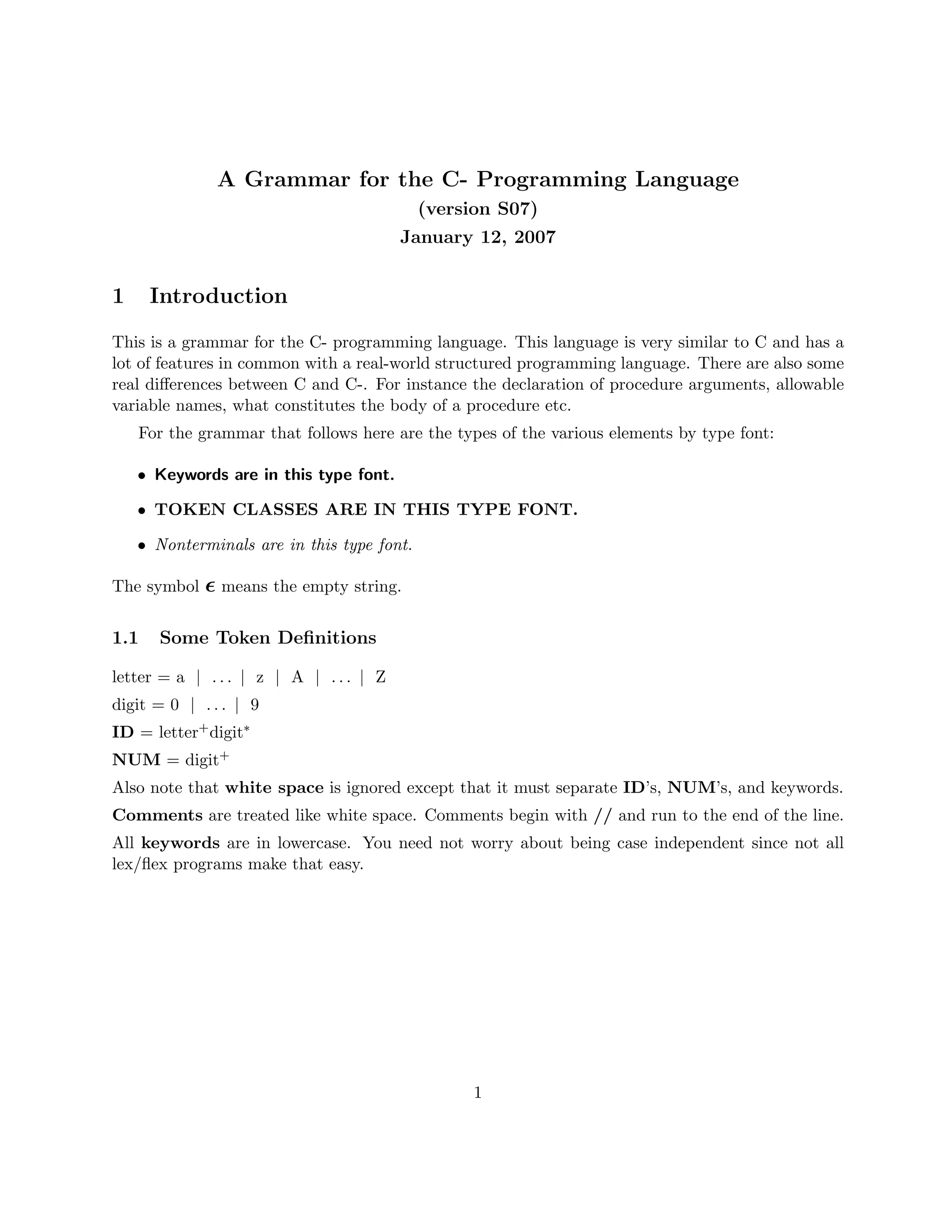
    For the grammar that follows here are the types of the various elements by type font:

    • Keywords are in this type font.

    • TOKEN CLASSES ARE IN THIS TYPE FONT.

    • Nonterminals are in this type font.

The symbol     means the empty string.


1.1   Some Token Definitions

letter = a | . . . | z | A | . . . | Z
digit = 0 | . . . | 9
ID = letter+ digit∗
NUM = digit+
Also note that white space is ignored except that it must separate ID’s, NUM’s, and keywords.
Comments are treated like white space. Comments begin with // and run to the end of the line.
All keywords are in lowercase. You need not worry about being case independent since not all
lex/flex programs make that easy.


                                                  1
2     The Grammar
    1. program → declaration-list

    2. declaration-list → declaration-list declaration | declaration

    3. declaration → var-declaration | fun-declaration

    4. var-declaration → type-specifier var-decl-list ;

    5. var-decl-list → var-decl-list , var-decl-id | var-decl-id

    6. var-decl-id → ID | ID [ NUM ]

    7. type-specifier → int | void | bool

    8. fun-declaration → type-specifier ID ( params ) statement

    9. params → param-list |

10. param-list → param-list ; param-type-list | param-type-list

11. param-type-list → type-specifier param-id-list

12. param-id-list → param-id-list , param-id | param-id

13. param-id → ID | ID [ ]

14. compound-stmt → { local-declarations statement-list }

15. local-declarations → local-declarations var-declaration |

16. statement-list → statement-list statement |

17. statement → expression-stmt | compound-stmt | selection-stmt | iteration-stmt | return-stmt
    | break-stmt

18. expression-stmt → expression ; | ;

19. selection-stmt → if ( expression ) statement | if ( expression ) statement else statement

20. iteration-stmt → while ( expression ) statement

21. return-stmt → return ; | return expression ;

22. break-stmt → break ;

23. expression → var = expression | var += expression | var −= expression | simple-expression

24. var → ID | ID [ expression ]

                                                    2
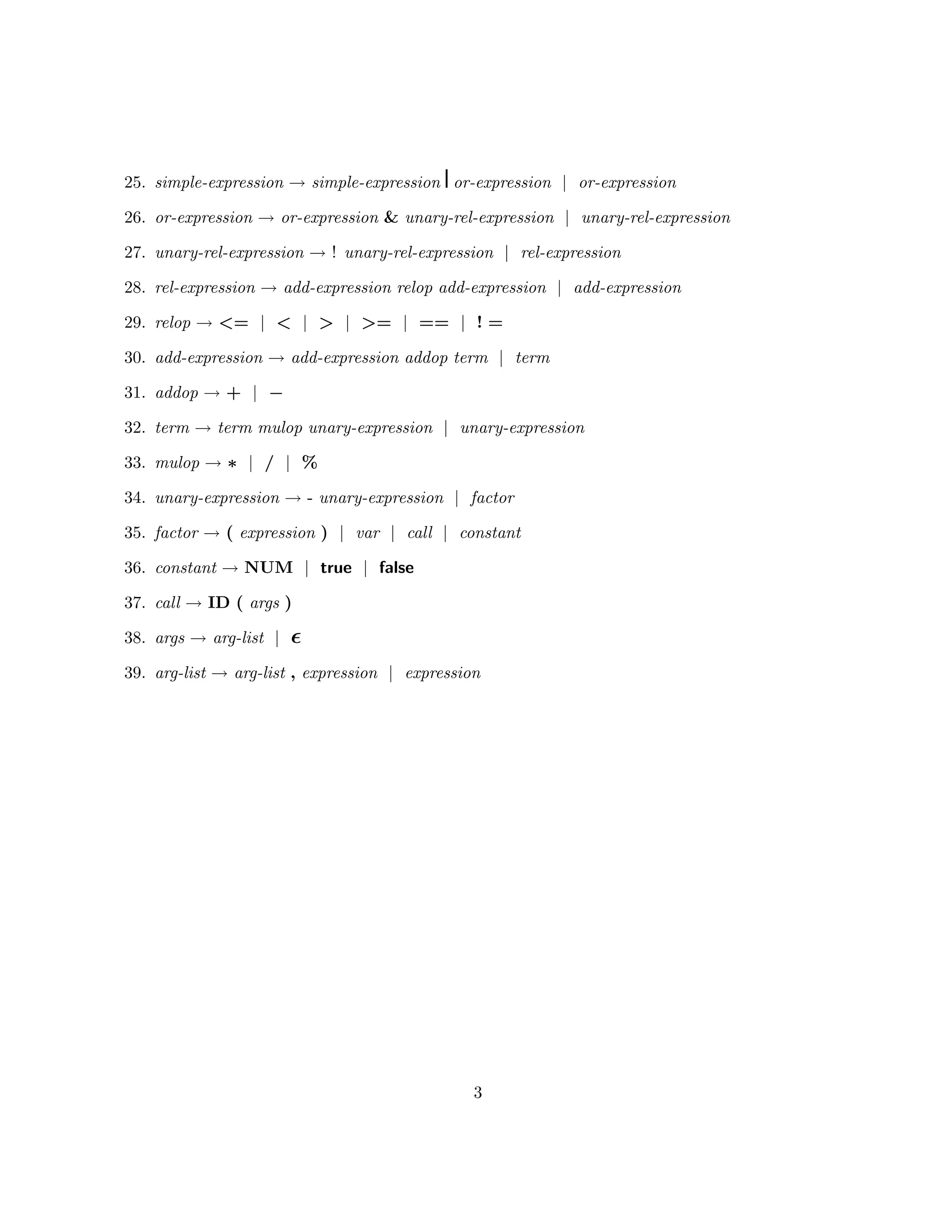
25. simple-expression → simple-expression or-expression | or-expression

26. or-expression → or-expression & unary-rel-expression | unary-rel-expression

27. unary-rel-expression → ! unary-rel-expression | rel-expression

28. rel-expression → add-expression relop add-expression | add-expression

29. relop → <= | < | > | >= | == | ! =

30. add-expression → add-expression addop term | term

31. addop → + | −

32. term → term mulop unary-expression | unary-expression

33. mulop → ∗ | / | %

34. unary-expression → - unary-expression | factor

35. factor → ( expression ) | var | call | constant

36. constant → NUM | true | false

37. call → ID ( args )

38. args → arg-list |

39. arg-list → arg-list , expression | expression


                                                3

C grammar

  • 1.
    A Grammar forthe C- Programming Language (version S07) January 12, 2007 1 Introduction This is a grammar for the C- programming language. This language is very similar to C and has a lot of features in common with a real-world structured programming language. There are also some real differences between C and C-. For instance the declaration of procedure arguments, allowable variable names, what constitutes the body of a procedure etc. For the grammar that follows here are the types of the various elements by type font: • Keywords are in this type font. • TOKEN CLASSES ARE IN THIS TYPE FONT. • Nonterminals are in this type font. The symbol means the empty string. 1.1 Some Token Definitions letter = a | . . . | z | A | . . . | Z digit = 0 | . . . | 9 ID = letter+ digit∗ NUM = digit+ Also note that white space is ignored except that it must separate ID’s, NUM’s, and keywords. Comments are treated like white space. Comments begin with // and run to the end of the line. All keywords are in lowercase. You need not worry about being case independent since not all lex/flex programs make that easy. 1
  • 2.
    2 The Grammar 1. program → declaration-list 2. declaration-list → declaration-list declaration | declaration 3. declaration → var-declaration | fun-declaration 4. var-declaration → type-specifier var-decl-list ; 5. var-decl-list → var-decl-list , var-decl-id | var-decl-id 6. var-decl-id → ID | ID [ NUM ] 7. type-specifier → int | void | bool 8. fun-declaration → type-specifier ID ( params ) statement 9. params → param-list | 10. param-list → param-list ; param-type-list | param-type-list 11. param-type-list → type-specifier param-id-list 12. param-id-list → param-id-list , param-id | param-id 13. param-id → ID | ID [ ] 14. compound-stmt → { local-declarations statement-list } 15. local-declarations → local-declarations var-declaration | 16. statement-list → statement-list statement | 17. statement → expression-stmt | compound-stmt | selection-stmt | iteration-stmt | return-stmt | break-stmt 18. expression-stmt → expression ; | ; 19. selection-stmt → if ( expression ) statement | if ( expression ) statement else statement 20. iteration-stmt → while ( expression ) statement 21. return-stmt → return ; | return expression ; 22. break-stmt → break ; 23. expression → var = expression | var += expression | var −= expression | simple-expression 24. var → ID | ID [ expression ] 2
  • 3.
    25. simple-expression →simple-expression or-expression | or-expression 26. or-expression → or-expression & unary-rel-expression | unary-rel-expression 27. unary-rel-expression → ! unary-rel-expression | rel-expression 28. rel-expression → add-expression relop add-expression | add-expression 29. relop → <= | < | > | >= | == | ! = 30. add-expression → add-expression addop term | term 31. addop → + | − 32. term → term mulop unary-expression | unary-expression 33. mulop → ∗ | / | % 34. unary-expression → - unary-expression | factor 35. factor → ( expression ) | var | call | constant 36. constant → NUM | true | false 37. call → ID ( args ) 38. args → arg-list | 39. arg-list → arg-list , expression | expression 3