B.Bhuvaneswaran, AP (SG) / CSE
9791519152
bhuvaneswaran@rajalakshmi.edu.in
C# and .NET Programming
Generics
Generics Rajalakshmi Engineering College 2
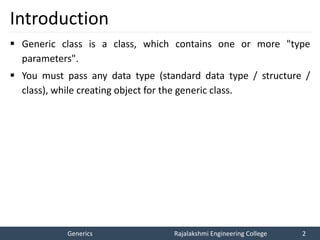
Introduction
▪ Generic class is a class, which contains one or more "type
parameters".
▪ You must pass any data type (standard data type / structure /
class), while creating object for the generic class.
Generics Rajalakshmi Engineering College 3
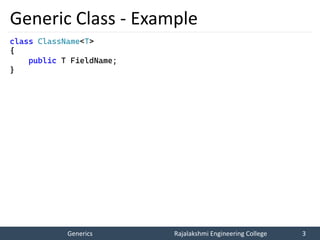
Generic Class - Example
class ClassName<T>
{
public T FieldName;
}
Generics Rajalakshmi Engineering College 4
Object of Generic Class - Example
▪ ClassName<int> referenceVariable = new ClassName<int> ( );
Generics Rajalakshmi Engineering College 5
Explanation
▪ The same field may belong to different data types, w.r.t. different objects of the
same class.
▪ You will decide the data type of the field, while creating the object, rather than
while creating field in the class.
▪ It helps you in code reuse, performance and type-safety.
▪ You can create your own generic-classes, generic-methods, generic-interfaces
and generic-delegates.
▪ You can create generic collection classes. The .NET framework class library
contains many new generic collection classes in System.Collections.Generic
namespace.
▪ The generic type parameter (T) acts as "temporary data type", which represents
the actual data type, provided by the user, while creating object.
▪ You can have multiple "generic type parameters" in the same class (for use for
different fields.
▪ Generics are introduced in C# 2.0.
Generics Rajalakshmi Engineering College 6
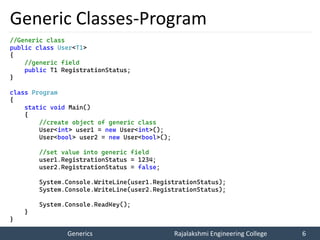
Generic Classes-Program
//Generic class
public class User<T1>
{
//generic field
public T1 RegistrationStatus;
}
class Program
{
static void Main()
{
//create object of generic class
User<int> user1 = new User<int>();
User<bool> user2 = new User<bool>();
//set value into generic field
user1.RegistrationStatus = 1234;
user2.RegistrationStatus = false;
System.Console.WriteLine(user1.RegistrationStatus);
System.Console.WriteLine(user2.RegistrationStatus);
System.Console.ReadKey();
}
}
Generics Rajalakshmi Engineering College 7
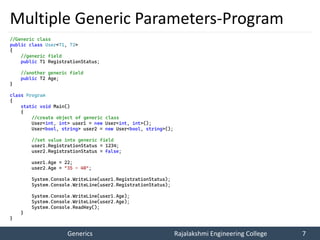
Multiple Generic Parameters-Program
//Generic class
public class User<T1, T2>
{
//generic field
public T1 RegistrationStatus;
//another generic field
public T2 Age;
}
class Program
{
static void Main()
{
//create object of generic class
User<int, int> user1 = new User<int, int>();
User<bool, string> user2 = new User<bool, string>();
//set value into generic field
user1.RegistrationStatus = 1234;
user2.RegistrationStatus = false;
user1.Age = 22;
user2.Age = "35 - 40";
System.Console.WriteLine(user1.RegistrationStatus);
System.Console.WriteLine(user2.RegistrationStatus);
System.Console.WriteLine(user1.Age);
System.Console.WriteLine(user2.Age);
System.Console.ReadKey();
}
}
Generics Rajalakshmi Engineering College 8
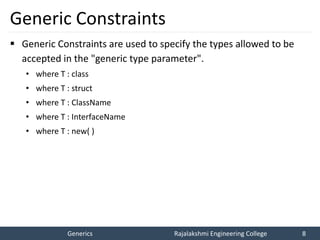
Generic Constraints
▪ Generic Constraints are used to specify the types allowed to be
accepted in the "generic type parameter".
• where T : class
• where T : struct
• where T : ClassName
• where T : InterfaceName
• where T : new( )
Generics Rajalakshmi Engineering College 9
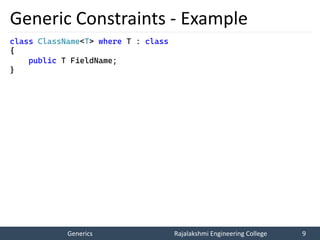
Generic Constraints - Example
class ClassName<T> where T : class
{
public T FieldName;
}
Generics Rajalakshmi Engineering College 10
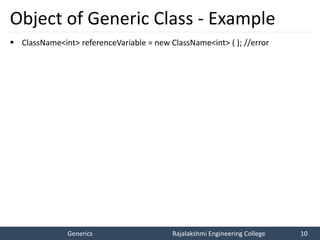
Object of Generic Class - Example
▪ ClassName<int> referenceVariable = new ClassName<int> ( ); //error
Generics Rajalakshmi Engineering College 11
Understanding Generic Constraints
▪ Advantage
• You can restrict what type of data types (class names) allowed to be passed
while creating object.
▪ In C#, constraints are used to restrict a generics to accept only
particular type or its derived types.
▪ By using 'where' keyword, we can apply constraints on generics.
▪ You can apply multiple constraints on generic classes or methods
based on your requirements.
▪ Eg: where T : class where T2 : class
Generics Rajalakshmi Engineering College 12
Generic Constraint - Program
public abstract class Student
{
public abstract int Marks { get; set; }
}
public class GraduateStudent : Student
{
public override int Marks { get; set; }
}
public class PostGraduateStudent : Student
{
public override int Marks { get; set; }
}
//generic class with constraints (want to accept Student or its child classes only)
public class MarksPrinter<T> where T : Student
{
public T stu;
public void PrintMarks()
{
Student temp = (Student)stu;
System.Console.WriteLine(temp.Marks);
}
}
class Program
{
static void Main()
{
//create object of generic class
MarksPrinter<GraduateStudent> mp = new MarksPrinter<GraduateStudent>();
mp.stu = new GraduateStudent() { Marks = 80 };
mp.PrintMarks();
System.Console.ReadKey();
}
}
Generics Rajalakshmi Engineering College 13
Generic Methods
▪ Generic Method is a method that has one or more generic
parameter(s).
▪ You can restrict what type of data types to be allowed to be
passed to the parameter while calling the method.
Generics Rajalakshmi Engineering College 14
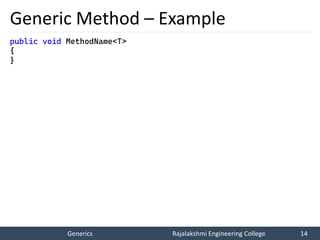
Generic Method – Example
public void MethodName<T>
{
}
Generics Rajalakshmi Engineering College 15
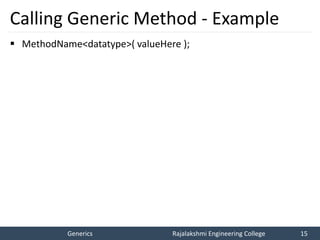
Calling Generic Method - Example
▪ MethodName<datatype>( valueHere );
Generics Rajalakshmi Engineering College 16
Generic Methods - Class
public class Employee
{
public int Salary;
}
public class Student
{
public int Marks;
}
//a class with generic method
public class Sample
{
//generic method
public void PrintData<T>(T obj) where T : class
{
if (obj.GetType() == typeof(Student))
{
Student temp = obj as Student;
System.Console.WriteLine(temp.Marks);
}
else if (obj.GetType() == typeof(Employee))
{
Employee temp = obj as Employee;
System.Console.WriteLine(temp.Salary);
}
}
}
Generics Rajalakshmi Engineering College 17
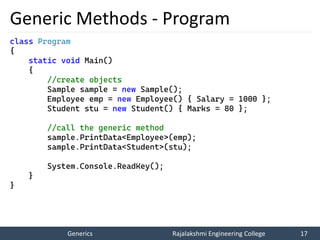
Generic Methods - Program
class Program
{
static void Main()
{
//create objects
Sample sample = new Sample();
Employee emp = new Employee() { Salary = 1000 };
Student stu = new Student() { Marks = 80 };
//call the generic method
sample.PrintData<Employee>(emp);
sample.PrintData<Student>(stu);
System.Console.ReadKey();
}
}
Generics Rajalakshmi Engineering College 18
Assignment
1. What are generic classes in C#? Provide an example of how to define
and use a generic class.
2. What are generic methods in C#? Provide an example of how to define
and use a generic method.
3. What are generic constraints in C#? Why are they important?
4. Can you provide an example of using generic constraints in a real-world
project scenario?
5. How can you specify multiple generic constraints for a type parameter
in C#?
6. What is the purpose of the default keyword in generic constraints?
7. Can you explain the concept of type inference in C# with respect to
generic methods?
Queries?
Thank You…!

C# Generics - Computer Science and Engineering Department

  • 1.
    B.Bhuvaneswaran, AP (SG)/ CSE 9791519152 bhuvaneswaran@rajalakshmi.edu.in C# and .NET Programming Generics
  • 2.
    Generics Rajalakshmi EngineeringCollege 2 Introduction ▪ Generic class is a class, which contains one or more "type parameters". ▪ You must pass any data type (standard data type / structure / class), while creating object for the generic class.
  • 3.
    Generics Rajalakshmi EngineeringCollege 3 Generic Class - Example class ClassName<T> { public T FieldName; }
  • 4.
    Generics Rajalakshmi EngineeringCollege 4 Object of Generic Class - Example ▪ ClassName<int> referenceVariable = new ClassName<int> ( );
  • 5.
    Generics Rajalakshmi EngineeringCollege 5 Explanation ▪ The same field may belong to different data types, w.r.t. different objects of the same class. ▪ You will decide the data type of the field, while creating the object, rather than while creating field in the class. ▪ It helps you in code reuse, performance and type-safety. ▪ You can create your own generic-classes, generic-methods, generic-interfaces and generic-delegates. ▪ You can create generic collection classes. The .NET framework class library contains many new generic collection classes in System.Collections.Generic namespace. ▪ The generic type parameter (T) acts as "temporary data type", which represents the actual data type, provided by the user, while creating object. ▪ You can have multiple "generic type parameters" in the same class (for use for different fields. ▪ Generics are introduced in C# 2.0.
  • 6.
    Generics Rajalakshmi EngineeringCollege 6 Generic Classes-Program //Generic class public class User<T1> { //generic field public T1 RegistrationStatus; } class Program { static void Main() { //create object of generic class User<int> user1 = new User<int>(); User<bool> user2 = new User<bool>(); //set value into generic field user1.RegistrationStatus = 1234; user2.RegistrationStatus = false; System.Console.WriteLine(user1.RegistrationStatus); System.Console.WriteLine(user2.RegistrationStatus); System.Console.ReadKey(); } }
  • 7.
    Generics Rajalakshmi EngineeringCollege 7 Multiple Generic Parameters-Program //Generic class public class User<T1, T2> { //generic field public T1 RegistrationStatus; //another generic field public T2 Age; } class Program { static void Main() { //create object of generic class User<int, int> user1 = new User<int, int>(); User<bool, string> user2 = new User<bool, string>(); //set value into generic field user1.RegistrationStatus = 1234; user2.RegistrationStatus = false; user1.Age = 22; user2.Age = "35 - 40"; System.Console.WriteLine(user1.RegistrationStatus); System.Console.WriteLine(user2.RegistrationStatus); System.Console.WriteLine(user1.Age); System.Console.WriteLine(user2.Age); System.Console.ReadKey(); } }
  • 8.
    Generics Rajalakshmi EngineeringCollege 8 Generic Constraints ▪ Generic Constraints are used to specify the types allowed to be accepted in the "generic type parameter". • where T : class • where T : struct • where T : ClassName • where T : InterfaceName • where T : new( )
  • 9.
    Generics Rajalakshmi EngineeringCollege 9 Generic Constraints - Example class ClassName<T> where T : class { public T FieldName; }
  • 10.
    Generics Rajalakshmi EngineeringCollege 10 Object of Generic Class - Example ▪ ClassName<int> referenceVariable = new ClassName<int> ( ); //error
  • 11.
    Generics Rajalakshmi EngineeringCollege 11 Understanding Generic Constraints ▪ Advantage • You can restrict what type of data types (class names) allowed to be passed while creating object. ▪ In C#, constraints are used to restrict a generics to accept only particular type or its derived types. ▪ By using 'where' keyword, we can apply constraints on generics. ▪ You can apply multiple constraints on generic classes or methods based on your requirements. ▪ Eg: where T : class where T2 : class
  • 12.
    Generics Rajalakshmi EngineeringCollege 12 Generic Constraint - Program public abstract class Student { public abstract int Marks { get; set; } } public class GraduateStudent : Student { public override int Marks { get; set; } } public class PostGraduateStudent : Student { public override int Marks { get; set; } } //generic class with constraints (want to accept Student or its child classes only) public class MarksPrinter<T> where T : Student { public T stu; public void PrintMarks() { Student temp = (Student)stu; System.Console.WriteLine(temp.Marks); } } class Program { static void Main() { //create object of generic class MarksPrinter<GraduateStudent> mp = new MarksPrinter<GraduateStudent>(); mp.stu = new GraduateStudent() { Marks = 80 }; mp.PrintMarks(); System.Console.ReadKey(); } }
  • 13.
    Generics Rajalakshmi EngineeringCollege 13 Generic Methods ▪ Generic Method is a method that has one or more generic parameter(s). ▪ You can restrict what type of data types to be allowed to be passed to the parameter while calling the method.
  • 14.
    Generics Rajalakshmi EngineeringCollege 14 Generic Method – Example public void MethodName<T> { }
  • 15.
    Generics Rajalakshmi EngineeringCollege 15 Calling Generic Method - Example ▪ MethodName<datatype>( valueHere );
  • 16.
    Generics Rajalakshmi EngineeringCollege 16 Generic Methods - Class public class Employee { public int Salary; } public class Student { public int Marks; } //a class with generic method public class Sample { //generic method public void PrintData<T>(T obj) where T : class { if (obj.GetType() == typeof(Student)) { Student temp = obj as Student; System.Console.WriteLine(temp.Marks); } else if (obj.GetType() == typeof(Employee)) { Employee temp = obj as Employee; System.Console.WriteLine(temp.Salary); } } }
  • 17.
    Generics Rajalakshmi EngineeringCollege 17 Generic Methods - Program class Program { static void Main() { //create objects Sample sample = new Sample(); Employee emp = new Employee() { Salary = 1000 }; Student stu = new Student() { Marks = 80 }; //call the generic method sample.PrintData<Employee>(emp); sample.PrintData<Student>(stu); System.Console.ReadKey(); } }
  • 18.
    Generics Rajalakshmi EngineeringCollege 18 Assignment 1. What are generic classes in C#? Provide an example of how to define and use a generic class. 2. What are generic methods in C#? Provide an example of how to define and use a generic method. 3. What are generic constraints in C#? Why are they important? 4. Can you provide an example of using generic constraints in a real-world project scenario? 5. How can you specify multiple generic constraints for a type parameter in C#? 6. What is the purpose of the default keyword in generic constraints? 7. Can you explain the concept of type inference in C# with respect to generic methods?
  • 19.
  • 20.