Business Opportunity 
Identification 
Lecture Contents 
Springboard for Business Ideas 
Existing/ Expected Enterprise 
Ideas from Market Place 
Information Search
Before Starting your Own 
Business 
Does the idea fire your motivation and is it adequate enough to 
keep you going for next one to two years? 
Is it a viable business proposition in your area? 
Does it match the needs of your clientele, local or otherwise? 
Check it out with basic market research 
Test it out in the market 
Consult with experts 
Look out for competition in the field 
Is it a sunrise industry? 
Evaluate your business opportunity 
Project conceptualization
Business Opportunities need to 
be filtered through 
a Five-layer Sieve 
• Researching your industry – how can you learn more about your 
chosen industry and about the resources that are available to help you? 
• Market assessment – is there a market for your product or service? If 
so, how much income can you expect to derive from it? 
• Profitability assessment – how much will starting a new business cost 
you? Can you afford a lengthy “red link” period following start-up, as well 
as periodic lulls in cash flow? Can you afford to fail? 
• Financing assessment – will you be able to obtain the necessary 
financing for your business? If so, from where? 
• Legal assessment – what potential legal liabilities are you exposing 
yourself to by starting a new business? Are the costs of protecting 
yourself worth the trouble?
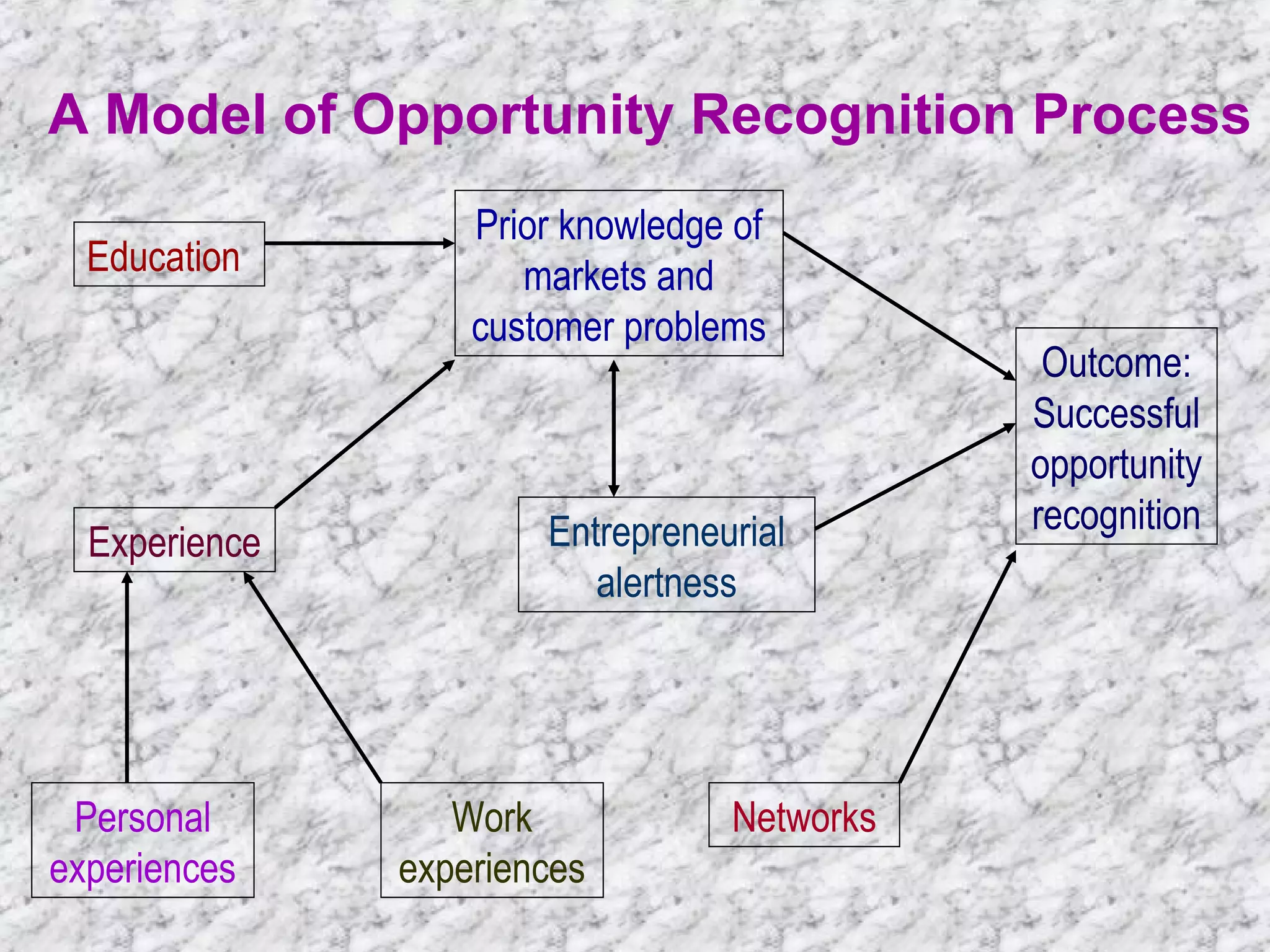
A Model of Opportunity Recognition Process 
Education 
Prior knowledge of 
markets and 
customer problems 
Networks 
Experience 
Work 
experiences 
Personal 
experiences 
Entrepreneurial 
alertness 
Outcome: 
Successful 
opportunity 
recognition
Springboards for a Business Enterprise Idea 
• Natural Resources 
• Existing/ Expected Enterprises 
• Market-Extension/ Modification of Present Work Content 
• Creative Effort 
Focus on …. 
 Is there any natural resource which you can commercialize? 
 Are there any existing enterprises you can supply goods or 
services to? 
 Are there any existing enterprises doing so well that it would be 
worthwhile to do the same? 
 Are there any products/ services for which the market demand will 
continue to expand? 
 Does the present work suggest any business opportunity?
Natural resources 
• Forest (gum, gooseberry, timber, bamboo, herbs,etc.) 
• Horticulture (fruits, vegetables and flowers) 
• Agriculture (grains, pulses, spices and such commercial 
crops as cane, tobacco, cotton and oilseeds) 
• Agro-waste (e.g. rice, straw, groundnut husk) 
• Marine or Aqua (fish, shrimp and crab) 
• Mineral (clay, iron and steel) 
• Animal (wool and meat) 
• Wind/ Sun (solar energy)
Existing/ Expected Enterprises 
and Business Ideas 
Similar Business 
Raw Materials 
Parts and Components 
Further Processing 
Packing Material 
By-product use 
Problem-solving products 
Service Needs
Industrial development-based opportunities : A Checklist 
• Is there any established industry in your area? 
• What is the performance rate of this industry? 
• Can you pursue any business ventures in your area, which though 
uncommon, are yet very successful? 
• What kind of raw materials, packing materials, components and services the 
local industries require? 
• Are any of these procured from outside your area? 
• Do any of these pose problems in terms of availability quality, delivery 
schedule, etc.? 
• Do the local industries generate any waste or by-products? What are these 
used for? Who buys these? 
• Are there non-local suppliers to a given industry with whom the industry is 
quite happy? 
• Are there any new and important industries being established in your area? 
• What are they likely to buy or manufacture? 
• Are there any infrastructure projects coming up? What are they likely to 
require?
Ideas from the Marketplace 
• Trade flow 
• Growth products and services 
• Ideas from other markets 
• Scarcity of products/ Services 
• Export
Sources of Information: 
New Business Ideas 
• Similar-enterprise owners 
• Machinery suppliers 
• Raw material suppliers 
• Customers 
• Packing material suppliers 
• Dealers 
• Consultants 
• Employees in similar enterprises 
• Bank officials 
• Regulatory-agency officials (e.g. Drug Controller office) 
• Promotional agency officials (DIC) 
• Associations of manufacturers, dealers, customers, raw material 
suppliers in relation to a given product

Business opportunity identification

  • 1.
    Business Opportunity Identification Lecture Contents Springboard for Business Ideas Existing/ Expected Enterprise Ideas from Market Place Information Search
  • 2.
    Before Starting yourOwn Business Does the idea fire your motivation and is it adequate enough to keep you going for next one to two years? Is it a viable business proposition in your area? Does it match the needs of your clientele, local or otherwise? Check it out with basic market research Test it out in the market Consult with experts Look out for competition in the field Is it a sunrise industry? Evaluate your business opportunity Project conceptualization
  • 3.
    Business Opportunities needto be filtered through a Five-layer Sieve • Researching your industry – how can you learn more about your chosen industry and about the resources that are available to help you? • Market assessment – is there a market for your product or service? If so, how much income can you expect to derive from it? • Profitability assessment – how much will starting a new business cost you? Can you afford a lengthy “red link” period following start-up, as well as periodic lulls in cash flow? Can you afford to fail? • Financing assessment – will you be able to obtain the necessary financing for your business? If so, from where? • Legal assessment – what potential legal liabilities are you exposing yourself to by starting a new business? Are the costs of protecting yourself worth the trouble?
  • 4.
    A Model ofOpportunity Recognition Process Education Prior knowledge of markets and customer problems Networks Experience Work experiences Personal experiences Entrepreneurial alertness Outcome: Successful opportunity recognition
  • 5.
    Springboards for aBusiness Enterprise Idea • Natural Resources • Existing/ Expected Enterprises • Market-Extension/ Modification of Present Work Content • Creative Effort Focus on ….  Is there any natural resource which you can commercialize?  Are there any existing enterprises you can supply goods or services to?  Are there any existing enterprises doing so well that it would be worthwhile to do the same?  Are there any products/ services for which the market demand will continue to expand?  Does the present work suggest any business opportunity?
  • 6.
    Natural resources •Forest (gum, gooseberry, timber, bamboo, herbs,etc.) • Horticulture (fruits, vegetables and flowers) • Agriculture (grains, pulses, spices and such commercial crops as cane, tobacco, cotton and oilseeds) • Agro-waste (e.g. rice, straw, groundnut husk) • Marine or Aqua (fish, shrimp and crab) • Mineral (clay, iron and steel) • Animal (wool and meat) • Wind/ Sun (solar energy)
  • 7.
    Existing/ Expected Enterprises and Business Ideas Similar Business Raw Materials Parts and Components Further Processing Packing Material By-product use Problem-solving products Service Needs
  • 8.
    Industrial development-based opportunities: A Checklist • Is there any established industry in your area? • What is the performance rate of this industry? • Can you pursue any business ventures in your area, which though uncommon, are yet very successful? • What kind of raw materials, packing materials, components and services the local industries require? • Are any of these procured from outside your area? • Do any of these pose problems in terms of availability quality, delivery schedule, etc.? • Do the local industries generate any waste or by-products? What are these used for? Who buys these? • Are there non-local suppliers to a given industry with whom the industry is quite happy? • Are there any new and important industries being established in your area? • What are they likely to buy or manufacture? • Are there any infrastructure projects coming up? What are they likely to require?
  • 9.
    Ideas from theMarketplace • Trade flow • Growth products and services • Ideas from other markets • Scarcity of products/ Services • Export
  • 10.
    Sources of Information: New Business Ideas • Similar-enterprise owners • Machinery suppliers • Raw material suppliers • Customers • Packing material suppliers • Dealers • Consultants • Employees in similar enterprises • Bank officials • Regulatory-agency officials (e.g. Drug Controller office) • Promotional agency officials (DIC) • Associations of manufacturers, dealers, customers, raw material suppliers in relation to a given product