15A52301 -MANAGERIAL ECONOMICS
AND FINANCIAL ANALYSIS
Prepared By
C.Bhupathi,
Associate Professor,
Department of MBA.
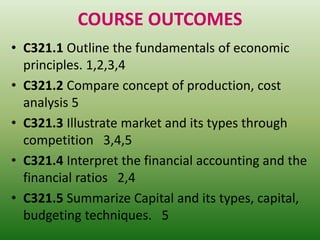
COURSE OUTCOMES
• C321.1 Outline the fundamentals of economic
principles. 1,2,3,4
• C321.2 Compare concept of production, cost
analysis 5
• C321.3 Illustrate market and its types through
competition 3,4,5
• C321.4 Interpret the financial accounting and the
financial ratios 2,4
• C321.5 Summarize Capital and its types, capital,
budgeting techniques. 5
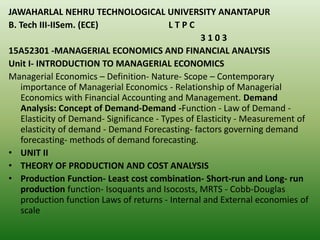
JAWAHARLAL NEHRU TECHNOLOGICAL UNIVERSITY ANANTAPUR
B. Tech III-IISem. (ECE) L T P C
3 1 0 3
15A52301 -MANAGERIAL ECONOMICS AND FINANCIAL ANALYSIS
Unit I- INTRODUCTION TO MANAGERIAL ECONOMICS
Managerial Economics – Definition- Nature- Scope – Contemporary
importance of Managerial Economics - Relationship of Managerial
Economics with Financial Accounting and Management. Demand
Analysis: Concept of Demand-Demand -Function - Law of Demand -
Elasticity of Demand- Significance - Types of Elasticity - Measurement of
elasticity of demand - Demand Forecasting- factors governing demand
forecasting- methods of demand forecasting.
• UNIT II
• THEORY OF PRODUCTION AND COST ANALYSIS
• Production Function- Least cost combination- Short-run and Long- run
production function- Isoquants and Isocosts, MRTS - Cobb-Douglas
production function Laws of returns - Internal and External economies of
scale
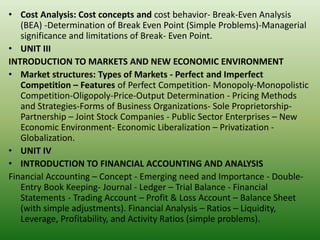
• Cost Analysis: Cost concepts and cost behavior- Break-Even Analysis
(BEA) -Determination of Break Even Point (Simple Problems)-Managerial
significance and limitations of Break- Even Point.
• UNIT III
INTRODUCTION TO MARKETS AND NEW ECONOMIC ENVIRONMENT
• Market structures: Types of Markets - Perfect and Imperfect
Competition – Features of Perfect Competition- Monopoly-Monopolistic
Competition-Oligopoly-Price-Output Determination - Pricing Methods
and Strategies-Forms of Business Organizations- Sole Proprietorship-
Partnership – Joint Stock Companies - Public Sector Enterprises – New
Economic Environment- Economic Liberalization – Privatization -
Globalization.
• UNIT IV
• INTRODUCTION TO FINANCIAL ACCOUNTING AND ANALYSIS
Financial Accounting – Concept - Emerging need and Importance - Double-
Entry Book Keeping- Journal - Ledger – Trial Balance - Financial
Statements - Trading Account – Profit & Loss Account – Balance Sheet
(with simple adjustments). Financial Analysis – Ratios – Liquidity,
Leverage, Profitability, and Activity Ratios (simple problems).
• UNIT V
• CAPITAL AND CAPITAL BUDGETING
• Concept of Capital - Over and Undercapitalization – Remedial Measures -
Sources of Shot term and Long term Capital - Estimating Working Capital
Requirements – Capital Budgeting – Features of Capital Budgeting
Proposals – Methods and Evaluation of Capital Budgeting Projects – Pay
Back Method – Accounting Rate of Return (ARR) – Net Present Value
(NPV) – Internal Rate Return (IRR) Method (simple problems)
• TEXT BOOKS:
1. Managerial Economics 3/e, Ahuja H.L, S.Chand, 2013.
2. Financial Management, I.M.Pandey, Vikas Publications, 2013.
• REFERENCES
1. Managerial Economics and Financial Analysis, 1/e, Aryasri, TMH, 2013.
2. Managerial Economics and Financial Analysis, S.A. Siddiqui and A.S.
Siddiqui, New Age International, 2013.
3. Accounting and Financial Management, T.S.Reddy& Y. Hariprasad Reddy,
Margham Publishers.
INTRODUCTION TO
MANAGERIAL ECONOMICS
UNIT -1
Introduction To Economics
Economics is a study of human activity both
at individual and national level. The economists of
early age treated merely as the science of wealth.
The reason for this is clear. Every one of us is
involved in efforts aimed at earning money and
spending this money to satisfy our wants such as food
, clothing , shelter , and others. Such activities of
earning and spending money are called ‘economics’.
It was only during the eighteen century
that “Adam smith” the father of economics , defined
economics as ‘the study of nature and uses of national
wealth’.
Wealth cannot be the ultimate goal of a
man. We work hard daily to keep our life daily to keep
our life comfort , and to earn money. Merely procuring
money or wealth is not our ultimate objective . We want
to buy necessary goods and services that make life more
comfortable, and for this purpose we need money .
DEFINITION :
“Dr. Alfred marshall “ One of the great
economists of the nineteenth century , writes
“Economics is a study of man’s actions in the ordinary
business of life ; it enquires how he gets his income and
how he uses it “.Thus , it is on one side , a study of
wealth ; and on the other ,and more important side ,it is
the study of man.
Prof Lionel Robbins defined Economics as “the
science which studies human behavior as a relationship
between ends and scarce means which have alternative
uses”.
The salient features of Economics according to
Prof Robbins are as follows :
1. Unlimited wants
2. Scarce resources
3. Alternative uses
4. Choice
Microeconomics
The study of an individual consumer or a firm is called
microeconomics ( also called the theory of firm ).
Micro means ‘one millionth’. Microeconomics deals with behaviour and
problems of single individual and of micro organisation.
Macroeconomics
The study of ‘aggregate’ or total level of economic activity in
a country is called macroeconomics. It studies the flow of
economics resources or factors of production ( such as Land ,
Labour , Capital , Organisation , and Technology )from the resource
owner to the business firms and then from the business firms to
the households.
Management
management is the art of getting things done through people
in formally organised groups . It is necessary that every
organisation is well managed to enable it to achieve its desired
goals . management includes a number of functions
1. Planning
2. Organising
3. Staffing
4. Directing
5. Controlling .
The Manager
A Manager gets things done through people in an
organisation. He directs the resources such as men ,
materials , machines , money and technology. A manager is
responsible for achieving the targeted results . The
managers task is to maximize the profits of the firm.
Definition of managerial economics
According to Spencer and Siegelman managerial economics as
“The integration of economic theory with business practice for the
purpose of facilitating decision-making and forward planning by
management”.
Nature of Managerial Economics
Managerial economics is perhaps , the youngest of all the social
sciences. Since it originates from economics it has the basic
features of economics, such as assuming that other things
remaining the same .
Further , it is assumed that the firm or the buyer acts in a
rational manner (which normally does not happen). The buyer is
carried away by the advertisements , brand loyalties , incentives
and so on and therefore , the innate behavior of the consumer will
be rational is not a realistic assumption.
This is because the behavior of a firm or a consumer is a
complex phenomenon.
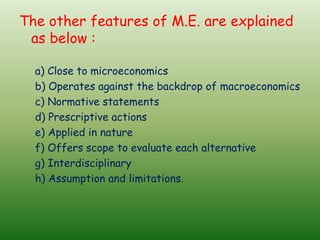
The other features of M.E. are explained
as below :
a) Close to microeconomics
b) Operates against the backdrop of macroeconomics
c) Normative statements
d) Prescriptive actions
e) Applied in nature
f) Offers scope to evaluate each alternative
g) Interdisciplinary
h) Assumption and limitations.
Scope of Managerial Economics
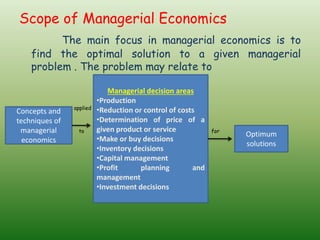
The main focus in managerial economics is to
find the optimal solution to a given managerial
problem . The problem may relate to
applied
to for
Concepts and
techniques of
managerial
economics
Managerial decision areas
•Production
•Reduction or control of costs
•Determination of price of a
given product or service
•Make or buy decisions
•Inventory decisions
•Capital management
•Profit planning and
management
•Investment decisions
Optimum
solutions
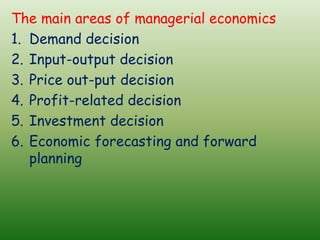
The main areas of managerial economics
1. Demand decision
2. Input-output decision
3. Price out-put decision
4. Profit-related decision
5. Investment decision
6. Economic forecasting and forward
planning
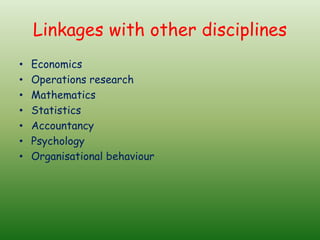
Linkages with other disciplines
• Economics
• Operations research
• Mathematics
• Statistics
• Accountancy
• Psychology
• Organisational behaviour
Demand Analysis
Introduction:
The scope of economics broadly comprises (a)
Consumption (b) Production (c) Exchange and (d) Distribution
Consumption deals with the behaviour of
consumers. To plan his operations, a producer has to understand
the consumer behaviour pattern before he commits his funds for
production. This is the reason why consumption precedes
production.
Exchange deals with how the goods, once produced,
are sold for a price to the customer.
Distribution deals with how the sale proceeds of
the goods sold are distributed among the various factors of
production towards the rent (to the landlord for letting out his
land), wages (for labour), interest (to capitalist for having provided
capital), and profits (to the organiser for having organised the
business activity).
What is demand ?
Every want supported by the willingness and ability to buy constitutes
demand for a particular product or service. In other words , if I want a car
and I cannot pay for it , there is no demand for the car from my side.
A product or service is said to have demand when three conditions are
satisfied :
• Desire on the part of the buyer to buy
• Willingness to pay for it
• Ability to pay the specified price for it.
unless all this conditions are fulfilled , the product is not said to have any
demand.
Nature And Types Of Demand:
1.Consumer Demand Vs Producer Goods :
Consumer goods refers to such products and services which are
capable of satisfying human needs.
Examples are bread ,apple , rice and so on .
This gives direct and immediate satisfaction.
Producer goods are those which are used for further processing or
production of goods/services to earn income .
Examples are machinery or a tractor .
These goods yield satisfaction indirectly.
2 . Autonomous demand vs derived demand :
Autonomous demand refers to the demand for products and services
directly.
Super speciality hospital can be considered as autonomous where as the
demand for the hotels around that is called derived demand.
If there is no demand for houses ,,there many not be demand for steel ,
cement , bricks and so on .
3. Durable vs perishable goods :
Here the demand for goods is classified based on their durability .
Examples of perishable goods are -milk , vegetables , fish , and such.
Rice , wheat , sugar such others can be examples of durable goods.
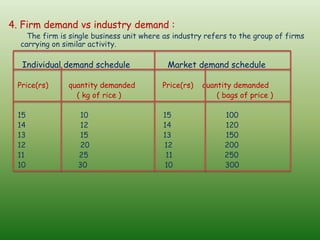
4. Firm demand vs industry demand :
The firm is single business unit where as industry refers to the group of firms
carrying on similar activity.
Individual demand schedule Market demand schedule
Price(rs) quantity demanded Price(rs) quantity demanded
( kg of rice ) ( bags of price )
15 10 15 100
14 12 14 120
13 15 13 150
12 20 12 200
11 25 11 250
10 30 10 300
5. Short-run demand VS long-run demand :
Joel Dean defines short-run demand as ‘the demand with
its immediate reaction to price changes, income fluctuations
and so on. Long-run demand is that demand which will
ultimately exist as a result of the changes in pricing,
promotion or product improvement, after enough time is
allowed to let the market adjust itself to the given situation’.
6. New demand VS Replacement Demand:
New demand refers to the demand for the new products
and it is the addition to the existing stock. In replacement
demand, the item is purchased to maintain the asset in good
condition.
7. Total market and segment market demand:
Let us take the consumption of sugar in a given region.
The total demand for sugar in the region is the total market
demand. The demand for sugar from the sweet-making
industry from this region is the segment market demand.
Factors Determining Demand:
The demand for a particular product depends
on several factors. The following factors determine the
demand for a given product:
a) Price of the product (P)
b) Income level of the consumer (I)
c) Tastes and preferences of the consumer (T)
d) Prices of related goods which may be
substitutes/complementary (PR)
e) Expectations about the prices in future (EP)
f) Expectations about the incomes in future (EI)
g) Size of population (SP)
h) Distribution of consumers over different regions (DC)
i) Advertising efforts (A)
j) Any other factor capable of affecting the demand (O)
Demand Function:
Demand function is a function which describes a relationship
between one variable and its determinants. It describes how much
quantity of goods is bought at alternative prices of good and
related goods, alternative income levels, and alternative values of
other variables affecting demand. Thus, the demand function for a
good relates the quantity of a good which consumers demand during
a given period to the factors which influence the demand. The
above factors can be built up into a demand function.
Mathematically, the demand function for a product A can be
expressed as follows:
Qd= f(P, I, T, PR , EP , EI , SP , DC , A, O)
The impact of some of these determinants on demand can be
described as follows:
a) Price of the product
b) Income of the consumer
c) Prices of substitutes or complementaries
d) Tastes and preferences
Elasticity of Demand:
Most of the times, it is not enough to
understand the increase or decrease in price and
its consequential impact of change in the quantity
demanded. It is necessary to find out the extent
of increase or decrease in each of the variables
for taking certain managerial decisions. This
paves the way for the concept of elasticity of
demand.
The term ‘elasticity’ is defined as the
rate of responsiveness in the demand of a
commodity of a given change in price or any other
determinants of demand. In other words, it
explains the extent of change in quantity
demanded because of a given change in the other
determining factors, may be price or any other
factor(s).
Measurements of Elasticity:
The elasticity is measured in the
following ways:
a) Perfectly elastic demand
b) Perfectly inelastic demand
c) Relatively elastic demand
d) Relatively inelastic demand
e) Unity elasticity
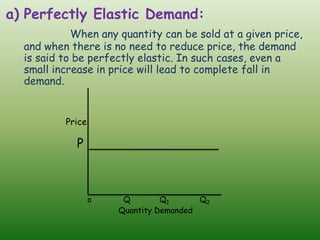
a) Perfectly Elastic Demand:
When any quantity can be sold at a given price,
and when there is no need to reduce price, the demand
is said to be perfectly elastic. In such cases, even a
small increase in price will lead to complete fall in
demand.
Price
P
o Q Q1 Q2
Quantity Demanded
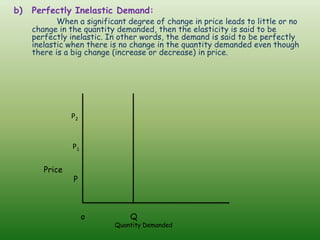
b) Perfectly Inelastic Demand:
When a significant degree of change in price leads to little or no
change in the quantity demanded, then the elasticity is said to be
perfectly inelastic. In other words, the demand is said to be perfectly
inelastic when there is no change in the quantity demanded even though
there is a big change (increase or decrease) in price.
P2
P1
Price
P
o Q
Quantity Demanded
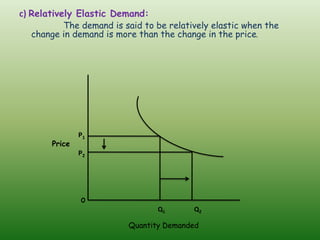
c) Relatively Elastic Demand:
The demand is said to be relatively elastic when the
change in demand is more than the change in the price.
P1
Price
P2
o
Q1 Q2
Quantity Demanded
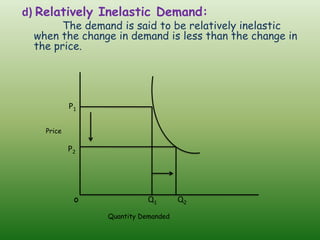
d) Relatively Inelastic Demand:
The demand is said to be relatively inelastic
when the change in demand is less than the change in
the price.
P1
Price
P2
o Q1 Q2
Quantity Demanded
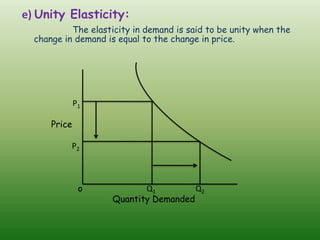
e) Unity Elasticity:
The elasticity in demand is said to be unity when the
change in demand is equal to the change in price.
P1
Price
P2
o Q1 Q2
Quantity Demanded
Types of Elasticity:
The following are the four types of
elasticity of demand:
a. Price elasticity of demand
b. Income elasticity of demand
c. Cross elasticity of demand
d. Advertising elasticity of demand
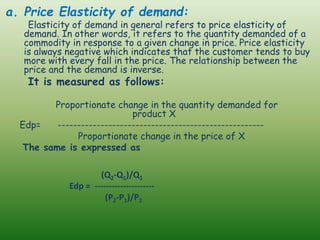
a. Price Elasticity of demand:
Elasticity of demand in general refers to price elasticity of
demand. In other words, it refers to the quantity demanded of a
commodity in response to a given change in price. Price elasticity
is always negative which indicates that the customer tends to buy
more with every fall in the price. The relationship between the
price and the demand is inverse.
It is measured as follows:
Proportionate change in the quantity demanded for
product X
Edp= -----------------------------------------------------
Proportionate change in the price of X
The same is expressed as
(Q2-Q1)/Q1
Edp = ---------------------
(P2-P1)/P1
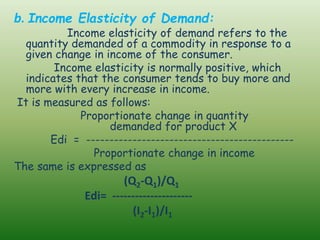
b. Income Elasticity of Demand:
Income elasticity of demand refers to the
quantity demanded of a commodity in response to a
given change in income of the consumer.
Income elasticity is normally positive, which
indicates that the consumer tends to buy more and
more with every increase in income.
It is measured as follows:
Proportionate change in quantity
demanded for product X
Edi = ---------------------------------------------
Proportionate change in income
The same is expressed as
(Q2-Q1)/Q1
Edi= ---------------------
(I2-I1)/I1
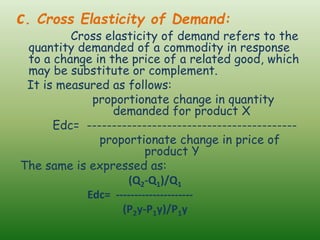
c. Cross Elasticity of Demand:
Cross elasticity of demand refers to the
quantity demanded of a commodity in response
to a change in the price of a related good, which
may be substitute or complement.
It is measured as follows:
proportionate change in quantity
demanded for product X
Edc= ------------------------------------------
proportionate change in price of
product Y
The same is expressed as:
(Q2-Q1)/Q1
Edc= ---------------------
(P2y-P1y)/P1y
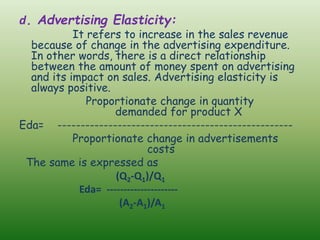
d. Advertising Elasticity:
It refers to increase in the sales revenue
because of change in the advertising expenditure.
In other words, there is a direct relationship
between the amount of money spent on advertising
and its impact on sales. Advertising elasticity is
always positive.
Proportionate change in quantity
demanded for product X
Eda= ---------------------------------------------------
Proportionate change in advertisements
costs
The same is expressed as
(Q2-Q1)/Q1
Eda= ---------------------
(A2-A1)/A1
Factors Governing Elasticity of Demand
a) Nature of product
b) Time frame
c) Degree of postponement
d) Number of alternative uses
e) Tastes and Preferences of the consumer
f) Availability of close substitutes
g) In case of complimentary or joint goods
h) Level of prices
i) Availability of subsidies
j) Expectation of prices
k) Durability of the product
l) Government policy
DEMAND FORECASTING
INTRODUCTION:
It is necessary to measure
demand accurately in terms of quantity
and its value for several purposes.
Demand forecasting is helpful not only
at the firm level but also at the national
level.
Methods of demand forecasting:
Forecasting demand is not an easy exercise.
It may be easy only in the case of a very few products
or services. Where the demand for the product does
not change from time to time or competition is not
significant, it may be relatively easy to forecast
demand for a particular product or service.
There are many methods of forecasting
demand. To forecast demand, we needed to build a
certain base of information. To build such an
information base, we need to consider what the
customers say, what the customers do, and how the
customers behaved in a given marketing situation.
The different methods of forecasting
demand can be grouped under (a) survey methods and
(b) statistical methods
1. Survey methods
(a) Survey of buyer intentions
▪ Census method
▪ Sample method
(b) Sales force opinion method
2. Statistical methods
(a) Trend projection method
▪ Trend line by observation
▪ Least square method
▪ Time series analysis
▪ Moving averages method
▪ Exponential smoothing
(b) Barometric techniques
(c) Simultaneous equations method
(d) Correlation and regression methods
3. Other methods
(a) Expert opinion method
(b) Test marketing
(c) Controlled experiments
(d) Judgemental approach
UNIT-2
Theory of Production
&
cost concepts
The production function
Samuelson defines the production
function as “the technical relationship which
reveals the maximum amount of output
capable of being produced by each and every
set of inputs”. It is defined for a given state of
technical knowledge.
Michael R Baye defines production
function as “that function which defines the
maximum amount of output that can be
produced with a given set of inputs”.
Input-output relationship or production function:
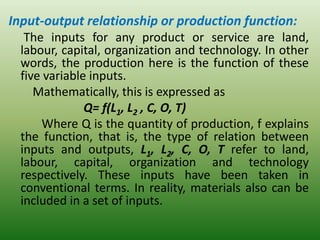
The inputs for any product or service are land,
labour, capital, organization and technology. In other
words, the production here is the function of these
five variable inputs.
Mathematically, this is expressed as
Q= f(L1, L2 , C, O, T)
Where Q is the quantity of production, f explains
the function, that is, the type of relation between
inputs and outputs, L1, L2, C, O, T refer to land,
labour, capital, organization and technology
respectively. These inputs have been taken in
conventional terms. In reality, materials also can be
included in a set of inputs.
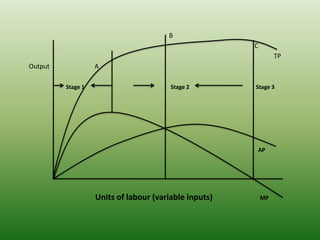
Production function with one variable input
and laws of returns:
The Laws of Returns states that when at least
one factor of production is fixed or factor input is
fixed and when all other factors are varied, the total
output in the initial stages will increase at an
increasing rate, and after reaching certain level of
output the total output will increase at declining
rate. If variable factor inputs are added further to the
fixed factor input, the total output may decline.
This law is of universal nature and it proved to
be true in agriculture and industry also. The law of
returns is also called the Law of Variable Proportions
or the Law of Diminishing returns.
B
C
TP
Output A
Stage 1 Stage 2 Stage 3
AP
Units of labour (variable inputs) MP
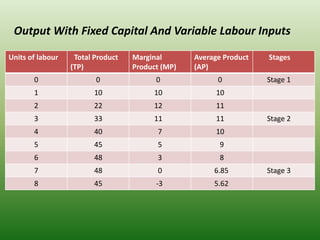
Units of labour Total Product
(TP)
Marginal
Product (MP)
Average Product
(AP)
Stages
0 0 0 0 Stage 1
1 10 10 10
2 22 12 11
3 33 11 11 Stage 2
4 40 7 10
5 45 5 9
6 48 3 8
7 48 0 6.85 Stage 3
8 45 -3 5.62
Output With Fixed Capital And Variable Labour Inputs
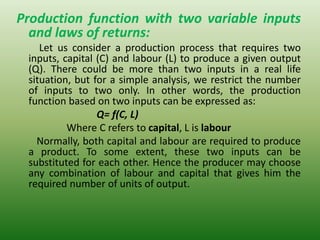
Production function with two variable inputs
and laws of returns:
Let us consider a production process that requires two
inputs, capital (C) and labour (L) to produce a given output
(Q). There could be more than two inputs in a real life
situation, but for a simple analysis, we restrict the number
of inputs to two only. In other words, the production
function based on two inputs can be expressed as:
Q= f(C, L)
Where C refers to capital, L is labour
Normally, both capital and labour are required to produce
a product. To some extent, these two inputs can be
substituted for each other. Hence the producer may choose
any combination of labour and capital that gives him the
required number of units of output.
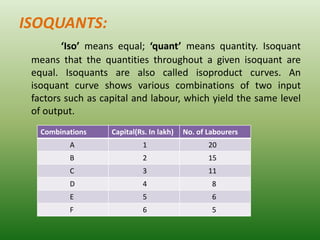
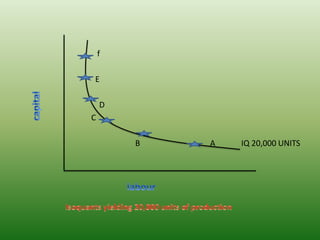
ISOQUANTS:
‘Iso’ means equal; ‘quant’ means quantity. Isoquant
means that the quantities throughout a given isoquant are
equal. Isoquants are also called isoproduct curves. An
isoquant curve shows various combinations of two input
factors such as capital and labour, which yield the same level
of output.
Combinations Capital(Rs. In lakh) No. of Labourers
A 1 20
B 2 15
C 3 11
D 4 8
E 5 6
F 6 5
f
E
D
C
B A IQ 20,000 UNITS
Features of an Isoquant:
1. Downward sloping:
Isoquants are downward sloping curves
because, if one input increases, the other one
reduces. There is no question of increase in
both the inputs to yield a given output.
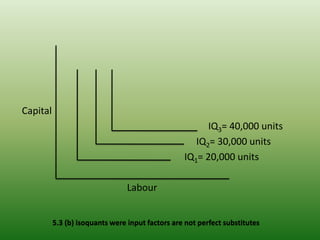
2. Convex to origin:
Isoquants are convex to the origin. It is
because the input factors are not perfect
substitutes. One input factor can be
substituted by other input factor in a
‘diminishing marginal rate’.
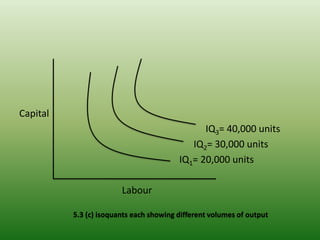
3. Do not intersect:
Two isoproducts do not intersect with
each other. It is because, each of these denote
a particular level of output. If the manufacturer
wants to operate at a higher level of output, he
has to switch over to another isoquant with a
higher level of output and vice versa.
4. Do not touch axes:
The isoquant touches neither X-axis nor
Y-axis, as both inputs are required to produce a
given product.
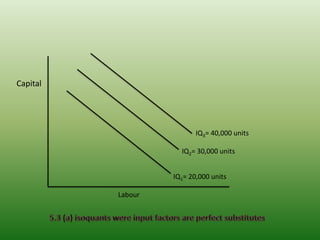
Capital
IQ3= 40,000 units
IQ2= 30,000 units
IQ1= 20,000 units
Labour
Capital
IQ3= 40,000 units
IQ2= 30,000 units
IQ1= 20,000 units
Labour
5.3 (b) isoquants were input factors are not perfect substitutes
Capital
IQ3= 40,000 units
IQ2= 30,000 units
IQ1= 20,000 units
Labour
5.3 (c) isoquants each showing different volumes of output
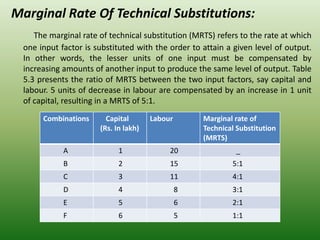
Marginal Rate Of Technical Substitutions:
The marginal rate of technical substitution (MRTS) refers to the rate at which
one input factor is substituted with the order to attain a given level of output.
In other words, the lesser units of one input must be compensated by
increasing amounts of another input to produce the same level of output. Table
5.3 presents the ratio of MRTS between the two input factors, say capital and
labour. 5 units of decrease in labour are compensated by an increase in 1 unit
of capital, resulting in a MRTS of 5:1.
Combinations Capital
(Rs. In lakh)
Labour Marginal rate of
Technical Substitution
(MRTS)
A 1 20 _
B 2 15 5:1
C 3 11 4:1
D 4 8 3:1
E 5 6 2:1
F 6 5 1:1
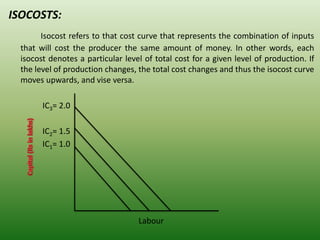
ISOCOSTS:
Isocost refers to that cost curve that represents the combination of inputs
that will cost the producer the same amount of money. In other words, each
isocost denotes a particular level of total cost for a given level of production. If
the level of production changes, the total cost changes and thus the isocost curve
moves upwards, and vise versa.
IC3= 2.0
IC2= 1.5
IC1= 1.0
Labour
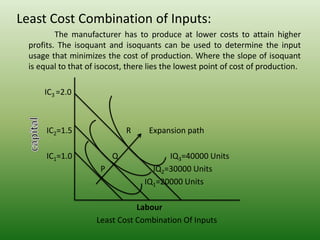
Least Cost Combination of Inputs:
The manufacturer has to produce at lower costs to attain higher
profits. The isoquant and isoquants can be used to determine the input
usage that minimizes the cost of production. Where the slope of isoquant
is equal to that of isocost, there lies the lowest point of cost of production.
IC3 =2.0
IC2=1.5 R Expansion path
IC1=1.0 Q IQ3=40000 Units
P IQ2=30000 Units
IQ1=20000 Units
Labour
Least Cost Combination Of Inputs
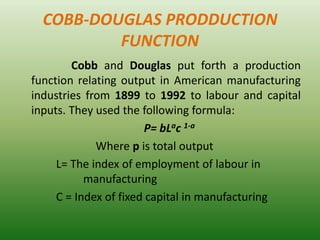
COBB-DOUGLAS PRODDUCTION
FUNCTION
Cobb and Douglas put forth a production
function relating output in American manufacturing
industries from 1899 to 1992 to labour and capital
inputs. They used the following formula:
P= bLac 1-a
Where p is total output
L= The index of employment of labour in
manufacturing
C = Index of fixed capital in manufacturing
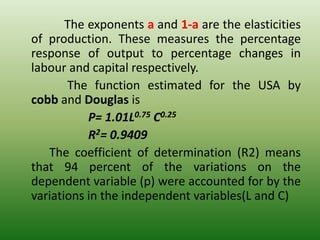
The exponents a and 1-a are the elasticities
of production. These measures the percentage
response of output to percentage changes in
labour and capital respectively.
The function estimated for the USA by
cobb and Douglas is
P= 1.01L0.75 C0.25
R2= 0.9409
The coefficient of determination (R2) means
that 94 percent of the variations on the
dependent variable (p) were accounted for by the
variations in the independent variables(L and C)
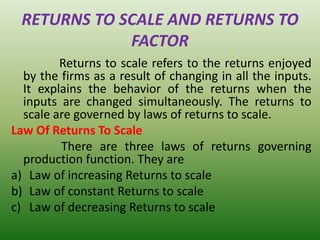
RETURNS TO SCALE AND RETURNS TO
FACTOR
Returns to scale refers to the returns enjoyed
by the firms as a result of changing in all the inputs.
It explains the behavior of the returns when the
inputs are changed simultaneously. The returns to
scale are governed by laws of returns to scale.
Law Of Returns To Scale
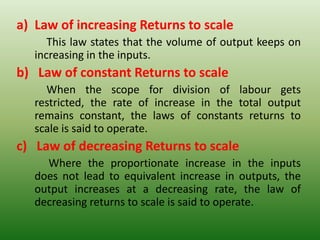
There are three laws of returns governing
production function. They are
a) Law of increasing Returns to scale
b) Law of constant Returns to scale
c) Law of decreasing Returns to scale
a) Law of increasing Returns to scale
This law states that the volume of output keeps on
increasing in the inputs.
b) Law of constant Returns to scale
When the scope for division of labour gets
restricted, the rate of increase in the total output
remains constant, the laws of constants returns to
scale is said to operate.
c) Law of decreasing Returns to scale
Where the proportionate increase in the inputs
does not lead to equivalent increase in outputs, the
output increases at a decreasing rate, the law of
decreasing returns to scale is said to operate.
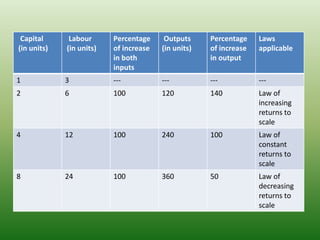
Capital
(in units)
Labour
(in units)
Percentage
of increase
in both
inputs
Outputs
(in units)
Percentage
of increase
in output
Laws
applicable
1 3 --- --- --- ---
2 6 100 120 140 Law of
increasing
returns to
scale
4 12 100 240 100 Law of
constant
returns to
scale
8 24 100 360 50 Law of
decreasing
returns to
scale
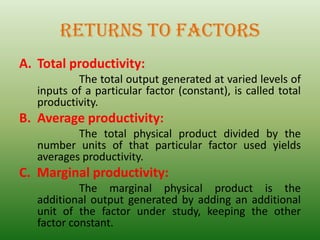
RETURNS TO FACTORS
A. Total productivity:
The total output generated at varied levels of
inputs of a particular factor (constant), is called total
productivity.
B. Average productivity:
The total physical product divided by the
number units of that particular factor used yields
averages productivity.
C. Marginal productivity:
The marginal physical product is the
additional output generated by adding an additional
unit of the factor under study, keeping the other
factor constant.
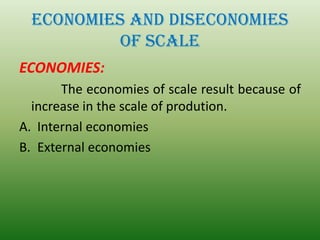
ECONOMIES AND DISECONOMIES
OF SCALE
ECONOMIES:
The economies of scale result because of
increase in the scale of prodution.
A. Internal economies
B. External economies
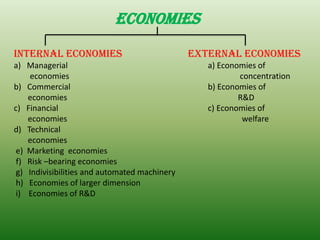
ECONOMIES
Internal economies External economies
a) Managerial a) Economies of
economies concentration
b) Commercial b) Economies of
economies R&D
c) Financial c) Economies of
economies welfare
d) Technical
economies
e) Marketing economies
f) Risk –bearing economies
g) Indivisibilities and automated machinery
h) Economies of larger dimension
i) Economies of R&D
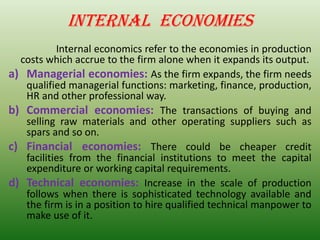
INTERNAL ECONOMIES
Internal economics refer to the economies in production
costs which accrue to the firm alone when it expands its output.
a) Managerial economies: As the firm expands, the firm needs
qualified managerial functions: marketing, finance, production,
HR and other professional way.
b) Commercial economies: The transactions of buying and
selling raw materials and other operating suppliers such as
spars and so on.
c) Financial economies: There could be cheaper credit
facilities from the financial institutions to meet the capital
expenditure or working capital requirements.
d) Technical economies: Increase in the scale of production
follows when there is sophisticated technology available and
the firm is in a position to hire qualified technical manpower to
make use of it.
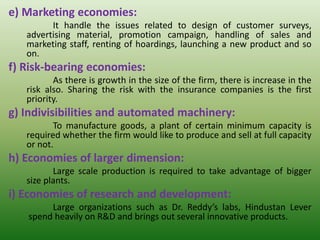
e) Marketing economies:
It handle the issues related to design of customer surveys,
advertising material, promotion campaign, handling of sales and
marketing staff, renting of hoardings, launching a new product and so
on.
f) Risk-bearing economies:
As there is growth in the size of the firm, there is increase in the
risk also. Sharing the risk with the insurance companies is the first
priority.
g) Indivisibilities and automated machinery:
To manufacture goods, a plant of certain minimum capacity is
required whether the firm would like to produce and sell at full capacity
or not.
h) Economies of larger dimension:
Large scale production is required to take advantage of bigger
size plants.
i) Economies of research and development:
Large organizations such as Dr. Reddy’s labs, Hindustan Lever
spend heavily on R&D and brings out several innovative products.
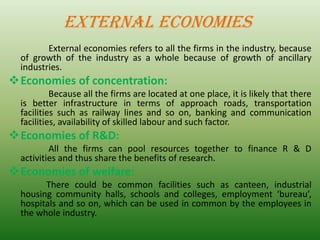
EXTERNAL ECONOMIES
External economies refers to all the firms in the industry, because
of growth of the industry as a whole because of growth of ancillary
industries.
❖Economies of concentration:
Because all the firms are located at one place, it is likely that there
is better infrastructure in terms of approach roads, transportation
facilities such as railway lines and so on, banking and communication
facilities, availability of skilled labour and such factor.
❖Economies of R&D:
All the firms can pool resources together to finance R & D
activities and thus share the benefits of research.
❖Economies of welfare:
There could be common facilities such as canteen, industrial
housing community halls, schools and colleges, employment ‘bureau’,
hospitals and so on, which can be used in common by the employees in
the whole industry.
DISECONOMIES:
Diseconomies are mostly managerial
in nature. Problems of planning, coordination,
communication and control may become
increasingly complex as the firm grows in size
resulting in Increasing average cost per unit.
Sometimes, the firm may also collapse.
COST ANALYSIS
The managerial economist is concerned with making
managerial decisions. Different business proposals are
evaluated in terms of their costs and revenues. To know what
costs are to be examined, it is necessary to understand what
‘cost’ is and how to analyse the same.
The Concept And Nature Of Cost:
Costs refers to the expenditure incurred to produce a
particular product or service. All costs involve a sacrifice of some
kind or other to acquire some benefit. For example, if I want to
eat food, I should be prepared to sacrifice money.
Costs may be monetary or non-monetary; tangible or
intangible, determined subjectively or objectively. Socials costs
such as pollution, noise or traffic congestion add another
dimension to the cost concept.
The following are the possible variations in the
concept of cost.
1. Long-run vs Short-run Costs
2. Fixed vs Variable Costs
3. Semi-fixed or Semi-variable Costs
4. Marginal Cost
5. Controllable vs Non-controllable Costs
6. Opportunity vs Outlay Costs
7. Explicit vs Implicit Costs
8. Out-of-pocket vs Book Costs
9. Replacement Costs vs Historical Costs
10. Past Costs vs Future Costs
11. Separable Costs vs Joint Costs
12. Urgent vs Postponable Costs
BREAK- EVEN ANALYSIS
INTRODUCTION:
Profit maximization is one of the major
goals of any business. The other goals include
enlarging the customer base, entering new
markets, innovation through major investments
in research and development, and so on. The
volume of profit is determined by a number of
internal and external factors.
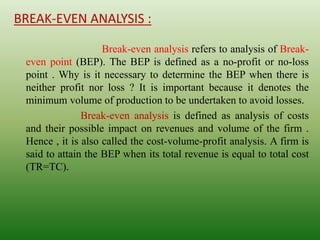
BREAK-EVEN ANALYSIS :
Break-even analysis refers to analysis of Break-
even point (BEP). The BEP is defined as a no-profit or no-loss
point . Why is it necessary to determine the BEP when there is
neither profit nor loss ? It is important because it denotes the
minimum volume of production to be undertaken to avoid losses.
Break-even analysis is defined as analysis of costs
and their possible impact on revenues and volume of the firm .
Hence , it is also called the cost-volume-profit analysis. A firm is
said to attain the BEP when its total revenue is equal to total cost
(TR=TC).
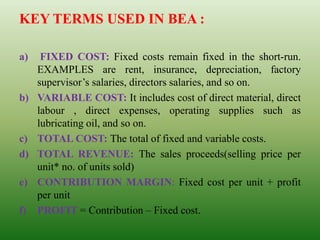
KEY TERMS USED IN BEA :
a) FIXED COST: Fixed costs remain fixed in the short-run.
EXAMPLES are rent, insurance, depreciation, factory
supervisor’s salaries, directors salaries, and so on.
b) VARIABLE COST: It includes cost of direct material, direct
labour , direct expenses, operating supplies such as
lubricating oil, and so on.
c) TOTAL COST: The total of fixed and variable costs.
d) TOTAL REVENUE: The sales proceeds(selling price per
unit* no. of units sold)
e) CONTRIBUTION MARGIN: Fixed cost per unit + profit
per unit
f) PROFIT = Contribution – Fixed cost.
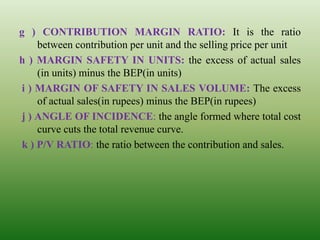
g ) CONTRIBUTION MARGIN RATIO: It is the ratio
between contribution per unit and the selling price per unit
h ) MARGIN SAFETY IN UNITS: the excess of actual sales
(in units) minus the BEP(in units)
i ) MARGIN OF SAFETY IN SALES VOLUME: The excess
of actual sales(in rupees) minus the BEP(in rupees)
j ) ANGLE OF INCIDENCE: the angle formed where total cost
curve cuts the total revenue curve.
k ) P/V RATIO: the ratio between the contribution and sales.
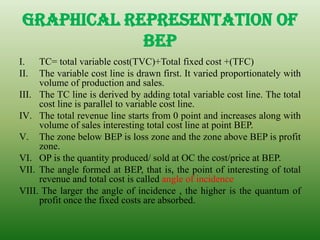
GRAPHICAL REPRESENTATION OF
BEP
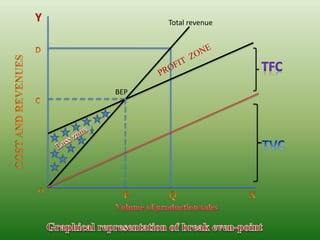
I. TC= total variable cost(TVC)+Total fixed cost +(TFC)
II. The variable cost line is drawn first. It varied proportionately with
volume of production and sales.
III. The TC line is derived by adding total variable cost line. The total
cost line is parallel to variable cost line.
IV. The total revenue line starts from 0 point and increases along with
volume of sales interesting total cost line at point BEP.
V. The zone below BEP is loss zone and the zone above BEP is profit
zone.
VI. OP is the quantity produced/ sold at OC the cost/price at BEP.
VII. The angle formed at BEP, that is, the point of interesting of total
revenue and total cost is called angle of incidence
VIII. The larger the angle of incidence , the higher is the quantum of
profit once the fixed costs are absorbed.
ix ) Margin of safety refers to the excess of production or sales
over and above the BEP of production / sales .The margin of
safety is OQ minus OP . The sales value at OQ is OD. It can
be observed that the firm reaches break even point at point
BEP . At BEP , the total cost is equal to total revenue . OP is
the volume of production / sales at the cost / revenue of OC.
The zone below BEP is called loss zone and zone above BEP
is called profit zone.
BEP
Total revenue
Y
Applications of Break-even Analysis
The following are the some of the significant areas of
applications of break-even analysis.
1. Make or Buy Decision:
Often, the manager is confronted with ‘make or
buy’ decisions the necessary components or spare parts.
Where the consumption is large, making may be
economical.
2. Choosing a Product Mix when there is a Limiting
Factor:
It is very likely that the company may be dealing in
more than one product and company wants to know, in
view of the limited plant capacity.
3. Drop or Add Decisions:
It is common that the firms keep on adding new
products to their product range while dropping the old
ones to keep pace with the changing demand.
Determination of Break-even Point:
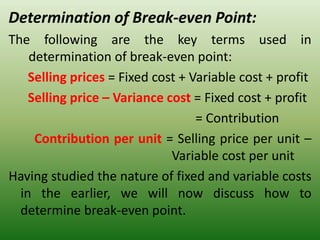
The following are the key terms used in
determination of break-even point:
Selling prices = Fixed cost + Variable cost + profit
Selling price – Variance cost = Fixed cost + profit
= Contribution
Contribution per unit = Selling price per unit –
Variable cost per unit
Having studied the nature of fixed and variable costs
in the earlier, we will now discuss how to
determine break-even point.
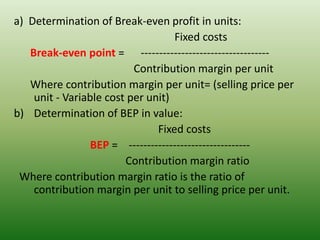
a) Determination of Break-even profit in units:
Fixed costs
Break-even point = -----------------------------------
Contribution margin per unit
Where contribution margin per unit= (selling price per
unit - Variable cost per unit)
b) Determination of BEP in value:
Fixed costs
BEP = ---------------------------------
Contribution margin ratio
Where contribution margin ratio is the ratio of
contribution margin per unit to selling price per unit.
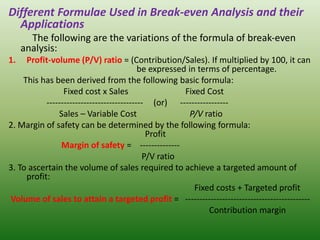
Different Formulae Used in Break-even Analysis and their
Applications
The following are the variations of the formula of break-even
analysis:
1. Profit-volume (P/V) ratio = (Contribution/Sales). If multiplied by 100, it can
be expressed in terms of percentage.
This has been derived from the following basic formula:
Fixed cost x Sales Fixed Cost
---------------------------------- (or) -----------------
Sales – Variable Cost P/V ratio
2. Margin of safety can be determined by the following formula:
Profit
Margin of safety = --------------
P/V ratio
3. To ascertain the volume of sales required to achieve a targeted amount of
profit:
Fixed costs + Targeted profit
Volume of sales to attain a targeted profit = --------------------------------------------
Contribution margin
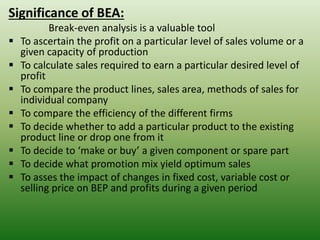
Significance of BEA:
Break-even analysis is a valuable tool
▪ To ascertain the profit on a particular level of sales volume or a
given capacity of production
▪ To calculate sales required to earn a particular desired level of
profit
▪ To compare the product lines, sales area, methods of sales for
individual company
▪ To compare the efficiency of the different firms
▪ To decide whether to add a particular product to the existing
product line or drop one from it
▪ To decide to ‘make or buy’ a given component or spare part
▪ To decide what promotion mix yield optimum sales
▪ To asses the impact of changes in fixed cost, variable cost or
selling price on BEP and profits during a given period
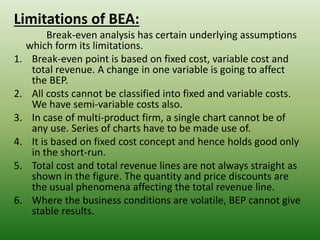
Limitations of BEA:
Break-even analysis has certain underlying assumptions
which form its limitations.
1. Break-even point is based on fixed cost, variable cost and
total revenue. A change in one variable is going to affect
the BEP.
2. All costs cannot be classified into fixed and variable costs.
We have semi-variable costs also.
3. In case of multi-product firm, a single chart cannot be of
any use. Series of charts have to be made use of.
4. It is based on fixed cost concept and hence holds good only
in the short-run.
5. Total cost and total revenue lines are not always straight as
shown in the figure. The quantity and price discounts are
the usual phenomena affecting the total revenue line.
6. Where the business conditions are volatile, BEP cannot give
stable results.
Unit-3
INTRODUCTION TO MARKETS
&
NEW ECONOMIC ENVIRONMENT
MARKET:
Markets constitute an important phase in the economic activity.
All the goods and services that are produced need to be sold to the
consumer for a price. Markets facilitate this process. We cannot imagine
a society without markets even for a while.
MARKET DEFINED:
Market is defined as a place or point at which buyers
and sellers negotiate their exchange of well-defined products
and services.
Traditionally, market was referred to as an public place
in a village or town where provisions and other objectives were
brought for sale. Based on the location, markets as classified
as rural, urban, national, or world markets. A market is said to
exist wherever there is potential for trade.
SIZE OF THE MARKET:
The size of the market depends on many factors such as nature of
products, nature of their demand, tastes and preferences of the
customers, their income level, state of technology, extent of
infrastructure including telecommunications and information
technology, time factor in terms of short-run or long-run and so on.
MARKET STRUCTURE:
Market structure refers to the characteristics of a market that
influence the behavior and performance of firms that sell in that
market.
The structure of market is based on its following features:
(a) The degree of seller concentration
(b) The degree of buyer concentration
(c) The degree of product differentiation
(d) The conditions of entry into the market
Types of Competition:
Based on degree of competition, the markets can be divided into
perfect markets and imperfect markets. In perfect markets, there is
said to prevail perfect competition and in case of imperfect markets,
imperfect competition. Perfect competition is said to exist when
certain conditions are fulfilled. These conditions are ideal and hence
only imaginative, not realistic.
PERFECT COMPETITION AND PERFECT MARKET:
A market structure in which all firms in an industry are price
takers and in which there is freedom of entry into and exit from the
industry is called Perfect Competition. The market with perfect
competition conditions is known as “Perfect Market”.
FEATURES:
The following are the features of perfect competition. In
other words, these are the assumptions underlying perfect
markets.
(a) Large number of buyers and sellers
(b) Homogeneous products or services
(c) Freedom to enter or exit the market
(d) Perfect information available to the buyers and sellers
(e) Perfect mobility of factors of production
(f) Each firm is a price taker
IMPERFECT COMPETITION:
A competition is said to be imperfect when it is not perfect.
In other words, when any or most of the above conditions do not exist
in a given market, it is referred to as an imperfect market. Based on
the number of buyers and sellers, the imperfect markets are
classified as explained below:
Based on the number of buyers and seller, the structure of
market varies as outlined below: ‘poly’ refers to seller and ‘psony’
means buyer.
MONOPOLY:
If there is only one seller, monopoly market is said to exist.
An extreme version of imperfect market is monopoly. Here a single
seller completely controls the entire the industry. For Ex: Maruthi-
Suzuki ,,,,,Most of the state electricity boards enjoy monopoly in
terms of the generation and transmission of power.
MONOPOLISTIC COMPETITION:
When large number of sellers produce differentiated products,
monopolistic competition is said to exist. A product is said to be
differentiated when its important features vary. It may be
differentiated based on real or perceived differences. For Ex:
Cameras – Yashica, Nikon, Kodak.
DUOPOLY:
If there are two sellers, duopoly is said to exist. If pepsi and coke
are the two companies in soft drinks, this market is called duopoly.
For Ex: satellite communication by Mahanagar Telephone Nigam
Limited (MTNL) and Videsh Sanchar Nigam Limited (VSNL).
OLIGOPOLY:
Another variety of imperfect competition is oligopoly. If there is
competition among a few sellers, oligopoly said to exist. For ex: Car
manufacturing companies and news papers.
Monopsony:
If there is only one buyer, monopsony market is said
to exist. Food corporation of India is the only government
organization that purchases the agricultural produce such
as rice and so on.
Duopsony :
If there are two buyers, duopsony is said to exist.
Oligopsony :
If there are a few buyers, oligopsony is said to exist.
There are a few newspaper publishing companies in India
and all these buy newsprint from the government of India.
MONOPOLY: Monopoly refers to a situation where a single firm is in a
position to control either supply or price of a particular product or
service. It cannot control or determine both price and supply as it
cannot control demand.
monopoly exists where there are certain restrictions on the entry
of other firms into business or where there are no close substitutes
for a given product or service.
FEATURES OF MONOPOLY:
1. There is a single firm dealing in a particular product or service.
2. There are no close substitutes and no competitors. Intellectual
Property Rights(IPRs), exclusive possession of factors of production
including latest technology make the firm more monopolistic in
nature. Railways had monopoly over distribution system till the road
transport system developed in terms of fuel efficient heavy trucks.
3. The monopolist can decide either the price or quantity, not both.
4. The products and services provided by the monopolist bear inelastic
demand.
5. Monopoly may be created through statutory grant of special privileges
such as licences, permits, patent rights, and so on.
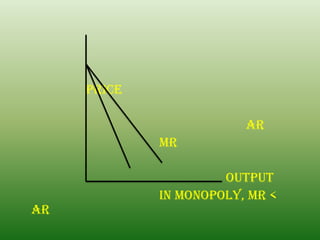
In case of monopoly, the marginal revenue(MR) is always less
than the average revenue(AR) because of quantitative discounts or
concessions.
Price
ar
mr
output
In monopoly, mr <
ar
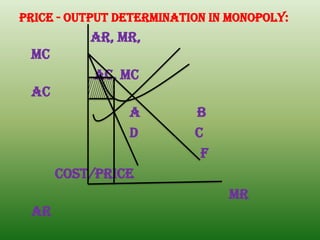
PRICE - OUTPUT DETERMINATION IN MONOPOLY:
AR, MR,
MC
AC, MC
AC
A B
D C
F
COST/PRICE
MR
AR
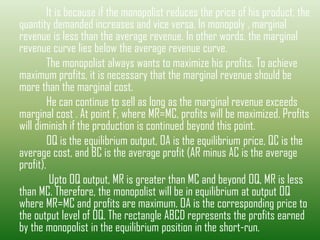
It is because if the monopolist reduces the price of his product, the
quantity demanded increases and vice versa. In monopoly , marginal
revenue is less than the average revenue. In other words, the marginal
revenue curve lies below the average revenue curve.
The monopolist always wants to maximize his profits. To achieve
maximum profits, it is necessary that the marginal revenue should be
more than the marginal cost.
He can continue to sell as long as the marginal revenue exceeds
marginal cost . At point F, where MR=MC, profits will be maximized. Profits
will diminish if the production is continued beyond this point.
OQ is the equilibrium output, OA is the equilibrium price, QC is the
average cost, and BC is the average profit (AR minus AC is the average
profit).
Upto OQ output, MR is greater than MC and beyond OQ, MR is less
than MC. Therefore, the monopolist will be in equilibrium at output OQ
where MR=MC and profits are maximum. OA is the corresponding price to
the output level of OQ. The rectangle ABCD represents the profits earned
by the monopolist in the equilibrium position in the short-run.
MONOPOLISTIC COMPeTITION:
Monopolistic competition is said to exist when there are
many firms and each one produces such goods and services that are
close substitutes to each other. They are similar but not identical.
There are no restrictions on the entry and with the result,
many firms who feel they can offer a relatively better product or
service, enter the market.
PRODUCT DIFFERENTIATION:
Product differentiation is the essential feature of
monopolistic competition. Products can be differentiated by means of
unique facilities, advertising, brand loyalty, packaging, pricing, terms of
credit, superior maintenance service, convenient location and so on.
For Example: Hotel Industry, Banking Industry, Nirmal
Paintings
Price –output determination in
monopolistic competition :
It is common that every firm whether operating under
perfect or imperfect market , wants to maximize the profits. It
means that the firm under monopolistic competition also will
reach equilibrium when its marginal cost equals its marginal
revenue (MC=MR).
As the products are differentiated, the demand curve
has a downward slope, in other words, each firm has a limited
control over price. These firms are price makers as far as a
given group of customers is concerned.
SHORT RUN:
In the short- run, firms may experience supernormal or
normal profits or even losses. When there is a fall in costs or
OQ is the equilibrium output, OA=QB=equilibrium price
and QC is the average cost. Average profit=average revenue –
average cost. BC is the average profit.
Profit *quantity = total profit.
The area ABCD represents the supernormal profits
earned by a firm under monopolistic competition in the short-
run.
MC
AC
A B
D C AR
F
PRICING OBJECTIVES:
Pricing objectives refers to the general and specific
objectives which a firm sets for itself in establishing the price of its
products and or services and these are not much different from the
marketing objectives of a firm or its overall business objectives.
Generally, the objectives of pricing are:
a) To maximize profits
b) To increase sales
c) To increase the market share
d) To satisfy customers
e) To meet the competition
f) To generate internal resources to finance expansion and growth
g) To maximize the value of the firm for different stakeholders.
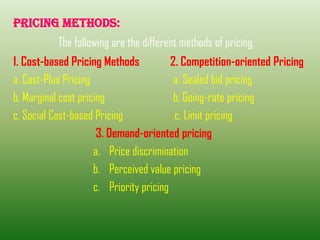
PRICING METHODS:
The following are the different methods of pricing.
1. Cost-based Pricing Methods 2. Competition-oriented Pricing
a. Cost-Plus Pricing a. Sealed bid pricing
b. Marginal cost pricing b. Going-rate pricing
c. Social Cost-based Pricing c. Limit pricing
3. Demand-oriented pricing
a. Price discrimination
b. Perceived value pricing
c. Priority pricing
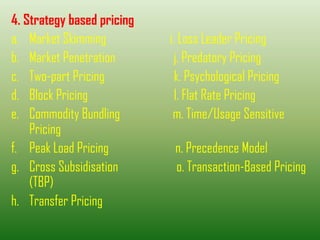
4. Strategy based pricing
a. Market Skimming i. Loss Leader Pricing
b. Market Penetration j. Predatory Pricing
c. Two-part Pricing k. Psychological Pricing
d. Block Pricing l. Flat Rate Pricing
e. Commodity Bundling m. Time/Usage Sensitive
Pricing
f. Peak Load Pricing n. Precedence Model
g. Cross Subsidisation o. Transaction-Based Pricing
(TBP)
h. Transfer Pricing
Types of Industrial / Business
Organisations
Introduction
Imagine you want to do business or start your own industry. Which business are you interested in?
For Example, You want to get into InfoTech industry. What can you do in this industry? Which one do
you choose? The following are the alternatives you have on hand;
1. You can buy and sell
2. You can setup a small/medium/large industry to manufacture.
3. You can set up a workshop to repair.
4. You can develop a software.
5. You can design a hardware.
6. You can be a consultant/trouble-shooter.
If you choose any one or more of the above, you have chosen the line of activity. The next step for
you is to deside whether
1. Only owner 2. co-owners along with you 3. Global player
4. Like minded people to share the benefits, 5. Involve in Government
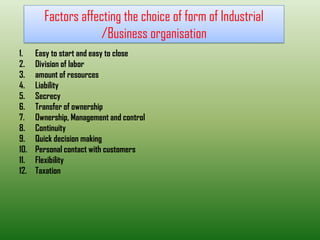
Factors affecting the choice of form of Industrial
/Business organisation
1. Easy to start and easy to close
2. Division of labor
3. amount of resources
4. Liability
5. Secrecy
6. Transfer of ownership
7. Ownership, Management and control
8. Continuity
9. Quick decision making
10. Personal contact with customers
11. Flexibility
12. Taxation
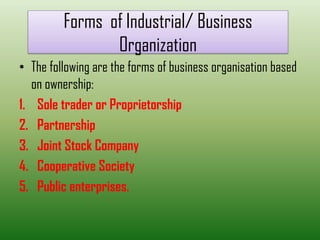
Forms of Industrial/ Business
Organization
• The following are the forms of business organisation based
on ownership:
1. Sole trader or Proprietorship
2. Partnership
3. Joint Stock Company
4. Cooperative Society
5. Public enterprises.
SOLE TRADER
• The Sole trader is the simplest, oldest the natural form of business
organization. “Sole” means one.
• Sole trader implies that there is only one trader who is the owner of
business.
• It is simple ,oldest and one man form of organization .
• He is a manager , owner and controller of business .
• He uses his own knowledge skills , capital and intelligence in carrying
out their business.
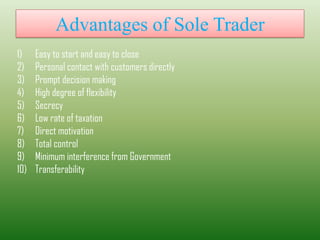
Advantages of Sole Trader
1) Easy to start and easy to close
2) Personal contact with customers directly
3) Prompt decision making
4) High degree of flexibility
5) Secrecy
6) Low rate of taxation
7) Direct motivation
8) Total control
9) Minimum interference from Government
10) Transferability
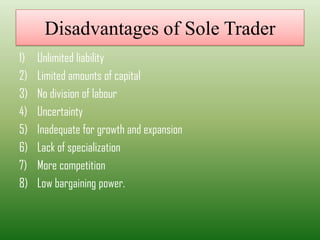
Disadvantages of Sole Trader
1) Unlimited liability
2) Limited amounts of capital
3) No division of labour
4) Uncertainty
5) Inadequate for growth and expansion
6) Lack of specialization
7) More competition
8) Low bargaining power.
2.Partnership
Indian Partnership Act,1932 defines partnership as the
relationship between two or more persons who agree to share the
profits of the business carried on by all or any one of them acting for
all.
Features:
1) Relationship
2) Two or more persons
3) There should be a business
4) Agreement
5) Carried on by all or any one of them acting for all
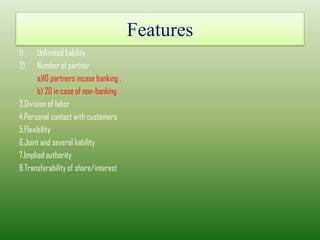
Features
1) Unlimited liability
2) Number of partner
a)10 partners incase banking .
b) 20 in case of non-banking
3.Division of labor
4.Personal contact with customers
5.Flexibility
6.Joint and several liability
7.Implied authority
8.Transferability of share/interest
Advantages
1) Easy to form
2) Availability of capital
3) Division of labor
4) Flexibility
5) Personal contact with customers
6) Quick decisions and prompt actions
7) The positive impact of unlimited liability
8) Tax rate
Disadvantages
• Formation of partnership is difficult
• Liability
• Lack of harmony or cohesiveness
• Limited growth
• Instability
• Lack of public confidence
• Implied authority misused
• High tax rate
Kinds of Partnership
1. Active partner
2. Sleeping partner
3. Nominal partner
4. Partner by Estoppel
5. Partner by holding out
6. Minor Partner
• Partnership deed : The written agreement among the partners is
termed as partnership deed . It contains all detail about the business .
• Dissolution
Joint stock company
• An association of many persons who contribute money to common
stock and employ its for common purpose . ------ lord justice
lindley. OR
• The companies formed and registered under the companies act ----
-sec3(1) of companies act 1956 .
Features:
1) Artificial person
2) Separate legal existence
3) Voluntary association of persons
4) Limited liability
5) Capital is divided in to shares
6) Transferability of shares
7) Common seal
8) Perpetual succession
9) Ownership and management separate
10) Winding up
11) The name of the company ends with limited
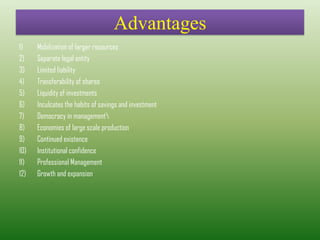
Advantages
1) Mobilization of larger resources
2) Separate legal entity
3) Limited liability
4) Transferability of shares
5) Liquidity of investments
6) Inculcates the habits of savings and investment
7) Democracy in management
8) Economies of large scale production
9) Continued existence
10) Institutional confidence
11) Professional Management
12) Growth and expansion
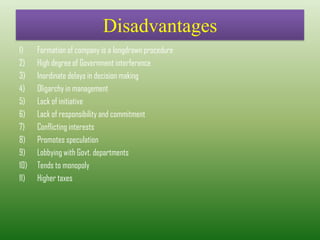
Disadvantages
1) Formation of company is a longdrawn procedure
2) High degree of Government interference
3) Inordinate delays in decision making
4) Oligarchy in management
5) Lack of initiative
6) Lack of responsibility and commitment
7) Conflicting interests
8) Promotes speculation
9) Lobbying with Govt. departments
10) Tends to monopoly
11) Higher taxes
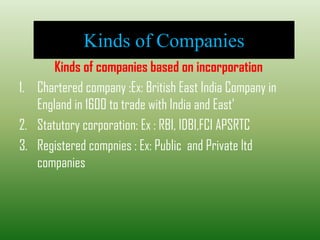
Kinds of Companies
Kinds of companies based on incorporation
1. Chartered company :Ex: British East India Company in
England in 1600 to trade with India and East’
2. Statutory corporation: Ex : RBI, IDBI,FCI APSRTC
3. Registered compnies : Ex: Public and Private ltd
companies
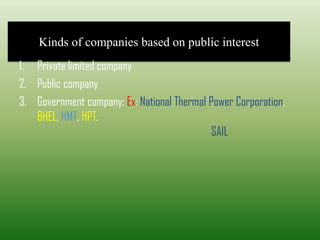
Kinds of companies based on public interest
1. Private limited company
2. Public company
3. Government company: Ex: National Thermal Power Corporation,
BHEL, HMT, HPT,
SAIL
Kinds of companies based on
liability
1. Unlimited company
2. Limited company
3. Companies limited by guarantee
Kinds of companies based on
Nationality
1. Foreign Company
2. Indian Company
Formation of Joint Stock Company
a) To obtain Certificate of incorporation
b) To obtain Certificate of Commencement of Business
1 . Memorandum of Association
2 . Articles of Association
3 . Names and address of proposed directors and their
willingness
4 . A statutory declaration of all the legal requirements
To obtain Certificate of Commencement of Business
1) Seek permission from the SEBI
2) File prospectus with Registrar
3) Collecting minimum subscription
4) Allotting shares
5) Apply to the Registrar for the Certificate of Commencement of
Business
Main documents in Company
Formation
A. Memorandum of Association
B. Articles of Association
C. Prospectus
Memorandum of Association
• The charter of the company which discloses scope of
operations and its relations to outsiders and investors .
• Clauses
• Name clause
• situation clause
• Objects clause
• Capital clause
• Subscription clause
Articles of Association
• The document that contains rules and procedures for internal
management and control of the affairs of the company .
• It contains details about the amount of share capital , types of
shares , procedure to transfer and transmission of shares ,
procedure to conduct meetings , powers , duties , remuneration .
Prospectus
• The notice that invite offers from public for the subscription of
shares or debentures of the body corporate .
• Contents
• The name of the company , address , objectives types of shares ,
list of promoters , directors address , details of brokers ,
underwriters and bankers .
Cooperative Societies
• A cooperative society is a society registered under the Cooperative Society Act,1904. It is an association of the group of
persons who come together to uplift themselves through organized efforts.
• Features
1. It is a voluntary association
2. Separate legal entity
3. Compulsory registration
4. Membership
5. Finances
6. Set up is democratic
7. One member one vote
8. Service objective
9. Restricted reward to capital
10. Non transferability of shares
11. Equitable distribution of surplus
Advantages
1) Voluntary organisation
2) Equal voting rights
3) Economic justice
4) Limited liability
5) Continued existence
6) Zero speculation
7) Each for all and all for each
8) Self Govt.
9) Larger identity of interests
10) Government support
11) Exploitation eliminated
12) Taxation
Disadvantages
1) Shortage of funds
2) Inefficient management
3) Many legal formalities
4) Shifting loyalties among members
5) Misuse of funds for sectional interests
6) Recurring loss
Public Enterprises
• Genesis of Public Enterprises
❖ Higher production
❖Greater employment
❖Economic equality
❖Dispersal of economic power
Forms of Public Enterprises
a) Departmental undertaking
b) Public corporation
c) Government company
Departmental Undertaking
• This is the earliest form of public enterprise. Under this form, the affairs of the public
enterprise are carried out under the overall control of one of the departments of the
government.
• Ex: Railways, Dept.of Posts, All India Radio, Doordarshan, Defense undertakings like DRDL, DLRL,
Ordinance factories and such.
• Features:
1. Under the control of a government department
2. More financial freedom
3. Like any other government department
4. Budget, accounting and audit controls
5. More a government organisation, less a business organisation
Advantages :
1. Effective control
2. Responsible executives
3. Less scope for institutionalization of funds
4. Adds to Government revenue
Dis-advantages :
1. Decision delayed
2. No incentives to maximize earnings
3. Slow response to market conditions
4. Redtapism and bureaucracy
5. Incidence of taxation
Public Corporation
• It is defined as a “body corporate created by an Act of Parliament or Legislature and notified by
the name in the Official Gazette of the Central or State Govt.
Ex: LIC, UTI, IFCI, Damodar Valley Corporation and others
• Features:
1. A body corporate
2. More freedom in day to day operations
3. Freedom regarding personnel
4. Perpetual succession
5. Financial autonomy
6. Commercial audit
7. Run on commercial principles
Government Company
Section 617 of the Indian Companies Act defines a government
company as “any company in which not less than 51 percent of the paid up
share capital is held by the Central Government or by any State
Government or Governments or partly by Central Government and partly
by one State Govt.
• Features:
1) Like any other registered company
2) Shareholding
3) Directors are nominated
4) Administrative autonomy and financial freedom
5) Subject to ministerial control
Advantages:
1. Formation is easy
2. Separate legal entity
3. Ability to compete
4. Flexibility
5. Quick decisions and prompt actions
6. Private participation is facilitated
Disadvantages:
1. Continued political and government interference
2. Higher degree of government control
3. Evades constitutional responsibility
4. Poor sense of attachment or commitment
5. Divided loyalties
6. Flexibility only on paper
Problems of Public Enterprises
1. Political interference
2. Accountability
3. Excessive inventories
4. Sense of insecurity and risk aversion
5. Unrealistic pricing policies
Functioning of Public Enterprises:
Common Defects
1. Inadequate return on capital and huge accumulated losses
2. Problems in project execution
3. Unrealistic production schedules and excess capacity
4. Over-capitalization
5. Disproportionate overheads
6. Overstaffing
7. Lack of progressive personnel policies
8. Price policy
9. Lack of professional approach
10. More parliamentary interference and faulty control
New economic environment
• Recent developments that have taken in the
environment of the business .environment means all
those factors which are external to the business .
• They are
• New industrial policy .
• LPG policy .
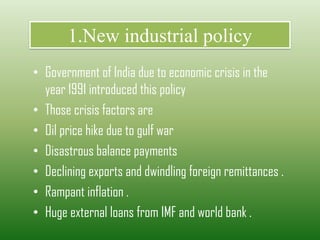
1.New industrial policy
• Government of India due to economic crisis in the
year 1991 introduced this policy
• Those crisis factors are
• Oil price hike due to gulf war
• Disastrous balance payments
• Declining exports and dwindling foreign remittances .
• Rampant inflation .
• Huge external loans from IMF and world bank .
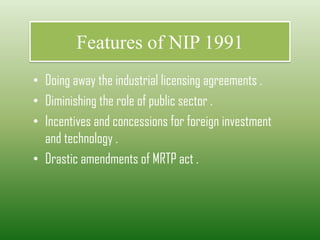
Features of NIP 1991
• Doing away the industrial licensing agreements .
• Diminishing the role of public sector .
• Incentives and concessions for foreign investment
and technology .
• Drastic amendments of MRTP act .
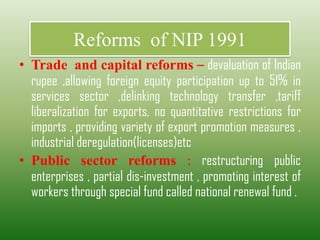
Reforms of NIP 1991
• Trade and capital reforms – devaluation of Indian
rupee ,allowing foreign equity participation up to 51% in
services sector ,delinking technology transfer ,tariff
liberalization for exports, no quantitative restrictions for
imports , providing variety of export promotion measures ,
industrial deregulation(licenses)etc
• Public sector reforms : restructuring public
enterprises , partial dis-investment , promoting interest of
workers through special fund called national renewal fund .
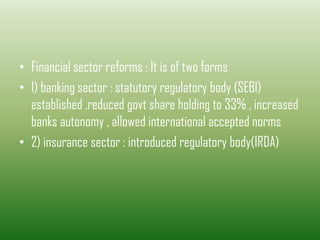
• Financial sector reforms : It is of two forms
• 1) banking sector : statutory regulatory body (SEBI)
established ,reduced govt share holding to 33% , increased
banks autonomy , allowed international accepted norms
• 2) insurance sector : introduced regulatory body(IRDA)
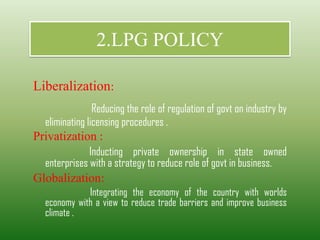
2.LPG POLICY
Liberalization:
Reducing the role of regulation of govt on industry by
eliminating licensing procedures .
Privatization :
Inducting private ownership in state owned
enterprises with a strategy to reduce role of govt in business.
Globalization:
Integrating the economy of the country with worlds
economy with a view to reduce trade barriers and improve business
climate .
Introduction to financial
accounting & analysis
UNIT-4
ACCOUNTING PART
Introduction
• Every business organisation
wants to know whether it
has made profit or not at the
end of given period
• For this it has to prepare a
statement containing profit
or loss.
• To know the what it
owns(assets), and how much
its owes(liabilities) to its
suppliers and others
Definition
• According to AICPA defines “ accounting as an
art of recording , classifying , and summarising
in a significant manner , and in terms of money
and events which are , in part at least , of a
financial character and interpreting the results
thereof”.
• According to AAA defines “ accounting as the
process of identifying , measuring , and
communicating economic information to
permit informed judgements and decisions by
the users of the information.”
Significance of accounting
• Maintain its own records of business
• Monitor the business activities
• Calculate profit or loss for a given period
• Full fill legal obligations
• Show financial positions for a given period
• Communicate the information to the
interested parties.
Users of accounting information
• Owners: to know the profits
• Creditors or financial institutions: to know
whether their funds safe or not
• Managers : to know whether their decisions
effective or not
• Government or tax authorities: to assesses
the tax liability of a firm.
• Employees: they can put path their claims for
better wages or better wages.
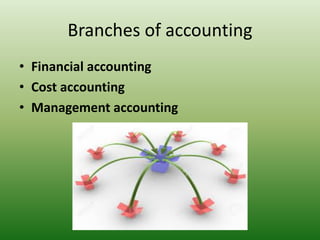
Branches of accounting
• Financial accounting
• Cost accounting
• Management accounting
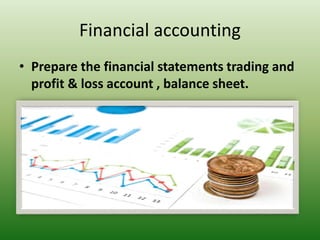
Financial accounting
• Prepare the financial statements trading and
profit & loss account , balance sheet.
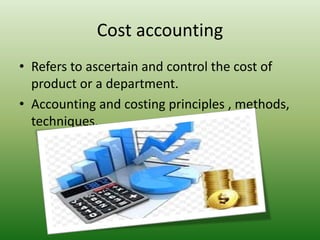
Cost accounting
• Refers to ascertain and control the cost of
product or a department.
• Accounting and costing principles , methods,
techniques.
Management accounting
• The purpose of management accounting is to assist
management in taking appropriate decisions .
• Accounting information is provided by the accountant
to enable the top management to take timely
decisions.
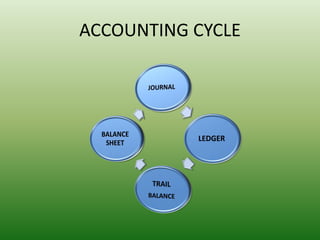
ACCOUNTING CYCLE
Journal
• The word Journal has been derived from the
French word “Jour” which means daily
records.
• Another name “Day book”
• Journal is the first in which transactions are
recorded in a chronological order[date
wise],the moment they take place in
business.
Format of Journal
Date particulars Lf
no
Dr.
Amount
[Rs]
Cr.
Amount[
Rs]
[debit ends with] -Dr.
[credit start with] To
(narration start as being…… and must be
with in brackets)
Single entry
• Single entry system is a method of recording
transactions is unscientific and incomplete .
• Under this system only one aspect of the
transaction ( either Dr or Cr) is to be recorded
instead of two aspects.
Double Entry System
• Double entry system is a scientific way of
recording transactions based on the fact that
for every debit , there is a corresponding
credit.
Advantages of Double Entry System
• Information about every account.
• Helps to know the receivables and payables.
• Arithmetical accuracy.
• Helps to locate errors .
• Helps to ascertain P/L .
• HELPS to know the financial position .
• Monitoring and auditing made easier.
classifications of accounting
• Personal account
• Real account
• Nominal account
Personal accounting
• These are accounts opened in the names of
persons ,firms and companies with whome
the firm deals.
• Rules
debit the receiver
credit the giver
debit the receiver
credit the giver
Real accuont
• These are the accounts opened in the name of
assets such as land and buildings , plant and
machinery, furniture etc .
• Rules
Debit what comes in
Credit what goes out
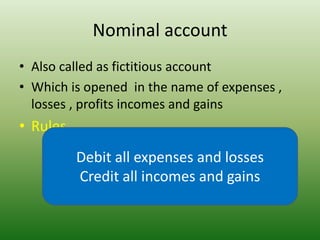
Nominal account
• Also called as fictitious account
• Which is opened in the name of expenses ,
losses , profits incomes and gains
• Rules
Debit all expenses and losses
Credit all incomes and gains
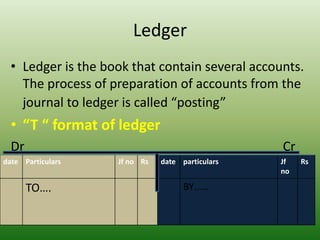
Ledger
• Ledger is the book that contain several accounts.
The process of preparation of accounts from the
journal to ledger is called “posting”
• “T “ format of ledger
Dr Cr
date Particulars Jf no Rs date particulars Jf
no
Rs
TO…. BY……
Sub-divisions of journal
• Purchase book
• Sale book
• Purchase return book
• Sales return book
• Bills receivable book
• Bills payable book
• Cash book
• Journal proper
Trial balance
• Trial balance is the statement containing debit
and credit balances of various accounts taken
out from ledger books as on a particular date.
• A trail balance must agree with as on that date
.
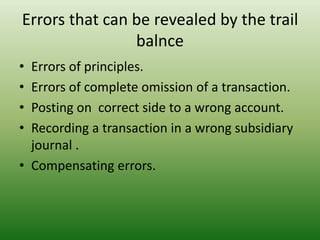
Errors that can be revealed by the trail
balnce
• Errors of principles.
• Errors of complete omission of a transaction.
• Posting on correct side to a wrong account.
• Recording a transaction in a wrong subsidiary
journal .
• Compensating errors.
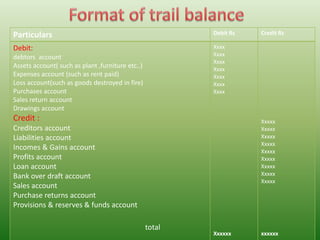
Particulars Debit Rs Credit Rs
Debit:
debtors account
Assets account( such as plant ,furniture etc..)
Expenses account (such as rent paid)
Loss account(such as goods destroyed in fire)
Purchases account
Sales return account
Drawings account
Credit :
Creditors account
Liabilities account
Incomes & Gains account
Profits account
Loan account
Bank over draft account
Sales account
Purchase returns account
Provisions & reserves & funds account
total
Xxxx
Xxxx
Xxxx
Xxxx
Xxxx
Xxxx
Xxxx
Xxxxxx
Xxxxx
Xxxxx
Xxxxx
Xxxxx
Xxxxx
Xxxxx
Xxxxx
Xxxxx
Xxxxx
xxxxxx
Final accounts
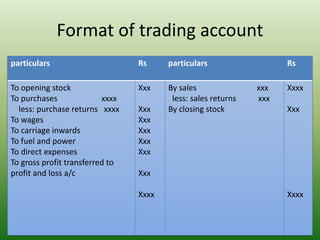
• Trading account
• Profit and loss account
• Balance sheet
Trading account
• It shows the gross profit or gross loss of given
accounting period
Gross profit= net sales- cost of goods sold
It has:
Opening stock
Purchases
Wages
Carriage inwards
Fuel and power etc
Format of trading account
particulars Rs particulars Rs
To opening stock
To purchases xxxx
less: purchase returns xxxx
To wages
To carriage inwards
To fuel and power
To direct expenses
To gross profit transferred to
profit and loss a/c
Xxx
Xxx
Xxx
Xxx
Xxx
Xxx
Xxx
Xxxx
By sales xxx
less: sales returns xxx
By closing stock
Xxxx
Xxx
Xxxx
Profit and loss account
• It shows the net profit or net loss for the end of
given period
• It has
Maintaining the capital asset
Running business to time to time
Selling and distributing the good of the business
Format profit and loss account
particulars Rs particulars Rs
To salaries
To rent
To insurance
To carriage out wards
To telephones
To provision for depreciation
To bad debts written off xxx
add: increase in bad debts xxx
To cost of samples
To advertising
To heating and lighting
To interest on loan
To discount allowed
To net profit transferred to
capital account
Xxx
Xxx
Xxx
Xxx
Xxx
Xxx
Xxx
Xxx
Xxx
Xxx
Xxx
Xxx
Xxx
Xxxx
By gross profit
By discount received
By commission received
By reduction in provision for bad
debts
By profit on sale of fixed asset
Xxx
Xxx
Xxx
Xxx
Xxx
Xxxx
Balance sheet
• Balance sheet is the statement of assets and
liabilities of the firm it show the fair value of
the business.
• It has 2 sides liabilities and asserts
liabilities assets
Format for balance sheet
liabilities Rs Assets Rs
Long term liabilities
Owner’s capital xxxx
add: net profit from
profit and loss account xxxx
less : drawings xxxx
Bank over draft
Current liabilities
Sundry creditors
Bills payable
Out standing expenses
Xxxx
Xxxx
Xxxx
Xxxx
Xxxx
Xxxx
xxxxx
Fixed assets
Plant and machinery xxxx
less: depreciation xxxx
Furniture and fixtures xxxx
less: depreciation xxxx
Current assets
Stock
Sundry debtors xxx
less : provision for bad and doubtful
debts xxx
Bills receivables
Cash at bank
Cash in hand
Prepaid expenses
Xxxx
xxx
xxx
Xxxx
Xxx
Xxx
Xxx
xxxx
xxxxx
UNIT – 5
Definition
• The amount of funds which is required to start
the business is termed as capital.
• Need for capital
• To promote the business.
• To conduct business smoothly
• To expand and diversify
• To meet contingencies
• To pay taxes
• To support welfare programmes
Types of capital
1. Fixed capital
2. Working capital
• Fixed capital:
The portion of capital which is required
to aquire long term assests like lands and
buildings , plant and machinery , furniture and
fixures etc
Features
• Permanent in nature
• Profit generation
• Low liquidity
• Utilized for promotion and expansion
• Amount depends on size , nature type of
business
Types of fixed assets
• Tangible fixed assets : which can be seen and
touched ex: lands and buildings , plant and
machinery , furniture and fixtures etc
• intangible fixed assets :assets which do not
have physical form ex: good will , brand names
trade marks
• financial fixed assets : investments in shares
, foreign currency deposits etc
2. Working capital
• The amount of capital which is required to meet
the day to day transactions of business is termed
as working capital.
• It is flesh and blood of the business .
• Features :
• Short life
• Smooth flow of operations
• Liquidity
• Amount depand on short term requirements
• Utilized to meet current expenses
Components of working capital
• 1.Current assets : assets from which cash can be realized
over a short period of time
• Ex : cash in hand , cash at bank , debtors , bills receivables ,
prepaid expenses , stocks ,Cash in hand and bank balance ,
Accrued income .
• 2.Current liabilities : the obligation that the firm must pay
to outsiders over a short period of time i.e below 1 year
• Ex : creditors , bills payables , short term loans and
advances , accrued expenses Dividends payable , Provision
for taxation
• etc.
• Formula: net working capital = current assets – current
liablities
Factors determining working capital
• Position in business cycle
• Nature of business
• Nature of demand
• Credit policy
• Working capital cycle
• Manufacturing cycle
• Price level changes ,
• Effect of external environment to business
• Degree of competition
Working capital cycle
• The flow of money in the business is termed
as working capital cycle
Bill
payable
s
Raw
materia
ls
Finishe
d goods
debtors
cash
Types of working capital
Working
capital
concept
Gross
working
capital
Networking
capital
time
Permanent
working
capital
regular reverse
temporary
seasonal special
sources of finance
types
• Three sources
• 1) short term finance
• 2) medium term finance
• 3) long term finance
Short term finance
• Source of finance with maturity period of less than 1 year or 1year.
• It is required to meet short term financial needs of a company i.e working capital
needs
• Instruments:
• Trade credit : short term credit facility extended by suppliers to customers during
their normal course of business .
• Commercial papers : unsecured promissory note issued by corporate to investors
at discount rate on face value .
• Bill of exchange :
• Certificate of deposits : negotiable instruments that are issued in materialized
form governed by RBI .
• Bank overdrafts : special arrangement between banker and customer to draw
more than what he has in his account subject to maximum limit .
• Call/ notice money : money lend or borrowed for very short period i.e 1-14 days .
• Treasure bills :short borrowing instruments Of union govt with maturity period of
14/91/182/364 days from the date of issue .
• Debt factoring : arrangement with factor where trader agrees to sell its
receivables at discounts to specialized dealers b.
Medium term sources of finance
• Source of finance with maturity period of more than 1 year and
less than 5 years .
• It is required by the company to meet repairs and maintenance of
fixed assets by the firm .
• Instruments.
• 1) Hire purchase :The facility to buy the fixed asset by paying down
payment a part of price and balance is paid in installments with
fixed rate of interest in agreed number of installments
• 2)leasing :agreement between lessor and lesse for getting
agreement on getting assets in rent over a specific period of time .
• 3) bank loans :banks render loans to customers at fixed rate of
interest scheduled in beginning and remaining is debited directly
from the account of customer in installments .
• 4) venture capital financing :for the projects which are high riskly
banks offer merchandise banking services .
Long term finance
• Source of finance with maturity period of more than 5year s and less than
20 years
• It is required for company to meet permanent capital requirements of firm
.
• Instruments
• 1) Equity shares :shares which are the part of ownership funds of
company .
• 2) preference shares : The share which provide rights to investors in terms
of fixed rate of dividend and return on capital .
• 3) debentures : certificate issued under common seal of a company
acknowledging receipt of the loan .
• 4)long term loans : source of finance availed by bankers and financial
institutions with maturity period of 5-20 years
• 5) retained earnings : the returns payable to equity share holders are
converted to reinvestments of firm through mutual agreements .
Capital budgeting
definition
• The process of evaluating relative worth of
investment proposals based on profitability is
termed as capital budgeting .
• It play an important role in undertaking
investment decisions .
process
1.Generating investment proposals ( Project
generation )
2.Estimating and evaluating cash flows( project
evaluation)
3.selection of projects(PROJECT SELECTION)
4.Project implementation.
5.Project control ( monitoring and re-evaluating)
significance
• Includes substantial cash flows.
• Long term implications .
• Strategic in nature .
• Irreversible .
Types of capital budgeting decisions
• Expansion
• Diversification
• Replacement decisions
• Contingent decisions
• Mutually exclusive decisions.
Capital
budgeting
methods
Non
discounting
/traditional
methods
PAY BACK
PERIOD
ACCOUNTI
NG RATE
OF
RETURN
Discounting/modren
methods
NET
PRESENT
VALUE
INTERNAL
RATE OF
RETYURN
PROFITYAB
ILITY
INDEX
1.PAY BACK PERIOD
• The length of time it will taken to recover the cost
of the project .
• FORMULA :
• pay back period = cost of the project
_________________
annual cash in flows
• METHODS: two types .
• 1. even cash in flows : the above formula is used
• 2 . Un even cash in flows : cumulative cash in
flows method is used .
• Advantages
• Easy to understand and calculate .
• Liquidity is easily identified .
• Disadvantages
• All cash flows are not considered .
• Ignores time value of money .
2.ACOUNTING RATE OF RETURN
• The ratio of annual profits after taxes to
average investment is termed as accounting
rate of return.
• ARR = annual profits after taxes
________________________×100
average investment
methods
• Two methods
• 1.accounting rate of return
• ARR = annual profits after taxes
________________________×100
average investment
• 2.average rate of return
• ARR = Average annual profits after taxes
________________________×100
average investment
1.Average annual profits after taxes
• = Total annual profits after taxes
____________________________
projects life
2. Average investment = orginal investment/2
or
original investment-scrap/2
or
• original investment-scrap/2+working capital
+scrap
• Advantages
• Easy to calculate
• Consider entire cash flows.
• Disadvantages
• Ignores time value of money
• Ignores project period .
Discounted cash flow methods
• The method that consider time value of money to assess
the profitability of the project is called as Discounted cash
flow methods .
• Time value of money means Factors that convert future
rupees into current rupees .
• Formula pv factor of re .1 = 1/1+r^n
• Formula pv factor of re .1 received annually for n years
= 1
_______
1/1+r^n
methods
• Net present value (NPV)
• Internal rate of return (IRR)
• Profitability index (PI)
1.NET PRESENT VALUE(NPV)
• The excess of present value of cash inflows over
and above cash outflows is termed as NPV .
• It is a modern method of evaluating investment
proposals .
• Formula
• NPV =PV CFAT-PVC
• Where PV CFAT =present value of cash in flows
• PVC= present value of cash outflows .
Steps in calculating npv
• Step -1 : identify pv of re-1 for given discount rate
.
• Step -2 : multiply the cash flows with
corresponding pv factor
• DCF = PV factor × CFAT(cash inflows after taxes)
• Step : 3: find the sum of the products
• Step -4 : interpret the results
• Npv>1 accept the project , npv <1 reject the
project , npv=1 may accept or reject the project .
• ADVANTAGES
• Recognizes time value of money .
• All cash flows are considered by this method .
• DISADVANTAGES
• Difficult to compute results .
• May not provide good results .
2. INRERNAL RATE OF RETURN
• Definition : the discount rate that equates
present value of cash inflows of the project
with cash outflows of the project .
• Methods – two methods
• 1.intrapolation method
• 2. Trail and error method .
• I. INTRAPOLATION METHOD
• Used in case of PROJECT with equal cash in flows .
• Two steps
• 1.determine pv factor
• pv factor = cost of the project
_________________
Average annual cash in flows
2.Determine IRR
PX- I
IRR = X+ ____ (Y-X)
PX-PY
Where x= lower discount rate.
Y= higher discount rate .
PX= present value of cash inflows at lower discount rate ‘x’
PY= present value of cash inflows at higher discount rate ‘y’
I = present value of cash OUTflows
•
TRAIL AND ERROR METHOD
• Used in case of PROJECT with un equal cash in flows .
• Two steps
• 1.determine pv factor
• pv factor = cost of the project
_________________
Average annual cash in flows
2.Determine IRR by applying trail and error method.
In first trail rate if results are not positive we apply second
trail rate until the values of cash inflows are equal or
negative or 0
3.Profitability index method
• The ratio of present value of cash inflows to
present value of cash outflows of the project is
called profitability index .
• Formula
sum of present value of cash inflows
PI = ______________________________
sum of present value of cash out flows
Interpretation
PI>1 accept the project , PI <1 reject the project ,
PI=1 may accept or reject the project .

Business economics notes for btech students

  • 1.
    15A52301 -MANAGERIAL ECONOMICS ANDFINANCIAL ANALYSIS Prepared By C.Bhupathi, Associate Professor, Department of MBA.
  • 2.
    COURSE OUTCOMES • C321.1Outline the fundamentals of economic principles. 1,2,3,4 • C321.2 Compare concept of production, cost analysis 5 • C321.3 Illustrate market and its types through competition 3,4,5 • C321.4 Interpret the financial accounting and the financial ratios 2,4 • C321.5 Summarize Capital and its types, capital, budgeting techniques. 5
  • 3.
    JAWAHARLAL NEHRU TECHNOLOGICALUNIVERSITY ANANTAPUR B. Tech III-IISem. (ECE) L T P C 3 1 0 3 15A52301 -MANAGERIAL ECONOMICS AND FINANCIAL ANALYSIS Unit I- INTRODUCTION TO MANAGERIAL ECONOMICS Managerial Economics – Definition- Nature- Scope – Contemporary importance of Managerial Economics - Relationship of Managerial Economics with Financial Accounting and Management. Demand Analysis: Concept of Demand-Demand -Function - Law of Demand - Elasticity of Demand- Significance - Types of Elasticity - Measurement of elasticity of demand - Demand Forecasting- factors governing demand forecasting- methods of demand forecasting. • UNIT II • THEORY OF PRODUCTION AND COST ANALYSIS • Production Function- Least cost combination- Short-run and Long- run production function- Isoquants and Isocosts, MRTS - Cobb-Douglas production function Laws of returns - Internal and External economies of scale
  • 4.
    • Cost Analysis:Cost concepts and cost behavior- Break-Even Analysis (BEA) -Determination of Break Even Point (Simple Problems)-Managerial significance and limitations of Break- Even Point. • UNIT III INTRODUCTION TO MARKETS AND NEW ECONOMIC ENVIRONMENT • Market structures: Types of Markets - Perfect and Imperfect Competition – Features of Perfect Competition- Monopoly-Monopolistic Competition-Oligopoly-Price-Output Determination - Pricing Methods and Strategies-Forms of Business Organizations- Sole Proprietorship- Partnership – Joint Stock Companies - Public Sector Enterprises – New Economic Environment- Economic Liberalization – Privatization - Globalization. • UNIT IV • INTRODUCTION TO FINANCIAL ACCOUNTING AND ANALYSIS Financial Accounting – Concept - Emerging need and Importance - Double- Entry Book Keeping- Journal - Ledger – Trial Balance - Financial Statements - Trading Account – Profit & Loss Account – Balance Sheet (with simple adjustments). Financial Analysis – Ratios – Liquidity, Leverage, Profitability, and Activity Ratios (simple problems).
  • 5.
    • UNIT V •CAPITAL AND CAPITAL BUDGETING • Concept of Capital - Over and Undercapitalization – Remedial Measures - Sources of Shot term and Long term Capital - Estimating Working Capital Requirements – Capital Budgeting – Features of Capital Budgeting Proposals – Methods and Evaluation of Capital Budgeting Projects – Pay Back Method – Accounting Rate of Return (ARR) – Net Present Value (NPV) – Internal Rate Return (IRR) Method (simple problems) • TEXT BOOKS: 1. Managerial Economics 3/e, Ahuja H.L, S.Chand, 2013. 2. Financial Management, I.M.Pandey, Vikas Publications, 2013. • REFERENCES 1. Managerial Economics and Financial Analysis, 1/e, Aryasri, TMH, 2013. 2. Managerial Economics and Financial Analysis, S.A. Siddiqui and A.S. Siddiqui, New Age International, 2013. 3. Accounting and Financial Management, T.S.Reddy& Y. Hariprasad Reddy, Margham Publishers.
  • 6.
  • 7.
    Introduction To Economics Economicsis a study of human activity both at individual and national level. The economists of early age treated merely as the science of wealth. The reason for this is clear. Every one of us is involved in efforts aimed at earning money and spending this money to satisfy our wants such as food , clothing , shelter , and others. Such activities of earning and spending money are called ‘economics’. It was only during the eighteen century that “Adam smith” the father of economics , defined economics as ‘the study of nature and uses of national wealth’.
  • 8.
    Wealth cannot bethe ultimate goal of a man. We work hard daily to keep our life daily to keep our life comfort , and to earn money. Merely procuring money or wealth is not our ultimate objective . We want to buy necessary goods and services that make life more comfortable, and for this purpose we need money . DEFINITION : “Dr. Alfred marshall “ One of the great economists of the nineteenth century , writes “Economics is a study of man’s actions in the ordinary business of life ; it enquires how he gets his income and how he uses it “.Thus , it is on one side , a study of wealth ; and on the other ,and more important side ,it is the study of man.
  • 9.
    Prof Lionel Robbinsdefined Economics as “the science which studies human behavior as a relationship between ends and scarce means which have alternative uses”. The salient features of Economics according to Prof Robbins are as follows : 1. Unlimited wants 2. Scarce resources 3. Alternative uses 4. Choice
  • 10.
    Microeconomics The study ofan individual consumer or a firm is called microeconomics ( also called the theory of firm ). Micro means ‘one millionth’. Microeconomics deals with behaviour and problems of single individual and of micro organisation. Macroeconomics The study of ‘aggregate’ or total level of economic activity in a country is called macroeconomics. It studies the flow of economics resources or factors of production ( such as Land , Labour , Capital , Organisation , and Technology )from the resource owner to the business firms and then from the business firms to the households.
  • 11.
    Management management is theart of getting things done through people in formally organised groups . It is necessary that every organisation is well managed to enable it to achieve its desired goals . management includes a number of functions 1. Planning 2. Organising 3. Staffing 4. Directing 5. Controlling . The Manager A Manager gets things done through people in an organisation. He directs the resources such as men , materials , machines , money and technology. A manager is responsible for achieving the targeted results . The managers task is to maximize the profits of the firm.
  • 12.
    Definition of managerialeconomics According to Spencer and Siegelman managerial economics as “The integration of economic theory with business practice for the purpose of facilitating decision-making and forward planning by management”. Nature of Managerial Economics Managerial economics is perhaps , the youngest of all the social sciences. Since it originates from economics it has the basic features of economics, such as assuming that other things remaining the same . Further , it is assumed that the firm or the buyer acts in a rational manner (which normally does not happen). The buyer is carried away by the advertisements , brand loyalties , incentives and so on and therefore , the innate behavior of the consumer will be rational is not a realistic assumption. This is because the behavior of a firm or a consumer is a complex phenomenon.
  • 13.
    The other featuresof M.E. are explained as below : a) Close to microeconomics b) Operates against the backdrop of macroeconomics c) Normative statements d) Prescriptive actions e) Applied in nature f) Offers scope to evaluate each alternative g) Interdisciplinary h) Assumption and limitations.
  • 14.
    Scope of ManagerialEconomics The main focus in managerial economics is to find the optimal solution to a given managerial problem . The problem may relate to applied to for Concepts and techniques of managerial economics Managerial decision areas •Production •Reduction or control of costs •Determination of price of a given product or service •Make or buy decisions •Inventory decisions •Capital management •Profit planning and management •Investment decisions Optimum solutions
  • 15.
    The main areasof managerial economics 1. Demand decision 2. Input-output decision 3. Price out-put decision 4. Profit-related decision 5. Investment decision 6. Economic forecasting and forward planning
  • 16.
    Linkages with otherdisciplines • Economics • Operations research • Mathematics • Statistics • Accountancy • Psychology • Organisational behaviour
  • 17.
    Demand Analysis Introduction: The scopeof economics broadly comprises (a) Consumption (b) Production (c) Exchange and (d) Distribution Consumption deals with the behaviour of consumers. To plan his operations, a producer has to understand the consumer behaviour pattern before he commits his funds for production. This is the reason why consumption precedes production. Exchange deals with how the goods, once produced, are sold for a price to the customer. Distribution deals with how the sale proceeds of the goods sold are distributed among the various factors of production towards the rent (to the landlord for letting out his land), wages (for labour), interest (to capitalist for having provided capital), and profits (to the organiser for having organised the business activity).
  • 18.
    What is demand? Every want supported by the willingness and ability to buy constitutes demand for a particular product or service. In other words , if I want a car and I cannot pay for it , there is no demand for the car from my side. A product or service is said to have demand when three conditions are satisfied : • Desire on the part of the buyer to buy • Willingness to pay for it • Ability to pay the specified price for it. unless all this conditions are fulfilled , the product is not said to have any demand. Nature And Types Of Demand: 1.Consumer Demand Vs Producer Goods : Consumer goods refers to such products and services which are capable of satisfying human needs. Examples are bread ,apple , rice and so on . This gives direct and immediate satisfaction.
  • 19.
    Producer goods arethose which are used for further processing or production of goods/services to earn income . Examples are machinery or a tractor . These goods yield satisfaction indirectly. 2 . Autonomous demand vs derived demand : Autonomous demand refers to the demand for products and services directly. Super speciality hospital can be considered as autonomous where as the demand for the hotels around that is called derived demand. If there is no demand for houses ,,there many not be demand for steel , cement , bricks and so on . 3. Durable vs perishable goods : Here the demand for goods is classified based on their durability . Examples of perishable goods are -milk , vegetables , fish , and such. Rice , wheat , sugar such others can be examples of durable goods.
  • 20.
    4. Firm demandvs industry demand : The firm is single business unit where as industry refers to the group of firms carrying on similar activity. Individual demand schedule Market demand schedule Price(rs) quantity demanded Price(rs) quantity demanded ( kg of rice ) ( bags of price ) 15 10 15 100 14 12 14 120 13 15 13 150 12 20 12 200 11 25 11 250 10 30 10 300
  • 21.
    5. Short-run demandVS long-run demand : Joel Dean defines short-run demand as ‘the demand with its immediate reaction to price changes, income fluctuations and so on. Long-run demand is that demand which will ultimately exist as a result of the changes in pricing, promotion or product improvement, after enough time is allowed to let the market adjust itself to the given situation’. 6. New demand VS Replacement Demand: New demand refers to the demand for the new products and it is the addition to the existing stock. In replacement demand, the item is purchased to maintain the asset in good condition. 7. Total market and segment market demand: Let us take the consumption of sugar in a given region. The total demand for sugar in the region is the total market demand. The demand for sugar from the sweet-making industry from this region is the segment market demand.
  • 22.
    Factors Determining Demand: Thedemand for a particular product depends on several factors. The following factors determine the demand for a given product: a) Price of the product (P) b) Income level of the consumer (I) c) Tastes and preferences of the consumer (T) d) Prices of related goods which may be substitutes/complementary (PR) e) Expectations about the prices in future (EP) f) Expectations about the incomes in future (EI) g) Size of population (SP) h) Distribution of consumers over different regions (DC) i) Advertising efforts (A) j) Any other factor capable of affecting the demand (O)
  • 23.
    Demand Function: Demand functionis a function which describes a relationship between one variable and its determinants. It describes how much quantity of goods is bought at alternative prices of good and related goods, alternative income levels, and alternative values of other variables affecting demand. Thus, the demand function for a good relates the quantity of a good which consumers demand during a given period to the factors which influence the demand. The above factors can be built up into a demand function. Mathematically, the demand function for a product A can be expressed as follows: Qd= f(P, I, T, PR , EP , EI , SP , DC , A, O) The impact of some of these determinants on demand can be described as follows: a) Price of the product b) Income of the consumer c) Prices of substitutes or complementaries d) Tastes and preferences
  • 24.
    Elasticity of Demand: Mostof the times, it is not enough to understand the increase or decrease in price and its consequential impact of change in the quantity demanded. It is necessary to find out the extent of increase or decrease in each of the variables for taking certain managerial decisions. This paves the way for the concept of elasticity of demand. The term ‘elasticity’ is defined as the rate of responsiveness in the demand of a commodity of a given change in price or any other determinants of demand. In other words, it explains the extent of change in quantity demanded because of a given change in the other determining factors, may be price or any other factor(s).
  • 25.
    Measurements of Elasticity: Theelasticity is measured in the following ways: a) Perfectly elastic demand b) Perfectly inelastic demand c) Relatively elastic demand d) Relatively inelastic demand e) Unity elasticity
  • 26.
    a) Perfectly ElasticDemand: When any quantity can be sold at a given price, and when there is no need to reduce price, the demand is said to be perfectly elastic. In such cases, even a small increase in price will lead to complete fall in demand. Price P o Q Q1 Q2 Quantity Demanded
  • 27.
    b) Perfectly InelasticDemand: When a significant degree of change in price leads to little or no change in the quantity demanded, then the elasticity is said to be perfectly inelastic. In other words, the demand is said to be perfectly inelastic when there is no change in the quantity demanded even though there is a big change (increase or decrease) in price. P2 P1 Price P o Q Quantity Demanded
  • 28.
    c) Relatively ElasticDemand: The demand is said to be relatively elastic when the change in demand is more than the change in the price. P1 Price P2 o Q1 Q2 Quantity Demanded
  • 29.
    d) Relatively InelasticDemand: The demand is said to be relatively inelastic when the change in demand is less than the change in the price. P1 Price P2 o Q1 Q2 Quantity Demanded
  • 30.
    e) Unity Elasticity: Theelasticity in demand is said to be unity when the change in demand is equal to the change in price. P1 Price P2 o Q1 Q2 Quantity Demanded
  • 31.
    Types of Elasticity: Thefollowing are the four types of elasticity of demand: a. Price elasticity of demand b. Income elasticity of demand c. Cross elasticity of demand d. Advertising elasticity of demand
  • 32.
    a. Price Elasticityof demand: Elasticity of demand in general refers to price elasticity of demand. In other words, it refers to the quantity demanded of a commodity in response to a given change in price. Price elasticity is always negative which indicates that the customer tends to buy more with every fall in the price. The relationship between the price and the demand is inverse. It is measured as follows: Proportionate change in the quantity demanded for product X Edp= ----------------------------------------------------- Proportionate change in the price of X The same is expressed as (Q2-Q1)/Q1 Edp = --------------------- (P2-P1)/P1
  • 33.
    b. Income Elasticityof Demand: Income elasticity of demand refers to the quantity demanded of a commodity in response to a given change in income of the consumer. Income elasticity is normally positive, which indicates that the consumer tends to buy more and more with every increase in income. It is measured as follows: Proportionate change in quantity demanded for product X Edi = --------------------------------------------- Proportionate change in income The same is expressed as (Q2-Q1)/Q1 Edi= --------------------- (I2-I1)/I1
  • 34.
    c. Cross Elasticityof Demand: Cross elasticity of demand refers to the quantity demanded of a commodity in response to a change in the price of a related good, which may be substitute or complement. It is measured as follows: proportionate change in quantity demanded for product X Edc= ------------------------------------------ proportionate change in price of product Y The same is expressed as: (Q2-Q1)/Q1 Edc= --------------------- (P2y-P1y)/P1y
  • 35.
    d. Advertising Elasticity: Itrefers to increase in the sales revenue because of change in the advertising expenditure. In other words, there is a direct relationship between the amount of money spent on advertising and its impact on sales. Advertising elasticity is always positive. Proportionate change in quantity demanded for product X Eda= --------------------------------------------------- Proportionate change in advertisements costs The same is expressed as (Q2-Q1)/Q1 Eda= --------------------- (A2-A1)/A1
  • 36.
    Factors Governing Elasticityof Demand a) Nature of product b) Time frame c) Degree of postponement d) Number of alternative uses e) Tastes and Preferences of the consumer f) Availability of close substitutes g) In case of complimentary or joint goods h) Level of prices i) Availability of subsidies j) Expectation of prices k) Durability of the product l) Government policy
  • 37.
    DEMAND FORECASTING INTRODUCTION: It isnecessary to measure demand accurately in terms of quantity and its value for several purposes. Demand forecasting is helpful not only at the firm level but also at the national level.
  • 38.
    Methods of demandforecasting: Forecasting demand is not an easy exercise. It may be easy only in the case of a very few products or services. Where the demand for the product does not change from time to time or competition is not significant, it may be relatively easy to forecast demand for a particular product or service. There are many methods of forecasting demand. To forecast demand, we needed to build a certain base of information. To build such an information base, we need to consider what the customers say, what the customers do, and how the customers behaved in a given marketing situation. The different methods of forecasting demand can be grouped under (a) survey methods and (b) statistical methods
  • 39.
    1. Survey methods (a)Survey of buyer intentions ▪ Census method ▪ Sample method (b) Sales force opinion method 2. Statistical methods (a) Trend projection method ▪ Trend line by observation ▪ Least square method ▪ Time series analysis ▪ Moving averages method ▪ Exponential smoothing (b) Barometric techniques (c) Simultaneous equations method (d) Correlation and regression methods 3. Other methods (a) Expert opinion method (b) Test marketing (c) Controlled experiments (d) Judgemental approach
  • 40.
  • 41.
    The production function Samuelsondefines the production function as “the technical relationship which reveals the maximum amount of output capable of being produced by each and every set of inputs”. It is defined for a given state of technical knowledge. Michael R Baye defines production function as “that function which defines the maximum amount of output that can be produced with a given set of inputs”.
  • 42.
    Input-output relationship orproduction function: The inputs for any product or service are land, labour, capital, organization and technology. In other words, the production here is the function of these five variable inputs. Mathematically, this is expressed as Q= f(L1, L2 , C, O, T) Where Q is the quantity of production, f explains the function, that is, the type of relation between inputs and outputs, L1, L2, C, O, T refer to land, labour, capital, organization and technology respectively. These inputs have been taken in conventional terms. In reality, materials also can be included in a set of inputs.
  • 43.
    Production function withone variable input and laws of returns: The Laws of Returns states that when at least one factor of production is fixed or factor input is fixed and when all other factors are varied, the total output in the initial stages will increase at an increasing rate, and after reaching certain level of output the total output will increase at declining rate. If variable factor inputs are added further to the fixed factor input, the total output may decline. This law is of universal nature and it proved to be true in agriculture and industry also. The law of returns is also called the Law of Variable Proportions or the Law of Diminishing returns.
  • 44.
    B C TP Output A Stage 1Stage 2 Stage 3 AP Units of labour (variable inputs) MP
  • 45.
    Units of labourTotal Product (TP) Marginal Product (MP) Average Product (AP) Stages 0 0 0 0 Stage 1 1 10 10 10 2 22 12 11 3 33 11 11 Stage 2 4 40 7 10 5 45 5 9 6 48 3 8 7 48 0 6.85 Stage 3 8 45 -3 5.62 Output With Fixed Capital And Variable Labour Inputs
  • 46.
    Production function withtwo variable inputs and laws of returns: Let us consider a production process that requires two inputs, capital (C) and labour (L) to produce a given output (Q). There could be more than two inputs in a real life situation, but for a simple analysis, we restrict the number of inputs to two only. In other words, the production function based on two inputs can be expressed as: Q= f(C, L) Where C refers to capital, L is labour Normally, both capital and labour are required to produce a product. To some extent, these two inputs can be substituted for each other. Hence the producer may choose any combination of labour and capital that gives him the required number of units of output.
  • 47.
    ISOQUANTS: ‘Iso’ means equal;‘quant’ means quantity. Isoquant means that the quantities throughout a given isoquant are equal. Isoquants are also called isoproduct curves. An isoquant curve shows various combinations of two input factors such as capital and labour, which yield the same level of output. Combinations Capital(Rs. In lakh) No. of Labourers A 1 20 B 2 15 C 3 11 D 4 8 E 5 6 F 6 5
  • 48.
    f E D C B A IQ20,000 UNITS
  • 49.
    Features of anIsoquant: 1. Downward sloping: Isoquants are downward sloping curves because, if one input increases, the other one reduces. There is no question of increase in both the inputs to yield a given output. 2. Convex to origin: Isoquants are convex to the origin. It is because the input factors are not perfect substitutes. One input factor can be substituted by other input factor in a ‘diminishing marginal rate’.
  • 50.
    3. Do notintersect: Two isoproducts do not intersect with each other. It is because, each of these denote a particular level of output. If the manufacturer wants to operate at a higher level of output, he has to switch over to another isoquant with a higher level of output and vice versa. 4. Do not touch axes: The isoquant touches neither X-axis nor Y-axis, as both inputs are required to produce a given product.
  • 51.
    Capital IQ3= 40,000 units IQ2=30,000 units IQ1= 20,000 units Labour
  • 52.
    Capital IQ3= 40,000 units IQ2=30,000 units IQ1= 20,000 units Labour 5.3 (b) isoquants were input factors are not perfect substitutes
  • 53.
    Capital IQ3= 40,000 units IQ2=30,000 units IQ1= 20,000 units Labour 5.3 (c) isoquants each showing different volumes of output
  • 54.
    Marginal Rate OfTechnical Substitutions: The marginal rate of technical substitution (MRTS) refers to the rate at which one input factor is substituted with the order to attain a given level of output. In other words, the lesser units of one input must be compensated by increasing amounts of another input to produce the same level of output. Table 5.3 presents the ratio of MRTS between the two input factors, say capital and labour. 5 units of decrease in labour are compensated by an increase in 1 unit of capital, resulting in a MRTS of 5:1. Combinations Capital (Rs. In lakh) Labour Marginal rate of Technical Substitution (MRTS) A 1 20 _ B 2 15 5:1 C 3 11 4:1 D 4 8 3:1 E 5 6 2:1 F 6 5 1:1
  • 55.
    ISOCOSTS: Isocost refers tothat cost curve that represents the combination of inputs that will cost the producer the same amount of money. In other words, each isocost denotes a particular level of total cost for a given level of production. If the level of production changes, the total cost changes and thus the isocost curve moves upwards, and vise versa. IC3= 2.0 IC2= 1.5 IC1= 1.0 Labour
  • 56.
    Least Cost Combinationof Inputs: The manufacturer has to produce at lower costs to attain higher profits. The isoquant and isoquants can be used to determine the input usage that minimizes the cost of production. Where the slope of isoquant is equal to that of isocost, there lies the lowest point of cost of production. IC3 =2.0 IC2=1.5 R Expansion path IC1=1.0 Q IQ3=40000 Units P IQ2=30000 Units IQ1=20000 Units Labour Least Cost Combination Of Inputs
  • 57.
    COBB-DOUGLAS PRODDUCTION FUNCTION Cobb andDouglas put forth a production function relating output in American manufacturing industries from 1899 to 1992 to labour and capital inputs. They used the following formula: P= bLac 1-a Where p is total output L= The index of employment of labour in manufacturing C = Index of fixed capital in manufacturing
  • 58.
    The exponents aand 1-a are the elasticities of production. These measures the percentage response of output to percentage changes in labour and capital respectively. The function estimated for the USA by cobb and Douglas is P= 1.01L0.75 C0.25 R2= 0.9409 The coefficient of determination (R2) means that 94 percent of the variations on the dependent variable (p) were accounted for by the variations in the independent variables(L and C)
  • 59.
    RETURNS TO SCALEAND RETURNS TO FACTOR Returns to scale refers to the returns enjoyed by the firms as a result of changing in all the inputs. It explains the behavior of the returns when the inputs are changed simultaneously. The returns to scale are governed by laws of returns to scale. Law Of Returns To Scale There are three laws of returns governing production function. They are a) Law of increasing Returns to scale b) Law of constant Returns to scale c) Law of decreasing Returns to scale
  • 60.
    a) Law ofincreasing Returns to scale This law states that the volume of output keeps on increasing in the inputs. b) Law of constant Returns to scale When the scope for division of labour gets restricted, the rate of increase in the total output remains constant, the laws of constants returns to scale is said to operate. c) Law of decreasing Returns to scale Where the proportionate increase in the inputs does not lead to equivalent increase in outputs, the output increases at a decreasing rate, the law of decreasing returns to scale is said to operate.
  • 61.
    Capital (in units) Labour (in units) Percentage ofincrease in both inputs Outputs (in units) Percentage of increase in output Laws applicable 1 3 --- --- --- --- 2 6 100 120 140 Law of increasing returns to scale 4 12 100 240 100 Law of constant returns to scale 8 24 100 360 50 Law of decreasing returns to scale
  • 62.
    RETURNS TO FACTORS A.Total productivity: The total output generated at varied levels of inputs of a particular factor (constant), is called total productivity. B. Average productivity: The total physical product divided by the number units of that particular factor used yields averages productivity. C. Marginal productivity: The marginal physical product is the additional output generated by adding an additional unit of the factor under study, keeping the other factor constant.
  • 63.
    ECONOMIES AND DISECONOMIES OFSCALE ECONOMIES: The economies of scale result because of increase in the scale of prodution. A. Internal economies B. External economies
  • 64.
    ECONOMIES Internal economies Externaleconomies a) Managerial a) Economies of economies concentration b) Commercial b) Economies of economies R&D c) Financial c) Economies of economies welfare d) Technical economies e) Marketing economies f) Risk –bearing economies g) Indivisibilities and automated machinery h) Economies of larger dimension i) Economies of R&D
  • 65.
    INTERNAL ECONOMIES Internal economicsrefer to the economies in production costs which accrue to the firm alone when it expands its output. a) Managerial economies: As the firm expands, the firm needs qualified managerial functions: marketing, finance, production, HR and other professional way. b) Commercial economies: The transactions of buying and selling raw materials and other operating suppliers such as spars and so on. c) Financial economies: There could be cheaper credit facilities from the financial institutions to meet the capital expenditure or working capital requirements. d) Technical economies: Increase in the scale of production follows when there is sophisticated technology available and the firm is in a position to hire qualified technical manpower to make use of it.
  • 66.
    e) Marketing economies: Ithandle the issues related to design of customer surveys, advertising material, promotion campaign, handling of sales and marketing staff, renting of hoardings, launching a new product and so on. f) Risk-bearing economies: As there is growth in the size of the firm, there is increase in the risk also. Sharing the risk with the insurance companies is the first priority. g) Indivisibilities and automated machinery: To manufacture goods, a plant of certain minimum capacity is required whether the firm would like to produce and sell at full capacity or not. h) Economies of larger dimension: Large scale production is required to take advantage of bigger size plants. i) Economies of research and development: Large organizations such as Dr. Reddy’s labs, Hindustan Lever spend heavily on R&D and brings out several innovative products.
  • 67.
    EXTERNAL ECONOMIES External economiesrefers to all the firms in the industry, because of growth of the industry as a whole because of growth of ancillary industries. ❖Economies of concentration: Because all the firms are located at one place, it is likely that there is better infrastructure in terms of approach roads, transportation facilities such as railway lines and so on, banking and communication facilities, availability of skilled labour and such factor. ❖Economies of R&D: All the firms can pool resources together to finance R & D activities and thus share the benefits of research. ❖Economies of welfare: There could be common facilities such as canteen, industrial housing community halls, schools and colleges, employment ‘bureau’, hospitals and so on, which can be used in common by the employees in the whole industry.
  • 68.
    DISECONOMIES: Diseconomies are mostlymanagerial in nature. Problems of planning, coordination, communication and control may become increasingly complex as the firm grows in size resulting in Increasing average cost per unit. Sometimes, the firm may also collapse.
  • 69.
    COST ANALYSIS The managerialeconomist is concerned with making managerial decisions. Different business proposals are evaluated in terms of their costs and revenues. To know what costs are to be examined, it is necessary to understand what ‘cost’ is and how to analyse the same. The Concept And Nature Of Cost: Costs refers to the expenditure incurred to produce a particular product or service. All costs involve a sacrifice of some kind or other to acquire some benefit. For example, if I want to eat food, I should be prepared to sacrifice money. Costs may be monetary or non-monetary; tangible or intangible, determined subjectively or objectively. Socials costs such as pollution, noise or traffic congestion add another dimension to the cost concept.
  • 70.
    The following arethe possible variations in the concept of cost. 1. Long-run vs Short-run Costs 2. Fixed vs Variable Costs 3. Semi-fixed or Semi-variable Costs 4. Marginal Cost 5. Controllable vs Non-controllable Costs 6. Opportunity vs Outlay Costs 7. Explicit vs Implicit Costs 8. Out-of-pocket vs Book Costs 9. Replacement Costs vs Historical Costs 10. Past Costs vs Future Costs 11. Separable Costs vs Joint Costs 12. Urgent vs Postponable Costs
  • 71.
    BREAK- EVEN ANALYSIS INTRODUCTION: Profitmaximization is one of the major goals of any business. The other goals include enlarging the customer base, entering new markets, innovation through major investments in research and development, and so on. The volume of profit is determined by a number of internal and external factors.
  • 72.
    BREAK-EVEN ANALYSIS : Break-evenanalysis refers to analysis of Break- even point (BEP). The BEP is defined as a no-profit or no-loss point . Why is it necessary to determine the BEP when there is neither profit nor loss ? It is important because it denotes the minimum volume of production to be undertaken to avoid losses. Break-even analysis is defined as analysis of costs and their possible impact on revenues and volume of the firm . Hence , it is also called the cost-volume-profit analysis. A firm is said to attain the BEP when its total revenue is equal to total cost (TR=TC).
  • 73.
    KEY TERMS USEDIN BEA : a) FIXED COST: Fixed costs remain fixed in the short-run. EXAMPLES are rent, insurance, depreciation, factory supervisor’s salaries, directors salaries, and so on. b) VARIABLE COST: It includes cost of direct material, direct labour , direct expenses, operating supplies such as lubricating oil, and so on. c) TOTAL COST: The total of fixed and variable costs. d) TOTAL REVENUE: The sales proceeds(selling price per unit* no. of units sold) e) CONTRIBUTION MARGIN: Fixed cost per unit + profit per unit f) PROFIT = Contribution – Fixed cost.
  • 74.
    g ) CONTRIBUTIONMARGIN RATIO: It is the ratio between contribution per unit and the selling price per unit h ) MARGIN SAFETY IN UNITS: the excess of actual sales (in units) minus the BEP(in units) i ) MARGIN OF SAFETY IN SALES VOLUME: The excess of actual sales(in rupees) minus the BEP(in rupees) j ) ANGLE OF INCIDENCE: the angle formed where total cost curve cuts the total revenue curve. k ) P/V RATIO: the ratio between the contribution and sales.
  • 75.
    GRAPHICAL REPRESENTATION OF BEP I.TC= total variable cost(TVC)+Total fixed cost +(TFC) II. The variable cost line is drawn first. It varied proportionately with volume of production and sales. III. The TC line is derived by adding total variable cost line. The total cost line is parallel to variable cost line. IV. The total revenue line starts from 0 point and increases along with volume of sales interesting total cost line at point BEP. V. The zone below BEP is loss zone and the zone above BEP is profit zone. VI. OP is the quantity produced/ sold at OC the cost/price at BEP. VII. The angle formed at BEP, that is, the point of interesting of total revenue and total cost is called angle of incidence VIII. The larger the angle of incidence , the higher is the quantum of profit once the fixed costs are absorbed.
  • 76.
    ix ) Marginof safety refers to the excess of production or sales over and above the BEP of production / sales .The margin of safety is OQ minus OP . The sales value at OQ is OD. It can be observed that the firm reaches break even point at point BEP . At BEP , the total cost is equal to total revenue . OP is the volume of production / sales at the cost / revenue of OC. The zone below BEP is called loss zone and zone above BEP is called profit zone.
  • 77.
  • 78.
    Applications of Break-evenAnalysis The following are the some of the significant areas of applications of break-even analysis. 1. Make or Buy Decision: Often, the manager is confronted with ‘make or buy’ decisions the necessary components or spare parts. Where the consumption is large, making may be economical. 2. Choosing a Product Mix when there is a Limiting Factor: It is very likely that the company may be dealing in more than one product and company wants to know, in view of the limited plant capacity. 3. Drop or Add Decisions: It is common that the firms keep on adding new products to their product range while dropping the old ones to keep pace with the changing demand.
  • 79.
    Determination of Break-evenPoint: The following are the key terms used in determination of break-even point: Selling prices = Fixed cost + Variable cost + profit Selling price – Variance cost = Fixed cost + profit = Contribution Contribution per unit = Selling price per unit – Variable cost per unit Having studied the nature of fixed and variable costs in the earlier, we will now discuss how to determine break-even point.
  • 80.
    a) Determination ofBreak-even profit in units: Fixed costs Break-even point = ----------------------------------- Contribution margin per unit Where contribution margin per unit= (selling price per unit - Variable cost per unit) b) Determination of BEP in value: Fixed costs BEP = --------------------------------- Contribution margin ratio Where contribution margin ratio is the ratio of contribution margin per unit to selling price per unit.
  • 81.
    Different Formulae Usedin Break-even Analysis and their Applications The following are the variations of the formula of break-even analysis: 1. Profit-volume (P/V) ratio = (Contribution/Sales). If multiplied by 100, it can be expressed in terms of percentage. This has been derived from the following basic formula: Fixed cost x Sales Fixed Cost ---------------------------------- (or) ----------------- Sales – Variable Cost P/V ratio 2. Margin of safety can be determined by the following formula: Profit Margin of safety = -------------- P/V ratio 3. To ascertain the volume of sales required to achieve a targeted amount of profit: Fixed costs + Targeted profit Volume of sales to attain a targeted profit = -------------------------------------------- Contribution margin
  • 82.
    Significance of BEA: Break-evenanalysis is a valuable tool ▪ To ascertain the profit on a particular level of sales volume or a given capacity of production ▪ To calculate sales required to earn a particular desired level of profit ▪ To compare the product lines, sales area, methods of sales for individual company ▪ To compare the efficiency of the different firms ▪ To decide whether to add a particular product to the existing product line or drop one from it ▪ To decide to ‘make or buy’ a given component or spare part ▪ To decide what promotion mix yield optimum sales ▪ To asses the impact of changes in fixed cost, variable cost or selling price on BEP and profits during a given period
  • 83.
    Limitations of BEA: Break-evenanalysis has certain underlying assumptions which form its limitations. 1. Break-even point is based on fixed cost, variable cost and total revenue. A change in one variable is going to affect the BEP. 2. All costs cannot be classified into fixed and variable costs. We have semi-variable costs also. 3. In case of multi-product firm, a single chart cannot be of any use. Series of charts have to be made use of. 4. It is based on fixed cost concept and hence holds good only in the short-run. 5. Total cost and total revenue lines are not always straight as shown in the figure. The quantity and price discounts are the usual phenomena affecting the total revenue line. 6. Where the business conditions are volatile, BEP cannot give stable results.
  • 84.
  • 85.
    MARKET: Markets constitute animportant phase in the economic activity. All the goods and services that are produced need to be sold to the consumer for a price. Markets facilitate this process. We cannot imagine a society without markets even for a while. MARKET DEFINED: Market is defined as a place or point at which buyers and sellers negotiate their exchange of well-defined products and services. Traditionally, market was referred to as an public place in a village or town where provisions and other objectives were brought for sale. Based on the location, markets as classified as rural, urban, national, or world markets. A market is said to exist wherever there is potential for trade.
  • 86.
    SIZE OF THEMARKET: The size of the market depends on many factors such as nature of products, nature of their demand, tastes and preferences of the customers, their income level, state of technology, extent of infrastructure including telecommunications and information technology, time factor in terms of short-run or long-run and so on. MARKET STRUCTURE: Market structure refers to the characteristics of a market that influence the behavior and performance of firms that sell in that market. The structure of market is based on its following features: (a) The degree of seller concentration (b) The degree of buyer concentration (c) The degree of product differentiation (d) The conditions of entry into the market
  • 87.
    Types of Competition: Basedon degree of competition, the markets can be divided into perfect markets and imperfect markets. In perfect markets, there is said to prevail perfect competition and in case of imperfect markets, imperfect competition. Perfect competition is said to exist when certain conditions are fulfilled. These conditions are ideal and hence only imaginative, not realistic. PERFECT COMPETITION AND PERFECT MARKET: A market structure in which all firms in an industry are price takers and in which there is freedom of entry into and exit from the industry is called Perfect Competition. The market with perfect competition conditions is known as “Perfect Market”.
  • 88.
    FEATURES: The following arethe features of perfect competition. In other words, these are the assumptions underlying perfect markets. (a) Large number of buyers and sellers (b) Homogeneous products or services (c) Freedom to enter or exit the market (d) Perfect information available to the buyers and sellers (e) Perfect mobility of factors of production (f) Each firm is a price taker
  • 89.
    IMPERFECT COMPETITION: A competitionis said to be imperfect when it is not perfect. In other words, when any or most of the above conditions do not exist in a given market, it is referred to as an imperfect market. Based on the number of buyers and sellers, the imperfect markets are classified as explained below: Based on the number of buyers and seller, the structure of market varies as outlined below: ‘poly’ refers to seller and ‘psony’ means buyer. MONOPOLY: If there is only one seller, monopoly market is said to exist. An extreme version of imperfect market is monopoly. Here a single seller completely controls the entire the industry. For Ex: Maruthi- Suzuki ,,,,,Most of the state electricity boards enjoy monopoly in terms of the generation and transmission of power.
  • 90.
    MONOPOLISTIC COMPETITION: When largenumber of sellers produce differentiated products, monopolistic competition is said to exist. A product is said to be differentiated when its important features vary. It may be differentiated based on real or perceived differences. For Ex: Cameras – Yashica, Nikon, Kodak. DUOPOLY: If there are two sellers, duopoly is said to exist. If pepsi and coke are the two companies in soft drinks, this market is called duopoly. For Ex: satellite communication by Mahanagar Telephone Nigam Limited (MTNL) and Videsh Sanchar Nigam Limited (VSNL). OLIGOPOLY: Another variety of imperfect competition is oligopoly. If there is competition among a few sellers, oligopoly said to exist. For ex: Car manufacturing companies and news papers.
  • 91.
    Monopsony: If there isonly one buyer, monopsony market is said to exist. Food corporation of India is the only government organization that purchases the agricultural produce such as rice and so on. Duopsony : If there are two buyers, duopsony is said to exist. Oligopsony : If there are a few buyers, oligopsony is said to exist. There are a few newspaper publishing companies in India and all these buy newsprint from the government of India.
  • 92.
    MONOPOLY: Monopoly refersto a situation where a single firm is in a position to control either supply or price of a particular product or service. It cannot control or determine both price and supply as it cannot control demand. monopoly exists where there are certain restrictions on the entry of other firms into business or where there are no close substitutes for a given product or service. FEATURES OF MONOPOLY: 1. There is a single firm dealing in a particular product or service. 2. There are no close substitutes and no competitors. Intellectual Property Rights(IPRs), exclusive possession of factors of production including latest technology make the firm more monopolistic in nature. Railways had monopoly over distribution system till the road transport system developed in terms of fuel efficient heavy trucks.
  • 93.
    3. The monopolistcan decide either the price or quantity, not both. 4. The products and services provided by the monopolist bear inelastic demand. 5. Monopoly may be created through statutory grant of special privileges such as licences, permits, patent rights, and so on. In case of monopoly, the marginal revenue(MR) is always less than the average revenue(AR) because of quantitative discounts or concessions.
  • 94.
  • 95.
    PRICE - OUTPUTDETERMINATION IN MONOPOLY: AR, MR, MC AC, MC AC A B D C F COST/PRICE MR AR
  • 96.
    It is becauseif the monopolist reduces the price of his product, the quantity demanded increases and vice versa. In monopoly , marginal revenue is less than the average revenue. In other words, the marginal revenue curve lies below the average revenue curve. The monopolist always wants to maximize his profits. To achieve maximum profits, it is necessary that the marginal revenue should be more than the marginal cost. He can continue to sell as long as the marginal revenue exceeds marginal cost . At point F, where MR=MC, profits will be maximized. Profits will diminish if the production is continued beyond this point. OQ is the equilibrium output, OA is the equilibrium price, QC is the average cost, and BC is the average profit (AR minus AC is the average profit). Upto OQ output, MR is greater than MC and beyond OQ, MR is less than MC. Therefore, the monopolist will be in equilibrium at output OQ where MR=MC and profits are maximum. OA is the corresponding price to the output level of OQ. The rectangle ABCD represents the profits earned by the monopolist in the equilibrium position in the short-run.
  • 97.
    MONOPOLISTIC COMPeTITION: Monopolistic competitionis said to exist when there are many firms and each one produces such goods and services that are close substitutes to each other. They are similar but not identical. There are no restrictions on the entry and with the result, many firms who feel they can offer a relatively better product or service, enter the market. PRODUCT DIFFERENTIATION: Product differentiation is the essential feature of monopolistic competition. Products can be differentiated by means of unique facilities, advertising, brand loyalty, packaging, pricing, terms of credit, superior maintenance service, convenient location and so on. For Example: Hotel Industry, Banking Industry, Nirmal Paintings
  • 98.
    Price –output determinationin monopolistic competition : It is common that every firm whether operating under perfect or imperfect market , wants to maximize the profits. It means that the firm under monopolistic competition also will reach equilibrium when its marginal cost equals its marginal revenue (MC=MR). As the products are differentiated, the demand curve has a downward slope, in other words, each firm has a limited control over price. These firms are price makers as far as a given group of customers is concerned. SHORT RUN: In the short- run, firms may experience supernormal or normal profits or even losses. When there is a fall in costs or
  • 99.
    OQ is theequilibrium output, OA=QB=equilibrium price and QC is the average cost. Average profit=average revenue – average cost. BC is the average profit. Profit *quantity = total profit. The area ABCD represents the supernormal profits earned by a firm under monopolistic competition in the short- run. MC AC A B D C AR F
  • 100.
    PRICING OBJECTIVES: Pricing objectivesrefers to the general and specific objectives which a firm sets for itself in establishing the price of its products and or services and these are not much different from the marketing objectives of a firm or its overall business objectives. Generally, the objectives of pricing are: a) To maximize profits b) To increase sales c) To increase the market share d) To satisfy customers e) To meet the competition f) To generate internal resources to finance expansion and growth g) To maximize the value of the firm for different stakeholders.
  • 101.
    PRICING METHODS: The followingare the different methods of pricing. 1. Cost-based Pricing Methods 2. Competition-oriented Pricing a. Cost-Plus Pricing a. Sealed bid pricing b. Marginal cost pricing b. Going-rate pricing c. Social Cost-based Pricing c. Limit pricing 3. Demand-oriented pricing a. Price discrimination b. Perceived value pricing c. Priority pricing
  • 102.
    4. Strategy basedpricing a. Market Skimming i. Loss Leader Pricing b. Market Penetration j. Predatory Pricing c. Two-part Pricing k. Psychological Pricing d. Block Pricing l. Flat Rate Pricing e. Commodity Bundling m. Time/Usage Sensitive Pricing f. Peak Load Pricing n. Precedence Model g. Cross Subsidisation o. Transaction-Based Pricing (TBP) h. Transfer Pricing
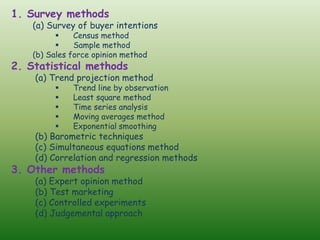
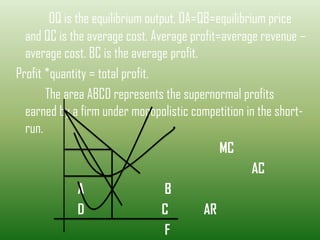
  • 103.
    Types of Industrial/ Business Organisations
  • 104.
    Introduction Imagine you wantto do business or start your own industry. Which business are you interested in? For Example, You want to get into InfoTech industry. What can you do in this industry? Which one do you choose? The following are the alternatives you have on hand; 1. You can buy and sell 2. You can setup a small/medium/large industry to manufacture. 3. You can set up a workshop to repair. 4. You can develop a software. 5. You can design a hardware. 6. You can be a consultant/trouble-shooter. If you choose any one or more of the above, you have chosen the line of activity. The next step for you is to deside whether 1. Only owner 2. co-owners along with you 3. Global player 4. Like minded people to share the benefits, 5. Involve in Government
  • 105.
    Factors affecting thechoice of form of Industrial /Business organisation 1. Easy to start and easy to close 2. Division of labor 3. amount of resources 4. Liability 5. Secrecy 6. Transfer of ownership 7. Ownership, Management and control 8. Continuity 9. Quick decision making 10. Personal contact with customers 11. Flexibility 12. Taxation
  • 106.
    Forms of Industrial/Business Organization • The following are the forms of business organisation based on ownership: 1. Sole trader or Proprietorship 2. Partnership 3. Joint Stock Company 4. Cooperative Society 5. Public enterprises.
  • 107.
    SOLE TRADER • TheSole trader is the simplest, oldest the natural form of business organization. “Sole” means one. • Sole trader implies that there is only one trader who is the owner of business. • It is simple ,oldest and one man form of organization . • He is a manager , owner and controller of business . • He uses his own knowledge skills , capital and intelligence in carrying out their business.
  • 108.
    Advantages of SoleTrader 1) Easy to start and easy to close 2) Personal contact with customers directly 3) Prompt decision making 4) High degree of flexibility 5) Secrecy 6) Low rate of taxation 7) Direct motivation 8) Total control 9) Minimum interference from Government 10) Transferability
  • 109.
    Disadvantages of SoleTrader 1) Unlimited liability 2) Limited amounts of capital 3) No division of labour 4) Uncertainty 5) Inadequate for growth and expansion 6) Lack of specialization 7) More competition 8) Low bargaining power.
  • 110.
    2.Partnership Indian Partnership Act,1932defines partnership as the relationship between two or more persons who agree to share the profits of the business carried on by all or any one of them acting for all. Features: 1) Relationship 2) Two or more persons 3) There should be a business 4) Agreement 5) Carried on by all or any one of them acting for all
  • 111.
    Features 1) Unlimited liability 2)Number of partner a)10 partners incase banking . b) 20 in case of non-banking 3.Division of labor 4.Personal contact with customers 5.Flexibility 6.Joint and several liability 7.Implied authority 8.Transferability of share/interest
  • 112.
    Advantages 1) Easy toform 2) Availability of capital 3) Division of labor 4) Flexibility 5) Personal contact with customers 6) Quick decisions and prompt actions 7) The positive impact of unlimited liability 8) Tax rate
  • 113.
    Disadvantages • Formation ofpartnership is difficult • Liability • Lack of harmony or cohesiveness • Limited growth • Instability • Lack of public confidence • Implied authority misused • High tax rate
  • 114.
    Kinds of Partnership 1.Active partner 2. Sleeping partner 3. Nominal partner 4. Partner by Estoppel 5. Partner by holding out 6. Minor Partner • Partnership deed : The written agreement among the partners is termed as partnership deed . It contains all detail about the business . • Dissolution
  • 115.
    Joint stock company •An association of many persons who contribute money to common stock and employ its for common purpose . ------ lord justice lindley. OR • The companies formed and registered under the companies act ---- -sec3(1) of companies act 1956 .
  • 116.
    Features: 1) Artificial person 2)Separate legal existence 3) Voluntary association of persons 4) Limited liability 5) Capital is divided in to shares 6) Transferability of shares 7) Common seal 8) Perpetual succession 9) Ownership and management separate 10) Winding up 11) The name of the company ends with limited
  • 117.
    Advantages 1) Mobilization oflarger resources 2) Separate legal entity 3) Limited liability 4) Transferability of shares 5) Liquidity of investments 6) Inculcates the habits of savings and investment 7) Democracy in management 8) Economies of large scale production 9) Continued existence 10) Institutional confidence 11) Professional Management 12) Growth and expansion
  • 118.
    Disadvantages 1) Formation ofcompany is a longdrawn procedure 2) High degree of Government interference 3) Inordinate delays in decision making 4) Oligarchy in management 5) Lack of initiative 6) Lack of responsibility and commitment 7) Conflicting interests 8) Promotes speculation 9) Lobbying with Govt. departments 10) Tends to monopoly 11) Higher taxes
  • 119.
    Kinds of Companies Kindsof companies based on incorporation 1. Chartered company :Ex: British East India Company in England in 1600 to trade with India and East’ 2. Statutory corporation: Ex : RBI, IDBI,FCI APSRTC 3. Registered compnies : Ex: Public and Private ltd companies
  • 120.
    Kinds of companiesbased on public interest 1. Private limited company 2. Public company 3. Government company: Ex: National Thermal Power Corporation, BHEL, HMT, HPT, SAIL
  • 121.
    Kinds of companiesbased on liability 1. Unlimited company 2. Limited company 3. Companies limited by guarantee
  • 122.
    Kinds of companiesbased on Nationality 1. Foreign Company 2. Indian Company
  • 123.
    Formation of JointStock Company a) To obtain Certificate of incorporation b) To obtain Certificate of Commencement of Business 1 . Memorandum of Association 2 . Articles of Association 3 . Names and address of proposed directors and their willingness 4 . A statutory declaration of all the legal requirements
  • 124.
    To obtain Certificateof Commencement of Business 1) Seek permission from the SEBI 2) File prospectus with Registrar 3) Collecting minimum subscription 4) Allotting shares 5) Apply to the Registrar for the Certificate of Commencement of Business
  • 125.
    Main documents inCompany Formation A. Memorandum of Association B. Articles of Association C. Prospectus
  • 126.
    Memorandum of Association •The charter of the company which discloses scope of operations and its relations to outsiders and investors . • Clauses • Name clause • situation clause • Objects clause • Capital clause • Subscription clause
  • 127.
    Articles of Association •The document that contains rules and procedures for internal management and control of the affairs of the company . • It contains details about the amount of share capital , types of shares , procedure to transfer and transmission of shares , procedure to conduct meetings , powers , duties , remuneration .
  • 128.
    Prospectus • The noticethat invite offers from public for the subscription of shares or debentures of the body corporate . • Contents • The name of the company , address , objectives types of shares , list of promoters , directors address , details of brokers , underwriters and bankers .
  • 129.
    Cooperative Societies • Acooperative society is a society registered under the Cooperative Society Act,1904. It is an association of the group of persons who come together to uplift themselves through organized efforts. • Features 1. It is a voluntary association 2. Separate legal entity 3. Compulsory registration 4. Membership 5. Finances 6. Set up is democratic 7. One member one vote 8. Service objective 9. Restricted reward to capital 10. Non transferability of shares 11. Equitable distribution of surplus
  • 130.
    Advantages 1) Voluntary organisation 2)Equal voting rights 3) Economic justice 4) Limited liability 5) Continued existence 6) Zero speculation 7) Each for all and all for each 8) Self Govt. 9) Larger identity of interests 10) Government support 11) Exploitation eliminated 12) Taxation
  • 131.
    Disadvantages 1) Shortage offunds 2) Inefficient management 3) Many legal formalities 4) Shifting loyalties among members 5) Misuse of funds for sectional interests 6) Recurring loss
  • 132.
    Public Enterprises • Genesisof Public Enterprises ❖ Higher production ❖Greater employment ❖Economic equality ❖Dispersal of economic power
  • 133.
    Forms of PublicEnterprises a) Departmental undertaking b) Public corporation c) Government company
  • 134.
    Departmental Undertaking • Thisis the earliest form of public enterprise. Under this form, the affairs of the public enterprise are carried out under the overall control of one of the departments of the government. • Ex: Railways, Dept.of Posts, All India Radio, Doordarshan, Defense undertakings like DRDL, DLRL, Ordinance factories and such. • Features: 1. Under the control of a government department 2. More financial freedom 3. Like any other government department 4. Budget, accounting and audit controls 5. More a government organisation, less a business organisation
  • 135.
    Advantages : 1. Effectivecontrol 2. Responsible executives 3. Less scope for institutionalization of funds 4. Adds to Government revenue Dis-advantages : 1. Decision delayed 2. No incentives to maximize earnings 3. Slow response to market conditions 4. Redtapism and bureaucracy 5. Incidence of taxation
  • 136.
    Public Corporation • Itis defined as a “body corporate created by an Act of Parliament or Legislature and notified by the name in the Official Gazette of the Central or State Govt. Ex: LIC, UTI, IFCI, Damodar Valley Corporation and others • Features: 1. A body corporate 2. More freedom in day to day operations 3. Freedom regarding personnel 4. Perpetual succession 5. Financial autonomy 6. Commercial audit 7. Run on commercial principles
  • 137.
    Government Company Section 617of the Indian Companies Act defines a government company as “any company in which not less than 51 percent of the paid up share capital is held by the Central Government or by any State Government or Governments or partly by Central Government and partly by one State Govt. • Features: 1) Like any other registered company 2) Shareholding 3) Directors are nominated 4) Administrative autonomy and financial freedom 5) Subject to ministerial control
  • 138.
    Advantages: 1. Formation iseasy 2. Separate legal entity 3. Ability to compete 4. Flexibility 5. Quick decisions and prompt actions 6. Private participation is facilitated
  • 139.
    Disadvantages: 1. Continued politicaland government interference 2. Higher degree of government control 3. Evades constitutional responsibility 4. Poor sense of attachment or commitment 5. Divided loyalties 6. Flexibility only on paper
  • 140.
    Problems of PublicEnterprises 1. Political interference 2. Accountability 3. Excessive inventories 4. Sense of insecurity and risk aversion 5. Unrealistic pricing policies
  • 141.
    Functioning of PublicEnterprises: Common Defects 1. Inadequate return on capital and huge accumulated losses 2. Problems in project execution 3. Unrealistic production schedules and excess capacity 4. Over-capitalization 5. Disproportionate overheads 6. Overstaffing 7. Lack of progressive personnel policies 8. Price policy 9. Lack of professional approach 10. More parliamentary interference and faulty control
  • 142.
    New economic environment •Recent developments that have taken in the environment of the business .environment means all those factors which are external to the business . • They are • New industrial policy . • LPG policy .
  • 143.
    1.New industrial policy •Government of India due to economic crisis in the year 1991 introduced this policy • Those crisis factors are • Oil price hike due to gulf war • Disastrous balance payments • Declining exports and dwindling foreign remittances . • Rampant inflation . • Huge external loans from IMF and world bank .
  • 144.
    Features of NIP1991 • Doing away the industrial licensing agreements . • Diminishing the role of public sector . • Incentives and concessions for foreign investment and technology . • Drastic amendments of MRTP act .
  • 145.
    Reforms of NIP1991 • Trade and capital reforms – devaluation of Indian rupee ,allowing foreign equity participation up to 51% in services sector ,delinking technology transfer ,tariff liberalization for exports, no quantitative restrictions for imports , providing variety of export promotion measures , industrial deregulation(licenses)etc • Public sector reforms : restructuring public enterprises , partial dis-investment , promoting interest of workers through special fund called national renewal fund .
  • 146.
    • Financial sectorreforms : It is of two forms • 1) banking sector : statutory regulatory body (SEBI) established ,reduced govt share holding to 33% , increased banks autonomy , allowed international accepted norms • 2) insurance sector : introduced regulatory body(IRDA)
  • 147.
    2.LPG POLICY Liberalization: Reducing therole of regulation of govt on industry by eliminating licensing procedures . Privatization : Inducting private ownership in state owned enterprises with a strategy to reduce role of govt in business. Globalization: Integrating the economy of the country with worlds economy with a view to reduce trade barriers and improve business climate .
  • 148.
    Introduction to financial accounting& analysis UNIT-4 ACCOUNTING PART
  • 149.
    Introduction • Every businessorganisation wants to know whether it has made profit or not at the end of given period • For this it has to prepare a statement containing profit or loss. • To know the what it owns(assets), and how much its owes(liabilities) to its suppliers and others
  • 150.
    Definition • According toAICPA defines “ accounting as an art of recording , classifying , and summarising in a significant manner , and in terms of money and events which are , in part at least , of a financial character and interpreting the results thereof”. • According to AAA defines “ accounting as the process of identifying , measuring , and communicating economic information to permit informed judgements and decisions by the users of the information.”
  • 151.
    Significance of accounting •Maintain its own records of business • Monitor the business activities • Calculate profit or loss for a given period • Full fill legal obligations • Show financial positions for a given period • Communicate the information to the interested parties.
  • 152.
    Users of accountinginformation • Owners: to know the profits • Creditors or financial institutions: to know whether their funds safe or not • Managers : to know whether their decisions effective or not • Government or tax authorities: to assesses the tax liability of a firm. • Employees: they can put path their claims for better wages or better wages.
  • 153.
    Branches of accounting •Financial accounting • Cost accounting • Management accounting
  • 154.
    Financial accounting • Preparethe financial statements trading and profit & loss account , balance sheet.
  • 155.
    Cost accounting • Refersto ascertain and control the cost of product or a department. • Accounting and costing principles , methods, techniques.
  • 156.
    Management accounting • Thepurpose of management accounting is to assist management in taking appropriate decisions . • Accounting information is provided by the accountant to enable the top management to take timely decisions.
  • 157.
  • 158.
    Journal • The wordJournal has been derived from the French word “Jour” which means daily records. • Another name “Day book” • Journal is the first in which transactions are recorded in a chronological order[date wise],the moment they take place in business.
  • 159.
    Format of Journal Dateparticulars Lf no Dr. Amount [Rs] Cr. Amount[ Rs] [debit ends with] -Dr. [credit start with] To (narration start as being…… and must be with in brackets)
  • 160.
    Single entry • Singleentry system is a method of recording transactions is unscientific and incomplete . • Under this system only one aspect of the transaction ( either Dr or Cr) is to be recorded instead of two aspects.
  • 161.
    Double Entry System •Double entry system is a scientific way of recording transactions based on the fact that for every debit , there is a corresponding credit.
  • 162.
    Advantages of DoubleEntry System • Information about every account. • Helps to know the receivables and payables. • Arithmetical accuracy. • Helps to locate errors . • Helps to ascertain P/L . • HELPS to know the financial position . • Monitoring and auditing made easier.
  • 163.
    classifications of accounting •Personal account • Real account • Nominal account
  • 164.
    Personal accounting • Theseare accounts opened in the names of persons ,firms and companies with whome the firm deals. • Rules debit the receiver credit the giver debit the receiver credit the giver
  • 165.
    Real accuont • Theseare the accounts opened in the name of assets such as land and buildings , plant and machinery, furniture etc . • Rules Debit what comes in Credit what goes out
  • 166.
    Nominal account • Alsocalled as fictitious account • Which is opened in the name of expenses , losses , profits incomes and gains • Rules Debit all expenses and losses Credit all incomes and gains
  • 167.
    Ledger • Ledger isthe book that contain several accounts. The process of preparation of accounts from the journal to ledger is called “posting” • “T “ format of ledger Dr Cr date Particulars Jf no Rs date particulars Jf no Rs TO…. BY……
  • 168.
    Sub-divisions of journal •Purchase book • Sale book • Purchase return book • Sales return book • Bills receivable book • Bills payable book • Cash book • Journal proper
  • 169.
    Trial balance • Trialbalance is the statement containing debit and credit balances of various accounts taken out from ledger books as on a particular date. • A trail balance must agree with as on that date .
  • 170.
    Errors that canbe revealed by the trail balnce • Errors of principles. • Errors of complete omission of a transaction. • Posting on correct side to a wrong account. • Recording a transaction in a wrong subsidiary journal . • Compensating errors.
  • 171.
    Particulars Debit RsCredit Rs Debit: debtors account Assets account( such as plant ,furniture etc..) Expenses account (such as rent paid) Loss account(such as goods destroyed in fire) Purchases account Sales return account Drawings account Credit : Creditors account Liabilities account Incomes & Gains account Profits account Loan account Bank over draft account Sales account Purchase returns account Provisions & reserves & funds account total Xxxx Xxxx Xxxx Xxxx Xxxx Xxxx Xxxx Xxxxxx Xxxxx Xxxxx Xxxxx Xxxxx Xxxxx Xxxxx Xxxxx Xxxxx Xxxxx xxxxxx
  • 172.
    Final accounts • Tradingaccount • Profit and loss account • Balance sheet
  • 173.
    Trading account • Itshows the gross profit or gross loss of given accounting period Gross profit= net sales- cost of goods sold It has: Opening stock Purchases Wages Carriage inwards Fuel and power etc
  • 174.
    Format of tradingaccount particulars Rs particulars Rs To opening stock To purchases xxxx less: purchase returns xxxx To wages To carriage inwards To fuel and power To direct expenses To gross profit transferred to profit and loss a/c Xxx Xxx Xxx Xxx Xxx Xxx Xxx Xxxx By sales xxx less: sales returns xxx By closing stock Xxxx Xxx Xxxx
  • 175.
    Profit and lossaccount • It shows the net profit or net loss for the end of given period • It has Maintaining the capital asset Running business to time to time Selling and distributing the good of the business
  • 176.
    Format profit andloss account particulars Rs particulars Rs To salaries To rent To insurance To carriage out wards To telephones To provision for depreciation To bad debts written off xxx add: increase in bad debts xxx To cost of samples To advertising To heating and lighting To interest on loan To discount allowed To net profit transferred to capital account Xxx Xxx Xxx Xxx Xxx Xxx Xxx Xxx Xxx Xxx Xxx Xxx Xxx Xxxx By gross profit By discount received By commission received By reduction in provision for bad debts By profit on sale of fixed asset Xxx Xxx Xxx Xxx Xxx Xxxx
  • 177.
    Balance sheet • Balancesheet is the statement of assets and liabilities of the firm it show the fair value of the business. • It has 2 sides liabilities and asserts liabilities assets
  • 178.
    Format for balancesheet liabilities Rs Assets Rs Long term liabilities Owner’s capital xxxx add: net profit from profit and loss account xxxx less : drawings xxxx Bank over draft Current liabilities Sundry creditors Bills payable Out standing expenses Xxxx Xxxx Xxxx Xxxx Xxxx Xxxx xxxxx Fixed assets Plant and machinery xxxx less: depreciation xxxx Furniture and fixtures xxxx less: depreciation xxxx Current assets Stock Sundry debtors xxx less : provision for bad and doubtful debts xxx Bills receivables Cash at bank Cash in hand Prepaid expenses Xxxx xxx xxx Xxxx Xxx Xxx Xxx xxxx xxxxx
  • 179.
  • 180.
    Definition • The amountof funds which is required to start the business is termed as capital. • Need for capital • To promote the business. • To conduct business smoothly • To expand and diversify • To meet contingencies • To pay taxes • To support welfare programmes
  • 181.
    Types of capital 1.Fixed capital 2. Working capital • Fixed capital: The portion of capital which is required to aquire long term assests like lands and buildings , plant and machinery , furniture and fixures etc
  • 182.
    Features • Permanent innature • Profit generation • Low liquidity • Utilized for promotion and expansion • Amount depends on size , nature type of business
  • 183.
    Types of fixedassets • Tangible fixed assets : which can be seen and touched ex: lands and buildings , plant and machinery , furniture and fixtures etc • intangible fixed assets :assets which do not have physical form ex: good will , brand names trade marks • financial fixed assets : investments in shares , foreign currency deposits etc
  • 184.
    2. Working capital •The amount of capital which is required to meet the day to day transactions of business is termed as working capital. • It is flesh and blood of the business . • Features : • Short life • Smooth flow of operations • Liquidity • Amount depand on short term requirements • Utilized to meet current expenses
  • 185.
    Components of workingcapital • 1.Current assets : assets from which cash can be realized over a short period of time • Ex : cash in hand , cash at bank , debtors , bills receivables , prepaid expenses , stocks ,Cash in hand and bank balance , Accrued income . • 2.Current liabilities : the obligation that the firm must pay to outsiders over a short period of time i.e below 1 year • Ex : creditors , bills payables , short term loans and advances , accrued expenses Dividends payable , Provision for taxation • etc. • Formula: net working capital = current assets – current liablities
  • 186.
    Factors determining workingcapital • Position in business cycle • Nature of business • Nature of demand • Credit policy • Working capital cycle • Manufacturing cycle • Price level changes , • Effect of external environment to business • Degree of competition
  • 187.
    Working capital cycle •The flow of money in the business is termed as working capital cycle
  • 188.
  • 189.
    Types of workingcapital Working capital concept Gross working capital Networking capital time Permanent working capital regular reverse temporary seasonal special
  • 190.
  • 191.
    types • Three sources •1) short term finance • 2) medium term finance • 3) long term finance
  • 192.
    Short term finance •Source of finance with maturity period of less than 1 year or 1year. • It is required to meet short term financial needs of a company i.e working capital needs • Instruments: • Trade credit : short term credit facility extended by suppliers to customers during their normal course of business . • Commercial papers : unsecured promissory note issued by corporate to investors at discount rate on face value . • Bill of exchange : • Certificate of deposits : negotiable instruments that are issued in materialized form governed by RBI . • Bank overdrafts : special arrangement between banker and customer to draw more than what he has in his account subject to maximum limit . • Call/ notice money : money lend or borrowed for very short period i.e 1-14 days . • Treasure bills :short borrowing instruments Of union govt with maturity period of 14/91/182/364 days from the date of issue . • Debt factoring : arrangement with factor where trader agrees to sell its receivables at discounts to specialized dealers b.
  • 193.
    Medium term sourcesof finance • Source of finance with maturity period of more than 1 year and less than 5 years . • It is required by the company to meet repairs and maintenance of fixed assets by the firm . • Instruments. • 1) Hire purchase :The facility to buy the fixed asset by paying down payment a part of price and balance is paid in installments with fixed rate of interest in agreed number of installments • 2)leasing :agreement between lessor and lesse for getting agreement on getting assets in rent over a specific period of time . • 3) bank loans :banks render loans to customers at fixed rate of interest scheduled in beginning and remaining is debited directly from the account of customer in installments . • 4) venture capital financing :for the projects which are high riskly banks offer merchandise banking services .
  • 194.
    Long term finance •Source of finance with maturity period of more than 5year s and less than 20 years • It is required for company to meet permanent capital requirements of firm . • Instruments • 1) Equity shares :shares which are the part of ownership funds of company . • 2) preference shares : The share which provide rights to investors in terms of fixed rate of dividend and return on capital . • 3) debentures : certificate issued under common seal of a company acknowledging receipt of the loan . • 4)long term loans : source of finance availed by bankers and financial institutions with maturity period of 5-20 years • 5) retained earnings : the returns payable to equity share holders are converted to reinvestments of firm through mutual agreements .
  • 195.
  • 196.
    definition • The processof evaluating relative worth of investment proposals based on profitability is termed as capital budgeting . • It play an important role in undertaking investment decisions .
  • 197.
    process 1.Generating investment proposals( Project generation ) 2.Estimating and evaluating cash flows( project evaluation) 3.selection of projects(PROJECT SELECTION) 4.Project implementation. 5.Project control ( monitoring and re-evaluating)
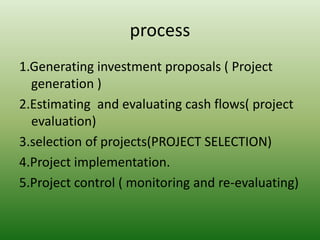
  • 198.
    significance • Includes substantialcash flows. • Long term implications . • Strategic in nature . • Irreversible .
  • 199.
    Types of capitalbudgeting decisions • Expansion • Diversification • Replacement decisions • Contingent decisions • Mutually exclusive decisions.
  • 200.
  • 201.
    1.PAY BACK PERIOD •The length of time it will taken to recover the cost of the project . • FORMULA : • pay back period = cost of the project _________________ annual cash in flows • METHODS: two types . • 1. even cash in flows : the above formula is used • 2 . Un even cash in flows : cumulative cash in flows method is used .
  • 202.
    • Advantages • Easyto understand and calculate . • Liquidity is easily identified . • Disadvantages • All cash flows are not considered . • Ignores time value of money .
  • 203.
    2.ACOUNTING RATE OFRETURN • The ratio of annual profits after taxes to average investment is termed as accounting rate of return. • ARR = annual profits after taxes ________________________×100 average investment
  • 204.
    methods • Two methods •1.accounting rate of return • ARR = annual profits after taxes ________________________×100 average investment • 2.average rate of return • ARR = Average annual profits after taxes ________________________×100 average investment
  • 205.
    1.Average annual profitsafter taxes • = Total annual profits after taxes ____________________________ projects life 2. Average investment = orginal investment/2 or original investment-scrap/2 or • original investment-scrap/2+working capital +scrap
  • 206.
    • Advantages • Easyto calculate • Consider entire cash flows. • Disadvantages • Ignores time value of money • Ignores project period .
  • 207.
    Discounted cash flowmethods • The method that consider time value of money to assess the profitability of the project is called as Discounted cash flow methods . • Time value of money means Factors that convert future rupees into current rupees . • Formula pv factor of re .1 = 1/1+r^n • Formula pv factor of re .1 received annually for n years = 1 _______ 1/1+r^n
  • 208.
    methods • Net presentvalue (NPV) • Internal rate of return (IRR) • Profitability index (PI)
  • 209.
    1.NET PRESENT VALUE(NPV) •The excess of present value of cash inflows over and above cash outflows is termed as NPV . • It is a modern method of evaluating investment proposals . • Formula • NPV =PV CFAT-PVC • Where PV CFAT =present value of cash in flows • PVC= present value of cash outflows .
  • 210.
    Steps in calculatingnpv • Step -1 : identify pv of re-1 for given discount rate . • Step -2 : multiply the cash flows with corresponding pv factor • DCF = PV factor × CFAT(cash inflows after taxes) • Step : 3: find the sum of the products • Step -4 : interpret the results • Npv>1 accept the project , npv <1 reject the project , npv=1 may accept or reject the project .
  • 211.
    • ADVANTAGES • Recognizestime value of money . • All cash flows are considered by this method . • DISADVANTAGES • Difficult to compute results . • May not provide good results .
  • 212.
    2. INRERNAL RATEOF RETURN • Definition : the discount rate that equates present value of cash inflows of the project with cash outflows of the project . • Methods – two methods • 1.intrapolation method • 2. Trail and error method .
  • 213.
    • I. INTRAPOLATIONMETHOD • Used in case of PROJECT with equal cash in flows . • Two steps • 1.determine pv factor • pv factor = cost of the project _________________ Average annual cash in flows 2.Determine IRR PX- I IRR = X+ ____ (Y-X) PX-PY Where x= lower discount rate. Y= higher discount rate . PX= present value of cash inflows at lower discount rate ‘x’ PY= present value of cash inflows at higher discount rate ‘y’ I = present value of cash OUTflows •
  • 214.
    TRAIL AND ERRORMETHOD • Used in case of PROJECT with un equal cash in flows . • Two steps • 1.determine pv factor • pv factor = cost of the project _________________ Average annual cash in flows 2.Determine IRR by applying trail and error method. In first trail rate if results are not positive we apply second trail rate until the values of cash inflows are equal or negative or 0
  • 215.
    3.Profitability index method •The ratio of present value of cash inflows to present value of cash outflows of the project is called profitability index . • Formula sum of present value of cash inflows PI = ______________________________ sum of present value of cash out flows Interpretation PI>1 accept the project , PI <1 reject the project , PI=1 may accept or reject the project .