AGENDA
Written Communication
Do’s and Don’ts of written Communication
E-mails
Reports
Meetings
4
Day
Minutes of Meeting
Written Communication
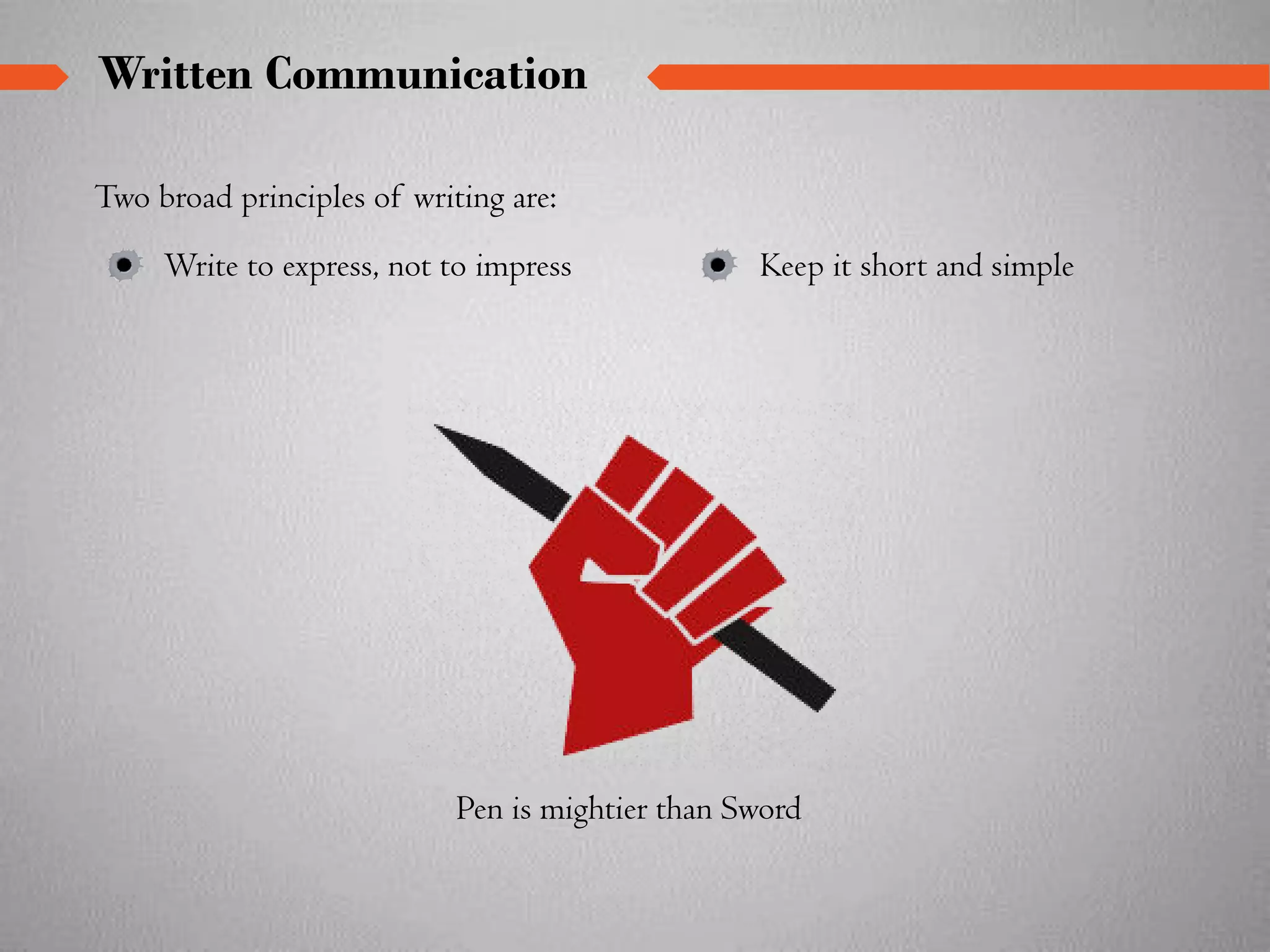
Pen is mightier than Sword
Two broad principles of writing are:
Write to express, not to impress Keep it short and simple
Five ways to Effective Writing
Put the readers first
Use simple words and short sentences
Communication = Understanding
Use words readers can picture
Tie in to the reader’s experience
What’s in it for me
In order to (to)
Due to the fact that (because)
In the event that (if)
During the time that (when, while)
in the amount of (for)
Use jargon only when necessary
What is Jargon?
Format to improve readability
Use lists, bullets, charts, tables,
indents, italics, bold, heading etc...
Write with verbs and nouns
Use the active voice
When it is okay to use passive voice
Five ways to Effective Writing
Do’s and Don’t of Written Business Communication
DO
DON’T
Keep writing as simple and succinct
as possible
Structure and organize your
business writing
Choose an appropriate tone for
your business writing
Save your best written documents
as templates for future use
Write with the reader in mind
Forget to include a call to action if
a response is needed
Be careless when writing a
recipient’s name, gender or title
Be tempted to use sarcasm jokingly
in written communication
Become over-reliant on your
computer’s spelling / grammar
checking facility
Be unprofessional in your writing
Emails
Be prompt and respond to
important email
Decide carefully who should be cc-
ed on email.
Use a clear subject line to clarify
what your email is about
Include an email “signature”
Be clear and specific
Capitalization
Avoid fancy look and special
characters
Refrain from using BCC
USE BLOCK or BOLD
Include non work related material
Use “Reply to All” for chain mails
Use unfriendly tone
Reports
Convey Information
A document that provides a strong base for planning and control in an organization,
i.e., reports give information which can be utilized by the management team in an
organization for making plans and for solving complex issues in the organization.
Purpose of business reports
Assist in decision-making
Actual Solution
Past Information – future planning
Business Concept
Management Model
Etc.
Written Communication
Writing Style for Reports
Be clear and effective. Never use
long sentences
Know the objective of report and
be focused.
Intelligently use graphs, pie-charts
etc to represent data.
Avoid jagrons
Make the information visually easy
to read
Meeting
A meeting is a gathering of two or more people that has been convened for the purpose
of achieving a common goal through verbal interaction, such as sharing information or
reaching agreement.
Do more work up front
Get the right people in the room
Gather the right materials
Pre-wire any key decisions
In the meeting focus
Strong long tangents
Avoid solving
Assign actions
How to make meeting effective?
Follow up on the assignments
Meeting
Make the meeting purpose clear
Send an agenda out along with the
meeting invitation ahead of time
Start and end meeting on time.
Send out a follow-up email after the
meeting that lists next steps, who’s
responsible for them, and when they’ll
get done
Do try to keep the meeting short not
more than an hour.
Schedule meetings at peak hours.
Move on to a new topic until everyone
feels they’ve been heard.
Let the group get distracted by tangents
— ask if you can address unrelated
topics another time.
Feel obliged to invite lots of people —
only include those who are critical to
making progress - fewer the better.
Minutes of Meeting
What should be included in MoM:
Announcements
Open issues
Agenda for next meeting
Minutes Approved By
Date/Time of meeting
Location of meeting
Members present
Agenda#1
o Discussion Points
o Action/Conclusion
Minutes Prepared By
Minutes of Meeting
How to effectively prepare MoM:
Review before sharing the MoM with the attendees and other participants not
present during the meeting.
Be attentive during the meeting
Take notes
Be objective while preparing MoM.
Try and cover all the points discussed during the meeting.
The
END !!

Business communication - Day 4

  • 1.
    AGENDA Written Communication Do’s andDon’ts of written Communication E-mails Reports Meetings 4 Day Minutes of Meeting
  • 2.
    Written Communication Pen ismightier than Sword Two broad principles of writing are: Write to express, not to impress Keep it short and simple
  • 3.
    Five ways toEffective Writing Put the readers first Use simple words and short sentences Communication = Understanding Use words readers can picture Tie in to the reader’s experience What’s in it for me In order to (to) Due to the fact that (because) In the event that (if) During the time that (when, while) in the amount of (for)
  • 4.
    Use jargon onlywhen necessary What is Jargon? Format to improve readability Use lists, bullets, charts, tables, indents, italics, bold, heading etc... Write with verbs and nouns Use the active voice When it is okay to use passive voice Five ways to Effective Writing
  • 5.
    Do’s and Don’tof Written Business Communication DO DON’T Keep writing as simple and succinct as possible Structure and organize your business writing Choose an appropriate tone for your business writing Save your best written documents as templates for future use Write with the reader in mind Forget to include a call to action if a response is needed Be careless when writing a recipient’s name, gender or title Be tempted to use sarcasm jokingly in written communication Become over-reliant on your computer’s spelling / grammar checking facility Be unprofessional in your writing
  • 6.
    Emails Be prompt andrespond to important email Decide carefully who should be cc- ed on email. Use a clear subject line to clarify what your email is about Include an email “signature” Be clear and specific Capitalization Avoid fancy look and special characters Refrain from using BCC USE BLOCK or BOLD Include non work related material Use “Reply to All” for chain mails Use unfriendly tone
  • 7.
    Reports Convey Information A documentthat provides a strong base for planning and control in an organization, i.e., reports give information which can be utilized by the management team in an organization for making plans and for solving complex issues in the organization. Purpose of business reports Assist in decision-making Actual Solution Past Information – future planning Business Concept Management Model Etc.
  • 8.
    Written Communication Writing Stylefor Reports Be clear and effective. Never use long sentences Know the objective of report and be focused. Intelligently use graphs, pie-charts etc to represent data. Avoid jagrons Make the information visually easy to read
  • 9.
    Meeting A meeting isa gathering of two or more people that has been convened for the purpose of achieving a common goal through verbal interaction, such as sharing information or reaching agreement. Do more work up front Get the right people in the room Gather the right materials Pre-wire any key decisions In the meeting focus Strong long tangents Avoid solving Assign actions How to make meeting effective? Follow up on the assignments
  • 10.
    Meeting Make the meetingpurpose clear Send an agenda out along with the meeting invitation ahead of time Start and end meeting on time. Send out a follow-up email after the meeting that lists next steps, who’s responsible for them, and when they’ll get done Do try to keep the meeting short not more than an hour. Schedule meetings at peak hours. Move on to a new topic until everyone feels they’ve been heard. Let the group get distracted by tangents — ask if you can address unrelated topics another time. Feel obliged to invite lots of people — only include those who are critical to making progress - fewer the better.
  • 11.
    Minutes of Meeting Whatshould be included in MoM: Announcements Open issues Agenda for next meeting Minutes Approved By Date/Time of meeting Location of meeting Members present Agenda#1 o Discussion Points o Action/Conclusion Minutes Prepared By
  • 12.
    Minutes of Meeting Howto effectively prepare MoM: Review before sharing the MoM with the attendees and other participants not present during the meeting. Be attentive during the meeting Take notes Be objective while preparing MoM. Try and cover all the points discussed during the meeting.
  • 13.