Business Ethics and Technology
Ethics eth•ic Pronunciation:  (eth'ik),  [key]   — n.   1. the body of moral principles or values governing or distinctive of a particular culture or group:  the Christian ethic; the tribal ethic of the Zuni.   2. a complex of moral precepts held or rules of conduct followed by an individual:  a personal ethic. Webster ’s Dictionary
So what is ethics? “ According to John Rawls . . . ‘ethics is how we decide to behave when we decide we belong together,’ the study of ethics has to do with developing standards for judging the conduct of one party whose behavior affects another” (Gini, 2010, p. 347). Gini, A. (2010).  Moral Leadership and Business Ethics (2nd ed.) (G. R. Hickman, Ed.). Thousand Oaks, CA: Sage.
Definition of Ethics Professor John Chaffee states,  “ ethics and morals are terms that refer to the principles that govern our relationships with other people: the ways we ought to behave . . . standards that we should employ in the decisions we make” (Chaffee, 2009, p.307) Chaffee, J. (2009).  Thinking Critically  (9th ed.). Boston: Cengage Learning.
Ethics is the ability  “to qualify for moral consideration; you must be able to use the power of reason to derive and understand the moral law, and you must follow the law because you recognize it as moral imperative” (Waller, 2008, p. 140). Waller, B. (2008).  Consider Ethics: Theory, Readings, and Contemporary Issues  (2nd ed.). New York: Pearson Longman. 
Business Ethics “ business ethics examines moral controversies relating to the social responsibilities of capitalist business practices, the moral status of corporate entities, deceptive advertising, insider trading, basic employee rights, job discrimination, affirmative action, drug testing, and whistle blowing” (Fieser, 2003) Fieser, J. (2003). Ethics. In  Internet Encyclopedia of Philosophy . Retrieved September 4, 2010, from http:/​/​www.iep.utm.edu/​ethics/​
Business Ethics Ethics is: “ how we treat each other, every day, person to person. If you want to know about a company’ ethics, look at how it treats people ---- customers, suppliers, and employees (Gini, 2010, p. 349). “ Business is about people . . . Ethics is about how customers and employees' are treated” (Gini, 2010, p. 349). Gini, A. (2010).  Moral Leadership and Business Ethics (2nd ed.) (G. R. Hickman, Ed.). Thousand Oaks, CA: Sage.
Break Time!
Learning Outcomes Identify the role that  technology plays in business. Gain an understanding of the technological environment and its characteristics that influence business ethics and stakeholders. Identify the benefits and side effects of technology in business. Gain an appreciation of society ’s intoxication with technology and the consequences of this intoxication. Learn to differentiate between information technology and biotechnology and their ethical implications. Identify the ethical issues involved in biotechnology and present arguments on both sides of the issues. 0
Introduction This lecture explores questions surrounding technology and business ethics, including: What does technology mean? What are the benefits and challenges of technology? How does ethics relate to technology? What are the ethical issues surrounding the major realms of technology:  computers and information technology,  and biotechnology? 0
Technology and the  Technological Environment 0 Technology The totality of the means employed  to provide objects necessary for  human sustenance and comfort
Characteristics of Technology Increased production of goods and services Reduced amount of labor needed to produce  goods and services Made labor easier and safer Increased productivity Increased standard of living Increased life expectancy Benefits of Technology  0
Side Effects and Challenges  of Technology Environmental pollution Depletion of natural resources Technological unemployment Creation of unsatisfying jobs Side Effects of Technology  0 http://www.ethix.org @
Ethics and Technology Key Issues Technological Determinism Ethical Lag 0
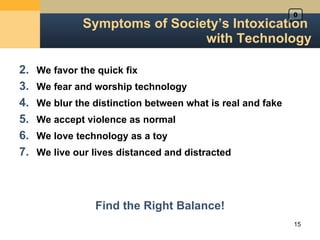
Symptoms of Society ’s Intoxication  with Technology We favor the quick fix We fear and worship technology We blur the distinction between what is real and fake We accept violence as normal We love technology as a toy We live our lives distanced and distracted Find the Right Balance! 0
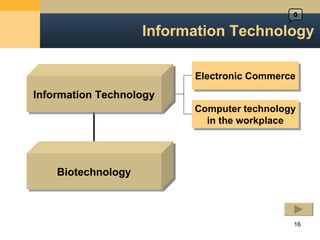
Information Technology 0 Biotechnology Electronic Commerce Computer technology in the workplace Information Technology
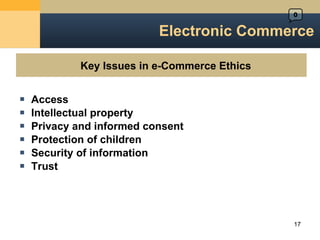
Electronic Commerce Access Intellectual property Privacy and informed consent Protection of children Security of information Trust 0 Key   Issues in e-Commerce Ethics
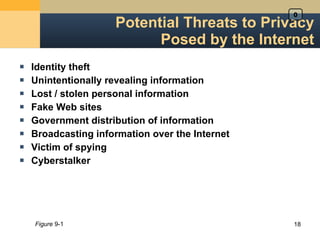
Potential Threats to Privacy Posed by the Internet Identity theft Unintentionally revealing information Lost / stolen personal information Fake Web sites Government distribution of information Broadcasting information over the Internet Victim of spying Cyberstalker Figure  9-1 0
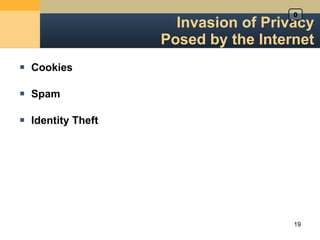
Invasion of Privacy Posed by the Internet Cookies Spam Identity Theft 0
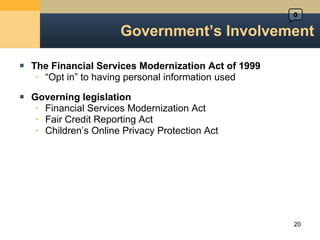
The Financial Services Modernization Act of 1999 “ Opt in” to having personal information used Governing legislation Financial Services Modernization Act Fair Credit Reporting Act Children ’s Online Privacy Protection Act Government ’s Involvement 0
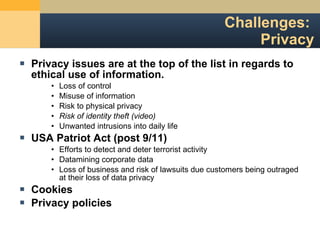
Challenges:  Privacy Privacy issues are at the top of the list in regards to ethical use of information. Loss of control Misuse of information Risk to physical privacy Risk of identity theft (video) Unwanted intrusions into daily life USA Patriot Act (post 9/11) Efforts to detect and deter terrorist activity Datamining corporate data Loss of business and risk of lawsuits due customers being outraged at their loss of data privacy Cookies Privacy policies
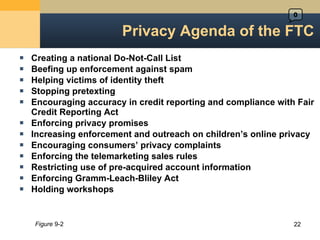
Creating a national Do-Not-Call List Beefing up enforcement against spam Helping victims of identity theft Stopping pretexting Encouraging accuracy in credit reporting and compliance with Fair Credit Reporting Act Enforcing privacy promises Increasing enforcement and outreach on children ’s online privacy Encouraging consumers ’ privacy complaints Enforcing the telemarketing sales rules Restricting use of pre-acquired account information Enforcing Gramm-Leach-Bliley Act Holding workshops Privacy Agenda of the FTC Figure  9-2 0
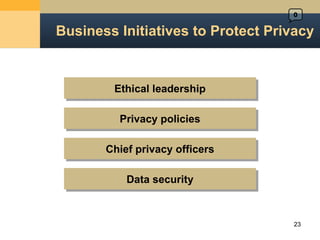
Business Initiatives to Protect Privacy 0 Ethical leadership Privacy policies Chief privacy officers Data security
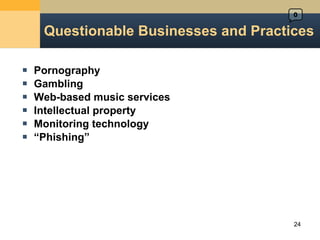
Pornography Gambling Web-based music services Intellectual property Monitoring technology “ Phishing” Questionable Businesses and Practices 0
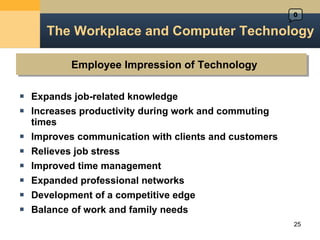
The Workplace and Computer Technology Expands job-related knowledge Increases productivity during work and commuting times Improves communication with clients and customers Relieves job stress  Improved time management Expanded professional networks Development of a competitive edge Balance of work and family needs 0 Employee Impression of Technology
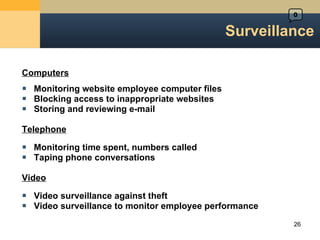
Surveillance Computers Monitoring website employee computer files Blocking access to inappropriate websites Storing and reviewing e-mail Telephone Monitoring time spent, numbers called Taping phone conversations Video Video surveillance against theft Video surveillance to monitor employee performance 0
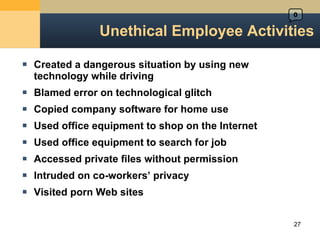
Unethical Employee Activities Created a dangerous situation by using new technology while driving Blamed error on technological glitch Copied company software for home use Used office equipment to shop on the Internet Used office equipment to search for job Accessed private files without permission Intruded on co-workers ’ privacy Visited porn Web sites 0
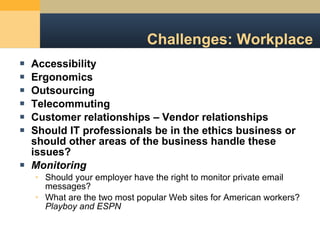
Challenges: Workplace Accessibility Ergonomics Outsourcing Telecommuting Customer relationships – Vendor relationships Should IT professionals be in the ethics business or should other areas of the business handle these issues? Monitoring Should your employer have the right to monitor private email messages? What are the two most popular Web sites for American workers?  Playboy and ESPN
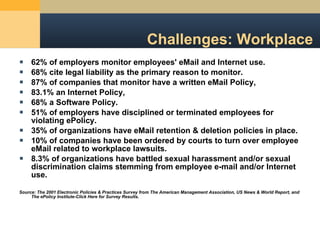
Challenges: Workplace 62% of employers monitor employees' eMail and Internet use. 68% cite legal liability as the primary reason to monitor.  87% of companies that monitor have a written eMail Policy,  83.1% an Internet Policy,  68% a Software Policy. 51% of employers have disciplined or terminated employees for violating ePolicy. 35% of organizations have eMail retention & deletion policies in place. 10% of companies have been ordered by courts to turn over employee eMail related to workplace lawsuits. 8.3% of organizations have battled sexual harassment and/or sexual discrimination claims stemming from employee e-mail and/or Internet use.  Source: The 2001 Electronic Policies & Practices Survey from The American Management Association, US News & World Report, and The ePolicy Institute-Click Here for Survey Results .
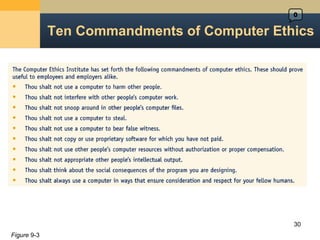
Ten Commandments of Computer Ethics Figure  9-3 0
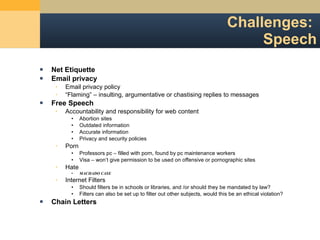
Challenges:  Speech Net Etiquette Email privacy Email privacy policy “ Flaming” – insulting, argumentative or chastising replies to messages Free Speech Accountability and responsibility for web content Abortion sites Outdated information Accurate information Privacy and security policies Porn Professors pc – filled with porn, found by pc maintenance workers Visa – won ’t give permission to be used on offensive or pornographic sites Hate MACHADO CASE  Internet Filters Should filters be in schools or libraries, and /or should they be mandated by law? Filters can also be set up to filter out other subjects, would this be an ethical violation? Chain Letters
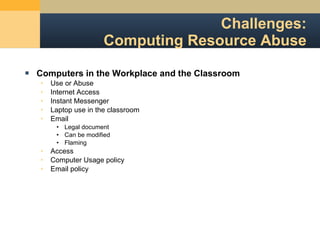
Challenges: Computing Resource Abuse Computers in the Workplace and the Classroom Use or Abuse Internet Access Instant Messenger Laptop use in the classroom Email Legal document Can be modified Flaming Access Computer Usage policy Email policy
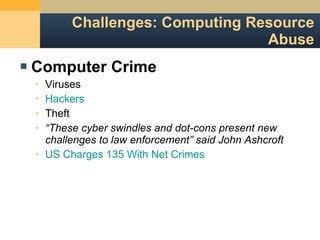
Challenges: Computing Resource Abuse Computer Crime Viruses Hackers Theft “ These cyber swindles and dot-cons present new challenges to law enforcement” said John Ashcroft US Charges 135 With Net Crimes
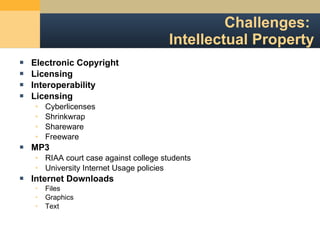
Challenges:  Intellectual Property Electronic Copyright Licensing Interoperability Licensing Cyberlicenses Shrinkwrap Shareware Freeware MP3 RIAA court case against college students University Internet Usage policies Internet Downloads Files Graphics Text

Bus ethics and tech

  • 1.
  • 2.
    Ethics eth•ic Pronunciation: (eth'ik), [key] — n. 1. the body of moral principles or values governing or distinctive of a particular culture or group: the Christian ethic; the tribal ethic of the Zuni. 2. a complex of moral precepts held or rules of conduct followed by an individual: a personal ethic. Webster ’s Dictionary
  • 3.
    So what isethics? “ According to John Rawls . . . ‘ethics is how we decide to behave when we decide we belong together,’ the study of ethics has to do with developing standards for judging the conduct of one party whose behavior affects another” (Gini, 2010, p. 347). Gini, A. (2010). Moral Leadership and Business Ethics (2nd ed.) (G. R. Hickman, Ed.). Thousand Oaks, CA: Sage.
  • 4.
    Definition of EthicsProfessor John Chaffee states, “ ethics and morals are terms that refer to the principles that govern our relationships with other people: the ways we ought to behave . . . standards that we should employ in the decisions we make” (Chaffee, 2009, p.307) Chaffee, J. (2009). Thinking Critically (9th ed.). Boston: Cengage Learning.
  • 5.
    Ethics is theability “to qualify for moral consideration; you must be able to use the power of reason to derive and understand the moral law, and you must follow the law because you recognize it as moral imperative” (Waller, 2008, p. 140). Waller, B. (2008). Consider Ethics: Theory, Readings, and Contemporary Issues (2nd ed.). New York: Pearson Longman. 
  • 6.
    Business Ethics “business ethics examines moral controversies relating to the social responsibilities of capitalist business practices, the moral status of corporate entities, deceptive advertising, insider trading, basic employee rights, job discrimination, affirmative action, drug testing, and whistle blowing” (Fieser, 2003) Fieser, J. (2003). Ethics. In Internet Encyclopedia of Philosophy . Retrieved September 4, 2010, from http:/​/​www.iep.utm.edu/​ethics/​
  • 7.
    Business Ethics Ethicsis: “ how we treat each other, every day, person to person. If you want to know about a company’ ethics, look at how it treats people ---- customers, suppliers, and employees (Gini, 2010, p. 349). “ Business is about people . . . Ethics is about how customers and employees' are treated” (Gini, 2010, p. 349). Gini, A. (2010). Moral Leadership and Business Ethics (2nd ed.) (G. R. Hickman, Ed.). Thousand Oaks, CA: Sage.
  • 8.
  • 9.
    Learning Outcomes Identifythe role that technology plays in business. Gain an understanding of the technological environment and its characteristics that influence business ethics and stakeholders. Identify the benefits and side effects of technology in business. Gain an appreciation of society ’s intoxication with technology and the consequences of this intoxication. Learn to differentiate between information technology and biotechnology and their ethical implications. Identify the ethical issues involved in biotechnology and present arguments on both sides of the issues. 0
  • 10.
    Introduction This lectureexplores questions surrounding technology and business ethics, including: What does technology mean? What are the benefits and challenges of technology? How does ethics relate to technology? What are the ethical issues surrounding the major realms of technology: computers and information technology, and biotechnology? 0
  • 11.
    Technology and the Technological Environment 0 Technology The totality of the means employed to provide objects necessary for human sustenance and comfort
  • 12.
    Characteristics of TechnologyIncreased production of goods and services Reduced amount of labor needed to produce goods and services Made labor easier and safer Increased productivity Increased standard of living Increased life expectancy Benefits of Technology 0
  • 13.
    Side Effects andChallenges of Technology Environmental pollution Depletion of natural resources Technological unemployment Creation of unsatisfying jobs Side Effects of Technology 0 http://www.ethix.org @
  • 14.
    Ethics and TechnologyKey Issues Technological Determinism Ethical Lag 0
  • 15.
    Symptoms of Society’s Intoxication with Technology We favor the quick fix We fear and worship technology We blur the distinction between what is real and fake We accept violence as normal We love technology as a toy We live our lives distanced and distracted Find the Right Balance! 0
  • 16.
    Information Technology 0Biotechnology Electronic Commerce Computer technology in the workplace Information Technology
  • 17.
    Electronic Commerce AccessIntellectual property Privacy and informed consent Protection of children Security of information Trust 0 Key Issues in e-Commerce Ethics
  • 18.
    Potential Threats toPrivacy Posed by the Internet Identity theft Unintentionally revealing information Lost / stolen personal information Fake Web sites Government distribution of information Broadcasting information over the Internet Victim of spying Cyberstalker Figure 9-1 0
  • 19.
    Invasion of PrivacyPosed by the Internet Cookies Spam Identity Theft 0
  • 20.
    The Financial ServicesModernization Act of 1999 “ Opt in” to having personal information used Governing legislation Financial Services Modernization Act Fair Credit Reporting Act Children ’s Online Privacy Protection Act Government ’s Involvement 0
  • 21.
    Challenges: PrivacyPrivacy issues are at the top of the list in regards to ethical use of information. Loss of control Misuse of information Risk to physical privacy Risk of identity theft (video) Unwanted intrusions into daily life USA Patriot Act (post 9/11) Efforts to detect and deter terrorist activity Datamining corporate data Loss of business and risk of lawsuits due customers being outraged at their loss of data privacy Cookies Privacy policies
  • 22.
    Creating a nationalDo-Not-Call List Beefing up enforcement against spam Helping victims of identity theft Stopping pretexting Encouraging accuracy in credit reporting and compliance with Fair Credit Reporting Act Enforcing privacy promises Increasing enforcement and outreach on children ’s online privacy Encouraging consumers ’ privacy complaints Enforcing the telemarketing sales rules Restricting use of pre-acquired account information Enforcing Gramm-Leach-Bliley Act Holding workshops Privacy Agenda of the FTC Figure 9-2 0
  • 23.
    Business Initiatives toProtect Privacy 0 Ethical leadership Privacy policies Chief privacy officers Data security
  • 24.
    Pornography Gambling Web-basedmusic services Intellectual property Monitoring technology “ Phishing” Questionable Businesses and Practices 0
  • 25.
    The Workplace andComputer Technology Expands job-related knowledge Increases productivity during work and commuting times Improves communication with clients and customers Relieves job stress Improved time management Expanded professional networks Development of a competitive edge Balance of work and family needs 0 Employee Impression of Technology
  • 26.
    Surveillance Computers Monitoringwebsite employee computer files Blocking access to inappropriate websites Storing and reviewing e-mail Telephone Monitoring time spent, numbers called Taping phone conversations Video Video surveillance against theft Video surveillance to monitor employee performance 0
  • 27.
    Unethical Employee ActivitiesCreated a dangerous situation by using new technology while driving Blamed error on technological glitch Copied company software for home use Used office equipment to shop on the Internet Used office equipment to search for job Accessed private files without permission Intruded on co-workers ’ privacy Visited porn Web sites 0
  • 28.
    Challenges: Workplace AccessibilityErgonomics Outsourcing Telecommuting Customer relationships – Vendor relationships Should IT professionals be in the ethics business or should other areas of the business handle these issues? Monitoring Should your employer have the right to monitor private email messages? What are the two most popular Web sites for American workers? Playboy and ESPN
  • 29.
    Challenges: Workplace 62%of employers monitor employees' eMail and Internet use. 68% cite legal liability as the primary reason to monitor. 87% of companies that monitor have a written eMail Policy, 83.1% an Internet Policy, 68% a Software Policy. 51% of employers have disciplined or terminated employees for violating ePolicy. 35% of organizations have eMail retention & deletion policies in place. 10% of companies have been ordered by courts to turn over employee eMail related to workplace lawsuits. 8.3% of organizations have battled sexual harassment and/or sexual discrimination claims stemming from employee e-mail and/or Internet use. Source: The 2001 Electronic Policies & Practices Survey from The American Management Association, US News & World Report, and The ePolicy Institute-Click Here for Survey Results .
  • 30.
    Ten Commandments ofComputer Ethics Figure 9-3 0
  • 31.
    Challenges: SpeechNet Etiquette Email privacy Email privacy policy “ Flaming” – insulting, argumentative or chastising replies to messages Free Speech Accountability and responsibility for web content Abortion sites Outdated information Accurate information Privacy and security policies Porn Professors pc – filled with porn, found by pc maintenance workers Visa – won ’t give permission to be used on offensive or pornographic sites Hate MACHADO CASE Internet Filters Should filters be in schools or libraries, and /or should they be mandated by law? Filters can also be set up to filter out other subjects, would this be an ethical violation? Chain Letters
  • 32.
    Challenges: Computing ResourceAbuse Computers in the Workplace and the Classroom Use or Abuse Internet Access Instant Messenger Laptop use in the classroom Email Legal document Can be modified Flaming Access Computer Usage policy Email policy
  • 33.
    Challenges: Computing ResourceAbuse Computer Crime Viruses Hackers Theft “ These cyber swindles and dot-cons present new challenges to law enforcement” said John Ashcroft US Charges 135 With Net Crimes
  • 34.
    Challenges: IntellectualProperty Electronic Copyright Licensing Interoperability Licensing Cyberlicenses Shrinkwrap Shareware Freeware MP3 RIAA court case against college students University Internet Usage policies Internet Downloads Files Graphics Text

Editor's Notes

  • #10 Chapter 9 Business Ethics and Technology
  • #11 Chapter 9 Business Ethics and Technology
  • #12 Chapter 9 Business Ethics and Technology
  • #13 Chapter 9 Business Ethics and Technology
  • #14 Chapter 9 Business Ethics and Technology
  • #15 Chapter 9 Business Ethics and Technology
  • #16 Chapter 9 Business Ethics and Technology
  • #17 Chapter 9 Business Ethics and Technology
  • #18 Chapter 9 Business Ethics and Technology
  • #19 Chapter 9 Business Ethics and Technology
  • #20 Chapter 9 Business Ethics and Technology
  • #21 Chapter 9 Business Ethics and Technology
  • #23 Chapter 9 Business Ethics and Technology
  • #24 Chapter 9 Business Ethics and Technology
  • #25 Chapter 9 Business Ethics and Technology
  • #26 Chapter 9 Business Ethics and Technology
  • #27 Chapter 9 Business Ethics and Technology
  • #28 Chapter 9 Business Ethics and Technology
  • #29 Playboy and ESPN
  • #31 Chapter 9 Business Ethics and Technology