BUILT ENVIRONMENT
- PROF. ROHAN DASGUPTA
The term built environment refers to the human-made
surroundings that provide the setting for human activity, ranging
in scale from buildings and parks or green space to
neighbourhoods and cities that can often include their
supporting infrastructure, such as water supply or energy
networks.
The built environment is a material, spatial and cultural
product of human labour that combines physical elements and
energy in forms for living, working and recreating.
The "built environment encompasses places and spaces
created or modified by people including buildings, parks, and
transportation systems. In recent years, public health research
has expanded the definition of "built environment" to include
healthy food access, community gardens, "walkability" and
"bikability”.
HISTORY
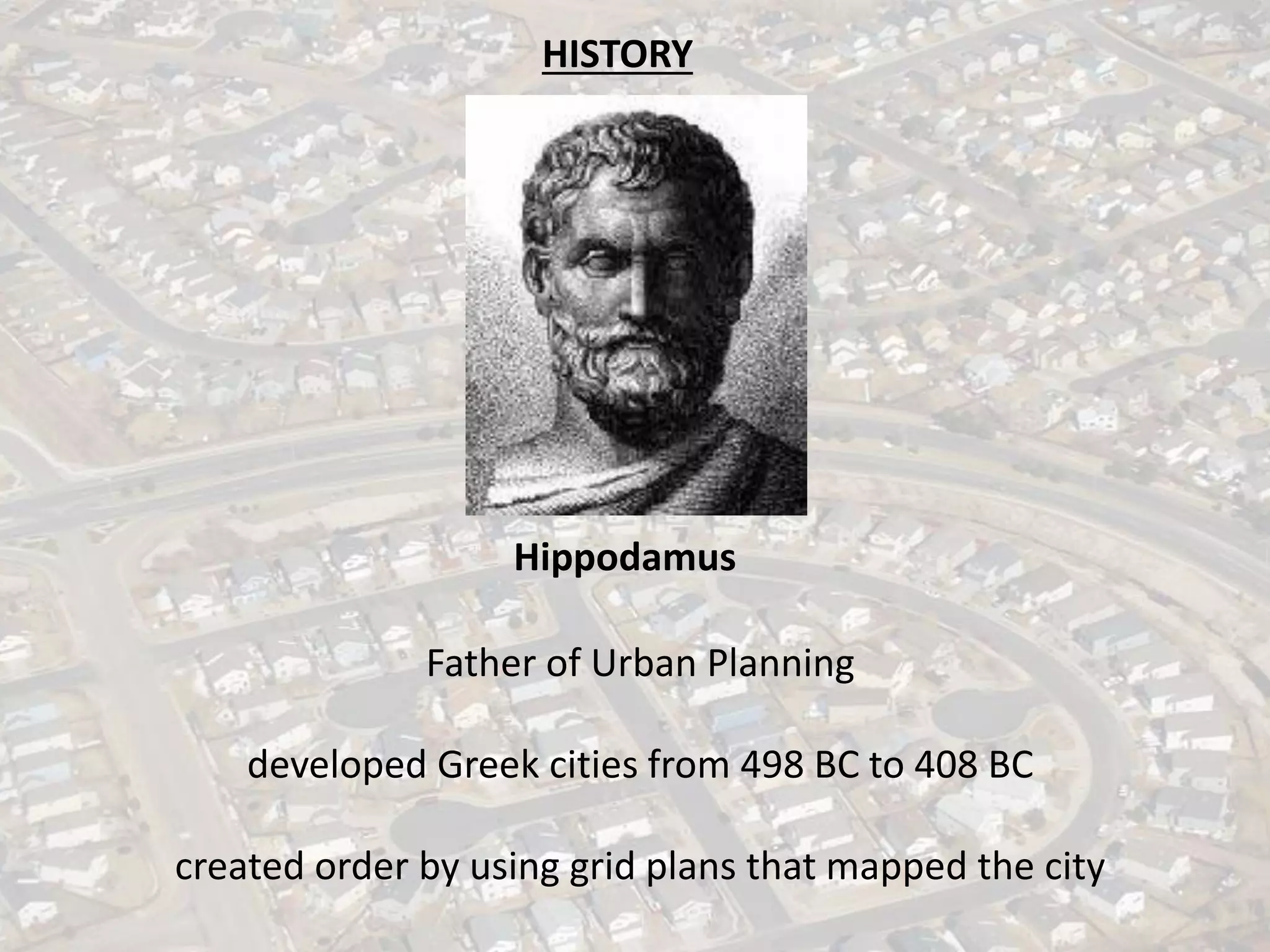
Hippodamus
Father of Urban Planning
developed Greek cities from 498 BC to 408 BC
created order by using grid plans that mapped the city
HISTORY
One of Hippodamus’ most famous urban planning was of the city
Miletos
HISTORY
These early city plans eventually gave way to the City
Beautiful movement in the late 1800s and early 1900s, inspired
by Daniel Hudson Burnham, a reformist for the Progressivism
movement who actively promoted "a reform of the landscape in
tandem with political change."
The effort was in partnership with others who believed
that beautifying cities would improve the moral compass of the
cities and encourage the upper class to spend their money in
cities.
This beautification process included parks and
architectural design.
MODERN BUILT ENVIRONMENT
Modern built environments have emerged out of
the interdisciplinary field that addresses the design,
construction, management and use of these man-made
surroundings as an interrelated whole as well as their
relationship to human activities over time (rather than a
particular element in isolation or at a single moment in time).
MODERN BUILT ENVIRONMENT
This field of study is generally not regarded as a
traditional profession or academic discipline in its own right,
instead drawing upon areas such as
✓ Economics
✓ Law
✓ Public policy
✓ Public health
✓ Management
✓ Geography
✓ Design
✓ Echnology
✓ Environmental sustainability
PUBLIC HEALTH
In public health, built environment refers to physical
environments that are designed with health and wellness as
integral parts of the communities.
Research has indicated that the way neighbourhoods are
created can affect both the physical activity and mental health of
the communities’ residents.
Studies have shown that built environments that were
expressly designed to improve physical activity are linked to higher
rates of physical activity, which in turn, positively affects health.
Public Health: WALKABILITY
Neighbourhoods with more walkability had:
✓ lower rates of obesity
✓ increased physical activity
✓ lower rates of depression
✓ higher social capital
✓ less alcohol and drug abuse
Walkability features in the neighbourhood include:
✓ safe sidewalks
✓ walkable destinations to walk to
Bikeabilty also leads to public health and may be achieved by
providing separate lanes for bikes (bicycles).
Public Health: BIKEABILITY
Bikeability refers to
the access that an area has
granted to safe biking
through multiple bike paths
and bike lanes.
Both walkability and
bikeability have been cited
as determinants of physical
activity.
Bikeability leads to:
✓ lower BMI
✓ lower overweight risk
✓ higher physical activity
Public Health: HEALTHY FOOD
Public health also
addresses healthy food access
such as proximity to grocery
stores and community gardens.
A higher density of
convenience stores has been
associated with obesity in
children.
Whereas, neighbourhoods with
community gardens have
shown:
✓ lower overweight status
✓ increase in vegetable intake
✓ positive social impact
✓ lower stress levels
✓ lower hypertension
✓ improved sense of welness
LANDSCAPE ARCHITECTURE
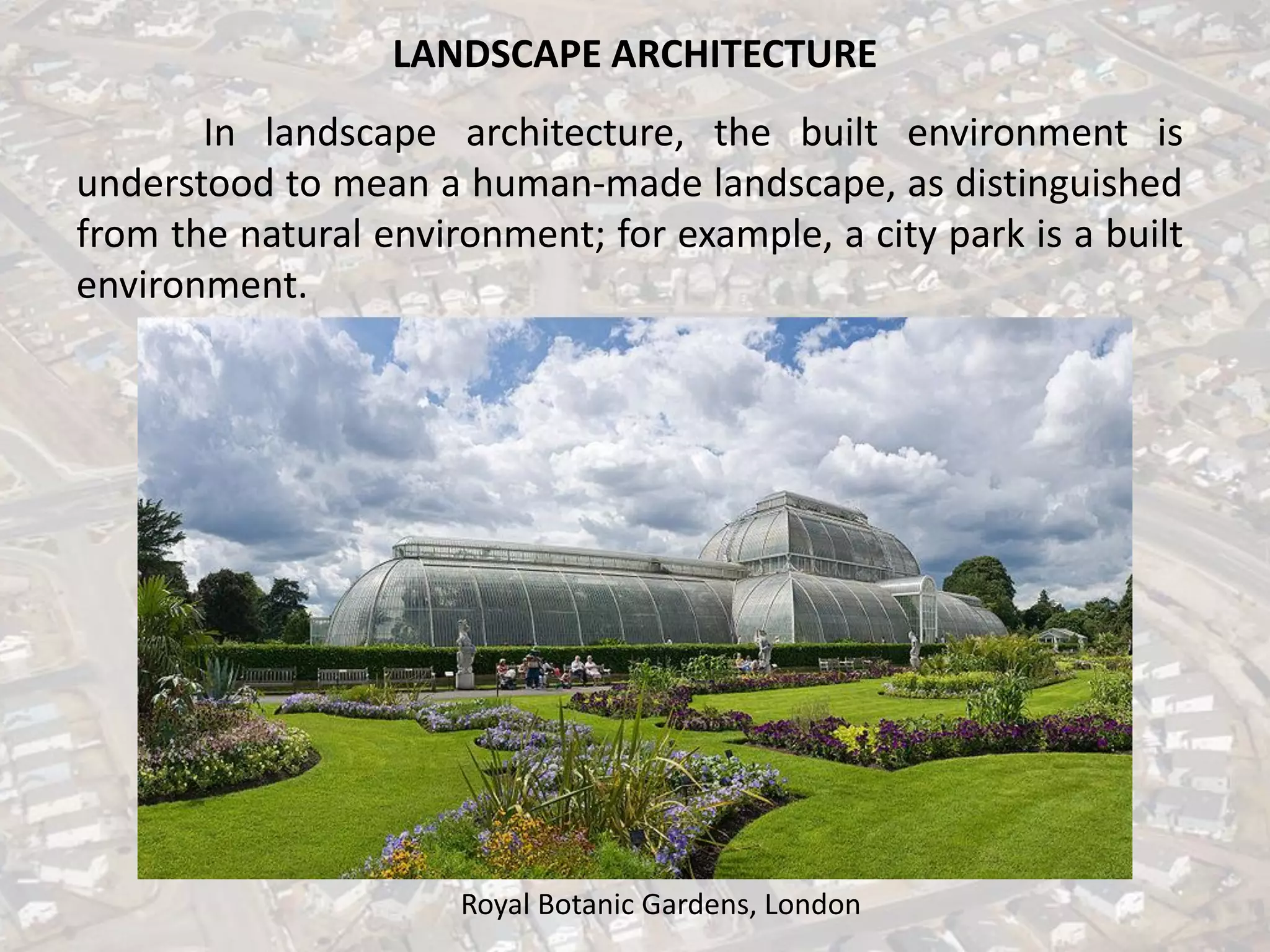
In landscape architecture, the built environment is
understood to mean a human-made landscape, as distinguished
from the natural environment; for example, a city park is a built
environment.
Royal Botanic Gardens, London
CHALLANGES IN BUILT ENVIRONMENT
• Environmental: to create environmental sustainabililty without
depleting natural resources but creating suitable base with
amenities for psycological shelter
•Architectural: Energy saving, user-friendly, efficiency improving,
creating occupational comfort, functional utility, aesthetics,
environmental filter, planned picturesque creation with colourful
nature, life with charm to refresh all
• Engineering: to provide safe and hygienic shelter while protecting
and healing the green of the Earth by creation of physical,
psychological and spiritual comfort for welfare of all with the
integrated approach of Environment-Building-Man relationship
• Desires of a Common Man: “Whatever is best in the world, that
should get place in my city.
REQUIREMENTS OF A BUILT ENVIRONMENT
✓ Integrated Approach – need of the future
✓ Development of control rules and general building
requirements
✓ Safety of inhabitants (from fire etc.)
✓ Safe structural design
✓ Safe construction practices
✓ Proper lighting and ventilation
✓ Adequate water supply
✓ Proper drainage
✓ Proper waste disposal
✓ Proper electrical and allied installations
✓ Gas supply
✓ Air conditioning, heating and mechanical ventilation
✓ Acoustics, sound insulation and noise control
✓ Landscaping
COMPETENT DESIGN TEAM
Architect - 35%
Quantity Surveyor – 23 %
Structural Engineer – 18%
Service Engineer – 12 %
Environmental Consultant – 4%
Management Consultant – 4%
Landscape Architect – 2%
Interior Designer – 2%
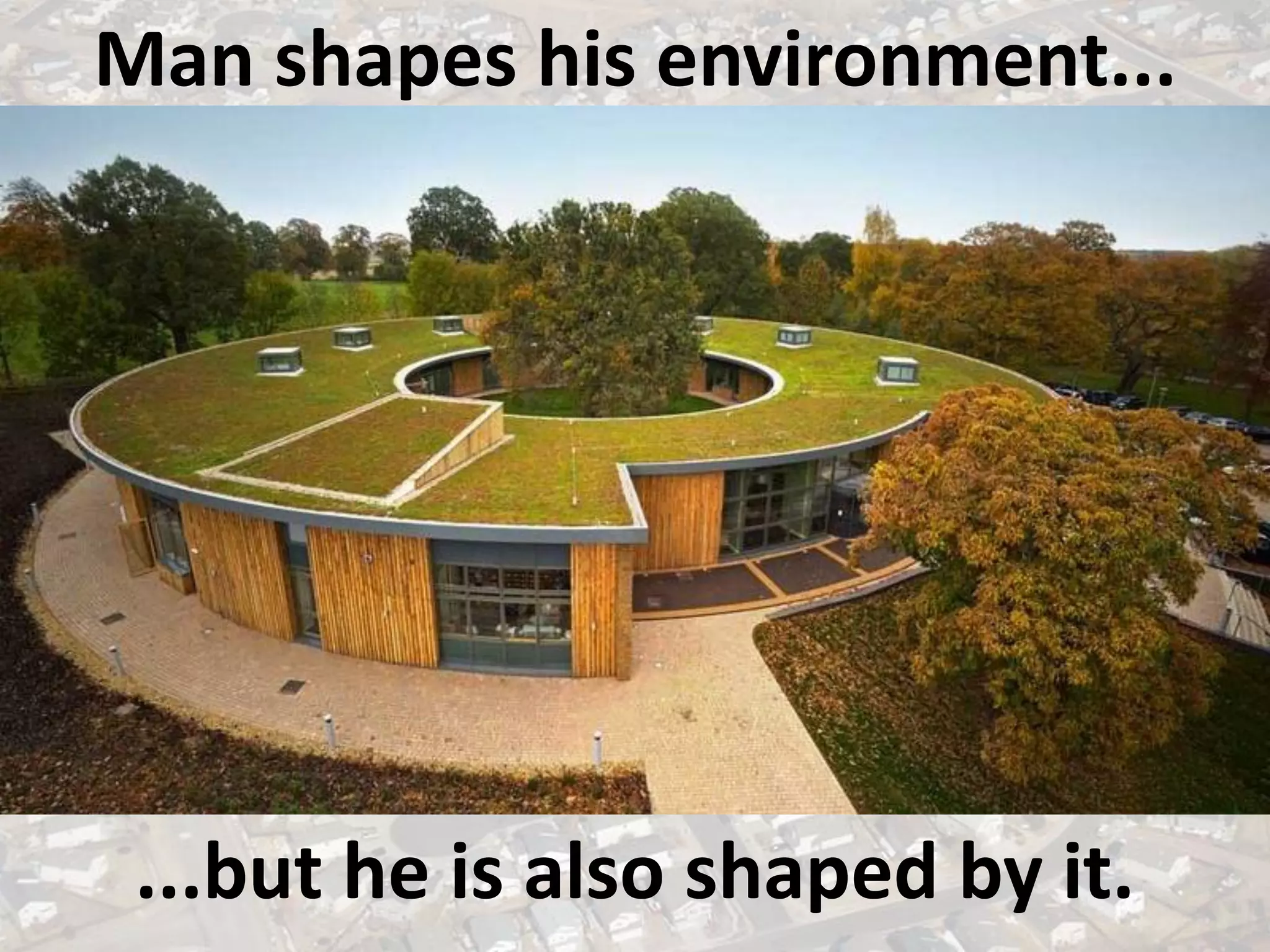
Man shapes his environment...
...but he is also shaped by it.

Built environment

  • 1.
  • 2.
    The term builtenvironment refers to the human-made surroundings that provide the setting for human activity, ranging in scale from buildings and parks or green space to neighbourhoods and cities that can often include their supporting infrastructure, such as water supply or energy networks. The built environment is a material, spatial and cultural product of human labour that combines physical elements and energy in forms for living, working and recreating. The "built environment encompasses places and spaces created or modified by people including buildings, parks, and transportation systems. In recent years, public health research has expanded the definition of "built environment" to include healthy food access, community gardens, "walkability" and "bikability”.
  • 3.
    HISTORY Hippodamus Father of UrbanPlanning developed Greek cities from 498 BC to 408 BC created order by using grid plans that mapped the city
  • 4.
    HISTORY One of Hippodamus’most famous urban planning was of the city Miletos
  • 5.
    HISTORY These early cityplans eventually gave way to the City Beautiful movement in the late 1800s and early 1900s, inspired by Daniel Hudson Burnham, a reformist for the Progressivism movement who actively promoted "a reform of the landscape in tandem with political change." The effort was in partnership with others who believed that beautifying cities would improve the moral compass of the cities and encourage the upper class to spend their money in cities. This beautification process included parks and architectural design.
  • 6.
    MODERN BUILT ENVIRONMENT Modernbuilt environments have emerged out of the interdisciplinary field that addresses the design, construction, management and use of these man-made surroundings as an interrelated whole as well as their relationship to human activities over time (rather than a particular element in isolation or at a single moment in time).
  • 7.
    MODERN BUILT ENVIRONMENT Thisfield of study is generally not regarded as a traditional profession or academic discipline in its own right, instead drawing upon areas such as ✓ Economics ✓ Law ✓ Public policy ✓ Public health ✓ Management ✓ Geography ✓ Design ✓ Echnology ✓ Environmental sustainability
  • 8.
    PUBLIC HEALTH In publichealth, built environment refers to physical environments that are designed with health and wellness as integral parts of the communities. Research has indicated that the way neighbourhoods are created can affect both the physical activity and mental health of the communities’ residents. Studies have shown that built environments that were expressly designed to improve physical activity are linked to higher rates of physical activity, which in turn, positively affects health.
  • 9.
    Public Health: WALKABILITY Neighbourhoodswith more walkability had: ✓ lower rates of obesity ✓ increased physical activity ✓ lower rates of depression ✓ higher social capital ✓ less alcohol and drug abuse Walkability features in the neighbourhood include: ✓ safe sidewalks ✓ walkable destinations to walk to Bikeabilty also leads to public health and may be achieved by providing separate lanes for bikes (bicycles).
  • 10.
    Public Health: BIKEABILITY Bikeabilityrefers to the access that an area has granted to safe biking through multiple bike paths and bike lanes. Both walkability and bikeability have been cited as determinants of physical activity. Bikeability leads to: ✓ lower BMI ✓ lower overweight risk ✓ higher physical activity
  • 11.
    Public Health: HEALTHYFOOD Public health also addresses healthy food access such as proximity to grocery stores and community gardens. A higher density of convenience stores has been associated with obesity in children. Whereas, neighbourhoods with community gardens have shown: ✓ lower overweight status ✓ increase in vegetable intake ✓ positive social impact ✓ lower stress levels ✓ lower hypertension ✓ improved sense of welness
  • 12.
    LANDSCAPE ARCHITECTURE In landscapearchitecture, the built environment is understood to mean a human-made landscape, as distinguished from the natural environment; for example, a city park is a built environment. Royal Botanic Gardens, London
  • 13.
    CHALLANGES IN BUILTENVIRONMENT • Environmental: to create environmental sustainabililty without depleting natural resources but creating suitable base with amenities for psycological shelter •Architectural: Energy saving, user-friendly, efficiency improving, creating occupational comfort, functional utility, aesthetics, environmental filter, planned picturesque creation with colourful nature, life with charm to refresh all • Engineering: to provide safe and hygienic shelter while protecting and healing the green of the Earth by creation of physical, psychological and spiritual comfort for welfare of all with the integrated approach of Environment-Building-Man relationship • Desires of a Common Man: “Whatever is best in the world, that should get place in my city.
  • 14.
    REQUIREMENTS OF ABUILT ENVIRONMENT ✓ Integrated Approach – need of the future ✓ Development of control rules and general building requirements ✓ Safety of inhabitants (from fire etc.) ✓ Safe structural design ✓ Safe construction practices ✓ Proper lighting and ventilation ✓ Adequate water supply ✓ Proper drainage ✓ Proper waste disposal ✓ Proper electrical and allied installations ✓ Gas supply ✓ Air conditioning, heating and mechanical ventilation ✓ Acoustics, sound insulation and noise control ✓ Landscaping
  • 15.
    COMPETENT DESIGN TEAM Architect- 35% Quantity Surveyor – 23 % Structural Engineer – 18% Service Engineer – 12 % Environmental Consultant – 4% Management Consultant – 4% Landscape Architect – 2% Interior Designer – 2%
  • 16.
    Man shapes hisenvironment... ...but he is also shaped by it.