Building Tools with GitHub Customize Your Workflow 1st Edition Chris Dawson
Building Tools with GitHub Customize Your Workflow 1st Edition Chris Dawson
Building Tools with GitHub Customize Your Workflow 1st Edition Chris Dawson
Building Tools with GitHub Customize Your Workflow 1st Edition Chris Dawson
Building Tools with GitHub Customize Your Workflow 1st Edition Chris Dawson
1.
Building Tools withGitHub Customize Your
Workflow 1st Edition Chris Dawson download
https://textbookfull.com/product/building-tools-with-github-
customize-your-workflow-1st-edition-chris-dawson/
Download more ebook from https://textbookfull.com
2.
We believe theseproducts will be a great fit for you. Click
the link to download now, or visit textbookfull.com
to discover even more!
The Linux DevOps Handbook: Customize and scale your
Linux distributions to accelerate your DevOps workflow
Wojs■aw
https://textbookfull.com/product/the-linux-devops-handbook-
customize-and-scale-your-linux-distributions-to-accelerate-your-
devops-workflow-wojslaw/
Working with Odoo 11 Configure Manage and Customize
Your Odoo System Greg Moss
https://textbookfull.com/product/working-with-odoo-11-configure-
manage-and-customize-your-odoo-system-greg-moss/
Customize your knitting Adjust to fit Embellish to
taste 1st Edition Margaret Hubert
https://textbookfull.com/product/customize-your-knitting-adjust-
to-fit-embellish-to-taste-1st-edition-margaret-hubert/
Artificial Neural Networks with Java - Tools for
Building Neural Network Applications 1st Edition Igor
Livshin
https://textbookfull.com/product/artificial-neural-networks-with-
java-tools-for-building-neural-network-applications-1st-edition-
igor-livshin/
3.
Exploring BeagleBone Toolsand Techniques for Building
with Embedded Linux 2nd Edition Derek Molloy
https://textbookfull.com/product/exploring-beaglebone-tools-and-
techniques-for-building-with-embedded-linux-2nd-edition-derek-
molloy/
Learn AI-Assisted Python Programming with GitHub
Copilot and ChatGPT 1st Edition Leo Porter
https://textbookfull.com/product/learn-ai-assisted-python-
programming-with-github-copilot-and-chatgpt-1st-edition-leo-
porter/
Geoprocessing with Python 1st Edition Chris Garrard
https://textbookfull.com/product/geoprocessing-with-python-1st-
edition-chris-garrard/
Bootstrapping Microservices: With Docker, Kubernetes,
GitHub Actions, and Terraform, 2nd Edition Ashley Davis
https://textbookfull.com/product/bootstrapping-microservices-
with-docker-kubernetes-github-actions-and-terraform-2nd-edition-
ashley-davis/
Hands-on GitHub Actions 1st Edition Chaminda
Chandrasekara
https://textbookfull.com/product/hands-on-github-actions-1st-
edition-chaminda-chandrasekara/
Table of Contents
Preface.. . . . . . . . . . . . . . . . . . . . . . . . . . . . . . . . . . . . . . . . . . . . . . . . . . . . . . . . . . . . . . . . . . . . . . ix
1. The Unclad GitHub API. . . . . . . . . . . . . . . . . . . . . . . . . . . . . . . . . . . . . . . . . . . . . . . . . . . . . . . 1
cURL 1
Breadcrumbs to Successive API Paths 2
The JavaScript Object Notation (JSON) Format 3
Parsing JSON from the Command Line 3
Debugging Switches for cURL 5
Important Headers 7
Following a Hypermedia API 7
Authentication 8
Username and Password Authentication 8
OAuth 9
Status Codes 11
Success (200 or 201) 12
Naughty JSON (400) 12
Improper JSON (422) 12
Successful Creation (201) 13
Nothing Has Changed (304) 14
GitHub API Rate Limits 14
Reading Your Rate Limits 15
Conditional Requests to Avoid Rate Limitations 15
Accessing Content from the Web 17
JSON-P 17
CORS Support 19
Specifying Response Content Format 20
Summary 21
iii
9.
2. Gists andthe Gist API. . . . . . . . . . . . . . . . . . . . . . . . . . . . . . . . . . . . . . . . . . . . . . . . . . . . . . . 23
Easy Code Sharing 23
Gists Are Repositories 24
Embedding Gists Inside HTML 25
Embedding Inside Jekyll Blogs 25
Gist from the Command Line 25
Gists as Fully Functioning Apps 26
Gists that Render Gists 28
Going Deeper into the Gist API 29
Using Hypermedia Data from Octokit 30
Summary 32
3. GitHub Wikis with Gollum. . . . . . . . . . . . . . . . . . . . . . . . . . . . . . . . . . . . . . . . . . . . . . . . . . . 33
“The Story of Smeagol…” 33
Repository Linked Wikis 34
Markup and Structure 35
Hacking Gollum 38
The Starting Point of a Gollum Editor 39
Programmatically Handling Images 40
Using the Rugged Library 42
Adding Images to a Review File 45
Optimizing for Image Storage 45
Reviewing on GitHub 48
Improving Revision Navigation 50
Fixing Linking Between Comp Pages 51
Summary 52
4. Python and the Search API. . . . . . . . . . . . . . . . . . . . . . . . . . . . . . . . . . . . . . . . . . . . . . . . . . . 53
Search API General Principles 53
Authentication 54
Result Format 54
Search Operators and Qualifiers 55
Sorting 56
Search APIs in Detail 57
Repository Search 57
Code Search 58
Issue Search 59
User Search 60
Our Example Application 61
User Flow 63
Python 64
AGitHub 65
iv | Table of Contents
10.
WxPython 65
PyInstaller 65
TheCode 66
Git Credential Helper 67
Windowing and Interface 68
GitHub Login 72
GitHub Search 75
Displaying Results 77
Packaging 79
Summary 79
5. .NET and the Commit Status API. . . . . . . . . . . . . . . . . . . . . . . . . . . . . . . . . . . . . . . . . . . . . . 81
The API 82
Raw Statuses 83
Combined Status 84
Creating a Status 85
Let’s Write an App 85
Libraries 86
Development Environment 86
Sending the Request 89
OAuth Flow 91
Status Handler 96
Summary 97
6. Ruby and Jekyll. . . . . . . . . . . . . . . . . . . . . . . . . . . . . . . . . . . . . . . . . . . . . . . . . . . . . . . . . . . . 99
Learning and Building with Jekyll 99
What Is Jekyll? 99
Operating Jekyll Locally 100
Jekyll Blog Quick Start 101
YFM: YAML Front Matter 104
Jekyll Markup 106
Using the Jekyll Command 106
Privacy Levels with Jekyll 107
Themes 107
Publishing on GitHub 107
Hosting On Your Own Domain 108
Importing from Other Blogs 110
From Wordpress 110
Exporting from Wordpress Alternatives 112
Scraping Sites into Jekyll 112
Jekyll Scraping Tactics 113
Setting Up 114
Table of Contents | v
11.
Scraping Titles 116
Refininingwith Interactive Ruby 117
Writing Tests and Caching 119
Writing Jekyll Posts 123
Using the Jekyll Command-Line Tool 126
Master Index File with Liquid Markup 128
Scraping Body and Author 130
Adding Images to Jekyll 131
Customizing Styling (CSS) 132
Inviting Contributions with GitHub “Fork” 134
Publishing Our Blog to GitHub 135
Summary 135
7. Android and the Git Data API. . . . . . . . . . . . . . . . . . . . . . . . . . . . . . . . . . . . . . . . . . . . . . . . 137
Setting Up 137
Creating a Jekyll Blog 137
Android Development Tools 138
Creating a New Project 139
Editing the Gradle Build File 141
Default Android Main 143
Android Automated Testing 147
Unit Tests for Our GitHub Client 147
Android UI Tests 151
Application Implementation 153
Code to Log In to GitHub 156
Code to Talk to GitHub 161
Writing the Blog Content 163
GitHub Services 164
The Base SHA from the Repository and Branch 165
Creating the Blob 166
Generating a Tree 166
Creating the Commit 167
Updating the Master Resource 169
Passing All Our Tests 169
Summary 171
8. CoffeeScript, Hubot, and the Activity API. . . . . . . . . . . . . . . . . . . . . . . . . . . . . . . . . . . . . . 173
The Activity API 173
Planning for PR Satisfaction Guaranteed 174
Considerations and Limitations 174
Creating a Vanilla Hubot 175
Creating a Slack Account 175
vi | Table of Contents
12.
Running Hubot Locally178
Installation on Heroku 180
Setting Up Heroku 180
Activity API Overview 181
Writing a Hubot Extension 182
Code Reviews via Pull Requests 183
Using the OAuth Token to Register for Events 189
Triggering Real Pull Requests 191
Handling PR Notifications as Post Requests over HTTP 194
Summary 217
9. JavaScript and the Git Data API. . . . . . . . . . . . . . . . . . . . . . . . . . . . . . . . . . . . . . . . . . . . . . 219
Building a Coffee Shop Database on GitHub 220
Set Up 220
Mapping Hostnames 221
Adding the Support Libraries 221
An AngularJS Application Using GitHub.js 222
Visualize Application Data Structure 225
Making Our App Testable 226
Test Data 231
CoffeeTech.js 231
Geocoding Support 233
City Data 236
Adding Login 236
Errors Already? 237
Displaying (Soon-to-Be) User-Reported Data 238
User-Contributed Data 240
Accepting Pull Requests 248
Toward a Safe Login Implementation 250
Authentication Requires a Server 250
Fixing Authentication with Firebase 251
Testing Firebase 253
Implementing Firebase Login 255
Summary 257
A. GitHub Enterprise. . . . . . . . . . . . . . . . . . . . . . . . . . . . . . . . . . . . . . . . . . . . . . . . . . . . . . . . . . 259
B. Ruby, NodeJS, (and the Shell) at GitHub. . . . . . . . . . . . . . . . . . . . . . . . . . . . . . . . . . . . . . . 265
Index. . . . . . . . . . . . . . . . . . . . . . . . . . . . . . . . . . . . . . . . . . . . . . . . . . . . . . . . . . . . . . . . . . . . . . . 271
Table of Contents | vii
14.
Preface
This book containsstories about building software tools.
If you write software on a daily basis, you realize the act of writing software is the
craft of creating tools. Software is nothing more than a tool. A spreadsheet is funda‐
mentally a tool to add and subtract numbers. A video game is fundamentally a tool to
alleviate boredom. Almost immediately after people started writing software tools we
then discovered we needed more tools to permit us to write the tools we set out to
build in the first place. Let’s call these tools that are strictly to support writing soft‐
ware (rather than software tools for the general population) meta-tools.
One of the most important meta-tools in the software development world is Git. Git
is a meta-tool that helps software developers manage the complexity that comes from
writing software. Git allows software developers to store snapshots of their programs
(and then easily restore those snapshots if necessary) and to easily collaborate with
other programmers (a surprisingly complicated problem). Git is called a source code
management (SCM) tool and though there were many other SCMs before Git, Git
has taken the software world by storm like no other before it and now dominates the
SCM landscape.
GitHub is a company that saw the immense potential of Git early on and built a layer
of web services on top of the existing features found in Git. Not surprisingly, one of
the factors behind its success was that GitHub employees embraced the ethos of writ‐
ing meta-tools from the beginning. Building meta-tools requires the courage to take a
little extra time to build a meta-tool rather than taking the easy route to get the
public-facing software out the door. GitHub employees are proud of this prioritiza‐
tion and have written extensively about the benefits, which include easy on-boarding
of new hires and a transparent workflow visible to all employees.
This book looks at the tools GitHub uses internally. The GitHub.com website is itself
a meta-tool, and we discuss the many facets of the GitHub service. Specifically these
technologies are the GitHub API and related GitHub technologies, Gollum wiki,
ix
15.
Jekyll static pagegenerator, and the chat robot called Hubot (if you are not familiar
with any of these, we’ll explain them fully in their respective chapters).
To reiterate, this book is not a reference of those technologies. This book is a story-
book, a book that relates the process of building software meta-tools, explaining not
only the technology specifics, but also the compromises, the realities of refactoring,
and the challenges inherent to writing meta-tools in long narrative story form.
Meta-tools require a different mindset than what comes from building software avail‐
able to the general population. Meta-tools are generally open source, which requires a
different level of responsibility and usage. One could argue that software engineers
are more demanding of quality than general users because software developers know
they can take action to improve or fork software that does not work for them. Meta-
tools enforce a higher level of contributory involvement, which makes automated
tests almost a requirement. All of these concepts constitute the background story
behind meta-tools, and we show you how they play out when building your own.
Why APIs and Why the GitHub API?
Using an API to back an application is a common practice today: this is the future of
application development. APIs provide a great pattern for making data accessible to
the multiscreen world. If your application is backed by a remote service API, the first
application could be a mobile app running on Apple’s iOS operating system. Criti‐
cally, if that business model does not turn out to be correct, you can respond quickly
to changing requirements and iterate to build another application for an Android
wearable. Or, perhaps you’ll build an integrated car application, or any other console
(or even nonconsole) application. As long as your applications can send and receive
data using calls to a remote API you are free to build whatever user interface you
want on whatever platform you want.
As an author, you could write and host your own API. Many frameworks for popular
languages like Ruby, Go, or Java support building APIs using standard architectural
styles like REST. Or, you could use a third-party API. In this book we’ll focus on a
third-party API: the GitHub API.
Why the GitHub API? The GitHub API is exceedingly relevant if you are building
software because you are probably using GitHub to manage your software code. For
those that aren’t, you might be using Git without GitHub, and the GitHub API is use‐
ful to know there as well, as it layers the functionality of Git into a networked pro‐
gramming interface.
The GitHub API is perhaps the best designed API I’ve ever used. It is a Hypermedia
API, which is an arguably successful attempt to make API clients resilient to API
changes—a tricky problem. The API is well versioned. It is comprehensive, mapping
closely to most features of Git. It is consistent across sections and well organized. The
x | Preface
16.
GitHub API isa great API on which to build applications, serving as a case study for a
well-designed API.
Structure of This Book
The GitHub API is extremely comprehensive, permitting access and modification of
almost all data and metadata stored or associated with a Git repository. Here is a
grouped summary of the sections of the API ordered alphabetically as they are on the
GitHub API documentation site:
• Activity: notifications of interesting events in your developer life
• Gists: programmatically create and share code snippets
• Git Data: raw access to Git data over a remote API
• Issues: add and modify issues
• Miscellaneous: whatever does not fit into the general API categorization
• Organizations: access and retrieve organizational membership data
• Pull Requests: a powerful API layer on the popular merge process
• Repositories: modify everything and anything related to repositories
• Search: code-driven search within the entire GitHub database
• Users: access user data
• Enterprise: specifics about using the API when using the private corporate Git‐
Hub
In addition, though not a part of the API, there are other important technologies you
should know about when using GitHub that are not covered in the API documenta‐
tion:
• Jekyll and “gh-pages”: hosting blogs and static documentation
• Gollum: wikis tied to a repository
• Hubot: a programmable chat robot used extensively at GitHub
Each of these sections of the GitHub technology stack are covered in various chapters
(with two exceptions, which we explain next). The GitHub API documentation is a
stellar reference you will use constantly when writing any application that talks to the
API, but the chapters in this book serve a different purpose: these chapters are stories
about building applications on top of the technologies provided by GitHub. Within
these stories you will learn the trade-offs and considerations you will face when you
use the GitHub API. Chapters in this book often cover multiple pieces of the API
when appropriate for the story we are telling. We’ve generally tried to focus on a
Preface | xi
17.
major API sectionand limit exposure to other pieces as much as possible, but most
chapters do need to bring in small pieces of more than one section.
Here is a short synopsis of each chapter:
Chapter 1
This chapter covers a first look at the API through the command-line HTTP cli‐
ent called cURL. We talk a bit about the response format and how to parse it
within the command line, and also document authentication. This is the only
chapter that does not build an application from the technologies presented.
Chapter 2: This chapter covers the Gist API, as well as command-line tools and
the Ruby language “Octokit” API client. We then take this API and build a simple
Ruby server that is stored as a gist and displays gists.
Chapter 3
This chapter explains usage of the Gollum command-line tool and associated
Ruby library (gem), which is backed by Grit, the C-language bindings for access‐
ing Git repositories. We also document some details of the Git storage format
and how it applies to storing large files inside of a Git repository, and show how
to use the Git command-line tools to play with this information. We use Gollum
and the Grit libraries to build an image management tool that also functions as a
regular Gollum wiki, which can be published to GitHub.
Chapter 4
In this chapter we explore the Search API and build a GUI tool to search reposi‐
tories on GitHub using Python.
Chapter 5
This chapter covers a relatively new part of the API that documents the interac‐
tions between third-party tools and your code. This chapter builds an application
using C# and the Nancy .NET GitHub API libraries.
Chapter 6
If you push a specifically organized repository into GitHub, GitHub will host a
fully featured blog, equivalent in most ways to a Wordpress site (well, except for
the complexity part). This chapter documents how to format your repository,
how to use Markdown within Jekyll, how to use programmatic looping con‐
structs provided by Liquid Templates, and then shows how to import an entire
website from the Internet Archive into the Jekyll format using Ruby. We show
how to respectfully spider a site using caching, a valuable technique when using
APIs or third-party public information.
Chapter 7
In this chapter we create a mobile application targeting the Android OS. Our
application reads and writes information into a Jekyll repository from the Git
xii | Preface
18.
Data section ofthe API. We show how to create user interface tests for Android
that verify GitHub API responses using the Calabash UI testing tool.
Chapter 8
Hubot is a JavaScript (NodeJS) chat robot enabling technologists to go beyond
developer operations (“DevOps”) to a new frontier called “ChatOps.” This chap‐
ter illustrates using the Activity and Pull Requests section of the API. In addition,
we show how you can simulate GitHub notifications and how to write testable
Hubot extensions (which is often a challenge when writing JavaScript code). We
string all these pieces together and build a robot that automates assigning pull
request review requests.
Chapter 9
Did you know you can host an entire “single-page application” on GitHub? We
show how you can build a coffee shop information app backed by a flat file data‐
base hosted on GitHub written in the JavaScript language. Importantly, we show
how you can write a testable JavaScript application that mocks out the GitHub
API when needed.
We don’t cover the Organizations API: this is a small facet of the API with only the
ability to list organizations and modify metadata about your organization; once you
have used other parts of the API this nook of the API will be very intuitive.
We also don’t cover the Users section of the API. While you might expect it to be an
important part of the API, the Users API is really nothing more than an endpoint to
list information about users, add or remove SSH keys, adjust email addresses, and
modify your list of followers.
There is not a specific chapter on issues. GitHub originally grouped issues and pull
requests into the same API section, but with the growing importance of pull requests
GitHub has separated them in the API documentation. In fact, they are still internally
stored in the same database and pull requests are, at least for now, just another type of
issue. Chapter 8 documents using pull requests and is a good reference for issues in
that way.
The Enterprise API works almost exactly the same as the GitHub.com site API. We
don’t have a chapter telling a story about an Enterprise version of the API, but we do
provide an appendix that contains a few notes about how the examples work when
using an Enterprise server. We also provide the specific syntax for each of the lan‐
guages used in the chapters that will make any of the examples provided work with an
Enterprise server.
Through these stories about the technologies behind GitHub we hope to give you an
inside look at the inner workings of the brain of a developer building on top of the
GitHub API.
Preface | xiii
19.
Who You Are
Thisbook should be an interesting source of information for people who have used
Git or GitHub and want to “level-up” their skills related to these technologies. People
without any experience using GitHub or Git should start with an introductory book
on these technologies.
You should have good familiarity with at least one imperative modern programming
language. You don’t need to be an expert programmer to read this book, but having
some programming experience and familiarity with at least one language is essential.
You should understand the basics of the HTTP protocol. The GitHub team uses a
very standard RESTful approach for its API. You should understand the difference
between a GET request and POST request and what HTTP status codes mean at the
very least.
Familiarity with other web APIs will make traversing these chapters easier, although
this book simultaneously aspires to provide a guide showing how a well-thought-out,
well-designed, and well-tested web API creates a foundation for building fun and
powerful tools. If you have not used web APIs extensively, but have experience using
other types of APIs, you will be in good company.
What You Will Learn
Much of the book focuses on the technical capabilities exposed by GitHub and the
powerful GitHub API. Perhaps you feel constrained by using Git only from within a
certain toolset; for example, if you are an Android developer using Git to manage
your app source code and want to unlock Git in other places in your life as a devel‐
oper, this book provides a wider vista to learn about the power of Git and GitHub. If
you have fallen into using Git for your own projects and are now interested in using
Git within a larger community, this book can teach you all about the “social coding”
style pioneered and dogfooded by the GitHub team. This book provides a stepping
stone for software developers who have used other distributed version control sys‐
tems and are looking for a bridge to using their skills with Git and within a web ser‐
vice like GitHub.
Like any seasoned developer, automation of your tools is important to you. This book
provides examples of mundane tasks converted into automated and repeatable pro‐
cesses. We show how to do this using a variety of languages talking to the GitHub
API.
To make this book accessible to everyone, regardless of their editor or operating sys‐
tem, many of the programming samples work within the command line. If you are
unfamiliar with the “command line” this book will give you a firm understanding of
how to use it, and we bet you will find great power there. If you have hated the com‐
xiv | Preface
20.
mand line sinceyour father forced you to use it when you were five, this is the perfect
book to rekindle a loving relationship with the bash shell.
If you absorb not only the technical facets of using GitHub but also pay attention to
the cultural and ideological changes offered behind the tools, you’ll very likely see a
new way of working in the modern age. We focus on these “meta” viewpoints as we
discuss the tools themselves to help you see these extra opportunities.
Almost every chapter has an associated repository hosted on GitHub where you can
review the code discussed. Fork away and take these samples into your own projects
and tools!
Finally, we help you write testable API-backed code. Even the most experienced
developers often find that writing tests for their code is a challenge, despite the mas‐
sive body of literature connecting quality code with tests. Testing can be especially
challenging when you are testing something backed by an API; it requires a different
level of thinking than is found in strict unit testing. To help you get past this road‐
block, whenever possible, this book shows you how to write code that interacts with
the GitHub API and is testable.
GitHub “First Class” Languages
There are two languages that are so fundamentally linked to GitHub that you do need
to install and use them in order to get the most out of this book.
Ruby
A simple, readable programming language the founders of GitHub used exten‐
sively early in the life of the company.
JavaScript
The only ubiquitous browser-side programming language; its importance has
grown to new heights with the introduction of NodeJS, rivaling even the popular‐
ity of Ruby on Rails as a server-side toolkit for web applications, especially for
independent developers.
Undoubtedly, many of you picking up this book already have familiarity with Ruby or
JavaScript/NodeJS. So, the basics and installation of them are in appendices in the
back of the book. The appendices don’t cover syntax of these languages; we expect
you have experience with other languages as a prerequisite and can read code from
any imperative language regardless of the syntax. Later chapters discuss facets of the
API and go into language details at times, but the code is readable regardless of your
familiarity with that particular language. These explanatory appendices discuss the
history of these tools within the GitHub story as well as important usage notes like
special files and installation options.
Preface | xv
21.
Your time willnot be wasted if you install and play with these two tools. Between
them you will have a solid toolset to begin exploration of the GitHub API. Several
chapters in this book use Ruby or JavaScript, so putting in some time to learn at least
a little bit will make the journey through this book richer for you.
Operating System Prerequisites
We, the authors, wrote this book using MacBook Pros. MacBooks have a ubiquitous
shell (“BASH”) that works almost identically to the one found on any Linux machine.
If you use either of these two operating systems, you will be able to run the code from
any chapter.
If you use a Windows machine (or an OS that does not include the BASH shell) then
some of the commands and code examples may not work without installing addi‐
tional software.
An easy remedy is to use VirtualBox and Vagrant. VirtualBox is a freely available vir‐
tualization system for x86 hardware. Vagrant is a tool for managing development
environments: using VirtualBox and Vagrant you can quickly install a Linux virtual
machine. To do this, visit the downloads page for VirtualBox and Vagrant. Once you
have installed these two tools, you can then install an Ubuntu Linux virtual machine
with these two commands:
$ vagrant init hashicorp/precise32
$ vagrant up
Who This Book Is Not For
If you are looking for a discussion of the GitHub API that focuses on a single lan‐
guage, you should know that we look at the API through many different languages.
We do this to describe the API from not only the way the GitHub team designed it to
work, but the aspirational way that client library authors made it work within diverse
programming languages and communities. We think there is a lot to learn from this
approach, but if you are interested in only a specific language and how it works with
the GitHub API, this is not the book for you.
This book strives to prove that API-driven code is testable and that there is a benefit
to doing so. This book does not intend to provide a manual on how to write perfectly
tested code. We cover too many languages to end the healthy debates happening
within each community about the right test frameworks. Instead, given our conten‐
tion that most software projects have zero test coverage, this book tries to help you
get past this significant roadblock. There is something transformational about writing
tests if you have never done so before. Having these examples in hand, we hope, will
allow you to transition to writing testable code for APIs, especially if you have not
done so before. Some of the associated repositories have much greater test suites than
xvi | Preface
22.
are documented inthis book, but we don’t cover all the entire set of edge cases in
every situation.
Conventions Used in This Book
The following typographical conventions are used in this book:
Italic
Indicates new terms, URLs, email addresses, filenames, and file extensions.
Constant width
Used for program listings, as well as within paragraphs to refer to program ele‐
ments such as variable or function names, databases, data types, environment
variables, statements, and keywords.
Constant width italic
Shows text that should be replaced with user-supplied values or by values deter‐
mined by context.
This icon signifies a general note.
This icon indicates a warning or caution.
Using Code Examples
Supplemental material (code examples, exercises, etc.) is available for download at
https://github.com/xrd/building-tools-with-github.
This book is here to help you get your job done. In general, if example code is offered
with this book, you may use it in your programs and documentation. You do not
need to contact us for permission unless you’re reproducing a significant portion of
the code. For example, writing a program that uses several chunks of code from this
book does not require permission. Selling or distributing a CD-ROM of examples
from O’Reilly books does require permission. Answering a question by citing this
book and quoting example code does not require permission. Incorporating a signifi‐
cant amount of example code from this book into your product’s documentation does
require permission.
Preface | xvii
23.
We appreciate, butdo not require, attribution. An attribution usually includes the
title, author, publisher, and ISBN. For example: “Building Tools with GitHub by Chris
Dawson and Ben Straub (O’Reilly). Copyright 2016 Chris Dawson and Ben Straub,
978-1-491-93350-3.”
If you feel your use of code examples falls outside fair use or the permission given
above, feel free to contact us at permissions@oreilly.com.
O’Reilly Safari
Safari (formerly Safari Books Online) is a membership-based
training and reference platform for enterprise, government,
educators, and individuals.
Members have access to thousands of books, training videos, Learning Paths, interac‐
tive tutorials, and curated playlists from over 250 publishers, including O’Reilly
Media, Harvard Business Review, Prentice Hall Professional, Addison-Wesley Profes‐
sional, Microsoft Press, Sams, Que, Peachpit Press, Adobe, Focal Press, Cisco Press,
John Wiley & Sons, Syngress, Morgan Kaufmann, IBM Redbooks, Packt, Adobe
Press, FT Press, Apress, Manning, New Riders, McGraw-Hill, Jones & Bartlett, and
Course Technology, among others.
For more information, please visit http://oreilly.com/safari.
How to Contact Us
Please address comments and questions concerning this book to the publisher:
O’Reilly Media, Inc.
1005 Gravenstein Highway North
Sebastopol, CA 95472
800-998-9938 (in the United States or Canada)
707-829-0515 (international or local)
707-829-0104 (fax)
We have a web page for this book, where we list errata, examples, and any additional
information. You can access this page at http://bit.ly/building-tools-with-github.
To comment or ask technical questions about this book, send email to bookques‐
tions@oreilly.com.
For more information about our books, courses, conferences, and news, see our web‐
site at http://www.oreilly.com.
Find us on Facebook: http://facebook.com/oreilly
xviii | Preface
24.
Follow us onTwitter: http://twitter.com/oreillymedia
Watch us on YouTube: http://www.youtube.com/oreillymedia
Acknowledgments
Chris wants to thank his lovely wife, Nicole. I hope that I have added to this book
even a tiny bit of the wit and wisdom you provide to me and our family every day. My
son Roosevelt’s energy continues to inspire me and keep me going even when I am at
my limits. To my daughter Charlotte, you are my little smiling Buddha. To my
mother, who showed me how to write and, most importantly, why to write, which is
something we need more of in the technology world. To Tim O’Brien who invited me
into this project, thank you, and I hope we can collaborate again. To Bradley Horo‐
witz, who demonstrates how small acts of kindness can have immeasurable impact.
And, to David J. Groom, though we have never met face to face, your suggestions and
excitement about the book early on came at a critical moment in the life of this book,
and I thank you for channeling the excitement I hoped to cultivate with people who
would one day pick up this book.
Ben would like to thank his wife, Becky, for her ongoing support and (when needed)
push from behind. None of this would have happened without you.
Preface | xix
26.
CHAPTER 1
The UncladGitHub API
This chapter eases us into reading and writing data from the GitHub API. Successive
chapters show you how to access information from the GitHub API using a variety of
client libraries. These client libraries, by design, hide the nuts and bolts of the API
from you, providing streamlined and idiomatic methods to view and modify data
inside a Git repository hosted on GitHub. This chapter, however, gives you a naked
viewpoint of the GitHub API and documents the details of the raw HTTP requests
and responses. It also discusses the different ways to access public and private data
inside of GitHub and where limitations exist. And it gives you an overview of the
options for accessing GitHub data when running inside a web browser context where
network access is restrained.
cURL
There will be times when you want to quickly access information from the GitHub
API without writing a formal program. Or, when you want to quickly get access to
the raw HTTP request headers and content. Or, where you might even question the
implementation of a client library and need confirmation it is doing the right thing
from another vantage point. In these situations, cURL, a simple command-line HTTP
tool, is the perfect fit. cURL, like the best Unix tools, is a small program with a very
specific and purposefully limited set of features for accessing HTTP servers.
cURL, like the HTTP protocol it speaks intimately, is stateless: we will explore solu‐
tions to this limitation in a later chapter, but note that cURL works best with one-off
requests.
1
27.
Installing cURL
cURL isusually installed on most OS X machines, and can easily be
installed using Linux package managers (probably one of apt-get
install curl or yum install curl). If you are using Windows or
want to manually install it, go to http://curl.haxx.se/download.html.
Let’s make a request. We’ll start with the most basic GitHub API endpoint found at
https://api.github.com:
$ curl https://api.github.com
{
"current_user_url": "https://api.github.com/user",
"current_user_authorizations_html_url":
"https://github.com/settings/connections/applications{/client_id}",
"authorizations_url": "https://api.github.com/authorizations",
"code_search_url":
"https://api.github.com/search/code?q={query}{&page,per_page,sort,order}",
"emails_url": "https://api.github.com/user/emails",
"emojis_url": "https://api.github.com/emojis",
...
}
We’ve abbreviated the response to make it more readable. A few salient things to
notice: there are a lot of URLs pointing to secondary information, parameters are
included in the URLs, and the response format is JSON.
What can we learn from this API response?
Breadcrumbs to Successive API Paths
The GitHub API is a hypermedia API. Though a discussion on what constitutes
hypermedia deserves an entire book of its own (check out O’Reilly’s Building Hyper‐
media APIs with HTML5 and Node), you can absorb much of what makes hyperme‐
dia interesting by just looking at a response. First, you can see from the API response
that each response contains a map with directions for the next responses you might
make. Not all clients use this information, of course, but one goal behind hypermedia
APIs is that clients can dynamically adjust their endpoints without recoding the client
code. If the thought of GitHub changing an API because clients should be written to
handle new endpoints automatically sounds worrisome, don’t fret too much: GitHub
is very dilligent about maintaining and supporting its API in a way that most compa‐
nies would do well to emulate. But you should know that you can rely on having an
API reference inside the API itself, rather than hosted externally in documentation,
which very easily could turn out to be out of date with the API itself.
These API maps are rich with data. For example, they are not just URLs to content,
but also information about how to provide parameters to the URLs. Looking at the
2 | Chapter 1: The Unclad GitHub API
28.
previous example, thecode_search_url key references a URL that obviously allows
you to search within code on GitHub, but also tells you how to structure the parame‐
ters passed to this URL. If you have an intelligent client who can follow this program‐
matic format, you could dynamically generate the query without involving a
developer who can read API documentation. At least that is the dream hypermedia
points us to; if you are skeptical, at least know that APIs such as GitHub encode docu‐
mentation into themselves, and you can bet GitHub has test coverage to prove that
this documentation matches the information delivered by the API endpoints. That’s a
strong guarantee that is sadly missing from many other APIs.
Now let’s briefly discuss the format of all GitHub API responses: JSON.
The JavaScript Object Notation (JSON) Format
Every response you get back from the GitHub API will be in the JSON (JavaScript
Object Notation) format. JSON is a “lightweight data interchange format” (read more
on the JSON.org website). There are other competing and effective formats, such as
XML (Extensible Markup Language) or YAML (YAML Ain’t Markup Language), but
JSON is quickly becoming the de facto standard for web services.
A few of the reasons JSON is so popular:
• JSON is readable. JSON has a nice balance of human readability when compared
to serialization formats like XML.
• JSON can be used within JavaScript with very little modification (and cognitive
processing on the part of the programmer). A data format that works equally well
on both the client and server side was bound to be victorious, as JSON has been.
You might expect that a site like GitHub, originally built on the Ruby on Rails stack
(and some of that code is still live), would support specifying an alternative format
like XML, but XML is no longer supported. Long live JSON.
JSON is very straightforward if you have used any other text-based interchange for‐
mat. One note about JSON that is not always obvious or expected to people new to
JSON is that the format only supports using double quotes, not single quotes.
We are using a command-line tool, cURL, to retrieve data from the API. It would be
handy to have a simple command-line tool that also processes that JSON. Let’s talk
about one such tool next.
Parsing JSON from the Command Line
JSON is a text format, so you could use any command-line text processing tool, such
as the venerable AWK, to process JSON responses. There is one fantastic JSON-
specific parsing tool that complements cURL that is worth knowing: jq. If you pipe
The JavaScript Object Notation (JSON) Format | 3
29.
JSON content (usingthe | character for most shells) into jq, you can then easily
extract pieces of the JSON using filters.
Installing jq
jq can be installed from source, using package managers like brew
or apt-get, and there are binaries on the downloads page for OS X,
Linux, Windows, and Solaris.
Going deeper into the prior example, let’s pull out something interesting from the
API map that we receive when we access api.github.com:
$ curl https://api.github.com | jq '.current_user_url'
% Total % Received % Xferd Average Speed Time Time Time Current
Dload Upload Total Spent Left Speed
100 2004 100 2004 0 0 4496 0 --:--:-- --:--:-- --:--:-- 4493
"https://api.github.com/user"
What just happened? The jq tool parsed the JSON, and using the .current_user_url
filter, it retrieved content from the JSON response. If you look at the response again,
you’ll notice it has key/value pairs inside an associative array. It uses the
current_user_url as a key into that associative array and prints out the value there.
You also will notice that cURL printed out transfer time information. cURL printed
this information to standard error, which is a shell convention used for messaging
errors and an output stream that jq will correctly ignore (in other words, the JSON
format stream will not be corrupted by error messages). If we want to restrict that
information and clean up the request we should use the -s switch, which runs cURL
in “silent” mode.
It should be easy to understand how the jq filter is applied to the response JSON. For
a more complicated request (for example, we might want to obtain a list of public
repositories for a user), we can see the pattern for the jq pattern parameter emerging.
Let’s get a more complicated set of information, a user’s list of repositories, and see
how we can extract information from the response using jq:
$ curl -s https://api.github.com/users/xrd/repos
[
{
"id": 19551182,
"name": "a-gollum-test",
"full_name": "xrd/a-gollum-test",
"owner": {
"login": "xrd",
"id": 17064,
"avatar_url":
"https://avatars.githubusercontent.com/u/17064?v=3",
...
}
4 | Chapter 1: The Unclad GitHub API
30.
]
$ curl -shttps://api.github.com/users/xrd/repos | jq '.[0].owner.id'
17064
This response is different structurally: instead of an associative array, we now have an
array (multiple items). To get the first one, we specify a numeric index, and then key
into the successive associative arrays inside of it to reach the desired content: the
owner id.
jq is a great tool for checking the validity of JSON. As mentioned before, JSON key/
values are stored only with double quotes, not single quotes. You can verify that JSON
is valid and satisfies this requirement using jq:
$ echo '{ "a" : "b" }' | jq '.'
{
"a": "b"
}
$ echo "{ 'no' : 'bueno' }" | jq "."
parse error: Invalid numeric literal at line 1, column 7
The first JSON we pass into jq works, while the second, because it uses invalid single-
quote characters, fails with an error. jq filters are strings passed as arguments, and the
shell that provides the string to jq does not care if you use single quotes or double
quotes, as you can see in the preceding code. The echo command, if you didn’t
already know, prints out whatever string you provide to it; when we combine this
with the pipe character we can easily provide that string to jq through standard input.
jq is a powerful tool for quickly retrieving content from an arbitray JSON request. jq
has many other powerful features, documented at https://stedolan.github.io/jq/.
We now know how to retrieve some interesting information from the GitHub API
and parse out bits of information from that response, all in a single line. But there will
be times when you incorrectly specify parameters to cURL or the API, and the data is
not what you expect. Now we’ll learn about how to debug the cURL tool and the API
service itself to provide more context when things go wrong.
Debugging Switches for cURL
As mentioned, cURL is a great tool when you are verifying that a response is what
you expect it to be. The response body is important, but often you’ll want access to
the headers as well. cURL makes getting these easy with the -i and -v switches. The
-i switch prints out request headers, and the -v switch prints out both request and
response headers (the > character indicates request data, and the < character indicates
response data):
$ curl -i https://api.github.com
HTTP/1.1 200 OK
Server: GitHub.com
Date: Wed, 03 Jun 2015 19:39:03 GMT
The JavaScript Object Notation (JSON) Format | 5
31.
Content-Type: application/json; charset=utf-8
Content-Length:2004
Status: 200 OK
X-RateLimit-Limit: 60
...
{
"current_user_url": "https://api.github.com/user",
...
}
$ curl -v https://api.github.com
* Rebuilt URL to: https://api.github.com/
* Hostname was NOT found in DNS cache
* Trying 192.30.252.137...
* Connected to api.github.com (192.30.252.137) port 443 (#0)
* successfully set certificate verify locations:
* CAfile: none
CApath: /etc/ssl/certs
* SSLv3, TLS handshake, Client hello (1):
* SSLv3, TLS handshake, Server hello (2):
...
* CN=DigiCert SHA2 High Assurance Server CA
* SSL certificate verify ok.
> GET / HTTP/1.1
> User-Agent: curl/7.35.0
> Host: api.github.com
> Accept: */*
>
< HTTP/1.1 200 OK
* Server GitHub.com is not blacklisted
...
With the -v switch you get everything: DNS lookups, information on the SSL chain,
and the full request and response information.
Be aware that if you print out headers, a tool like jq will get con‐
fused because you are no longer providing it with pure JSON.
This section shows us that there is interesting information not only in the body (the
JSON data) but also in the headers. It is important to understand what headers are
here and which ones are important. The HTTP specification requires a lot of these
headers, and we can often ignore those, but there are a few that are vital when you
start making more than just a few isolated requests.
6 | Chapter 1: The Unclad GitHub API
32.
Important Headers
Three headersare present in every GitHub API response that tell you about the Git‐
Hub API rate limits. They are X-RateLimit-Limit, X-RateLimit-Remaining, and X-
RateLimit-Reset. These limits are explained in detail in “GitHub API Rate Limits” on
page 14.
The X-GitHub-Media-Type header contains information that will come in handy
when you are starting to retrieve text or blob content from the API. When you make
a request to the GitHub API you can specify the format you want to work with by
sending an Accept header with your request.
Now, let’s use a response to build another response.
Following a Hypermedia API
We’ll use the “map” of the API by hitting the base endpoint, and then use the
response to manually generate another request:
$ curl -i https://api.github.com/
HTTP/1.1 200 OK
Server: GitHub.com
Date: Sat, 25 Apr 2015 05:36:16 GMT
...
{
"current_user_url": "https://api.github.com/user",
...
"organization_url": "https://api.github.com/orgs/{org}",
...
}
We can use the organizational URL and substitute "github" in the placeholder:
$ curl https://api.github.com/orgs/github
{
"login": "github",
"id": 9919,
"url": "https://api.github.com/orgs/github",
...
"description": "GitHub, the company.",
"name": "GitHub",
"company": null,
"blog": "https://github.com/about",
"location": "San Francisco, CA",
"email": "support@github.com",
...
"created_at": "2008-05-11T04:37:31Z",
"updated_at": "2015-04-25T05:17:01Z",
"type": "Organization"
}
Important Headers | 7
forbidden. We cannotread the counsels of the heart; it is the
province and prerogative of God alone to do this: but to say that we
are not to judge the doctrine, the gift, or the manner of life of those
who take the place of preachers, teachers, and pastors in the Church
of God, is simply to fly in the face of holy Scripture, and to ignore
the very instincts of the divine nature implanted in us by the Holy
Ghost.
Hence, therefore, we can return, with increased clearness and
decision, to our thesis of Christian obedience. It seems perfectly
plain that the fullest recognition of all true ministry in the Church,
and the most gracious submission of ourselves to all those whom
our Lord Christ may see fit to raise up as pastors, teachers, and
guides in our midst, can never, in the smallest degree, interfere with
the grand fundamental principle set forth in Peter's magnificent reply
to the council—"We ought to obey God rather than men."
It will ever be the aim and object of all true ministers of Christ to
lead those to whom they minister in the true path of obedience to
the Word of God. The chapter which lies open before us, as indeed
the entire book of Deuteronomy, shows us very plainly how Moses,
that eminent servant of God, ever sought and diligently labored to
press upon the congregation of Israel the urgent necessity of the
most implicit obedience to all the statutes and judgments of God. He
did not seek any place of authority for himself: he never lorded it
over God's heritage. His one grand theme, from first to last, was
obedience. This was the burden of all his discourses—obedience, not
to him, but to his and their Lord. He rightly judged that this was the
true secret of their happiness, their moral security, their dignity, and
their strength. He knew that an obedient people must also, of
necessity, be an invincible and invulnerable people. No weapon
formed against them could prosper so long as they were governed
by the word of God. In a word, he knew and believed that Israel's
province was to obey Jehovah, as it was Jehovah's province to bless
Israel. It was their one simple business to "hear," "learn," "keep,"
and "do" the revealed will of God; and so doing, they might count on
35.
Him, with allpossible confidence, to be their shield, their strength,
their safeguard, their refuge, their resource, their all in all. The only
true and proper path for the Israel of God is that narrow path of
obedience on which the light of God's approving countenance ever
shines, and all who, through grace, tread that path will find Him "a
guide, a glory, a defense, to save from every fear."
This, surely, is quite enough. We have nothing to do with
consequences: these we may, in simple confidence, leave to Him
whose we are and whom we are responsible to serve. "The name of
the Lord is a strong tower; the righteous runneth into it and is safe."
If we are doing His will, we shall ever find His name a strong tower;
but, on the other hand, if we are not walking in a path of practical
righteousness—if we are doing our own will—if we are living in the
habitual neglect of the plain Word of God, then, verily, it is utterly
vain for us to think that the name of the Lord will be a strong tower
to us; rather would His name be a reproof to us, leading us to judge
our ways and to return to the path of righteousness from which we
have wandered.
Blessed be His name, His grace will ever meet us, in all its precious
fullness and freeness, in the place of self-judgment and confession,
however we may have failed and wandered; but this is a totally
different thing. We may have to say, with the Psalmist, "Out of the
depths have I cried unto Thee, O Lord. Lord, hear my voice; let
Thine ears be attentive to the voice of my supplications. If Thou,
Lord, shouldest mark iniquities, O Lord, who shall stand? But there is
forgiveness with Thee, that Thou mayest be feared." But then, a
soul crying to God from the depths, and getting forgiveness, is one
thing; and a soul looking to Him in the path of practical
righteousness is quite another. We must carefully distinguish
between these two things. Confessing our sins and finding pardon
must never be confounded with walking uprightly and counting on
God. Both are blessedly true, but they are not the same thing.
We shall now proceed with our chapter.
36.
At the secondverse, Moses reminds the people of their covenant-
relationship with Jehovah. He says, "The Lord our God made a
covenant with us in Horeb. The Lord made not this covenant with
our fathers, but with us, even us, who are all of us here alive this
day. The Lord talked with you face to face, in the mount, out of the
midst of the fire, (I stood between the Lord and you at that time, to
show you the word of the Lord; for ye were afraid by reason of the
fire, and went not up into the mount) saying," etc.
The reader must distinguish and thoroughly understand the
difference between the covenant made at Horeb and the covenant
made with Abraham, Isaac, and Jacob. They are essentially
different. The former was a covenant of works, in which the people
undertook to do all that the Lord had spoken: the latter was a
covenant of pure grace, in which God pledged Himself with an oath
to do all which He promised.
Human language would utterly fail us to set forth the immense
difference, in every respect, between these two covenants. In their
basis, in their character, in their accompaniments, and in their
practical result, they are as different as any two things could possibly
be. The Horeb covenant rested upon human competency for the
fulfillment of its terms, and this one fact is quite sufficient to account
for the total failure of the whole thing. The Abrahamic covenant
rested upon divine competency for the fulfillment of its terms, and
hence the utter impossibility of its failure in a single jot or tittle.
Having in our "Notes on the Book of Exodus" gone somewhat fully
into the subject of the law, and endeavored to set forth the divine
object in giving it, and, further, the utter impossibility of any one
getting life or righteousness by keeping it, we must refer the reader
to what we have there advanced on this profoundly interesting
subject.
It seems strange, to one taught exclusively by Scripture, that such
confusion of thought should prevail amongst professing Christians in
reference to a question so distinctly and definitively settled by the
37.
Holy Ghost. Wereit merely a question of the divine authority of
Exodus xx. or Deuteronomy v. as inspired portions of the Bible, we
should not have a word to say. We most fully believe that these
chapters are as much inspired as the seventeenth of John or the
eighth of Romans.
But this is not the point. All true Christians receive, with devout
thankfulness, the precious statement that "all Scripture is given by
inspiration of God;" and, further, they rejoice in the assurance that
"whatsoever things were written aforetime were written for our
learning; that we through patience and comfort of the Scriptures
might have hope;" and, finally, they believe that the morality of the
law is of abiding and universal application. Murder, adultery, theft,
false witness, covetousness, are wrong—always wrong—every-where
wrong: to honor our parents is right—always and every-where right.
We read, in the fourth chapter of Ephesians, "Let him that stole steal
no more;" and again, in chapter vi, we read, "Honor thy father and
mother; which is the first commandment with promise; that it may
be well with thee, and thou mayest live long on the earth."
All this is so divinely plain and settled that discussion is definitively
closed; but when we come to look at the law as a ground of
relationship with God, we get into an entirely different region of
thought. Scripture, in manifold places, and in the clearest possible
manner, teaches us that, as Christians, as children of God, we are
not on that ground at all. The Jew was on that ground, but he could
not stand there with God. It was death and condemnation. "They
could not endure that which was commanded, 'And if so much as a
beast touch the mountain, it shall be stoned, or thrust through with
a dart;' and so terrible was the sight, that Moses said, 'I exceedingly
fear and quake.'" The Jew found the law to be a bed on which he
could not stretch himself, and a covering in which he could not wrap
himself.
As to the Gentile, he was never, by any one branch of the divine
economy, placed under law. His condition is expressly declared, in
the opening of the epistle to the Romans, to be "without law
38.
[ἀνόμως]."—"For when theGentiles, which have not the law," etc.,
and, "As many as have sinned without law shall perish without law;
and as many as have sinned in the law shall be judged by the law."
Here the two classes are brought into sharp and vivid contrast, in
the matter of their dispensational position. The Jew, under law; the
Gentile, without law,—nothing can be more distinct. The Gentile was
placed under government, in the person of Noah; but never under
law. Should any one feel disposed to call this in question, let him
produce a single line of Scripture to prove that God ever placed the
Gentiles under the law. Let him search and see. It is of no possible
use to argue and reason and object,—it is utterly vain to say, "We
think" this or that: the question is, "What saith the Scripture?" If it
says that the Gentiles were put under the law, let the passage be
produced. We solemnly declare it says nothing of the kind, but the
very reverse. It describes the condition and the position of the
Gentile as "without law"—"having not the law."
In Acts x, we see God opening the kingdom of heaven to the
Gentile; in Acts xiv. 27, we see Him opening "the door of faith" to
the Gentile; in Acts xxviii. 28, we see Him sending His salvation to
the Gentile: but we search in vain, from cover to cover of the
blessed Book, for a passage in which He places the Gentile under
the law.
We would very earnestly entreat the Christian reader to give this
deeply interesting and important question his calm attention. Let him
lay aside all his preconceived thoughts, and examine the matter
simply in the light of holy Scripture. We are quite aware that our
statements on this subject will be regarded by thousands as novel, if
not actually heretical; but this does not move us, in the smallest
degree. It is our one grand desire to be taught absolutely and
exclusively by Scripture. The opinions, commandments, and
doctrines of men have no weight whatever with us. The dogmas of
the various schools of divinity must just go for what they are worth.
We demand Scripture. A single line of inspiration is amply sufficient
to settle this question, and close all discussion, forever. Let us be
39.
shown from theWord of God that the Gentiles were ever put under
the law, and we shall at once bow; but inasmuch as we cannot find
it there, we reject the notion altogether, and we would have the
reader to do the same. The invariable language of Scripture, in
describing the position of the Jew, is, "under law;" and, in describing
the position of the Gentile, is, "without law." This is so obvious that
we cannot but marvel how any reader of the Bible can fail to see it.
[15]
If the reader will turn, for a few moments, to the fifteenth chapter of
the Acts of the Apostles, he will see how the first attempt to put
Gentile converts under the law was met by the apostles and the
whole church at Jerusalem. The question was raised at Antioch; and
God, in His infinite goodness and wisdom, so ordered that it should
not be settled there, but that Paul and Barnabas should go up to
Jerusalem and have the matter fully and freely discussed, and
definitively settled by the unanimous voice of the twelve apostles
and the whole church.
How we can bless our God for this! We can at once see that the
decision of a local assembly, such as Antioch, even though approved
by Paul and Barnabas, would not carry the same weight as that of
the twelve apostles assembled in council at Jerusalem. But the Lord,
blessed be His name, took care that the enemy should be completely
confounded, and that the law-teachers of that day, and of every
other day, should be distinctly and authoritatively taught that it was
not according to His mind that Christians should be put under law,
for any object whatsoever.
The subject is so deeply important that we cannot forbear quoting a
few passages for the reader. We believe it will refresh both the
reader and the writer to refer to the soul-stirring addresses delivered
at the most remarkable and interesting council that ever sat.
"And certain men which came down from Judæa taught the
brethren, 'Except ye be circumcised after the manner of Moses, ye
cannot be saved.'" How awful! How terribly chilling! What a death-
40.
knell to ringin the ears of those who had been converted under
Paul's splendid address in the synagogue at Antioch!—"Be it known
unto you therefore, men and brethren, that through this Man"—
without circumcision or works of law of any kind whatsoever—"is
preached unto you the forgiveness of sins; and by Him all that
believe"—irrespective altogether of circumcision—"are justified from
all things, from which ye could not be justified by the law of
Moses.... And when the Jews were gone out of the synagogue, the
Gentiles besought that these words might be preached to them the
next Sabbath."
Such was the glorious message sent to the Gentiles by the lips of the
apostle Paul—a message of free, full, immediate, and perfect
salvation—full remission of sins and perfect justification, through
faith in our Lord Jesus Christ. But according to the teaching of the
"certain men which came down from Judæa," all this was insufficient
—Christ was not enough, without circumcision and the law of Moses.
Poor Gentiles, who had never heard of circumcision or the law of
Moses, must add to Christ and His glorious salvation the keeping of
the whole law.
How must Paul's heart have burned within him to have the beloved
Gentile converts brought under such monstrous teaching as this! He
saw in it nothing short of the complete surrender of Christianity. If
circumcision must be added to the cross of Christ—if the law of
Moses must supplement the grace of God, then verily all was gone.
But, blessed forever be the God of all grace, He caused a noble
stand to be made against such deadly teaching. When the enemy
came in like a flood, the Spirit of the Lord raised up a standard
against him. "When therefore Paul and Barnabas had no small
dissension and disputation with them, they determined that Paul and
Barnabas, and certain other of them, should go up to Jerusalem,
unto the apostles and elders about this question. And being brought
on their way by the church, they passed through Phenice and
Samaria, declaring," not the circumcision, but "the conversion of the
Gentiles; and they caused great joy unto all the brethren."
41.
The brethren werein the current of the mind of Christ, and in sweet
communion with the heart of God; and hence they rejoiced to hear
of the conversion and salvation of the Gentiles. We may rest assured
it would have afforded them no joy to hear of the heavy yoke of
circumcision and the law of Moses being put upon the necks of those
beloved disciples who had just been brought into the glorious liberty
of the gospel. But to hear of their conversion to God, their salvation
by Christ, their being sealed by the Holy Ghost, filled their hearts
with a joy which was in lovely harmony with the mind of heaven.
"And when they were come to Jerusalem, they were received of the
church, and of the apostles and elders, and they declared all things
that God had done with them. But there rose up certain of the sect
of the Pharisees which believed, saying that it was needful to
circumcise them, and to command them to keep the law of Moses."
Who made it "needful"? Not God, surely; inasmuch as He had, in His
infinite grace, opened the door of faith to them without circumcision
or any command to keep the law of Moses. No; it was "certain men"
who presumed to speak of such things as needful—men who have
troubled the Church of God from that day to the present—men
"desiring to be teachers of the law, knowing neither what they say
nor whereof they affirm." Law-teachers never know what is involved
in their dark and dismal teaching. They have not the most distant
idea of how thoroughly hateful their teaching is to the God of all
grace, the Father of mercies.
But, thanks be to God, the chapter from which We are now quoting
affords the very clearest and most forcible evidence that could be
given as to the divine mind on the subject. It proves, beyond all
question, that it was not of God to put Gentile believers under the
law.
"And the apostles and elders came together for to consider of this
matter. And when there had been much disputing" (alas! how soon it
began!) "Peter rose up and said unto them, Men and brethren, ye
know how that a good while ago God made choice among us, that
42.
the Gentiles bymy mouth should hear," not the law of Moses or
circumcision, but "the word of the gospel, and believe. And God
which knoweth the hearts, bare them witness, giving them the Holy
Ghost, even as unto us. And put no difference between us and
them, purifying their hearts by faith. Now therefore why tempt ye
God, to put a yoke upon the neck of the disciples, which neither our
fathers nor we were able to bear?"
Mark this, reader. The law had proved an intolerable yoke to those
who were under it, that is, the Jews; and, further, it was nothing
short of tempting God to put that yoke upon the neck of Gentile
Christians. Would that all the law-teachers throughout the length
and breadth of christendom would but open their eyes to this grand
fact! and not only so, but that all the Lord's beloved people every
where were given to see that it is in positive opposition to the will of
God that they should be put under the law for any object
whatsoever. "But," adds the blessed apostle of the circumcision, "we
believe that through the grace of the Lord Jesus Christ," and not by
law in any shape or form, "we shall be saved even as they."
This is uncommonly fine, coming from the lips of the apostle of the
circumcision. He does not say, They shall be saved even as we; but,
"We shall be saved even as they." The Jew is well content to come
down from his lofty dispensational position, and be saved after the
pattern of the poor uncircumcised Gentile. Surely, those noble
utterances must have fallen in stunning force upon the ears of the
law-party. They left them, as we say, not a leg to stand upon.
"Then all the multitude kept silence, and gave audience to Barnabas
and Paul, declaring what miracles and wonders God had wrought
among the Gentiles by them." The inspiring Spirit has not thought
good to tell us what Paul and Barnabas said on this memorable
occasion, and we can see His wisdom in this. It is evidently His
object to give prominence to Peter and James, as men whose words
would, of necessity, have more weight with the law-teachers than
those of the apostle to the Gentiles and his companion.
43.
"And after theyhad held their peace, James answered, saying, Men
and brethren, hearken unto me: Simeon hath declared how God at
the first did visit the Gentiles," not to convert them all, but "to take
out of them a people for His name. And to this agree the words of
the prophets;" (here he brings an overwhelming tide of evidence
from the Old Testament to bear down upon the Judaizers,) "as it is
written, After this I will return, and will build again the tabernacle of
David, which is fallen down; and I will build again the ruins thereof,
and I will set it up: that the residue of men might seek after the
Lord, and all the Gentiles," without the slightest reference to
circumcision or the law of Moses, but "upon whom My name is
called, saith the Lord, who doeth all these things. Known unto God
are all His works from the beginning of the world. Wherefore my
sentence is, that we trouble not them, which from among the
Gentiles are turned to God."
Here, then, we have this great question definitively settled by the
Holy Ghost, the twelve apostles, and the whole Church; and we
cannot but be struck with the fact that, at this most important
council, none spoke more emphatically, more distinctly, or more
decidedly than Peter and James; the former, the apostle of the
circumcision, and the latter, the one who specially addressed the
twelve tribes, and whose position and ministry were calculated to
give great weight to his words, in the judgment of all who were still,
in any measure, occupying Jewish or legal ground. Both these
eminent apostles were clear and decided in their judgment that the
Gentile converts were not to be "troubled" or burdened with the law.
They proved, in their powerful addresses, that to place the Gentile
Christians under the law was directly contrary to the Word, the will,
and the ways of God.
Who can fail to see the marvelous wisdom of God in this? The words
of Paul and Barnabas are not recorded. We are simply told that they
rehearsed what things God had wrought among the Gentiles. That
they should be utterly opposed to putting the Gentiles under the law
44.
was only whatmight be expected; but to find Peter and James so
decided would carry great weight with all parties.
But if the reader would have a clear view of Paul's thoughts on the
question of the law, he should study the epistle to the Galatians.
There this blessed apostle, under the direct inspiration of the Holy
Ghost, pours out his heart to the Gentile converts in words of
glowing earnestness and commanding power. It is perfectly amazing
how any one can read this wonderful epistle and yet maintain that
Christians are under the law, in any way or for any purpose. Hardly
has the apostle got through his brief opening address when he
plunges, with his characteristic energy, into the subject with which
his large, loving, though grieved and troubled heart is full to
overflowing. "I marvel," he says—and well he might—"that ye are so
soon removed from Him that called you into"—what? The law of
Moses? Nay, but "the grace of Christ into a different gospel which is
not another [ἕτερον εὐαγγέλιον ὃ οὐκ ἔστιν ἄλλο]; but there be
some that trouble you, and would pervert the gospel of Christ. But
though we or an angel from heaven preach any other gospel unto
you than that which we have preached unto you, let him be
accursed. As we said before, so say I now again, If any man preach
any other gospel unto you than that ye have received, let him be
accursed."
Let all law-teachers ponder these burning words. Do they seem
strong and severe? Let us remember that they are the very words of
God the Holy Ghost. Yes, reader, God the Holy Ghost hurls His awful
anathema at any one who presumes to add the law of Moses to the
gospel of Christ—any one who attempts to place Christians under
the law. How is it that men are not afraid, in the face of such words,
to contend for the law? Are they not afraid of coming under the
solemn curse of God the Holy Ghost?
Some, however, seek to meet this question by telling us that they do
not take the law for justification, but as a rule of life; but this is
neither reasonable nor intelligent, inasmuch as we may very lawfully
inquire, Who gave us authority to decide as to the use we are to
45.
make of thelaw? We are either under the law or we are not. If we
are under it at all, it is not a question of how we take it, but how it
takes us.
This makes all the difference. The law knows no such distinctions as
those which some theologians contend for. If we are under it for any
object whatsoever, we are under the curse; for it is written, "Cursed
is every one that continueth not in all things which are written in the
book of the law to do them." To say that I am born again, I am a
Christian, will not meet the case at all; for what has the law to do
with the question of new birth, or of Christianity? Nothing whatever.
The law is addressed to man, as a responsible being. It demands
perfect obedience, and pronounces its curse upon every one who
fails to render it.
Moreover, it will not do to say that though we have failed to keep the
law, yet Christ has fulfilled it in our room and stead. The law knows
nothing of obedience by proxy. Its language is, "The man that doeth
them shall live in them."
Nor is it merely on the man who fails to keep the law that the curse
is pronounced, but, as if to put the principle in the clearest possible
light before us, we read that "as many as are of works of law are
under the curse." (See Greek.) That is, as many as take their stand
on legal ground—as many as are on that principle—in a word, as
many as have to do with works of law, are, of necessity, under the
curse. Hence we may see at a glance the terrible inconsistency of a
Christian's maintaining the idea of being under the law as a rule of
life and yet not being under the curse. It is simply flying in the face
of the very plainest statements of holy Scripture. Blessed be the God
of all grace, the Christian is not under the curse. But why? Is it
because the law has lost its power, its majesty, its dignity, its holy
stringency? By no means. To say so were to blaspheme the law. To
say that any "man," call him what you please—Christian, Jew, or
heathen—can be under the law, can stand on that ground, and yet
not be under the curse, is to say that he perfectly fulfills the law or
46.
that the lawis abrogated—it is to make it null and void. Who will
dare to say this? Woe be to all who do so.
But how comes it to pass that the Christian is not under the curse?
Because he is not under the law. And how has he passed from under
the law? Is it by another having fulfilled it in his stead? Nay; we
repeat the statement, there is no such idea throughout the entire
legal economy as obedience by proxy. How is it, then? Here it is, in
all its moral force, fullness, and beauty: "I through law am dead to
law, that I might live unto God."[16]
Now, if it be true, and the apostle says it is, that we are dead to law,
how can the law, by any possibility, be a rule of life to us? It proved
only a rule of death, curse, and condemnation to those who were
under it—those who had received it by the disposition of angels. Can
it prove to be aught else to us? Did the law ever produce a single
cluster of living fruit, or of the fruits of righteousness, in the history
of any son or daughter of Adam? Hear the apostle's reply—"When
we were in the flesh," that is, when we were viewed as men in our
fallen nature, "the motions of sins, which were by the law, did work
in our members to bring forth fruit unto death."
It is very important for the reader to understand the real force of the
expression, "in the flesh." It does not, in this passage, mean "in the
body." It simply sets forth the condition of unconverted men and
women responsible to keep the law. Now, in this condition, all that
was or ever could be produced was "fruit unto death"—"motions of
sins." No life, no righteousness, no holiness, nothing for God,
nothing right at all.[17]
But where are we now, as Christians? Hear the reply—"I through law
am dead to law, that I might live unto God. I am crucified with
Christ: nevertheless I live; yet not I, but Christ liveth in me; and the
life which I now live in the flesh" (here it means in the body) "I
live"—how? By the law, as a rule of life? Not a hint at such a thing,
but "by the faith of the Son of God, who loved me, and gave Himself
for me."
47.
This, and nothingelse, is Christianity. Do we understand it? do we
enter into it? are we in the power of it? There are two distinct evils
from which we are completely delivered by the precious death of
Christ, namely, legality on the one hand and licentiousness on the
other. Instead of those terrible evils, it introduces us into the holy
liberty of grace—liberty to serve God—liberty to "mortify our
members which are upon the earth"—liberty to deny "ungodliness
and worldly lusts"—liberty to "live soberly, righteously, and godly"—
liberty to "keep under the body and bring it into subjection."
Yes, beloved Christian reader, let us remember this; let us deeply
ponder the words, "I am crucified with Christ: nevertheless I live;
yet not I, but Christ liveth in me." The old "I" dead—crucified,
buried: the new "I" alive in Christ. Let us not mistake this. We know
of nothing more awful, nothing more dangerous, than for the old "I"
to assume the new ground; or, in other words, the glorious doctrines
of Christianity taken up in the flesh—unconverted people talking of
being free from the law, and turning the grace of God into
lasciviousness. We must confess we would rather, a thousand times,
have legality than licentiousness. It is this latter that many of us
have to watch against with all possible earnestness. It is growing
around us with appalling rapidity, and paving the way for that dark
and desolating tide of infidelity which shall, ere long, roll over the
length and breadth of christendom.
To talk of being free from the law in any way save by being dead to
it, and alive to God, is not Christianity at all, but licentiousness, from
which every pious soul must shrink with holy horror. If we are dead
to the law, we are dead to sin also; and hence we are not to do our
own will, which is only another name for sin; but the will of God,
which is true practical holiness.
Further, let us ever bear in mind that if we are dead to the law, we
are dead to this present evil world also, and linked with a risen,
ascended, and glorified Christ. Hence, we are not of the world, even
as Christ is not of the world. To contend for position in the world is
to deny that we are dead to the law; for we cannot be alive to the
48.
one and deadto the other. The death of Christ has delivered us from
the law, from the power of sin, from this present evil world, and
from the fear of death. But then all these things hang together, and
we cannot be delivered from one without being delivered from all. To
assert our freedom from the law, while pursuing a course of
carnality, self-indulgence, and worldliness, is one of the darkest and
deadliest evils of the last days.
The Christian is called to prove, in his daily life, that grace can
produce results that law could never reach. It is one of the moral
glories of Christianity to enable a man to surrender self and live for
others. Law never could do this. It occupied a man with himself.
Under its rule, every man had to do the best he could for himself. If
he tried to love his neighbor, it was to work out a righteousness for
himself. Under grace, all is blessedly and gloriously reversed—self is
set aside as a thing crucified, dead, and buried; the old "I" is gone,
and the new "I" is before God in all the acceptability and
preciousness of Christ; He is our life, our righteousness, our
holiness, our object, our model, our all; He is in us and we are in
Him, and our daily practical life is to be simply Christ reproduced in
us by the power of the Holy Ghost. Hence, we are not only called to
love our neighbor, but our enemy; and this, not to work out a
righteousness, for we have become the righteousness of God in
Christ: it is simply the outflow of the life which we possess—which is
in us, and this life is Christ. A Christian is a man who should live
Christ. He is neither a Jew "under law" nor a Gentile "without law,"
but "a man in Christ," standing in grace, called to the same
character of obedience as that which was rendered by the Lord
Jesus Himself.
We shall not pursue this subject further here, but we earnestly
entreat the Christian reader to study attentively the fifteenth chapter
of Acts and the epistle to the Galatians. Let him drink in the blessed
teaching of these scriptures, and we feel assured he will arrive at a
clear understanding of the great question of the law. He will see that
the Christian is not under the law for any purpose whatsoever; that
49.
his life, hisrighteousness, his holiness, are on a different ground or
principle altogether; that to place the Christian under law in any way
is to deny the very foundations of Christianity and contradict the
plainest statements of the Word. He will learn, from the third
chapter of Galatians, that to put ourselves under the law is to give
up Christ, to give up the Holy Ghost, to give up faith, to give up the
promises.
Tremendous consequences! But there they are, plainly set forth
before our eyes; and truly, when we contemplate the state of the
professing church, we cannot but see how terribly those
consequences are being realized.
May God the Holy Ghost open the eyes of all Christians to the truth
of these things. May He lead them to study the Scriptures, and to
submit themselves to their holy authority in all things. This is the
special need of this our day. We do not study Scripture sufficiently;
we are not governed by it; we do not see the absolute necessity of
testing every thing by the light of Scripture, and rejecting all that will
not stand the test; we go on with a quantity of things that have no
foundation whatever in the Word—yea, that are positively opposed
to it.
What must be the end of all this? We tremble to think of it. We
know, blessed be God, that our Lord Jesus Christ will soon come and
take His own beloved and blood-bought people home to the
prepared place in the Father's house, to be forever with Himself, in
the ineffable blessedness of that bright home; but what of those
who shall be left behind? what of that vast mass of baptized worldly
profession? These are solemn questions, which must be weighed in
the immediate presence of God, in order to have the true, the divine
answer. Let the reader ponder them there, in all tenderness of heart
and teachableness of spirit, and the Holy Ghost will lead him to the
true answer.
50.
Having sought toset forth, from various parts of Scripture, the
glorious truth that believers are not under law, but under grace, we
may now pursue our study of this fifth chapter of Deuteronomy. In it
we have the ten commandments, but not exactly as we have them
in the twentieth chapter of Exodus. There are some characteristic
touches which demand the reader's attention.
In Exodus xx, we have history; in Deuteronomy v, we have not only
history, but commentary. In the latter, the lawgiver presents moral
motives, and makes appeals which would be wholly out of place in
the former. In the one, we have naked facts; in the other, facts and
comments—facts and their practical application. In a word, there is
not the slightest ground for imagining that Deuteronomy v. is
intended to be a literal repetition of Exodus xx; and hence the
miserable arguments which infidels ground upon their apparent
divergence just crumble into dust beneath our feet. They are simply
baseless, and utterly contemptible.
Let us, for instance, compare the two scriptures in reference to the
subject of the Sabbath. In Exodus xx, we read, "Remember the
Sabbath day, to keep it holy. Six days shalt thou labor, and do all thy
work; but the seventh day is the Sabbath of the Lord thy God; in it
thou shalt not do any work, thou, nor thy son, nor thy daughter, thy
man-servant, nor thy maid-servant, nor thy cattle, nor thy stranger
that is within thy gates: for in six days the Lord made heaven and
earth, the sea, and all that in them is, and rested the seventh day;
wherefore the Lord blessed the Sabbath day, and hallowed it."
In Deuteronomy v, we read, "Keep the Sabbath day to sanctify it, as
the Lord thy God hath commanded thee. Six days thou shalt labor,
and do all thy work; but the seventh day is the Sabbath of the Lord
thy God; in it thou shalt not do any work, thou, nor thy son, nor thy
daughter, nor thy man-servant, nor thy maid-servant, nor thine ox,
nor thine ass, nor any of thy cattle, nor thy stranger that is within
thy gates; that thy man-servant and thy maid-servant may rest as
well as thou. And remember that thou wast a servant in the land of
Egypt, and that the Lord thy God brought thee out thence, through a
51.
mighty hand andby a stretched-out arm; therefore the Lord thy God
commanded thee to keep the Sabbath day." (Ver. 12-15.)
Now, the reader can see at a glance the difference between the two
passages. In Exodus xx, the command to keep the Sabbath is
grounded on creation; in Deuteronomy v, it is grounded on
redemption, without any allusion to creation at all. In short, the
points of difference arise out of the distinct character of each book,
and are perfectly plain to every spiritual mind.
With regard to the institution of the Sabbath, we must remember
that it rests wholly upon the direct authority of the word of God.
Other commandments set forth plain moral duties. Every man knows
it to be morally wrong to kill or steal; but as to the observance of the
Sabbath, no one could possibly recognize it as a duty had it not been
distinctly appointed by divine authority. Hence its immense
importance and interest. Both in our chapter and in Exodus xx. it
stands side by side with all those great moral duties which are
universally recognized by the human conscience.
And not only so, but we find, in various other scriptures, that the
Sabbath is singled out and presented, with special prominence, as a
precious link between Jehovah and Israel, a seal of His covenant
with them, and a powerful test of their devotedness to Him. Every
one could recognize the moral wrong of theft and murder; only
those who loved Jehovah and His word would love and honor His
Sabbath.
Thus, in the sixteenth chapter of Exodus, in connection with the
giving of the manna, we read, "And it came to pass, that on the
sixth day they gathered twice as much bread, two omers for one
man; and all the rulers of the congregation came and told Moses.
And he said unto them, 'This is that which the Lord hath said, To-
morrow is the rest of the holy Sabbath unto the Lord: bake that
which ye will bake to-day, and seethe that ye will seethe; and that
which remaineth over lay up for you, to be kept until the morning.'
... And Moses said, 'Eat that to-day; for to-day is a Sabbath unto the
52.
Lord; to-day yeshall not find it in the field. Six days ye shall gather
it; but on the seventh day, which is the Sabbath, in it there shall be
none.' And it came to pass,"—so little were they capable of
appreciating the high and holy privilege of keeping Jehovah's
Sabbath—"that there went out some of the people on the seventh
day for to gather, and they found none. And the Lord said unto
Moses, 'How long refuse ye to keep My commandments and My
laws?'" Their neglect of the Sabbath proved their moral condition to
be all wrong—proved them to be astray as to all the commandments
and laws of God. The Sabbath was the great touchstone—the
measure and gauge of the real state of their hearts toward Jehovah.
"See, for that the Lord hath given you the Sabbath, therefore He
giveth you on the sixth day the bread of two days; abide ye every
man in his place; let no man go out of his place on the seventh day.
So the people rested on the seventh day." They found rest and food
on the holy Sabbath.
Again, at the close of chapter xxxi, we have a very remarkable
passage in proof of the importance and interest attaching to the
Sabbath in the mind of Jehovah. A full description of the tabernacle
and its furniture had been given to Moses, and he was about to
receive the two tables of testimony from the hand of Jehovah; but,
as if to prove the prominent place which the holy Sabbath held in
the divine mind, we read, "And the Lord spake unto Moses, saying,
'Speak thou also unto the children of Israel, saying, Verily My
Sabbaths ye shall keep: for it is a sign between Me and you
throughout your generations; that ye may know that I am the Lord
that doth sanctify you. Ye shall keep the Sabbath therefore; for it is
holy unto you: every one that defileth it shall surely be put to death;
for whosoever doeth any work therein, that soul shall be cut off from
among his people. Six days may work be done; but in the seventh is
the Sabbath of rest, holy to the Lord: whosoever doeth any work in
the Sabbath day, he shall surely be put to death. Wherefore the
children of Israel shall keep the Sabbath, to observe the Sabbath
throughout their generations, for a perpetual covenant. It is a sign
between Me and the children of Israel forever: for in six days the
53.
Lord made heavenand earth, and on the seventh day He rested,
and was refreshed." (Exod. xxxi. 12-17.)
Now, this is a very important passage. It proves very distinctly the
abiding character of the Sabbath. The terms in which it is spoken of
are quite sufficient to show that it was no mere temporary
institution.—"A sign between Me and you throughout your
generations."—"A perpetual covenant."—"A sign forever."
Let the reader carefully mark these words. They prove, beyond all
question, first, that the Sabbath was for Israel; secondly, that the
Sabbath is, in the mind of God, a permanent institution. It is needful
to bear these things in mind in order to avoid all vagueness of
thought and looseness of expression on this deeply interesting
subject.
The Sabbath was distinctly and exclusively for the Jewish nation. It
is spoken of emphatically as a sign between Jehovah and His people
Israel. There is not the most remote hint of its being intended for
the Gentiles. We shall see, further on, that it is a lovely type of the
times of the restitution of all things, of which God has spoken by the
mouth of all His holy prophets since the world began; but this in no
wise touches the fact of its being an exclusively Jewish institution.
There is not so much as a single sentence of Scripture to show that
the Sabbath had any reference whatever to the Gentiles.
Some would teach us that inasmuch as we read of the Sabbath day
in the second chapter of Genesis, it must, of necessity, have a wider
range than the Jewish nation. But let us turn to the passage and see
what it says.—"And on the seventh day God ended His work which
He had made; and He rested on the seventh day from all His work
which He had made. And God blessed the seventh day, and
sanctified it; because that in it He had rested from all His work which
God created and made."
This is simple enough. There is no mention here of man at all. We
are not told that man rested on the seventh day. Men may infer,
54.
conclude, or imaginethat he did so; but the second of Genesis says
nothing about it. And not only so, but we look in vain for any
allusion to the Sabbath throughout the entire book of Genesis. The
very first notice we have of the Sabbath in connection with man, is
in the sixteenth of Exodus, a passage already quoted; and there we
see, most distinctly, that it was given to Israel, as a people in
recognized covenant-relationship with Jehovah. That they did not
understand or appreciate it is perfectly plain; that they never
entered into it is equally plain, according to psalm xcv. and Hebrews
iv. But we are now speaking of what it was in the mind of God; and
He tells us it was a sign between Him and His people Israel, and a
powerful test of their moral condition and of the state of their heart
as to Him. It was not only an integral part of the law, as given by
Moses to the congregation of Israel, but it is specially referred to and
singled out, again and again, as an institution holding a very peculiar
place in the mind of God.
Thus, in the book of the prophet Isaiah, we read, "Blessed is the
man that doeth this, and the son of man that layeth hold on it; that
keepeth the Sabbath from polluting it, and keepeth his hand from
doing any evil. Neither let the son of the stranger, that hath joined
himself to the Lord, speak, saying, The Lord hath utterly separated
me from His people; neither let the eunuch say, Behold I am a dry
tree. For thus saith the Lord unto the eunuchs that keep My
Sabbaths, and choose the things that please Me, and take hold of
My covenant; even unto them will I give in Mine house, and within
My walls, a place and a name better than of sons and of daughters:
I will give them an everlasting name that shall not be cut off. Also
the sons of the stranger," (here, of course, viewed in connection
with Israel, as in Numbers xv. and other scriptures,) "that join
themselves to the Lord, to serve Him, and to love the name of the
Lord, to be His servants, every one that keepeth the Sabbath from
polluting it, and taketh hold of My covenant; even them will I bring
to My holy mountain, and make them joyful in My house of prayer:
their burnt-offerings and their sacrifices shall be accepted upon Mine
55.
altar; for Minehouse shall be called a house of prayer for all
people."
Again, "If thou turn away thy foot from the Sabbath, from doing thy
pleasure on My holy day; and call the Sabbath a delight, the holy of
the Lord, honorable; and shalt honor Him, not doing thine own
ways, nor finding thine own pleasure, nor speaking thine own
words: then shalt thou delight thyself in the Lord; and I will cause
thee to ride upon the high places of the earth, and feed thee with
the heritage of Jacob thy father; for the mouth of the Lord hath
spoken it." (Isaiah lviii. 13, 14.)
The foregoing quotations are amply sufficient to show the place
which the Sabbath holds in the mind of God. It is needless to
multiply passages, but there is just one to which we must refer the
reader, in connection with our present subject, namely, Leviticus
xxiii.—"And the Lord spake unto Moses, saying, 'Speak unto the
children of Israel, and say unto them, Concerning the feasts of the
Lord, which ye shall proclaim to be holy convocations, even these
are My feasts. Six days shall work be done; but the seventh day is
the Sabbath of rest, a holy convocation; ye shall do no work therein:
it is the Sabbath of the Lord in all your dwellings." (Ver. 1-3.)
Here it stands at the head of all the feasts given in this marvelous
chapter, in which we have foreshadowed the entire history of God's
dealings with His people Israel. The Sabbath is the expression of
God's eternal rest, into which it is His purpose yet to bring His
people, when all their toils and sorrows, their trials and tribulations,
shall have passed away—that blessed "Sabbath-keeping
[σαββατισμός]" which "remaineth for the people of God." In various
ways He sought to keep this glorious rest before the hearts of His
people; the seventh day, the seventh year, the year of jubilee—all
these lovely sabbatic seasons were designed to set forth that
blessed time when Israel shall be gathered back to their own
beloved land, when the Sabbath shall be kept, in all its deep, divine
blessedness, as it never has been kept yet.
56.
And this leadsus, naturally, to the second point in connection with
the Sabbath, namely, its permanency. This is plainly proved by such
expressions as, "perpetual," "a sign forever," "throughout your
generations." Such words would never be applied to any merely
temporary institution. True it is, alas! that Israel never really kept the
Sabbath according to God; they never understood its meaning,
never entered into its blessedness, never drank into its spirit. They
made it a badge of their own righteousness; they boasted in it as a
national institution, and used it for self-exaltation; but they never
celebrated it in communion with God.
We speak of the nation as a whole. We doubt not there were
precious souls who, in secret, enjoyed the Sabbath, and entered into
the thoughts of God about it; but as a nation, Israel never kept the
Sabbath according to God. Hear what Isaiah says, "Bring no more
vain oblations; incense is an abomination unto Me; the new moons
and Sabbaths, the calling of assemblies, I cannot away with; it is
iniquity, even the solemn meeting." (Chap. i. 13.)
Here we see that the precious and beautiful institution of the
Sabbath which God had given as a sign of His covenant with His
people, had, in their hands, become a positive abomination,
perfectly intolerable to Him. And when we open the pages of the
New Testament, we find the leaders and heads of the Jewish people
continually at issue with our Lord Jesus Christ in reference to the
Sabbath. Look, for example, at the opening verses of Luke vi.—"And
it came to pass on the second Sabbath after the first, that He went
through the corn-fields; and His disciples plucked the ears of corn,
and did eat, rubbing them in their hands. And certain of the
Pharisees said unto them, 'Why do ye that which is not lawful to do
on the Sabbath days?' And Jesus answering them said, 'Have ye not
read so much as this, what David did, when himself was a hungred,
and they which were with him; how he went into the house of God,
and did take and eat the show-bread, and gave also to them that
were with him; which it is not lawful to eat, but for the priests
57.
alone?' And Hesaid unto them that the Son of Man is Lord also of
the Sabbath."
And again, we read, "It came to pass also on another Sabbath, that
He entered into the synagogue and taught; and there was a man
whose right hand was withered. And the scribes and Pharisees
watched Him, whether He would heal on the Sabbath day, that they
might find an accusation against Him." (Only conceive, an accusation
for healing a poor, afflicted fellow-mortal!) "But He knew their
thoughts"—yes, He read their hearts through to their very centre,
"and said to the man which had the withered hand, 'Rise up, and
stand forth in the midst.' And he arose and stood forth. Then said
Jesus unto them, 'I will ask you one thing, Is it lawful on the
Sabbath day to do good, or to do evil? to save life, or to destroy it?'
And looking round about upon them all, He said unto the man,
'Stretch forth thine hand.' And he did so; and his hand was restored
whole as the other. And they were filled with madness; and
communed one with another what they might do to Jesus."
What an insight we have here into the hollowness and worthlessness
of man's Sabbath-keeping! Those religious guides would rather let
the disciples starve than have their Sabbath interfered with; they
would allow the man to carry his withered hand to the grave rather
than have him healed on their Sabbath. Alas! alas! it was indeed
their Sabbath, and not God's. His rest could never comport with
hunger and withered hands. They had never read aright the record
of David's act in eating the show-bread. They did not understand
that legal institutions must give way in the presence of divine grace
meeting human need. Grace rises, in its magnificence, above all
legal barriers, and faith rejoices in its lustre; but mere religiousness
is offended by the activities of grace and the boldness of faith. The
Pharisees did not see that the man with the withered hand was a
striking commentary upon the nation's moral condition, a living proof
of the fact that they were far away from God. If they were as they
ought to be, there would have been no withered hands to heal; but
they were not, and hence their Sabbath was an empty formality—a
58.
powerless, worthless ordinance—ahideous anomaly, hateful to God,
and utterly inconsistent with the condition of man.
Take another instance, in Luke xiii.—"And He was teaching in one of
the synagogues on the Sabbath." (Assuredly, the Sabbath was no
day of rest to Him.) "And, behold, there was a woman which had a
spirit of infirmity eighteen years, and was bowed together, and could
in no wise lift up herself. And when Jesus saw her, He called her to
Him, and said unto her, 'Woman, thou art loosed from thine
infirmity.' And He laid His hands on her, and immediately she was
made straight, and glorified God." Beautiful illustration of the work
of grace in the soul, and the practical result, in every case. All on
whom Christ lays His blessed hands are "immediately made
straight," and enabled to glorify God.
But man's Sabbath was touched. "The ruler of the synagogue
answered with indignation, because that Jesus had healed on the
Sabbath day." He was indignant at the gracious work of healing,
though quite indifferent as to the humiliating case of infirmity; and
he "said unto the people, 'There are six days in which men ought to
work: in them therefore come and be healed, and not on the
Sabbath day.'" How little this poor hollow religionist knew that he
was in the very presence of the Lord of the true Sabbath! How
utterly insensible he was to the moral inconsistency of attempting to
keep a Sabbath while man's condition called aloud for divine work!
"The Lord then answered him, and said, 'Thou hypocrite, doth not
each one of you on the Sabbath loose his ox or his ass from the
stall, and lead him away to watering? And ought not this woman,
being a daughter of Abraham, whom Satan hath bound, lo, these
eighteen years, be loosed from this bond on the Sabbath day?'"
What a withering rebuke! What an opening up of the hollowness and
utter wretchedness of their whole system of Judaism! Only think of
the glaring incongruity of a Sabbath and a daughter of Abraham
bound by the cruel hand of Satan for eighteen years! There is
nothing in all this world so blinding to the mind, so hardening to the
heart, so deadening to the conscience, so demoralizing to the whole
59.
being, as religionwithout Christ. Its deceiving and degrading power
can only be thoroughly judged in the light of the divine presence.
For aught that the ruler of the synagogue cared, that poor woman
might have gone on to the end of her days bowed together and
unable to lift up herself. He would have been well content to let her
go on as a sad witness of the power of Satan, provided he could
keep his Sabbath. His religious indignation was excited, not by the
power of Satan as seen in the woman's condition, but by the power
of Christ as seen in her complete deliverance.
But the Lord gave him his answer. "And when He had said these
things, all His adversaries were ashamed" (as well they might); "and
all the people rejoiced for all the glorious things that were done by
Him." What a striking contrast! The advocates of a powerless,
heartless, worthless religion unmasked and covered with shame and
confusion on the one hand, and on the other, all the people rejoicing
in the glorious actings of the Son of God, who had come into their
midst to deliver them from the crushing power of Satan, and fill their
hearts with the joy of God's salvation, and their mouths with His
praise!
We must now ask the reader to turn to the gospel of John for further
illustration of our subject. We earnestly desire that this vexed
question of the Sabbath should be thoroughly examined in the light
of Scripture. We are convinced that there is very much more
involved in it than many professing Christians are aware.
At the opening of John v, we are introduced to a scene strikingly
indicative of Israel's condition. We do not here attempt to go fully
into the passage, we merely refer to it in connection with the subject
before us.
The pool of Bethesda, or "house of mercy"—while it was
undoubtedly the expression of the mercy of God toward His people—
afforded abundant evidence of the miserable condition of man in
general, and of Israel in particular. Its five porches were thronged
with "a great multitude of impotent folk, of blind, halt, withered,
60.
waiting for themoving of the water." What a sample of the whole
human family, and of the nation of Israel! What a striking illustration
of their moral and spiritual condition as viewed from a divine stand-
point. "Blind, halt, withered"—such is man's real state, if he only
knew it.
But there was one man in the midst of this impotent throng so far
gone—so feeble and helpless, that the pool of Bethesda could not
meet his case. "A certain man was there, which had an infirmity
thirty and eight years. When Jesus saw him lie, and knew that he
had been now a long time in that case, He saith unto him, 'Wilt thou
be made whole?'" What grace and power in this question! It went
far beyond the utmost stretch of the impotent man's thoughts. He
thought only of human help, or of his own ability to get into the
pool. He knew not that the speaker was above and beyond the pool,
with its occasional movement—beyond angelic ministry—beyond all
human help and effort, the Possessor of all power in heaven and on
earth. "The impotent man answered Him, 'Sir, I have no man, when
the water is troubled, to put me into the pool; but while I am
coming, another steppeth down before me.'" What a true picture of
all those who are seeking salvation by ordinances! Each one doing
the best he could for himself. No care for others. No thought of
helping them. "Jesus saith unto him, 'Rise, take up thy bed, and
walk.' And immediately the man was made whole, and took up his
bed, and walked: and on the same day was the Sabbath."
Here we have man's Sabbath again. It certainly was not God's
Sabbath. The miserable multitude gathered around the pool proved
that God's full rest had not yet come—that His glorious antitype of
the Sabbath had not yet dawned on this sin-stricken earth. When
that bright day comes, there will be no blind, halt, and withered folk
thronging the porches of the pool of Bethesda. God's Sabbath and
human misery are wholly incompatible.
But it was man's Sabbath. It was no longer the seal of Jehovah's
covenant with the seed of Abraham (as it was once, and will be
again), but the badge of man's self-righteousness. "The Jews
61.
Welcome to ourwebsite – the ideal destination for book lovers and
knowledge seekers. With a mission to inspire endlessly, we offer a
vast collection of books, ranging from classic literary works to
specialized publications, self-development books, and children's
literature. Each book is a new journey of discovery, expanding
knowledge and enriching the soul of the reade
Our website is not just a platform for buying books, but a bridge
connecting readers to the timeless values of culture and wisdom. With
an elegant, user-friendly interface and an intelligent search system,
we are committed to providing a quick and convenient shopping
experience. Additionally, our special promotions and home delivery
services ensure that you save time and fully enjoy the joy of reading.
Let us accompany you on the journey of exploring knowledge and
personal growth!
textbookfull.com



![978-1-491-93350-3
[LSI]
Building Tools with GitHub
by Chris Dawson and Ben Straub
Copyright © 2016 Chris Dawson, Ben Straub. All rights reserved.
Printed in the United States of America.
Published by O’Reilly Media, Inc., 1005 Gravenstein Highway North, Sebastopol, CA 95472.
O’Reilly books may be purchased for educational, business, or sales promotional use. Online editions are
also available for most titles (http://oreilly.com/safari). For more information, contact our corporate/insti‐
tutional sales department: 800-998-9938 or corporate@oreilly.com.
Editors: Brian MacDonald and Meghan Blanchette
Production Editor: Nicholas Adams
Copyeditor: Christina Edwards
Proofreader: Kim Cofer
Indexer: WordCo Indexing Services, Inc.
Interior Designer: David Futato
Cover Designer: Randy Comer
Illustrator: Rebecca Demarest
February 2016: First Edition
Revision History for the First Edition
2016-02-05: First Release
2016-12-16: Second Release
See http://oreilly.com/catalog/errata.csp?isbn=9781491933503 for release details.
The O’Reilly logo is a registered trademark of O’Reilly Media, Inc. Building Tools with GitHub, the cover
image, and related trade dress are trademarks of O’Reilly Media, Inc.
While the publisher and the authors have used good faith efforts to ensure that the information and
instructions contained in this work are accurate, the publisher and the authors disclaim all responsibility
for errors or omissions, including without limitation responsibility for damages resulting from the use of
or reliance on this work. Use of the information and instructions contained in this work is at your own
risk. If any code samples or other technology this work contains or describes is subject to open source
licenses or the intellectual property rights of others, it is your responsibility to ensure that your use
thereof complies with such licenses and/or rights.](https://image.slidesharecdn.com/14297-250429143553-f16a2633/85/Building-Tools-with-GitHub-Customize-Your-Workflow-1st-Edition-Chris-Dawson-7-320.jpg)




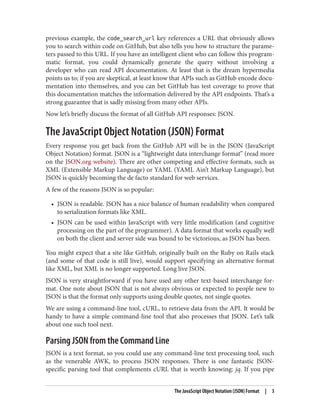
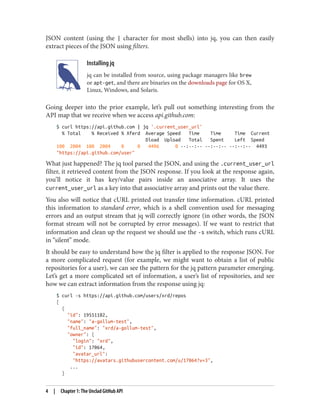
![]
$ curl -s https://api.github.com/users/xrd/repos | jq '.[0].owner.id'
17064
This response is different structurally: instead of an associative array, we now have an
array (multiple items). To get the first one, we specify a numeric index, and then key
into the successive associative arrays inside of it to reach the desired content: the
owner id.
jq is a great tool for checking the validity of JSON. As mentioned before, JSON key/
values are stored only with double quotes, not single quotes. You can verify that JSON
is valid and satisfies this requirement using jq:
$ echo '{ "a" : "b" }' | jq '.'
{
"a": "b"
}
$ echo "{ 'no' : 'bueno' }" | jq "."
parse error: Invalid numeric literal at line 1, column 7
The first JSON we pass into jq works, while the second, because it uses invalid single-
quote characters, fails with an error. jq filters are strings passed as arguments, and the
shell that provides the string to jq does not care if you use single quotes or double
quotes, as you can see in the preceding code. The echo command, if you didn’t
already know, prints out whatever string you provide to it; when we combine this
with the pipe character we can easily provide that string to jq through standard input.
jq is a powerful tool for quickly retrieving content from an arbitray JSON request. jq
has many other powerful features, documented at https://stedolan.github.io/jq/.
We now know how to retrieve some interesting information from the GitHub API
and parse out bits of information from that response, all in a single line. But there will
be times when you incorrectly specify parameters to cURL or the API, and the data is
not what you expect. Now we’ll learn about how to debug the cURL tool and the API
service itself to provide more context when things go wrong.
Debugging Switches for cURL
As mentioned, cURL is a great tool when you are verifying that a response is what
you expect it to be. The response body is important, but often you’ll want access to
the headers as well. cURL makes getting these easy with the -i and -v switches. The
-i switch prints out request headers, and the -v switch prints out both request and
response headers (the > character indicates request data, and the < character indicates
response data):
$ curl -i https://api.github.com
HTTP/1.1 200 OK
Server: GitHub.com
Date: Wed, 03 Jun 2015 19:39:03 GMT
The JavaScript Object Notation (JSON) Format | 5](https://image.slidesharecdn.com/14297-250429143553-f16a2633/85/Building-Tools-with-GitHub-Customize-Your-Workflow-1st-Edition-Chris-Dawson-30-320.jpg)
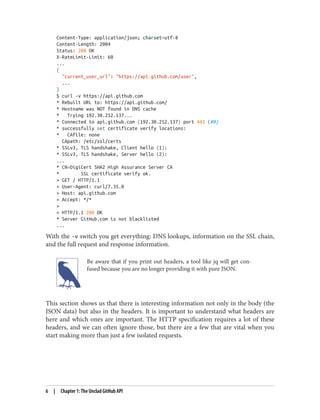
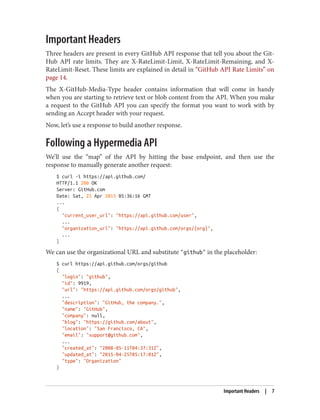

![[ἀνόμως]."—"For when the Gentiles, which have not the law," etc.,
and, "As many as have sinned without law shall perish without law;
and as many as have sinned in the law shall be judged by the law."
Here the two classes are brought into sharp and vivid contrast, in
the matter of their dispensational position. The Jew, under law; the
Gentile, without law,—nothing can be more distinct. The Gentile was
placed under government, in the person of Noah; but never under
law. Should any one feel disposed to call this in question, let him
produce a single line of Scripture to prove that God ever placed the
Gentiles under the law. Let him search and see. It is of no possible
use to argue and reason and object,—it is utterly vain to say, "We
think" this or that: the question is, "What saith the Scripture?" If it
says that the Gentiles were put under the law, let the passage be
produced. We solemnly declare it says nothing of the kind, but the
very reverse. It describes the condition and the position of the
Gentile as "without law"—"having not the law."
In Acts x, we see God opening the kingdom of heaven to the
Gentile; in Acts xiv. 27, we see Him opening "the door of faith" to
the Gentile; in Acts xxviii. 28, we see Him sending His salvation to
the Gentile: but we search in vain, from cover to cover of the
blessed Book, for a passage in which He places the Gentile under
the law.
We would very earnestly entreat the Christian reader to give this
deeply interesting and important question his calm attention. Let him
lay aside all his preconceived thoughts, and examine the matter
simply in the light of holy Scripture. We are quite aware that our
statements on this subject will be regarded by thousands as novel, if
not actually heretical; but this does not move us, in the smallest
degree. It is our one grand desire to be taught absolutely and
exclusively by Scripture. The opinions, commandments, and
doctrines of men have no weight whatever with us. The dogmas of
the various schools of divinity must just go for what they are worth.
We demand Scripture. A single line of inspiration is amply sufficient
to settle this question, and close all discussion, forever. Let us be](https://image.slidesharecdn.com/14297-250429143553-f16a2633/85/Building-Tools-with-GitHub-Customize-Your-Workflow-1st-Edition-Chris-Dawson-38-320.jpg)
![shown from the Word of God that the Gentiles were ever put under
the law, and we shall at once bow; but inasmuch as we cannot find
it there, we reject the notion altogether, and we would have the
reader to do the same. The invariable language of Scripture, in
describing the position of the Jew, is, "under law;" and, in describing
the position of the Gentile, is, "without law." This is so obvious that
we cannot but marvel how any reader of the Bible can fail to see it.
[15]
If the reader will turn, for a few moments, to the fifteenth chapter of
the Acts of the Apostles, he will see how the first attempt to put
Gentile converts under the law was met by the apostles and the
whole church at Jerusalem. The question was raised at Antioch; and
God, in His infinite goodness and wisdom, so ordered that it should
not be settled there, but that Paul and Barnabas should go up to
Jerusalem and have the matter fully and freely discussed, and
definitively settled by the unanimous voice of the twelve apostles
and the whole church.
How we can bless our God for this! We can at once see that the
decision of a local assembly, such as Antioch, even though approved
by Paul and Barnabas, would not carry the same weight as that of
the twelve apostles assembled in council at Jerusalem. But the Lord,
blessed be His name, took care that the enemy should be completely
confounded, and that the law-teachers of that day, and of every
other day, should be distinctly and authoritatively taught that it was
not according to His mind that Christians should be put under law,
for any object whatsoever.
The subject is so deeply important that we cannot forbear quoting a
few passages for the reader. We believe it will refresh both the
reader and the writer to refer to the soul-stirring addresses delivered
at the most remarkable and interesting council that ever sat.
"And certain men which came down from Judæa taught the
brethren, 'Except ye be circumcised after the manner of Moses, ye
cannot be saved.'" How awful! How terribly chilling! What a death-](https://image.slidesharecdn.com/14297-250429143553-f16a2633/85/Building-Tools-with-GitHub-Customize-Your-Workflow-1st-Edition-Chris-Dawson-39-320.jpg)
![was only what might be expected; but to find Peter and James so
decided would carry great weight with all parties.
But if the reader would have a clear view of Paul's thoughts on the
question of the law, he should study the epistle to the Galatians.
There this blessed apostle, under the direct inspiration of the Holy
Ghost, pours out his heart to the Gentile converts in words of
glowing earnestness and commanding power. It is perfectly amazing
how any one can read this wonderful epistle and yet maintain that
Christians are under the law, in any way or for any purpose. Hardly
has the apostle got through his brief opening address when he
plunges, with his characteristic energy, into the subject with which
his large, loving, though grieved and troubled heart is full to
overflowing. "I marvel," he says—and well he might—"that ye are so
soon removed from Him that called you into"—what? The law of
Moses? Nay, but "the grace of Christ into a different gospel which is
not another [ἕτερον εὐαγγέλιον ὃ οὐκ ἔστιν ἄλλο]; but there be
some that trouble you, and would pervert the gospel of Christ. But
though we or an angel from heaven preach any other gospel unto
you than that which we have preached unto you, let him be
accursed. As we said before, so say I now again, If any man preach
any other gospel unto you than that ye have received, let him be
accursed."
Let all law-teachers ponder these burning words. Do they seem
strong and severe? Let us remember that they are the very words of
God the Holy Ghost. Yes, reader, God the Holy Ghost hurls His awful
anathema at any one who presumes to add the law of Moses to the
gospel of Christ—any one who attempts to place Christians under
the law. How is it that men are not afraid, in the face of such words,
to contend for the law? Are they not afraid of coming under the
solemn curse of God the Holy Ghost?
Some, however, seek to meet this question by telling us that they do
not take the law for justification, but as a rule of life; but this is
neither reasonable nor intelligent, inasmuch as we may very lawfully
inquire, Who gave us authority to decide as to the use we are to](https://image.slidesharecdn.com/14297-250429143553-f16a2633/85/Building-Tools-with-GitHub-Customize-Your-Workflow-1st-Edition-Chris-Dawson-44-320.jpg)
![that the law is abrogated—it is to make it null and void. Who will
dare to say this? Woe be to all who do so.
But how comes it to pass that the Christian is not under the curse?
Because he is not under the law. And how has he passed from under
the law? Is it by another having fulfilled it in his stead? Nay; we
repeat the statement, there is no such idea throughout the entire
legal economy as obedience by proxy. How is it, then? Here it is, in
all its moral force, fullness, and beauty: "I through law am dead to
law, that I might live unto God."[16]
Now, if it be true, and the apostle says it is, that we are dead to law,
how can the law, by any possibility, be a rule of life to us? It proved
only a rule of death, curse, and condemnation to those who were
under it—those who had received it by the disposition of angels. Can
it prove to be aught else to us? Did the law ever produce a single
cluster of living fruit, or of the fruits of righteousness, in the history
of any son or daughter of Adam? Hear the apostle's reply—"When
we were in the flesh," that is, when we were viewed as men in our
fallen nature, "the motions of sins, which were by the law, did work
in our members to bring forth fruit unto death."
It is very important for the reader to understand the real force of the
expression, "in the flesh." It does not, in this passage, mean "in the
body." It simply sets forth the condition of unconverted men and
women responsible to keep the law. Now, in this condition, all that
was or ever could be produced was "fruit unto death"—"motions of
sins." No life, no righteousness, no holiness, nothing for God,
nothing right at all.[17]
But where are we now, as Christians? Hear the reply—"I through law
am dead to law, that I might live unto God. I am crucified with
Christ: nevertheless I live; yet not I, but Christ liveth in me; and the
life which I now live in the flesh" (here it means in the body) "I
live"—how? By the law, as a rule of life? Not a hint at such a thing,
but "by the faith of the Son of God, who loved me, and gave Himself
for me."](https://image.slidesharecdn.com/14297-250429143553-f16a2633/85/Building-Tools-with-GitHub-Customize-Your-Workflow-1st-Edition-Chris-Dawson-46-320.jpg)
![altar; for Mine house shall be called a house of prayer for all
people."
Again, "If thou turn away thy foot from the Sabbath, from doing thy
pleasure on My holy day; and call the Sabbath a delight, the holy of
the Lord, honorable; and shalt honor Him, not doing thine own
ways, nor finding thine own pleasure, nor speaking thine own
words: then shalt thou delight thyself in the Lord; and I will cause
thee to ride upon the high places of the earth, and feed thee with
the heritage of Jacob thy father; for the mouth of the Lord hath
spoken it." (Isaiah lviii. 13, 14.)
The foregoing quotations are amply sufficient to show the place
which the Sabbath holds in the mind of God. It is needless to
multiply passages, but there is just one to which we must refer the
reader, in connection with our present subject, namely, Leviticus
xxiii.—"And the Lord spake unto Moses, saying, 'Speak unto the
children of Israel, and say unto them, Concerning the feasts of the
Lord, which ye shall proclaim to be holy convocations, even these
are My feasts. Six days shall work be done; but the seventh day is
the Sabbath of rest, a holy convocation; ye shall do no work therein:
it is the Sabbath of the Lord in all your dwellings." (Ver. 1-3.)
Here it stands at the head of all the feasts given in this marvelous
chapter, in which we have foreshadowed the entire history of God's
dealings with His people Israel. The Sabbath is the expression of
God's eternal rest, into which it is His purpose yet to bring His
people, when all their toils and sorrows, their trials and tribulations,
shall have passed away—that blessed "Sabbath-keeping
[σαββατισμός]" which "remaineth for the people of God." In various
ways He sought to keep this glorious rest before the hearts of His
people; the seventh day, the seventh year, the year of jubilee—all
these lovely sabbatic seasons were designed to set forth that
blessed time when Israel shall be gathered back to their own
beloved land, when the Sabbath shall be kept, in all its deep, divine
blessedness, as it never has been kept yet.](https://image.slidesharecdn.com/14297-250429143553-f16a2633/85/Building-Tools-with-GitHub-Customize-Your-Workflow-1st-Edition-Chris-Dawson-55-320.jpg)



![[artifactconf] Github for People Who Don't Code](https://cdn.slidesharecdn.com/ss_thumbnails/github-for-people-that-dont-code-131115221827-phpapp02-thumbnail.jpg?width=640&height=640&fit=bounds)


