BUILDING SCIENCE 2 (BLD61303 / ARC3413)
PROJECT 2: INTEGRATION PROJECT
COMMUNITY LIBRARY
NAME: TEO CHEN YI
STUDENT ID: 0320618
TUTOR: MR. SIVA
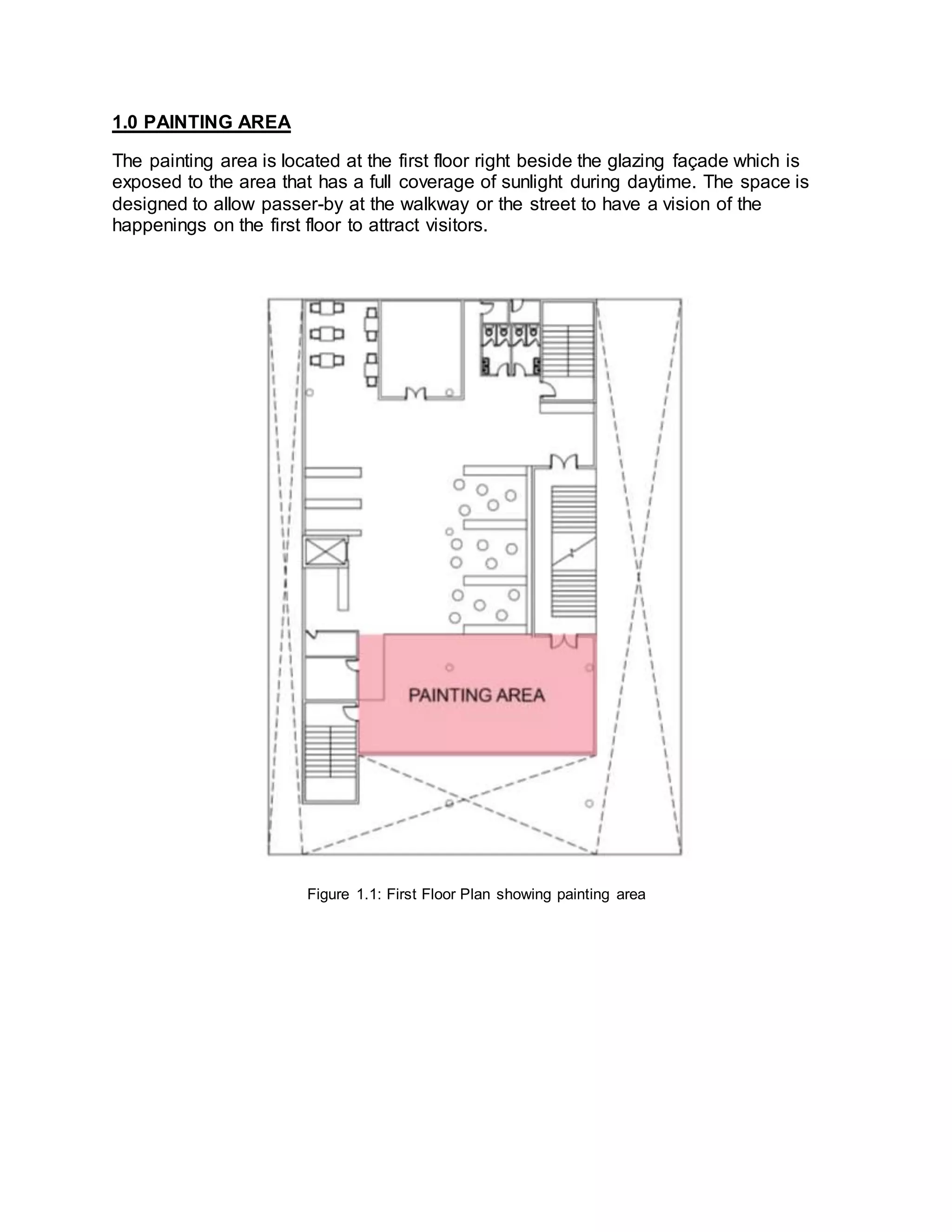
1.0 PAINTING AREA
The painting area is located at the first floor right beside the glazing façade which is
exposed to the area that has a full coverage of sunlight during daytime. The space is
designed to allow passer-by at the walkway or the street to have a vision of the
happenings on the first floor to attract visitors.
Figure 1.1: First Floor Plan showing painting area
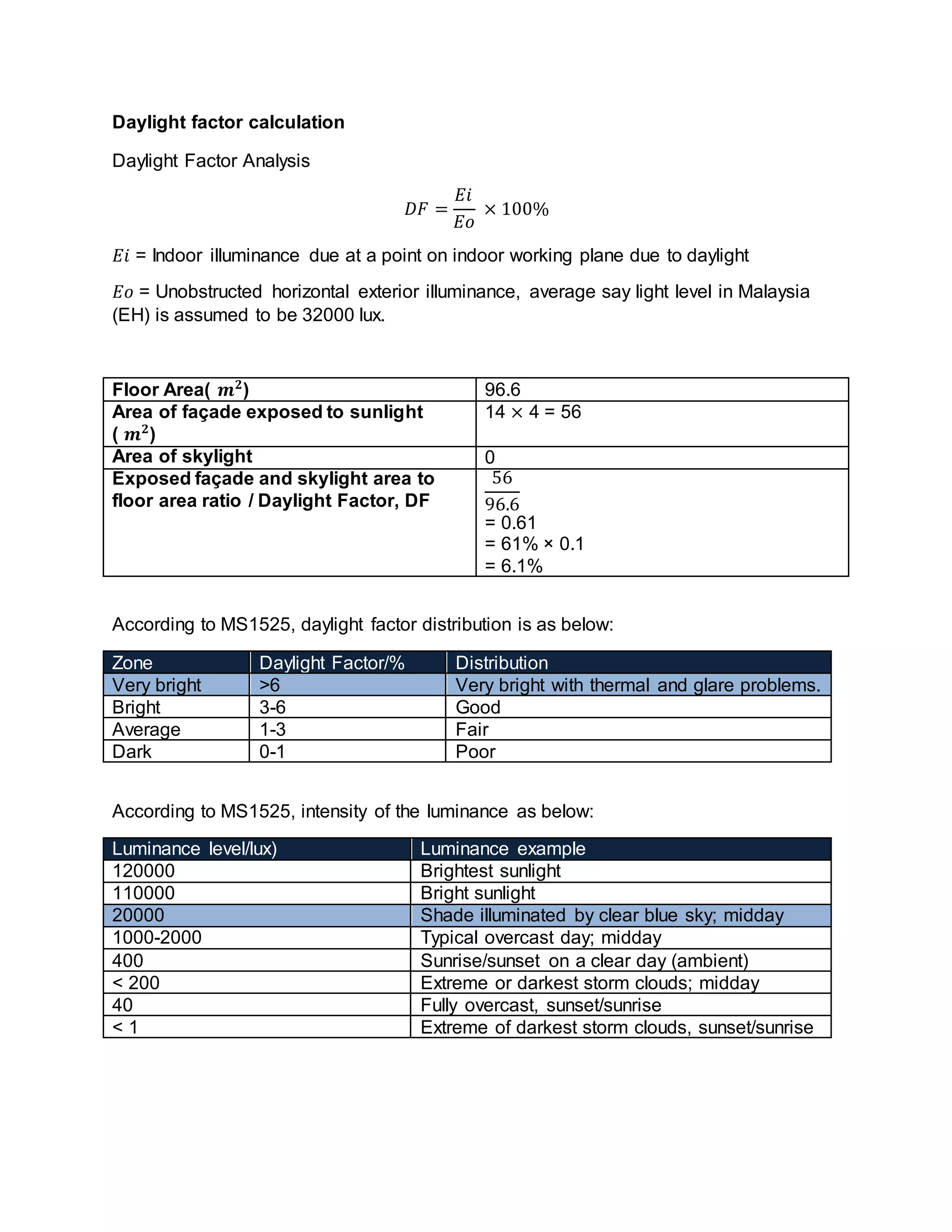
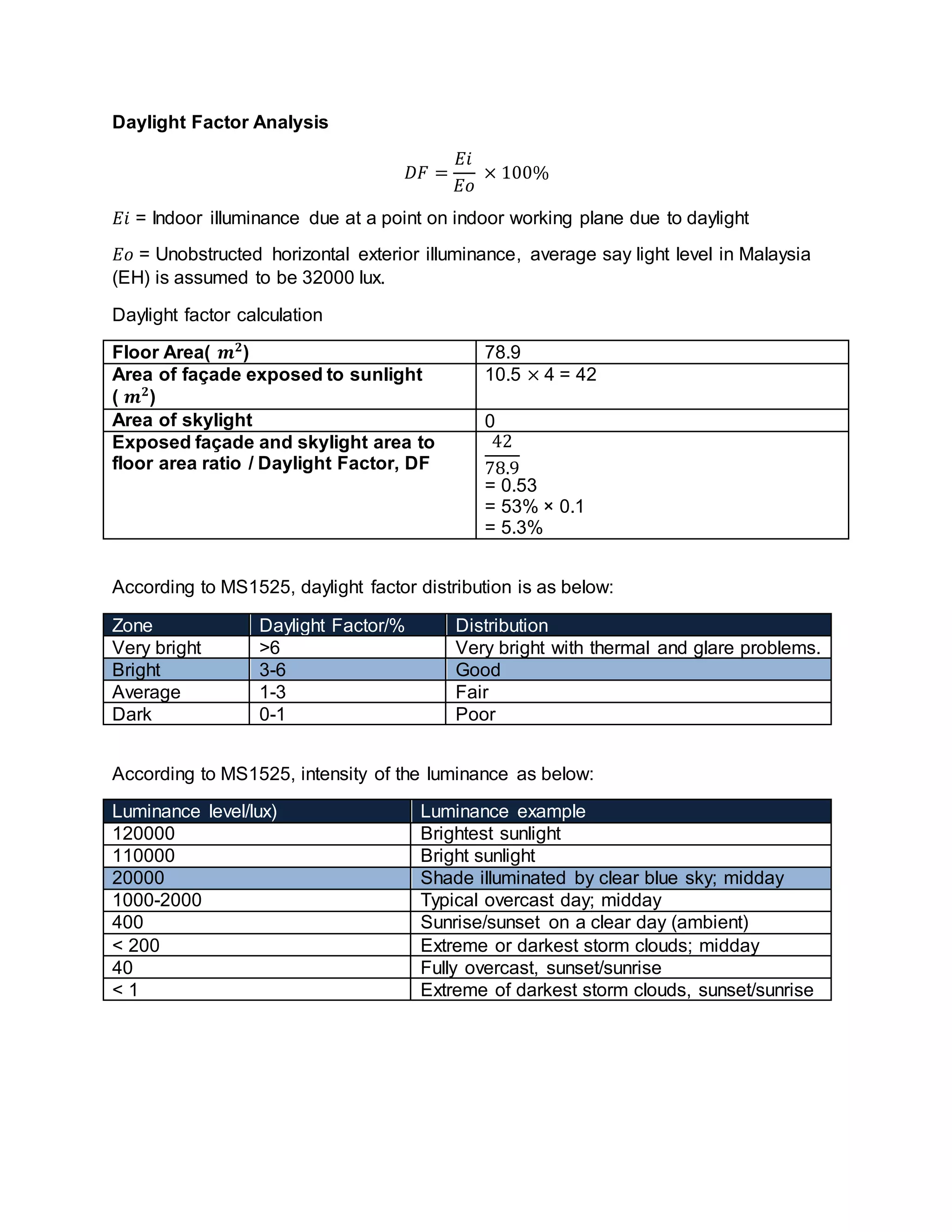
Daylight factor calculation
Daylight Factor Analysis
𝐷𝐹 =
𝐸𝑖
𝐸𝑜
× 100%
𝐸𝑖 = Indoor illuminance due at a point on indoor working plane due to daylight
𝐸𝑜 = Unobstructed horizontal exterior illuminance, average say light level in Malaysia
(EH) is assumed to be 32000 lux.
Floor Area( 𝒎 𝟐
) 96.6
Area of façade exposed to sunlight
( 𝒎 𝟐
)
14 × 4 = 56
Area of skylight 0
Exposed façade and skylight area to
floor area ratio / Daylight Factor, DF
56
96.6
= 0.61
= 61% × 0.1
= 6.1%
According to MS1525, daylight factor distribution is as below:
Zone Daylight Factor/% Distribution
Very bright >6 Very bright with thermal and glare problems.
Bright 3-6 Good
Average 1-3 Fair
Dark 0-1 Poor
According to MS1525, intensity of the luminance as below:
Luminance level/lux) Luminance example
120000 Brightest sunlight
110000 Bright sunlight
20000 Shade illuminated by clear blue sky; midday
1000-2000 Typical overcast day; midday
400 Sunrise/sunset on a clear day (ambient)
< 200 Extreme or darkest storm clouds; midday
40 Fully overcast, sunset/sunrise
< 1 Extreme of darkest storm clouds, sunset/sunrise
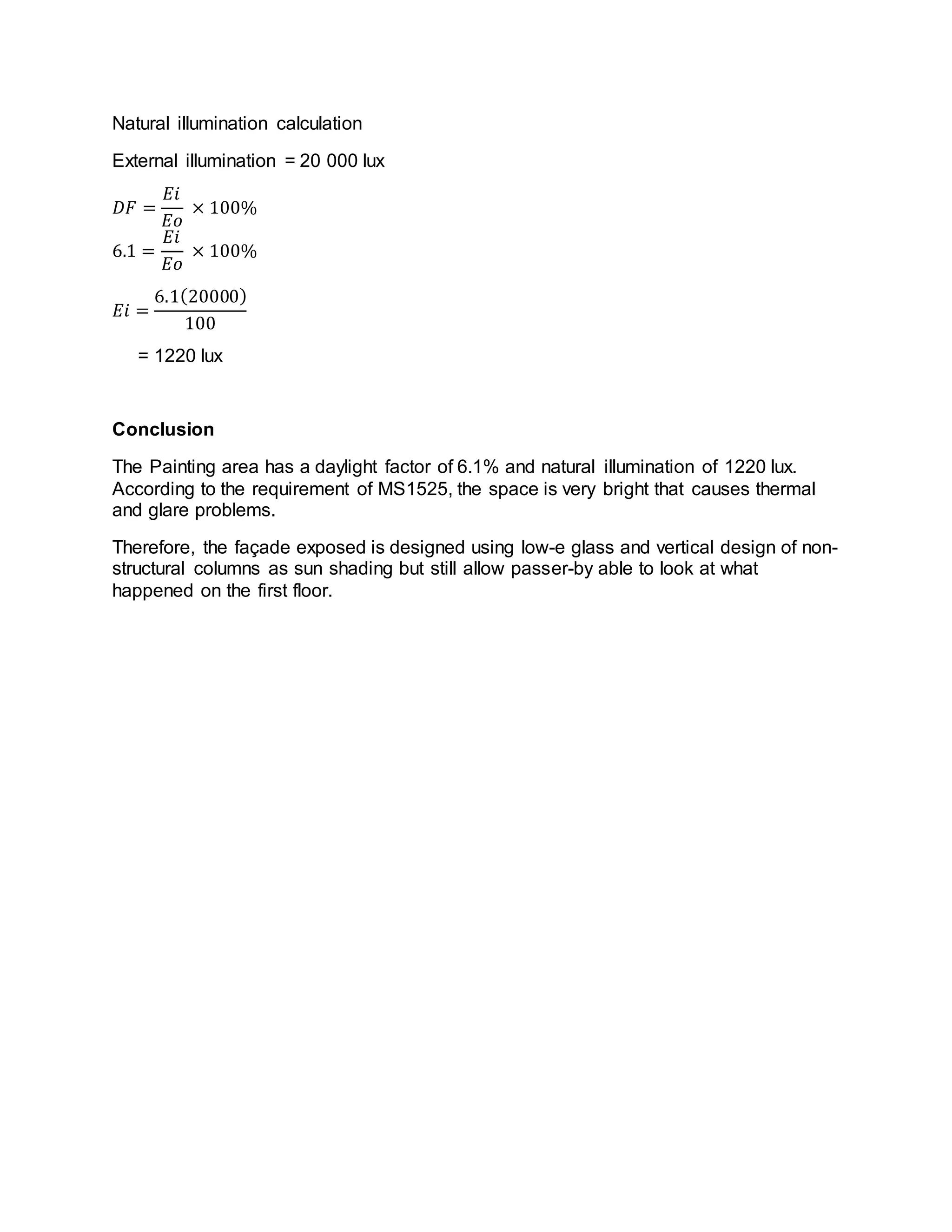
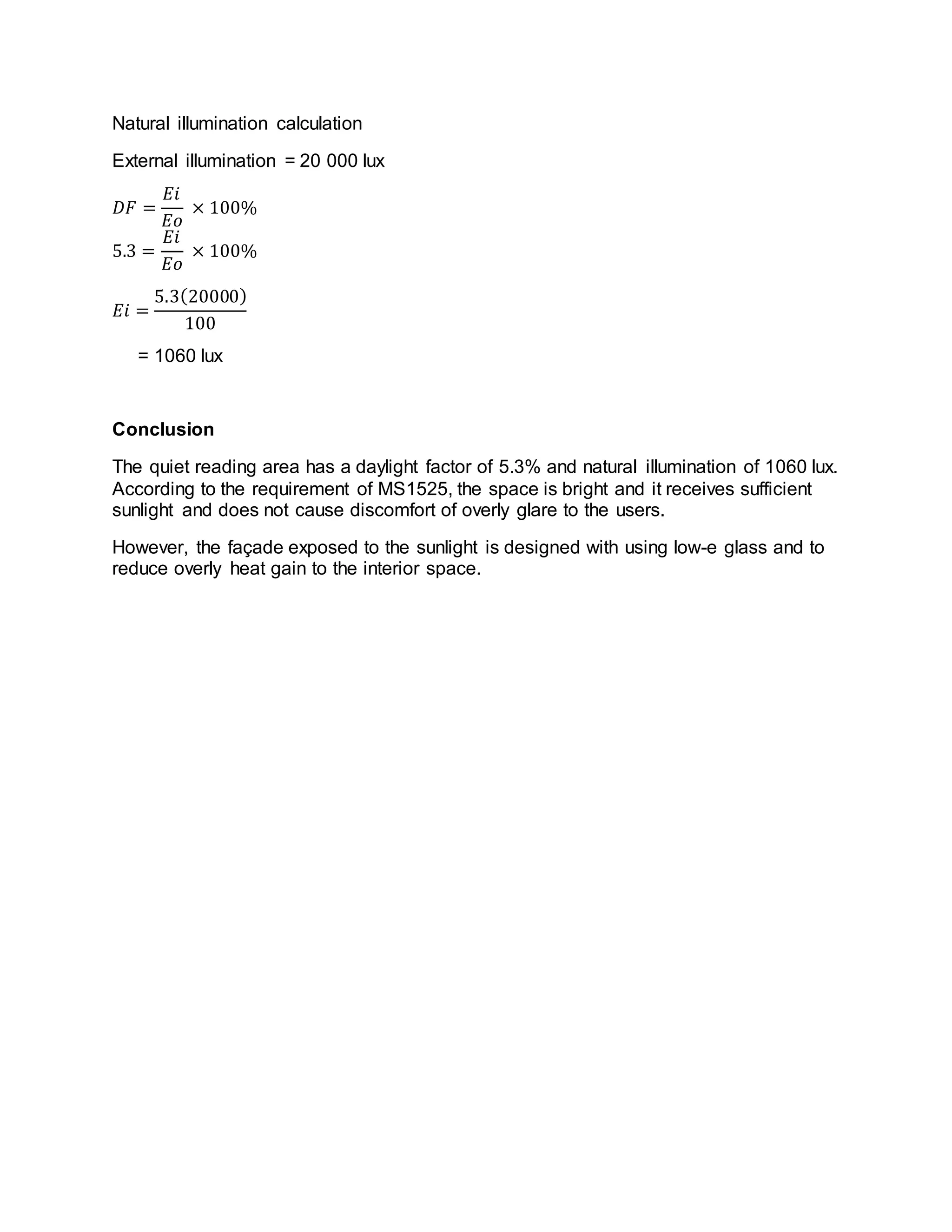
Natural illumination calculation
External illumination = 20 000 lux
𝐷𝐹 =
𝐸𝑖
𝐸𝑜
× 100%
6.1 =
𝐸𝑖
𝐸𝑜
× 100%
𝐸𝑖 =
6.1(20000)
100
= 1220 lux
Conclusion
The Painting area has a daylight factor of 6.1% and natural illumination of 1220 lux.
According to the requirement of MS1525, the space is very bright that causes thermal
and glare problems.
Therefore, the façade exposed is designed using low-e glass and vertical design of non-
structural columns as sun shading but still allow passer-by able to look at what
happened on the first floor.
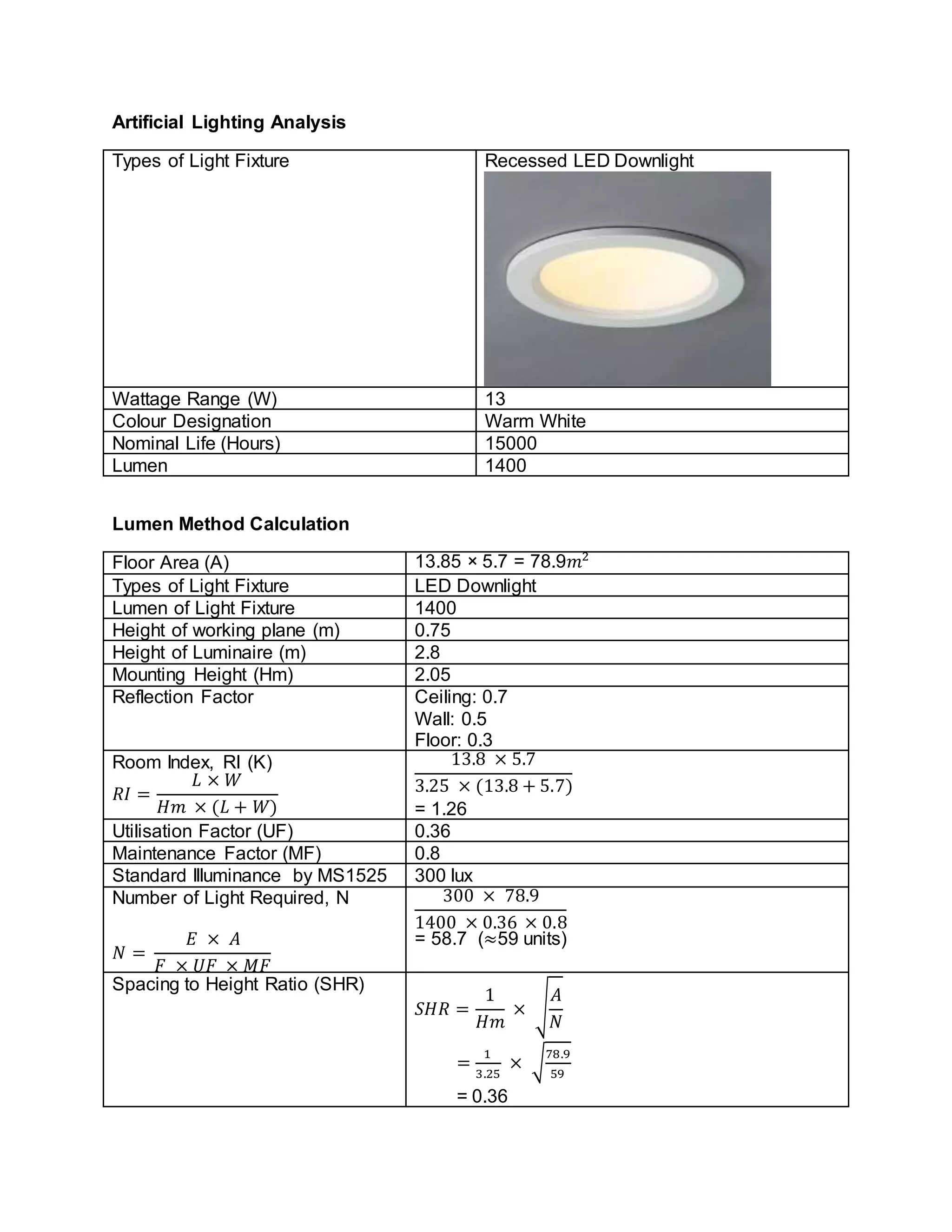
Artificial Lighting Analysis
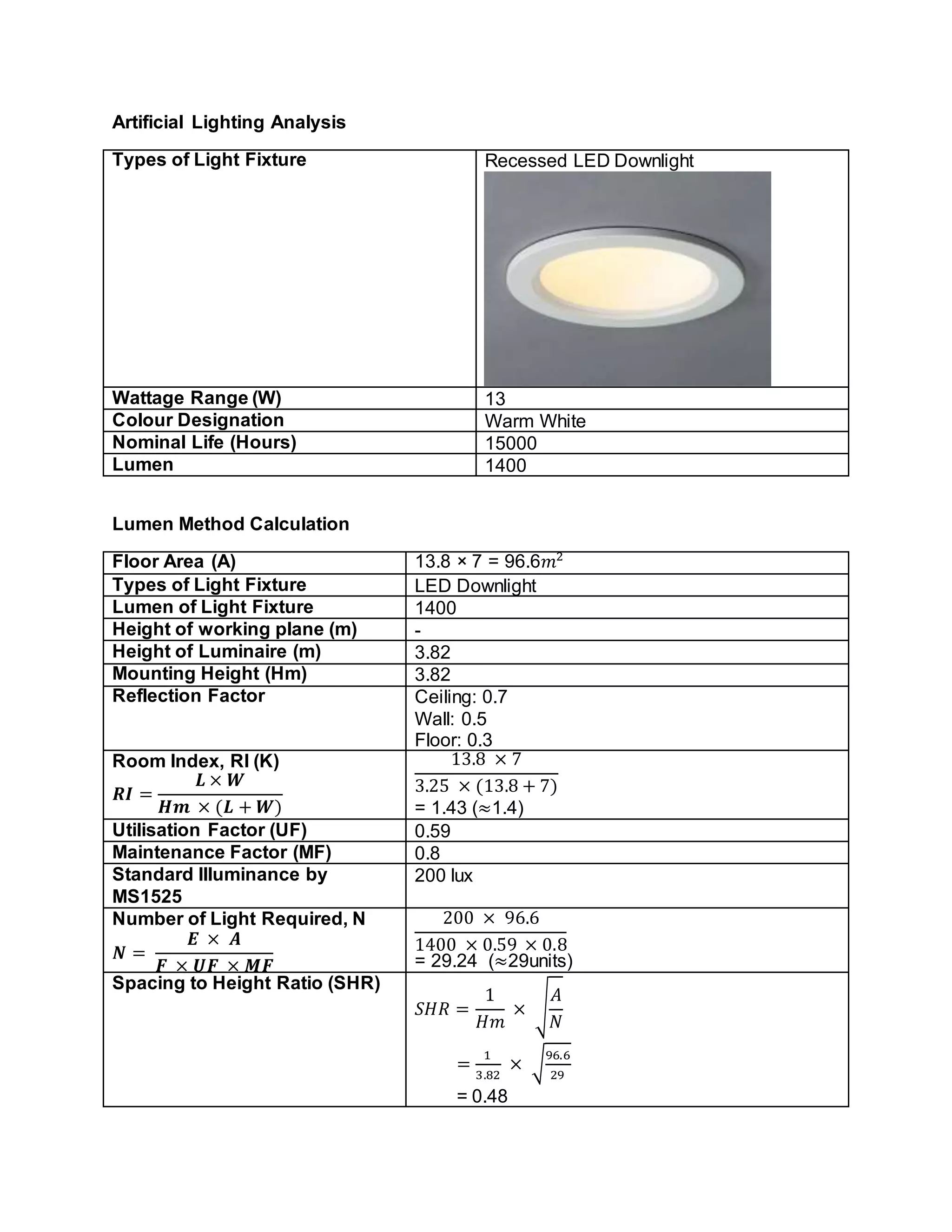
Types of Light Fixture Recessed LED Downlight
Wattage Range (W) 13
Colour Designation Warm White
Nominal Life (Hours) 15000
Lumen 1400
Lumen Method Calculation
Floor Area (A) 13.8 × 7 = 96.6𝑚2
Types of Light Fixture LED Downlight
Lumen of Light Fixture 1400
Height of working plane (m) -
Height of Luminaire (m) 3.82
Mounting Height (Hm) 3.82
Reflection Factor Ceiling: 0.7
Wall: 0.5
Floor: 0.3
Room Index, RI (K)
𝑹𝑰 =
𝑳 × 𝑾
𝑯𝒎 × (𝑳 + 𝑾)
13.8 × 7
3.25 × (13.8 + 7)
= 1.43 (≈1.4)
Utilisation Factor (UF) 0.59
Maintenance Factor (MF) 0.8
Standard Illuminance by
MS1525
200 lux
Number of Light Required, N
𝑵 =
𝑬 × 𝑨
𝑭 × 𝑼𝑭 × 𝑴𝑭
200 × 96.6
1400 × 0.59 × 0.8
= 29.24 (≈29units)
Spacing to Height Ratio (SHR)
𝑆𝐻𝑅 =
1
𝐻𝑚
× √
𝐴
𝑁
=
1
3.82
× √
96.6
29
= 0.48
0.48 =
𝑥
3.82
= 1.83
Fitting Layout by Approximately
(m)
Fitting required along 13.8m wall
= 13.8 / 1.83
= 7.54 (7-8 rows)
Number of fittings per row
= 29 / 8
= 3.63 (≈4 units)
Spacing along the width
= 13.8 / 8
= 1.73m
Conclusion
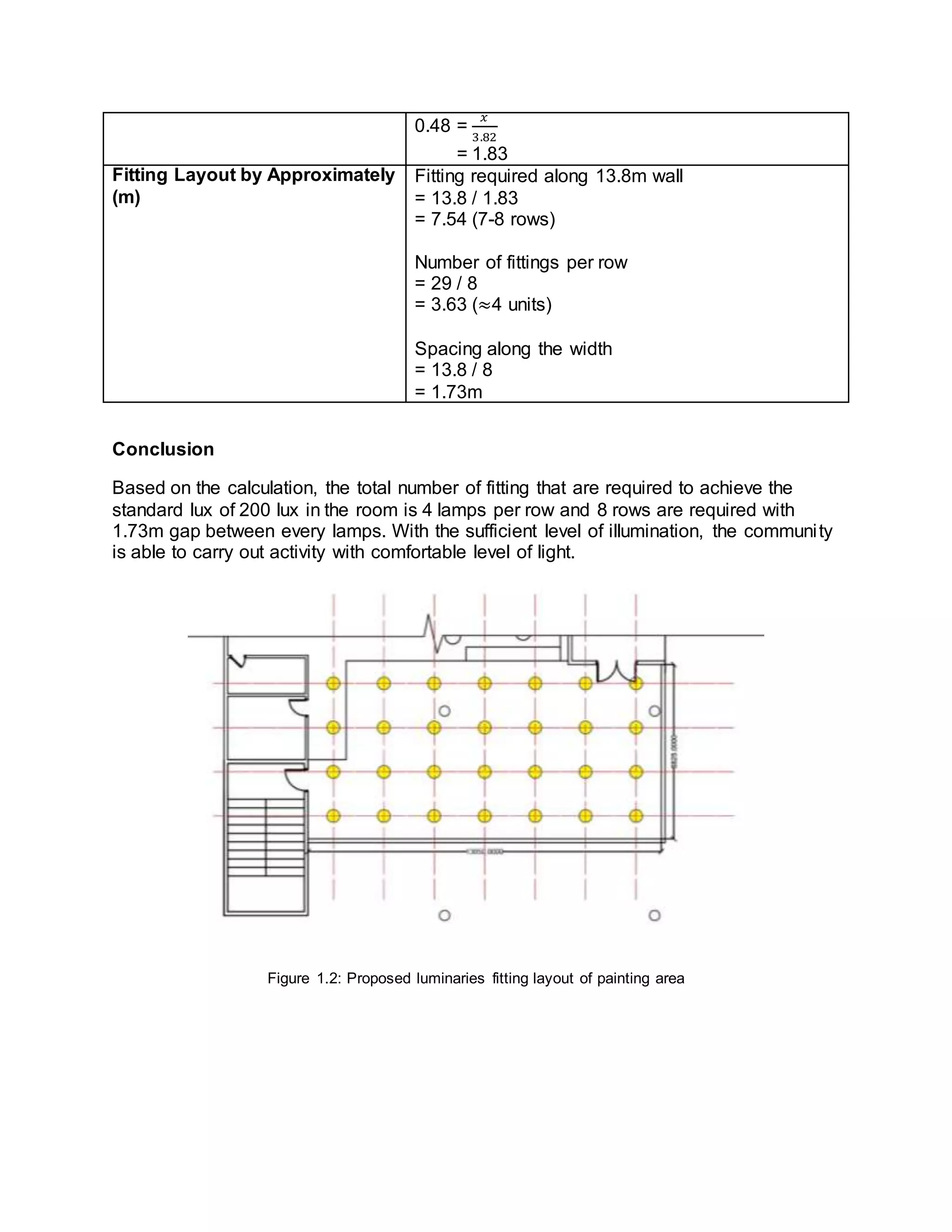
Based on the calculation, the total number of fitting that are required to achieve the
standard lux of 200 lux in the room is 4 lamps per row and 8 rows are required with
1.73m gap between every lamps. With the sufficient level of illumination, the community
is able to carry out activity with comfortable level of light.
Figure 1.2: Proposed luminaries fitting layout of painting area
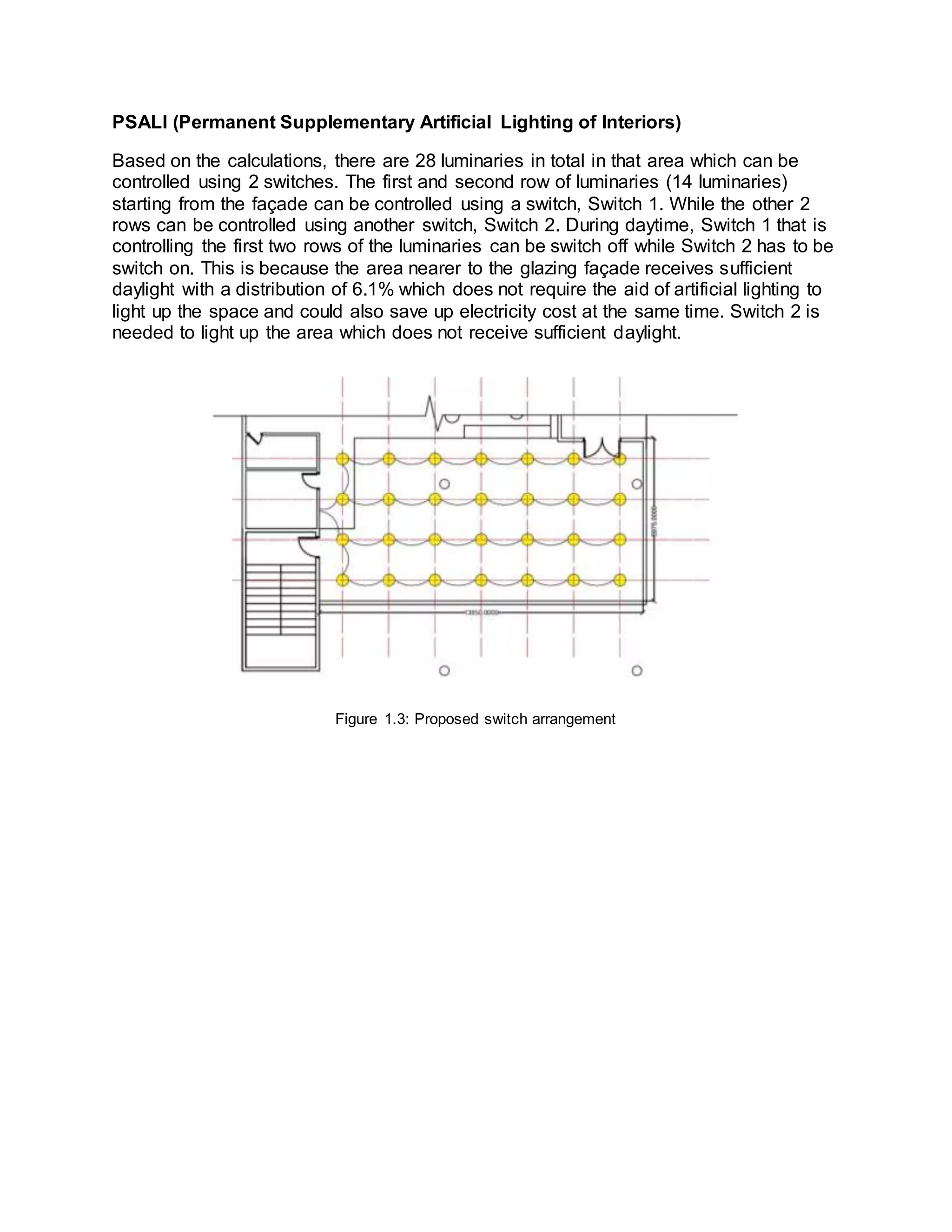
PSALI (Permanent Supplementary Artificial Lighting of Interiors)
Based on the calculations, there are 28 luminaries in total in that area which can be
controlled using 2 switches. The first and second row of luminaries (14 luminaries)
starting from the façade can be controlled using a switch, Switch 1. While the other 2
rows can be controlled using another switch, Switch 2. During daytime, Switch 1 that is
controlling the first two rows of the luminaries can be switch off while Switch 2 has to be
switch on. This is because the area nearer to the glazing façade receives sufficient
daylight with a distribution of 6.1% which does not require the aid of artificial lighting to
light up the space and could also save up electricity cost at the same time. Switch 2 is
needed to light up the area which does not receive sufficient daylight.
Figure 1.3: Proposed switch arrangement
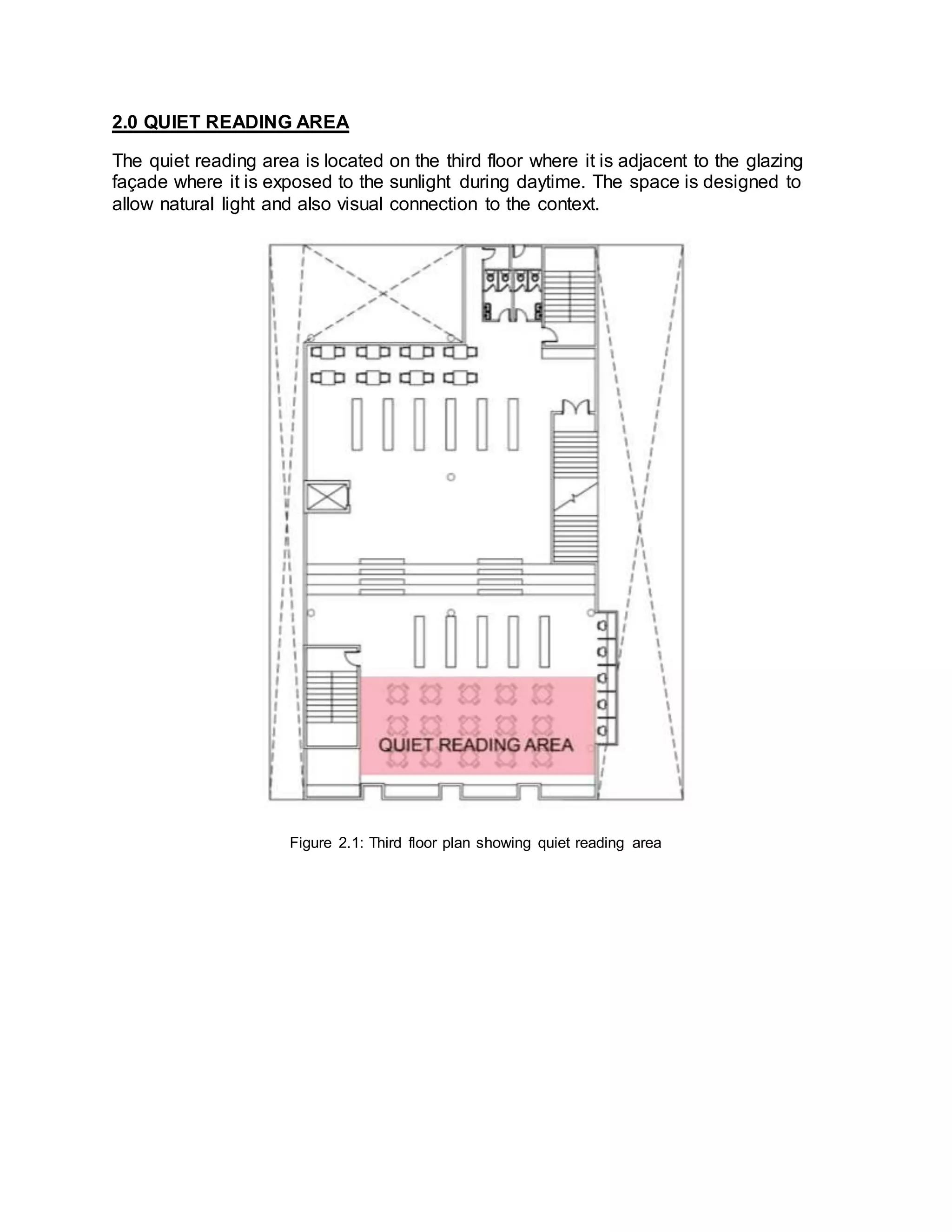
2.0 QUIET READING AREA
The quiet reading area is located on the third floor where it is adjacent to the glazing
façade where it is exposed to the sunlight during daytime. The space is designed to
allow natural light and also visual connection to the context.
Figure 2.1: Third floor plan showing quiet reading area
Daylight Factor Analysis
𝐷𝐹 =
𝐸𝑖
𝐸𝑜
× 100%
𝐸𝑖 = Indoor illuminance due at a point on indoor working plane due to daylight
𝐸𝑜 = Unobstructed horizontal exterior illuminance, average say light level in Malaysia
(EH) is assumed to be 32000 lux.
Daylight factor calculation
Floor Area( 𝒎 𝟐
) 78.9
Area of façade exposed to sunlight
( 𝒎 𝟐
)
10.5 × 4 = 42
Area of skylight 0
Exposed façade and skylight area to
floor area ratio / Daylight Factor, DF
42
78.9
= 0.53
= 53% × 0.1
= 5.3%
According to MS1525, daylight factor distribution is as below:
Zone Daylight Factor/% Distribution
Very bright >6 Very bright with thermal and glare problems.
Bright 3-6 Good
Average 1-3 Fair
Dark 0-1 Poor
According to MS1525, intensity of the luminance as below:
Luminance level/lux) Luminance example
120000 Brightest sunlight
110000 Bright sunlight
20000 Shade illuminated by clear blue sky; midday
1000-2000 Typical overcast day; midday
400 Sunrise/sunset on a clear day (ambient)
< 200 Extreme or darkest storm clouds; midday
40 Fully overcast, sunset/sunrise
< 1 Extreme of darkest storm clouds, sunset/sunrise
Natural illumination calculation
External illumination = 20 000 lux
𝐷𝐹 =
𝐸𝑖
𝐸𝑜
× 100%
5.3 =
𝐸𝑖
𝐸𝑜
× 100%
𝐸𝑖 =
5.3(20000)
100
= 1060 lux
Conclusion
The quiet reading area has a daylight factor of 5.3% and natural illumination of 1060 lux.
According to the requirement of MS1525, the space is bright and it receives sufficient
sunlight and does not cause discomfort of overly glare to the users.
However, the façade exposed to the sunlight is designed with using low-e glass and to
reduce overly heat gain to the interior space.
Artificial Lighting Analysis
Types of Light Fixture Recessed LED Downlight
Wattage Range (W) 13
Colour Designation Warm White
Nominal Life (Hours) 15000
Lumen 1400
Lumen Method Calculation
Floor Area (A) 13.85 × 5.7 = 78.9𝑚2
Types of Light Fixture LED Downlight
Lumen of Light Fixture 1400
Height of working plane (m) 0.75
Height of Luminaire (m) 2.8
Mounting Height (Hm) 2.05
Reflection Factor Ceiling: 0.7
Wall: 0.5
Floor: 0.3
Room Index, RI (K)
𝑅𝐼 =
𝐿 × 𝑊
𝐻𝑚 × (𝐿 + 𝑊)
13.8 × 5.7
3.25 × (13.8 + 5.7)
= 1.26
Utilisation Factor (UF) 0.36
Maintenance Factor (MF) 0.8
Standard Illuminance by MS1525 300 lux
Number of Light Required, N
𝑁 =
𝐸 × 𝐴
𝐹 × 𝑈𝐹 × 𝑀𝐹
300 × 78.9
1400 × 0.36 × 0.8
= 58.7 (≈59 units)
Spacing to Height Ratio (SHR)
𝑆𝐻𝑅 =
1
𝐻𝑚
× √
𝐴
𝑁
=
1
3.25
× √
78.9
59
= 0.36
0.36 =
𝑥
3.25
= 1.17
Fitting Layout by Approximately
(m)
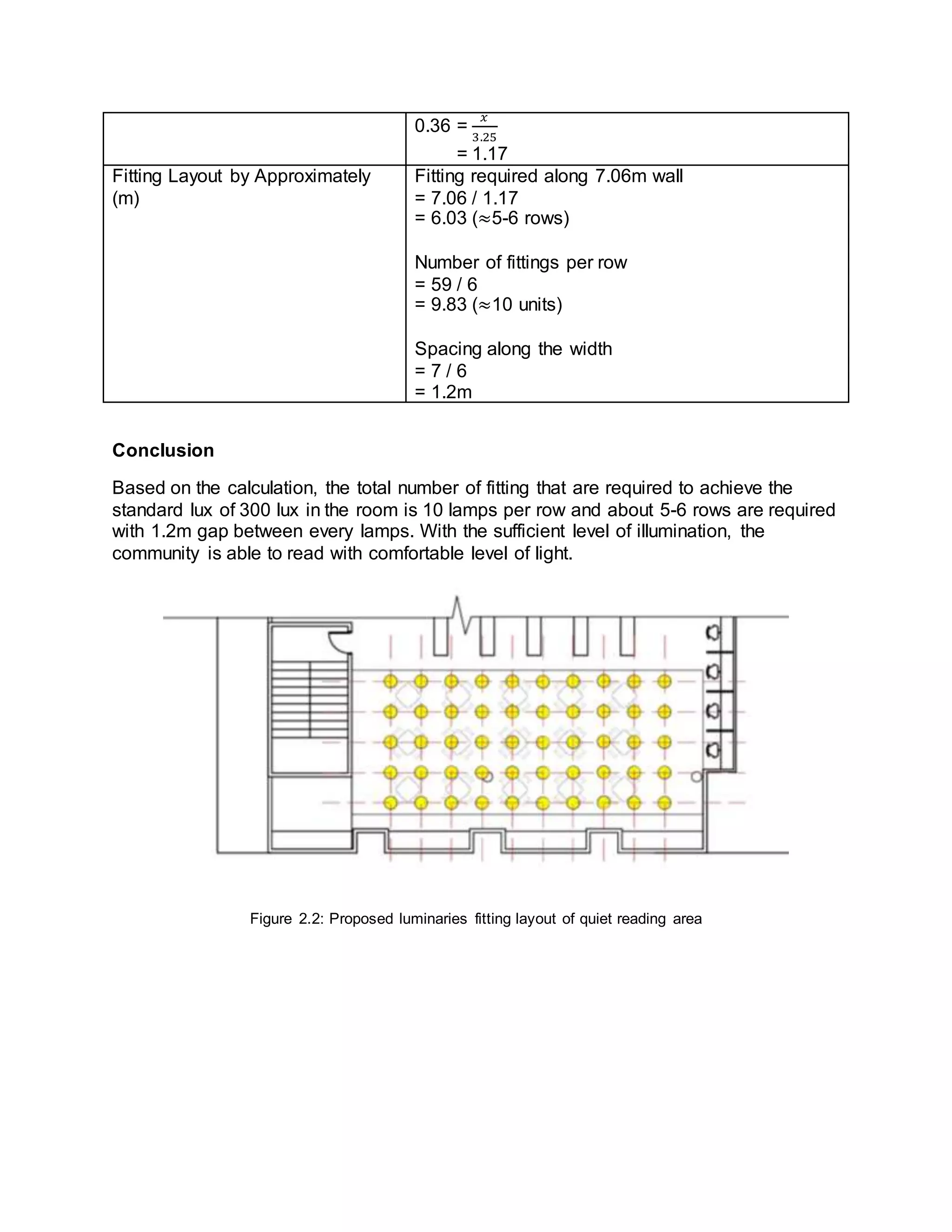
Fitting required along 7.06m wall
= 7.06 / 1.17
= 6.03 (≈5-6 rows)
Number of fittings per row
= 59 / 6
= 9.83 (≈10 units)
Spacing along the width
= 7 / 6
= 1.2m
Conclusion
Based on the calculation, the total number of fitting that are required to achieve the
standard lux of 300 lux in the room is 10 lamps per row and about 5-6 rows are required
with 1.2m gap between every lamps. With the sufficient level of illumination, the
community is able to read with comfortable level of light.
Figure 2.2: Proposed luminaries fitting layout of quiet reading area
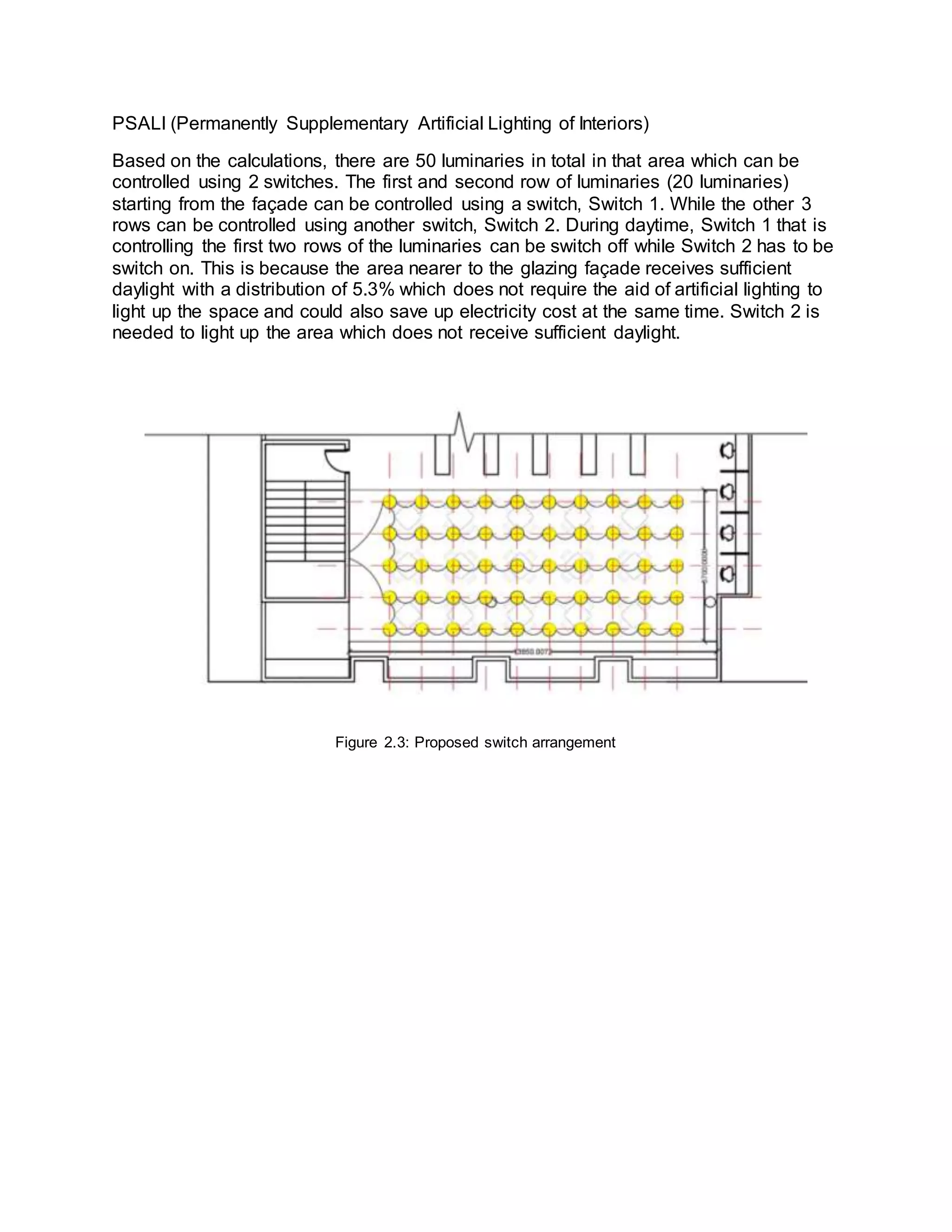
PSALI (Permanently Supplementary Artificial Lighting of Interiors)
Based on the calculations, there are 50 luminaries in total in that area which can be
controlled using 2 switches. The first and second row of luminaries (20 luminaries)
starting from the façade can be controlled using a switch, Switch 1. While the other 3
rows can be controlled using another switch, Switch 2. During daytime, Switch 1 that is
controlling the first two rows of the luminaries can be switch off while Switch 2 has to be
switch on. This is because the area nearer to the glazing façade receives sufficient
daylight with a distribution of 5.3% which does not require the aid of artificial lighting to
light up the space and could also save up electricity cost at the same time. Switch 2 is
needed to light up the area which does not receive sufficient daylight.
Figure 2.3: Proposed switch arrangement

Building science 2

  • 1.
    BUILDING SCIENCE 2(BLD61303 / ARC3413) PROJECT 2: INTEGRATION PROJECT COMMUNITY LIBRARY NAME: TEO CHEN YI STUDENT ID: 0320618 TUTOR: MR. SIVA
  • 2.
    1.0 PAINTING AREA Thepainting area is located at the first floor right beside the glazing façade which is exposed to the area that has a full coverage of sunlight during daytime. The space is designed to allow passer-by at the walkway or the street to have a vision of the happenings on the first floor to attract visitors. Figure 1.1: First Floor Plan showing painting area
  • 3.
    Daylight factor calculation DaylightFactor Analysis 𝐷𝐹 = 𝐸𝑖 𝐸𝑜 × 100% 𝐸𝑖 = Indoor illuminance due at a point on indoor working plane due to daylight 𝐸𝑜 = Unobstructed horizontal exterior illuminance, average say light level in Malaysia (EH) is assumed to be 32000 lux. Floor Area( 𝒎 𝟐 ) 96.6 Area of façade exposed to sunlight ( 𝒎 𝟐 ) 14 × 4 = 56 Area of skylight 0 Exposed façade and skylight area to floor area ratio / Daylight Factor, DF 56 96.6 = 0.61 = 61% × 0.1 = 6.1% According to MS1525, daylight factor distribution is as below: Zone Daylight Factor/% Distribution Very bright >6 Very bright with thermal and glare problems. Bright 3-6 Good Average 1-3 Fair Dark 0-1 Poor According to MS1525, intensity of the luminance as below: Luminance level/lux) Luminance example 120000 Brightest sunlight 110000 Bright sunlight 20000 Shade illuminated by clear blue sky; midday 1000-2000 Typical overcast day; midday 400 Sunrise/sunset on a clear day (ambient) < 200 Extreme or darkest storm clouds; midday 40 Fully overcast, sunset/sunrise < 1 Extreme of darkest storm clouds, sunset/sunrise
  • 4.
    Natural illumination calculation Externalillumination = 20 000 lux 𝐷𝐹 = 𝐸𝑖 𝐸𝑜 × 100% 6.1 = 𝐸𝑖 𝐸𝑜 × 100% 𝐸𝑖 = 6.1(20000) 100 = 1220 lux Conclusion The Painting area has a daylight factor of 6.1% and natural illumination of 1220 lux. According to the requirement of MS1525, the space is very bright that causes thermal and glare problems. Therefore, the façade exposed is designed using low-e glass and vertical design of non- structural columns as sun shading but still allow passer-by able to look at what happened on the first floor.
  • 5.
    Artificial Lighting Analysis Typesof Light Fixture Recessed LED Downlight Wattage Range (W) 13 Colour Designation Warm White Nominal Life (Hours) 15000 Lumen 1400 Lumen Method Calculation Floor Area (A) 13.8 × 7 = 96.6𝑚2 Types of Light Fixture LED Downlight Lumen of Light Fixture 1400 Height of working plane (m) - Height of Luminaire (m) 3.82 Mounting Height (Hm) 3.82 Reflection Factor Ceiling: 0.7 Wall: 0.5 Floor: 0.3 Room Index, RI (K) 𝑹𝑰 = 𝑳 × 𝑾 𝑯𝒎 × (𝑳 + 𝑾) 13.8 × 7 3.25 × (13.8 + 7) = 1.43 (≈1.4) Utilisation Factor (UF) 0.59 Maintenance Factor (MF) 0.8 Standard Illuminance by MS1525 200 lux Number of Light Required, N 𝑵 = 𝑬 × 𝑨 𝑭 × 𝑼𝑭 × 𝑴𝑭 200 × 96.6 1400 × 0.59 × 0.8 = 29.24 (≈29units) Spacing to Height Ratio (SHR) 𝑆𝐻𝑅 = 1 𝐻𝑚 × √ 𝐴 𝑁 = 1 3.82 × √ 96.6 29 = 0.48
  • 6.
    0.48 = 𝑥 3.82 = 1.83 FittingLayout by Approximately (m) Fitting required along 13.8m wall = 13.8 / 1.83 = 7.54 (7-8 rows) Number of fittings per row = 29 / 8 = 3.63 (≈4 units) Spacing along the width = 13.8 / 8 = 1.73m Conclusion Based on the calculation, the total number of fitting that are required to achieve the standard lux of 200 lux in the room is 4 lamps per row and 8 rows are required with 1.73m gap between every lamps. With the sufficient level of illumination, the community is able to carry out activity with comfortable level of light. Figure 1.2: Proposed luminaries fitting layout of painting area
  • 7.
    PSALI (Permanent SupplementaryArtificial Lighting of Interiors) Based on the calculations, there are 28 luminaries in total in that area which can be controlled using 2 switches. The first and second row of luminaries (14 luminaries) starting from the façade can be controlled using a switch, Switch 1. While the other 2 rows can be controlled using another switch, Switch 2. During daytime, Switch 1 that is controlling the first two rows of the luminaries can be switch off while Switch 2 has to be switch on. This is because the area nearer to the glazing façade receives sufficient daylight with a distribution of 6.1% which does not require the aid of artificial lighting to light up the space and could also save up electricity cost at the same time. Switch 2 is needed to light up the area which does not receive sufficient daylight. Figure 1.3: Proposed switch arrangement
  • 8.
    2.0 QUIET READINGAREA The quiet reading area is located on the third floor where it is adjacent to the glazing façade where it is exposed to the sunlight during daytime. The space is designed to allow natural light and also visual connection to the context. Figure 2.1: Third floor plan showing quiet reading area
  • 9.
    Daylight Factor Analysis 𝐷𝐹= 𝐸𝑖 𝐸𝑜 × 100% 𝐸𝑖 = Indoor illuminance due at a point on indoor working plane due to daylight 𝐸𝑜 = Unobstructed horizontal exterior illuminance, average say light level in Malaysia (EH) is assumed to be 32000 lux. Daylight factor calculation Floor Area( 𝒎 𝟐 ) 78.9 Area of façade exposed to sunlight ( 𝒎 𝟐 ) 10.5 × 4 = 42 Area of skylight 0 Exposed façade and skylight area to floor area ratio / Daylight Factor, DF 42 78.9 = 0.53 = 53% × 0.1 = 5.3% According to MS1525, daylight factor distribution is as below: Zone Daylight Factor/% Distribution Very bright >6 Very bright with thermal and glare problems. Bright 3-6 Good Average 1-3 Fair Dark 0-1 Poor According to MS1525, intensity of the luminance as below: Luminance level/lux) Luminance example 120000 Brightest sunlight 110000 Bright sunlight 20000 Shade illuminated by clear blue sky; midday 1000-2000 Typical overcast day; midday 400 Sunrise/sunset on a clear day (ambient) < 200 Extreme or darkest storm clouds; midday 40 Fully overcast, sunset/sunrise < 1 Extreme of darkest storm clouds, sunset/sunrise
  • 10.
    Natural illumination calculation Externalillumination = 20 000 lux 𝐷𝐹 = 𝐸𝑖 𝐸𝑜 × 100% 5.3 = 𝐸𝑖 𝐸𝑜 × 100% 𝐸𝑖 = 5.3(20000) 100 = 1060 lux Conclusion The quiet reading area has a daylight factor of 5.3% and natural illumination of 1060 lux. According to the requirement of MS1525, the space is bright and it receives sufficient sunlight and does not cause discomfort of overly glare to the users. However, the façade exposed to the sunlight is designed with using low-e glass and to reduce overly heat gain to the interior space.
  • 11.
    Artificial Lighting Analysis Typesof Light Fixture Recessed LED Downlight Wattage Range (W) 13 Colour Designation Warm White Nominal Life (Hours) 15000 Lumen 1400 Lumen Method Calculation Floor Area (A) 13.85 × 5.7 = 78.9𝑚2 Types of Light Fixture LED Downlight Lumen of Light Fixture 1400 Height of working plane (m) 0.75 Height of Luminaire (m) 2.8 Mounting Height (Hm) 2.05 Reflection Factor Ceiling: 0.7 Wall: 0.5 Floor: 0.3 Room Index, RI (K) 𝑅𝐼 = 𝐿 × 𝑊 𝐻𝑚 × (𝐿 + 𝑊) 13.8 × 5.7 3.25 × (13.8 + 5.7) = 1.26 Utilisation Factor (UF) 0.36 Maintenance Factor (MF) 0.8 Standard Illuminance by MS1525 300 lux Number of Light Required, N 𝑁 = 𝐸 × 𝐴 𝐹 × 𝑈𝐹 × 𝑀𝐹 300 × 78.9 1400 × 0.36 × 0.8 = 58.7 (≈59 units) Spacing to Height Ratio (SHR) 𝑆𝐻𝑅 = 1 𝐻𝑚 × √ 𝐴 𝑁 = 1 3.25 × √ 78.9 59 = 0.36
  • 12.
    0.36 = 𝑥 3.25 = 1.17 FittingLayout by Approximately (m) Fitting required along 7.06m wall = 7.06 / 1.17 = 6.03 (≈5-6 rows) Number of fittings per row = 59 / 6 = 9.83 (≈10 units) Spacing along the width = 7 / 6 = 1.2m Conclusion Based on the calculation, the total number of fitting that are required to achieve the standard lux of 300 lux in the room is 10 lamps per row and about 5-6 rows are required with 1.2m gap between every lamps. With the sufficient level of illumination, the community is able to read with comfortable level of light. Figure 2.2: Proposed luminaries fitting layout of quiet reading area
  • 13.
    PSALI (Permanently SupplementaryArtificial Lighting of Interiors) Based on the calculations, there are 50 luminaries in total in that area which can be controlled using 2 switches. The first and second row of luminaries (20 luminaries) starting from the façade can be controlled using a switch, Switch 1. While the other 3 rows can be controlled using another switch, Switch 2. During daytime, Switch 1 that is controlling the first two rows of the luminaries can be switch off while Switch 2 has to be switch on. This is because the area nearer to the glazing façade receives sufficient daylight with a distribution of 5.3% which does not require the aid of artificial lighting to light up the space and could also save up electricity cost at the same time. Switch 2 is needed to light up the area which does not receive sufficient daylight. Figure 2.3: Proposed switch arrangement