CoronaWhy Knowledge Graph
Slava Tykhonov
Senior Information Scientist
(DANS-KNAW, the Netherlands)
W3C Semantic Web Health Care and Life Sciences Interest Group webinar
06.10.2020
About me: DANS-KNAW projects (2016-2020)
● CLARIAH+ (ongoing)
● EOSC Synergy (ongoing)
● SSHOC Dataverse (ongoing)
● CESSDA DataverseEU 2018
● Time Machine Europe Supervisor at DANS-KNAW
● PARTHENOS Horizon 2020
● CESSDA PID (Personal Identifiers) Horizon 2020
● CLARIAH
● RDA (Research Data Alliance) PITTS Horizon 2020
● CESSDA SaW H2020-EU.1.4.1.1 Horizon 2020
2
Source: LinkedIn
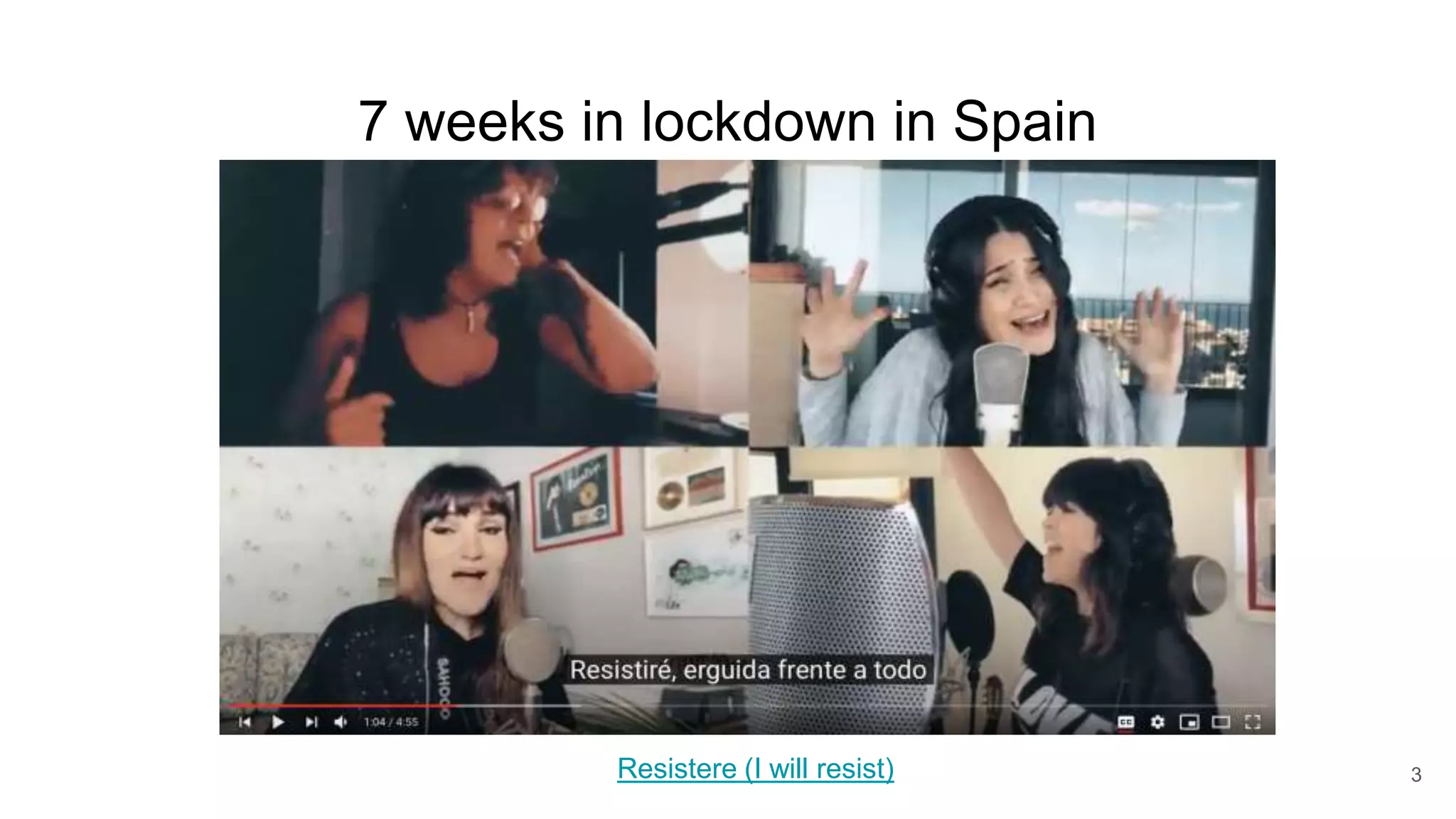
7 weeks in lockdown in Spain
3
Resistere (I will resist)
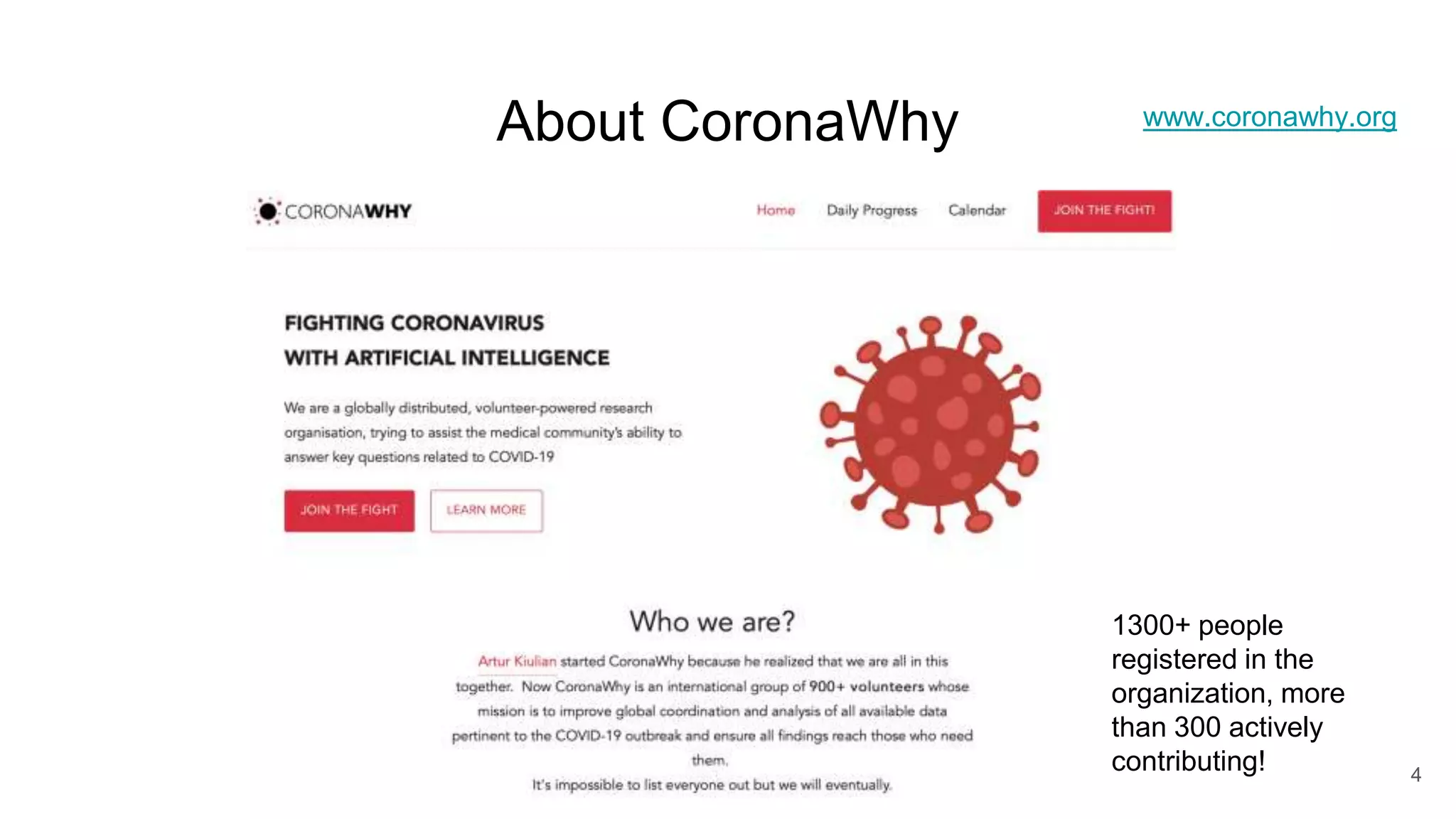
About CoronaWhy
1300+ people
registered in the
organization, more
than 300 actively
contributing! 4
www.coronawhy.org
COVID-19 Open Research Dataset Challenge (CORD-19)
It’s all started from this (March, 2020):
“In response to the COVID-19 pandemic and with the view to boost research, the Allen
Institute for AI together with CZI, MSR, Georgetown, NIH & The White House is collecting
and making available for free the COVID-19 Open Research Dataset (CORD-19). This
resource is updated weekly and contains over 287,000 scholarly articles, including 82,870
with full text, about COVID-19 and other viruses of the coronavirus family.” (Kaggle)
5
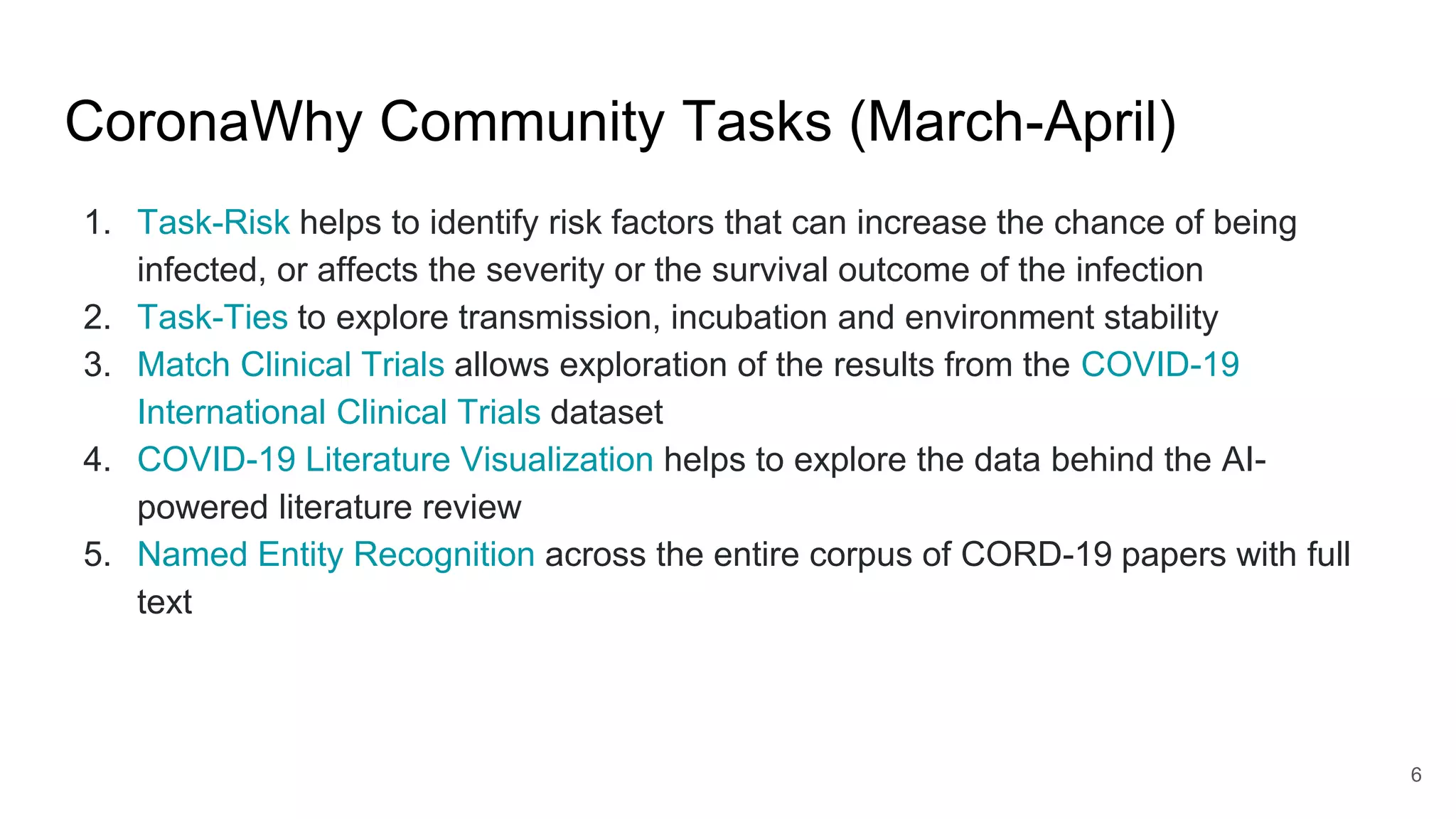
CoronaWhy Community Tasks (March-April)
1. Task-Risk helps to identify risk factors that can increase the chance of being
infected, or affects the severity or the survival outcome of the infection
2. Task-Ties to explore transmission, incubation and environment stability
3. Match Clinical Trials allows exploration of the results from the COVID-19
International Clinical Trials dataset
4. COVID-19 Literature Visualization helps to explore the data behind the AI-
powered literature review
5. Named Entity Recognition across the entire corpus of CORD-19 papers with full
text
6
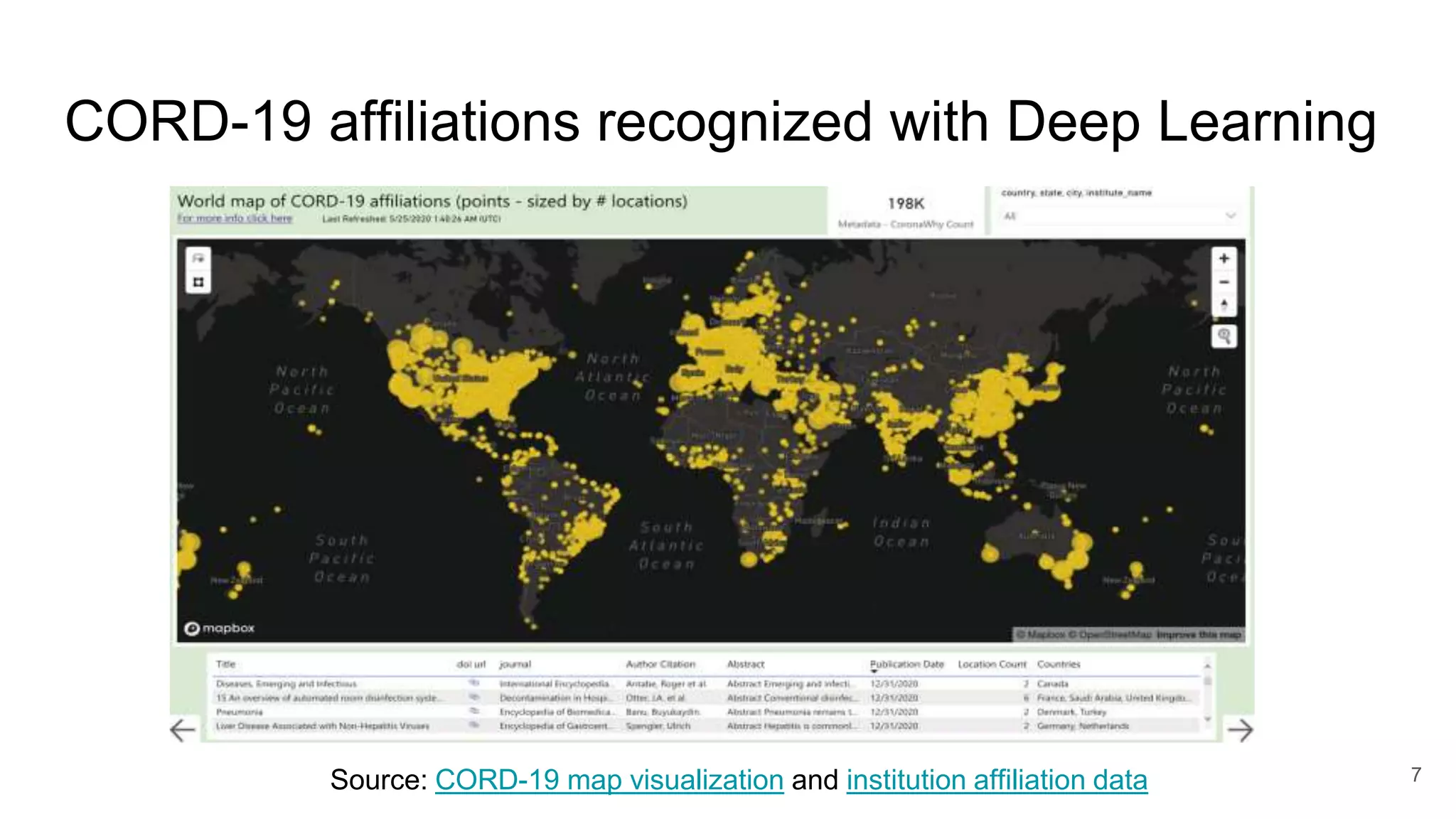
CORD-19 affiliations recognized with Deep Learning
7
Source: CORD-19 map visualization and institution affiliation data
Collaboration with other organizations
● Harvard Medical School, INDRA integration
● Helix Group, Stanford University
● NASA JPL, COVID-19 knowledge graph and GeoParser
● Kaggle, coronamed application
● Fraunhofer Institute for Intelligent Analysis and Information Systems IAIS,
knowledge graph
● dcyphr, a platform for creating and engaging with distillations of academic
articles
● CAMARADES (Collaborative Approach to Meta-Analysis and Review of
Animal Data from Experimental Studies)
We’ve got almost endless data streams...
8
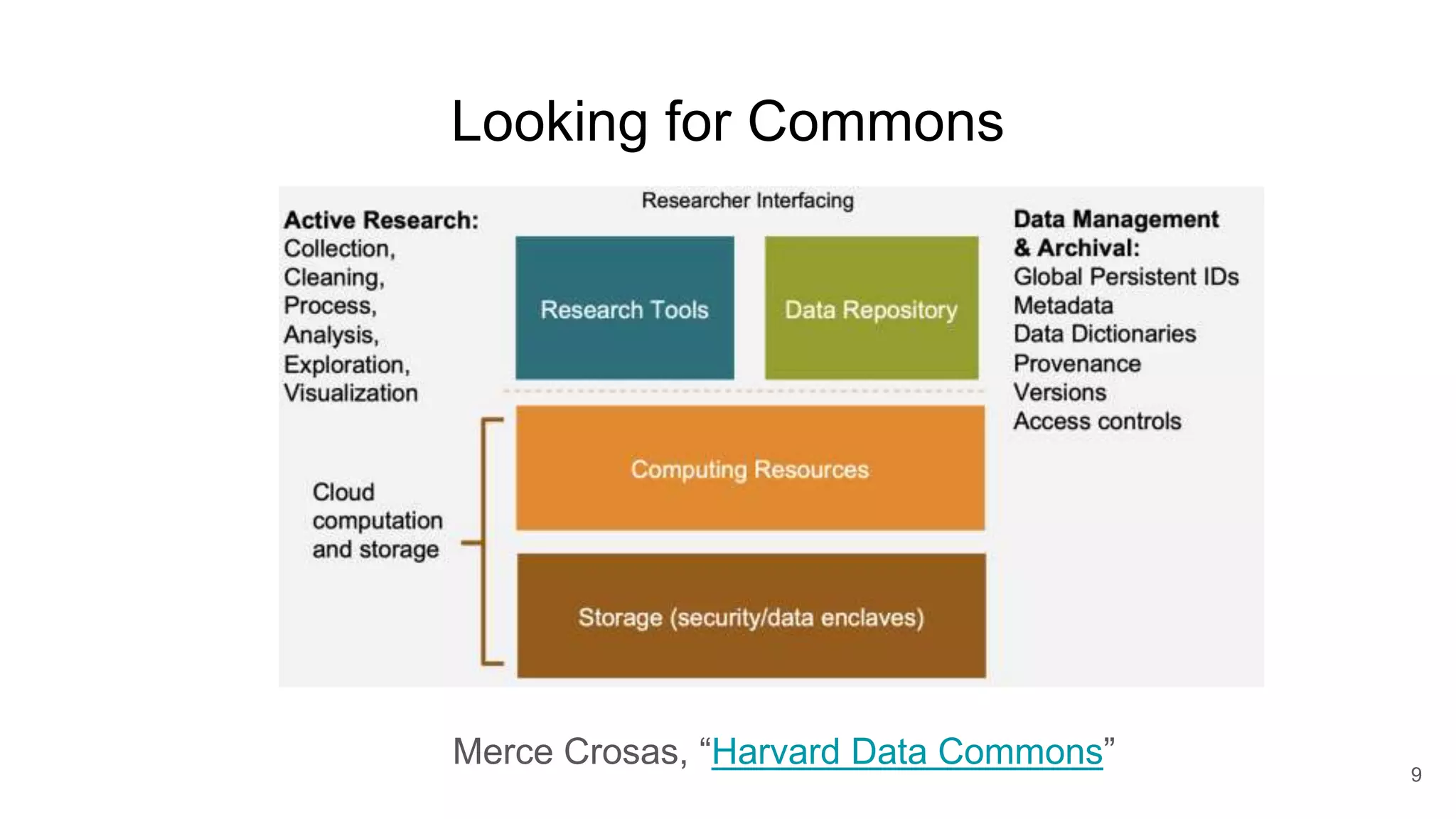
Looking for Commons
Merce Crosas, “Harvard Data Commons” 9
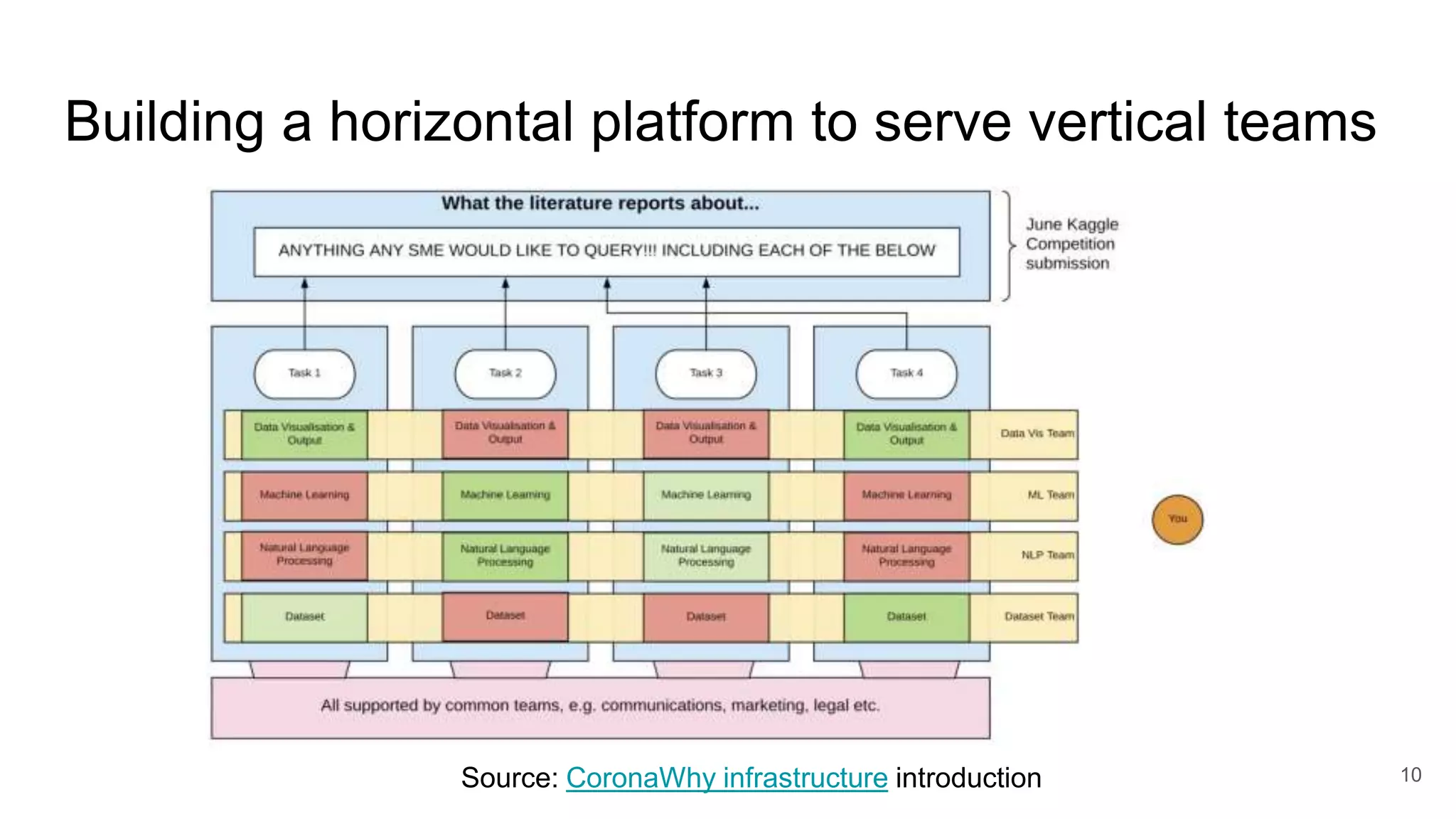
Building a horizontal platform to serve vertical teams
Source: CoronaWhy infrastructure introduction 10
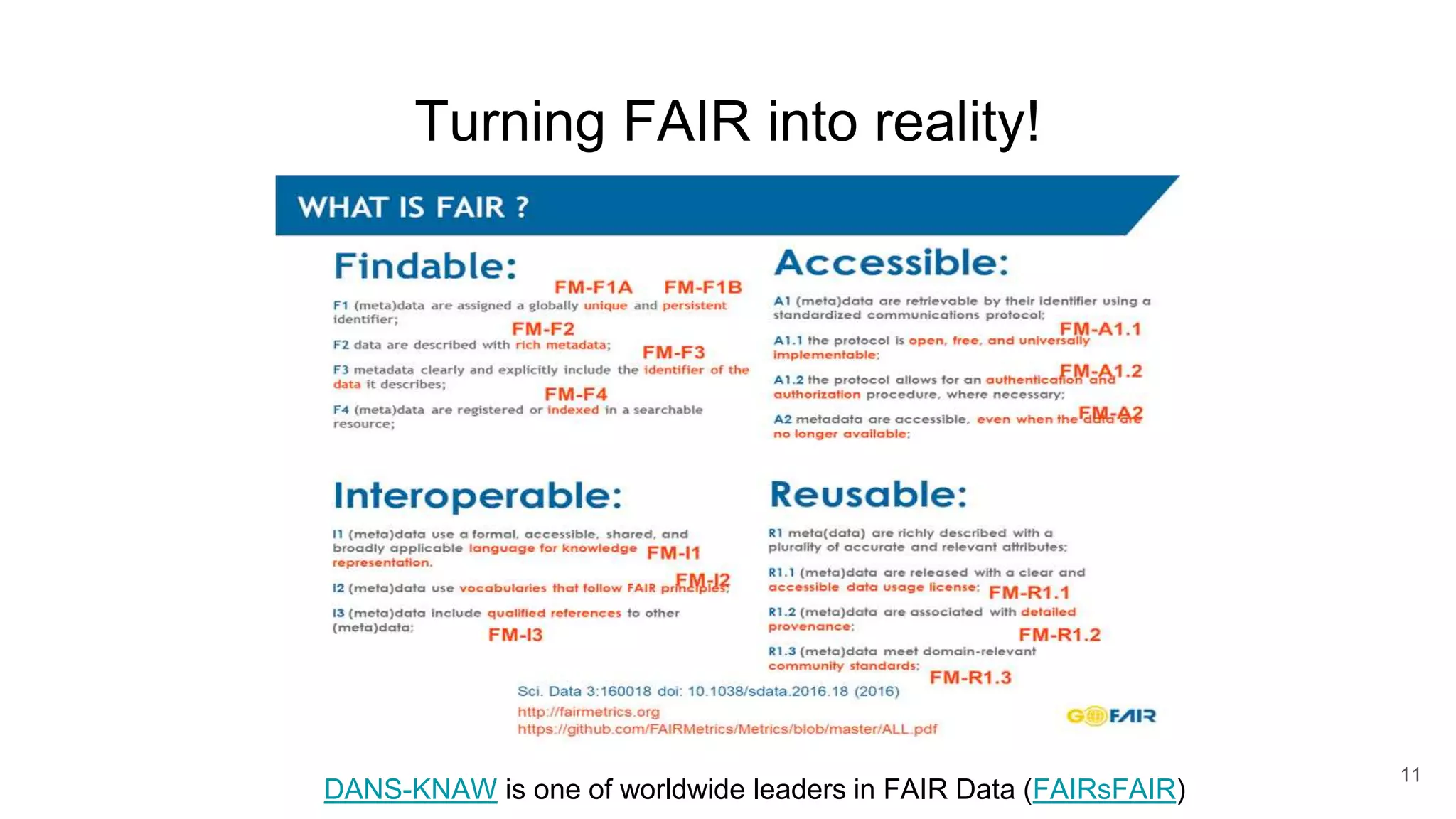
Turning FAIR into reality!
11
DANS-KNAW is one of worldwide leaders in FAIR Data (FAIRsFAIR)
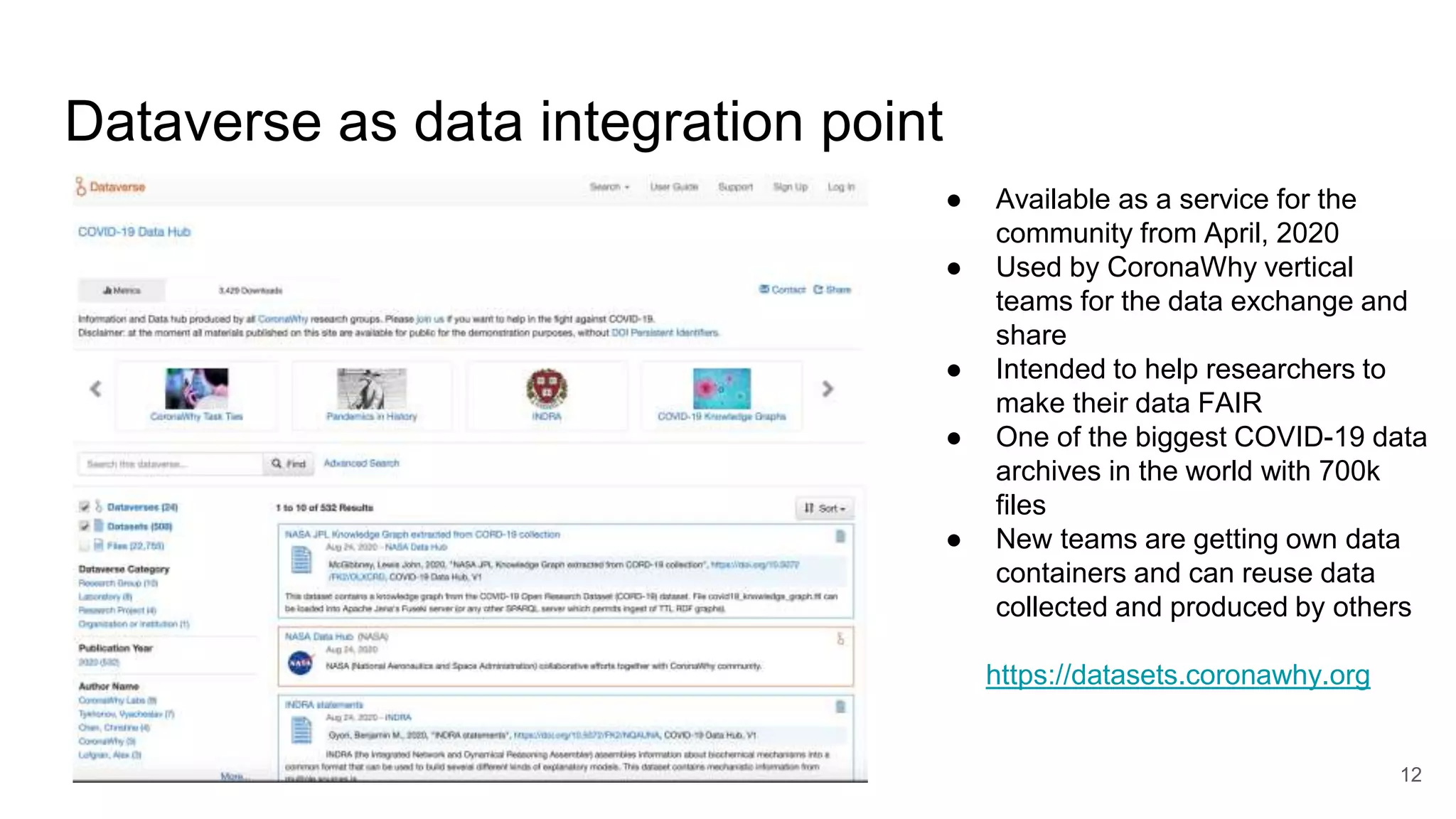
Dataverse as data integration point
12
● Available as a service for the
community from April, 2020
● Used by CoronaWhy vertical
teams for the data exchange and
share
● Intended to help researchers to
make their data FAIR
● One of the biggest COVID-19 data
archives in the world with 700k
files
● New teams are getting own data
containers and can reuse data
collected and produced by others
https://datasets.coronawhy.org
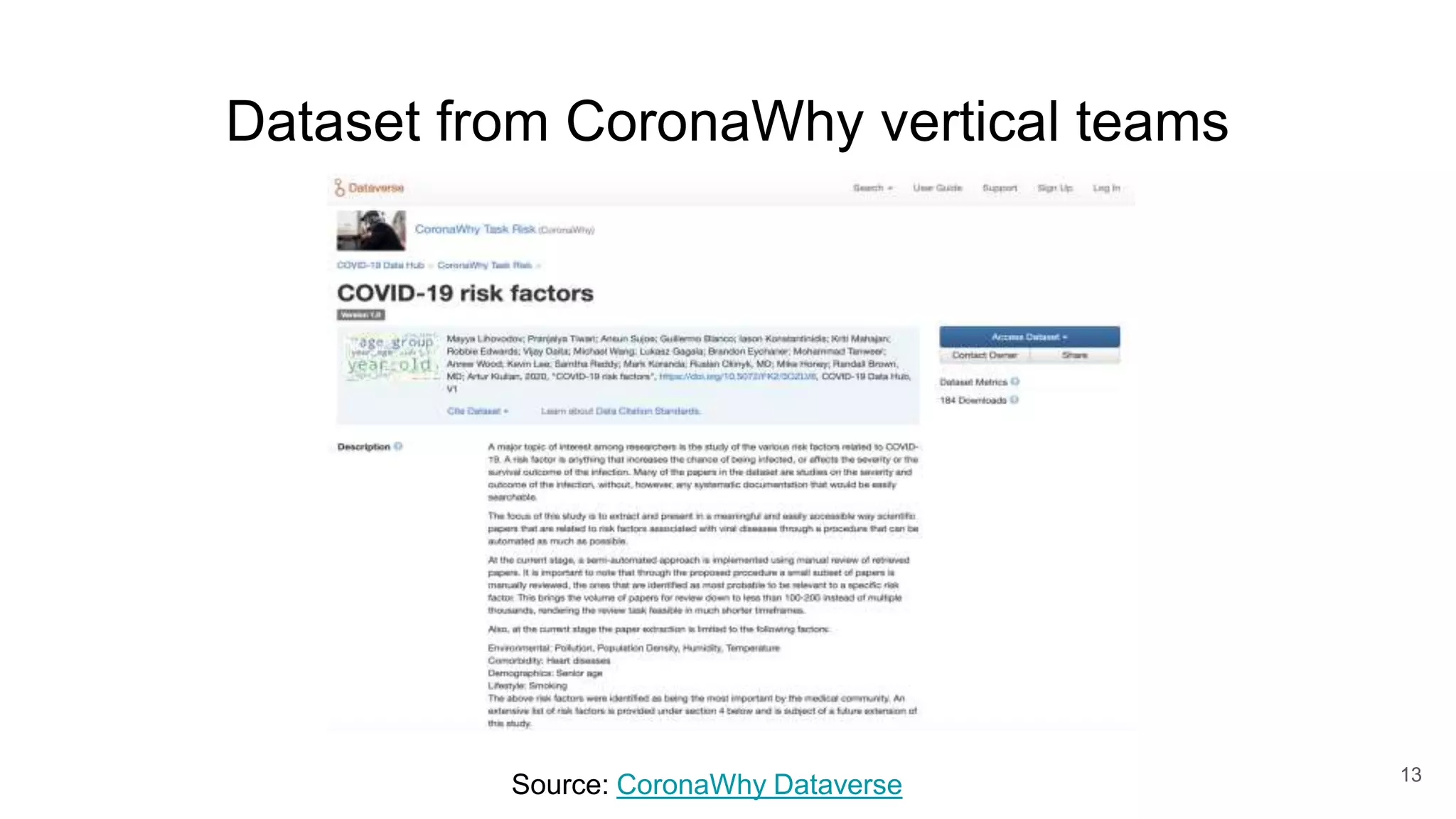
Dataset from CoronaWhy vertical teams
13
Source: CoronaWhy Dataverse
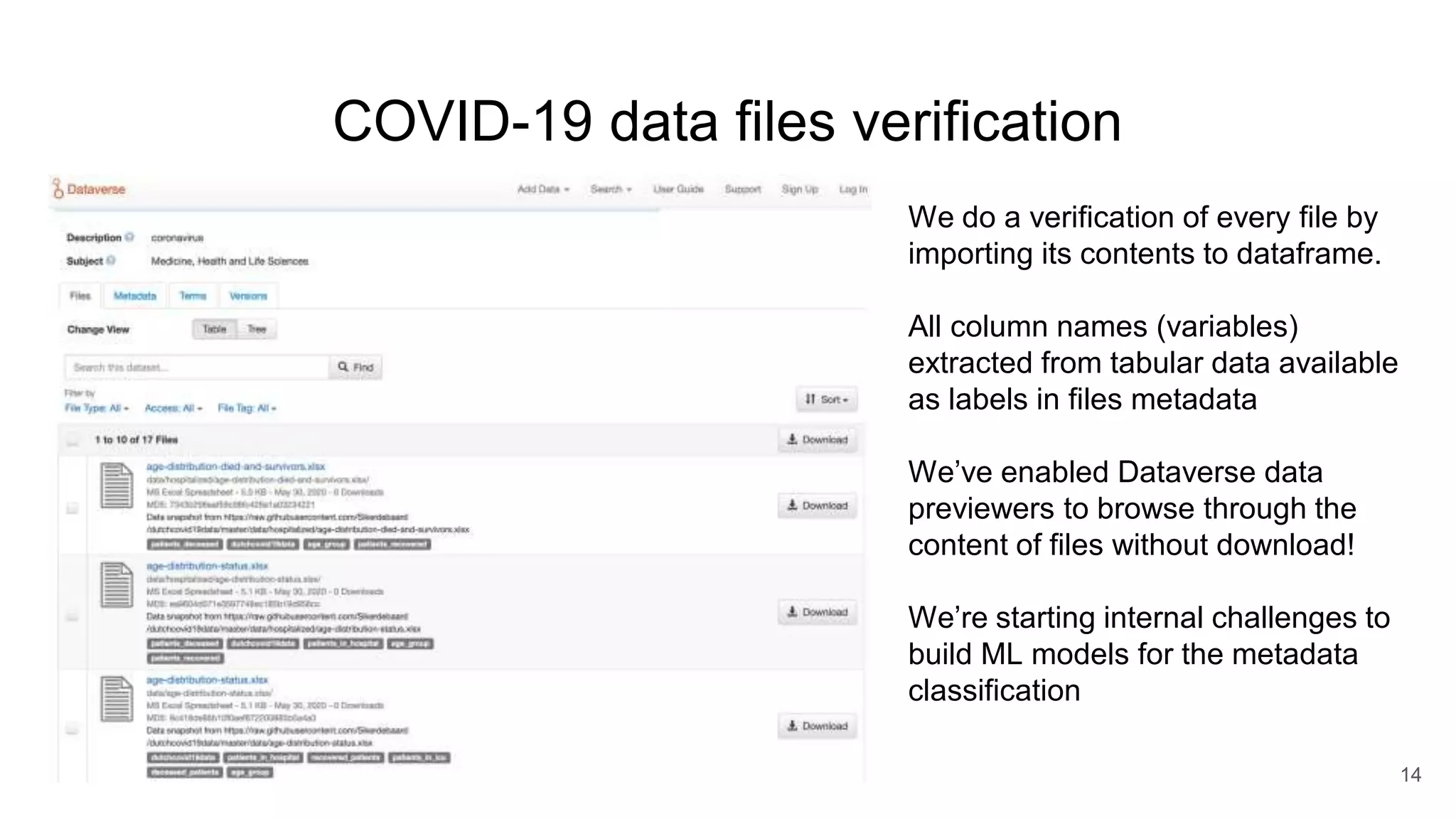
COVID-19 data files verification
14
We do a verification of every file by
importing its contents to dataframe.
All column names (variables)
extracted from tabular data available
as labels in files metadata
We’ve enabled Dataverse data
previewers to browse through the
content of files without download!
We’re starting internal challenges to
build ML models for the metadata
classification
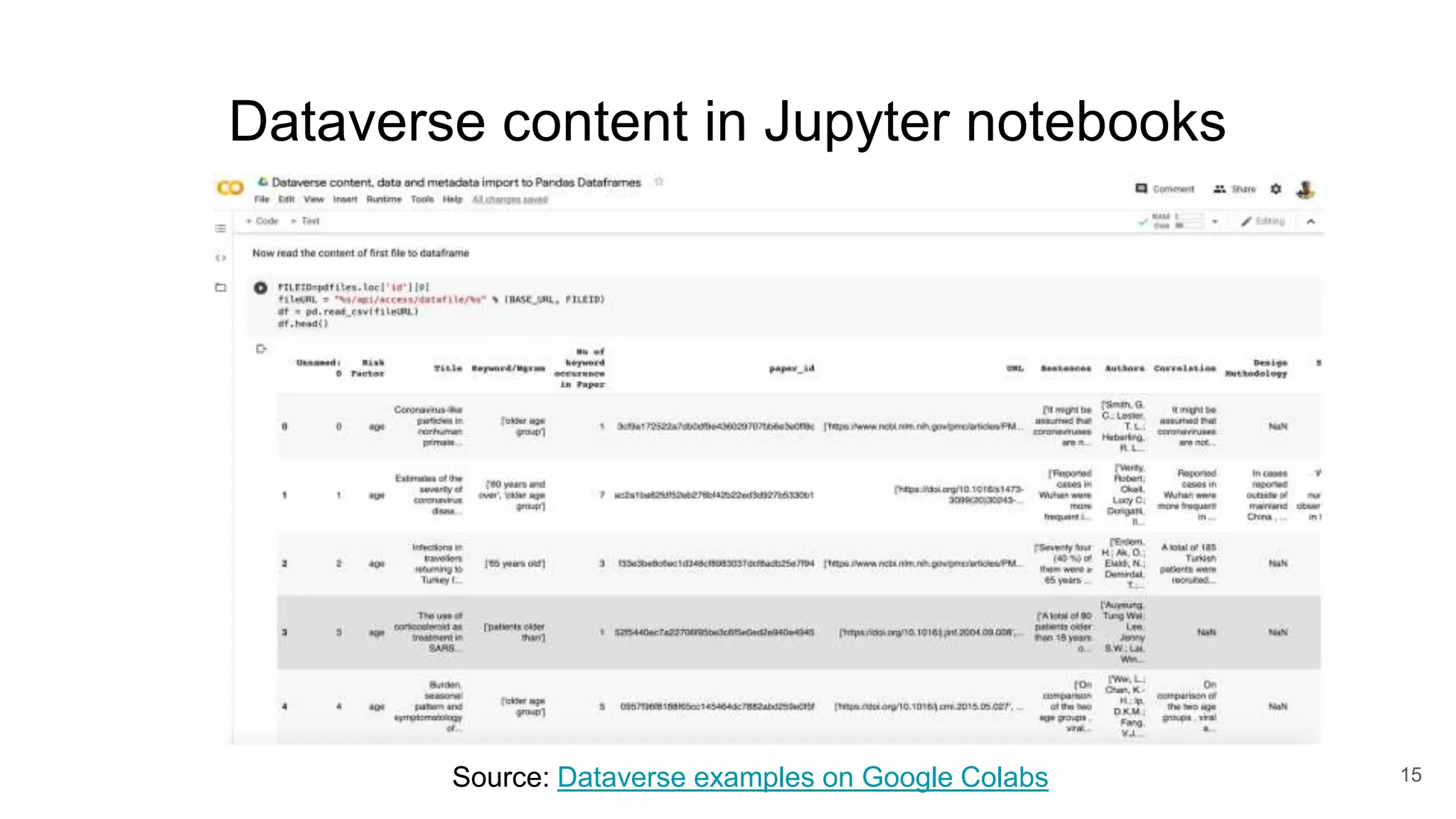
Dataverse content in Jupyter notebooks
15
Source: Dataverse examples on Google Colabs
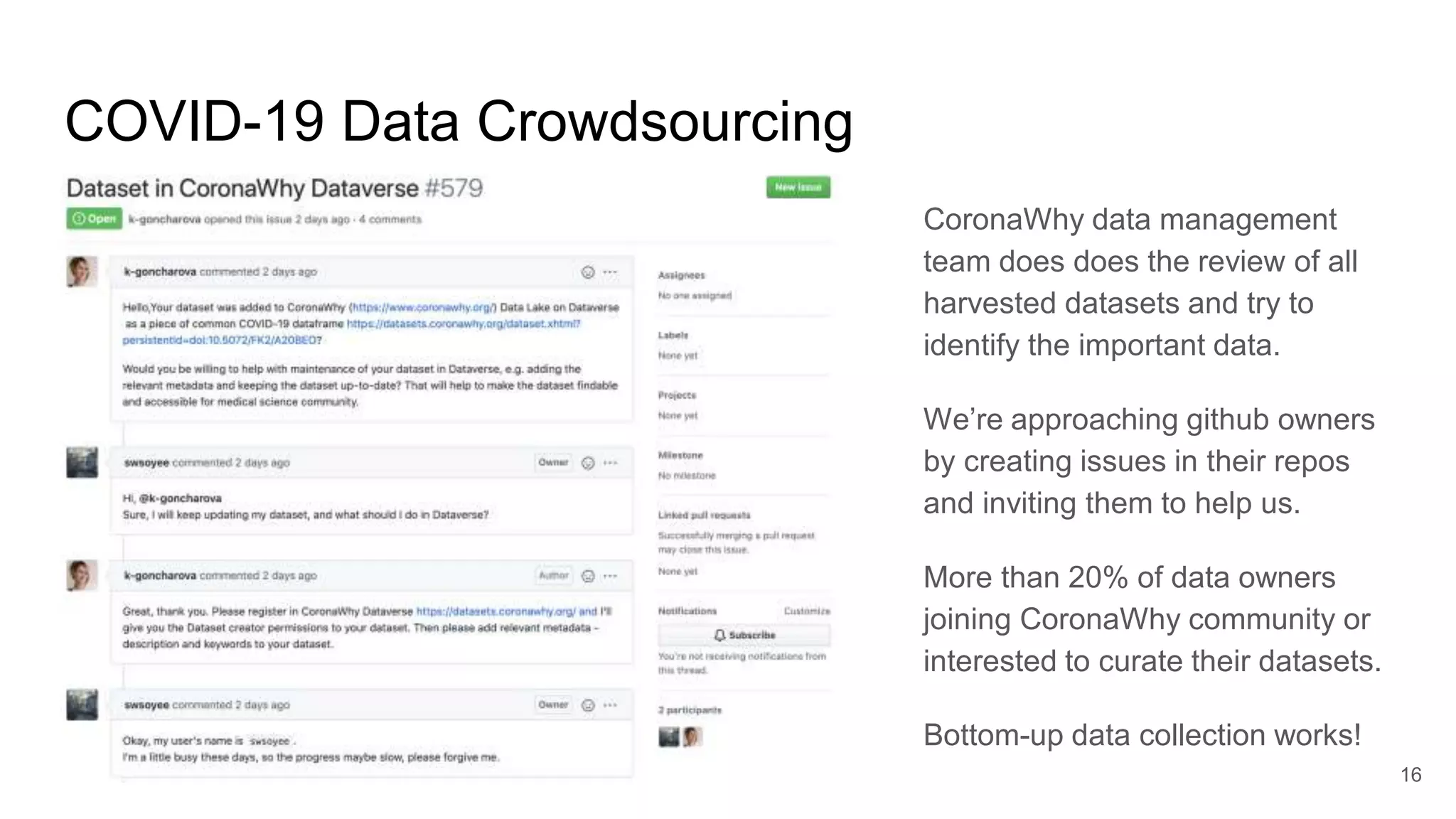
COVID-19 Data Crowdsourcing
CoronaWhy data management
team does does the review of all
harvested datasets and try to
identify the important data.
We’re approaching github owners
by creating issues in their repos
and inviting them to help us.
More than 20% of data owners
joining CoronaWhy community or
interested to curate their datasets.
Bottom-up data collection works!
16
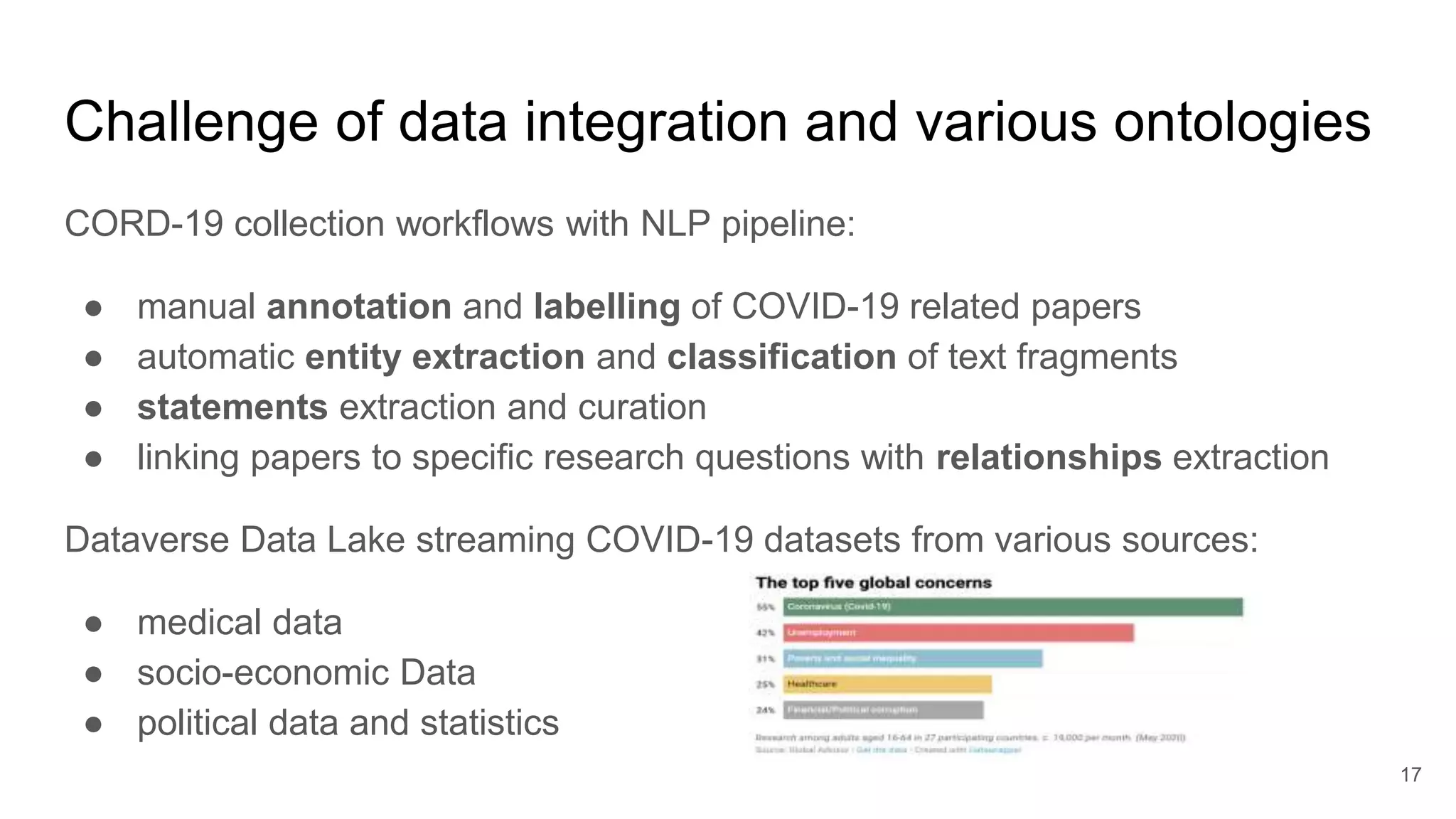
Challenge of data integration and various ontologies
CORD-19 collection workflows with NLP pipeline:
● manual annotation and labelling of COVID-19 related papers
● automatic entity extraction and classification of text fragments
● statements extraction and curation
● linking papers to specific research questions with relationships extraction
Dataverse Data Lake streaming COVID-19 datasets from various sources:
● medical data
● socio-economic Data
● political data and statistics
17
The importance of standards and ontologies
Generic controlled vocabularies to link metadata in the bibliographic collections are well
known: ORCID, GRID, GeoNames, Getty.
Medical knowledge graphs powered by:
● Biological Expression Language (BEL)
● Medical Subject Headings (MeSH®) by U.S. National Library of Medicine (NIH)
● Wikidata (Open ontology) - Wikipedia
Integration based on metadata standards:
● MARC21, Dublin Core (DC), Data Documentation Initiative (DDI)
18
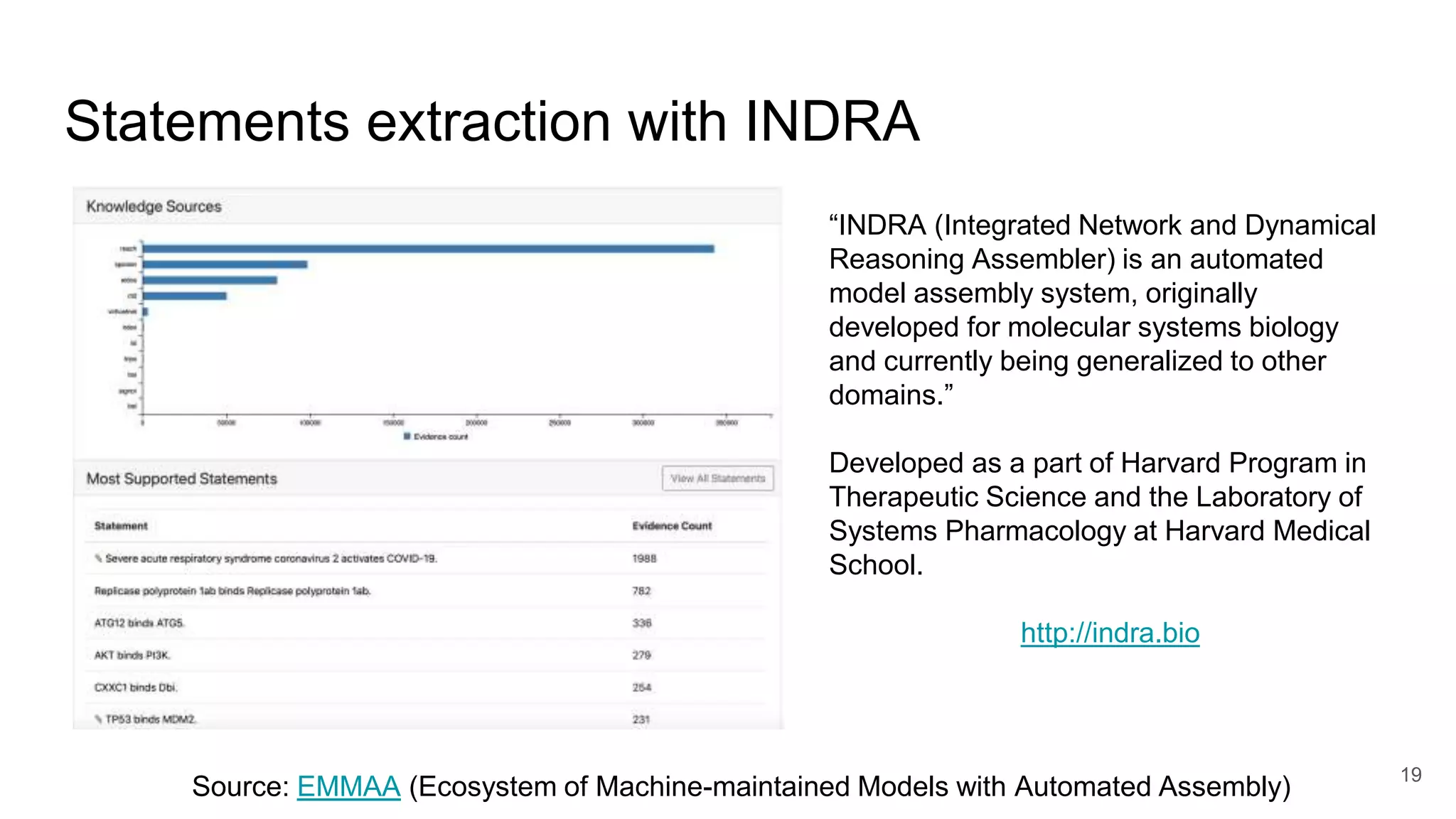
Statements extraction with INDRA
19
Source: EMMAA (Ecosystem of Machine-maintained Models with Automated Assembly)
“INDRA (Integrated Network and Dynamical
Reasoning Assembler) is an automated
model assembly system, originally
developed for molecular systems biology
and currently being generalized to other
domains.”
Developed as a part of Harvard Program in
Therapeutic Science and the Laboratory of
Systems Pharmacology at Harvard Medical
School.
http://indra.bio
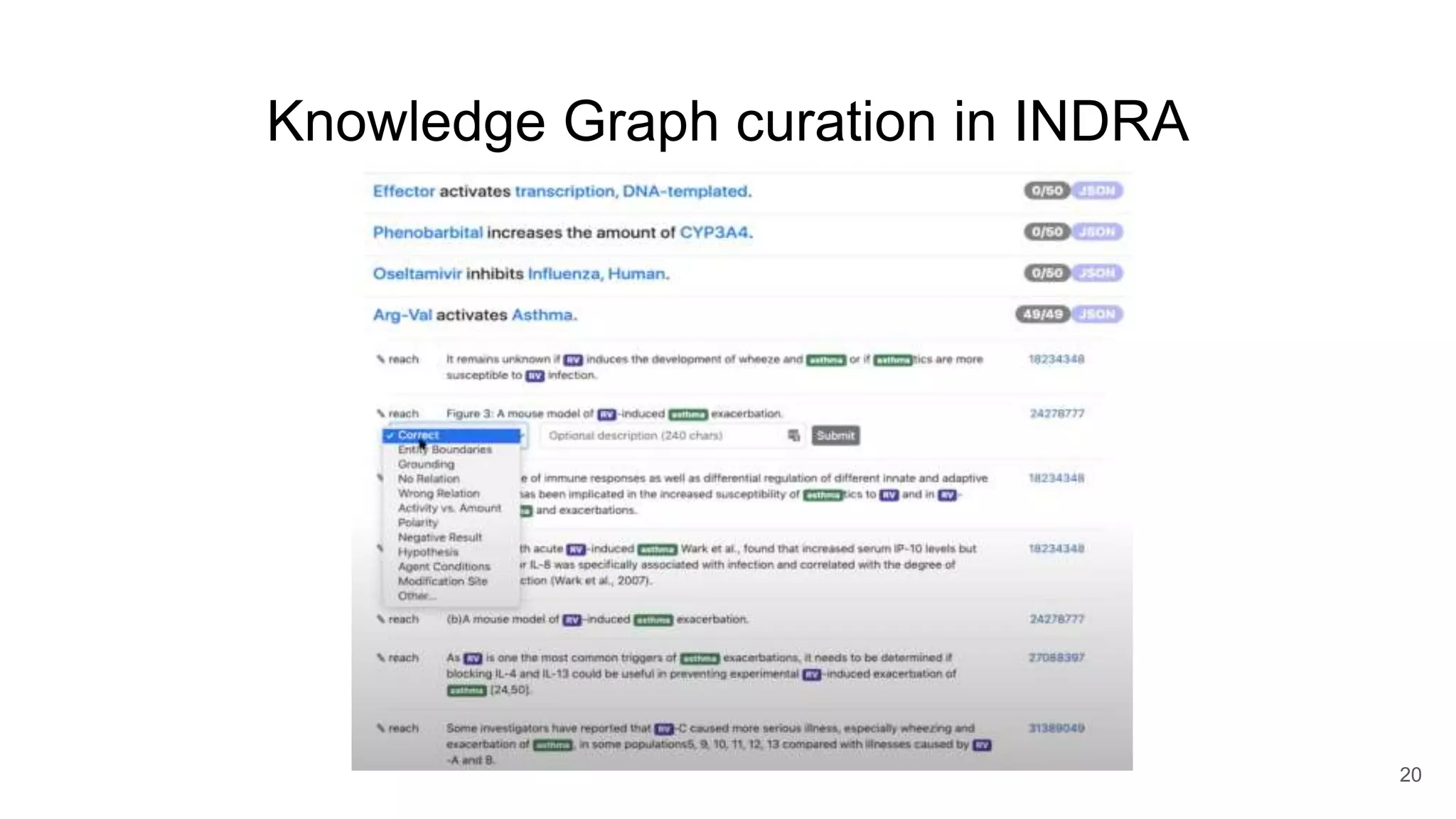
Knowledge Graph curation in INDRA
20
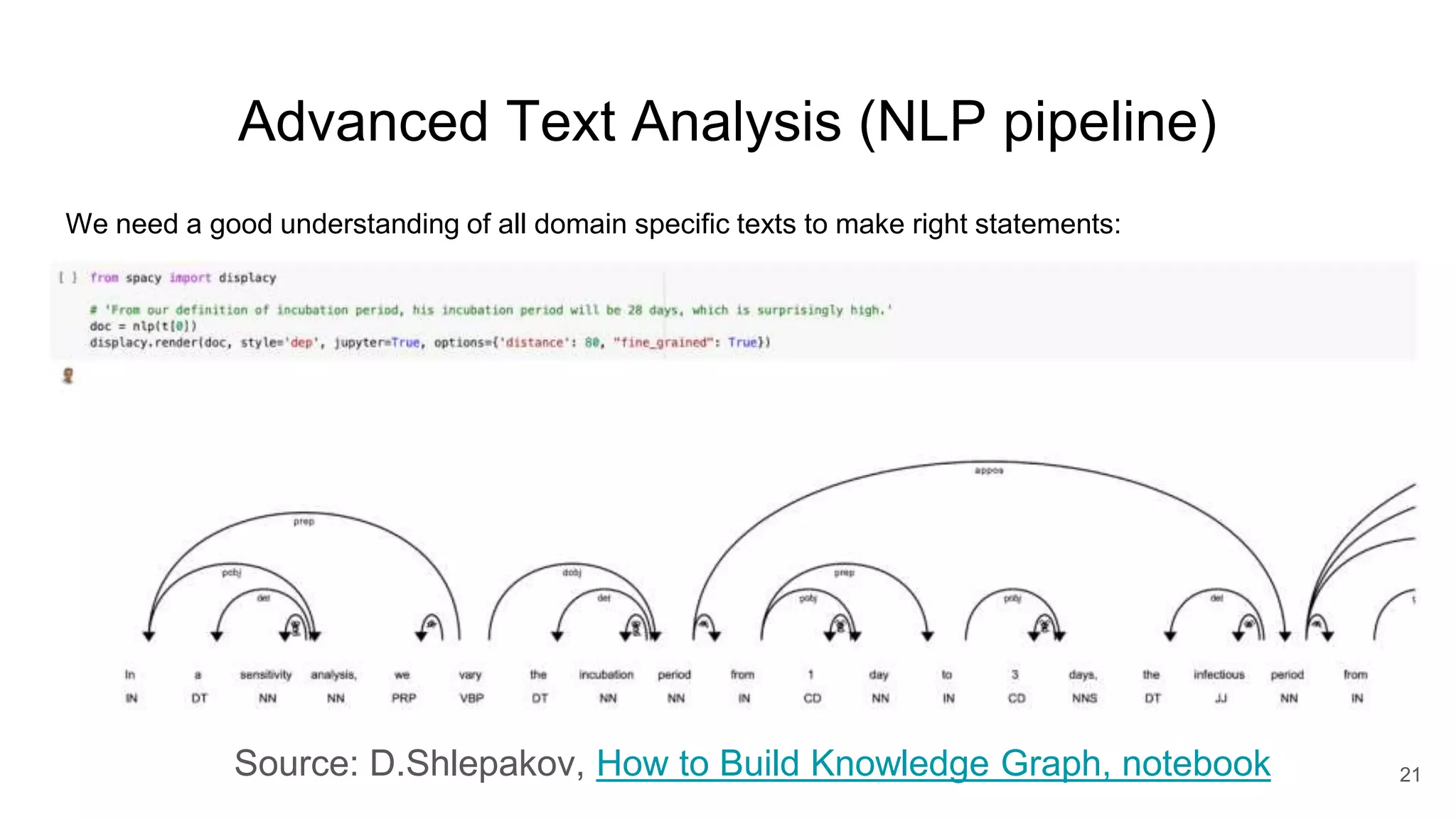
Advanced Text Analysis (NLP pipeline)
Source: D.Shlepakov, How to Build Knowledge Graph, notebook
We need a good understanding of all domain specific texts to make right statements:
21
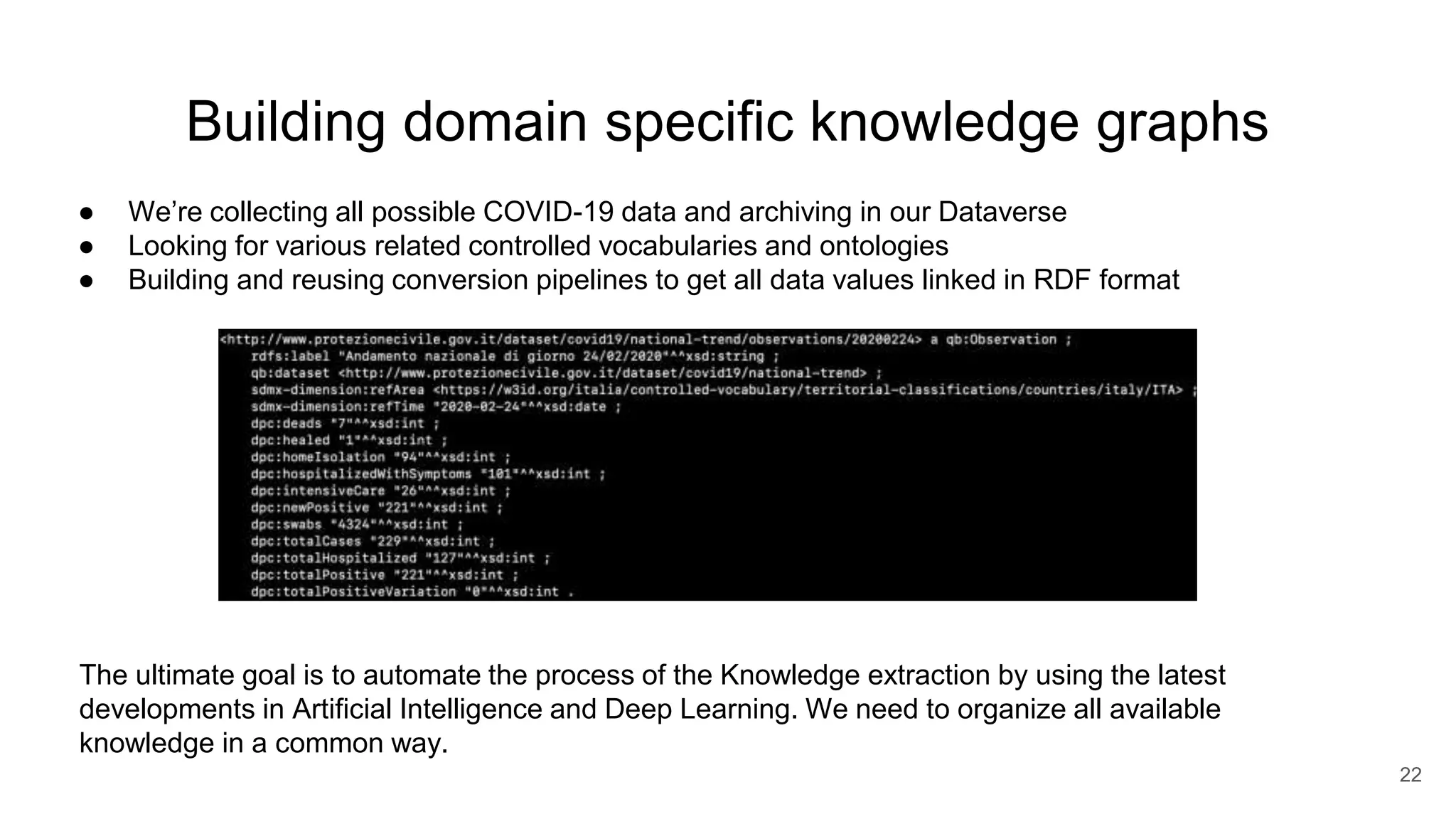
Building domain specific knowledge graphs
● We’re collecting all possible COVID-19 data and archiving in our Dataverse
● Looking for various related controlled vocabularies and ontologies
● Building and reusing conversion pipelines to get all data values linked in RDF format
The ultimate goal is to automate the process of the Knowledge extraction by using the latest
developments in Artificial Intelligence and Deep Learning. We need to organize all available
knowledge in a common way.
22
Simple Knowledge Organization System (SKOS)
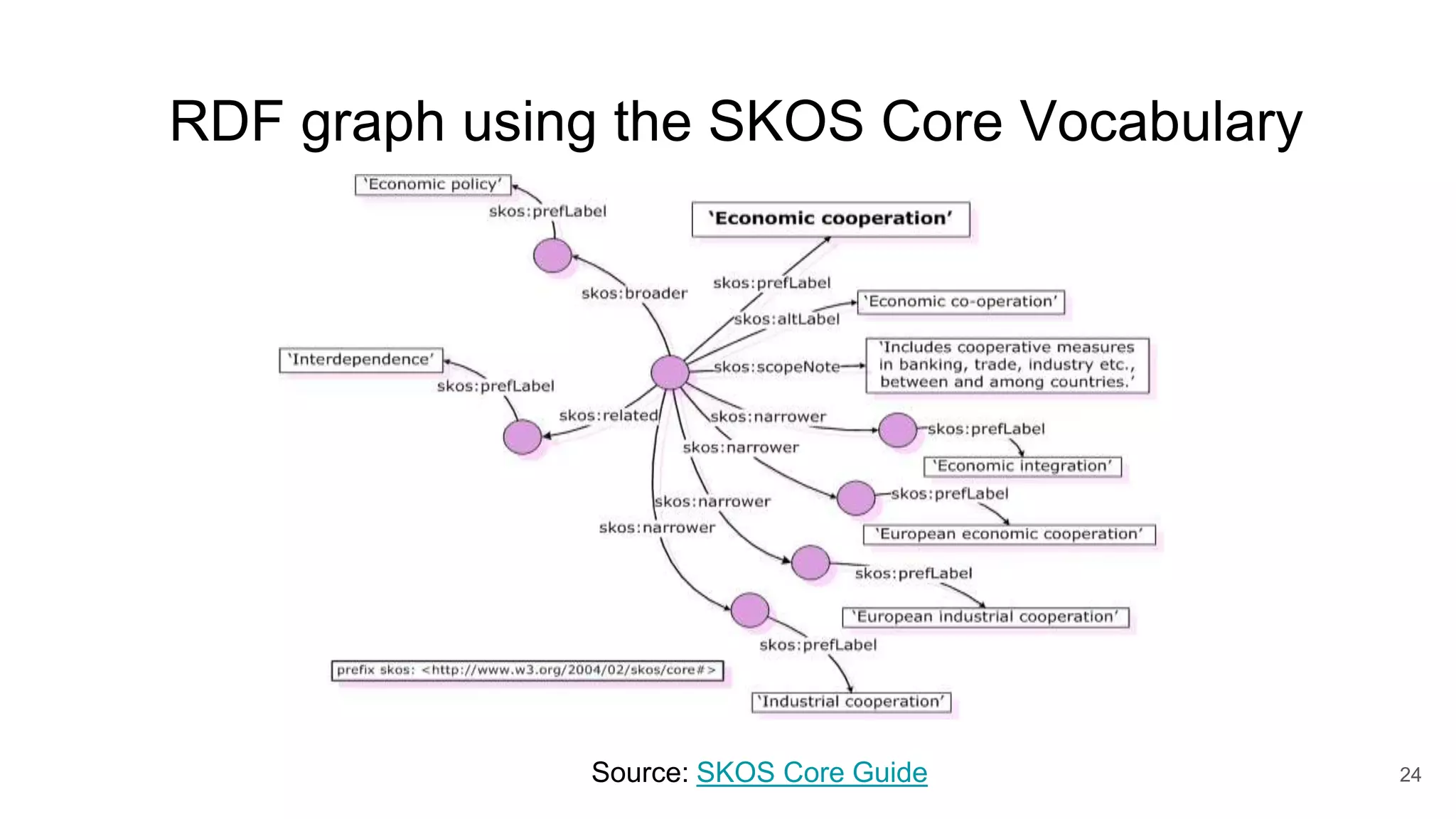
SKOS models a thesauri-like resources:
- skos:Concepts with preferred labels and alternative labels (synonyms) attached to them
(skos:prefLabel, skos:altLabel).
- skos:Concept can be related with skos:broader, skos:narrower and skos:related properties.
- terms and concepts could have more than one broader term and concept.
SKOS allows to create a semantic layer on top of objects, a network with statements and relationships.
A major difference of SKOS is logical “is-a hierarchies”. In thesauri the hierarchical relation can represent
anything from “is-a” to “part-of”.
23
RDF graph using the SKOS Core Vocabulary
24
Source: SKOS Core Guide
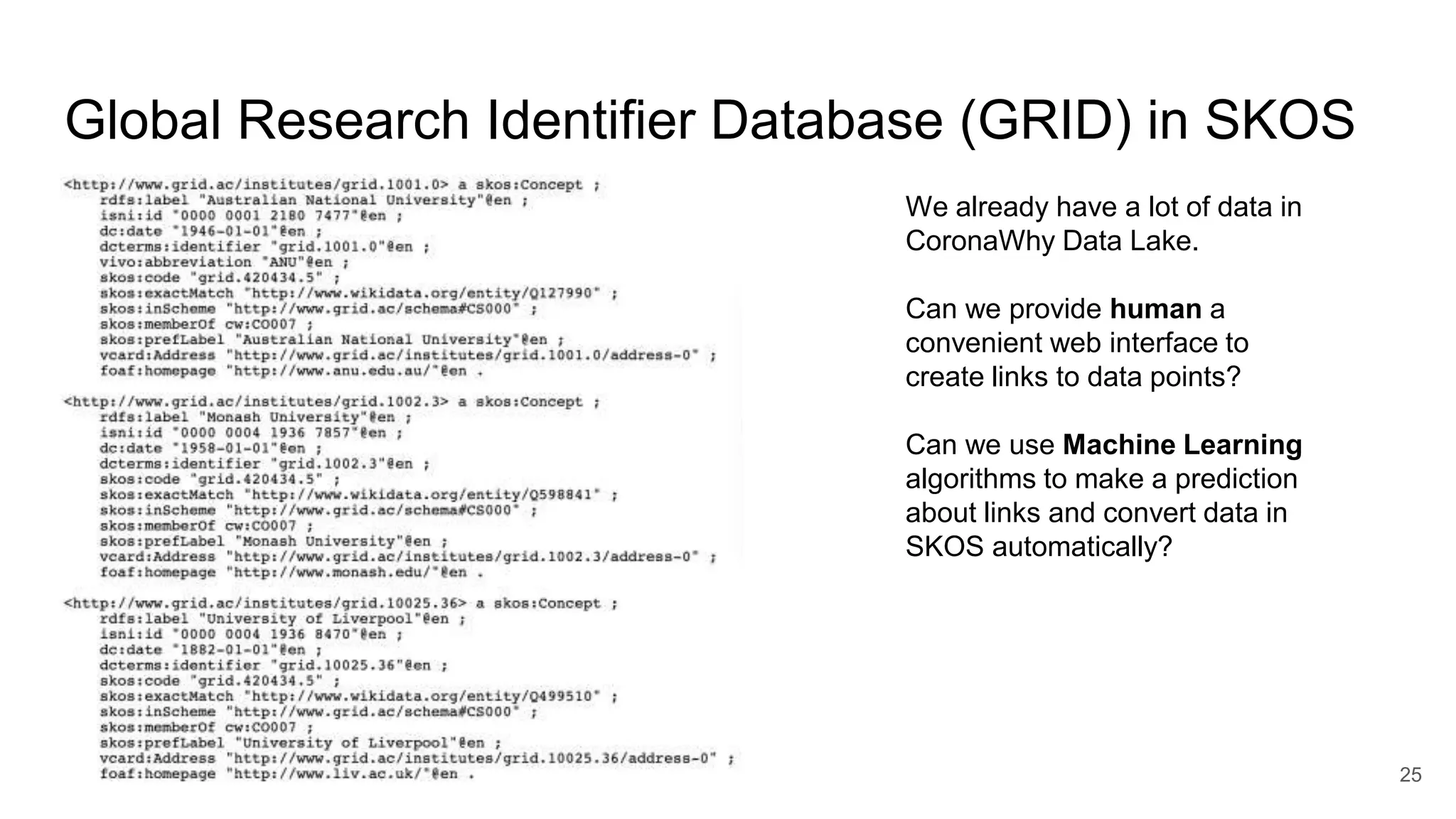
Global Research Identifier Database (GRID) in SKOS
25
We already have a lot of data in
CoronaWhy Data Lake.
Can we provide human a
convenient web interface to
create links to data points?
Can we use Machine Learning
algorithms to make a prediction
about links and convert data in
SKOS automatically?
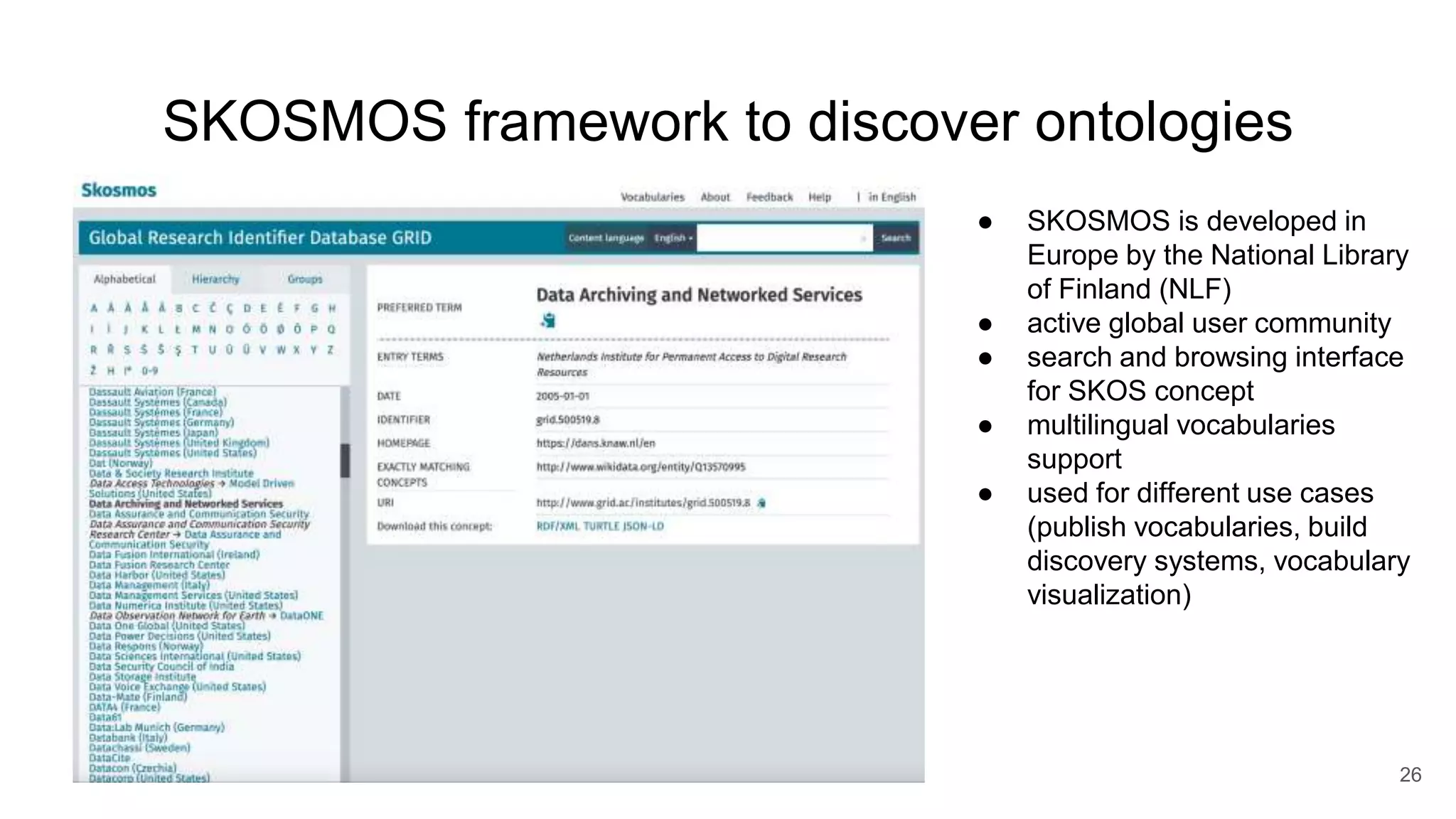
SKOSMOS framework to discover ontologies
26
● SKOSMOS is developed in
Europe by the National Library
of Finland (NLF)
● active global user community
● search and browsing interface
for SKOS concept
● multilingual vocabularies
support
● used for different use cases
(publish vocabularies, build
discovery systems, vocabulary
visualization)
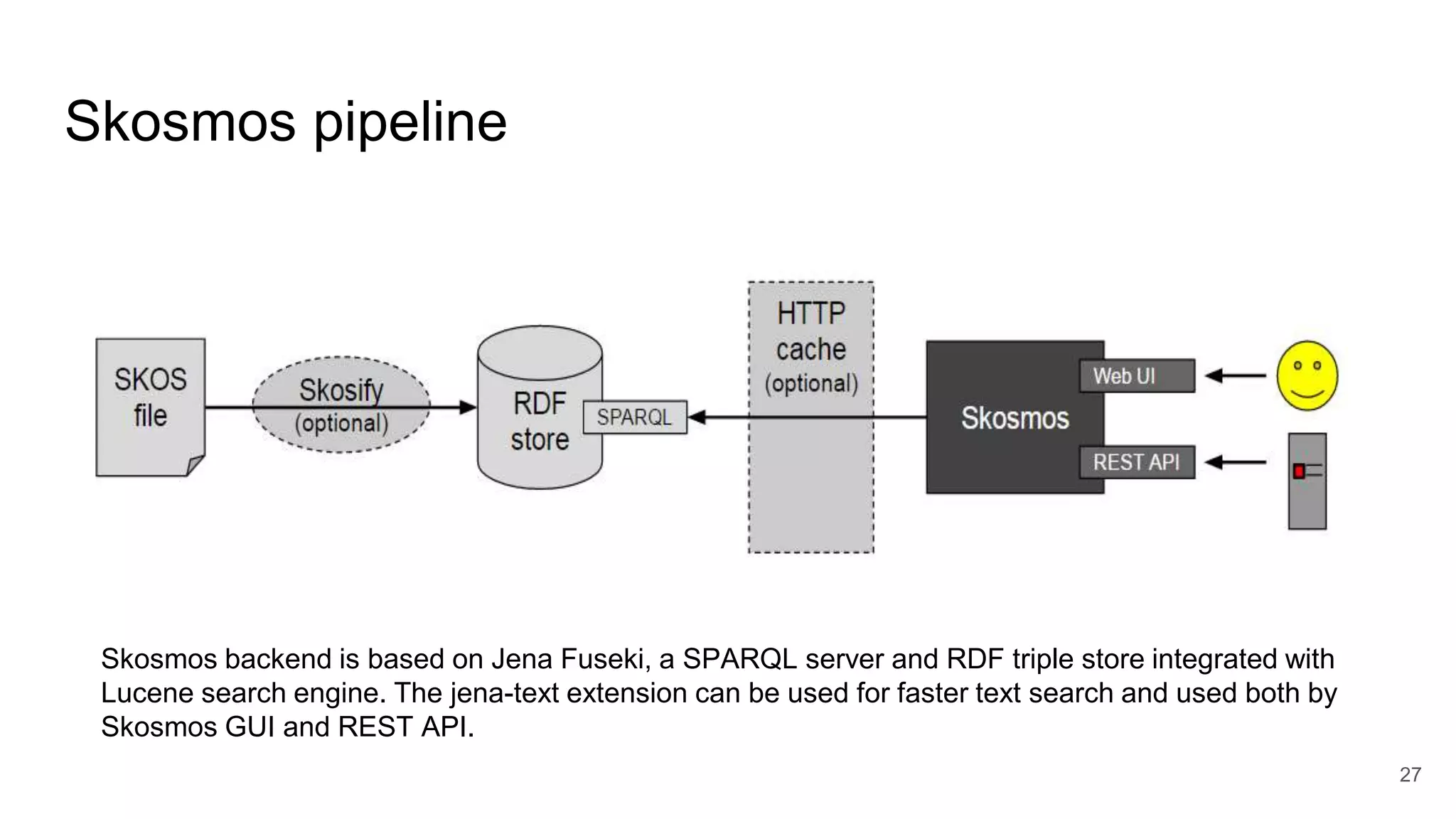
Skosmos pipeline
27
Skosmos backend is based on Jena Fuseki, a SPARQL server and RDF triple store integrated with
Lucene search engine. The jena-text extension can be used for faster text search and used both by
Skosmos GUI and REST API.
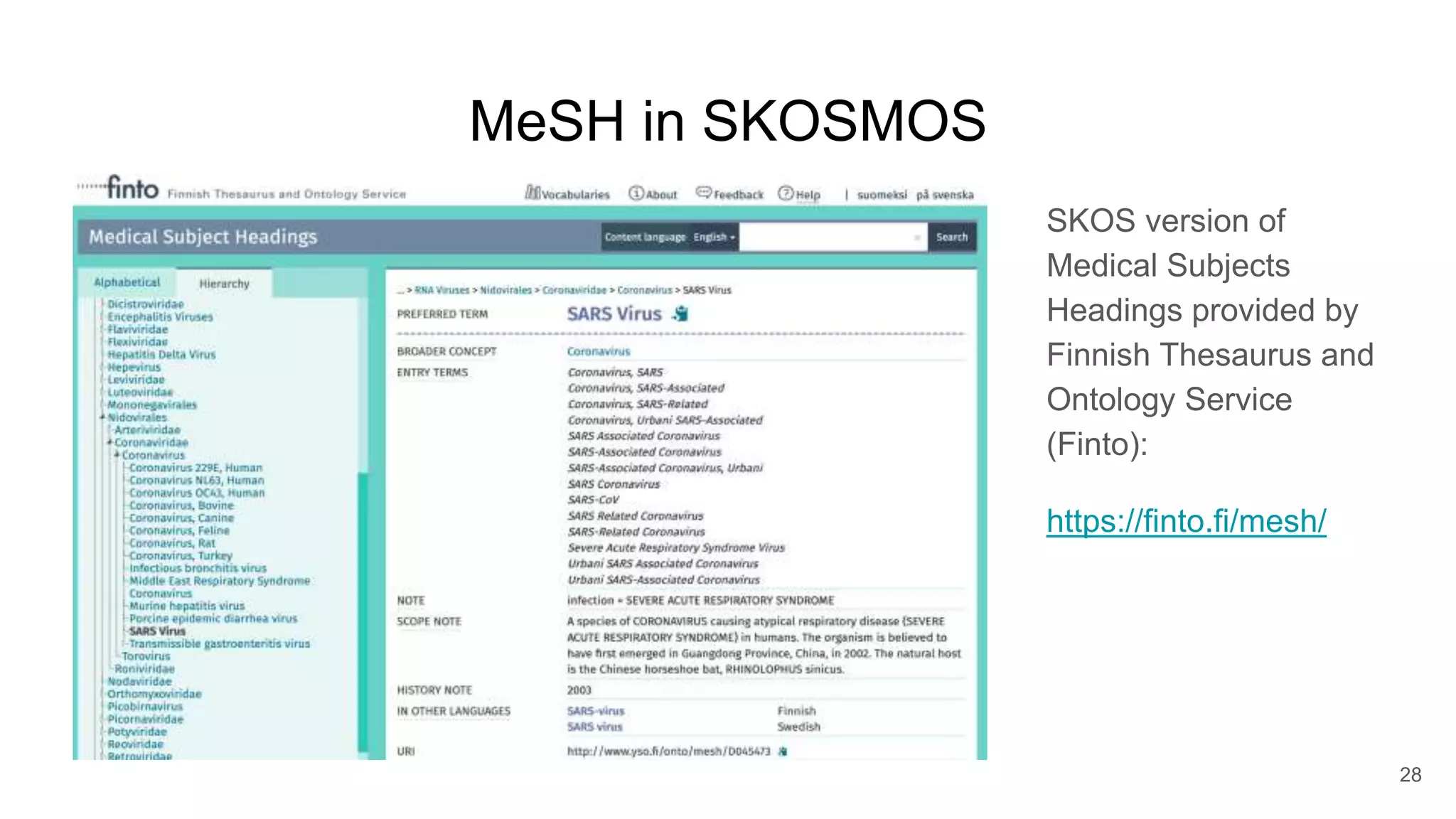
MeSH in SKOSMOS
SKOS version of
Medical Subjects
Headings provided by
Finnish Thesaurus and
Ontology Service
(Finto):
https://finto.fi/mesh/
28
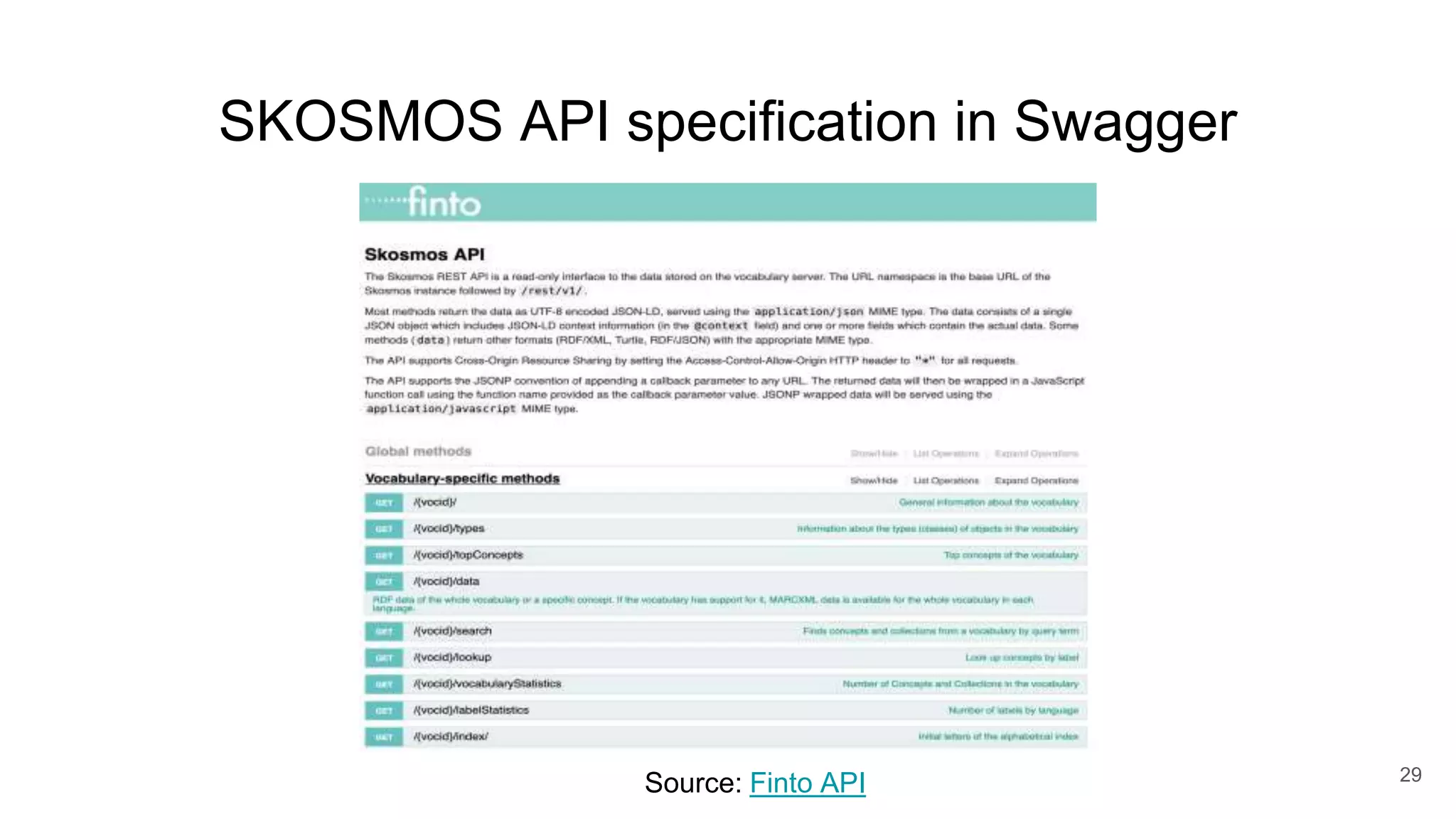
SKOSMOS API specification in Swagger
29
Source: Finto API
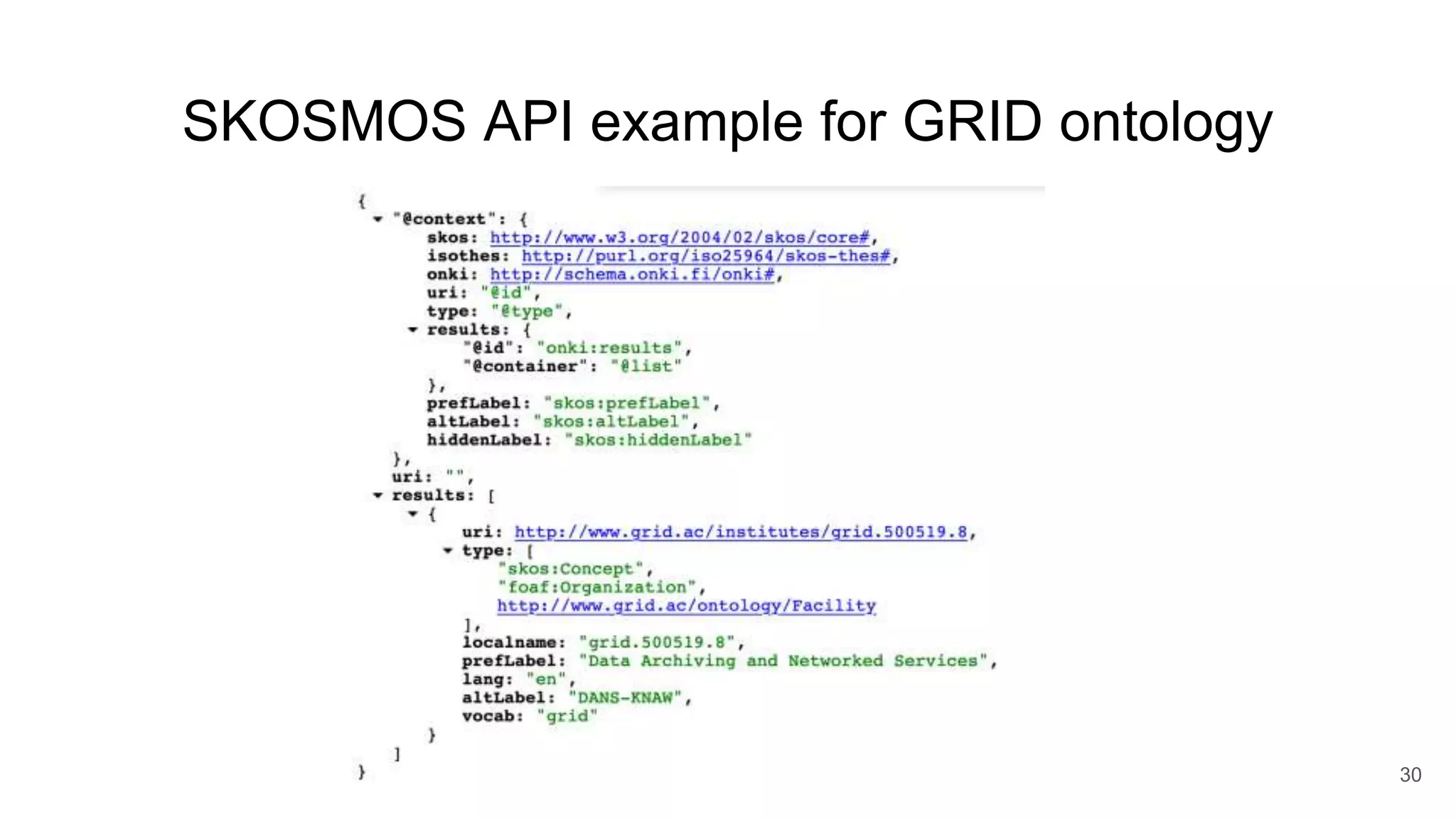
SKOSMOS API example for GRID ontology
30
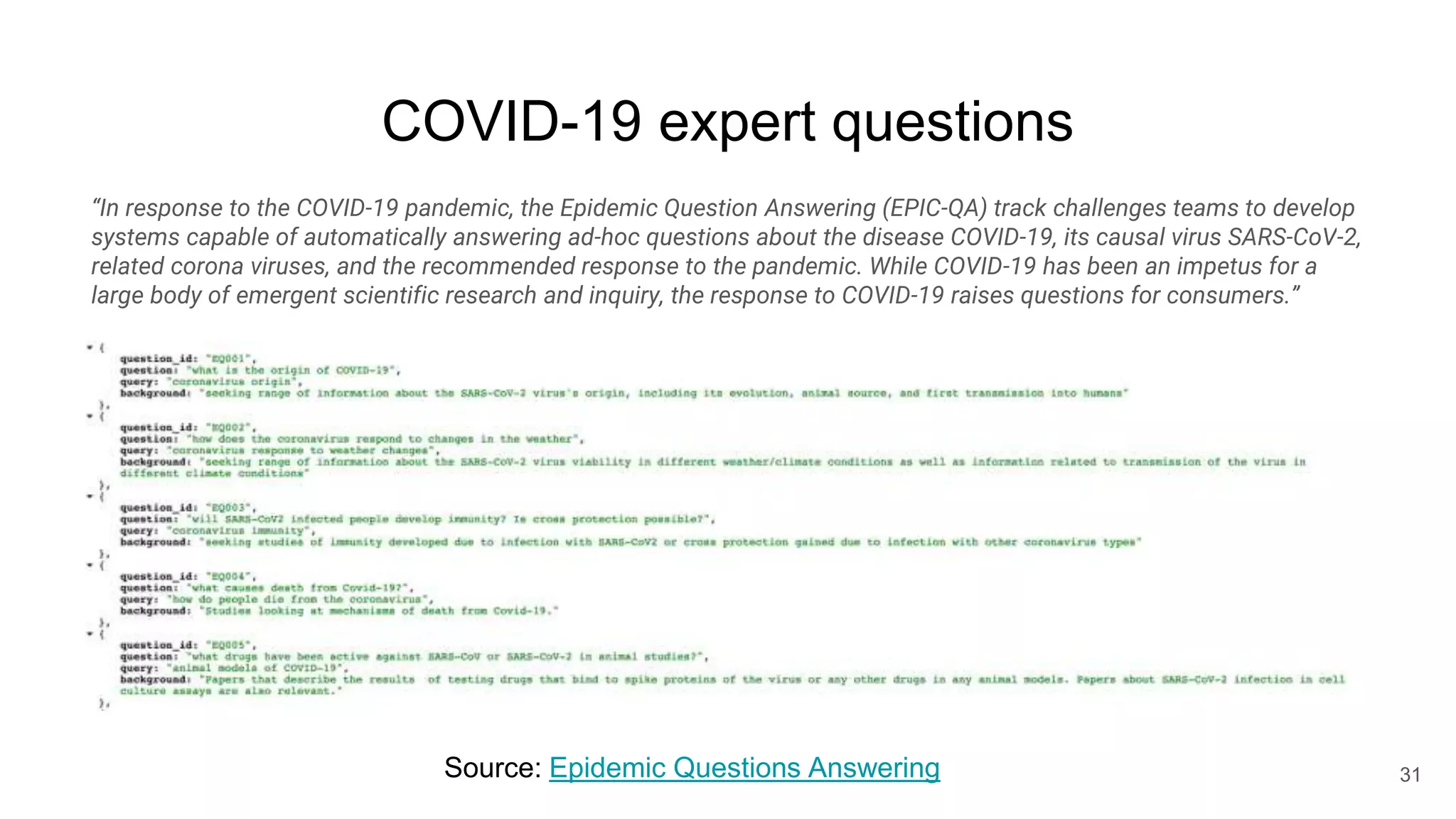
COVID-19 expert questions
31
Source: Epidemic Questions Answering
“In response to the COVID-19 pandemic, the Epidemic Question Answering (EPIC-QA) track challenges teams to develop
systems capable of automatically answering ad-hoc questions about the disease COVID-19, its causal virus SARS-CoV-2,
related corona viruses, and the recommended response to the pandemic. While COVID-19 has been an impetus for a
large body of emergent scientific research and inquiry, the response to COVID-19 raises questions for consumers.”
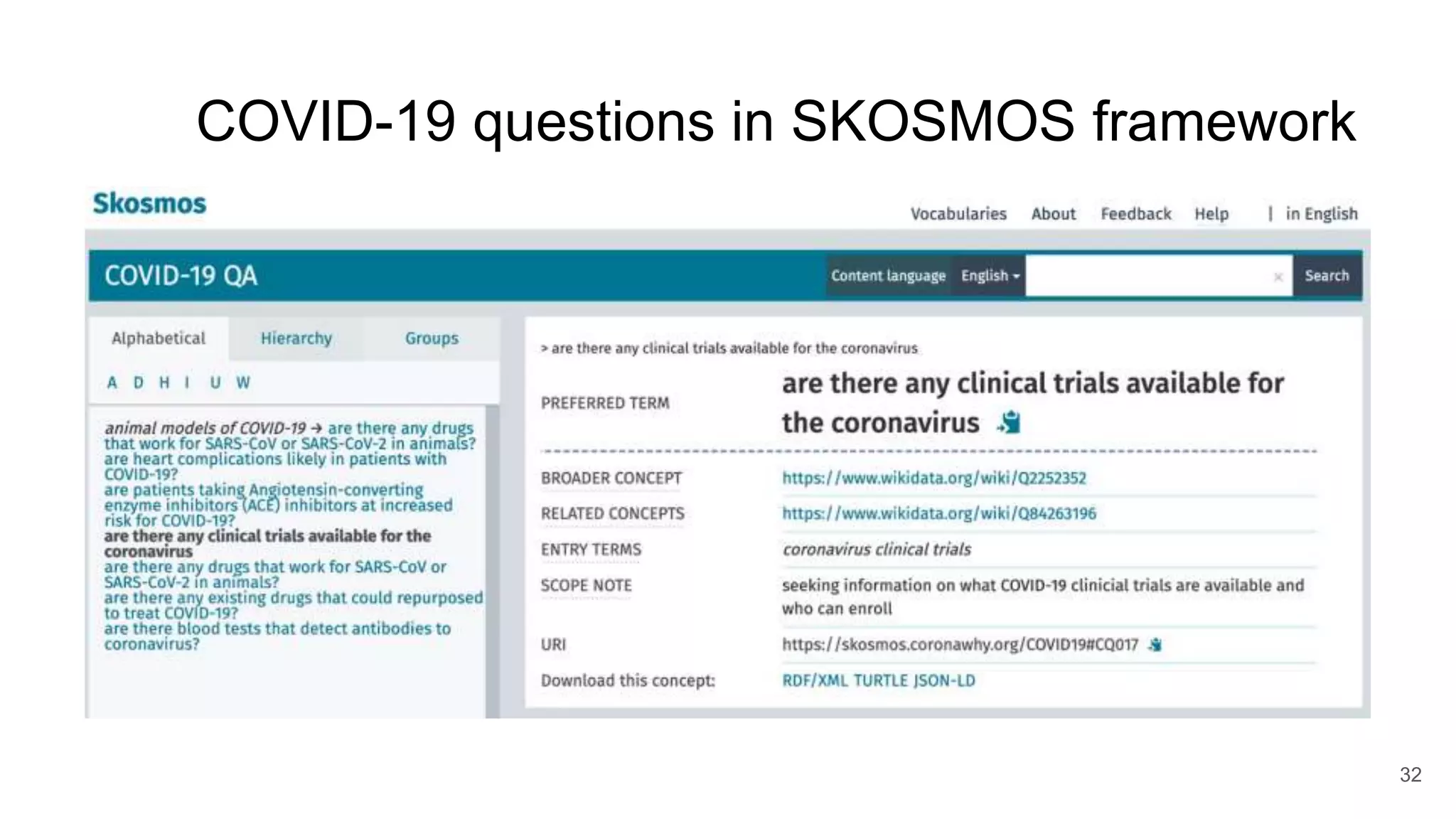
COVID-19 questions in SKOSMOS framework
32
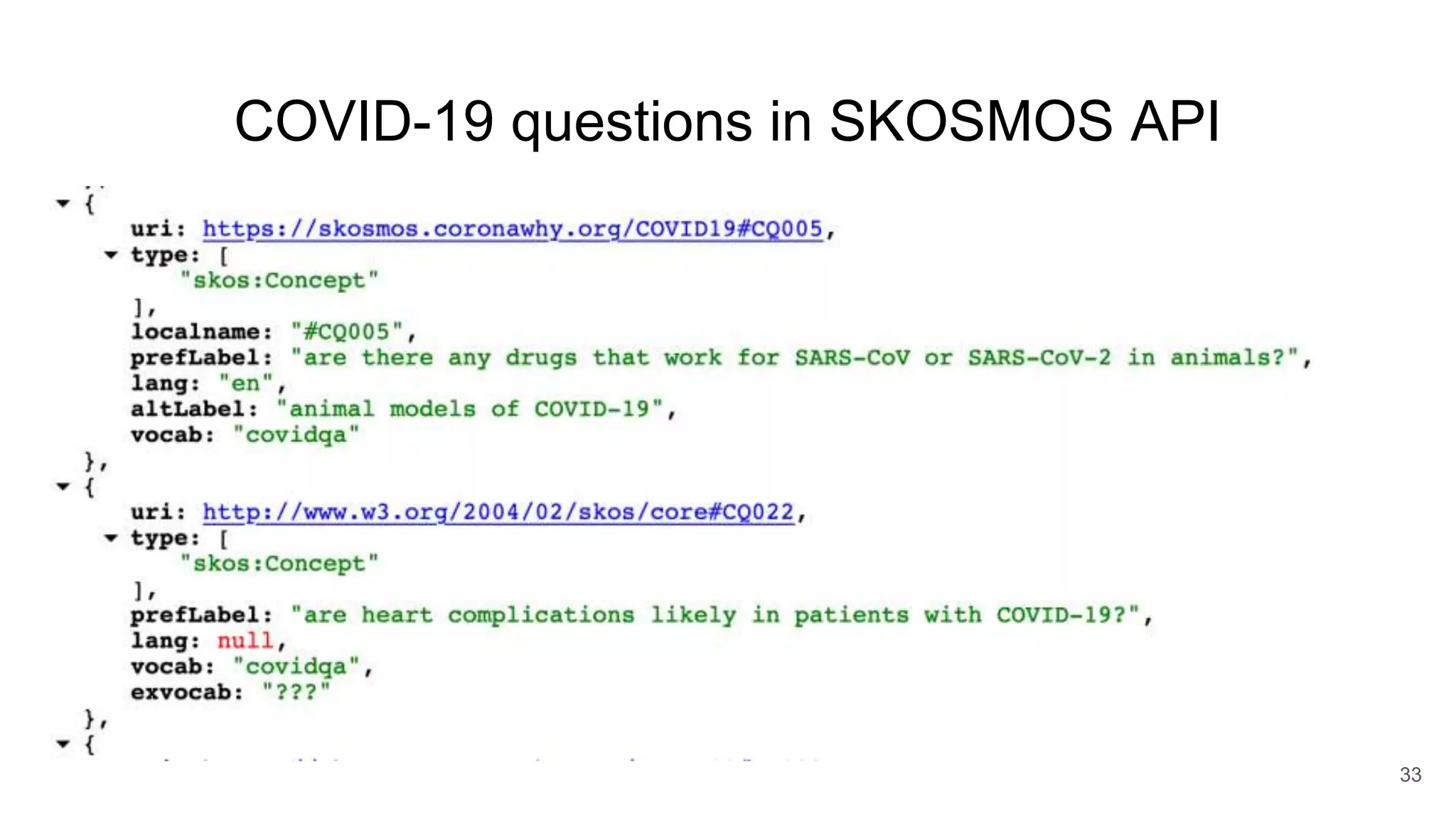
COVID-19 questions in SKOSMOS API
33
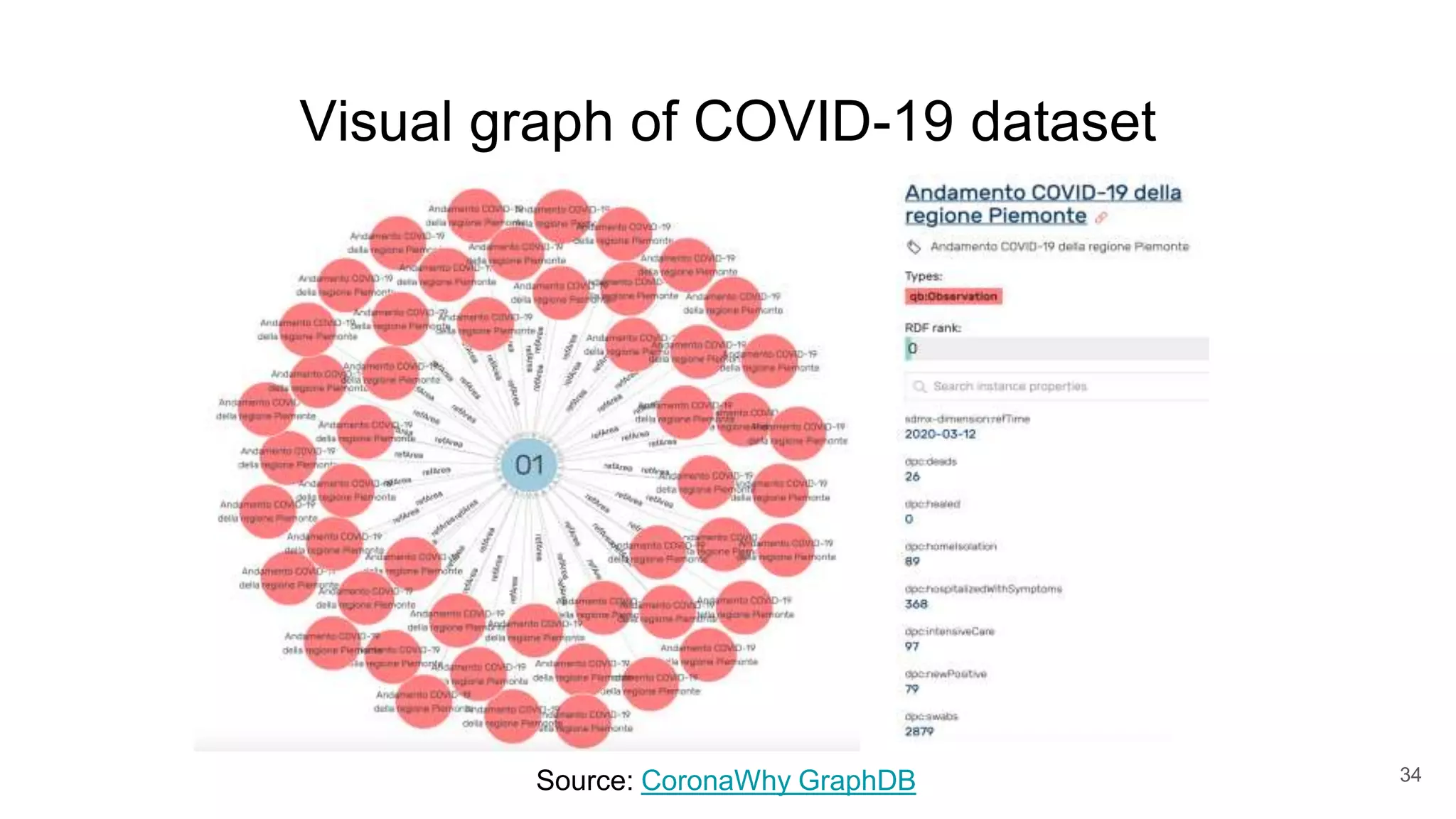
Visual graph of COVID-19 dataset
34
Source: CoronaWhy GraphDB
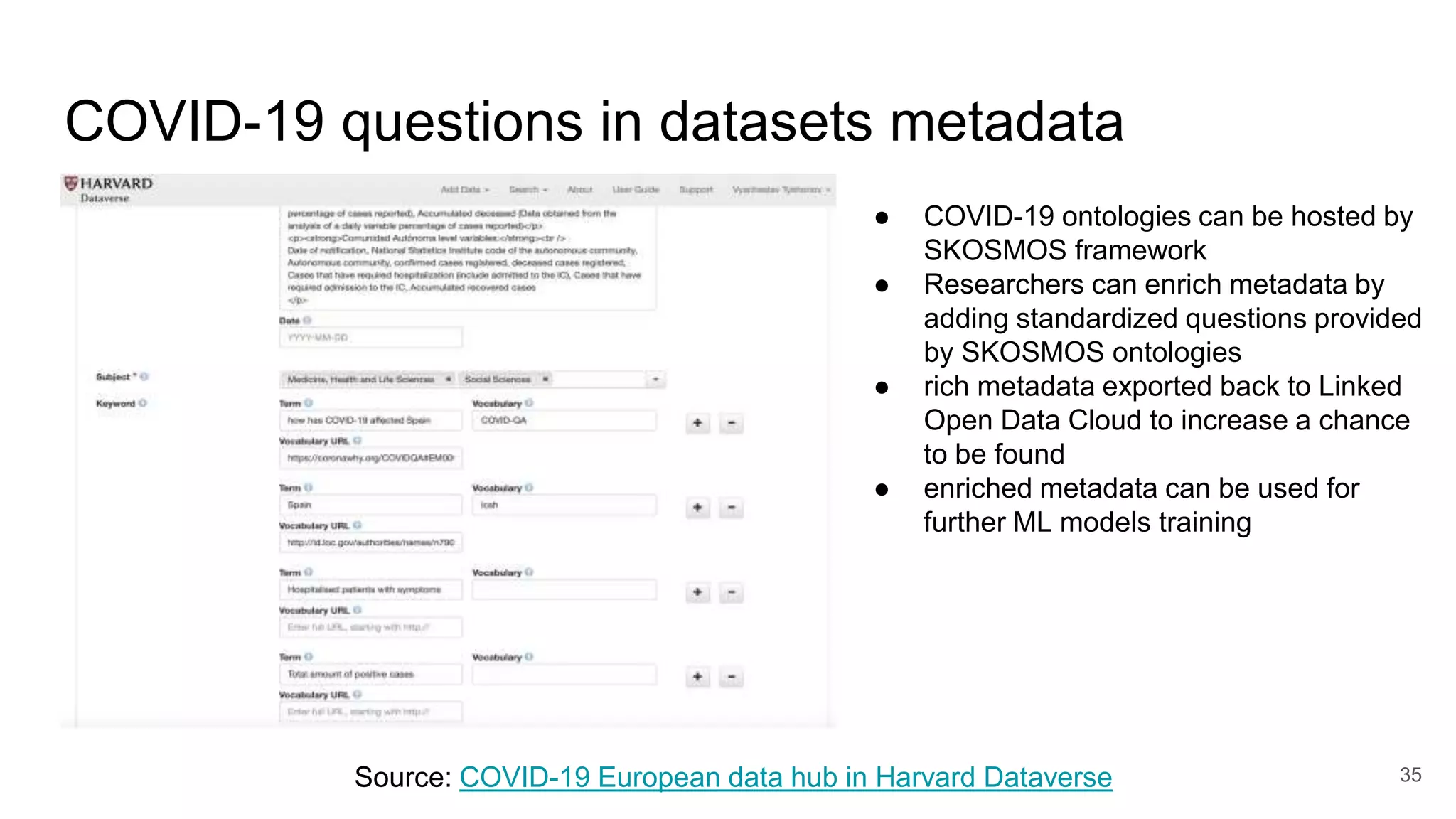
COVID-19 questions in datasets metadata
35
Source: COVID-19 European data hub in Harvard Dataverse
● COVID-19 ontologies can be hosted by
SKOSMOS framework
● Researchers can enrich metadata by
adding standardized questions provided
by SKOSMOS ontologies
● rich metadata exported back to Linked
Open Data Cloud to increase a chance
to be found
● enriched metadata can be used for
further ML models training
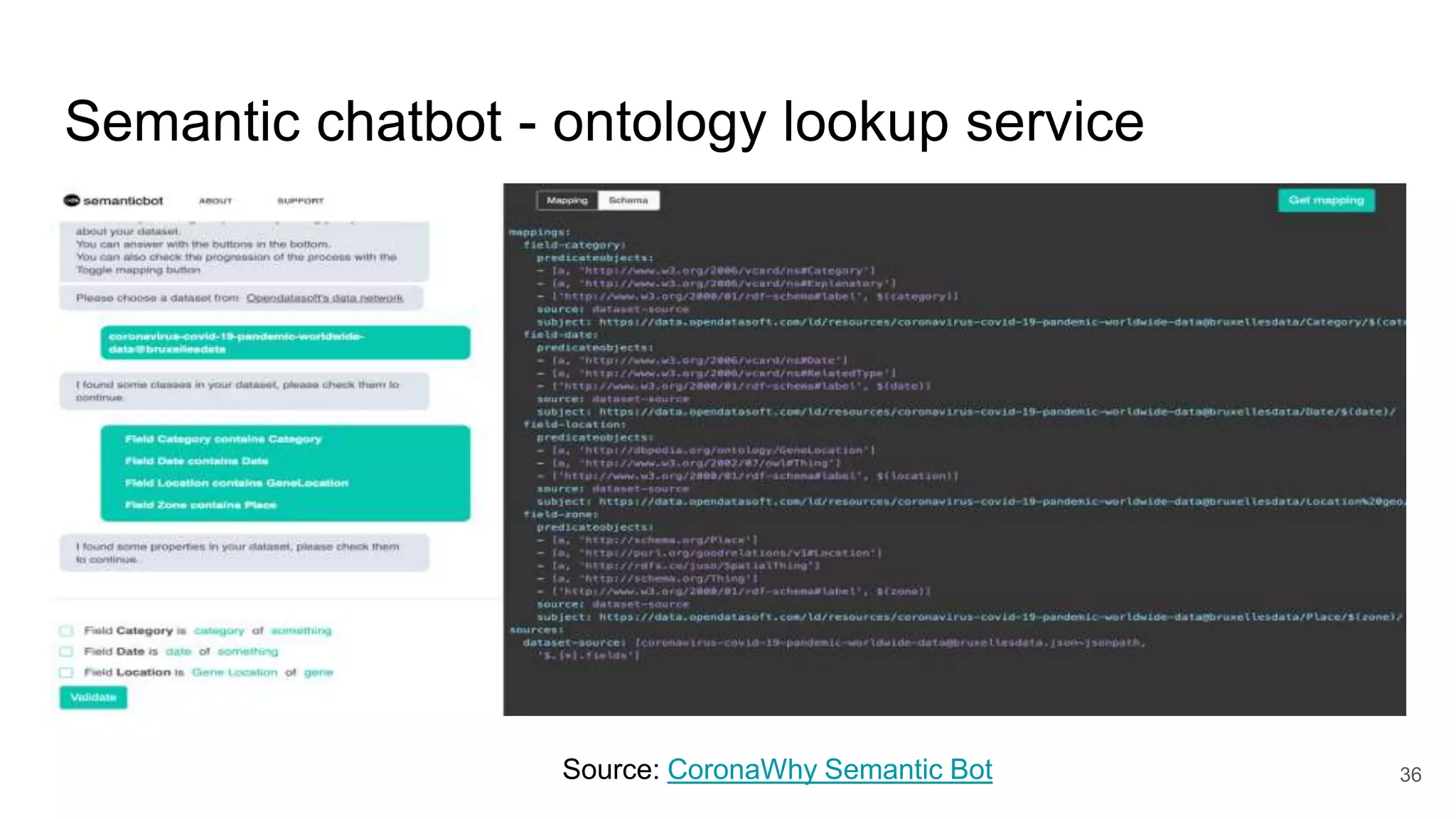
Semantic chatbot - ontology lookup service
36
Source: CoronaWhy Semantic Bot
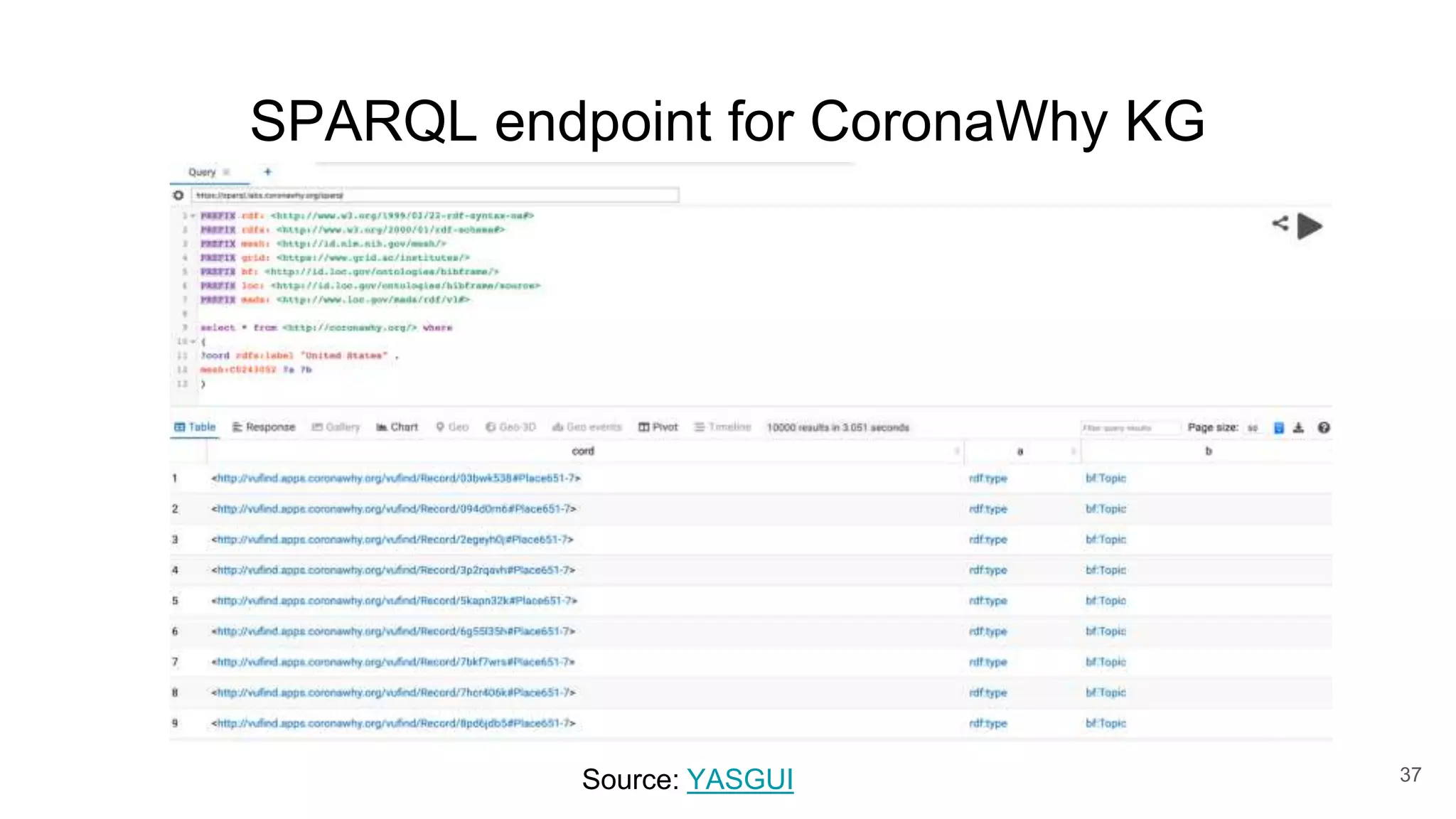
SPARQL endpoint for CoronaWhy KG
37
Source: YASGUI
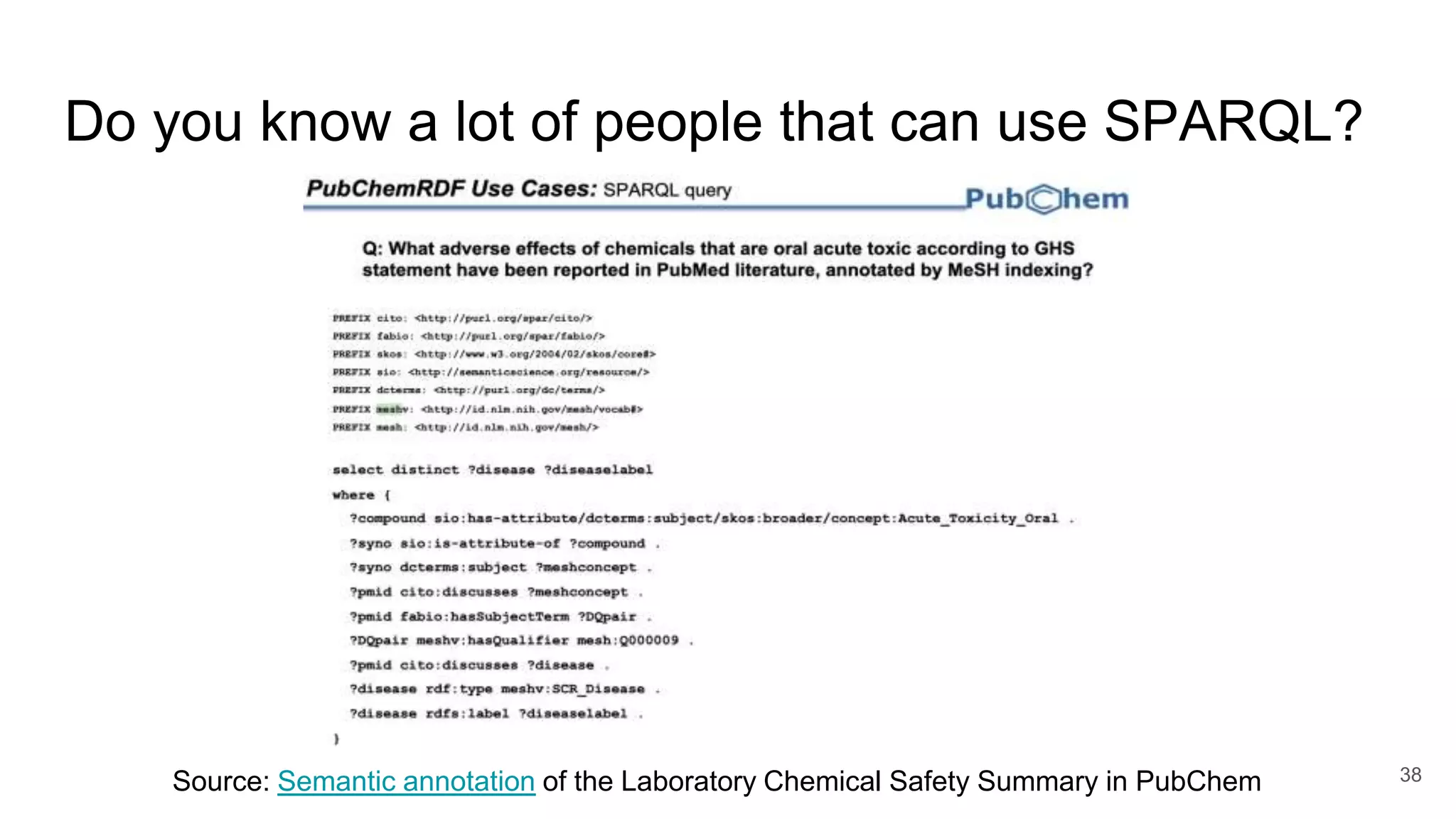
Do you know a lot of people that can use SPARQL?
38
Source: Semantic annotation of the Laboratory Chemical Safety Summary in PubChem
CLARIAH conclusions
“By developing these decentralised, yet controlled Knowledge Graph development practices we have
contributed to increasing interoperability in the humanities and enabling new research opportunities to a
wide range of scholars. However, we observe that users without Semantic Web knowledge find these
technologies hard to use, and place high value in end-user tools that enable engagement.
Therefore, for the future we emphasise the importance of tools to specifically target the goals of concrete
communities – in our case, the analytical and quantitative answering of humanities research questions for
humanities scholars. In this sense, usability is not just important in a tool context; in our view, we need to
empower users in deciding under what models these tools operate.” (CLARIAH: Enabling
Interoperability Between Humanities Disciplines with Ontologies)
Chicken-egg problem: users are building tools without data models and ontologies but in
reality they need to build a knowledge graph with common ontologies first!
39
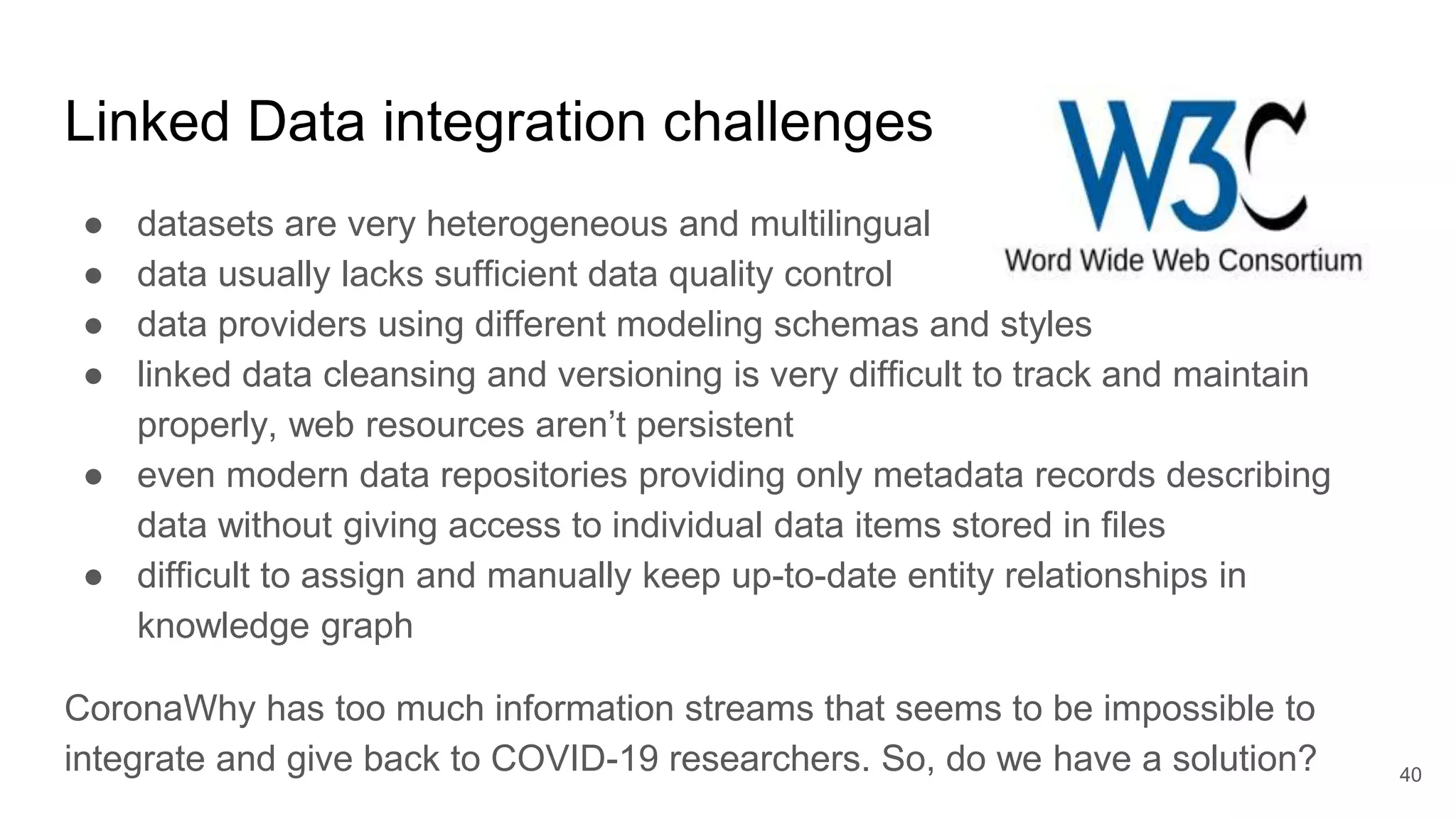
Linked Data integration challenges
● datasets are very heterogeneous and multilingual
● data usually lacks sufficient data quality control
● data providers using different modeling schemas and styles
● linked data cleansing and versioning is very difficult to track and maintain
properly, web resources aren’t persistent
● even modern data repositories providing only metadata records describing
data without giving access to individual data items stored in files
● difficult to assign and manually keep up-to-date entity relationships in
knowledge graph
CoronaWhy has too much information streams that seems to be impossible to
integrate and give back to COVID-19 researchers. So, do we have a solution? 40
Bibliographic Framework (BIBFRAME) as a Web of Data
“The Library of Congress officially launched its Bibliographic Framework Initiative
in May 2011. The Initiative aims to re-envision and, in the long run, implement a
new bibliographic environment for libraries that makes "the network" central and
makes interconnectedness commonplace.”
“Instead of thousands of catalogers repeatedly describing the same resources, the
effort of one cataloger could be shared with many.” (Source)
In 2019 BIBFRAME 2.0, the Library of Congress Pilot, was announced.
Let’s take a journey and move from domain specific ontology to bibliographic!
41
BIBFRAME 2.0 concepts
42
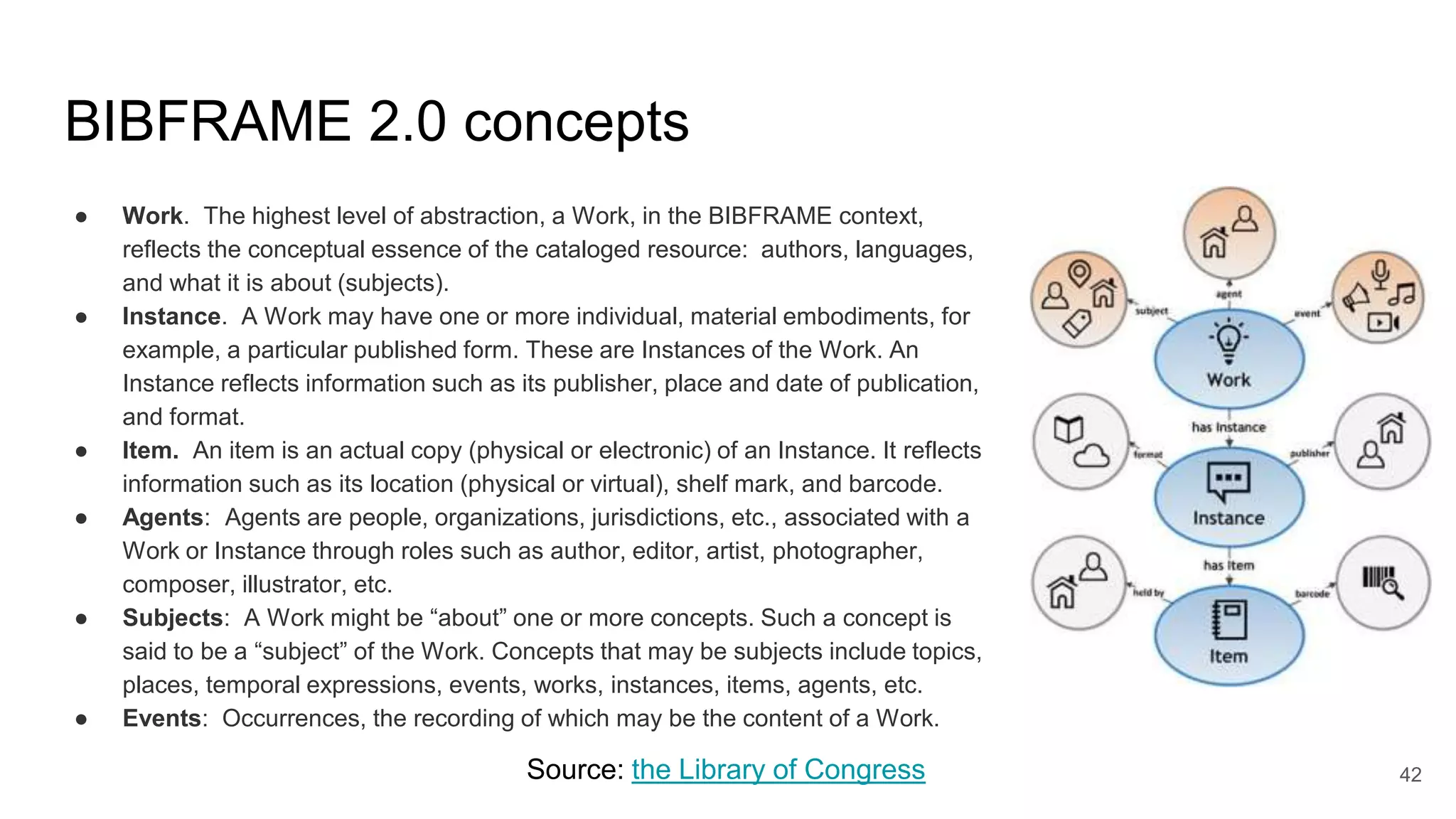
● Work. The highest level of abstraction, a Work, in the BIBFRAME context,
reflects the conceptual essence of the cataloged resource: authors, languages,
and what it is about (subjects).
● Instance. A Work may have one or more individual, material embodiments, for
example, a particular published form. These are Instances of the Work. An
Instance reflects information such as its publisher, place and date of publication,
and format.
● Item. An item is an actual copy (physical or electronic) of an Instance. It reflects
information such as its location (physical or virtual), shelf mark, and barcode.
● Agents: Agents are people, organizations, jurisdictions, etc., associated with a
Work or Instance through roles such as author, editor, artist, photographer,
composer, illustrator, etc.
● Subjects: A Work might be “about” one or more concepts. Such a concept is
said to be a “subject” of the Work. Concepts that may be subjects include topics,
places, temporal expressions, events, works, instances, items, agents, etc.
● Events: Occurrences, the recording of which may be the content of a Work.
Source: the Library of Congress
MARC as a foundation of the structured Data Hub
43
Source: the Library of Congress, USA
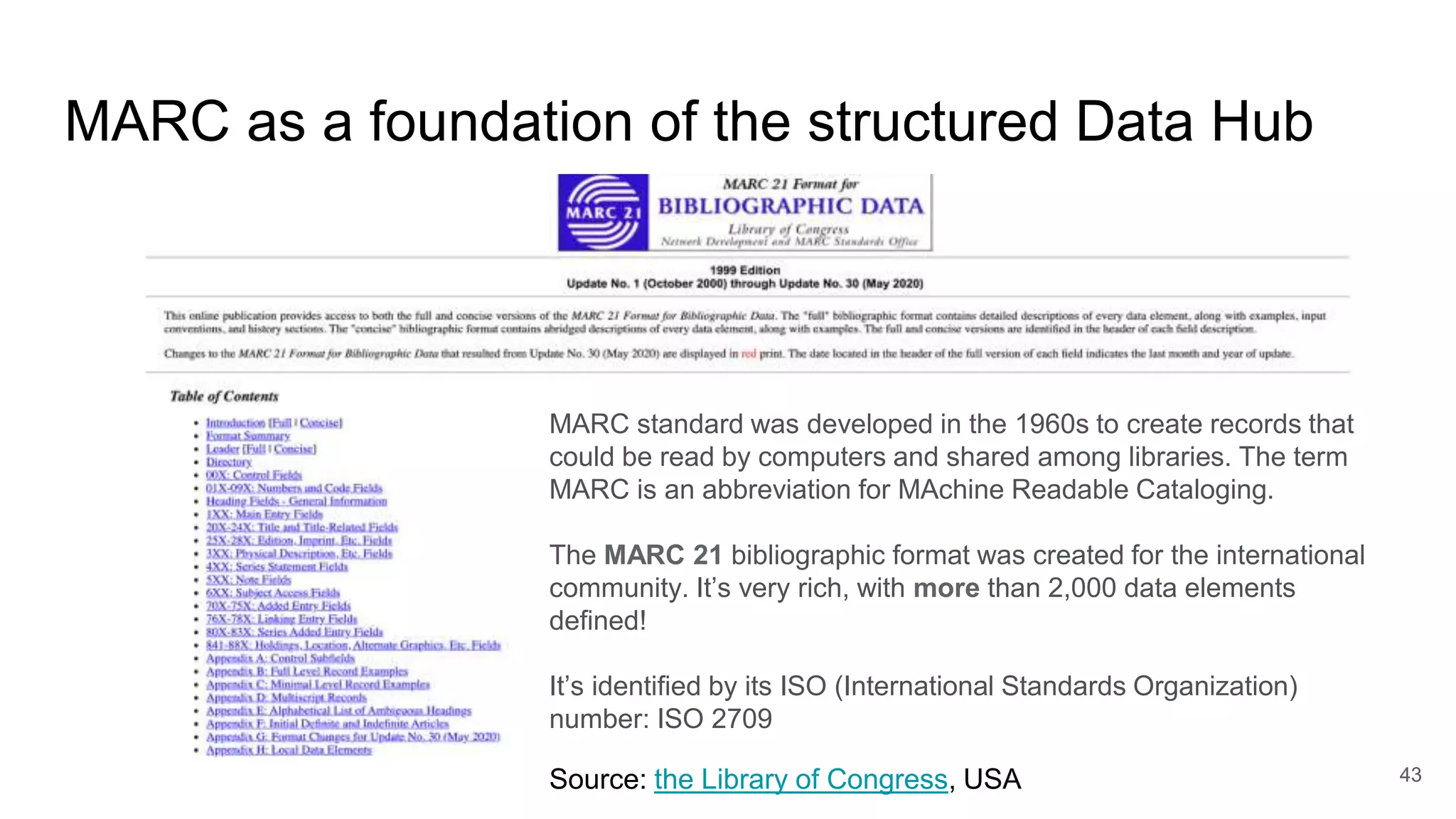
MARC standard was developed in the 1960s to create records that
could be read by computers and shared among libraries. The term
MARC is an abbreviation for MAchine Readable Cataloging.
The MARC 21 bibliographic format was created for the international
community. It’s very rich, with more than 2,000 data elements
defined!
It’s identified by its ISO (International Standards Organization)
number: ISO 2709
How to integrate data in the common KG?
● Use MARC 21 as a basis for all bibliographic and authority records
● All controlled vocabularies should be expressed in MARC 21 format for Authority
Data, we need to build an authority linking process with the “human in the loop”
approach that will allow to verify AI predicted links.
● Different MARC 21 fields could be linked to the different ontologies and/or even
interlinked. For example, we can get some entities linked to both MeSH and
Wikidata in the same bibliographic record to increase the interoperability of the
Knowledge Graph.
● Every CORD-19 paper can get a metadata enrichment provided by any research
team working on the NLP extraction of entities, relations or linking CV together.
44
COVID-19 paper in MARC 21 representation
45
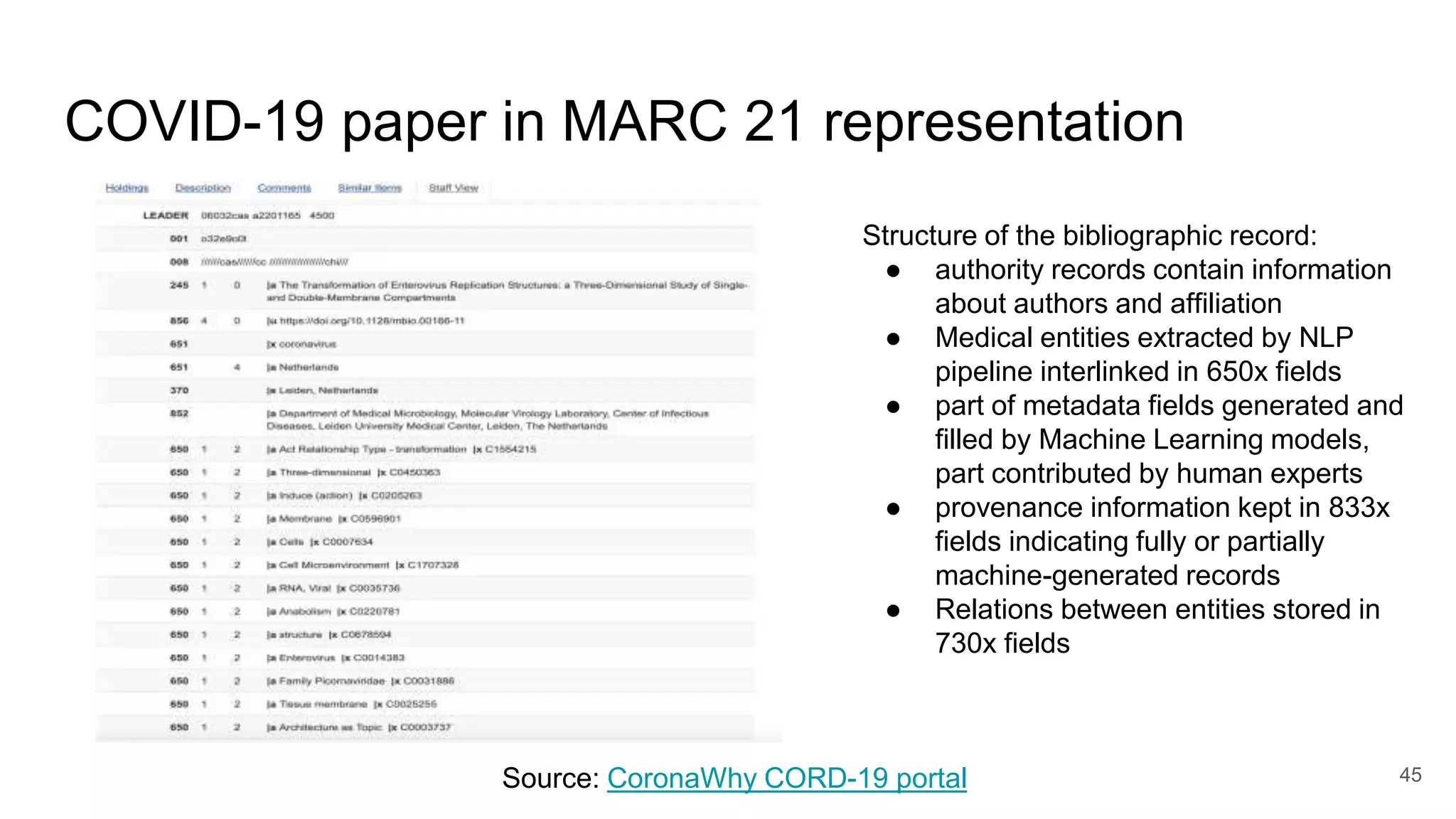
Structure of the bibliographic record:
● authority records contain information
about authors and affiliation
● Medical entities extracted by NLP
pipeline interlinked in 650x fields
● part of metadata fields generated and
filled by Machine Learning models,
part contributed by human experts
● provenance information kept in 833x
fields indicating fully or partially
machine-generated records
● Relations between entities stored in
730x fields
Source: CoronaWhy CORD-19 portal
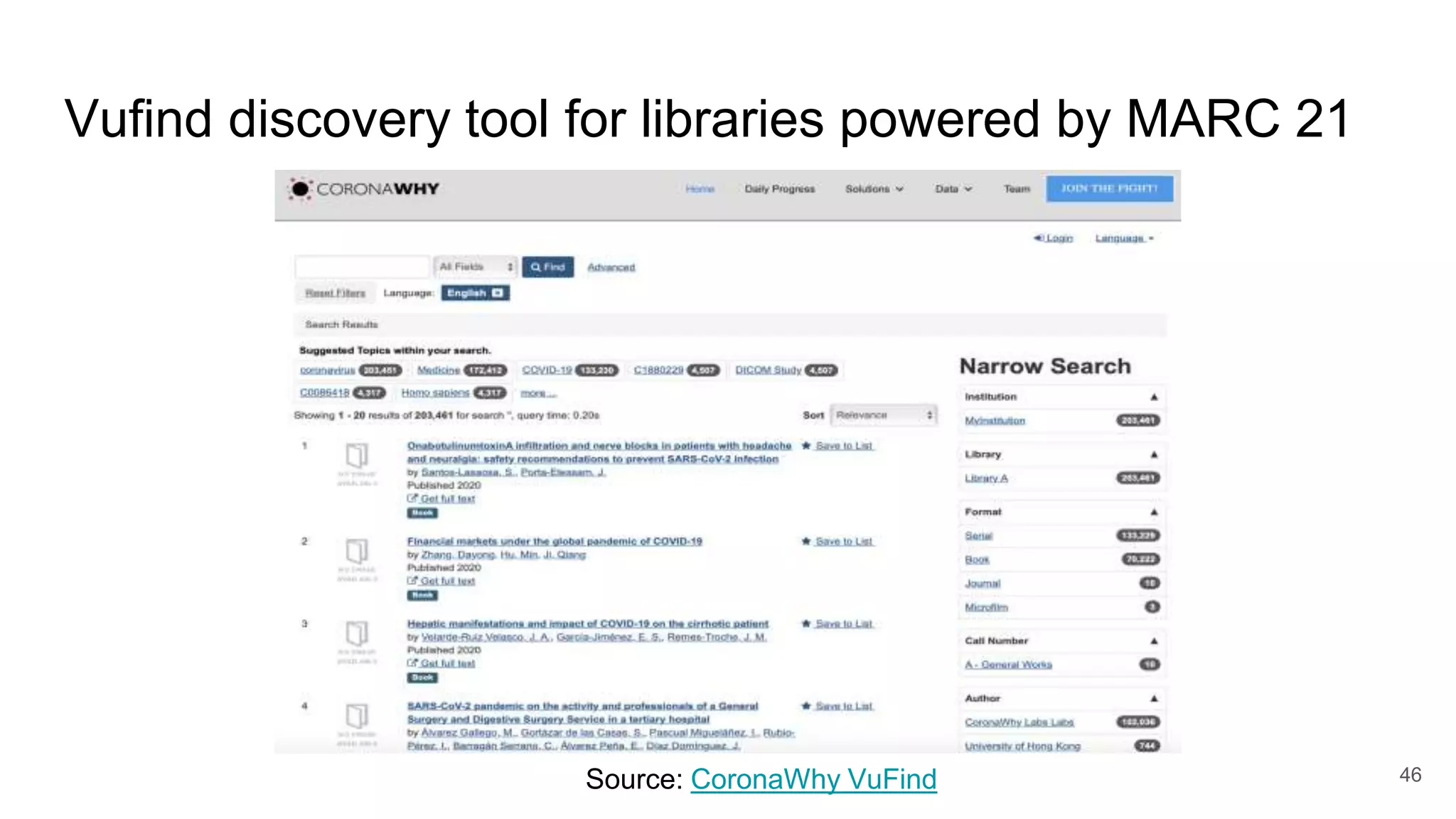
Vufind discovery tool for libraries powered by MARC 21
46
Source: CoronaWhy VuFind
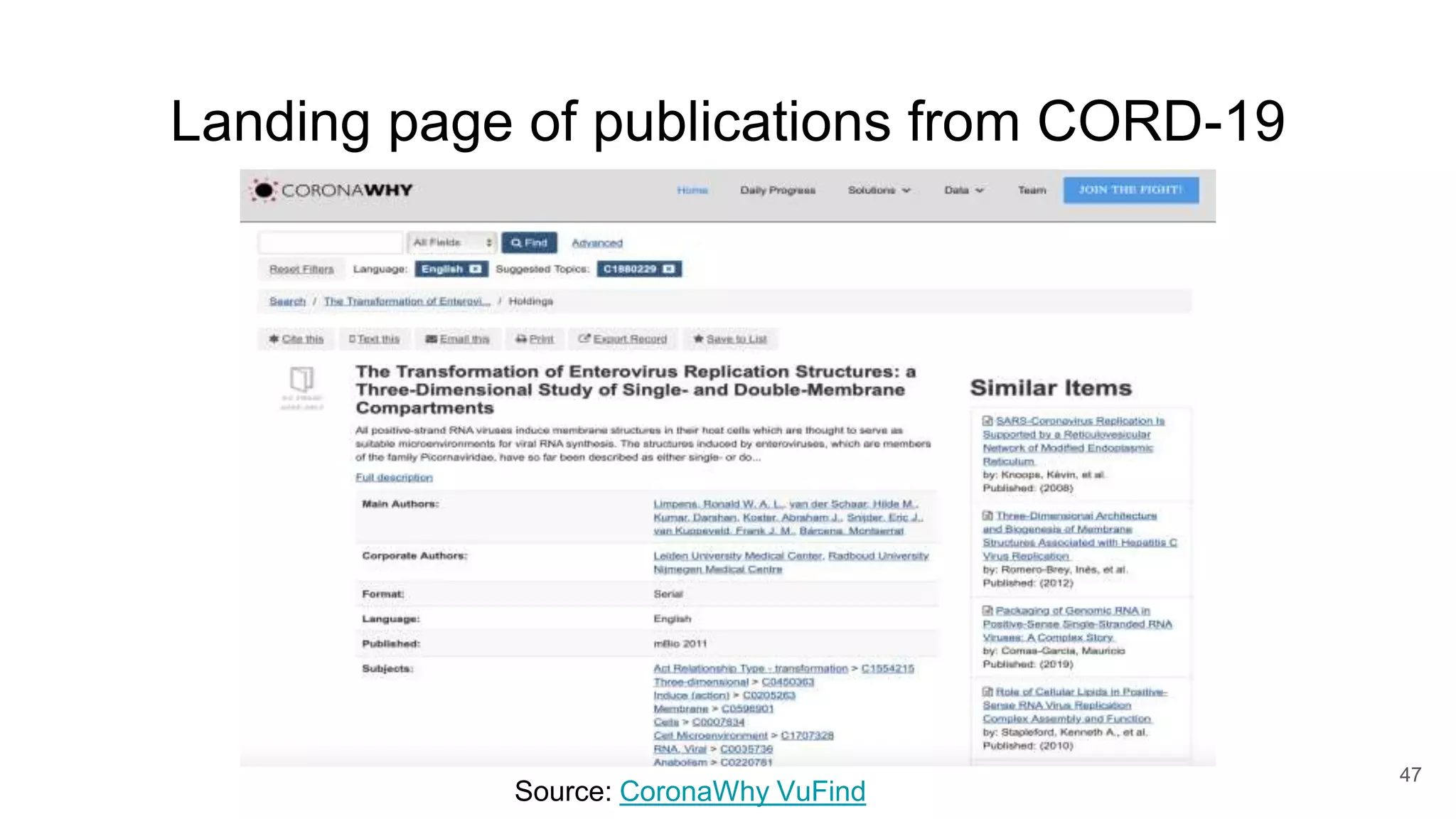
Landing page of publications from CORD-19
47
Source: CoronaWhy VuFind
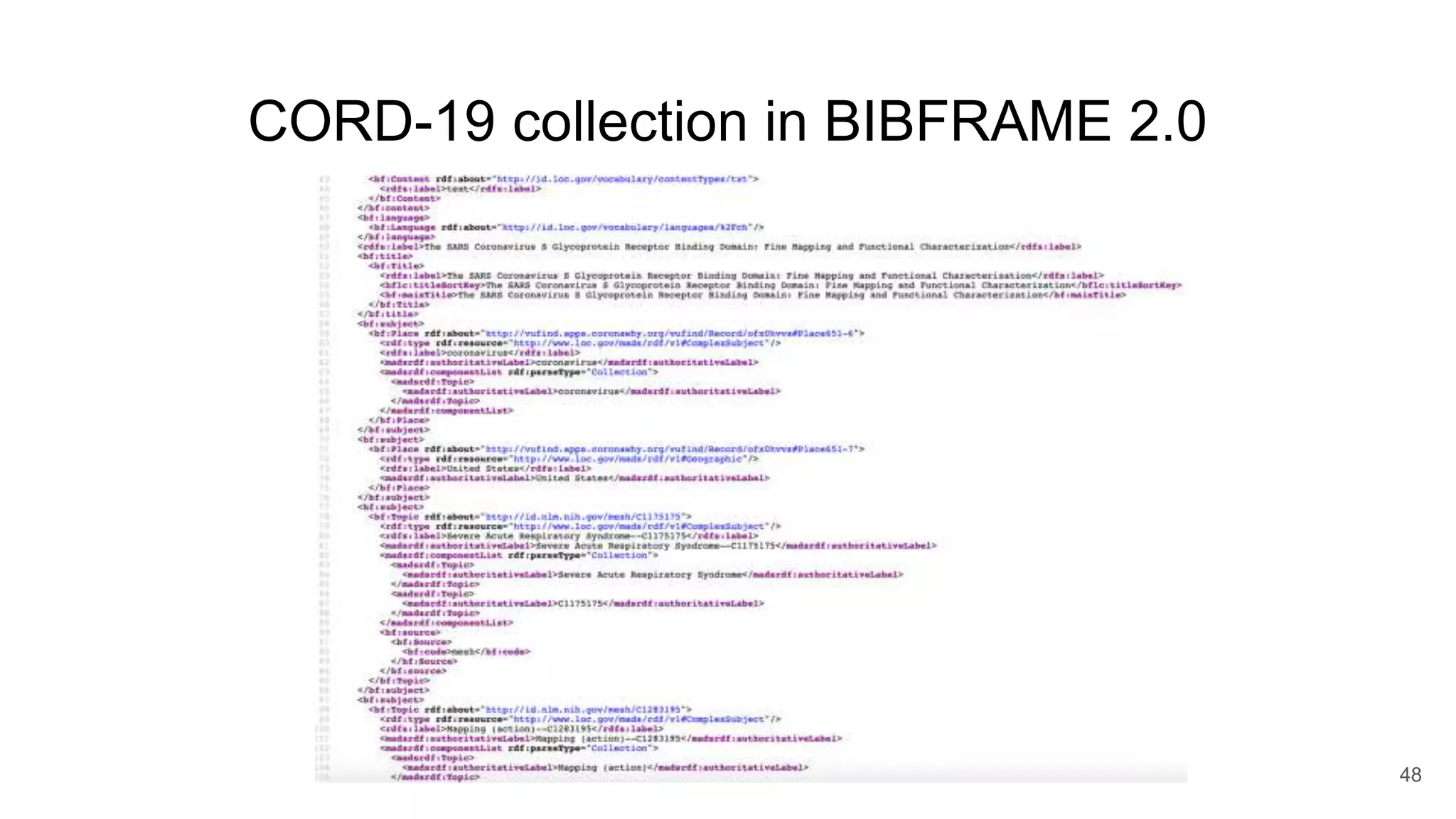
CORD-19 collection in BIBFRAME 2.0
48
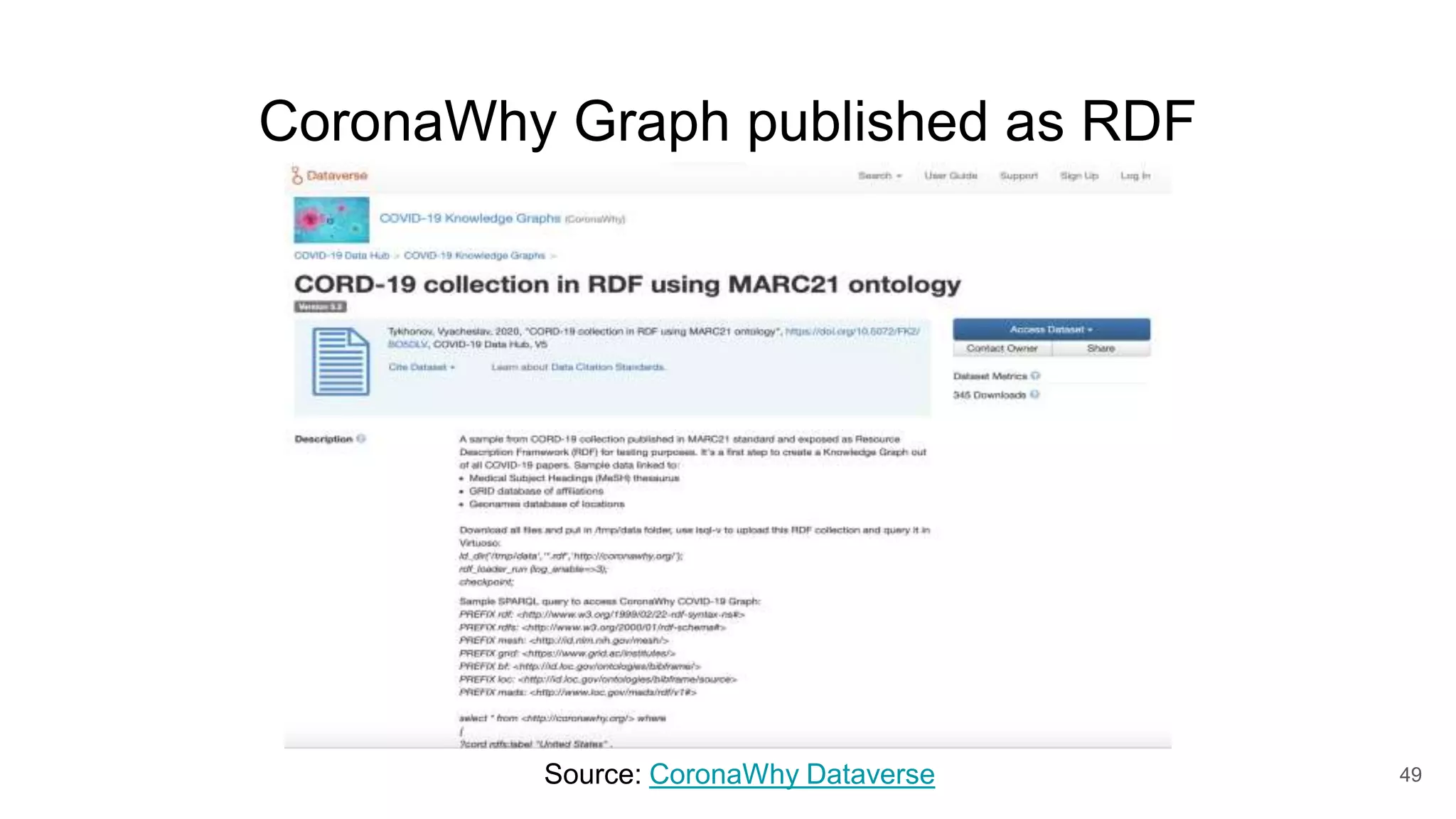
CoronaWhy Graph published as RDF
49
Source: CoronaWhy Dataverse
CLARIAH and Network Digital Heritage (NDE) GraphiQL
50
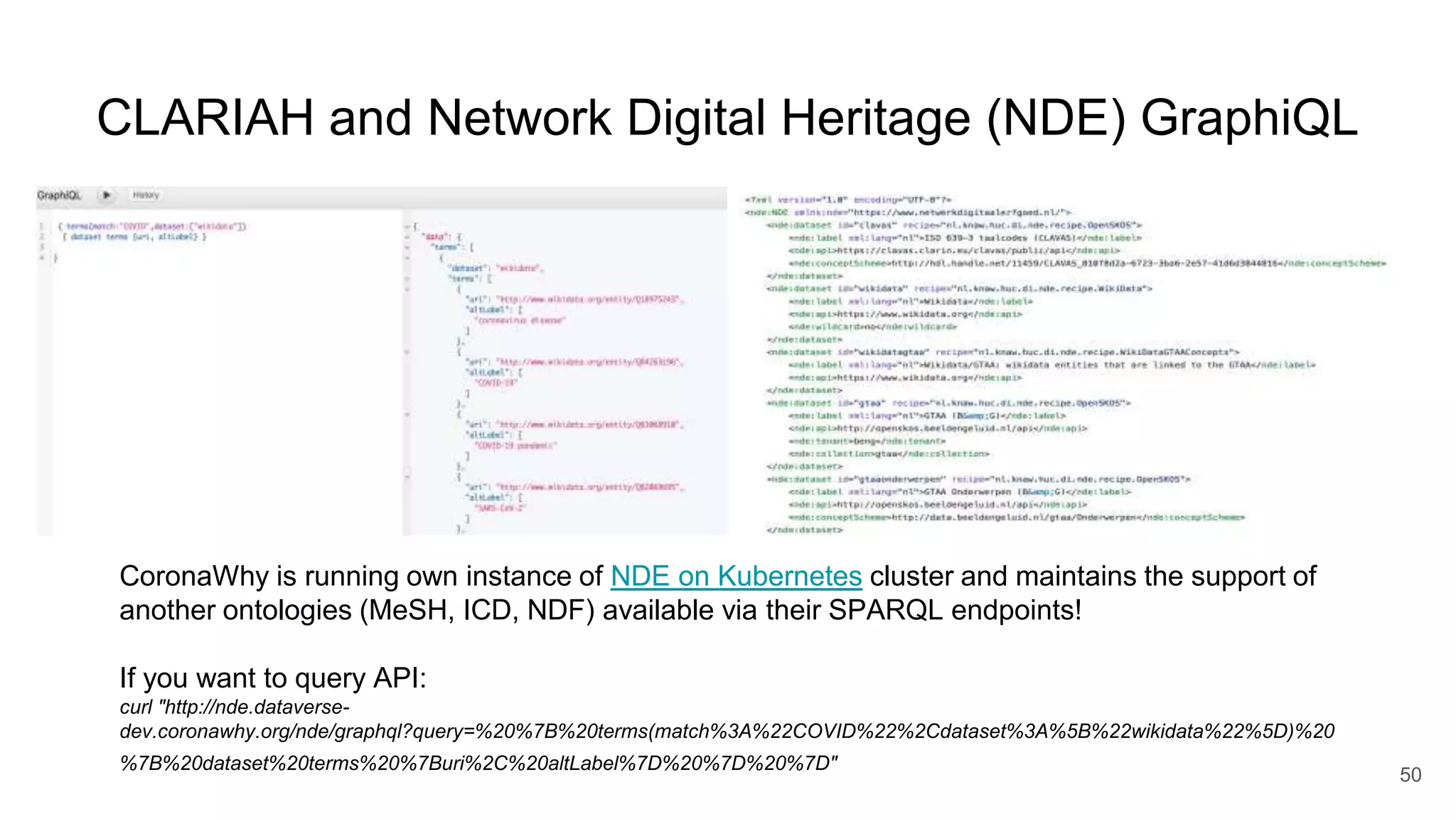
CoronaWhy is running own instance of NDE on Kubernetes cluster and maintains the support of
another ontologies (MeSH, ICD, NDF) available via their SPARQL endpoints!
If you want to query API:
curl "http://nde.dataverse-
dev.coronawhy.org/nde/graphql?query=%20%7B%20terms(match%3A%22COVID%22%2Cdataset%3A%5B%22wikidata%22%5D)%20
%7B%20dataset%20terms%20%7Buri%2C%20altLabel%7D%20%7D%20%7D"
Increasing Dataverse metadata interoperability
51
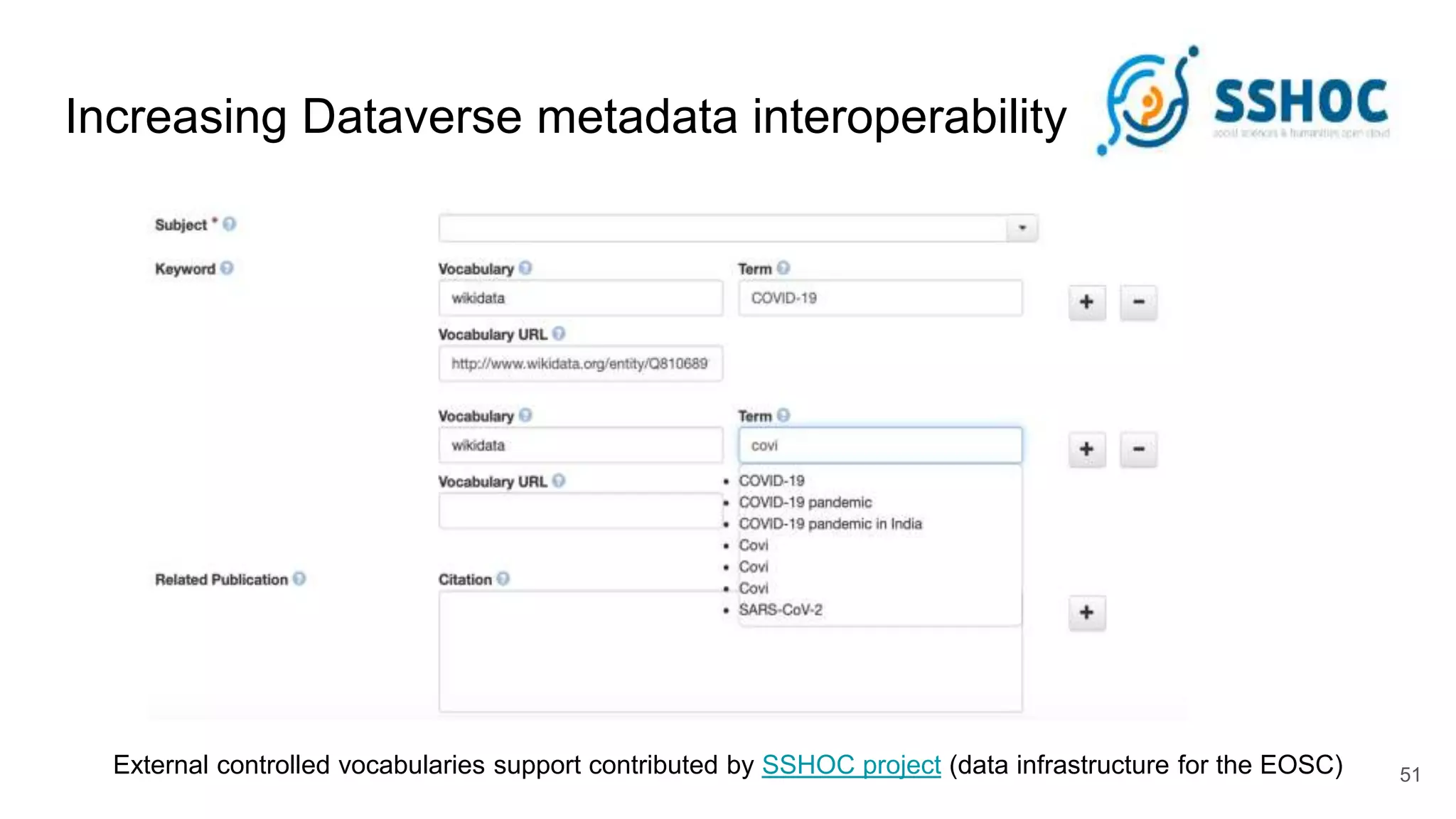
External controlled vocabularies support contributed by SSHOC project (data infrastructure for the EOSC)
Hypothes.is annotations as a peer review service
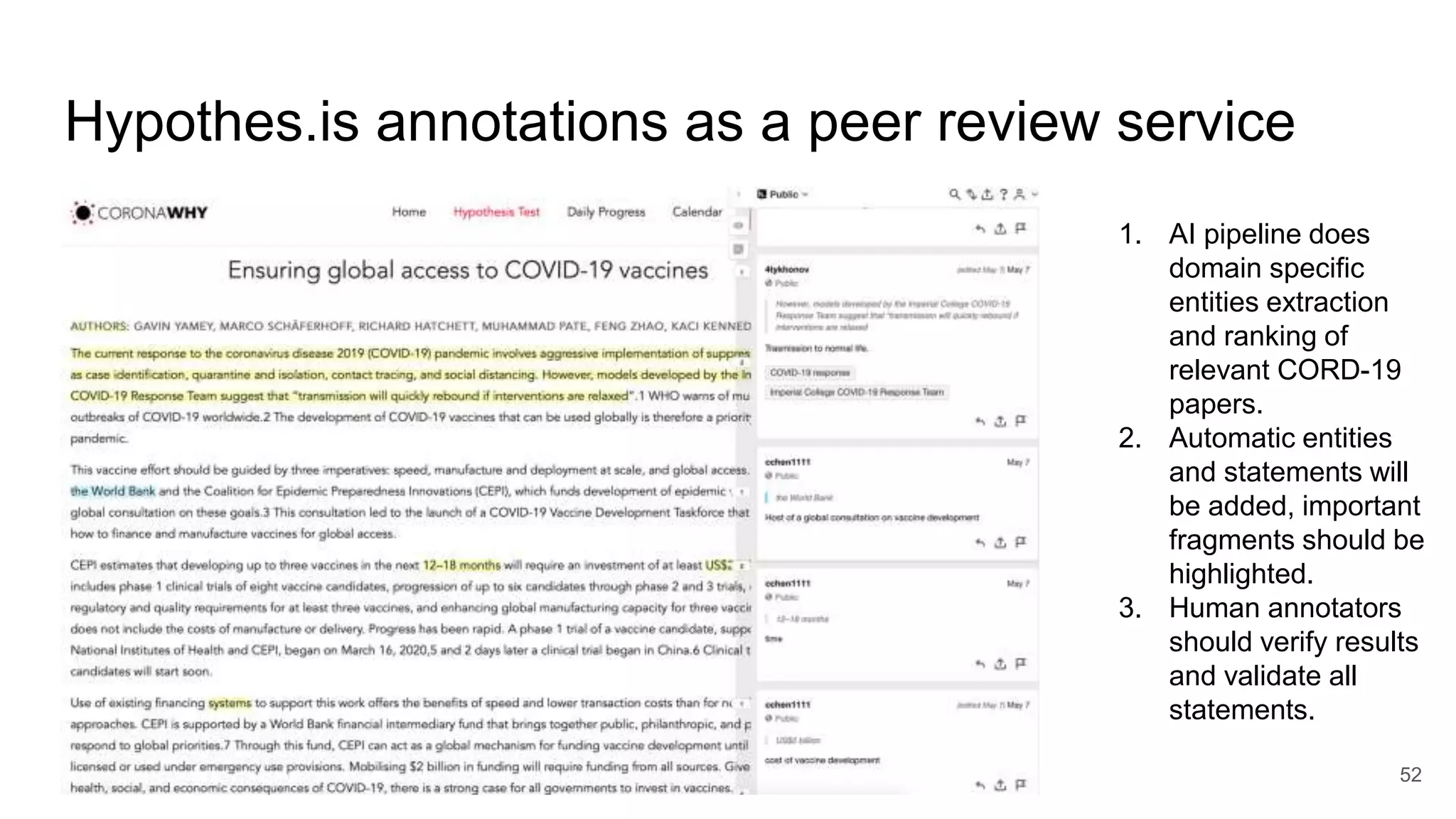
1. AI pipeline does
domain specific
entities extraction
and ranking of
relevant CORD-19
papers.
2. Automatic entities
and statements will
be added, important
fragments should be
highlighted.
3. Human annotators
should verify results
and validate all
statements.
52
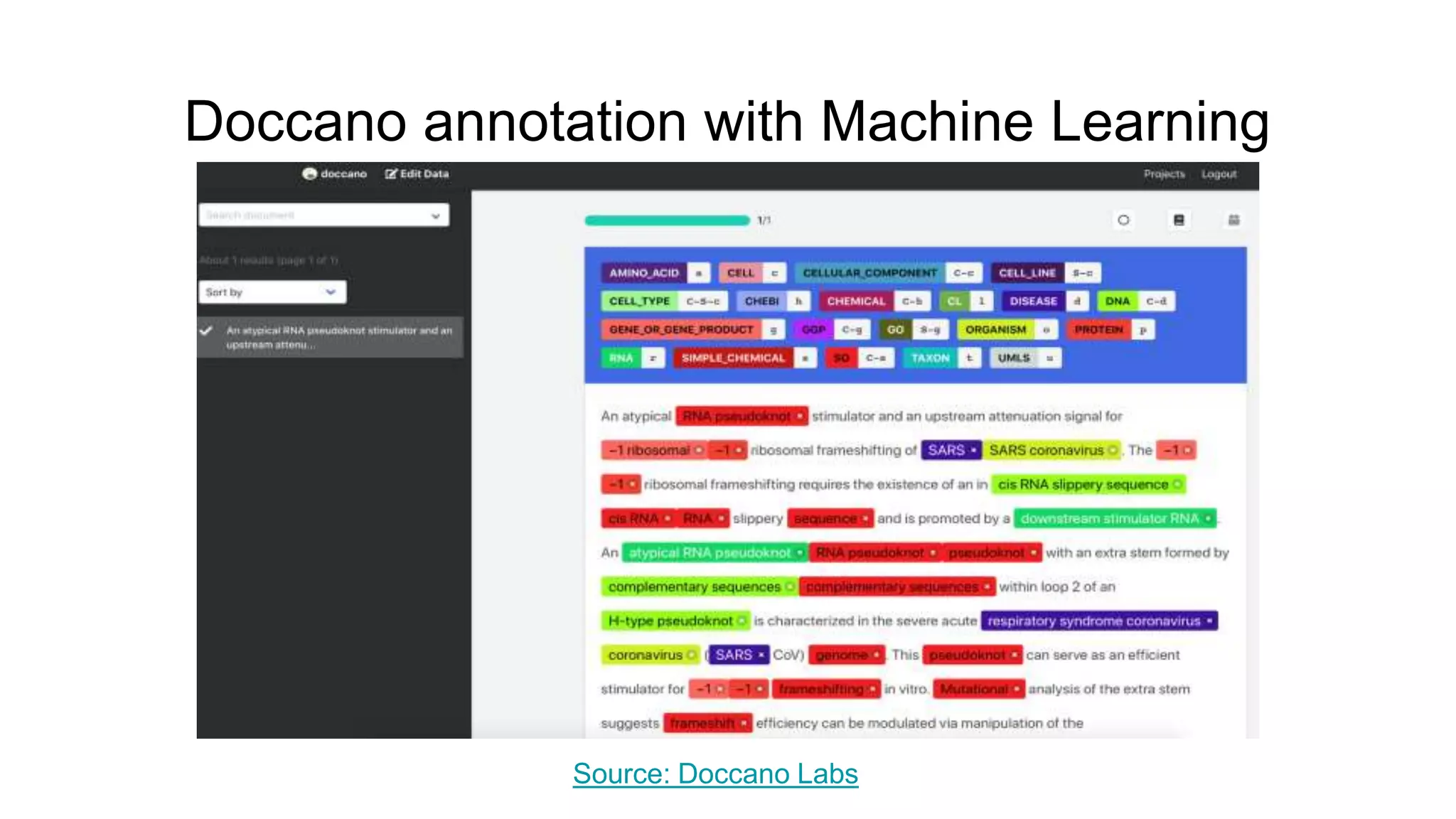
Doccano annotation with Machine Learning
Source: Doccano Labs
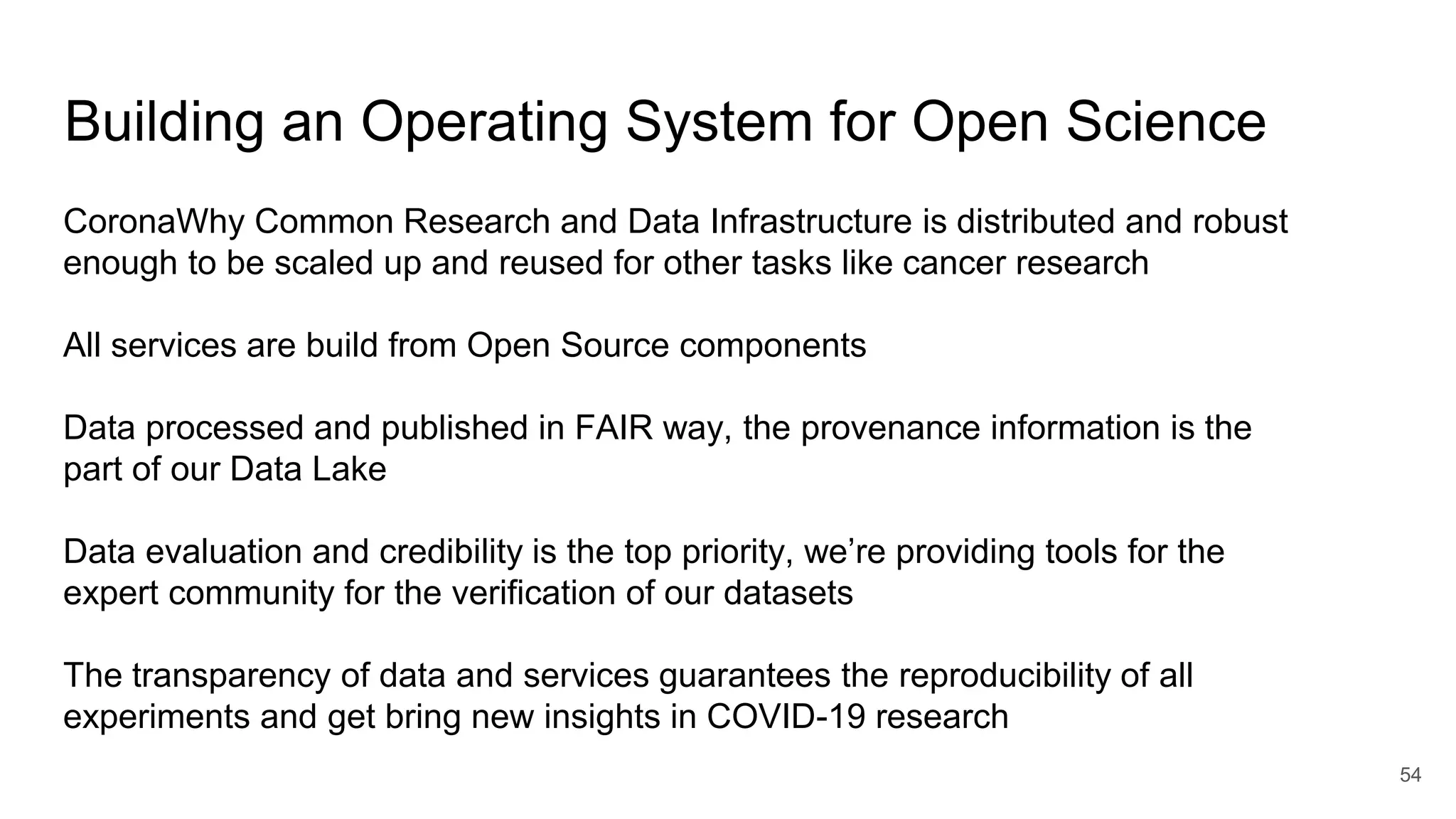
Building an Operating System for Open Science
54
CoronaWhy Common Research and Data Infrastructure is distributed and robust
enough to be scaled up and reused for other tasks like cancer research
All services are build from Open Source components
Data processed and published in FAIR way, the provenance information is the
part of our Data Lake
Data evaluation and credibility is the top priority, we’re providing tools for the
expert community for the verification of our datasets
The transparency of data and services guarantees the reproducibility of all
experiments and get bring new insights in COVID-19 research
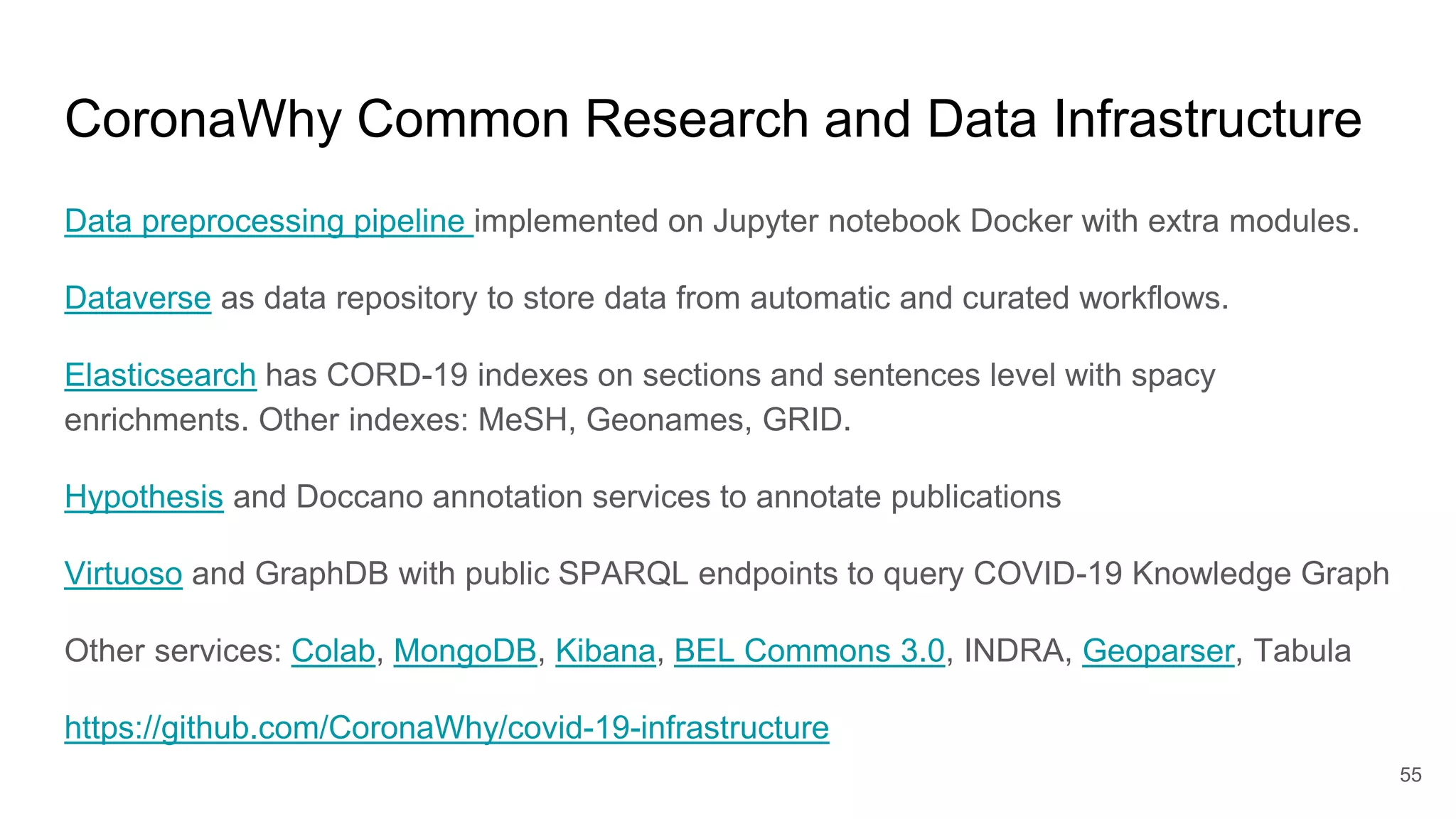
CoronaWhy Common Research and Data Infrastructure
Data preprocessing pipeline implemented on Jupyter notebook Docker with extra modules.
Dataverse as data repository to store data from automatic and curated workflows.
Elasticsearch has CORD-19 indexes on sections and sentences level with spacy
enrichments. Other indexes: MeSH, Geonames, GRID.
Hypothesis and Doccano annotation services to annotate publications
Virtuoso and GraphDB with public SPARQL endpoints to query COVID-19 Knowledge Graph
Other services: Colab, MongoDB, Kibana, BEL Commons 3.0, INDRA, Geoparser, Tabula
https://github.com/CoronaWhy/covid-19-infrastructure
55
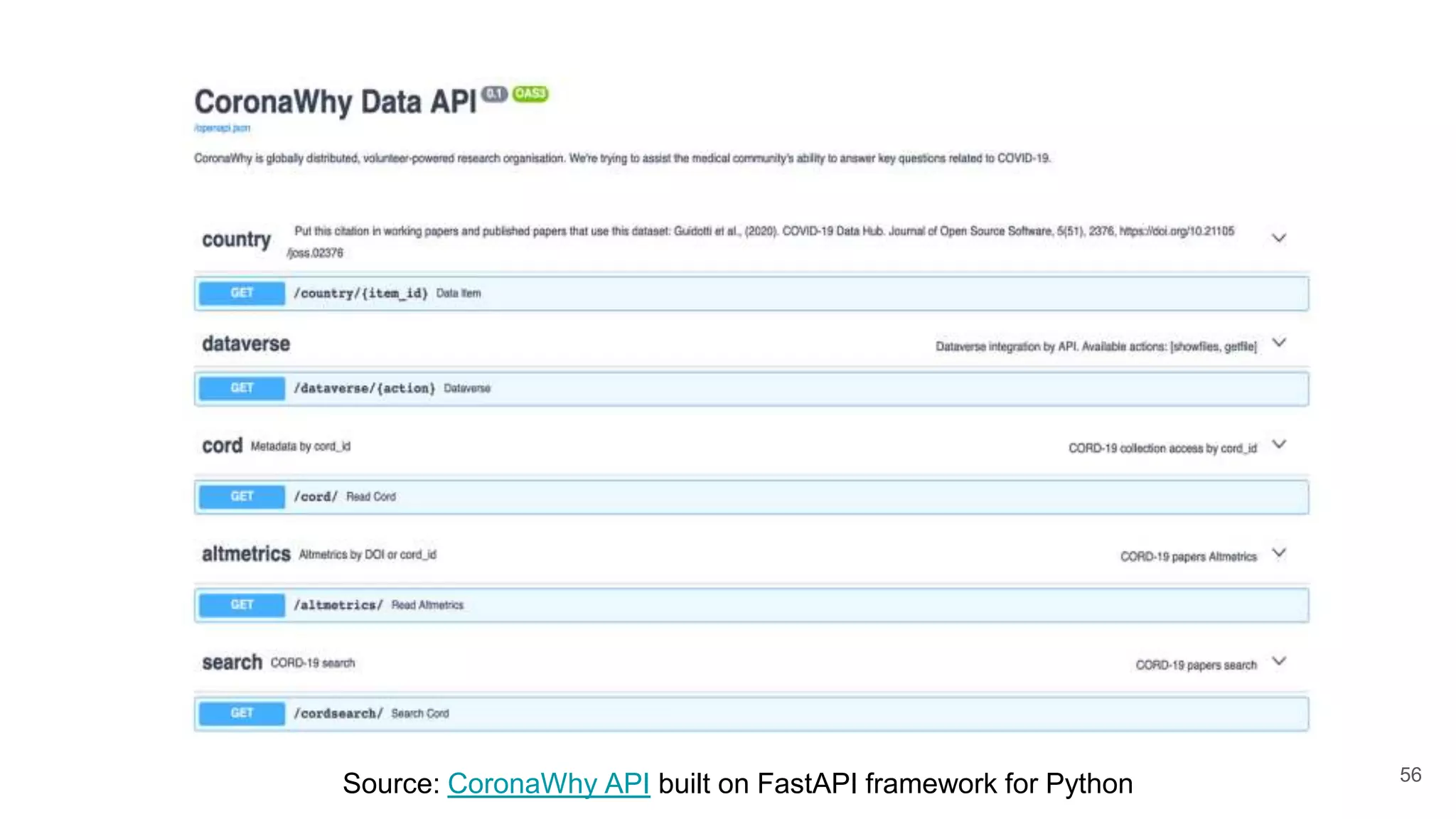
56
Source: CoronaWhy API built on FastAPI framework for Python
Thank you! Questions?
@Slava Tykhonov on CoronaWhy Slack
vyacheslav.tykhonov@dans.knaw.nl
www.coronawhy.org
www.dans.knaw.nl/en
57

Building COVID-19 Knowledge Graph at CoronaWhy

  • 1.
    CoronaWhy Knowledge Graph SlavaTykhonov Senior Information Scientist (DANS-KNAW, the Netherlands) W3C Semantic Web Health Care and Life Sciences Interest Group webinar 06.10.2020
  • 2.
    About me: DANS-KNAWprojects (2016-2020) ● CLARIAH+ (ongoing) ● EOSC Synergy (ongoing) ● SSHOC Dataverse (ongoing) ● CESSDA DataverseEU 2018 ● Time Machine Europe Supervisor at DANS-KNAW ● PARTHENOS Horizon 2020 ● CESSDA PID (Personal Identifiers) Horizon 2020 ● CLARIAH ● RDA (Research Data Alliance) PITTS Horizon 2020 ● CESSDA SaW H2020-EU.1.4.1.1 Horizon 2020 2 Source: LinkedIn
  • 3.
    7 weeks inlockdown in Spain 3 Resistere (I will resist)
  • 4.
    About CoronaWhy 1300+ people registeredin the organization, more than 300 actively contributing! 4 www.coronawhy.org
  • 5.
    COVID-19 Open ResearchDataset Challenge (CORD-19) It’s all started from this (March, 2020): “In response to the COVID-19 pandemic and with the view to boost research, the Allen Institute for AI together with CZI, MSR, Georgetown, NIH & The White House is collecting and making available for free the COVID-19 Open Research Dataset (CORD-19). This resource is updated weekly and contains over 287,000 scholarly articles, including 82,870 with full text, about COVID-19 and other viruses of the coronavirus family.” (Kaggle) 5
  • 6.
    CoronaWhy Community Tasks(March-April) 1. Task-Risk helps to identify risk factors that can increase the chance of being infected, or affects the severity or the survival outcome of the infection 2. Task-Ties to explore transmission, incubation and environment stability 3. Match Clinical Trials allows exploration of the results from the COVID-19 International Clinical Trials dataset 4. COVID-19 Literature Visualization helps to explore the data behind the AI- powered literature review 5. Named Entity Recognition across the entire corpus of CORD-19 papers with full text 6
  • 7.
    CORD-19 affiliations recognizedwith Deep Learning 7 Source: CORD-19 map visualization and institution affiliation data
  • 8.
    Collaboration with otherorganizations ● Harvard Medical School, INDRA integration ● Helix Group, Stanford University ● NASA JPL, COVID-19 knowledge graph and GeoParser ● Kaggle, coronamed application ● Fraunhofer Institute for Intelligent Analysis and Information Systems IAIS, knowledge graph ● dcyphr, a platform for creating and engaging with distillations of academic articles ● CAMARADES (Collaborative Approach to Meta-Analysis and Review of Animal Data from Experimental Studies) We’ve got almost endless data streams... 8
  • 9.
    Looking for Commons MerceCrosas, “Harvard Data Commons” 9
  • 10.
    Building a horizontalplatform to serve vertical teams Source: CoronaWhy infrastructure introduction 10
  • 11.
    Turning FAIR intoreality! 11 DANS-KNAW is one of worldwide leaders in FAIR Data (FAIRsFAIR)
  • 12.
    Dataverse as dataintegration point 12 ● Available as a service for the community from April, 2020 ● Used by CoronaWhy vertical teams for the data exchange and share ● Intended to help researchers to make their data FAIR ● One of the biggest COVID-19 data archives in the world with 700k files ● New teams are getting own data containers and can reuse data collected and produced by others https://datasets.coronawhy.org
  • 13.
    Dataset from CoronaWhyvertical teams 13 Source: CoronaWhy Dataverse
  • 14.
    COVID-19 data filesverification 14 We do a verification of every file by importing its contents to dataframe. All column names (variables) extracted from tabular data available as labels in files metadata We’ve enabled Dataverse data previewers to browse through the content of files without download! We’re starting internal challenges to build ML models for the metadata classification
  • 15.
    Dataverse content inJupyter notebooks 15 Source: Dataverse examples on Google Colabs
  • 16.
    COVID-19 Data Crowdsourcing CoronaWhydata management team does does the review of all harvested datasets and try to identify the important data. We’re approaching github owners by creating issues in their repos and inviting them to help us. More than 20% of data owners joining CoronaWhy community or interested to curate their datasets. Bottom-up data collection works! 16
  • 17.
    Challenge of dataintegration and various ontologies CORD-19 collection workflows with NLP pipeline: ● manual annotation and labelling of COVID-19 related papers ● automatic entity extraction and classification of text fragments ● statements extraction and curation ● linking papers to specific research questions with relationships extraction Dataverse Data Lake streaming COVID-19 datasets from various sources: ● medical data ● socio-economic Data ● political data and statistics 17
  • 18.
    The importance ofstandards and ontologies Generic controlled vocabularies to link metadata in the bibliographic collections are well known: ORCID, GRID, GeoNames, Getty. Medical knowledge graphs powered by: ● Biological Expression Language (BEL) ● Medical Subject Headings (MeSH®) by U.S. National Library of Medicine (NIH) ● Wikidata (Open ontology) - Wikipedia Integration based on metadata standards: ● MARC21, Dublin Core (DC), Data Documentation Initiative (DDI) 18
  • 19.
    Statements extraction withINDRA 19 Source: EMMAA (Ecosystem of Machine-maintained Models with Automated Assembly) “INDRA (Integrated Network and Dynamical Reasoning Assembler) is an automated model assembly system, originally developed for molecular systems biology and currently being generalized to other domains.” Developed as a part of Harvard Program in Therapeutic Science and the Laboratory of Systems Pharmacology at Harvard Medical School. http://indra.bio
  • 20.
  • 21.
    Advanced Text Analysis(NLP pipeline) Source: D.Shlepakov, How to Build Knowledge Graph, notebook We need a good understanding of all domain specific texts to make right statements: 21
  • 22.
    Building domain specificknowledge graphs ● We’re collecting all possible COVID-19 data and archiving in our Dataverse ● Looking for various related controlled vocabularies and ontologies ● Building and reusing conversion pipelines to get all data values linked in RDF format The ultimate goal is to automate the process of the Knowledge extraction by using the latest developments in Artificial Intelligence and Deep Learning. We need to organize all available knowledge in a common way. 22
  • 23.
    Simple Knowledge OrganizationSystem (SKOS) SKOS models a thesauri-like resources: - skos:Concepts with preferred labels and alternative labels (synonyms) attached to them (skos:prefLabel, skos:altLabel). - skos:Concept can be related with skos:broader, skos:narrower and skos:related properties. - terms and concepts could have more than one broader term and concept. SKOS allows to create a semantic layer on top of objects, a network with statements and relationships. A major difference of SKOS is logical “is-a hierarchies”. In thesauri the hierarchical relation can represent anything from “is-a” to “part-of”. 23
  • 24.
    RDF graph usingthe SKOS Core Vocabulary 24 Source: SKOS Core Guide
  • 25.
    Global Research IdentifierDatabase (GRID) in SKOS 25 We already have a lot of data in CoronaWhy Data Lake. Can we provide human a convenient web interface to create links to data points? Can we use Machine Learning algorithms to make a prediction about links and convert data in SKOS automatically?
  • 26.
    SKOSMOS framework todiscover ontologies 26 ● SKOSMOS is developed in Europe by the National Library of Finland (NLF) ● active global user community ● search and browsing interface for SKOS concept ● multilingual vocabularies support ● used for different use cases (publish vocabularies, build discovery systems, vocabulary visualization)
  • 27.
    Skosmos pipeline 27 Skosmos backendis based on Jena Fuseki, a SPARQL server and RDF triple store integrated with Lucene search engine. The jena-text extension can be used for faster text search and used both by Skosmos GUI and REST API.
  • 28.
    MeSH in SKOSMOS SKOSversion of Medical Subjects Headings provided by Finnish Thesaurus and Ontology Service (Finto): https://finto.fi/mesh/ 28
  • 29.
    SKOSMOS API specificationin Swagger 29 Source: Finto API
  • 30.
    SKOSMOS API examplefor GRID ontology 30
  • 31.
    COVID-19 expert questions 31 Source:Epidemic Questions Answering “In response to the COVID-19 pandemic, the Epidemic Question Answering (EPIC-QA) track challenges teams to develop systems capable of automatically answering ad-hoc questions about the disease COVID-19, its causal virus SARS-CoV-2, related corona viruses, and the recommended response to the pandemic. While COVID-19 has been an impetus for a large body of emergent scientific research and inquiry, the response to COVID-19 raises questions for consumers.”
  • 32.
    COVID-19 questions inSKOSMOS framework 32
  • 33.
    COVID-19 questions inSKOSMOS API 33
  • 34.
    Visual graph ofCOVID-19 dataset 34 Source: CoronaWhy GraphDB
  • 35.
    COVID-19 questions indatasets metadata 35 Source: COVID-19 European data hub in Harvard Dataverse ● COVID-19 ontologies can be hosted by SKOSMOS framework ● Researchers can enrich metadata by adding standardized questions provided by SKOSMOS ontologies ● rich metadata exported back to Linked Open Data Cloud to increase a chance to be found ● enriched metadata can be used for further ML models training
  • 36.
    Semantic chatbot -ontology lookup service 36 Source: CoronaWhy Semantic Bot
  • 37.
    SPARQL endpoint forCoronaWhy KG 37 Source: YASGUI
  • 38.
    Do you knowa lot of people that can use SPARQL? 38 Source: Semantic annotation of the Laboratory Chemical Safety Summary in PubChem
  • 39.
    CLARIAH conclusions “By developingthese decentralised, yet controlled Knowledge Graph development practices we have contributed to increasing interoperability in the humanities and enabling new research opportunities to a wide range of scholars. However, we observe that users without Semantic Web knowledge find these technologies hard to use, and place high value in end-user tools that enable engagement. Therefore, for the future we emphasise the importance of tools to specifically target the goals of concrete communities – in our case, the analytical and quantitative answering of humanities research questions for humanities scholars. In this sense, usability is not just important in a tool context; in our view, we need to empower users in deciding under what models these tools operate.” (CLARIAH: Enabling Interoperability Between Humanities Disciplines with Ontologies) Chicken-egg problem: users are building tools without data models and ontologies but in reality they need to build a knowledge graph with common ontologies first! 39
  • 40.
    Linked Data integrationchallenges ● datasets are very heterogeneous and multilingual ● data usually lacks sufficient data quality control ● data providers using different modeling schemas and styles ● linked data cleansing and versioning is very difficult to track and maintain properly, web resources aren’t persistent ● even modern data repositories providing only metadata records describing data without giving access to individual data items stored in files ● difficult to assign and manually keep up-to-date entity relationships in knowledge graph CoronaWhy has too much information streams that seems to be impossible to integrate and give back to COVID-19 researchers. So, do we have a solution? 40
  • 41.
    Bibliographic Framework (BIBFRAME)as a Web of Data “The Library of Congress officially launched its Bibliographic Framework Initiative in May 2011. The Initiative aims to re-envision and, in the long run, implement a new bibliographic environment for libraries that makes "the network" central and makes interconnectedness commonplace.” “Instead of thousands of catalogers repeatedly describing the same resources, the effort of one cataloger could be shared with many.” (Source) In 2019 BIBFRAME 2.0, the Library of Congress Pilot, was announced. Let’s take a journey and move from domain specific ontology to bibliographic! 41
  • 42.
    BIBFRAME 2.0 concepts 42 ●Work. The highest level of abstraction, a Work, in the BIBFRAME context, reflects the conceptual essence of the cataloged resource: authors, languages, and what it is about (subjects). ● Instance. A Work may have one or more individual, material embodiments, for example, a particular published form. These are Instances of the Work. An Instance reflects information such as its publisher, place and date of publication, and format. ● Item. An item is an actual copy (physical or electronic) of an Instance. It reflects information such as its location (physical or virtual), shelf mark, and barcode. ● Agents: Agents are people, organizations, jurisdictions, etc., associated with a Work or Instance through roles such as author, editor, artist, photographer, composer, illustrator, etc. ● Subjects: A Work might be “about” one or more concepts. Such a concept is said to be a “subject” of the Work. Concepts that may be subjects include topics, places, temporal expressions, events, works, instances, items, agents, etc. ● Events: Occurrences, the recording of which may be the content of a Work. Source: the Library of Congress
  • 43.
    MARC as afoundation of the structured Data Hub 43 Source: the Library of Congress, USA MARC standard was developed in the 1960s to create records that could be read by computers and shared among libraries. The term MARC is an abbreviation for MAchine Readable Cataloging. The MARC 21 bibliographic format was created for the international community. It’s very rich, with more than 2,000 data elements defined! It’s identified by its ISO (International Standards Organization) number: ISO 2709
  • 44.
    How to integratedata in the common KG? ● Use MARC 21 as a basis for all bibliographic and authority records ● All controlled vocabularies should be expressed in MARC 21 format for Authority Data, we need to build an authority linking process with the “human in the loop” approach that will allow to verify AI predicted links. ● Different MARC 21 fields could be linked to the different ontologies and/or even interlinked. For example, we can get some entities linked to both MeSH and Wikidata in the same bibliographic record to increase the interoperability of the Knowledge Graph. ● Every CORD-19 paper can get a metadata enrichment provided by any research team working on the NLP extraction of entities, relations or linking CV together. 44
  • 45.
    COVID-19 paper inMARC 21 representation 45 Structure of the bibliographic record: ● authority records contain information about authors and affiliation ● Medical entities extracted by NLP pipeline interlinked in 650x fields ● part of metadata fields generated and filled by Machine Learning models, part contributed by human experts ● provenance information kept in 833x fields indicating fully or partially machine-generated records ● Relations between entities stored in 730x fields Source: CoronaWhy CORD-19 portal
  • 46.
    Vufind discovery toolfor libraries powered by MARC 21 46 Source: CoronaWhy VuFind
  • 47.
    Landing page ofpublications from CORD-19 47 Source: CoronaWhy VuFind
  • 48.
    CORD-19 collection inBIBFRAME 2.0 48
  • 49.
    CoronaWhy Graph publishedas RDF 49 Source: CoronaWhy Dataverse
  • 50.
    CLARIAH and NetworkDigital Heritage (NDE) GraphiQL 50 CoronaWhy is running own instance of NDE on Kubernetes cluster and maintains the support of another ontologies (MeSH, ICD, NDF) available via their SPARQL endpoints! If you want to query API: curl "http://nde.dataverse- dev.coronawhy.org/nde/graphql?query=%20%7B%20terms(match%3A%22COVID%22%2Cdataset%3A%5B%22wikidata%22%5D)%20 %7B%20dataset%20terms%20%7Buri%2C%20altLabel%7D%20%7D%20%7D"
  • 51.
    Increasing Dataverse metadatainteroperability 51 External controlled vocabularies support contributed by SSHOC project (data infrastructure for the EOSC)
  • 52.
    Hypothes.is annotations asa peer review service 1. AI pipeline does domain specific entities extraction and ranking of relevant CORD-19 papers. 2. Automatic entities and statements will be added, important fragments should be highlighted. 3. Human annotators should verify results and validate all statements. 52
  • 53.
    Doccano annotation withMachine Learning Source: Doccano Labs
  • 54.
    Building an OperatingSystem for Open Science 54 CoronaWhy Common Research and Data Infrastructure is distributed and robust enough to be scaled up and reused for other tasks like cancer research All services are build from Open Source components Data processed and published in FAIR way, the provenance information is the part of our Data Lake Data evaluation and credibility is the top priority, we’re providing tools for the expert community for the verification of our datasets The transparency of data and services guarantees the reproducibility of all experiments and get bring new insights in COVID-19 research
  • 55.
    CoronaWhy Common Researchand Data Infrastructure Data preprocessing pipeline implemented on Jupyter notebook Docker with extra modules. Dataverse as data repository to store data from automatic and curated workflows. Elasticsearch has CORD-19 indexes on sections and sentences level with spacy enrichments. Other indexes: MeSH, Geonames, GRID. Hypothesis and Doccano annotation services to annotate publications Virtuoso and GraphDB with public SPARQL endpoints to query COVID-19 Knowledge Graph Other services: Colab, MongoDB, Kibana, BEL Commons 3.0, INDRA, Geoparser, Tabula https://github.com/CoronaWhy/covid-19-infrastructure 55
  • 56.
    56 Source: CoronaWhy APIbuilt on FastAPI framework for Python
  • 57.
    Thank you! Questions? @SlavaTykhonov on CoronaWhy Slack vyacheslav.tykhonov@dans.knaw.nl www.coronawhy.org www.dans.knaw.nl/en 57