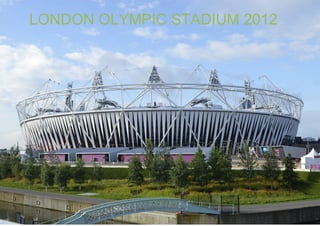
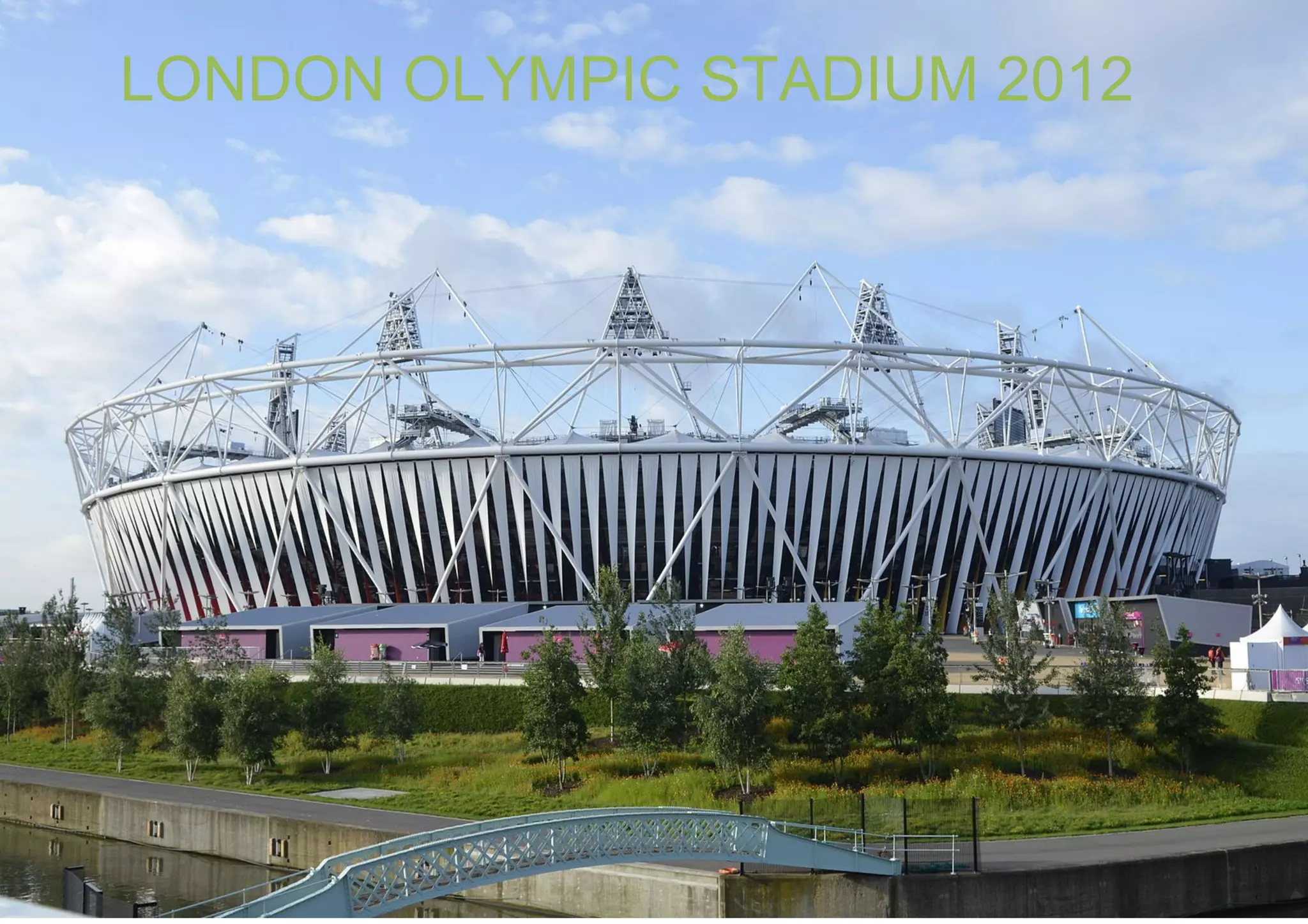
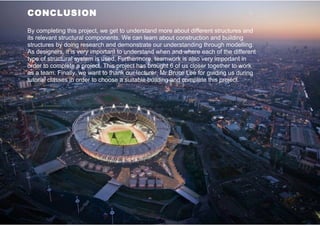
LONDON OLYMPIC STADIUM 2012
SCHOOL OF ARCHITECTURE, BUILDING & DESIGN 
Bachelor of Science (Honours) in Architecture 
BUILDING CONSTRUCTION 2 [ARC 2513] 
Project 2: Understanding Forces in Solid Structure and Surface Structure 
Tutor: Mr Bruce Lee Xia Sheng 
GROUP MEMBERS: TAN WEI HOW (0310707) 
YONG CHANG THENG (0310925) 
LEE YUAN JUNE (0311128) 
WONG PEAKKY (1101A13474) 
CHUAH WEI HONG (0310900) 
CHEONG SIEW LEONG (0310845)
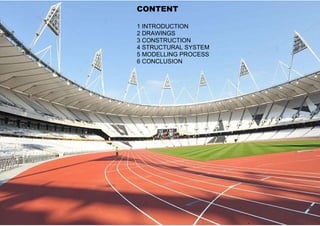
CONTENT 
1 INTRODUCTION 
2 DRAWINGS 
3 CONSTRUCTION 
4 STRUCTURAL SYSTEM 
5 MODELLING PROCESS 
6 CONCLUSION
INTRODUCTION 
In this project, we are to do research and 
choose a building with at least 2 different 
types of structural system and study the 
various structural systems that are used in 
that building. In a group of 6 persons, we 
need to build a structural model with 
suitable scale and materials to understand 
the construction of the building. 
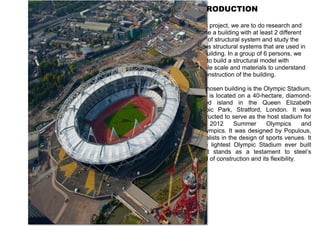
Our chosen building is the Olympic Stadium, 
which is located on a 40-hectare, diamond-shaped 
island in the Queen Elizabeth 
Olympic Park, Stratford, London. It was 
constructed to serve as the host stadium for 
the 2012 Summer Olympics and 
Paralympics. It was designed by Populous, 
specialists in the design of sports venues. It 
is the lightest Olympic Stadium ever built 
and it stands as a testament to steel’s 
speed of construction and its flexibility.
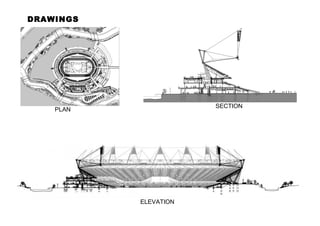
DRAWINGS 
PLAN SECTION 
ELEVATION
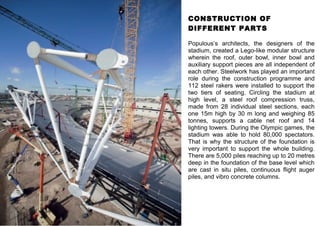
CONSTRUCTION OF 
DIFFERENT PARTS 
Populous’s architects, the designers of the 
stadium, created a Lego-like modular structure 
wherein the roof, outer bowl, inner bowl and 
auxiliary support pieces are all independent of 
each other. Steelwork has played an important 
role during the construction programme and 
112 steel rakers were installed to support the 
two tiers of seating. Circling the stadium at 
high level, a steel roof compression truss, 
made from 28 individual steel sections, each 
one 15m high by 30 m long and weighing 85 
tonnes, supports a cable net roof and 14 
lighting towers. During the Olympic games, the 
stadium was able to hold 80,000 spectators. 
That is why the structure of the foundation is 
very important to support the whole building. 
There are 5,000 piles reaching up to 20 metres 
deep in the foundation of the base level which 
are cast in situ piles, continuous flight auger 
piles, and vibro concrete columns.
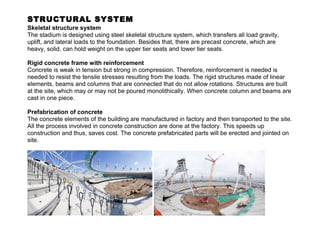
STRUCTURAL SYSTEM 
Skeletal structure system 
The stadium is designed using steel skeletal structure system, which transfers all load gravity, 
uplift, and lateral loads to the foundation. Besides that, there are precast concrete, which are 
heavy, solid, can hold weight on the upper tier seats and lower tier seats. 
Rigid concrete frame with reinforcement 
Concrete is weak in tension but strong in compression. Therefore, reinforcement is needed is 
needed to resist the tensile stresses resulting from the loads. The rigid structures made of linear 
elements, beams and columns that are connected that do not allow rotations. Structures are built 
at the site, which may or may not be poured monolithically. When concrete column and beams are 
cast in one piece. 
Prefabrication of concrete 
The concrete elements of the building are manufactured in factory and then transported to the site. 
All the process involved in concrete construction are done at the factory. This speeds up 
construction and thus, saves cost. The concrete prefabricated parts will be erected and jointed on 
site.
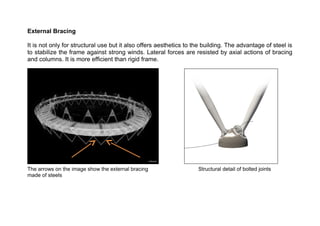
External Bracing 
It is not only for structural use but it also offers aesthetics to the building. The advantage of steel is 
to stabilize the frame against strong winds. Lateral forces are resisted by axial actions of bracing 
and columns. It is more efficient than rigid frame. 
The arrows on the image show the external bracing Structural detail of bolted joints 
made of steels
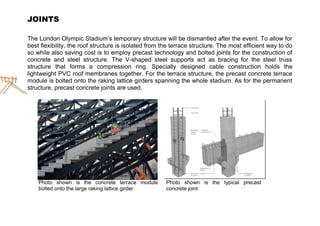
JOINTS 
The London Olympic Stadium’s temporary structure will be dismantled after the event. To allow for 
best flexibility, the roof structure is isolated from the terrace structure. The most efficient way to do 
so while also saving cost is to employ precast technology and bolted joints for the construction of 
concrete and steel structure. The V-shaped steel supports act as bracing for the steel truss 
structure that forms a compression ring. Specially designed cable construction holds the 
lightweight PVC roof membranes together. For the terrace structure, the precast concrete terrace 
module is bolted onto the raking lattice girders spanning the whole stadium. As for the permanent 
structure, precast concrete joints are used. 
Photo shown is the concrete terrace module 
bolted onto the large raking lattice girder 
Photo shown is the typical precast 
concrete joint
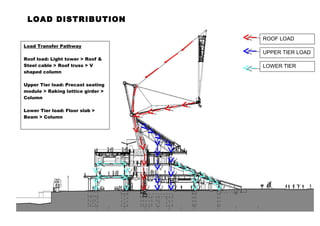
LOAD DISTRIBUTION 
ROOF LOAD 
UPPER TIER LOAD 
LOWER TIER 
LOAD 
Load Transfer Pathway 
Roof load: Light tower > Roof & 
Steel cable > Roof truss > V 
shaped column 
Upper Tier load: Precast seating 
module > Raking lattice girder > 
Column 
Lower Tier load: Floor slab > 
Beam > Column
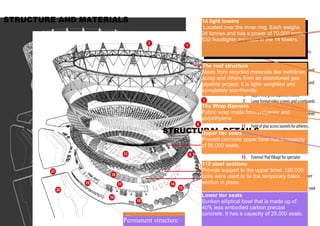
14 light towers 
Located over the inner ring. Each weighs 
34 tonnes and has a power of 70,000 watts. 
532 floodlights are used in the 14 towers. 
The roof structure 
Made from recycled materials like meltdown 
scrap and others from an abandoned gas 
pipeline project. It is light- weighted and 
completely eco-friendly. 
The Wrap Banners 
Fabric wrap made from polyester and 
polyethylene 
Upper tier seats 
Precast concrete upper bowl has a capacity 
of 55,000 seats. 
STRUCTURAL DETAILS 
Lower tier seats 
Sunken elliptical bowl that is made up of 
40% less embodied carbon precast 
concrete. It has a capacity of 25,000 seats. 
STRUCTURE AND MATERIALS 
112 steel sections 
Provide support to the upper bowl. 126,000 
bolts were used to fix the temporary black 
section in place. 
PTeremmapnoernatr ys tructure
CONCLUSION 
By completing this project, we get to understand more about different structures and 
its relevant structural components. We can learn about construction and building 
structures by doing research and demonstrate our understanding through modelling. 
As designers, it is very important to understand when and where each of the different 
type of structural system is used. Furthermore, teamwork is also very important in 
order to complete a project. This project has brought 6 of us closer together to work 
as a team. Finally, we want to thank our lecturer, Mr Bruce Lee for guiding us during 
tutorial classes in order to choose a suitable building and complete this project.
REFERENCES 
1. London 2012 - Olympic Stadium, 2012, Detail architecture-topics. 
[online] Available at: 
http://www.detail-online.com/architecture/topics/london-2012-olympic-stadium-019389.html 
2. Olympic Stadium, London, 2012, Structural Steel Design Awards, Steel Construction. 
[online] Available at: 
http://www.steelconstruction.info/Olympic_Stadium,_London 
3. How to Construct the Lightest, Most Open Olympic Stadium Ever built, 2012, Popular 
Science. 
[online] Available at: http://www.popsci.com/technology/article/2012-07/how-construct-lightest- 
most-open-olympic-stadium-ever-built 
4. London 2012 Olympic Stadium, 2014, Designing Buildings Wiki. 
[online] Available at: 
http://www.designingbuildings.co.uk/wiki/London_2012_Olympic_Stadium#Engineering_for_t 
he_Seating_Bowl

Building Construction 2 Project 2 Report

  • 1.
  • 2.
    SCHOOL OF ARCHITECTURE,BUILDING & DESIGN Bachelor of Science (Honours) in Architecture BUILDING CONSTRUCTION 2 [ARC 2513] Project 2: Understanding Forces in Solid Structure and Surface Structure Tutor: Mr Bruce Lee Xia Sheng GROUP MEMBERS: TAN WEI HOW (0310707) YONG CHANG THENG (0310925) LEE YUAN JUNE (0311128) WONG PEAKKY (1101A13474) CHUAH WEI HONG (0310900) CHEONG SIEW LEONG (0310845)
  • 3.
    CONTENT 1 INTRODUCTION 2 DRAWINGS 3 CONSTRUCTION 4 STRUCTURAL SYSTEM 5 MODELLING PROCESS 6 CONCLUSION
  • 4.
    INTRODUCTION In thisproject, we are to do research and choose a building with at least 2 different types of structural system and study the various structural systems that are used in that building. In a group of 6 persons, we need to build a structural model with suitable scale and materials to understand the construction of the building. Our chosen building is the Olympic Stadium, which is located on a 40-hectare, diamond-shaped island in the Queen Elizabeth Olympic Park, Stratford, London. It was constructed to serve as the host stadium for the 2012 Summer Olympics and Paralympics. It was designed by Populous, specialists in the design of sports venues. It is the lightest Olympic Stadium ever built and it stands as a testament to steel’s speed of construction and its flexibility.
  • 5.
  • 6.
    CONSTRUCTION OF DIFFERENTPARTS Populous’s architects, the designers of the stadium, created a Lego-like modular structure wherein the roof, outer bowl, inner bowl and auxiliary support pieces are all independent of each other. Steelwork has played an important role during the construction programme and 112 steel rakers were installed to support the two tiers of seating. Circling the stadium at high level, a steel roof compression truss, made from 28 individual steel sections, each one 15m high by 30 m long and weighing 85 tonnes, supports a cable net roof and 14 lighting towers. During the Olympic games, the stadium was able to hold 80,000 spectators. That is why the structure of the foundation is very important to support the whole building. There are 5,000 piles reaching up to 20 metres deep in the foundation of the base level which are cast in situ piles, continuous flight auger piles, and vibro concrete columns.
  • 7.
    STRUCTURAL SYSTEM Skeletalstructure system The stadium is designed using steel skeletal structure system, which transfers all load gravity, uplift, and lateral loads to the foundation. Besides that, there are precast concrete, which are heavy, solid, can hold weight on the upper tier seats and lower tier seats. Rigid concrete frame with reinforcement Concrete is weak in tension but strong in compression. Therefore, reinforcement is needed is needed to resist the tensile stresses resulting from the loads. The rigid structures made of linear elements, beams and columns that are connected that do not allow rotations. Structures are built at the site, which may or may not be poured monolithically. When concrete column and beams are cast in one piece. Prefabrication of concrete The concrete elements of the building are manufactured in factory and then transported to the site. All the process involved in concrete construction are done at the factory. This speeds up construction and thus, saves cost. The concrete prefabricated parts will be erected and jointed on site.
  • 8.
    External Bracing Itis not only for structural use but it also offers aesthetics to the building. The advantage of steel is to stabilize the frame against strong winds. Lateral forces are resisted by axial actions of bracing and columns. It is more efficient than rigid frame. The arrows on the image show the external bracing Structural detail of bolted joints made of steels
  • 9.
    JOINTS The LondonOlympic Stadium’s temporary structure will be dismantled after the event. To allow for best flexibility, the roof structure is isolated from the terrace structure. The most efficient way to do so while also saving cost is to employ precast technology and bolted joints for the construction of concrete and steel structure. The V-shaped steel supports act as bracing for the steel truss structure that forms a compression ring. Specially designed cable construction holds the lightweight PVC roof membranes together. For the terrace structure, the precast concrete terrace module is bolted onto the raking lattice girders spanning the whole stadium. As for the permanent structure, precast concrete joints are used. Photo shown is the concrete terrace module bolted onto the large raking lattice girder Photo shown is the typical precast concrete joint
  • 10.
    LOAD DISTRIBUTION ROOFLOAD UPPER TIER LOAD LOWER TIER LOAD Load Transfer Pathway Roof load: Light tower > Roof & Steel cable > Roof truss > V shaped column Upper Tier load: Precast seating module > Raking lattice girder > Column Lower Tier load: Floor slab > Beam > Column
  • 11.
    14 light towers Located over the inner ring. Each weighs 34 tonnes and has a power of 70,000 watts. 532 floodlights are used in the 14 towers. The roof structure Made from recycled materials like meltdown scrap and others from an abandoned gas pipeline project. It is light- weighted and completely eco-friendly. The Wrap Banners Fabric wrap made from polyester and polyethylene Upper tier seats Precast concrete upper bowl has a capacity of 55,000 seats. STRUCTURAL DETAILS Lower tier seats Sunken elliptical bowl that is made up of 40% less embodied carbon precast concrete. It has a capacity of 25,000 seats. STRUCTURE AND MATERIALS 112 steel sections Provide support to the upper bowl. 126,000 bolts were used to fix the temporary black section in place. PTeremmapnoernatr ys tructure
  • 14.
    CONCLUSION By completingthis project, we get to understand more about different structures and its relevant structural components. We can learn about construction and building structures by doing research and demonstrate our understanding through modelling. As designers, it is very important to understand when and where each of the different type of structural system is used. Furthermore, teamwork is also very important in order to complete a project. This project has brought 6 of us closer together to work as a team. Finally, we want to thank our lecturer, Mr Bruce Lee for guiding us during tutorial classes in order to choose a suitable building and complete this project.
  • 15.
    REFERENCES 1. London2012 - Olympic Stadium, 2012, Detail architecture-topics. [online] Available at: http://www.detail-online.com/architecture/topics/london-2012-olympic-stadium-019389.html 2. Olympic Stadium, London, 2012, Structural Steel Design Awards, Steel Construction. [online] Available at: http://www.steelconstruction.info/Olympic_Stadium,_London 3. How to Construct the Lightest, Most Open Olympic Stadium Ever built, 2012, Popular Science. [online] Available at: http://www.popsci.com/technology/article/2012-07/how-construct-lightest- most-open-olympic-stadium-ever-built 4. London 2012 Olympic Stadium, 2014, Designing Buildings Wiki. [online] Available at: http://www.designingbuildings.co.uk/wiki/London_2012_Olympic_Stadium#Engineering_for_t he_Seating_Bowl