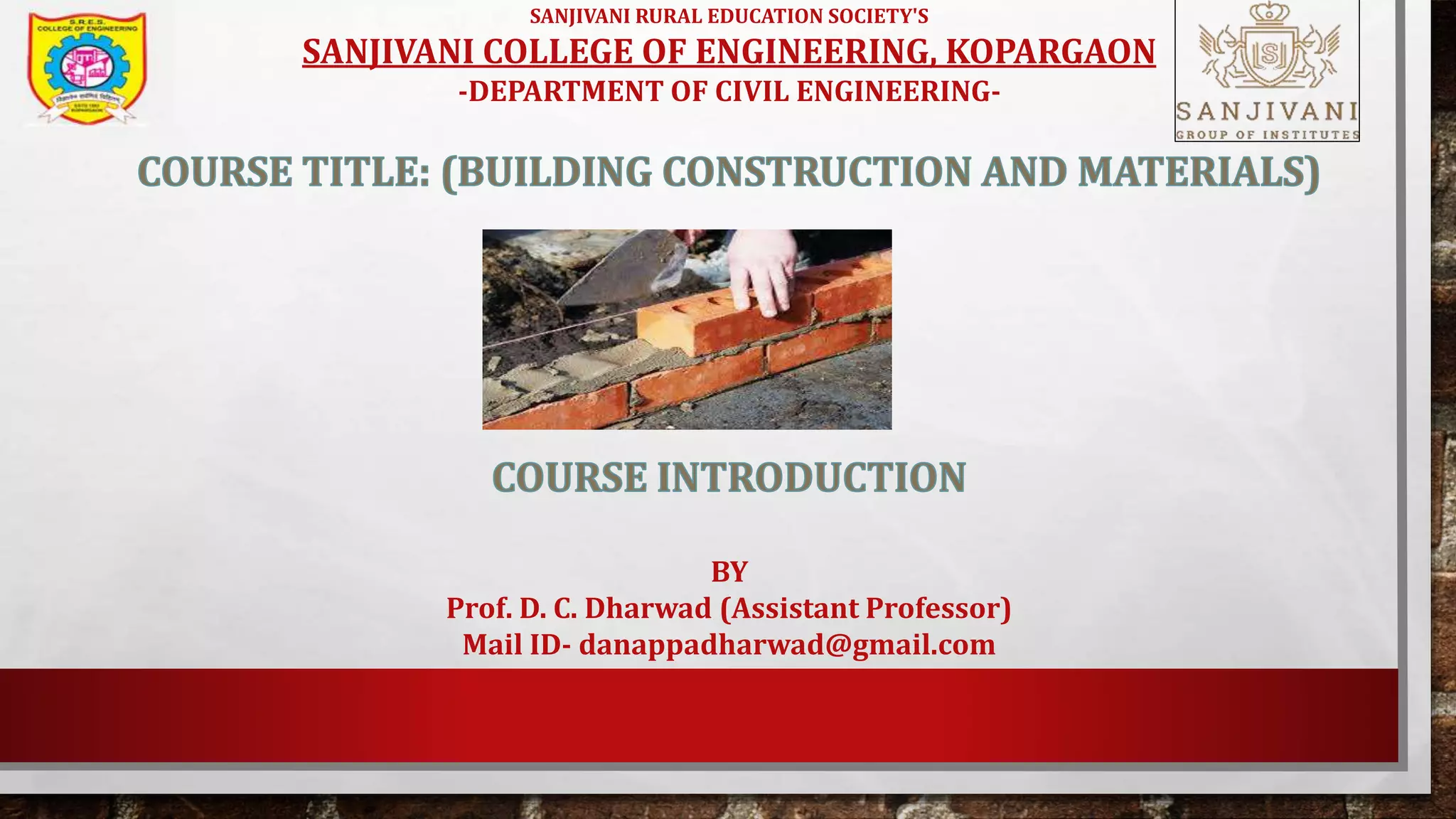
SANJIVANI RURAL EDUCATION SOCIETY'S
SANJIVANI COLLEGE OF ENGINEERING, KOPARGAON
-DEPARTMENT OF CIVIL ENGINEERING-
BY
Prof. D. C. Dharwad (Assistant Professor)
Mail ID- danappadharwad@gmail.com
UNIT NO.01
INTRODUCTION TO BUILDING CONSTRUCTION
AND MASONRY
PART- A
INTRODUCTION TO BUILDING
CONSTRUCTION
CONTENTS
INTRODUCTION
DEFINITION
TYPES OF BUILDING
TOPIC - 1.1 INTRODUCTION
WHY DO WE NEED BUILDINGS?
•We need shelter from sun, wind, rain, and snow.
•We need dry, level platforms for our activities. On these platforms, and within
our shelter, we need air that is warmer or cooler, more or less humid, than
outdoors.
• We need less light by day, and more light by night, than is offered by the natural
world. We need services that provide energy, communications, water and
disposal of wastes.
• So we gather materials and assemble them into the constructions we call
buildings to satisfy these needs.
CONT…..
•Building construction is an ancient human activity.
•It began with the purely functional need for a controlled environment to
moderate the effects of climate.
• The history of civil construction was began from the period of primitive human.
From the protection against cold, heat, rain etc. they made cave as their shelter.
• But that was not enough. Cave didn’t remain safe for long. So huts from the
straws and leaves and evolution goes on. But for better comfort civil construction
got evolved and still evolving.
•Today we have every comfort and facility.
DEFINITION OF BUILDING
•National Building Code of India (SP :7 -1970) defines the building as ‘any
structure for whatsoever purpose and whatsoever materials constructed and
every part thereof whether used as human habitation or not and includes
foundations , plinth, walls , floors, roofs, chimneys , plumbing and building
services , fixed platforms, verandah, balcony cornice or projection, part of a
building or anything affixed thereto or any wall enclosing or intented to enclose
any land or space and signs and outdoor display structures’
•Tents, shamianas, tarpaulin shelters are not considered as building.
TYPES OF BUILDINGS BASED ON OCCUPANCY AS PER NBC
What is NBC-
•NBC (national building code) is comprehensive building code which is national
instrument providing guidelines for regulating the building construction activity
across the country.
•The first version of the national building code was published in 1970 since the
publication in 1970 version of the national building code a large number of
comments and useful suggestions for modifications and additions to different
parts and sections of the code were received.
CONT…..
•It serves as a model code for adoption by all agencies involved in building
construction works be they public works departments, other government
construction departments, local bodies or private construction agencies
•The code mainly contains administrative regulations, development control rules
and general building requirements; fire safety requirements; stipulations
regarding materials, structural design and construction (including safety); and
building and plumbing services
TYPES OF BUILDINGS BASED ON OCCUPANCY AS PER NBC
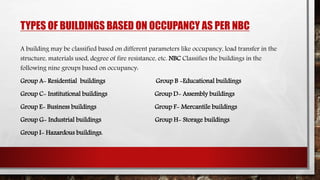
A building may be classified based on different parameters like occupancy, load transfer in the
structure, materials used, degree of fire resistance, etc. NBC Classifies the buildings in the
following nine groups based on occupancy:
Group A- Residential buildings Group B -Educational buildings
Group C- Institutional buildings Group D- Assembly buildings
Group E- Business buildings Group F- Mercantile buildings
Group G- Industrial buildings Group H- Storage buildings
Group I- Hazardous buildings.
GROUP – A : RESIDENTIAL BUILDINGS
• The buildings in which sleeping accommodation is provided for normal residential purposes, with Or
without cooking or dining or both facilities are grouped as residential buildings. However, the Buildings
classified under institutional group are excluded from this group.
• Residential buildings are further subdivided into many categories as follows.
A. Lodging or rooming Houses :
These are the buildings in which under the same management, separate sleeping accommodation for a
total of not more than 40 persons is provided. The accommodation may be on transit or permanent basis
and it may be with or without dining facilities. However, there should not be cooking facility on individual
basis.
CONT….
• B. One or Two family Private Dwellings
These include any private dwelling which is occupied by the members of a single family and has
a total sleeping accommodation for not more than 20 persons.
• C. Dormitories:
These include any building in which group sleeping accommodation is provided with or
without dining facilities , for persons who are not of the same family , in any one room or a
series of rooms under joint occupancy and single management. Ex: School and colleges, military
barracks etc.
CONT….
• D. Apartment Houses (Flats):
These include any building or structure in which living quarters are provided for three or more
families living independently of each other and with independent cooking fascilities. Ex:
Apartment Houses etc.
• E. Hotels:
These are the buildings under single management in which sleeping accommodation with or
without dining facility is provided for more than 15 persons who are primarily transient.
Examples of such buildings are hotels, inns, clubs and motels.
GROUP – B : EDUCATIONAL BUILDINGS
• This occupancy type shall include any building or portion thereof in which education, training
and care are provided to children or adults. This occupancy shall be subdivided as follows:
B1: educational facilities up to higher secondary level
• These shall include any building or portion thereof used for purposes involving assembly for
instruction, education and recreation of more than six persons on regular basis to fulfill the
requirement of an academic curriculum approved by the government up to H.S.C (12th grade),
and which is not covered by occupancy I.
• B2: facilities for training and for above-secondary level
• These shall include any building or portion thereof used for purposes involving assembly for
instruction, education, training and recreation of more than six persons, and which is not
covered by occupancy I and B1.
B3: pre-school facilities
• These shall include any building or portion thereof used for purposes involving care, recreation
and education of children more than six in number, who have not yet reached the age to attend
the school.
Group C- Institutional buildings
• Buildings classified under this occupancy shall include those used for purposes of institutional
care of the occupants, such as detention for correctional or penal purposes, medical or nursing
care of persons suffering from illness or infirmity due to mental condition, or accommodation of
children or minor, where the personal liberty of the inmate is restricted. These buildings shall
ordinarily provide accommodation for sleeping, dining and other provisions approved by the
authority for the occupants. This occupancy shall be subdivided as follows:
Institution for care of children
• These shall include any building or portion thereof or group of buildings under single
management used as an institution for the full time care of children or minor, each providing
accommodation for sleeping, dining and other provisions approved by the authority for more
than six children.
Custodial institution for physically capable adults
• These shall include any building or portion thereof or group of buildings under single
management used for purposes of full time care and custody of adult or mentally disabled
persons but physically capable of responding to emergency.
Custodial institution for the incapable adults
• These shall include any building or portion thereof or group of buildings under single
management used for purposes of full time care and custody of persons physically or mentally
incapable of responding to emergency.
Penal and mental institution for children
• These shall include any building or portion thereof or group of buildings under single
management used for housing children under restraint, or who are detained for penal and
corrective purposes, in which personal liberty of the inmates is restricted.
Penal and mental institution for adults
• These shall include any building or portion thereof or group of buildings under single
management used for housing persons under restraint, or who are detained for penal and
corrective purposes, in which personal liberty of the inmates is restricted
Group D- Assembly buildings
• Buildings under this occupancy group shall include any building or portion thereof in which
groups of people congregate or assemble for recreation, amusement, social, religious, political,
cultural, travel and similar purposes. This occupancy shall be subdivided as follows:
D1. Large assembly with fixed seats
• This occupancy shall include a building or a portion thereof for assembly in a space provided
with fixed seats for 1000 or more persons. Assembly buildings under this subdivision may be for
theatrical, operatic performances or cinema projection having or not a raised stage, proscenium
curtains, scenery loft or projection screen, lighting equipment, projection booth and necessary
theatrical and mechanical equipment.
D2. Small assembly with fixed seats
• This occupancy type shall include any building or portion thereof primarily meant for use as
described for buildings under occupancy D1., but with fixed seats for less than 1000 persons in a
space. These assembly buildings may or may not be provided with a legitimate theatrical stage or
related accessories or equipment.
D3. Large assembly without fixed seats
• This occupancy type shall include any building or portion thereof for assembly in a space, in
which there are no fixed seats, which may or may not be provided with a legitimate stage or
theatrical accessories, and which has accommodation for 300 or more persons.
D4. Small assembly without fixed seats
• This occupancy type shall include any building or portion thereof primarily intended for use as
described in occupancy D3, but with accommodation for less than 300 persons in a space.
D5. Sports facilities
• This occupancy type shall include any building or portion thereof meant for assembly of
spectators for recreational and amusement purpose mainly related to sports.
THANK YOU

Building and its types

  • 1.
    SANJIVANI RURAL EDUCATIONSOCIETY'S SANJIVANI COLLEGE OF ENGINEERING, KOPARGAON -DEPARTMENT OF CIVIL ENGINEERING- BY Prof. D. C. Dharwad (Assistant Professor) Mail ID- danappadharwad@gmail.com
  • 3.
    UNIT NO.01 INTRODUCTION TOBUILDING CONSTRUCTION AND MASONRY
  • 4.
    PART- A INTRODUCTION TOBUILDING CONSTRUCTION
  • 5.
  • 6.
    TOPIC - 1.1INTRODUCTION WHY DO WE NEED BUILDINGS? •We need shelter from sun, wind, rain, and snow. •We need dry, level platforms for our activities. On these platforms, and within our shelter, we need air that is warmer or cooler, more or less humid, than outdoors. • We need less light by day, and more light by night, than is offered by the natural world. We need services that provide energy, communications, water and disposal of wastes. • So we gather materials and assemble them into the constructions we call buildings to satisfy these needs.
  • 7.
    CONT….. •Building construction isan ancient human activity. •It began with the purely functional need for a controlled environment to moderate the effects of climate. • The history of civil construction was began from the period of primitive human. From the protection against cold, heat, rain etc. they made cave as their shelter. • But that was not enough. Cave didn’t remain safe for long. So huts from the straws and leaves and evolution goes on. But for better comfort civil construction got evolved and still evolving. •Today we have every comfort and facility.
  • 8.
    DEFINITION OF BUILDING •NationalBuilding Code of India (SP :7 -1970) defines the building as ‘any structure for whatsoever purpose and whatsoever materials constructed and every part thereof whether used as human habitation or not and includes foundations , plinth, walls , floors, roofs, chimneys , plumbing and building services , fixed platforms, verandah, balcony cornice or projection, part of a building or anything affixed thereto or any wall enclosing or intented to enclose any land or space and signs and outdoor display structures’ •Tents, shamianas, tarpaulin shelters are not considered as building.
  • 9.
    TYPES OF BUILDINGSBASED ON OCCUPANCY AS PER NBC What is NBC- •NBC (national building code) is comprehensive building code which is national instrument providing guidelines for regulating the building construction activity across the country. •The first version of the national building code was published in 1970 since the publication in 1970 version of the national building code a large number of comments and useful suggestions for modifications and additions to different parts and sections of the code were received.
  • 10.
    CONT….. •It serves asa model code for adoption by all agencies involved in building construction works be they public works departments, other government construction departments, local bodies or private construction agencies •The code mainly contains administrative regulations, development control rules and general building requirements; fire safety requirements; stipulations regarding materials, structural design and construction (including safety); and building and plumbing services
  • 11.
    TYPES OF BUILDINGSBASED ON OCCUPANCY AS PER NBC A building may be classified based on different parameters like occupancy, load transfer in the structure, materials used, degree of fire resistance, etc. NBC Classifies the buildings in the following nine groups based on occupancy: Group A- Residential buildings Group B -Educational buildings Group C- Institutional buildings Group D- Assembly buildings Group E- Business buildings Group F- Mercantile buildings Group G- Industrial buildings Group H- Storage buildings Group I- Hazardous buildings.
  • 12.
    GROUP – A: RESIDENTIAL BUILDINGS • The buildings in which sleeping accommodation is provided for normal residential purposes, with Or without cooking or dining or both facilities are grouped as residential buildings. However, the Buildings classified under institutional group are excluded from this group. • Residential buildings are further subdivided into many categories as follows. A. Lodging or rooming Houses : These are the buildings in which under the same management, separate sleeping accommodation for a total of not more than 40 persons is provided. The accommodation may be on transit or permanent basis and it may be with or without dining facilities. However, there should not be cooking facility on individual basis.
  • 13.
    CONT…. • B. Oneor Two family Private Dwellings These include any private dwelling which is occupied by the members of a single family and has a total sleeping accommodation for not more than 20 persons. • C. Dormitories: These include any building in which group sleeping accommodation is provided with or without dining facilities , for persons who are not of the same family , in any one room or a series of rooms under joint occupancy and single management. Ex: School and colleges, military barracks etc.
  • 14.
    CONT…. • D. ApartmentHouses (Flats): These include any building or structure in which living quarters are provided for three or more families living independently of each other and with independent cooking fascilities. Ex: Apartment Houses etc. • E. Hotels: These are the buildings under single management in which sleeping accommodation with or without dining facility is provided for more than 15 persons who are primarily transient. Examples of such buildings are hotels, inns, clubs and motels.
  • 15.
    GROUP – B: EDUCATIONAL BUILDINGS • This occupancy type shall include any building or portion thereof in which education, training and care are provided to children or adults. This occupancy shall be subdivided as follows: B1: educational facilities up to higher secondary level • These shall include any building or portion thereof used for purposes involving assembly for instruction, education and recreation of more than six persons on regular basis to fulfill the requirement of an academic curriculum approved by the government up to H.S.C (12th grade), and which is not covered by occupancy I.
  • 16.
    • B2: facilitiesfor training and for above-secondary level • These shall include any building or portion thereof used for purposes involving assembly for instruction, education, training and recreation of more than six persons, and which is not covered by occupancy I and B1. B3: pre-school facilities • These shall include any building or portion thereof used for purposes involving care, recreation and education of children more than six in number, who have not yet reached the age to attend the school.
  • 17.
    Group C- Institutionalbuildings • Buildings classified under this occupancy shall include those used for purposes of institutional care of the occupants, such as detention for correctional or penal purposes, medical or nursing care of persons suffering from illness or infirmity due to mental condition, or accommodation of children or minor, where the personal liberty of the inmate is restricted. These buildings shall ordinarily provide accommodation for sleeping, dining and other provisions approved by the authority for the occupants. This occupancy shall be subdivided as follows:
  • 18.
    Institution for careof children • These shall include any building or portion thereof or group of buildings under single management used as an institution for the full time care of children or minor, each providing accommodation for sleeping, dining and other provisions approved by the authority for more than six children. Custodial institution for physically capable adults • These shall include any building or portion thereof or group of buildings under single management used for purposes of full time care and custody of adult or mentally disabled persons but physically capable of responding to emergency. Custodial institution for the incapable adults • These shall include any building or portion thereof or group of buildings under single management used for purposes of full time care and custody of persons physically or mentally incapable of responding to emergency.
  • 19.
    Penal and mentalinstitution for children • These shall include any building or portion thereof or group of buildings under single management used for housing children under restraint, or who are detained for penal and corrective purposes, in which personal liberty of the inmates is restricted. Penal and mental institution for adults • These shall include any building or portion thereof or group of buildings under single management used for housing persons under restraint, or who are detained for penal and corrective purposes, in which personal liberty of the inmates is restricted
  • 20.
    Group D- Assemblybuildings • Buildings under this occupancy group shall include any building or portion thereof in which groups of people congregate or assemble for recreation, amusement, social, religious, political, cultural, travel and similar purposes. This occupancy shall be subdivided as follows: D1. Large assembly with fixed seats • This occupancy shall include a building or a portion thereof for assembly in a space provided with fixed seats for 1000 or more persons. Assembly buildings under this subdivision may be for theatrical, operatic performances or cinema projection having or not a raised stage, proscenium curtains, scenery loft or projection screen, lighting equipment, projection booth and necessary theatrical and mechanical equipment.
  • 21.
    D2. Small assemblywith fixed seats • This occupancy type shall include any building or portion thereof primarily meant for use as described for buildings under occupancy D1., but with fixed seats for less than 1000 persons in a space. These assembly buildings may or may not be provided with a legitimate theatrical stage or related accessories or equipment. D3. Large assembly without fixed seats • This occupancy type shall include any building or portion thereof for assembly in a space, in which there are no fixed seats, which may or may not be provided with a legitimate stage or theatrical accessories, and which has accommodation for 300 or more persons.
  • 22.
    D4. Small assemblywithout fixed seats • This occupancy type shall include any building or portion thereof primarily intended for use as described in occupancy D3, but with accommodation for less than 300 persons in a space. D5. Sports facilities • This occupancy type shall include any building or portion thereof meant for assembly of spectators for recreational and amusement purpose mainly related to sports.
  • 23.