Building High
Performance Teams
www.warpspeedtraining.com
THE BEST COMPANIES ARE THE BEST COLLABORATORS
… more and more business will be done through
collaborations within and between companies, for a
very simple reason …
The next layers of value creation - whether in
technology, marketing, biomedicine, or manufacturing –
are becoming so complex that no single firm or
department is going to be able to master them alone.
Thomas Freidman, 2005, The World Is Flat. Farrar, Straus & Giroux (page 353)
QUICK REVIEW &
DEEPER DIVE:
WORK GROUPS
VS. WORK TEAMS
www.warpspeedtraining.com
Work Groups versus Work Teams
Work Group
– A set of individuals who rely on the sum of
“individual bests’ for their performance
Work Team
– A group of people who must work
interdependently to achieve a specific
outcome for which they are collectively
responsible, whose tasks are interdependent,
and who develop specialized member roles
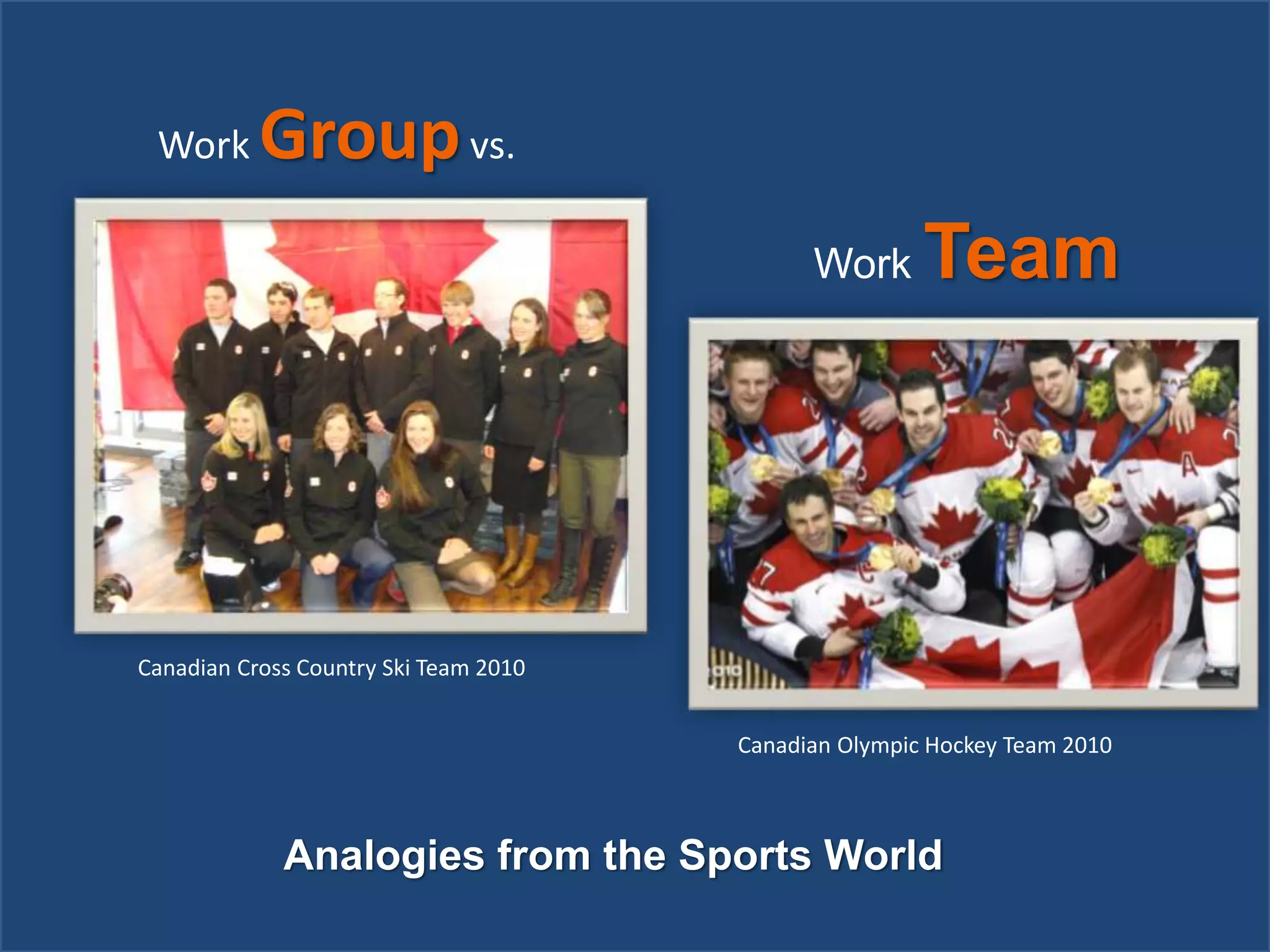
Work Groupvs.
Work Team
Analogies from the Sports World
Canadian Olympic Hockey Team 2010
Canadian Cross Country Ski Team 2010
www.warpspeedtraining.com
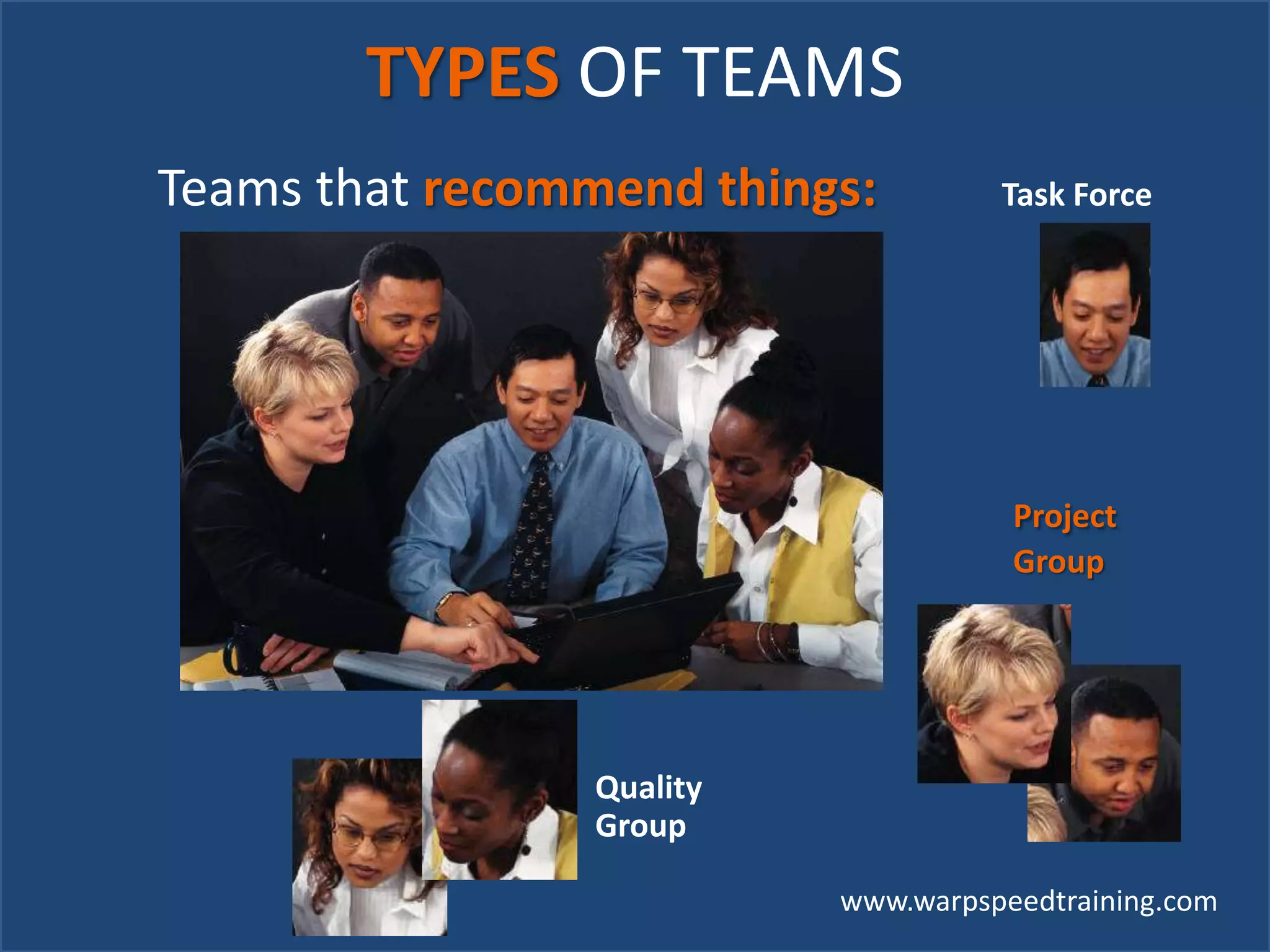
TYPES OF TEAMS
Quality
Group
Teams that recommend things:
Project
Group
Task Force
www.warpspeedtraining.com
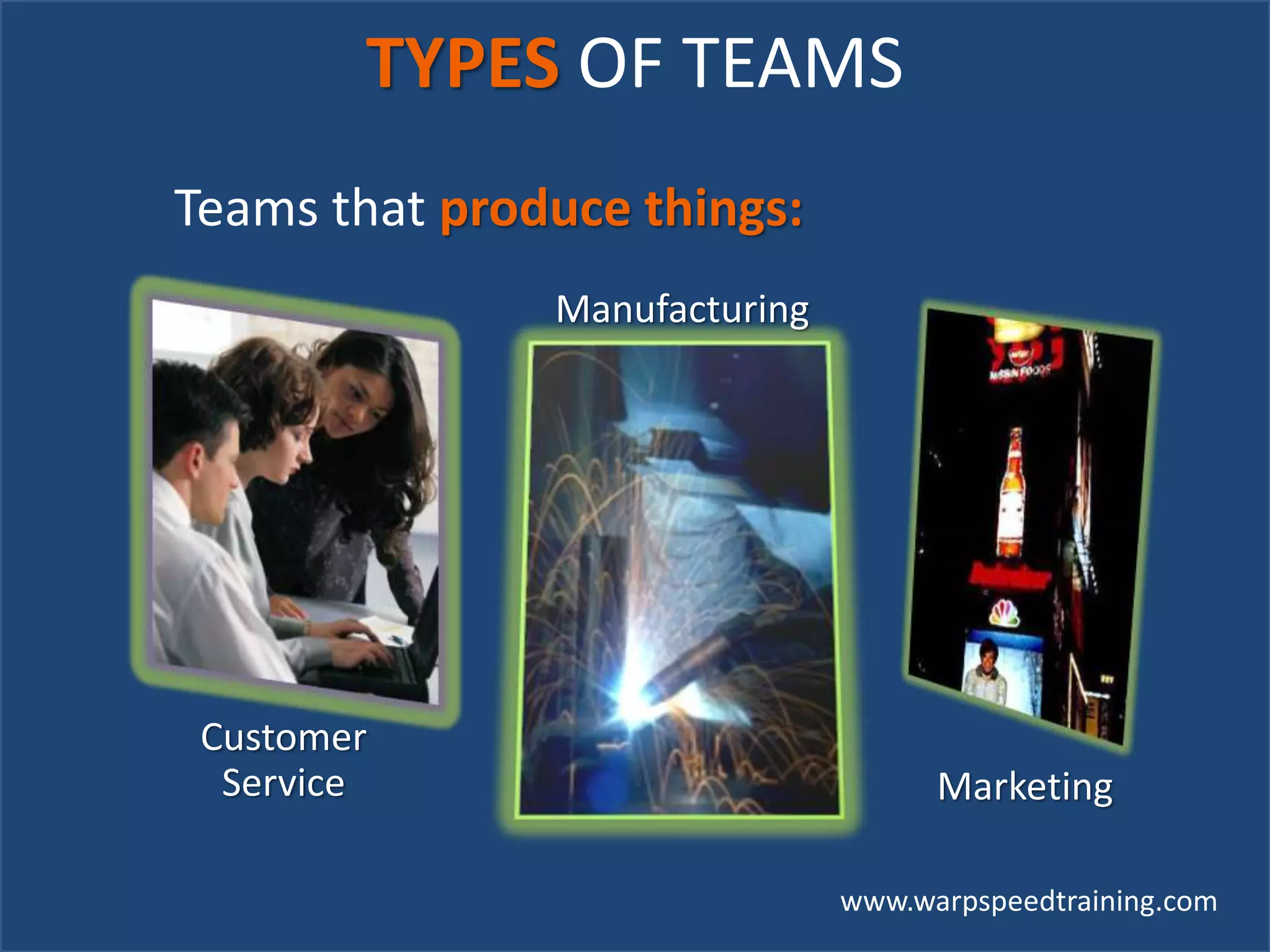
Teams that produce things:
Marketing
Customer
Service
Manufacturing
TYPES OF TEAMS
www.warpspeedtraining.com
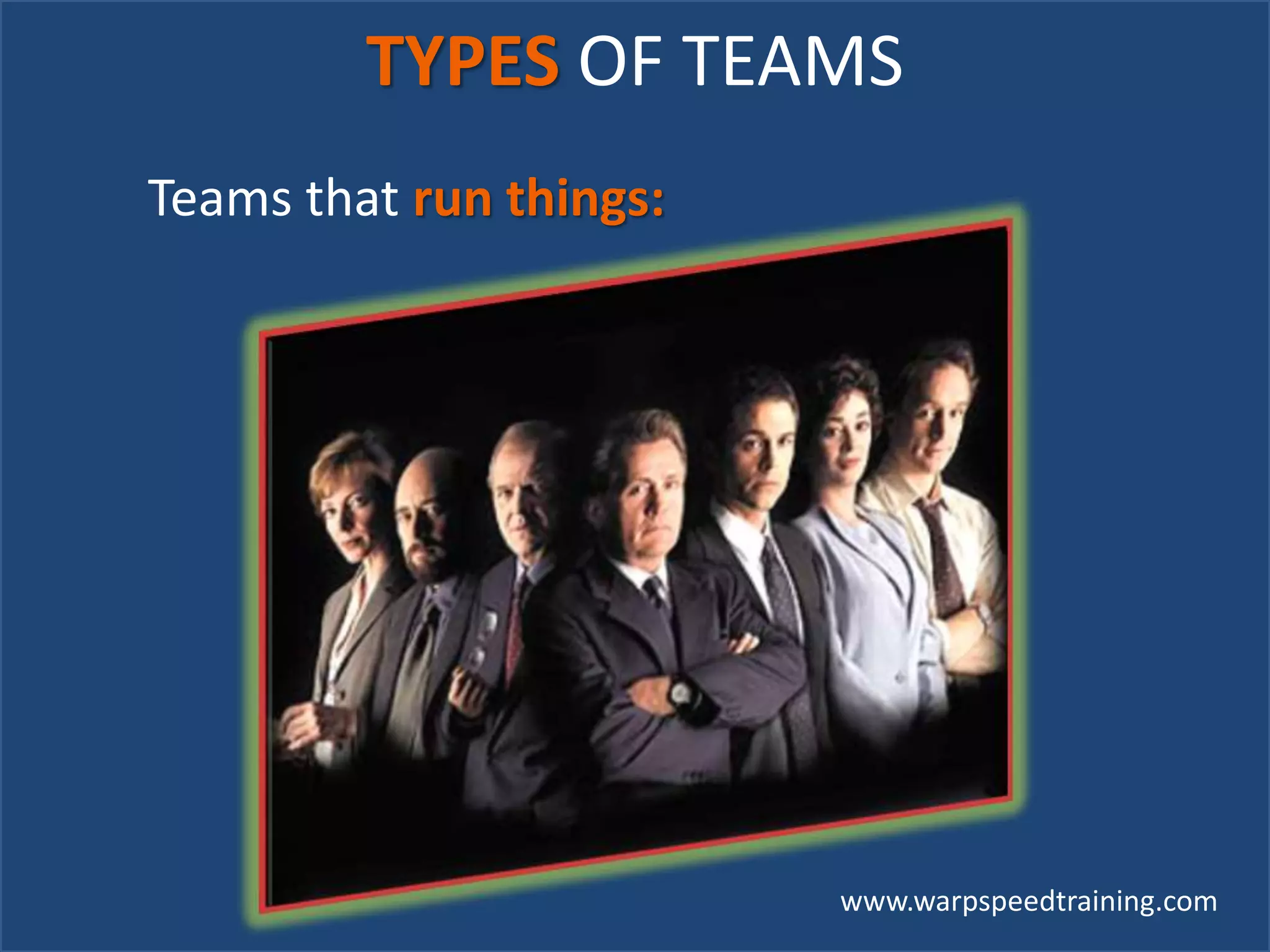
Teams that run things:
TYPES OF TEAMS
www.warpspeedtraining.com
When is a Team appropriate?
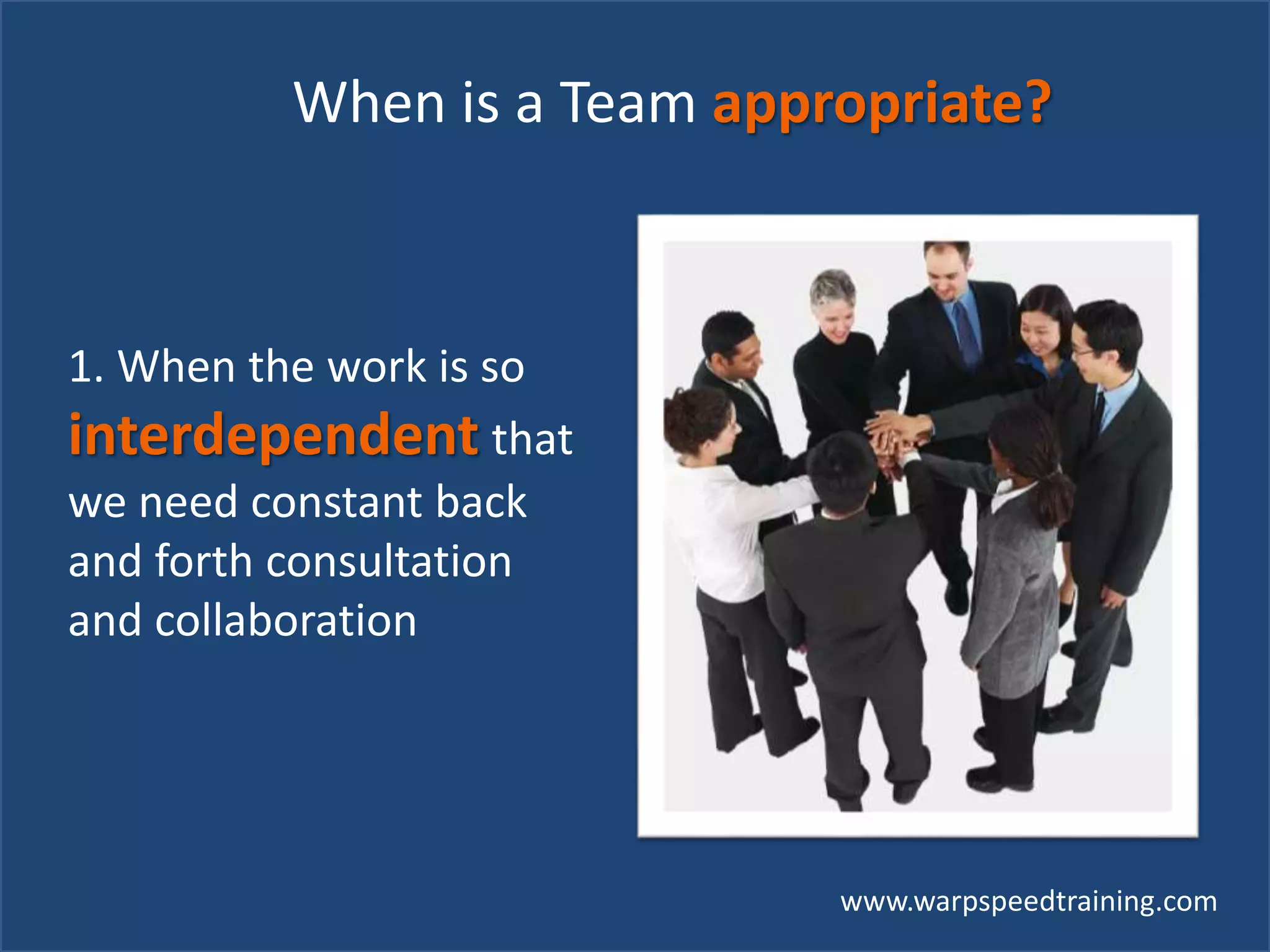
1. When the work is so
interdependent that
we need constant back
and forth consultation
and collaboration
www.warpspeedtraining.com
When is a Team appropriate?
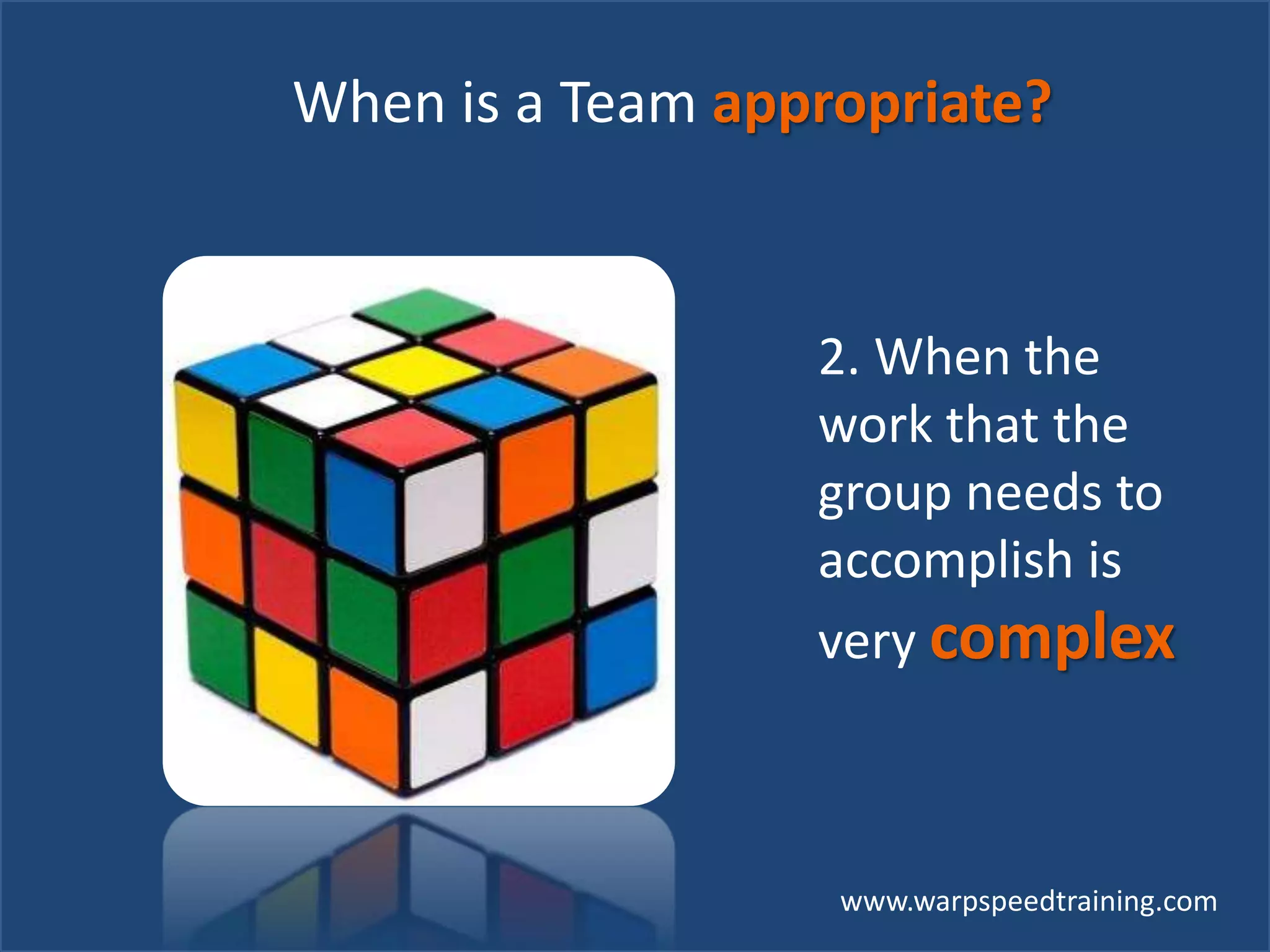
2. When the
work that the
group needs to
accomplish is
very complex
When is a Team appropriate?
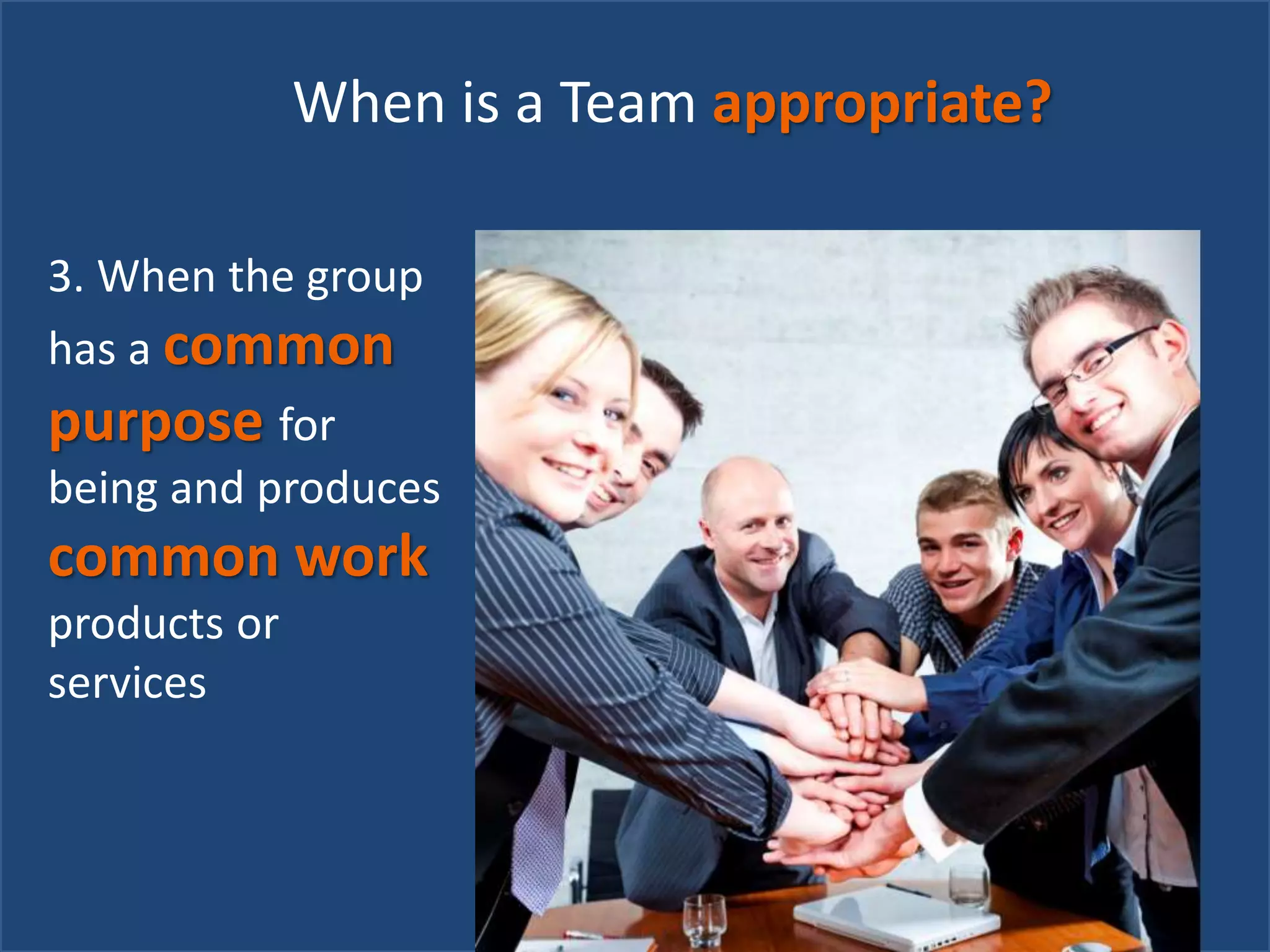
3. When the group
has a common
purpose for
being and produces
common work
products or
services
www.warpspeedtraining.com
When is a Team appropriate?
4. When the group
is committed to
building teamwork
and the
collaboration skills
necessary for team
success
www.warpspeedtraining.com
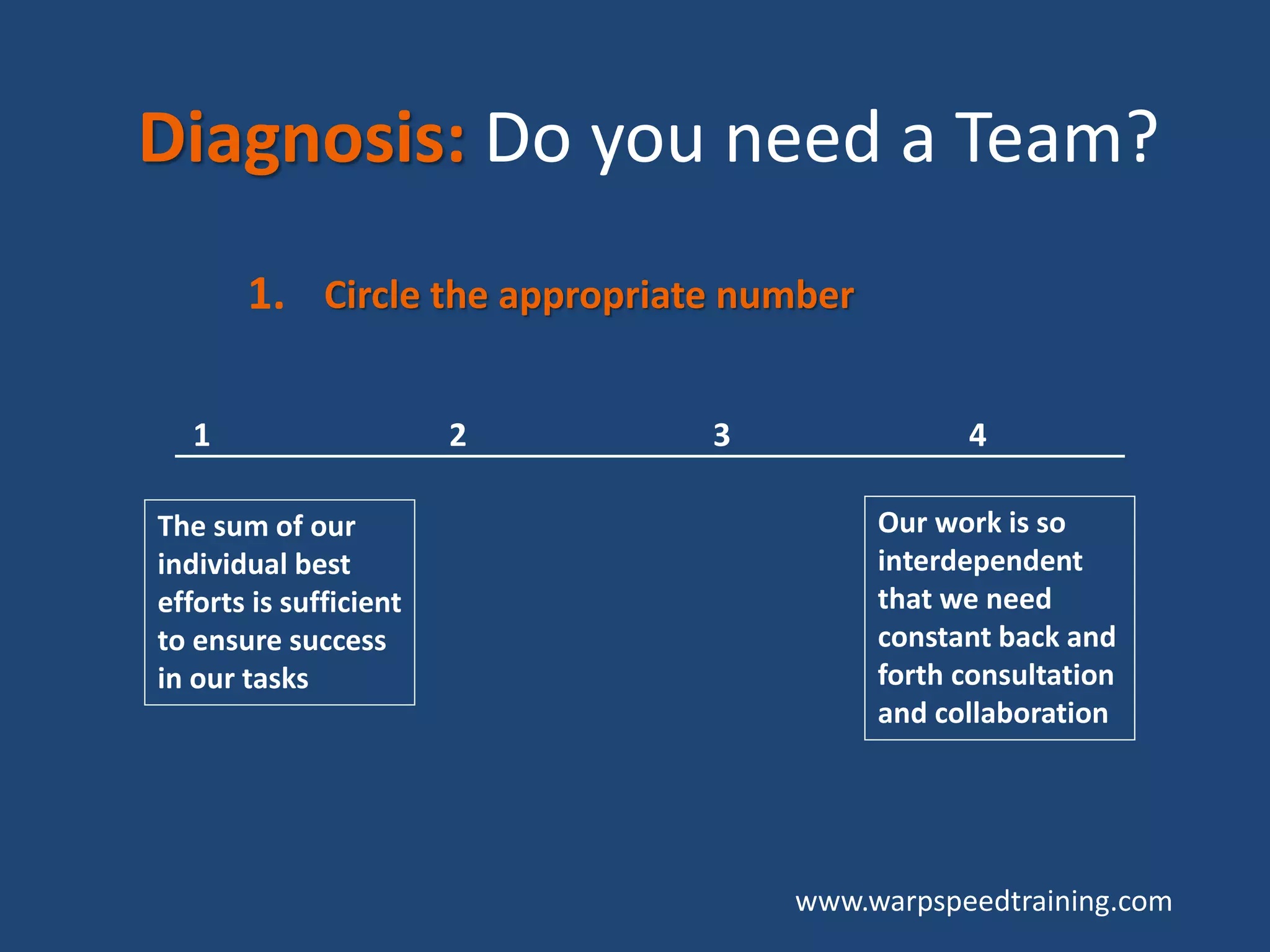
1.
The sum of our
individual best
efforts is sufficient
to ensure success
in our tasks
Our work is so
interdependent
that we need
constant back and
forth consultation
and collaboration
1 2 3 4
Circle the appropriate number
Diagnosis: Do you need a Team?
www.warpspeedtraining.com
2.
1 2 3 4
Circle the appropriate number
The work our
group needs to
accomplish is
well-understood
and doesn’t
require constant
complex decisions
The work that our
group needs to
accomplish is very
complex
Diagnosis: Do you need a Team?
www.warpspeedtraining.com
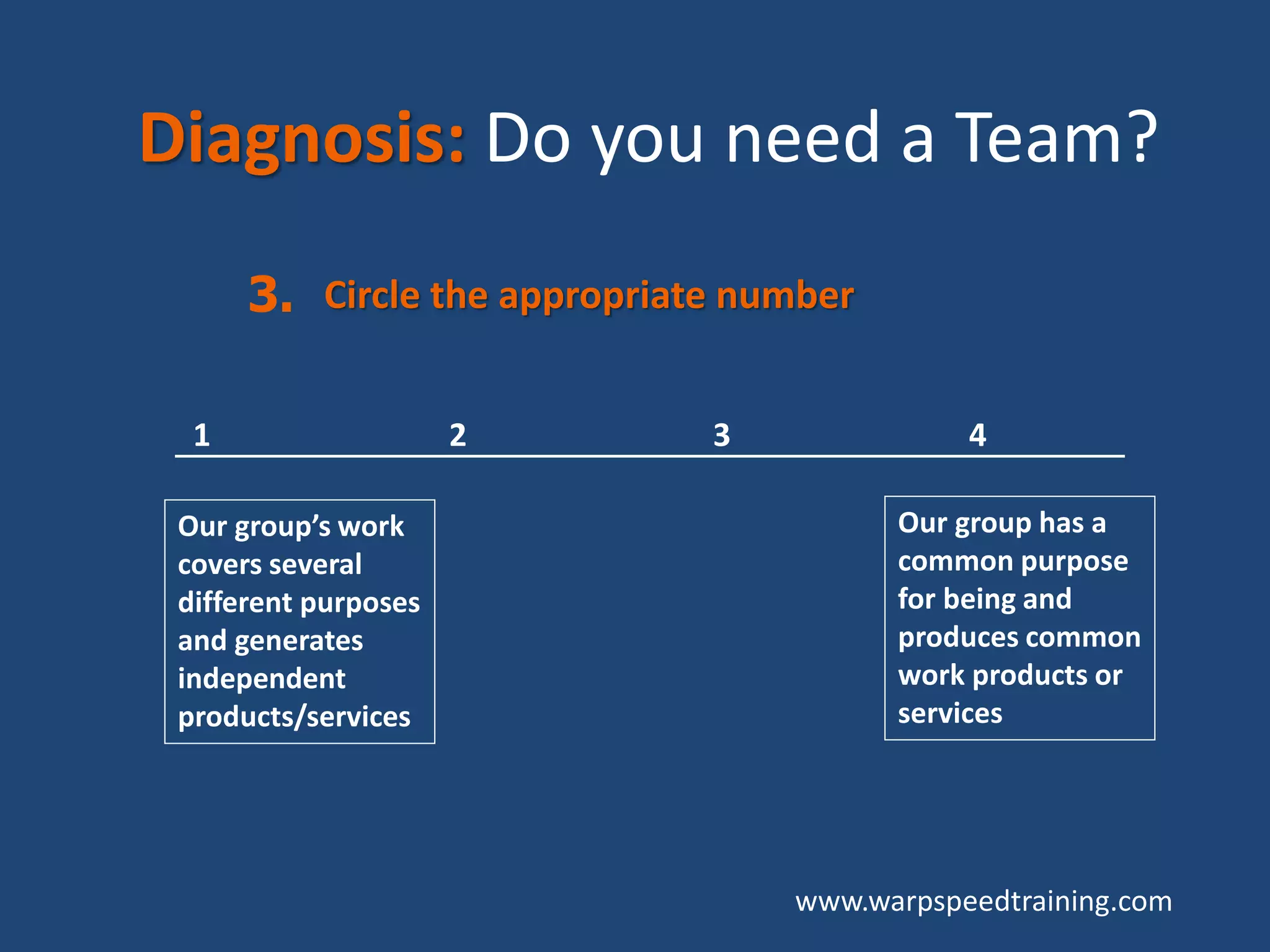
3.
1 2 3 4
Circle the appropriate number
Our group’s work
covers several
different purposes
and generates
independent
products/services
Our group has a
common purpose
for being and
produces common
work products or
services
Diagnosis: Do you need a Team?
www.warpspeedtraining.com
4.
1 2 3 4
Circle the appropriate number
Our group is not
interested in
putting forth a lot
of effort in
teambuilding
Our group is
committed to
building
teamwork and
collaboration
skills
Diagnosis: Do you need a Team?
www.warpspeedtraining.com
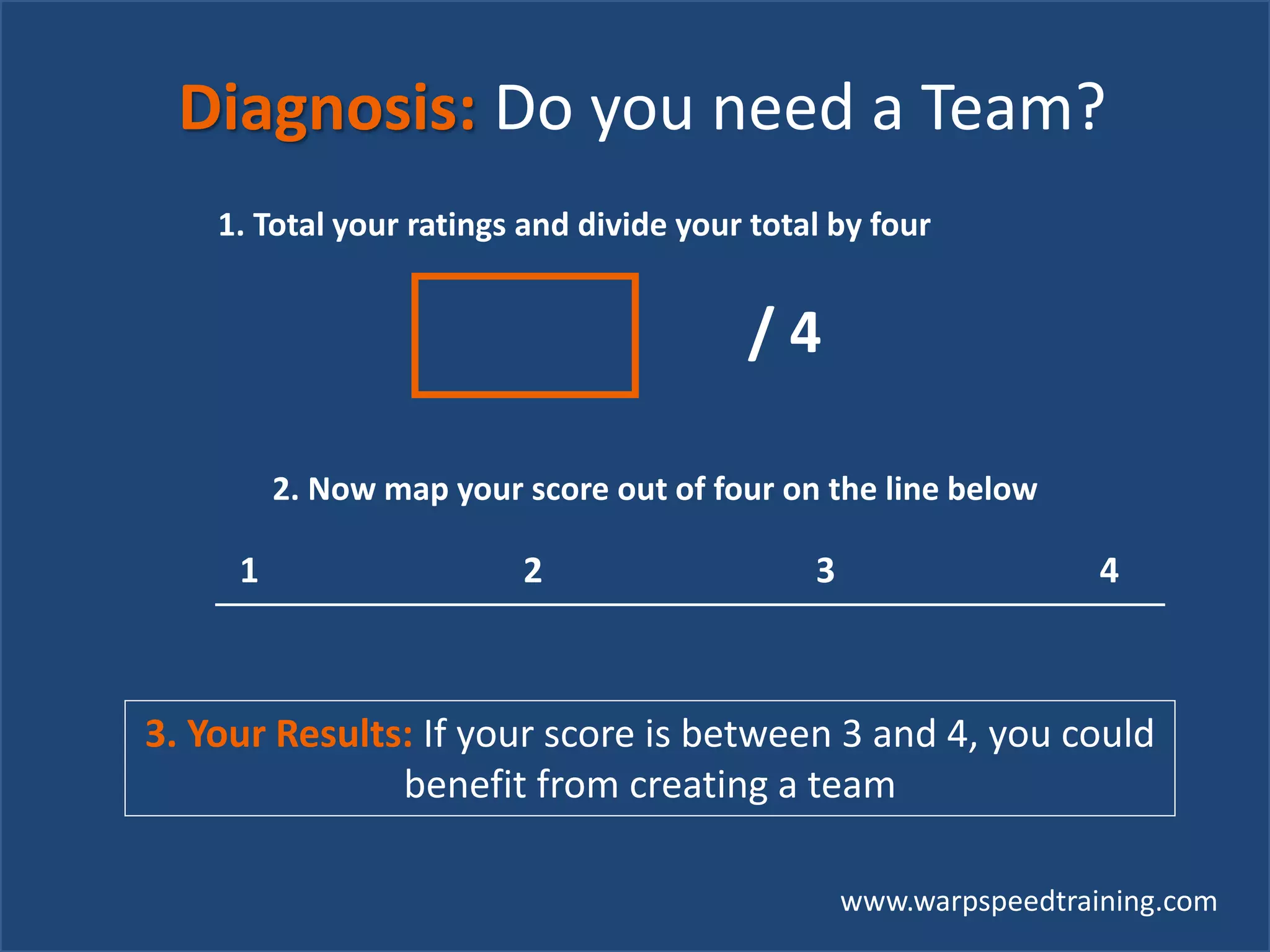
1 2 3 4
1. Total your ratings and divide your total by four
/ 4
2. Now map your score out of four on the line below
3. Your Results: If your score is between 3 and 4, you could
benefit from creating a team
Diagnosis: Do you need a Team?
www.warpspeedtraining.com
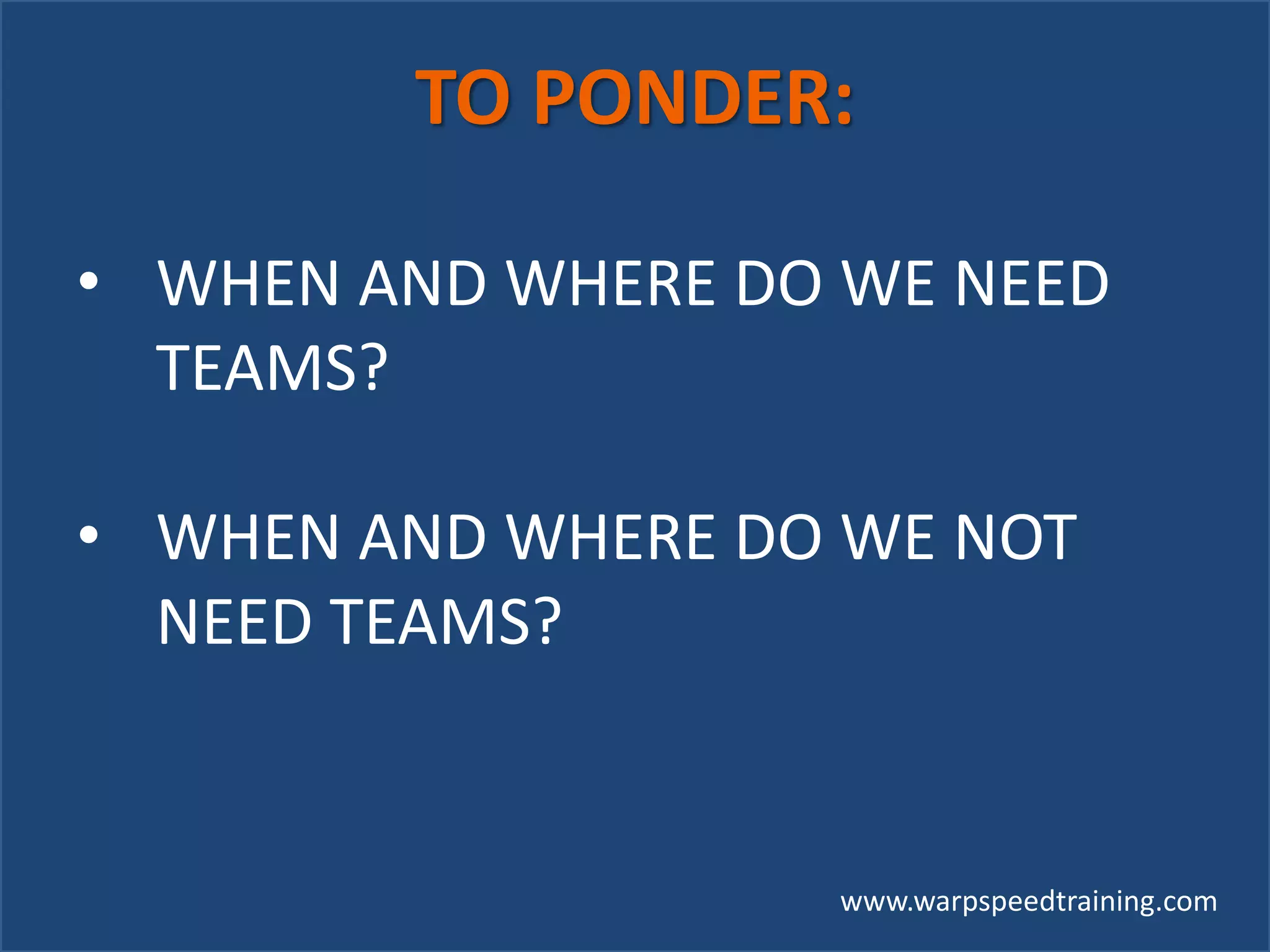
TO PONDER:
• WHEN AND WHERE DO WE NEED
TEAMS?
• WHEN AND WHERE DO WE NOT
NEED TEAMS?
QUICK REVIEW &
DEEPER DIVE:
CREATING A HIGH
PERFORMANCE
TEAM
www.warpspeedtraining.com
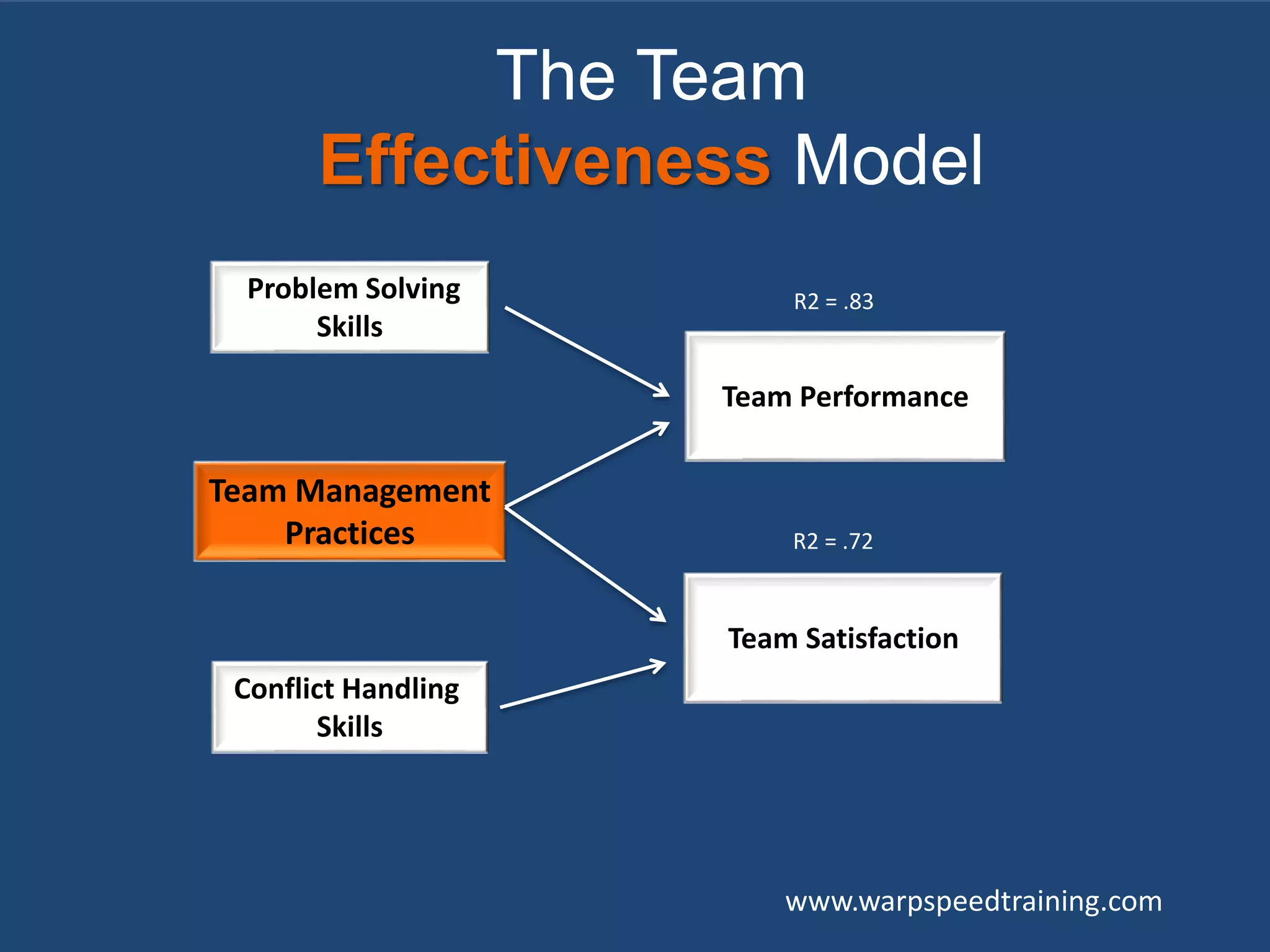
Team Management
Practices
Problem Solving
Skills
Conflict Handling
Skills
Team Performance
Team Satisfaction
R2 = .83
R2 = .72
The research model has been validated with over 250 teams and 1800 individuals
The Team
Effectiveness Model
www.warpspeedtraining.com
Team Management
Practices
Problem Solving
Skills
Conflict Handling
Skills
Team Performance
Team Satisfaction
R2 = .83
R2 = .72
The Team
Effectiveness Model
www.warpspeedtraining.com
Team Management Practices:
Prepare for High Performance
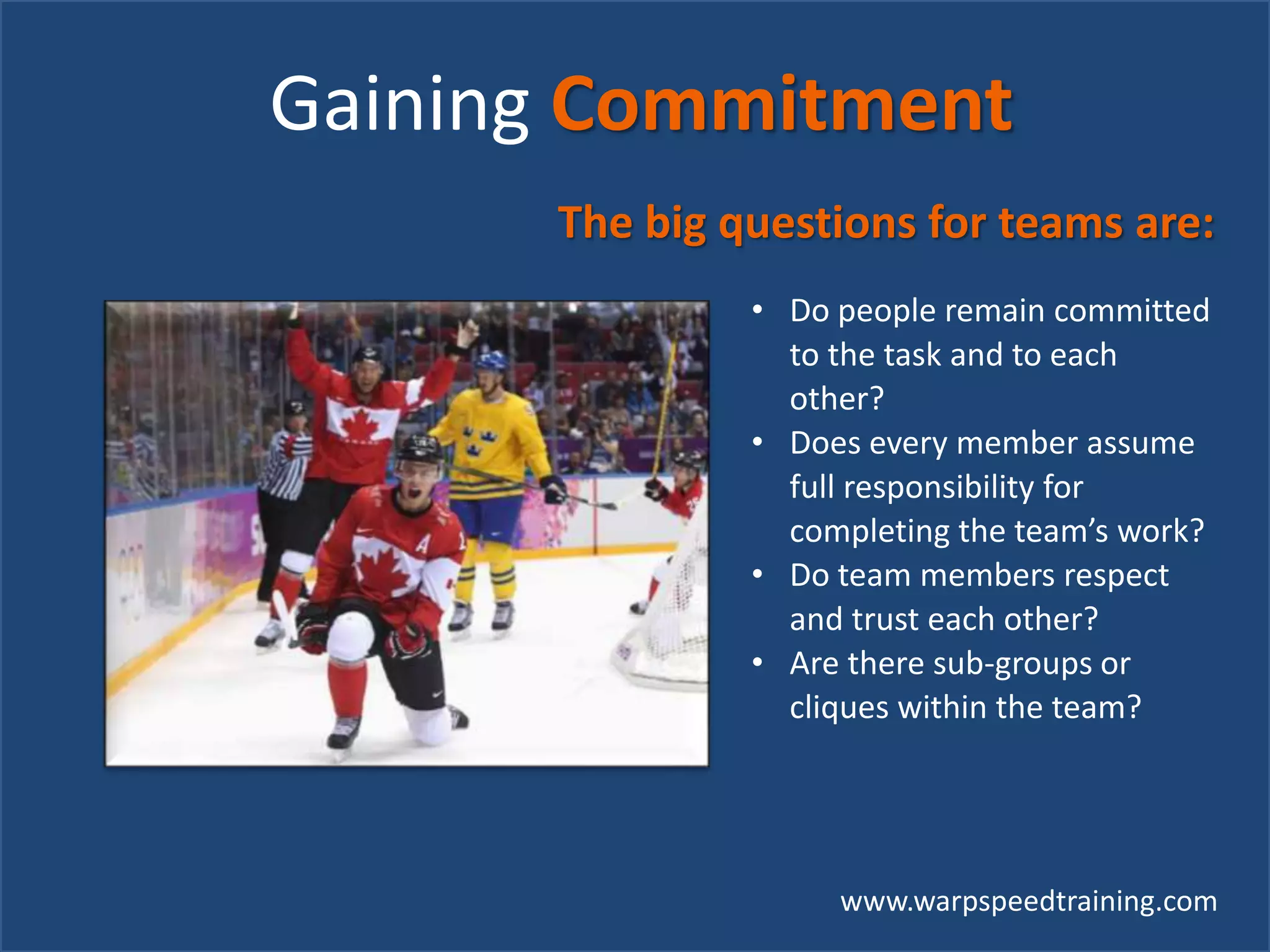
Canadian Olympic Champions 2014
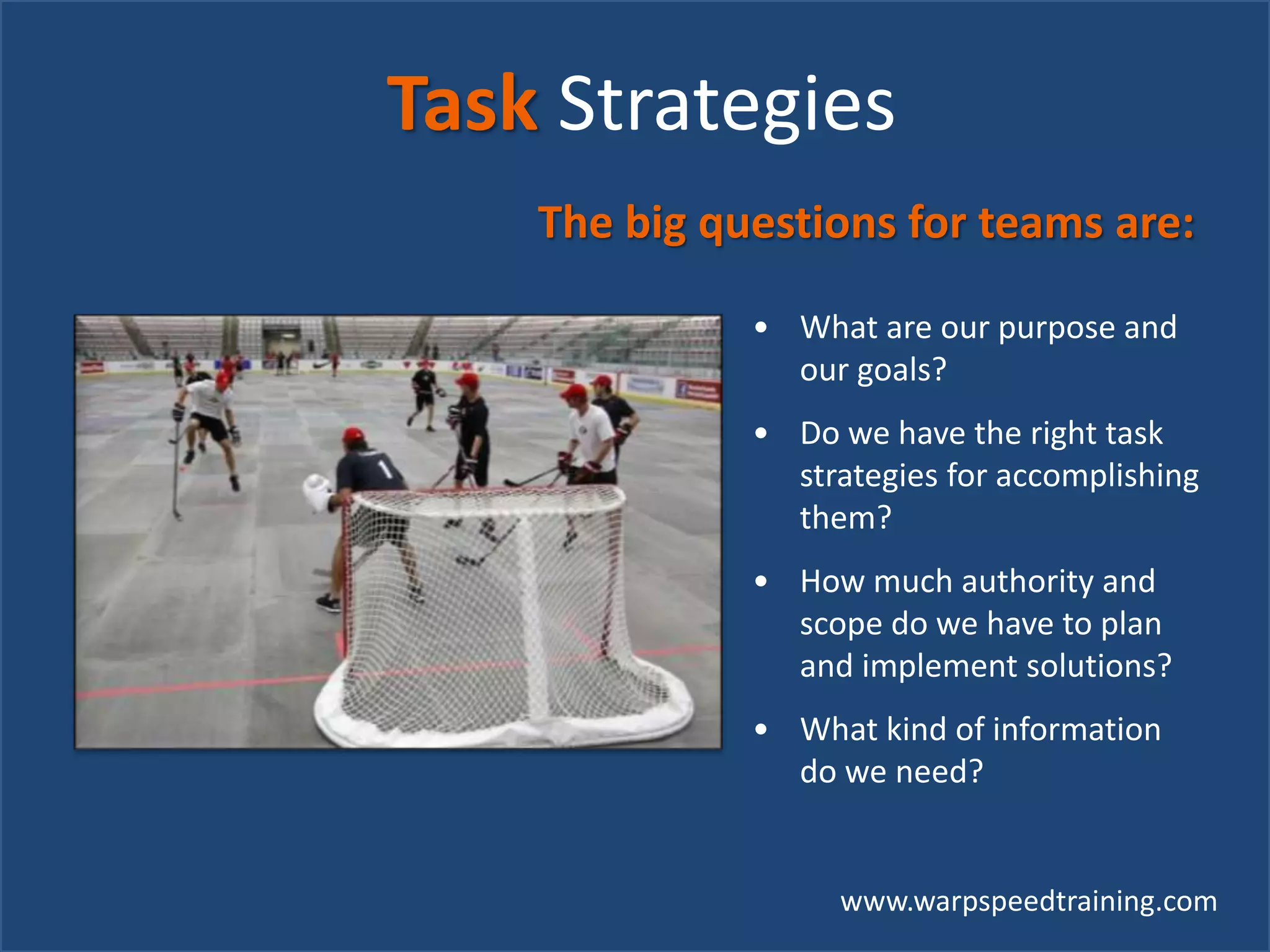
• Task strategies
• Social strategies
• Gaining
Commitment
www.warpspeedtraining.com
Task Strategies
• What are our purpose and
our goals?
• Do we have the right task
strategies for accomplishing
them?
• How much authority and
scope do we have to plan
and implement solutions?
• What kind of information
do we need?
The big questions for teams are:
www.warpspeedtraining.com
Social Strategies
The big questions for teams are:
• Do we have the right people
on the team?
• Do our processes ensure that
members contribute fully? Or
are we carrying dead weight?
• Do members understand &
fulfill their responsibilities
and their roles?
• Does the team abide by an
agreed upon set of group
norms?
• Are our meetings effective?
www.warpspeedtraining.com
Gaining Commitment
The big questions for teams are:
• Do people remain committed
to the task and to each
other?
• Does every member assume
full responsibility for
completing the team’s work?
• Do team members respect
and trust each other?
• Are there sub-groups or
cliques within the team?
www.warpspeedtraining.com
ASSESS YOUR TEAM
The Appendix contains a questionnaire
your can use to assess your team’s level of:
1. Task Strategies
2. Social Strategies
3. Level of Commitment
www.warpspeedtraining.com
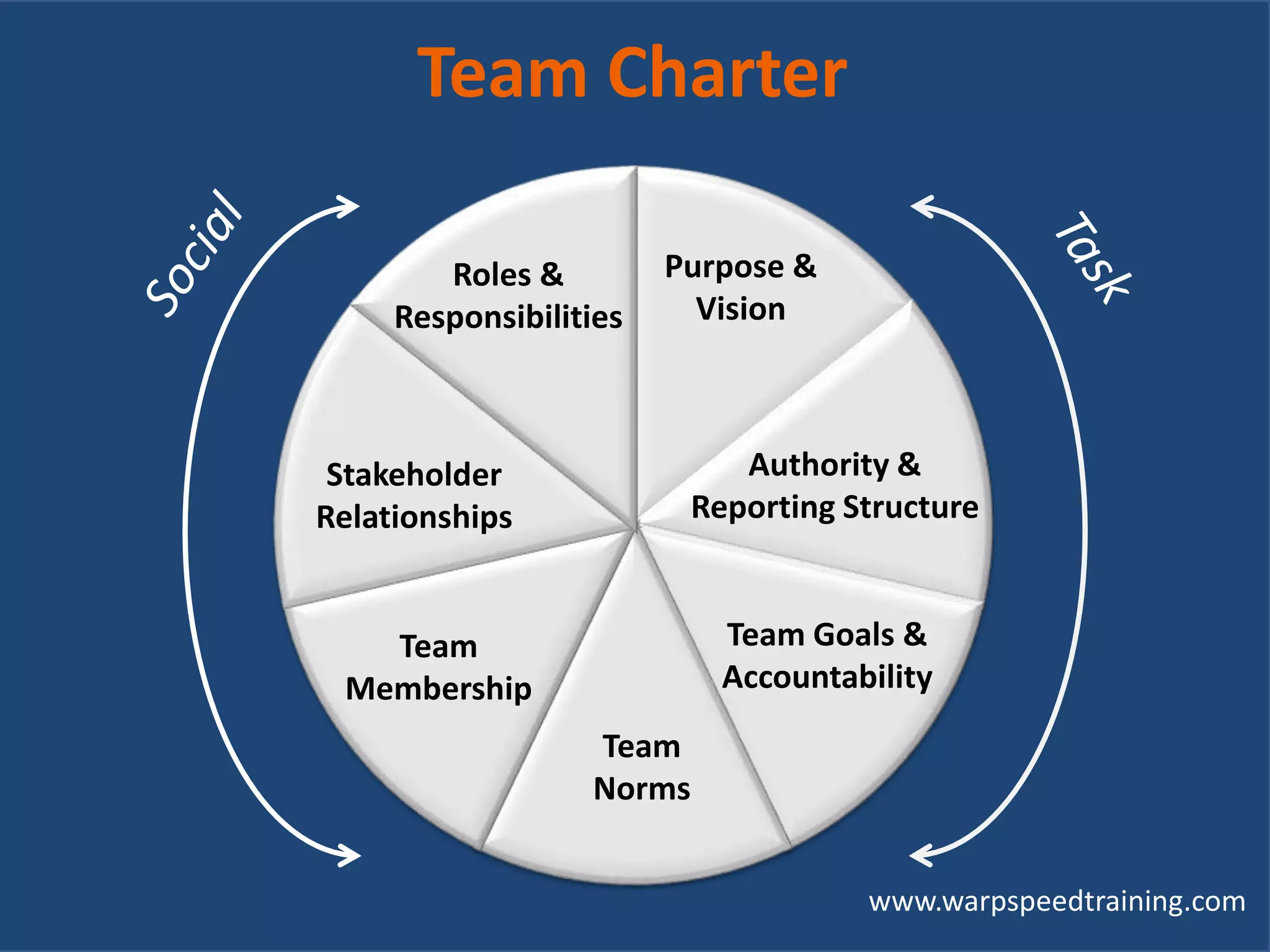
Purpose &
Vision
Authority &
Reporting Structure
Team Goals &
Accountability
Team
Norms
Team
Membership
Stakeholder
Relationships
Roles &
Responsibilities
Team Charter
www.warpspeedtraining.com
Team Management
Practices
Problem Solving
Skills
Conflict Handling
Skills
Team Performance
Team Satisfaction
R2 = .83
R2 = .72
The Team
Effectiveness Model
www.warpspeedtraining.com
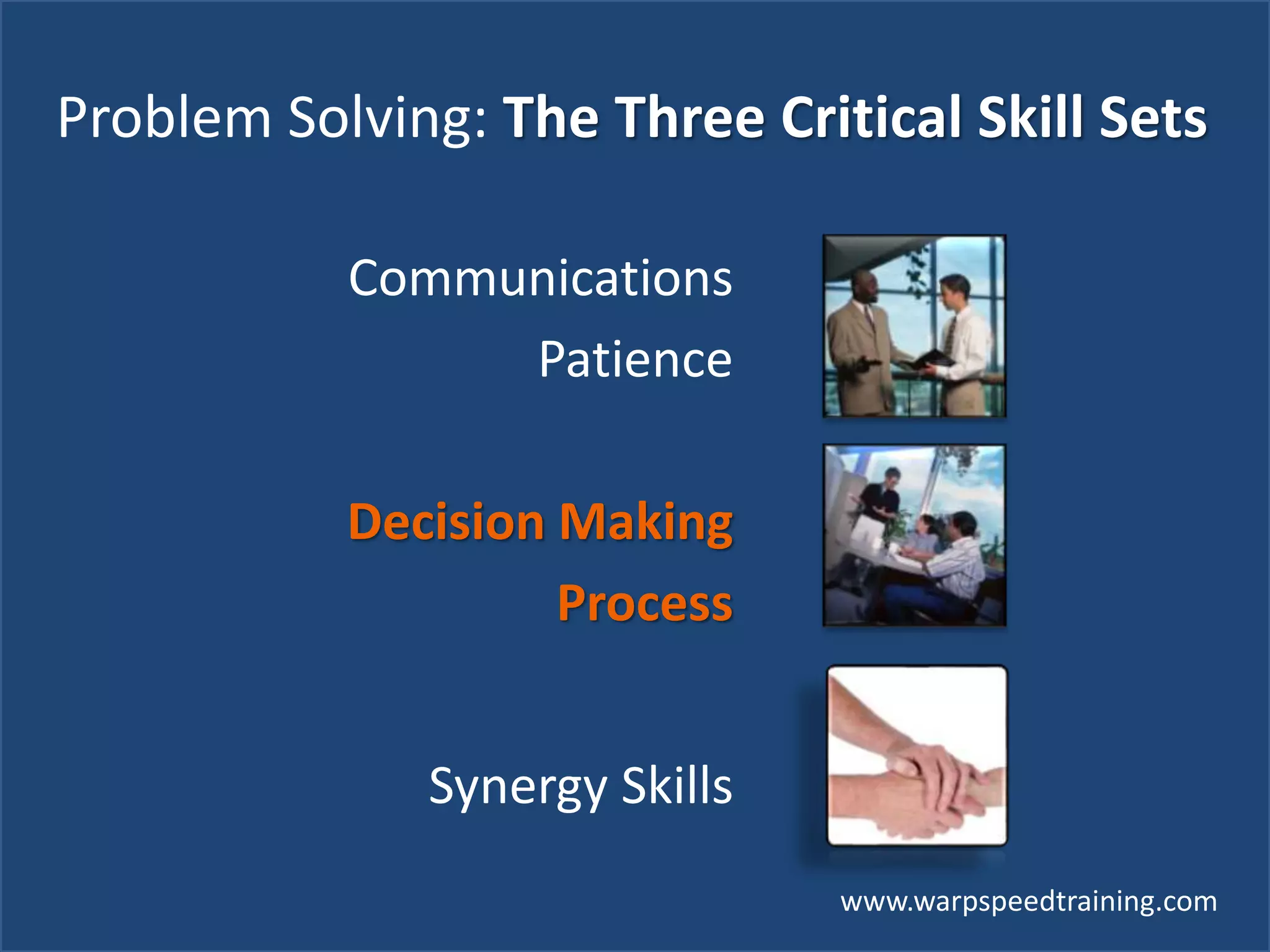
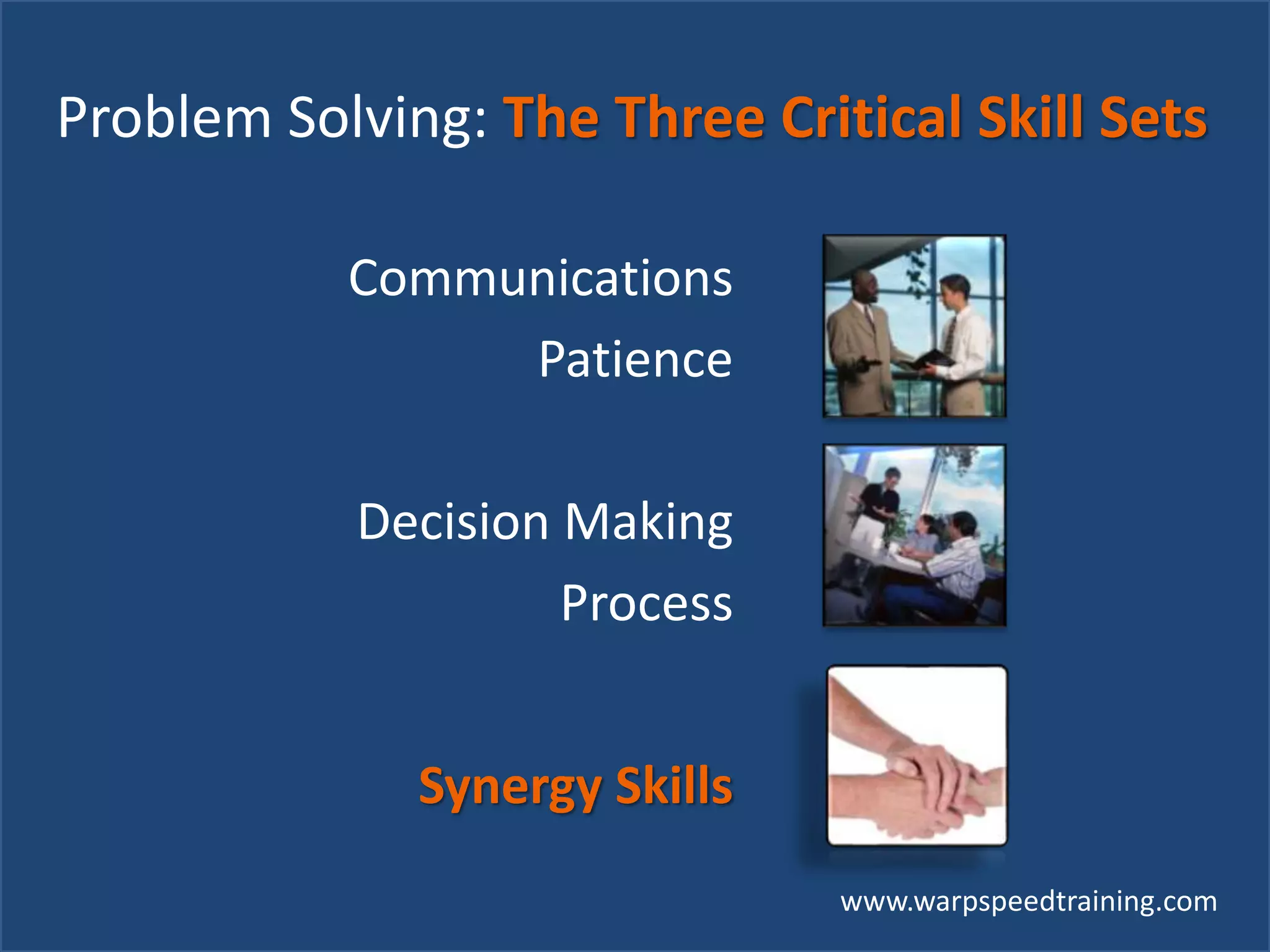
Problem Solving: The Three Critical Skill Sets
Communications
Patience
Decision Making
Process
Synergy Skills
www.warpspeedtraining.com
Problem Solving: The Three Critical Skill Sets
Communications
Patience
Decision Making
Process
Synergy Skills
www.warpspeedtraining.com
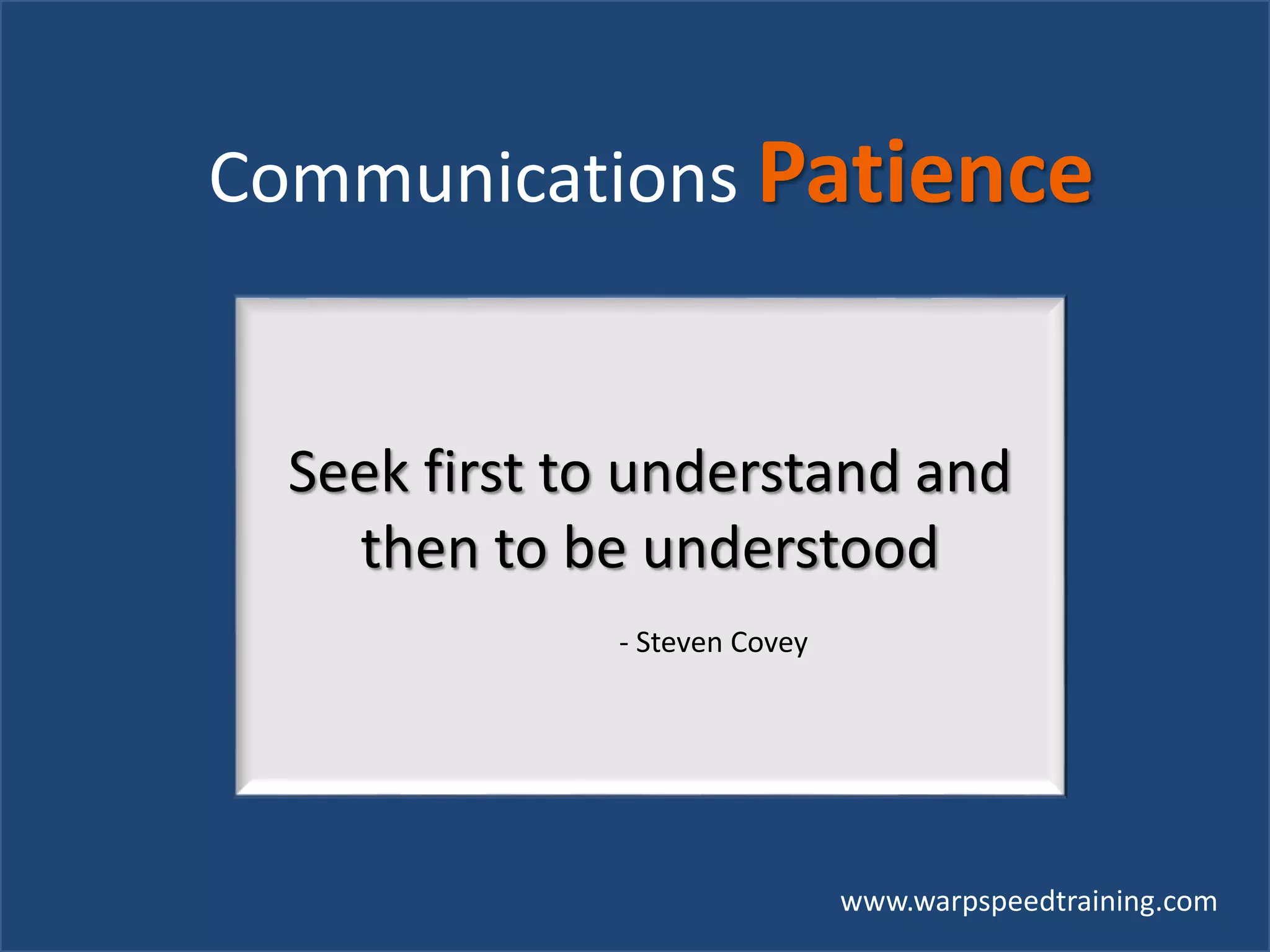
Seek first to understand and
then to be understood
- Steven Covey
Communications Patience
www.warpspeedtraining.com
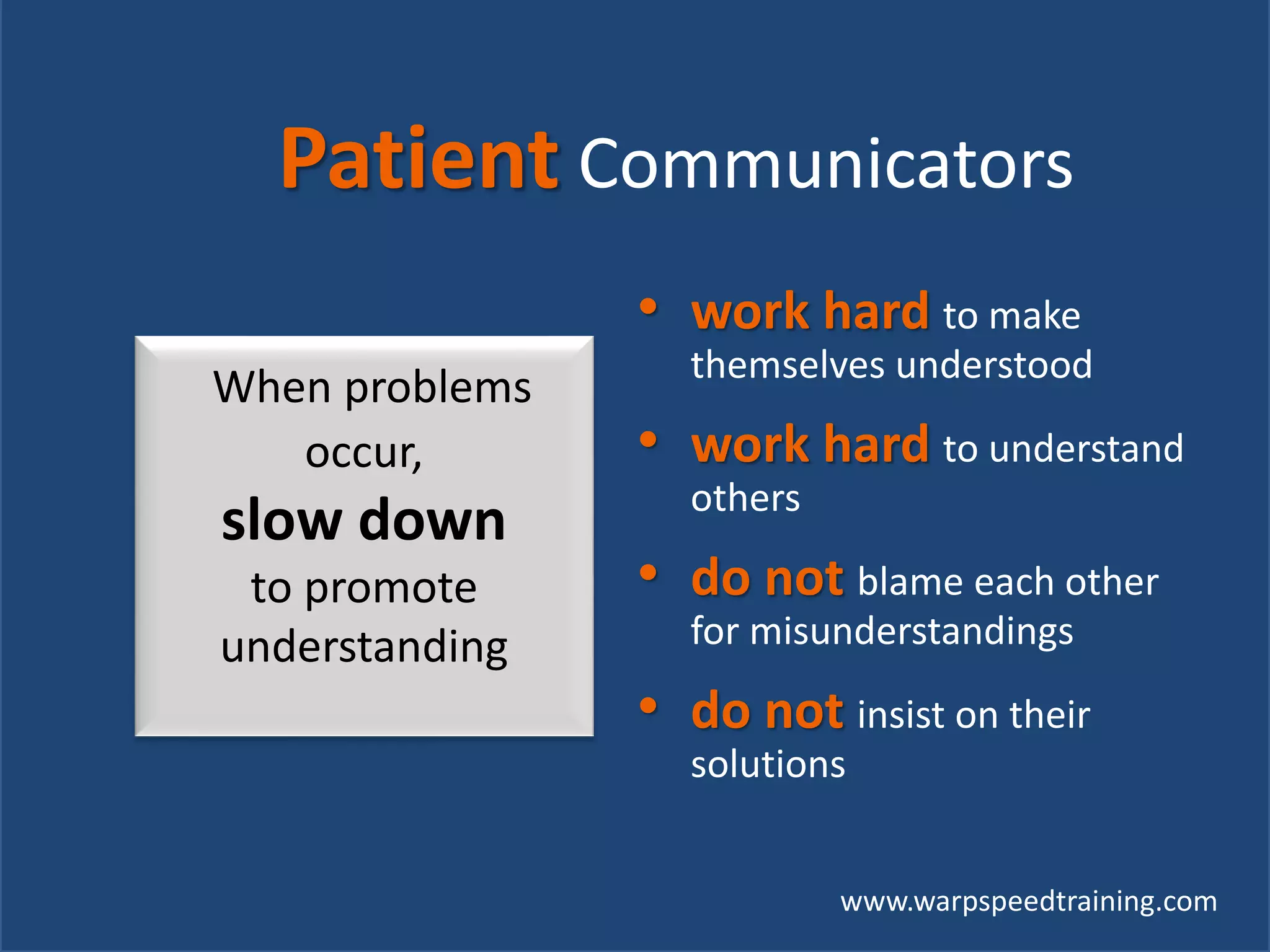
Patient Communicators
• work hard to make
themselves understood
• work hard to understand
others
• do not blame each other
for misunderstandings
• do not insist on their
solutions
When problems
occur,
slow down
to promote
understanding
www.warpspeedtraining.com
Problem Solving: The Three Critical Skill Sets
Communications
Patience
Decision Making
Process
Synergy Skills
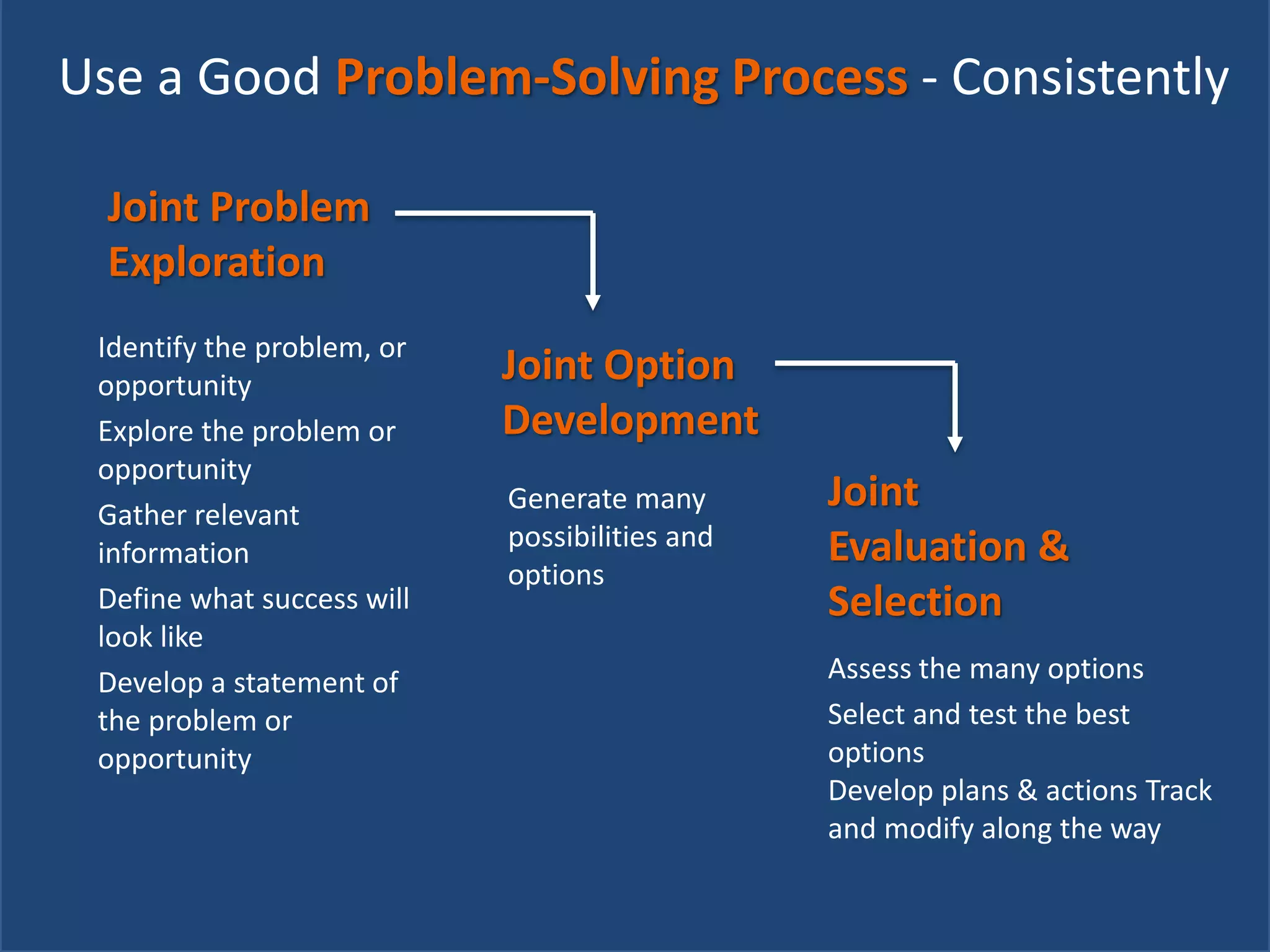
Use a Good Problem-Solving Process - Consistently
Joint Problem
Exploration
Joint Option
Development
Identify the problem, or
opportunity
Explore the problem or
opportunity
Gather relevant
information
Define what success will
look like
Develop a statement of
the problem or
opportunity
Generate many
possibilities and
options
Joint
Evaluation &
Selection
Assess the many options
Select and test the best
options
Develop plans & actions Track
and modify along the way
www.warpspeedtraining.com
If I had an hour to solve a
problem, I would spend 50
minutes defining the problem
and 10 minutes solving it.
- Albert Einstein
HOW TO CREATE
SYNERGY ON YOUR
TEAM
www.warpspeedtraining.com
Problem Solving: The Three Critical Skill Sets
Communications
Patience
Decision Making
Process
Synergy Skills
www.warpspeedtraining.com
Synergy
All members together
achieving a result that no
member could achieve
on their own, thus
satisfying the needs of
all
What are the conditions
that must be in place for
synergy to occur?
www.warpspeedtraining.com
Conditions for Synergy
Creativity and risk
Examine problems from
many sides
Combine knowledge from
different functions and
perspectives
Suspend judgment-what if
it is true? What if it
could work? 1 + 1 > 2
www.warpspeedtraining.com
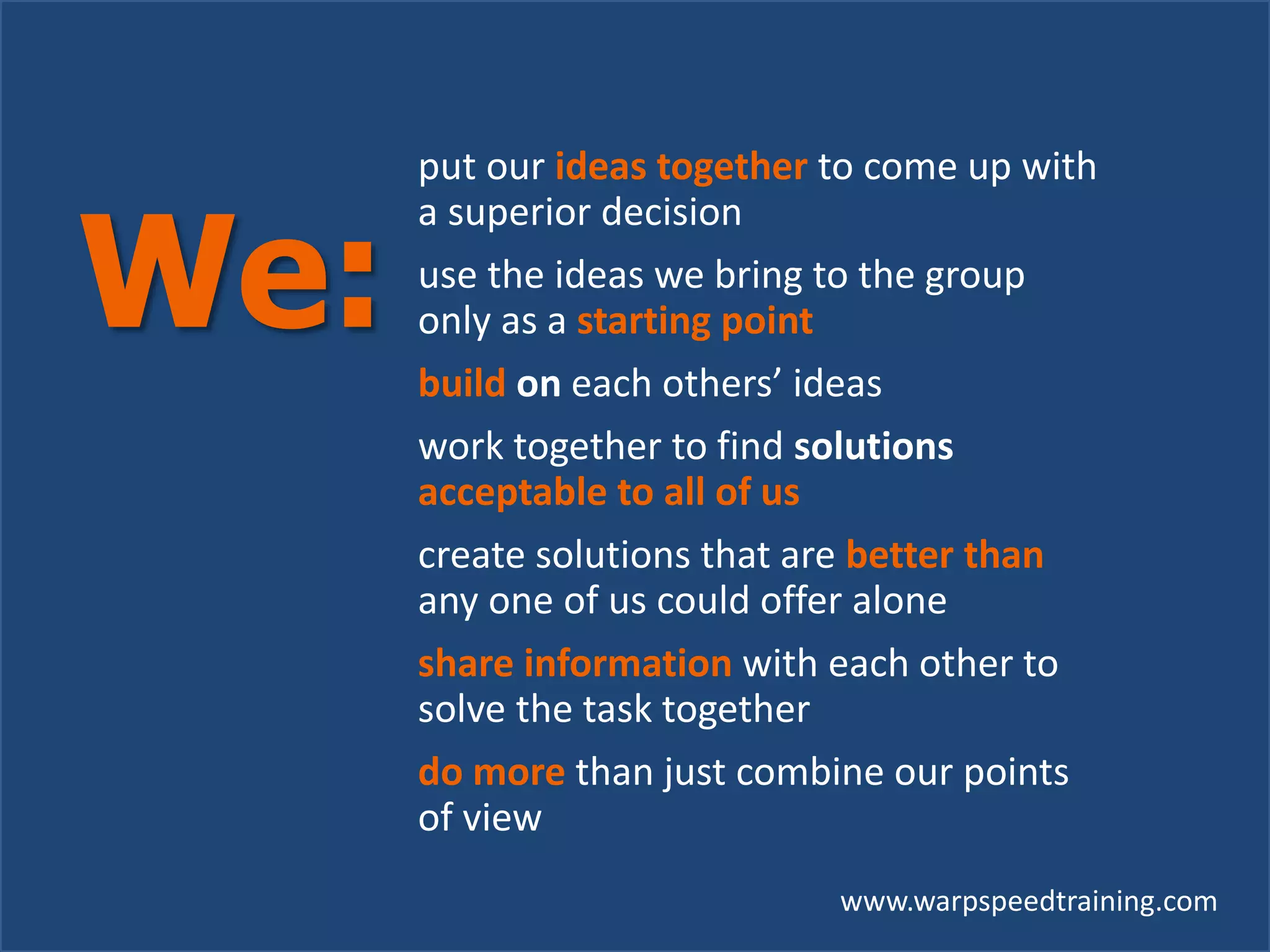
put our ideas together to come up with
a superior decision
use the ideas we bring to the group
only as a starting point
build on each others’ ideas
work together to find solutions
acceptable to all of us
create solutions that are better than
any one of us could offer alone
share information with each other to
solve the task together
do more than just combine our points
of view
We:
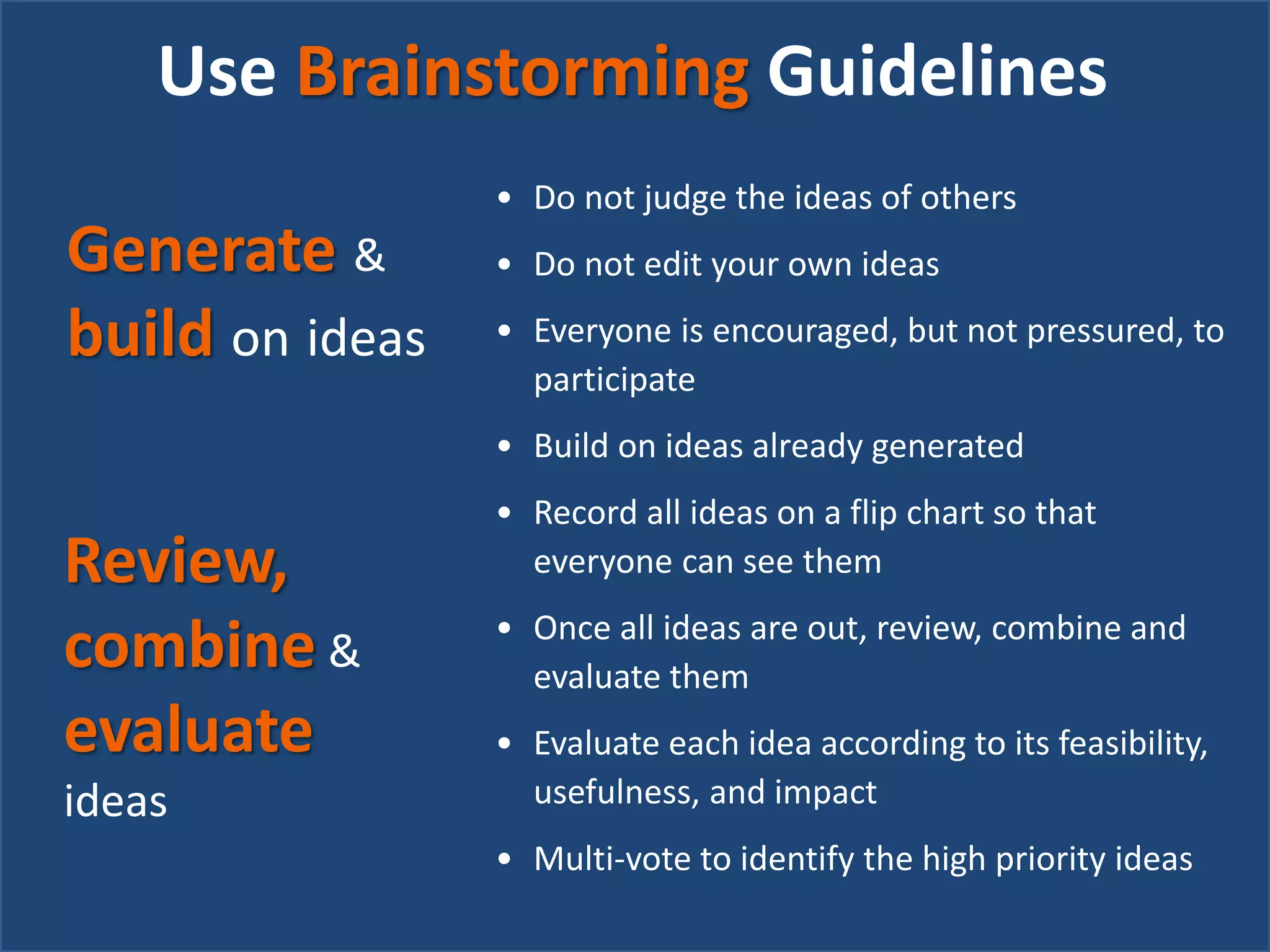
Use Brainstorming Guidelines
• Do not judge the ideas of others
• Do not edit your own ideas
• Everyone is encouraged, but not pressured, to
participate
• Build on ideas already generated
• Record all ideas on a flip chart so that
everyone can see them
• Once all ideas are out, review, combine and
evaluate them
• Evaluate each idea according to its feasibility,
usefulness, and impact
• Multi-vote to identify the high priority ideas
Review,
combine &
evaluate
ideas
Generate &
build on ideas
CONFLICT ON THE
TEAM
ANALYZING THE
COMMON SOURCES
OF PROBLEMS WITH
MOORE’S CIRCLE OF
CONFLICT
www.warpspeedtraining.com
Team Management
Practices
Problem Solving
Skills
Conflict Handling
Skills
Team Performance
Team Satisfaction
R2 = .83
R2 = .72
The research model has been validated with over 250 teams and 1800 individuals
The Team
Effectiveness Model
www.warpspeedtraining.com
Trouble on the Team
• Read the following vignette
• What do you think is the source of the
problem?
The Domineering Team Member
The deadline for submission of the project XYZ interim report was fast approaching, and
Alex was worried. The project team was already showing signs of strain, and Alex
considered it extremely unfortunate to be paired with Chris on their part of the project. All
members of the project team had to perform their regular jobs on top of the project but
Chris seemed unusually busy and stressed. Although very assertive, even categorical, about
the project solutions, Chris had devoted little visible time and effort to the project so far.
Their meetings had been tense and brief, with Chris more or less dictating the contents of
the report from notes. Alex was not confident that their work to date was relevant to the
stated objectives of the project mandate, but Chris had either dismissed or totally ignored
these concerns. As Alex walked into Chris’ plush office and saw the desk piled high with
files, there was a moment of dread. Was this going to be another frustrating wrangle of a
meeting?
Chris, I’ve been thinking about our report a lot, and I think we ought to look at the
outline to make sure we’re on topic.
Godammit, Alex, are you still harping on that? I don’t have time for this! I’ve already
done most of the work on this, so where do you get off telling me my work is all
wrong?
Alex saw that Chris was on the verge of a major explosion and backed down:
Ok! Ok! Calm down! We’ll do it your way!
www.warpspeedtraining.com
Value
Differences
Structural
Interests
Data
Relationship
Conflict Analysis using the Circle of Conflict
Moore, C. (1996) The mediation process: Practical strategies for resolving conflict, 2nd
ed., San Francisco: Jossey-Bass Publishers.
www.warpspeedtraining.com
Data
Conflict Analysis using the Circle of Conflict
• Missing information
• Wrong information
• Different views about what information is
relevant
• Different interpretations of the information
www.warpspeedtraining.com
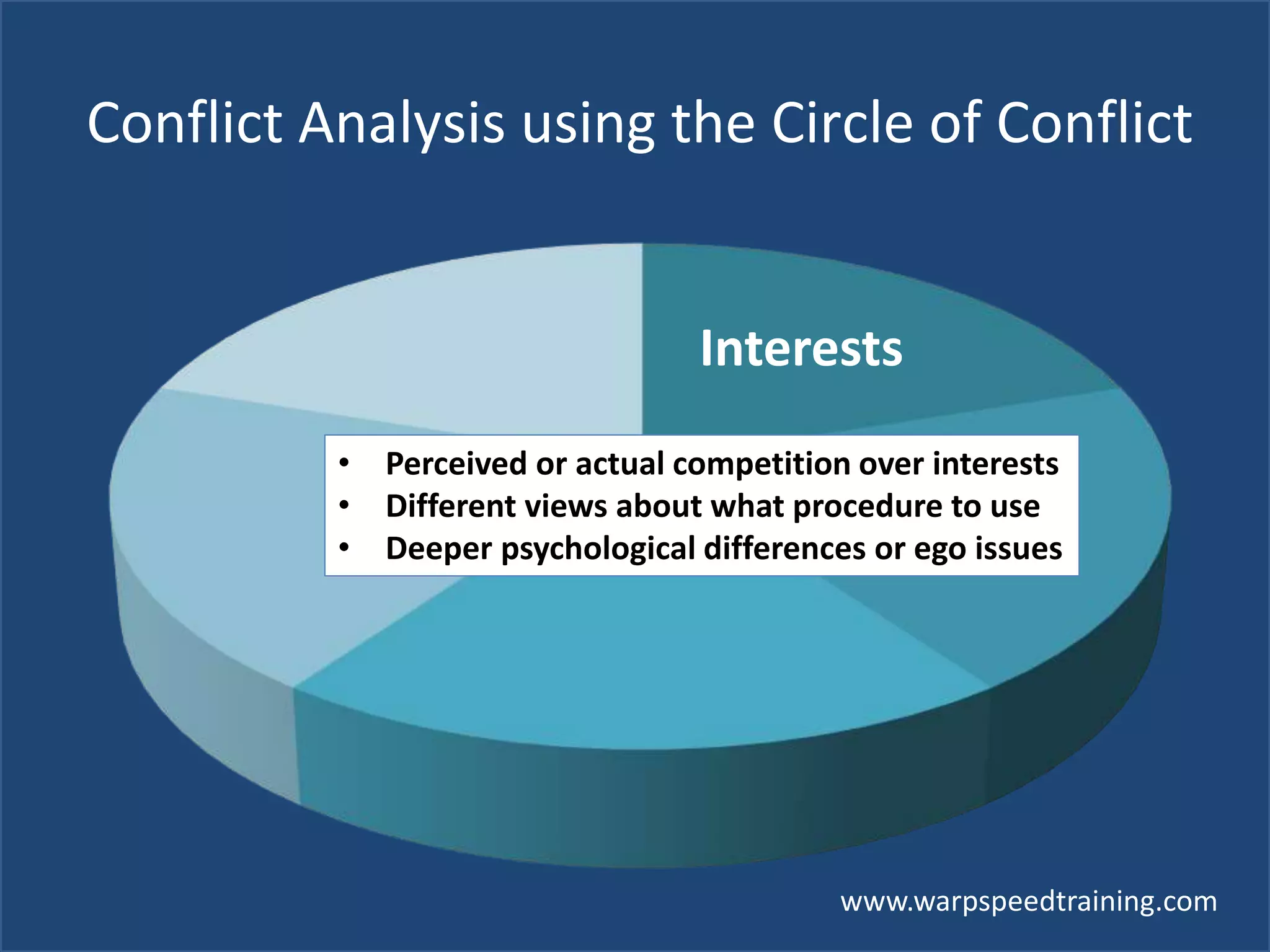
Interests
Conflict Analysis using the Circle of Conflict
• Perceived or actual competition over interests
• Different views about what procedure to use
• Deeper psychological differences or ego issues
www.warpspeedtraining.com
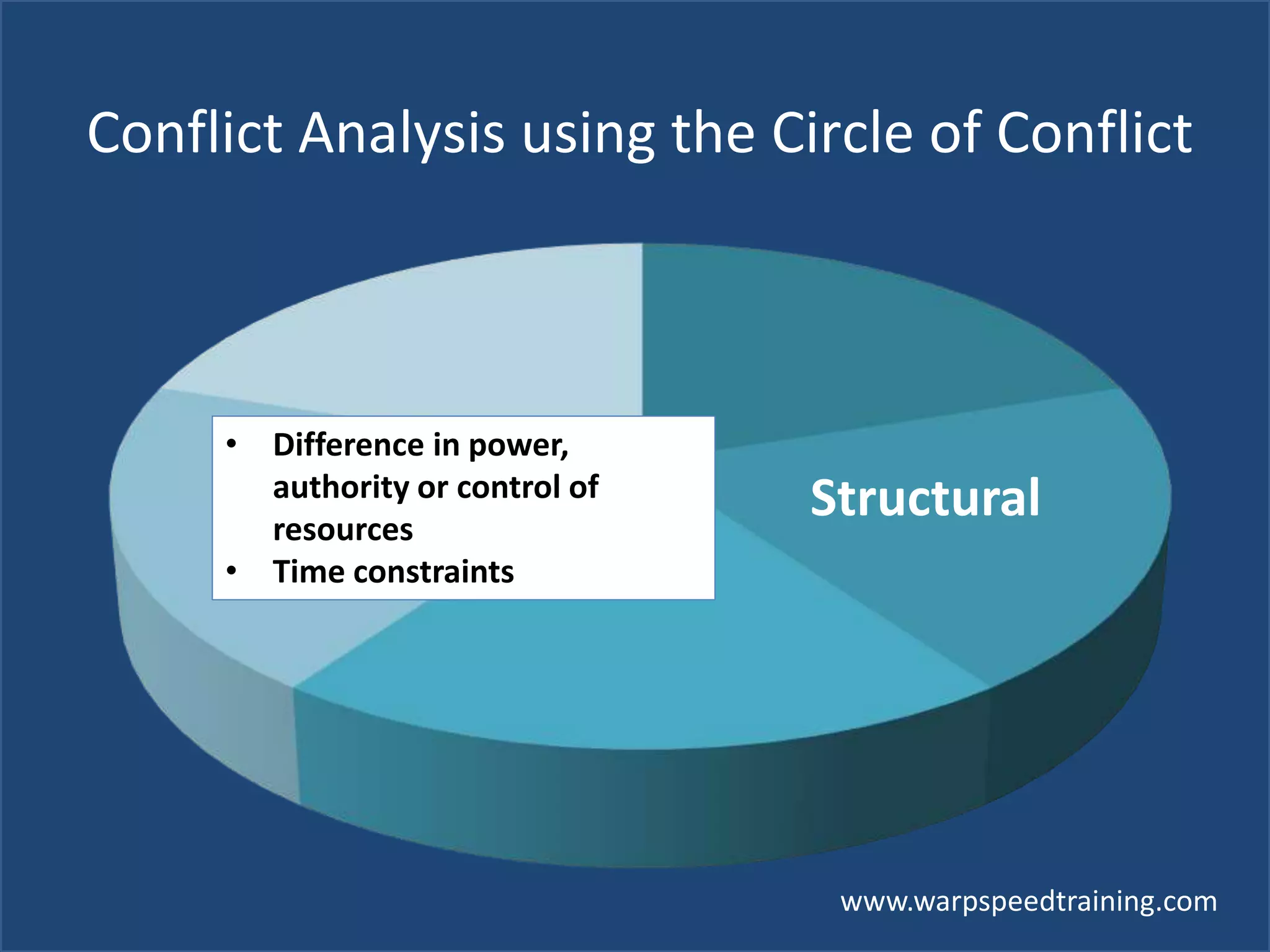
Structural
Conflict Analysis using the Circle of Conflict
• Difference in power,
authority or control of
resources
• Time constraints
www.warpspeedtraining.com
Value
Differences
Conflict Analysis using the Circle of Conflict
• Different worldview,
ideology or way of life
• Different criteria for
evaluating ideas
www.warpspeedtraining.com
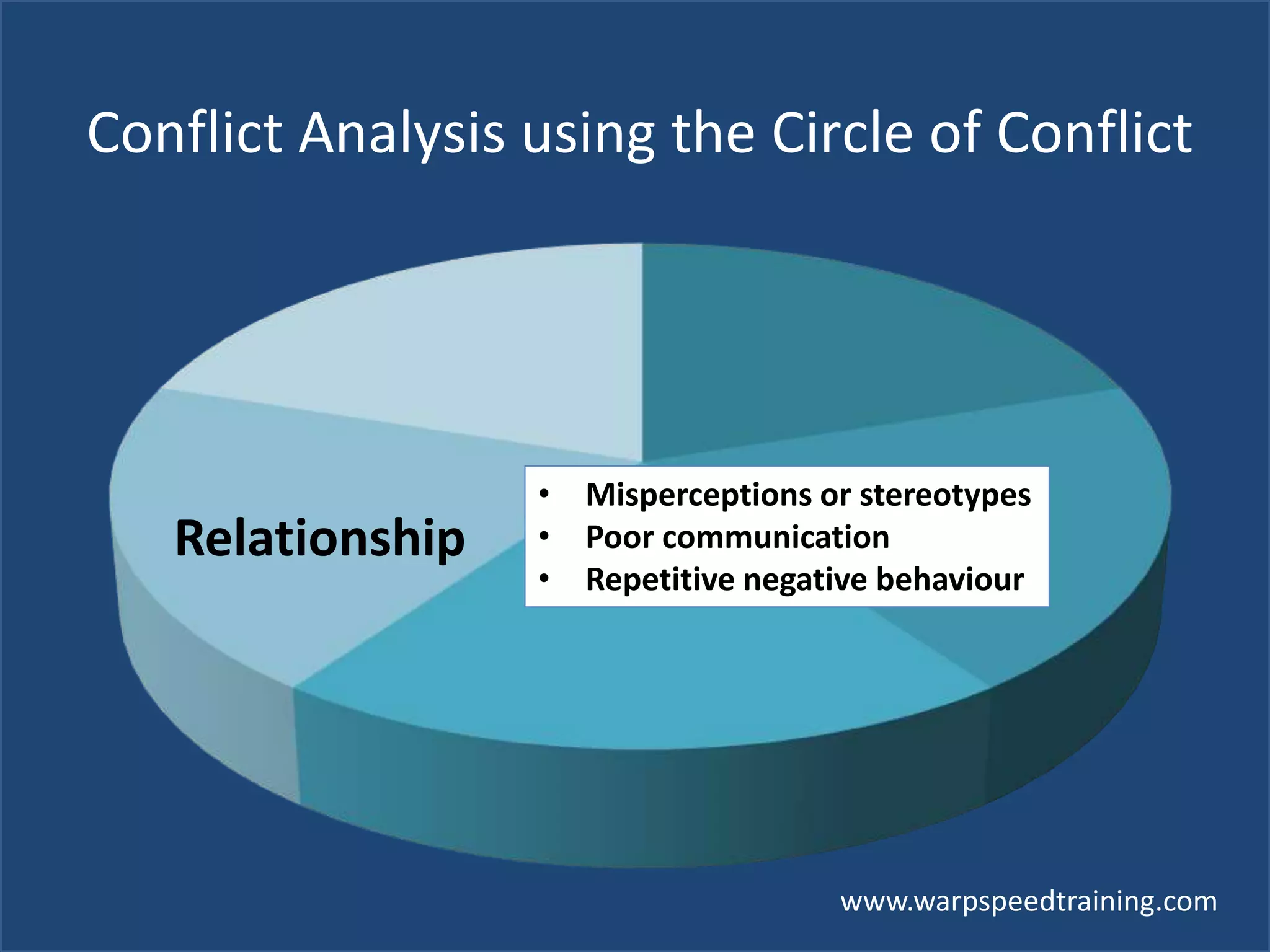
Relationship
Conflict Analysis using the Circle of Conflict
• Misperceptions or stereotypes
• Poor communication
• Repetitive negative behaviour
www.warpspeedtraining.com
Trouble on the Team
• Read the following vignette
• What do you think is the source of the
problem?
Use the Conflict Analysis Matrix provided
below
Overtime Blues
Drew was angry. One Tuesday morning in May, Jordan had sent round a voice
message, announcing a meeting for Friday afternoon at 4:30pm. It would
probably drag on and run into the opening dinner at the golf course that had
been planned and anticipated for weeks.
Did Jordan think their project team had nothing better to do than discuss work
on the weekend? Besides, Drew had made it clear the last time that the group
meetings should be meet earlier in the afternoon so as not to interfere with the
group members’ family and social life. Jordan was single and didn’t seem to
appreciate the balancing act that married project members all experienced,
especially those with his children.
Besides, Jordan seemed to lack confidence in the group as a whole to do good
work and so insisted on long meetings with “thorough” discussions. It was
simpler to just divide up the work, have each member do his or part, and report
back at their meetings. Besides, he knew that only Jordan and perhaps Gary were
eager to meet at such inconvenient times and for such long sessions. The other
three would agree with Drew if push came to shove. And it was time for shove.
Overtime Blues
It was only Tuesday, but already Jordan was dreading the upcoming meeting
Friday afternoon. She knew Drew would be angry about the time, but felt she
had no choice but to call it for 4:30pm. Her boss had not been keen on her joining
the project team and had made it clear that there would be little time off except
for Friday afternoons. What with more cutbacks rumoured in the department,
Jordan couldn’t afford to irritate the boss. The others in the group either had
supportive supervisors or were their own boss. They didn’t appear to appreciate
her situation; either that or they chose to ignore it. Besides which, the rest were
all men, and she felt they ignored her ideas and concerns in general, perhaps
without even realizing it. She had trouble with Drew in particular, although she
liked him well enough at first. He was so dominating and always seemed to ram
through his ideas and agendas as quickly as possible and then leave for another
appointment. She knew that Gary was also concerned that their meetings were
too short and superficial, but was not willing to “rock the boat.”
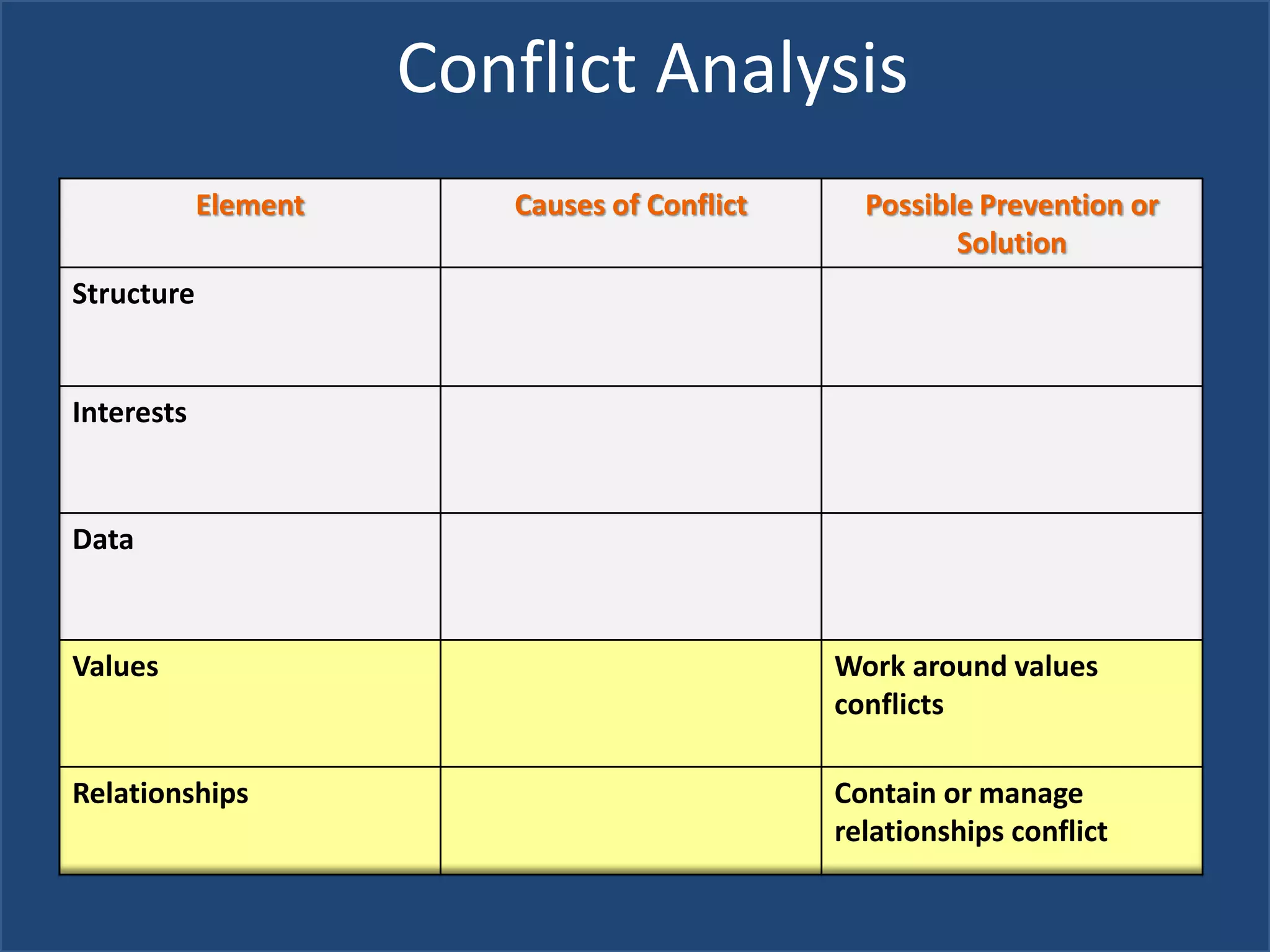
Conflict Analysis
Element Causes of Conflict Possible Prevention or
Solution
Structure
Interests
Data
Values
Relationships
www.warpspeedtraining.com
The Moore Model
The Moore model suggests that you can
'contain’ or manage relationship conflicts
and you can work around value conflicts
but you cannot directly solve either.
It argues you should contain those two
first then focus the conflict into the
remaining three areas where solutions are
possible.
Conflict Analysis
Element Causes of Conflict Possible Prevention or
Solution
Structure
Interests
Data
Values Work around values
conflicts
Relationships Contain or manage
relationships conflict
Conflict Analysis
Element Causes of Conflict Possible Prevention or Solution
Structure Change variables blocking cooperation: i.e:
opposing goals, time pressures, distance,
location, authority imbalance, etc.
Interests Ask members to express aims and needs. Assess
areas of agreement/disagreement. Create
options. Find a joint solution.
Data Agree on which data are important, how to
collect them and their meaning. Agree on a
problem-solving approach.
Values Remove values from decision-making. Allow
parties to disagree on values. Search for
superordinate goals.
Relationships Control emotions through process. Encourage
good listening. Give opportunity to express
views. Remove toxicity. Depersonalize conflict.
N.B.
DO NOT AVOID CONFLICT:
www.warpspeedtraining.com
• Acknowledge the issue
• Discuss it
• Develop a process for managing it
NOW WHAT?
WHERE DO WE GO
FROM HERE?
www.warpspeedtraining.com
Need to know more?
Contact me for more
information about our in-
house training or a free trial
of our online course in Team
Building
DrCarol@warpspeedtraining.com

Building a high performing team

  • 1.
  • 2.
    www.warpspeedtraining.com THE BEST COMPANIESARE THE BEST COLLABORATORS … more and more business will be done through collaborations within and between companies, for a very simple reason … The next layers of value creation - whether in technology, marketing, biomedicine, or manufacturing – are becoming so complex that no single firm or department is going to be able to master them alone. Thomas Freidman, 2005, The World Is Flat. Farrar, Straus & Giroux (page 353)
  • 3.
    QUICK REVIEW & DEEPERDIVE: WORK GROUPS VS. WORK TEAMS www.warpspeedtraining.com
  • 4.
    www.warpspeedtraining.com Work Groups versusWork Teams Work Group – A set of individuals who rely on the sum of “individual bests’ for their performance Work Team – A group of people who must work interdependently to achieve a specific outcome for which they are collectively responsible, whose tasks are interdependent, and who develop specialized member roles
  • 5.
    Work Groupvs. Work Team Analogiesfrom the Sports World Canadian Olympic Hockey Team 2010 Canadian Cross Country Ski Team 2010
  • 6.
    www.warpspeedtraining.com TYPES OF TEAMS Quality Group Teamsthat recommend things: Project Group Task Force
  • 7.
    www.warpspeedtraining.com Teams that producethings: Marketing Customer Service Manufacturing TYPES OF TEAMS
  • 8.
  • 9.
    www.warpspeedtraining.com When is aTeam appropriate? 1. When the work is so interdependent that we need constant back and forth consultation and collaboration
  • 10.
    www.warpspeedtraining.com When is aTeam appropriate? 2. When the work that the group needs to accomplish is very complex
  • 11.
    When is aTeam appropriate? 3. When the group has a common purpose for being and produces common work products or services
  • 12.
    www.warpspeedtraining.com When is aTeam appropriate? 4. When the group is committed to building teamwork and the collaboration skills necessary for team success
  • 13.
    www.warpspeedtraining.com 1. The sum ofour individual best efforts is sufficient to ensure success in our tasks Our work is so interdependent that we need constant back and forth consultation and collaboration 1 2 3 4 Circle the appropriate number Diagnosis: Do you need a Team?
  • 14.
    www.warpspeedtraining.com 2. 1 2 34 Circle the appropriate number The work our group needs to accomplish is well-understood and doesn’t require constant complex decisions The work that our group needs to accomplish is very complex Diagnosis: Do you need a Team?
  • 15.
    www.warpspeedtraining.com 3. 1 2 34 Circle the appropriate number Our group’s work covers several different purposes and generates independent products/services Our group has a common purpose for being and produces common work products or services Diagnosis: Do you need a Team?
  • 16.
    www.warpspeedtraining.com 4. 1 2 34 Circle the appropriate number Our group is not interested in putting forth a lot of effort in teambuilding Our group is committed to building teamwork and collaboration skills Diagnosis: Do you need a Team?
  • 17.
    www.warpspeedtraining.com 1 2 34 1. Total your ratings and divide your total by four / 4 2. Now map your score out of four on the line below 3. Your Results: If your score is between 3 and 4, you could benefit from creating a team Diagnosis: Do you need a Team?
  • 18.
    www.warpspeedtraining.com TO PONDER: • WHENAND WHERE DO WE NEED TEAMS? • WHEN AND WHERE DO WE NOT NEED TEAMS?
  • 19.
    QUICK REVIEW & DEEPERDIVE: CREATING A HIGH PERFORMANCE TEAM www.warpspeedtraining.com
  • 20.
    www.warpspeedtraining.com Team Management Practices Problem Solving Skills ConflictHandling Skills Team Performance Team Satisfaction R2 = .83 R2 = .72 The research model has been validated with over 250 teams and 1800 individuals The Team Effectiveness Model
  • 21.
    www.warpspeedtraining.com Team Management Practices Problem Solving Skills ConflictHandling Skills Team Performance Team Satisfaction R2 = .83 R2 = .72 The Team Effectiveness Model
  • 22.
    www.warpspeedtraining.com Team Management Practices: Preparefor High Performance Canadian Olympic Champions 2014 • Task strategies • Social strategies • Gaining Commitment
  • 23.
    www.warpspeedtraining.com Task Strategies • Whatare our purpose and our goals? • Do we have the right task strategies for accomplishing them? • How much authority and scope do we have to plan and implement solutions? • What kind of information do we need? The big questions for teams are:
  • 24.
    www.warpspeedtraining.com Social Strategies The bigquestions for teams are: • Do we have the right people on the team? • Do our processes ensure that members contribute fully? Or are we carrying dead weight? • Do members understand & fulfill their responsibilities and their roles? • Does the team abide by an agreed upon set of group norms? • Are our meetings effective?
  • 25.
    www.warpspeedtraining.com Gaining Commitment The bigquestions for teams are: • Do people remain committed to the task and to each other? • Does every member assume full responsibility for completing the team’s work? • Do team members respect and trust each other? • Are there sub-groups or cliques within the team?
  • 26.
    www.warpspeedtraining.com ASSESS YOUR TEAM TheAppendix contains a questionnaire your can use to assess your team’s level of: 1. Task Strategies 2. Social Strategies 3. Level of Commitment
  • 27.
    www.warpspeedtraining.com Purpose & Vision Authority & ReportingStructure Team Goals & Accountability Team Norms Team Membership Stakeholder Relationships Roles & Responsibilities Team Charter
  • 28.
    www.warpspeedtraining.com Team Management Practices Problem Solving Skills ConflictHandling Skills Team Performance Team Satisfaction R2 = .83 R2 = .72 The Team Effectiveness Model
  • 29.
    www.warpspeedtraining.com Problem Solving: TheThree Critical Skill Sets Communications Patience Decision Making Process Synergy Skills
  • 30.
    www.warpspeedtraining.com Problem Solving: TheThree Critical Skill Sets Communications Patience Decision Making Process Synergy Skills
  • 31.
    www.warpspeedtraining.com Seek first tounderstand and then to be understood - Steven Covey Communications Patience
  • 32.
    www.warpspeedtraining.com Patient Communicators • workhard to make themselves understood • work hard to understand others • do not blame each other for misunderstandings • do not insist on their solutions When problems occur, slow down to promote understanding
  • 33.
    www.warpspeedtraining.com Problem Solving: TheThree Critical Skill Sets Communications Patience Decision Making Process Synergy Skills
  • 34.
    Use a GoodProblem-Solving Process - Consistently Joint Problem Exploration Joint Option Development Identify the problem, or opportunity Explore the problem or opportunity Gather relevant information Define what success will look like Develop a statement of the problem or opportunity Generate many possibilities and options Joint Evaluation & Selection Assess the many options Select and test the best options Develop plans & actions Track and modify along the way
  • 35.
    www.warpspeedtraining.com If I hadan hour to solve a problem, I would spend 50 minutes defining the problem and 10 minutes solving it. - Albert Einstein
  • 36.
    HOW TO CREATE SYNERGYON YOUR TEAM www.warpspeedtraining.com
  • 37.
    www.warpspeedtraining.com Problem Solving: TheThree Critical Skill Sets Communications Patience Decision Making Process Synergy Skills
  • 38.
    www.warpspeedtraining.com Synergy All members together achievinga result that no member could achieve on their own, thus satisfying the needs of all What are the conditions that must be in place for synergy to occur?
  • 39.
    www.warpspeedtraining.com Conditions for Synergy Creativityand risk Examine problems from many sides Combine knowledge from different functions and perspectives Suspend judgment-what if it is true? What if it could work? 1 + 1 > 2
  • 40.
    www.warpspeedtraining.com put our ideastogether to come up with a superior decision use the ideas we bring to the group only as a starting point build on each others’ ideas work together to find solutions acceptable to all of us create solutions that are better than any one of us could offer alone share information with each other to solve the task together do more than just combine our points of view We:
  • 41.
    Use Brainstorming Guidelines •Do not judge the ideas of others • Do not edit your own ideas • Everyone is encouraged, but not pressured, to participate • Build on ideas already generated • Record all ideas on a flip chart so that everyone can see them • Once all ideas are out, review, combine and evaluate them • Evaluate each idea according to its feasibility, usefulness, and impact • Multi-vote to identify the high priority ideas Review, combine & evaluate ideas Generate & build on ideas
  • 42.
    CONFLICT ON THE TEAM ANALYZINGTHE COMMON SOURCES OF PROBLEMS WITH MOORE’S CIRCLE OF CONFLICT www.warpspeedtraining.com
  • 43.
    www.warpspeedtraining.com Team Management Practices Problem Solving Skills ConflictHandling Skills Team Performance Team Satisfaction R2 = .83 R2 = .72 The research model has been validated with over 250 teams and 1800 individuals The Team Effectiveness Model
  • 44.
    www.warpspeedtraining.com Trouble on theTeam • Read the following vignette • What do you think is the source of the problem?
  • 45.
    The Domineering TeamMember The deadline for submission of the project XYZ interim report was fast approaching, and Alex was worried. The project team was already showing signs of strain, and Alex considered it extremely unfortunate to be paired with Chris on their part of the project. All members of the project team had to perform their regular jobs on top of the project but Chris seemed unusually busy and stressed. Although very assertive, even categorical, about the project solutions, Chris had devoted little visible time and effort to the project so far. Their meetings had been tense and brief, with Chris more or less dictating the contents of the report from notes. Alex was not confident that their work to date was relevant to the stated objectives of the project mandate, but Chris had either dismissed or totally ignored these concerns. As Alex walked into Chris’ plush office and saw the desk piled high with files, there was a moment of dread. Was this going to be another frustrating wrangle of a meeting? Chris, I’ve been thinking about our report a lot, and I think we ought to look at the outline to make sure we’re on topic. Godammit, Alex, are you still harping on that? I don’t have time for this! I’ve already done most of the work on this, so where do you get off telling me my work is all wrong? Alex saw that Chris was on the verge of a major explosion and backed down: Ok! Ok! Calm down! We’ll do it your way!
  • 46.
    www.warpspeedtraining.com Value Differences Structural Interests Data Relationship Conflict Analysis usingthe Circle of Conflict Moore, C. (1996) The mediation process: Practical strategies for resolving conflict, 2nd ed., San Francisco: Jossey-Bass Publishers.
  • 47.
    www.warpspeedtraining.com Data Conflict Analysis usingthe Circle of Conflict • Missing information • Wrong information • Different views about what information is relevant • Different interpretations of the information
  • 48.
    www.warpspeedtraining.com Interests Conflict Analysis usingthe Circle of Conflict • Perceived or actual competition over interests • Different views about what procedure to use • Deeper psychological differences or ego issues
  • 49.
    www.warpspeedtraining.com Structural Conflict Analysis usingthe Circle of Conflict • Difference in power, authority or control of resources • Time constraints
  • 50.
    www.warpspeedtraining.com Value Differences Conflict Analysis usingthe Circle of Conflict • Different worldview, ideology or way of life • Different criteria for evaluating ideas
  • 51.
    www.warpspeedtraining.com Relationship Conflict Analysis usingthe Circle of Conflict • Misperceptions or stereotypes • Poor communication • Repetitive negative behaviour
  • 52.
    www.warpspeedtraining.com Trouble on theTeam • Read the following vignette • What do you think is the source of the problem? Use the Conflict Analysis Matrix provided below
  • 53.
    Overtime Blues Drew wasangry. One Tuesday morning in May, Jordan had sent round a voice message, announcing a meeting for Friday afternoon at 4:30pm. It would probably drag on and run into the opening dinner at the golf course that had been planned and anticipated for weeks. Did Jordan think their project team had nothing better to do than discuss work on the weekend? Besides, Drew had made it clear the last time that the group meetings should be meet earlier in the afternoon so as not to interfere with the group members’ family and social life. Jordan was single and didn’t seem to appreciate the balancing act that married project members all experienced, especially those with his children. Besides, Jordan seemed to lack confidence in the group as a whole to do good work and so insisted on long meetings with “thorough” discussions. It was simpler to just divide up the work, have each member do his or part, and report back at their meetings. Besides, he knew that only Jordan and perhaps Gary were eager to meet at such inconvenient times and for such long sessions. The other three would agree with Drew if push came to shove. And it was time for shove.
  • 54.
    Overtime Blues It wasonly Tuesday, but already Jordan was dreading the upcoming meeting Friday afternoon. She knew Drew would be angry about the time, but felt she had no choice but to call it for 4:30pm. Her boss had not been keen on her joining the project team and had made it clear that there would be little time off except for Friday afternoons. What with more cutbacks rumoured in the department, Jordan couldn’t afford to irritate the boss. The others in the group either had supportive supervisors or were their own boss. They didn’t appear to appreciate her situation; either that or they chose to ignore it. Besides which, the rest were all men, and she felt they ignored her ideas and concerns in general, perhaps without even realizing it. She had trouble with Drew in particular, although she liked him well enough at first. He was so dominating and always seemed to ram through his ideas and agendas as quickly as possible and then leave for another appointment. She knew that Gary was also concerned that their meetings were too short and superficial, but was not willing to “rock the boat.”
  • 55.
    Conflict Analysis Element Causesof Conflict Possible Prevention or Solution Structure Interests Data Values Relationships
  • 56.
    www.warpspeedtraining.com The Moore Model TheMoore model suggests that you can 'contain’ or manage relationship conflicts and you can work around value conflicts but you cannot directly solve either. It argues you should contain those two first then focus the conflict into the remaining three areas where solutions are possible.
  • 57.
    Conflict Analysis Element Causesof Conflict Possible Prevention or Solution Structure Interests Data Values Work around values conflicts Relationships Contain or manage relationships conflict
  • 58.
    Conflict Analysis Element Causesof Conflict Possible Prevention or Solution Structure Change variables blocking cooperation: i.e: opposing goals, time pressures, distance, location, authority imbalance, etc. Interests Ask members to express aims and needs. Assess areas of agreement/disagreement. Create options. Find a joint solution. Data Agree on which data are important, how to collect them and their meaning. Agree on a problem-solving approach. Values Remove values from decision-making. Allow parties to disagree on values. Search for superordinate goals. Relationships Control emotions through process. Encourage good listening. Give opportunity to express views. Remove toxicity. Depersonalize conflict.
  • 59.
    N.B. DO NOT AVOIDCONFLICT: www.warpspeedtraining.com • Acknowledge the issue • Discuss it • Develop a process for managing it
  • 60.
    NOW WHAT? WHERE DOWE GO FROM HERE? www.warpspeedtraining.com
  • 61.
    Need to knowmore? Contact me for more information about our in- house training or a free trial of our online course in Team Building DrCarol@warpspeedtraining.com

Editor's Notes

  • #47 Imagine a circle cut into five wedges. Each wedge represents potential causes of conflict. Data, structural, relationships, values and interests make up the five wedges of the circle. Each wedge can be the source of the problem or multiple wedges can be the cause of the problem. You can use this concept to help you figure out what is the origin of all of your headaches. Consider learning about this concept as adding another tool to your problem-solver tool kit.  
  • #48 Let’s take the first wedge: data or information. One of the causes of your problem could be that you are either missing information or the information you have is flawed. Or you could have different views of what information is relevant. Sometimes it’s different interpretations of the data or different ways the data is assessed. The key point here is that data or information is the root of the problem. Fixes: Surface assumptions about the parties’ assessment of data Reach agreement on what data are important Agree on joint process to collect data Develop common criteria to assess data Use third-party experts Agree on what’s important Agree on collection Agree on meaning Agree on a problem solving approach Agree on what is important  
  • #49 The next wedge is interests. Interests are the ‘why’ in any problem. Most people will tell you ‘what’ they want, which we call their position. Interests are why they want it.  Examples here are perceived and or actual competition over interests. Or it could be an argument over what procedure to use to execute a task. Also, sometimes deeper psychological differences or ego type issues (perceptions of trust, fairness, respect, status) are the root cause of the problem. Fixes: Focus on interests not positions Develop integrative solutions Search for ways to expand options Ask members to express aims and needs Find superordinate goals Assess areas of agreement and disagreement Create many options Find a joint solution
  • #50 The third wedge is structural. A difference in power or authority is a good example of a structural problem. Another example is who controls resources and how are those resources allocated or dispersed.  Time constraints could be another cause of the conflict.   Fixes: Be sure to define and clarify roles Modify external pressures Reallocate control of resources Change time constraints Negotiate a ratification process if authority at the table is a problem Negotiate who needs to be present to effectively resolve the issue
  • #51 Values are the focus of the fourth wedge. Different ways of life, ideology or worldview are examples of how what you value can be part of the problem. Having different criteria for evaluating ideas is another example. This wedge is all about whether team members are on the same page about their values. Different values need not always cause conflict. Conflicts arise when someone tries to impose a set of values on someone else Fixes: Have the parties share information about their values Do not define the problem in terms of value Allow parties to agree to disagree on some matters Search for super-ordinate goal shared by all parties Remove from decision making  
  • #52 The final wedge of the circle is relationships. Misperceptions or stereotypes of others are common causes of relationship conflicts as are poor communication or miscommunication. Finally, repetitive negative behavior by a team member may lead to a deterioration of relationships. If left unresolved the relationships may be harmed beyond repair. Fixes: Control expressions of emotion through procedures and ground rules Promote expression of emotions by legitimizing feelings Improve communication Block negative, repetitive behaviour by changing structure Honour emotions Encourage good listening Give people opportunity to express views Remove toxicity from statements; reframe to state the issues, less the toxic statements   By using the circle of conflict, you can begin to analyze the problem from a more objective viewpoint and untangle your problem with less effort and wasted energy.