Unit-2 GAMMA, BETA FUNCTION
RAI UNIVERSITY, AHMEDABAD 1
Unit-II: GAMMA, BETA FUNCTION
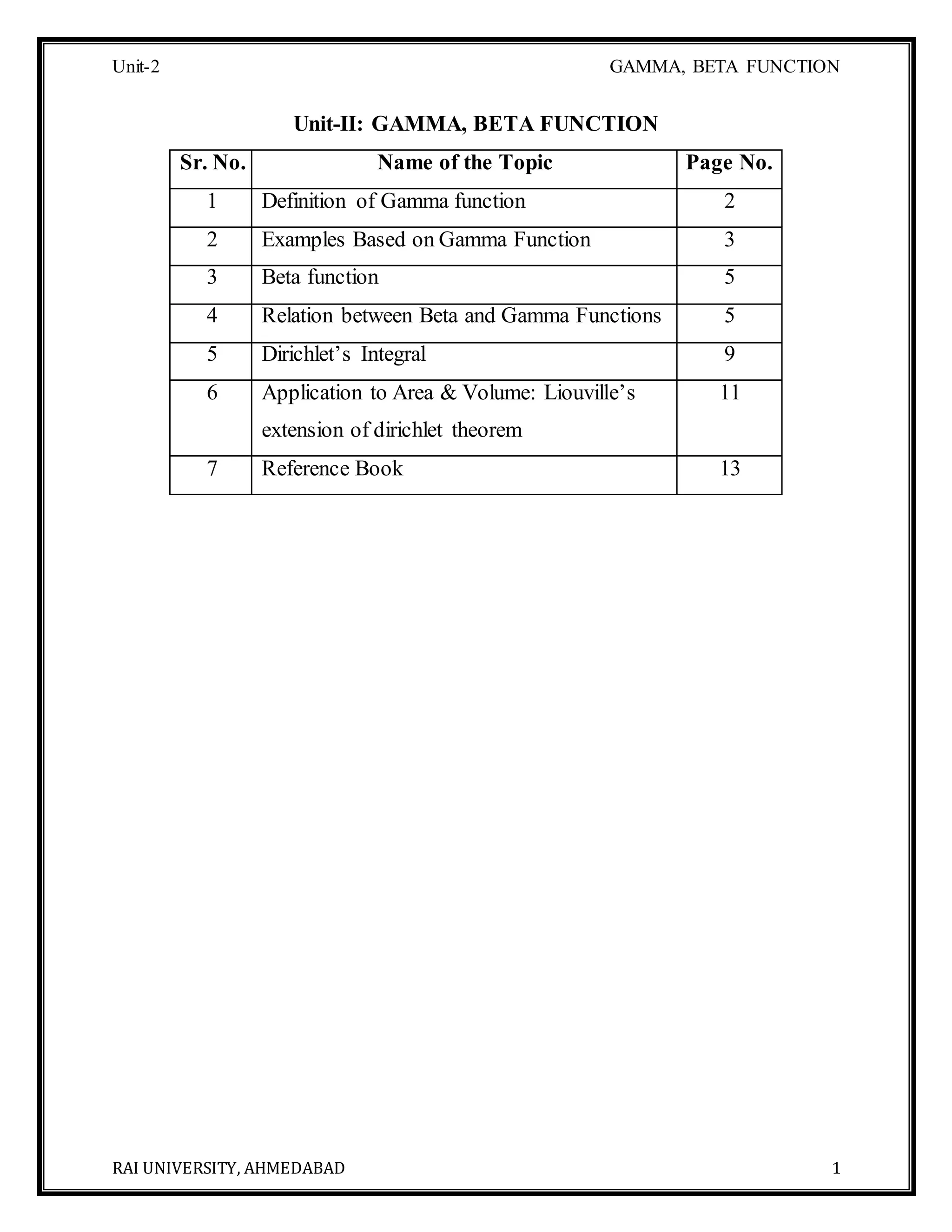
Sr. No. Name of the Topic Page No.
1 Definition of Gamma function 2
2 Examples Based on Gamma Function 3
3 Beta function 5
4 Relation between Beta and Gamma Functions 5
5 Dirichlet’s Integral 9
6 Application to Area & Volume: Liouville’s
extension of dirichlet theorem
11
7 Reference Book 13
Unit-2 GAMMA, BETA FUNCTION
RAI UNIVERSITY, AHMEDABAD 2
GAMMA, BETA FUNCTION
 The Gamma function and Beta functions belong to the category of the
special transcendental functions and are defined in terms of improper
definite integrals.
1.1 Definition of Gamma function :
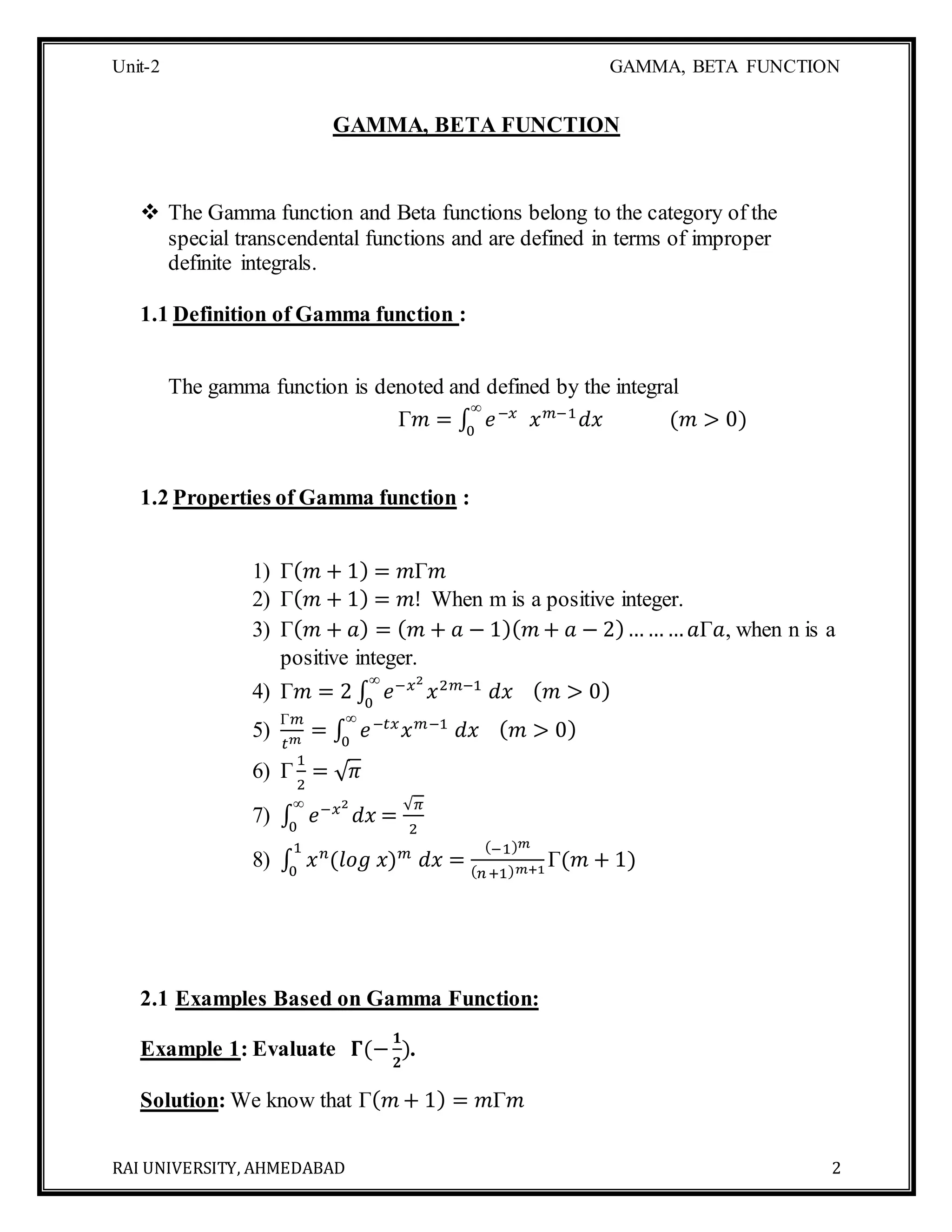
The gamma function is denoted and defined by the integral
Γ𝑚 = ∫ 𝑒−𝑥
𝑥 𝑚−1
𝑑𝑥 (𝑚 > 0)
∞
0
1.2 Properties of Gamma function :
1) Γ( 𝑚 + 1) = 𝑚Γ𝑚
2) Γ( 𝑚 + 1) = 𝑚! When m is a positive integer.
3) Γ( 𝑚 + 𝑎) = ( 𝑚 + 𝑎 − 1)( 𝑚 + 𝑎 − 2)……… 𝑎Γ𝑎, when n is a
positive integer.
4) Γ𝑚 = 2 ∫ 𝑒−𝑥2
𝑥2𝑚−1
𝑑𝑥 ( 𝑚 > 0)
∞
0
5)
Γ𝑚
𝑡 𝑚
= ∫ 𝑒−𝑡𝑥
𝑥 𝑚−1
𝑑𝑥 ( 𝑚 > 0)
∞
0
6) Γ
1
2
= √ 𝜋
7) ∫ 𝑒−𝑥2
𝑑𝑥 =
√𝜋
2
∞
0
8) ∫ 𝑥 𝑛
(𝑙𝑜𝑔 𝑥) 𝑚
𝑑𝑥 =
(−1) 𝑚
( 𝑛+1) 𝑚+1
Γ(𝑚 + 1)
1
0
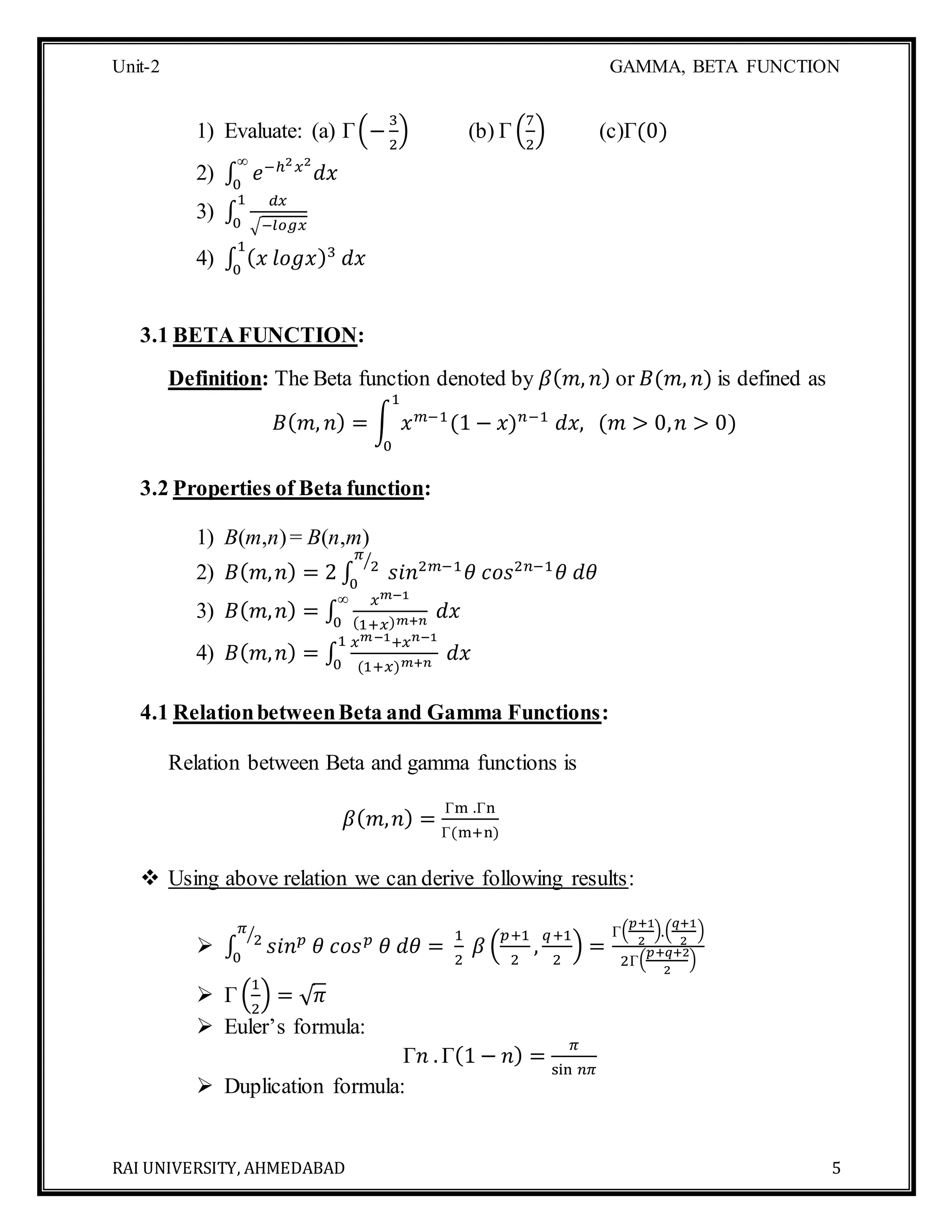
2.1 Examples Based on Gamma Function:
Example 1: Evaluate 𝚪(−
𝟏
𝟐
).
Solution: We know that Γ( 𝑚 + 1) = 𝑚Γ𝑚
Unit-2 GAMMA, BETA FUNCTION
RAI UNIVERSITY, AHMEDABAD 3
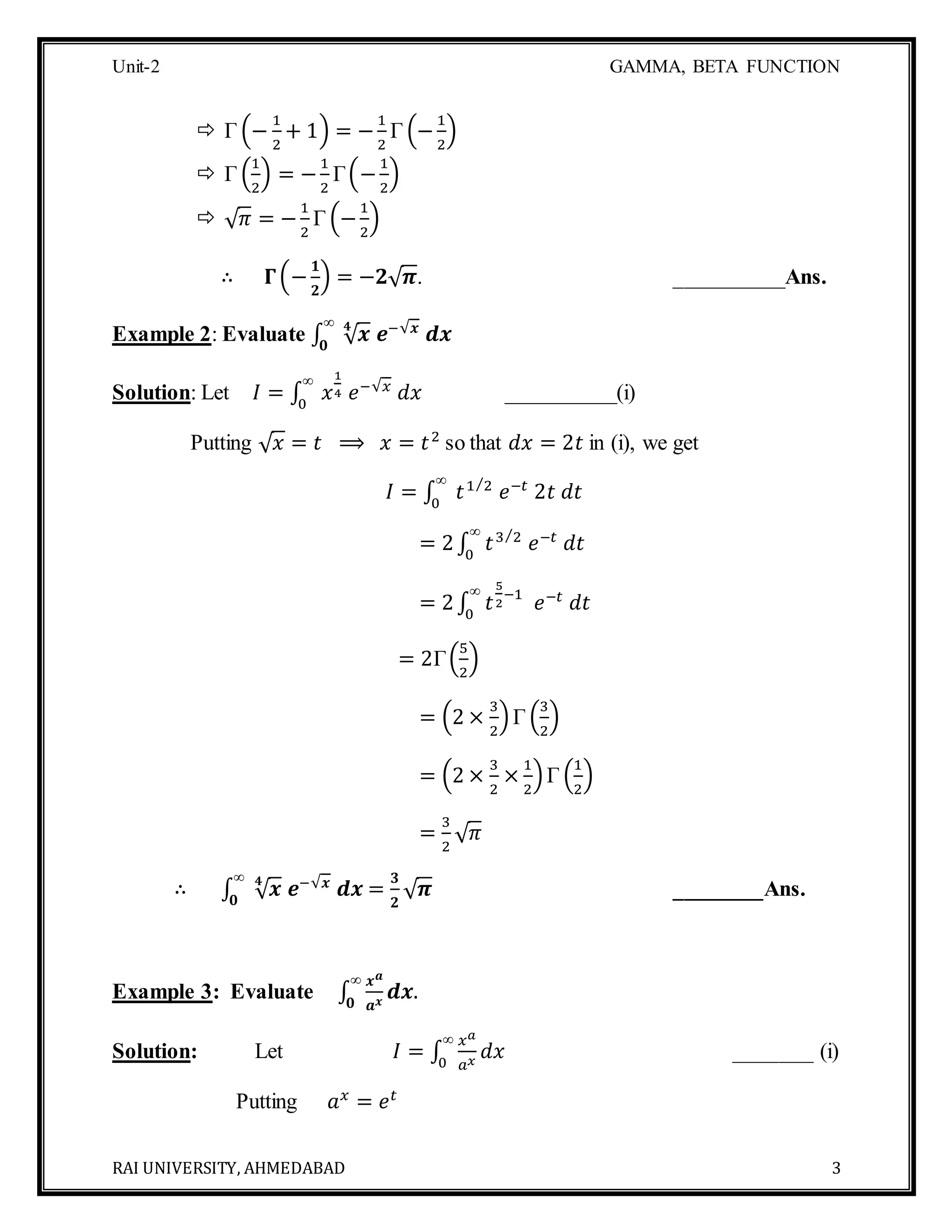
 Γ (−
1
2
+ 1) = −
1
2
Γ (−
1
2
)
 Γ (
1
2
) = −
1
2
Γ(−
1
2
)
 √ 𝜋 = −
1
2
Γ (−
1
2
)
∴ 𝚪(−
𝟏
𝟐
) = −𝟐√ 𝝅. __________Ans.
Example 2: Evaluate ∫ √ 𝒙𝟒
𝒆−√𝒙
𝒅𝒙
∞
𝟎
Solution: Let 𝐼 = ∫ 𝑥
1
4 𝑒−√𝑥
𝑑𝑥
∞
0
__________(i)
Putting √ 𝑥 = 𝑡 ⟹ 𝑥 = 𝑡2
so that 𝑑𝑥 = 2𝑡 in (i), we get
𝐼 = ∫ 𝑡1 2⁄
𝑒−𝑡
2𝑡 𝑑𝑡
∞
0
= 2∫ 𝑡3 2⁄
𝑒−𝑡
𝑑𝑡
∞
0
= 2∫ 𝑡
5
2
−1
𝑒−𝑡
𝑑𝑡
∞
0
= 2Γ(
5
2
)
= (2 ×
3
2
)Γ (
3
2
)
= (2 ×
3
2
×
1
2
)Γ (
1
2
)
=
3
2
√ 𝜋
∴ ∫ √ 𝒙𝟒
𝒆−√𝒙
𝒅𝒙
∞
𝟎
=
𝟑
𝟐
√ 𝝅 ________Ans.
Example 3: Evaluate ∫
𝒙 𝒂
𝒂 𝒙
𝒅𝒙
∞
𝟎
.
Solution: Let 𝐼 = ∫
𝑥 𝑎
𝑎 𝑥
𝑑𝑥
∞
0
_______ (i)
Putting 𝑎 𝑥
= 𝑒 𝑡
Unit-2 GAMMA, BETA FUNCTION
RAI UNIVERSITY, AHMEDABAD 4
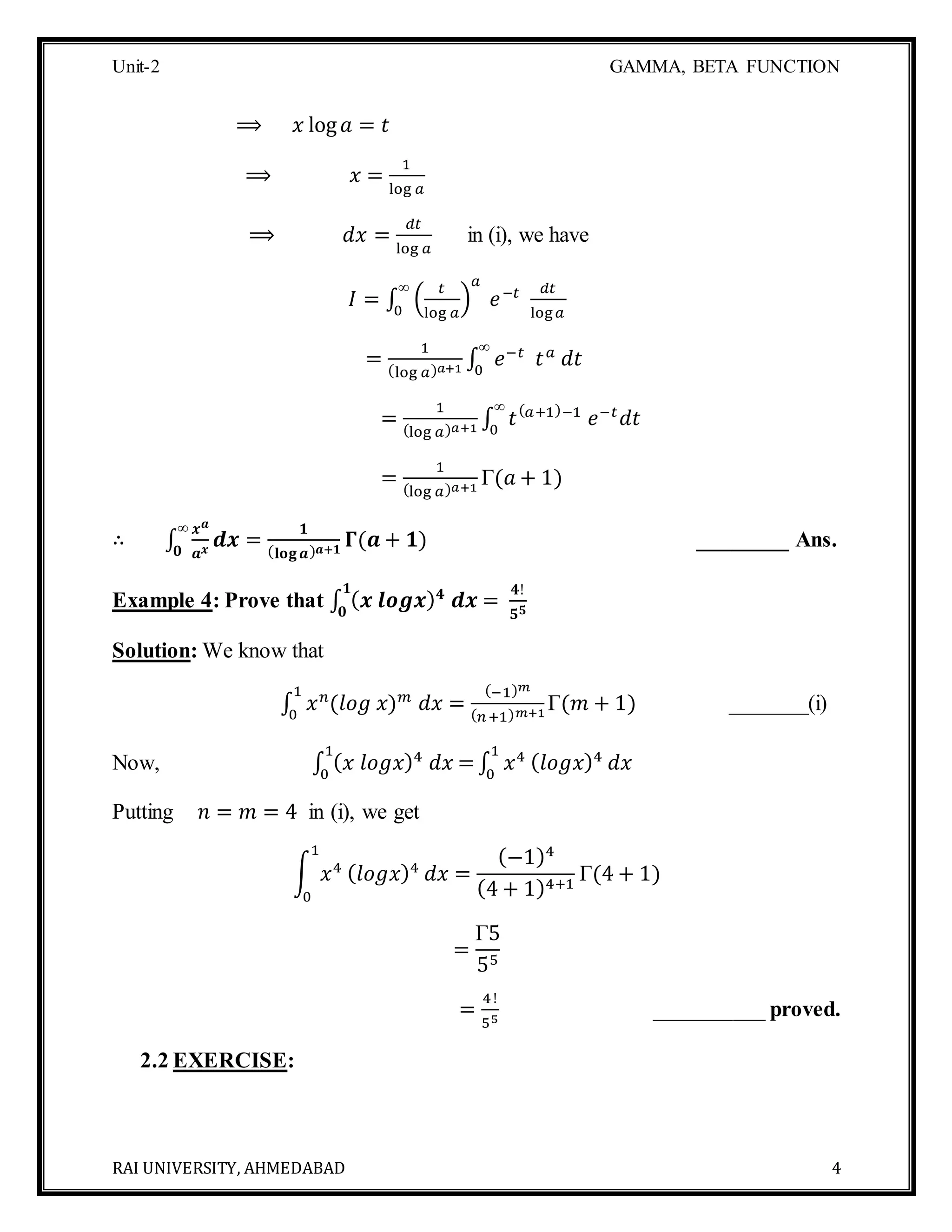
⟹ 𝑥 log 𝑎 = 𝑡
⟹ 𝑥 =
1
log 𝑎
⟹ 𝑑𝑥 =
𝑑𝑡
log 𝑎
in (i), we have
𝐼 = ∫ (
𝑡
log 𝑎
)
𝑎
𝑒−𝑡∞
0
𝑑𝑡
log 𝑎
=
1
(log 𝑎) 𝑎+1 ∫ 𝑒−𝑡
𝑡 𝑎
𝑑𝑡
∞
0
=
1
(log 𝑎) 𝑎+1 ∫ 𝑡( 𝑎+1)−1
𝑒−𝑡
𝑑𝑡
∞
0
=
1
(log 𝑎) 𝑎+1
Γ(𝑎 + 1)
∴ ∫
𝒙 𝒂
𝒂 𝒙
𝒅𝒙
∞
𝟎
=
𝟏
( 𝐥𝐨𝐠 𝒂) 𝒂+𝟏
𝚪(𝒂 + 𝟏) ________ Ans.
Example 4: Prove that ∫ ( 𝒙 𝒍𝒐𝒈𝒙) 𝟒
𝒅𝒙 =
𝟒!
𝟓 𝟓
𝟏
𝟎
Solution: We know that
∫ 𝑥 𝑛
(𝑙𝑜𝑔 𝑥) 𝑚
𝑑𝑥 =
(−1) 𝑚
( 𝑛+1) 𝑚+1
Γ(𝑚 + 1)
1
0
_______(i)
Now, ∫ ( 𝑥 𝑙𝑜𝑔𝑥)4
𝑑𝑥 =
1
0
∫ 𝑥41
0
( 𝑙𝑜𝑔𝑥)4
𝑑𝑥
Putting 𝑛 = 𝑚 = 4 in (i), we get
∫ 𝑥4
1
0
( 𝑙𝑜𝑔𝑥)4
𝑑𝑥 =
(−1)4
(4 + 1)4+1
Γ(4 + 1)
=
Γ5
55
=
4!
55
__________ proved.
2.2 EXERCISE:
Unit-2 GAMMA, BETA FUNCTION
RAI UNIVERSITY, AHMEDABAD 5
1) Evaluate: (a) Γ(−
3
2
) (b) Γ (
7
2
) (c)Γ(0)
2) ∫ 𝑒−ℎ2 𝑥2
𝑑𝑥
∞
0
3) ∫
𝑑𝑥
√−𝑙𝑜𝑔𝑥
1
0
4) ∫ ( 𝑥 𝑙𝑜𝑔𝑥)3
𝑑𝑥
1
0
3.1 BETA FUNCTION:
Definition: The Beta function denoted by 𝛽( 𝑚, 𝑛) or 𝐵(𝑚, 𝑛) is defined as
𝐵( 𝑚, 𝑛) = ∫ 𝑥 𝑚−1
(1 − 𝑥) 𝑛−1
𝑑𝑥, (𝑚 > 0, 𝑛 > 0)
1
0
3.2 Properties of Beta function:
1) B(m,n)= B(n,m)
2) 𝐵( 𝑚, 𝑛) = 2 ∫ 𝑠𝑖𝑛2𝑚−1
𝜃 𝑐𝑜𝑠2𝑛−1
𝜃 𝑑𝜃
𝜋
2⁄
0
3) 𝐵( 𝑚, 𝑛) = ∫
𝑥 𝑚−1
(1+𝑥) 𝑚+𝑛
𝑑𝑥
∞
0
4) 𝐵( 𝑚, 𝑛) = ∫
𝑥 𝑚−1+𝑥 𝑛−1
(1+𝑥) 𝑚+𝑛
𝑑𝑥
1
0
4.1 RelationbetweenBeta and Gamma Functions:
Relation between Beta and gamma functions is
𝛽( 𝑚, 𝑛) =
Γm .Γn
Γ(m+n)
 Using above relation we can derive following results:
 ∫ 𝑠𝑖𝑛 𝑝
𝜃 𝑐𝑜𝑠 𝑝
𝜃 𝑑𝜃 =
1
2
𝛽 (
𝑝+1
2
,
𝑞+1
2
) =
Γ(
𝑝+1
2
).(
𝑞+1
2
)
2Γ(
𝑝+𝑞+2
2
)
𝜋
2⁄
0
 Γ (
1
2
) = √ 𝜋
 Euler’s formula:
Γ𝑛 . Γ(1 − 𝑛) =
𝜋
sin 𝑛𝜋
 Duplication formula:
Unit-2 GAMMA, BETA FUNCTION
RAI UNIVERSITY, AHMEDABAD 6
Γ𝑛 . Γ(𝑛 +
1
2
) =
√𝜋 Γ(2𝑛)
22𝑛−1
4.2 EXAMPLES:
Example 1: Evaluate ∫ 𝒙 𝟒
(𝟏− √ 𝒙)
𝟓
𝒅𝒙
𝟏
𝟎
Solution: Let √ 𝑥 = 𝑡 ⟹ 𝑥 = 𝑡2
so that 𝑑𝑥 = 2𝑡 𝑑𝑡
∫ 𝑥4
(1− √ 𝑥)
5
𝑑𝑥 =
1
0
∫( 𝑡2)4 (1 − 𝑡)5
(2𝑡 𝑑𝑡)
1
0
= 2 ∫ 𝑡9
(1 − 𝑡)5
𝑑𝑡
1
0
= 2 𝐵(10,6)
= 2
Γ10 Γ6
Γ16
= 2 ×
9!5!
15!
=
2×1×2×3×4×5
15×14×13×12×11×10
=
1
11×13×7×15
=
1
15015
∴ ∫ 𝑥4
(1 − √ 𝑥)
5
𝑑𝑥 =
1
0
1
15015
_________ Ans.
Example 2: Find the value of 𝚪 (
𝟏
𝟐
).
Solution: We know that,
∫ 𝑠𝑖𝑛 𝑝
𝜃 𝑐𝑜𝑠 𝑝
𝜃 𝑑𝜃 =
Γ(
𝑝+1
2
).(
𝑞+1
2
)
2Γ(
𝑝+𝑞+2
2
)
𝜋
2⁄
0
Putting 𝑝 = 𝑞 = 0, we get ∫ 𝑑𝜃 =
𝚪(
𝟏
𝟐
) 𝚪(
𝟏
𝟐
)
2 𝚪𝟏
𝜋
2
0
 [ 𝜃]0
𝜋 2⁄
=
1
2
(Γ
1
2
)
2
Unit-2 GAMMA, BETA FUNCTION
RAI UNIVERSITY, AHMEDABAD 7

𝜋
2
=
1
2
(Γ
1
2
)
2
 (Γ
1
2
)
2
= 𝜋
 Γ (
1
2
) = √ 𝜋 _______Ans.
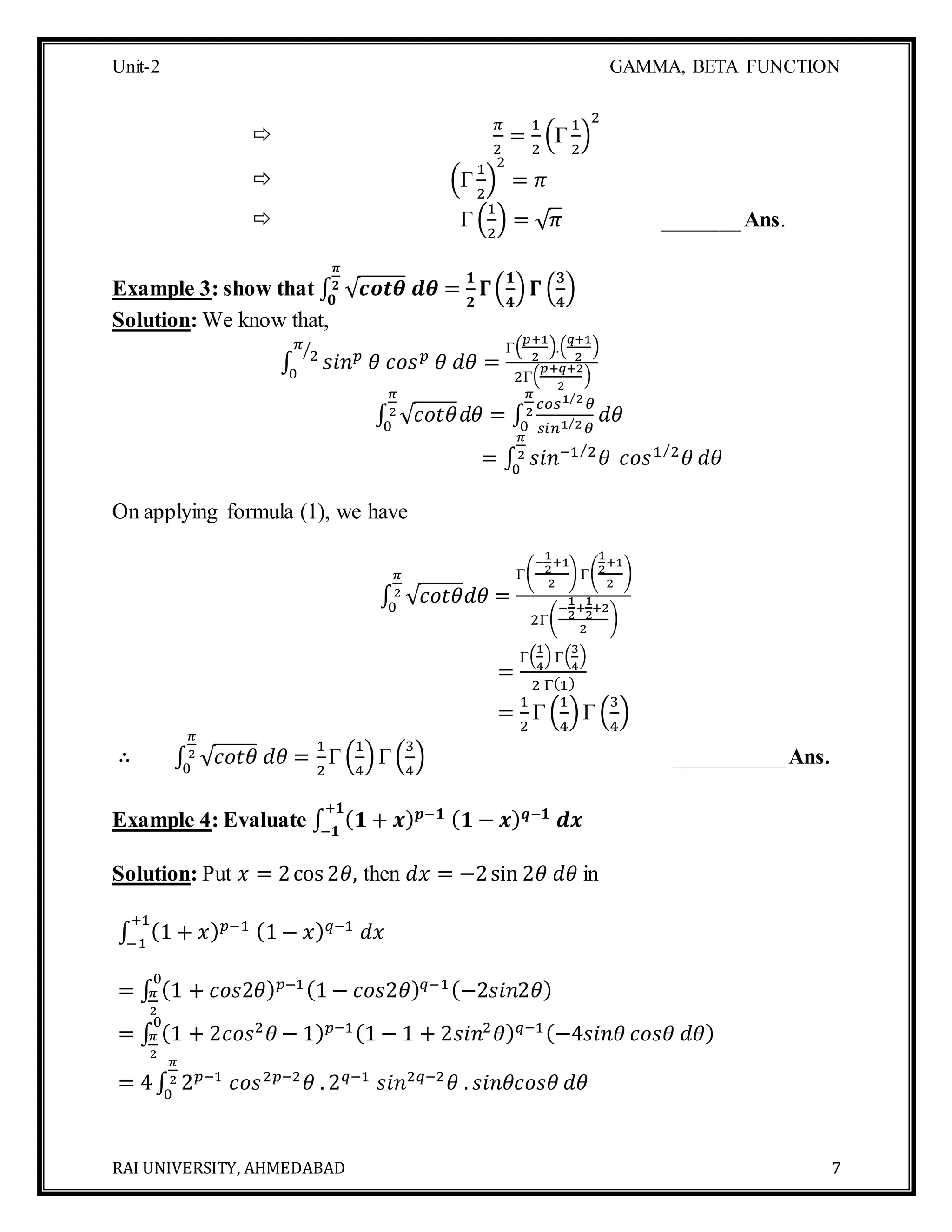
Example 3: show that ∫ √ 𝒄𝒐𝒕𝜽 𝒅𝜽 =
𝟏
𝟐
𝚪(
𝟏
𝟒
) 𝚪 (
𝟑
𝟒
)
𝝅
𝟐
𝟎
Solution: We know that,
∫ 𝑠𝑖𝑛 𝑝
𝜃 𝑐𝑜𝑠 𝑝
𝜃 𝑑𝜃 =
Γ(
𝑝+1
2
).(
𝑞+1
2
)
2Γ(
𝑝+𝑞+2
2
)
𝜋
2⁄
0
∫ √ 𝑐𝑜𝑡𝜃𝑑𝜃 = ∫
𝑐𝑜𝑠1 2⁄
𝜃
𝑠𝑖𝑛1 2⁄ 𝜃
𝑑𝜃
𝜋
2
0
𝜋
2
0
= ∫ 𝑠𝑖𝑛−1 2⁄
𝜃
𝜋
2
0
𝑐𝑜𝑠1 2⁄
𝜃 𝑑𝜃
On applying formula (1), we have
∫ √ 𝑐𝑜𝑡𝜃𝑑𝜃 =
Γ(
−
1
2
+1
2
) Γ(
1
2
+1
2
)
2Γ(
−
1
2
+
1
2
+2
2
)
𝜋
2
0
=
Γ(
1
4
) Γ(
3
4
)
2 Γ(1)
=
1
2
Γ (
1
4
)Γ (
3
4
)
∴ ∫ √ 𝑐𝑜𝑡𝜃 𝑑𝜃 =
1
2
Γ (
1
4
)Γ (
3
4
)
𝜋
2
0
__________Ans.
Example 4: Evaluate ∫ ( 𝟏 + 𝒙) 𝒑−𝟏 ( 𝟏 − 𝒙) 𝒒−𝟏
𝒅𝒙
+𝟏
−𝟏
Solution: Put 𝑥 = 2cos 2𝜃, then 𝑑𝑥 = −2sin 2𝜃 𝑑𝜃 in
∫ (1 + 𝑥) 𝑝−1 (1 − 𝑥) 𝑞−1
𝑑𝑥
+1
−1
= ∫ (1 + 𝑐𝑜𝑠2𝜃) 𝑝−1(1 − 𝑐𝑜𝑠2𝜃) 𝑞−1(−2𝑠𝑖𝑛2𝜃)
0
𝜋
2
= ∫ (1 + 2𝑐𝑜𝑠2
𝜃 − 1) 𝑝−1(1 − 1 + 2𝑠𝑖𝑛2
𝜃) 𝑞−1(−4𝑠𝑖𝑛𝜃 𝑐𝑜𝑠𝜃 𝑑𝜃)
0
𝜋
2
= 4∫ 2 𝑝−1
𝑐𝑜𝑠2𝑝−2
𝜃 . 2 𝑞−1
𝑠𝑖𝑛2𝑞−2
𝜃 . 𝑠𝑖𝑛𝜃𝑐𝑜𝑠𝜃 𝑑𝜃
𝜋
2
0
Unit-2 GAMMA, BETA FUNCTION
RAI UNIVERSITY, AHMEDABAD 8
= 2 𝑝+𝑞
∫ 𝑠𝑖𝑛2𝑞−1
𝜃 𝑐𝑜𝑠2𝑝−1
𝜃
∞
0
𝑑𝜃
= 2 𝑝+𝑞
Γ(
2𝑞
2
) Γ(
2𝑝
2
)
2Γ(
2𝑝+2𝑞
2
)
= 2 𝑝+𝑞−1 Γ( 𝑝) Γ( 𝑞)
Γ( 𝑝+𝑞)
__________Ans.
Example 5: Show that 𝚪( 𝒏) 𝚪( 𝟏− 𝒏) =
𝝅
𝒔𝒊𝒏 𝒏𝝅
(𝟎 < 𝑛 < 1)
Solution: We know that
𝛽( 𝑚, 𝑛) = ∫
𝑥 𝑛−1
(1 + 𝑥) 𝑚+𝑛
𝑑𝑥
∞
0
Γ𝑚 Γ𝑛
Γ(𝑚+𝑛)
= ∫
𝑥 𝑛−1
(1+𝑥) 𝑚+𝑛
𝑑𝑥
∞
0
Putting 𝑚 + 𝑛 = 1 𝑜𝑟 𝑚 = 1 − 𝑛, we get
Γ(1−𝑛) Γ𝑛
Γ1
= ∫
𝑥 𝑛−1
(1+𝑥)1
𝑑𝑥
∞
0
Γ(1 − 𝑛)Γ𝑛 = ∫
𝑥 𝑛−1
1+𝑥
𝑑𝑥
∞
0
[∵ ∫
𝑥 𝑛−1
1+𝑥
𝑑𝑥
∞
0
=
𝜋
𝑠𝑖𝑛 𝑛𝜋
]
∴ Γ( 𝑛)Γ(1− 𝑛) =
𝜋
𝑠𝑖𝑛 𝑛𝜋
______proved.
4.3 EXERCISE:
1) Evaluate ∫ (1 − 𝑥3)−1 2⁄
𝑑𝑥
1
0
2) Evaluate ∫
𝑥 𝑚−1+𝑥 𝑛−1
(1+𝑥) 𝑚+𝑛
𝑑𝑥
1
0
3) Evaluate ∫ (
𝑥3
1−𝑥3
)
1
2
𝑑𝑥
1
0
4) Prove that Γ (
1
4
) Γ (
3
4
) = 𝜋√2
5) Show that 𝛽( 𝑝, 𝑞) = 𝛽( 𝑝 + 1, 𝑞) + (𝑝, 𝑞 + 1)
5.1 DIRICHLET’S INTEGRAL:
If 𝑙, 𝑚, 𝑛 are all positive, then the triple integral
∭ 𝑥 𝑙−1
𝑦 𝑚−1
𝑧 𝑛−1
𝑑𝑥 𝑑𝑦 𝑑𝑧
𝑉
=
Γ(l)Γ(m)Γ(n)
Γ(𝑙 + 𝑚 + 𝑛 + 1)
Unit-2 GAMMA, BETA FUNCTION
RAI UNIVERSITY, AHMEDABAD 9
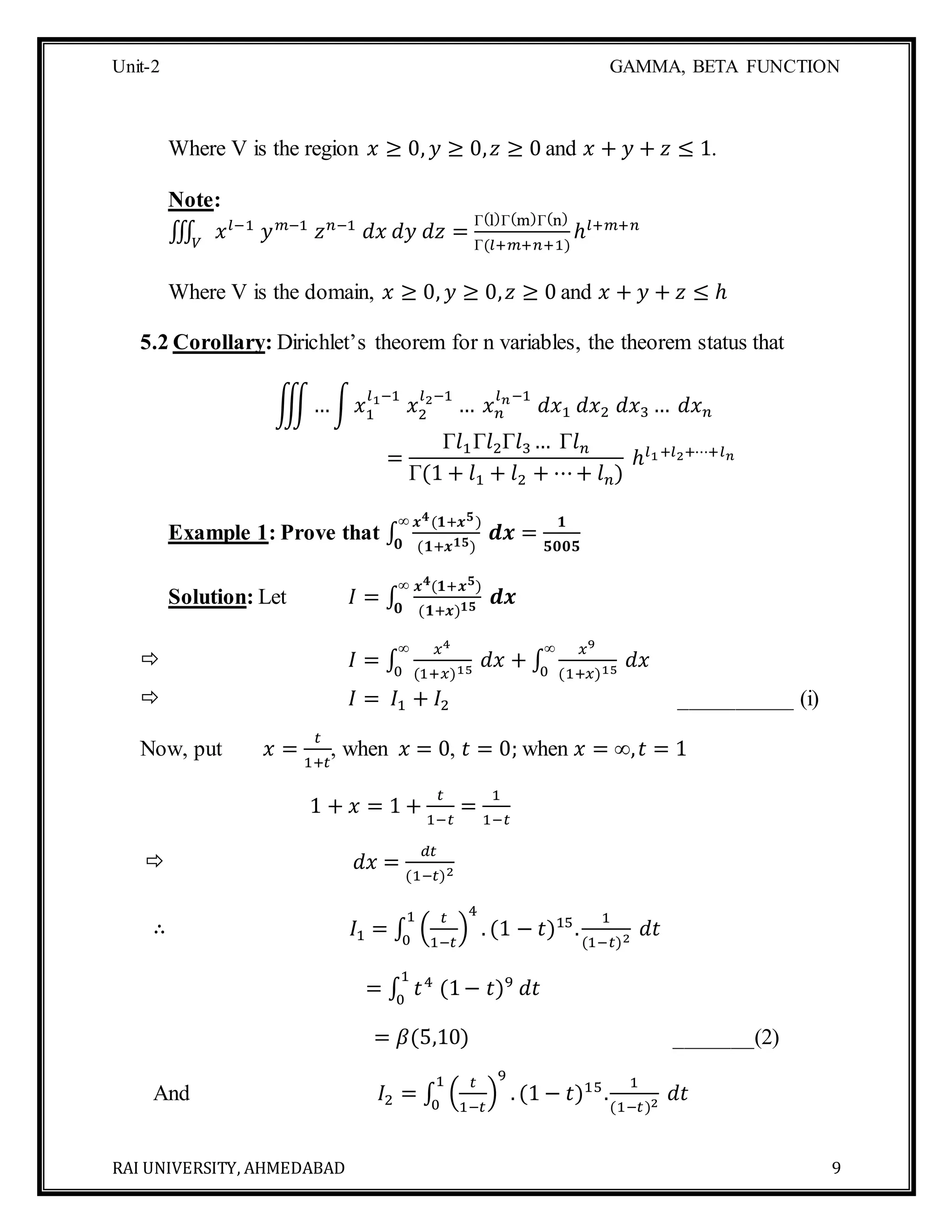
Where V is the region 𝑥 ≥ 0, 𝑦 ≥ 0, 𝑧 ≥ 0 and 𝑥 + 𝑦 + 𝑧 ≤ 1.
Note:
∭ 𝑥 𝑙−1
𝑦 𝑚−1
𝑧 𝑛−1
𝑑𝑥 𝑑𝑦 𝑑𝑧𝑉
=
Γ(l)Γ(m)Γ(n)
Γ(𝑙+𝑚+𝑛+1)
ℎ𝑙+𝑚+𝑛
Where V is the domain, 𝑥 ≥ 0, 𝑦 ≥ 0, 𝑧 ≥ 0 and 𝑥 + 𝑦 + 𝑧 ≤ ℎ
5.2 Corollary: Dirichlet’s theorem for n variables, the theorem status that
∭…∫ 𝑥1
𝑙1−1
𝑥2
𝑙2−1
… 𝑥 𝑛
𝑙 𝑛−1
𝑑𝑥1 𝑑𝑥2 𝑑𝑥3 … 𝑑𝑥 𝑛
=
Γ𝑙1Γ𝑙2Γ𝑙3 … Γ𝑙 𝑛
Γ(1 + 𝑙1 + 𝑙2 + ⋯+ 𝑙 𝑛)
ℎ𝑙1+𝑙2+⋯+𝑙 𝑛
Example 1: Prove that ∫
𝒙 𝟒(𝟏+𝒙 𝟓)
(𝟏+𝒙 𝟏𝟓)
𝒅𝒙 =
𝟏
𝟓𝟎𝟎𝟓
∞
𝟎
Solution: Let 𝐼 = ∫
𝒙 𝟒(𝟏+𝒙 𝟓)
(𝟏+𝒙) 𝟏𝟓
𝒅𝒙
∞
𝟎
 𝐼 = ∫
𝑥4
(1+𝑥)15
𝑑𝑥
∞
0
+ ∫
𝑥9
(1+𝑥)15
𝑑𝑥
∞
0
 𝐼 = 𝐼1 + 𝐼2 __________ (i)
Now, put 𝑥 =
𝑡
1+𝑡
, when 𝑥 = 0, 𝑡 = 0; when 𝑥 = ∞, 𝑡 = 1
1 + 𝑥 = 1 +
𝑡
1−𝑡
=
1
1−𝑡
 𝑑𝑥 =
𝑑𝑡
(1−𝑡)2
∴ 𝐼1 = ∫ (
𝑡
1−𝑡
)
4
. (1 − 𝑡)15
.
1
(1−𝑡)2
𝑑𝑡
1
0
= ∫ 𝑡4
(1− 𝑡)9
𝑑𝑡
1
0
= 𝛽(5,10) _______(2)
And 𝐼2 = ∫ (
𝑡
1−𝑡
)
9
. (1 − 𝑡)15
.
1
(1−𝑡)2
𝑑𝑡
1
0
Unit-2 GAMMA, BETA FUNCTION
RAI UNIVERSITY, AHMEDABAD 10
= ∫ 𝑡9
(1− 𝑡)4
𝑑𝑡
1
0
= 𝛽(10,5) ________(3)
∴ 𝐼 = 𝐼1 + 𝐼2
= 𝛽(5,10) + 𝛽(10,5) [Using(2) and (3)]
= 𝛽(5,10) + 𝛽(5,10) [𝛽( 𝑚, 𝑛) = 𝛽(𝑛, 𝑚)]
= 2𝛽(5,10)
=
2Γ5Γ10
Γ15
=
2×4!×9!
14!
=
2×4×3×2×1×9!
14×13×12×11×10×9!
=
1
5005
_______ Proved.
5.3 EXERCISE:
1) Find the value of ∫
𝑥3−2𝑥4+𝑥5
(1+𝑥)7
𝑑𝑥
1
0
2) Show that ∫
𝑥 𝑚−1(1−𝑥) 𝑛−1
(𝑎+𝑥) 𝑚+𝑛
𝑑𝑥 =
𝛽(𝑚,𝑛)
𝑎 𝑛(1+𝑎) 𝑚
1
0
3) 𝛽( 𝑚 + 1, 𝑛) =
𝑚
𝑚+𝑛
𝛽(𝑚, 𝑛)
6.1 Application to Area & Volume:
 Liouville’s extension of dirichlet theorem:
Unit-2 GAMMA, BETA FUNCTION
RAI UNIVERSITY, AHMEDABAD 11
∭ 𝑓(𝑥 + 𝑦 + 𝑧)𝑥 𝑙−1
𝑦 𝑚−1
𝑧 𝑛−1
𝑑𝑥 𝑑𝑦 𝑑𝑧
=
Γ(l)Γ(m)Γ(n)
Γ(l + m + n)
∫ 𝑓( 𝑢) 𝑢𝑙+𝑚+𝑛−1
𝑑𝑢
ℎ2
ℎ1
Example1: Show that ∭
𝒅𝒙 𝒅𝒚 𝒅𝒛
(𝒙+𝒚+𝒛+𝟏) 𝟑
=
𝟏
𝟐
𝒍𝒐𝒈𝟐−
𝟓
𝟏𝟔
, the integral being
takenthroughout the volume bounded by
𝒙 = 𝟎, 𝒚 = 𝟎, 𝒛 = 𝟎, 𝒙 + 𝒚 + 𝒛 = 𝟏.
Solution: By Liouville’s theorem when 0 < 𝑥 + 𝑦 + 𝑧 < 1
∭
𝑑𝑥 𝑑𝑦 𝑑𝑧
(𝑥+𝑦+𝑧+1)3
= ∭
𝑥 𝑙−1 𝑦 𝑚−1 𝑧 𝑛−1 𝑑𝑥 𝑑𝑦 𝑑𝑧
(𝑥+𝑦+𝑧+1)3
(0 ≤ 𝑥 + 𝑦 + 𝑧 ≤ 1)
=
Γ1Γ1Γ1
Γ(l+m+n)
∫
1
(u+1)3
u3−1
du
1
0
=
1
2
∫
𝑢2
(𝑢+1)3
𝑑𝑢
1
0
= ∫ [
1
𝑢+1
−
2
(𝑢+1)2
+
1
(𝑢+1)3
] 𝑑𝑢
1
0
(Partial fractions)
=
1
2
[log( 𝑢 + 1) +
2
𝑢+1
−
1
2(𝑢+1)2
]
0
1
=
1
2
[𝑙𝑜𝑔2 + 2(
1
2
− 1) − (
1
8
−
1
2
)]
=
1
2
𝑙𝑜𝑔2 −
5
16
∴ ∭
𝒅𝒙 𝒅𝒚 𝒅𝒛
(𝒙+𝒚+𝒛+𝟏) 𝟑
=
𝟏
𝟐
𝒍𝒐𝒈𝟐−
𝟓
𝟏𝟔
_______Proved.
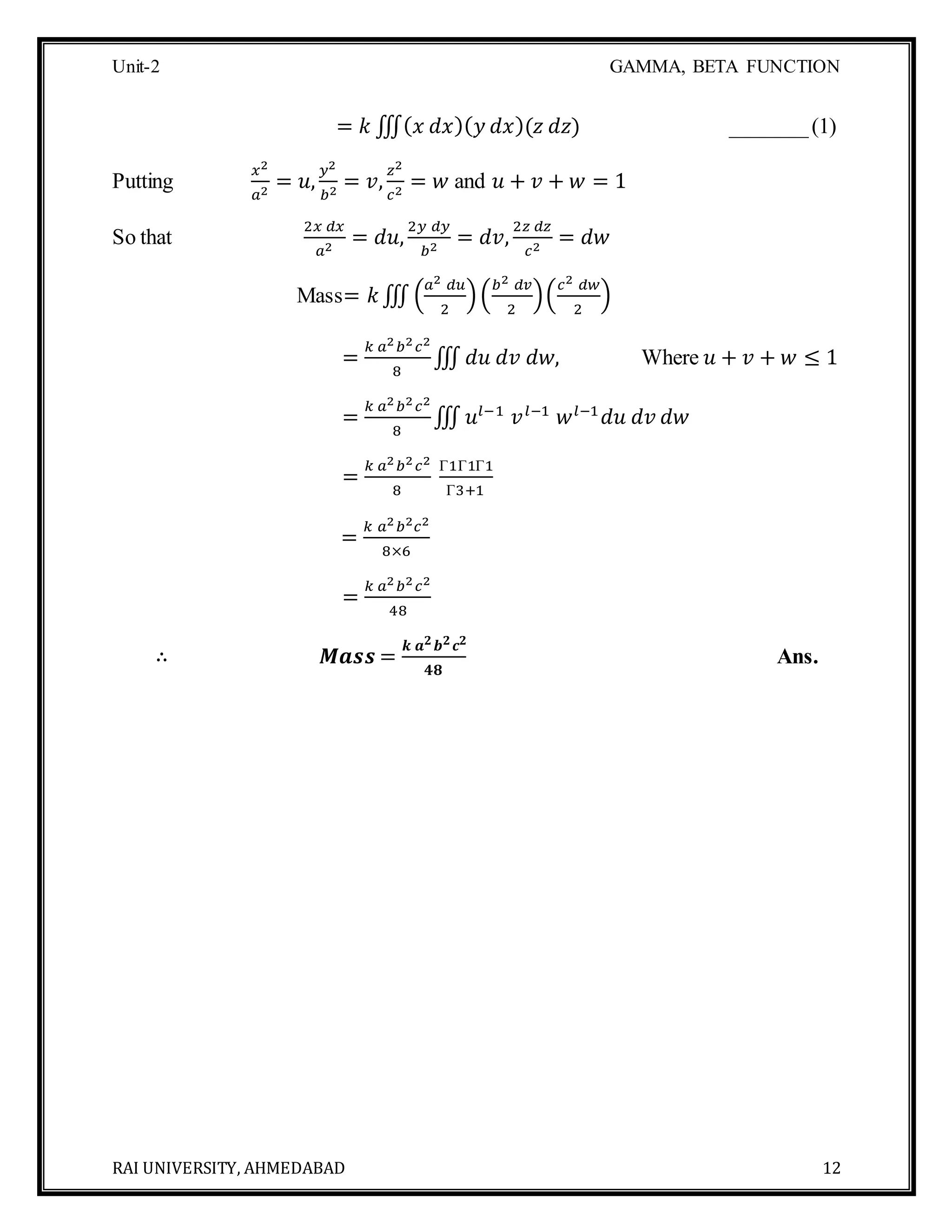
Example 2: Find the mass of an octantof the ellipsoid
𝒙 𝟐
𝒂 𝟐
+
𝒚 𝟐
𝒃 𝟐
+
𝒛 𝟐
𝒄 𝟐
= 𝟏,
the density at any point being 𝝆 = 𝒌 𝒙 𝒚 𝒛.
Solution: Mass = ∭ 𝜌 𝑑𝑣
= ∭( 𝑘 𝑥 𝑦 𝑧) 𝑑𝑥 𝑑𝑦 𝑑𝑧
Unit-2 GAMMA, BETA FUNCTION
RAI UNIVERSITY, AHMEDABAD 12
= 𝑘 ∭( 𝑥 𝑑𝑥)( 𝑦 𝑑𝑥)(𝑧 𝑑𝑧) _______(1)
Putting
𝑥2
𝑎2
= 𝑢,
𝑦2
𝑏2
= 𝑣,
𝑧2
𝑐2
= 𝑤 and 𝑢 + 𝑣 + 𝑤 = 1
So that
2𝑥 𝑑𝑥
𝑎2
= 𝑑𝑢,
2𝑦 𝑑𝑦
𝑏2
= 𝑑𝑣,
2𝑧 𝑑𝑧
𝑐2
= 𝑑𝑤
Mass= 𝑘∭ (
𝑎2 𝑑𝑢
2
)(
𝑏2 𝑑𝑣
2
)(
𝑐2 𝑑𝑤
2
)
=
𝑘 𝑎2 𝑏2 𝑐2
8
∭ 𝑑𝑢 𝑑𝑣 𝑑𝑤, Where 𝑢 + 𝑣 + 𝑤 ≤ 1
=
𝑘 𝑎2 𝑏2 𝑐2
8
∭ 𝑢𝑙−1
𝑣 𝑙−1
𝑤 𝑙−1
𝑑𝑢 𝑑𝑣 𝑑𝑤
=
𝑘 𝑎2 𝑏2 𝑐2
8
Γ1Γ1Γ1
Γ3+1
=
𝑘 𝑎2 𝑏2 𝑐2
8×6
=
𝑘 𝑎2 𝑏2 𝑐2
48
∴ 𝑴𝒂𝒔𝒔 =
𝒌 𝒂 𝟐 𝒃 𝟐 𝒄 𝟐
𝟒𝟖
Ans.
Unit-2 GAMMA, BETA FUNCTION
RAI UNIVERSITY, AHMEDABAD 13
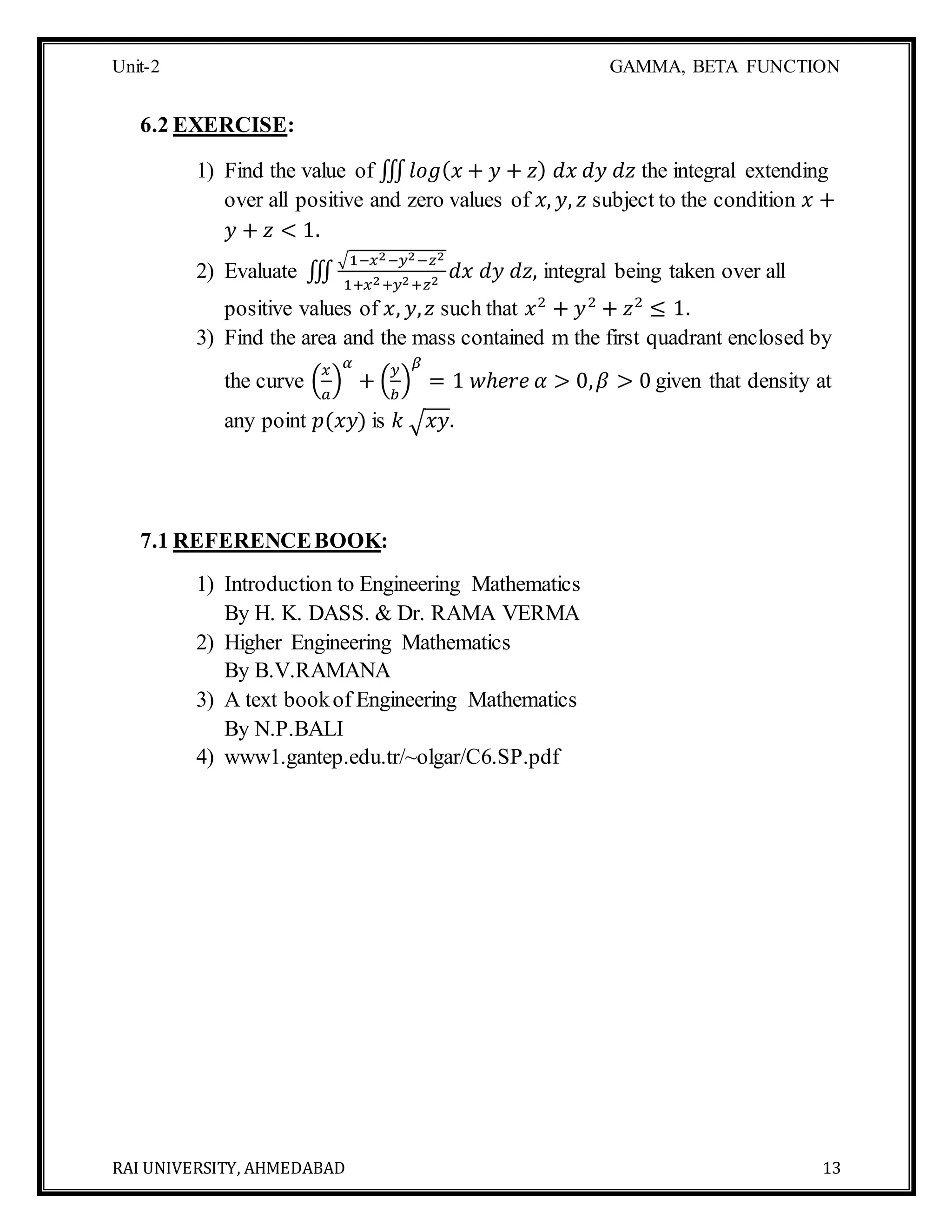
6.2 EXERCISE:
1) Find the value of ∭ 𝑙𝑜𝑔( 𝑥 + 𝑦 + 𝑧) 𝑑𝑥 𝑑𝑦 𝑑𝑧 the integral extending
over all positive and zero values of 𝑥, 𝑦, 𝑧 subject to the condition 𝑥 +
𝑦 + 𝑧 < 1.
2) Evaluate ∭
√1−𝑥2−𝑦2−𝑧2
1+𝑥2+𝑦2+𝑧2
𝑑𝑥 𝑑𝑦 𝑑𝑧, integral being taken over all
positive values of 𝑥, 𝑦, 𝑧 such that 𝑥2
+ 𝑦2
+ 𝑧2
≤ 1.
3) Find the area and the mass contained m the first quadrant enclosed by
the curve (
𝑥
𝑎
)
𝛼
+ (
𝑦
𝑏
)
𝛽
= 1 𝑤ℎ𝑒𝑟𝑒 𝛼 > 0, 𝛽 > 0 given that density at
any point 𝑝(𝑥𝑦) is 𝑘 √ 𝑥𝑦.
7.1 REFERENCEBOOK:
1) Introduction to Engineering Mathematics
By H. K. DASS. & Dr. RAMA VERMA
2) Higher Engineering Mathematics
By B.V.RAMANA
3) A text bookof Engineering Mathematics
By N.P.BALI
4) www1.gantep.edu.tr/~olgar/C6.SP.pdf

B.tech ii unit-2 material beta gamma function

  • 1.
    Unit-2 GAMMA, BETAFUNCTION RAI UNIVERSITY, AHMEDABAD 1 Unit-II: GAMMA, BETA FUNCTION Sr. No. Name of the Topic Page No. 1 Definition of Gamma function 2 2 Examples Based on Gamma Function 3 3 Beta function 5 4 Relation between Beta and Gamma Functions 5 5 Dirichlet’s Integral 9 6 Application to Area & Volume: Liouville’s extension of dirichlet theorem 11 7 Reference Book 13
  • 2.
    Unit-2 GAMMA, BETAFUNCTION RAI UNIVERSITY, AHMEDABAD 2 GAMMA, BETA FUNCTION  The Gamma function and Beta functions belong to the category of the special transcendental functions and are defined in terms of improper definite integrals. 1.1 Definition of Gamma function : The gamma function is denoted and defined by the integral Γ𝑚 = ∫ 𝑒−𝑥 𝑥 𝑚−1 𝑑𝑥 (𝑚 > 0) ∞ 0 1.2 Properties of Gamma function : 1) Γ( 𝑚 + 1) = 𝑚Γ𝑚 2) Γ( 𝑚 + 1) = 𝑚! When m is a positive integer. 3) Γ( 𝑚 + 𝑎) = ( 𝑚 + 𝑎 − 1)( 𝑚 + 𝑎 − 2)……… 𝑎Γ𝑎, when n is a positive integer. 4) Γ𝑚 = 2 ∫ 𝑒−𝑥2 𝑥2𝑚−1 𝑑𝑥 ( 𝑚 > 0) ∞ 0 5) Γ𝑚 𝑡 𝑚 = ∫ 𝑒−𝑡𝑥 𝑥 𝑚−1 𝑑𝑥 ( 𝑚 > 0) ∞ 0 6) Γ 1 2 = √ 𝜋 7) ∫ 𝑒−𝑥2 𝑑𝑥 = √𝜋 2 ∞ 0 8) ∫ 𝑥 𝑛 (𝑙𝑜𝑔 𝑥) 𝑚 𝑑𝑥 = (−1) 𝑚 ( 𝑛+1) 𝑚+1 Γ(𝑚 + 1) 1 0 2.1 Examples Based on Gamma Function: Example 1: Evaluate 𝚪(− 𝟏 𝟐 ). Solution: We know that Γ( 𝑚 + 1) = 𝑚Γ𝑚
  • 3.
    Unit-2 GAMMA, BETAFUNCTION RAI UNIVERSITY, AHMEDABAD 3  Γ (− 1 2 + 1) = − 1 2 Γ (− 1 2 )  Γ ( 1 2 ) = − 1 2 Γ(− 1 2 )  √ 𝜋 = − 1 2 Γ (− 1 2 ) ∴ 𝚪(− 𝟏 𝟐 ) = −𝟐√ 𝝅. __________Ans. Example 2: Evaluate ∫ √ 𝒙𝟒 𝒆−√𝒙 𝒅𝒙 ∞ 𝟎 Solution: Let 𝐼 = ∫ 𝑥 1 4 𝑒−√𝑥 𝑑𝑥 ∞ 0 __________(i) Putting √ 𝑥 = 𝑡 ⟹ 𝑥 = 𝑡2 so that 𝑑𝑥 = 2𝑡 in (i), we get 𝐼 = ∫ 𝑡1 2⁄ 𝑒−𝑡 2𝑡 𝑑𝑡 ∞ 0 = 2∫ 𝑡3 2⁄ 𝑒−𝑡 𝑑𝑡 ∞ 0 = 2∫ 𝑡 5 2 −1 𝑒−𝑡 𝑑𝑡 ∞ 0 = 2Γ( 5 2 ) = (2 × 3 2 )Γ ( 3 2 ) = (2 × 3 2 × 1 2 )Γ ( 1 2 ) = 3 2 √ 𝜋 ∴ ∫ √ 𝒙𝟒 𝒆−√𝒙 𝒅𝒙 ∞ 𝟎 = 𝟑 𝟐 √ 𝝅 ________Ans. Example 3: Evaluate ∫ 𝒙 𝒂 𝒂 𝒙 𝒅𝒙 ∞ 𝟎 . Solution: Let 𝐼 = ∫ 𝑥 𝑎 𝑎 𝑥 𝑑𝑥 ∞ 0 _______ (i) Putting 𝑎 𝑥 = 𝑒 𝑡
  • 4.
    Unit-2 GAMMA, BETAFUNCTION RAI UNIVERSITY, AHMEDABAD 4 ⟹ 𝑥 log 𝑎 = 𝑡 ⟹ 𝑥 = 1 log 𝑎 ⟹ 𝑑𝑥 = 𝑑𝑡 log 𝑎 in (i), we have 𝐼 = ∫ ( 𝑡 log 𝑎 ) 𝑎 𝑒−𝑡∞ 0 𝑑𝑡 log 𝑎 = 1 (log 𝑎) 𝑎+1 ∫ 𝑒−𝑡 𝑡 𝑎 𝑑𝑡 ∞ 0 = 1 (log 𝑎) 𝑎+1 ∫ 𝑡( 𝑎+1)−1 𝑒−𝑡 𝑑𝑡 ∞ 0 = 1 (log 𝑎) 𝑎+1 Γ(𝑎 + 1) ∴ ∫ 𝒙 𝒂 𝒂 𝒙 𝒅𝒙 ∞ 𝟎 = 𝟏 ( 𝐥𝐨𝐠 𝒂) 𝒂+𝟏 𝚪(𝒂 + 𝟏) ________ Ans. Example 4: Prove that ∫ ( 𝒙 𝒍𝒐𝒈𝒙) 𝟒 𝒅𝒙 = 𝟒! 𝟓 𝟓 𝟏 𝟎 Solution: We know that ∫ 𝑥 𝑛 (𝑙𝑜𝑔 𝑥) 𝑚 𝑑𝑥 = (−1) 𝑚 ( 𝑛+1) 𝑚+1 Γ(𝑚 + 1) 1 0 _______(i) Now, ∫ ( 𝑥 𝑙𝑜𝑔𝑥)4 𝑑𝑥 = 1 0 ∫ 𝑥41 0 ( 𝑙𝑜𝑔𝑥)4 𝑑𝑥 Putting 𝑛 = 𝑚 = 4 in (i), we get ∫ 𝑥4 1 0 ( 𝑙𝑜𝑔𝑥)4 𝑑𝑥 = (−1)4 (4 + 1)4+1 Γ(4 + 1) = Γ5 55 = 4! 55 __________ proved. 2.2 EXERCISE:
  • 5.
    Unit-2 GAMMA, BETAFUNCTION RAI UNIVERSITY, AHMEDABAD 5 1) Evaluate: (a) Γ(− 3 2 ) (b) Γ ( 7 2 ) (c)Γ(0) 2) ∫ 𝑒−ℎ2 𝑥2 𝑑𝑥 ∞ 0 3) ∫ 𝑑𝑥 √−𝑙𝑜𝑔𝑥 1 0 4) ∫ ( 𝑥 𝑙𝑜𝑔𝑥)3 𝑑𝑥 1 0 3.1 BETA FUNCTION: Definition: The Beta function denoted by 𝛽( 𝑚, 𝑛) or 𝐵(𝑚, 𝑛) is defined as 𝐵( 𝑚, 𝑛) = ∫ 𝑥 𝑚−1 (1 − 𝑥) 𝑛−1 𝑑𝑥, (𝑚 > 0, 𝑛 > 0) 1 0 3.2 Properties of Beta function: 1) B(m,n)= B(n,m) 2) 𝐵( 𝑚, 𝑛) = 2 ∫ 𝑠𝑖𝑛2𝑚−1 𝜃 𝑐𝑜𝑠2𝑛−1 𝜃 𝑑𝜃 𝜋 2⁄ 0 3) 𝐵( 𝑚, 𝑛) = ∫ 𝑥 𝑚−1 (1+𝑥) 𝑚+𝑛 𝑑𝑥 ∞ 0 4) 𝐵( 𝑚, 𝑛) = ∫ 𝑥 𝑚−1+𝑥 𝑛−1 (1+𝑥) 𝑚+𝑛 𝑑𝑥 1 0 4.1 RelationbetweenBeta and Gamma Functions: Relation between Beta and gamma functions is 𝛽( 𝑚, 𝑛) = Γm .Γn Γ(m+n)  Using above relation we can derive following results:  ∫ 𝑠𝑖𝑛 𝑝 𝜃 𝑐𝑜𝑠 𝑝 𝜃 𝑑𝜃 = 1 2 𝛽 ( 𝑝+1 2 , 𝑞+1 2 ) = Γ( 𝑝+1 2 ).( 𝑞+1 2 ) 2Γ( 𝑝+𝑞+2 2 ) 𝜋 2⁄ 0  Γ ( 1 2 ) = √ 𝜋  Euler’s formula: Γ𝑛 . Γ(1 − 𝑛) = 𝜋 sin 𝑛𝜋  Duplication formula:
  • 6.
    Unit-2 GAMMA, BETAFUNCTION RAI UNIVERSITY, AHMEDABAD 6 Γ𝑛 . Γ(𝑛 + 1 2 ) = √𝜋 Γ(2𝑛) 22𝑛−1 4.2 EXAMPLES: Example 1: Evaluate ∫ 𝒙 𝟒 (𝟏− √ 𝒙) 𝟓 𝒅𝒙 𝟏 𝟎 Solution: Let √ 𝑥 = 𝑡 ⟹ 𝑥 = 𝑡2 so that 𝑑𝑥 = 2𝑡 𝑑𝑡 ∫ 𝑥4 (1− √ 𝑥) 5 𝑑𝑥 = 1 0 ∫( 𝑡2)4 (1 − 𝑡)5 (2𝑡 𝑑𝑡) 1 0 = 2 ∫ 𝑡9 (1 − 𝑡)5 𝑑𝑡 1 0 = 2 𝐵(10,6) = 2 Γ10 Γ6 Γ16 = 2 × 9!5! 15! = 2×1×2×3×4×5 15×14×13×12×11×10 = 1 11×13×7×15 = 1 15015 ∴ ∫ 𝑥4 (1 − √ 𝑥) 5 𝑑𝑥 = 1 0 1 15015 _________ Ans. Example 2: Find the value of 𝚪 ( 𝟏 𝟐 ). Solution: We know that, ∫ 𝑠𝑖𝑛 𝑝 𝜃 𝑐𝑜𝑠 𝑝 𝜃 𝑑𝜃 = Γ( 𝑝+1 2 ).( 𝑞+1 2 ) 2Γ( 𝑝+𝑞+2 2 ) 𝜋 2⁄ 0 Putting 𝑝 = 𝑞 = 0, we get ∫ 𝑑𝜃 = 𝚪( 𝟏 𝟐 ) 𝚪( 𝟏 𝟐 ) 2 𝚪𝟏 𝜋 2 0  [ 𝜃]0 𝜋 2⁄ = 1 2 (Γ 1 2 ) 2
  • 7.
    Unit-2 GAMMA, BETAFUNCTION RAI UNIVERSITY, AHMEDABAD 7  𝜋 2 = 1 2 (Γ 1 2 ) 2  (Γ 1 2 ) 2 = 𝜋  Γ ( 1 2 ) = √ 𝜋 _______Ans. Example 3: show that ∫ √ 𝒄𝒐𝒕𝜽 𝒅𝜽 = 𝟏 𝟐 𝚪( 𝟏 𝟒 ) 𝚪 ( 𝟑 𝟒 ) 𝝅 𝟐 𝟎 Solution: We know that, ∫ 𝑠𝑖𝑛 𝑝 𝜃 𝑐𝑜𝑠 𝑝 𝜃 𝑑𝜃 = Γ( 𝑝+1 2 ).( 𝑞+1 2 ) 2Γ( 𝑝+𝑞+2 2 ) 𝜋 2⁄ 0 ∫ √ 𝑐𝑜𝑡𝜃𝑑𝜃 = ∫ 𝑐𝑜𝑠1 2⁄ 𝜃 𝑠𝑖𝑛1 2⁄ 𝜃 𝑑𝜃 𝜋 2 0 𝜋 2 0 = ∫ 𝑠𝑖𝑛−1 2⁄ 𝜃 𝜋 2 0 𝑐𝑜𝑠1 2⁄ 𝜃 𝑑𝜃 On applying formula (1), we have ∫ √ 𝑐𝑜𝑡𝜃𝑑𝜃 = Γ( − 1 2 +1 2 ) Γ( 1 2 +1 2 ) 2Γ( − 1 2 + 1 2 +2 2 ) 𝜋 2 0 = Γ( 1 4 ) Γ( 3 4 ) 2 Γ(1) = 1 2 Γ ( 1 4 )Γ ( 3 4 ) ∴ ∫ √ 𝑐𝑜𝑡𝜃 𝑑𝜃 = 1 2 Γ ( 1 4 )Γ ( 3 4 ) 𝜋 2 0 __________Ans. Example 4: Evaluate ∫ ( 𝟏 + 𝒙) 𝒑−𝟏 ( 𝟏 − 𝒙) 𝒒−𝟏 𝒅𝒙 +𝟏 −𝟏 Solution: Put 𝑥 = 2cos 2𝜃, then 𝑑𝑥 = −2sin 2𝜃 𝑑𝜃 in ∫ (1 + 𝑥) 𝑝−1 (1 − 𝑥) 𝑞−1 𝑑𝑥 +1 −1 = ∫ (1 + 𝑐𝑜𝑠2𝜃) 𝑝−1(1 − 𝑐𝑜𝑠2𝜃) 𝑞−1(−2𝑠𝑖𝑛2𝜃) 0 𝜋 2 = ∫ (1 + 2𝑐𝑜𝑠2 𝜃 − 1) 𝑝−1(1 − 1 + 2𝑠𝑖𝑛2 𝜃) 𝑞−1(−4𝑠𝑖𝑛𝜃 𝑐𝑜𝑠𝜃 𝑑𝜃) 0 𝜋 2 = 4∫ 2 𝑝−1 𝑐𝑜𝑠2𝑝−2 𝜃 . 2 𝑞−1 𝑠𝑖𝑛2𝑞−2 𝜃 . 𝑠𝑖𝑛𝜃𝑐𝑜𝑠𝜃 𝑑𝜃 𝜋 2 0
  • 8.
    Unit-2 GAMMA, BETAFUNCTION RAI UNIVERSITY, AHMEDABAD 8 = 2 𝑝+𝑞 ∫ 𝑠𝑖𝑛2𝑞−1 𝜃 𝑐𝑜𝑠2𝑝−1 𝜃 ∞ 0 𝑑𝜃 = 2 𝑝+𝑞 Γ( 2𝑞 2 ) Γ( 2𝑝 2 ) 2Γ( 2𝑝+2𝑞 2 ) = 2 𝑝+𝑞−1 Γ( 𝑝) Γ( 𝑞) Γ( 𝑝+𝑞) __________Ans. Example 5: Show that 𝚪( 𝒏) 𝚪( 𝟏− 𝒏) = 𝝅 𝒔𝒊𝒏 𝒏𝝅 (𝟎 < 𝑛 < 1) Solution: We know that 𝛽( 𝑚, 𝑛) = ∫ 𝑥 𝑛−1 (1 + 𝑥) 𝑚+𝑛 𝑑𝑥 ∞ 0 Γ𝑚 Γ𝑛 Γ(𝑚+𝑛) = ∫ 𝑥 𝑛−1 (1+𝑥) 𝑚+𝑛 𝑑𝑥 ∞ 0 Putting 𝑚 + 𝑛 = 1 𝑜𝑟 𝑚 = 1 − 𝑛, we get Γ(1−𝑛) Γ𝑛 Γ1 = ∫ 𝑥 𝑛−1 (1+𝑥)1 𝑑𝑥 ∞ 0 Γ(1 − 𝑛)Γ𝑛 = ∫ 𝑥 𝑛−1 1+𝑥 𝑑𝑥 ∞ 0 [∵ ∫ 𝑥 𝑛−1 1+𝑥 𝑑𝑥 ∞ 0 = 𝜋 𝑠𝑖𝑛 𝑛𝜋 ] ∴ Γ( 𝑛)Γ(1− 𝑛) = 𝜋 𝑠𝑖𝑛 𝑛𝜋 ______proved. 4.3 EXERCISE: 1) Evaluate ∫ (1 − 𝑥3)−1 2⁄ 𝑑𝑥 1 0 2) Evaluate ∫ 𝑥 𝑚−1+𝑥 𝑛−1 (1+𝑥) 𝑚+𝑛 𝑑𝑥 1 0 3) Evaluate ∫ ( 𝑥3 1−𝑥3 ) 1 2 𝑑𝑥 1 0 4) Prove that Γ ( 1 4 ) Γ ( 3 4 ) = 𝜋√2 5) Show that 𝛽( 𝑝, 𝑞) = 𝛽( 𝑝 + 1, 𝑞) + (𝑝, 𝑞 + 1) 5.1 DIRICHLET’S INTEGRAL: If 𝑙, 𝑚, 𝑛 are all positive, then the triple integral ∭ 𝑥 𝑙−1 𝑦 𝑚−1 𝑧 𝑛−1 𝑑𝑥 𝑑𝑦 𝑑𝑧 𝑉 = Γ(l)Γ(m)Γ(n) Γ(𝑙 + 𝑚 + 𝑛 + 1)
  • 9.
    Unit-2 GAMMA, BETAFUNCTION RAI UNIVERSITY, AHMEDABAD 9 Where V is the region 𝑥 ≥ 0, 𝑦 ≥ 0, 𝑧 ≥ 0 and 𝑥 + 𝑦 + 𝑧 ≤ 1. Note: ∭ 𝑥 𝑙−1 𝑦 𝑚−1 𝑧 𝑛−1 𝑑𝑥 𝑑𝑦 𝑑𝑧𝑉 = Γ(l)Γ(m)Γ(n) Γ(𝑙+𝑚+𝑛+1) ℎ𝑙+𝑚+𝑛 Where V is the domain, 𝑥 ≥ 0, 𝑦 ≥ 0, 𝑧 ≥ 0 and 𝑥 + 𝑦 + 𝑧 ≤ ℎ 5.2 Corollary: Dirichlet’s theorem for n variables, the theorem status that ∭…∫ 𝑥1 𝑙1−1 𝑥2 𝑙2−1 … 𝑥 𝑛 𝑙 𝑛−1 𝑑𝑥1 𝑑𝑥2 𝑑𝑥3 … 𝑑𝑥 𝑛 = Γ𝑙1Γ𝑙2Γ𝑙3 … Γ𝑙 𝑛 Γ(1 + 𝑙1 + 𝑙2 + ⋯+ 𝑙 𝑛) ℎ𝑙1+𝑙2+⋯+𝑙 𝑛 Example 1: Prove that ∫ 𝒙 𝟒(𝟏+𝒙 𝟓) (𝟏+𝒙 𝟏𝟓) 𝒅𝒙 = 𝟏 𝟓𝟎𝟎𝟓 ∞ 𝟎 Solution: Let 𝐼 = ∫ 𝒙 𝟒(𝟏+𝒙 𝟓) (𝟏+𝒙) 𝟏𝟓 𝒅𝒙 ∞ 𝟎  𝐼 = ∫ 𝑥4 (1+𝑥)15 𝑑𝑥 ∞ 0 + ∫ 𝑥9 (1+𝑥)15 𝑑𝑥 ∞ 0  𝐼 = 𝐼1 + 𝐼2 __________ (i) Now, put 𝑥 = 𝑡 1+𝑡 , when 𝑥 = 0, 𝑡 = 0; when 𝑥 = ∞, 𝑡 = 1 1 + 𝑥 = 1 + 𝑡 1−𝑡 = 1 1−𝑡  𝑑𝑥 = 𝑑𝑡 (1−𝑡)2 ∴ 𝐼1 = ∫ ( 𝑡 1−𝑡 ) 4 . (1 − 𝑡)15 . 1 (1−𝑡)2 𝑑𝑡 1 0 = ∫ 𝑡4 (1− 𝑡)9 𝑑𝑡 1 0 = 𝛽(5,10) _______(2) And 𝐼2 = ∫ ( 𝑡 1−𝑡 ) 9 . (1 − 𝑡)15 . 1 (1−𝑡)2 𝑑𝑡 1 0
  • 10.
    Unit-2 GAMMA, BETAFUNCTION RAI UNIVERSITY, AHMEDABAD 10 = ∫ 𝑡9 (1− 𝑡)4 𝑑𝑡 1 0 = 𝛽(10,5) ________(3) ∴ 𝐼 = 𝐼1 + 𝐼2 = 𝛽(5,10) + 𝛽(10,5) [Using(2) and (3)] = 𝛽(5,10) + 𝛽(5,10) [𝛽( 𝑚, 𝑛) = 𝛽(𝑛, 𝑚)] = 2𝛽(5,10) = 2Γ5Γ10 Γ15 = 2×4!×9! 14! = 2×4×3×2×1×9! 14×13×12×11×10×9! = 1 5005 _______ Proved. 5.3 EXERCISE: 1) Find the value of ∫ 𝑥3−2𝑥4+𝑥5 (1+𝑥)7 𝑑𝑥 1 0 2) Show that ∫ 𝑥 𝑚−1(1−𝑥) 𝑛−1 (𝑎+𝑥) 𝑚+𝑛 𝑑𝑥 = 𝛽(𝑚,𝑛) 𝑎 𝑛(1+𝑎) 𝑚 1 0 3) 𝛽( 𝑚 + 1, 𝑛) = 𝑚 𝑚+𝑛 𝛽(𝑚, 𝑛) 6.1 Application to Area & Volume:  Liouville’s extension of dirichlet theorem:
  • 11.
    Unit-2 GAMMA, BETAFUNCTION RAI UNIVERSITY, AHMEDABAD 11 ∭ 𝑓(𝑥 + 𝑦 + 𝑧)𝑥 𝑙−1 𝑦 𝑚−1 𝑧 𝑛−1 𝑑𝑥 𝑑𝑦 𝑑𝑧 = Γ(l)Γ(m)Γ(n) Γ(l + m + n) ∫ 𝑓( 𝑢) 𝑢𝑙+𝑚+𝑛−1 𝑑𝑢 ℎ2 ℎ1 Example1: Show that ∭ 𝒅𝒙 𝒅𝒚 𝒅𝒛 (𝒙+𝒚+𝒛+𝟏) 𝟑 = 𝟏 𝟐 𝒍𝒐𝒈𝟐− 𝟓 𝟏𝟔 , the integral being takenthroughout the volume bounded by 𝒙 = 𝟎, 𝒚 = 𝟎, 𝒛 = 𝟎, 𝒙 + 𝒚 + 𝒛 = 𝟏. Solution: By Liouville’s theorem when 0 < 𝑥 + 𝑦 + 𝑧 < 1 ∭ 𝑑𝑥 𝑑𝑦 𝑑𝑧 (𝑥+𝑦+𝑧+1)3 = ∭ 𝑥 𝑙−1 𝑦 𝑚−1 𝑧 𝑛−1 𝑑𝑥 𝑑𝑦 𝑑𝑧 (𝑥+𝑦+𝑧+1)3 (0 ≤ 𝑥 + 𝑦 + 𝑧 ≤ 1) = Γ1Γ1Γ1 Γ(l+m+n) ∫ 1 (u+1)3 u3−1 du 1 0 = 1 2 ∫ 𝑢2 (𝑢+1)3 𝑑𝑢 1 0 = ∫ [ 1 𝑢+1 − 2 (𝑢+1)2 + 1 (𝑢+1)3 ] 𝑑𝑢 1 0 (Partial fractions) = 1 2 [log( 𝑢 + 1) + 2 𝑢+1 − 1 2(𝑢+1)2 ] 0 1 = 1 2 [𝑙𝑜𝑔2 + 2( 1 2 − 1) − ( 1 8 − 1 2 )] = 1 2 𝑙𝑜𝑔2 − 5 16 ∴ ∭ 𝒅𝒙 𝒅𝒚 𝒅𝒛 (𝒙+𝒚+𝒛+𝟏) 𝟑 = 𝟏 𝟐 𝒍𝒐𝒈𝟐− 𝟓 𝟏𝟔 _______Proved. Example 2: Find the mass of an octantof the ellipsoid 𝒙 𝟐 𝒂 𝟐 + 𝒚 𝟐 𝒃 𝟐 + 𝒛 𝟐 𝒄 𝟐 = 𝟏, the density at any point being 𝝆 = 𝒌 𝒙 𝒚 𝒛. Solution: Mass = ∭ 𝜌 𝑑𝑣 = ∭( 𝑘 𝑥 𝑦 𝑧) 𝑑𝑥 𝑑𝑦 𝑑𝑧
  • 12.
    Unit-2 GAMMA, BETAFUNCTION RAI UNIVERSITY, AHMEDABAD 12 = 𝑘 ∭( 𝑥 𝑑𝑥)( 𝑦 𝑑𝑥)(𝑧 𝑑𝑧) _______(1) Putting 𝑥2 𝑎2 = 𝑢, 𝑦2 𝑏2 = 𝑣, 𝑧2 𝑐2 = 𝑤 and 𝑢 + 𝑣 + 𝑤 = 1 So that 2𝑥 𝑑𝑥 𝑎2 = 𝑑𝑢, 2𝑦 𝑑𝑦 𝑏2 = 𝑑𝑣, 2𝑧 𝑑𝑧 𝑐2 = 𝑑𝑤 Mass= 𝑘∭ ( 𝑎2 𝑑𝑢 2 )( 𝑏2 𝑑𝑣 2 )( 𝑐2 𝑑𝑤 2 ) = 𝑘 𝑎2 𝑏2 𝑐2 8 ∭ 𝑑𝑢 𝑑𝑣 𝑑𝑤, Where 𝑢 + 𝑣 + 𝑤 ≤ 1 = 𝑘 𝑎2 𝑏2 𝑐2 8 ∭ 𝑢𝑙−1 𝑣 𝑙−1 𝑤 𝑙−1 𝑑𝑢 𝑑𝑣 𝑑𝑤 = 𝑘 𝑎2 𝑏2 𝑐2 8 Γ1Γ1Γ1 Γ3+1 = 𝑘 𝑎2 𝑏2 𝑐2 8×6 = 𝑘 𝑎2 𝑏2 𝑐2 48 ∴ 𝑴𝒂𝒔𝒔 = 𝒌 𝒂 𝟐 𝒃 𝟐 𝒄 𝟐 𝟒𝟖 Ans.
  • 13.
    Unit-2 GAMMA, BETAFUNCTION RAI UNIVERSITY, AHMEDABAD 13 6.2 EXERCISE: 1) Find the value of ∭ 𝑙𝑜𝑔( 𝑥 + 𝑦 + 𝑧) 𝑑𝑥 𝑑𝑦 𝑑𝑧 the integral extending over all positive and zero values of 𝑥, 𝑦, 𝑧 subject to the condition 𝑥 + 𝑦 + 𝑧 < 1. 2) Evaluate ∭ √1−𝑥2−𝑦2−𝑧2 1+𝑥2+𝑦2+𝑧2 𝑑𝑥 𝑑𝑦 𝑑𝑧, integral being taken over all positive values of 𝑥, 𝑦, 𝑧 such that 𝑥2 + 𝑦2 + 𝑧2 ≤ 1. 3) Find the area and the mass contained m the first quadrant enclosed by the curve ( 𝑥 𝑎 ) 𝛼 + ( 𝑦 𝑏 ) 𝛽 = 1 𝑤ℎ𝑒𝑟𝑒 𝛼 > 0, 𝛽 > 0 given that density at any point 𝑝(𝑥𝑦) is 𝑘 √ 𝑥𝑦. 7.1 REFERENCEBOOK: 1) Introduction to Engineering Mathematics By H. K. DASS. & Dr. RAMA VERMA 2) Higher Engineering Mathematics By B.V.RAMANA 3) A text bookof Engineering Mathematics By N.P.BALI 4) www1.gantep.edu.tr/~olgar/C6.SP.pdf