BREAK EVEN-ANALYSIS
INTRODUCTION
The break-even point has its origins in the
economic concept of the "point of indifference."
From an economic perspective, this point indicates
the quantity of some good at which the decision
maker would be indifferent, i.e., would be satisfied,
without reason to celebrate or to opine. At this
quantity, the costs and benefits are precisely
balanced.
Similarly, the managerial concept of break-even
analysis seeks to find the quantity of output that just
covers all costs so that no loss is generated.
Managers can determine the minimum quantity of
sales at which the company would avoid a loss in
the production of a given good. If a product cannot
cover its own costs, it inherently reduces the
profitability of the firm
DEFINITION
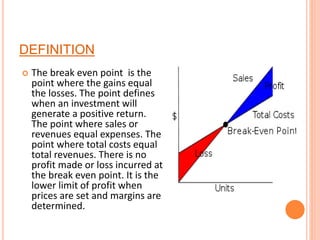
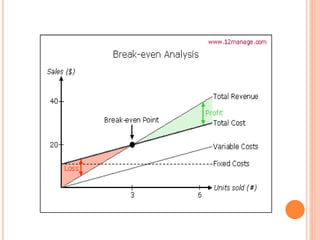
 The break even point is the
point where the gains equal
the losses. The point defines
when an investment will
generate a positive return.
The point where sales or
revenues equal expenses. The
point where total costs equal
total revenues. There is no
profit made or loss incurred at
the break even point. It is the
lower limit of profit when
prices are set and margins are
determined.
DEFINITION
 At this point the income of the business exactly
equals its expenditure. If production is enhanced
beyond this level, profit shall accrue to the business
and if it is decreased from this level, loss shall be
suffered by the business.
FORMULA
•Break even point
= (fixed cost) / (contribution per unit)
Where,
Contribution=selling cost-variable cost
Fixed cost= Contribution- profit
CALCULATION OF THE BREAK EVEN
POINT
 VARIABLE COST
They are directly related to the volume of sales:
that is these cost increase in proportion to the increase
in sales and vice versa.
 FIXED COST
Fixed costs continue regardless of how much you can
sell or not sell, and can be made up of such expenses as rent,
wages, telephone account and insurance. These cost can be
estimated by using last years figure as a basis, because they
typically do not change.
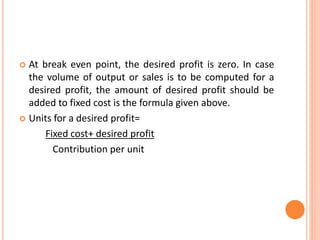
 At break even point, the desired profit is zero. In case
the volume of output or sales is to be computed for a
desired profit, the amount of desired profit should be
added to fixed cost is the formula given above.
 Units for a desired profit=
Fixed cost+ desired profit
Contribution per unit
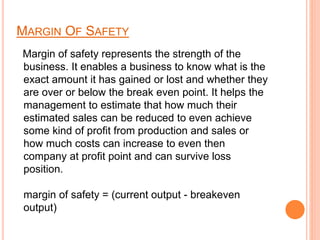
MARGIN OF SAFETY
Margin of safety represents the strength of the
business. It enables a business to know what is the
exact amount it has gained or lost and whether they
are over or below the break even point. It helps the
management to estimate that how much their
estimated sales can be reduced to even achieve
some kind of profit from production and sales or
how much costs can increase to even then
company at profit point and can survive loss
position.
margin of safety = (current output - breakeven
output)
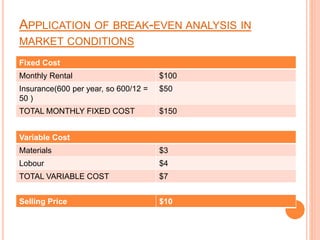
APPLICATION OF BREAK-EVEN ANALYSIS IN
MARKET CONDITIONS
Fixed Cost
Monthly Rental $100
Insurance(600 per year, so 600/12 =
50 )
$50
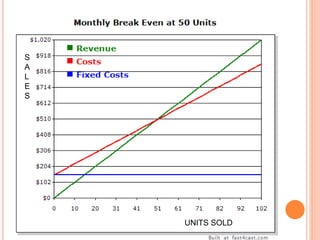
TOTAL MONTHLY FIXED COST $150
Variable Cost
Materials $3
Lobour $4
TOTAL VARIABLE COST $7
Selling Price $10
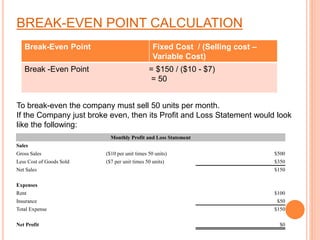
BREAK-EVEN POINT CALCULATION
Break-Even Point Fixed Cost / (Selling cost –
Variable Cost)
Break -Even Point = $150 / ($10 - $7)
= 50
To break-even the company must sell 50 units per month.
If the Company just broke even, then its Profit and Loss Statement would look
like the following:
Monthly Profit and Loss Statement
Sales
Gross Sales ($10 per unit times 50 units) $500
Less Cost of Goods Sold ($7 per unit times 50 units) $350
Net Sales $150
Expenses
Rent $100
Insurance $50
Total Expense $150
Net Profit $0
S
A
L
E
S
UNITS SOLD
BREAK-EVEN ANALYSIS
 It refers to the ascertainment of level of operations
where total revenue equals to total costs.
 Analytical tool to determine probable level of
operation.
 Method of studying the relationship among sales,
revenue, variable cost, fixed cost to determine the
level of operation at which all the costs are equal to
the sales revenue and there is no profit and no loss
situation.
 Important techniques in profit planning and
managerial decision making.
DEPENDENCE
 Break even analysis depends on the following
variables:
 The fixed production costs for a product.
 The variable production costs for a product.
 The product's unit price.
 The product's expected unit sales [sometimes
called projected sales.]
ADVANTAGES
 It is cheap to carry out and it can show the
profits/losses at varying levels of output.
 It provides a simple picture of a business - a
new business will often have to present a
break-even analysis to its bank in order to
get a loan.
LIMITATIONS
 Break-even analysis is only a supply side (i.e. costs
only) analysis, as it tells you nothing about what
sales are actually likely to be for the product at
various prices.
 It assumes that fixed costs (FC) are constant
 It assumes average variable costs are constant per
unit of output, at least in the range of likely
quantities of sales. (i.e. linearity)
 It assumes that the quantity of goods produced is
equal to the quantity of goods sold (i.e., there is no
change in the quantity of goods held in inventory at
the beginning of the period and the quantity of
goods held in inventory at the end of the period).
 In multi-product companies, it assumes that the
relative proportions of each product sold and
produced are constant (i.e., the sales mix is
constant).
THANK YOU!!!!!!!!!!!

Break even analysis 2

  • 1.
  • 2.
    INTRODUCTION The break-even pointhas its origins in the economic concept of the "point of indifference." From an economic perspective, this point indicates the quantity of some good at which the decision maker would be indifferent, i.e., would be satisfied, without reason to celebrate or to opine. At this quantity, the costs and benefits are precisely balanced. Similarly, the managerial concept of break-even analysis seeks to find the quantity of output that just covers all costs so that no loss is generated. Managers can determine the minimum quantity of sales at which the company would avoid a loss in the production of a given good. If a product cannot cover its own costs, it inherently reduces the profitability of the firm
  • 3.
    DEFINITION  The breakeven point is the point where the gains equal the losses. The point defines when an investment will generate a positive return. The point where sales or revenues equal expenses. The point where total costs equal total revenues. There is no profit made or loss incurred at the break even point. It is the lower limit of profit when prices are set and margins are determined.
  • 4.
    DEFINITION  At thispoint the income of the business exactly equals its expenditure. If production is enhanced beyond this level, profit shall accrue to the business and if it is decreased from this level, loss shall be suffered by the business.
  • 5.
    FORMULA •Break even point =(fixed cost) / (contribution per unit) Where, Contribution=selling cost-variable cost Fixed cost= Contribution- profit
  • 6.
    CALCULATION OF THEBREAK EVEN POINT  VARIABLE COST They are directly related to the volume of sales: that is these cost increase in proportion to the increase in sales and vice versa.  FIXED COST Fixed costs continue regardless of how much you can sell or not sell, and can be made up of such expenses as rent, wages, telephone account and insurance. These cost can be estimated by using last years figure as a basis, because they typically do not change.
  • 7.
     At breakeven point, the desired profit is zero. In case the volume of output or sales is to be computed for a desired profit, the amount of desired profit should be added to fixed cost is the formula given above.  Units for a desired profit= Fixed cost+ desired profit Contribution per unit
  • 8.
    MARGIN OF SAFETY Marginof safety represents the strength of the business. It enables a business to know what is the exact amount it has gained or lost and whether they are over or below the break even point. It helps the management to estimate that how much their estimated sales can be reduced to even achieve some kind of profit from production and sales or how much costs can increase to even then company at profit point and can survive loss position. margin of safety = (current output - breakeven output)
  • 9.
    APPLICATION OF BREAK-EVENANALYSIS IN MARKET CONDITIONS Fixed Cost Monthly Rental $100 Insurance(600 per year, so 600/12 = 50 ) $50 TOTAL MONTHLY FIXED COST $150 Variable Cost Materials $3 Lobour $4 TOTAL VARIABLE COST $7 Selling Price $10
  • 10.
    BREAK-EVEN POINT CALCULATION Break-EvenPoint Fixed Cost / (Selling cost – Variable Cost) Break -Even Point = $150 / ($10 - $7) = 50 To break-even the company must sell 50 units per month. If the Company just broke even, then its Profit and Loss Statement would look like the following: Monthly Profit and Loss Statement Sales Gross Sales ($10 per unit times 50 units) $500 Less Cost of Goods Sold ($7 per unit times 50 units) $350 Net Sales $150 Expenses Rent $100 Insurance $50 Total Expense $150 Net Profit $0
  • 11.
  • 12.
    BREAK-EVEN ANALYSIS  Itrefers to the ascertainment of level of operations where total revenue equals to total costs.  Analytical tool to determine probable level of operation.  Method of studying the relationship among sales, revenue, variable cost, fixed cost to determine the level of operation at which all the costs are equal to the sales revenue and there is no profit and no loss situation.  Important techniques in profit planning and managerial decision making.
  • 14.
    DEPENDENCE  Break evenanalysis depends on the following variables:  The fixed production costs for a product.  The variable production costs for a product.  The product's unit price.  The product's expected unit sales [sometimes called projected sales.]
  • 15.
    ADVANTAGES  It ischeap to carry out and it can show the profits/losses at varying levels of output.  It provides a simple picture of a business - a new business will often have to present a break-even analysis to its bank in order to get a loan.
  • 16.
    LIMITATIONS  Break-even analysisis only a supply side (i.e. costs only) analysis, as it tells you nothing about what sales are actually likely to be for the product at various prices.  It assumes that fixed costs (FC) are constant  It assumes average variable costs are constant per unit of output, at least in the range of likely quantities of sales. (i.e. linearity)  It assumes that the quantity of goods produced is equal to the quantity of goods sold (i.e., there is no change in the quantity of goods held in inventory at the beginning of the period and the quantity of goods held in inventory at the end of the period).  In multi-product companies, it assumes that the relative proportions of each product sold and produced are constant (i.e., the sales mix is constant).
  • 17.