J u l y 1 5 t h , 2 0 2 0
Brazil’s
Consumer Pulse
Update
2Bain&Co. - Brazil Consumer Pul ...NYCThis information is confidential and was prepared by Bain & Company solely for the use of our client; it is not to be relied on by any 3rd party without Bain's prior written consent
Key messages
• Brazil became more pessimistic about the pandemic duration, expecting it to last even longer, but not about the
financial impact: expectations start matching real impact. Sadness, fear, worry and anxiety describe how
the consumers in Brazil are feeling about the pandemic
• Routines remain stable since May: consumers are still spending more time on digital entertainment (+60
minutes per day) and less time working (-60 minutes). Most consumers keep trying new activities and expect
to maintain these new habits, with Youtube, Whatsapp and Netflix showing the largest use increase
• Demand in general is falling when compared to the beginning of the pandemic, with results varying by
category, but remained stable through June. Consumers expect essential categories spending to drop
between 5-25% in the mid and long term, in comparison to pre-pandemic levels
• Services spending is slightly growing between 5-10p.p. across all categories except travel and education,
when compared to last month. Higher income households are recovering their spending quicker than lower
income households
• Flight to value deepens for high income households, growing up to 10p.p. in size purchase behavior; lower
income households show a stable trend
• Online continues to win over offline, with net spending more of 2% and -19%, respectively. ~50% of all
consumers replaced purchases on traditional channels for alternative ones, and 75% expect to keep some
degree of these new ways of buying. The winning players continue to be iFood and Mercado Livre, with ~40% of
respondents saying they began to use them or increased their usage during the pandemic
• The use of digital banks and wallets is increasing mainly across low and mid income segment (+20%)
• Financial situation is currently better than in May, with ~21% of respondents not able to meet financing terms
Consumer
sentiment
Time allocation
Flight to value
Demand
spending
Channel shifts
Payments &
financing
3Bain&Co. - Brazil Consumer Pul ...NYCThis information is confidential and was prepared by Bain & Company solely for the use of our client; it is not to be relied on by any 3rd party without Bain's prior written consent
Key messages
• Brazil became more pessimistic about the pandemic duration, expecting it to last even longer, but not about the
financial impact: expectations start matching real impact. Sadness, fear, worry and anxiety describe how
the consumers in Brazil are feeling about the pandemic
• Routines remain stable since May: consumers are still spending more time on digital entertainment (+60
minutes per day) and less time working (-60 minutes). Most consumers keep trying new activities and expect
to maintain these new habits, with Youtube, Whatsapp and Netflix showing the largest use increase
• Demand in general is falling when compared to the beginning of the pandemic, with results varying by
category, but remained stable through June. Consumers expect essential categories spending to drop
between 5-25% in the mid and long term, in comparison to pre-pandemic levels
• Services spending is slightly growing between 5-10p.p. across all categories except travel and education,
when compared to last month. Higher income households are recovering their spending quicker than lower
income households
• Flight to value deepens for high income households, growing up to 10p.p. in size purchase behavior; lower
income households show a stable trend
• Online continues to win over offline, with net spending more of 2% and -19%, respectively. ~50% of all
consumers replaced purchases on traditional channels for alternative ones, and 75% expect to keep some
degree of these new ways of buying. The winning players continue to be iFood and Mercado Livre, with ~40% of
respondents saying they began to use them or increased their usage during the pandemic
• The use of digital banks and wallets is increasing mainly across low and mid income segment (+20%)
• Financial situation is currently better than in May, with ~21% of respondents not able to meet financing terms
Consumer
sentiment
Time allocation
Flight to value
Demand
spending
Channel shifts
Payments &
financing
Como os brasileiros estão se sentindo?
Fonte: Bain Consumer Pulse no Brasil, maio e junho 2020
Um mês atrás… Hoje…
5Bain&Co. - Brazil Consumer Pul ...NYCThis information is confidential and was prepared by Bain & Company solely for the use of our client; it is not to be relied on by any 3rd party without Bain's prior written consent
People are still following government recommendations of
social distancing, minimizing the possible effect of the virus
Essential workers are a small percentage of the workforce, most
people are WFH or not working at all
Brazil is in a deeper lockdown now than it was in April, and over 95% of respondents
incorporated government recommendations
Lockdown is slightly
more flexible outside São
Paulo and Río de Janeiro
Source: Bain Brazil Consumer Pulse 30/06/2020 (N=1,597); 29/05/2020 (N=1,532), 13/04/2020 (N=2,131)
C O N S U M E R S E N T I M E N T
May June May June
6Bain&Co. - Brazil Consumer Pul ...NYCThis information is confidential and was prepared by Bain & Company solely for the use of our client; it is not to be relied on by any 3rd party without Bain's prior written consent
Brazil became more pessimistic about the pandemic duration but not about the
financial impact
Consumers expect a longer duration for the pandemic
restrictions as time goes by
Expectations on the financial impact of the pandemic start
matching real impact
Source: Bain Brazil Consumer Pulse 30/06/2020 (N=1,597); 29/05/2020 (N=1,532), 13/04/2020 (N=2,131)
Real
impact
Expected impact
63%
66%
C O N S U M E R S E N T I M E N T
66%
62%63%
68%
72%
7Bain&Co. - Brazil Consumer Pul ...NYCThis information is confidential and was prepared by Bain & Company solely for the use of our client; it is not to be relied on by any 3rd party without Bain's prior written consent
Most consumers expect to be economically hindered due to COVID, specially in low
income groups
Note: Question: How much do you expect Coronavirus will impact your household income? | Low income includes households with a total monthly income lower than R$2,078; Mid income are households with a total monthly income between R$2,079 -
R$10,390; High income are households with a total monthly income higher than R$10,391; Source: Bain Brazil Consumer Pulse 30/06/2020 (N=1,597); 29/05/2020 (N=1,532), 13/04/2020 (N=2,131)
Expected financial impact
Percentage of respondents (%)
Expected financial impact by income level
Percentage of respondents (%)
C O N S U M E R S E N T I M E N T
Low income Mid income High income
8Bain&Co. - Brazil Consumer Pul ...NYCThis information is confidential and was prepared by Bain & Company solely for the use of our client; it is not to be relied on by any 3rd party without Bain's prior written consent
Key messages
• Brazil became more pessimistic about the pandemic duration, expecting it to last even longer, but not about the
financial impact: expectations start matching real impact. Sadness, fear, worry and anxiety describe how
the consumers in Brazil are feeling about the pandemic
• Routines remain stable since May: consumers are still spending more time on digital entertainment (+60
minutes per day) and less time working (-60 minutes). Most consumers keep trying new activities and expect
to maintain these new habits, with Youtube, Whatsapp and Netflix showing the largest use increase
• Demand in general is falling when compared to the beginning of the pandemic, with results varying by
category, but remained stable through June. Consumers expect essential categories spending to drop
between 5-25% in the mid and long term, in comparison to pre-pandemic levels
• Services spending is slightly growing between 5-10p.p. across all categories except travel and education,
when compared to last month. Higher income households are recovering their spending quicker than lower
income households
• Flight to value deepens for high income households, growing up to 10p.p. in size purchase behavior; lower
income households show a stable trend
• Online continues to win over offline, with net spending more of 2% and -19%, respectively. ~50% of all
consumers replaced purchases on traditional channels for alternative ones, and 75% expect to keep some
degree of these new ways of buying. The winning players continue to be iFood and Mercado Livre, with ~40% of
respondents saying they began to use them or increased their usage during the pandemic
• The use of digital banks and wallets is increasing mainly across low and mid income segment (+20%)
• Financial situation is currently better than in May, with ~21% of respondents not able to meet financing terms
Consumer
sentiment
Time allocation
Flight to value
Demand
spending
Channel shifts
Payments &
financing
9Bain&Co. - Brazil Consumer Pul ...NYCThis information is confidential and was prepared by Bain & Company solely for the use of our client; it is not to be relied on by any 3rd party without Bain's prior written consent
Routines keep on being affected by COVID: consumers are still spending more time
on digital entertainment and less time working
Activities:
Pre-Covid
June
Hour spent per day
breakdown
Indoor exercise replaced outdoor and gym
as people are cautious and many facilities
remain closed
Indoor
entertainment
Mahjong, spend
time with family
Digital
entertainment
On mobile, laptop,
TV and gaming
devices
Daily necessity
Sleep, eat,
personal hygiene
etc.
Work and study
Meetings, learning,
finish work tasks
along or
collaboration
Outdoor
activities
Exercise, jogging,
social gathering
Indoor exercise
Yoga, push ups
Transport
Public or own
transportation
Change in time
(June/ Pre-Covid
in minutes)
+39 -42 +62 +16 +15 -37
Note: May/June survey results adjusted to be comparable with pre-covid results from April’s survey
Source: Bain Brazil Consumer Pulse 30/06/2020 (N=1,597); 29/05/2020 (N=1,532), 13/04/2020 (N=2,131)
May
-56
T I M E A L L O C A T I O N
+1
April
10Bain&Co. - Brazil Consumer Pul ...NYCThis information is confidential and was prepared by Bain & Company solely for the use of our client; it is not to be relied on by any 3rd party without Bain's prior written consent
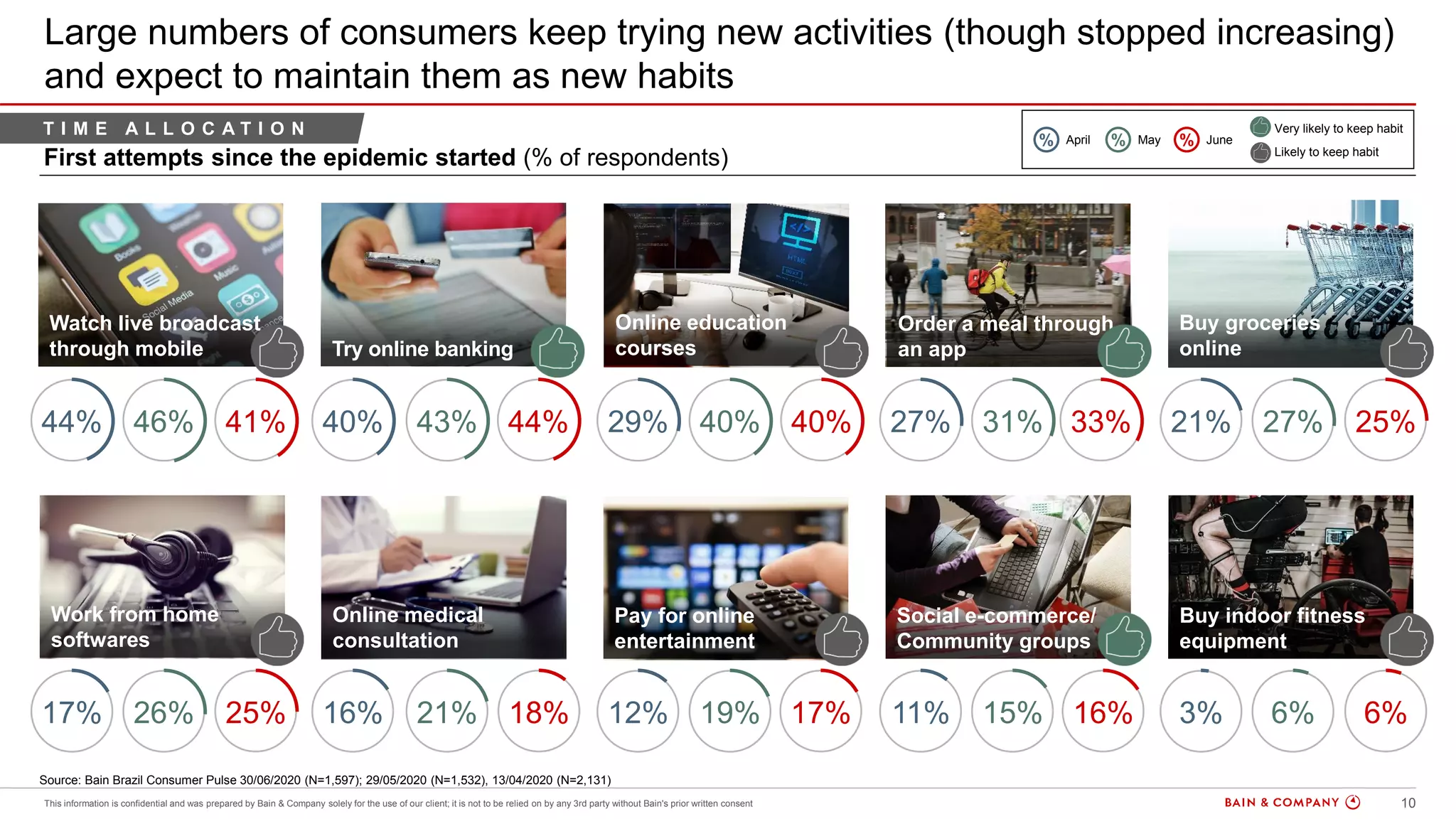
Large numbers of consumers keep trying new activities (though stopped increasing)
and expect to maintain them as new habits
First attempts since the epidemic started (% of respondents)
Watch live broadcast
through mobile
39%
Buy indoor fitness
equipment
5%
Try online banking
38%
Online education
courses
34%
Online medical
consultation
14%
Watch live broadcast
through mobile
Buy indoor fitness
equipment
6%
Try online banking
44%
Online education
courses
40%
Online medical
consultation
18%
Order a meal through
an app
17%
Order a meal through
an app
33%
Work from home
softwares
32%
Work from home
softwares
25%
Buy groceries online
13%
Buy groceries
online
25%
Pay for online
entertainment
33%
Pay for online
entertainment
17%
Social e-commerce/
Community groups
15%
Social e-commerce/
Community groups
16%
Source: Bain Brazil Consumer Pulse 30/06/2020 (N=1,597); 29/05/2020 (N=1,532), 13/04/2020 (N=2,131)
Likely to keep habit
Very likely to keep habitT I M E A L L O C A T I O N
41%44% 46% 40% 43% 29% 40% 27% 31% 21% 27%
% June% May% April
17% 26% 16% 21% 12% 19% 11% 15% 3% 6%
11Bain&Co. - Brazil Consumer Pul ...NYCThis information is confidential and was prepared by Bain & Company solely for the use of our client; it is not to be relied on by any 3rd party without Bain's prior written consent
Large numbers of consumers keep trying new activities and expect to maintain them
as new habits
First attempts since the epidemic started (% of respondents)
Watch live broadcast
through mobile
39%
Buy indoor fitness
equipment
5%
Try online banking
38%
Online education
courses
34%
Online medical
consultation
14%
Watch live broadcast
through mobile
Buy indoor fitness
equipment
6%
Try online banking
44%
Online education
courses
40%
Online medical
consultation
18%
Order a meal through
an app
17%
Order a meal through
an app
33%
Work from home
softwares
32%
Work from home
softwares
25%
Buy groceries online
13%
Buy groceries
online
25%
Pay for online
entertainment
33%
Pay for online
entertainment
17%
Social e-commerce/
Community groups
15%
Social e-commerce/
Community groups
16%
Source: Bain Brazil Consumer Pulse 30/06/2020 (N=1,597); 29/05/2020 (N=1,532), 13/04/2020 (N=2,131)
Likely to keep habit
Very likely to keep habit
41%44% 46% 40% 43% 29% 40% 27% 31% 21% 27%
% June% May% April
17% 26% 16% 21% 12% 19% 11% 15% 3% 6%
18-34 46% 51% 50% 18-34 37% 42% 40% 18-34 38% 51% 50% 18-34 28% 33% 36% 18-34 16% 27% 25%
35-54 47% 44% 45% 35-54 37% 41% 46% 35-54 27% 37% 37% 35-54 25% 32% 36% 35-54 15% 23% 23%
+55 36% 41% 32% +55 47% 46% 52% +55 18% 28% 34% +55 28% 27% 30% +55 20% 35% 30%
18-34 25% 29% 29% 18-34 12% 19% 21% 18-34 20% 23% 22% 18-34 14% 15% 18% 18-34 5% 7% 9%
35-54 22% 27% 29% 35-54 11% 21% 21% 35-54 15% 20% 20% 35-54 11% 15% 16% 35-54 3% 5% 5%
+55 14% 19% 19% +55 11% 23% 13% +55 13% 12% 9% +55 10% 15% 17% +55 1% 6% 4%
T I M E A L L O C A T I O N A G E
12Bain&Co. - Brazil Consumer Pul ...NYCThis information is confidential and was prepared by Bain & Company solely for the use of our client; it is not to be relied on by any 3rd party without Bain's prior written consent
Large numbers of consumers keep trying new activities and expect to maintain them
as new habits
First attempts since the epidemic started (% of respondents)
Watch live broadcast
through mobile
39%
Buy indoor fitness
equipment
5%
Try online banking
38%
Online education
courses
34%
Online medical
consultation
14%
Watch live broadcast
through mobile
Buy indoor fitness
equipment
6%
Try online banking
44%
Online education
courses
40%
Online medical
consultation
18%
Order a meal through
an app
17%
Order a meal through
an app
33%
Work from home
softwares
32%
Work from home
softwares
25%
Buy groceries online
13%
Buy groceries
online
25%
Pay for online
entertainment
33%
Pay for online
entertainment
17%
Social e-commerce/
Community groups
15%
Social e-commerce/
Community groups
16%
Source: Bain Brazil Consumer Pulse 30/06/2020 (N=1,597); 29/05/2020 (N=1,532), 13/04/2020 (N=2,131)
Likely to keep habit
Very likely to keep habit
41%44% 46% 40% 43% 29% 40% 27% 31% 21% 27%
% June% May% April
17% 26% 16% 21% 12% 19% 11% 15% 3% 6%
Low 49% 48% 40% Low 42% 50% 45% Low 31% 42% 37% Low 25% 28% 29% Low 10% 23% 15%
Mid 42% 46% 47% Mid 37% 42% 48% Mid 27% 40% 42% Mid 27% 34% 38% Mid 19% 30% 28%
High 37% 36% 33% High 41% 18% 30% High 30% 31% 53% High 32% 20% 30% High 25% 33% 52%
Low 17% 18% 13% Low 8% 16% 13% Low 17% 19% 17% Low 13% 15% 12% Low 2% 4% 3%
Mid 23% 29% 31% Mid 13% 21% 21% Mid 16% 19% 19% Mid 11% 16% 21% Mid 4% 7% 8%
High 24% 38% 52% High 14% 37% 27% High 15% 18% 18% High 12% 11% 9% High 4% 6% 7%
T I M E A L L O C A T I O N I N C O M E
13Bain&Co. - Brazil Consumer Pul ...NYCThis information is confidential and was prepared by Bain & Company solely for the use of our client; it is not to be relied on by any 3rd party without Bain's prior written consent
Platform usages are up across the board: Youtube, Whatsapp and Netflix show the
largest increase
Percentage of respondents using more (%)
Change in platform use during June
Source: Bain Brazil Consumer Pulse 30/06/2020 (N=1,597); 29/05/2020 (N=1,532), 13/04/2020 (N=2,131)
Media contentSocial media Communication platforms
T I M E A L L O C A T I O N
70%
51%
63%
61% 58%
53%
37%
75%
58%
39% 40%
24%
73%
65%
14Bain&Co. - Brazil Consumer Pul ...NYCThis information is confidential and was prepared by Bain & Company solely for the use of our client; it is not to be relied on by any 3rd party without Bain's prior written consent
Key messages
• Brazil became more pessimistic about the pandemic duration, expecting it to last even longer, but not about the
financial impact: expectations start matching real impact. Sadness, fear, worry and anxiety describe how
the consumers in Brazil are feeling about the pandemic
• Routines remain stable since May: consumers are still spending more time on digital entertainment (+60
minutes per day) and less time working (-60 minutes). Most consumers keep trying new activities and expect
to maintain these new habits, with Youtube, Whatsapp and Netflix showing the largest use increase
• Demand in general is falling when compared to the beginning of the pandemic, with results varying by
category, but remained stable through June. Consumers expect essential categories spending to drop
between 5-25% in the mid and long term, in comparison to pre-pandemic levels
• Services spending is slightly growing between 5-10p.p. across all categories except travel and education,
when compared to last month. Higher income households are recovering their spending quicker than lower
income households
• Flight to value deepens for high income households, growing up to 10p.p. in size purchase behavior; lower
income households show a stable trend
• Online continues to win over offline, with net spending more of 2% and -19%, respectively. ~50% of all
consumers replaced purchases on traditional channels for alternative ones, and 75% expect to keep some
degree of these new ways of buying. The winning players continue to be iFood and Mercado Livre, with ~40% of
respondents saying they began to use them or increased their usage during the pandemic
• The use of digital banks and wallets is increasing mainly across low and mid income segment (+20%)
• Financial situation is currently better than in May, with ~21% of respondents not able to meet financing terms
Consumer
sentiment
Time allocation
Flight to value
Demand
spending
Channel shifts
Payments &
financing
15Bain&Co. - Brazil Consumer Pul ...NYCThis information is confidential and was prepared by Bain & Company solely for the use of our client; it is not to be relied on by any 3rd party without Bain's prior written consent
Reference to have a better understanding on the next slides
“Net percentage spending more” Time reference Future expectations
Q: “How did your spending change in [product/service X]
since the pandemic began?”
Respondents change in spending
(%, change/ total respondents)
% respondents
spending somewhat
or significantly
more than before
% respondents
spending about the
same than before
% respondents
spending somewhat
or significantly less
than before
Net %
spending more
(NSM)
=
% respondents
spending somewhat
or significantly more
than before
% respondents
spending somewhat
or significantly less
than before
-
Net % spending more
(%)
E X A M P L E
The information shown at each
month reflects the
accumulated value from the
beginning of pandemic until
the respective month
Net % spending more expectations
(%)
E X A M P L E
Long
term
Refers to
expected
values
after +12
months
Mid term
Refers to
expected
values
within the
next 12
months
[Month]
Refers to
current
values
recorded
in the last
survey
I L L U S T R A T I V E
16Bain&Co. - Brazil Consumer Pul ...NYCThis information is confidential and was prepared by Bain & Company solely for the use of our client; it is not to be relied on by any 3rd party without Bain's prior written consent
Spending has fallen through April and May, but seems to have stabilized through
June
Net percentage of respondents spending more (%)
Change in spending per category
D E M A N D S P E N D I N G
April May June
Essentials (Groceries) Essentials (Others) Non-essential categories
Fresh
food
Packaged
food Beverages Home care
Personal
care Pet
Consumer
health Games Beauty
Apparel &
footwear
Note: Net % spending more is calculated as % spending more minus % spending less; Consumer health refers to non-prescription items (e.g., vitamins, cold/allergy tablets etc.); Excludes respondents who indicated they never spend on category
Source: Bain Brazil Consumer Pulse 30/06/2020 (N=1,597); 29/05/2020 (N=1,532), 13/04/2020 (N=2,131)
17Bain&Co. - Brazil Consumer Pul ...NYCThis information is confidential and was prepared by Bain & Company solely for the use of our client; it is not to be relied on by any 3rd party without Bain's prior written consent
Consumers expect essential categories spending to drop between 10-30% in the
mid term and long term
Note: Net % spending more is calculated as % spending more minus % spending less; Excludes respondents who indicated they never spend on category; Mid term refers to the next 12 months; Long term refers to +12 months
Source: Bain Brazil Consumer Pulse 30/06/2020 (N=1,597); 29/05/2020 (N=1,532), 13/04/2020 (N=2,131)
Fresh food Packaged food Beverages Home care Personal care
Net percentage of respondents spending more (%)
Change in spending per category over the pandemic
(to June)
D E M A N D S P E N D I N G E S S E N T I A L S
18Bain&Co. - Brazil Consumer Pul ...NYCThis information is confidential and was prepared by Bain & Company solely for the use of our client; it is not to be relied on by any 3rd party without Bain's prior written consent
Higher income households grew their spending on essential categories; both income
levels have reduced their spending over the last month (excl. personal care – low)
Note: Net % spending more is calculated as % spending more minus % spending less; Excludes respondents who indicated they never spend on category
Source: Bain Brazil Consumer Pulse 30/06/2020 (N=1,597); 29/05/2020 (N=1,532), 13/04/2020 (N=2,131)
D E M A N D S P E N D I N G
Net percentage of respondents spending more (%)
Change in spending per category
April May June
BeveragesFresh food Packaged food Home care Personal care BeveragesFresh food Packaged food Home care Personal care
Low income levels High income levels
D E M A N D S P E N D I N G E S S E N T I A L S
19Bain&Co. - Brazil Consumer Pul ...NYCThis information is confidential and was prepared by Bain & Company solely for the use of our client; it is not to be relied on by any 3rd party without Bain's prior written consent
Spending expectations for essential categories are better than those from a month
ago across income levels
D E M A N D S P E N D I N G
Net percentage of respondents expecting to spend more in the mid term (%)
Change in spending per category
Note: : Net % spending more is calculated as % spending more minus % spending less; Excludes respondents who indicated they never spend on category; Mid term refers to the next 12 months; Long term refers to +12 months;
Source: Bain Brazil Consumer Pulse 30/06/2020 (N=1,597); 29/05/2020 (N=1,532), 13/04/2020 (N=2,131)
May June
BeveragesFresh food Packaged food Home care Personal care BeveragesFresh food Packaged food Home care Personal care
Mid term
Low income levels High income levels
D E M A N D S P E N D I N G E S S E N T I A L S
20Bain&Co. - Brazil Consumer Pul ...NYCThis information is confidential and was prepared by Bain & Company solely for the use of our client; it is not to be relied on by any 3rd party without Bain's prior written consent
Services spending grew ~5-10p.p. across most categories vs. last month, making
spending slightly closer to the normal (pre-covid)
Net percentage of respondents spending more (%)
Change in spending per category
D E M A N D S P E N D I N G
April May June
Entertainment Health & well-being Education
Restaurants
Concerts &
events Travel
Beauty
services Fitness
Vehicle
maintenance
House
maintenance Education
Maintenance
Note: Net % spending more is calculated as % spending more minus % spending less; Excludes respondents who indicated they never spend on category
Source: Bain Brazil Consumer Pulse 30/06/2020 (N=1,597); 29/05/2020 (N=1,532), 13/04/2020 (N=2,131)
D E M A N D S P E N D I N G S E R V I C E S
21Bain&Co. - Brazil Consumer Pul ...NYCThis information is confidential and was prepared by Bain & Company solely for the use of our client; it is not to be relied on by any 3rd party without Bain's prior written consent
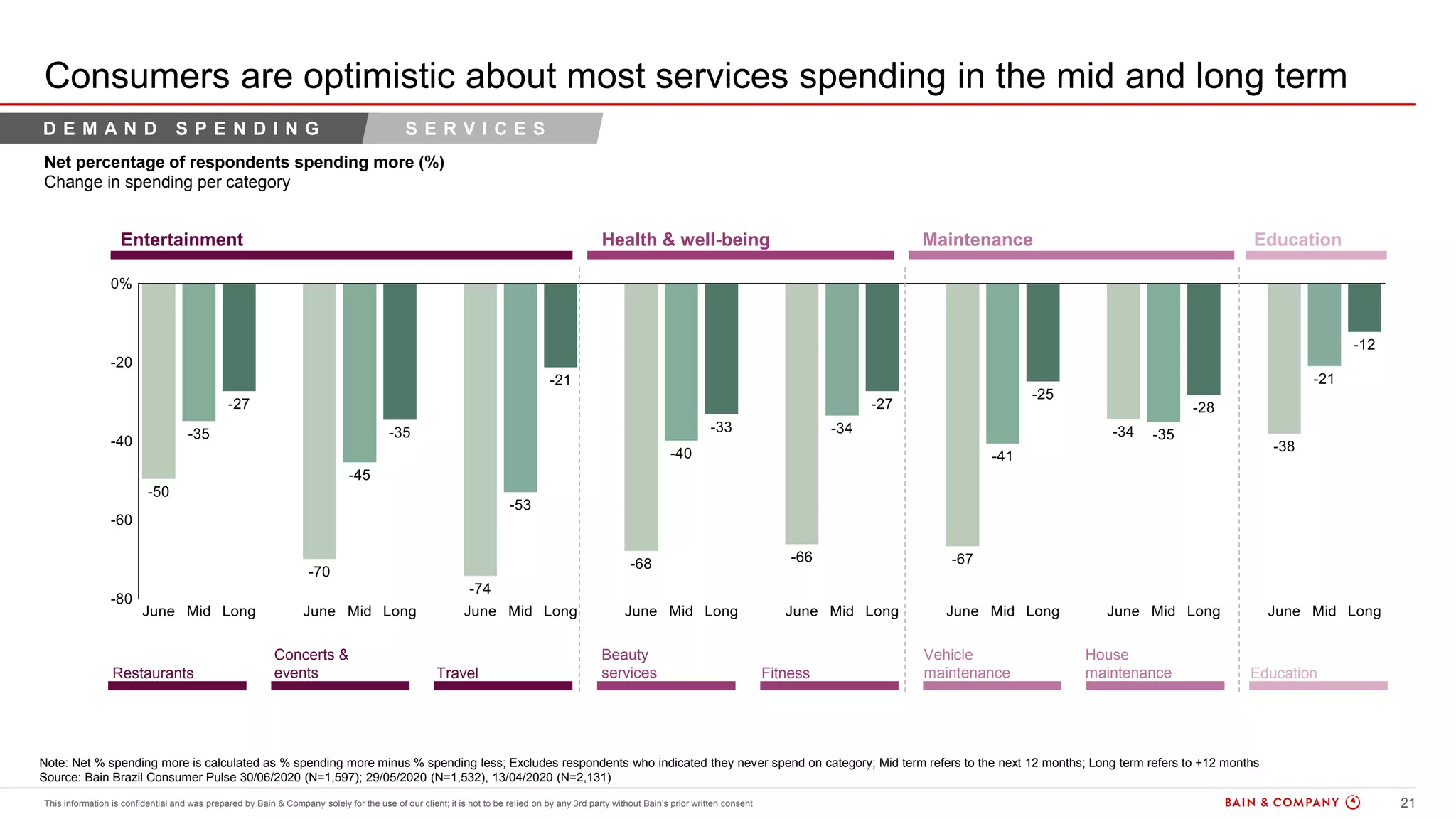
Consumers are optimistic about most services spending in the mid and long term
Note: Net % spending more is calculated as % spending more minus % spending less; Excludes respondents who indicated they never spend on category; Mid term refers to the next 12 months; Long term refers to +12 months
Source: Bain Brazil Consumer Pulse 30/06/2020 (N=1,597); 29/05/2020 (N=1,532), 13/04/2020 (N=2,131)
D E M A N D S P E N D I N G
Net percentage of respondents spending more (%)
Change in spending per category
Entertainment Health & well-being Education
Restaurants
Concerts &
events Travel
Beauty
services Fitness
Vehicle
maintenance
House
maintenance Education
Maintenance
D E M A N D S P E N D I N G S E R V I C E S
22Bain&Co. - Brazil Consumer Pul ...NYCThis information is confidential and was prepared by Bain & Company solely for the use of our client; it is not to be relied on by any 3rd party without Bain's prior written consent
Higher income households are recovering their spending on services quicker than
lower income households
Note: Net % spending more is calculated as % spending more minus % spending less; Excludes respondents who indicated they never spend on category
Source: Bain Brazil Consumer Pulse 30/06/2020 (N=1,597); 29/05/2020 (N=1,532), 13/04/2020 (N=2,131)
D E M A N D S P E N D I N G
Net percentage of respondents spending more (%)
Change in spending per category
Entertainment Health & well-being Education
Restaurants
Concerts &
events Travel
Beauty
services Fitness
Vehicle
maintenance
House
maintenance Education
Maintenance Entertainment Health & well-being Education
Restaurants
Concerts &
events Travel
Beauty
services Fitness
Vehicle
maintenance
House
maintenanceEducation
Maintenance
April May June
Low income levels High income levels
D E M A N D S P E N D I N G S E R V I C E S
23Bain&Co. - Brazil Consumer Pul ...NYCThis information is confidential and was prepared by Bain & Company solely for the use of our client; it is not to be relied on by any 3rd party without Bain's prior written consent
Services spending mid term expectations are positive; higher income households
are more optimistic
D E M A N D S P E N D I N G
Entertainment Health & well-being Education
Restaurants
Concerts &
events Travel
Beauty
services Fitness
Vehicle
maintenance
House
maintenance Education
Maintenance Entertainment Health & well-being Education
Restaurants
Concerts &
events Travel
Beauty
services Fitness
Vehicle
maintenance
House
maintenanceEducation
Maintenance
Note: : Net % spending more is calculated as % spending more minus % spending less; Excludes respondents who indicated they never spend on category; Mid term refers to the next 12 months; Long term refers to +12 months;
Source: Bain Brazil Consumer Pulse 30/06/2020 (N=1,597); 29/05/2020 (N=1,532), 13/04/2020 (N=2,131)
April May June
Mid term
Net percentage of respondents expecting to spend more in the mid term (%)
Change in spending per category
Low income levels High income levels
D E M A N D S P E N D I N G S E R V I C E S
24Bain&Co. - Brazil Consumer Pul ...NYCThis information is confidential and was prepared by Bain & Company solely for the use of our client; it is not to be relied on by any 3rd party without Bain's prior written consent
Key messages
• Brazil became more pessimistic about the pandemic duration, expecting it to last even longer, but not about the
financial impact: expectations start matching real impact. Sadness, fear, worry and anxiety describe how
the consumers in Brazil are feeling about the pandemic
• Routines remain stable since May: consumers are still spending more time on digital entertainment (+60
minutes per day) and less time working (-60 minutes). Most consumers keep trying new activities and expect
to maintain these new habits, with Youtube, Whatsapp and Netflix showing the largest use increase
• Demand in general is falling when compared to the beginning of the pandemic, with results varying by
category, but remained stable through June. Consumers expect essential categories spending to drop
between 5-25% in the mid and long term, in comparison to pre-pandemic levels
• Services spending is slightly growing between 5-10p.p. across all categories except travel and education,
when compared to last month. Higher income households are recovering their spending quicker than lower
income households
• Flight to value deepens for high income households, growing up to 10p.p. in size purchase behavior; lower
income households show a stable trend
• Online continues to win over offline, with net spending more of 2% and -19%, respectively. ~50% of all
consumers replaced purchases on traditional channels for alternative ones, and 75% expect to keep some
degree of these new ways of buying. The winning players continue to be iFood and Mercado Livre, with ~40% of
respondents saying they began to use them or increased their usage during the pandemic
• The use of digital banks and wallets is increasing mainly across low and mid income segment (+20%)
• Financial situation is currently better than in May, with ~21% of respondents not able to meet financing terms
Consumer
sentiment
Time allocation
Flight to value
Demand
spending
Channel shifts
Payments &
financing
25Bain&Co. - Brazil Consumer Pul ...NYCThis information is confidential and was prepared by Bain & Company solely for the use of our client; it is not to be relied on by any 3rd party without Bain's prior written consent
Flight to value is deepening across all essential categories except personal care in
brand behavior
Note: Excludes respondents who indicated they never spend on category
Source: Bain Brazil Consumer Pulse 30/06/2020 (N=1,597); 29/05/2020 (N=1,532), 13/04/2020 (N=2,131)
April May JuneRespondents under Flight to value brand behavior (%)
Fresh food Packaged food Beverages Home care Personal care
F L I G H T T O V A L U E B R A N D S
26Bain&Co. - Brazil Consumer Pul ...NYCThis information is confidential and was prepared by Bain & Company solely for the use of our client; it is not to be relied on by any 3rd party without Bain's prior written consent
Sustained flight to value behavior for low income households in brand behavior vs.
May; high income household’s behavior varies across categories
Note: Excludes respondents who indicated they never spend on category
Source: Bain Brazil Consumer Pulse 30/06/2020 (N=1,597); 29/05/2020 (N=1,532), 13/04/2020 (N=2,131)
April May JuneRespondents under Flight to value brand behavior (%)
BeveragesFresh food Packaged food Home care Personal care BeveragesFresh food Packaged food Home care Personal care
Low income levels High income levels
F L I G H T T O V A L U E B R A N D S
27Bain&Co. - Brazil Consumer Pul ...NYCThis information is confidential and was prepared by Bain & Company solely for the use of our client; it is not to be relied on by any 3rd party without Bain's prior written consent
Flight to value in size behavior remains almost stable across essential categories
Note: Excludes respondents who indicated they never spend on category; April N/A
Source: Bain Brazil Consumer Pulse 30/06/2020 (N=1,597); 29/05/2020 (N=1,532), 13/04/2020 (N=2,131)
F L I G H T T O V A L U E
May JuneRespondents under Flight to value size behavior (%)
Fresh food Packaged food Beverages Home care Personal care
F L I G H T T O V A L U E S I Z E S
28Bain&Co. - Brazil Consumer Pul ...NYCThis information is confidential and was prepared by Bain & Company solely for the use of our client; it is not to be relied on by any 3rd party without Bain's prior written consent
Sustained flight to value behavior for low income households in size behavior vs.
May; high income households continue on a flight to value behavior
Note: Excludes respondents who indicated they never spend on category
Source: Bain Brazil Consumer Pulse 30/06/2020 (N=1,597); 29/05/2020 (N=1,532), 13/04/2020 (N=2,131)
April May JuneRespondents under Flight to value size behavior (%)
BeveragesFresh food Packaged food Home care Personal care BeveragesFresh food Packaged food Home care Personal care
Low income levels High income levels
F L I G H T T O V A L U EF L I G H T T O V A L U E S I Z E S
29Bain&Co. - Brazil Consumer Pul ...NYCThis information is confidential and was prepared by Bain & Company solely for the use of our client; it is not to be relied on by any 3rd party without Bain's prior written consent
Key messages
• Brazil became more pessimistic about the pandemic duration, expecting it to last even longer, but not about the
financial impact: expectations start matching real impact. Sadness, fear, worry and anxiety describe how
the consumers in Brazil are feeling about the pandemic
• Routines remain stable since May: consumers are still spending more time on digital entertainment (+60
minutes per day) and less time working (-60 minutes). Most consumers keep trying new activities and expect
to maintain these new habits, with Youtube, Whatsapp and Netflix showing the largest use increase
• Demand in general is falling when compared to the beginning of the pandemic, with results varying by
category, but remained stable through June. Consumers expect essential categories spending to drop
between 5-25% in the mid and long term, in comparison to pre-pandemic levels
• Services spending is slightly growing between 5-10p.p. across all categories except travel and education,
when compared to last month. Higher income households are recovering their spending quicker than lower
income households
• Flight to value deepens for high income households, growing up to 10p.p. in size purchase behavior; lower
income households show a stable trend
• Online continues to win over offline, with net spending more of 2% and -19%, respectively. ~50% of all
consumers replaced purchases on traditional channels for alternative ones, and 75% expect to keep some
degree of these new ways of buying. The winning players continue to be iFood and Mercado Livre, with ~40% of
respondents saying they began to use them or increased their usage during the pandemic
• The use of digital banks and wallets is increasing mainly across low and mid income segment (+20%)
• Financial situation is currently better than in May, with ~21% of respondents not able to meet financing terms
Consumer
sentiment
Time allocation
Flight to value
Demand
spending
Channel shifts
Payments &
financing
30Bain&Co. - Brazil Consumer Pul ...NYCThis information is confidential and was prepared by Bain & Company solely for the use of our client; it is not to be relied on by any 3rd party without Bain's prior written consent
Spending trends in June are mostly flat across all channels when compared to May;
online continues to win over offline, with NSM of 2% vs. -19%
Net percentage of respondents spending more (%)
Change in spending per category
April May June
Note: Net % spending more is calculated as % spending more minus % spending less; Excludes respondents who indicated they never spend on category
Source: Bain Brazil Consumer Pulse 30/06/2020 (N=1,597); 29/05/2020 (N=1,532), 13/04/2020 (N=2,131)
C H A N N E L S H I F T S
Aggregated spend change Offline channels Online channels
Offline
channels
Online
channels Drug stores Local stores Wholesalers Supermarkets Convenience
Pick up at
store
Delivery
app
Retailer
appWhatsapp
31Bain&Co. - Brazil Consumer Pul ...NYCThis information is confidential and was prepared by Bain & Company solely for the use of our client; it is not to be relied on by any 3rd party without Bain's prior written consent
Consumers used a large number of providers to make purchases in June
Source: Bain Brazil Consumer Pulse 30/06/2020 (N=1,597); 29/05/2020 (N=1,532), 13/04/2020 (N=2,131)
C H A N N E L S H I F T S
May’s results
32Bain&Co. - Brazil Consumer Pul ...NYCThis information is confidential and was prepared by Bain & Company solely for the use of our client; it is not to be relied on by any 3rd party without Bain's prior written consent
~51% of respondents replaced a
purchase on traditional channels in June
+50% of consumers replaced purchases on traditional channels for alternative ones,
and ~75% expect to keep some degree of these new ways of buying
Online + delivery is the main option for
consumers who didn’t visit the store
~75% expect to maintain some degree
of the new habit
C H A N N E L S H I F T S
Source: Bain Brazil Consumer Pulse 30/06/2020 (N=1,597); 29/05/2020 (N=1,532), 13/04/2020 (N=2,131)
33Bain&Co. - Brazil Consumer Pul ...NYCThis information is confidential and was prepared by Bain & Company solely for the use of our client; it is not to be relied on by any 3rd party without Bain's prior written consent
~55% of consumers that replaced purchases on traditional channels are also using
other retailers to make those purchases
~55% of consumers uses other retailers when switching to new
channels
51% of consumers replaced purchases they would do on
traditional channels
C H A N N E L S H I F T S
Source: Bain Brazil Consumer Pulse 30/06/2020 (N=1,597); 29/05/2020 (N=1,532), 13/04/2020 (N=2,131)
51%
45%
54%52%
34Bain&Co. - Brazil Consumer Pul ...NYCThis information is confidential and was prepared by Bain & Company solely for the use of our client; it is not to be relied on by any 3rd party without Bain's prior written consent
Low income: ~40% replaced traditional
channels and most will keep new habits
Traditional channel replacement is happening across all income segments; ~83% of
high income respondents expect to keep some degree of these new ways of buying
Mid income: Half replaced traditional
channels and ~75% will keep new habits
High income: Most replaced traditional
channels and will keep new habits
C H A N N E L S H I F T S
Source: Bain Brazil Consumer Pulse 30/06/2020 (N=1,597); 29/05/2020 (N=1,532), 13/04/2020 (N=2,131)
41%
59%
67%
54%
64%
76%
60%
73%
83%
35Bain&Co. - Brazil Consumer Pul ...NYCThis information is confidential and was prepared by Bain & Company solely for the use of our client; it is not to be relied on by any 3rd party without Bain's prior written consent
Young: Most replaced traditional
channels and will keep new habits
Traditional channel replacement is happening across all age segments; most expect
to keep some degree of these new ways of buying
Middle-aged: half replaced traditional
channels and ~75% will keep new habits
Old-aged: half replaced traditional
channels and ~80% will keep new habits
C H A N N E L S H I F T S
Source: Bain Brazil Consumer Pulse 30/06/2020 (N=1,597); 29/05/2020 (N=1,532), 13/04/2020 (N=2,131)
54%
59%
73%
48%
62%
76%
51%
73%
78%
36Bain&Co. - Brazil Consumer Pul ...NYCThis information is confidential and was prepared by Bain & Company solely for the use of our client; it is not to be relied on by any 3rd party without Bain's prior written consent
iFood and Mercado Livre have ~40% of respondents saying they began to use them
or increased their usage during the pandemic
C H A N N E L S H I F T S
Source: Bain Brazil Consumer Pulse 30/06/2020 (N=1,597); 29/05/2020 (N=1,532), 13/04/2020 (N=2,131)
N/A N/A
April May June
Market apps
37Bain&Co. - Brazil Consumer Pul ...NYCThis information is confidential and was prepared by Bain & Company solely for the use of our client; it is not to be relied on by any 3rd party without Bain's prior written consent
Customer experience: Mercado Livre has a stable leading NPS vs. other surveyed
platforms
C H A N N E L S H I F T S
Source: Bain Brazil Consumer Pulse 30/06/2020 (N=1,597); 29/05/2020 (N=1,532), 13/04/2020 (N=2,131)
N/A N/A
Market apps
38Bain&Co. - Brazil Consumer Pul ...NYCThis information is confidential and was prepared by Bain & Company solely for the use of our client; it is not to be relied on by any 3rd party without Bain's prior written consent
Key messages
• Brazil became more pessimistic about the pandemic duration, expecting it to last even longer, but not about the
financial impact: expectations start matching real impact. Sadness, fear, worry and anxiety describe how
the consumers in Brazil are feeling about the pandemic
• Routines remain stable since May: consumers are still spending more time on digital entertainment (+60
minutes per day) and less time working (-60 minutes). Most consumers keep trying new activities and expect
to maintain these new habits, with Youtube, Whatsapp and Netflix showing the largest use increase
• Demand in general is falling when compared to the beginning of the pandemic, with results varying by
category, but remained stable through June. Consumers expect essential categories spending to drop
between 5-25% in the mid and long term, in comparison to pre-pandemic levels
• Services spending is slightly growing between 5-10p.p. across all categories except travel and education,
when compared to last month. Higher income households are recovering their spending quicker than lower
income households
• Flight to value deepens for high income households, growing up to 10p.p. in size purchase behavior; lower
income households show a stable trend
• Online continues to win over offline, with net spending more of 2% and -19%, respectively. ~50% of all
consumers replaced purchases on traditional channels for alternative ones, and 75% expect to keep some
degree of these new ways of buying. The winning players continue to be iFood and Mercado Livre, with ~40% of
respondents saying they began to use them or increased their usage during the pandemic
• The use of digital banks and wallets is increasing mainly across low and mid income segment (+20%)
• Financial situation is currently better than in May, with ~21% of respondents not able to meet financing terms
Consumer
sentiment
Time allocation
Flight to value
Demand
spending
Channel shifts
Payments &
financing
39Bain&Co. - Brazil Consumer Pul ...NYCThis information is confidential and was prepared by Bain & Company solely for the use of our client; it is not to be relied on by any 3rd party without Bain's prior written consent
The use of digital banks and wallets has increased across all income levels. PicPay
leads with 37% growth in adoption and NuBank, Mercado Pago follow with 29%
Digital banks are growing in penetration and usage Top players are growing disproportionately
P A Y M E N T S & F I N A N C I N G
Source: Bain Brazil Consumer Pulse 30/06/2020 (N=1,597); 29/05/2020 (N=1,532), 13/04/2020 (N=2,131) Note: Use increase % refers to the added % of those who answered ‘Increased usage’ and ‘Created a new account’
May’s results
Low income Mid income High income
40Bain&Co. - Brazil Consumer Pul ...NYCThis information is confidential and was prepared by Bain & Company solely for the use of our client; it is not to be relied on by any 3rd party without Bain's prior written consent
Financial situation seems better than in May: ~21% of consumers will not be able to
meet, already restructured or need to restructure terms of the financing agreements
~21% of consumers won’t be able to
meet the original terms of the financing
Half of consumers that restructured
think they still may not be able to pay
Main reason to default is receiving an
offer to rest. but not being able to take it
2
1
21
High interest rates and
proof of income are the
most mentioned reasons
P A Y M E N T S & F I N A N C I N G
Source: Bain Brazil Consumer Pulse 30/06/2020 (N=1,597); 29/05/2020 (N=1,532), 13/04/2020 (N=2,131)
41Bain&Co. - Brazil Consumer Pul ...NYCThis information is confidential and was prepared by Bain & Company solely for the use of our client; it is not to be relied on by any 3rd party without Bain's prior written consent
Financial situation seems better than in May: Low and mid income households
show more difficulty to meet the original terms of the financing agreements
~25% of low and mid income won’t be
able to meet the original terms
Half of consumers that restructured
think they still may not be able to pay
Main reason to default is receiving an
offer to rest. but not being able to take it
21
Note: Low income includes households with a total monthly income lower than R$2,078; Mid income are households with a total monthly income between R$2,079 - R$10,390; High income are households with a total monthly income higher than R$10,391
Source: Bain Brazil Consumer Pulse 30/06/2020 (N=1,597); 29/05/2020 (N=1,532), 13/04/2020 (N=2,131)
P A Y M E N T S & F I N A N C I N G B Y I N C O M E L E V E L
High interest
rates and proof
of income are
the most
mentioned
reasons under
“other”
Low Mid High
2
1
Low Mid HighLow Mid High
42Bain&Co. - Brazil Consumer Pul ...NYCThis information is confidential and was prepared by Bain & Company solely for the use of our client; it is not to be relied on by any 3rd party without Bain's prior written consent
Financial situation seems better than in May: Older aged people show more
difficulty to meet the original terms of the financing agreements
~25% of older respondents won’t be
able to meet the original terms
Half of consumers that restructured
think they still may not be able to pay
Older resp. are unable to accept offers,
many due to high rates/lack of income 21
Note: Young age includes respondents between 18 and 34 years old; Mid aged includes respondents between 35 and 54 years old; Old aged includes respondents between 55 and 74 years old
Source: Bain Brazil Consumer Pulse 30/06/2020 (N=1,597); 29/05/2020 (N=1,532), 13/04/2020 (N=2,131)
P A Y M E N T S & F I N A N C I N G B Y A G E G R O U P
2
1
Young Mid Old Young Mid Old Young Mid Old
High interest rates
and lack of income
are the most
mentioned reasons
43Bain&Co. - Brazil Consumer Pul ...NYCThis information is confidential and was prepared by Bain & Company solely for the use of our client; it is not to be relied on by any 3rd party without Bain's prior written consent
Financial situation seems better than in May: ~25% of consumers across all
regions won’t be able to meet the original terms of the financing agreements
~25% of consumers won’t be able to
meet the original terms of the financing
Half of consumers that restructured
think they still may not be able to pay
Main reason to default is receiving an
offer to rest. but not being able to take it
21
Note: Rio refers to Rio de Janeiro
Source: Bain Brazil Consumer Pulse 30/06/2020 (N=1,597); 29/05/2020 (N=1,532), 13/04/2020 (N=2,131)
P A Y M E N T S & F I N A N C I N G B Y R E G I O N
2
1
SP RJ Other SP RJ Other SP RJ Other
In Rio three
fourths of
consumers that
restructured think
they may not be
able to pay back
44Bain&Co. - Brazil Consumer Pul ...NYCThis information is confidential and was prepared by Bain & Company solely for the use of our client; it is not to be relied on by any 3rd party without Bain's prior written consent
Panel composition
Geography Age groups Income level
Note: Low income includes households with a total monthly income lower than R$2,078; Mid income are households with a total monthly income between R$2,079 - R$10,390; High income are households with a total monthly income higher than R$10,391
Source: Bain Brazil Consumer Pulse 30/06/2020 (N=1,597); 29/05/2020 (N=1,532), 13/04/2020 (N=2,131)
B A C K U P
Stay tuned to Bain social channels and follow us:
Thank you!

Brazil's Consumer Pulse Update

  • 1.
    J u ly 1 5 t h , 2 0 2 0 Brazil’s Consumer Pulse Update
  • 2.
    2Bain&Co. - BrazilConsumer Pul ...NYCThis information is confidential and was prepared by Bain & Company solely for the use of our client; it is not to be relied on by any 3rd party without Bain's prior written consent Key messages • Brazil became more pessimistic about the pandemic duration, expecting it to last even longer, but not about the financial impact: expectations start matching real impact. Sadness, fear, worry and anxiety describe how the consumers in Brazil are feeling about the pandemic • Routines remain stable since May: consumers are still spending more time on digital entertainment (+60 minutes per day) and less time working (-60 minutes). Most consumers keep trying new activities and expect to maintain these new habits, with Youtube, Whatsapp and Netflix showing the largest use increase • Demand in general is falling when compared to the beginning of the pandemic, with results varying by category, but remained stable through June. Consumers expect essential categories spending to drop between 5-25% in the mid and long term, in comparison to pre-pandemic levels • Services spending is slightly growing between 5-10p.p. across all categories except travel and education, when compared to last month. Higher income households are recovering their spending quicker than lower income households • Flight to value deepens for high income households, growing up to 10p.p. in size purchase behavior; lower income households show a stable trend • Online continues to win over offline, with net spending more of 2% and -19%, respectively. ~50% of all consumers replaced purchases on traditional channels for alternative ones, and 75% expect to keep some degree of these new ways of buying. The winning players continue to be iFood and Mercado Livre, with ~40% of respondents saying they began to use them or increased their usage during the pandemic • The use of digital banks and wallets is increasing mainly across low and mid income segment (+20%) • Financial situation is currently better than in May, with ~21% of respondents not able to meet financing terms Consumer sentiment Time allocation Flight to value Demand spending Channel shifts Payments & financing
  • 3.
    3Bain&Co. - BrazilConsumer Pul ...NYCThis information is confidential and was prepared by Bain & Company solely for the use of our client; it is not to be relied on by any 3rd party without Bain's prior written consent Key messages • Brazil became more pessimistic about the pandemic duration, expecting it to last even longer, but not about the financial impact: expectations start matching real impact. Sadness, fear, worry and anxiety describe how the consumers in Brazil are feeling about the pandemic • Routines remain stable since May: consumers are still spending more time on digital entertainment (+60 minutes per day) and less time working (-60 minutes). Most consumers keep trying new activities and expect to maintain these new habits, with Youtube, Whatsapp and Netflix showing the largest use increase • Demand in general is falling when compared to the beginning of the pandemic, with results varying by category, but remained stable through June. Consumers expect essential categories spending to drop between 5-25% in the mid and long term, in comparison to pre-pandemic levels • Services spending is slightly growing between 5-10p.p. across all categories except travel and education, when compared to last month. Higher income households are recovering their spending quicker than lower income households • Flight to value deepens for high income households, growing up to 10p.p. in size purchase behavior; lower income households show a stable trend • Online continues to win over offline, with net spending more of 2% and -19%, respectively. ~50% of all consumers replaced purchases on traditional channels for alternative ones, and 75% expect to keep some degree of these new ways of buying. The winning players continue to be iFood and Mercado Livre, with ~40% of respondents saying they began to use them or increased their usage during the pandemic • The use of digital banks and wallets is increasing mainly across low and mid income segment (+20%) • Financial situation is currently better than in May, with ~21% of respondents not able to meet financing terms Consumer sentiment Time allocation Flight to value Demand spending Channel shifts Payments & financing
  • 4.
    Como os brasileirosestão se sentindo? Fonte: Bain Consumer Pulse no Brasil, maio e junho 2020 Um mês atrás… Hoje…
  • 5.
    5Bain&Co. - BrazilConsumer Pul ...NYCThis information is confidential and was prepared by Bain & Company solely for the use of our client; it is not to be relied on by any 3rd party without Bain's prior written consent People are still following government recommendations of social distancing, minimizing the possible effect of the virus Essential workers are a small percentage of the workforce, most people are WFH or not working at all Brazil is in a deeper lockdown now than it was in April, and over 95% of respondents incorporated government recommendations Lockdown is slightly more flexible outside São Paulo and Río de Janeiro Source: Bain Brazil Consumer Pulse 30/06/2020 (N=1,597); 29/05/2020 (N=1,532), 13/04/2020 (N=2,131) C O N S U M E R S E N T I M E N T May June May June
  • 6.
    6Bain&Co. - BrazilConsumer Pul ...NYCThis information is confidential and was prepared by Bain & Company solely for the use of our client; it is not to be relied on by any 3rd party without Bain's prior written consent Brazil became more pessimistic about the pandemic duration but not about the financial impact Consumers expect a longer duration for the pandemic restrictions as time goes by Expectations on the financial impact of the pandemic start matching real impact Source: Bain Brazil Consumer Pulse 30/06/2020 (N=1,597); 29/05/2020 (N=1,532), 13/04/2020 (N=2,131) Real impact Expected impact 63% 66% C O N S U M E R S E N T I M E N T 66% 62%63% 68% 72%
  • 7.
    7Bain&Co. - BrazilConsumer Pul ...NYCThis information is confidential and was prepared by Bain & Company solely for the use of our client; it is not to be relied on by any 3rd party without Bain's prior written consent Most consumers expect to be economically hindered due to COVID, specially in low income groups Note: Question: How much do you expect Coronavirus will impact your household income? | Low income includes households with a total monthly income lower than R$2,078; Mid income are households with a total monthly income between R$2,079 - R$10,390; High income are households with a total monthly income higher than R$10,391; Source: Bain Brazil Consumer Pulse 30/06/2020 (N=1,597); 29/05/2020 (N=1,532), 13/04/2020 (N=2,131) Expected financial impact Percentage of respondents (%) Expected financial impact by income level Percentage of respondents (%) C O N S U M E R S E N T I M E N T Low income Mid income High income
  • 8.
    8Bain&Co. - BrazilConsumer Pul ...NYCThis information is confidential and was prepared by Bain & Company solely for the use of our client; it is not to be relied on by any 3rd party without Bain's prior written consent Key messages • Brazil became more pessimistic about the pandemic duration, expecting it to last even longer, but not about the financial impact: expectations start matching real impact. Sadness, fear, worry and anxiety describe how the consumers in Brazil are feeling about the pandemic • Routines remain stable since May: consumers are still spending more time on digital entertainment (+60 minutes per day) and less time working (-60 minutes). Most consumers keep trying new activities and expect to maintain these new habits, with Youtube, Whatsapp and Netflix showing the largest use increase • Demand in general is falling when compared to the beginning of the pandemic, with results varying by category, but remained stable through June. Consumers expect essential categories spending to drop between 5-25% in the mid and long term, in comparison to pre-pandemic levels • Services spending is slightly growing between 5-10p.p. across all categories except travel and education, when compared to last month. Higher income households are recovering their spending quicker than lower income households • Flight to value deepens for high income households, growing up to 10p.p. in size purchase behavior; lower income households show a stable trend • Online continues to win over offline, with net spending more of 2% and -19%, respectively. ~50% of all consumers replaced purchases on traditional channels for alternative ones, and 75% expect to keep some degree of these new ways of buying. The winning players continue to be iFood and Mercado Livre, with ~40% of respondents saying they began to use them or increased their usage during the pandemic • The use of digital banks and wallets is increasing mainly across low and mid income segment (+20%) • Financial situation is currently better than in May, with ~21% of respondents not able to meet financing terms Consumer sentiment Time allocation Flight to value Demand spending Channel shifts Payments & financing
  • 9.
    9Bain&Co. - BrazilConsumer Pul ...NYCThis information is confidential and was prepared by Bain & Company solely for the use of our client; it is not to be relied on by any 3rd party without Bain's prior written consent Routines keep on being affected by COVID: consumers are still spending more time on digital entertainment and less time working Activities: Pre-Covid June Hour spent per day breakdown Indoor exercise replaced outdoor and gym as people are cautious and many facilities remain closed Indoor entertainment Mahjong, spend time with family Digital entertainment On mobile, laptop, TV and gaming devices Daily necessity Sleep, eat, personal hygiene etc. Work and study Meetings, learning, finish work tasks along or collaboration Outdoor activities Exercise, jogging, social gathering Indoor exercise Yoga, push ups Transport Public or own transportation Change in time (June/ Pre-Covid in minutes) +39 -42 +62 +16 +15 -37 Note: May/June survey results adjusted to be comparable with pre-covid results from April’s survey Source: Bain Brazil Consumer Pulse 30/06/2020 (N=1,597); 29/05/2020 (N=1,532), 13/04/2020 (N=2,131) May -56 T I M E A L L O C A T I O N +1 April
  • 10.
    10Bain&Co. - BrazilConsumer Pul ...NYCThis information is confidential and was prepared by Bain & Company solely for the use of our client; it is not to be relied on by any 3rd party without Bain's prior written consent Large numbers of consumers keep trying new activities (though stopped increasing) and expect to maintain them as new habits First attempts since the epidemic started (% of respondents) Watch live broadcast through mobile 39% Buy indoor fitness equipment 5% Try online banking 38% Online education courses 34% Online medical consultation 14% Watch live broadcast through mobile Buy indoor fitness equipment 6% Try online banking 44% Online education courses 40% Online medical consultation 18% Order a meal through an app 17% Order a meal through an app 33% Work from home softwares 32% Work from home softwares 25% Buy groceries online 13% Buy groceries online 25% Pay for online entertainment 33% Pay for online entertainment 17% Social e-commerce/ Community groups 15% Social e-commerce/ Community groups 16% Source: Bain Brazil Consumer Pulse 30/06/2020 (N=1,597); 29/05/2020 (N=1,532), 13/04/2020 (N=2,131) Likely to keep habit Very likely to keep habitT I M E A L L O C A T I O N 41%44% 46% 40% 43% 29% 40% 27% 31% 21% 27% % June% May% April 17% 26% 16% 21% 12% 19% 11% 15% 3% 6%
  • 11.
    11Bain&Co. - BrazilConsumer Pul ...NYCThis information is confidential and was prepared by Bain & Company solely for the use of our client; it is not to be relied on by any 3rd party without Bain's prior written consent Large numbers of consumers keep trying new activities and expect to maintain them as new habits First attempts since the epidemic started (% of respondents) Watch live broadcast through mobile 39% Buy indoor fitness equipment 5% Try online banking 38% Online education courses 34% Online medical consultation 14% Watch live broadcast through mobile Buy indoor fitness equipment 6% Try online banking 44% Online education courses 40% Online medical consultation 18% Order a meal through an app 17% Order a meal through an app 33% Work from home softwares 32% Work from home softwares 25% Buy groceries online 13% Buy groceries online 25% Pay for online entertainment 33% Pay for online entertainment 17% Social e-commerce/ Community groups 15% Social e-commerce/ Community groups 16% Source: Bain Brazil Consumer Pulse 30/06/2020 (N=1,597); 29/05/2020 (N=1,532), 13/04/2020 (N=2,131) Likely to keep habit Very likely to keep habit 41%44% 46% 40% 43% 29% 40% 27% 31% 21% 27% % June% May% April 17% 26% 16% 21% 12% 19% 11% 15% 3% 6% 18-34 46% 51% 50% 18-34 37% 42% 40% 18-34 38% 51% 50% 18-34 28% 33% 36% 18-34 16% 27% 25% 35-54 47% 44% 45% 35-54 37% 41% 46% 35-54 27% 37% 37% 35-54 25% 32% 36% 35-54 15% 23% 23% +55 36% 41% 32% +55 47% 46% 52% +55 18% 28% 34% +55 28% 27% 30% +55 20% 35% 30% 18-34 25% 29% 29% 18-34 12% 19% 21% 18-34 20% 23% 22% 18-34 14% 15% 18% 18-34 5% 7% 9% 35-54 22% 27% 29% 35-54 11% 21% 21% 35-54 15% 20% 20% 35-54 11% 15% 16% 35-54 3% 5% 5% +55 14% 19% 19% +55 11% 23% 13% +55 13% 12% 9% +55 10% 15% 17% +55 1% 6% 4% T I M E A L L O C A T I O N A G E
  • 12.
    12Bain&Co. - BrazilConsumer Pul ...NYCThis information is confidential and was prepared by Bain & Company solely for the use of our client; it is not to be relied on by any 3rd party without Bain's prior written consent Large numbers of consumers keep trying new activities and expect to maintain them as new habits First attempts since the epidemic started (% of respondents) Watch live broadcast through mobile 39% Buy indoor fitness equipment 5% Try online banking 38% Online education courses 34% Online medical consultation 14% Watch live broadcast through mobile Buy indoor fitness equipment 6% Try online banking 44% Online education courses 40% Online medical consultation 18% Order a meal through an app 17% Order a meal through an app 33% Work from home softwares 32% Work from home softwares 25% Buy groceries online 13% Buy groceries online 25% Pay for online entertainment 33% Pay for online entertainment 17% Social e-commerce/ Community groups 15% Social e-commerce/ Community groups 16% Source: Bain Brazil Consumer Pulse 30/06/2020 (N=1,597); 29/05/2020 (N=1,532), 13/04/2020 (N=2,131) Likely to keep habit Very likely to keep habit 41%44% 46% 40% 43% 29% 40% 27% 31% 21% 27% % June% May% April 17% 26% 16% 21% 12% 19% 11% 15% 3% 6% Low 49% 48% 40% Low 42% 50% 45% Low 31% 42% 37% Low 25% 28% 29% Low 10% 23% 15% Mid 42% 46% 47% Mid 37% 42% 48% Mid 27% 40% 42% Mid 27% 34% 38% Mid 19% 30% 28% High 37% 36% 33% High 41% 18% 30% High 30% 31% 53% High 32% 20% 30% High 25% 33% 52% Low 17% 18% 13% Low 8% 16% 13% Low 17% 19% 17% Low 13% 15% 12% Low 2% 4% 3% Mid 23% 29% 31% Mid 13% 21% 21% Mid 16% 19% 19% Mid 11% 16% 21% Mid 4% 7% 8% High 24% 38% 52% High 14% 37% 27% High 15% 18% 18% High 12% 11% 9% High 4% 6% 7% T I M E A L L O C A T I O N I N C O M E
  • 13.
    13Bain&Co. - BrazilConsumer Pul ...NYCThis information is confidential and was prepared by Bain & Company solely for the use of our client; it is not to be relied on by any 3rd party without Bain's prior written consent Platform usages are up across the board: Youtube, Whatsapp and Netflix show the largest increase Percentage of respondents using more (%) Change in platform use during June Source: Bain Brazil Consumer Pulse 30/06/2020 (N=1,597); 29/05/2020 (N=1,532), 13/04/2020 (N=2,131) Media contentSocial media Communication platforms T I M E A L L O C A T I O N 70% 51% 63% 61% 58% 53% 37% 75% 58% 39% 40% 24% 73% 65%
  • 14.
    14Bain&Co. - BrazilConsumer Pul ...NYCThis information is confidential and was prepared by Bain & Company solely for the use of our client; it is not to be relied on by any 3rd party without Bain's prior written consent Key messages • Brazil became more pessimistic about the pandemic duration, expecting it to last even longer, but not about the financial impact: expectations start matching real impact. Sadness, fear, worry and anxiety describe how the consumers in Brazil are feeling about the pandemic • Routines remain stable since May: consumers are still spending more time on digital entertainment (+60 minutes per day) and less time working (-60 minutes). Most consumers keep trying new activities and expect to maintain these new habits, with Youtube, Whatsapp and Netflix showing the largest use increase • Demand in general is falling when compared to the beginning of the pandemic, with results varying by category, but remained stable through June. Consumers expect essential categories spending to drop between 5-25% in the mid and long term, in comparison to pre-pandemic levels • Services spending is slightly growing between 5-10p.p. across all categories except travel and education, when compared to last month. Higher income households are recovering their spending quicker than lower income households • Flight to value deepens for high income households, growing up to 10p.p. in size purchase behavior; lower income households show a stable trend • Online continues to win over offline, with net spending more of 2% and -19%, respectively. ~50% of all consumers replaced purchases on traditional channels for alternative ones, and 75% expect to keep some degree of these new ways of buying. The winning players continue to be iFood and Mercado Livre, with ~40% of respondents saying they began to use them or increased their usage during the pandemic • The use of digital banks and wallets is increasing mainly across low and mid income segment (+20%) • Financial situation is currently better than in May, with ~21% of respondents not able to meet financing terms Consumer sentiment Time allocation Flight to value Demand spending Channel shifts Payments & financing
  • 15.
    15Bain&Co. - BrazilConsumer Pul ...NYCThis information is confidential and was prepared by Bain & Company solely for the use of our client; it is not to be relied on by any 3rd party without Bain's prior written consent Reference to have a better understanding on the next slides “Net percentage spending more” Time reference Future expectations Q: “How did your spending change in [product/service X] since the pandemic began?” Respondents change in spending (%, change/ total respondents) % respondents spending somewhat or significantly more than before % respondents spending about the same than before % respondents spending somewhat or significantly less than before Net % spending more (NSM) = % respondents spending somewhat or significantly more than before % respondents spending somewhat or significantly less than before - Net % spending more (%) E X A M P L E The information shown at each month reflects the accumulated value from the beginning of pandemic until the respective month Net % spending more expectations (%) E X A M P L E Long term Refers to expected values after +12 months Mid term Refers to expected values within the next 12 months [Month] Refers to current values recorded in the last survey I L L U S T R A T I V E
  • 16.
    16Bain&Co. - BrazilConsumer Pul ...NYCThis information is confidential and was prepared by Bain & Company solely for the use of our client; it is not to be relied on by any 3rd party without Bain's prior written consent Spending has fallen through April and May, but seems to have stabilized through June Net percentage of respondents spending more (%) Change in spending per category D E M A N D S P E N D I N G April May June Essentials (Groceries) Essentials (Others) Non-essential categories Fresh food Packaged food Beverages Home care Personal care Pet Consumer health Games Beauty Apparel & footwear Note: Net % spending more is calculated as % spending more minus % spending less; Consumer health refers to non-prescription items (e.g., vitamins, cold/allergy tablets etc.); Excludes respondents who indicated they never spend on category Source: Bain Brazil Consumer Pulse 30/06/2020 (N=1,597); 29/05/2020 (N=1,532), 13/04/2020 (N=2,131)
  • 17.
    17Bain&Co. - BrazilConsumer Pul ...NYCThis information is confidential and was prepared by Bain & Company solely for the use of our client; it is not to be relied on by any 3rd party without Bain's prior written consent Consumers expect essential categories spending to drop between 10-30% in the mid term and long term Note: Net % spending more is calculated as % spending more minus % spending less; Excludes respondents who indicated they never spend on category; Mid term refers to the next 12 months; Long term refers to +12 months Source: Bain Brazil Consumer Pulse 30/06/2020 (N=1,597); 29/05/2020 (N=1,532), 13/04/2020 (N=2,131) Fresh food Packaged food Beverages Home care Personal care Net percentage of respondents spending more (%) Change in spending per category over the pandemic (to June) D E M A N D S P E N D I N G E S S E N T I A L S
  • 18.
    18Bain&Co. - BrazilConsumer Pul ...NYCThis information is confidential and was prepared by Bain & Company solely for the use of our client; it is not to be relied on by any 3rd party without Bain's prior written consent Higher income households grew their spending on essential categories; both income levels have reduced their spending over the last month (excl. personal care – low) Note: Net % spending more is calculated as % spending more minus % spending less; Excludes respondents who indicated they never spend on category Source: Bain Brazil Consumer Pulse 30/06/2020 (N=1,597); 29/05/2020 (N=1,532), 13/04/2020 (N=2,131) D E M A N D S P E N D I N G Net percentage of respondents spending more (%) Change in spending per category April May June BeveragesFresh food Packaged food Home care Personal care BeveragesFresh food Packaged food Home care Personal care Low income levels High income levels D E M A N D S P E N D I N G E S S E N T I A L S
  • 19.
    19Bain&Co. - BrazilConsumer Pul ...NYCThis information is confidential and was prepared by Bain & Company solely for the use of our client; it is not to be relied on by any 3rd party without Bain's prior written consent Spending expectations for essential categories are better than those from a month ago across income levels D E M A N D S P E N D I N G Net percentage of respondents expecting to spend more in the mid term (%) Change in spending per category Note: : Net % spending more is calculated as % spending more minus % spending less; Excludes respondents who indicated they never spend on category; Mid term refers to the next 12 months; Long term refers to +12 months; Source: Bain Brazil Consumer Pulse 30/06/2020 (N=1,597); 29/05/2020 (N=1,532), 13/04/2020 (N=2,131) May June BeveragesFresh food Packaged food Home care Personal care BeveragesFresh food Packaged food Home care Personal care Mid term Low income levels High income levels D E M A N D S P E N D I N G E S S E N T I A L S
  • 20.
    20Bain&Co. - BrazilConsumer Pul ...NYCThis information is confidential and was prepared by Bain & Company solely for the use of our client; it is not to be relied on by any 3rd party without Bain's prior written consent Services spending grew ~5-10p.p. across most categories vs. last month, making spending slightly closer to the normal (pre-covid) Net percentage of respondents spending more (%) Change in spending per category D E M A N D S P E N D I N G April May June Entertainment Health & well-being Education Restaurants Concerts & events Travel Beauty services Fitness Vehicle maintenance House maintenance Education Maintenance Note: Net % spending more is calculated as % spending more minus % spending less; Excludes respondents who indicated they never spend on category Source: Bain Brazil Consumer Pulse 30/06/2020 (N=1,597); 29/05/2020 (N=1,532), 13/04/2020 (N=2,131) D E M A N D S P E N D I N G S E R V I C E S
  • 21.
    21Bain&Co. - BrazilConsumer Pul ...NYCThis information is confidential and was prepared by Bain & Company solely for the use of our client; it is not to be relied on by any 3rd party without Bain's prior written consent Consumers are optimistic about most services spending in the mid and long term Note: Net % spending more is calculated as % spending more minus % spending less; Excludes respondents who indicated they never spend on category; Mid term refers to the next 12 months; Long term refers to +12 months Source: Bain Brazil Consumer Pulse 30/06/2020 (N=1,597); 29/05/2020 (N=1,532), 13/04/2020 (N=2,131) D E M A N D S P E N D I N G Net percentage of respondents spending more (%) Change in spending per category Entertainment Health & well-being Education Restaurants Concerts & events Travel Beauty services Fitness Vehicle maintenance House maintenance Education Maintenance D E M A N D S P E N D I N G S E R V I C E S
  • 22.
    22Bain&Co. - BrazilConsumer Pul ...NYCThis information is confidential and was prepared by Bain & Company solely for the use of our client; it is not to be relied on by any 3rd party without Bain's prior written consent Higher income households are recovering their spending on services quicker than lower income households Note: Net % spending more is calculated as % spending more minus % spending less; Excludes respondents who indicated they never spend on category Source: Bain Brazil Consumer Pulse 30/06/2020 (N=1,597); 29/05/2020 (N=1,532), 13/04/2020 (N=2,131) D E M A N D S P E N D I N G Net percentage of respondents spending more (%) Change in spending per category Entertainment Health & well-being Education Restaurants Concerts & events Travel Beauty services Fitness Vehicle maintenance House maintenance Education Maintenance Entertainment Health & well-being Education Restaurants Concerts & events Travel Beauty services Fitness Vehicle maintenance House maintenanceEducation Maintenance April May June Low income levels High income levels D E M A N D S P E N D I N G S E R V I C E S
  • 23.
    23Bain&Co. - BrazilConsumer Pul ...NYCThis information is confidential and was prepared by Bain & Company solely for the use of our client; it is not to be relied on by any 3rd party without Bain's prior written consent Services spending mid term expectations are positive; higher income households are more optimistic D E M A N D S P E N D I N G Entertainment Health & well-being Education Restaurants Concerts & events Travel Beauty services Fitness Vehicle maintenance House maintenance Education Maintenance Entertainment Health & well-being Education Restaurants Concerts & events Travel Beauty services Fitness Vehicle maintenance House maintenanceEducation Maintenance Note: : Net % spending more is calculated as % spending more minus % spending less; Excludes respondents who indicated they never spend on category; Mid term refers to the next 12 months; Long term refers to +12 months; Source: Bain Brazil Consumer Pulse 30/06/2020 (N=1,597); 29/05/2020 (N=1,532), 13/04/2020 (N=2,131) April May June Mid term Net percentage of respondents expecting to spend more in the mid term (%) Change in spending per category Low income levels High income levels D E M A N D S P E N D I N G S E R V I C E S
  • 24.
    24Bain&Co. - BrazilConsumer Pul ...NYCThis information is confidential and was prepared by Bain & Company solely for the use of our client; it is not to be relied on by any 3rd party without Bain's prior written consent Key messages • Brazil became more pessimistic about the pandemic duration, expecting it to last even longer, but not about the financial impact: expectations start matching real impact. Sadness, fear, worry and anxiety describe how the consumers in Brazil are feeling about the pandemic • Routines remain stable since May: consumers are still spending more time on digital entertainment (+60 minutes per day) and less time working (-60 minutes). Most consumers keep trying new activities and expect to maintain these new habits, with Youtube, Whatsapp and Netflix showing the largest use increase • Demand in general is falling when compared to the beginning of the pandemic, with results varying by category, but remained stable through June. Consumers expect essential categories spending to drop between 5-25% in the mid and long term, in comparison to pre-pandemic levels • Services spending is slightly growing between 5-10p.p. across all categories except travel and education, when compared to last month. Higher income households are recovering their spending quicker than lower income households • Flight to value deepens for high income households, growing up to 10p.p. in size purchase behavior; lower income households show a stable trend • Online continues to win over offline, with net spending more of 2% and -19%, respectively. ~50% of all consumers replaced purchases on traditional channels for alternative ones, and 75% expect to keep some degree of these new ways of buying. The winning players continue to be iFood and Mercado Livre, with ~40% of respondents saying they began to use them or increased their usage during the pandemic • The use of digital banks and wallets is increasing mainly across low and mid income segment (+20%) • Financial situation is currently better than in May, with ~21% of respondents not able to meet financing terms Consumer sentiment Time allocation Flight to value Demand spending Channel shifts Payments & financing
  • 25.
    25Bain&Co. - BrazilConsumer Pul ...NYCThis information is confidential and was prepared by Bain & Company solely for the use of our client; it is not to be relied on by any 3rd party without Bain's prior written consent Flight to value is deepening across all essential categories except personal care in brand behavior Note: Excludes respondents who indicated they never spend on category Source: Bain Brazil Consumer Pulse 30/06/2020 (N=1,597); 29/05/2020 (N=1,532), 13/04/2020 (N=2,131) April May JuneRespondents under Flight to value brand behavior (%) Fresh food Packaged food Beverages Home care Personal care F L I G H T T O V A L U E B R A N D S
  • 26.
    26Bain&Co. - BrazilConsumer Pul ...NYCThis information is confidential and was prepared by Bain & Company solely for the use of our client; it is not to be relied on by any 3rd party without Bain's prior written consent Sustained flight to value behavior for low income households in brand behavior vs. May; high income household’s behavior varies across categories Note: Excludes respondents who indicated they never spend on category Source: Bain Brazil Consumer Pulse 30/06/2020 (N=1,597); 29/05/2020 (N=1,532), 13/04/2020 (N=2,131) April May JuneRespondents under Flight to value brand behavior (%) BeveragesFresh food Packaged food Home care Personal care BeveragesFresh food Packaged food Home care Personal care Low income levels High income levels F L I G H T T O V A L U E B R A N D S
  • 27.
    27Bain&Co. - BrazilConsumer Pul ...NYCThis information is confidential and was prepared by Bain & Company solely for the use of our client; it is not to be relied on by any 3rd party without Bain's prior written consent Flight to value in size behavior remains almost stable across essential categories Note: Excludes respondents who indicated they never spend on category; April N/A Source: Bain Brazil Consumer Pulse 30/06/2020 (N=1,597); 29/05/2020 (N=1,532), 13/04/2020 (N=2,131) F L I G H T T O V A L U E May JuneRespondents under Flight to value size behavior (%) Fresh food Packaged food Beverages Home care Personal care F L I G H T T O V A L U E S I Z E S
  • 28.
    28Bain&Co. - BrazilConsumer Pul ...NYCThis information is confidential and was prepared by Bain & Company solely for the use of our client; it is not to be relied on by any 3rd party without Bain's prior written consent Sustained flight to value behavior for low income households in size behavior vs. May; high income households continue on a flight to value behavior Note: Excludes respondents who indicated they never spend on category Source: Bain Brazil Consumer Pulse 30/06/2020 (N=1,597); 29/05/2020 (N=1,532), 13/04/2020 (N=2,131) April May JuneRespondents under Flight to value size behavior (%) BeveragesFresh food Packaged food Home care Personal care BeveragesFresh food Packaged food Home care Personal care Low income levels High income levels F L I G H T T O V A L U EF L I G H T T O V A L U E S I Z E S
  • 29.
    29Bain&Co. - BrazilConsumer Pul ...NYCThis information is confidential and was prepared by Bain & Company solely for the use of our client; it is not to be relied on by any 3rd party without Bain's prior written consent Key messages • Brazil became more pessimistic about the pandemic duration, expecting it to last even longer, but not about the financial impact: expectations start matching real impact. Sadness, fear, worry and anxiety describe how the consumers in Brazil are feeling about the pandemic • Routines remain stable since May: consumers are still spending more time on digital entertainment (+60 minutes per day) and less time working (-60 minutes). Most consumers keep trying new activities and expect to maintain these new habits, with Youtube, Whatsapp and Netflix showing the largest use increase • Demand in general is falling when compared to the beginning of the pandemic, with results varying by category, but remained stable through June. Consumers expect essential categories spending to drop between 5-25% in the mid and long term, in comparison to pre-pandemic levels • Services spending is slightly growing between 5-10p.p. across all categories except travel and education, when compared to last month. Higher income households are recovering their spending quicker than lower income households • Flight to value deepens for high income households, growing up to 10p.p. in size purchase behavior; lower income households show a stable trend • Online continues to win over offline, with net spending more of 2% and -19%, respectively. ~50% of all consumers replaced purchases on traditional channels for alternative ones, and 75% expect to keep some degree of these new ways of buying. The winning players continue to be iFood and Mercado Livre, with ~40% of respondents saying they began to use them or increased their usage during the pandemic • The use of digital banks and wallets is increasing mainly across low and mid income segment (+20%) • Financial situation is currently better than in May, with ~21% of respondents not able to meet financing terms Consumer sentiment Time allocation Flight to value Demand spending Channel shifts Payments & financing
  • 30.
    30Bain&Co. - BrazilConsumer Pul ...NYCThis information is confidential and was prepared by Bain & Company solely for the use of our client; it is not to be relied on by any 3rd party without Bain's prior written consent Spending trends in June are mostly flat across all channels when compared to May; online continues to win over offline, with NSM of 2% vs. -19% Net percentage of respondents spending more (%) Change in spending per category April May June Note: Net % spending more is calculated as % spending more minus % spending less; Excludes respondents who indicated they never spend on category Source: Bain Brazil Consumer Pulse 30/06/2020 (N=1,597); 29/05/2020 (N=1,532), 13/04/2020 (N=2,131) C H A N N E L S H I F T S Aggregated spend change Offline channels Online channels Offline channels Online channels Drug stores Local stores Wholesalers Supermarkets Convenience Pick up at store Delivery app Retailer appWhatsapp
  • 31.
    31Bain&Co. - BrazilConsumer Pul ...NYCThis information is confidential and was prepared by Bain & Company solely for the use of our client; it is not to be relied on by any 3rd party without Bain's prior written consent Consumers used a large number of providers to make purchases in June Source: Bain Brazil Consumer Pulse 30/06/2020 (N=1,597); 29/05/2020 (N=1,532), 13/04/2020 (N=2,131) C H A N N E L S H I F T S May’s results
  • 32.
    32Bain&Co. - BrazilConsumer Pul ...NYCThis information is confidential and was prepared by Bain & Company solely for the use of our client; it is not to be relied on by any 3rd party without Bain's prior written consent ~51% of respondents replaced a purchase on traditional channels in June +50% of consumers replaced purchases on traditional channels for alternative ones, and ~75% expect to keep some degree of these new ways of buying Online + delivery is the main option for consumers who didn’t visit the store ~75% expect to maintain some degree of the new habit C H A N N E L S H I F T S Source: Bain Brazil Consumer Pulse 30/06/2020 (N=1,597); 29/05/2020 (N=1,532), 13/04/2020 (N=2,131)
  • 33.
    33Bain&Co. - BrazilConsumer Pul ...NYCThis information is confidential and was prepared by Bain & Company solely for the use of our client; it is not to be relied on by any 3rd party without Bain's prior written consent ~55% of consumers that replaced purchases on traditional channels are also using other retailers to make those purchases ~55% of consumers uses other retailers when switching to new channels 51% of consumers replaced purchases they would do on traditional channels C H A N N E L S H I F T S Source: Bain Brazil Consumer Pulse 30/06/2020 (N=1,597); 29/05/2020 (N=1,532), 13/04/2020 (N=2,131) 51% 45% 54%52%
  • 34.
    34Bain&Co. - BrazilConsumer Pul ...NYCThis information is confidential and was prepared by Bain & Company solely for the use of our client; it is not to be relied on by any 3rd party without Bain's prior written consent Low income: ~40% replaced traditional channels and most will keep new habits Traditional channel replacement is happening across all income segments; ~83% of high income respondents expect to keep some degree of these new ways of buying Mid income: Half replaced traditional channels and ~75% will keep new habits High income: Most replaced traditional channels and will keep new habits C H A N N E L S H I F T S Source: Bain Brazil Consumer Pulse 30/06/2020 (N=1,597); 29/05/2020 (N=1,532), 13/04/2020 (N=2,131) 41% 59% 67% 54% 64% 76% 60% 73% 83%
  • 35.
    35Bain&Co. - BrazilConsumer Pul ...NYCThis information is confidential and was prepared by Bain & Company solely for the use of our client; it is not to be relied on by any 3rd party without Bain's prior written consent Young: Most replaced traditional channels and will keep new habits Traditional channel replacement is happening across all age segments; most expect to keep some degree of these new ways of buying Middle-aged: half replaced traditional channels and ~75% will keep new habits Old-aged: half replaced traditional channels and ~80% will keep new habits C H A N N E L S H I F T S Source: Bain Brazil Consumer Pulse 30/06/2020 (N=1,597); 29/05/2020 (N=1,532), 13/04/2020 (N=2,131) 54% 59% 73% 48% 62% 76% 51% 73% 78%
  • 36.
    36Bain&Co. - BrazilConsumer Pul ...NYCThis information is confidential and was prepared by Bain & Company solely for the use of our client; it is not to be relied on by any 3rd party without Bain's prior written consent iFood and Mercado Livre have ~40% of respondents saying they began to use them or increased their usage during the pandemic C H A N N E L S H I F T S Source: Bain Brazil Consumer Pulse 30/06/2020 (N=1,597); 29/05/2020 (N=1,532), 13/04/2020 (N=2,131) N/A N/A April May June Market apps
  • 37.
    37Bain&Co. - BrazilConsumer Pul ...NYCThis information is confidential and was prepared by Bain & Company solely for the use of our client; it is not to be relied on by any 3rd party without Bain's prior written consent Customer experience: Mercado Livre has a stable leading NPS vs. other surveyed platforms C H A N N E L S H I F T S Source: Bain Brazil Consumer Pulse 30/06/2020 (N=1,597); 29/05/2020 (N=1,532), 13/04/2020 (N=2,131) N/A N/A Market apps
  • 38.
    38Bain&Co. - BrazilConsumer Pul ...NYCThis information is confidential and was prepared by Bain & Company solely for the use of our client; it is not to be relied on by any 3rd party without Bain's prior written consent Key messages • Brazil became more pessimistic about the pandemic duration, expecting it to last even longer, but not about the financial impact: expectations start matching real impact. Sadness, fear, worry and anxiety describe how the consumers in Brazil are feeling about the pandemic • Routines remain stable since May: consumers are still spending more time on digital entertainment (+60 minutes per day) and less time working (-60 minutes). Most consumers keep trying new activities and expect to maintain these new habits, with Youtube, Whatsapp and Netflix showing the largest use increase • Demand in general is falling when compared to the beginning of the pandemic, with results varying by category, but remained stable through June. Consumers expect essential categories spending to drop between 5-25% in the mid and long term, in comparison to pre-pandemic levels • Services spending is slightly growing between 5-10p.p. across all categories except travel and education, when compared to last month. Higher income households are recovering their spending quicker than lower income households • Flight to value deepens for high income households, growing up to 10p.p. in size purchase behavior; lower income households show a stable trend • Online continues to win over offline, with net spending more of 2% and -19%, respectively. ~50% of all consumers replaced purchases on traditional channels for alternative ones, and 75% expect to keep some degree of these new ways of buying. The winning players continue to be iFood and Mercado Livre, with ~40% of respondents saying they began to use them or increased their usage during the pandemic • The use of digital banks and wallets is increasing mainly across low and mid income segment (+20%) • Financial situation is currently better than in May, with ~21% of respondents not able to meet financing terms Consumer sentiment Time allocation Flight to value Demand spending Channel shifts Payments & financing
  • 39.
    39Bain&Co. - BrazilConsumer Pul ...NYCThis information is confidential and was prepared by Bain & Company solely for the use of our client; it is not to be relied on by any 3rd party without Bain's prior written consent The use of digital banks and wallets has increased across all income levels. PicPay leads with 37% growth in adoption and NuBank, Mercado Pago follow with 29% Digital banks are growing in penetration and usage Top players are growing disproportionately P A Y M E N T S & F I N A N C I N G Source: Bain Brazil Consumer Pulse 30/06/2020 (N=1,597); 29/05/2020 (N=1,532), 13/04/2020 (N=2,131) Note: Use increase % refers to the added % of those who answered ‘Increased usage’ and ‘Created a new account’ May’s results Low income Mid income High income
  • 40.
    40Bain&Co. - BrazilConsumer Pul ...NYCThis information is confidential and was prepared by Bain & Company solely for the use of our client; it is not to be relied on by any 3rd party without Bain's prior written consent Financial situation seems better than in May: ~21% of consumers will not be able to meet, already restructured or need to restructure terms of the financing agreements ~21% of consumers won’t be able to meet the original terms of the financing Half of consumers that restructured think they still may not be able to pay Main reason to default is receiving an offer to rest. but not being able to take it 2 1 21 High interest rates and proof of income are the most mentioned reasons P A Y M E N T S & F I N A N C I N G Source: Bain Brazil Consumer Pulse 30/06/2020 (N=1,597); 29/05/2020 (N=1,532), 13/04/2020 (N=2,131)
  • 41.
    41Bain&Co. - BrazilConsumer Pul ...NYCThis information is confidential and was prepared by Bain & Company solely for the use of our client; it is not to be relied on by any 3rd party without Bain's prior written consent Financial situation seems better than in May: Low and mid income households show more difficulty to meet the original terms of the financing agreements ~25% of low and mid income won’t be able to meet the original terms Half of consumers that restructured think they still may not be able to pay Main reason to default is receiving an offer to rest. but not being able to take it 21 Note: Low income includes households with a total monthly income lower than R$2,078; Mid income are households with a total monthly income between R$2,079 - R$10,390; High income are households with a total monthly income higher than R$10,391 Source: Bain Brazil Consumer Pulse 30/06/2020 (N=1,597); 29/05/2020 (N=1,532), 13/04/2020 (N=2,131) P A Y M E N T S & F I N A N C I N G B Y I N C O M E L E V E L High interest rates and proof of income are the most mentioned reasons under “other” Low Mid High 2 1 Low Mid HighLow Mid High
  • 42.
    42Bain&Co. - BrazilConsumer Pul ...NYCThis information is confidential and was prepared by Bain & Company solely for the use of our client; it is not to be relied on by any 3rd party without Bain's prior written consent Financial situation seems better than in May: Older aged people show more difficulty to meet the original terms of the financing agreements ~25% of older respondents won’t be able to meet the original terms Half of consumers that restructured think they still may not be able to pay Older resp. are unable to accept offers, many due to high rates/lack of income 21 Note: Young age includes respondents between 18 and 34 years old; Mid aged includes respondents between 35 and 54 years old; Old aged includes respondents between 55 and 74 years old Source: Bain Brazil Consumer Pulse 30/06/2020 (N=1,597); 29/05/2020 (N=1,532), 13/04/2020 (N=2,131) P A Y M E N T S & F I N A N C I N G B Y A G E G R O U P 2 1 Young Mid Old Young Mid Old Young Mid Old High interest rates and lack of income are the most mentioned reasons
  • 43.
    43Bain&Co. - BrazilConsumer Pul ...NYCThis information is confidential and was prepared by Bain & Company solely for the use of our client; it is not to be relied on by any 3rd party without Bain's prior written consent Financial situation seems better than in May: ~25% of consumers across all regions won’t be able to meet the original terms of the financing agreements ~25% of consumers won’t be able to meet the original terms of the financing Half of consumers that restructured think they still may not be able to pay Main reason to default is receiving an offer to rest. but not being able to take it 21 Note: Rio refers to Rio de Janeiro Source: Bain Brazil Consumer Pulse 30/06/2020 (N=1,597); 29/05/2020 (N=1,532), 13/04/2020 (N=2,131) P A Y M E N T S & F I N A N C I N G B Y R E G I O N 2 1 SP RJ Other SP RJ Other SP RJ Other In Rio three fourths of consumers that restructured think they may not be able to pay back
  • 44.
    44Bain&Co. - BrazilConsumer Pul ...NYCThis information is confidential and was prepared by Bain & Company solely for the use of our client; it is not to be relied on by any 3rd party without Bain's prior written consent Panel composition Geography Age groups Income level Note: Low income includes households with a total monthly income lower than R$2,078; Mid income are households with a total monthly income between R$2,079 - R$10,390; High income are households with a total monthly income higher than R$10,391 Source: Bain Brazil Consumer Pulse 30/06/2020 (N=1,597); 29/05/2020 (N=1,532), 13/04/2020 (N=2,131) B A C K U P
  • 45.
    Stay tuned toBain social channels and follow us: Thank you!