BRAIN ABSCESS
PRESENTED BY:- JASPREET KAUR SODHI
 
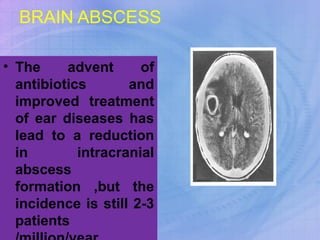
BRAIN ABSCESS The advent of antibiotics and improved treatment of ear diseases has lead to a reduction in intracranial abscess formation ,but the incidence is still 2-3 patients /million/year
Brain Abscess Microorgansims reach the brain  by i. Direct extension ii. Hematogenous spread Iii. Direct inoculation from penetrating trauma or neurosurgical intervention
Brain Abscess Younger patients affected (<40 years) Presence of predisposing condition in 80% of cases Immunocompromised states from AIDS and immunosuppressive drugs in organ transplant recipents
Most Common Pathogens Otitis media, mastoiditis   Streptococci Paranasal sinusitis   Streptococci Pulmonary infection   Strep, Actionomyces Dental   Mixed, Bacteroides spp. CHD    Strep Penetrating/Post-crani    S. aureus HIV    Toxoplasma gondii Transplant    Aspergillus, Candida
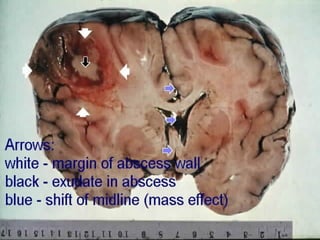
BRAIN ABSCESS Causes : 1. complication of bacterial meningitis 2. bacterial endocarditis 3. pulmonary sepsis : peumonia……etc 4. other sepsis Brain abscess cause a space occupying  lesion in the brain
PREDISPOSING FACTORS Congenital heart disease  (6.1%)  HIV infection  (1.2%)  Immunosuppression  (3.7%)  Diabetes mellitus  (3.1%)
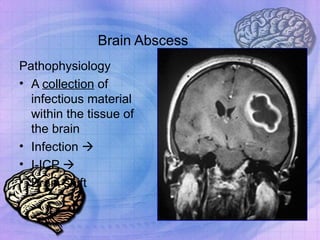
Brain Abscess Pathophysiology A  collection  of infectious material within the tissue of the brain Infection     I-ICP     Brain shift
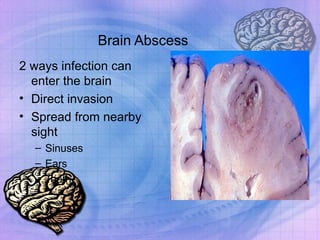
Brain Abscess 2 ways infection can enter the brain Direct invasion  Spread from nearby sight Sinuses Ears Teeth
Tongue piercing causes brain abscess 13 December 2001 New Scientist  Parents now have another reason to frown on tongue piercing - a potentially fatal brain abscess suffered by a young woman in Connecticut. The woman's tongue became sore and swollen two or three days after it was pierced, and she reported a foul-tasting discharge from the pierced region. The infection healed in a few days after she removed the stud from her tongue, but a month later she suffered severe headaches, fever, nausea and vomiting.  A scan at the Yale University hospital revealed the brain abscess, which physicians drained. She recovered after six weeks of intravenous antibiotic treatment.
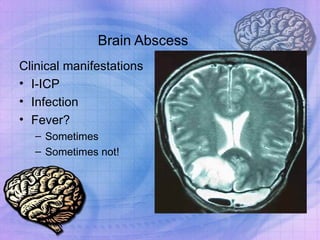
Brain Abscess Clinical manifestations I-ICP Infection Fever? Sometimes Sometimes not!
PATHOGENESIS Direct spread from contiguous foci (40-50%) Hematogenous (25-35%) Penetrating trauma/surgery (10%) Cryptogenic (15-20%)
DIRECT SPREAD (from contiguous foci) Occurs by: Direct extension through infected bone Spread through emissary veins, diploic veins, local lymphatics The contiguous foci include : Otitis media/mastoiditis  Sinusitis Dental infection (<10%), typically with molar infections  Meningitis rarely complicated by brain abscess  (more common in neonates with  Citrobacter diversus  meningitis, of whom 70% develop brain abscess)
HEMATOGENOUS SPREAD  (from remote foci) Sources: Empyema, lung abscess, bronchiectasis, endocarditis, wound infections, pelvic infections, intra-abdominal source, etc… may be facilitated by cyanotic HD, AVM. Results in brain abscess(es) at middle cerebral artery distribution Often multiple
PREDISPOSING CONDITION &   LOCATION OF BRAIN ABSCESS Otitis/mastoiditis Temporal lobe, Cerebellum Frontal/ethmoid sinusitis Frontal lobe Sphenoidal sinusitis Frontal lobe,  Sella turcica Dental infection Frontal > temporal lobe. Remote source Middle cerebral artery distribution  (often multiple)
Microbiology of  Brain Abscess Dependent upon: Site of primary infection Patient’s underlying condition Geographic location Usually streptococci and anaerobes  Staph aureus, aerobic GNR common after trauma or surgery 30-60 % are polymicrobial
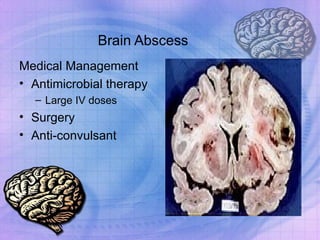
Brain Abscess Medical Management Antimicrobial therapy Large IV doses Surgery Anti-convulsant
Brain Abscess Microorgansims reach the brain  by i. Direct extension ii. Hematogenous spread Iii. Direct inoculation from penetrating trauma or neurosurgical intervention


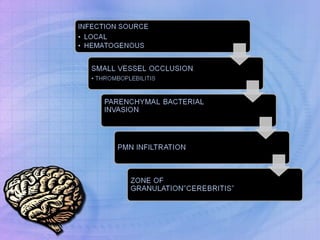
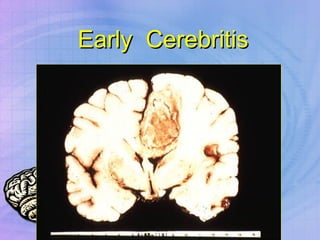
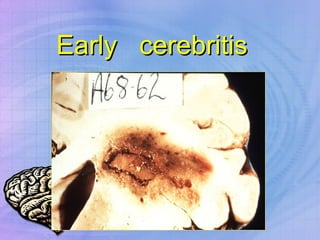
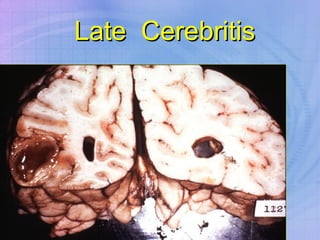
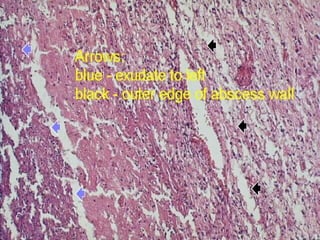
PATHOPHYSIOLOGY Begins as localized cerebritis (1-2 wks) Evolves into a collection of pus surrounded by a well-vascularized capsule (3-4 wks) Lesion evolution ( based on experimental animal models ): Days 1-3:  “early cerebritis stage” Days 4-9: “late cerebritis stage” Days 10-14:  “early capsule stage” > day14:  “late capsule stage”
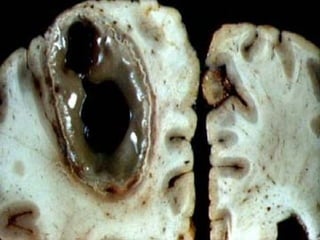
STAGES 1.  Early cerebritis stage  (D1-3):focal area of inflammation and edema 2 . Late cerebritis stage  (D4-9):development of a necrotic central focus 3.  Early capsule stage  (D10-14):ring-enhancing capsule of well-vascularized tissue with early appearance of peripheral fibrosis 4.  Late capsule stage  (>D14):host defenses lead to a well-formed capsule
PATHOGENESIS Bacterial  invasion  of  brain (Parenchyma ) Preexisting  or  concomitant : Ischemia  & Necrosis  &  Hypoxia  of  brain  tissue
PATHOGENESIS Early  cerebritis  (  days  1 to 3 ) Prevascular  infiltration  of  inflammatory  cells Central  core  of  coagulative  necrosis  Marked  edema  surrounds  the  lesions Stage  1
Early  Cerebritis
Early  cerebritis
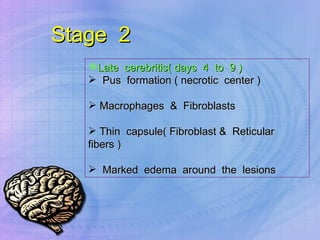
Late  cerebritis( days  4  to  9 ) Pus  formation ( necrotic  center ) Macrophages  &  Fibroblasts  Thin  capsule( Fibroblast &  Reticular  fibers ) Marked  edema  around  the  lesions  Stage  2
Late  Cerebritis
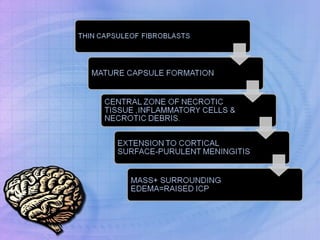
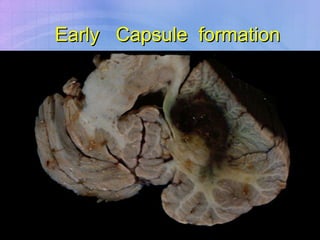
Early Capsule formation ( days 10 to13 ) Capsule  formation Ring-enhancing  capsule (  Imaging ) Stage  3
 
Early  Capsule  formation
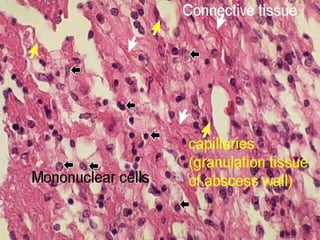
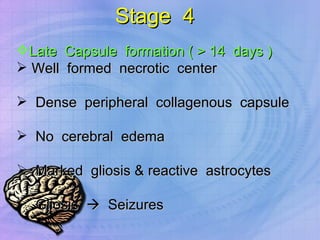
Stage  4  Late  Capsule  formation ( > 14  days ) Well  formed  necrotic  center Dense  peripheral  collagenous  capsule No  cerebral  edema Marked  gliosis & reactive  astrocytes Gliosis     Seizures
 
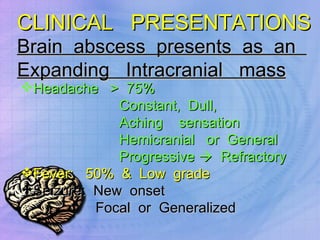
CLINICAL  PRESENTATIONS Brain  abscess  presents  as  an  Expanding  Intracranial  mass Headache  >  75% Constant,  Dull,  Aching  sensation Hemicranial  or  General  Progressive     Refractory Fever:  50%  &  Low  grade Seizure:  New  onset  Focal  or  Generalized
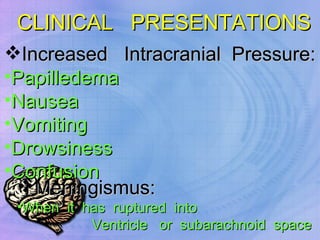
CLINICAL  PRESENTATIONS Increased  Intracranial  Pressure: Papilledema Nausea Vomiting Drowsiness Confusion Meningismus: When  it  has  ruptured  into  Ventricle  or  subarachnoid  space
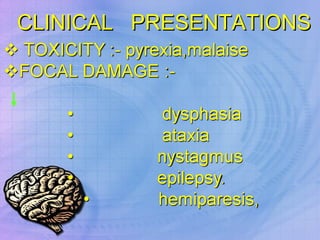
CLINICAL  PRESENTATIONS
CLINICAL MANIFESTATIONS Non-specific symptoms Mainly due to the presence of a space-occupying lesion H/A, N/V, lethargy, focal neuro signs , seizures Signs/symptoms influenced by  Location  Size Virulence of organism Presence of underlying condition
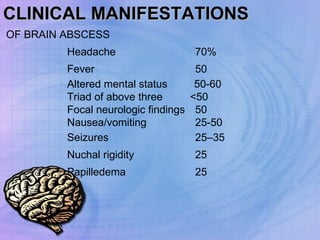
CLINICAL MANIFESTATIONS   OF BRAIN ABSCESS Headache 70% Fever 50 Altered mental status  50-60  Triad of above three   <50 Focal neurologic findings 50 Nausea/vomiting 25-50 Seizures 25–35  Nuchal rigidity 25   Papilledema 25
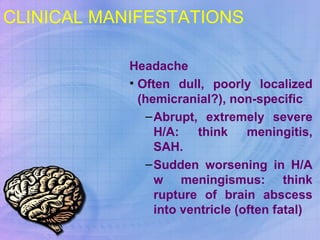
CLINICAL MANIFESTATIONS    Headache  Often dull, poorly localized (hemicranial?), non-specific Abrupt, extremely severe H/A: think meningitis, SAH. Sudden worsening in H/A w meningismus: think rupture of brain abscess into ventricle (often fatal)
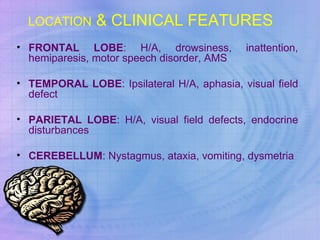
LOCATION  & CLINICAL FEATURES  FRONTAL LOBE : H/A, drowsiness, inattention, hemiparesis, motor speech disorder, AMS TEMPORAL LOBE : Ipsilateral H/A, aphasia, visual field defect PARIETAL LOBE : H/A, visual field defects, endocrine disturbances CEREBELLUM : Nystagmus, ataxia, vomiting, dysmetria
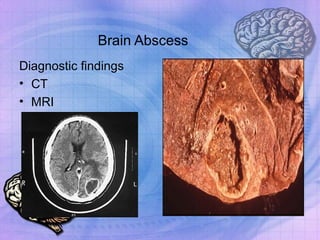
Brain Abscess Diagnostic findings CT MRI
DIAGNOSIS High index of suspicion Contrast CT or MRI Drainage/biopsy,  if ring enhancing lesion (s)  are seen
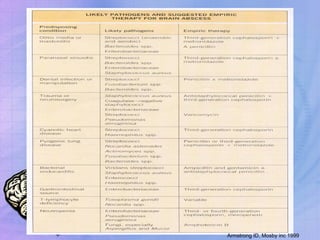
TREATMENT Combined medical & surgical Aspiration or excision empirical abx Empirical antibiotics are selected based on: Likely pathogen (consider primary source, underlying condition, & geography) Antibiotic characteristics: usual MICs, CNS penetration, activity in abscess cavity Modify abx based on stains Duration: usually 6-8 wks  after surgical excision, a shorter course may suffice
Armstrong ID, Mosby inc 1999
MEDICAL TREATMENT   ONLY Only in pts with prohibitive surgical risk:  poor surgical candidate, multiple abscesses, in a dominant location, Abscess size  < 2.5 cm concomitant meningitis, ependymitis,  early abscess (cerebritis?)  with improvement on abx, [Better-vascularized cortical lesions more likely to respond to abx alone] [ Subcortical/white-matter lesions are poorly vascularized]
Treatment I.V. Antibiotics 6 weeks Steroids Surgical intervention: Stereotactic aspiration vs. craniotomy
ANTIBIOTICS CEFTRIAXONE i.v 3-4 g/day METRONIDAZOLE i.v 500 mg tds + amoxicillin iv 2g 4 hourly (for middle ear source) I f  ENDOCARDITIS OR CONGENITAL HEART FAILURE DISEASES , + benzylpenicillin i.v 1.8-2.4 g 6hourly IF A PENETRATING TRAUMA, FLUCLOXACILLIN-i.v 2g 4 hourly. GENTAMICIN –i.v 5 mg/kg/day(monitor levels)
ABSCESS DRAINAGE  Primary excision of the whole abscess Burr hole aspiration of pus,guided by ultrasound & frameless sterotaxy,with repeated aspirations if required. Evacuation of abscess contents under direct vision, leaving capsule remnants .
TREATMENT OF INFECTION SITE Mastoditis and sinusitis require immediate surgery. Use of steroids is controversial. Conservative management
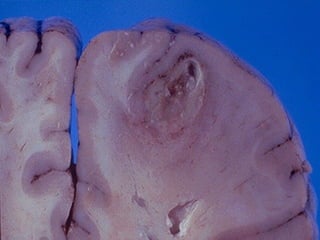
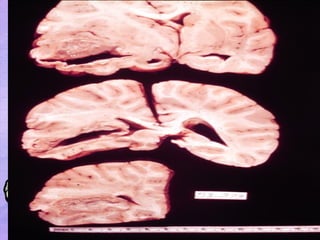
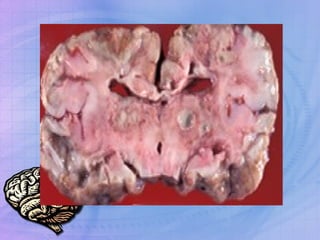
FEW PICTURES RELATED TO BRAIN ABSCESS


BRAIN ABSCESS

  • 1.
  • 2.
  • 3.
  • 4.
    BRAIN ABSCESS Theadvent of antibiotics and improved treatment of ear diseases has lead to a reduction in intracranial abscess formation ,but the incidence is still 2-3 patients /million/year
  • 5.
    Brain Abscess Microorgansimsreach the brain by i. Direct extension ii. Hematogenous spread Iii. Direct inoculation from penetrating trauma or neurosurgical intervention
  • 6.
    Brain Abscess Youngerpatients affected (<40 years) Presence of predisposing condition in 80% of cases Immunocompromised states from AIDS and immunosuppressive drugs in organ transplant recipents
  • 7.
    Most Common PathogensOtitis media, mastoiditis  Streptococci Paranasal sinusitis  Streptococci Pulmonary infection  Strep, Actionomyces Dental  Mixed, Bacteroides spp. CHD  Strep Penetrating/Post-crani  S. aureus HIV  Toxoplasma gondii Transplant  Aspergillus, Candida
  • 8.
    BRAIN ABSCESS Causes: 1. complication of bacterial meningitis 2. bacterial endocarditis 3. pulmonary sepsis : peumonia……etc 4. other sepsis Brain abscess cause a space occupying lesion in the brain
  • 9.
    PREDISPOSING FACTORS Congenitalheart disease (6.1%) HIV infection (1.2%) Immunosuppression (3.7%) Diabetes mellitus (3.1%)
  • 10.
    Brain Abscess PathophysiologyA collection of infectious material within the tissue of the brain Infection  I-ICP  Brain shift
  • 11.
    Brain Abscess 2ways infection can enter the brain Direct invasion Spread from nearby sight Sinuses Ears Teeth
  • 12.
    Tongue piercing causesbrain abscess 13 December 2001 New Scientist Parents now have another reason to frown on tongue piercing - a potentially fatal brain abscess suffered by a young woman in Connecticut. The woman's tongue became sore and swollen two or three days after it was pierced, and she reported a foul-tasting discharge from the pierced region. The infection healed in a few days after she removed the stud from her tongue, but a month later she suffered severe headaches, fever, nausea and vomiting. A scan at the Yale University hospital revealed the brain abscess, which physicians drained. She recovered after six weeks of intravenous antibiotic treatment.
  • 13.
    Brain Abscess Clinicalmanifestations I-ICP Infection Fever? Sometimes Sometimes not!
  • 14.
    PATHOGENESIS Direct spreadfrom contiguous foci (40-50%) Hematogenous (25-35%) Penetrating trauma/surgery (10%) Cryptogenic (15-20%)
  • 15.
    DIRECT SPREAD (fromcontiguous foci) Occurs by: Direct extension through infected bone Spread through emissary veins, diploic veins, local lymphatics The contiguous foci include : Otitis media/mastoiditis Sinusitis Dental infection (<10%), typically with molar infections Meningitis rarely complicated by brain abscess (more common in neonates with Citrobacter diversus meningitis, of whom 70% develop brain abscess)
  • 16.
    HEMATOGENOUS SPREAD (from remote foci) Sources: Empyema, lung abscess, bronchiectasis, endocarditis, wound infections, pelvic infections, intra-abdominal source, etc… may be facilitated by cyanotic HD, AVM. Results in brain abscess(es) at middle cerebral artery distribution Often multiple
  • 17.
    PREDISPOSING CONDITION & LOCATION OF BRAIN ABSCESS Otitis/mastoiditis Temporal lobe, Cerebellum Frontal/ethmoid sinusitis Frontal lobe Sphenoidal sinusitis Frontal lobe, Sella turcica Dental infection Frontal > temporal lobe. Remote source Middle cerebral artery distribution (often multiple)
  • 18.
    Microbiology of Brain Abscess Dependent upon: Site of primary infection Patient’s underlying condition Geographic location Usually streptococci and anaerobes Staph aureus, aerobic GNR common after trauma or surgery 30-60 % are polymicrobial
  • 19.
    Brain Abscess MedicalManagement Antimicrobial therapy Large IV doses Surgery Anti-convulsant
  • 20.
    Brain Abscess Microorgansimsreach the brain by i. Direct extension ii. Hematogenous spread Iii. Direct inoculation from penetrating trauma or neurosurgical intervention
  • 21.
  • 22.
  • 23.
  • 24.
    PATHOPHYSIOLOGY Begins aslocalized cerebritis (1-2 wks) Evolves into a collection of pus surrounded by a well-vascularized capsule (3-4 wks) Lesion evolution ( based on experimental animal models ): Days 1-3: “early cerebritis stage” Days 4-9: “late cerebritis stage” Days 10-14: “early capsule stage” > day14: “late capsule stage”
  • 25.
    STAGES 1. Early cerebritis stage (D1-3):focal area of inflammation and edema 2 . Late cerebritis stage (D4-9):development of a necrotic central focus 3. Early capsule stage (D10-14):ring-enhancing capsule of well-vascularized tissue with early appearance of peripheral fibrosis 4. Late capsule stage (>D14):host defenses lead to a well-formed capsule
  • 26.
    PATHOGENESIS Bacterial invasion of brain (Parenchyma ) Preexisting or concomitant : Ischemia & Necrosis & Hypoxia of brain tissue
  • 27.
    PATHOGENESIS Early cerebritis ( days 1 to 3 ) Prevascular infiltration of inflammatory cells Central core of coagulative necrosis Marked edema surrounds the lesions Stage 1
  • 28.
  • 29.
  • 30.
    Late cerebritis(days 4 to 9 ) Pus formation ( necrotic center ) Macrophages & Fibroblasts Thin capsule( Fibroblast & Reticular fibers ) Marked edema around the lesions Stage 2
  • 31.
  • 32.
    Early Capsule formation( days 10 to13 ) Capsule formation Ring-enhancing capsule ( Imaging ) Stage 3
  • 33.
  • 34.
    Early Capsule formation
  • 35.
    Stage 4 Late Capsule formation ( > 14 days ) Well formed necrotic center Dense peripheral collagenous capsule No cerebral edema Marked gliosis & reactive astrocytes Gliosis  Seizures
  • 36.
  • 37.
    CLINICAL PRESENTATIONSBrain abscess presents as an Expanding Intracranial mass Headache > 75% Constant, Dull, Aching sensation Hemicranial or General Progressive  Refractory Fever: 50% & Low grade Seizure: New onset Focal or Generalized
  • 38.
    CLINICAL PRESENTATIONSIncreased Intracranial Pressure: Papilledema Nausea Vomiting Drowsiness Confusion Meningismus: When it has ruptured into Ventricle or subarachnoid space
  • 39.
  • 40.
    CLINICAL MANIFESTATIONS Non-specificsymptoms Mainly due to the presence of a space-occupying lesion H/A, N/V, lethargy, focal neuro signs , seizures Signs/symptoms influenced by Location Size Virulence of organism Presence of underlying condition
  • 41.
    CLINICAL MANIFESTATIONS OF BRAIN ABSCESS Headache 70% Fever 50 Altered mental status 50-60 Triad of above three <50 Focal neurologic findings 50 Nausea/vomiting 25-50 Seizures 25–35 Nuchal rigidity 25 Papilledema 25
  • 42.
    CLINICAL MANIFESTATIONS Headache Often dull, poorly localized (hemicranial?), non-specific Abrupt, extremely severe H/A: think meningitis, SAH. Sudden worsening in H/A w meningismus: think rupture of brain abscess into ventricle (often fatal)
  • 43.
    LOCATION &CLINICAL FEATURES FRONTAL LOBE : H/A, drowsiness, inattention, hemiparesis, motor speech disorder, AMS TEMPORAL LOBE : Ipsilateral H/A, aphasia, visual field defect PARIETAL LOBE : H/A, visual field defects, endocrine disturbances CEREBELLUM : Nystagmus, ataxia, vomiting, dysmetria
  • 44.
    Brain Abscess Diagnosticfindings CT MRI
  • 45.
    DIAGNOSIS High indexof suspicion Contrast CT or MRI Drainage/biopsy, if ring enhancing lesion (s) are seen
  • 46.
    TREATMENT Combined medical& surgical Aspiration or excision empirical abx Empirical antibiotics are selected based on: Likely pathogen (consider primary source, underlying condition, & geography) Antibiotic characteristics: usual MICs, CNS penetration, activity in abscess cavity Modify abx based on stains Duration: usually 6-8 wks after surgical excision, a shorter course may suffice
  • 47.
  • 48.
    MEDICAL TREATMENT ONLY Only in pts with prohibitive surgical risk: poor surgical candidate, multiple abscesses, in a dominant location, Abscess size < 2.5 cm concomitant meningitis, ependymitis, early abscess (cerebritis?) with improvement on abx, [Better-vascularized cortical lesions more likely to respond to abx alone] [ Subcortical/white-matter lesions are poorly vascularized]
  • 49.
    Treatment I.V. Antibiotics6 weeks Steroids Surgical intervention: Stereotactic aspiration vs. craniotomy
  • 50.
    ANTIBIOTICS CEFTRIAXONE i.v3-4 g/day METRONIDAZOLE i.v 500 mg tds + amoxicillin iv 2g 4 hourly (for middle ear source) I f ENDOCARDITIS OR CONGENITAL HEART FAILURE DISEASES , + benzylpenicillin i.v 1.8-2.4 g 6hourly IF A PENETRATING TRAUMA, FLUCLOXACILLIN-i.v 2g 4 hourly. GENTAMICIN –i.v 5 mg/kg/day(monitor levels)
  • 51.
    ABSCESS DRAINAGE Primary excision of the whole abscess Burr hole aspiration of pus,guided by ultrasound & frameless sterotaxy,with repeated aspirations if required. Evacuation of abscess contents under direct vision, leaving capsule remnants .
  • 52.
    TREATMENT OF INFECTIONSITE Mastoditis and sinusitis require immediate surgery. Use of steroids is controversial. Conservative management
  • 53.
    FEW PICTURES RELATEDTO BRAIN ABSCESS
  • 54.
  • 55.
  • 56.
  • 57.
  • 58.