© 2014 IBM Corporation
BP308 The Journey to
Becoming a Social
Application Developer
Serdar Basegmez, Developi Information Systems
Graham Acres, Brytek Systems Inc.
Serdar Basegmez
Developi Information Systems
 IBM Collaboration Solutions Champion (2011-2014)
 Owner of Developi Information Systems (Istanbul, Turkey)
 Founder and Co-leader of LUGTR – Turkish Lotus User Group
 Bilingual Blogger at LotusNotus.com (Turkish/English)
 OpenNTF Guy in Turkey
– Contributor in XSnippets and CollaborationToday.info
– Member Director at OpenNTF Board
 IBM Notes/Domino and Social Business Toolkit Design Partner
 Featured on The View, NotesIn9; Speaker at IBM Connect and LUGs
 Away from work
– Blogger and Podcaster on Scientific Scepticism
2
follow me
@sbasegmez
Graham Acres
Brytek Systems Inc.
 IBM Lotus Notes® Developer/Designer since 1992 (v2.1)
 Brytek is an IBM Business Partner based in Vancouver, Canada
 Experienced as both an IBM customer and Business Partner
 Currently focus on application development (Social Business, XPages, Mobile)
 Featured on NotesIn9; Speaker at Connect/Lotusphere, LUGs
 Blog: www.bleedyellow.com/blogs/brytekblog
 LinkedIn: www.linkedin.com/in/grahamacres
 Away from work
– Coach minor hockey
– Cyclist, Ride to Conquer Cancer
3
follow me
@gacres99
Products Discussed in this Presentation
 IBM® Connections
 IBM SmartCloud®
 Domino®
 Lotus Notes®
 Sametime®
 WebSphere®
 JavaTM
 EclipseTM
 FacebookTM
 DropBoxTM
 Apache TomcatTM
 Apache ShindigTM
 JBossTM
 PHPTM
4
 TwitterTM
 LinkedInTM
 PinterestTM
 Box.netTM
 InstagramTM
 Google AnalyticsTM
 FitbitTM
 GarminTM
 Basecamp®
Disclaimer
 This presentation will not include a conversation of how many people in your country use
Facebook
 Further, it will not talk about the transformation from Web 2.0 to Web 3.0
 Widgets and Gadgets are a key part of the SBT, but not this presentation
 OpenSocial is a big factor in this subject too, but we only have so much time today
 This presentation was built before the most recent release of the SBT SDK, Saturday.
 Social is still a ‘Buzzword’ that we cannot escape from
5
Agenda
 Your First Step on the Journey to Becoming a Social Application Developer
 The Social Business Toolkit SDK
 Social Business Toolkit SDK Setup
 Basic Concepts
 Demo Time
 Homework
 Resources
 Questions
6
7
Your First Step on the
Journey to Becoming a
Social Application Developer
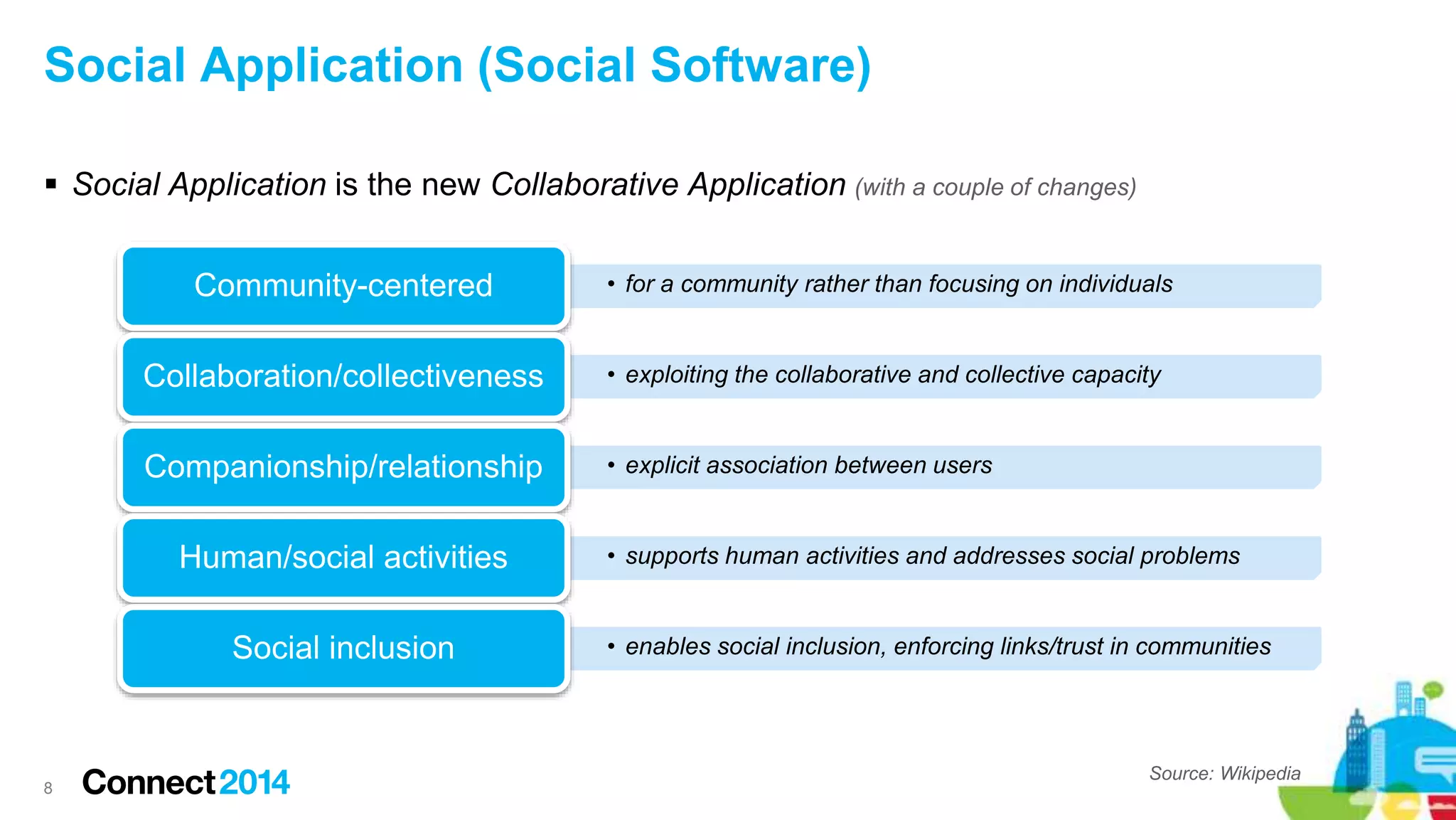
Social Application (Social Software)
 Social Application is the new Collaborative Application (with a couple of changes)
8
• for a community rather than focusing on individualsCommunity-centered
• exploiting the collaborative and collective capacityCollaboration/collectiveness
• explicit association between usersCompanionship/relationship
• supports human activities and addresses social problemsHuman/social activities
• enables social inclusion, enforcing links/trust in communitiesSocial inclusion
Source: Wikipedia
Social Adaption and Integration
 Would you write your own ERP application?
 Integrate to collaborative environments
– ... instead of developing your own.
 The Keyword is API (We now live in the world of the API)
– An application programming interface (API) specifies how some software components
should interact with each other*
– ProgrammableWeb** lists over 10,000 public APIs available on the Internet
– APIs are indispensable for Business apps too!
 Another Concept: SDK
– A software development kit (SDK or "devkit") is typically a set of software development
tools that allows for the creation of applications [...]*
– SDK’s provide higher-level integration with tooling, components, samples, etc.
9
* Source: Wikipedia ** Source: http://www.programmableweb.com
Becoming a Social Application Developer
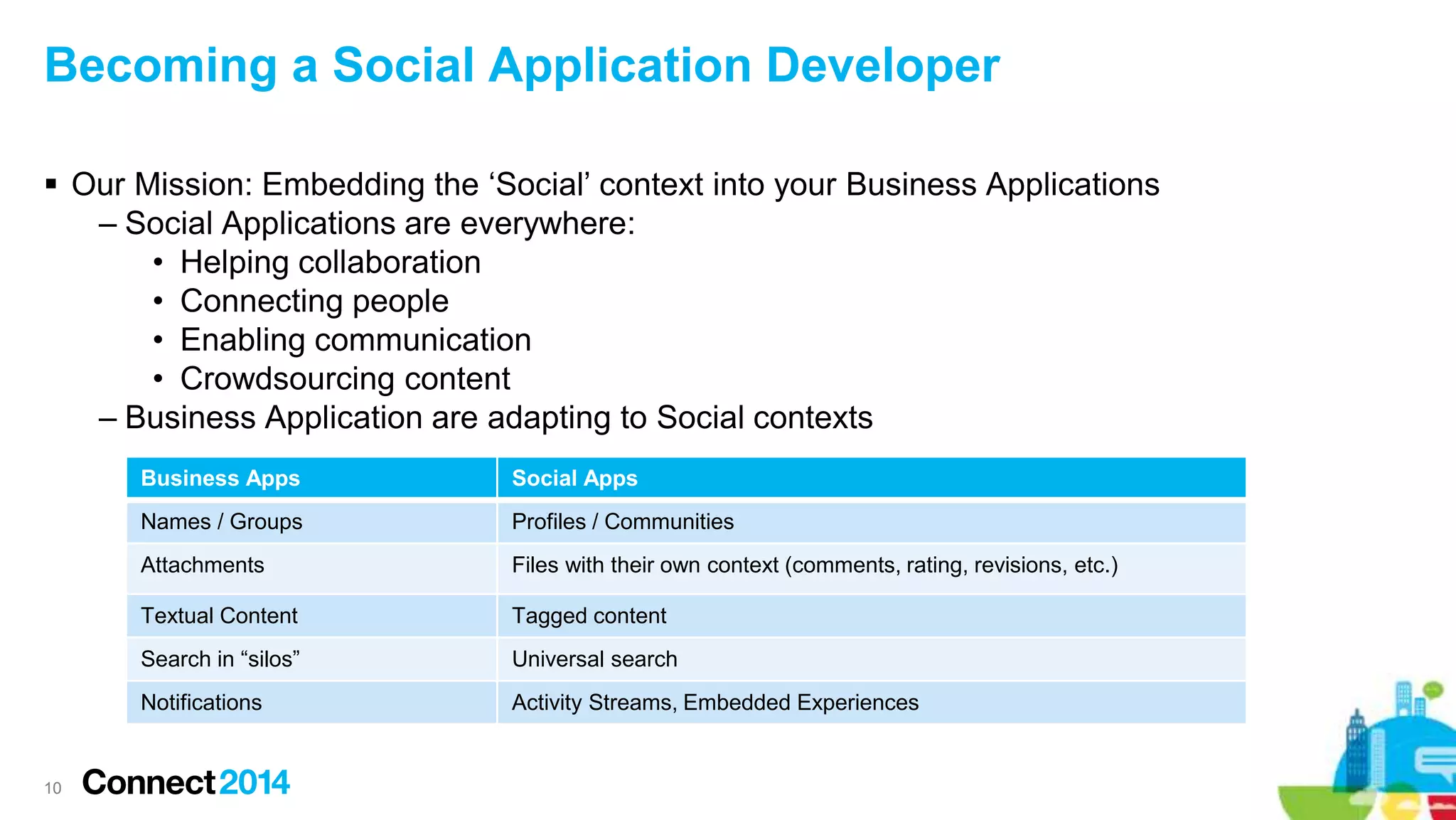
 Our Mission: Embedding the ‘Social’ context into your Business Applications
– Social Applications are everywhere:
• Helping collaboration
• Connecting people
• Enabling communication
• Crowdsourcing content
– Business Application are adapting to Social contexts
10
Business Apps Social Apps
Names / Groups Profiles / Communities
Attachments Files with their own context (comments, rating, revisions, etc.)
Textual Content Tagged content
Search in “silos” Universal search
Notifications Activity Streams, Embedded Experiences
11
Demo Time
Demo – 1 : XPages + Basecamp + Connections
12
IBM Connections Server
IBM Domino Server
Basecamp
Web BrowserWeb Browser
Connections REST API
Java Beans / SDK Core
OAuth2
Endpoint
SSO
Endpoint
XPages
HTML/CSS/JS
HighLevelAPICalls
REST Calls
widget.xml
iWidget
Demo – 1 : XPages + Basecamp + Connections
13
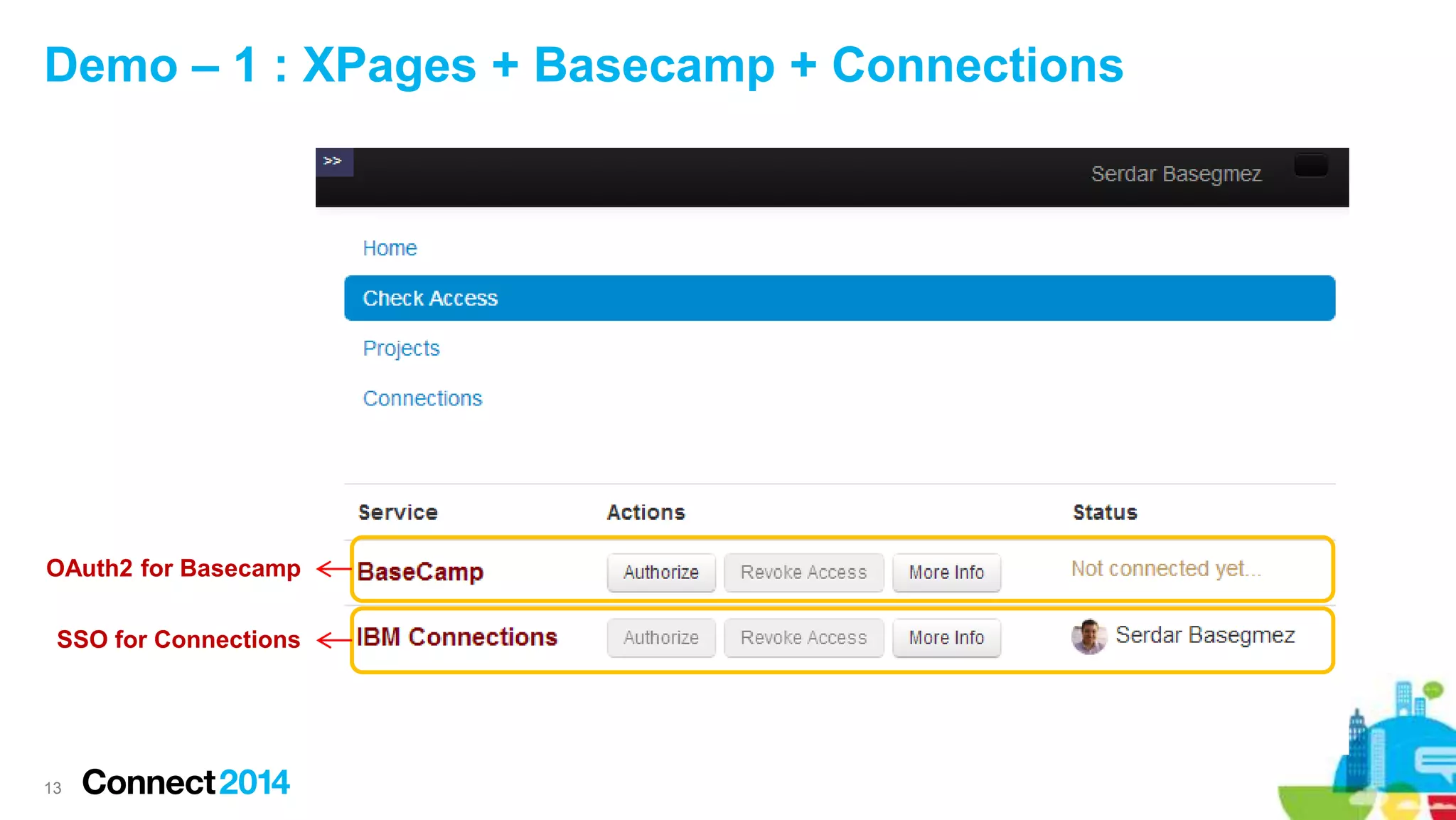
OAuth2 for Basecamp
SSO for Connections
Demo – 1 : XPages + Basecamp + Connections
14
Demo – 1 : XPages + Basecamp + Connections
15
Demo – 1 : XPages + Basecamp + Connections
16
17
The Social Business Toolkit SDK
 Basically, it is intended to make your life easy as a developer!
 SDK for the IBM Social Platform:
– Developing applications for Social
– Integrate social components
– Customize the IBM Social Platform
 On premises and in the cloud:
– IBM Connections, IBM Notes / Domino, IBM Sametime
– IBM SmartCloud for Social Business, etc.
– Non-IBM Service APIs (Twitter, Dropbox and many more...)
 SBT is a Software Development Kit (and more)
– IBM products have their own APIs
– SDK encapsulates different APIs
• but does not span the entire functionality of each yet
18
SDK Structure
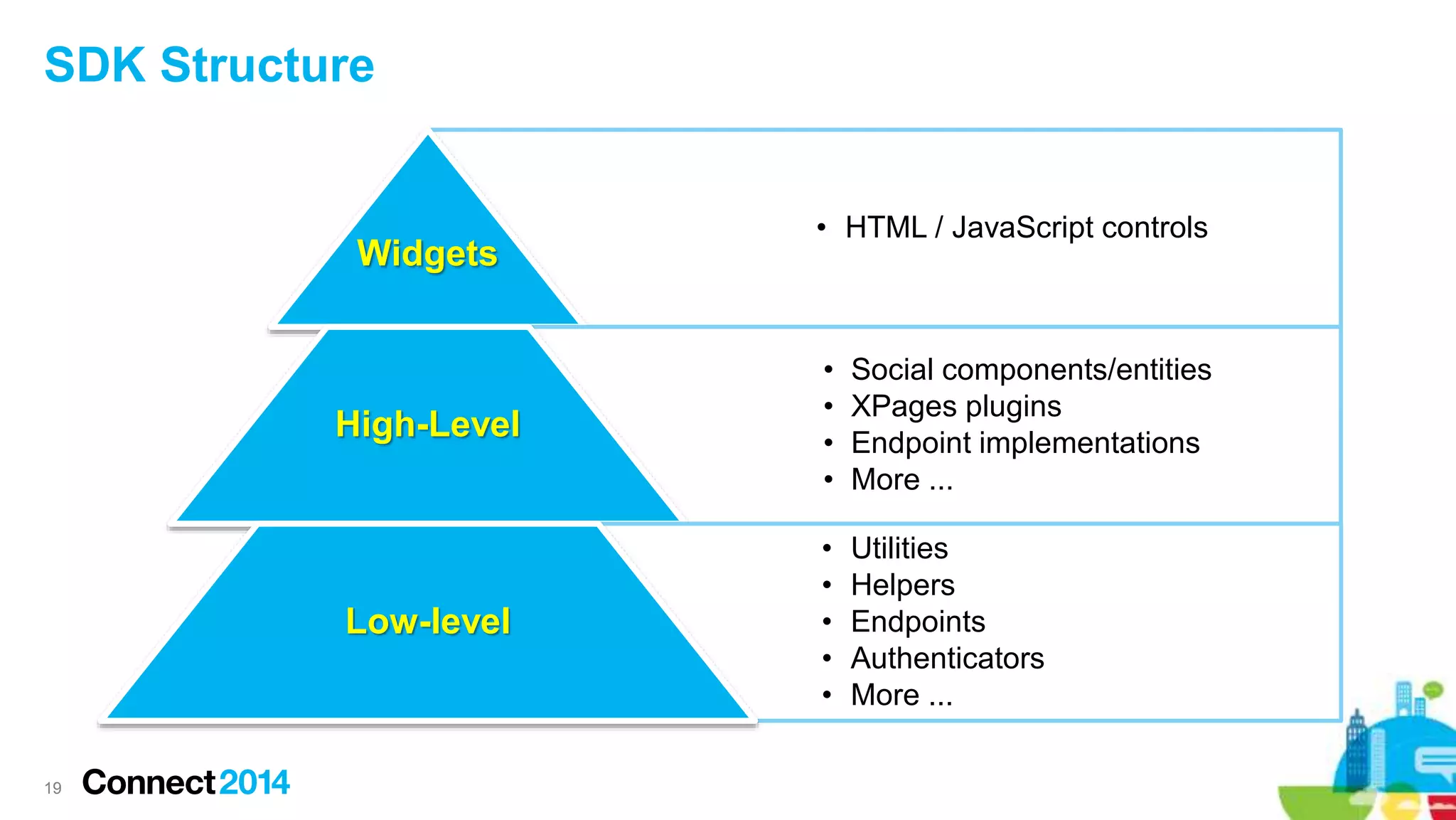
• HTML / JavaScript controls
Widgets
• Social components/entities
• XPages plugins
• Endpoint implementations
• More ...
High-Level
• Utilities
• Helpers
• Endpoints
• Authenticators
• More ...
Low-level
19
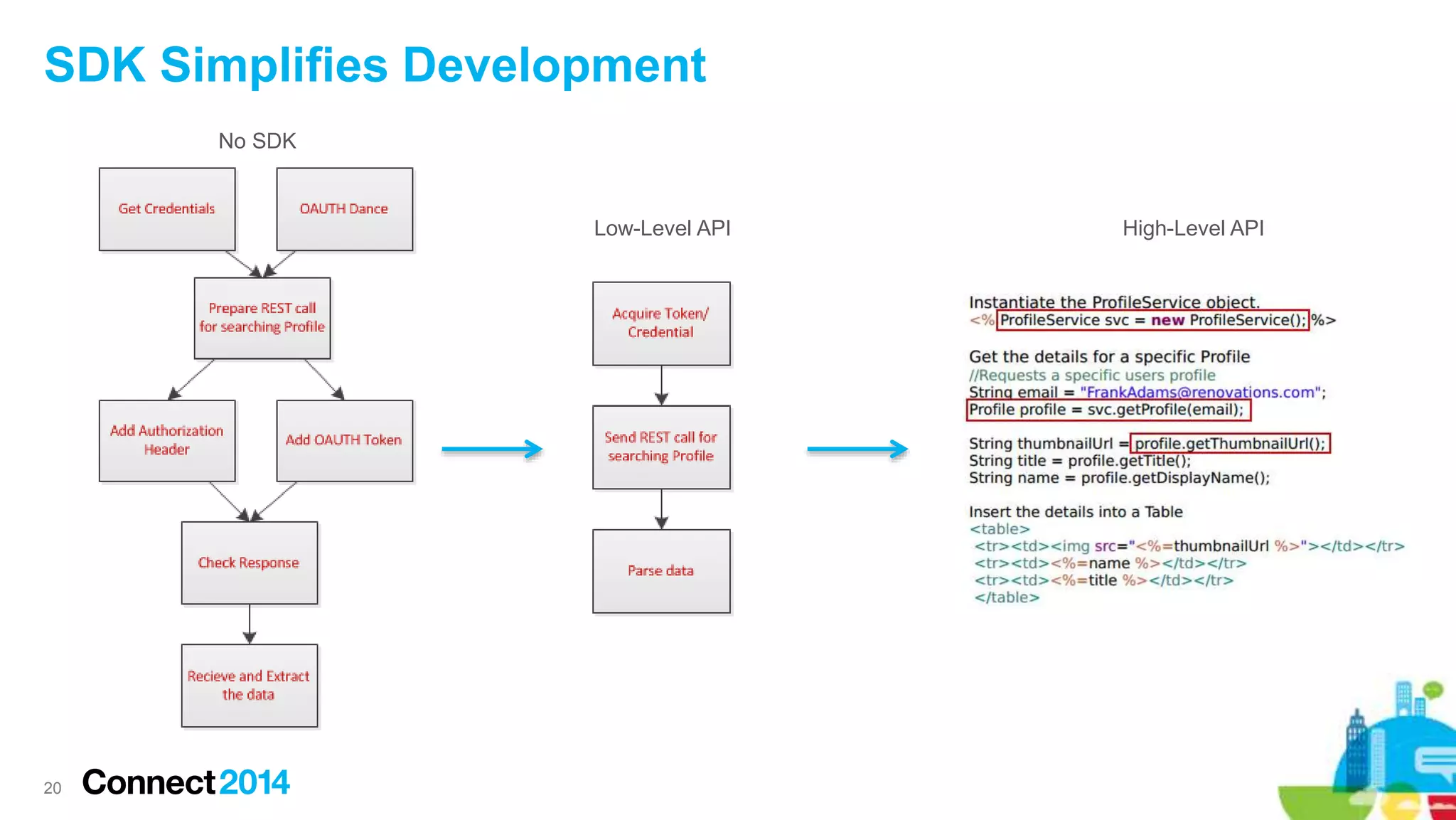
SDK Simplifies Development
20
No SDK
Low-Level API High-Level API
High-Level API vs. Low-Level API
 Low-Level API
– Base-level modules
– Everything we need to consume REST services directly
 For instance:
– Endpoint to handle connections
• How to connect
• How to authenticate
• How to maintain authentication
– Parsers to extract response
• JSON, XML
– Servlets to process workflows
• Proxy redirections, OAuth dance...
21
High-Level API vs. Low-Level API
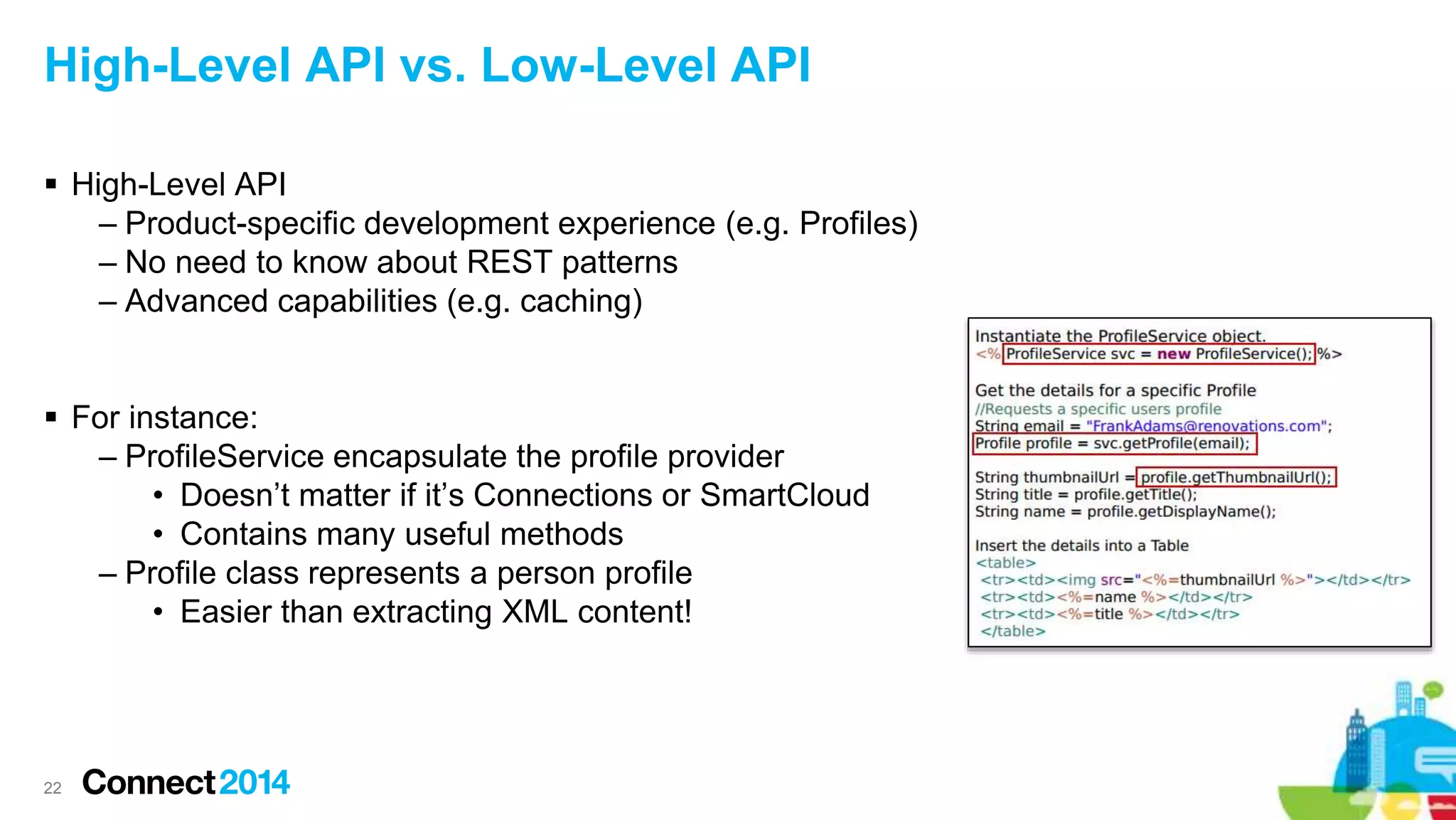
 High-Level API
– Product-specific development experience (e.g. Profiles)
– No need to know about REST patterns
– Advanced capabilities (e.g. caching)
 For instance:
– ProfileService encapsulate the profile provider
• Doesn’t matter if it’s Connections or SmartCloud
• Contains many useful methods
– Profile class represents a person profile
• Easier than extracting XML content!
22
The Architecture
23
For Java Developers
 Java developers can:
– Utilize Low-level API to integrate applications with remote API’s,
– Use High-level API to utilize IBM Social Platform components
 SBT can work on:
– Java Application Servers (WebSphere, Tomcat, JBoss, etc.)
– IBM Domino Server (XPages, DOTS)
– As Standalone applications
– As OSGi Plugins
24
For JavaScript Developers
 For client-side development, the SDK provides a comprehensive JavaScript API
– Embed social components over the client-level user interface
– Language-agnostic for back-end
– Ready to use UI widgets for faster development
 Two important points:
– JavaScript components need a Java Application Server on the back end (e.g. Tomcat)
– JavaScript API provides only client-side integration.
 More options for back-end coming soon
25
26
For XPages Developers
 The SBT replaced Social Enabler delivered by Extension Library (OpenNTF version)
– It might conflict with the old version of ExtLib
– Installable via NSF based update sites
 Provides a set of plugins for IBM Domino server and IBM Domino Designer
– Sample database and Playground
– Java classes and SSJS functions (Endpoints, Service classes, Parsers etc.)
– Data Sources (Activity Streams, Twitter, etc.)
– UI Components
– OpenSocial support
What About Others?
 The Social Business Toolkit can be used to connect many APIs over the Internet!
– Twitter, Facebook, LinkedIn, DropBox, Pinterest, Box.net
– Instagram, Google Analytics, Fitbit, Garmin, Basecamp
 Practical if there is...
– REST API
– OAUTH or OAUTH2 authentication
– JSON, XML, Atom
 But...
27
Validate Yourself!
 Does your solution really add business value?
 Will it create more complexity?
 Will it be easy to maintain?
 Are you sure you can do it?
 DIY vs. Buy
28
Just Because You Can,
Doesn’t Mean You Should!
Ask Yourself These Questions
 Am I integrating with IBM Connections or IBM SmartCloud?
– If yes, SBT is the way to go
 Is there an SDK supported/suggested by the provider?
– If yes, consider using it instead (Google Analytics is a good example)
 Does it use REST API, OAuth, Username/Password authentication?
 What identity will I use to interact/authenticate?
– Will every user have their own account?
– Will one application-level account be used (If so, consider OAuth capabilities)
 Are there any security restrictions (e.g. Twitter uses HMAC)
 Are there any limiting factors that might block you (e.g. usage, rate limit)
 Triggering vs. Polling
– Remote service supports triggers; rate limit might prevent frequent polling
29
30
Social Business Toolkit SDK Setup
Social Business Toolkit SDK Download
 Two versions of the Social Business Toolkit SDK
– Daily builds: http://github.com/OpenNTF/SocialSDK
– Releases: http://ibmsbt.openntf.org
 Included in download:
– Source code
– Tomcat server
– Playground (for Domino and J2EE)
– Sample applications
– Notes/Domino plugins, sample NSFs
31
Social Business Toolkit SDK Install Options
 Gotchas
– Must have Java installed and JRE in the path
– Ports!
• A playground server may have Connections (IHS), Domino and Tomcat installed –
who gets HTTP port 80? (8080, 8081)
– «sbt.properties»
– SSL is important for OAUTH
• Check wikis to enable SSL for Tomcat
– Use the documentation!
• Link included in resources section of this presentation
• Look for differences between Connections 4.0 and 4.5 in the wiki pages
32
Social Business Toolkit SDK Install Options
 Domino Designer
– SDK is an Eclipse plugin
– Instructions in wiki on same page as Domino Server install
• Uses the same Update Site database
 Eclipse
– Instructions in wiki in ‘Configuring’ section
 DOTS support via OpenSocial Component on Domino
 Other Systems
– Configure your own endpoints using «managed-beans.xml»
33
34
Basic Concepts:
The OAuth Dance
The OAuth Dance
 Why is OAuth important?
– Authentication
– Username / Password
• Don’t have to provide your username / password to all apps
• You can change your password without losing your token
 OAuth2 has been developed to simplify OAuth 1.0a process.
– OAuth2 provides short-lived tokens but allows renewal without user interaction
– No need to encrypt every request (but trafic should be secured with SSL)
– Flow is simplified for non-HTTP applications
– Allows application-level access (i.e. user name-password) and assertion (e.g. SAML)
35
The OAuth Dance
36
* Courtesy Julian Robichaux
http://www.slideshare.net/dominopoint/dd12-oauth-for-domino-developers
*OAuth 1.0
37
Basic Concepts:
Endpoint Configuration
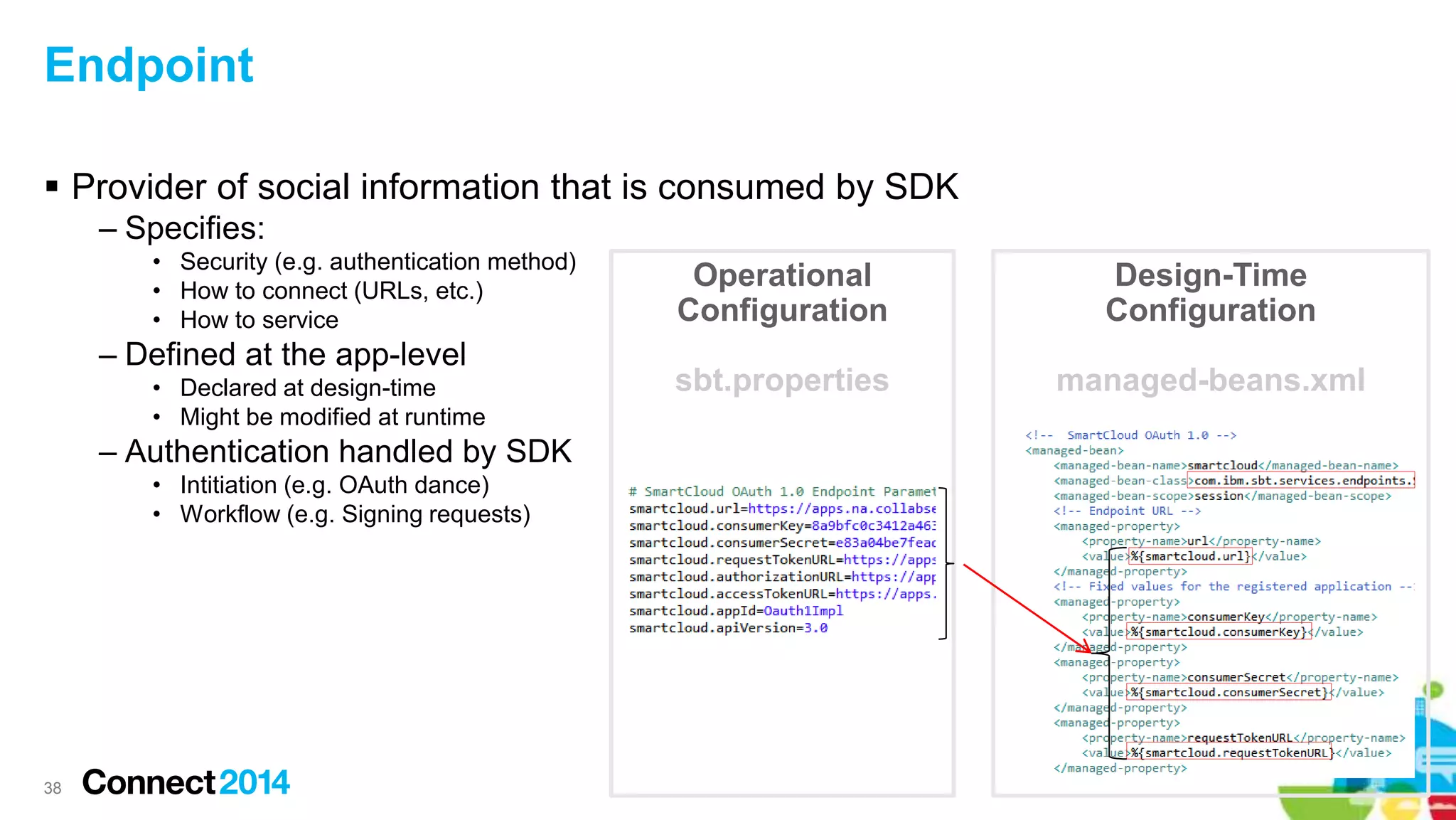
Endpoint
 Provider of social information that is consumed by SDK
– Specifies:
• Security (e.g. authentication method)
• How to connect (URLs, etc.)
• How to service
– Defined at the app-level
• Declared at design-time
• Might be modified at runtime
– Authentication handled by SDK
• Intitiation (e.g. OAuth dance)
• Workflow (e.g. Signing requests)
38
Design-Time
Configuration
managed-beans.xml
Operational
Configuration
sbt.properties
Design-Time
Configuration
managed-beans.xml
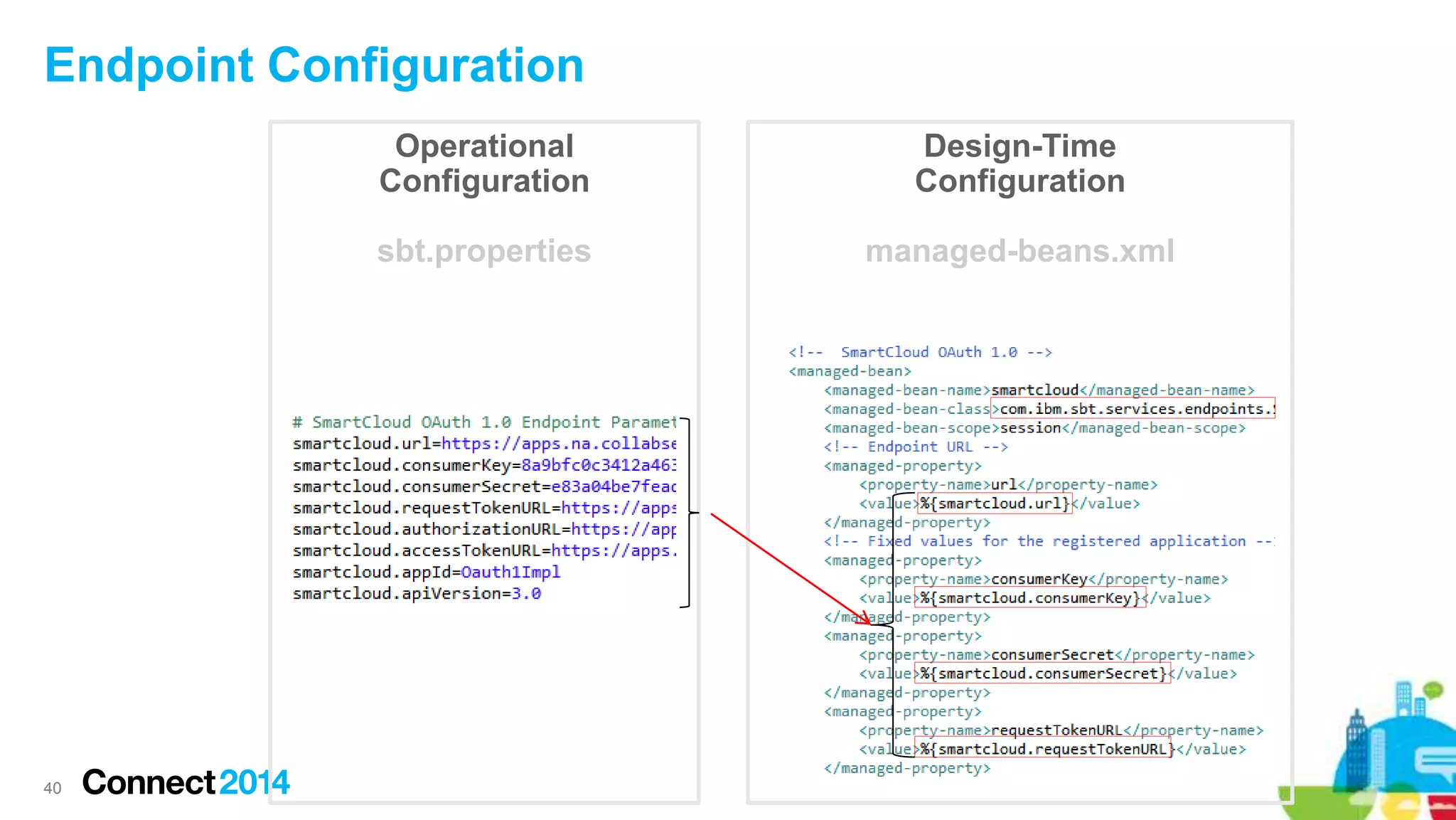
Endpoint Configuration
39
Endpoint
Name and alias
Java class (type)
Other details
Operational
Configuration
sbt.properties
Definitions
OAuth keys
URLs
Username/passwords
Runtime
Configuration
Credential Store
Definitions
OAuth Tokens
Username/passwords
Endpoint Configuration
40
Design-Time
Configuration
managed-beans.xml
Operational
Configuration
sbt.properties
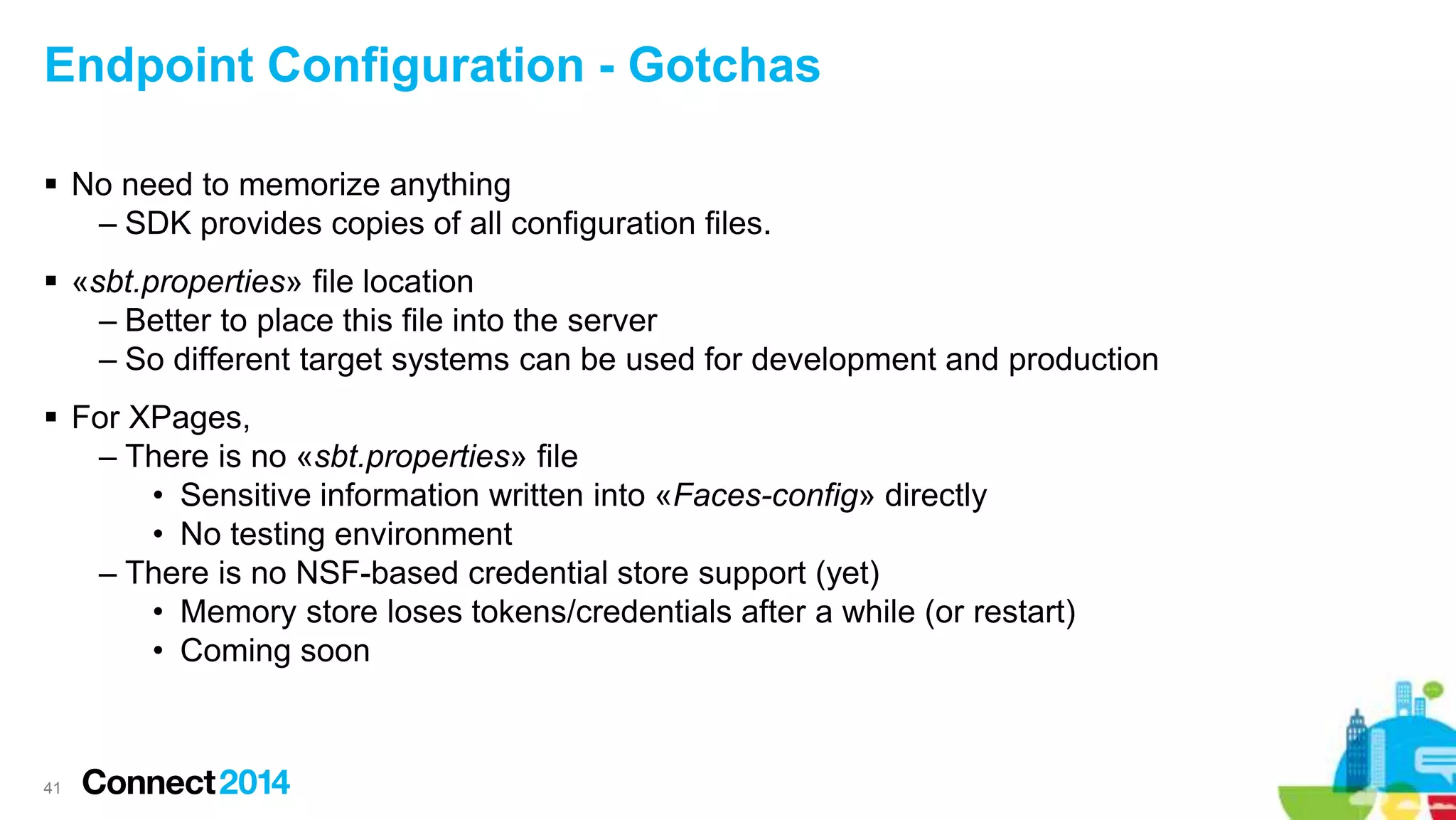
Endpoint Configuration - Gotchas
 No need to memorize anything
– SDK provides copies of all configuration files.
 «sbt.properties» file location
– Better to place this file into the server
– So different target systems can be used for development and production
 For XPages,
– There is no «sbt.properties» file
• Sensitive information written into «Faces-config» directly
• No testing environment
– There is no NSF-based credential store support (yet)
• Memory store loses tokens/credentials after a while (or restart)
• Coming soon
41
42
Demo Time
Demo – 2 : Notes + DOTS + Connections
43
IBM Connections Server
IBM Domino Server
UserUser
Connections REST API
Notes App
SBT
Endpoint
Activity Stream
Staging App
DOTS
Tasklet
Workflow action creates
document(s) on save Get/Post Data
Check updates
High Level API Calls
ProfileServices.getProfile(...)
ActivityStreamServices.postEntry(...)
...
Notes Client
Web Browser
Demo – 2 : Notes + DOTS + Connections
44
Demo – 2 : Notes + DOTS + Connections
45
Demo – 2 : Notes + DOTS + Connections
46
Demo – 2 : Notes + DOTS + Connections
47
48
Conclusion
What’s New with Social Business Toolkit SDK 20140125
 Mobile API for iOS
 OpenSocial Explorer support in the Playground
 Alpha Support For Rendering Gadgets In Your Own App
 Reusable Files View control
 Alpha version of PHP support for Moodle and WordPress
49
Homework...
 Start Today!
– Introduce yourself to the IBM SBT Team (Meet the Developers Lab)
– Discuss your business case and the details of the platforms you use
– Ask questions, provide feedback...
 Start with baby steps...
– Watch videos on the IBM SBT Channel...
– Setup your Eclipse IDE and/or IBM Domino environment
– Register IBM SmartCloud and/or IBM Greenhouse
– Setup, run, learn and use SBT Playground...
– Learn SBT Playground again 
 Stay connected to the community... Don’t be shy
– IBM Social Business Toolkit community, OpenNTF, Stackoverflow, Twitter, etc.
 Watch videos again.
50
51
Resources
Resources: Other Sessions
 JMP103 : Extending Your Application Arsenal With OpenSocial
 SHOW501 : Mastering Social Development Using the IBM Collaboration Quickstart
 AD301 : What's New on the IBM Social Business Toolkit Version 2.0
 ID101 : Extending IBM SmartCloud Applications in 30 Minutes
 INV111 : The Evolution from Simple Sharing to Purposeful Collaboration
 AD207 : Widgets, Live Text and Now OpenSocial: Linking Your Data to the World!
 SB311 : Unlock Social Integration Secrets with the Latest Open Technologies
 BP302 : Running a Successful Pilot Program with Social Software
– Next! 11:15 AM Dolphin N. Hem E
 AD206 : Build Apps Rapidly by Leveraging Services from IBM Collaboration Solutions
– Today 5:30 PM Dolphin S. Hem III
52
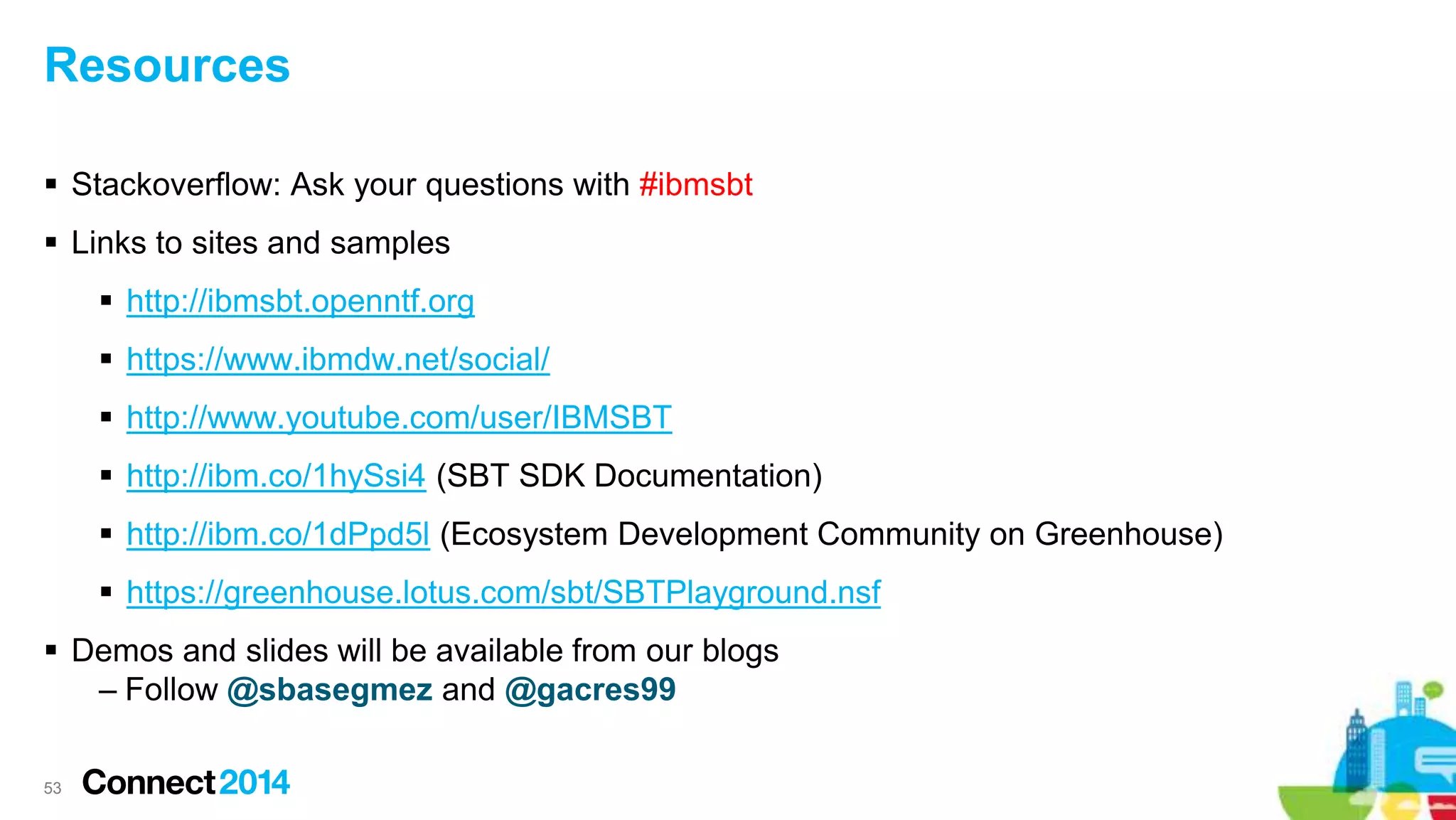
Resources
 Stackoverflow: Ask your questions with #ibmsbt
 Links to sites and samples
 http://ibmsbt.openntf.org
 https://www.ibmdw.net/social/
 http://www.youtube.com/user/IBMSBT
 http://ibm.co/1hySsi4 (SBT SDK Documentation)
 http://ibm.co/1dPpd5l (Ecosystem Development Community on Greenhouse)
 https://greenhouse.lotus.com/sbt/SBTPlayground.nsf
 Demos and slides will be available from our blogs
– Follow @sbasegmez and @gacres99
53
54
Questions
 Access Connect Online to complete your session surveys using any:
– Web or mobile browser
– Connect Online kiosk onsite
55
56
Acknowledgements and Disclaimers
© Copyright IBM Corporation 2014. All rights reserved.
 U.S. Government Users Restricted Rights - Use, duplication or disclosure restricted by GSA ADP Schedule Contract with IBM Corp.
 IBM, the IBM logo, ibm.com, and Lotus, Notes, Domino, Sametime, WebSphere, and SmartCloud are trademarks or registered trademarks of International Business Machines
Corporation in the United States, other countries, or both. If these and other IBM trademarked terms are marked on their first occurrence in this information with a trademark symbol (® or
™), these symbols indicate U.S. registered or common law trademarks owned by IBM at the time this information was published. Such trademarks may also be registered or common law
trademarks in other countries. A current list of IBM trademarks is available on the Web at “Copyright and trademark information” at www.ibm.com/legal/copytrade.shtml
Availability. References in this presentation to IBM products, programs, or services do not imply that they will be available in all countries in which IBM operates.
The workshops, sessions and materials have been prepared by IBM or the session speakers and reflect their own views. They are provided for informational purposes only, and are neither
intended to, nor shall have the effect of being, legal or other guidance or advice to any participant. While efforts were made to verify the completeness and accuracy of the information
contained in this presentation, it is provided AS-IS without warranty of any kind, express or implied. IBM shall not be responsible for any damages arising out of the use of, or otherwise
related to, this presentation or any other materials. Nothing contained in this presentation is intended to, nor shall have the effect of, creating any warranties or representations from IBM or
its suppliers or licensors, or altering the terms and conditions of the applicable license agreement governing the use of IBM software.
All customer examples described are presented as illustrations of how those customers have used IBM products and the results they may have achieved. Actual environmental costs and
performance characteristics may vary by customer. Nothing contained in these materials is intended to, nor shall have the effect of, stating or implying that any activities undertaken by you
will result in any specific sales, revenue growth or other results.
 Twitter and the Twitter logo are trademarks of Twitter Inc.
 Facebook is a registered trademark of Facebook, Inc.
 Java and all Java-based trademarks and logos are trademarks or registered
trademarks of Oracle and/or its affiliates.
 Eclipse is a trademark of Eclipse Foundation, Inc.
 Dropbox and the Dropbox logo are trademarks of Dropbox, Inc.
 Apache Tomcat, Tomcat, and Apache Sindig are trademarks of the Apache Software
Foundation
 Basecamp and Basecamp logo are registered trademark of 37Signals, LLC.
 JBoss is a registered trademark of RedHat, Inc.
 PHP is a registered trademark of Mike Mackintosh.
 LinkedIn is a registered trademark of LinkedIn Corporation
 Pintrest is a registered trademark of Pintrest, Inc.
 Box.net is a registered trademark of Box.net, Inc.
 Instagram is a registered trademark of Instagram
 Google Analytics is a registered trademark of Google Inc.
 FitBit is a registered trademark of FitBit, Inc.
 Garmin is a registered trademark of Garmin Ltd.

BP 308 - The Journey to Becoming a Social Application Developer

  • 1.
    © 2014 IBMCorporation BP308 The Journey to Becoming a Social Application Developer Serdar Basegmez, Developi Information Systems Graham Acres, Brytek Systems Inc.
  • 2.
    Serdar Basegmez Developi InformationSystems  IBM Collaboration Solutions Champion (2011-2014)  Owner of Developi Information Systems (Istanbul, Turkey)  Founder and Co-leader of LUGTR – Turkish Lotus User Group  Bilingual Blogger at LotusNotus.com (Turkish/English)  OpenNTF Guy in Turkey – Contributor in XSnippets and CollaborationToday.info – Member Director at OpenNTF Board  IBM Notes/Domino and Social Business Toolkit Design Partner  Featured on The View, NotesIn9; Speaker at IBM Connect and LUGs  Away from work – Blogger and Podcaster on Scientific Scepticism 2 follow me @sbasegmez
  • 3.
    Graham Acres Brytek SystemsInc.  IBM Lotus Notes® Developer/Designer since 1992 (v2.1)  Brytek is an IBM Business Partner based in Vancouver, Canada  Experienced as both an IBM customer and Business Partner  Currently focus on application development (Social Business, XPages, Mobile)  Featured on NotesIn9; Speaker at Connect/Lotusphere, LUGs  Blog: www.bleedyellow.com/blogs/brytekblog  LinkedIn: www.linkedin.com/in/grahamacres  Away from work – Coach minor hockey – Cyclist, Ride to Conquer Cancer 3 follow me @gacres99
  • 4.
    Products Discussed inthis Presentation  IBM® Connections  IBM SmartCloud®  Domino®  Lotus Notes®  Sametime®  WebSphere®  JavaTM  EclipseTM  FacebookTM  DropBoxTM  Apache TomcatTM  Apache ShindigTM  JBossTM  PHPTM 4  TwitterTM  LinkedInTM  PinterestTM  Box.netTM  InstagramTM  Google AnalyticsTM  FitbitTM  GarminTM  Basecamp®
  • 5.
    Disclaimer  This presentationwill not include a conversation of how many people in your country use Facebook  Further, it will not talk about the transformation from Web 2.0 to Web 3.0  Widgets and Gadgets are a key part of the SBT, but not this presentation  OpenSocial is a big factor in this subject too, but we only have so much time today  This presentation was built before the most recent release of the SBT SDK, Saturday.  Social is still a ‘Buzzword’ that we cannot escape from 5
  • 6.
    Agenda  Your FirstStep on the Journey to Becoming a Social Application Developer  The Social Business Toolkit SDK  Social Business Toolkit SDK Setup  Basic Concepts  Demo Time  Homework  Resources  Questions 6
  • 7.
    7 Your First Stepon the Journey to Becoming a Social Application Developer
  • 8.
    Social Application (SocialSoftware)  Social Application is the new Collaborative Application (with a couple of changes) 8 • for a community rather than focusing on individualsCommunity-centered • exploiting the collaborative and collective capacityCollaboration/collectiveness • explicit association between usersCompanionship/relationship • supports human activities and addresses social problemsHuman/social activities • enables social inclusion, enforcing links/trust in communitiesSocial inclusion Source: Wikipedia
  • 9.
    Social Adaption andIntegration  Would you write your own ERP application?  Integrate to collaborative environments – ... instead of developing your own.  The Keyword is API (We now live in the world of the API) – An application programming interface (API) specifies how some software components should interact with each other* – ProgrammableWeb** lists over 10,000 public APIs available on the Internet – APIs are indispensable for Business apps too!  Another Concept: SDK – A software development kit (SDK or "devkit") is typically a set of software development tools that allows for the creation of applications [...]* – SDK’s provide higher-level integration with tooling, components, samples, etc. 9 * Source: Wikipedia ** Source: http://www.programmableweb.com
  • 10.
    Becoming a SocialApplication Developer  Our Mission: Embedding the ‘Social’ context into your Business Applications – Social Applications are everywhere: • Helping collaboration • Connecting people • Enabling communication • Crowdsourcing content – Business Application are adapting to Social contexts 10 Business Apps Social Apps Names / Groups Profiles / Communities Attachments Files with their own context (comments, rating, revisions, etc.) Textual Content Tagged content Search in “silos” Universal search Notifications Activity Streams, Embedded Experiences
  • 11.
  • 12.
    Demo – 1: XPages + Basecamp + Connections 12 IBM Connections Server IBM Domino Server Basecamp Web BrowserWeb Browser Connections REST API Java Beans / SDK Core OAuth2 Endpoint SSO Endpoint XPages HTML/CSS/JS HighLevelAPICalls REST Calls widget.xml iWidget
  • 13.
    Demo – 1: XPages + Basecamp + Connections 13 OAuth2 for Basecamp SSO for Connections
  • 14.
    Demo – 1: XPages + Basecamp + Connections 14
  • 15.
    Demo – 1: XPages + Basecamp + Connections 15
  • 16.
    Demo – 1: XPages + Basecamp + Connections 16
  • 17.
  • 18.
    The Social BusinessToolkit SDK  Basically, it is intended to make your life easy as a developer!  SDK for the IBM Social Platform: – Developing applications for Social – Integrate social components – Customize the IBM Social Platform  On premises and in the cloud: – IBM Connections, IBM Notes / Domino, IBM Sametime – IBM SmartCloud for Social Business, etc. – Non-IBM Service APIs (Twitter, Dropbox and many more...)  SBT is a Software Development Kit (and more) – IBM products have their own APIs – SDK encapsulates different APIs • but does not span the entire functionality of each yet 18
  • 19.
    SDK Structure • HTML/ JavaScript controls Widgets • Social components/entities • XPages plugins • Endpoint implementations • More ... High-Level • Utilities • Helpers • Endpoints • Authenticators • More ... Low-level 19
  • 20.
    SDK Simplifies Development 20 NoSDK Low-Level API High-Level API
  • 21.
    High-Level API vs.Low-Level API  Low-Level API – Base-level modules – Everything we need to consume REST services directly  For instance: – Endpoint to handle connections • How to connect • How to authenticate • How to maintain authentication – Parsers to extract response • JSON, XML – Servlets to process workflows • Proxy redirections, OAuth dance... 21
  • 22.
    High-Level API vs.Low-Level API  High-Level API – Product-specific development experience (e.g. Profiles) – No need to know about REST patterns – Advanced capabilities (e.g. caching)  For instance: – ProfileService encapsulate the profile provider • Doesn’t matter if it’s Connections or SmartCloud • Contains many useful methods – Profile class represents a person profile • Easier than extracting XML content! 22
  • 23.
  • 24.
    For Java Developers Java developers can: – Utilize Low-level API to integrate applications with remote API’s, – Use High-level API to utilize IBM Social Platform components  SBT can work on: – Java Application Servers (WebSphere, Tomcat, JBoss, etc.) – IBM Domino Server (XPages, DOTS) – As Standalone applications – As OSGi Plugins 24
  • 25.
    For JavaScript Developers For client-side development, the SDK provides a comprehensive JavaScript API – Embed social components over the client-level user interface – Language-agnostic for back-end – Ready to use UI widgets for faster development  Two important points: – JavaScript components need a Java Application Server on the back end (e.g. Tomcat) – JavaScript API provides only client-side integration.  More options for back-end coming soon 25
  • 26.
    26 For XPages Developers The SBT replaced Social Enabler delivered by Extension Library (OpenNTF version) – It might conflict with the old version of ExtLib – Installable via NSF based update sites  Provides a set of plugins for IBM Domino server and IBM Domino Designer – Sample database and Playground – Java classes and SSJS functions (Endpoints, Service classes, Parsers etc.) – Data Sources (Activity Streams, Twitter, etc.) – UI Components – OpenSocial support
  • 27.
    What About Others? The Social Business Toolkit can be used to connect many APIs over the Internet! – Twitter, Facebook, LinkedIn, DropBox, Pinterest, Box.net – Instagram, Google Analytics, Fitbit, Garmin, Basecamp  Practical if there is... – REST API – OAUTH or OAUTH2 authentication – JSON, XML, Atom  But... 27
  • 28.
    Validate Yourself!  Doesyour solution really add business value?  Will it create more complexity?  Will it be easy to maintain?  Are you sure you can do it?  DIY vs. Buy 28 Just Because You Can, Doesn’t Mean You Should!
  • 29.
    Ask Yourself TheseQuestions  Am I integrating with IBM Connections or IBM SmartCloud? – If yes, SBT is the way to go  Is there an SDK supported/suggested by the provider? – If yes, consider using it instead (Google Analytics is a good example)  Does it use REST API, OAuth, Username/Password authentication?  What identity will I use to interact/authenticate? – Will every user have their own account? – Will one application-level account be used (If so, consider OAuth capabilities)  Are there any security restrictions (e.g. Twitter uses HMAC)  Are there any limiting factors that might block you (e.g. usage, rate limit)  Triggering vs. Polling – Remote service supports triggers; rate limit might prevent frequent polling 29
  • 30.
  • 31.
    Social Business ToolkitSDK Download  Two versions of the Social Business Toolkit SDK – Daily builds: http://github.com/OpenNTF/SocialSDK – Releases: http://ibmsbt.openntf.org  Included in download: – Source code – Tomcat server – Playground (for Domino and J2EE) – Sample applications – Notes/Domino plugins, sample NSFs 31
  • 32.
    Social Business ToolkitSDK Install Options  Gotchas – Must have Java installed and JRE in the path – Ports! • A playground server may have Connections (IHS), Domino and Tomcat installed – who gets HTTP port 80? (8080, 8081) – «sbt.properties» – SSL is important for OAUTH • Check wikis to enable SSL for Tomcat – Use the documentation! • Link included in resources section of this presentation • Look for differences between Connections 4.0 and 4.5 in the wiki pages 32
  • 33.
    Social Business ToolkitSDK Install Options  Domino Designer – SDK is an Eclipse plugin – Instructions in wiki on same page as Domino Server install • Uses the same Update Site database  Eclipse – Instructions in wiki in ‘Configuring’ section  DOTS support via OpenSocial Component on Domino  Other Systems – Configure your own endpoints using «managed-beans.xml» 33
  • 34.
  • 35.
    The OAuth Dance Why is OAuth important? – Authentication – Username / Password • Don’t have to provide your username / password to all apps • You can change your password without losing your token  OAuth2 has been developed to simplify OAuth 1.0a process. – OAuth2 provides short-lived tokens but allows renewal without user interaction – No need to encrypt every request (but trafic should be secured with SSL) – Flow is simplified for non-HTTP applications – Allows application-level access (i.e. user name-password) and assertion (e.g. SAML) 35
  • 36.
    The OAuth Dance 36 *Courtesy Julian Robichaux http://www.slideshare.net/dominopoint/dd12-oauth-for-domino-developers *OAuth 1.0
  • 37.
  • 38.
    Endpoint  Provider ofsocial information that is consumed by SDK – Specifies: • Security (e.g. authentication method) • How to connect (URLs, etc.) • How to service – Defined at the app-level • Declared at design-time • Might be modified at runtime – Authentication handled by SDK • Intitiation (e.g. OAuth dance) • Workflow (e.g. Signing requests) 38 Design-Time Configuration managed-beans.xml Operational Configuration sbt.properties
  • 39.
    Design-Time Configuration managed-beans.xml Endpoint Configuration 39 Endpoint Name andalias Java class (type) Other details Operational Configuration sbt.properties Definitions OAuth keys URLs Username/passwords Runtime Configuration Credential Store Definitions OAuth Tokens Username/passwords
  • 40.
  • 41.
    Endpoint Configuration -Gotchas  No need to memorize anything – SDK provides copies of all configuration files.  «sbt.properties» file location – Better to place this file into the server – So different target systems can be used for development and production  For XPages, – There is no «sbt.properties» file • Sensitive information written into «Faces-config» directly • No testing environment – There is no NSF-based credential store support (yet) • Memory store loses tokens/credentials after a while (or restart) • Coming soon 41
  • 42.
  • 43.
    Demo – 2: Notes + DOTS + Connections 43 IBM Connections Server IBM Domino Server UserUser Connections REST API Notes App SBT Endpoint Activity Stream Staging App DOTS Tasklet Workflow action creates document(s) on save Get/Post Data Check updates High Level API Calls ProfileServices.getProfile(...) ActivityStreamServices.postEntry(...) ... Notes Client Web Browser
  • 44.
    Demo – 2: Notes + DOTS + Connections 44
  • 45.
    Demo – 2: Notes + DOTS + Connections 45
  • 46.
    Demo – 2: Notes + DOTS + Connections 46
  • 47.
    Demo – 2: Notes + DOTS + Connections 47
  • 48.
  • 49.
    What’s New withSocial Business Toolkit SDK 20140125  Mobile API for iOS  OpenSocial Explorer support in the Playground  Alpha Support For Rendering Gadgets In Your Own App  Reusable Files View control  Alpha version of PHP support for Moodle and WordPress 49
  • 50.
    Homework...  Start Today! –Introduce yourself to the IBM SBT Team (Meet the Developers Lab) – Discuss your business case and the details of the platforms you use – Ask questions, provide feedback...  Start with baby steps... – Watch videos on the IBM SBT Channel... – Setup your Eclipse IDE and/or IBM Domino environment – Register IBM SmartCloud and/or IBM Greenhouse – Setup, run, learn and use SBT Playground... – Learn SBT Playground again   Stay connected to the community... Don’t be shy – IBM Social Business Toolkit community, OpenNTF, Stackoverflow, Twitter, etc.  Watch videos again. 50
  • 51.
  • 52.
    Resources: Other Sessions JMP103 : Extending Your Application Arsenal With OpenSocial  SHOW501 : Mastering Social Development Using the IBM Collaboration Quickstart  AD301 : What's New on the IBM Social Business Toolkit Version 2.0  ID101 : Extending IBM SmartCloud Applications in 30 Minutes  INV111 : The Evolution from Simple Sharing to Purposeful Collaboration  AD207 : Widgets, Live Text and Now OpenSocial: Linking Your Data to the World!  SB311 : Unlock Social Integration Secrets with the Latest Open Technologies  BP302 : Running a Successful Pilot Program with Social Software – Next! 11:15 AM Dolphin N. Hem E  AD206 : Build Apps Rapidly by Leveraging Services from IBM Collaboration Solutions – Today 5:30 PM Dolphin S. Hem III 52
  • 53.
    Resources  Stackoverflow: Askyour questions with #ibmsbt  Links to sites and samples  http://ibmsbt.openntf.org  https://www.ibmdw.net/social/  http://www.youtube.com/user/IBMSBT  http://ibm.co/1hySsi4 (SBT SDK Documentation)  http://ibm.co/1dPpd5l (Ecosystem Development Community on Greenhouse)  https://greenhouse.lotus.com/sbt/SBTPlayground.nsf  Demos and slides will be available from our blogs – Follow @sbasegmez and @gacres99 53
  • 54.
  • 55.
     Access ConnectOnline to complete your session surveys using any: – Web or mobile browser – Connect Online kiosk onsite 55
  • 56.
    56 Acknowledgements and Disclaimers ©Copyright IBM Corporation 2014. All rights reserved.  U.S. Government Users Restricted Rights - Use, duplication or disclosure restricted by GSA ADP Schedule Contract with IBM Corp.  IBM, the IBM logo, ibm.com, and Lotus, Notes, Domino, Sametime, WebSphere, and SmartCloud are trademarks or registered trademarks of International Business Machines Corporation in the United States, other countries, or both. If these and other IBM trademarked terms are marked on their first occurrence in this information with a trademark symbol (® or ™), these symbols indicate U.S. registered or common law trademarks owned by IBM at the time this information was published. Such trademarks may also be registered or common law trademarks in other countries. A current list of IBM trademarks is available on the Web at “Copyright and trademark information” at www.ibm.com/legal/copytrade.shtml Availability. References in this presentation to IBM products, programs, or services do not imply that they will be available in all countries in which IBM operates. The workshops, sessions and materials have been prepared by IBM or the session speakers and reflect their own views. They are provided for informational purposes only, and are neither intended to, nor shall have the effect of being, legal or other guidance or advice to any participant. While efforts were made to verify the completeness and accuracy of the information contained in this presentation, it is provided AS-IS without warranty of any kind, express or implied. IBM shall not be responsible for any damages arising out of the use of, or otherwise related to, this presentation or any other materials. Nothing contained in this presentation is intended to, nor shall have the effect of, creating any warranties or representations from IBM or its suppliers or licensors, or altering the terms and conditions of the applicable license agreement governing the use of IBM software. All customer examples described are presented as illustrations of how those customers have used IBM products and the results they may have achieved. Actual environmental costs and performance characteristics may vary by customer. Nothing contained in these materials is intended to, nor shall have the effect of, stating or implying that any activities undertaken by you will result in any specific sales, revenue growth or other results.  Twitter and the Twitter logo are trademarks of Twitter Inc.  Facebook is a registered trademark of Facebook, Inc.  Java and all Java-based trademarks and logos are trademarks or registered trademarks of Oracle and/or its affiliates.  Eclipse is a trademark of Eclipse Foundation, Inc.  Dropbox and the Dropbox logo are trademarks of Dropbox, Inc.  Apache Tomcat, Tomcat, and Apache Sindig are trademarks of the Apache Software Foundation  Basecamp and Basecamp logo are registered trademark of 37Signals, LLC.  JBoss is a registered trademark of RedHat, Inc.  PHP is a registered trademark of Mike Mackintosh.  LinkedIn is a registered trademark of LinkedIn Corporation  Pintrest is a registered trademark of Pintrest, Inc.  Box.net is a registered trademark of Box.net, Inc.  Instagram is a registered trademark of Instagram  Google Analytics is a registered trademark of Google Inc.  FitBit is a registered trademark of FitBit, Inc.  Garmin is a registered trademark of Garmin Ltd.