Boosting Waste Digestion
Efficiency with CSTRs
Discover how Continuous Stirred Tank Reactors (CSTRs) revolutionise
waste treatment, converting waste into valuable renewable energy.
Addressing Inefficiencies in Traditional Digestion
Longer Hydraulic Retention Times
Leading to reduced throughput and increased
operational footprints for waste processing.
Inconsistent Biogas Output
Making it difficult to predict and utilise renewable
energy generation effectively.
Low Volatile Solids Destruction
Resulting in less efficient breakdown of organic matter
and higher residual waste volumes.
Problematic Sludge Accumulation
Increasing disposal costs and requiring more frequent,
costly maintenance.
These issues collectively inflate operational costs, highlighting the need for more efficient solutions.
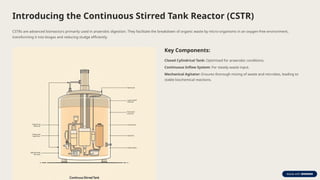
Introducing the Continuous Stirred Tank Reactor (CSTR)
CSTRs are advanced bioreactors primarily used in anaerobic digestion. They facilitate the breakdown of organic waste by micro-organisms in an oxygen-free environment,
transforming it into biogas and reducing sludge efficiently.
Key Components:
Closed Cylindrical Tank: Optimised for anaerobic conditions.
Continuous Inflow System: For steady waste input.
Mechanical Agitator: Ensures thorough mixing of waste and microbes, leading to
stable biochemical reactions.
Benefits of CSTR for Waste Digestion
1
Enhanced Mixing Efficiency
Continuous agitation prevents
solids from settling, ensuring
uniform nutrient access for
microbes and improving
biodegradation rates. This leads to
superior digestion and efficient
wastewater treatment.
2
Higher Biogas Production
Even distribution of bacteria
throughout the waste material
maximises methane output,
providing a consistent and
abundant source of renewable
energy.
3
Improved Organic Waste
Breakdown
Constant blending prevents
layering, allowing for complete
hydrolysis, acidogenesis,
acetogenesis, and methanogenesis.
This reduces leftover sludge and
enhances overall treatment
efficiency.
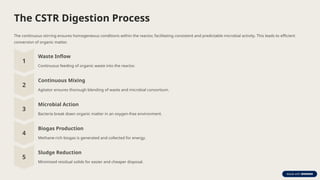
The CSTR Digestion Process
The continuous stirring ensures homogeneous conditions within the reactor, facilitating consistent and predictable microbial activity. This leads to efficient
conversion of organic matter.
Waste Inflow
Continuous feeding of organic waste into the reactor.
Continuous Mixing
Agitator ensures thorough blending of waste and microbial consortium.
Microbial Action
Bacteria break down organic matter in an oxygen-free environment.
Biogas Production
Methane-rich biogas is generated and collected for energy.
Sludge Reduction
Minimised residual solids for easier and cheaper disposal.
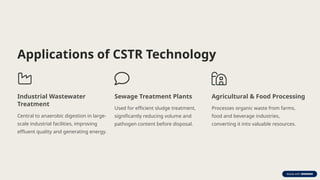
Applications of CSTR Technology
Industrial Wastewater
Treatment
Central to anaerobic digestion in large-
scale industrial facilities, improving
effluent quality and generating energy.
Sewage Treatment Plants
Used for efficient sludge treatment,
significantly reducing volume and
pathogen content before disposal.
Agricultural & Food Processing
Processes organic waste from farms,
food and beverage industries,
converting it into valuable resources.
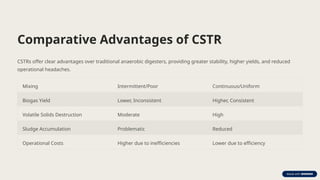
Comparative Advantages of CSTR
CSTRs offer clear advantages over traditional anaerobic digesters, providing greater stability, higher yields, and reduced
operational headaches.
Mixing Intermittent/Poor Continuous/Uniform
Biogas Yield Lower, Inconsistent Higher, Consistent
Volatile Solids Destruction Moderate High
Sludge Accumulation Problematic Reduced
Operational Costs Higher due to inefficiencies Lower due to efficiency
Next Steps: Optimise Your Waste Digestion
Transitioning to CSTR technology can significantly improve your waste digestion process, turning liabilities into assets.
Efficient waste digestion starts with the right solutions.
Assess Your Current System: Identify specific inefficiencies in your existing setup.
Consult Experts: Engage with specialists in CSTR implementation for tailored solutions.
Implement CSTR Technology: Upgrade to a system that promises enhanced efficiency and sustainability.
Monitor & Optimise: Continuously evaluate performance to maximise biogas production and minimise waste.
Contact us
info@kjhil.com
7433913405
https://kjhil.com/

Boosting-Waste-Digestion-Efficiency-with-CSTRs

  • 1.
    Boosting Waste Digestion Efficiencywith CSTRs Discover how Continuous Stirred Tank Reactors (CSTRs) revolutionise waste treatment, converting waste into valuable renewable energy.
  • 2.
    Addressing Inefficiencies inTraditional Digestion Longer Hydraulic Retention Times Leading to reduced throughput and increased operational footprints for waste processing. Inconsistent Biogas Output Making it difficult to predict and utilise renewable energy generation effectively. Low Volatile Solids Destruction Resulting in less efficient breakdown of organic matter and higher residual waste volumes. Problematic Sludge Accumulation Increasing disposal costs and requiring more frequent, costly maintenance. These issues collectively inflate operational costs, highlighting the need for more efficient solutions.
  • 3.
    Introducing the ContinuousStirred Tank Reactor (CSTR) CSTRs are advanced bioreactors primarily used in anaerobic digestion. They facilitate the breakdown of organic waste by micro-organisms in an oxygen-free environment, transforming it into biogas and reducing sludge efficiently. Key Components: Closed Cylindrical Tank: Optimised for anaerobic conditions. Continuous Inflow System: For steady waste input. Mechanical Agitator: Ensures thorough mixing of waste and microbes, leading to stable biochemical reactions.
  • 4.
    Benefits of CSTRfor Waste Digestion 1 Enhanced Mixing Efficiency Continuous agitation prevents solids from settling, ensuring uniform nutrient access for microbes and improving biodegradation rates. This leads to superior digestion and efficient wastewater treatment. 2 Higher Biogas Production Even distribution of bacteria throughout the waste material maximises methane output, providing a consistent and abundant source of renewable energy. 3 Improved Organic Waste Breakdown Constant blending prevents layering, allowing for complete hydrolysis, acidogenesis, acetogenesis, and methanogenesis. This reduces leftover sludge and enhances overall treatment efficiency.
  • 5.
    The CSTR DigestionProcess The continuous stirring ensures homogeneous conditions within the reactor, facilitating consistent and predictable microbial activity. This leads to efficient conversion of organic matter. Waste Inflow Continuous feeding of organic waste into the reactor. Continuous Mixing Agitator ensures thorough blending of waste and microbial consortium. Microbial Action Bacteria break down organic matter in an oxygen-free environment. Biogas Production Methane-rich biogas is generated and collected for energy. Sludge Reduction Minimised residual solids for easier and cheaper disposal.
  • 6.
    Applications of CSTRTechnology Industrial Wastewater Treatment Central to anaerobic digestion in large- scale industrial facilities, improving effluent quality and generating energy. Sewage Treatment Plants Used for efficient sludge treatment, significantly reducing volume and pathogen content before disposal. Agricultural & Food Processing Processes organic waste from farms, food and beverage industries, converting it into valuable resources.
  • 7.
    Comparative Advantages ofCSTR CSTRs offer clear advantages over traditional anaerobic digesters, providing greater stability, higher yields, and reduced operational headaches. Mixing Intermittent/Poor Continuous/Uniform Biogas Yield Lower, Inconsistent Higher, Consistent Volatile Solids Destruction Moderate High Sludge Accumulation Problematic Reduced Operational Costs Higher due to inefficiencies Lower due to efficiency
  • 8.
    Next Steps: OptimiseYour Waste Digestion Transitioning to CSTR technology can significantly improve your waste digestion process, turning liabilities into assets. Efficient waste digestion starts with the right solutions. Assess Your Current System: Identify specific inefficiencies in your existing setup. Consult Experts: Engage with specialists in CSTR implementation for tailored solutions. Implement CSTR Technology: Upgrade to a system that promises enhanced efficiency and sustainability. Monitor & Optimise: Continuously evaluate performance to maximise biogas production and minimise waste.
  • 9.