PRESENTATION
ON
BOLTED CONNECTION
BY
RAHUL RAJ , BSAP , NEW DELHI
INTRODUCTION
• A bolt is a metal pin with a head formed at
one end and shank threaded at the other in
order to receive a nut.
• On the basis of load transfer in the
connection bolts are classified as:
• (a) Bearing Type
• (b) Friction Grip Type
Types of bearing bolts
• There are two types of bearing type bolts,
namely,
• (i) Unfinished or Black Bolts.
• (ii) Finished or Turned Bolts.
Unfinished or Black Bolts.
• The shanks of black bolts are unfinished, i.e.,
rough as obtained at the time of rolling.
• For black bolts, diameter of bolt hole is larger
and are used in most of the work.
• A black bolt is represented as M16, M20, etc.
which means black bolt of nominal diameter
16 mm, black bolt of nominal diameter 20
mm, etc.
Finished or Turned Bolts.
• turned bolts are obtained by turning
hexagonal shank to circular shape.
• The bolt hole diameter is only 1.5 mm larger
than that of the shank in case of turned bolt.
• These bolts are used in special jobs like
connecting machine parts subject to dynamic
loadings.
TERMINOLOGY
The following terms used in bolted connection
should be
1. Pitch of the Bolts (p): It is the centre-to-centre
spacing of the bolts in a row, measured along the
direction of load.
2. Gauge Distance (g): It is the distance between
the two consecutive bolts of adjacent rows and is
measured at right angles to the direction of load.
3. Edge Distance (e): It is the distance of bolt hole
from the adjacent edge of the plate.
Grade Classification of Bolts
• The grade classification of bolt is indicative of the strength
of the material of the bolt. The two grades of bolts
commonly used are 4.6 and 8.8.
• For a 4.6 grade 4 indicates that the ultimate tensile
strength of the bolt,
fub = 4 x 100 = 400 N/mm2
and, 0.6 indicates that the yield strength of the bolt,
fyb= 0.6 x Ultimate strength
= 0.6 x 400 = 240 N/ mm2
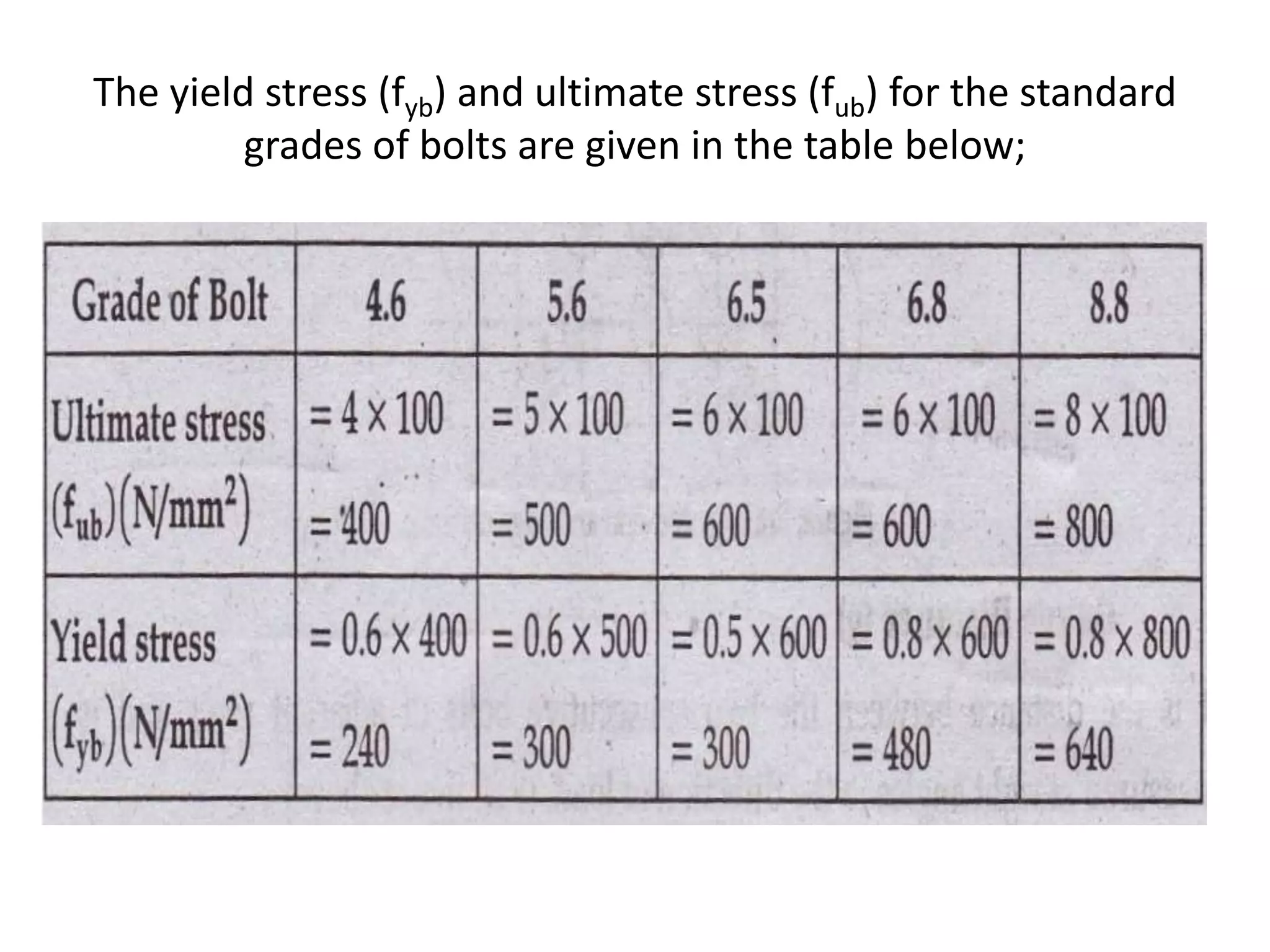
The yield stress (fyb) and ultimate stress (fub) for the standard
grades of bolts are given in the table below;
Specification
For connection, see section 10 code IS 800 : 2007.
1. Pitch 'p' shall not be less than 2.5d, where, 'd' is the
nominal diameter of bolt (also see clause 10.2.2 of code IS
800 : 2007)
2. Pitch 'p' shall not be more than;
a) 16 t or 200 mm whichever is less, in case of tension
members. (Also see clause 10.2.3.2 of code IS 800 : 2007).
b) 12 t or 200 mm, whichever is less in case of compression
member where, 't' is the thickness of thinnest member.
c) In case of staggered pitch, pitch may be increased by 50
percent of values specified above provided gap distance is less
than 75 mm. (See clause 10.2.3.4 of code IS 800 : 2007).
3. In case of butt joints maximum pitch is to be restricted to 4.5
d for a distance of 1.5 times the width of plate from the butting
surface.
4. The gauge length 'g' should not be more than 100 + 4 t or 200
mm whichever is less.
5. Minimum edge distance shall not be;
a) Less than 1.7 x hole diameter in case of sheared or hand
flame cut edges.
b) Less than 1.5 x hole diameter in case of rolled, machine flame
cut, sawn and planed edges (See clause 10.2.4.2 of code IS 800:
2007).
6. Maximum edge distance (e) should not exceed
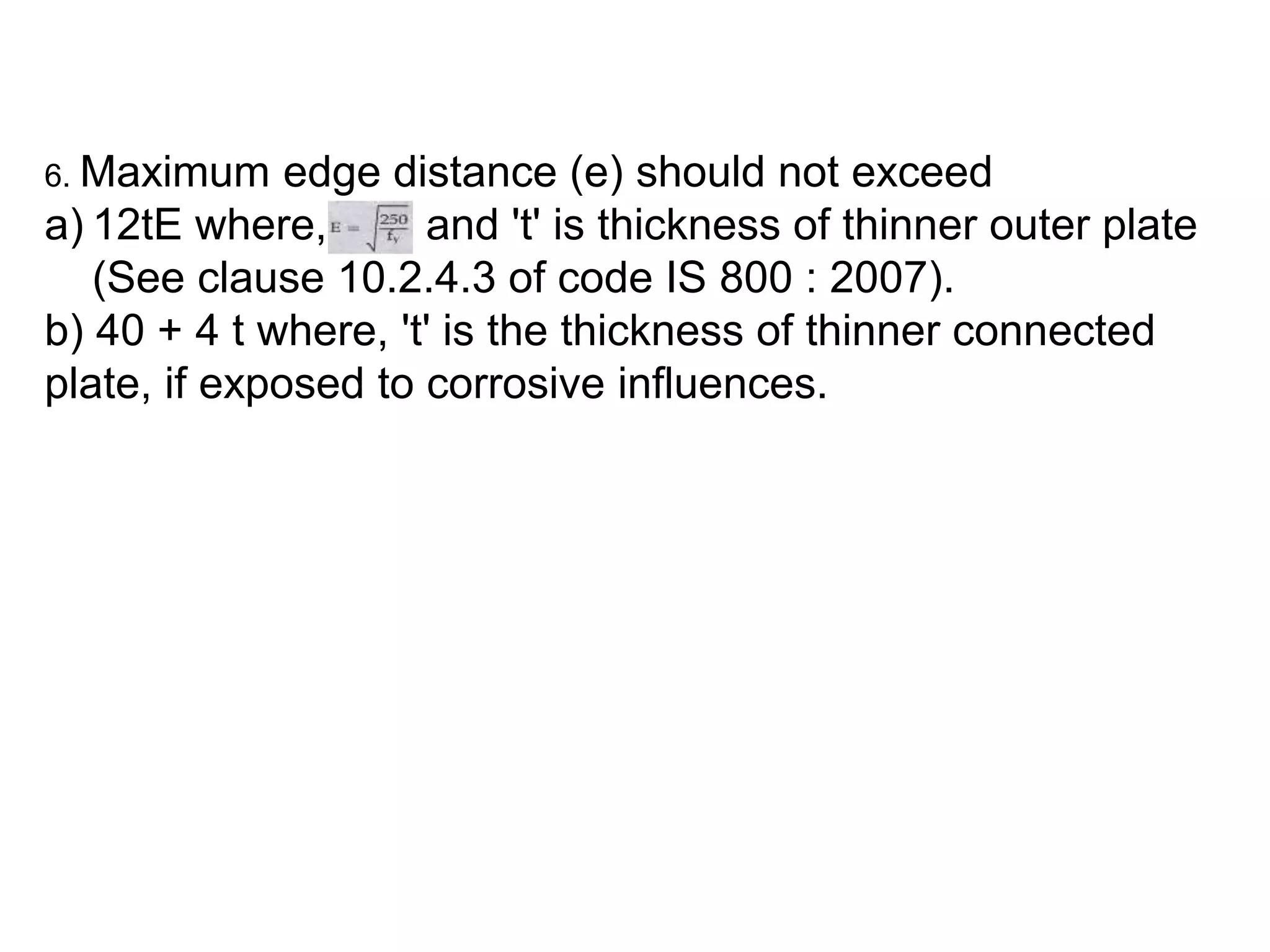
a) 12tE where, and 't' is thickness of thinner outer plate
(See clause 10.2.4.3 of code IS 800 : 2007).
b) 40 + 4 t where, 't' is the thickness of thinner connected
plate, if exposed to corrosive influences.
Types of Bolted Connections
Types of joints may be grouped into the following two;
a) Lap Joint: It is simplest types of joints. In this, plates to
be connected overlap one another.
b) Butt Joint: In this type of connection, the two main plates
about against each other and the connection is made by
providing a single cover plate connected to the main plate
or by double cover plates, one on either side connected to
the main plates.
Bolted joint
lap joint Butt joint
THANK YOU

BOLTED CONNECTION

  • 1.
  • 2.
    INTRODUCTION • A boltis a metal pin with a head formed at one end and shank threaded at the other in order to receive a nut. • On the basis of load transfer in the connection bolts are classified as: • (a) Bearing Type • (b) Friction Grip Type
  • 4.
    Types of bearingbolts • There are two types of bearing type bolts, namely, • (i) Unfinished or Black Bolts. • (ii) Finished or Turned Bolts.
  • 5.
    Unfinished or BlackBolts. • The shanks of black bolts are unfinished, i.e., rough as obtained at the time of rolling. • For black bolts, diameter of bolt hole is larger and are used in most of the work. • A black bolt is represented as M16, M20, etc. which means black bolt of nominal diameter 16 mm, black bolt of nominal diameter 20 mm, etc.
  • 6.
    Finished or TurnedBolts. • turned bolts are obtained by turning hexagonal shank to circular shape. • The bolt hole diameter is only 1.5 mm larger than that of the shank in case of turned bolt. • These bolts are used in special jobs like connecting machine parts subject to dynamic loadings.
  • 7.
    TERMINOLOGY The following termsused in bolted connection should be 1. Pitch of the Bolts (p): It is the centre-to-centre spacing of the bolts in a row, measured along the direction of load. 2. Gauge Distance (g): It is the distance between the two consecutive bolts of adjacent rows and is measured at right angles to the direction of load. 3. Edge Distance (e): It is the distance of bolt hole from the adjacent edge of the plate.
  • 9.
    Grade Classification ofBolts • The grade classification of bolt is indicative of the strength of the material of the bolt. The two grades of bolts commonly used are 4.6 and 8.8. • For a 4.6 grade 4 indicates that the ultimate tensile strength of the bolt, fub = 4 x 100 = 400 N/mm2 and, 0.6 indicates that the yield strength of the bolt, fyb= 0.6 x Ultimate strength = 0.6 x 400 = 240 N/ mm2
  • 10.
    The yield stress(fyb) and ultimate stress (fub) for the standard grades of bolts are given in the table below;
  • 11.
    Specification For connection, seesection 10 code IS 800 : 2007. 1. Pitch 'p' shall not be less than 2.5d, where, 'd' is the nominal diameter of bolt (also see clause 10.2.2 of code IS 800 : 2007) 2. Pitch 'p' shall not be more than; a) 16 t or 200 mm whichever is less, in case of tension members. (Also see clause 10.2.3.2 of code IS 800 : 2007). b) 12 t or 200 mm, whichever is less in case of compression member where, 't' is the thickness of thinnest member.
  • 12.
    c) In caseof staggered pitch, pitch may be increased by 50 percent of values specified above provided gap distance is less than 75 mm. (See clause 10.2.3.4 of code IS 800 : 2007). 3. In case of butt joints maximum pitch is to be restricted to 4.5 d for a distance of 1.5 times the width of plate from the butting surface. 4. The gauge length 'g' should not be more than 100 + 4 t or 200 mm whichever is less. 5. Minimum edge distance shall not be; a) Less than 1.7 x hole diameter in case of sheared or hand flame cut edges. b) Less than 1.5 x hole diameter in case of rolled, machine flame cut, sawn and planed edges (See clause 10.2.4.2 of code IS 800: 2007).
  • 13.
    6. Maximum edgedistance (e) should not exceed a) 12tE where, and 't' is thickness of thinner outer plate (See clause 10.2.4.3 of code IS 800 : 2007). b) 40 + 4 t where, 't' is the thickness of thinner connected plate, if exposed to corrosive influences.
  • 14.
    Types of BoltedConnections Types of joints may be grouped into the following two; a) Lap Joint: It is simplest types of joints. In this, plates to be connected overlap one another. b) Butt Joint: In this type of connection, the two main plates about against each other and the connection is made by providing a single cover plate connected to the main plate or by double cover plates, one on either side connected to the main plates.
  • 15.
  • 16.