BLOOM’S
TAXONOMY
Jamaica C. Olazo
https://www.facebook.com/ja.maica.393
• comes from the Greek word
“taxis=arrangements” and “nomos=science”
• Science of arrangements
• means 'a set of classification principles', or
'structure', and
• Domain simply means 'category'.
TAXONOMY
2
Jamaica C. Olazo || https://www.facebook.com/ja.maica.393
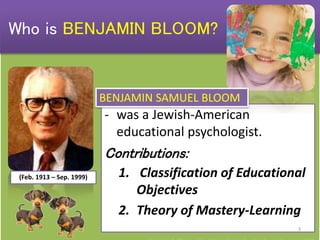
- was a Jewish-American
educational psychologist.
Contributions:
1. Classification of Educational
Objectives
2. Theory of Mastery-Learning
(Feb. 1913 – Sep. 1999)
Who is BENJAMIN BLOOM?
BENJAMIN SAMUEL BLOOM
3
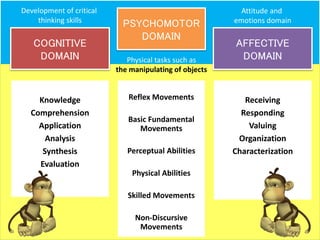
COGNITIVE
DOMAIN
Knowledge
Comprehension
Application
Analysis
Synthesis
Evaluation
PSYCHOMOTOR
DOMAIN
AFFECTIVE
DOMAIN
Reflex Movements
Basic Fundamental
Movements
Perceptual Abilities
Physical Abilities
Skilled Movements
Non-Discursive
Movements
Receiving
Responding
Valuing
Organization
Characterization
4
Attitude and
emotions domain
Physical tasks such as
the manipulating of objects
Development of critical
thinking skills
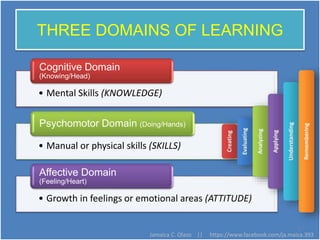
THREE DOMAINS OF LEARNING
• Mental Skills (KNOWLEDGE)
Cognitive Domain
(Knowing/Head)
• Manual or physical skills (SKILLS)
Psychomotor Domain (Doing/Hands)
• Growth in feelings or emotional areas (ATTITUDE)
Affective Domain
(Feeling/Heart)
5
Jamaica C. Olazo || https://www.facebook.com/ja.maica.393
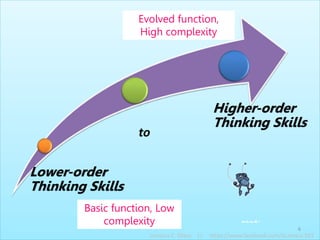
Lower-order
Thinking Skills
to
Higher-order
Thinking Skills
6
Evolved function,
High complexity
Basic function, Low
complexity
Jamaica C. Olazo || https://www.facebook.com/ja.maica.393
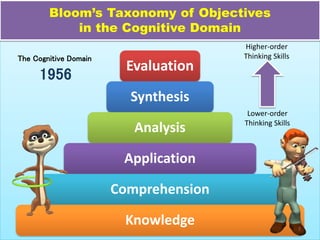
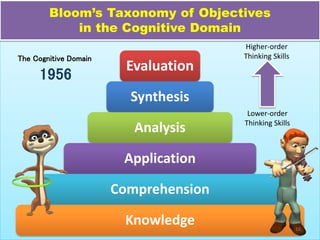
Bloom’s Taxonomy of Objectives
in the Cognitive Domain
Evaluation
Synthesis
Analysis
Application
Comprehension
Knowledge
The Cognitive Domain
1956
7
Lower-order
Thinking Skills
Higher-order
Thinking Skills
8
Jamaica C. Olazo || https://www.facebook.com/ja.maica.393
9
Jamaica C. Olazo || https://www.facebook.com/ja.maica.393
Bloom’s Taxonomy of Objectives
in the Cognitive Domain
Evaluation
Synthesis
Analysis
Application
Comprehension
Knowledge
The Cognitive Domain
1956
10
Lower-order
Thinking Skills
Higher-order
Thinking Skills
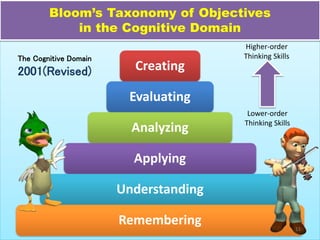
Bloom’s Taxonomy of Objectives
in the Cognitive Domain
Creating
Evaluating
Analyzing
Applying
Understanding
Remembering
The Cognitive Domain
2001(Revised)
11
Lower-order
Thinking Skills
Higher-order
Thinking Skills
12
Jamaica C. Olazo || https://www.facebook.com/ja.maica.393
13
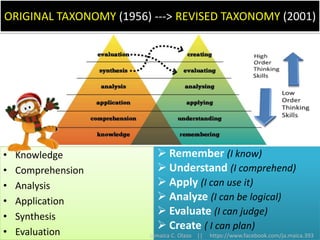
ORIGINAL TAXONOMY (1956) ---> REVISED TAXONOMY (2001)
• Knowledge
• Comprehension
• Analysis
• Application
• Synthesis
• Evaluation
 Remember (I know)
 Understand (I comprehend)
 Apply (I can use it)
 Analyze (I can be logical)
 Evaluate (I can judge)
 Create ( I can plan)
Jamaica C. Olazo || https://www.facebook.com/ja.maica.393
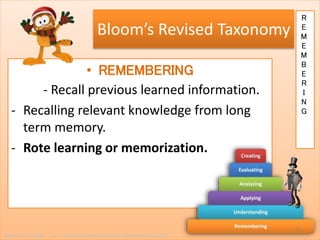
• REMEMBERING
- Recall previous learned information.
- Recalling relevant knowledge from long
term memory.
- Rote learning or memorization.
Bloom’s Revised Taxonomy
R
E
M
E
M
B
E
R
I
N
G
14
Jamaica C. Olazo || https://www.facebook.com/ja.maica.393
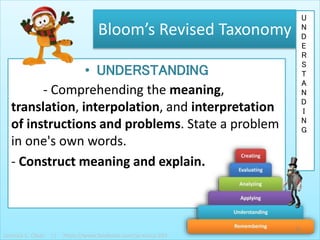
• UNDERSTANDING
- Comprehending the meaning,
translation, interpolation, and interpretation
of instructions and problems. State a problem
in one's own words.
- Construct meaning and explain.
Bloom’s Revised Taxonomy
U
N
D
E
R
S
T
A
N
D
I
N
G
15
Jamaica C. Olazo || https://www.facebook.com/ja.maica.393
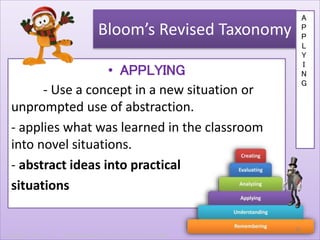
• APPLYING
- Use a concept in a new situation or
unprompted use of abstraction.
- applies what was learned in the classroom
into novel situations.
- abstract ideas into practical
situations
Bloom’s Revised Taxonomy
A
P
P
L
Y
I
N
G
16
Jamaica C. Olazo || https://www.facebook.com/ja.maica.393
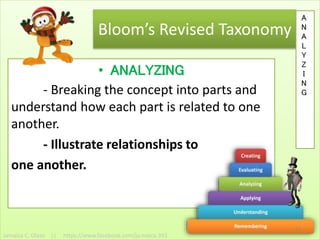
• ANALYZING
- Breaking the concept into parts and
understand how each part is related to one
another.
- Illustrate relationships to
one another.
Bloom’s Revised Taxonomy
A
N
A
L
Y
Z
I
N
G
17
Jamaica C. Olazo || https://www.facebook.com/ja.maica.393
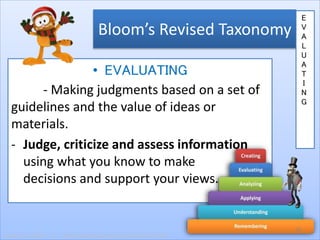
• EVALUATING
- Making judgments based on a set of
guidelines and the value of ideas or
materials.
- Judge, criticize and assess information
using what you know to make
decisions and support your views.
Bloom’s Revised Taxonomy
E
V
A
L
U
A
T
I
N
G
18
Jamaica C. Olazo || https://www.facebook.com/ja.maica.393
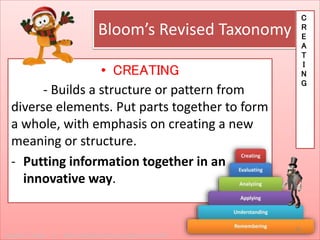
• CREATING
- Builds a structure or pattern from
diverse elements. Put parts together to form
a whole, with emphasis on creating a new
meaning or structure.
- Putting information together in an
innovative way.
Bloom’s Revised Taxonomy
C
R
E
A
T
I
N
G
19
Jamaica C. Olazo || https://www.facebook.com/ja.maica.393
20
Jamaica C. Olazo || https://www.facebook.com/ja.maica.393
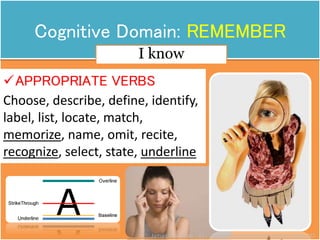
Cognitive Domain: REMEMBER
APPROPRIATE VERBS
Choose, describe, define, identify,
label, list, locate, match,
memorize, name, omit, recite,
recognize, select, state, underline
21
I know
Jamaica C. Olazo || https://www.facebook.com/ja.maica.393
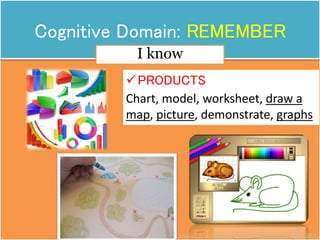
PRODUCTS
Chart, model, worksheet, draw a
map, picture, demonstrate, graphs
22
Cognitive Domain: REMEMBER
I know
Jamaica C. Olazo || https://www.facebook.com/ja.maica.393
23
MODEL QUESTIONS
• Who? Where? Which
One? What? How?
• What is the best one?
Why? How much?
When?
• What does it
mean?
INSTRUCTIONAL
STRATEGIES
• Highlighting
• Rehearsal
• Memorizing
• Mnemonics
Cognitive Domain: REMEMBER
I know
24
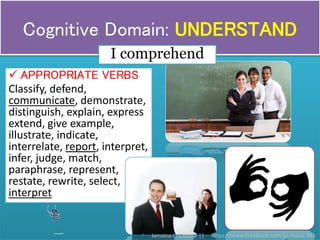
 APPROPRIATE VERBS
Classify, defend,
communicate, demonstrate,
distinguish, explain, express
extend, give example,
illustrate, indicate,
interrelate, report, interpret,
infer, judge, match,
paraphrase, represent,
restate, rewrite, select,
interpret
Cognitive Domain: UNDERSTAND
I comprehend
Jamaica C. Olazo || https://www.facebook.com/ja.maica.393
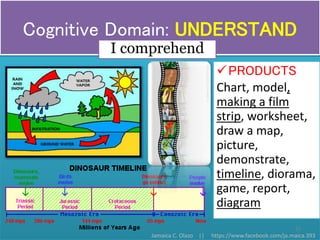
PRODUCTS
Chart, model,
making a film
strip, worksheet,
draw a map,
picture,
demonstrate,
timeline, diorama,
game, report,
diagram
Cognitive Domain: UNDERSTAND
25
I comprehend
Jamaica C. Olazo || https://www.facebook.com/ja.maica.393
26
MODEL QUESTIONS
• State in your own words.
Which are facts?
• What does this mean? Is
this the same as. . .?
Give an example.
• Select the best
definition.
• State in one word . . .
Explain what is
happening.
INSTRUCTIONAL
STRATEGIES
• Key examples
• Emphasize
connections
• Elaborate concepts
• Summarize
Cognitive Domain: UNDERSTAND
I comprehend
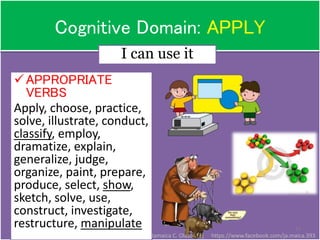
Cognitive Domain: APPLY
27
APPROPRIATE
VERBS
Apply, choose, practice,
solve, illustrate, conduct,
classify, employ,
dramatize, explain,
generalize, judge,
organize, paint, prepare,
produce, select, show,
sketch, solve, use,
construct, investigate,
restructure, manipulate
I can use it
Jamaica C. Olazo || https://www.facebook.com/ja.maica.393
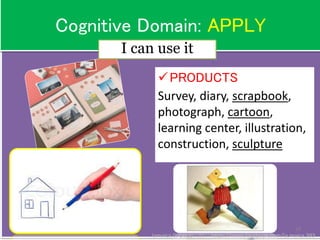
PRODUCTS
Survey, diary, scrapbook,
photograph, cartoon,
learning center, illustration,
construction, sculpture
28
Cognitive Domain: APPLY
I can use it
Jamaica C. Olazo || https://www.facebook.com/ja.maica.393
29
 MODEL QUESTIONS
• Predict what would happen
if… Choose the best
statements that apply…
• Judge the effects…
• What would result…
• Tell what would happen…
• Tell how, when, where, why
Tell how much change
there would be…
• Identify the results of…
 INSTRUCTIONAL
STRATEGIES
• Modeling
• Cognitive
apprenticeships
“Mindful” practice – NOT
just a “routine” practice
• Part and whole
sequencing
• Authentic situations
“Coached” practice Case
studies Simulations
Algorithms
Cognitive Domain: APPLY
I can use it
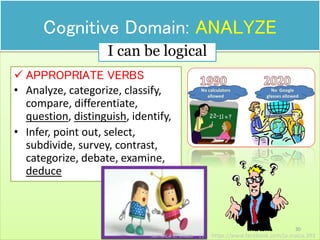
Cognitive Domain: ANALYZE
30
 APPROPRIATE VERBS
• Analyze, categorize, classify,
compare, differentiate,
question, distinguish, identify,
• Infer, point out, select,
subdivide, survey, contrast,
categorize, debate, examine,
deduce
I can be logical
Jamaica C. Olazo || https://www.facebook.com/ja.maica.393
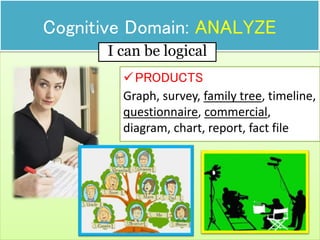
PRODUCTS
Graph, survey, family tree, timeline,
questionnaire, commercial,
diagram, chart, report, fact file
31
Cognitive Domain: ANALYZE
I can be logical
32
 MODEL QUESTIONS
• What is the function of . . .?
What's fact? Opinion? What
assumptions. . .?
• What statement is relevant?
What motive is there?
• Related to, extraneous to, not
applicable.
• What conclusions?
• What does the author
believe? What does the
author assume?
• Make a distinction.
 INSTRUCTIONAL
STRATEGIES
• Models of thinking
• Challenging
assumptions
• Retrospective analysis
• Reflection through
journaling Debates
• Discussions and other
collaborating learning
activities Decision-
making situations
Cognitive Domain: ANALYZE
I can be logical
Cognitive Domain: EVALUATE
33
APPROPRIATE
VERBS
• Appraise, judge,
criticize, defend,
estimate, compare,
measure, verify,
justify, select, decide,
choose, recommend,
assess, critique,
revise, validate,
standardize, argue,
rate, measure
I can judge
Jamaica C. Olazo || https://www.facebook.com/ja.maica.393
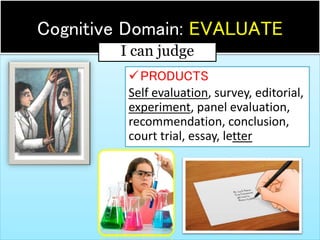
PRODUCTS
Self evaluation, survey, editorial,
experiment, panel evaluation,
recommendation, conclusion,
court trial, essay, letter
34
Cognitive Domain: EVALUATE
I can judge
35
MODEL QUESTIONS
• What fallacies,
consistencies,
inconsistencies appear?
• Which is more
important, moral, better,
logical, valid,
appropriate?
• Find the errors.
INSTRUCTIONAL
STRATEGIES
• Challenging
assumptions
• Journaling
• Debates
• Discussions and
other collaborating
learning activities
Decision-making
situations
Cognitive Domain: EVALUATE
I can judge
Cognitive Domain: CREATE
36
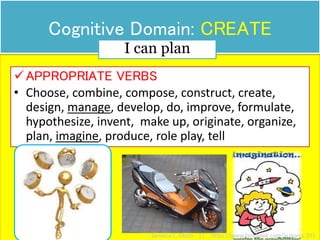
APPROPRIATE VERBS
• Choose, combine, compose, construct, create,
design, manage, develop, do, improve, formulate,
hypothesize, invent, make up, originate, organize,
plan, imagine, produce, role play, tell
I can plan
Jamaica C. Olazo || https://www.facebook.com/ja.maica.393
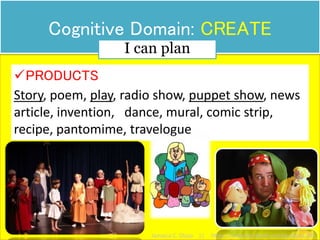
PRODUCTS
Story, poem, play, radio show, puppet show, news
article, invention, dance, mural, comic strip,
recipe, pantomime, travelogue
37
Cognitive Domain: CREATE
I can plan
Jamaica C. Olazo || https://www.facebook.com/ja.maica.393
38
MODEL QUESTIONS
• How would you test…?
• Propose an alternative.
• Solve the following.
• How else would you...?
• State a rule.
 INSTRUCTIONAL
STRATEGIES
• Modeling
• Challenging assumptions
Reflection through
journaling Debates
• Discussions and other
• collaborating learning
activities
• Design
• Decision-making
situations
Cognitive Domain: CREATE
I can plan
39
HOW CAN WE DEVELOP THE
HABIT OF ASKING HIGHER-ORDER
QUESTIONS?
1. Avoid literal-level questions in favor of those
requiring higher-order thinking.
2. Use questions requiring higher-order
thinking.
Higher-order questions are important for modeling
different ways students can:
- Interpret
- Apply
- Evaluate
- Reflect on what they are learning
40
HOW CAN WE DEVELOP THE
HABIT OF ASKING HIGHER-ORDER
QUESTIONS?
3. Classify questions according to the kinds of
thinking required for students to respond.
– Use of Bloom’s Taxonomy of Thinking
– Questions classified as knowledge or comprehension
should be avoided
– Teachers should make sure their questions can be
classified as APPLICATION, ANALYSIS, SYNTHESIS and/or
EVALUATION.
Jamaica C. Olazo || https://www.facebook.com/ja.maica.393
HOW CAN WE DEVELOP THE HABIT
OF ASKING HIGHER-ORDER
QUESTIONS?
41
4. Use verbs associated with higher-order
thinking tasks.
- Verbs representing cognitive tasks in Bloom’s Taxonomy
5. Consider the learning products associated
with higher-order thinking tasks.
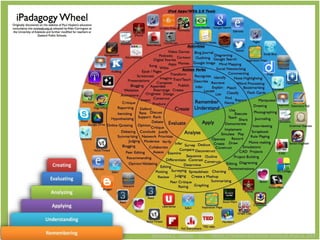
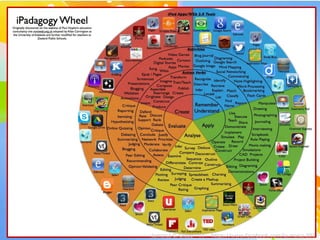
- Task Oriented Question Construction Wheel
Jamaica C. Olazo || https://www.facebook.com/ja.maica.393
42
Jamaica C. Olazo || https://www.facebook.com/ja.maica.393
EFFECTIVE QUESTIONING TECHNIQUES
1. Pose the question first before asking a student
to respond.
2. Allow plenty of “think time” by waiting at
least 7-10 seconds before expecting the student
to respond.
-help students adjust to an extended wait time
43
Jamaica C. Olazo || https://www.facebook.com/ja.maica.393
EFFECTIVE QUESTIONING TECHNIQUES
3. Give all students the opportunity to respond
rather than relying on volunteers.
a. Create a system to help you keep track of
who you call on
b. Allow your student to “pass” when he’s
not ready to respond
c. Give him another opportunity later
44
Jamaica C. Olazo || https://www.facebook.com/ja.maica.393
EFFECTIVE QUESTIONING TECHNIQUES
4. Hold students accountable by expecting,
requiring, and facilitating their participation and
contributions.
a. Never answer your own questions.
b. Do NOT accept “I don’t know” for an answer.
c. Offer hints or suggestions to guide students.
d. Offer two or more options and let the student
choose one
45
Jamaica C. Olazo || https://www.facebook.com/ja.maica.393
EFFECTIVE QUESTIONING TECHNIQUES
5. Establish a safe atmosphere for risk
taking by guiding students.
a. Always “dignify” incorrect responses by saying
something positive about students.
b. Build confidence and trust when students make
mistakes.
c. Admit your own mistakes and “think aloud”
examples of a reflection.
46
Jamaica C. Olazo || https://www.facebook.com/ja.maica.393

Bloomstaxonomyfinal 130903085938-

  • 1.
  • 2.
    • comes fromthe Greek word “taxis=arrangements” and “nomos=science” • Science of arrangements • means 'a set of classification principles', or 'structure', and • Domain simply means 'category'. TAXONOMY 2 Jamaica C. Olazo || https://www.facebook.com/ja.maica.393
  • 3.
    - was aJewish-American educational psychologist. Contributions: 1. Classification of Educational Objectives 2. Theory of Mastery-Learning (Feb. 1913 – Sep. 1999) Who is BENJAMIN BLOOM? BENJAMIN SAMUEL BLOOM 3
  • 4.
    COGNITIVE DOMAIN Knowledge Comprehension Application Analysis Synthesis Evaluation PSYCHOMOTOR DOMAIN AFFECTIVE DOMAIN Reflex Movements Basic Fundamental Movements PerceptualAbilities Physical Abilities Skilled Movements Non-Discursive Movements Receiving Responding Valuing Organization Characterization 4 Attitude and emotions domain Physical tasks such as the manipulating of objects Development of critical thinking skills
  • 5.
    THREE DOMAINS OFLEARNING • Mental Skills (KNOWLEDGE) Cognitive Domain (Knowing/Head) • Manual or physical skills (SKILLS) Psychomotor Domain (Doing/Hands) • Growth in feelings or emotional areas (ATTITUDE) Affective Domain (Feeling/Heart) 5 Jamaica C. Olazo || https://www.facebook.com/ja.maica.393
  • 6.
    Lower-order Thinking Skills to Higher-order Thinking Skills 6 Evolvedfunction, High complexity Basic function, Low complexity Jamaica C. Olazo || https://www.facebook.com/ja.maica.393
  • 7.
    Bloom’s Taxonomy ofObjectives in the Cognitive Domain Evaluation Synthesis Analysis Application Comprehension Knowledge The Cognitive Domain 1956 7 Lower-order Thinking Skills Higher-order Thinking Skills
  • 8.
    8 Jamaica C. Olazo|| https://www.facebook.com/ja.maica.393
  • 9.
    9 Jamaica C. Olazo|| https://www.facebook.com/ja.maica.393
  • 10.
    Bloom’s Taxonomy ofObjectives in the Cognitive Domain Evaluation Synthesis Analysis Application Comprehension Knowledge The Cognitive Domain 1956 10 Lower-order Thinking Skills Higher-order Thinking Skills
  • 11.
    Bloom’s Taxonomy ofObjectives in the Cognitive Domain Creating Evaluating Analyzing Applying Understanding Remembering The Cognitive Domain 2001(Revised) 11 Lower-order Thinking Skills Higher-order Thinking Skills
  • 12.
    12 Jamaica C. Olazo|| https://www.facebook.com/ja.maica.393
  • 13.
    13 ORIGINAL TAXONOMY (1956)---> REVISED TAXONOMY (2001) • Knowledge • Comprehension • Analysis • Application • Synthesis • Evaluation  Remember (I know)  Understand (I comprehend)  Apply (I can use it)  Analyze (I can be logical)  Evaluate (I can judge)  Create ( I can plan) Jamaica C. Olazo || https://www.facebook.com/ja.maica.393
  • 14.
    • REMEMBERING - Recallprevious learned information. - Recalling relevant knowledge from long term memory. - Rote learning or memorization. Bloom’s Revised Taxonomy R E M E M B E R I N G 14 Jamaica C. Olazo || https://www.facebook.com/ja.maica.393
  • 15.
    • UNDERSTANDING - Comprehendingthe meaning, translation, interpolation, and interpretation of instructions and problems. State a problem in one's own words. - Construct meaning and explain. Bloom’s Revised Taxonomy U N D E R S T A N D I N G 15 Jamaica C. Olazo || https://www.facebook.com/ja.maica.393
  • 16.
    • APPLYING - Usea concept in a new situation or unprompted use of abstraction. - applies what was learned in the classroom into novel situations. - abstract ideas into practical situations Bloom’s Revised Taxonomy A P P L Y I N G 16 Jamaica C. Olazo || https://www.facebook.com/ja.maica.393
  • 17.
    • ANALYZING - Breakingthe concept into parts and understand how each part is related to one another. - Illustrate relationships to one another. Bloom’s Revised Taxonomy A N A L Y Z I N G 17 Jamaica C. Olazo || https://www.facebook.com/ja.maica.393
  • 18.
    • EVALUATING - Makingjudgments based on a set of guidelines and the value of ideas or materials. - Judge, criticize and assess information using what you know to make decisions and support your views. Bloom’s Revised Taxonomy E V A L U A T I N G 18 Jamaica C. Olazo || https://www.facebook.com/ja.maica.393
  • 19.
    • CREATING - Buildsa structure or pattern from diverse elements. Put parts together to form a whole, with emphasis on creating a new meaning or structure. - Putting information together in an innovative way. Bloom’s Revised Taxonomy C R E A T I N G 19 Jamaica C. Olazo || https://www.facebook.com/ja.maica.393
  • 20.
    20 Jamaica C. Olazo|| https://www.facebook.com/ja.maica.393
  • 21.
    Cognitive Domain: REMEMBER APPROPRIATEVERBS Choose, describe, define, identify, label, list, locate, match, memorize, name, omit, recite, recognize, select, state, underline 21 I know Jamaica C. Olazo || https://www.facebook.com/ja.maica.393
  • 22.
    PRODUCTS Chart, model, worksheet,draw a map, picture, demonstrate, graphs 22 Cognitive Domain: REMEMBER I know Jamaica C. Olazo || https://www.facebook.com/ja.maica.393
  • 23.
    23 MODEL QUESTIONS • Who?Where? Which One? What? How? • What is the best one? Why? How much? When? • What does it mean? INSTRUCTIONAL STRATEGIES • Highlighting • Rehearsal • Memorizing • Mnemonics Cognitive Domain: REMEMBER I know
  • 24.
    24  APPROPRIATE VERBS Classify,defend, communicate, demonstrate, distinguish, explain, express extend, give example, illustrate, indicate, interrelate, report, interpret, infer, judge, match, paraphrase, represent, restate, rewrite, select, interpret Cognitive Domain: UNDERSTAND I comprehend Jamaica C. Olazo || https://www.facebook.com/ja.maica.393
  • 25.
    PRODUCTS Chart, model, making afilm strip, worksheet, draw a map, picture, demonstrate, timeline, diorama, game, report, diagram Cognitive Domain: UNDERSTAND 25 I comprehend Jamaica C. Olazo || https://www.facebook.com/ja.maica.393
  • 26.
    26 MODEL QUESTIONS • Statein your own words. Which are facts? • What does this mean? Is this the same as. . .? Give an example. • Select the best definition. • State in one word . . . Explain what is happening. INSTRUCTIONAL STRATEGIES • Key examples • Emphasize connections • Elaborate concepts • Summarize Cognitive Domain: UNDERSTAND I comprehend
  • 27.
    Cognitive Domain: APPLY 27 APPROPRIATE VERBS Apply,choose, practice, solve, illustrate, conduct, classify, employ, dramatize, explain, generalize, judge, organize, paint, prepare, produce, select, show, sketch, solve, use, construct, investigate, restructure, manipulate I can use it Jamaica C. Olazo || https://www.facebook.com/ja.maica.393
  • 28.
    PRODUCTS Survey, diary, scrapbook, photograph,cartoon, learning center, illustration, construction, sculpture 28 Cognitive Domain: APPLY I can use it Jamaica C. Olazo || https://www.facebook.com/ja.maica.393
  • 29.
    29  MODEL QUESTIONS •Predict what would happen if… Choose the best statements that apply… • Judge the effects… • What would result… • Tell what would happen… • Tell how, when, where, why Tell how much change there would be… • Identify the results of…  INSTRUCTIONAL STRATEGIES • Modeling • Cognitive apprenticeships “Mindful” practice – NOT just a “routine” practice • Part and whole sequencing • Authentic situations “Coached” practice Case studies Simulations Algorithms Cognitive Domain: APPLY I can use it
  • 30.
    Cognitive Domain: ANALYZE 30 APPROPRIATE VERBS • Analyze, categorize, classify, compare, differentiate, question, distinguish, identify, • Infer, point out, select, subdivide, survey, contrast, categorize, debate, examine, deduce I can be logical Jamaica C. Olazo || https://www.facebook.com/ja.maica.393
  • 31.
    PRODUCTS Graph, survey, familytree, timeline, questionnaire, commercial, diagram, chart, report, fact file 31 Cognitive Domain: ANALYZE I can be logical
  • 32.
    32  MODEL QUESTIONS •What is the function of . . .? What's fact? Opinion? What assumptions. . .? • What statement is relevant? What motive is there? • Related to, extraneous to, not applicable. • What conclusions? • What does the author believe? What does the author assume? • Make a distinction.  INSTRUCTIONAL STRATEGIES • Models of thinking • Challenging assumptions • Retrospective analysis • Reflection through journaling Debates • Discussions and other collaborating learning activities Decision- making situations Cognitive Domain: ANALYZE I can be logical
  • 33.
    Cognitive Domain: EVALUATE 33 APPROPRIATE VERBS •Appraise, judge, criticize, defend, estimate, compare, measure, verify, justify, select, decide, choose, recommend, assess, critique, revise, validate, standardize, argue, rate, measure I can judge Jamaica C. Olazo || https://www.facebook.com/ja.maica.393
  • 34.
    PRODUCTS Self evaluation, survey,editorial, experiment, panel evaluation, recommendation, conclusion, court trial, essay, letter 34 Cognitive Domain: EVALUATE I can judge
  • 35.
    35 MODEL QUESTIONS • Whatfallacies, consistencies, inconsistencies appear? • Which is more important, moral, better, logical, valid, appropriate? • Find the errors. INSTRUCTIONAL STRATEGIES • Challenging assumptions • Journaling • Debates • Discussions and other collaborating learning activities Decision-making situations Cognitive Domain: EVALUATE I can judge
  • 36.
    Cognitive Domain: CREATE 36 APPROPRIATEVERBS • Choose, combine, compose, construct, create, design, manage, develop, do, improve, formulate, hypothesize, invent, make up, originate, organize, plan, imagine, produce, role play, tell I can plan Jamaica C. Olazo || https://www.facebook.com/ja.maica.393
  • 37.
    PRODUCTS Story, poem, play,radio show, puppet show, news article, invention, dance, mural, comic strip, recipe, pantomime, travelogue 37 Cognitive Domain: CREATE I can plan Jamaica C. Olazo || https://www.facebook.com/ja.maica.393
  • 38.
    38 MODEL QUESTIONS • Howwould you test…? • Propose an alternative. • Solve the following. • How else would you...? • State a rule.  INSTRUCTIONAL STRATEGIES • Modeling • Challenging assumptions Reflection through journaling Debates • Discussions and other • collaborating learning activities • Design • Decision-making situations Cognitive Domain: CREATE I can plan
  • 39.
    39 HOW CAN WEDEVELOP THE HABIT OF ASKING HIGHER-ORDER QUESTIONS? 1. Avoid literal-level questions in favor of those requiring higher-order thinking. 2. Use questions requiring higher-order thinking. Higher-order questions are important for modeling different ways students can: - Interpret - Apply - Evaluate - Reflect on what they are learning
  • 40.
    40 HOW CAN WEDEVELOP THE HABIT OF ASKING HIGHER-ORDER QUESTIONS? 3. Classify questions according to the kinds of thinking required for students to respond. – Use of Bloom’s Taxonomy of Thinking – Questions classified as knowledge or comprehension should be avoided – Teachers should make sure their questions can be classified as APPLICATION, ANALYSIS, SYNTHESIS and/or EVALUATION. Jamaica C. Olazo || https://www.facebook.com/ja.maica.393
  • 41.
    HOW CAN WEDEVELOP THE HABIT OF ASKING HIGHER-ORDER QUESTIONS? 41 4. Use verbs associated with higher-order thinking tasks. - Verbs representing cognitive tasks in Bloom’s Taxonomy 5. Consider the learning products associated with higher-order thinking tasks. - Task Oriented Question Construction Wheel Jamaica C. Olazo || https://www.facebook.com/ja.maica.393
  • 42.
    42 Jamaica C. Olazo|| https://www.facebook.com/ja.maica.393
  • 43.
    EFFECTIVE QUESTIONING TECHNIQUES 1.Pose the question first before asking a student to respond. 2. Allow plenty of “think time” by waiting at least 7-10 seconds before expecting the student to respond. -help students adjust to an extended wait time 43 Jamaica C. Olazo || https://www.facebook.com/ja.maica.393
  • 44.
    EFFECTIVE QUESTIONING TECHNIQUES 3.Give all students the opportunity to respond rather than relying on volunteers. a. Create a system to help you keep track of who you call on b. Allow your student to “pass” when he’s not ready to respond c. Give him another opportunity later 44 Jamaica C. Olazo || https://www.facebook.com/ja.maica.393
  • 45.
    EFFECTIVE QUESTIONING TECHNIQUES 4.Hold students accountable by expecting, requiring, and facilitating their participation and contributions. a. Never answer your own questions. b. Do NOT accept “I don’t know” for an answer. c. Offer hints or suggestions to guide students. d. Offer two or more options and let the student choose one 45 Jamaica C. Olazo || https://www.facebook.com/ja.maica.393
  • 46.
    EFFECTIVE QUESTIONING TECHNIQUES 5.Establish a safe atmosphere for risk taking by guiding students. a. Always “dignify” incorrect responses by saying something positive about students. b. Build confidence and trust when students make mistakes. c. Admit your own mistakes and “think aloud” examples of a reflection. 46 Jamaica C. Olazo || https://www.facebook.com/ja.maica.393