Blood component preparation & Preservation
Bipul Chandra Sarkar
Medical technologist
Transfusion Medicine
Introduction
Whole Blood: One unit of donor blood collected in
suitable anticoagulant preservative solution and
which contain blood cells and plasma.
Blood Components: A constituent separated from
whole blood, by differential centrifugation of one
donor or by apheresis.
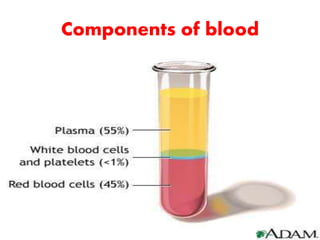
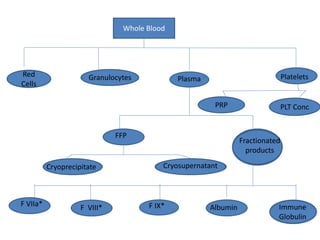
Components of blood
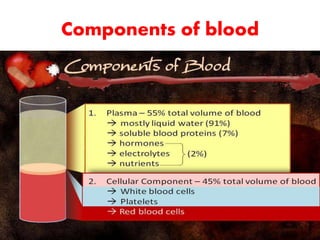
Components of blood
Whole Blood
Red
Cells
Granulocytes Plasma Platelets
FFP
Fractionated
products
Cryoprecipitate Cryosupernatant
F VIIa* F VIII* F IX* Albumin Immune
Globulin
PRP PLT Conc
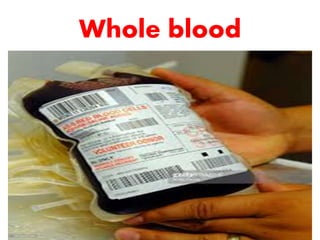
Whole blood
Whole Blood
 Volume: 450ml blood.
 Anticoagulant: 63ml
 Storage temp : 4˚C (Range is 2-6˚C)
 Hct-38-44%.
 No component have been removed.
 Shelf life(it is the time of storage after which, after transfusion, at least 70% of
transfused cells remain in recipient circulation)
Citrate-Phosphate-Dextrose (CPD) - 28 days.
CPDA-1 (adenine) - 35 days.
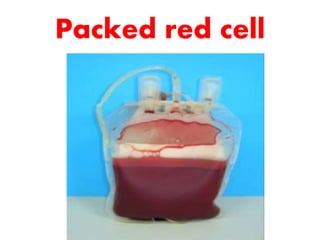
Packed red cell
Packed red cell
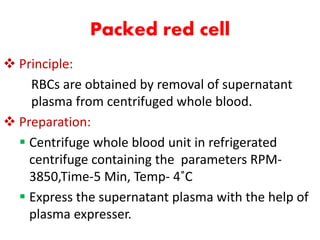
 Principle:
RBCs are obtained by removal of supernatant
plasma from centrifuged whole blood.
 Preparation:
 Centrifuge whole blood unit in refrigerated
centrifuge containing the parameters RPM-
3850,Time-5 Min, Temp- 4˚C
 Express the supernatant plasma with the help of
plasma expresser.
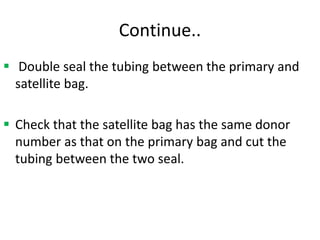
Continue..
 Double seal the tubing between the primary and
satellite bag.
 Check that the satellite bag has the same donor
number as that on the primary bag and cut the
tubing between the two seal.
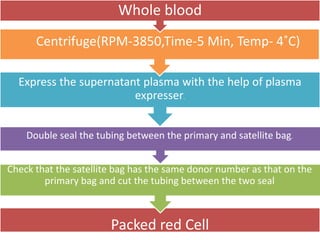
Packed red Cell
Check that the satellite bag has the same donor number as that on the
primary bag and cut the tubing between the two seal
Double seal the tubing between the primary and satellite bag.
Express the supernatant plasma with the help of plasma
expresser.
Centrifuge(RPM-3850,Time-5 Min, Temp- 4˚C)
Whole blood
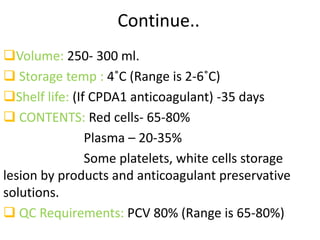
Continue..
Volume: 250- 300 ml.
 Storage temp : 4˚C (Range is 2-6˚C)
Shelf life: (If CPDA1 anticoagulant) -35 days
 CONTENTS: Red cells- 65-80%
Plasma – 20-35%
Some platelets, white cells storage
lesion by products and anticoagulant preservative
solutions.
 QC Requirements: PCV 80% (Range is 65-80%)
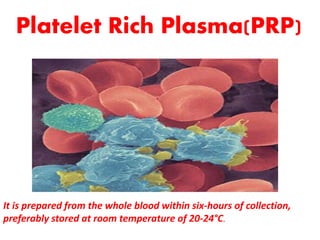
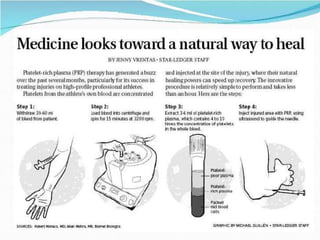
Platelet Rich Plasma(PRP)
It is prepared from the whole blood within six-hours of collection,
preferably stored at room temperature of 20-24°C.
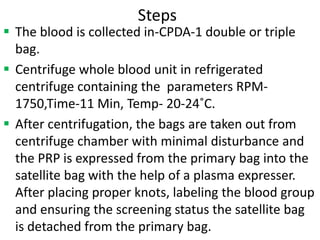
Steps
 The blood is collected in-CPDA-1 double or triple
bag.
 Centrifuge whole blood unit in refrigerated
centrifuge containing the parameters RPM-
1750,Time-11 Min, Temp- 20-24˚C.
 After centrifugation, the bags are taken out from
centrifuge chamber with minimal disturbance and
the PRP is expressed from the primary bag into the
satellite bag with the help of a plasma expresser.

After placing proper knots, labeling the blood group
and ensuring the screening status the satellite bag
is detached from the primary bag.
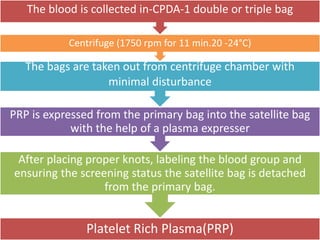
Platelet Rich Plasma(PRP)
After placing proper knots, labeling the blood group and
ensuring the screening status the satellite bag is detached
from the primary bag.
PRP is expressed from the primary bag into the satellite bag
with the help of a plasma expresser
The bags are taken out from centrifuge chamber with
minimal disturbance
Centrifuge (1750 rpm for 11 min.20 -24°C)
The blood is collected in-CPDA-1 double or triple bag
Continue..
 Volume: 250-300 ml
Storage temp : 22-24°C
Shelf life: Maximum 48-72 hours in a platelet
incubator with constant agitation.
Composition:
 Platelet-derived growth factor
 Transforming growth factor beta
 Fibroblast growth factor
Insulin-like growth factor 1 & 2
 Vascular endothelial growth factor
Epidermal growth factor
 Interleukin 8
Keratinocyte growth factor
 Connective tissue growth factor
Continue..
 QC Requirements: As a part of internal quality
control 1% of the random components units over a
month are tested for pH and yield. For PRP the pH
should always be > 6.2 and yield 4.5 x 10¹°/ bag (Drugs
and Cosmetics Act) and 5.5 x 10¹°/ bag (AABB Technical Manual).
 One bag of PRP generally raises the platelet count
in the recipient by 5000-10000 / μl.
Thank you
Blood component processing &
preservation
Manik chandra shill
Medical technologist
Transfusion Medicine
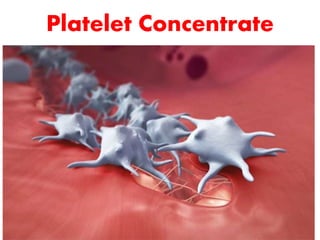
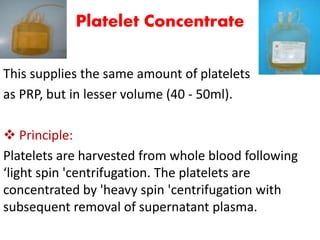
Platelet Concentrate
This supplies the same amount of platelets
as PRP, but in lesser volume (40 - 50ml).
 Principle:
Platelets are harvested from whole blood following
‘light spin 'centrifugation. The platelets are
concentrated by 'heavy spin 'centrifugation with
subsequent removal of supernatant plasma.
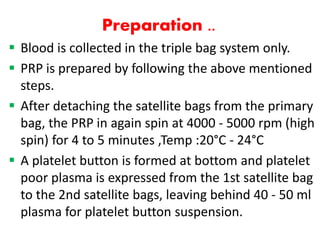
Preparation ..
 Blood is collected in the triple bag system only.
 PRP is prepared by following the above mentioned
steps.
 After detaching the satellite bags from the primary
bag, the PRP in again spin at 4000 - 5000 rpm (high
spin) for 4 to 5 minutes ,Temp :20°C - 24°C
 A platelet button is formed at bottom and platelet
poor plasma is expressed from the 1st satellite bag
to the 2nd satellite bags, leaving behind 40 - 50 ml
plasma for platelet button suspension.
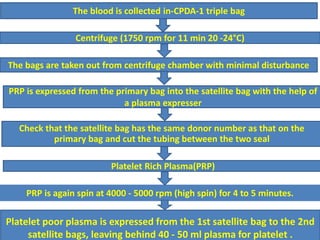
PRP is again spin at 4000 - 5000 rpm (high spin) for 4 to 5 minutes.
Platelet poor plasma is expressed from the 1st satellite bag to the 2nd
satellite bags, leaving behind 40 - 50 ml plasma for platelet .
Platelet Rich Plasma(PRP)
The blood is collected in-CPDA-1 triple bag
Check that the satellite bag has the same donor number as that on the
primary bag and cut the tubing between the two seal
Centrifuge (1750 rpm for 11 min 20 -24°C)
The bags are taken out from centrifuge chamber with minimal disturbance
PRP is expressed from the primary bag into the satellite bag with the help of
a plasma expresser
Continue..
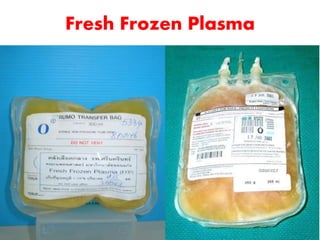
Volume: 30 to 50 ml.
 Storage temp :20°C - 24°C
Shelf life: Maximum 5 days with continuous
incubation & agitator.
: 24 hrs if no storage cabinet.
Contents: Platelet - 5.5 x 10¹° /bag
Plasma - 30 to 50 ml and some white cells
Q.C. Requirements: To be prepared within 8 hrs
after collection, pH should be 6.2 or more at the
end of storage time. Platelet count > 5.5 x 10¹°
/unit.
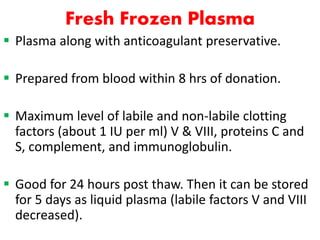
Fresh Frozen Plasma
Fresh Frozen Plasma
 Plasma along with anticoagulant preservative.
 Prepared from blood within 8 hrs of donation.
 Maximum level of labile and non-labile clotting
factors (about 1 IU per ml) V & VIII, proteins C and
S, complement, and immunoglobulin.
 Good for 24 hours post thaw. Then it can be stored
for 5 days as liquid plasma (labile factors V and VIII
decreased).
Continue..
Principle:
Plasma is separated from cellular blood elements and
frozen to preserve the activity of labile coagulation
factors.
Steps
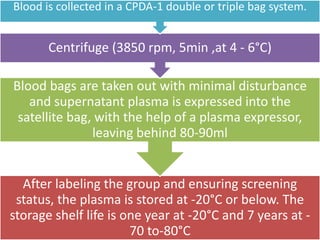
 Blood is collected in a CPDA-1 double or triple bag
system.
 Centrifuge whole blood unit in refrigerated
centrifuge containing the parameters RPM-
3850,Time-5 Min, Temp- 4-6˚C.
Continue ..
 After the centrifuge stops, the blood bags are taken
out with minimal disturbance and supernatant
plasma is expressed into the satellite bag, with the
help of a plasma expressor, leaving behind 80-90ml.
 After labeling the group and ensuring screening
status, the plasma is stored at -20°C or below. The
storage shelf life is one year at -20°C and 7 years at -
70 to-80°C
After labeling the group and ensuring screening
status, the plasma is stored at -20°C or below. The
storage shelf life is one year at -20°C and 7 years at -
70 to-80°C
Blood bags are taken out with minimal disturbance
and supernatant plasma is expressed into the
satellite bag, with the help of a plasma expressor,
leaving behind 80-90ml
Centrifuge (3850 rpm, 5min ,at 4 - 6°C)
Blood is collected in a CPDA-1 double or triple bag system.
Continue ..
Volume: 200-250 ml
Storage temp: -20°C to -65˚C
Shelf life: One year to 7 year.
Contents: Per bag
Factor VIII - 0.6 IU / ml
Factor IX - 0.9 IU / ml
Fibrinogen - 250-300 mg / bag
Proteins - Albumin, globulin, etc.
Q. C, Requirements: The entire process of
preparation and freezing should be completed
within 8 hrs after collection.
Continue ..
1 IU / kg of factor VIII or factor IX raises the factor
VIII levels in plasma by 2% and factor IX levels by 1%
respectively.
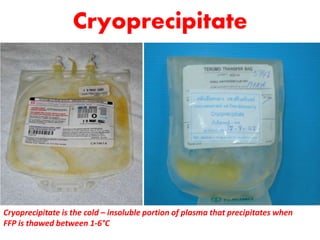
Cryoprecipitate
Cryoprecipitate is the cold – insoluble portion of plasma that precipitates when
FFP is thawed between 1-6°C
 Cryoprecipitate contains precipitated proteins of
plasma, rich in factor VIII and fibrinogen, obtained
from FFP prepared within 6-8 hours of collection,
subsequent thawing at 4- 6°C and removal of
supernatant.
 Also the advantage of Cryoprecipitate is that we can
administer large amount of factor VIII without
overloading the recipient, especially in pediatric
patients.
Principle: Coagulation factor VIII can be concentrated by
cryoprecipitation of freshly collected plasma. Cryoprecipitation is
accomplished by rapid freezing of plasma and slow thawing at low
temperature.
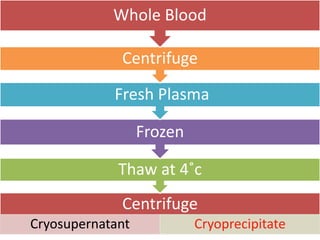
Steps:
Centrifuge
Cryosupernatant Cryoprecipitate
Thaw at 4˚c
Frozen
Fresh Plasma
Centrifuge
Whole Blood
Continue ..
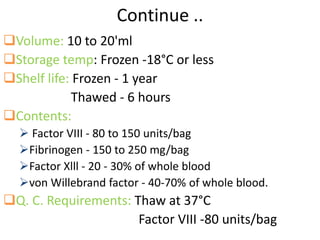
Volume: 10 to 20'ml
Storage temp: Frozen -18°C or less
Shelf life: Frozen - 1 year
Thawed - 6 hours
Contents:
 Factor VIII - 80 to 150 units/bag
Fibrinogen - 150 to 250 mg/bag
Factor Xlll - 20 - 30% of whole blood
von Willebrand factor - 40-70% of whole blood.
Q. C. Requirements: Thaw at 37°C
Factor VIII -80 units/bag
Question & Answer

Blood component processing &

  • 1.
    Blood component preparation& Preservation Bipul Chandra Sarkar Medical technologist Transfusion Medicine
  • 2.
    Introduction Whole Blood: Oneunit of donor blood collected in suitable anticoagulant preservative solution and which contain blood cells and plasma. Blood Components: A constituent separated from whole blood, by differential centrifugation of one donor or by apheresis.
  • 3.
  • 4.
  • 5.
    Whole Blood Red Cells Granulocytes PlasmaPlatelets FFP Fractionated products Cryoprecipitate Cryosupernatant F VIIa* F VIII* F IX* Albumin Immune Globulin PRP PLT Conc
  • 6.
  • 7.
    Whole Blood  Volume:450ml blood.  Anticoagulant: 63ml  Storage temp : 4˚C (Range is 2-6˚C)  Hct-38-44%.  No component have been removed.  Shelf life(it is the time of storage after which, after transfusion, at least 70% of transfused cells remain in recipient circulation) Citrate-Phosphate-Dextrose (CPD) - 28 days. CPDA-1 (adenine) - 35 days.
  • 8.
  • 9.
    Packed red cell Principle: RBCs are obtained by removal of supernatant plasma from centrifuged whole blood.  Preparation:  Centrifuge whole blood unit in refrigerated centrifuge containing the parameters RPM- 3850,Time-5 Min, Temp- 4˚C  Express the supernatant plasma with the help of plasma expresser.
  • 10.
    Continue..  Double sealthe tubing between the primary and satellite bag.  Check that the satellite bag has the same donor number as that on the primary bag and cut the tubing between the two seal.
  • 11.
    Packed red Cell Checkthat the satellite bag has the same donor number as that on the primary bag and cut the tubing between the two seal Double seal the tubing between the primary and satellite bag. Express the supernatant plasma with the help of plasma expresser. Centrifuge(RPM-3850,Time-5 Min, Temp- 4˚C) Whole blood
  • 12.
    Continue.. Volume: 250- 300ml.  Storage temp : 4˚C (Range is 2-6˚C) Shelf life: (If CPDA1 anticoagulant) -35 days  CONTENTS: Red cells- 65-80% Plasma – 20-35% Some platelets, white cells storage lesion by products and anticoagulant preservative solutions.  QC Requirements: PCV 80% (Range is 65-80%)
  • 13.
    Platelet Rich Plasma(PRP) Itis prepared from the whole blood within six-hours of collection, preferably stored at room temperature of 20-24°C.
  • 14.
    Steps  The bloodis collected in-CPDA-1 double or triple bag.  Centrifuge whole blood unit in refrigerated centrifuge containing the parameters RPM- 1750,Time-11 Min, Temp- 20-24˚C.  After centrifugation, the bags are taken out from centrifuge chamber with minimal disturbance and the PRP is expressed from the primary bag into the satellite bag with the help of a plasma expresser. After placing proper knots, labeling the blood group and ensuring the screening status the satellite bag is detached from the primary bag.
  • 15.
    Platelet Rich Plasma(PRP) Afterplacing proper knots, labeling the blood group and ensuring the screening status the satellite bag is detached from the primary bag. PRP is expressed from the primary bag into the satellite bag with the help of a plasma expresser The bags are taken out from centrifuge chamber with minimal disturbance Centrifuge (1750 rpm for 11 min.20 -24°C) The blood is collected in-CPDA-1 double or triple bag
  • 18.
    Continue..  Volume: 250-300ml Storage temp : 22-24°C Shelf life: Maximum 48-72 hours in a platelet incubator with constant agitation. Composition:  Platelet-derived growth factor  Transforming growth factor beta  Fibroblast growth factor Insulin-like growth factor 1 & 2  Vascular endothelial growth factor Epidermal growth factor  Interleukin 8 Keratinocyte growth factor  Connective tissue growth factor
  • 19.
    Continue..  QC Requirements:As a part of internal quality control 1% of the random components units over a month are tested for pH and yield. For PRP the pH should always be > 6.2 and yield 4.5 x 10¹°/ bag (Drugs and Cosmetics Act) and 5.5 x 10¹°/ bag (AABB Technical Manual).  One bag of PRP generally raises the platelet count in the recipient by 5000-10000 / μl.
  • 20.
  • 21.
    Blood component processing& preservation Manik chandra shill Medical technologist Transfusion Medicine
  • 22.
  • 23.
    Platelet Concentrate This suppliesthe same amount of platelets as PRP, but in lesser volume (40 - 50ml).  Principle: Platelets are harvested from whole blood following ‘light spin 'centrifugation. The platelets are concentrated by 'heavy spin 'centrifugation with subsequent removal of supernatant plasma.
  • 24.
    Preparation ..  Bloodis collected in the triple bag system only.  PRP is prepared by following the above mentioned steps.  After detaching the satellite bags from the primary bag, the PRP in again spin at 4000 - 5000 rpm (high spin) for 4 to 5 minutes ,Temp :20°C - 24°C  A platelet button is formed at bottom and platelet poor plasma is expressed from the 1st satellite bag to the 2nd satellite bags, leaving behind 40 - 50 ml plasma for platelet button suspension.
  • 25.
    PRP is againspin at 4000 - 5000 rpm (high spin) for 4 to 5 minutes. Platelet poor plasma is expressed from the 1st satellite bag to the 2nd satellite bags, leaving behind 40 - 50 ml plasma for platelet . Platelet Rich Plasma(PRP) The blood is collected in-CPDA-1 triple bag Check that the satellite bag has the same donor number as that on the primary bag and cut the tubing between the two seal Centrifuge (1750 rpm for 11 min 20 -24°C) The bags are taken out from centrifuge chamber with minimal disturbance PRP is expressed from the primary bag into the satellite bag with the help of a plasma expresser
  • 26.
    Continue.. Volume: 30 to50 ml.  Storage temp :20°C - 24°C Shelf life: Maximum 5 days with continuous incubation & agitator. : 24 hrs if no storage cabinet. Contents: Platelet - 5.5 x 10¹° /bag Plasma - 30 to 50 ml and some white cells Q.C. Requirements: To be prepared within 8 hrs after collection, pH should be 6.2 or more at the end of storage time. Platelet count > 5.5 x 10¹° /unit.
  • 27.
  • 28.
    Fresh Frozen Plasma Plasma along with anticoagulant preservative.  Prepared from blood within 8 hrs of donation.  Maximum level of labile and non-labile clotting factors (about 1 IU per ml) V & VIII, proteins C and S, complement, and immunoglobulin.  Good for 24 hours post thaw. Then it can be stored for 5 days as liquid plasma (labile factors V and VIII decreased).
  • 29.
    Continue.. Principle: Plasma is separatedfrom cellular blood elements and frozen to preserve the activity of labile coagulation factors. Steps  Blood is collected in a CPDA-1 double or triple bag system.  Centrifuge whole blood unit in refrigerated centrifuge containing the parameters RPM- 3850,Time-5 Min, Temp- 4-6˚C.
  • 30.
    Continue ..  Afterthe centrifuge stops, the blood bags are taken out with minimal disturbance and supernatant plasma is expressed into the satellite bag, with the help of a plasma expressor, leaving behind 80-90ml.  After labeling the group and ensuring screening status, the plasma is stored at -20°C or below. The storage shelf life is one year at -20°C and 7 years at - 70 to-80°C
  • 31.
    After labeling thegroup and ensuring screening status, the plasma is stored at -20°C or below. The storage shelf life is one year at -20°C and 7 years at - 70 to-80°C Blood bags are taken out with minimal disturbance and supernatant plasma is expressed into the satellite bag, with the help of a plasma expressor, leaving behind 80-90ml Centrifuge (3850 rpm, 5min ,at 4 - 6°C) Blood is collected in a CPDA-1 double or triple bag system.
  • 32.
    Continue .. Volume: 200-250ml Storage temp: -20°C to -65˚C Shelf life: One year to 7 year. Contents: Per bag Factor VIII - 0.6 IU / ml Factor IX - 0.9 IU / ml Fibrinogen - 250-300 mg / bag Proteins - Albumin, globulin, etc. Q. C, Requirements: The entire process of preparation and freezing should be completed within 8 hrs after collection.
  • 33.
    Continue .. 1 IU/ kg of factor VIII or factor IX raises the factor VIII levels in plasma by 2% and factor IX levels by 1% respectively.
  • 34.
    Cryoprecipitate Cryoprecipitate is thecold – insoluble portion of plasma that precipitates when FFP is thawed between 1-6°C
  • 35.
     Cryoprecipitate containsprecipitated proteins of plasma, rich in factor VIII and fibrinogen, obtained from FFP prepared within 6-8 hours of collection, subsequent thawing at 4- 6°C and removal of supernatant.  Also the advantage of Cryoprecipitate is that we can administer large amount of factor VIII without overloading the recipient, especially in pediatric patients.
  • 36.
    Principle: Coagulation factorVIII can be concentrated by cryoprecipitation of freshly collected plasma. Cryoprecipitation is accomplished by rapid freezing of plasma and slow thawing at low temperature. Steps:
  • 37.
    Centrifuge Cryosupernatant Cryoprecipitate Thaw at4˚c Frozen Fresh Plasma Centrifuge Whole Blood
  • 38.
    Continue .. Volume: 10to 20'ml Storage temp: Frozen -18°C or less Shelf life: Frozen - 1 year Thawed - 6 hours Contents:  Factor VIII - 80 to 150 units/bag Fibrinogen - 150 to 250 mg/bag Factor Xlll - 20 - 30% of whole blood von Willebrand factor - 40-70% of whole blood. Q. C. Requirements: Thaw at 37°C Factor VIII -80 units/bag
  • 40.