



blogging
getting blogging with the basics
BASICS
 PHOTO BY LADY MADONNA - HTTP://FLIC.KR/P/DZKNR
A blog is a Web page (usually) written in a programming
language where the content of the site is stored in a
metadata-rich format, and the presentation of the
content is (usually) in a reverse chronological format.
Each piece of content is (usually) the product of a single
author, and the content is updated regularly. The page in
question (usually) has some form of social component,
whether through comments, trackback, or other
mechanism of communicating content or feedback.
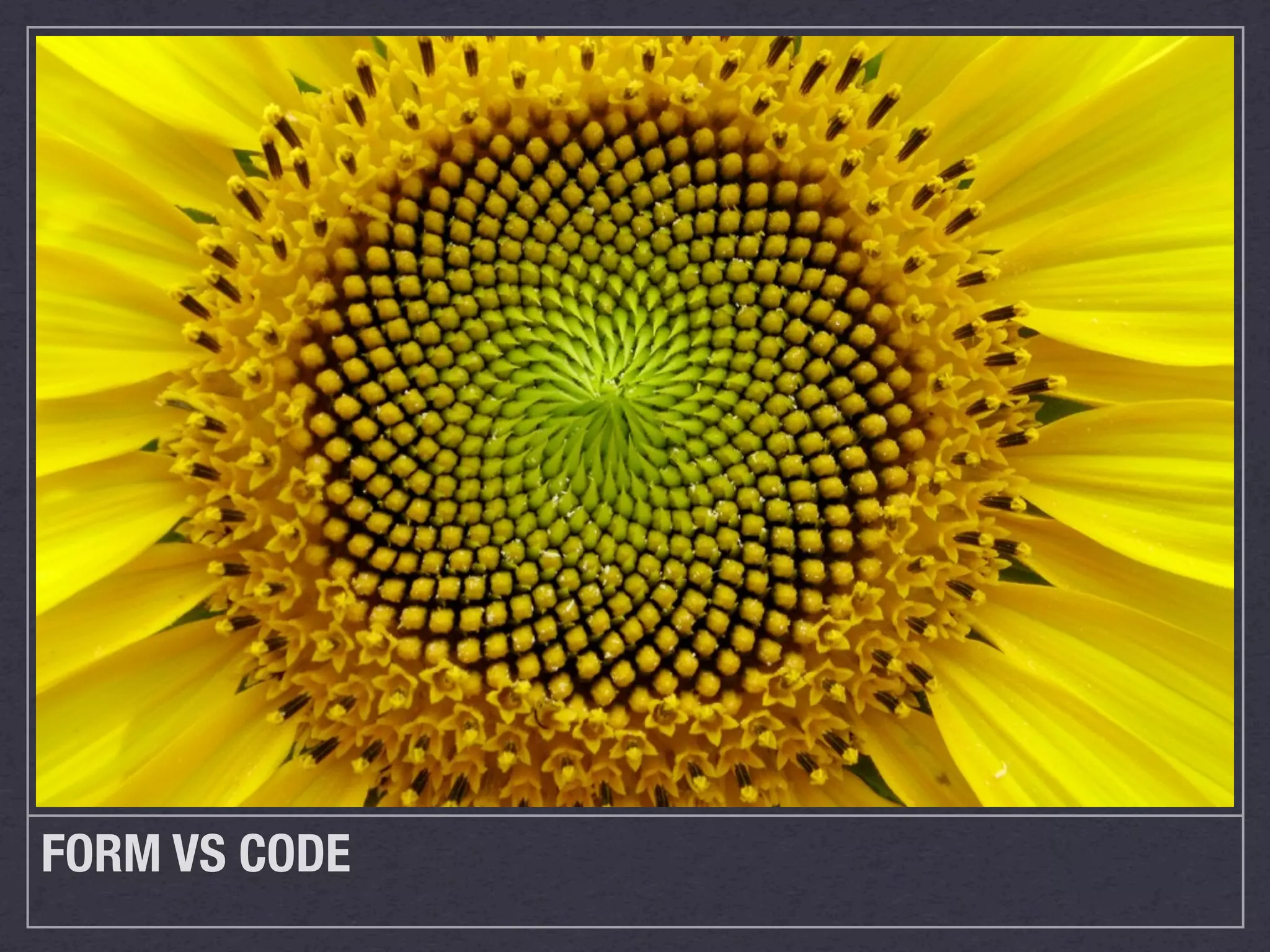
FORM VS CODE
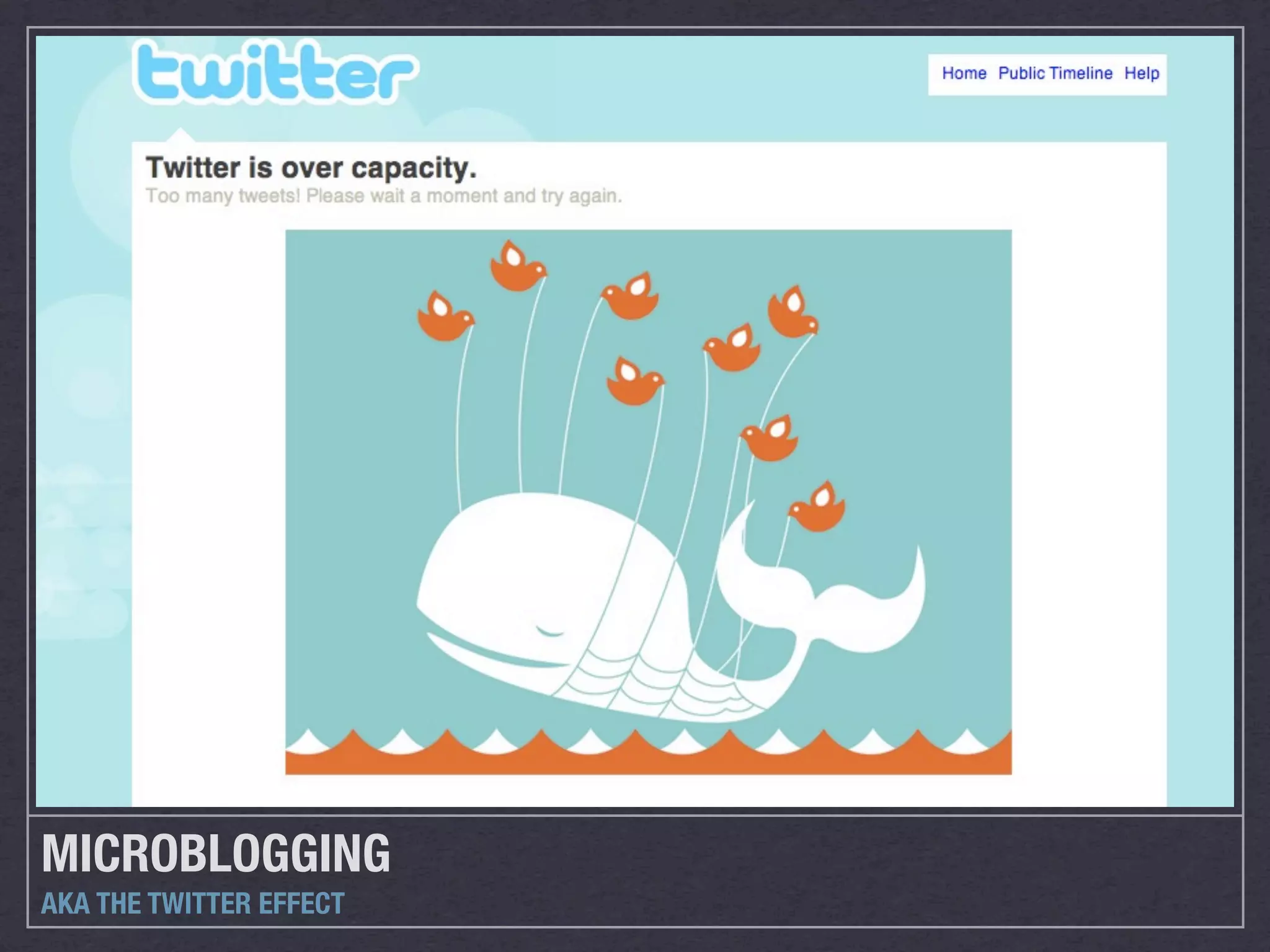
MICROBLOGGING
AKA THE TWITTER EFFECT
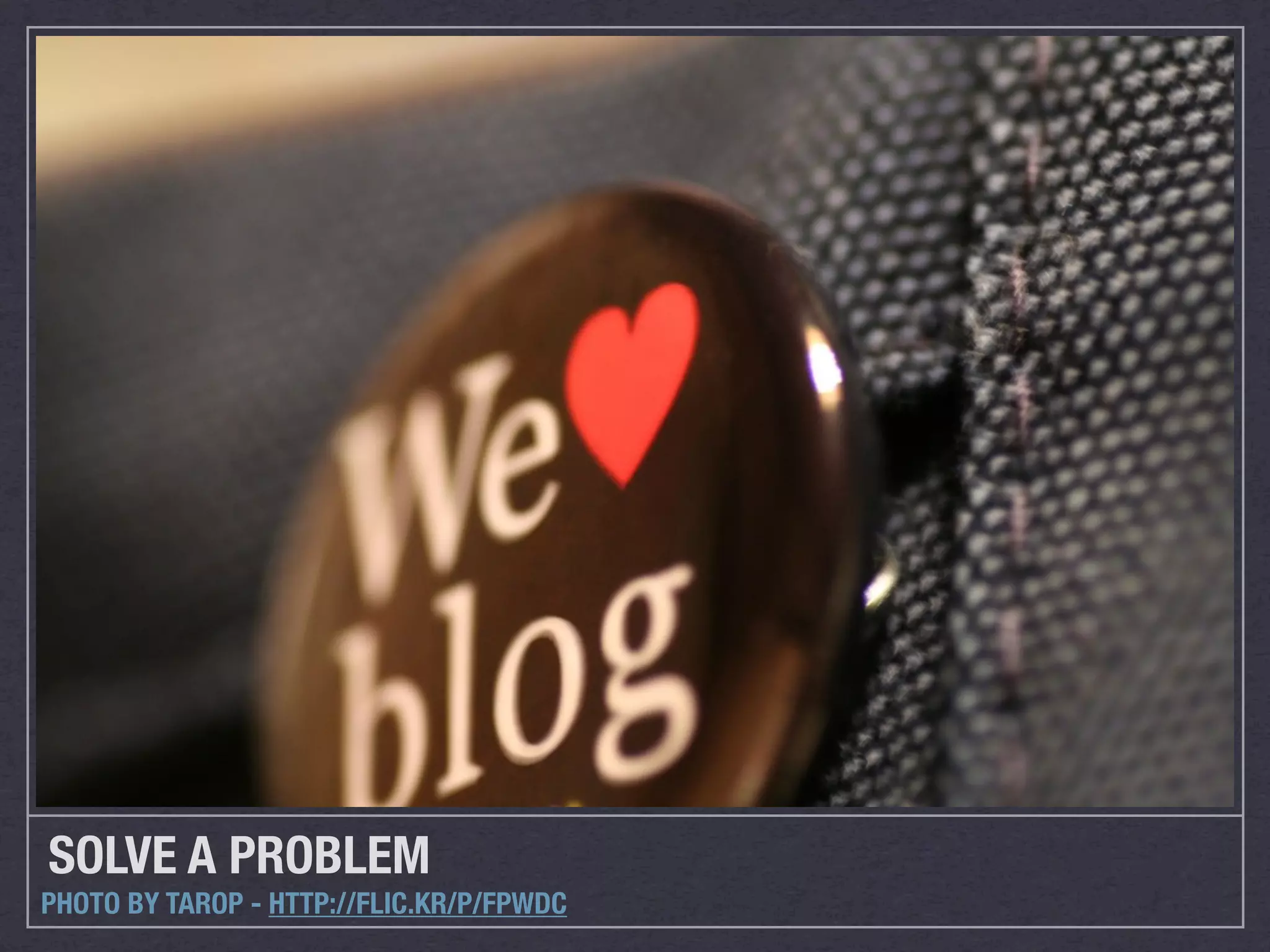
SOLVE A PROBLEM
PHOTO BY TAROP - HTTP://FLIC.KR/P/FPWDC
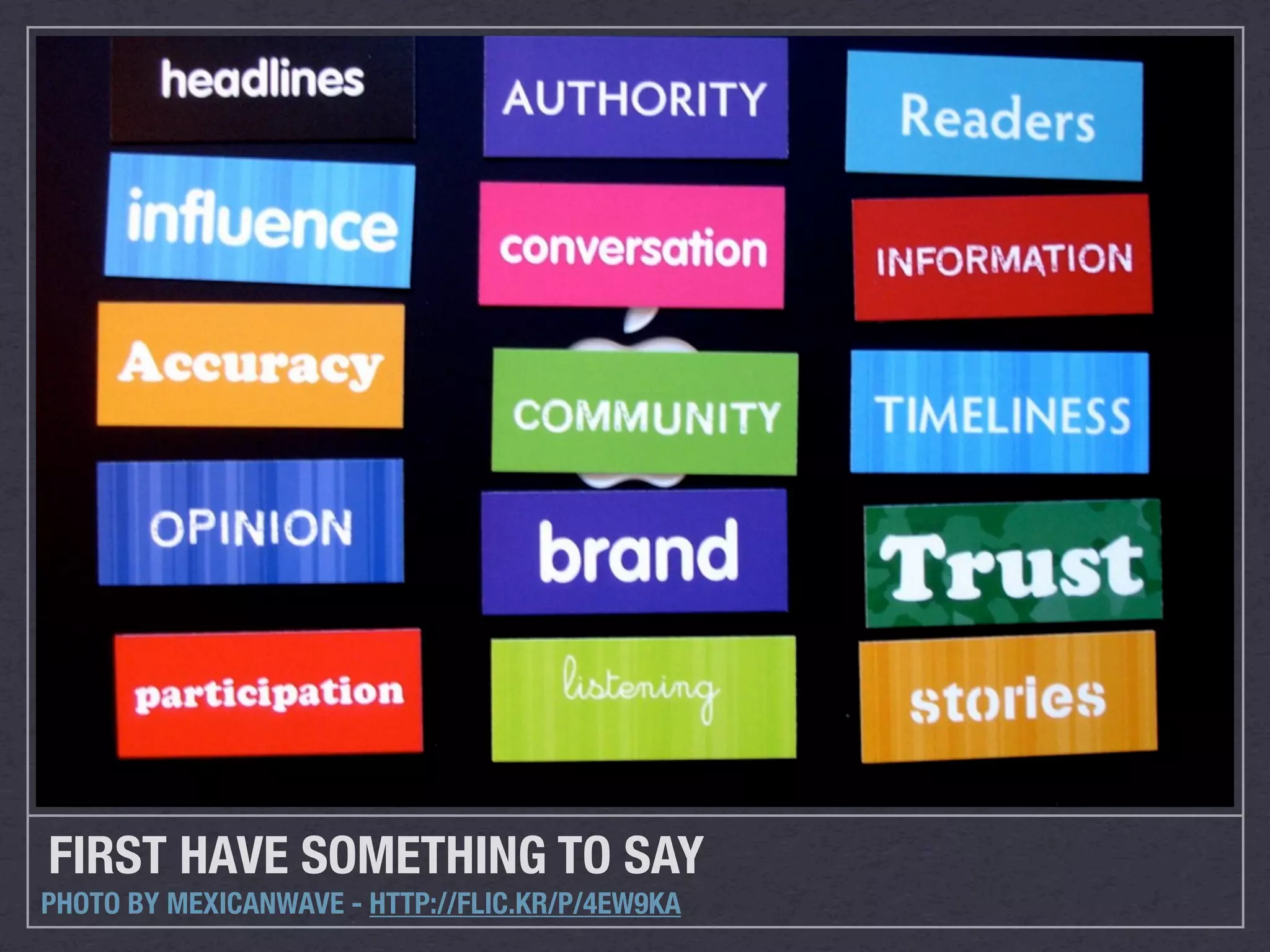
FIRST HAVE SOMETHING TO SAY
PHOTO BY MEXICANWAVE - HTTP://FLIC.KR/P/4EW9KA
blogs are for....
blogs are for....
easy updates

time sensitive information

multiple authors

easy reuse of content (rss)

mediacasting

whatever you need
who does it well
who does it well

Skokie Public

Topeka

University Laboratory High School

Blogging Libraries Wiki
hosted vs local
local
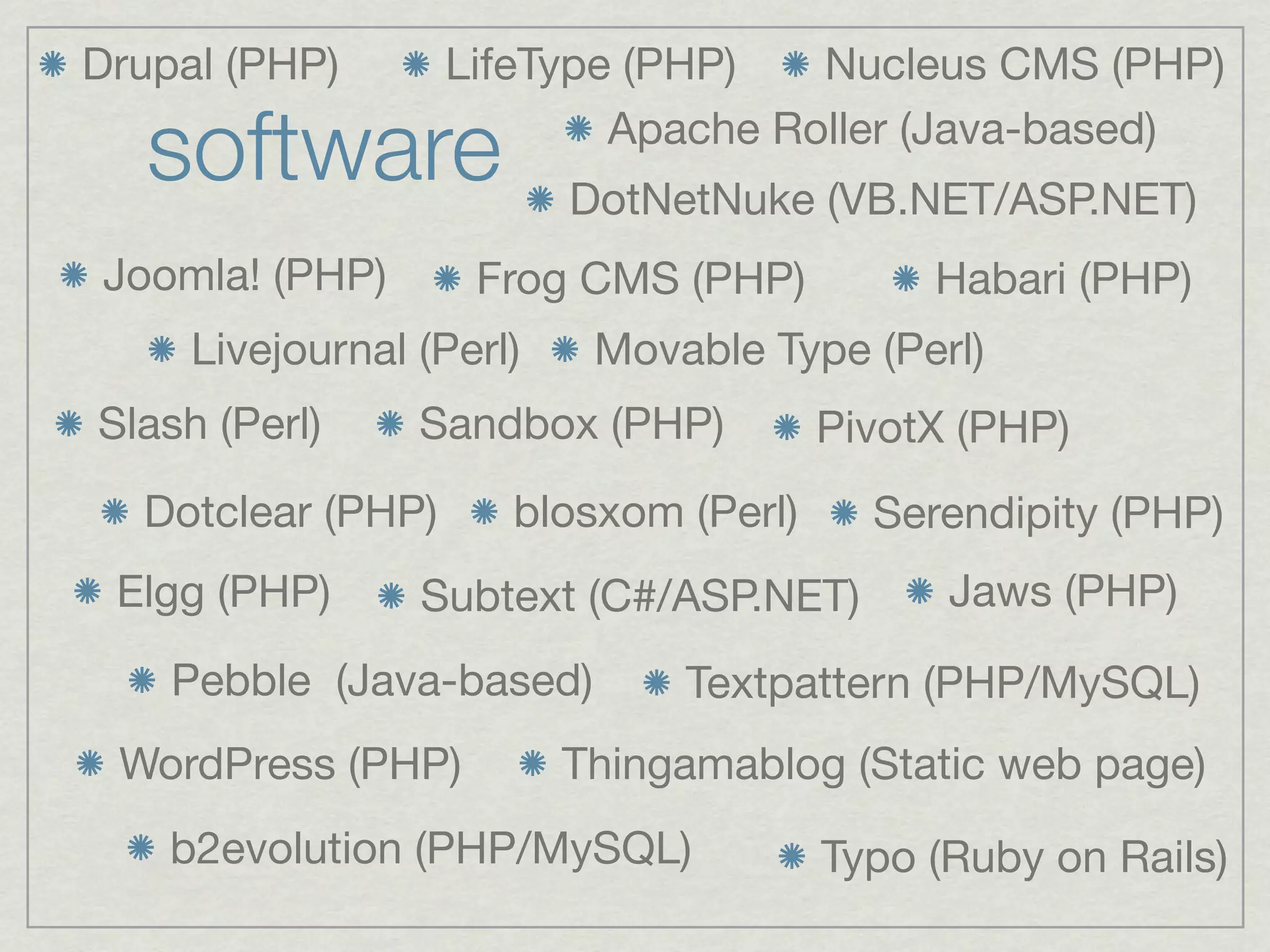
software
Drupal (PHP)       LifeType (PHP)   Nucleus CMS (PHP)

   software                Apache Roller (Java-based)
                          DotNetNuke (VB.NET/ASP.NET)
Joomla! (PHP)       Frog CMS (PHP)          Habari (PHP)
     Livejournal (Perl)    Movable Type (Perl)
Slash (Perl)     Sandbox (PHP)         PivotX (PHP)
  Dotclear (PHP)      blosxom (Perl)     Serendipity (PHP)
 Elgg (PHP)      Subtext (C#/ASP.NET)        Jaws (PHP)

    Pebble (Java-based)        Textpattern (PHP/MySQL)
 WordPress (PHP)          Thingamablog (Static web page)
    b2evolution (PHP/MySQL)            Typo (Ruby on Rails)
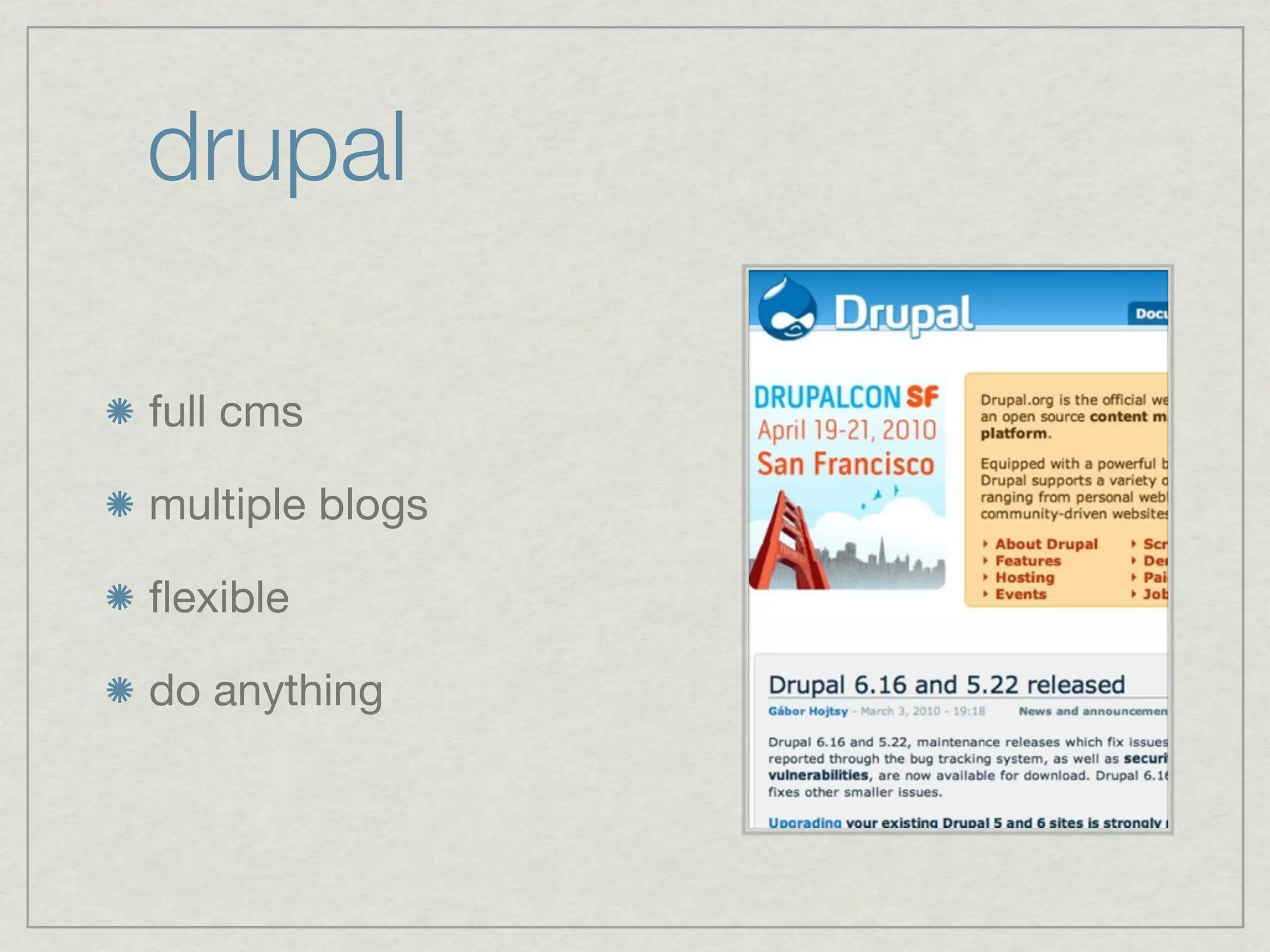
drupal
drupal

full cms

multiple blogs

flexible

do anything
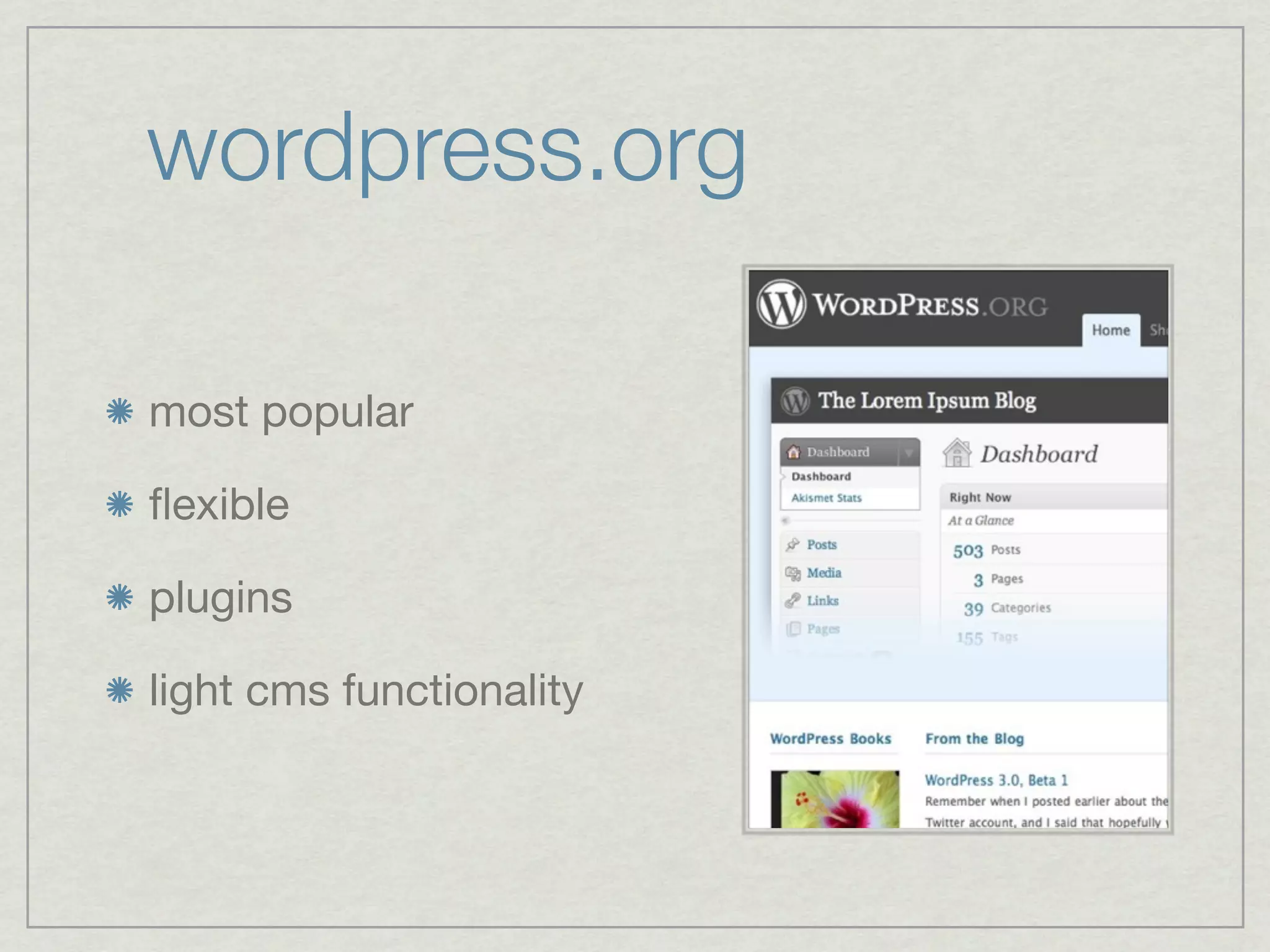
wordpress.org
wordpress.org

most popular

flexible

plugins

light cms functionality
hosted
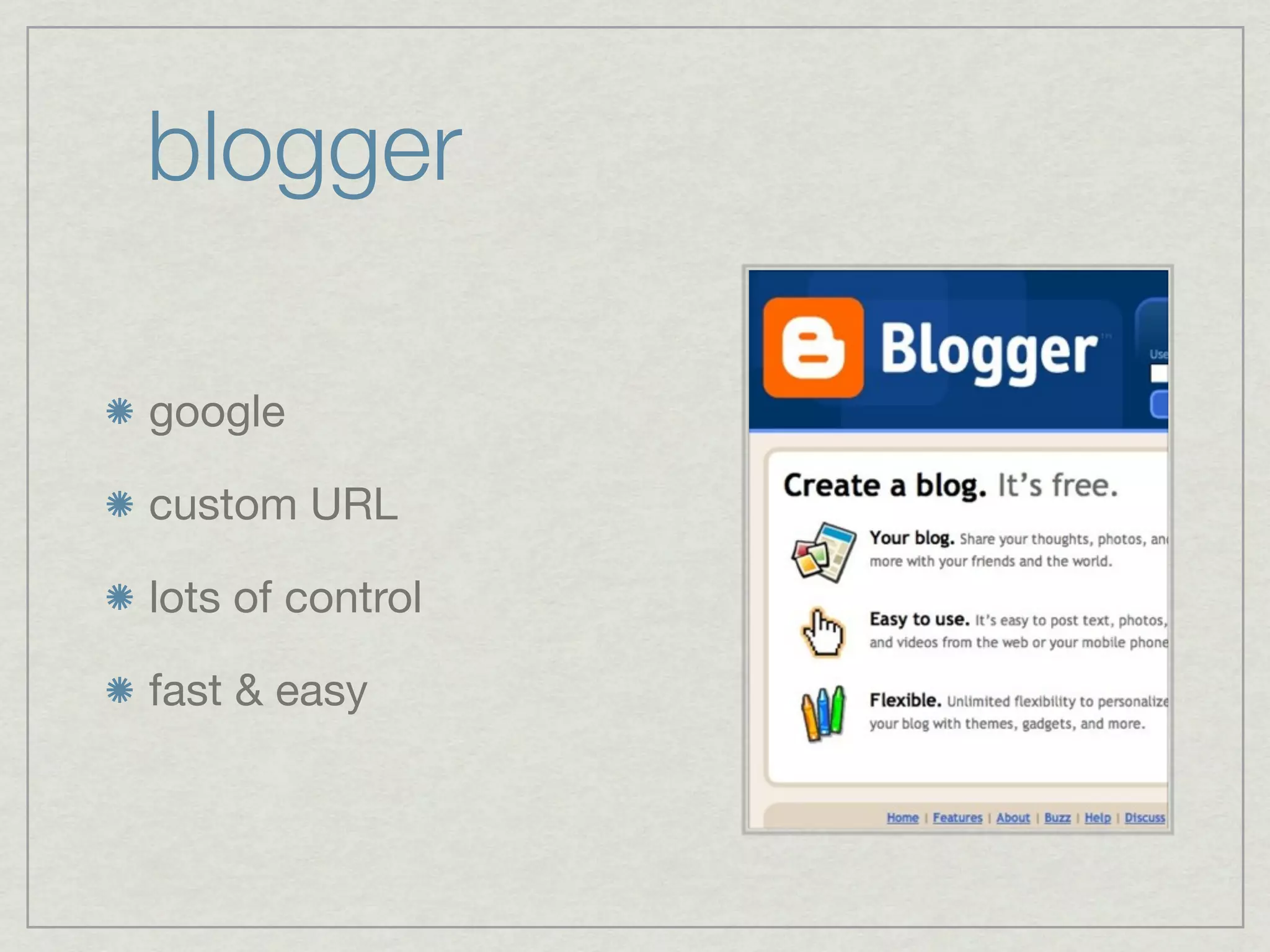
blogger
blogger

google

custom URL

lots of control

fast & easy
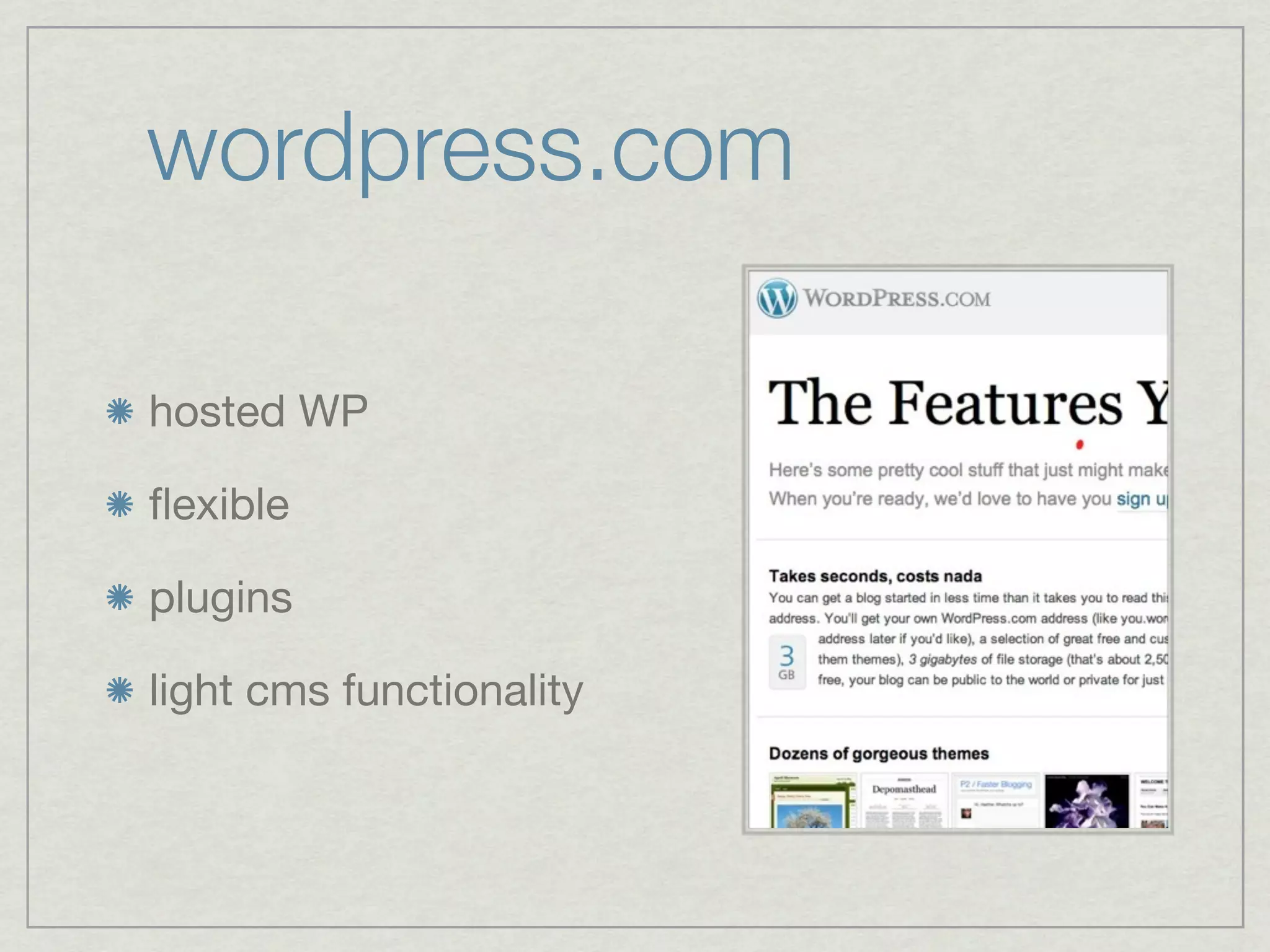
wordpress.com
wordpress.com

hosted WP

flexible

plugins

light cms functionality
tumblr
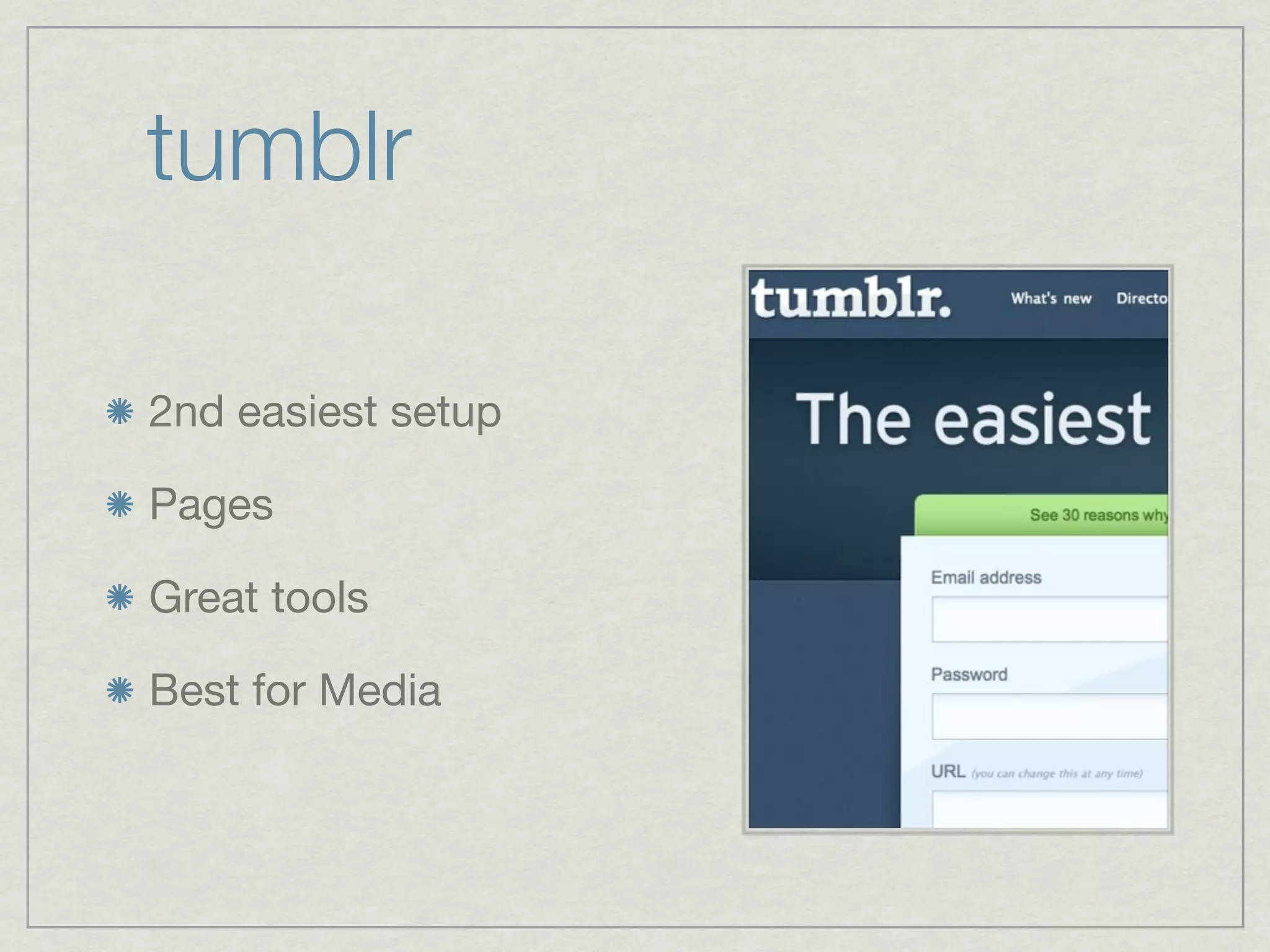
tumblr

2nd easiest setup

Pages

Great tools

Best for Media
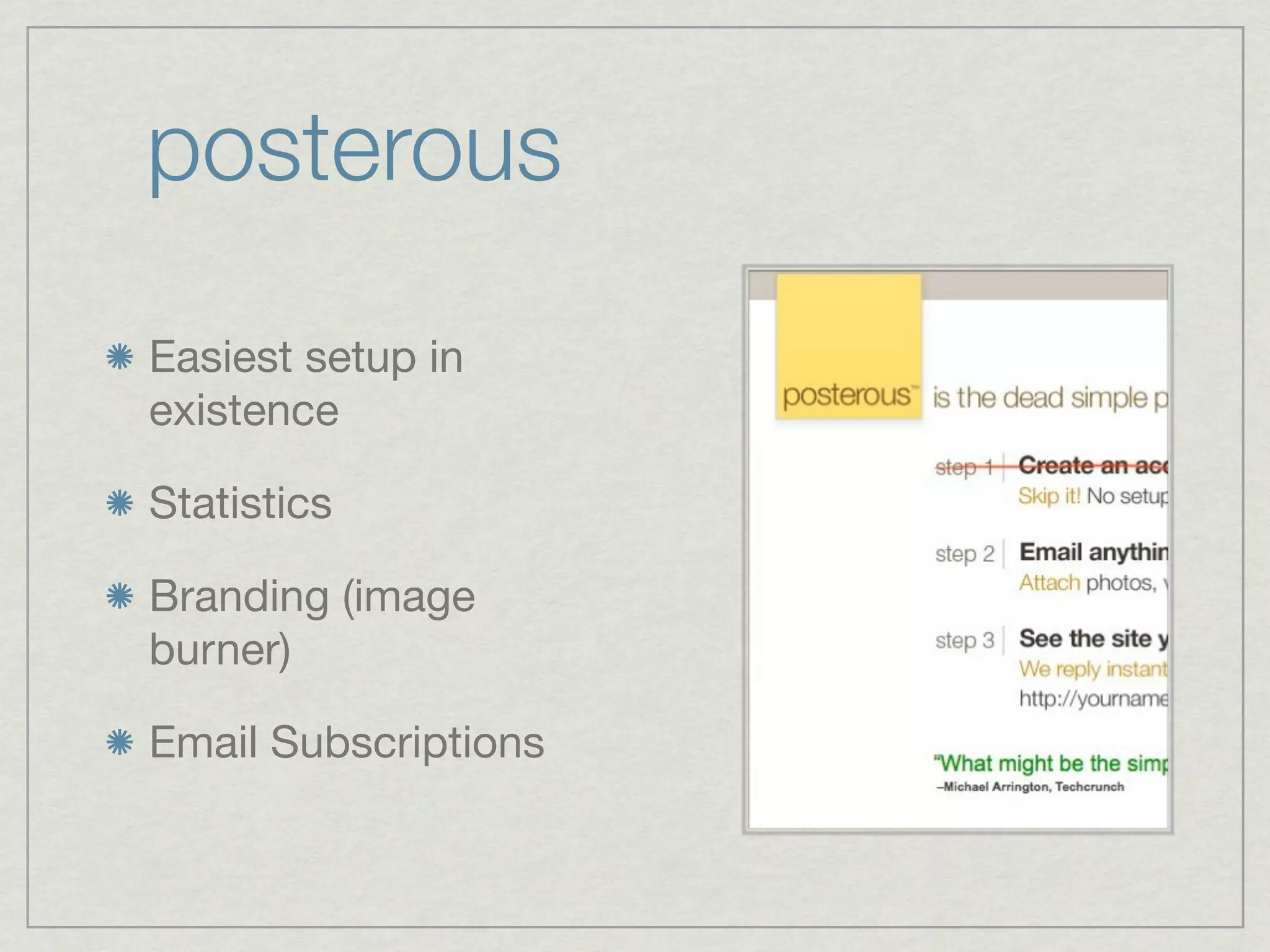
posterous
posterous
Easiest setup in
existence

Statistics

Branding (image
burner)

Email Subscriptions
ebublogs
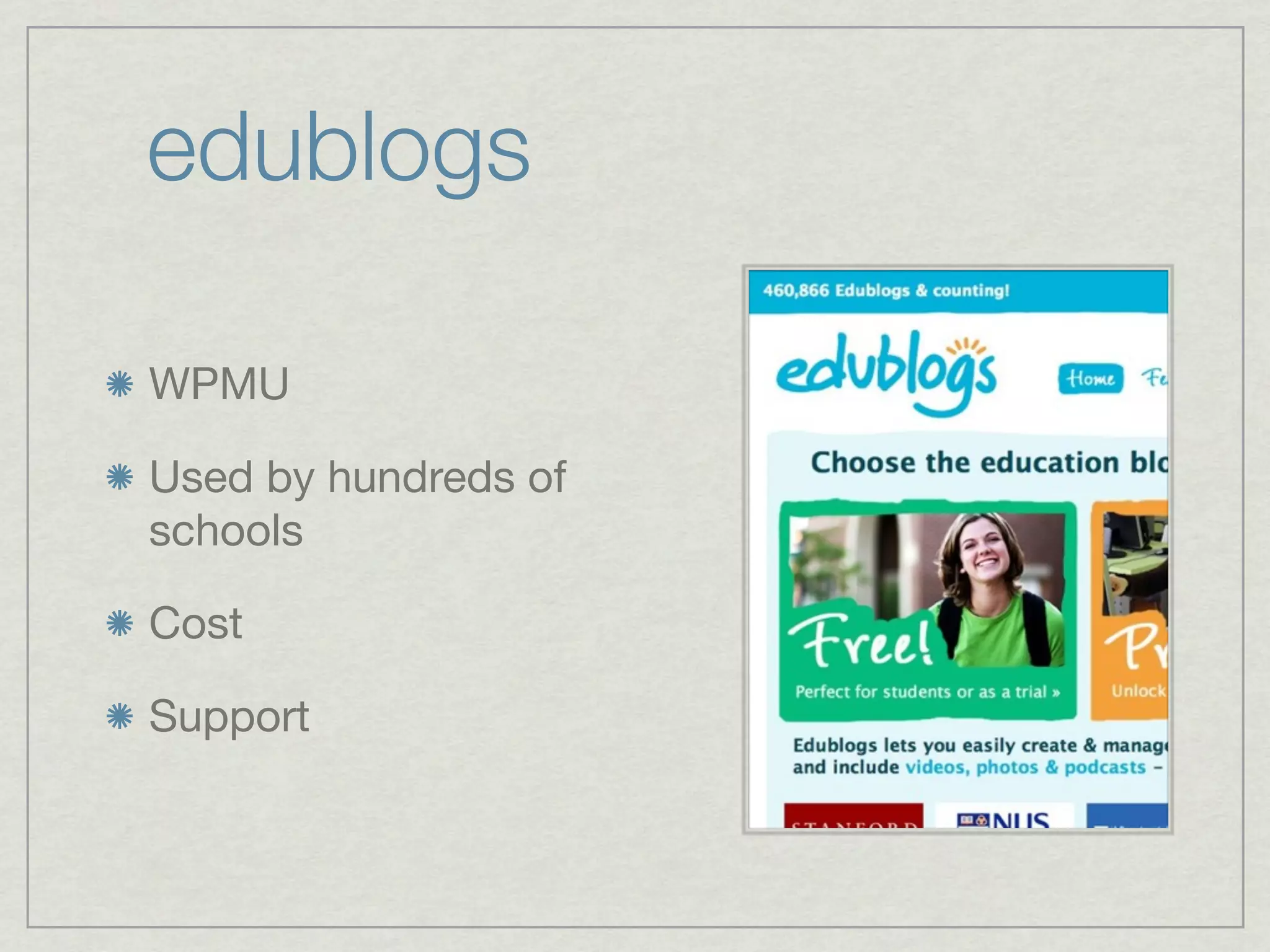
edublogs

WPMU

Used by hundreds of
schools

Cost

Support
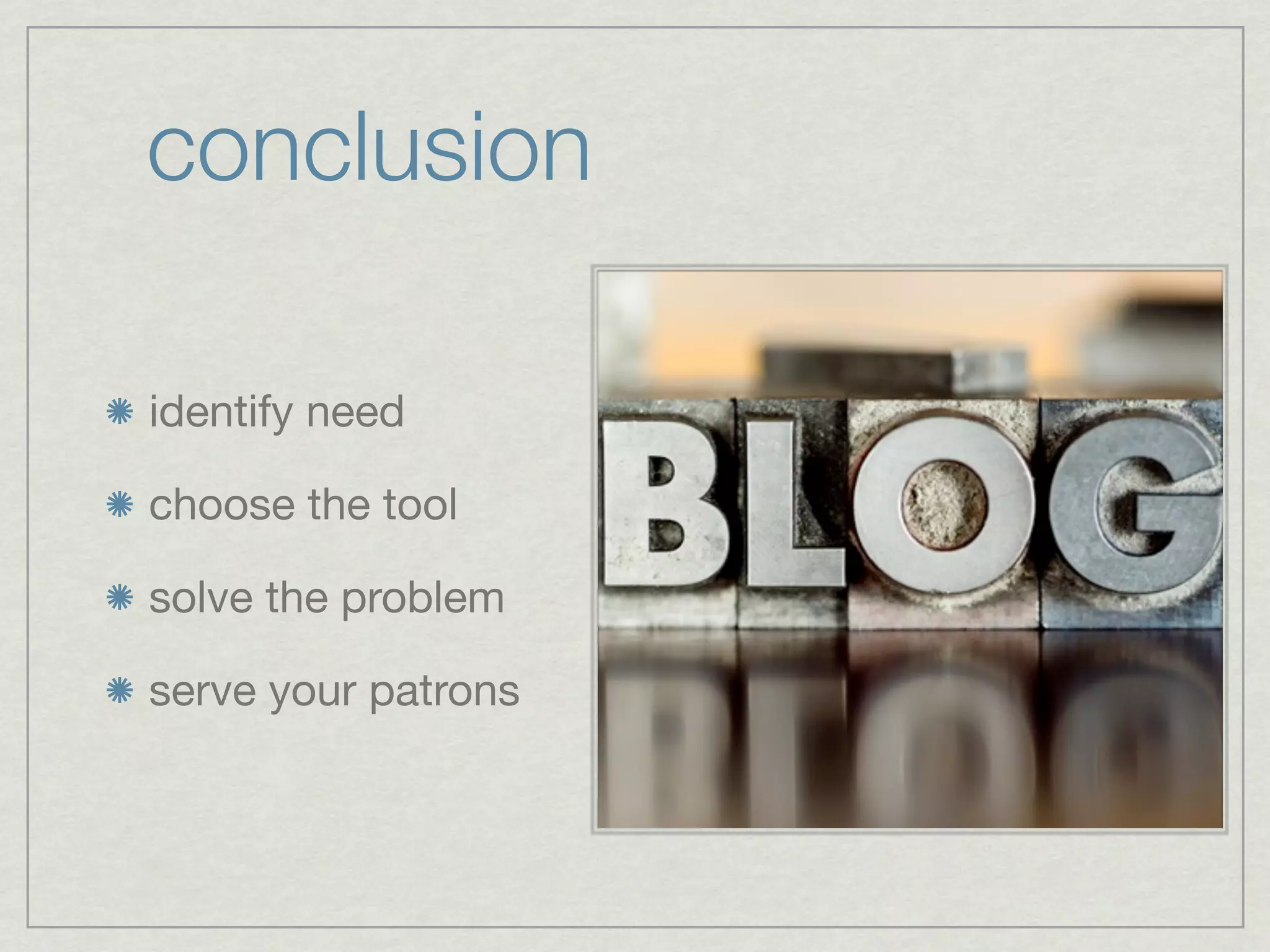
conclusion

identify need

choose the tool

solve the problem

serve your patrons
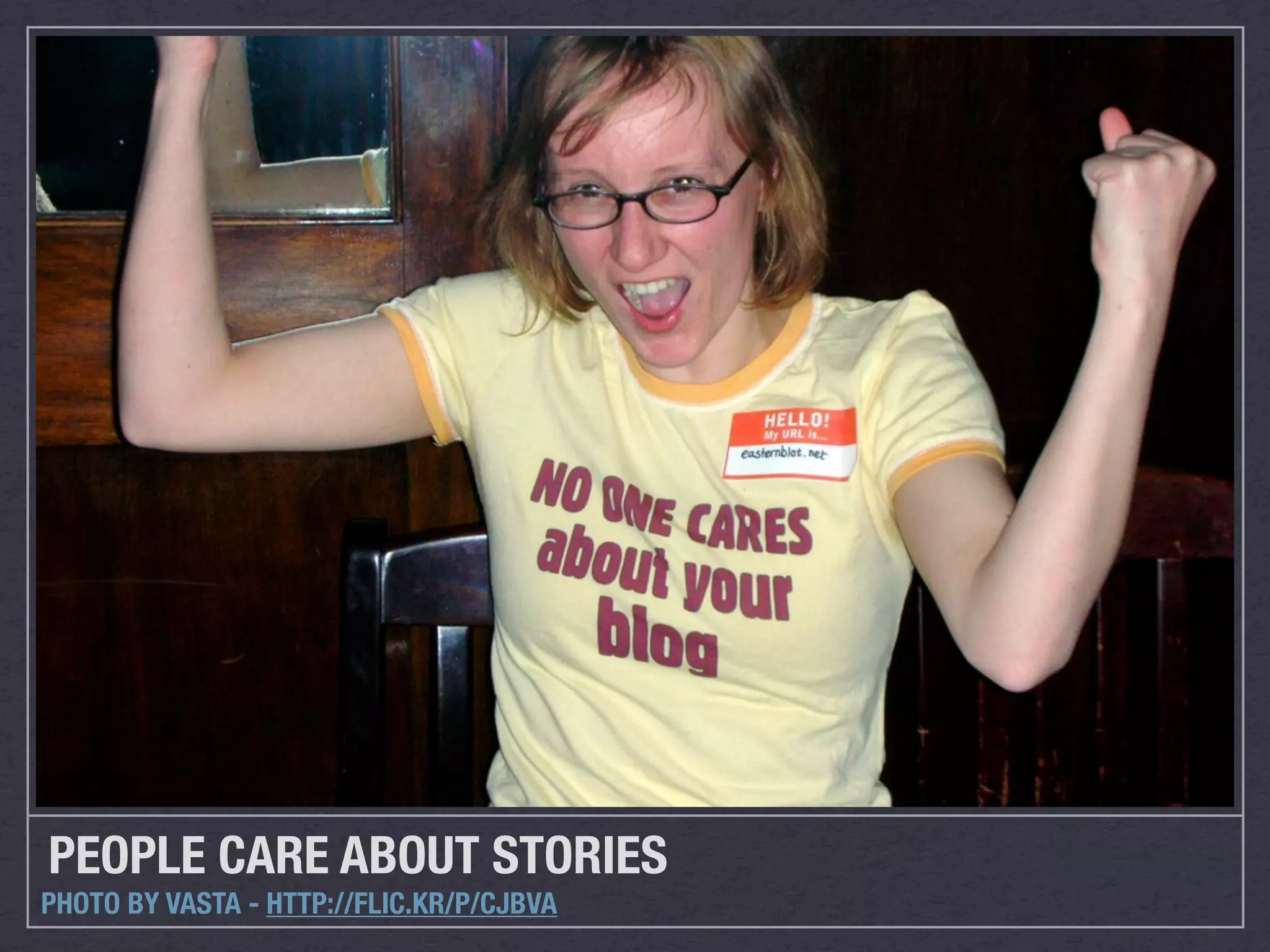
PEOPLE CARE ABOUT STORIES
PHOTO BY VASTA - HTTP://FLIC.KR/P/CJBVA
Thank You
Jason Griffey

 Email: griffey@gmail.com
 Site: jasongriffey.net
 gVoice: 423-443-4770
 Twitter: @griffey
 Other: Perpetual Beta
          TechSource

                                        Head of Library Information Technology
HTTP://DELICIOUS.COM/GRIFFEY/BLOGGING
                                        University of Tennessee at Chattanooga
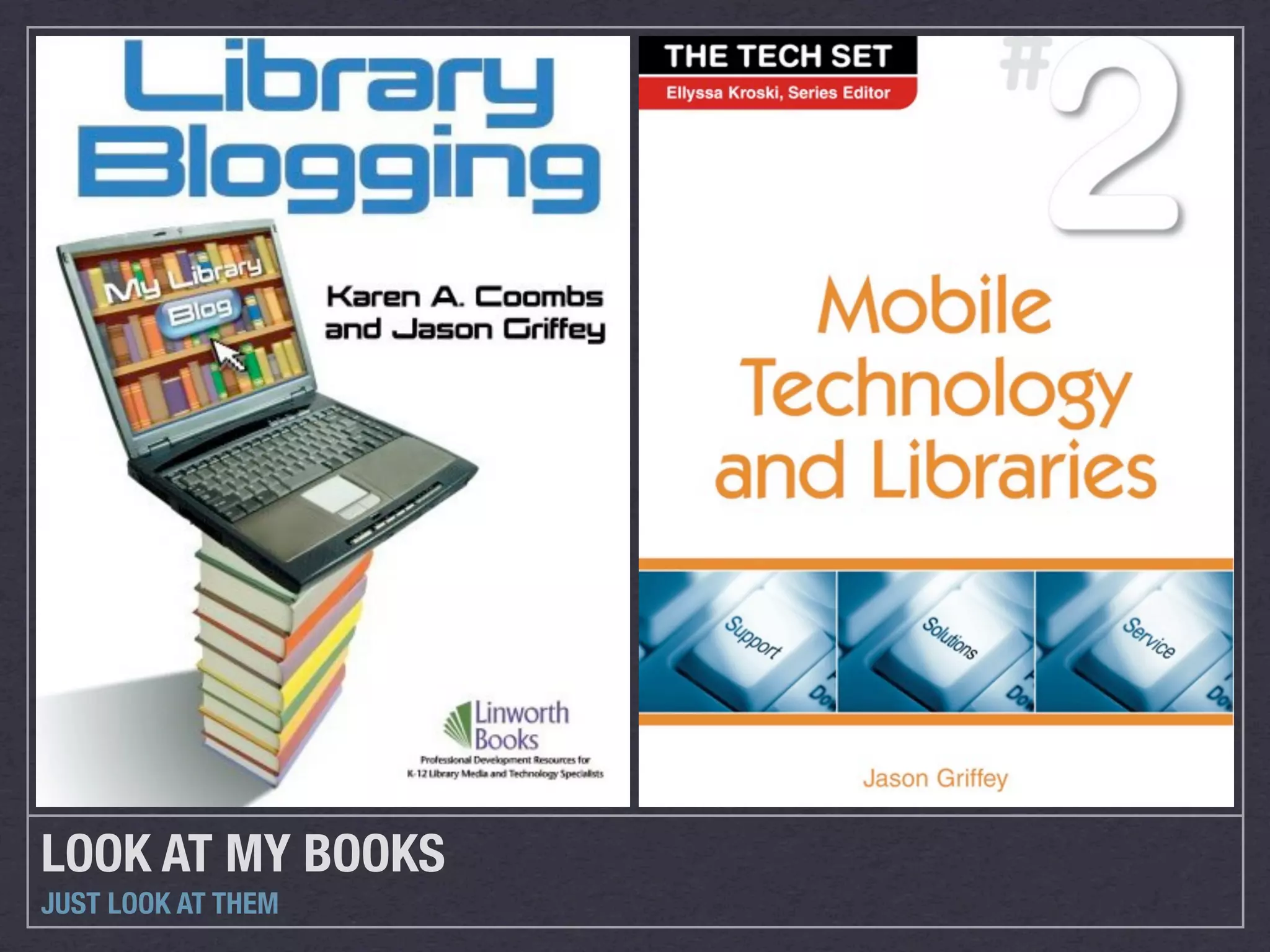
LOOK AT MY BOOKS
JUST LOOK AT THEM

Blogging basics

Editor's Notes

  • #2 Introduction Why me? How many have a personal blog? Library blog? How many are signed up for both workshops?
  • #3 What is a Blog? What do we mean?
  • #4 Defining a blog is a lot like defining a “book”. Size isn’t relevant. Neither is content, or material, or binding, or nearly anything else. Definitions are hard. For a blog, nearly all of the above can change completely, and we’d still call it a blog.
  • #5 So here’s the biggest definitional problem with talking about the future of blogs: what are we talking about? You can have the Form of a blog, without running a piece of blogging software. As well, you can use blog software for things that are not blogs. The form and the code are different things, even though we refer to them similarly. I am more interested in the form than the code. However, interesting things are going on with the code...various groups have harnessed Wordpress, for instance, to do everything from run their entire website (using WP as a generic CMS) to madmen like Casey Bisson who used Wordpress as an OPAC via his Scriblio product. Because it is Open Source, WP is used for MANY things that it wasn’t necessarily “designed” for. Closed systems don’t have this “problem”. I tend to be more interested in Form than Code, unless Code is giving me fun new toys to play with.
  • #7 Ease of use Organized, searchable flexible What sort of problems do YOU have?
  • #8 Decide on your tone, your voice, your need, and your audience before you start. Then change everything if you need.