Chapter 20North Africa
Physical FeaturesMorocco, Algeria, Tunisia, Libya, and EgyptStretches from the Atlantic Ocean to the Red Sea; Mediterranean Sea is off the northern coast; Sahara desert is to the south
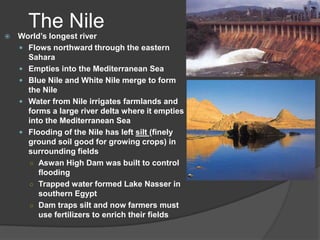
The NileWorld’s longest riverFlows northward through the eastern SaharaEmpties into the Mediterranean SeaBlue Nile and White Nile merge to form the NileWater from Nile irrigates farmlands and forms a large river delta where it empties into the Mediterranean SeaFlooding of the Nile has left silt (finely ground soil good for growing crops) in surrounding fieldsAswan High Dam was built to control floodingTrapped water formed Lake Nasser in southern EgyptDam traps silt and now farmers must use fertilizers to enrich their fields
The Sinai Peninsula and Suez CanalSinai PeninsulaEast of the NileBarren, rocky mountains, and desert cover the peninsulaSuez Canal was built by the French in 1860sIt is a strategic waterway that connects the Mediterranean Sea with the Red Sea
The SaharaCovers most of North Africa Largest desert in the worldFew people live hereSome settlements near oasisWindswept gravel plains and sand dunes cover much of desert
MountainsSome sand dunes reach 1,000 feetMountainsAhagger Mountains located in central SaharaHighest peak is 9,842 feetAtlas Mountains located on northwestern side of SaharaRise to 13,671 feet
Climate& Resources3 climate types:Desert Climate covers most of region; temperatures from mild to very hot (136 degrees F); low humidity causes temperatures to drop rapidly after sunsetMediterranean Climate (A climate characterized by moist, mild winters and hot, dry summers):Northern coast west of EgyptSteppe Climate (found in the middle of continents and in the lee of high mountains. The mountains block moist air from oceans or tropical climates from reaching the steppe)Between the Mediterranean climate and the SaharaResources:Oil and gas most importantIron ore and minerals to make fertilizerscoal
Section 2History & Culture
historyNile River home to world’s oldest civilizations3200 B.C. Egyptian kingdom was formed along northern NileThey also built pyramids, other monuments, and writing systemLater invaded by Greeks and Arabs
The Ancient EgyptiansBuilt pyramids as tombs for pharaohsWorkers cut large blocks of stone far away and rolled them on logs to the Nile, moved on barges, and carved at building site
Egyptian WritingDeveloped hieroglyphicsPictures and symbols stood for ideas or wordsCarved into temples and monumentsRecord words and achievements of pharaohs
Greek and Arab CivilizationsOpen to invaders due to long Mediterranean coastlineGreeks and RomansAlexander the Great: founded city of Alexandria, EgyptBecame important seaport and trading centerArab armiesInvaded; brought Arabic language & IslamCities became centers of learning, trade, and craft making
European Control1800s European countries began taking over region1912 controlled all of North Africa1922 Egypt gained limited independenceBritish kept military bases & control of the Suez Canal until 1956Region a major battle ground during WWII1950s Libya, Morocco, & Tunisia each gained independence; Algeria in 1962 after bitter war with FranceModern North AfricaAfter gaining independence, countries have tried to build stronger ties with Arab countries
CultureLanguage & ReligionCommon aspects of cultureLanguage, religion, foods, holidays, customs, & art and literaturePeople and LanguageEgyptians, Berbers, & Bedouins (nomadic herders who travel throughout deserts of Egypt and Southwest Asia) make up nearly all of Egypt’s populationArab & Berber ancestryBerbers: an ethnic group who are native to North Africa and speak Berber languageFrench, Italian, & English still spoken in some areasReligionMost are MuslimsPray 5 times a day6% of Egyptians are Christians
Food & FestivalsGrains, vegetables, fruits, & nuts are commonCouscous: made from wheat and looks like small pellets of pasta; steamed over boiling water or soup; served with vegetables or meat, butter, & olive oilFuul is a popular dish in EgyptMade from fava beans mashed with olive oil, salt, pepper, garlic, & lemons
HolidaysBirthday of the prophet of Islam, MuhammadMarked with lights, parades, and special sweets of honey, nuts, & sugarDuring holy month of Ramadan, Muslims abstain from food and drink during the day
Art & LiteratureNorth Africa is know for its architecture, wood carving, & other craftsWomen weave textiles (carpets with geometric designs and bright colors)Important writers and artists in this regionEgyptian poetry  and other writings date back thousands of yearsNaguib Mahfouz: 1st Arab writer to win Noble Prize in literatureAlso has growing movie industryPopular music based on singing and poetry is enjoyed by North Africans
Section 3North Africa Today
EgyptMost populous of North Africa’s countriesGov’t face challengesMost Egyptians are poor farmersLimited resources & few jobsGov’t and SocietyRepublic gov’tInfluenced by Islamic lawConstitution; elected officials; power shared between president & prime ministerDebate over role of Islam in countrySome believe laws should be based on Islam law, some fear this would cause fewer personal freedoms; some violence has resultedLittle clean water and disease are common in larger cities
Resources & EconomyFew resourcesFarmland limited to Nile River valley & deltaFertilizer must be used in soil (expensive)Over watering has brought salt to the surface of the soil, which is bad for growing cropsHave caused increase in importing of foodsHad to import much of its food recentlySuez Canal is another sources of income; ships pay a toll to pass through itEconomy dependent on:Agriculture, petroleum exports, and tourism
Other Countries of North AfricaWestern Libya, Tunisia, Algeria, & Morocco called MaghrebArabic for westMostly covered by SaharaCities & farmland along the coast
Government & EconomyConflict over role of Islam in societyOil, mining, and tourismOil most importantMoney from oil pays for schools, health care, other social programs, & military equipmentLarge deposits of natural gas, iron ore, & lead as wellAgriculture is importantWheat, other grains, olives, fruits, & nutsDesert climate & poor soil limit farmingFood is generally imported
The Countries TodayShare similar challengesViolence: under dictator shipsTrying to strengthen trading relationships w/ U.S. & Europe
AlgeriaViolence between gov’t & Islamic groups killed thousands in1990sTodayTrying to recover from violence & strengthen economy w/ exports
TunisiaMore rights granted to women recentlyClose economic relationships w/ Europe
MoroccoOnly North African country w/ little oilImportant producer and exporter of fertilizer

Blog notes

  • 1.
  • 2.
    Physical FeaturesMorocco, Algeria,Tunisia, Libya, and EgyptStretches from the Atlantic Ocean to the Red Sea; Mediterranean Sea is off the northern coast; Sahara desert is to the south
  • 3.
    The NileWorld’s longestriverFlows northward through the eastern SaharaEmpties into the Mediterranean SeaBlue Nile and White Nile merge to form the NileWater from Nile irrigates farmlands and forms a large river delta where it empties into the Mediterranean SeaFlooding of the Nile has left silt (finely ground soil good for growing crops) in surrounding fieldsAswan High Dam was built to control floodingTrapped water formed Lake Nasser in southern EgyptDam traps silt and now farmers must use fertilizers to enrich their fields
  • 4.
    The Sinai Peninsulaand Suez CanalSinai PeninsulaEast of the NileBarren, rocky mountains, and desert cover the peninsulaSuez Canal was built by the French in 1860sIt is a strategic waterway that connects the Mediterranean Sea with the Red Sea
  • 5.
    The SaharaCovers mostof North Africa Largest desert in the worldFew people live hereSome settlements near oasisWindswept gravel plains and sand dunes cover much of desert
  • 6.
    MountainsSome sand dunesreach 1,000 feetMountainsAhagger Mountains located in central SaharaHighest peak is 9,842 feetAtlas Mountains located on northwestern side of SaharaRise to 13,671 feet
  • 7.
    Climate& Resources3 climatetypes:Desert Climate covers most of region; temperatures from mild to very hot (136 degrees F); low humidity causes temperatures to drop rapidly after sunsetMediterranean Climate (A climate characterized by moist, mild winters and hot, dry summers):Northern coast west of EgyptSteppe Climate (found in the middle of continents and in the lee of high mountains. The mountains block moist air from oceans or tropical climates from reaching the steppe)Between the Mediterranean climate and the SaharaResources:Oil and gas most importantIron ore and minerals to make fertilizerscoal
  • 8.
  • 9.
    historyNile River hometo world’s oldest civilizations3200 B.C. Egyptian kingdom was formed along northern NileThey also built pyramids, other monuments, and writing systemLater invaded by Greeks and Arabs
  • 10.
    The Ancient EgyptiansBuiltpyramids as tombs for pharaohsWorkers cut large blocks of stone far away and rolled them on logs to the Nile, moved on barges, and carved at building site
  • 11.
    Egyptian WritingDeveloped hieroglyphicsPicturesand symbols stood for ideas or wordsCarved into temples and monumentsRecord words and achievements of pharaohs
  • 12.
    Greek and ArabCivilizationsOpen to invaders due to long Mediterranean coastlineGreeks and RomansAlexander the Great: founded city of Alexandria, EgyptBecame important seaport and trading centerArab armiesInvaded; brought Arabic language & IslamCities became centers of learning, trade, and craft making
  • 13.
    European Control1800s Europeancountries began taking over region1912 controlled all of North Africa1922 Egypt gained limited independenceBritish kept military bases & control of the Suez Canal until 1956Region a major battle ground during WWII1950s Libya, Morocco, & Tunisia each gained independence; Algeria in 1962 after bitter war with FranceModern North AfricaAfter gaining independence, countries have tried to build stronger ties with Arab countries
  • 14.
    CultureLanguage & ReligionCommonaspects of cultureLanguage, religion, foods, holidays, customs, & art and literaturePeople and LanguageEgyptians, Berbers, & Bedouins (nomadic herders who travel throughout deserts of Egypt and Southwest Asia) make up nearly all of Egypt’s populationArab & Berber ancestryBerbers: an ethnic group who are native to North Africa and speak Berber languageFrench, Italian, & English still spoken in some areasReligionMost are MuslimsPray 5 times a day6% of Egyptians are Christians
  • 15.
    Food & FestivalsGrains,vegetables, fruits, & nuts are commonCouscous: made from wheat and looks like small pellets of pasta; steamed over boiling water or soup; served with vegetables or meat, butter, & olive oilFuul is a popular dish in EgyptMade from fava beans mashed with olive oil, salt, pepper, garlic, & lemons
  • 16.
    HolidaysBirthday of theprophet of Islam, MuhammadMarked with lights, parades, and special sweets of honey, nuts, & sugarDuring holy month of Ramadan, Muslims abstain from food and drink during the day
  • 17.
    Art & LiteratureNorthAfrica is know for its architecture, wood carving, & other craftsWomen weave textiles (carpets with geometric designs and bright colors)Important writers and artists in this regionEgyptian poetry and other writings date back thousands of yearsNaguib Mahfouz: 1st Arab writer to win Noble Prize in literatureAlso has growing movie industryPopular music based on singing and poetry is enjoyed by North Africans
  • 18.
  • 19.
    EgyptMost populous ofNorth Africa’s countriesGov’t face challengesMost Egyptians are poor farmersLimited resources & few jobsGov’t and SocietyRepublic gov’tInfluenced by Islamic lawConstitution; elected officials; power shared between president & prime ministerDebate over role of Islam in countrySome believe laws should be based on Islam law, some fear this would cause fewer personal freedoms; some violence has resultedLittle clean water and disease are common in larger cities
  • 20.
    Resources & EconomyFewresourcesFarmland limited to Nile River valley & deltaFertilizer must be used in soil (expensive)Over watering has brought salt to the surface of the soil, which is bad for growing cropsHave caused increase in importing of foodsHad to import much of its food recentlySuez Canal is another sources of income; ships pay a toll to pass through itEconomy dependent on:Agriculture, petroleum exports, and tourism
  • 21.
    Other Countries ofNorth AfricaWestern Libya, Tunisia, Algeria, & Morocco called MaghrebArabic for westMostly covered by SaharaCities & farmland along the coast
  • 22.
    Government & EconomyConflictover role of Islam in societyOil, mining, and tourismOil most importantMoney from oil pays for schools, health care, other social programs, & military equipmentLarge deposits of natural gas, iron ore, & lead as wellAgriculture is importantWheat, other grains, olives, fruits, & nutsDesert climate & poor soil limit farmingFood is generally imported
  • 23.
    The Countries TodaySharesimilar challengesViolence: under dictator shipsTrying to strengthen trading relationships w/ U.S. & Europe
  • 24.
    AlgeriaViolence between gov’t& Islamic groups killed thousands in1990sTodayTrying to recover from violence & strengthen economy w/ exports
  • 25.
    TunisiaMore rights grantedto women recentlyClose economic relationships w/ Europe
  • 26.
    MoroccoOnly North Africancountry w/ little oilImportant producer and exporter of fertilizer