APPLICATIONS	OF	
BLOCKCHAINS	TO	
SMART	CONTRACTS	


PGPEM		
HAGAR	SUDHA	
ROLL	NO:	1816062	
PGPEM	2018-2020	|	IIM-B
2	
Table	of	Contents	
INTRODUCTION	.............................................................................................................................	3	
What	is	Ethereum	?	......................................................................................................................	4	
What	are	Smart	Contracts?	..........................................................................................................	6	
Present	state	of	Ethereum	platforms	...........................................................................................	7	
Performance	of	ether	as	a	cryptocurrency	..................................................................................	9	
Future	directions	of	ether	as	cryptocurrency	............................................................................	10	
Microeconomics	principle	applicable	to	blockchains	driven	smart	contracts	..........................	12	
CONCLUSION	..............................................................................................................................	15	
REFERENCES	................................................................................................................................	16
3	
	
	
INTRODUCTION	
	
On	the	background	of	smart	contracts,	the	term	was	first	coined	by	Nick	Szabo,	a	prominent	
computer	scientist,	and	cryptographer,	who	first	proposed	the	idea	in	the	1990s.	
	
Szabo	realized	that	decentralized	ledger	technology	could	be	leveraged	for	smart	contracts,	
which	could	be	converted	into	computer	code,	stored,	and	replicated	on	the	system	under	
the	supervision	of	the	computer	network	tasked	with	keeping	the	blockchain	running,	thus	
smart	contracts	bring	with	it	the	elimination	of	human	management	and	reduces	risk	that	
would	have	otherwise	existed	with	conventional	contracts.	
	
With	the	advent	of	technology	contracts	can	be	coded	to	communicate	with	each	other,	
exchange	vital	information,	reflect	what	influences	them,	and	stay	updated	with	the	most	
current	information.	
	
Through	the	use	of	smart	contracts,	business	will	become	faster	and	more	flexible	in	the	
current	year	and	beyond:	
• Offering	the	ability	to	learn	from	past	contracts	
• Providing	an	understanding	of	the	risk-taking	capacity	of	the	organization	
• Creating	adaptable	contracts	that	change	with	underlying	assets	
	
Blockchains	that	utilize	distributed	ledger	technology	require	contracts	that	are	self-
verifying,	self-executing,	and	autonomous.	Companies	can	exchange	terms,	events,	and	
information	throughout	the	lifecycle	of	a	contract	without	relying	on	brokers	or	middlemen.	
	
For	example,	contracting	parties	can	automate	payments	due	over	the	lifecycle	of	a	
contract.	The	nature	of	blockchains	and	distributed	ledgers	means	that	as	these	contract	
milestones	are	reached	and	payments	are	made,	they	are	recorded	in	such	a	way	that	
neither	party	can	repudiate	or	manipulate	the	record.	
	
Bitcoin	was	the	first	crypto	currency	to	support	basic	smart	contracts,	since	its	network	
could	transfer	value	from	one	participant	to	another.	Its	programming	language	could	
create	smart	contracts	such	as	payment	channels,	escrows,	multisig	accounts,	and	time	
locks,	but	is	somewhat	limited.	
	
Ethereum,	unlike	Bitcoin	was	built	with	smart	contracts	in	mind.	It	had	a	script	language	
that	was	more	flexible	in	that	it	enables	developers	to	build	their	own	decentralized	
applications.	It	is	today	credited	with	the	most	prominent	smart	contracts	framework.
4	
What	is	Ethereum	?	
	
	
Ethereum	is	typically	thought	of	as	a	cryptocurrency,	but	it	is	more	than	just	a	
cryptocurrency,	its	actually	an	open	software	platform	built	on	blockchain	technology	that	
enables	developers	to	build	and	deploy	decentralized	applications.	
	
Ethereum	is	a	computer	network	run	by	the	community	of	users,	it	means	that	personal	
information	of	users	will	no	longer	be	stored	on	the	central	servers	of	big	companies.	So	the	
possibility	of	hacking,	selling	information	and	disruption	does	not	exist	–	thus	making	it	
safer.	
	
The	biggest	breakthrough	with	Ethereum	is	that	any	user	can	can	use	this	platform,	
distributed	network	to	create	and	run	decentralized	applications.	No	permission	is	needed	
because	third	parties	are	no	longer	required.	
	
Ethereum	platform	consists	of	a	cryptocurrency	called	‘ether’	that	is	used	to	power	
applications	built	on	the	Ethereum	blockchain.	Ethereum	lets	software	applications	run	on	a	
network	of	many	private	computers	(also	known	as	distributed	systems).	
	
Any	program	that	runs	on	the	Ethereum	Virtual	Machine(EVM)	is	commonly	referred	to	as	
“smart	contract”.	The	most	popular	languages	for	writing	smart	contracts	on	Ethereum	are	
Solidarity	and	Vyper,	though	there	are	others	which	are	currently	under	development.	
	
Ethereum	community	adopts	standards	that	are	helpful	to	developers.	These	are	introduced	
as	Ethereum	Improvement	Proposals	(EIPs),	which	are	discussed	by	community	members	
through	a	standard	process.	
	
Certain	EIPs	relate	to	application-level	standards	(Ex:	standard	smart-contract	format),	
which	are	introduced	as	Ethereum	Requests	for	Comment(ERC).	Many	ERCs	are	critical	
standards	used	widely	across	the	Ethereum	ecosystem.
5	
	
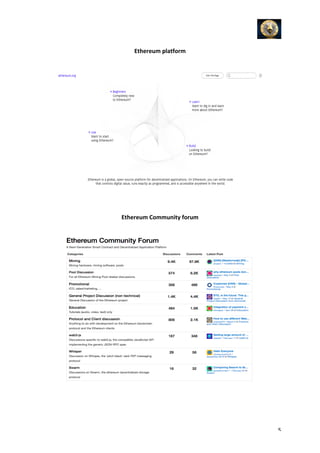
Ethereum	platform	


Ethereum	Community	forum
6	
What	are	Smart	Contracts?	
	
Smart	contracts	could	be	considered	as	digital	agreements	that	execute	automatically	based	
on	data	that	exists	in	the	real-world.	It’s	best	thought	of	as	an	“If-then	statement”.	If	
condition	A	is	true,	then	execute	function	B.	
	
The	example	below	brings	in	the	clarity	of	smart	contract:	


Suppose	Tom	has	put	up	house	for	sale	through	blockchain,	and	the	payment	has	been	
made	in	cryptocurrency.	The	renter	received	a	receipt	which	is	held	in	smart	contract	with	
the	following	terms:	
• Tom	must	give	the	renter	a	digital	entry	key	by	a	specified	date.	If	the	key	doesn’t	
come	on	time,	the	blockchain	releases	a	refund.	If	it	does,	the	smart	contract	
validates	and	releases	both	the	payment	to	Tom	and	key	to	the	renter.	
	
Here,	smart	contract	works	on	the	If-then	logic,	so	the	buyer	can	expect	a	faultless	delivery.	
If	Tom	gives	the	buyer	the	key,	then	he	is	sure	to	be	paid.	If	the	buyer	sends	a	certain	
amount	of	cryptocurrency,	then	the	buyer	receives	the	key	from	Tom.	
	
The	code	cannot	be	interfered	with	either	of	the	parties	involved	without	the	other	knowing	
since	all	the	participants	are	simultaneously	alerted	and	the	code	is	open	sourced,	meaning	
it	is	publicly	viewable.	
	
Smart	contracts	are	used	for	many	other	applications	beyond	even	reliability	and	efficiency	
of	real-estate	payment	collection.	In	any	process	that	involves	manual	interactions	between	
the	participants	could	be	eliminated	and	instead	be	automated	and	the	value	can	be	moved	
in	real-time	by	blockchain	rather	than	taking	a	number	of	days	to	settle	them	using	
conventional	banking.	And	above	all,	there	is	no	charge	to	set	up	and	deploy	this	
mechanism.
7	
Present	state	of	Ethereum	platforms	
	
Ethereum	has	gained	international	attention	and	traction	since	its	release	in	the	year	2015.	
Especially	from	late	2017	and	early	2018	there	has	been	a	massive	increase	in	popularity	
because	of	rapid	price	increases	in	the	entire	crypto-asset	ecosystem.	
	
There	have	been	nearly	240	million	transactions.	At	its	peak	on	January	4th
	2018,	the	
network	processed	1.3million	transactions	in	24	hours.	
	
To	current	date,	35	million	unique	addresses	exist	on	Ethereum	blockchain.	
	
Ethernodes	reports	just	under	17,000	nodes	running	the	Ethereum	blockchain	in	six	
continents,	hence	this	makes	blockchain	the	most	decentralized	platform	till	date.	


Ethereum	blockchain	is,	without	doubt,	the	most	active	smart	contract	platform	in	
existence.	Of	the	100	tokens	by	market	capitalization,	94%	are	built	on	Ethereum	and	of	the
8	
top	800	tokens,	87%	are	built	on	Ethereum.	Almost	most	of	these	tokens	are	“ERC-20	
tokens”,	which	made	possible	the	majority	of	the	$5.5billion	raised	through	token	sales	in	
2017	and	the	$6.5billion	raised	in	just	the	first	quarter	of	this	year	(2019).	
	
Ethereum	developer	community	is	the	largest	in	the	world	at	250000.	
	
Countries	around	the	world	have	found	ways	to	implement	blockchain	technology	–	
specifically	Ethereum	to	benefit	its	citizens.	Government	of	Brazil	has	announced	its	
intention	to	move	the	petitions	and	popular	voting	onto	Ethereum.	Canada	is	also	testing	
out	Ethereum	to	provide	transparency	to	the	use	of	Government	grants	to	ease	citizens’s	
concerns	of	misappropriation	and	corruption.	In	Switzerland,	the	city	of	Zug,	has	began	
offering	digital	IDs	registered	on	Ethereum	in	2017.	
	
To	combat	corruption	and	exploitation	through	transparent	means	Chile	uses	Ethereum	to	
track	data	and	finances	through	energy	grid,	and	data	is	available	for	every	citizen	to	see.	
Dubai	is	on	the	move	to	become	an	entirely	integrated,	blockchain-powere	city	by	2020.	
We	may	see	Government	adoption	of	the	Ethereum	blockchain	as	its	utility	is	proven	across	
the	world.	
	
As	an	open-source,	turing	complete,	world	computer,	Ethereum	can	be	leveraged	by	any	
developer	today	to	build	her	own	series	of	smart	contracts	(i.e.,	decentralized	application).	
A	site	that	tracks	dApp	development	lists	1,552	launched	dApps,	though	more	are	currently	
in	development.	Dapps	consist	of	everything	ranging	from	everything	to	do	with	prediction	
markets	to	gaming,	and	will	continue	to	grow	stronger	as	the	network	is	improved	upon.	
	
Scaling	of	the	Ethereum	network	is	an	important	problem	that	has	multiple	solutions	
offered	by	participants	working	in	the	community.	“Casper	protocol”	has	been	rolled	out	to	
solve	this	problem,	to	tackle	the	scalability,	security	and	decentralization	on	blockchain.	
“Cosmos”	is	a	permission	less	network	built	for	developers	that	allows	blockchain	
interoperability	and	scaling.	“Loom	network”	has	developed	and	launched	a	layer	2	
platform	on	top	of	Ethereum,	allowing	gaming	and	social	dApps	to	scale	while	still	relying	on	
Ethereum’s	core	security	and	decentralization.			
		
Cryptozombies,	a	live	app	enabling	anyone	to	learn	to	code	smart	contracts	on	Ethereum	
(with	over	200,000	students).	Layer	2	scaling	solutions	have	also	been	provided	for	
performance,	but	not	safety.	
	
Compared	to	2018,	ICO	inflows	and	outflows	are	heading	downwards	compare	to	the	
beginning	of	2018,	but	are	slightly	increasing	again.	This	selling	pressure	for	the	ICO	holdings	
will	continue	until	a	new	token	offering	will	enter	the	market.	ETH	holdings	in	ICO	have	been	
declining,	but	decentralized	finance	ETH	holdings	have	been	on	the	rise	again.	Also,	several	
Dapps	on	the	Ethereum	platform	are	increasing	in	popularity	which	brings	growing	
transaction	volumes.
9	
	
Performance	of	ether	as	a	cryptocurrency	
	
The	performance	of	Ether	as	cryptocurrency	as	of	September	2018	has	been	shown	below:	


One,	perhaps	unforeseen	was	that	Ethereum’s	smart	contracts	enabled	the	Initial	Coin	
Offering(ICO).	Unfortunately,	many	ICOs	revealed	themselves	to	be	little	more	than	money	
making	scams.	Many	ICOs	released	white	papers	and	Ethereum	based	tokens	with	no	
intention	of	ever	delivering	a	working	product	–	may	never	did.	
	
Its	facing	challenges	on	many	fronts	–	Scaling	woes,	governance	issues,	and	platform	
updates.	
	
Ethereum’s	price	was	positive	in	2017,	but	it	was	not	the	same	in	2018.	In	2017,	Ethereum	
closed	the	year	having	made	gains	of	over	8000%,	however	its	trading	price	dropped	by	90%	
over	the	course	of	the	year.	
	
In	January,	Ethereum	had	to	delay	a	long	awaited	hard	fork	following	security	concerns	over	
updates	to	its	smart	contracts.	Had	the	update	happened,	the	vulnerability	would	have	
allowed	attackers	to	exploit	smart	contracts	to	steal	funds	from	them	by	interacting	with	
contracts	numerous	times.	
	
Ethereum	is	also	facing	usership	issues.	Of	the	top	50	dapps	on	DappRadar.com,	only	three	
use	the	Ethereum	blockchain.	Many	developers	favour	the	EOS	and	TRON	platforms.	It	also	
looks	like	dapps	are	migrating	because	of	the	continued	scaling	woes	that	Ethereum	is	still	
in	the	process	of	addressing.	
	
However,	Ethereum	hopes	to	bypass	online	giants	such	as	Amazon,	Facebook	or	Uber	by	
allowing	automated	agreements	to	guarantee	users	a	service.
10	
	
Future	directions	of	ether	as	cryptocurrency	
	
Just	like	the	other	blockchains	that	exist	in	public	domain	today,	Ethereum	intends	to	
support	as	many	users	as	it	can	possibly	do.	
	
But,	the	problem	they	often	stumble	upon	is	that	it’s	tricky	to	preserve	this	balance	while	
also	growing	the	number	of	users,	this	problem	is	primarily	faced	because	Ethereum	
depends	on	a	network	of	‘nodes’,	each	of	which	stores	the	entire	Ethereum	transaction	
history	and	the	current	‘state’	of	account	balances,	contracts	and	storage.	This	becomes	a	
cumbersome	task	because	the	total	number	of	transactions	is	increasing	approximately	
every	10-12	seconds	with	each	new	block.	
	
But	the	solution	seems	that	to	raise	the	blocksize	to	fit	more	transactions,	but	this	will	
require	more	resources	and	come	to	a	point	where	only	a	few	large	companies	can	
accommodate	them,	hence	making	scaling	a	big	issue	in	Ethereum.	
	
Ethereum	in	future	is	looking	at	‘cryptoeconomic	incentives’	in	this	nodes	are	passing	only	
valid	information	to	other	nodes	thus	storing	only	subsets	of	data	in	the	nodes.	
	
In	a	distributed	consensus-based	on	the	proof	of	work,	miners	need	a	lot	of	energy.	One	
bitcoin	transaction	required	the	same	amount	of	electricity	as	powering	1.57	American	
households	for	one	day,	and	these	costs	are	paid	with	fiat	currencies	leading	to	constant	
downward	pressure	on	the	digital	currency	value.	


Hence,	Ethereum	community	wants	to	exploit	the	proof	of	stake	method	for	a	greener	and	
cheaper	distributed	form	of	consensus.	Also	reward	for	the	creation	of	a	new	block	are	
different:	with	proof	of	work,	the	miner	may	potentially	own	none	of	the	digital	currency	
he/she	is	mining.	But,	on	the	other	hand	with	proof	of	stake,	forgers	are	always	those	who	
own	the	coins	minted.
11	
Transition	to	Ethereum	2.0	(Serenity)	is	aimed	at	making	Ethereum	better	and	faster.	The	
final	completion	date	is	set	around	2021,	Ethereum	has	come	up	with	fastest	and	ad-free	
blockchain	explorer,	EnjinX,	which	would	definitely	make	ETH	more	accessible	to	the	
mainstream	market.	
	
Ethereum’s	strength	in	comparison	to	other	cryptocurrencies	is	the	computing	language	
that	allows	the	‘smart	contracts’	and	‘crowd-funding	campaigns’	to	exist	that	makes	
Ethereum	more	valuable	than	others,	so	in	future	there	will	be	more	smart	contracts	that	
would	be	realized	using	ETH.	However,	there	are	many	other	smart	contracts	that	exist	
today	and	hence	Ethereum	has	to	fix	the	many	issues	that	its	platform	has	else	it	could	
loose	out	to	its	competitors,	this	has	been	quoted	because	researchers	from	Singapore	and	
the	UK	have	found	34,000	Ethereum	based	contracts	susceptible	to	bugs	and	security	
breaches.	
	
Smart	contracts	would	breakdown	the	barrier	between	traditional	financial	products	and	
blockchain	technology.	Physicians	who	are	part	of	the	Medicalchain	platform	will	have	
access	to	read	and	write	to	a	patient’s	medical	record	with	access	secured	by	the	
blockchain.	Ethereum	could	look	into	expanding	via	smart	contracts	into	Supply	chain,	by	
using	smart	contracts	to	track	global	supply	chains	companies	can	work	across	borders	and	
still	offer	more	robust	services	to	enterprise	clients.	
	
ICO’s	are	validated	by	the	Ethereum	blockchain,	meaning	without	Ethereum	other	tokens	
cannot	exist.	This	positions	Ethereum	to	become	one	of	largest	cryptocurrency	companies	in	
the	world.	
	
The	profitability	of	computer	operators	who	validate	transactions	is	deemed	by	some	
analysts	to	favour	those	who	run	their	own	hardware	as	opposed	to	relying	on	cloud	
services	in	the	near	future.	
	
Ethereum	might	rise	with	strong	capitalization	and	consequently	a	concrete	value	per	coin	
increase.	It	might	also	experience	frequent	ups	and	downs	in	the	1st
	and	2nd
	quarter.	From	
the	third	quarter,	it	will	start	growing	at	a	steady	pace	from	$484	in	July	to	around	$1449.89	
in	2019.
12	
	
	
Microeconomics	principle	applicable	to	blockchains	driven	smart	
contracts	
	
Blockchain	(or	distributed	ledger	system)	and	microeconomics	both	are	large-scale	
distributed	systems,	and	there	are	inherent	connections	found	between	them.	
In	principle,	a	blockchain	system	(including	various	nodes	such	as	full	node,	mining	node,	
and	lightweight	node)	and	a	microeconomic	system	(including	a	social	system,	which	
consists	of	producers,	consumers	and	markets)	have	many	similarities:	different	
interconnected	subsystems,	decentralized	computations	and	so	on.		
The	broad	concern	of	microeconomics	is	to	allocate	scarce	resources	among	various	users	
with	the	goal	of	maximizing	user’s	utility	and	producer’s	profit	just	like	in	the	case	of	
blockchains.	
	
Markets	are	often	efficient	governance	institutions	for	spot	contracts	(a	pure	exchange	
economy)	but	when	an	economic	activity	requires	coordinated	investment	through	time	
(asset	specificity),	or	an	ongoing	relation	between	parties	(frequency),	or	involves	
uncontract	able	dealings	(uncertainty),	alternative	governance	institutions	like	Ethereum	
platforms	can	be	used	to	deal	with	the	effects	of	opportunism	(in	game-theoretic	terms)	
since	programmatically	it	automates	the	process	between	the	parties	involved	based	on	
actions	by	each	parties	which	then	triggers	the	next	steps	in	the	algorithms	to	finally	come	
to	a	consensus	if	the	party	on	the	other	hand	has	had	a	breach	or	not,	hence	there	is	
consensus	and	transparency	in	Ethereum	platform	which	eliminates	opportunism.	
	
Blockchain	enabled	smart	contracts	facilitated	transactions	should	experience	less	of	the	
efficiency	problems	of	information	asymmetries	–	adverse	selection	and	moral	hazard	
since	the	smart	contracts	exist	in	the	public	domain	and	are	completely	transparent.	
Also,	since	smart	contracts	exist	in	ethereum	platforms,	costly	signalling	could	be	easily	
avoided	or	even	screening,	it	all	happens	automatically.	
	
Since,	Ethereum	functions	like	open	source	libraries	that	could	simply	be	inserted	into	
machine	readable	contracts,	the	complexity	cost	of	writing	contracts	could	scale	linearly	and	
hence	the	blockchain	would	have	lower	transaction	costs	from	a	microeconomic	viewpoint.		
	
Also,	we	can	say	that	a	blockchain	is	a	‘trustless	commons’	in	which	effective	rules	are	
embedded	in	constitutional	smart	contracts	that	are	made	secure	by	cryptographic	and	are	
implemented	crypto-economically.	
	
Talking	about	blockchain	mining,	it	generates	economies	of	scale	and	creates	a	positive	
feedback	loop	between	network	effects	and	security:	as	more	participants	use	a	crypto	
token,	its	value	increases	which	in	turn	attracts	more	miners	(due	to	higher	rewards),	
ultimately	increasing	the	security	of	the	shared	ledger.	Similarly,	on	the	other	hand	if	the	
confidence	in	a	crypto	token	drops	like	ETH,	it	would	destroy	the	value	of	the	underlying	
cryptocurrency	and	hence	miners	could	leave	the	ecosystem	because	of	the	lower	rewards	
until	the	point	where	the	ledger	becomes	insecure	and	is	rendered	useless.
13	
	
	
As	seen	above,	on	the	horizontal	axis,	quantity	could	be	assumed	as	the	number	of	
transactions	that	can	be	cleared.	On	the	vertical	axis	is	the	miner’s	fee	in	Bitcoins.	The	orange	
demand	line	is	the	number	of	transactions	that	market	participants	want	to	clear	and	blue	
supply	line	is	hash	power	supplied	by	miners	to	clear	the	transactions.	
The	red	vertical	line	denotes	the	quota	of	1	MB	block	size.	Since	the	inception	of	bitcoin,	the	
quota	line	has	always	been	firmly	to	the	right	of	the	equilibrium	point.	This	means	there	was	
never	enough	demand	to	fill	up	the	blocks	so	the	quota	actually	didn’t	matter	economically.	
But	once	the	quota	goes	to	the	left	of	the	equilibrium	point	(the	current	scenario),	things	
begin	to	change.	The	red	area	in	figure	3	is	the	dead	weight	loss.	It	represents	transactions	
that	would	have	been	valuable	to	both	the	miners	as	well	as	traders	but	cannot	be	executed	
because	of	the	block	size	quota.	This	is	the	economical	value	which	is	lost	forever.	
Also,	we	see	a	difference	between	the	producer	price	and	consumer	price	when	the	quota	is	
applicable.	So	consumers	-	in	this	case	the	bitcoin	traders	-	end	up	paying	more	than	what	it	
takes	to	validate	their	transactions.	This	cost	to	consumers	is	not	necessarily	monetary,	but	
the	time	they	spend	waiting	for	their	transactions	to	be	validated.	
Mining	small	blocks	is	indeed	profitable	to	miners	if	the	fee	density	of	transactions	in	
mempool	is	low.	However,	this	increases	the	dead	weight	loss	to	the	system	as	a	whole	and	
could	lead	to	phenomenon	similar	to	‘tragedy	of	commons’.	Having	a	fixed	fee	density	
(something	similar	to	gas	while	deploying	smart	contracts	in	Ethereum	blockchain)	could	be	
an	interesting	approach	to	incentivise	miners	to	include	maximum	transactions	in	block,	but	
the	downfall	being	that	transactions	couldn’t	be	prioritized.
14	
As	seen	above,	the	basic	supply-demand	graph	stands	the	same	for	Ethereum	
cryptocurrency.	On	the	vertical	axis	is	the	price	of	a	product	per	unit	and	on	the	horizontal	
axis	is	the	quantity	per	period.	The	blue	and	orange	lines	simultaneously	show	supply	and	
demand.	The	point	of	intersection	of	these	two	lines	gives	the	equilibrium	point.	
The	orange	shaded	region	in	the	graph	is	consumer	surplus	which	is	derived	whenever	the	
price	paid	by	the	consumer	is	actually	less	than	what	the	consumer	was	willing	to	pay.		
The	blue	shaded	region	in	the	graph	is	producer	surplus	which	is	the	additional	private	
benefit	to	producers,	in	term	of	profit,	gained	when	the	price	they	receive	in	the	market	is	
more	than	the	minimum	price	they	would	be	prepared	to	sell	for	ETH.	
	
On	the	platform	of	Ethereum,	Dutch	auction	was	used	by	Gnosis	to	sell	tokens	and	they	
reached	their	goal	of	250K	ETH	in	less	than	15	minutes.	Meanwhile,	the	popular	game	
CryptoKitties	is	using	Dutch	auction	to	sell	their	cats.	We	can	imagine	that	Dutch	auction	will	
be	used	in	more	and	more	smart	contracts	to	figure	out	the	optimum	price	of	various	
commodities.
15	
CONCLUSION	
	
In	conclusion,	Ethereum	is	an	improvement	of	bitcoins,	with	better	technology	and	having	
the	smartest	people	in	the	world	working	on	them.	Ethereum	will	have	a	positive	impact	as	
time	progresses	on	the	economy	as	a	whole.	
	
Ethereum	could	potentially	help	Governments,	entrepreneurs,	financial	companies	and	
intermediaries	and	healthcare	departments	alike	and	at	the	same	time	with	the	smart	
contracts	as	the	major	strength	of	Ethereum	it	could	educate	and	encourage	public	
participation	to	use	it	to	prevent	additional	costs	and	manual	intervention	in	a	world	where	
everything	today	is	driven	by	the	amazing	possibilities	that	technology	has	to	offer.	
	
Ethereum	is	definitely	going	to	taste	success	in	the	coming	years	as	it	has	in	the	past,	but	
what	we	look	forward	to	is	the	reduction	in	energy	consumption	and	building	efficient	
systems	that	are	scalable	with	increased	participation	by	the	public	and	Government.	
	
Smart	contracts	have	to	be	still	dealt	with	caution	since	its	easy	to	find	breaches	if	not	
explicitly	stated	during	design	of	contracts,	and	it	may	have	external	dependencies	to	work	
for	most	things	in	some	complex	smart	contracts,	so	we	have	to	tread	with	caution	as	there	
is	still	scope	for	improvisation	of	smart	contracts	in	Ethereum	itself	though	they	were	the	
pioneers	of	smart	contracts.	
	
But	for	sure,	smart	contracts	will	revolutionize	the	world!!!
16	
	
REFERENCES	
	
https://www.icertis.com/blog/blockchain-smart-contracts-will-change-contract-
management-2018/?icid=70137000000Enu9AAC&gclid=CjwKCAjwq-
TmBRBdEiwAaO1en1CgooqAz1TDj9DlGBJVyWw4kQI3P4A5LVkc-
NGOu5ElrupKyC_isBoC8mUQAvD_BwE	
https://education.district0x.io/general-topics/understanding-ethereum/what-is-ethereum/	
https://www.ethereum.org/build/	
https://www.ethereum.org/build/#smart-contract-languages	
https://blockgeeks.com/guides/smart-contracts/	
https://education.district0x.io/general-topics/understanding-ethereum/what-are-smart-
contracts/	
https://media.consensys.net/the-state-of-the-ethereum-network-949332cb6895	
https://thenextweb.com/hardfork/2019/05/01/ethereum-performance-q1-2019-etoro/	
https://www.theatlas.com/charts/BJ7B4P8u7	
https://blockonomi.com/ethereum-price-prediction-2019/	
https://cryptoinsider.com/examples-real-world-uses-smart-contracts/	
https://readbtc.com/7-smart-contracts-to-consider-2019/	
https://www.genesis-mining.com/future-of-ethereum	
https://www.mangoresearch.co/ethereum-casper-v2-beacon-chain-sharding-explained-
simply/	
https://www.coindesk.com/staking-ethereums-mining-alternative-will-be-profitable-but-
barely	
https://blog.blockonomics.co/the-economics-of-bitcoin-block-size-e9575272c3ee	
https://medium.com/platform-innovation-kit/how-blockchain-will-transform-the-platform-
economy-part-1-e5994de8663d	
https://medium.com/secbit-media/smart-contract-and-nash-equilibrium-3ef947d87042

BlockChainInSmartContracts