Objectives
• WHO definition of blindness
• Problem statement
• Causes
• Epidemiological determinants
• Changing concepts in eye health care
• Prevention
• NPCB
• Vision 2020: The Right to Sight
• World Sight Day
Definition of Blindness???
• 65 definitions of blindness (publication of
WHO in 1966)
• 25th WHA in 1972 considered the need for
generally acceptable definition of
blindness and visual impairment for
national and international comparability
WHO definition
• “Visual acuity of less than 3/60(snellen) or its
equivalent” or
• “Inability to count fingers in daylight at a distance
of 3 meters.”
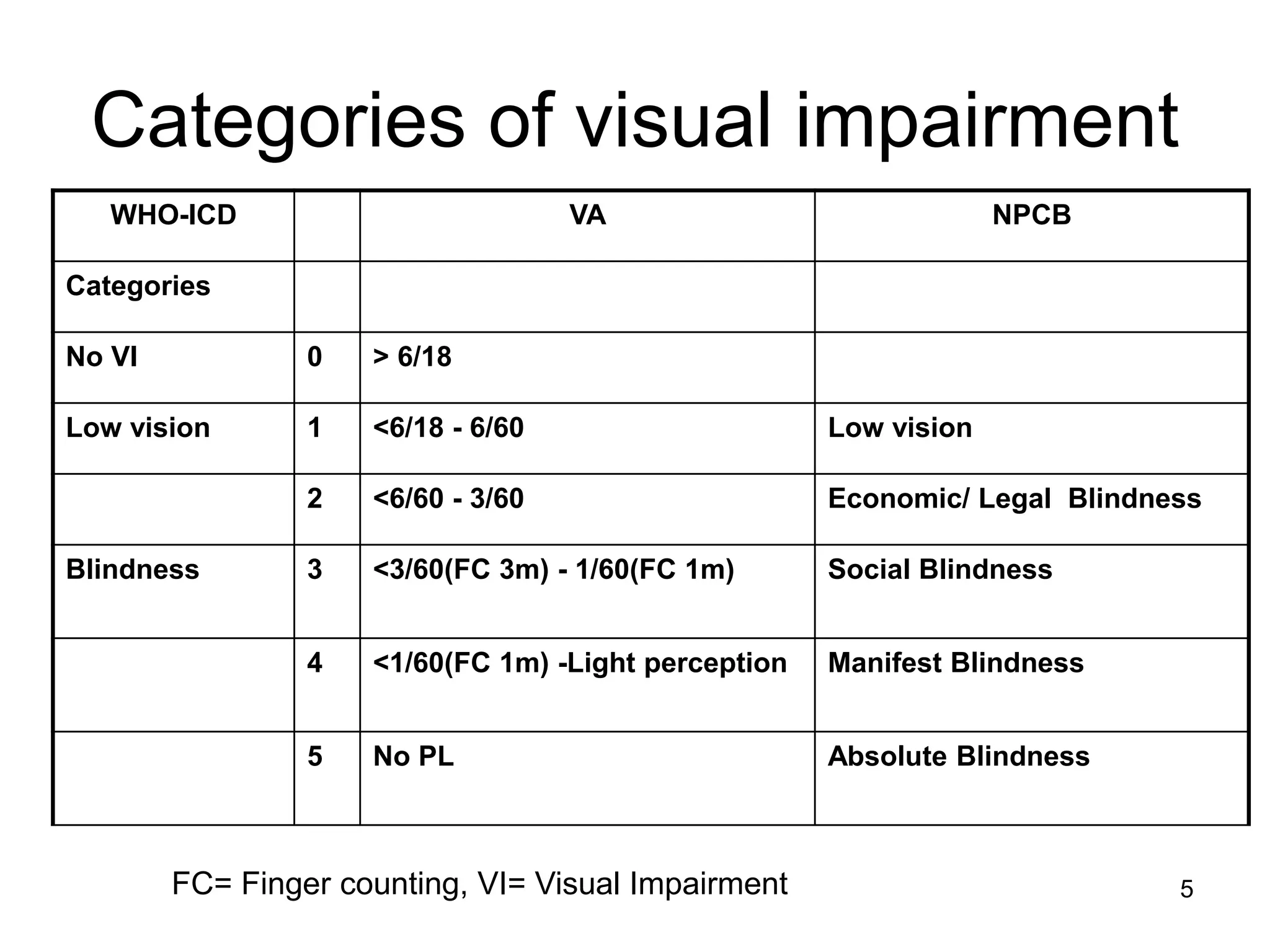
Categories of visual impairment
WHO-ICD VA NPCB
Categories
No VI 0 > 6/18
Low vision 1 <6/18 - 6/60 Low vision
2 <6/60 - 3/60 Economic/ Legal Blindness
Blindness 3 <3/60(FC 3m) - 1/60(FC 1m) Social Blindness
4 <1/60(FC 1m) -Light perception Manifest Blindness
5 No PL Absolute Blindness
FC= Finger counting, VI= Visual Impairment 5
Problem statement-
• World-
– 180 million people worldwide are visually
disabled of which 45 million are blind.
– Prevalence- 0.2% or less to 1%
– 80% of which is avoidable.
• In India-
– Prevalence- 0.7%
0.95%
3.05%
1.89%
1.52%
1.55%
1.61%
1.78%
2.28%
1.61%
1.42%
1.38%
1.19%
1.40%
1.16%
1.13%
1.07%
1.05%
1.01%
1.41%
0.94%
0.78%
0.78%
0.56%
0.78%
0.77%
0.74%
0.70%
0.65%
Prevalence of Blindness
State wise blindness prevalence [%]
National Survey [2001-02] [2003-04]
High Prevalence
Medium Prevalence
Low Prevalence
CAUSES OF BLINDNESS-
World
• In developed countries: accidents, glaucoma,
diabetes, vascular disease , cataract,
degeneration of ocular tissues, hereditary
conditions
• In SEAR: cataract(50-80%), RE, emerging
causes- glaucoma, ARMD, diabetic retinopathy,
corneal ulcer, ocular trauma
• Childhood blindness: xerophthalmia, cong.
Cataract, cong. Glaucoma, OA due to
meningitis, ROP, uncorrected RE
Prevalence of Blindness
Based on National Surveys:
• 1974 (ICMR) : 1.38%
• 1986-89 (NPCB) : 1.49%
• 2001-04 (NPCB) : 1.10%
• 2007 (NPCP) : 1.05 %
1.00%
1.20%
1.40%
1.60%
1974 1986 2001 2007
Causes of Blindness
Cataract 62.6%
Refractive Error 19.7%
Corneal Blindness 0.9%
Glaucoma 5.8%
Surgical Complication 1.2%
Posterior Segment Disorder 4.7%
Others 5%
CAUSES OF BLINDNESS
62%
20%
10%
6%
1%
1%
Survey 2001-02
80%
2%
4%
5%
2%
7%
Corneal Opacity
Glaucoma & DR
Ref. Errors Surg. Comp.
Others
Cataract
Survey 1986-89
Epidemiological determinants
• Age
– RE, Trachoma, conjunctivitis, malnutrition at
younger ages
– Cataract, glaucoma, diabetes at middle age
– Injuries and accidents at any age
• Females
– Cataract, trachoma and conjunctivitis higher
among females
• Malnutrition – Vitamin A
Epidemiological determinants
• Occupation
– Occupational exposure to dust, airborne
particles, flying objects, gases, fumes,
radiation
• Social class
– Poor socioeconomic class
• Other
– Treatment by quakes, poverty, ignorance, low
standard of hygiene, inadequate healthcare
services
Changing concepts in eye
health care
• Acute intervention – comprehensive
eye health care which includes
1) Primary eye care
2) Epidemiological approach
3) Team concept
4) Establishment and enhancement of
national programme
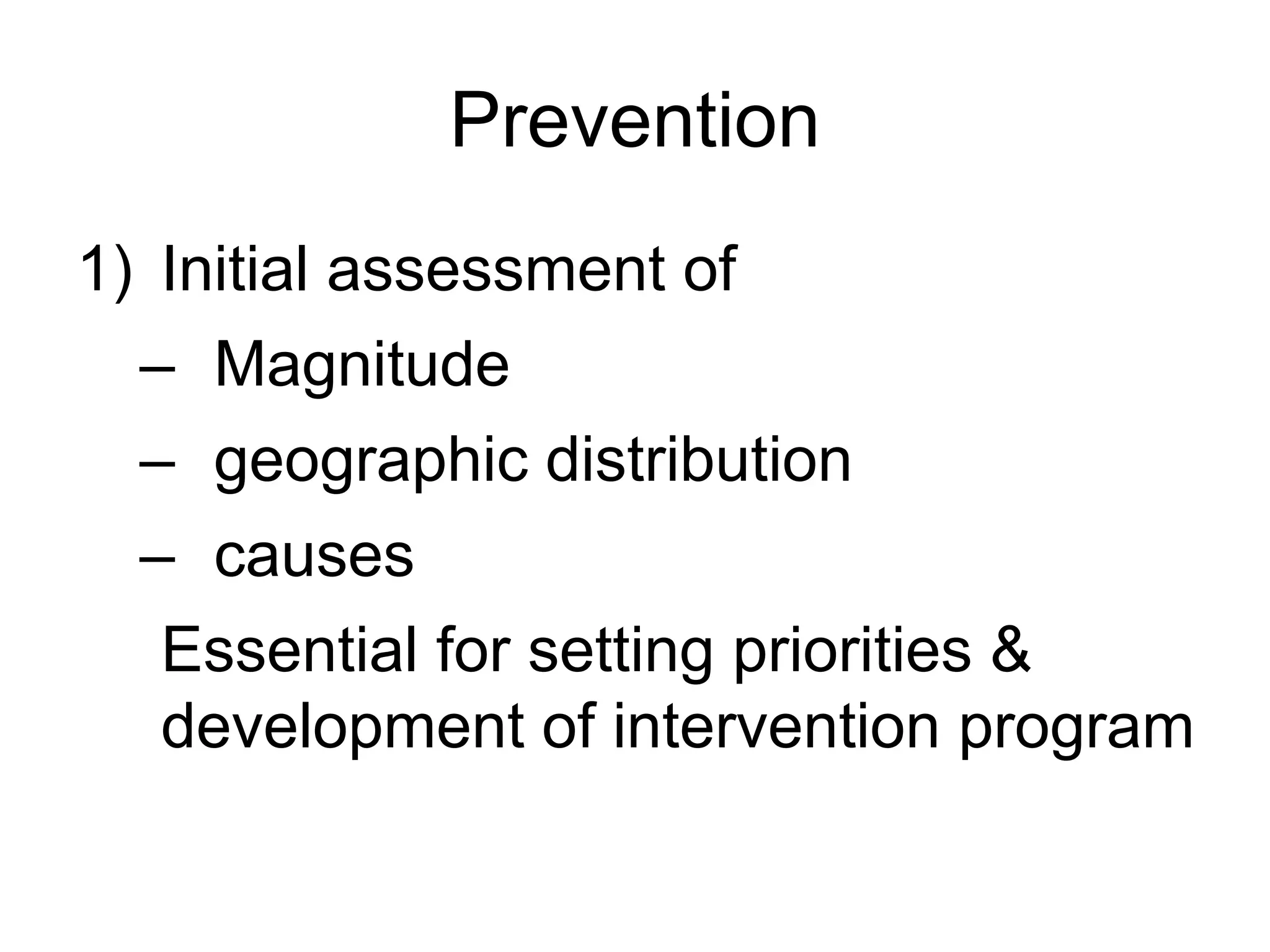
Prevention
1) Initial assessment of
– Magnitude
– geographic distribution
– causes
Essential for setting priorities &
development of intervention program
Methods of intervention
a) Primary eye care
 Based on primary health care
 Certain eye condition manageable locally
 Promotion of hygiene, sanitation, good
dietary habits
b) Secondary care
 Management of common blinding condition.
 Involves PHC, district hospitals with eye
clinics & mobile camps
c) Tertiary care
 At tertiary care centres, regional centres,
medical colleges etc.
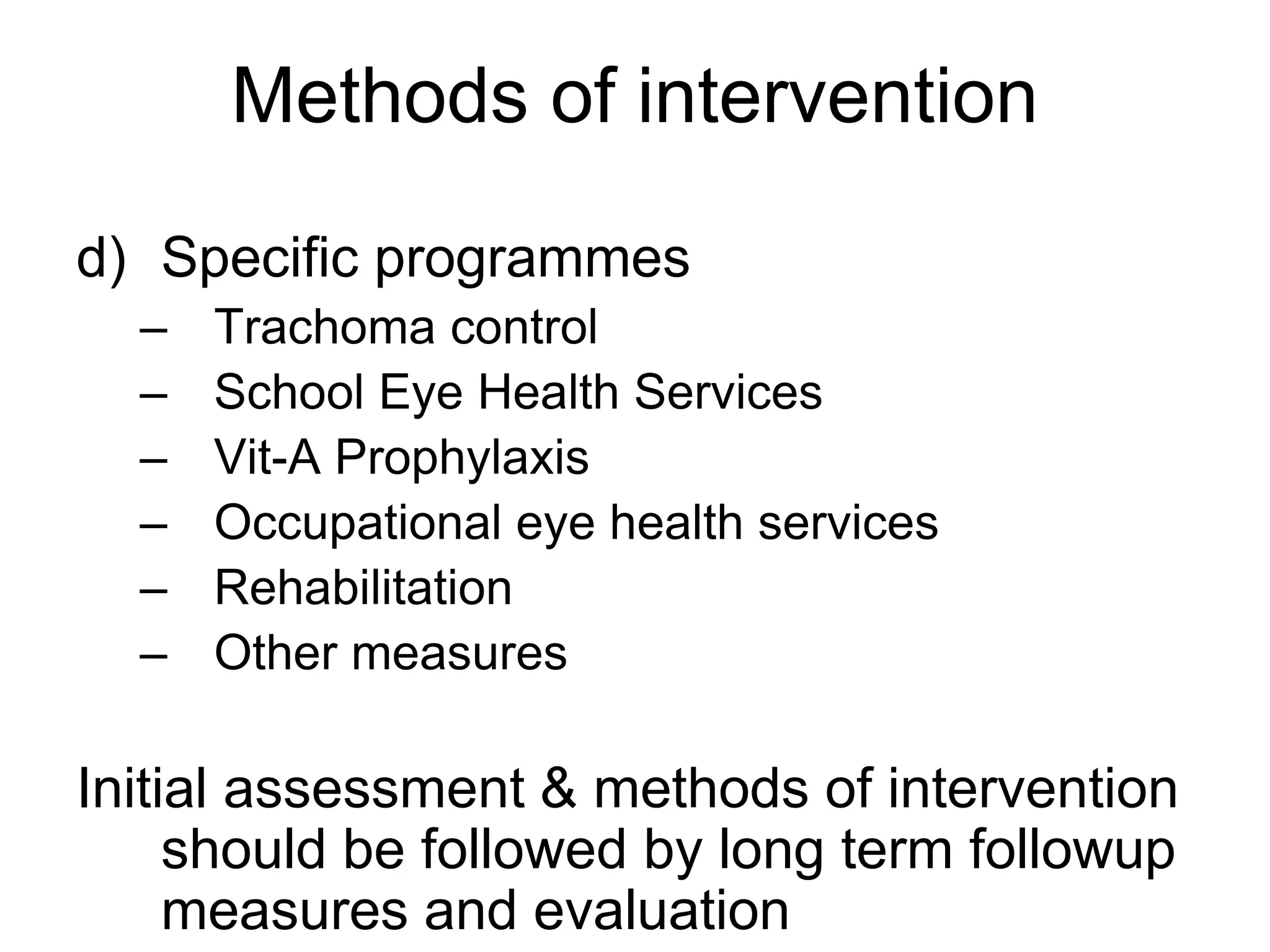
Methods of intervention
d) Specific programmes
– Trachoma control
– School Eye Health Services
– Vit-A Prophylaxis
– Occupational eye health services
– Rehabilitation
– Other measures
Initial assessment & methods of intervention
should be followed by long term followup
measures and evaluation
National Programme for Control
of Blindness
• Launched in 1976
• 100% centrally sponsored
OBJECTIVES
• To establish eye care facilities for every 5 lac
population
• To develop human resources for eye care
services at all levels
• To improve quality of service delivery and
• To secure participation of civil society and the
private sector
GOALS
• To reduce the prevalence of blindness from
0.7% to less than 0.3%
• To establish an infrastructure and efficiency
levels in the program to be able to cater new
cases of blindness each year to prevent the
future backlog.
Revised Program Objectives
• To expand the coverage for eye care services to
under privileged areas
• To shift from eye camp approach to fixed facility
surgical approach & from conventional surgery
to IOL implantation
• Development of district blindness control
societies
• To make NPCB more comprehensive by
strengthening services for other causes of
blindness, improving follow-up services for post-
operative patients
• To strengthen participation of voluntary
organizations
ORGANIZATION
CENTRAL LEVEL:
• National blindness control board
• National management cell
• National technical advisor committee
STATE LEVEL:
• State programme cell
• State blindness control society
DISTRICT LEVEL:
District blindness control society
DISTRICT BLINDNESS
CONTROL SOCIETY
STRATEGIES:
• Annual district action plan
• NGO participation made accountable
• Emphasis on utilization of existing government
facilities
• Gradual shift from camp surgeries to institutional
surgeries
• Development of infrastructure and manpower
Voluntary organisations
• International Agency For Prevention Of
Blindness
• National Society for Prevention of Blindness
• Royal Commonwealth Society
• Lions International
• Rotary International
• Hellen Keller International
• Helpage India
Objectives We achieved… so far
• Reduced the backlog of blindness through
identification and treatment of blind
• Developed eye care facilities in every district
• Developed human resources for providing
eye care services
• Improved quality of service delivery
• Secured participation of voluntary
organization/private practitioners in eye care
%
5 9 12
20
34
46
58
65
77
83
88 90 93 94
0
10
20
30
40
50
60
70
80
90
100
94-95
95-96
96-97
97-98
98-99
99-00
2000-01
2001-02
2002-03
2003-04
2004-05
2005-06
2006-07
2007-08
Percentage of Cataract Performance with IOL
Implantation:1993-2008
Cataract Operations in India:
Pvt. Practitioners
NGOs and private practitioners play a key
role in our blindness control programme
NGOs
Dt. Hospitals
Mobile Units
Medical Colleges
Others
39%
34%
11%
5%
6%
4%
Achievements under the
Programme
307 Dedicated eye operation theatres and eye
wards in District Hospitals constructed;
Supply of Ophthalmic equipments of common
eye disorders.
More than 2500 Eye Surgeons trained in various
Eye Care Specialties.
80 NGOs assisted for setting up/expanding eye
care facilities.
70% coverage of eye care services.
Focus areas for 11TH five year plan
Cataract
Childhood Blindness
Refractive Error & Low Vision
Corneal Blindness
Glaucoma
Diabetic Retinopathy
Trachoma
CHILDHOOD BLINDNESS
a. Target all communities with Vitamin A
deficiency and provide Vitamin ‘A’ for
children below 6 yrs of age. (NRHM-
RCH)
b. School Eye Screening & community
screening for Refractive Errors- Provide
spectacles for all children with Refractive
Errors. (School Health Services)
PEDIATRIC OPHTHALMOLOGY UNITS/ RETINA
UNITS/ GLAUCOMA UNITS IN EYE
DEPARTMENTS OF MEDICAL COLLEGES/RIOS.
Strengthening of
• Pediatric Ophthalmology Units
• Retina Units
• Glaucoma Units.
In all RIO, Selected Medical Colleges,
State Level Eye Hospitals, NGO
Hospitals etc.
• Low vision services
– To be strengthened in all Regional Institutes of
Ophthalmology & identified Medical College
Hospitals/State Level Hospitals & Non Government
Orgaization Hospitals by 2012
• Vision centres
– Establishing 3000 Vision Centres constituting of basic
screening equipments catering every 50,000
population.
OUTPUT TARGETS BY 2012
 Comprehensive Eye Care for diseases like Diabetic
Retinopathy, Glaucoma, Corneal Blindness,
Uncorrected Refractive Error, Childhood Blindness,
Trachoma etc.
 Increase Cataract Surgery Rate to 500 per lakh per
year;
 Improve Visual Outcome of Cataract Surgery (> 90%
with VA > 6/18);
 Increase proportion of Intra Ocular Lens (IOL)
surgery >90%
 Coverage of population > 90%.
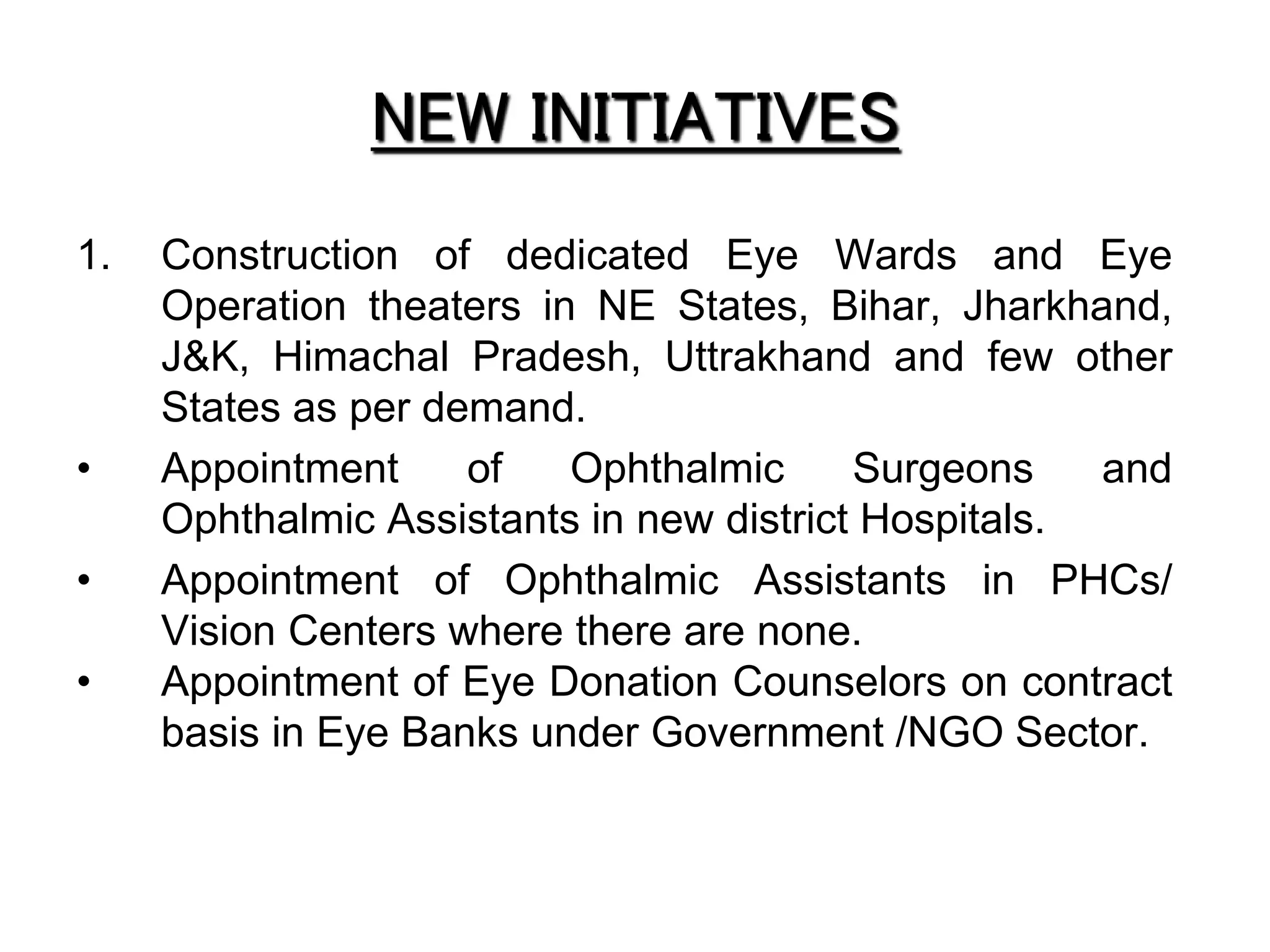
NEW INITIATIVES
1. Construction of dedicated Eye Wards and Eye
Operation theaters in NE States, Bihar, Jharkhand,
J&K, Himachal Pradesh, Uttrakhand and few other
States as per demand.
• Appointment of Ophthalmic Surgeons and
Ophthalmic Assistants in new district Hospitals.
• Appointment of Ophthalmic Assistants in PHCs/
Vision Centers where there are none.
• Appointment of Eye Donation Counselors on contract
basis in Eye Banks under Government /NGO Sector.
5. Grant-in-Aid for Non Government Organizations for
management of other Eye diseases other than Cataract
like Diabetic Retinopathy, Glaucoma Management, Laser
Techniques, Corneal Transplantation, Vitreoretinal
Surgery, Treatment of Childhood blindness etc. (Rs. 750
for Cataract Surgery with Intra Ocular Lens Implantation
and Rs.1000 for other intervention)
6. Involvement of Private Practitioners in sub-district, block
and village levels
7. Development of Ophthalmic mobile units with Tele
Ophthalmology network in NE/Hilly states/Difficult
terrains/underserved states and few fixed models in other
states for diagnosis and medical management of eye
diseases.
8. Maintenance of ophtalmic equipments supplied to RIOs,
Medical Colleges, district hospitals, PHCs/Vision centres.
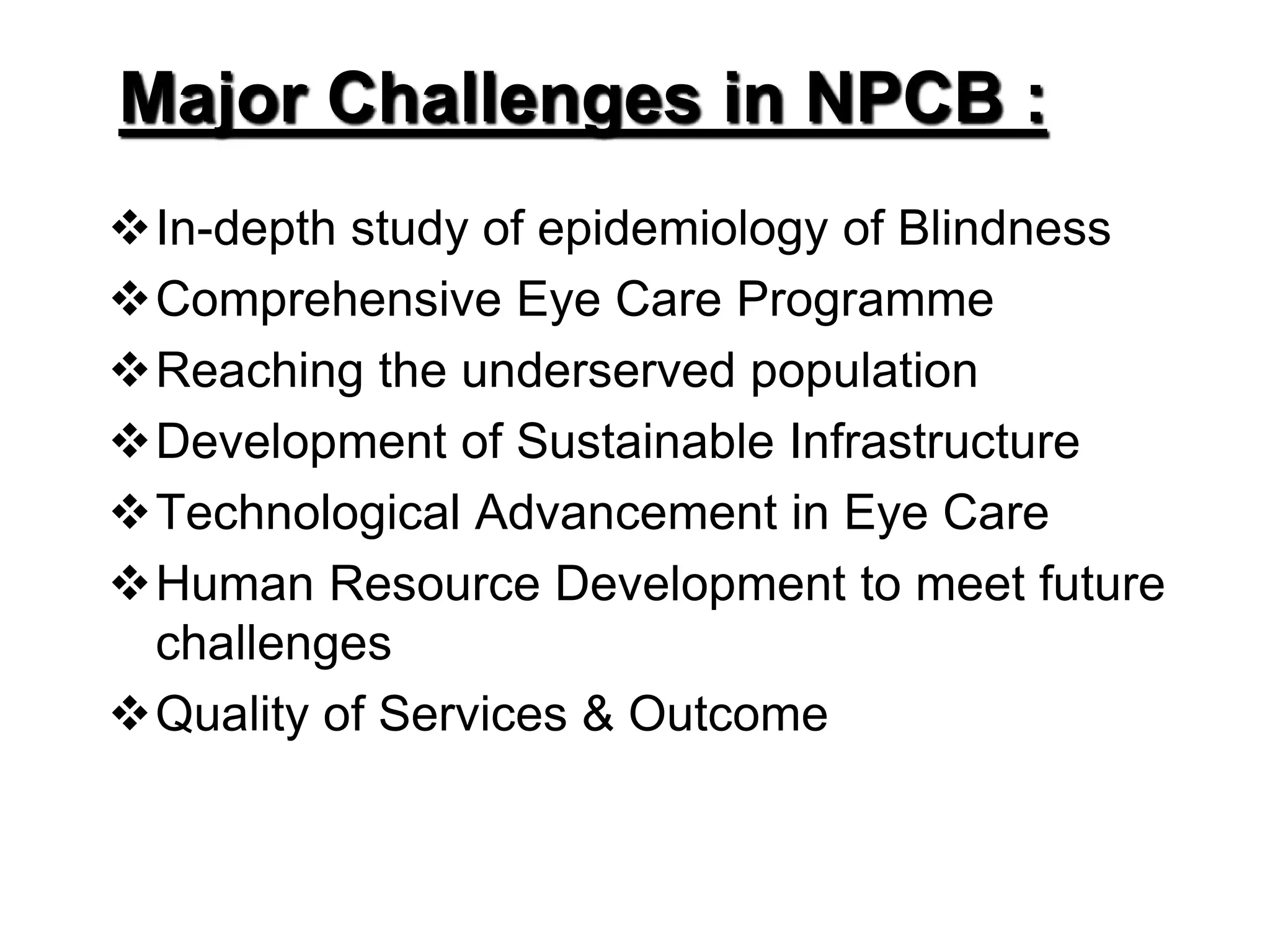
Major Challenges in NPCB :
In-depth study of epidemiology of Blindness
Comprehensive Eye Care Programme
Reaching the underserved population
Development of Sustainable Infrastructure
Technological Advancement in Eye Care
Human Resource Development to meet future
challenges
Quality of Services & Outcome
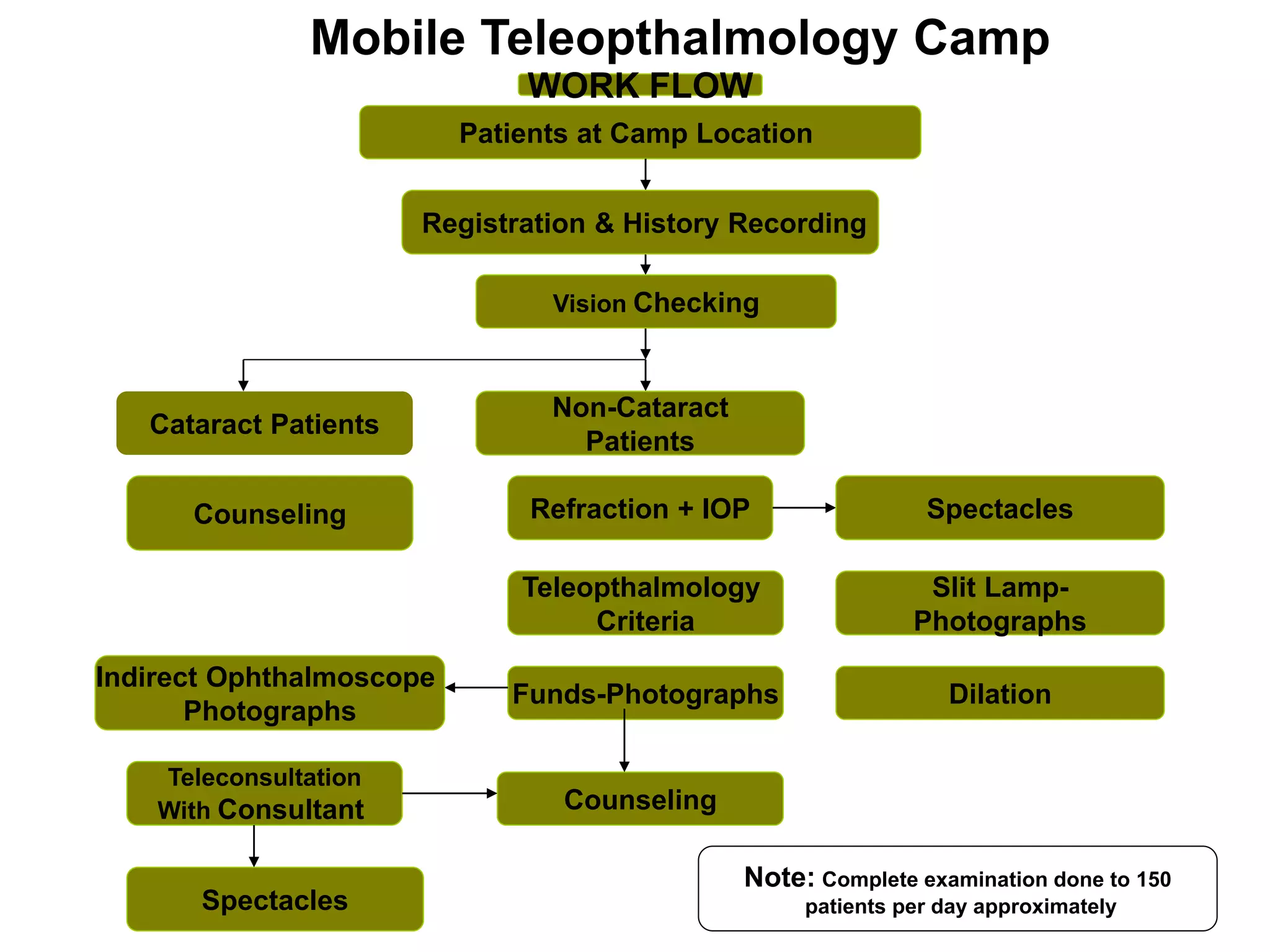
Patients at Camp Location
Cataract Patients
Non-Cataract
Patients
Counseling Refraction + IOP Spectacles
Teleopthalmology
Criteria
Funds-Photographs
Slit Lamp-
Photographs
Indirect Ophthalmoscope
Photographs
Teleconsultation
With Consultant
Dilation
Counseling
Spectacles
Registration & History Recording
Vision Checking
Note: Complete examination done to 150
patients per day approximately
Mobile Teleopthalmology Camp
WORK FLOW
TELE-OPHTHALMOLOGY
Mobile Van
National Program for Control of
Blindness in Gujarat
• State Government of Gujarat started
implementation of this programme in 1978.
• To bring more intensity in the programme
Government of Gujarat has launched
“DRASHTI” Programme on 26th Jan. – 96.
• Gujarat is committed to reduce the burden of
avoidable blindness by the year 2020 by
adopting strategies advocate for VISION 2020.
• To provide high quality of Eye care to the
affected population.
• To expand coverage of eye care services to
the underserved areas.
• To reduce the backlog of blindness by
identifying and providing services to the
affected population.
• To develop institutional capacity for eye care
services by providing support for equipment
& material and training personnel.
Goal :
ACTIVITIES UNDER NPCB
• Cataract Surgery.
• School Eye Screening Programme.
• Eye Banking.
• Co-ordination with NGO and Private Sector.
• Preparation of Village Blind Register.
• IEC activities.
• Training of Ophthalmic Surgeon, Ophthalmic
Assistant, Medical Officers and Paramedical
workers.
Launched by WHO in February 1999
What is VISION 2020?
2020
20/20
VISION
A world in which no
one is needlessly blind
and where those with
unavoidable vision
loss can achieve their
full potential.
MISSION
To eliminate the main causes of
avoidable blindness by the year 2020
by facilitating the planning, development
and implementation of sustainable
national eye care programs
AIM
• To eliminate the main causes of
avoidable blindness by the year 2020
and
• To prevent the projected doubling of
avoidable vision impairment between
1990 and 2020.
Objectives
• Increase awareness, within key
audiences, of the causes of avoidable
blindness and the solutions to the
problem;
• Advocate for and secure the necessary
resources to increase prevention and
treatment activities; and
• Facilitate the planning, development
and implementation of national VISION
2020 programmes in all countries.
Features
• Goal of eliminating avoidable blindness by
the year 2020 will best be achieved by
integrating an equitable, sustainable,
comprehensive eye-care system into
every national health system.
• The VISION 2020 initiative is intended to
strengthen national health-care systems
and facilitate national capacity-building.
Features
• National programmes have three main
elements: cost-effective disease control,
human resource development and
infrastructure and technology.
• VISION 2020 is built on a foundation of
community participation
• Overarching issues, such as equity,
quality of services and visual outcomes,
are addressed as part of national
programmes
VISION 2020
“THE RIGHT TO SIGHT”
Target diseases:
 Cataract
 Refractory errors
 Childhood blindness
 Corneal blindness
 Glaucoma
 Diabetic retinopathy
VISION 2020
“THE RIGHT TO SIGHT”
Proposed 4 tire structure:
1) Centres of excellence (20) - tertiary
2) Training centres (200) - tertiary
3) Service centres (2000) - secondary
4) Vision centres (20000) - primary
TC
SC
VC
Centre Of Excellence:
1 for 5 crores
Training Centre:
1 for 50 Lakhs
Vision Centre:
1 for 50,000
Service Centre:
1 for 5 Lakhs
20
200
2000
20000
INFRASTRUCTURE
BY 2020 UNDER NPCB
VISION 2020
“THE RIGHT TO SIGHT”
It has been recognized to implement the
“SAFE” strategy
• S : Surgery
• A : Antibiotic
• F : Facial cleanliness
• E : Environment
World Sight Day
• World Sight Day (WSD) is an annual day
of awareness held on the Second
Thursday of October, to focus global
attention on blindness and vision
impairment.
Thank You

BLINDNESS.ppt

  • 2.
    Objectives • WHO definitionof blindness • Problem statement • Causes • Epidemiological determinants • Changing concepts in eye health care • Prevention • NPCB • Vision 2020: The Right to Sight • World Sight Day
  • 3.
    Definition of Blindness??? •65 definitions of blindness (publication of WHO in 1966) • 25th WHA in 1972 considered the need for generally acceptable definition of blindness and visual impairment for national and international comparability
  • 4.
    WHO definition • “Visualacuity of less than 3/60(snellen) or its equivalent” or • “Inability to count fingers in daylight at a distance of 3 meters.”
  • 5.
    Categories of visualimpairment WHO-ICD VA NPCB Categories No VI 0 > 6/18 Low vision 1 <6/18 - 6/60 Low vision 2 <6/60 - 3/60 Economic/ Legal Blindness Blindness 3 <3/60(FC 3m) - 1/60(FC 1m) Social Blindness 4 <1/60(FC 1m) -Light perception Manifest Blindness 5 No PL Absolute Blindness FC= Finger counting, VI= Visual Impairment 5
  • 6.
    Problem statement- • World- –180 million people worldwide are visually disabled of which 45 million are blind. – Prevalence- 0.2% or less to 1% – 80% of which is avoidable. • In India- – Prevalence- 0.7%
  • 7.
  • 8.
    CAUSES OF BLINDNESS- World •In developed countries: accidents, glaucoma, diabetes, vascular disease , cataract, degeneration of ocular tissues, hereditary conditions • In SEAR: cataract(50-80%), RE, emerging causes- glaucoma, ARMD, diabetic retinopathy, corneal ulcer, ocular trauma • Childhood blindness: xerophthalmia, cong. Cataract, cong. Glaucoma, OA due to meningitis, ROP, uncorrected RE
  • 9.
    Prevalence of Blindness Basedon National Surveys: • 1974 (ICMR) : 1.38% • 1986-89 (NPCB) : 1.49% • 2001-04 (NPCB) : 1.10% • 2007 (NPCP) : 1.05 % 1.00% 1.20% 1.40% 1.60% 1974 1986 2001 2007
  • 10.
    Causes of Blindness Cataract62.6% Refractive Error 19.7% Corneal Blindness 0.9% Glaucoma 5.8% Surgical Complication 1.2% Posterior Segment Disorder 4.7% Others 5%
  • 11.
    CAUSES OF BLINDNESS 62% 20% 10% 6% 1% 1% Survey2001-02 80% 2% 4% 5% 2% 7% Corneal Opacity Glaucoma & DR Ref. Errors Surg. Comp. Others Cataract Survey 1986-89
  • 12.
    Epidemiological determinants • Age –RE, Trachoma, conjunctivitis, malnutrition at younger ages – Cataract, glaucoma, diabetes at middle age – Injuries and accidents at any age • Females – Cataract, trachoma and conjunctivitis higher among females • Malnutrition – Vitamin A
  • 13.
    Epidemiological determinants • Occupation –Occupational exposure to dust, airborne particles, flying objects, gases, fumes, radiation • Social class – Poor socioeconomic class • Other – Treatment by quakes, poverty, ignorance, low standard of hygiene, inadequate healthcare services
  • 14.
    Changing concepts ineye health care • Acute intervention – comprehensive eye health care which includes 1) Primary eye care 2) Epidemiological approach 3) Team concept 4) Establishment and enhancement of national programme
  • 15.
    Prevention 1) Initial assessmentof – Magnitude – geographic distribution – causes Essential for setting priorities & development of intervention program
  • 16.
    Methods of intervention a)Primary eye care  Based on primary health care  Certain eye condition manageable locally  Promotion of hygiene, sanitation, good dietary habits b) Secondary care  Management of common blinding condition.  Involves PHC, district hospitals with eye clinics & mobile camps c) Tertiary care  At tertiary care centres, regional centres, medical colleges etc.
  • 17.
    Methods of intervention d)Specific programmes – Trachoma control – School Eye Health Services – Vit-A Prophylaxis – Occupational eye health services – Rehabilitation – Other measures Initial assessment & methods of intervention should be followed by long term followup measures and evaluation
  • 18.
    National Programme forControl of Blindness • Launched in 1976 • 100% centrally sponsored
  • 19.
    OBJECTIVES • To establisheye care facilities for every 5 lac population • To develop human resources for eye care services at all levels • To improve quality of service delivery and • To secure participation of civil society and the private sector
  • 20.
    GOALS • To reducethe prevalence of blindness from 0.7% to less than 0.3% • To establish an infrastructure and efficiency levels in the program to be able to cater new cases of blindness each year to prevent the future backlog.
  • 21.
    Revised Program Objectives •To expand the coverage for eye care services to under privileged areas • To shift from eye camp approach to fixed facility surgical approach & from conventional surgery to IOL implantation • Development of district blindness control societies • To make NPCB more comprehensive by strengthening services for other causes of blindness, improving follow-up services for post- operative patients • To strengthen participation of voluntary organizations
  • 22.
    ORGANIZATION CENTRAL LEVEL: • Nationalblindness control board • National management cell • National technical advisor committee STATE LEVEL: • State programme cell • State blindness control society DISTRICT LEVEL: District blindness control society
  • 23.
    DISTRICT BLINDNESS CONTROL SOCIETY STRATEGIES: •Annual district action plan • NGO participation made accountable • Emphasis on utilization of existing government facilities • Gradual shift from camp surgeries to institutional surgeries • Development of infrastructure and manpower
  • 24.
    Voluntary organisations • InternationalAgency For Prevention Of Blindness • National Society for Prevention of Blindness • Royal Commonwealth Society • Lions International • Rotary International • Hellen Keller International • Helpage India
  • 25.
    Objectives We achieved…so far • Reduced the backlog of blindness through identification and treatment of blind • Developed eye care facilities in every district • Developed human resources for providing eye care services • Improved quality of service delivery • Secured participation of voluntary organization/private practitioners in eye care
  • 26.
    % 5 9 12 20 34 46 58 65 77 83 8890 93 94 0 10 20 30 40 50 60 70 80 90 100 94-95 95-96 96-97 97-98 98-99 99-00 2000-01 2001-02 2002-03 2003-04 2004-05 2005-06 2006-07 2007-08 Percentage of Cataract Performance with IOL Implantation:1993-2008
  • 27.
    Cataract Operations inIndia: Pvt. Practitioners NGOs and private practitioners play a key role in our blindness control programme NGOs Dt. Hospitals Mobile Units Medical Colleges Others 39% 34% 11% 5% 6% 4%
  • 28.
    Achievements under the Programme 307Dedicated eye operation theatres and eye wards in District Hospitals constructed; Supply of Ophthalmic equipments of common eye disorders. More than 2500 Eye Surgeons trained in various Eye Care Specialties. 80 NGOs assisted for setting up/expanding eye care facilities. 70% coverage of eye care services.
  • 29.
    Focus areas for11TH five year plan Cataract Childhood Blindness Refractive Error & Low Vision Corneal Blindness Glaucoma Diabetic Retinopathy Trachoma
  • 30.
    CHILDHOOD BLINDNESS a. Targetall communities with Vitamin A deficiency and provide Vitamin ‘A’ for children below 6 yrs of age. (NRHM- RCH) b. School Eye Screening & community screening for Refractive Errors- Provide spectacles for all children with Refractive Errors. (School Health Services)
  • 31.
    PEDIATRIC OPHTHALMOLOGY UNITS/RETINA UNITS/ GLAUCOMA UNITS IN EYE DEPARTMENTS OF MEDICAL COLLEGES/RIOS. Strengthening of • Pediatric Ophthalmology Units • Retina Units • Glaucoma Units. In all RIO, Selected Medical Colleges, State Level Eye Hospitals, NGO Hospitals etc.
  • 32.
    • Low visionservices – To be strengthened in all Regional Institutes of Ophthalmology & identified Medical College Hospitals/State Level Hospitals & Non Government Orgaization Hospitals by 2012 • Vision centres – Establishing 3000 Vision Centres constituting of basic screening equipments catering every 50,000 population.
  • 33.
    OUTPUT TARGETS BY2012  Comprehensive Eye Care for diseases like Diabetic Retinopathy, Glaucoma, Corneal Blindness, Uncorrected Refractive Error, Childhood Blindness, Trachoma etc.  Increase Cataract Surgery Rate to 500 per lakh per year;  Improve Visual Outcome of Cataract Surgery (> 90% with VA > 6/18);  Increase proportion of Intra Ocular Lens (IOL) surgery >90%  Coverage of population > 90%.
  • 34.
    NEW INITIATIVES 1. Constructionof dedicated Eye Wards and Eye Operation theaters in NE States, Bihar, Jharkhand, J&K, Himachal Pradesh, Uttrakhand and few other States as per demand. • Appointment of Ophthalmic Surgeons and Ophthalmic Assistants in new district Hospitals. • Appointment of Ophthalmic Assistants in PHCs/ Vision Centers where there are none. • Appointment of Eye Donation Counselors on contract basis in Eye Banks under Government /NGO Sector.
  • 35.
    5. Grant-in-Aid forNon Government Organizations for management of other Eye diseases other than Cataract like Diabetic Retinopathy, Glaucoma Management, Laser Techniques, Corneal Transplantation, Vitreoretinal Surgery, Treatment of Childhood blindness etc. (Rs. 750 for Cataract Surgery with Intra Ocular Lens Implantation and Rs.1000 for other intervention) 6. Involvement of Private Practitioners in sub-district, block and village levels 7. Development of Ophthalmic mobile units with Tele Ophthalmology network in NE/Hilly states/Difficult terrains/underserved states and few fixed models in other states for diagnosis and medical management of eye diseases. 8. Maintenance of ophtalmic equipments supplied to RIOs, Medical Colleges, district hospitals, PHCs/Vision centres.
  • 36.
    Major Challenges inNPCB : In-depth study of epidemiology of Blindness Comprehensive Eye Care Programme Reaching the underserved population Development of Sustainable Infrastructure Technological Advancement in Eye Care Human Resource Development to meet future challenges Quality of Services & Outcome
  • 37.
    Patients at CampLocation Cataract Patients Non-Cataract Patients Counseling Refraction + IOP Spectacles Teleopthalmology Criteria Funds-Photographs Slit Lamp- Photographs Indirect Ophthalmoscope Photographs Teleconsultation With Consultant Dilation Counseling Spectacles Registration & History Recording Vision Checking Note: Complete examination done to 150 patients per day approximately Mobile Teleopthalmology Camp WORK FLOW
  • 38.
  • 39.
    National Program forControl of Blindness in Gujarat • State Government of Gujarat started implementation of this programme in 1978. • To bring more intensity in the programme Government of Gujarat has launched “DRASHTI” Programme on 26th Jan. – 96. • Gujarat is committed to reduce the burden of avoidable blindness by the year 2020 by adopting strategies advocate for VISION 2020.
  • 40.
    • To providehigh quality of Eye care to the affected population. • To expand coverage of eye care services to the underserved areas. • To reduce the backlog of blindness by identifying and providing services to the affected population. • To develop institutional capacity for eye care services by providing support for equipment & material and training personnel. Goal :
  • 41.
    ACTIVITIES UNDER NPCB •Cataract Surgery. • School Eye Screening Programme. • Eye Banking. • Co-ordination with NGO and Private Sector. • Preparation of Village Blind Register. • IEC activities. • Training of Ophthalmic Surgeon, Ophthalmic Assistant, Medical Officers and Paramedical workers.
  • 42.
    Launched by WHOin February 1999
  • 43.
    What is VISION2020? 2020 20/20
  • 44.
    VISION A world inwhich no one is needlessly blind and where those with unavoidable vision loss can achieve their full potential.
  • 45.
    MISSION To eliminate themain causes of avoidable blindness by the year 2020 by facilitating the planning, development and implementation of sustainable national eye care programs
  • 46.
    AIM • To eliminatethe main causes of avoidable blindness by the year 2020 and • To prevent the projected doubling of avoidable vision impairment between 1990 and 2020.
  • 47.
    Objectives • Increase awareness,within key audiences, of the causes of avoidable blindness and the solutions to the problem; • Advocate for and secure the necessary resources to increase prevention and treatment activities; and • Facilitate the planning, development and implementation of national VISION 2020 programmes in all countries.
  • 48.
    Features • Goal ofeliminating avoidable blindness by the year 2020 will best be achieved by integrating an equitable, sustainable, comprehensive eye-care system into every national health system. • The VISION 2020 initiative is intended to strengthen national health-care systems and facilitate national capacity-building.
  • 49.
    Features • National programmeshave three main elements: cost-effective disease control, human resource development and infrastructure and technology. • VISION 2020 is built on a foundation of community participation • Overarching issues, such as equity, quality of services and visual outcomes, are addressed as part of national programmes
  • 50.
    VISION 2020 “THE RIGHTTO SIGHT” Target diseases:  Cataract  Refractory errors  Childhood blindness  Corneal blindness  Glaucoma  Diabetic retinopathy
  • 51.
    VISION 2020 “THE RIGHTTO SIGHT” Proposed 4 tire structure: 1) Centres of excellence (20) - tertiary 2) Training centres (200) - tertiary 3) Service centres (2000) - secondary 4) Vision centres (20000) - primary
  • 52.
    TC SC VC Centre Of Excellence: 1for 5 crores Training Centre: 1 for 50 Lakhs Vision Centre: 1 for 50,000 Service Centre: 1 for 5 Lakhs 20 200 2000 20000 INFRASTRUCTURE BY 2020 UNDER NPCB
  • 53.
    VISION 2020 “THE RIGHTTO SIGHT” It has been recognized to implement the “SAFE” strategy • S : Surgery • A : Antibiotic • F : Facial cleanliness • E : Environment
  • 54.
    World Sight Day •World Sight Day (WSD) is an annual day of awareness held on the Second Thursday of October, to focus global attention on blindness and vision impairment.
  • 56.