
Bleeding
The researcher : Mehrasa Nikandish
Semester : 2019 -2020
Subject : first aid
University of georgia
Overview
Introduction
Types of bleeding
External bleeding
Internal bleeding
Wounds
Introduction
BLEEDING
Hemorrhage: Bleeding or the abnormal flow of blood.
A hemorrhage may be "external" and visible on the outside of the
body or "internal," where there is no sign of bleeding outside the
body. Bleeding from a cut on the face is an external hemorrhage.
Bleeding into the spleen or liver are examples of internal
hemorrhage.
The term "hemorrhagic" comes from the Greek "haima," blood +
rhegnumai," to break forth; a free and forceful escape of blood.
WOUND
Wound, a break in the continuity of any
bodily tissue due to violence, where violence is
understood to encompass any action of external
agency, including, for example, surgery. Within this
general definition many subdivisions are possible,
taking into account and grouping together the
various forms of violence or tissue damage.
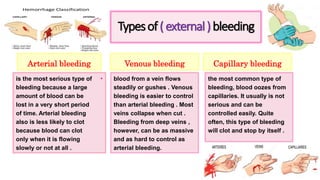
Typesof(external)bleeding
Arterial bleeding
•is the most serious type of
bleeding because a large
amount of blood can be
lost in a very short period
of time. Arterial bleeding
also is less likely to clot
because blood can clot
only when it is flowing
slowly or not at all .
Venous bleeding
blood from a vein flows
steadily or gushes . Venous
bleeding is easier to control
than arterial bleeding . Most
veins collapse when cut .
Bleeding from deep veins ,
however, can be as massive
and as hard to control as
arterial bleeding.
Capillary bleeding
the most common type of
bleeding, blood oozes from
capillaries. It usually is not
serious and can be
controlled easily. Quite
often, this type of bleeding
will clot and stop by itself .
Externalbleeding
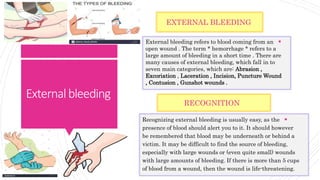
EXTERNAL BLEEDING
External bleeding refers to blood coming from an
open wound . The term * hemorrhage * refers to a
large amount of bleeding in a short time . There are
many causes of external bleeding, which fall in to
seven main categories, which are: Abrasion ,
Excoriation , Laceration , Incision, Puncture Wound
, Contusion , Gunshot wounds .
RECOGNITION
Recognizing external bleeding is usually easy, as the
presence of blood should alert you to it. It should however
be remembered that blood may be underneath or behind a
victim. It may be difficult to find the source of bleeding,
especially with large wounds or (even quite small) wounds
with large amounts of bleeding. If there is more than 5 cups
of blood from a wound, then the wound is life-threatening.
Treatment
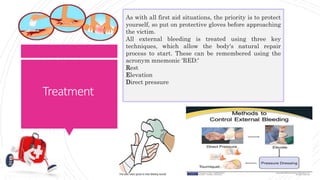
As with all first aid situations, the priority is to protect
yourself, so put on protective gloves before approaching
the victim.
All external bleeding is treated using three key
techniques, which allow the body's natural repair
process to start. These can be remembered using the
acronym mnemonic 'RED ':
Rest
Elevation
Direct pressure
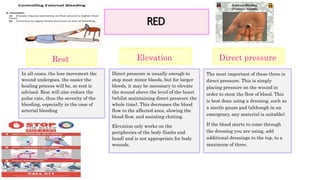
RED
Rest
In all cases, the less movement the
wound undergoes, the easier the
healing process will be, so rest is
advised. Rest will also reduce the
pulse rate, thus the severity of the
bleeding, especially in the case of
arterial bleeding
Elevation
Direct pressure is usually enough to
stop most minor bleeds, but for larger
bleeds, it may be necessary to elevate
the wound above the level of the heart
(whilst maintaining direct pressure the
whole time). This decreases the blood
flow to the affected area, slowing the
blood flow, and assisting clotting.
Elevation only works on the
peripheries of the body (limbs and
head) and is not appropriate for body
wounds.
Direct pressure
The most important of these three is
direct pressure. This is simply
placing pressure on the wound in
order to stem the flow of blood. This
is best done using a dressing, such as
a sterile gauze pad (although in an
emergency, any material is suitable).
If the blood starts to come through
the dressing you are using, add
additional dressings to the top, to a
maximum of three.
Internalbleeding
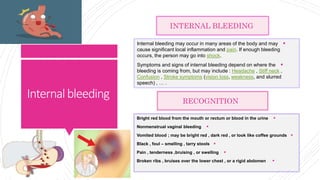
INTERNAL BLEEDING
Internal bleeding may occur in many areas of the body and may
cause significant local inflammation and pain. If enough bleeding
occurs, the person may go into shock.
Symptoms and signs of internal bleeding depend on where the
bleeding is coming from, but may include : Headache , Stiff neck ,
Confusion , Stroke symptoms (vision loss, weakness, and slurred
speech) , … .
RECOGNITION
Bright red blood from the mouth or rectum or blood in the urine
Nonmenstrual vaginal bleeding
Vomited blood ; may be bright red , dark red , or look like coffee grounds
Black , foul – smelling , tarry stools
Pain , tenderness ,bruising , or swelling
Broken ribs , bruises over the lower chest , or a rigid abdomen
Careforinternal
bleeding
For sever internal bleeding , follow these steps
:
(aMonitor breathing
(bExpect vomiting . If vomiting occurs , keep
the victim lying on his or her left side to
allow drainage and to prevent inhalation
(aspiration ) of vomitus .
(cTreat for shock and cover the victim with a
coat or blanket for warmth
(dTreat suspected internal bleeding in an
extremity by applying a splint .
(eSeek immediate medical care .
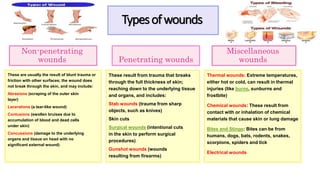
Typesofwounds
Non-penetrating
wounds
These are usually the result of blunt trauma or
friction with other surfaces; the wound does
not break through the skin, and may include:
Abrasions (scraping of the outer skin
layer)
Lacerations (a tear-like wound)
Contusions (swollen bruises due to
accumulation of blood and dead cells
under skin)
Concussions (damage to the underlying
organs and tissue on head with no
significant external wound)
Penetrating wounds
These result from trauma that breaks
through the full thickness of skin;
reaching down to the underlying tissue
and organs, and includes:
Stab wounds (trauma from sharp
objects, such as knives)
Skin cuts
Surgical wounds (intentional cuts
in the skin to perform surgical
procedures)
Gunshot wounds (wounds
resulting from firearms)
Miscellaneous
wounds
Thermal wounds: Extreme temperatures,
either hot or cold, can result in thermal
injuries (like burns, sunburns and
frostbite)
Chemical wounds: These result from
contact with or inhalation of chemical
materials that cause skin or lung damage
Bites and Stings: Bites can be from
humans, dogs, bats, rodents, snakes,
scorpions, spiders and tick
Electrical wounds
Complicationsof
wounds
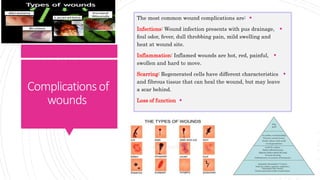
The most common wound complications are:
Infections: Wound infection presents with pus drainage,
foul odor, fever, dull throbbing pain, mild swelling and
heat at wound site.
Inflammation: Inflamed wounds are hot, red, painful,
swollen and hard to move.
Scarring: Regenerated cells have different characteristics
and fibrous tissue that can heal the wound, but may leave
a scar behind.
Loss of function
Thanksforyour
attention
Resources :
https://www.woundcarecenters.org/article/wound-
basics/different-types-of-wounds
https://www.medicinenet.com/internal_bleeding/article.
htm#what_causes_internal_bleeding
https://www.nfti.edu.au/AboutUs/FirstAidTips-
15/ExternalBleeding-359/
https://www.healthline.com/health/bleeding-
disorders#causes
https://www.firstaidforfree.com/what-are-the-different-
types-of-bleeding-in-first-aid/
https://www.britannica.com/science/wound
First aid , CPR , and AED essentials ( sixth edition )

Bleeding

  • 1.
    Bleeding The researcher :Mehrasa Nikandish Semester : 2019 -2020 Subject : first aid University of georgia
  • 2.
    Overview Introduction Types of bleeding Externalbleeding Internal bleeding Wounds
  • 3.
    Introduction BLEEDING Hemorrhage: Bleeding orthe abnormal flow of blood. A hemorrhage may be "external" and visible on the outside of the body or "internal," where there is no sign of bleeding outside the body. Bleeding from a cut on the face is an external hemorrhage. Bleeding into the spleen or liver are examples of internal hemorrhage. The term "hemorrhagic" comes from the Greek "haima," blood + rhegnumai," to break forth; a free and forceful escape of blood. WOUND Wound, a break in the continuity of any bodily tissue due to violence, where violence is understood to encompass any action of external agency, including, for example, surgery. Within this general definition many subdivisions are possible, taking into account and grouping together the various forms of violence or tissue damage.
  • 4.
    Typesof(external)bleeding Arterial bleeding •is themost serious type of bleeding because a large amount of blood can be lost in a very short period of time. Arterial bleeding also is less likely to clot because blood can clot only when it is flowing slowly or not at all . Venous bleeding blood from a vein flows steadily or gushes . Venous bleeding is easier to control than arterial bleeding . Most veins collapse when cut . Bleeding from deep veins , however, can be as massive and as hard to control as arterial bleeding. Capillary bleeding the most common type of bleeding, blood oozes from capillaries. It usually is not serious and can be controlled easily. Quite often, this type of bleeding will clot and stop by itself .
  • 5.
    Externalbleeding EXTERNAL BLEEDING External bleedingrefers to blood coming from an open wound . The term * hemorrhage * refers to a large amount of bleeding in a short time . There are many causes of external bleeding, which fall in to seven main categories, which are: Abrasion , Excoriation , Laceration , Incision, Puncture Wound , Contusion , Gunshot wounds . RECOGNITION Recognizing external bleeding is usually easy, as the presence of blood should alert you to it. It should however be remembered that blood may be underneath or behind a victim. It may be difficult to find the source of bleeding, especially with large wounds or (even quite small) wounds with large amounts of bleeding. If there is more than 5 cups of blood from a wound, then the wound is life-threatening.
  • 6.
    Treatment As with allfirst aid situations, the priority is to protect yourself, so put on protective gloves before approaching the victim. All external bleeding is treated using three key techniques, which allow the body's natural repair process to start. These can be remembered using the acronym mnemonic 'RED ': Rest Elevation Direct pressure
  • 7.
    RED Rest In all cases,the less movement the wound undergoes, the easier the healing process will be, so rest is advised. Rest will also reduce the pulse rate, thus the severity of the bleeding, especially in the case of arterial bleeding Elevation Direct pressure is usually enough to stop most minor bleeds, but for larger bleeds, it may be necessary to elevate the wound above the level of the heart (whilst maintaining direct pressure the whole time). This decreases the blood flow to the affected area, slowing the blood flow, and assisting clotting. Elevation only works on the peripheries of the body (limbs and head) and is not appropriate for body wounds. Direct pressure The most important of these three is direct pressure. This is simply placing pressure on the wound in order to stem the flow of blood. This is best done using a dressing, such as a sterile gauze pad (although in an emergency, any material is suitable). If the blood starts to come through the dressing you are using, add additional dressings to the top, to a maximum of three.
  • 8.
    Internalbleeding INTERNAL BLEEDING Internal bleedingmay occur in many areas of the body and may cause significant local inflammation and pain. If enough bleeding occurs, the person may go into shock. Symptoms and signs of internal bleeding depend on where the bleeding is coming from, but may include : Headache , Stiff neck , Confusion , Stroke symptoms (vision loss, weakness, and slurred speech) , … . RECOGNITION Bright red blood from the mouth or rectum or blood in the urine Nonmenstrual vaginal bleeding Vomited blood ; may be bright red , dark red , or look like coffee grounds Black , foul – smelling , tarry stools Pain , tenderness ,bruising , or swelling Broken ribs , bruises over the lower chest , or a rigid abdomen
  • 9.
    Careforinternal bleeding For sever internalbleeding , follow these steps : (aMonitor breathing (bExpect vomiting . If vomiting occurs , keep the victim lying on his or her left side to allow drainage and to prevent inhalation (aspiration ) of vomitus . (cTreat for shock and cover the victim with a coat or blanket for warmth (dTreat suspected internal bleeding in an extremity by applying a splint . (eSeek immediate medical care .
  • 10.
    Typesofwounds Non-penetrating wounds These are usuallythe result of blunt trauma or friction with other surfaces; the wound does not break through the skin, and may include: Abrasions (scraping of the outer skin layer) Lacerations (a tear-like wound) Contusions (swollen bruises due to accumulation of blood and dead cells under skin) Concussions (damage to the underlying organs and tissue on head with no significant external wound) Penetrating wounds These result from trauma that breaks through the full thickness of skin; reaching down to the underlying tissue and organs, and includes: Stab wounds (trauma from sharp objects, such as knives) Skin cuts Surgical wounds (intentional cuts in the skin to perform surgical procedures) Gunshot wounds (wounds resulting from firearms) Miscellaneous wounds Thermal wounds: Extreme temperatures, either hot or cold, can result in thermal injuries (like burns, sunburns and frostbite) Chemical wounds: These result from contact with or inhalation of chemical materials that cause skin or lung damage Bites and Stings: Bites can be from humans, dogs, bats, rodents, snakes, scorpions, spiders and tick Electrical wounds
  • 11.
    Complicationsof wounds The most commonwound complications are: Infections: Wound infection presents with pus drainage, foul odor, fever, dull throbbing pain, mild swelling and heat at wound site. Inflammation: Inflamed wounds are hot, red, painful, swollen and hard to move. Scarring: Regenerated cells have different characteristics and fibrous tissue that can heal the wound, but may leave a scar behind. Loss of function
  • 12.