Biscuits (Glucose): Industrial
Manufacturing process
Prasad Jitkar
Sachin Minke
Rama Gabale
Dinesh Shinde
INTRODUCTION
•Biscuit is a term used for a variety of baked, commonly flour-
based food products.
•Biscuit (Europe) = cookie or cracker (North America)
•In the Commonwealth Nations, "cookie" typically refers to
only chocolate chip cookie.
•In the United States and some parts of English Canada,
a "biscuit" is a quick bread, usually unsweetened.
Types of biscuits present in the market
• Glucose (44 per cent)
• Marie (13 per cent)
• Cream (10 per cent)
• Crackers (13 per cent)
• Milk (12 per cent)
• Others (8 per cent)
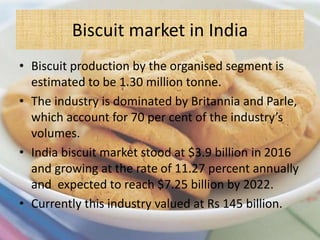
• Biscuit production by the organised segment is
estimated to be 1.30 million tonne.
• The industry is dominated by Britannia and Parle,
which account for 70 per cent of the industry’s
volumes.
• India biscuit market stood at $3.9 billion in 2016
and growing at the rate of 11.27 percent annually
and expected to reach $7.25 billion by 2022.
• Currently this industry valued at Rs 145 billion.
Biscuit market in India
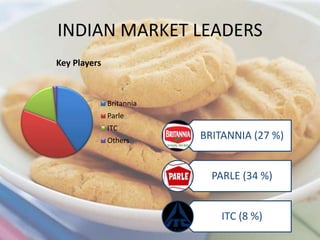
INDIAN MARKET LEADERS
Key Players
Britannia
Parle
ITC
Others
BRITANNIA (27 %)
PARLE (34 %)
ITC (8 %)
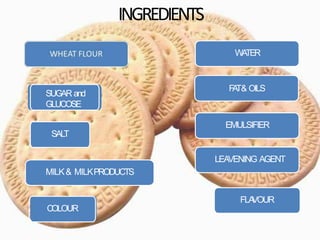
INGREDIENTS
SALT
WATER
FAT& OILS
SUGAR and
GLUCOSE
MILK& MILKPRODUCTS
FLAVOUR
COLOUR
EMULSIFIER
LEAVENING AGENT
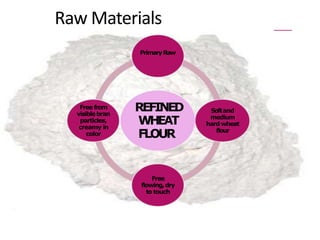
REFINED
WHEAT
FLOUR
PrimaryRaw
Raw Materials
Softand
medium
hard wheat
flour
Free
flowing,dry
to touch
Free from
visiblebran
particles,
creamy in
color
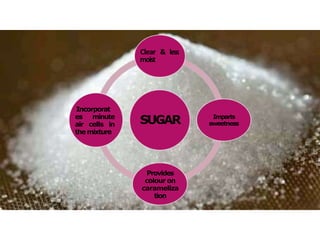
SUGAR
Clear & less
moist
Imparts
sweetness
Provides
colour on
carameliza
tion
Incorporat
es minute
air cells in
themixture
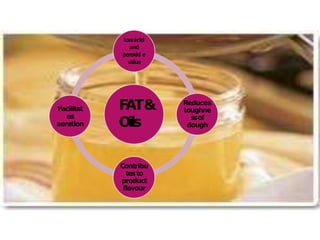
FAT&
Oils
Lowacid
and
peroxid e
value
Reduces
toughne
ssof
dough
Contribu
testo
product
flavour
Facilitat
es
aeration
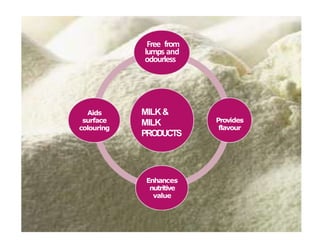
MILK&
MILK
PRODUCTS
Free from
lumps and
odourless
Provides
flavour
Enhances
nutritive
value
Aids
surface
colouring
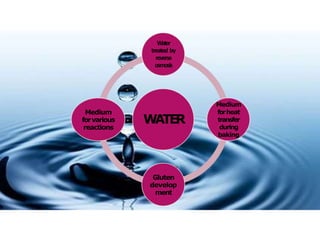
WATER
Water
treated by
reverse
osmosis
Medium
forheat
transfer
during
baking
Gluten
develop
ment
Medium
forvarious
reactions
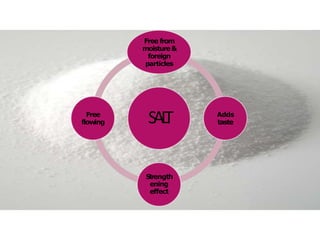
SALT
Free from
moisture&
foreign
particles
Adds
taste
Strength
ening
effect
Free
flowing
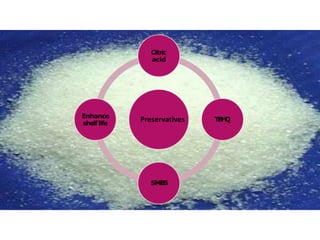
Preservatives
Citric
acid
TBHQ
SMBS
Enhance
shelflife
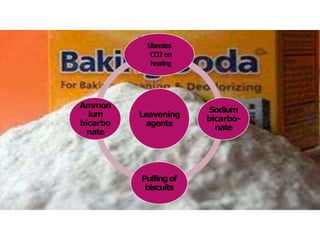
Leavening
agents
Liberates
CO2 on
heating
Sodium
bicarbo-
nate
Puffingof
biscuits
Ammon
ium
bicarbo
nate
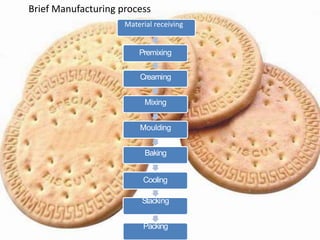
Material receiving
Brief Manufacturing process
Premixing
Creaming
Mixing
Moulding
Baking
Cooling
Stacking
Packing
Flavour development in biscuit
• Maillard reaction:
When protein (Gluten) and sugar(carbohydrates) in the biscuit
are heated it becomes brown, and that interaction produces
flavour. It is called Maillard reaction and this is the back bone
of the baking/cooking/roasting/ almost all the
cooking/baking.
• Caramelization or caramel flavour:
Sometimes Caramelization causes browning the same foods in
which the Maillard reaction occurs, but the two processes are
distinct. They are both promoted by heating, but the
Maillard reaction involves amino acids, as discussed above,
whereas caramelization is simply the pyrolysis of certain
sugars.
• Fats, oils, milk and milk products are also responsible for
imparting flavour in biscuits.
• Role:
 Tasteenhancer
 Masking any undesirable odour from theproduct
 It increases palatability and make product acceptable
 Provide identity
 Reduces raw material cost
 Make biscuits of consistent quality
• Selection:
 The flavour should be stable and non reactive with
the other ingredients
 Many flavours are heat susceptible and protection of
flavours needs consideration of baking process.
Role and selection of flavour
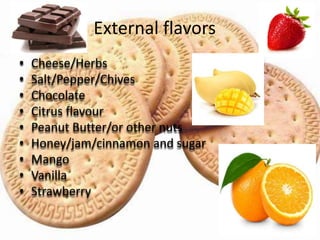
External flavors
• Cheese/Herbs
• Salt/Pepper/Chives
• Chocolate
• Citrus flavour
• Peanut Butter/or other nuts
• Honey/jam/cinnamon and sugar
• Mango
• Vanilla
• Strawberry
Biscuits
Biscuits

Biscuits