Nirmal kumar
Department of biotechnology
MANIT BHOPAL
CONTENT
Introduction
Human Eye
Disease of the Eye
Working of Bionic eye
Methods
Future prospects
Conclusion
Introduction
Bionic eye is a bio-electronic eye.
Bionic eye replaces the functionality of a part
or whole of the eye.
In our proposed method of bionic eye, a
small and a powerful camera powered by
nanogenerator, is implanted inside the patient’s
eye rather than worn on a pair of glasses
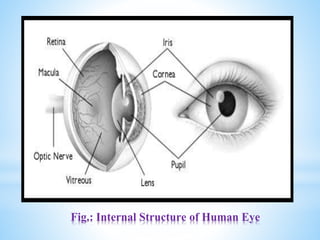
The Human eye : Structure and function
The Human eye is an organ that reacts to light
for several purposes.
The important part of the eye responsible for the
vision is the retina.
The retina is a light sensitive tissue lining the
inner surface of the eye. Light falling on the eye is
focused on to a sheet of light sensitive cells.
Fig.: Internal Structure of Human Eye
Diseases of the Eye
Retinitis Pigmentosa
Macular Degeneration
Retinitis Pigmentosa
Hereditary Genetic Disease
Peripheral Rods degenerate
Gradually progresses towards center of eye
Spares the foveal region
Tunnel vision results
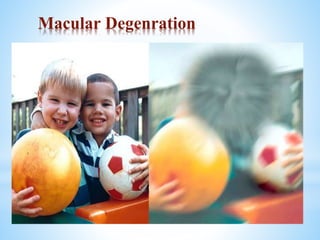
Macular Degenration
Genetically Related
Cones in Macula region degenrate
Loss or damage of central vision
Peripheral Retina spared
Common among old people
BIONIC EYE
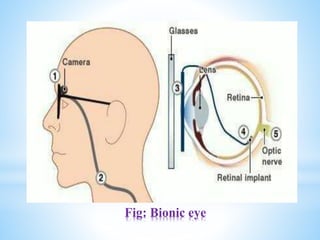
A visual prosthesis or bionic eye is a
form of neural prosthesis intended to
partially restore lost vision or amplify
existing vision.
Fig: Bionic eye
Working of Bionic eye
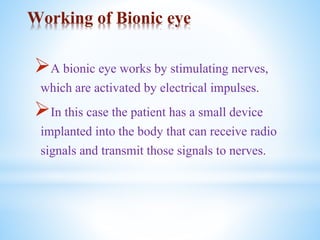
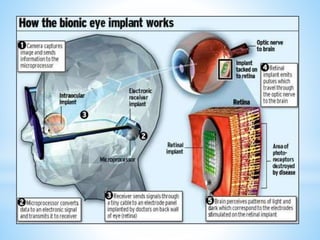
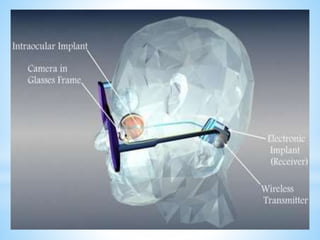
A bionic eye works by stimulating nerves,
which are activated by electrical impulses.
In this case the patient has a small device
implanted into the body that can receive radio
signals and transmit those signals to nerves.
METHOD
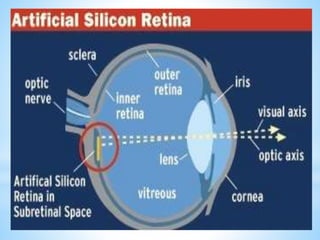
A. ASR (Artificial silicone Retina) system
B. MARC (Multiple unit Artificial Retina Chip) system
A. Artificial silicon retina
Artificial Silicon Retina (ASR) is a solid state
biocompatible chip which contains an array of
photoreceptors, and is implanted to replace the functionality
of the defective photoreceptor.
B. The MARC system
The MARC system are a power and signal transceiver
and processing chip, a stimulation- current driver , and
a proposed electrode array fabricating on a material
such as silicone rubber,thin silicone or polyimide with
a ribbon cables connecting the device.
Application
 Treating patient with total vision loss.
 Ceramic detectors are biocompatible
Wonderful optical properties.
 Naturally porous structure allows nutrients
to flow from the back to the front of the eye
Future prospects
Planning a third version that has 1,000 electrodes on the
retinal implant, which they believe could allow for facial-
recognition capabilities and hope to allow the user to see
colorful images.
Hopefully, the technology may enable people to
recognize faces and facial expressions.
“The thing is to significantly improve the quality of life for
blind patients".
Conclusion
Bionic devices are being developed to do more
than replace defective parts
We may not restore the vision fully, but we can
help them at least to find their way, recognize faces,
read books, distinguish between objects such as cups
and plates, above all lead an independent life
References
K. Pradeep, K.Vasantha Kokilam and C. Sunitha Proceedings of
National Conference on New Horizons in IT - NCNHIT 2013
Bionic Eye Technology: An Advanced Version of Artificial Vision”,
Academia, Volume 2, Issue 7, July, 2012
C. V. Krishnaveni, 2Ramesh B Lakkakula, 3Sunki Manasa
1,2,3Dept. of IT, Bhoj Reddy Engineering College, Hyderabad,
AP,India
Praveenkumar Narayanan, Guhan Senthil2011 International
Conference on Life Science and Technology IPCBEE vol.3 (2011) ©
(2011) IACSIT Press, Singapore
Thank
you

Bionic eye

  • 1.
    Nirmal kumar Department ofbiotechnology MANIT BHOPAL
  • 2.
    CONTENT Introduction Human Eye Disease ofthe Eye Working of Bionic eye Methods Future prospects Conclusion
  • 3.
    Introduction Bionic eye isa bio-electronic eye. Bionic eye replaces the functionality of a part or whole of the eye. In our proposed method of bionic eye, a small and a powerful camera powered by nanogenerator, is implanted inside the patient’s eye rather than worn on a pair of glasses
  • 4.
    The Human eye: Structure and function The Human eye is an organ that reacts to light for several purposes. The important part of the eye responsible for the vision is the retina. The retina is a light sensitive tissue lining the inner surface of the eye. Light falling on the eye is focused on to a sheet of light sensitive cells.
  • 5.
  • 6.
    Diseases of theEye Retinitis Pigmentosa Macular Degeneration
  • 7.
    Retinitis Pigmentosa Hereditary GeneticDisease Peripheral Rods degenerate Gradually progresses towards center of eye Spares the foveal region Tunnel vision results
  • 8.
    Macular Degenration Genetically Related Conesin Macula region degenrate Loss or damage of central vision Peripheral Retina spared Common among old people
  • 9.
    BIONIC EYE A visualprosthesis or bionic eye is a form of neural prosthesis intended to partially restore lost vision or amplify existing vision.
  • 10.
  • 11.
    Working of Bioniceye A bionic eye works by stimulating nerves, which are activated by electrical impulses. In this case the patient has a small device implanted into the body that can receive radio signals and transmit those signals to nerves.
  • 13.
    METHOD A. ASR (Artificialsilicone Retina) system B. MARC (Multiple unit Artificial Retina Chip) system
  • 14.
    A. Artificial siliconretina Artificial Silicon Retina (ASR) is a solid state biocompatible chip which contains an array of photoreceptors, and is implanted to replace the functionality of the defective photoreceptor.
  • 15.
    B. The MARCsystem The MARC system are a power and signal transceiver and processing chip, a stimulation- current driver , and a proposed electrode array fabricating on a material such as silicone rubber,thin silicone or polyimide with a ribbon cables connecting the device.
  • 16.
    Application  Treating patientwith total vision loss.  Ceramic detectors are biocompatible Wonderful optical properties.  Naturally porous structure allows nutrients to flow from the back to the front of the eye
  • 17.
    Future prospects Planning athird version that has 1,000 electrodes on the retinal implant, which they believe could allow for facial- recognition capabilities and hope to allow the user to see colorful images. Hopefully, the technology may enable people to recognize faces and facial expressions. “The thing is to significantly improve the quality of life for blind patients".
  • 18.
    Conclusion Bionic devices arebeing developed to do more than replace defective parts We may not restore the vision fully, but we can help them at least to find their way, recognize faces, read books, distinguish between objects such as cups and plates, above all lead an independent life
  • 19.
    References K. Pradeep, K.VasanthaKokilam and C. Sunitha Proceedings of National Conference on New Horizons in IT - NCNHIT 2013 Bionic Eye Technology: An Advanced Version of Artificial Vision”, Academia, Volume 2, Issue 7, July, 2012 C. V. Krishnaveni, 2Ramesh B Lakkakula, 3Sunki Manasa 1,2,3Dept. of IT, Bhoj Reddy Engineering College, Hyderabad, AP,India Praveenkumar Narayanan, Guhan Senthil2011 International Conference on Life Science and Technology IPCBEE vol.3 (2011) © (2011) IACSIT Press, Singapore
  • 20.