


Fahimeh TabatabaeiFahimeh Tabatabaei
Fahimeh Tabatabaei
1
2
Fahimeh Tabatabaei
3
Fahimeh Tabatabaei
4
Fahimeh Tabatabaei
5
Fahimeh Tabatabaei
6
Fahimeh Tabatabaei
7
Fahimeh Tabatabaei
8
Fahimeh Tabatabaei
9
Fahimeh Tabatabaei
10
Fahimeh Tabatabaei
11
Fahimeh Tabatabaei
12
Fahimeh Tabatabaei
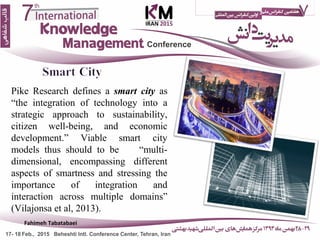
Pike Research defines a smart city as
“the integration of technology into a
strategic approach to sustainability,
citizen well-being, and economic
development.” Viable smart city
models thus should to be “multi-
dimensional, encompassing different
aspects of smartness and stressing the
importance of integration and
interaction across multiple domains”
(Vilajonsa et al, 2013).
13
Fahimeh Tabatabaei
14
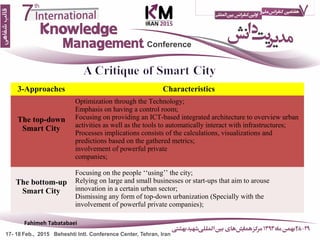
3-Approaches Characteristics
The top-down
Smart City
Optimization through the Technology;
Emphasis on having a control room;
Focusing on providing an ICT-based integrated architecture to overview urban
activities as well as the tools to automatically interact with infrastructures;
Processes implications consists of the calculations, visualizations and
predictions based on the gathered metrics;
involvement of powerful private
companies;
The bottom-up
Smart City
Focusing on the people ‘‘using’’ the city;
Relying on large and small businesses or start-ups that aim to arouse
innovation in a certain urban sector;
Dismissing any form of top-down urbanization (Specially with the
involvement of powerful private companies);
Fahimeh Tabatabaei
15
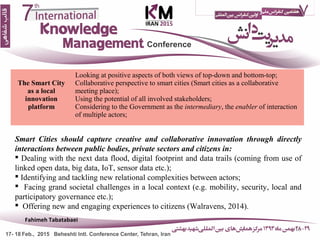
The Smart City
as a local
innovation
platform
Looking at positive aspects of both views of top-down and bottom-top;
Collaborative perspective to smart cities (Smart cities as a collaborative
meeting place);
Using the potential of all involved stakeholders;
Considering to the Government as the intermediary, the enabler of interaction
of multiple actors;
Smart Cities should capture creative and collaborative innovation through directly
interactions between public bodies, private sectors and citizens in:
 Dealing with the next data flood, digital footprint and data trails (coming from use of
linked open data, big data, IoT, sensor data etc.);
 Identifying and tackling new relational complexities between actors;
 Facing grand societal challenges in a local context (e.g. mobility, security, local and
participatory governance etc.);
 Offering new and engaging experiences to citizens (Walravens, 2014).
Fahimeh Tabatabaei
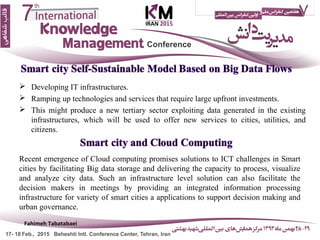
 Developing IT infrastructures.
 Ramping up technologies and services that require large upfront investments.
 This might produce a new tertiary sector exploiting data generated in the existing
infrastructures, which will be used to offer new services to cities, utilities, and
citizens.
16
Recent emergence of Cloud computing promises solutions to ICT challenges in Smart
cities by facilitating Big data storage and delivering the capacity to process, visualize
and analyze city data. Such an infrastructure level solution can also facilitate the
decision makers in meetings by providing an integrated information processing
infrastructure for variety of smart cities a applications to support decision making and
urban governance.
Fahimeh Tabatabaei
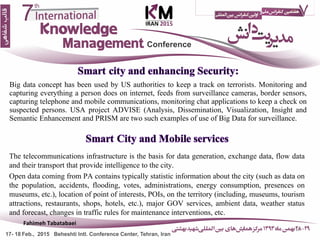
Big data concept has been used by US authorities to keep a track on terrorists. Monitoring and
capturing everything a person does on internet, feeds from surveillance cameras, border sensors,
capturing telephone and mobile communications, monitoring chat applications to keep a check on
suspected persons. USA project ADVISE (Analysis, Dissemination, Visualization, Insight and
Semantic Enhancement and PRISM are two such examples of use of Big Data for surveillance.
17
The telecommunications infrastructure is the basis for data generation, exchange data, flow data
and their transport that provide intelligence to the city.
Open data coming from PA contains typically statistic information about the city (such as data on
the population, accidents, flooding, votes, administrations, energy consumption, presences on
museums, etc.), location of point of interests, POIs, on the territory (including, museums, tourism
attractions, restaurants, shops, hotels, etc.), major GOV services, ambient data, weather status
and forecast, changes in traffic rules for maintenance interventions, etc.
Fahimeh Tabatabaei
18
Fahimeh Tabatabaei
19Fahimeh Tabatabaei

Big data tools, techs & smart cities

  • 1.
  • 2.
  • 3.
  • 4.
  • 5.
  • 6.
  • 7.
  • 8.
  • 9.
  • 10.
  • 11.
  • 12.
  • 13.
    Pike Research definesa smart city as “the integration of technology into a strategic approach to sustainability, citizen well-being, and economic development.” Viable smart city models thus should to be “multi- dimensional, encompassing different aspects of smartness and stressing the importance of integration and interaction across multiple domains” (Vilajonsa et al, 2013). 13 Fahimeh Tabatabaei
  • 14.
    14 3-Approaches Characteristics The top-down SmartCity Optimization through the Technology; Emphasis on having a control room; Focusing on providing an ICT-based integrated architecture to overview urban activities as well as the tools to automatically interact with infrastructures; Processes implications consists of the calculations, visualizations and predictions based on the gathered metrics; involvement of powerful private companies; The bottom-up Smart City Focusing on the people ‘‘using’’ the city; Relying on large and small businesses or start-ups that aim to arouse innovation in a certain urban sector; Dismissing any form of top-down urbanization (Specially with the involvement of powerful private companies); Fahimeh Tabatabaei
  • 15.
    15 The Smart City asa local innovation platform Looking at positive aspects of both views of top-down and bottom-top; Collaborative perspective to smart cities (Smart cities as a collaborative meeting place); Using the potential of all involved stakeholders; Considering to the Government as the intermediary, the enabler of interaction of multiple actors; Smart Cities should capture creative and collaborative innovation through directly interactions between public bodies, private sectors and citizens in:  Dealing with the next data flood, digital footprint and data trails (coming from use of linked open data, big data, IoT, sensor data etc.);  Identifying and tackling new relational complexities between actors;  Facing grand societal challenges in a local context (e.g. mobility, security, local and participatory governance etc.);  Offering new and engaging experiences to citizens (Walravens, 2014). Fahimeh Tabatabaei
  • 16.
     Developing ITinfrastructures.  Ramping up technologies and services that require large upfront investments.  This might produce a new tertiary sector exploiting data generated in the existing infrastructures, which will be used to offer new services to cities, utilities, and citizens. 16 Recent emergence of Cloud computing promises solutions to ICT challenges in Smart cities by facilitating Big data storage and delivering the capacity to process, visualize and analyze city data. Such an infrastructure level solution can also facilitate the decision makers in meetings by providing an integrated information processing infrastructure for variety of smart cities a applications to support decision making and urban governance. Fahimeh Tabatabaei
  • 17.
    Big data concepthas been used by US authorities to keep a track on terrorists. Monitoring and capturing everything a person does on internet, feeds from surveillance cameras, border sensors, capturing telephone and mobile communications, monitoring chat applications to keep a check on suspected persons. USA project ADVISE (Analysis, Dissemination, Visualization, Insight and Semantic Enhancement and PRISM are two such examples of use of Big Data for surveillance. 17 The telecommunications infrastructure is the basis for data generation, exchange data, flow data and their transport that provide intelligence to the city. Open data coming from PA contains typically statistic information about the city (such as data on the population, accidents, flooding, votes, administrations, energy consumption, presences on museums, etc.), location of point of interests, POIs, on the territory (including, museums, tourism attractions, restaurants, shops, hotels, etc.), major GOV services, ambient data, weather status and forecast, changes in traffic rules for maintenance interventions, etc. Fahimeh Tabatabaei
  • 18.
  • 19.

Editor's Notes

  • #17 This phase is of utmost importance, since it essentially sets the technological basis (introducing the developed platforms described above) and guarantees viable bootstrapping of the smart city market by generating cash flows for new investments. These technologies and services are expected to be attracted by the finances generated in the first phase, which will attract private capital, and take advantage of previously deployed infrastructures to lower its barriers to entry (i.e., platforms). The third phase banks on the availability of data through standardized APIs offered by the implemented platforms. This phase has the scope of making the system self-sustainable by developing services on top of the existing smart cities infrastructures and involving the whole value chain (through standardized APIs). Smart City and Cloud Computing A lot of ICT is actually the backbone of real life urban challenges such as environmental sustainability, socioeconomic innovation, and participatory governance, better public services, planning and collaborative decision-making.