1
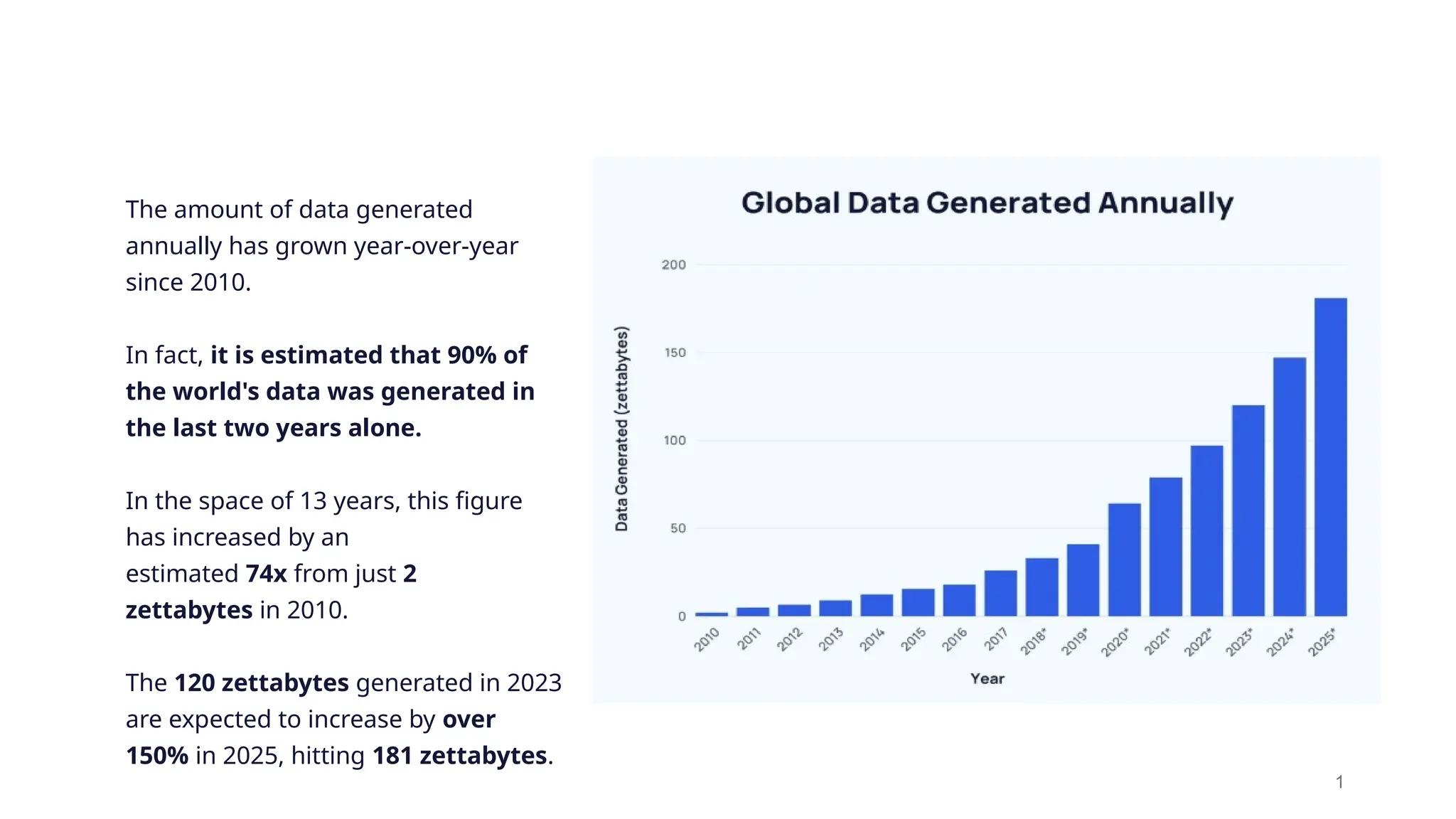
The amount ofdata generated
annually has grown year-over-year
since 2010.
In fact, it is estimated that 90% of
the world's data was generated in
the last two years alone.
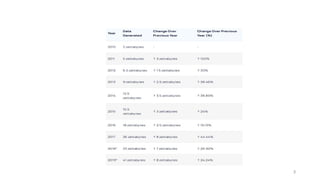
In the space of 13 years, this figure
has increased by an
estimated 74x from just 2
zettabytes in 2010.
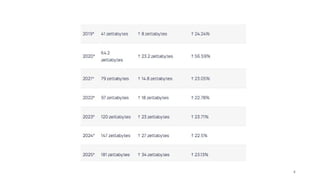
The 120 zettabytes generated in 2023
are expected to increase by over
150% in 2025, hitting 181 zettabytes.
5
Data Creation byCategory
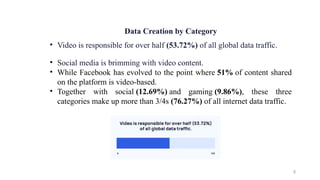
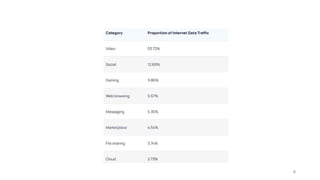
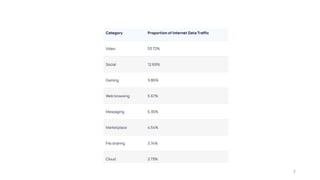
• Video is responsible for over half (53.72%) of all global data traffic.
• Social media is brimming with video content.
• While Facebook has evolved to the point where 51% of content shared
on the platform is video-based.
• Together with social (12.69%) and gaming (9.86%), these three
categories make up more than 3/4s (76.27%) of all internet data traffic.
11
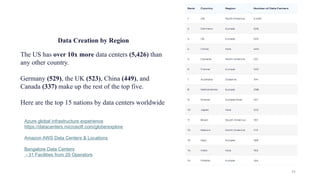
Data Creation byRegion
The US has over 10x more data centers (5,426) than
any other country.
Germany (529), the UK (523), China (449), and
Canada (337) make up the rest of the top five.
Here are the top 15 nations by data centers worldwide
Azure global infrastructure experience
https://datacenters.microsoft.com/globe/explore
Amazon AWS Data Centers & Locations
Bangalore Data Centers
- 31 Facilities from 29 Operators
12.
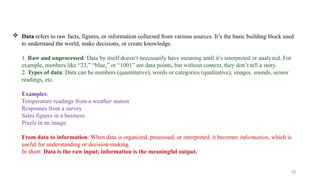
Data refersto raw facts, figures, or information collected from various sources. It’s the basic building block used
to understand the world, make decisions, or create knowledge.
1. Raw and unprocessed: Data by itself doesn’t necessarily have meaning until it’s interpreted or analyzed. For
example, numbers like “23,” “blue,” or “1001” are data points, but without context, they don’t tell a story.
2. Types of data: Data can be numbers (quantitative), words or categories (qualitative), images, sounds, sensor
readings, etc.
Examples:
Temperature readings from a weather station
Responses from a survey
Sales figures in a business
Pixels in an image
From data to information: When data is organized, processed, or interpreted, it becomes information, which is
useful for understanding or decision-making.
In short: Data is the raw input; information is the meaningful output.
n students will be able to
12
15
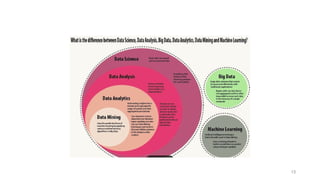
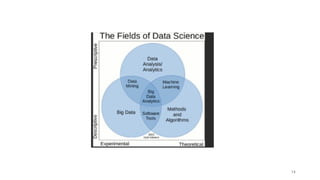
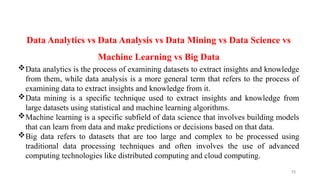
Data Analytics vsData Analysis vs Data Mining vs Data Science vs
Machine Learning vs Big Data
Data analytics is the process of examining datasets to extract insights and knowledge
from them, while data analysis is a more general term that refers to the process of
examining data to extract insights and knowledge from it.
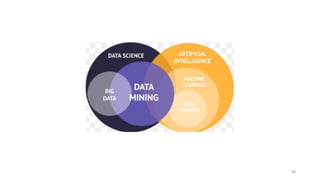
Data mining is a specific technique used to extract insights and knowledge from
large datasets using statistical and machine learning algorithms.
Machine learning is a specific subfield of data science that involves building models
that can learn from data and make predictions or decisions based on that data.
Big data refers to datasets that are too large and complex to be processed using
traditional data processing techniques and often involves the use of advanced
computing technologies like distributed computing and cloud computing.
17
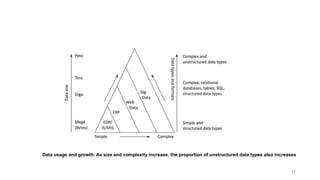
Data usage andgrowth. As size and complexity increase, the proportion of unstructured data types also increases
18.
18
Need of BigData
The rise in technology has led to the production and storage of
voluminous amounts of data. Earlier megabytes (106 B) were
used but nowadays petabytes (1015 B) are used for
processing, analysis, discovering new facts and generating new
knowledge. Conventional systems for storage, processing and
analysis pose challenges in large growth in volume of data,
variety of data, various forms and formats, increasing
complexity, faster generation of data and need of quickly
processing, analyzing and usage
Editor's Notes
#1 including process management, memory management, file system management, and device management.
#2 including process management, memory management, file system management, and device management.
#3 including process management, memory management, file system management, and device management.
#4 including process management, memory management, file system management, and device management.
#5 including process management, memory management, file system management, and device management.
#6 including process management, memory management, file system management, and device management.
#7 including process management, memory management, file system management, and device management.
#8 including process management, memory management, file system management, and device management.
#9 including process management, memory management, file system management, and device management.
#10 including process management, memory management, file system management, and device management.
#11 including process management, memory management, file system management, and device management.
#12 including process management, memory management, file system management, and device management.
#13 including process management, memory management, file system management, and device management.
#14 including process management, memory management, file system management, and device management.
#15 including process management, memory management, file system management, and device management.
#16 including process management, memory management, file system management, and device management.
#17 including process management, memory management, file system management, and device management.
#18 including process management, memory management, file system management, and device management.