E
Abstract The lifelong benefits of breastfeeding have long been proven. Studies over the past four decades have shown that
many common hospital practices thwart rather than facilitate exclusive and extended breastfeeding. Although many strides
have been made in the past two decades to promote best breastfeeding practices in hospitals, much work remains to translate
research evidence into practice nationwide. http://dx.doi.org/10.1016/j.nwh.2016.01.005
Keywords Baby-Friendly | breastfeeding | exclusive breastfeeding | skin-to-skin contact
nwhjournal.org © 2016, AWHONN 135
Commentary
Editor’s note: To mark the journal’s 20th anni-
versary, we have invited a series of commentaries
that explore different topics in women’s health,
obstetric, and neonatal nursing through the lens
of the past 20 years. This commentary on breast-
feeding by editor emeritus Marie Biancuzzo
highlights the many strides that have been made
and recognizes that much work remains to trans-
late the evidence on breastfeeding into practice.
I loathed hearing those seven words time
and again: “That’s the way we’ve always done
it.” . . . Everyone gave lip service to research,
but they didn’t incorporate results into clini-
cal practice. Questioning existing protocols,
demanding scientific rationale, and suggest-
ing better alternatives didn’t win me the Miss
Congeniality Award among my peers or su-
pervisors. (Biancuzzo, 1997, p. 9)
I wrote those words two decades ago, but
I still hear similar frustration from nurses and
lactation consultants as I travel around the
country today. I, too, am still frustrated. The evi-
dence for better breastfeeding practice exists,
but the integration of evidence into practice has
been woefully slow. But I, and nurses who share
my passion, have been determined to bring
about change.
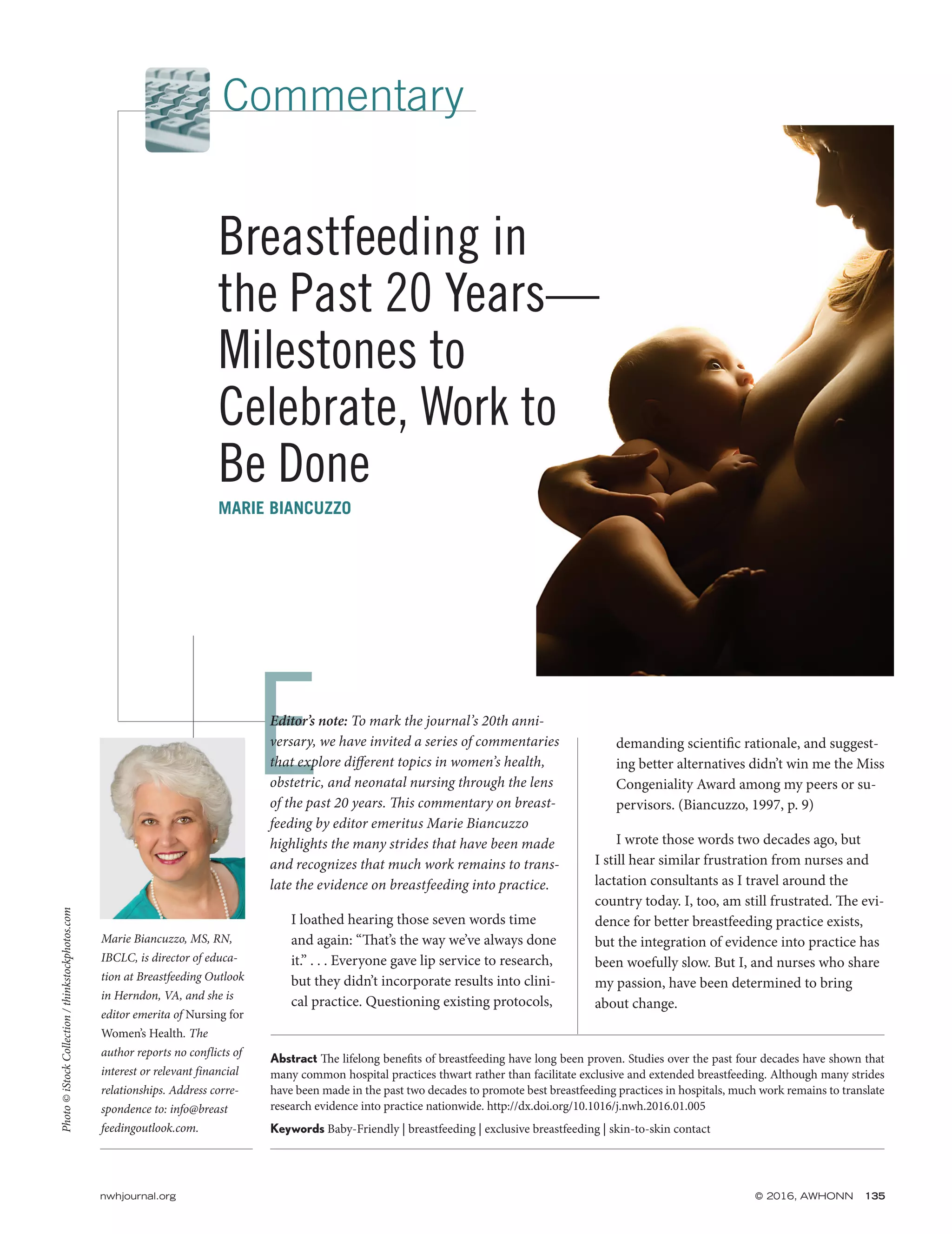
Photo©iStockCollection/thinkstockphotos.com
Marie Biancuzzo, MS, RN,
IBCLC, is director of educa-
tion at Breastfeeding Outlook
in Herndon, VA, and she is
editor emerita of Nursing for
Women’s Health. The
author reports no conflicts of
interest or relevant financial
relationships. Address corre-
spondence to: info@breast
feedingoutlook.com.
Breastfeeding in
the Past 20 Years—
Milestones to
Celebrate, Work to
Be Done
MARIE BIANCUZZO
Commentary
136 Nursing for Women’s Health	 Volume 20 Issue 2
Milestones and Achievements
In the ensuing 20 years since I wrote that edi-
torial, all of us have seen—and many nurses
have contributed to—evidence to support better
breastfeeding practices with literally thousands
of additional studies. We have seen the develop-
ment of scientific rationales for a host of practic-
es we have long suspected were evidence-based,
such as active birthing positions, skin-to-skin
contact, delayed cord clamping, and breastfeed-
ing. We have celebrated the Surgeon General’s
Call to Action to Support Breastfeeding (U.S. De-
partment of Health and Human Services, Office
of the Surgeon General, 2011). We have rejoiced
to see an increase in membership in the Human
Milk Banking Association of North America to
23 milk banks in the United States and Canada
(up from 17 just one year ago—and with 6 more
currently in development). We have been glad
to see the importance of breastfeeding recog-
nized by passage of the “Break Time for Nurs-
ing Mothers” requirement as part of the Patient
Protection and Affordable Care Act in 2010
(U.S. Department of Labor, n.d.). As a found-
ing member of the U.S. Breastfeeding Com-
mittee (and AWHONN’s representative to that
committee), I personally advocated for and wit-
nessed the launch of the first national awareness
campaign. With the slogan “Babies Were Born
to Breastfeed,” this campaign carried radio
and TV public service announcements. It is
heartening to see the progress we have made.
The Work That Remains
There is still much work to be done. On a regu-
lar basis, I am contacted by hospitals that are
pursuing designation as Baby-Friendly facilities.
The Baby-Friendly Hospital Initiative, launched
in 1991 by the World Health Organization as the
quintessential body of evidence-based practices
for a global increase in breastfeeding rates, is
about to celebrate its 25th anniversary, but hos-
pitals in the United States have been surprisingly
slow to jump on board. It was not until 1997
that a U.S. hospital was designated as Baby-
Friendly for the first time. Even a decade later,
in 2007, only 2.7% of U.S. births occurred in
Baby-Friendly facilities. As I write this com-
mentary, I see that 325 U.S. facilities have
earned the Baby-Friendly designation, and they
provide care for 16.23% of U.S. births (Baby-
Friendly USA, n.d.). And yet, the hospitals that
reach out to me often describe themselves as
“stuck” in the process.
Sometimes, the problem is related to insti-
tutional factors, such as a lack of breastfeeding
policies, procedures, or protocols. In some cases,
it is a lack of staff buy-in to the importance of
breastfeeding support. Other times, hospitals
are stuck because of problems with implemen-
tation. Although the structure is present, the
process is considered to be too cumbersome.
Still other times, it is what I call “familial” fac-
tors that are the culprit: hospital staff express
commitment to evidence-based practice, but
families do not want it. Families often complain
when they don’t get their formula “freebies.”
Mothers refuse to room-in because they believe
the only way to get a good night’s sleep is if the
baby is in the nursery. Could they be right?
Fortunately, the past 20 years have given us a
wealth of resources to draw on that show, mostly,
that the existing common hospital practices are
not right. Numerous publications, public health
initiatives, compliance mandates (e.g., the Peri-
natal Care Core Measures [Joint Commission,
2015], which now apply to nearly all hospitals in
the United States), and much more have made a
difference in our understanding of best practices
for mothers and babies in our care.
Conclusion
I plan to be here in another 20 years to write
another commentary, and I hope we will have
achieved a wonderful state of evidence-based
practices in maternal–infant care nationwide. I
hope that evidence-based practice will be better
aligned with client satisfaction. I allow myself to
fantasize that the Baby-Friendly Hospital Initia-
tive will be everywhere, available to and enjoyed
by every mother and every baby, and supported
by every nurse.
The evidence for better
breastfeeding practice exists, but
the integration of evidence into
practice has been woefully slow.
But I, and nurses who share my
passion, have been determined
to bring about change
Commentary
April | May 2016	 Nursing for Women’s Health 137
to move forward. With about 84% of U.S. new-
borns being born in facilities that are not desig-
nated Baby-Friendly and less than one-fifth of all
U.S. infants being exclusively breastfed for the
recommended first 6 months of life, we can see
that we still have a long way to go (Baby-Friendly
USA, n.d.). NWH
References
Baby-Friendly USA. (n.d.). Find facilities. Albany,
NY: Author. Retrieved from https://www
.babyfriendlyusa.org/find-facilities
Biancuzzo, M. (1997). Wanted: Nurses as
change agents. AWHONN Lifelines, 1(3), 9.
doi:10.1111/j.1552-6356.1997.tb01315.x
Joint Commission. (2015). Perinatal care. Re-
trieved from http://www.jointcommission.org/
core_measure_sets.aspx
U.S. Department of Health and Human Services,
Office of the Surgeon General. (2011). The sur-
geon general’s call to action to support breastfeed-
ing. Rockville, MD: Author.
U.S. Department of Labor. (n.d.). Wage and
hour division: Break time for nursing moth-
ers. Retrieved from http://www.dol.gov/whd/
nursingmothers/
But because I am a realist, I doubt that will
be the case. I try not to criticize those initia-
tives that have been developed by several states
for their hospitals (e.g., Texas Ten Step, Key-
stone Ten, and others). These are often devel-
oped with an eye toward Baby-Friendly criteria,
but because they rely entirely or almost entirely
on self-assessment, I cannot foresee their effec-
tiveness. (I have been a Baby-Friendly Assessor
and have seen firsthand that hospitals rarely see
themselves as they really are.) Still, at least these
knock-off initiatives are helping hospitals go in
the right direction and take the first steps.
But the first steps should not be the end of
the journey, and even with all that has happened
over the past 20 years, we should not rest on our
laurels. We can celebrate, yes. But having taken
the first important steps toward evidence-based
breastfeeding practice and support of mothers
and newborns in our care, we should continue
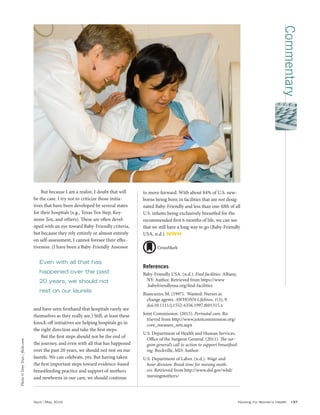
Photo©TonyTran/flickr.com
Even with all that has
happened over the past
20 years, we should not
rest on our laurels

Biancuzzo April 2016

  • 1.
    E Abstract The lifelongbenefits of breastfeeding have long been proven. Studies over the past four decades have shown that many common hospital practices thwart rather than facilitate exclusive and extended breastfeeding. Although many strides have been made in the past two decades to promote best breastfeeding practices in hospitals, much work remains to translate research evidence into practice nationwide. http://dx.doi.org/10.1016/j.nwh.2016.01.005 Keywords Baby-Friendly | breastfeeding | exclusive breastfeeding | skin-to-skin contact nwhjournal.org © 2016, AWHONN 135 Commentary Editor’s note: To mark the journal’s 20th anni- versary, we have invited a series of commentaries that explore different topics in women’s health, obstetric, and neonatal nursing through the lens of the past 20 years. This commentary on breast- feeding by editor emeritus Marie Biancuzzo highlights the many strides that have been made and recognizes that much work remains to trans- late the evidence on breastfeeding into practice. I loathed hearing those seven words time and again: “That’s the way we’ve always done it.” . . . Everyone gave lip service to research, but they didn’t incorporate results into clini- cal practice. Questioning existing protocols, demanding scientific rationale, and suggest- ing better alternatives didn’t win me the Miss Congeniality Award among my peers or su- pervisors. (Biancuzzo, 1997, p. 9) I wrote those words two decades ago, but I still hear similar frustration from nurses and lactation consultants as I travel around the country today. I, too, am still frustrated. The evi- dence for better breastfeeding practice exists, but the integration of evidence into practice has been woefully slow. But I, and nurses who share my passion, have been determined to bring about change. Photo©iStockCollection/thinkstockphotos.com Marie Biancuzzo, MS, RN, IBCLC, is director of educa- tion at Breastfeeding Outlook in Herndon, VA, and she is editor emerita of Nursing for Women’s Health. The author reports no conflicts of interest or relevant financial relationships. Address corre- spondence to: info@breast feedingoutlook.com. Breastfeeding in the Past 20 Years— Milestones to Celebrate, Work to Be Done MARIE BIANCUZZO
  • 2.
    Commentary 136 Nursing forWomen’s Health Volume 20 Issue 2 Milestones and Achievements In the ensuing 20 years since I wrote that edi- torial, all of us have seen—and many nurses have contributed to—evidence to support better breastfeeding practices with literally thousands of additional studies. We have seen the develop- ment of scientific rationales for a host of practic- es we have long suspected were evidence-based, such as active birthing positions, skin-to-skin contact, delayed cord clamping, and breastfeed- ing. We have celebrated the Surgeon General’s Call to Action to Support Breastfeeding (U.S. De- partment of Health and Human Services, Office of the Surgeon General, 2011). We have rejoiced to see an increase in membership in the Human Milk Banking Association of North America to 23 milk banks in the United States and Canada (up from 17 just one year ago—and with 6 more currently in development). We have been glad to see the importance of breastfeeding recog- nized by passage of the “Break Time for Nurs- ing Mothers” requirement as part of the Patient Protection and Affordable Care Act in 2010 (U.S. Department of Labor, n.d.). As a found- ing member of the U.S. Breastfeeding Com- mittee (and AWHONN’s representative to that committee), I personally advocated for and wit- nessed the launch of the first national awareness campaign. With the slogan “Babies Were Born to Breastfeed,” this campaign carried radio and TV public service announcements. It is heartening to see the progress we have made. The Work That Remains There is still much work to be done. On a regu- lar basis, I am contacted by hospitals that are pursuing designation as Baby-Friendly facilities. The Baby-Friendly Hospital Initiative, launched in 1991 by the World Health Organization as the quintessential body of evidence-based practices for a global increase in breastfeeding rates, is about to celebrate its 25th anniversary, but hos- pitals in the United States have been surprisingly slow to jump on board. It was not until 1997 that a U.S. hospital was designated as Baby- Friendly for the first time. Even a decade later, in 2007, only 2.7% of U.S. births occurred in Baby-Friendly facilities. As I write this com- mentary, I see that 325 U.S. facilities have earned the Baby-Friendly designation, and they provide care for 16.23% of U.S. births (Baby- Friendly USA, n.d.). And yet, the hospitals that reach out to me often describe themselves as “stuck” in the process. Sometimes, the problem is related to insti- tutional factors, such as a lack of breastfeeding policies, procedures, or protocols. In some cases, it is a lack of staff buy-in to the importance of breastfeeding support. Other times, hospitals are stuck because of problems with implemen- tation. Although the structure is present, the process is considered to be too cumbersome. Still other times, it is what I call “familial” fac- tors that are the culprit: hospital staff express commitment to evidence-based practice, but families do not want it. Families often complain when they don’t get their formula “freebies.” Mothers refuse to room-in because they believe the only way to get a good night’s sleep is if the baby is in the nursery. Could they be right? Fortunately, the past 20 years have given us a wealth of resources to draw on that show, mostly, that the existing common hospital practices are not right. Numerous publications, public health initiatives, compliance mandates (e.g., the Peri- natal Care Core Measures [Joint Commission, 2015], which now apply to nearly all hospitals in the United States), and much more have made a difference in our understanding of best practices for mothers and babies in our care. Conclusion I plan to be here in another 20 years to write another commentary, and I hope we will have achieved a wonderful state of evidence-based practices in maternal–infant care nationwide. I hope that evidence-based practice will be better aligned with client satisfaction. I allow myself to fantasize that the Baby-Friendly Hospital Initia- tive will be everywhere, available to and enjoyed by every mother and every baby, and supported by every nurse. The evidence for better breastfeeding practice exists, but the integration of evidence into practice has been woefully slow. But I, and nurses who share my passion, have been determined to bring about change
  • 3.
    Commentary April | May2016 Nursing for Women’s Health 137 to move forward. With about 84% of U.S. new- borns being born in facilities that are not desig- nated Baby-Friendly and less than one-fifth of all U.S. infants being exclusively breastfed for the recommended first 6 months of life, we can see that we still have a long way to go (Baby-Friendly USA, n.d.). NWH References Baby-Friendly USA. (n.d.). Find facilities. Albany, NY: Author. Retrieved from https://www .babyfriendlyusa.org/find-facilities Biancuzzo, M. (1997). Wanted: Nurses as change agents. AWHONN Lifelines, 1(3), 9. doi:10.1111/j.1552-6356.1997.tb01315.x Joint Commission. (2015). Perinatal care. Re- trieved from http://www.jointcommission.org/ core_measure_sets.aspx U.S. Department of Health and Human Services, Office of the Surgeon General. (2011). The sur- geon general’s call to action to support breastfeed- ing. Rockville, MD: Author. U.S. Department of Labor. (n.d.). Wage and hour division: Break time for nursing moth- ers. Retrieved from http://www.dol.gov/whd/ nursingmothers/ But because I am a realist, I doubt that will be the case. I try not to criticize those initia- tives that have been developed by several states for their hospitals (e.g., Texas Ten Step, Key- stone Ten, and others). These are often devel- oped with an eye toward Baby-Friendly criteria, but because they rely entirely or almost entirely on self-assessment, I cannot foresee their effec- tiveness. (I have been a Baby-Friendly Assessor and have seen firsthand that hospitals rarely see themselves as they really are.) Still, at least these knock-off initiatives are helping hospitals go in the right direction and take the first steps. But the first steps should not be the end of the journey, and even with all that has happened over the past 20 years, we should not rest on our laurels. We can celebrate, yes. But having taken the first important steps toward evidence-based breastfeeding practice and support of mothers and newborns in our care, we should continue Photo©TonyTran/flickr.com Even with all that has happened over the past 20 years, we should not rest on our laurels