Goals of
the Baby-friendly Hospital Initiative
1.To transform hospitals and maternity facilities
through implementation of the “Ten steps”.
2.To end the practice of distribution of free and low-
cost supplies of breast-milk substitutes to
maternity wards and hospitals.
Slide 3.1
Every facility providing maternity services and
care for newborn infants should follow these
Ten steps to successful breastfeeding
1. Have a written breastfeeding policy that is routinely
communicated to all health care staff.
2. Train all health care staff in skills necessary to implement
this policy.
3. Inform all pregnant women about the benefits and
management of breastfeeding.
4. Help mothers initiate breastfeeding within a half-hour of
birth.
5. Show mothers how to breastfeed, and how to maintain
lactation even if they should be separated from their infants.
Slide 3.2
Every facility providing maternity services and
care for newborn infants should follow these
Ten steps to successful breastfeeding
6. Give newborn infants no food or drink other than breast
milk, unless medically indicated.
7. Practise rooming-in — allow mothers and infants to
remain together — 24 hours a day.
8. Encourage breastfeeding on demand.
9. Give no artificial teats or pacifiers (also called dummies
or soothers) to breastfeeding infants.
10. Foster the establishment of breastfeeding support
groups and refer mothers to them on discharge from the
hospital or clinic.
Slide 3.3
1991 – Launching of Baby-friendly Hospital Initiative
Slide 3.4
Aim
To contribute to the provision of safe and adequate
nutrition for infants by:
 the protection and promotion of breastfeeding, and
 ensuring the proper use of breast-milk substitutes,
when these are necessary, on basis of adequate
information and through appropriate marketing and
distribution.
Slide 3.5
Scope
Marketing, practices related, quality and availability,
and information concerning the use of:
 breast-milk substitutes, including infant formula
 other milk products, foods and beverages, including
bottle-fed complementary foods, when intended for
use as a partial or total replacement of breast milk
 feeding bottles and teats
Slide 3.6
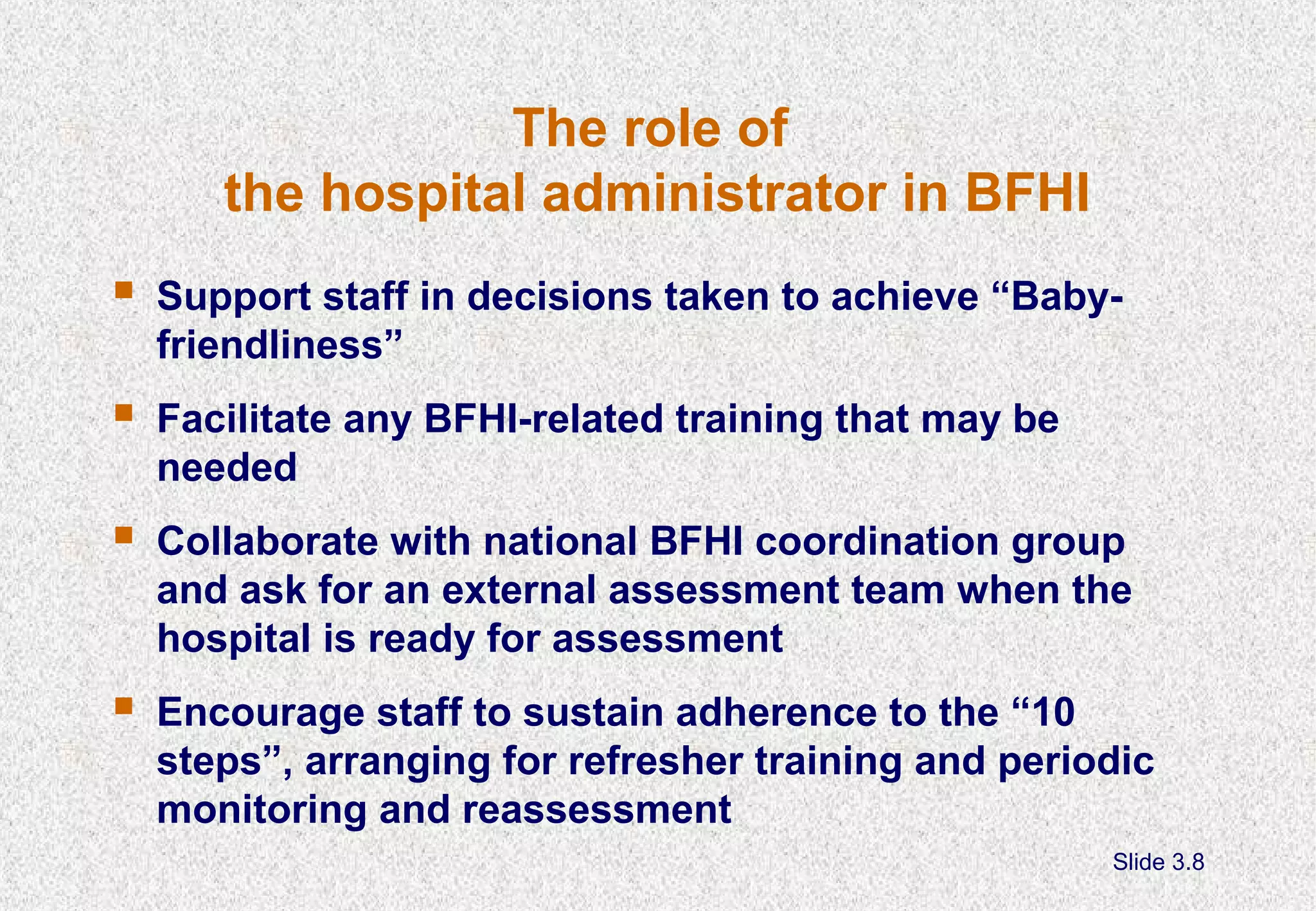
The role of
the hospital administrator in BFHI
 Become familiar with the BFHI process
 Decide where responsibility lies within the hospital
structure. This can be a coordinating committee,
working group, multidisciplinary team, etc.
 Establish the process within the hospital of working
with the identified responsible body
 Work with key hospital staff to fill in the self-appraisal
tool using the Global Criteria and interpret results
Slide 3.7
The role of
the hospital administrator in BFHI
 Support staff in decisions taken to achieve “Baby-
friendliness”
 Facilitate any BFHI-related training that may be
needed
 Collaborate with national BFHI coordination group
and ask for an external assessment team when the
hospital is ready for assessment
 Encourage staff to sustain adherence to the “10
steps”, arranging for refresher training and periodic
monitoring and reassessment
Slide 3.8
 To improve – through optimal feeding – the
nutritional status, growth and development, health,
and thus the survival of infants and young children.
Global Strategy on Infant and Young Child
Feeding (IYCF): Aim
Slide 3.9
Operational targets in the strategy
 Develop, implement, monitor, and evaluate a comprehensive policy
on IYCF;
 Ensure that the health and other relevant sectors protect, promote
and support exclusive breastfeeding for six months and continued
breastfeeding up to two years of age or beyond, while providing
women access to the support they require;
 Promote timely, adequate, safe, and appropriate complementary
feeding with continued breastfeeding;
 Provide guidance on feeding infants and young children in
exceptionally difficult circumstances;
 Consider what new legislation or other suitable measures may be
required, as part of a comprehensive policy on IYCF, to give effect to
the principles and aim of the International Code of Marketing and to
subsequent relevant Health Assembly resolutions.
Slide 3.10
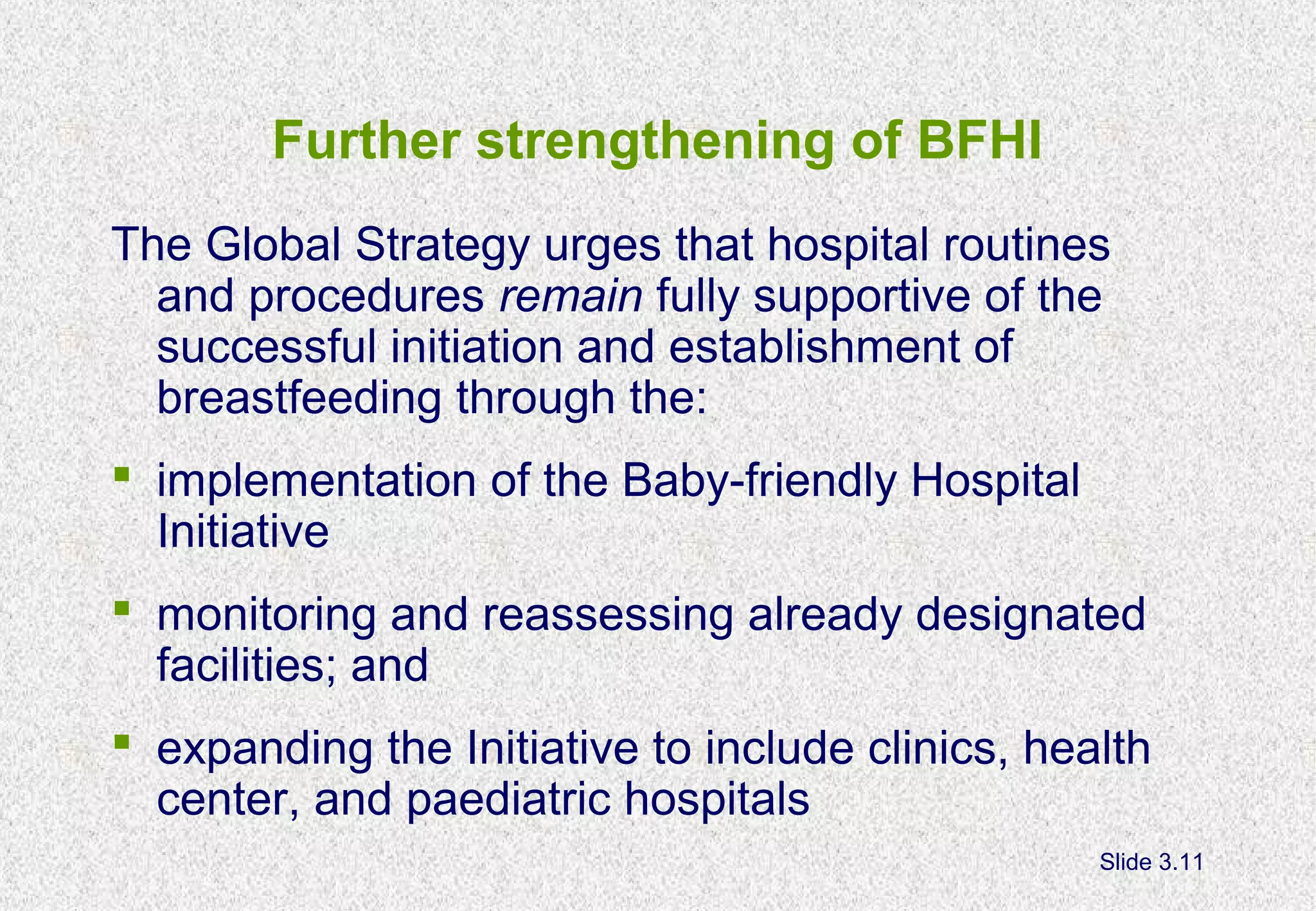
Further strengthening of BFHI
The Global Strategy urges that hospital routines
and procedures remain fully supportive of the
successful initiation and establishment of
breastfeeding through the:
 implementation of the Baby-friendly Hospital
Initiative
 monitoring and reassessing already designated
facilities; and
 expanding the Initiative to include clinics, health
center, and paediatric hospitals
Slide 3.11
It also urges that support be given for feeding
infants and young children in exceptionally
difficult circumstances,
 with one aspect of this being to adapt the BFHI by
taking account of HIV/AIDS,
 and by ensuring that those responsible for
emergency preparedness are well trained to
support appropriate feeding practices consistent
with the Initiative’s universal principles.
Slide 3.12

Bfhi

  • 1.
    Goals of the Baby-friendlyHospital Initiative 1.To transform hospitals and maternity facilities through implementation of the “Ten steps”. 2.To end the practice of distribution of free and low- cost supplies of breast-milk substitutes to maternity wards and hospitals. Slide 3.1
  • 2.
    Every facility providingmaternity services and care for newborn infants should follow these Ten steps to successful breastfeeding 1. Have a written breastfeeding policy that is routinely communicated to all health care staff. 2. Train all health care staff in skills necessary to implement this policy. 3. Inform all pregnant women about the benefits and management of breastfeeding. 4. Help mothers initiate breastfeeding within a half-hour of birth. 5. Show mothers how to breastfeed, and how to maintain lactation even if they should be separated from their infants. Slide 3.2
  • 3.
    Every facility providingmaternity services and care for newborn infants should follow these Ten steps to successful breastfeeding 6. Give newborn infants no food or drink other than breast milk, unless medically indicated. 7. Practise rooming-in — allow mothers and infants to remain together — 24 hours a day. 8. Encourage breastfeeding on demand. 9. Give no artificial teats or pacifiers (also called dummies or soothers) to breastfeeding infants. 10. Foster the establishment of breastfeeding support groups and refer mothers to them on discharge from the hospital or clinic. Slide 3.3
  • 4.
    1991 – Launchingof Baby-friendly Hospital Initiative Slide 3.4
  • 5.
    Aim To contribute tothe provision of safe and adequate nutrition for infants by:  the protection and promotion of breastfeeding, and  ensuring the proper use of breast-milk substitutes, when these are necessary, on basis of adequate information and through appropriate marketing and distribution. Slide 3.5
  • 6.
    Scope Marketing, practices related,quality and availability, and information concerning the use of:  breast-milk substitutes, including infant formula  other milk products, foods and beverages, including bottle-fed complementary foods, when intended for use as a partial or total replacement of breast milk  feeding bottles and teats Slide 3.6
  • 7.
    The role of thehospital administrator in BFHI  Become familiar with the BFHI process  Decide where responsibility lies within the hospital structure. This can be a coordinating committee, working group, multidisciplinary team, etc.  Establish the process within the hospital of working with the identified responsible body  Work with key hospital staff to fill in the self-appraisal tool using the Global Criteria and interpret results Slide 3.7
  • 8.
    The role of thehospital administrator in BFHI  Support staff in decisions taken to achieve “Baby- friendliness”  Facilitate any BFHI-related training that may be needed  Collaborate with national BFHI coordination group and ask for an external assessment team when the hospital is ready for assessment  Encourage staff to sustain adherence to the “10 steps”, arranging for refresher training and periodic monitoring and reassessment Slide 3.8
  • 9.
     To improve– through optimal feeding – the nutritional status, growth and development, health, and thus the survival of infants and young children. Global Strategy on Infant and Young Child Feeding (IYCF): Aim Slide 3.9
  • 10.
    Operational targets inthe strategy  Develop, implement, monitor, and evaluate a comprehensive policy on IYCF;  Ensure that the health and other relevant sectors protect, promote and support exclusive breastfeeding for six months and continued breastfeeding up to two years of age or beyond, while providing women access to the support they require;  Promote timely, adequate, safe, and appropriate complementary feeding with continued breastfeeding;  Provide guidance on feeding infants and young children in exceptionally difficult circumstances;  Consider what new legislation or other suitable measures may be required, as part of a comprehensive policy on IYCF, to give effect to the principles and aim of the International Code of Marketing and to subsequent relevant Health Assembly resolutions. Slide 3.10
  • 11.
    Further strengthening ofBFHI The Global Strategy urges that hospital routines and procedures remain fully supportive of the successful initiation and establishment of breastfeeding through the:  implementation of the Baby-friendly Hospital Initiative  monitoring and reassessing already designated facilities; and  expanding the Initiative to include clinics, health center, and paediatric hospitals Slide 3.11
  • 12.
    It also urgesthat support be given for feeding infants and young children in exceptionally difficult circumstances,  with one aspect of this being to adapt the BFHI by taking account of HIV/AIDS,  and by ensuring that those responsible for emergency preparedness are well trained to support appropriate feeding practices consistent with the Initiative’s universal principles. Slide 3.12