The Agile Mindset – the
      Next Steps

       Linda Rising
     linda@lindarising.org
      www.lindarising.org
Disclaimer: This provocative presentation is ideally the
beginning of a conversation. It won't take long for me
to tell you everything I know about cognitive
psychology, although I have been reading in the area
for several years now. I'm an amateur who has
sufficient interest in weird topics and a strange way of
connecting ideas that might or might not be of interest
to you. Thank you for your tolerance and understanding
of my meanderings and I hope you learn a little that
might help you in your life.

This is not an “academic” presentation, but those
interested in more information are invited to ask me for
references for any part of this talk and I will be happy
to make them available.
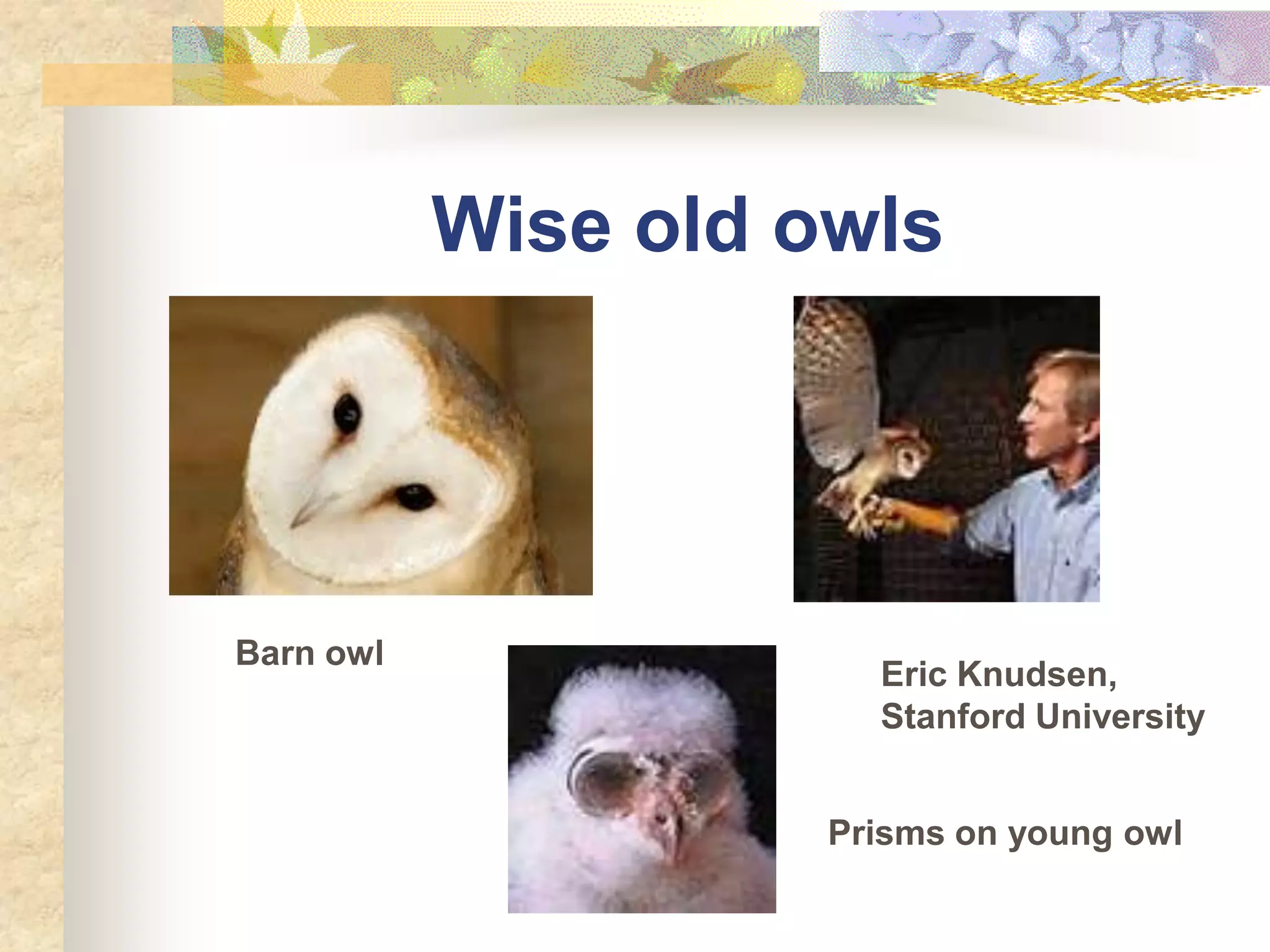
Wise old owls


Barn owl
                       Eric Knudsen,
                       Stanford University


                     Prisms on young owl
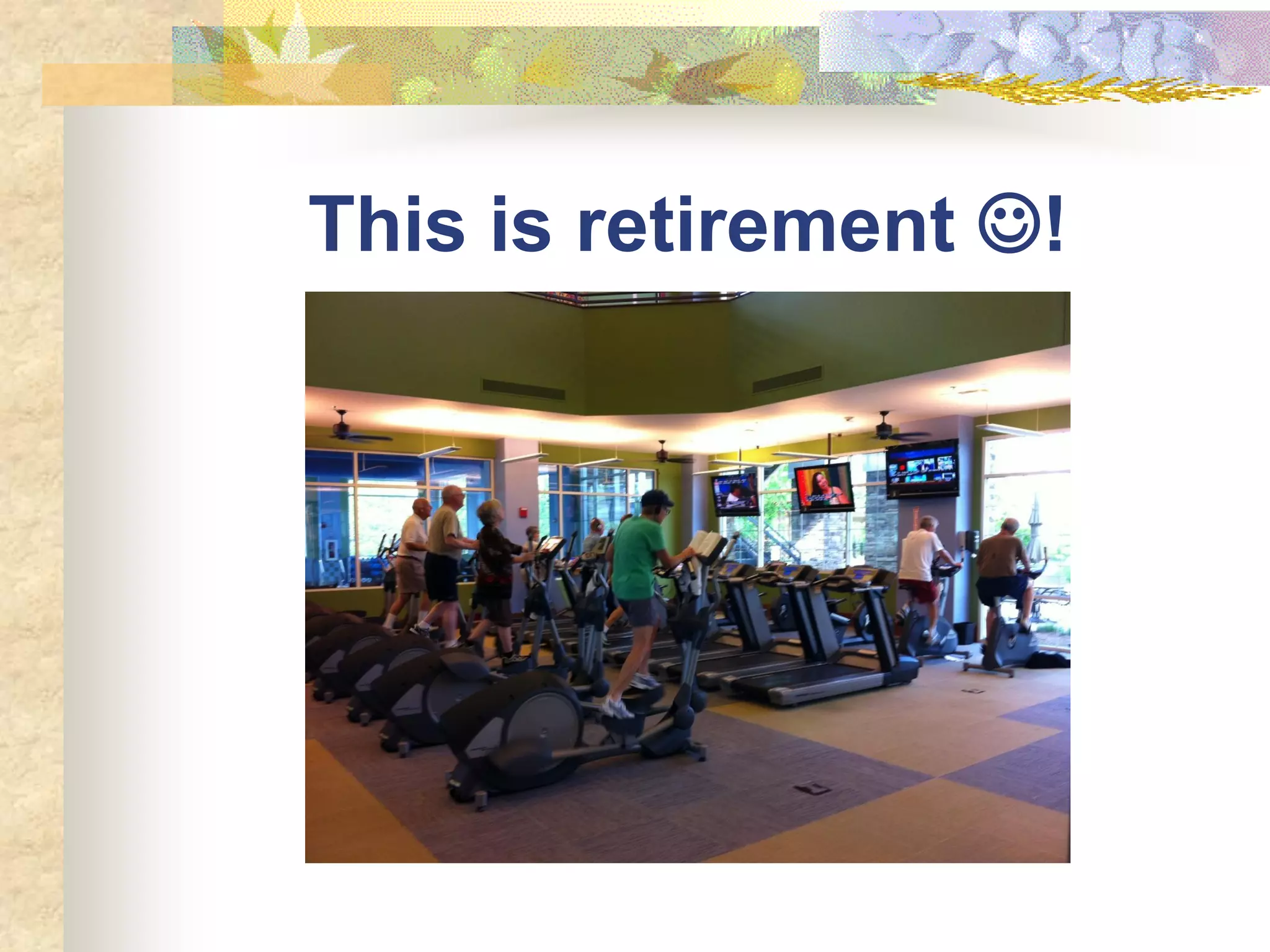
This is retirement !
Find the 80-year-olds !
Do you mostly agree or mostly
 disagree with the following
Intelligence is something very basic that you really
   can't change much. You’re born with it or not.
   Yes, you can learn new things, but you can't
   really change how intelligent you are.
No matter how intelligent you are, you can always
   get better, sometimes you can improve a lot.

You can substitute any ability or talent for
  “intelligence.”
Agile 2012 Keynote
http://www.agilealliance.org/resources/learning-
   center/keynote-the-power-of-an-agile-mindset
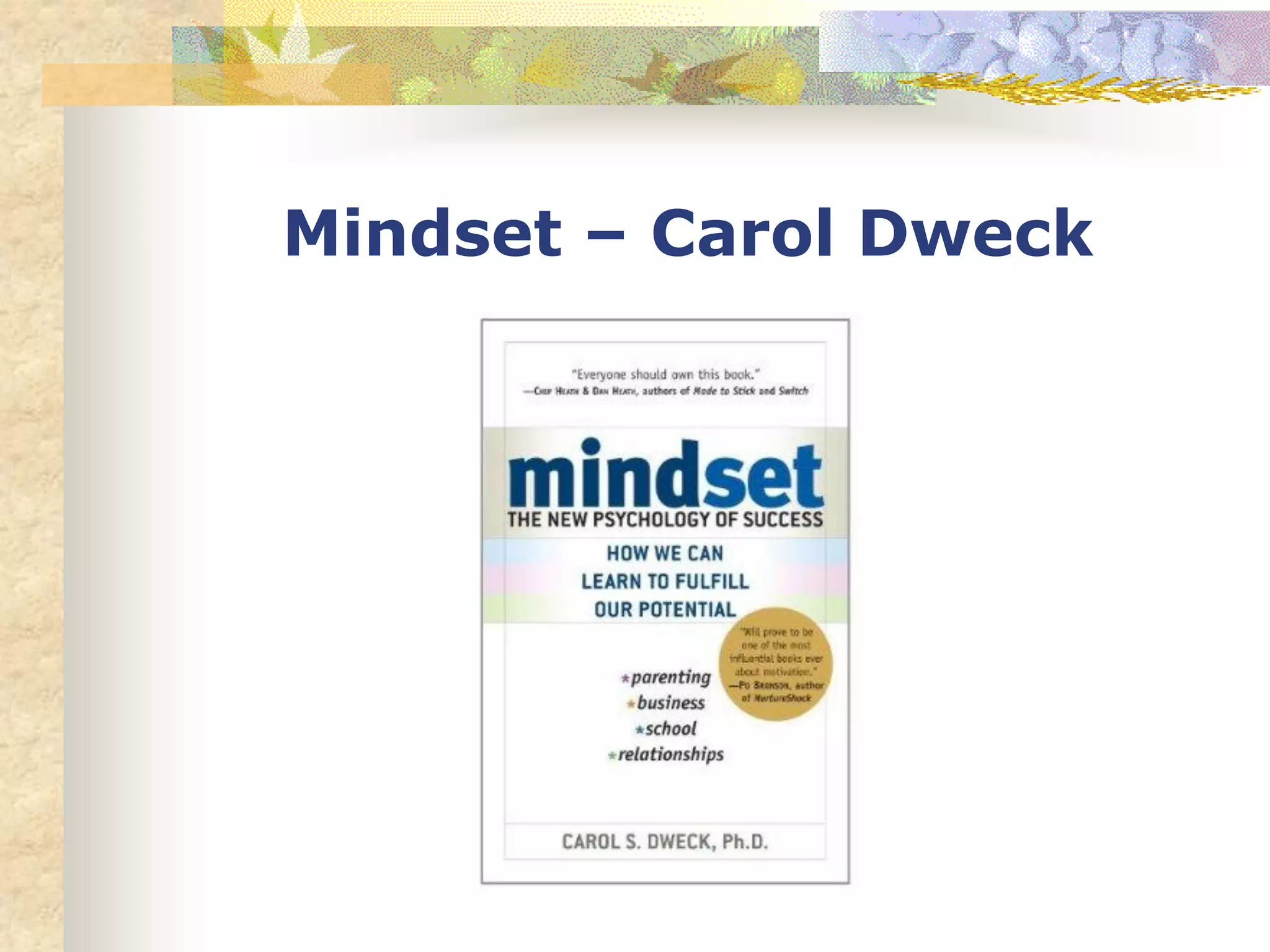
Mindset – Carol Dweck
More info
New Yorker – “The Talent Myth,” gladwell.com
New York Magazine – “How not to talk to your kids,”
  Po Bronson
TIME magazine – “How to help them succeed”
mindsetonline.com/
www.stanford.edu/dept/psychology/cgi-bin/drupalm/cdweck
Two mindsets: Fixed & Agile
Research shows that mindset:
Determines goals
Reactions to failure
Belief about effort and strategies
Attitudes toward others’ successes
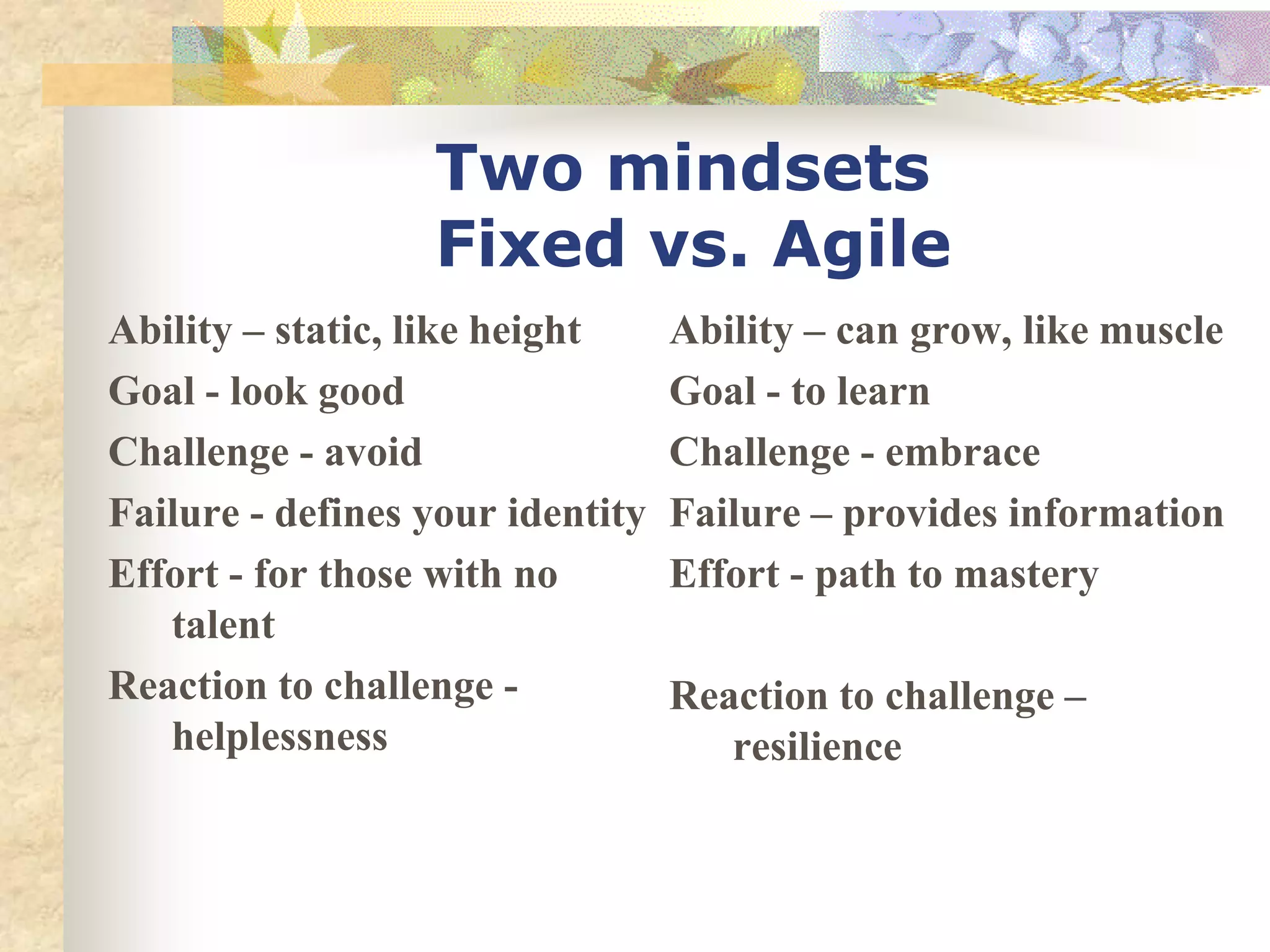
Two mindsets
                  Fixed vs. Agile
Ability – static, like height     Ability – can grow, like muscle
Goal - look good                  Goal - to learn
Challenge - avoid                 Challenge - embrace
Failure - defines your identity   Failure – provides information
Effort - for those with no        Effort - path to mastery
   talent
Reaction to challenge -           Reaction to challenge –
   helplessness                      resilience
Belief about yourself affects
      belief about others
Those with a fixed mindset are quick to
   judge others based on little information
   and quick to stereotype
Those with an agile mindset don’t ignore
   information about others but are less
   negative/positive
“Who do you trust” – Agile 2008
..VideosCarlsberg.flv
Why stereotyping is a bad thing
Because those who are labeled become
  believers in the stereotype
Women taking math tests
Iowa 3rd grade teacher, Jane Elliott – 1968
  – the day after MLK assassination
pbs.org/wgbh/pages/frontline/shows/divided/etc/view.html
The good news is…
Mindset is not “fixed”
We encourage one or the other in each
  other
We develop one or the other in our children
Research has shown that small
  experimental manipulations, e.g.
  feedback or reading an article can
  produce one or the other
Effort & failure are good!
Praise effort, strategies, process
Ask about the work
Instead of ignoring failure, teach others that it’s a way to
   learn and improve
Tell stories about those who suceeded by working through
   failure—tell your own stories!
Talk about the research in cognitive science that shows
   that the brain is like a muscle, learning grows new
   connections in the brain
For Kids
Instead of “You’re so smart” or “You picked that up so quickly,” say “That
    was a clever approach” or “I’m proud of your persistence.”
Instead of “You’re a natural” say “Practice is really making you better.”
Instead of “Did you win?” say “Did you give your best effort?”
Instead of “How was your day?” say “What did you learn today?” or “What
    mistakes did you make that taught you something?”
Instead of “What do you want to do when you grow up?” say “What are your
    plans for reaching your goals?”
Never let failure progress from an action to an identity.
Never label kids, e.g. “Jimmy is the artist” or “Susie is the computer geek.”
When a child doubts her ability, ask her to think of areas where she once had
    low ability and now excels, or to recall a time when she saw someone learn
    something or improve in ways no one thought possible.
For Yourself
Instead of letting salary, benefits, and status define job satisfaction, ask
    yourself if you’re still learning. If yes, then you’re fortunate to have a
    job that encourages an agile mind-set. View its challenges as
    opportunities rather than stress. If you’ve stopped learning, then
    consider looking either for new avenues of growth or for another job.
Instead of blaming others in your relationships, remember “the whole
    point of a relationship is to encourage each other’s development.”
Depressed people tend to believe that it’s just the way they are. Instead of
    viewing yourself as a failed end product, think of yourself as a
    temporarily derailed work in progress. “We usually think of
    personality as something very stable, but we’re finding that even core
    parts of it can be changed by shifting mind-sets.”
For Others
Instead of arguing with someone (especially a significant other) that
    “you’re not stupid, you’re brilliant, it’s just that those people
    can’t see it,” choose a quiet moment to talk about what you’ve
    learned about this research. Don’t force anyone to read about it,
    just make it available. In the typical argument, one fixed label is
    being substituted for another.
Instead of using generalities, give specific, concrete examples of when
    the other has made progress and done something that was
    thought to be difficult or challenging.
Instead of praising talent when things are going well, “see, I told you
    that you were brilliant,” praise the process and the effort that was
    involved in the success.
Agile software development
Fail early, fail often.
Fail fast, learn constantly.
Failure *IS* an option.
Without failure how can learning happen?
“Make mistakes faster.”
   Rich Sheridan, CEO, Menlo Innovations
“Perfect is a verb.” Kent Beck
“Those that fail fastest grow strongest.”
   Roy Singham, Founder and Chair, Thoughtworks
Agile is agile
The agile mindset believes that we are *ALL* a work in progress.
The agile software development process isn’t fixed. It continues to
    change and grow as we learn more about it. If we are lucky, this
    will never end because it will never be perfect.
We will continue to improve as we age—just like me !
Ever tried. Ever failed. No matter. Try Again. Fail again. Fail better.
    Samuel Beckett, Irish poet (1906-1989)
You must learn to fail intelligently. Failing is one of the greatest arts
    in the world. One fails forward to success. Thomas Edison
Thoughts on mistakes
Don’t equate making mistakes with being a mistake. There is no such thing as a successful
     person who has not failed or made mistakes, there are successful people who made
     mistakes and changed their lives or performance in response to them, and so got it
     right the next time. They viewed mistakes as warnings rather than signs of hopeless
     inadequacy. Never making a mistake means never living life to the full. Steve Jobs
Sometimes when you innovate, you make mistakes. It is best to admit them quickly, and get
     on with improving your other innovations.” Steve Jobs
Move fast and break things. Unless you break things you’re not moving fast enough.
     Mark Zuckerberg
Basic research is what I am doing when I don't know what I am doing.
     Wernher von Braun
Success seems to be connected with action. Successful people keep moving. They make
     mistakes, but they don't quit. Conrad Hilton
Anyone who has never made a mistake has never tried anything new. Albert Einstein
I have not failed. I've just found 10,000 ways that won't work. Thomas Edison
A gift from Steve Jobs
Remembering that I'll be dead soon is
  the most important tool I've ever
  encountered to help me make the
  big choices in life.

  Steve Jobs
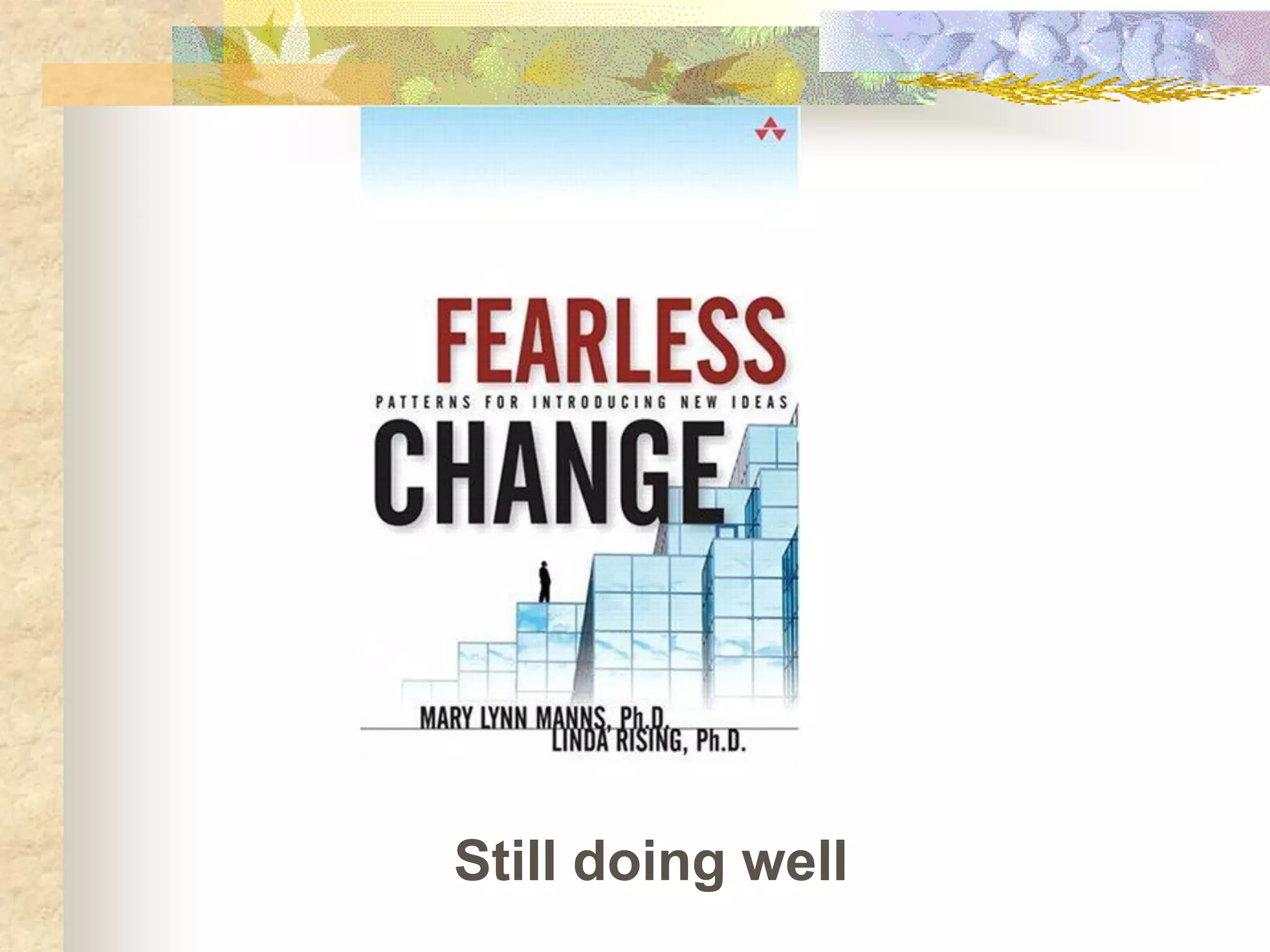
Still doing well
Patterns for Sustainable Development
www.SustainableDevelopmentPatterns.info
My gift to you !
Research shows that self stereotyping
  affects performance – old people who
  believe they’re hopeless and helpless are.
A study over nearly 40 years shows that
  those younger people who held negative
  age stereotypes influenced their own
  health when they became older.
Let me be the image you have of old age!
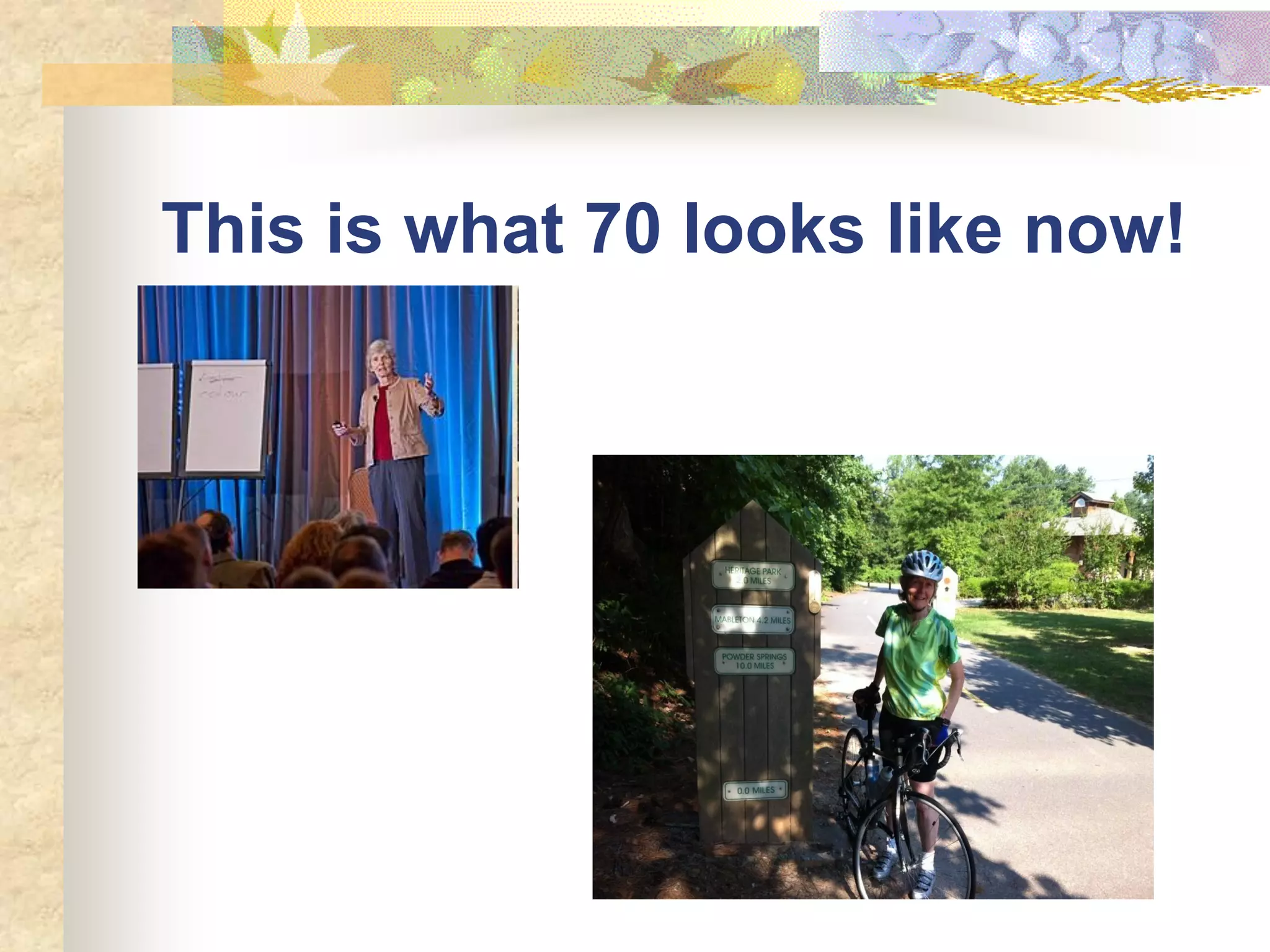
This is what 70 looks like now!
You will be even better!
Swedish study: 70-year-olds given IQ test in 2000 better than 70-year-
    olds given the test in 1971.
Researchers analyzed Nobel Prizes in physics, chemistry and medicine
    from 1901 to 2008. Prize winning work before age 30 was common
    in all disciplines before 1905. By 2000, achievement before 30
    almost never happened in any of the three fields. In physics, great
    achievements by 40 occurred in only 19% of cases and in
    chemistry, it almost never occurred. Today, the average age at
    which physicists do their prize winning work is 48.


                     Thanks for listening !

Beyond the agile mindset agile 2012

  • 1.
    The Agile Mindset– the Next Steps Linda Rising linda@lindarising.org www.lindarising.org
  • 2.
    Disclaimer: This provocativepresentation is ideally the beginning of a conversation. It won't take long for me to tell you everything I know about cognitive psychology, although I have been reading in the area for several years now. I'm an amateur who has sufficient interest in weird topics and a strange way of connecting ideas that might or might not be of interest to you. Thank you for your tolerance and understanding of my meanderings and I hope you learn a little that might help you in your life. This is not an “academic” presentation, but those interested in more information are invited to ask me for references for any part of this talk and I will be happy to make them available.
  • 3.
    Wise old owls Barnowl Eric Knudsen, Stanford University Prisms on young owl
  • 4.
  • 5.
  • 6.
    Do you mostlyagree or mostly disagree with the following Intelligence is something very basic that you really can't change much. You’re born with it or not. Yes, you can learn new things, but you can't really change how intelligent you are. No matter how intelligent you are, you can always get better, sometimes you can improve a lot. You can substitute any ability or talent for “intelligence.”
  • 7.
  • 8.
  • 9.
    More info New Yorker– “The Talent Myth,” gladwell.com New York Magazine – “How not to talk to your kids,” Po Bronson TIME magazine – “How to help them succeed” mindsetonline.com/ www.stanford.edu/dept/psychology/cgi-bin/drupalm/cdweck
  • 10.
    Two mindsets: Fixed& Agile Research shows that mindset: Determines goals Reactions to failure Belief about effort and strategies Attitudes toward others’ successes
  • 11.
    Two mindsets Fixed vs. Agile Ability – static, like height Ability – can grow, like muscle Goal - look good Goal - to learn Challenge - avoid Challenge - embrace Failure - defines your identity Failure – provides information Effort - for those with no Effort - path to mastery talent Reaction to challenge - Reaction to challenge – helplessness resilience
  • 12.
    Belief about yourselfaffects belief about others Those with a fixed mindset are quick to judge others based on little information and quick to stereotype Those with an agile mindset don’t ignore information about others but are less negative/positive “Who do you trust” – Agile 2008 ..VideosCarlsberg.flv
  • 13.
    Why stereotyping isa bad thing Because those who are labeled become believers in the stereotype Women taking math tests Iowa 3rd grade teacher, Jane Elliott – 1968 – the day after MLK assassination pbs.org/wgbh/pages/frontline/shows/divided/etc/view.html
  • 14.
    The good newsis… Mindset is not “fixed” We encourage one or the other in each other We develop one or the other in our children Research has shown that small experimental manipulations, e.g. feedback or reading an article can produce one or the other
  • 15.
    Effort & failureare good! Praise effort, strategies, process Ask about the work Instead of ignoring failure, teach others that it’s a way to learn and improve Tell stories about those who suceeded by working through failure—tell your own stories! Talk about the research in cognitive science that shows that the brain is like a muscle, learning grows new connections in the brain
  • 16.
    For Kids Instead of“You’re so smart” or “You picked that up so quickly,” say “That was a clever approach” or “I’m proud of your persistence.” Instead of “You’re a natural” say “Practice is really making you better.” Instead of “Did you win?” say “Did you give your best effort?” Instead of “How was your day?” say “What did you learn today?” or “What mistakes did you make that taught you something?” Instead of “What do you want to do when you grow up?” say “What are your plans for reaching your goals?” Never let failure progress from an action to an identity. Never label kids, e.g. “Jimmy is the artist” or “Susie is the computer geek.” When a child doubts her ability, ask her to think of areas where she once had low ability and now excels, or to recall a time when she saw someone learn something or improve in ways no one thought possible.
  • 17.
    For Yourself Instead ofletting salary, benefits, and status define job satisfaction, ask yourself if you’re still learning. If yes, then you’re fortunate to have a job that encourages an agile mind-set. View its challenges as opportunities rather than stress. If you’ve stopped learning, then consider looking either for new avenues of growth or for another job. Instead of blaming others in your relationships, remember “the whole point of a relationship is to encourage each other’s development.” Depressed people tend to believe that it’s just the way they are. Instead of viewing yourself as a failed end product, think of yourself as a temporarily derailed work in progress. “We usually think of personality as something very stable, but we’re finding that even core parts of it can be changed by shifting mind-sets.”
  • 18.
    For Others Instead ofarguing with someone (especially a significant other) that “you’re not stupid, you’re brilliant, it’s just that those people can’t see it,” choose a quiet moment to talk about what you’ve learned about this research. Don’t force anyone to read about it, just make it available. In the typical argument, one fixed label is being substituted for another. Instead of using generalities, give specific, concrete examples of when the other has made progress and done something that was thought to be difficult or challenging. Instead of praising talent when things are going well, “see, I told you that you were brilliant,” praise the process and the effort that was involved in the success.
  • 19.
    Agile software development Failearly, fail often. Fail fast, learn constantly. Failure *IS* an option. Without failure how can learning happen? “Make mistakes faster.” Rich Sheridan, CEO, Menlo Innovations “Perfect is a verb.” Kent Beck “Those that fail fastest grow strongest.” Roy Singham, Founder and Chair, Thoughtworks
  • 20.
    Agile is agile Theagile mindset believes that we are *ALL* a work in progress. The agile software development process isn’t fixed. It continues to change and grow as we learn more about it. If we are lucky, this will never end because it will never be perfect. We will continue to improve as we age—just like me ! Ever tried. Ever failed. No matter. Try Again. Fail again. Fail better. Samuel Beckett, Irish poet (1906-1989) You must learn to fail intelligently. Failing is one of the greatest arts in the world. One fails forward to success. Thomas Edison
  • 21.
    Thoughts on mistakes Don’tequate making mistakes with being a mistake. There is no such thing as a successful person who has not failed or made mistakes, there are successful people who made mistakes and changed their lives or performance in response to them, and so got it right the next time. They viewed mistakes as warnings rather than signs of hopeless inadequacy. Never making a mistake means never living life to the full. Steve Jobs Sometimes when you innovate, you make mistakes. It is best to admit them quickly, and get on with improving your other innovations.” Steve Jobs Move fast and break things. Unless you break things you’re not moving fast enough. Mark Zuckerberg Basic research is what I am doing when I don't know what I am doing. Wernher von Braun Success seems to be connected with action. Successful people keep moving. They make mistakes, but they don't quit. Conrad Hilton Anyone who has never made a mistake has never tried anything new. Albert Einstein I have not failed. I've just found 10,000 ways that won't work. Thomas Edison
  • 22.
    A gift fromSteve Jobs Remembering that I'll be dead soon is the most important tool I've ever encountered to help me make the big choices in life. Steve Jobs
  • 23.
  • 24.
    Patterns for SustainableDevelopment www.SustainableDevelopmentPatterns.info
  • 25.
    My gift toyou ! Research shows that self stereotyping affects performance – old people who believe they’re hopeless and helpless are. A study over nearly 40 years shows that those younger people who held negative age stereotypes influenced their own health when they became older. Let me be the image you have of old age!
  • 26.
    This is what70 looks like now!
  • 27.
    You will beeven better! Swedish study: 70-year-olds given IQ test in 2000 better than 70-year- olds given the test in 1971. Researchers analyzed Nobel Prizes in physics, chemistry and medicine from 1901 to 2008. Prize winning work before age 30 was common in all disciplines before 1905. By 2000, achievement before 30 almost never happened in any of the three fields. In physics, great achievements by 40 occurred in only 19% of cases and in chemistry, it almost never occurred. Today, the average age at which physicists do their prize winning work is 48. Thanks for listening !