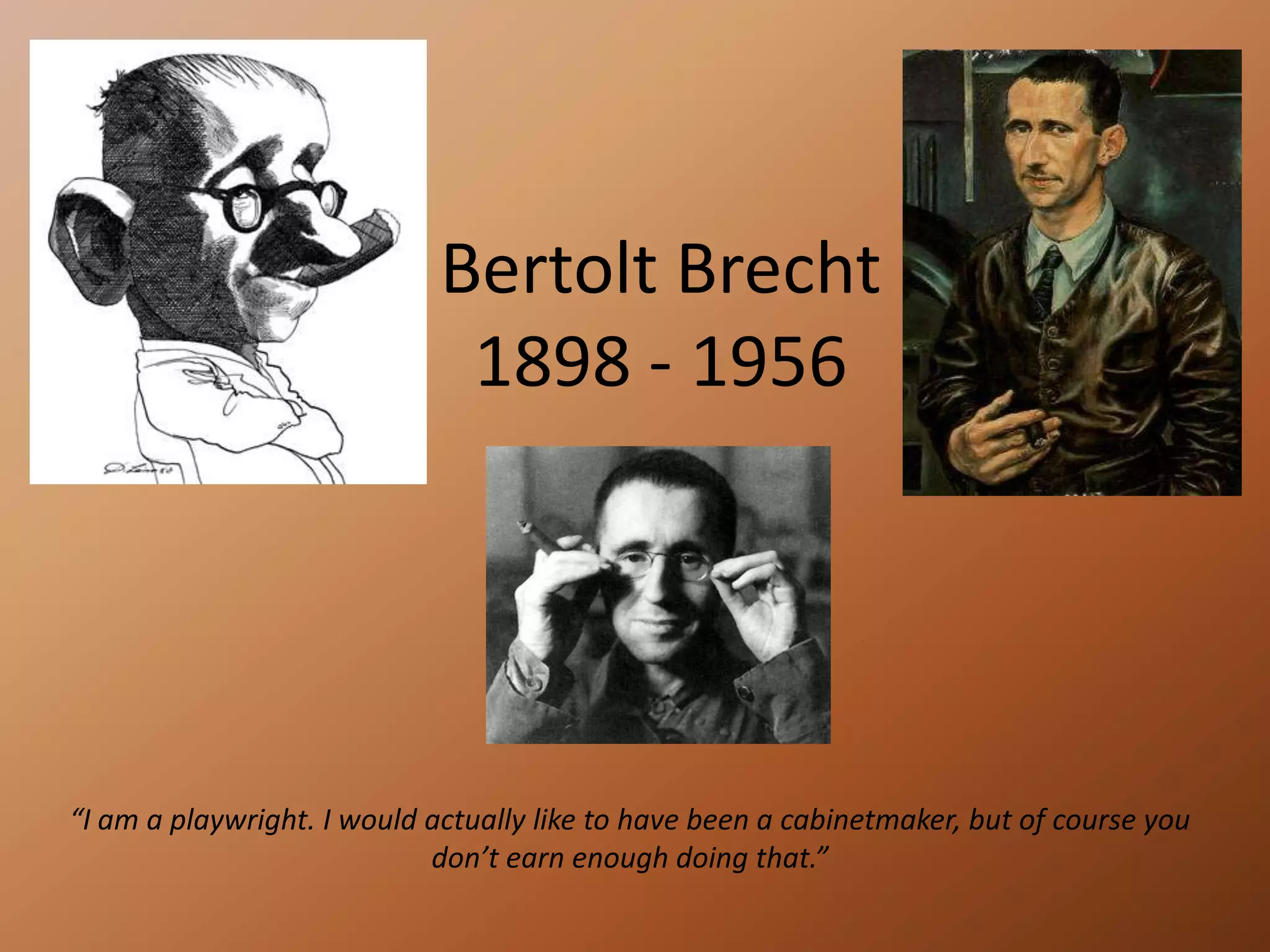
Bertolt Brecht 1898 - 1956“I am a playwright. I would actually like to have been a cabinetmaker, but of course you don’t earn enough doing that.”
Social Context1914-1918	 First World War Brecht posted as a medical orderly in his home town. Not attached to the emotion of the frontline but witness the effects of war.
1919-1933 Munich and Berlin 1922 - Directs first production. 1925 – Sees Battleship Potemkin by Sergei Eisenstein – introduced to 	the idea of montage.1926 - Produces Baal – riot in the auditorium. 			Begins to study Karl Marx.1927 – First collaboration with musician Kurt Weill (also 	collaborates 	with Piscator)1928 -The Threepenny Opera is a box-office success.1930 -Performances of The Rise and Fall of the City of Mahogany 	picketed by Nazis.  Brecht sees Meyerhold’s theatre on tour. 1932 - Agit-prop sequence in Brecht’s film KuhleWampeis 	censored. 1932 - Nazis come to power, Brecht flees the country.
1933-1948 The Years of ExileMost of Brecht’s major plays were completed before he reached the safety of America in 1941.1935 - Begins to use Verfremdungseffekt. Nazis 	formally remove German citizenship. 	Friends and colleagues in Russia start to 	disappear. 1935-41 - Moves around Europe away from 	Nazis.1941 - Leaves Europe to go to California. 1947 - Appears before the House of Un-American 	Activities.
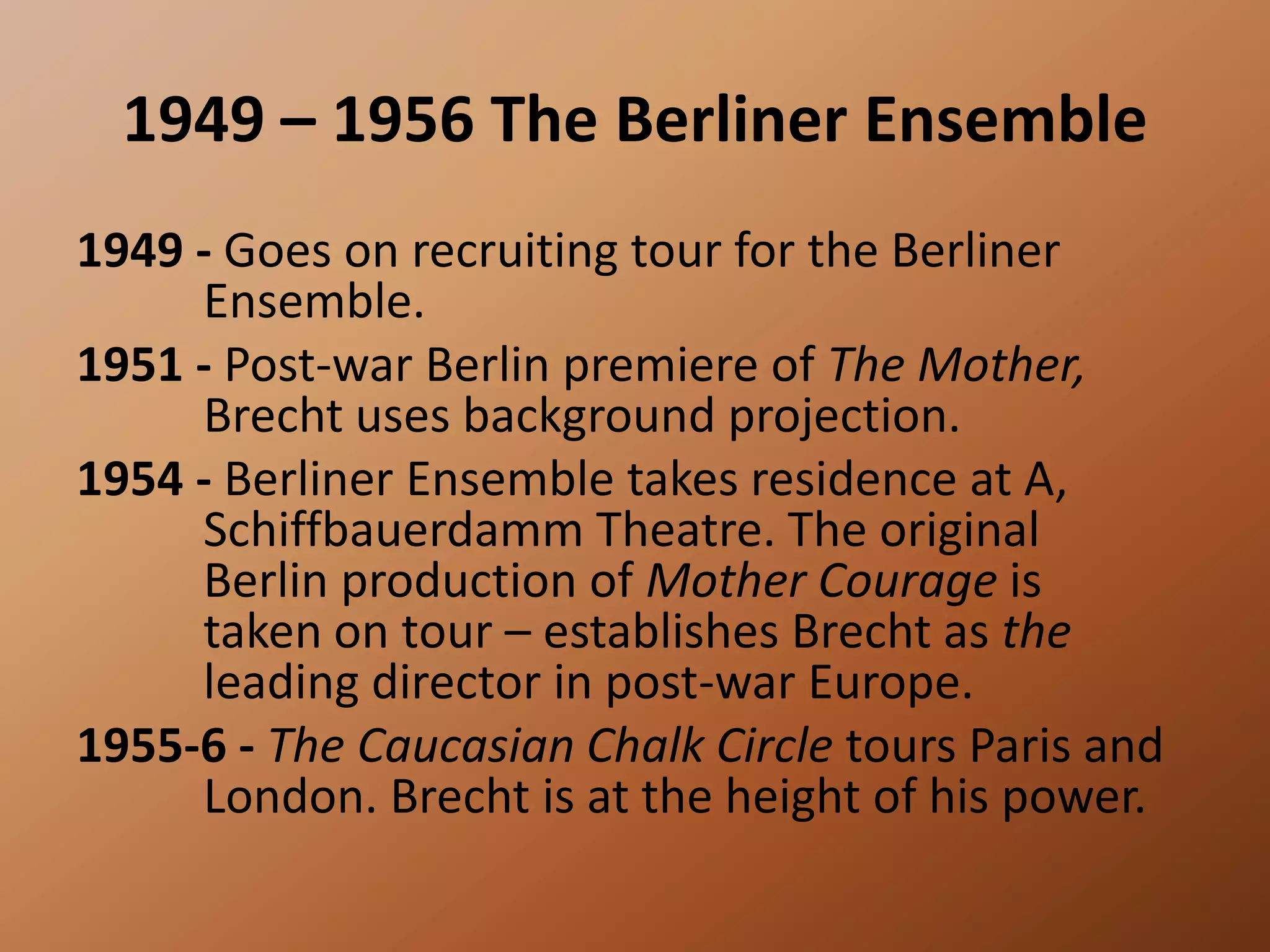
1949 – 1956 The Berliner Ensemble1949 - Goes on recruiting tour for the Berliner 	Ensemble. 1951 - Post-war Berlin premiere of The Mother, 	Brecht uses background projection. 1954 - Berliner Ensemble takes residence at A, 	Schiffbauerdamm Theatre. The original 	Berlin production of Mother Courage is 	taken on tour – establishes Brecht as the 	leading director in post-war Europe. 1955-6 - The Caucasian Chalk Circle tours Paris and 	London. Brecht is at the height of his power.
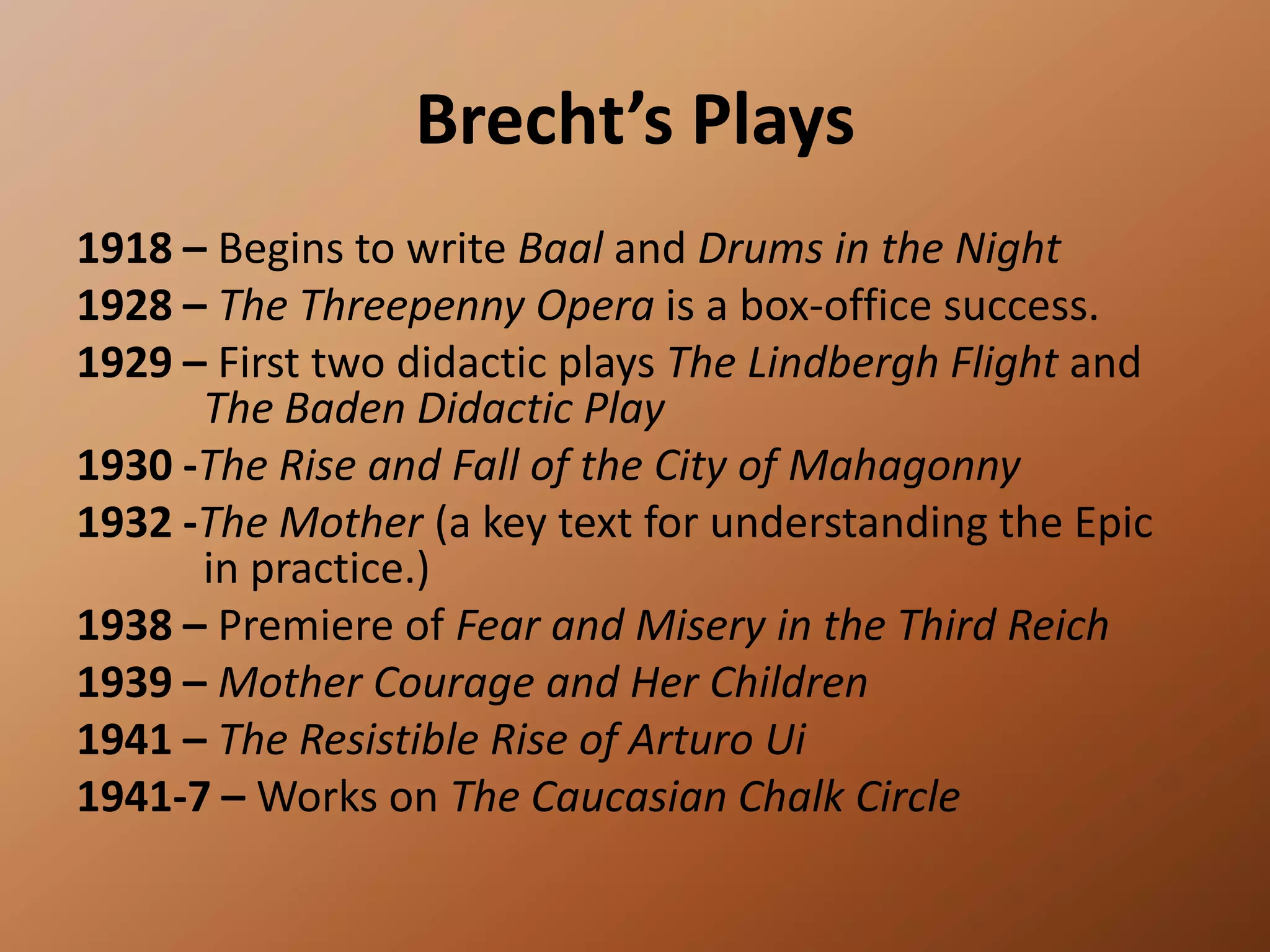
Brecht’s Plays1918 – Begins to write Baal and Drums in the Night 1928 – The Threepenny Opera is a box-office success.1929 – First two didactic plays The Lindbergh Flight and 	The Baden Didactic Play1930 -The Rise and Fall of the City of Mahagonny1932 -The Mother (a key text for understanding the Epic 	in practice.) 1938 – Premiere of Fear and Misery in the Third Reich1939 – Mother Courage and Her Children 1941 – The Resistible Rise of Arturo Ui1941-7 – Works on The Caucasian Chalk Circle
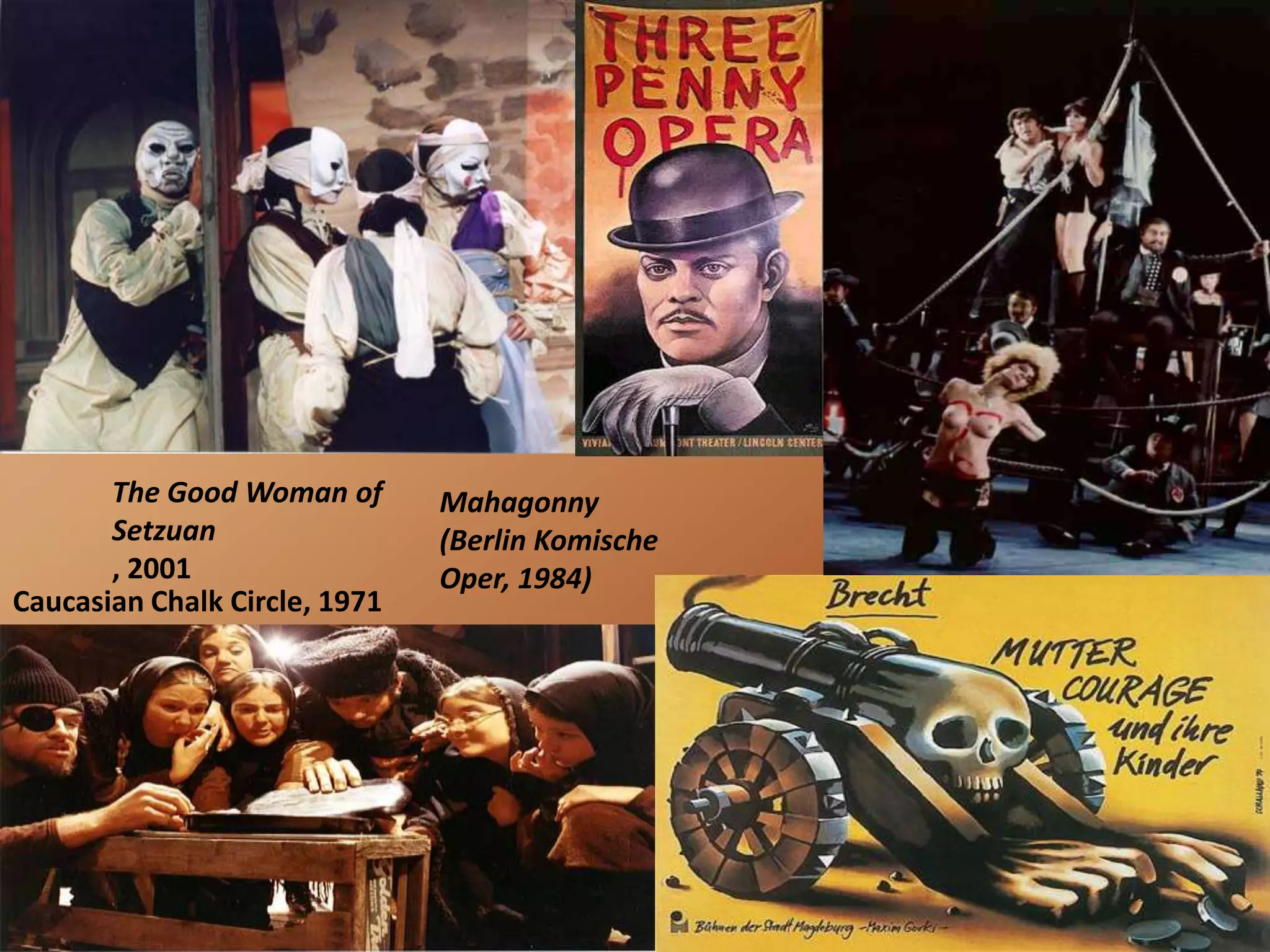
The Good Woman of Setzuan, 2001Mahagonny(Berlin Komische Oper, 1984)Caucasian Chalk Circle, 1971
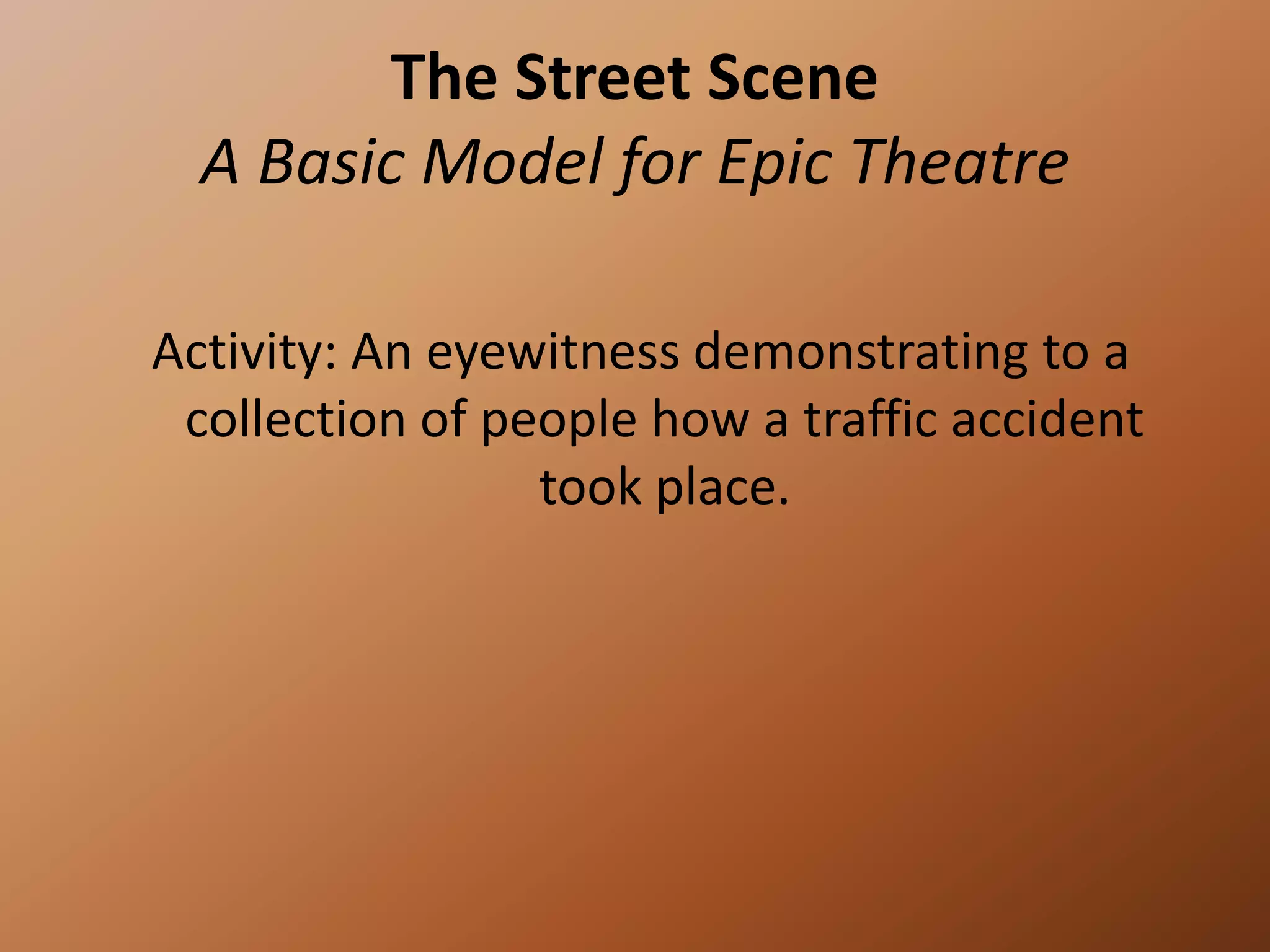
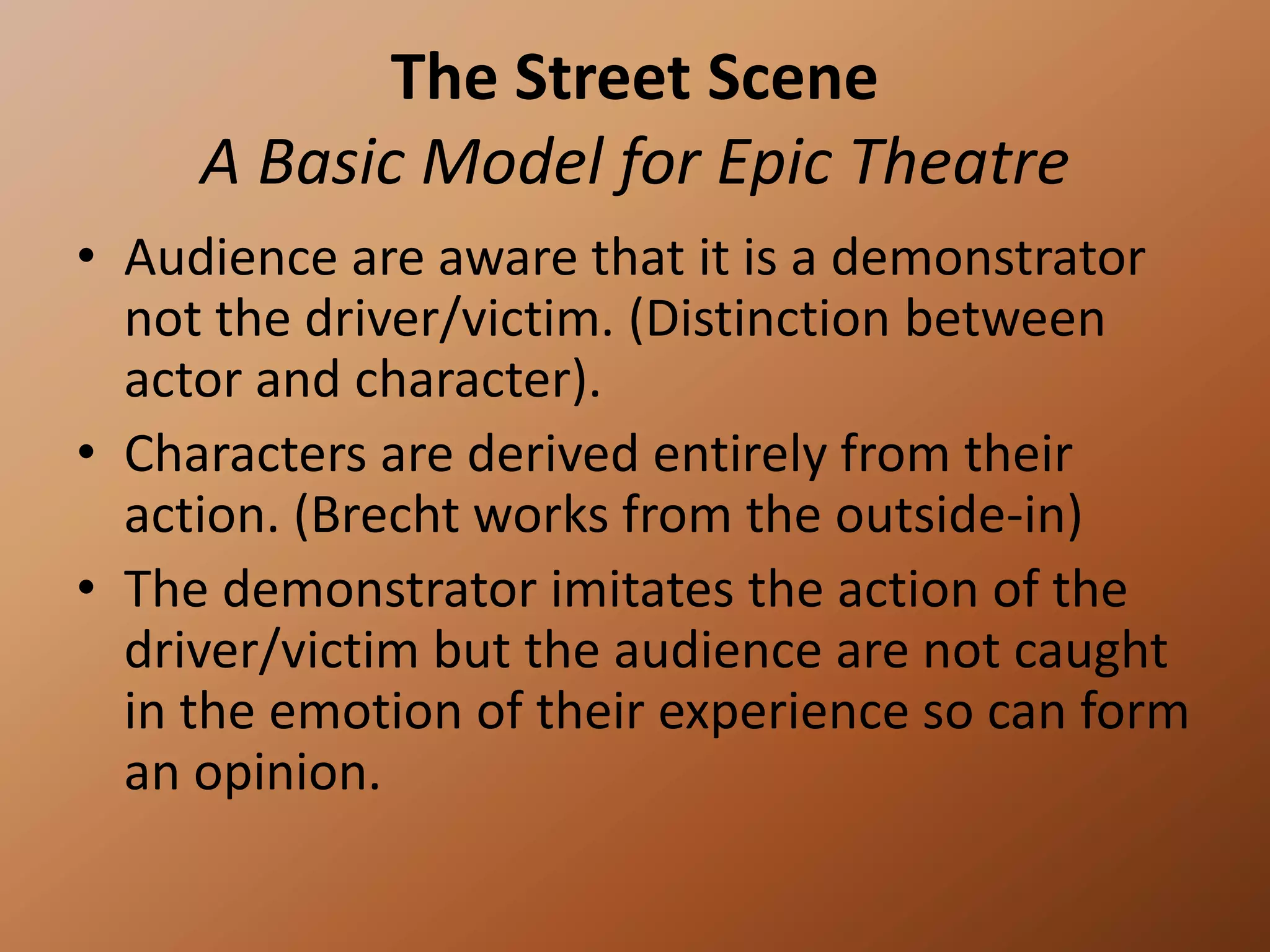
The Street SceneA Basic Model for Epic TheatreActivity: An eyewitness demonstrating to a collection of people how a traffic accident took place.
The Street SceneA Basic Model for Epic TheatreAudience are aware that it is a demonstrator not the driver/victim. (Distinction between actor and character).
Characters are derived entirely from their action. (Brecht works from the outside-in)
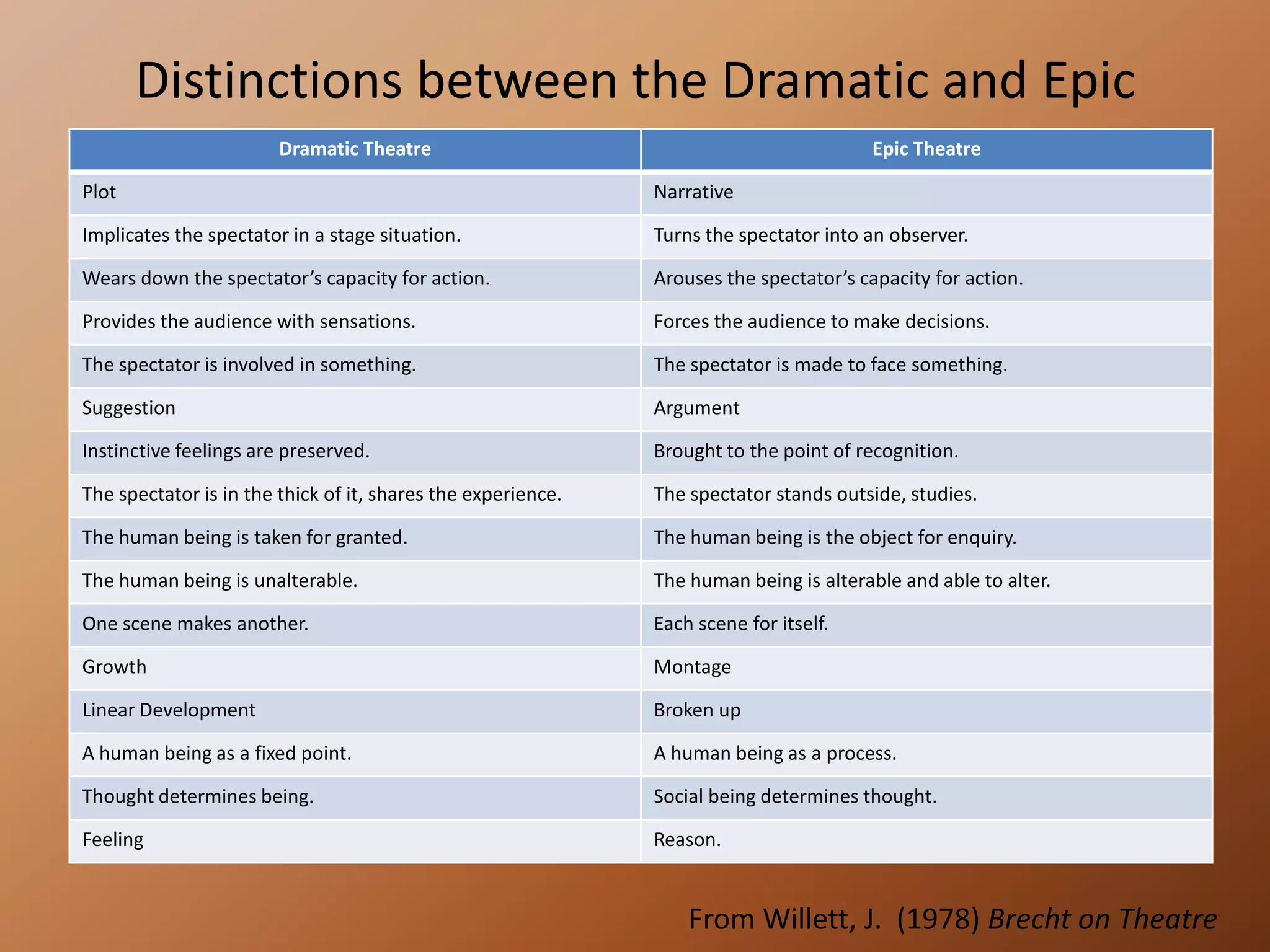
The demonstrator imitates the action of the driver/victim but the audience are not caught in the emotion of their experience so can form an opinion. Distinctions between the Dramatic and EpicFrom Willett, J.  (1978) Brecht on Theatre
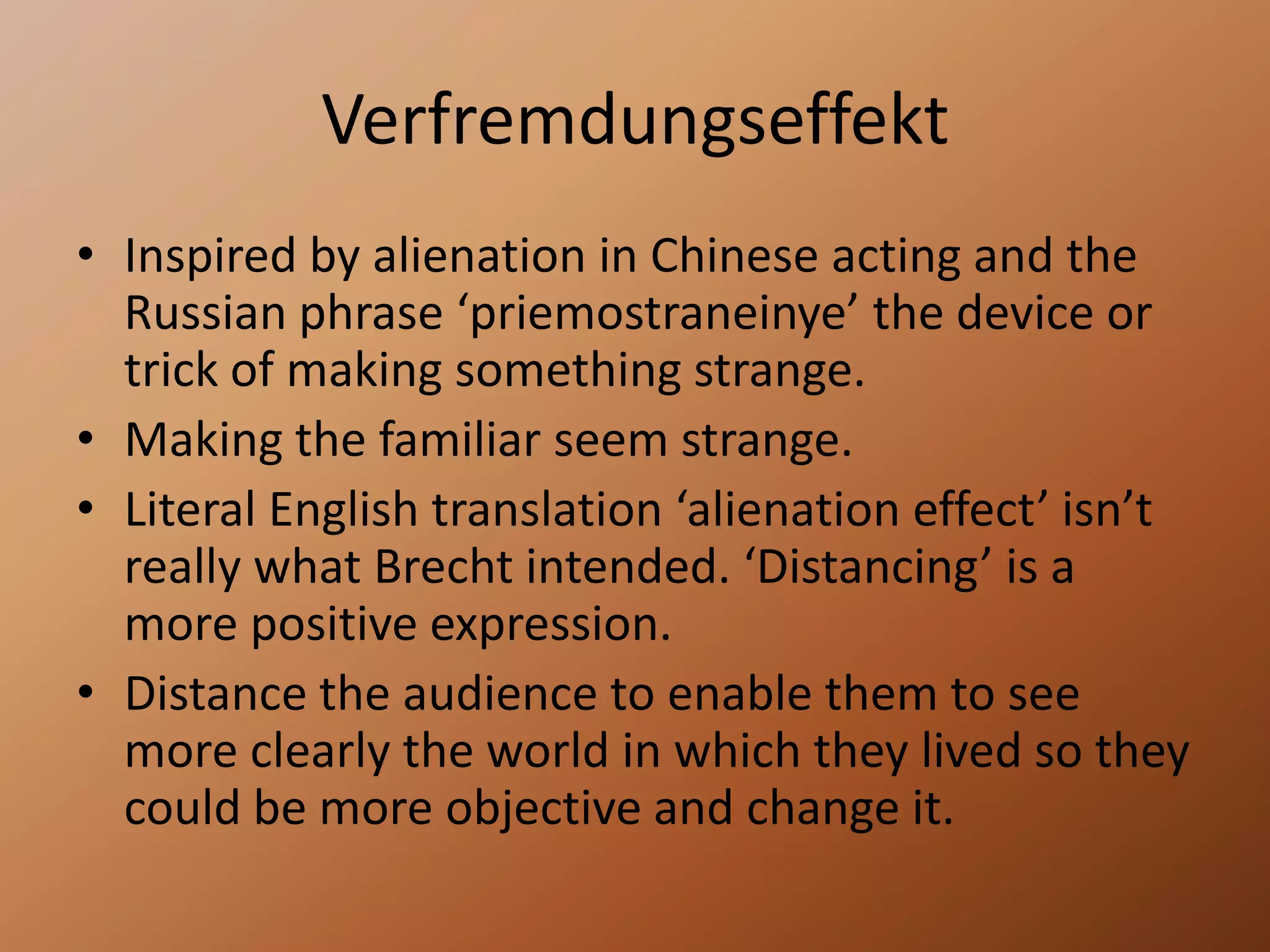
VerfremdungseffektInspired by alienation in Chinese acting and the Russian phrase ‘priemostraneinye’ the device or trick of making something strange.
Making the familiar seem strange.
Literal English translation ‘alienation effect’ isn’t really what Brecht intended. ‘Distancing’ is a more positive expression.
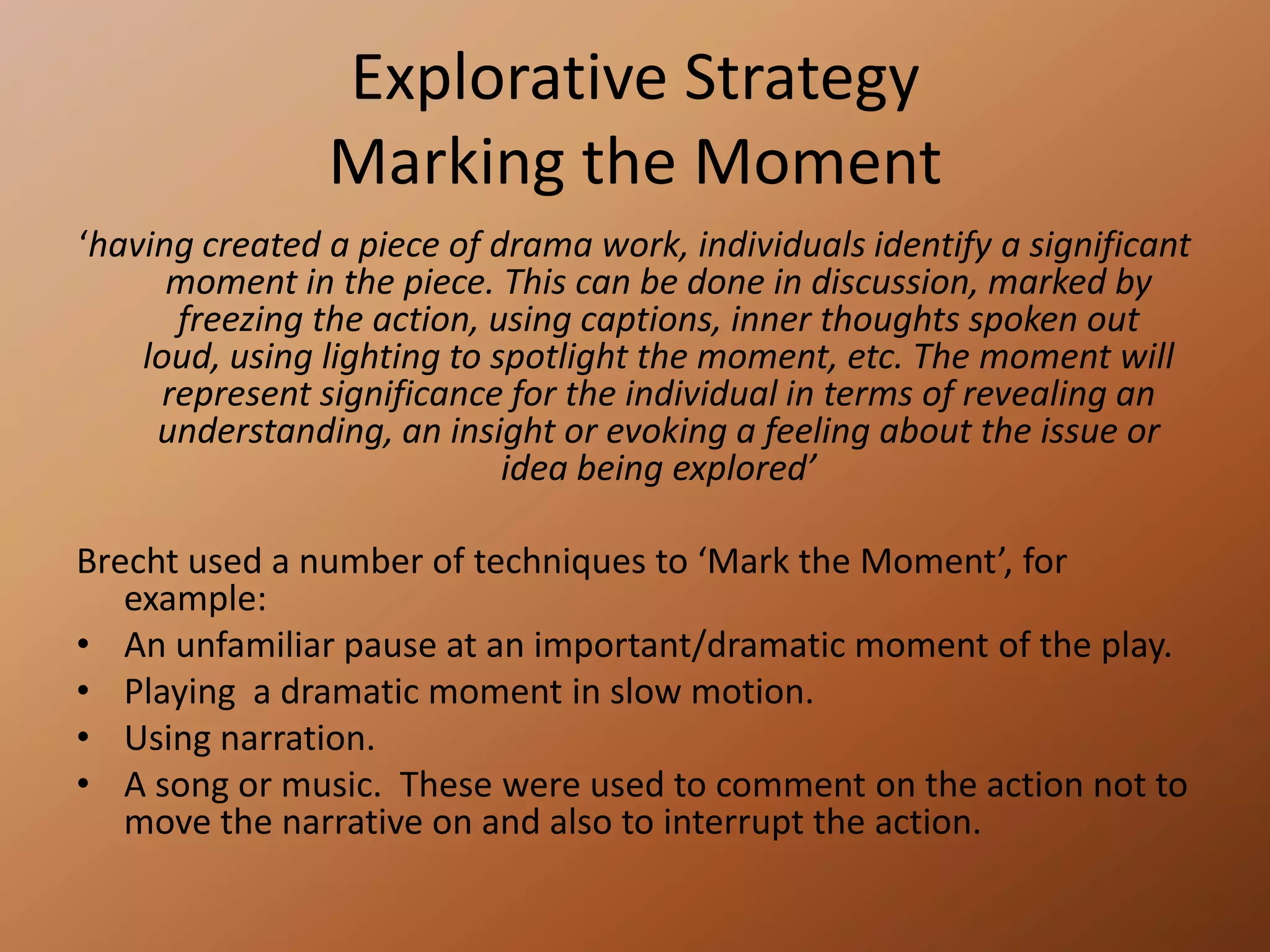
Distance the audience to enable them to see more clearly the world in which they lived so they could be more objective and change it. Explorative StrategyMarking the Moment ‘having created a piece of drama work, individuals identify a significant moment in the piece. This can be done in discussion, marked by freezing the action, using captions, inner thoughts spoken out loud, using lighting to spotlight the moment, etc. The moment will represent significance for the individual in terms of revealing an understanding, an insight or evoking a feeling about the issue or idea being explored’Brecht used a number of techniques to ‘Mark the Moment’, for example:An unfamiliar pause at an important/dramatic moment of the play.
Playing  a dramatic moment in slow motion.
Using narration.
A song or music.  These were used to comment on the action not to move the narrative on and also to interrupt the action.Explorative Strategy Cross-cutting‘creating a scene or scenes and then reordering the action by ‘cutting’ forwards and backwards to different moments’Montage

Bertolt brecht pp

  • 1.
    Bertolt Brecht 1898- 1956“I am a playwright. I would actually like to have been a cabinetmaker, but of course you don’t earn enough doing that.”
  • 2.
    Social Context1914-1918 FirstWorld War Brecht posted as a medical orderly in his home town. Not attached to the emotion of the frontline but witness the effects of war.
  • 3.
    1919-1933 Munich andBerlin 1922 - Directs first production. 1925 – Sees Battleship Potemkin by Sergei Eisenstein – introduced to the idea of montage.1926 - Produces Baal – riot in the auditorium. Begins to study Karl Marx.1927 – First collaboration with musician Kurt Weill (also collaborates with Piscator)1928 -The Threepenny Opera is a box-office success.1930 -Performances of The Rise and Fall of the City of Mahogany picketed by Nazis. Brecht sees Meyerhold’s theatre on tour. 1932 - Agit-prop sequence in Brecht’s film KuhleWampeis censored. 1932 - Nazis come to power, Brecht flees the country.
  • 4.
    1933-1948 The Yearsof ExileMost of Brecht’s major plays were completed before he reached the safety of America in 1941.1935 - Begins to use Verfremdungseffekt. Nazis formally remove German citizenship. Friends and colleagues in Russia start to disappear. 1935-41 - Moves around Europe away from Nazis.1941 - Leaves Europe to go to California. 1947 - Appears before the House of Un-American Activities.
  • 5.
    1949 – 1956The Berliner Ensemble1949 - Goes on recruiting tour for the Berliner Ensemble. 1951 - Post-war Berlin premiere of The Mother, Brecht uses background projection. 1954 - Berliner Ensemble takes residence at A, Schiffbauerdamm Theatre. The original Berlin production of Mother Courage is taken on tour – establishes Brecht as the leading director in post-war Europe. 1955-6 - The Caucasian Chalk Circle tours Paris and London. Brecht is at the height of his power.
  • 6.
    Brecht’s Plays1918 –Begins to write Baal and Drums in the Night 1928 – The Threepenny Opera is a box-office success.1929 – First two didactic plays The Lindbergh Flight and The Baden Didactic Play1930 -The Rise and Fall of the City of Mahagonny1932 -The Mother (a key text for understanding the Epic in practice.) 1938 – Premiere of Fear and Misery in the Third Reich1939 – Mother Courage and Her Children 1941 – The Resistible Rise of Arturo Ui1941-7 – Works on The Caucasian Chalk Circle
  • 7.
    The Good Womanof Setzuan, 2001Mahagonny(Berlin Komische Oper, 1984)Caucasian Chalk Circle, 1971
  • 8.
    The Street SceneABasic Model for Epic TheatreActivity: An eyewitness demonstrating to a collection of people how a traffic accident took place.
  • 9.
    The Street SceneABasic Model for Epic TheatreAudience are aware that it is a demonstrator not the driver/victim. (Distinction between actor and character).
  • 10.
    Characters are derivedentirely from their action. (Brecht works from the outside-in)
  • 11.
    The demonstrator imitatesthe action of the driver/victim but the audience are not caught in the emotion of their experience so can form an opinion. Distinctions between the Dramatic and EpicFrom Willett, J. (1978) Brecht on Theatre
  • 12.
    VerfremdungseffektInspired by alienationin Chinese acting and the Russian phrase ‘priemostraneinye’ the device or trick of making something strange.
  • 13.
    Making the familiarseem strange.
  • 14.
    Literal English translation‘alienation effect’ isn’t really what Brecht intended. ‘Distancing’ is a more positive expression.
  • 15.
    Distance the audienceto enable them to see more clearly the world in which they lived so they could be more objective and change it. Explorative StrategyMarking the Moment ‘having created a piece of drama work, individuals identify a significant moment in the piece. This can be done in discussion, marked by freezing the action, using captions, inner thoughts spoken out loud, using lighting to spotlight the moment, etc. The moment will represent significance for the individual in terms of revealing an understanding, an insight or evoking a feeling about the issue or idea being explored’Brecht used a number of techniques to ‘Mark the Moment’, for example:An unfamiliar pause at an important/dramatic moment of the play.
  • 16.
    Playing adramatic moment in slow motion.
  • 17.
  • 18.
    A song ormusic. These were used to comment on the action not to move the narrative on and also to interrupt the action.Explorative Strategy Cross-cutting‘creating a scene or scenes and then reordering the action by ‘cutting’ forwards and backwards to different moments’Montage
  • 19.
    Introduced to theconcept in 1925 watching Sergei Eisenstein’s Battleship Potemkin.
  • 20.
    Montage connected unrelatedscenes to give new meanings.
  • 21.
    Broke down actioninto minute details. Not a moment is wasted. Explorative StrategyNarration‘providing a spoken commentary that accompanies stage action, or a story being related by a character’Narration is a key element of Brechtian writing and again serves a purpose; to make the audience aware that they are witnessing ‘drama’.
  • 22.
    The narration ismostly expressed through the use of titles.
  • 23.
    Brecht often encouragedhis actors to comment in character(while on stage), on how to play the next part of the scene .Gestus‘Attitude’ Creating meaning and communicating a message to the audience.Has been interpreted in many different ways. Can relate to:- Individual characters Combination of gesture and facial expression and body language is deliberately used to emphasise meaning and communicate a message to the audience. Influenced by the control and attention to detail of Charlie Chaplin. - Whole scenes Thinking about the meaning conveyed by the ‘whole picture’ of a scene. - Music Illustrates an incident on the stage – comments on the action and reinforces and exemplifies a text’s meaning.
  • 24.
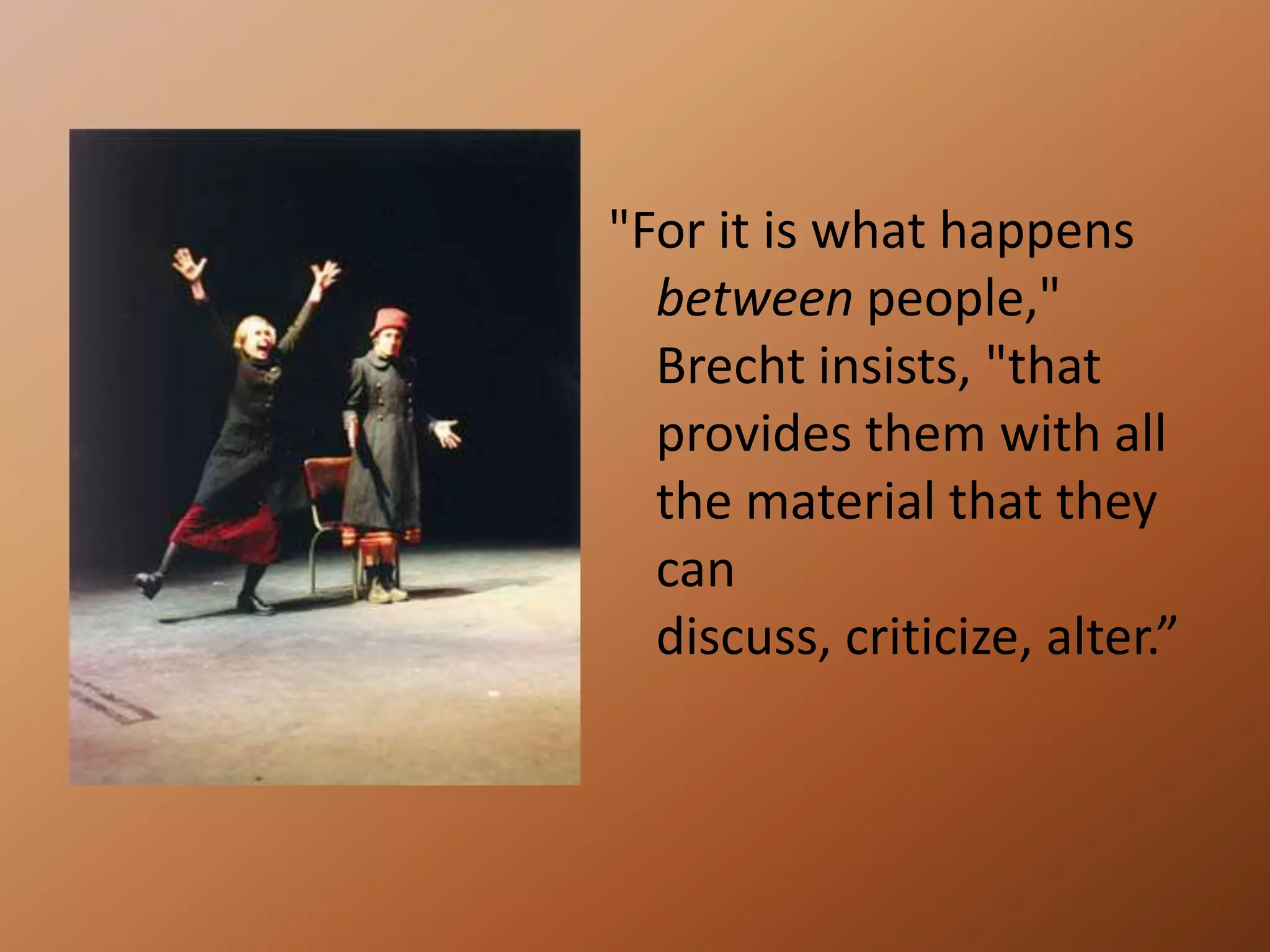
    "For it iswhat happens between people," Brecht insists, "that provides them with all the material that they can discuss, criticize, alter.”
  • 25.
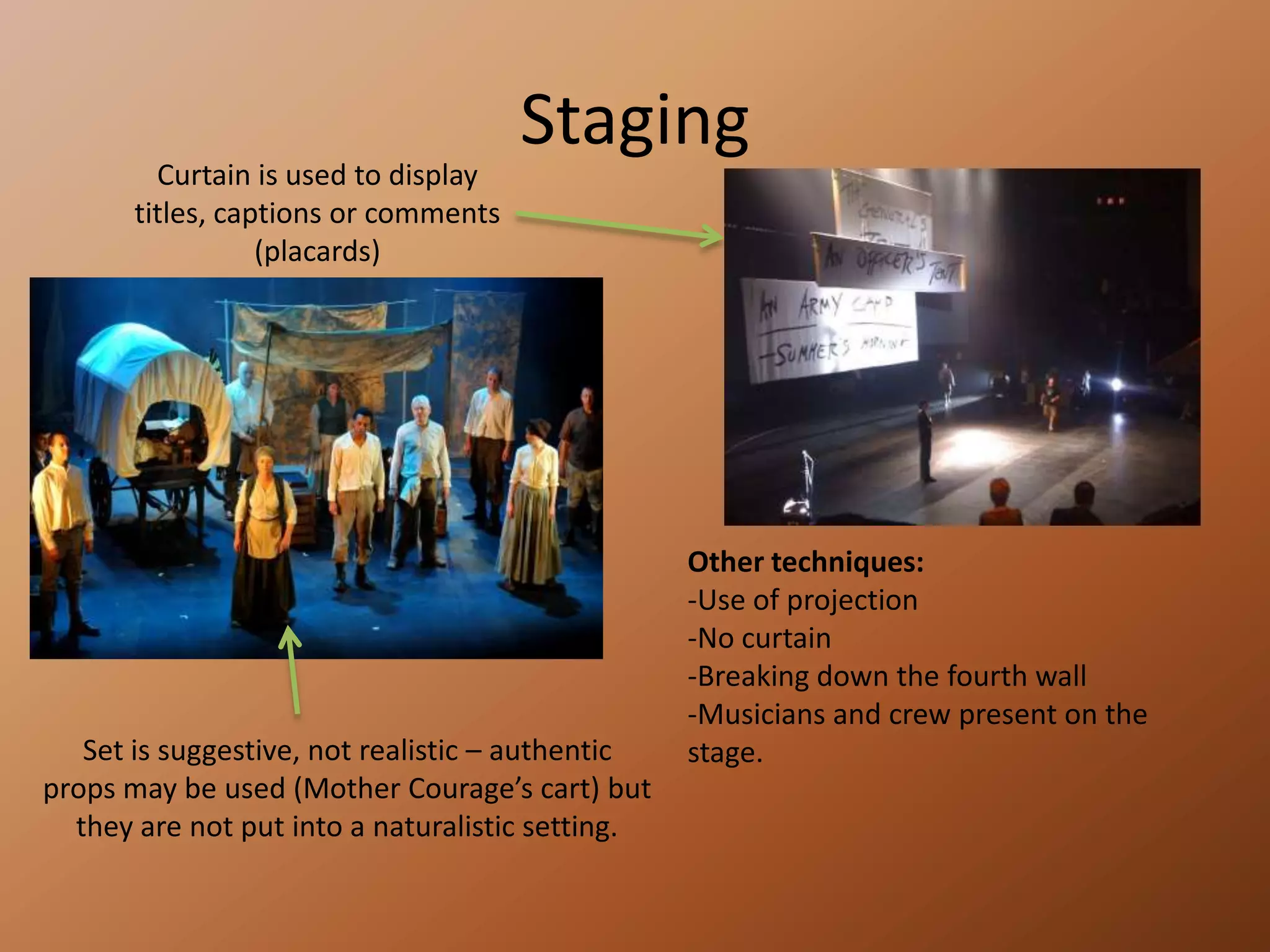
    Staging Curtain isused to display titles, captions or comments (placards) Other techniques: Use of projection
  • 26.
  • 27.
  • 28.
    Musicians and crewpresent on the stage. Set is suggestive, not realistic – authentic props may be used (Mother Courage’s cart) but they are not put into a naturalistic setting.
  • 29.
    Brecht’s Influence‘...all theatrework today at some point starts of returns to his statements and achievement.’Brook, P. (1986) The Empty Space

Editor's Notes

  • #3 1917 – studies drama and theatre. 1918 – begins to write the his first plays.
  • #4 Brechts career can be split into three sections. Brecht begins to work in the theatre. ‘Group 1925’ younger dramatists who want to reform German theatre.
  • #5 Verfremdungseffekt – from seeing Chinese actor Mei Lan-Fang and as a translation from the Russian term ‘priem ostraneniye’ – a device for making strange. Although the translation sometimes is called alienation this suggests a hostile relationship between actor and audience so preferred term is distancing which relates to the actor distancing themselves from the role as well as the audience being distanced from the emotion.
  • #14 From the table of dramatic and epic: narrative against plot and broken up against linear development.