A JAVA VIRTUAL MACHINE LEARNING OBJECT TO SUPPORT
              I NTRODUCTORY P ROGRAMMING C OMPUTING

                            Bernard Chalk                                                 Alan Clements
         Faculty of Business Computing & Information                                    School of Computing
                         Management                                                    University of Teesside
                   London South Bank University                                         Middlesborough, UK
                         London SE1 0AA, UK                                            a.clements@tees.ac.uk
                      bernard.chalk@lsbu.ac.uk                               http://www-scm.tees.ac.uk/users/a.clements/
                   http://www.lsbu.ac.uk/~chalkbs


ABSTRACT
This paper describes a Java Virtual Machine (JVM)                        Teaching introductory programming using Java can
learning object that was developed to support the                        be done either by introducing the concepts of
teaching of introductory programming. Following a                        objects, classes and inheritance at the beginning of
general introduction, the modelling of the JVM is                        the course (object-first approach) or introducing
discussed together with an overview of its main                          them after the procedural aspects of the language
features. An evaluation procedure is then described                      have been covered (object-late approach). Although
and results presented which suggest the learning                         the object-first approach is pedagogically sound and
object is an effective teaching support aid. The                         avoids the need for a paradigm-shift, it also creates
paper concludes with a discussion of these results                       a steeper learning curve making it incumbent upon
and suggestions for future development.                                  course designers to provide support material to aid
                                                                         conceptualisation.

Keywords
                                                                         An increasingly popular way of providing learning
Learning Object,           Java      Virtual    Machine,        Java     support is through the use of learning objects. These
programming                                                              are small chunks of interactive educational content
                                                                         that can be reused in different learning
                                                                         environments. In the area of introductory Java
1. I NTRODUCTION                                                         programming a number of different learning objects
                                                                         have been developed to assist students in getting to
                                                                         grips with the OO paradigm [2][3][4]. Some of these
A recent programming language survey of HE                               address a single idea or concept whereas others link
institutions in the UK revealed that Java was the                        several learning objects together in order to increase
most popular language for teaching introductory                          the richness of the learning experience. Most if not
programming [1]. One reason for this is that Java is                     all of them use some form of visualisation technique
a freely available object-oriented language that can                     to explain basic concepts, such as providing
run on any machine having a Java Virtual Machine                         graphical or textual feedback as the user steps
(JVM).                                                                   through an application or investigates a ‘virtual
                                                                         world’. Few however offer the user a chance to
                                                                         substitute their own code for that ‘hardwired’ by the
                                                                         developer and none take advantage of the JVM itself
                                                                         as a vehicle for improving the student’s ability to
                                                                         construct mental models.

Permission to make digital or hard copies of all or part of this         This paper describes a learning object that was
work for personal or classroom use is granted without fee
provided that copies are not made or distributed for profit or           designed to support the teaching of introductory
commercial advantage and that copies bear this notice and the            Java by allowing students to visualise the creation
full citation on the first page. To copy otherwise, to republish, to     and manipulation of objects inside a JVM during
post on servers or to redistribute to lists, requires prior specific     program execution. Following a rationale for the
permission.
                                                                         model chosen to represent the JVM, we describe a
© 2006 Higher Education Academy
Subject Centre for Information and Computer Sciences

                                                                       111
scenario in which a user single-steps through parts       represent our objects and classes using this notation
of a demonstration program, highlighting key              as far as possible.
features and options of the learning object along the
way. We then present the results of an evaluation
exercise that was carried out in an attempt to            3. L EARNING O BJECT O VERVIEW
measure its effectiveness and conclude with a
discussion of our findings and suggestions for future
development.                                              The JVM application and user guide can be found at
                                                          http://sos-tutors.co.uk/jvmrlo, where instructions for
                                                          installing the application are given. After starting the
2. M ODELLING T HE JVM                                    JVM learning object, users have the option of either
                                                          running their own application or installing one of the
                                                          in-built demonstration applications. In this section we
The JVM specification describes an abstract               will outline its main features by describing a scenario
computing machine [5]. Like a real machine, the           in which the DVDHire demonstration application is
JVM has an instruction set and manipulates various        used. This models a simple DVD Hire Shop by
memory areas at run time. It knows nothing of the         creating and modifying instances of the classes
Java programming language only of a particular            Customer, Rental and DVD. The DVD class extends
binary format; the class file format. Java programs       a further abstract class called RentableItem.
are compiled into class files containing instructions
(bytecodes), a symbol table and some other ancillary
                                                          After installing and compiling the demonstration, the
information. When a JVM is started, various data
                                                          user can either run it and display the output or
areas are created including a heap, method area
                                                          single-step through it and observe one or more
and stack. The heap is used to store objects that can
                                                          areas of the JVM. Figure 1 illustrates the JVM after
take the form of class instances and arrays while the
                                                          the user has chosen to view the heap in single-step
method area is used to store class information such
                                                          mode using the Run and View menus.
as constants and the code for methods and
constructors. Each JVM thread has its own private
stack that is used to store frames containing local
variables, operands and return values for methods.


To support introductory programming by modelling
an implementation of the JVM, we had to give
careful consideration to the views that would benefit
conceptualisation. Clearly the heap was essential for
visualising objects and parts of the method area
were important for understanding the relationship
between objects and classes but did we need to
model the stack? Although this would help students
gain a deeper understanding of parameter passing
and stack traces would it reduce the cohesion of the      Figure 1 The JVM in single-step mode showing the
views and clutter the user interface? On the other        heap area at the bottom
hand, if our model ignored it. Especially the concept
of bytecodes. How would students appreciate the
difference between a .java and a .class file ?. These     The blue square cursor in the code area near the
together with the issue of how best to represent          centre indicates that the user has stepped to line 10
objects and classes on the graphical user interface       in the program and the heap area beneath shows
required careful consideration.                           the object that has been created. In this case, a
                                                          Customer object c1 has been added to the heap with
After some experimentation with throwaway                 its name and identifier fields initialised to those
prototypes, it was eventually decided to model the        shown in the constructor and with the rentals list
JVM in terms of the heap, method area and a third         marked empty. Because the user has chosen
byte code area in which the bytecodes                     ‘display feedback’ from the Options menu, a brief
corresponding to each high level programming              description of what the program statement does is
language statement could be displayed. We also            also provided in a pop-up dialogue box.
decided that because the Unified Modelling
Language(UML) [6] was so widely used with the             To see details of the class to which this object
more      popular     introductory     development        belongs, the method area can be opened using the
environments and text books, that we would                View menu, as shown in figure 2.


                                                        112
Figure 4 Viewing superclass fields and methods


                                                             When a method is invoked upon an object the heap
                                                             area gives a view of the object in its new state, as
                                                             shown in figure 5 If the user also happens to have
Figure 2 Heap area and method area views of a                selected to view the byte code area, the JVM
Customer object                                              instructions for this method are also displayed in the
                                                             byte code view shown beneath the method area.

Here beneath the heap we can see the Customer
class has been loaded and that it has three private
fields, a single public constructor together with
several public methods such as addRental(). A scroll
bar adjacent to the method area but out of view in
this screen shot allows the user to see these other
methods.


Figure 3 illustrates the creation of another object d1
of type DVD, which appears as the user steps to line
15. This time the method area shows that class has
three public static fields (in bold) together with a two
                                                             Figure 5 Byte      code    instructions   for   method
private instance fields.
                                                             addRental( )


                                                             If an assignment statement is encountered, such as
                                                             that shown in figure 6, then the references are
                                                             recorded in a line-bordered list at the bottom of the
                                                             object.


Figure 3 Representing static and instance fields of a
class                                                        Figure 6 Representing object references


As mentioned earlier, this class extends the                 This allows the user to see that they haven’t created
RentableItem class which has a field called barcode          a new object c but have a reference to an existing
and a couple of methods for setting and getting its          object, in this case, c2 so that any changes that are
value. These cannot be seen in the current view of           now made to c2 will be reflected in c.
the method area, but had the user used the Options           When loop statements such as while and for loops
menu to select ‘show superclass details’ then we             are encountered in the application, the current
would have seen this additional information                  version of the JVM learning object only displays the
highlighted in blue, as shown in figure 4.                   state of objects during the final pass and not for
                                                             each iteration. In a similar way when selection
Fields and methods of higher-level superclasses              statements such as switch or if are encountered,
such as Object are also displayed but in light grey.         objects are only displayed if the particular line of
                                                             code is reachable, otherwise the heap and other
                                                             areas shown nothing.


                                                           113
80

                                                                     60
                                                                                               Before
                                                                     40


                                                                 %
                                                                                               After
The application or any of its dependant classes can                  20

be modified at any time using the File -> Edit menu,                  0
provided the user exits the stepping mode first. The                      O      C      B


application can also be closed and a new one
started, provided it exists in a subdirectory of the
same working directory specified when the JVM is            As far as usability was concerned, no formal attempt
first started. This gives the learning object great         was made to evaluate this although informal
flexibility and allows it to be used in a wide range of     interviews with the volunteers immediately after the
learning contexts.                                          evaluation exercise suggested that the user interface
                                                            was easy to use and that the representation of
                                                            objects and classes were easy to understand.
4. EVALUATION
To measure the effectiveness of the learning object
a group of 10 student volunteers were asked to
                                                            5. D ISCUSSION
undertake a short multiple-choice test before and           This paper has described a Java Virtual Machine
after using the JVM learning object to perform a            learning object designed to support introductory
simple simulation exercise. The same test was used          programming and outlined how it can be used. The
in both cases and all students had some                     results of an evaluation exercise using a small
understanding of the Java programming language              cohort of experienced Java users have shown that
although none of them had any understanding of the          using the learning object can increase the users
Java Virtual Machine. Details of the test and the           understanding of objects but appears to make little
simulation exercise can be found on our website             difference to their understanding of classes,
http://sos-tutors.co.uk/jvmrlo.                             inheritance or the byte codes executed by a JVM. It
                                                            has also shown that using the learning object
The test consisted of 15 questions, 7 designed to
                                                            increases the users general confidence and
test their understanding of objects, 6 to test their
                                                            perceived understanding.
understanding of classes and 2 to test their
understanding of byte codes. After each question the        As with any small scale evaluation exercise, the
students were asked to rate the confidence in their         results could be influenced by a number of factors
answer as either certain, confident or unsure.              including the way the simulation exercise was
                                                            carried out, the structure and type of questions used
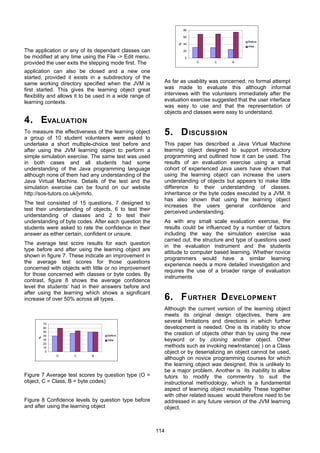
The average test score results for each question
                                                            in the evaluation instrument and the students
type before and after using the learning object are
                                                            attitude to computer based learning. Whether novice
shown in figure 7. These indicate an improvement in
                                                            programmers would have a similar learning
the average test scores for those questions
                                                            experience needs a more detailed investigation and
concerned with objects with little or no improvement
                                                            requires the use of a broader range of evaluation
for those concerned with classes or byte codes. By
                                                            instruments
contrast, figure 8 shows the average confidence
level the students’ had in their answers before and
after using the learning which shows a significant
increase of over 50% across all types.                      6. F URTHER D EVELOPMENT
                                                            Although the current version of the learning object
                                                            meets its original design objectives, there are
          70
                                                            several limitations and directions in which further
          60                                                development is needed. One is its inability to show
          50
          40                        Before
                                                            the creation of objects other than by using the new
                                                            keyword or by cloning another object. Other
      %


          30                        After
          20
          10                                                methods such as invoking newInstance( ) on a Class
           0                                                object or by deserializing an object cannot be used,
               O     C       B
                                                            although on novice programming courses for which
                                                            the learning object was designed, this is unlikely to
                                                            be a major problem. Another is its inability to allow
Figure 7 Average test scores by question type (O =          tutors to modify the commentry to suit the
object, C = Class, B = byte codes)                          instructional methodology, which is a fundamental
                                                            aspect of learning object reusability These together
                                                            with other related issues would therefore need to be
Figure 8 Confidence levels by question type before          addressed in any future version of the JVM learning
and after using the learning object                         object.


                                                          114
[3] Chalk P., Bradlet C. and Pickard P., Designing
                                                         and Evaluating Learning Objects for Introductory
7. ACKNOWLEDGEMENTS                                      Programming Education, ITiCSE, 2003
We wish to thank the Higher Education Academy for        [4] Ford L., A Learning Object Generator for
supporting this project under a development funded       Programming, ITiCSE, 2004
grant 2005/06.                                           [5] Lindholm S. and Yellin F., The Java Virtual
                                                         Machine Specification 2nd Ed, Addison-Wesley, 2003
                                                         [6] Booch G., Rumbaugh J., Jacobson I., The
                                                         Unified Modelling Language User Guide, Addison-
                                                         Wesley, 2001


8. R EFERENCES
[1] Chalk B. and Fraser K., A Survey on the teaching
of introductory programming in Higher Education,
JICC 10, London Metropolitan University, (2006)
 [2] Boyle T., Design Principles For Authoring
Dynamic, Reusable Learning Objects. Procs. of the
19th ASCILITE Conference, Auckland, New
Zealand, 2002


                                                       115

Bernard Chalk 21.doc

  • 1.
    A JAVA VIRTUALMACHINE LEARNING OBJECT TO SUPPORT I NTRODUCTORY P ROGRAMMING C OMPUTING Bernard Chalk Alan Clements Faculty of Business Computing & Information School of Computing Management University of Teesside London South Bank University Middlesborough, UK London SE1 0AA, UK a.clements@tees.ac.uk bernard.chalk@lsbu.ac.uk http://www-scm.tees.ac.uk/users/a.clements/ http://www.lsbu.ac.uk/~chalkbs ABSTRACT This paper describes a Java Virtual Machine (JVM) Teaching introductory programming using Java can learning object that was developed to support the be done either by introducing the concepts of teaching of introductory programming. Following a objects, classes and inheritance at the beginning of general introduction, the modelling of the JVM is the course (object-first approach) or introducing discussed together with an overview of its main them after the procedural aspects of the language features. An evaluation procedure is then described have been covered (object-late approach). Although and results presented which suggest the learning the object-first approach is pedagogically sound and object is an effective teaching support aid. The avoids the need for a paradigm-shift, it also creates paper concludes with a discussion of these results a steeper learning curve making it incumbent upon and suggestions for future development. course designers to provide support material to aid conceptualisation. Keywords An increasingly popular way of providing learning Learning Object, Java Virtual Machine, Java support is through the use of learning objects. These programming are small chunks of interactive educational content that can be reused in different learning environments. In the area of introductory Java 1. I NTRODUCTION programming a number of different learning objects have been developed to assist students in getting to grips with the OO paradigm [2][3][4]. Some of these A recent programming language survey of HE address a single idea or concept whereas others link institutions in the UK revealed that Java was the several learning objects together in order to increase most popular language for teaching introductory the richness of the learning experience. Most if not programming [1]. One reason for this is that Java is all of them use some form of visualisation technique a freely available object-oriented language that can to explain basic concepts, such as providing run on any machine having a Java Virtual Machine graphical or textual feedback as the user steps (JVM). through an application or investigates a ‘virtual world’. Few however offer the user a chance to substitute their own code for that ‘hardwired’ by the developer and none take advantage of the JVM itself as a vehicle for improving the student’s ability to construct mental models. Permission to make digital or hard copies of all or part of this This paper describes a learning object that was work for personal or classroom use is granted without fee provided that copies are not made or distributed for profit or designed to support the teaching of introductory commercial advantage and that copies bear this notice and the Java by allowing students to visualise the creation full citation on the first page. To copy otherwise, to republish, to and manipulation of objects inside a JVM during post on servers or to redistribute to lists, requires prior specific program execution. Following a rationale for the permission. model chosen to represent the JVM, we describe a © 2006 Higher Education Academy Subject Centre for Information and Computer Sciences 111
  • 2.
    scenario in whicha user single-steps through parts represent our objects and classes using this notation of a demonstration program, highlighting key as far as possible. features and options of the learning object along the way. We then present the results of an evaluation exercise that was carried out in an attempt to 3. L EARNING O BJECT O VERVIEW measure its effectiveness and conclude with a discussion of our findings and suggestions for future development. The JVM application and user guide can be found at http://sos-tutors.co.uk/jvmrlo, where instructions for installing the application are given. After starting the 2. M ODELLING T HE JVM JVM learning object, users have the option of either running their own application or installing one of the in-built demonstration applications. In this section we The JVM specification describes an abstract will outline its main features by describing a scenario computing machine [5]. Like a real machine, the in which the DVDHire demonstration application is JVM has an instruction set and manipulates various used. This models a simple DVD Hire Shop by memory areas at run time. It knows nothing of the creating and modifying instances of the classes Java programming language only of a particular Customer, Rental and DVD. The DVD class extends binary format; the class file format. Java programs a further abstract class called RentableItem. are compiled into class files containing instructions (bytecodes), a symbol table and some other ancillary After installing and compiling the demonstration, the information. When a JVM is started, various data user can either run it and display the output or areas are created including a heap, method area single-step through it and observe one or more and stack. The heap is used to store objects that can areas of the JVM. Figure 1 illustrates the JVM after take the form of class instances and arrays while the the user has chosen to view the heap in single-step method area is used to store class information such mode using the Run and View menus. as constants and the code for methods and constructors. Each JVM thread has its own private stack that is used to store frames containing local variables, operands and return values for methods. To support introductory programming by modelling an implementation of the JVM, we had to give careful consideration to the views that would benefit conceptualisation. Clearly the heap was essential for visualising objects and parts of the method area were important for understanding the relationship between objects and classes but did we need to model the stack? Although this would help students gain a deeper understanding of parameter passing and stack traces would it reduce the cohesion of the Figure 1 The JVM in single-step mode showing the views and clutter the user interface? On the other heap area at the bottom hand, if our model ignored it. Especially the concept of bytecodes. How would students appreciate the difference between a .java and a .class file ?. These The blue square cursor in the code area near the together with the issue of how best to represent centre indicates that the user has stepped to line 10 objects and classes on the graphical user interface in the program and the heap area beneath shows required careful consideration. the object that has been created. In this case, a Customer object c1 has been added to the heap with After some experimentation with throwaway its name and identifier fields initialised to those prototypes, it was eventually decided to model the shown in the constructor and with the rentals list JVM in terms of the heap, method area and a third marked empty. Because the user has chosen byte code area in which the bytecodes ‘display feedback’ from the Options menu, a brief corresponding to each high level programming description of what the program statement does is language statement could be displayed. We also also provided in a pop-up dialogue box. decided that because the Unified Modelling Language(UML) [6] was so widely used with the To see details of the class to which this object more popular introductory development belongs, the method area can be opened using the environments and text books, that we would View menu, as shown in figure 2. 112
  • 3.
    Figure 4 Viewingsuperclass fields and methods When a method is invoked upon an object the heap area gives a view of the object in its new state, as shown in figure 5 If the user also happens to have Figure 2 Heap area and method area views of a selected to view the byte code area, the JVM Customer object instructions for this method are also displayed in the byte code view shown beneath the method area. Here beneath the heap we can see the Customer class has been loaded and that it has three private fields, a single public constructor together with several public methods such as addRental(). A scroll bar adjacent to the method area but out of view in this screen shot allows the user to see these other methods. Figure 3 illustrates the creation of another object d1 of type DVD, which appears as the user steps to line 15. This time the method area shows that class has three public static fields (in bold) together with a two Figure 5 Byte code instructions for method private instance fields. addRental( ) If an assignment statement is encountered, such as that shown in figure 6, then the references are recorded in a line-bordered list at the bottom of the object. Figure 3 Representing static and instance fields of a class Figure 6 Representing object references As mentioned earlier, this class extends the This allows the user to see that they haven’t created RentableItem class which has a field called barcode a new object c but have a reference to an existing and a couple of methods for setting and getting its object, in this case, c2 so that any changes that are value. These cannot be seen in the current view of now made to c2 will be reflected in c. the method area, but had the user used the Options When loop statements such as while and for loops menu to select ‘show superclass details’ then we are encountered in the application, the current would have seen this additional information version of the JVM learning object only displays the highlighted in blue, as shown in figure 4. state of objects during the final pass and not for each iteration. In a similar way when selection Fields and methods of higher-level superclasses statements such as switch or if are encountered, such as Object are also displayed but in light grey. objects are only displayed if the particular line of code is reachable, otherwise the heap and other areas shown nothing. 113
  • 4.
    80 60 Before 40 % After The application or any of its dependant classes can 20 be modified at any time using the File -> Edit menu, 0 provided the user exits the stepping mode first. The O C B application can also be closed and a new one started, provided it exists in a subdirectory of the same working directory specified when the JVM is As far as usability was concerned, no formal attempt first started. This gives the learning object great was made to evaluate this although informal flexibility and allows it to be used in a wide range of interviews with the volunteers immediately after the learning contexts. evaluation exercise suggested that the user interface was easy to use and that the representation of objects and classes were easy to understand. 4. EVALUATION To measure the effectiveness of the learning object a group of 10 student volunteers were asked to 5. D ISCUSSION undertake a short multiple-choice test before and This paper has described a Java Virtual Machine after using the JVM learning object to perform a learning object designed to support introductory simple simulation exercise. The same test was used programming and outlined how it can be used. The in both cases and all students had some results of an evaluation exercise using a small understanding of the Java programming language cohort of experienced Java users have shown that although none of them had any understanding of the using the learning object can increase the users Java Virtual Machine. Details of the test and the understanding of objects but appears to make little simulation exercise can be found on our website difference to their understanding of classes, http://sos-tutors.co.uk/jvmrlo. inheritance or the byte codes executed by a JVM. It has also shown that using the learning object The test consisted of 15 questions, 7 designed to increases the users general confidence and test their understanding of objects, 6 to test their perceived understanding. understanding of classes and 2 to test their understanding of byte codes. After each question the As with any small scale evaluation exercise, the students were asked to rate the confidence in their results could be influenced by a number of factors answer as either certain, confident or unsure. including the way the simulation exercise was carried out, the structure and type of questions used The average test score results for each question in the evaluation instrument and the students type before and after using the learning object are attitude to computer based learning. Whether novice shown in figure 7. These indicate an improvement in programmers would have a similar learning the average test scores for those questions experience needs a more detailed investigation and concerned with objects with little or no improvement requires the use of a broader range of evaluation for those concerned with classes or byte codes. By instruments contrast, figure 8 shows the average confidence level the students’ had in their answers before and after using the learning which shows a significant increase of over 50% across all types. 6. F URTHER D EVELOPMENT Although the current version of the learning object meets its original design objectives, there are 70 several limitations and directions in which further 60 development is needed. One is its inability to show 50 40 Before the creation of objects other than by using the new keyword or by cloning another object. Other % 30 After 20 10 methods such as invoking newInstance( ) on a Class 0 object or by deserializing an object cannot be used, O C B although on novice programming courses for which the learning object was designed, this is unlikely to be a major problem. Another is its inability to allow Figure 7 Average test scores by question type (O = tutors to modify the commentry to suit the object, C = Class, B = byte codes) instructional methodology, which is a fundamental aspect of learning object reusability These together with other related issues would therefore need to be Figure 8 Confidence levels by question type before addressed in any future version of the JVM learning and after using the learning object object. 114
  • 5.
    [3] Chalk P.,Bradlet C. and Pickard P., Designing and Evaluating Learning Objects for Introductory 7. ACKNOWLEDGEMENTS Programming Education, ITiCSE, 2003 We wish to thank the Higher Education Academy for [4] Ford L., A Learning Object Generator for supporting this project under a development funded Programming, ITiCSE, 2004 grant 2005/06. [5] Lindholm S. and Yellin F., The Java Virtual Machine Specification 2nd Ed, Addison-Wesley, 2003 [6] Booch G., Rumbaugh J., Jacobson I., The Unified Modelling Language User Guide, Addison- Wesley, 2001 8. R EFERENCES [1] Chalk B. and Fraser K., A Survey on the teaching of introductory programming in Higher Education, JICC 10, London Metropolitan University, (2006) [2] Boyle T., Design Principles For Authoring Dynamic, Reusable Learning Objects. Procs. of the 19th ASCILITE Conference, Auckland, New Zealand, 2002 115