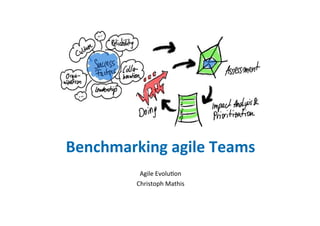
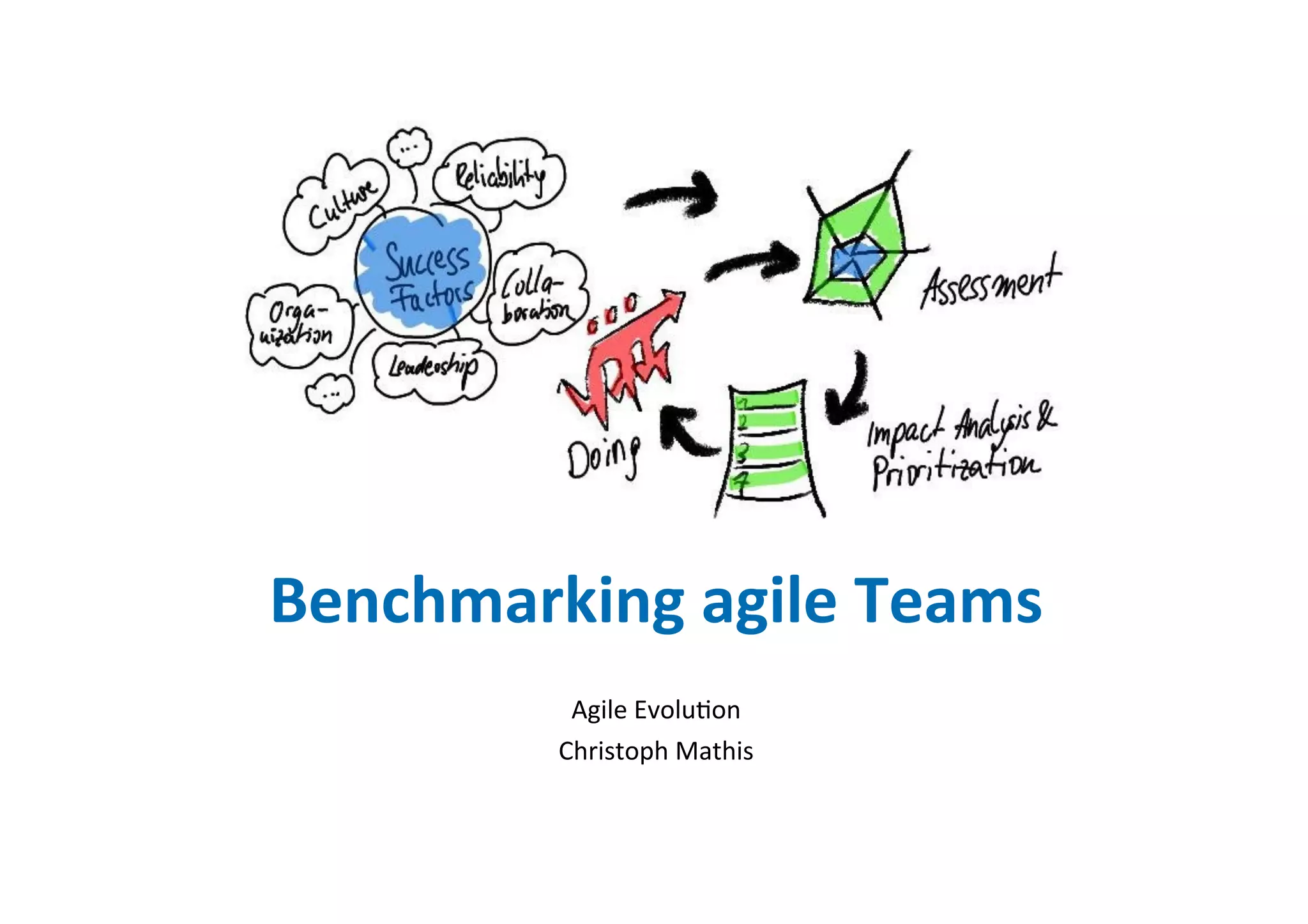
Benchmarking	agile	Teams	
Agile	Evolu+on	
Christoph	Mathis
Stable,	cross	func7onal	teams:	
a	core	prerequisite	to	succeed	with	Agility	
•  Small,	stable	teams	make	agile	principles	work.	
•  Agility	relies	on	team	responsibility	+	con+nuous	
improvement.	
•  One	key	success	factor	in	an	Agile	Enterprise	is	the	effec+ve	
collabora+on	of	its	teams	-	and	their	con+nuous	effort	to	
improve.	
This	is	the	reason	why	we	need	to	assess	and	benchmark	
teams	
©	improuv	GmbH		Agile	Leadership	|	hJp://improuv.com		2
To	start	working	with	a	team:		
facilitate	a	self	assessment	
Why	
•  To	assess	the	poten+al	of	improvement,		
you	need	a	concept	of	"beJer"	
•  So,	you	need	an	idea	for	criteria	to	assess	against	
How	
•  Assessments,	measuring,	benchmarking	is	tricky:	it	can	
backfire	in	a	preJy	bad	way.	Self	assessments	avoid	many	
of	these	piQalls	
What	
•  Focus	on	the	right	level	–	on	capabili+es.		
Capabili7es	describe	what	can	be	provided		
and	are	more	stable	than	the	how.	
©	improuv	GmbH		Agile	Leadership	|	hJp://improuv.com		3
What	to	assess	
©	improuv	GmbH		Agile	Leadership	|	hJp://improuv.com		4
You	can	assess	prac7ces,		
like	in	the	frequently	used	"Nokia	Test"	
But:		
•  In	some	teams,	we	see	poor	prac+ces,	but	the	team	s+ll	
achievs	outstanding	results	
•  …	and	vice	versa	
(to	tell	a	secret:	we	encountered	the	second	case	much	more	oZen)	
©	improuv	GmbH		Agile	Leadership	|	hJp://improuv.com		5
Maybe,	you	have	to	look	beyond	
prac7ces	...	to	business	goals?	
Business	goals	like	…	
•  adap+ng	to	changing	condi+ons	
•  surviving	in	a	changing	environment	
•  providing	the	best	service	at	the	best	price	
	
The	Problem:	
Most	of	the	+me,	business	goals	are	too	general		
to	give	concrete	guidance	what	to	do.	
©	improuv	GmbH		Agile	Leadership	|	hJp://improuv.com		6
We	came	up	with	a	more	specific	
focus:	Capabili7es	
Capabili+es	help	to	fulfill	business	objec+ves	
•  Business	objec+ves	->	Capabili+es	
Capabili+es	are	in	turn	provided	through	a	
combina+on	of	
•  Empowerment	
•  Intent	
•  Prac+ces	
•  Knowledge	
•  Skills	
©	improuv	GmbH		Agile	Leadership	|	hJp://improuv.com		7
Capabili7es	are	the	ideal	touch	
point	for	assessments	
For	the	team	
•  Capabili+es	guide	the	team	towards	the	business	
objec+ves	it	helps	to	fulfill	
•  They	focus	on	„what“	instead	on	„how“	
For	the	outside,	e.g.	management	or	customers	
•  Capabili+es	help	to	evaluate	a	team	without	micro	
managing	the	team’s	work	
•  They	tend	to	provide	ac+onable	op+ons	towards	
enablement	instead	of	using	pressure	
©	improuv	GmbH		Agile	Leadership	|	hJp://improuv.com		8
Context	is	important	
©	improuv	GmbH		Agile	Leadership	|	hJp://improuv.com		9
Industrial	and	Knowledge	Work	
Before	we	go	deeper,	we	have	to	look	at	the	type	of	
work	in	development	environments.	
Industrial	work	
• has	a	clear	dis+nc+on	of	planning	and	execu+on	
(and	assigns	these	typically	to	different	persons)	
• has	a	clear	opinion	about	„efficient“	
Knowledge	work,	the	emerging	dominant	work	form	
of	the	21st	century,	is	different.	
©	improuv	GmbH		Agile	Leadership	|	hJp://improuv.com		10
Knowledge	Work	is	different	
In	knowledge	work,	the	defini+on	of	efficient	and	effec+ve	
is	much	more	difficult	
One	way	to	describe	knowledge	work	is	„I	know	the	job	
beJer	than	my	boss	does“	
•  Work	is	much	harder	to	evaluate	
•  Mo+va+on,	Skill,	Collabora+on	become	key	factors	for	
effec+ve	work	
•  Many	restric+on	in	the	effec+veness	are	outside	factors	
Leading	knowledge	workers	focuses	on	delega+ng	
decisions	and	developing	people	instead	of	managing	
things.	
©	improuv	GmbH		Agile	Leadership	|	hJp://improuv.com		11
So,	measuring	of	an	agile	team	must	
include	its	rela7on	to	the	outside	world	
Team	skills	include		
• their	daily	business	
• their	ability	to	cooperate	
• their	intent	and	ability	to	make	a	contribu+on		
(and	to	take	responsibility)	for	value	crea+on	
• their	focus	on	par+cipa+ng	in	global	improvement	
efforts	
©	improuv	GmbH		Agile	Leadership	|	hJp://improuv.com		12
Agile	Maturity	Models	include	
these	factors	
The	exis+ng	models	for	team	assessment	include	
both	capabili+es	to	contribute	to	the	greater	good	
and	to	deal	with	problems,	e.g.	
• Seven	Pillars	
• Agile	Fluency	
• Execute	-	Pull	-	Flow	-	Innovate	
©	improuv	GmbH		Agile	Leadership	|	hJp://improuv.com		13
Exis7ng	Maturiy	Models	
©	improuv	GmbH		Agile	Leadership	|	hJp://improuv.com		14
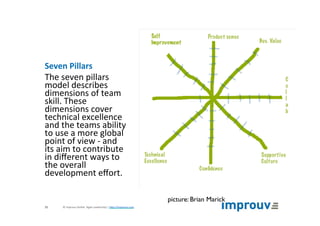
Seven	Pillars	
The	seven	pillars	
model	describes	
dimensions	of	team	
skill.	These	
dimensions	cover	
technical	excellence	
and	the	teams	ability	
to	use	a	more	global	
point	of	view	-	and	
its	aim	to	contribute	
in	different	ways	to	
the	overall	
development	effort.	
picture: Brian Marick
©	improuv	GmbH		Agile	Leadership	|	hJp://improuv.com		15
Agile	
Fluency	
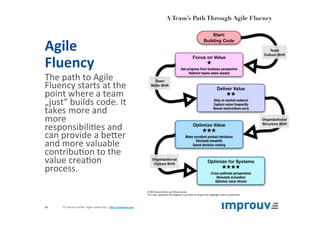
The	path	to	Agile	
Fluency	starts	at	the	
point	where	a	team	
„just“	builds	code.	It	
takes	more	and	
more	
responsibili+es	and	
can	provide	a	beJer	
and	more	valuable	
contribu+on	to	the	
value	crea+on	
process.	
©	improuv	GmbH		Agile	Leadership	|	hJp://improuv.com		16
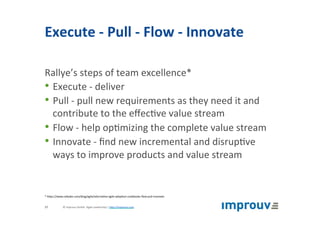
Execute	-	Pull	-	Flow	-	Innovate	
Rallye’s	steps	of	team	excellence*	
• Execute	-	deliver	
• Pull	-	pull	new	requirements	as	they	need	it	and	
contribute	to	the	effec+ve	value	stream	
• Flow	-	help	op+mizing	the	complete	value	stream	
• Innovate	-	find	new	incremental	and	disrup+ve	
ways	to	improve	products	and	value	stream	
©	improuv	GmbH		Agile	Leadership	|	hJp://improuv.com		17	
*	hJps://www.rallydev.com/blog/agile/alterna+ve-agile-adop+on-cookbooks-flow-pull-innovate
About	Agile	Evolu7on	
©	improuv	GmbH		Agile	Leadership	|	hJp://improuv.com		18
The	Agile	Evolu7on	Approach	
Agile	Evolu+on	adopts	the	broader	view	of	
capabili+es.	
• It	includes	a	holis+c	view	of	the	team	and	its	
environment	
• It	is	useful	for	all	agile	methods	and	helps	to	unlock	
concealed	improvement	poten+als	
• It	acknowledges	the	different	focus	seqngs	and	
learning	needs	for	teams	in	different	stages	of	
development	
©	improuv	GmbH		Agile	Leadership	|	hJp://improuv.com		19
Start	with	discussing	Basic	Team	
Capabili7es	(which	every	team	needs)	
Agile	Teams	contribute	best	to	the	success	of	their	
organiza+on	when	they	
• Work	in	small	incremental	(ver+cal)	slices	of	
func+onality	
• Priori+ze	with	a	backlog	and	well	defined	quality	
goals	(defini+on	of	done)	
• Collaborate,	reflect	and	improve	as	a	team	
• Make	progress	measurable	and	quality	transparent	
-	develop	automated	tests	in	the	same	Sprint	as	
development	
©	improuv	GmbH		Agile	Leadership	|	hJp://improuv.com		20
The	role	of	Methods	
The	agile	methods	provide	prac+ces	to	support	
providing	these	capabili+es	-	in	different	ways	and	
with	a	different	focus.		
Let’s	look	into	
• Scrum	
• Kanban	
• Extreme	Programming	
©	improuv	GmbH		Agile	Leadership	|	hJp://improuv.com		21
Scrum	
• Scrum	provides	a	priori+zed	backlog,	requires	a	
poten+ally	shippable	product	increment	at	the	end	
of	each	Sprint	
• Creates	a	+mebox	to	stabilize	these	capabili+es	
• Provides	implicitly	a	WIP	limit	(Sprint	Backlog)	
• Enforces	team	accountability	
• Supports	team	collabora+on	and	development	
through	a	mandatory	retrospec+ve	mee+ng	at	the	
end	of	each	Sprint	
©	improuv	GmbH		Agile	Leadership	|	hJp://improuv.com		22
Kanban	
• Starts	with	the	visualiza+on	of	the	process	
• Concentrates	on	flow,	WIP	limit	and	delivery	-	
delivery	in	short	cycles	follows	implicitly	from	this	
focus	
• Helps	to	improve	work	through	visualiza+on	of	the	
flow,	e.g.	CFD	(cumula+ve	flow	diagram)	
• Team	work	and	team	responsibility	is	op+onal	in	
Kanban	
©	improuv	GmbH		Agile	Leadership	|	hJp://improuv.com		23
Extreme	Programming	
• Provides	soZware	prac+ces	to	assure	the	quality	of	
work	
• Prac+ces	are	mandatory	for	sustainable	success	(in	
most	environments)	
• Today	heavily	used	as	a	„plugin“	for	one	of	the	
other	methods	
©	improuv	GmbH		Agile	Leadership	|	hJp://improuv.com		24
A	comprehensive	team	assessment	
A	team	assessment	can	cover	the	following	areas:	
• Product	Quality	
• Planning	Quality	
• Consistent	Delivery	
• Collabora+ve	Work	
• Inter-Team	Collabora+on	
• Empowerment	
• Con+nuous	Improvement	
For	more	info,	mail	to:	contact@improuv.com	
©	improuv	GmbH		Agile	Leadership	|	hJp://improuv.com		25
About	Measuring	
©	improuv	GmbH		Agile	Leadership	|	hJp://improuv.com		26
The	nature	and	piSalls	of	
measuring	
• PiQalls	and	dangers	
• Why	we	concentrate	on	self	assessment	
©	improuv	GmbH		Agile	Leadership	|	hJp://improuv.com		27
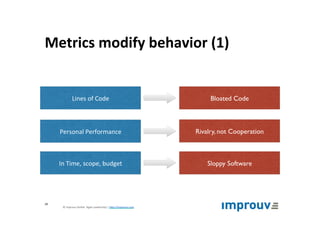
Metrics	modify	behavior	(1)	
28	
Lines	of	Code	
Personal	Performance	
In	Time,	scope,	budget	
Bloated Code
Rivalry, not Cooperation
Sloppy Software
©	improuv	GmbH		Agile	Leadership	|	hJp://improuv.com
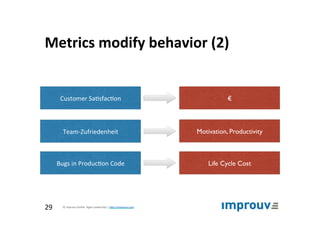
Metrics	modify	behavior	(2)	
29	
Customer	Sa+sfac+on	
Team-Zufriedenheit	
Bugs	in	Produc+on	Code	
€
Motivation, Productivity
Life Cycle Cost
©	improuv	GmbH		Agile	Leadership	|	hJp://improuv.com
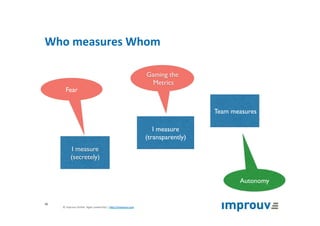
Who	measures	Whom	
30	
I measure
(secretely)
I measure
(transparently)
Team measures
Fear
Gaming the
Metrics
Autonomy
©	improuv	GmbH		Agile	Leadership	|	hJp://improuv.com
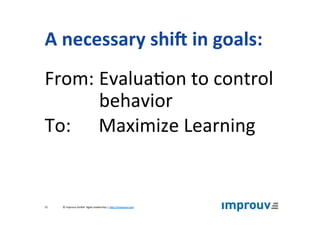
A	necessary	shiV	in	goals:	
From:		Evalua+on	to	control	
behavior	
To:	 	Maximize	Learning	
©	improuv	GmbH		Agile	Leadership	|	hJp://improuv.com		31
Valid	Goals	of	a	(self-)	assessment	
•  Find	direct	improvement	opportuni+es	
•  Extend	the	range	of	viewpoints	-	remove	blind	
spots	
•  Strengthen	team	autonomy	-	enable	the	team	to	
steer	their	own	process	improvement	
•  Improve	alignment	-	provide	transparency	on	
personal,	team	and	organiza+onal	goals	
©	improuv	GmbH		Agile	Leadership	|	hJp://improuv.com		32
Provide	a	good	environment	
©	improuv	GmbH		Agile	Leadership	|	hJp://improuv.com		33
Enabling	Factors	
Leadership	
• Help	the	team	to	iden+fy	opportuni+es	
Sustainable	Pace	
• Define	a	budget	in	terms	of	+me	and	WIP	limit	
Transparency	
• Create	an	open	environment	which	empowers	
people	and	values	alignment	over	compliance	
Trust	
• Make	sure	openness	is	not	exploited	
©	improuv	GmbH		Agile	Leadership	|	hJp://improuv.com		34
Enabling	Factors	
Provide	a	healthy	environment	
•  teams	cannot	perform	indefinitely	if	their	
organiza+on	is	broken	
Protect	the	team	
•  A	team	caught	in	strong	cross	wind	(„seitenwind“)	
will	not	easily	achieve	high	performance	
Isola+on	only	works	so	far	
•  Be	a	change	agent	-	help	the	organiza+on	to	
develop	towards	a	Lean	Agile	Enterprise	
©	improuv	GmbH		Agile	Leadership	|	hJp://improuv.com		35
Ask	the	Team	
Inspect	and	Adapt	
Deliver	every	Sprint	
Treat	People	as	Adults

Benchmarking Agile Teams