Behaviour
  {   How do Dutch children behave?
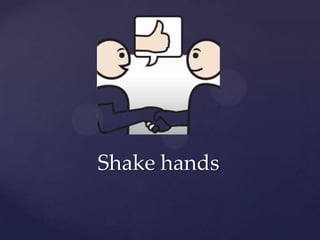
Shake hands
   Shake hands is polite. When you get to know
    someone, you shake hands while you say
    “Hello” and introduce yourself.
   When you meet friends or family, it’s more
    common to hug them instead of shake hands.
    Shaking hands is formal.
Thank you and please
   It is rude if you do not say “Thank you” when
    you receive something or “Please” when you
    ask someone else to do something for you.
   It is also polite to say “You’re welcome”, which
    is “Graag gedaan” in Dutch. It actually means
    “It’s a pleasure”.
   “Thank you” is “Dankjewel” or “Dankuwel”;
    the difference between “u” and “je” will be
    mentioned in this powerpoint, too.
   “Please” is “Alsjeblieft”. “Alsjeblieft” can also
    be said when you offer someone something.
“Jij” or “U”? / “You” or “you”?
   In English, there is not any distinction between
    “U” and “jij”. You just say “you” to everybody.
   In Holland, “U” is being said to elder people.
    “Jij” is being said to people you know well,
    friends and family, and people who do not like
    to be called “U”. It is very polite to say “U”
    when you meet someone for the first time.
   “Jij” can also be shortened to “je” in some
    situations.
There are some general rules in Holland, like;
 Let your parents know where you are. A lot of
  children have the rule let their parents know
  where they are. For instance when you are at
  school, and you want to go to a friend, you call
  your parents to tell them.
 Be home at a certain time. Almost all children
  have a certain time they have to be back at
  home. For example ten minutes before dinner.
There are, of course, a lot more general rules in
Holland. This is just to give you an idea about our
rules.
Behaviour in Holland

Behaviour in Holland

  • 1.
    Behaviour { How do Dutch children behave?
  • 2.
  • 3.
    Shake hands is polite. When you get to know someone, you shake hands while you say “Hello” and introduce yourself.  When you meet friends or family, it’s more common to hug them instead of shake hands. Shaking hands is formal.
  • 4.
  • 5.
    It is rude if you do not say “Thank you” when you receive something or “Please” when you ask someone else to do something for you.  It is also polite to say “You’re welcome”, which is “Graag gedaan” in Dutch. It actually means “It’s a pleasure”.  “Thank you” is “Dankjewel” or “Dankuwel”; the difference between “u” and “je” will be mentioned in this powerpoint, too.  “Please” is “Alsjeblieft”. “Alsjeblieft” can also be said when you offer someone something.
  • 6.
    “Jij” or “U”?/ “You” or “you”?
  • 7.
    In English, there is not any distinction between “U” and “jij”. You just say “you” to everybody.  In Holland, “U” is being said to elder people. “Jij” is being said to people you know well, friends and family, and people who do not like to be called “U”. It is very polite to say “U” when you meet someone for the first time.  “Jij” can also be shortened to “je” in some situations.
  • 9.
    There are somegeneral rules in Holland, like;  Let your parents know where you are. A lot of children have the rule let their parents know where they are. For instance when you are at school, and you want to go to a friend, you call your parents to tell them.  Be home at a certain time. Almost all children have a certain time they have to be back at home. For example ten minutes before dinner. There are, of course, a lot more general rules in Holland. This is just to give you an idea about our rules.