
KANPUR
SUBJECT- COMMUNITY HEALTH NURSING
TOPIC - BEHAVIOUR CHANGE COMMUNICATION SKILLS
PRESENTED TO:
Mr Rishabh Sharma
PG Tutor (Community Health Nursing)
K.I.N.S.R
PRESENTED BY:
Abhisikta Raikwar
B.sc nursing 4th year 2020-21
Batch
BEHAVIOUR CHANGE
COMMUNICATION
SKILLS
CONTENTS
1.COMMUNICATION
4. STEPS &TECHNIQUES OF BEHAVIOUR
CHANGES
3. HEALTH BELIEF MODEL
2. HUMAN BEHAVIOUR
6. BARRIER OF EFFECTIVE
COMMUNICATION
5.SOCIAL AND BEHAVIOUR CHANGE
STRETEGIES
Behaviour change interventions are 'Coordinated sets of
activities designed to change specified behaviour patterns.
Behavioral change can be a temporary or permanent effect
that is considered a change in an individual's behavior when
compared to previous behavior.
BEHAVIOUR CHANGE COMMUNICATION SKILLS
INTRODUCTION
DEFINITION
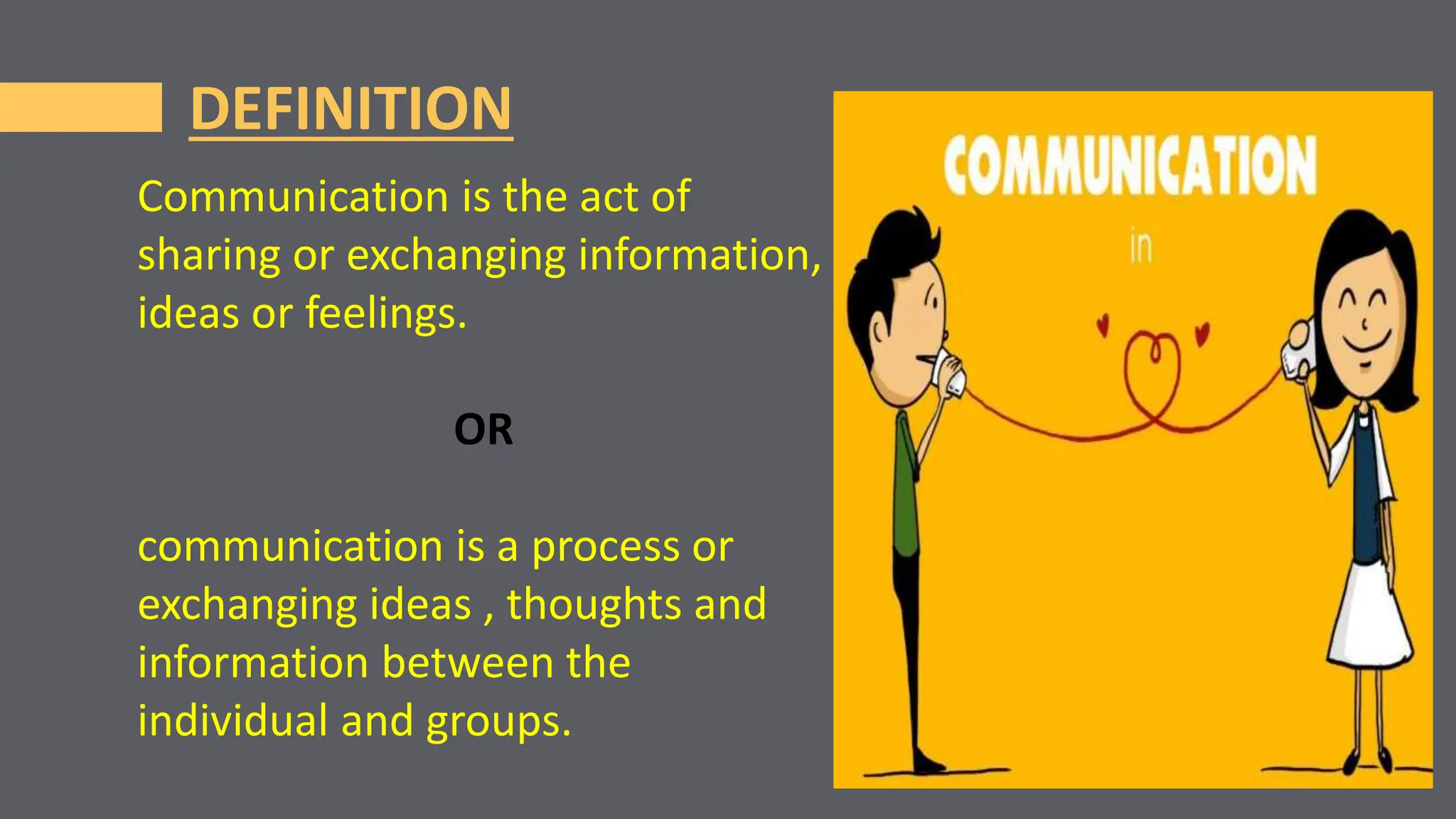
Communication is the act of
sharing or exchanging information,
ideas or feelings.
OR
communication is a process or
exchanging ideas , thoughts and
information between the
individual and groups.
TYPE OF COMMUNICATION
• Formal and informal.
• verbal and nonverbal.
• one way and two way.
• vertical and horizontal.
LEVEL OF COMMUNICATION
• Intrapersonal communication.
• Interpersonal communication.
• Small group communication.
• Mass communication.
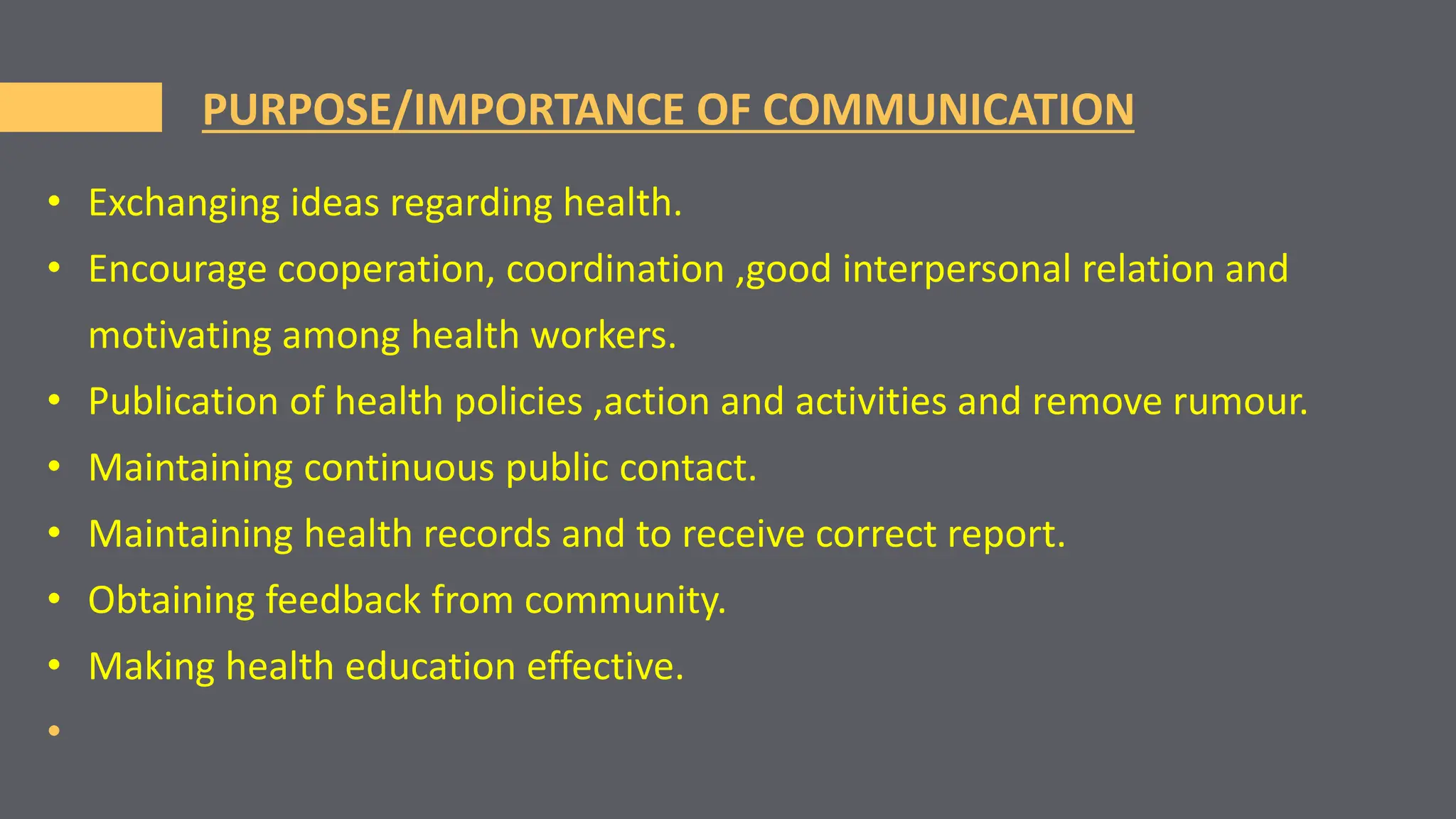
PURPOSE/IMPORTANCE OF COMMUNICATION
• Exchanging ideas regarding health.
• Encourage cooperation, coordination ,good interpersonal relation and
motivating among health workers.
• Publication of health policies ,action and activities and remove rumour.
• Maintaining continuous public contact.
• Maintaining health records and to receive correct report.
• Obtaining feedback from community.
• Making health education effective.
•
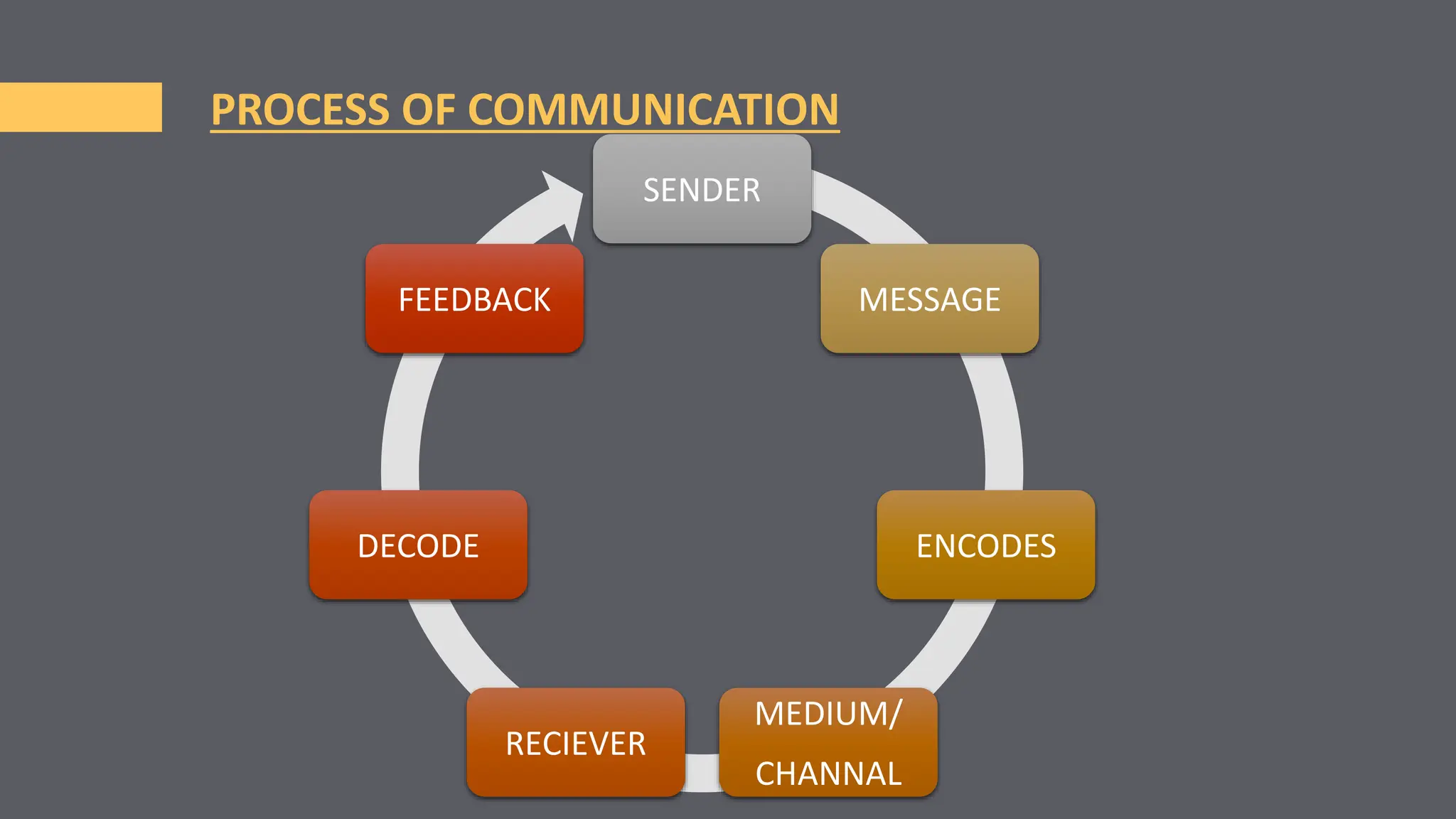
PROCESS OF COMMUNICATION
SENDER
MESSAGE
ENCODES
MEDIUM/
CHANNAL
RECIEVER
DECODE
FEEDBACK
2
Two
HUMAN
BEHAVIOUR
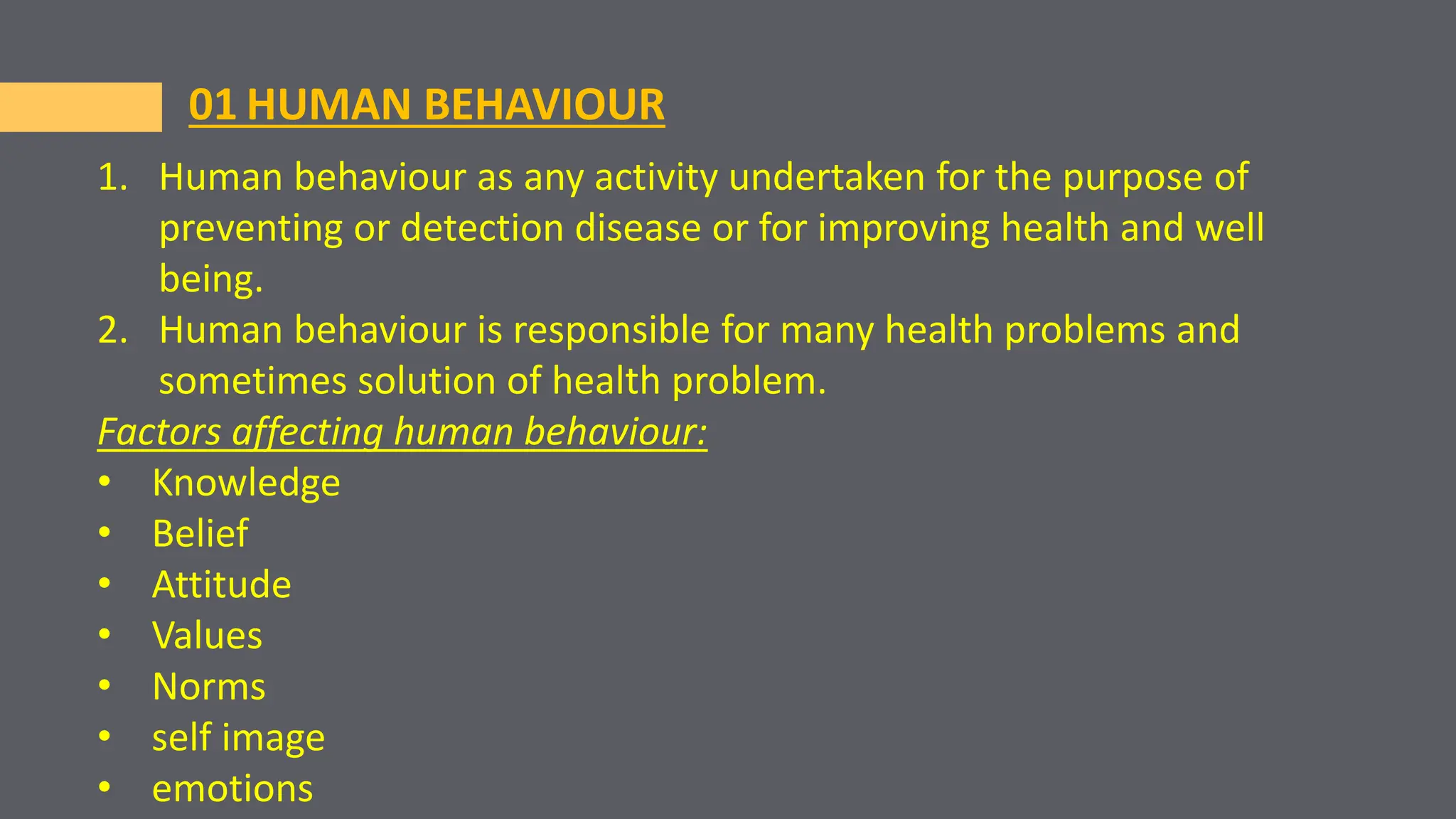
01 HUMAN BEHAVIOUR
1. Human behaviour as any activity undertaken for the purpose of
preventing or detection disease or for improving health and well
being.
2. Human behaviour is responsible for many health problems and
sometimes solution of health problem.
Factors affecting human behaviour:
• Knowledge
• Belief
• Attitude
• Values
• Norms
• self image
• emotions
3
Three
HEALTH BELIEF
MODEL
3.1 The health belief model(HBM)
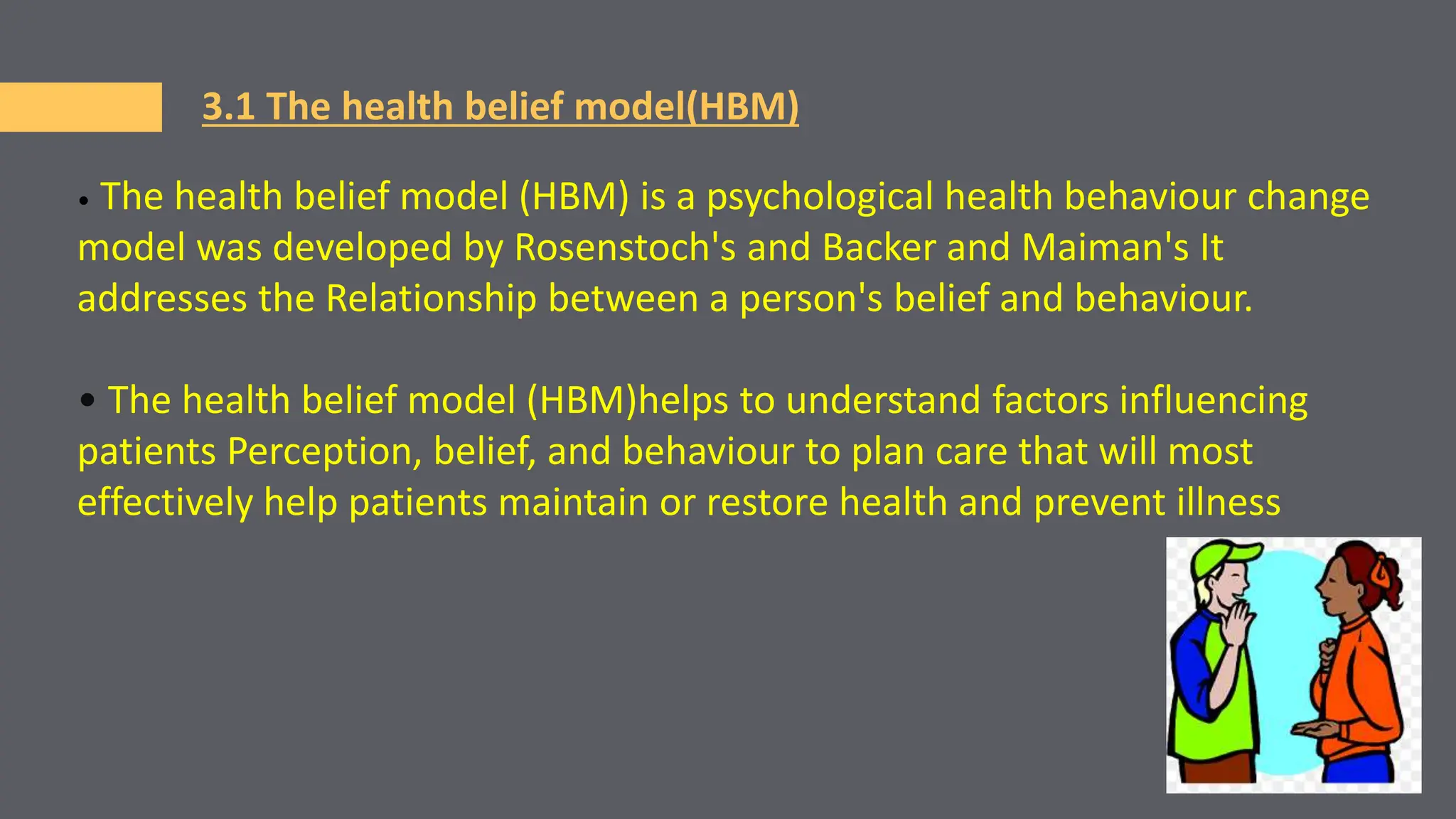
• The health belief model (HBM) is a psychological health behaviour change
model was developed by Rosenstoch's and Backer and Maiman's It
addresses the Relationship between a person's belief and behaviour.
• The health belief model (HBM)helps to understand factors influencing
patients Perception, belief, and behaviour to plan care that will most
effectively help patients maintain or restore health and prevent illness
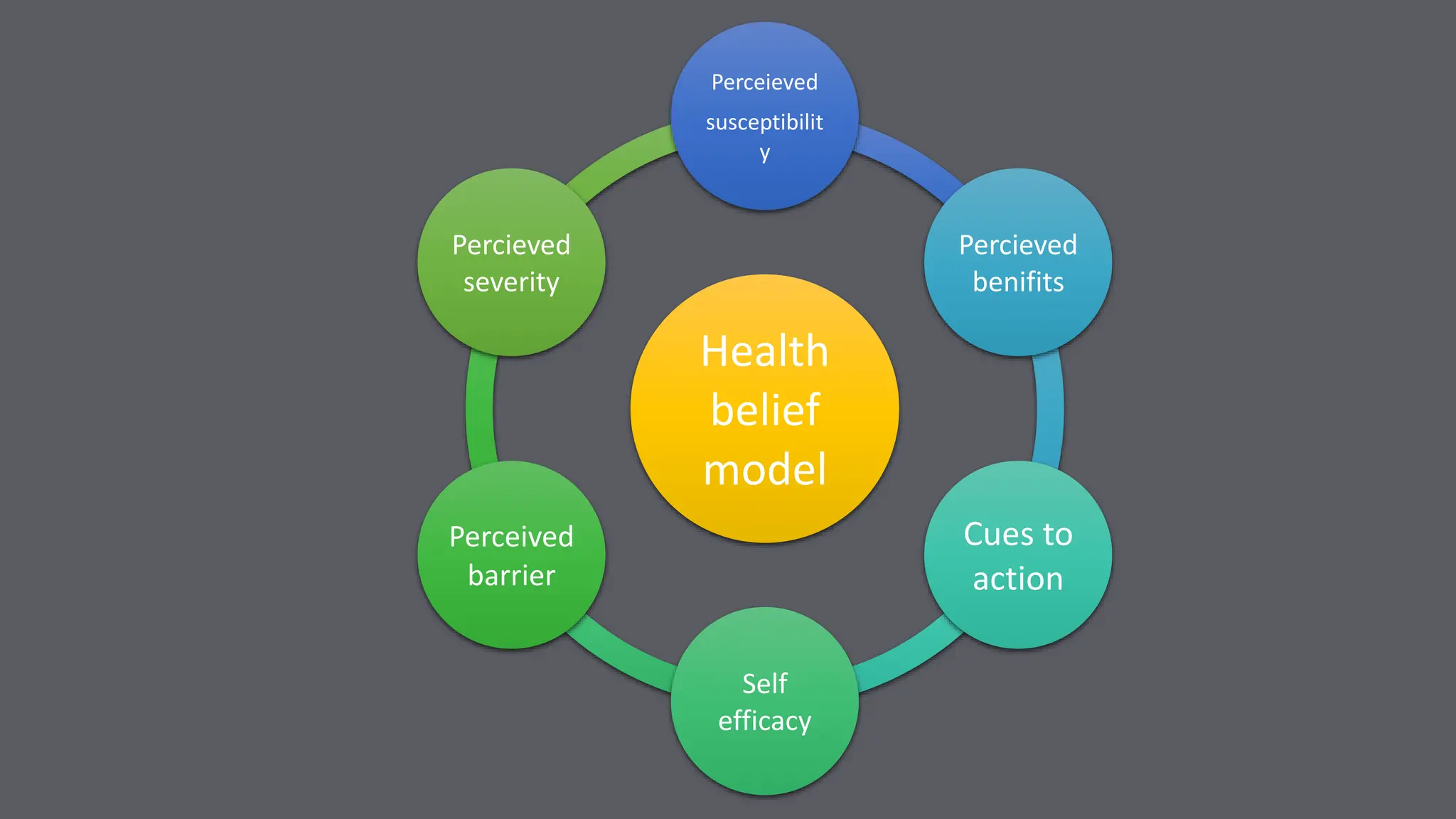
Health
belief
model
Perceieved
susceptibilit
y
Percieved
benifits
Cues to
action
Self
efficacy
Perceived
barrier
Percieved
severity
Perceived susceptibility:
• Perceived susceptibility refers to beliefs about the likelihood of getting a
disease or condition. For ex- a woman must believe there is a possibility
of getting breast cancer before she will be interested in obtaining a
mammogram.
• Ex-corona virus.
• This model predicts that individuals who perceive that they are
susceptible to a particular health problem will engage in behaviors to
reduce their risk of developing the health problem.
COMPONENTS OF HEALTH BELIEF MODEL
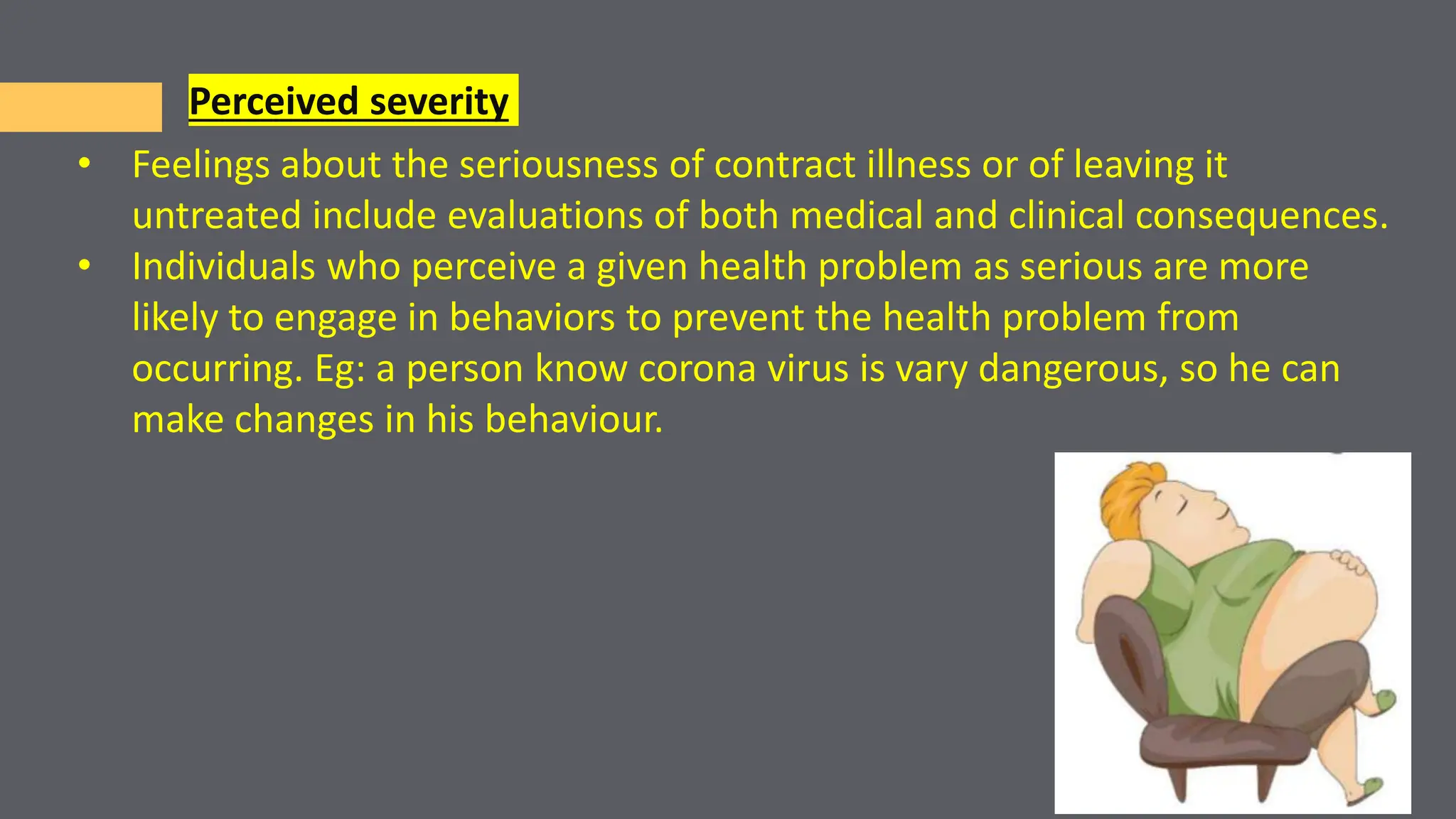
Perceived severity
• Feelings about the seriousness of contract illness or of leaving it
untreated include evaluations of both medical and clinical consequences.
• Individuals who perceive a given health problem as serious are more
likely to engage in behaviors to prevent the health problem from
occurring. Eg: a person know corona virus is vary dangerous, so he can
make changes in his behaviour.
Perceived barrier
• One’s opinion of the tangible and psychological costs of the advised
action.
• Ex-if he quit smoking the withdrawl symptoms are appears.
Perceived benefits
• The perceived effectiveness of taking action to improve a health
condition or Belief in efficacy of the advised action to reduce risk or
seriousness of impact ,For example, person believe to wear
sunscreen to protect from skin cancer.
• ex-yoga diet exercise etc to reduce risk factor of disease.
Cues to action
• Factors that activate "readiness to change"
• This model suggests that a cue, or trigger, is necessary for prompting
engagement in health promoting behaviors.
• Internal cues - Physiological cues (e.g., pain, symptoms)
• External cues - events or information from media, or health care
providers.
Self-efficacy
• Self confidence in one's ability to take action Are confident in their
ability to successfully perform an action.
• Self-efficacy was added to better explain individual differences in
health behaviors. Developers of the model recognized that
confidence in one's ability to effect change in outcomes was a key
component of health behavior change.
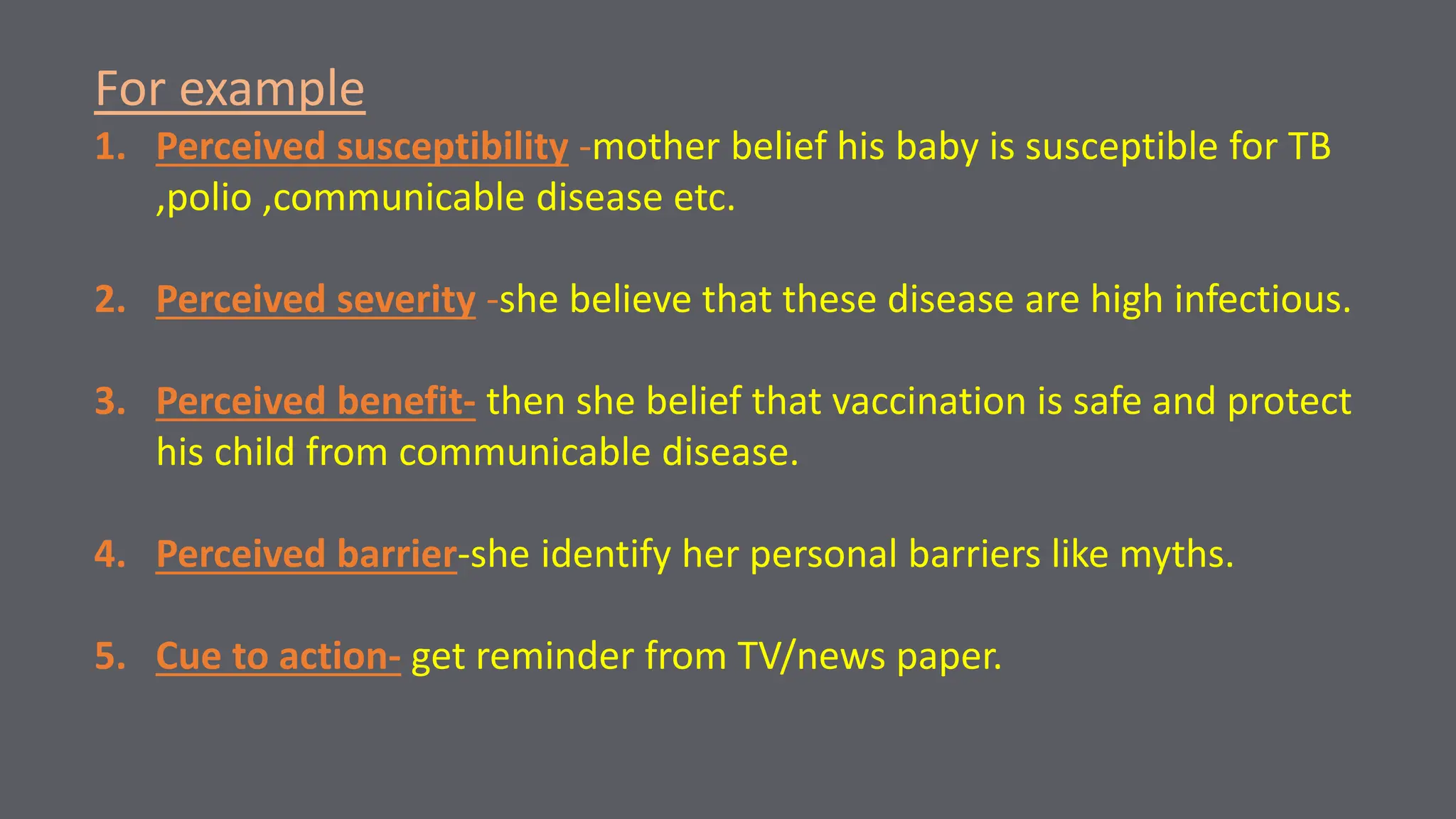
For example
1. Perceived susceptibility -mother belief his baby is susceptible for TB
,polio ,communicable disease etc.
2. Perceived severity -she believe that these disease are high infectious.
3. Perceived benefit- then she belief that vaccination is safe and protect
his child from communicable disease.
4. Perceived barrier-she identify her personal barriers like myths.
5. Cue to action- get reminder from TV/news paper.
4
Four
STEPS & TECHNIQUE OF
BEHAVIOUR CHANGES
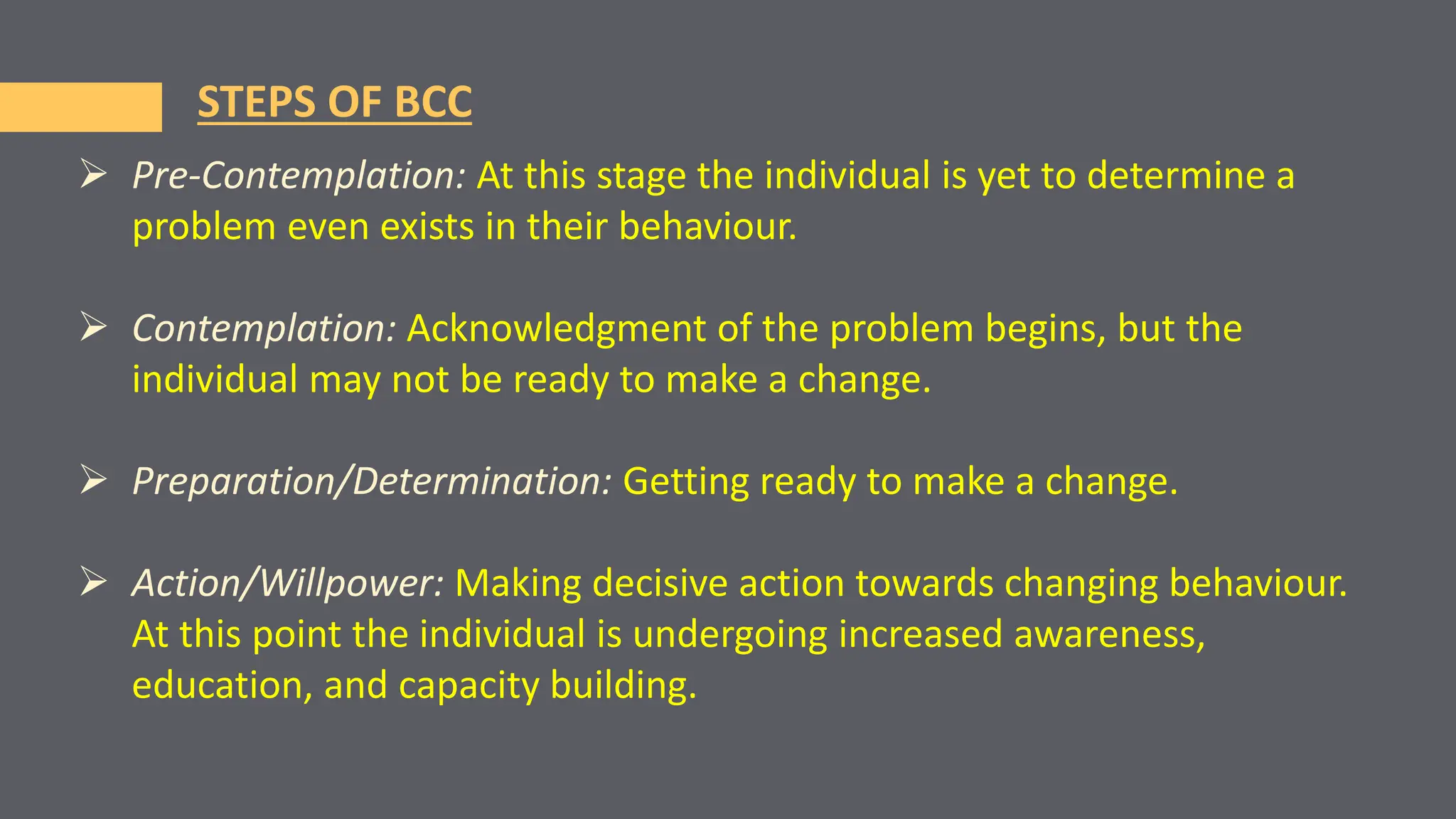
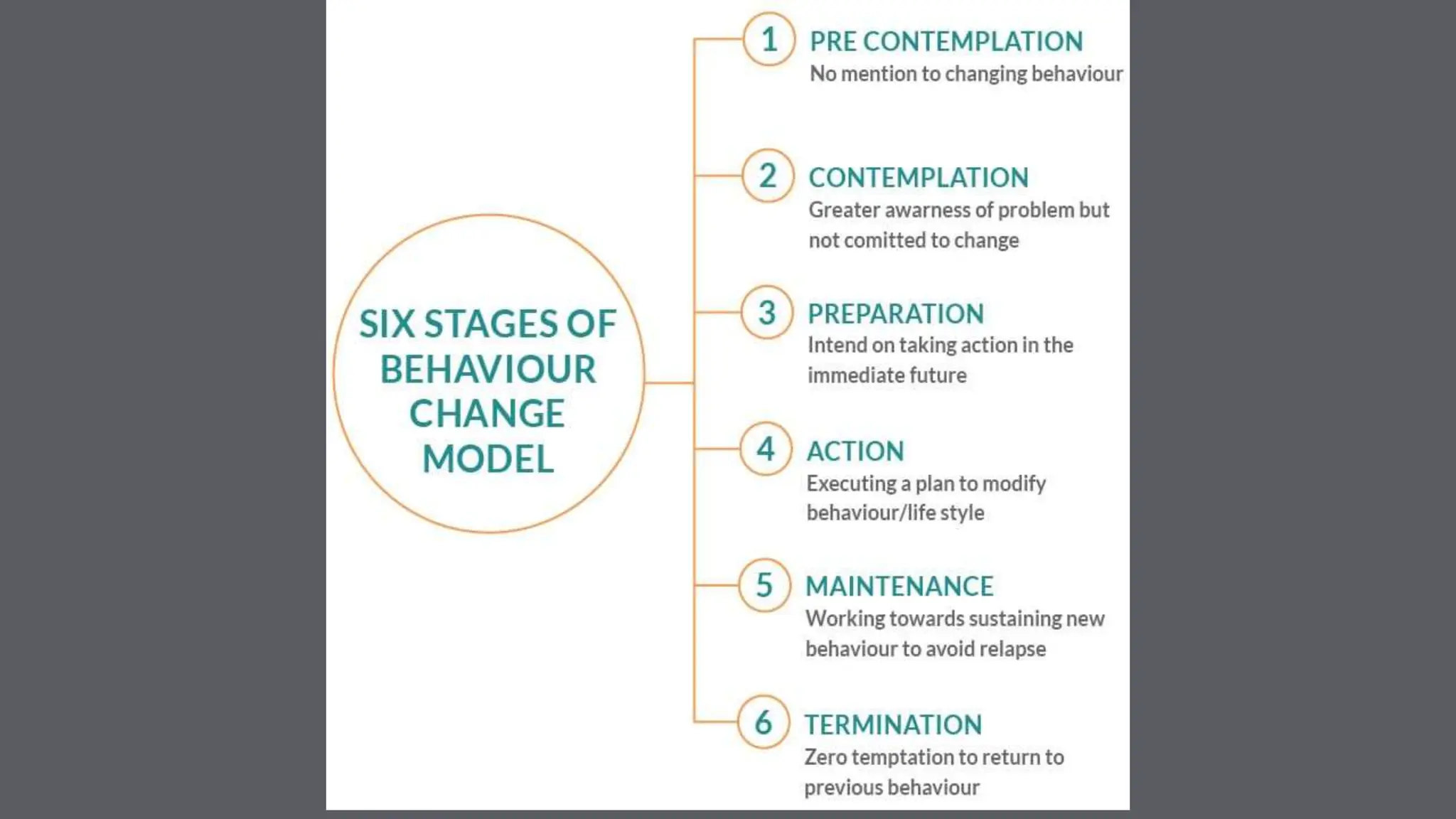
 Pre-Contemplation: At this stage the individual is yet to determine a
problem even exists in their behaviour.
 Contemplation: Acknowledgment of the problem begins, but the
individual may not be ready to make a change.
 Preparation/Determination: Getting ready to make a change.
 Action/Willpower: Making decisive action towards changing behaviour.
At this point the individual is undergoing increased awareness,
education, and capacity building.
STEPS OF BCC
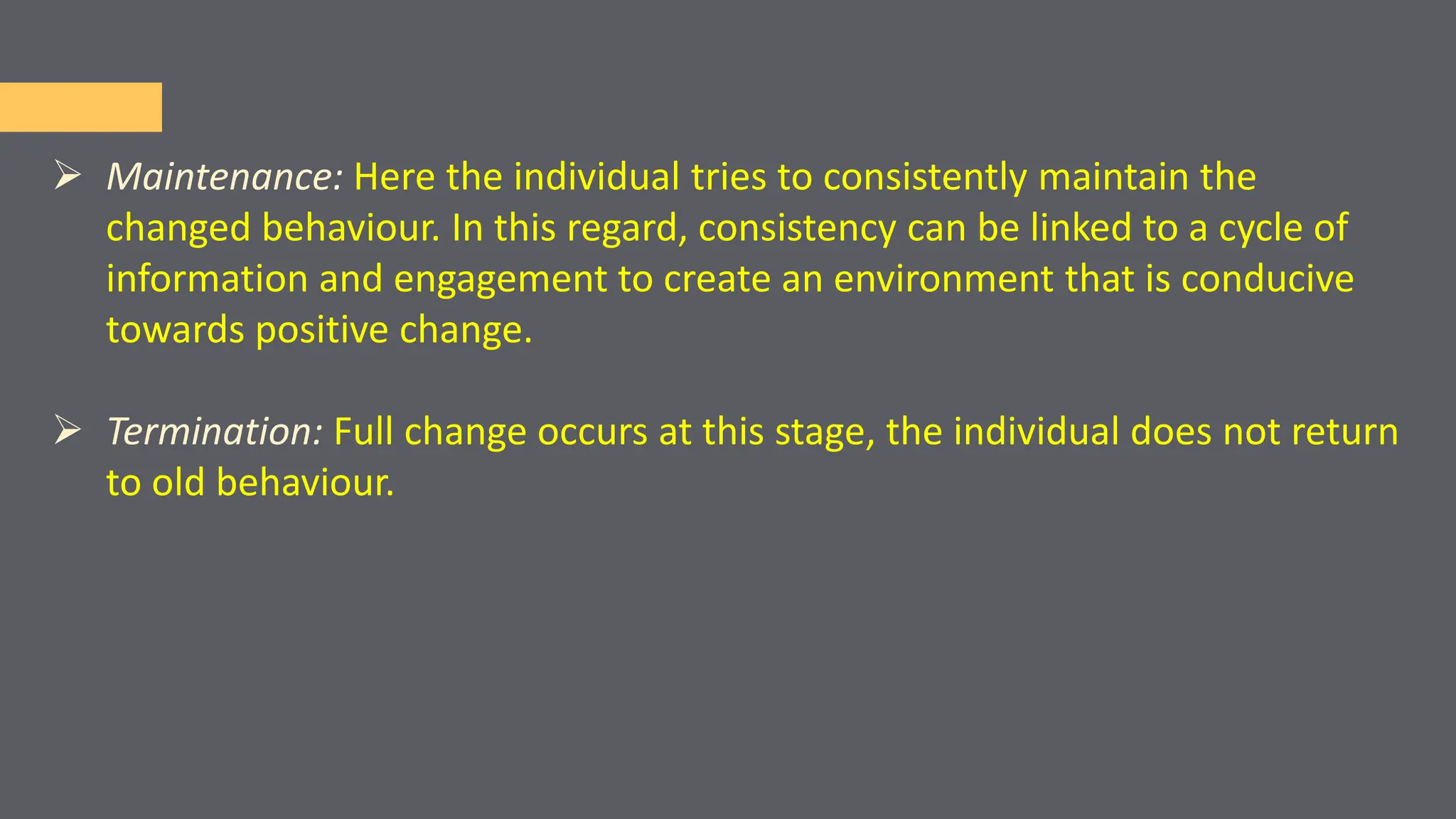
 Maintenance: Here the individual tries to consistently maintain the
changed behaviour. In this regard, consistency can be linked to a cycle of
information and engagement to create an environment that is conducive
towards positive change.
 Termination: Full change occurs at this stage, the individual does not return
to old behaviour.
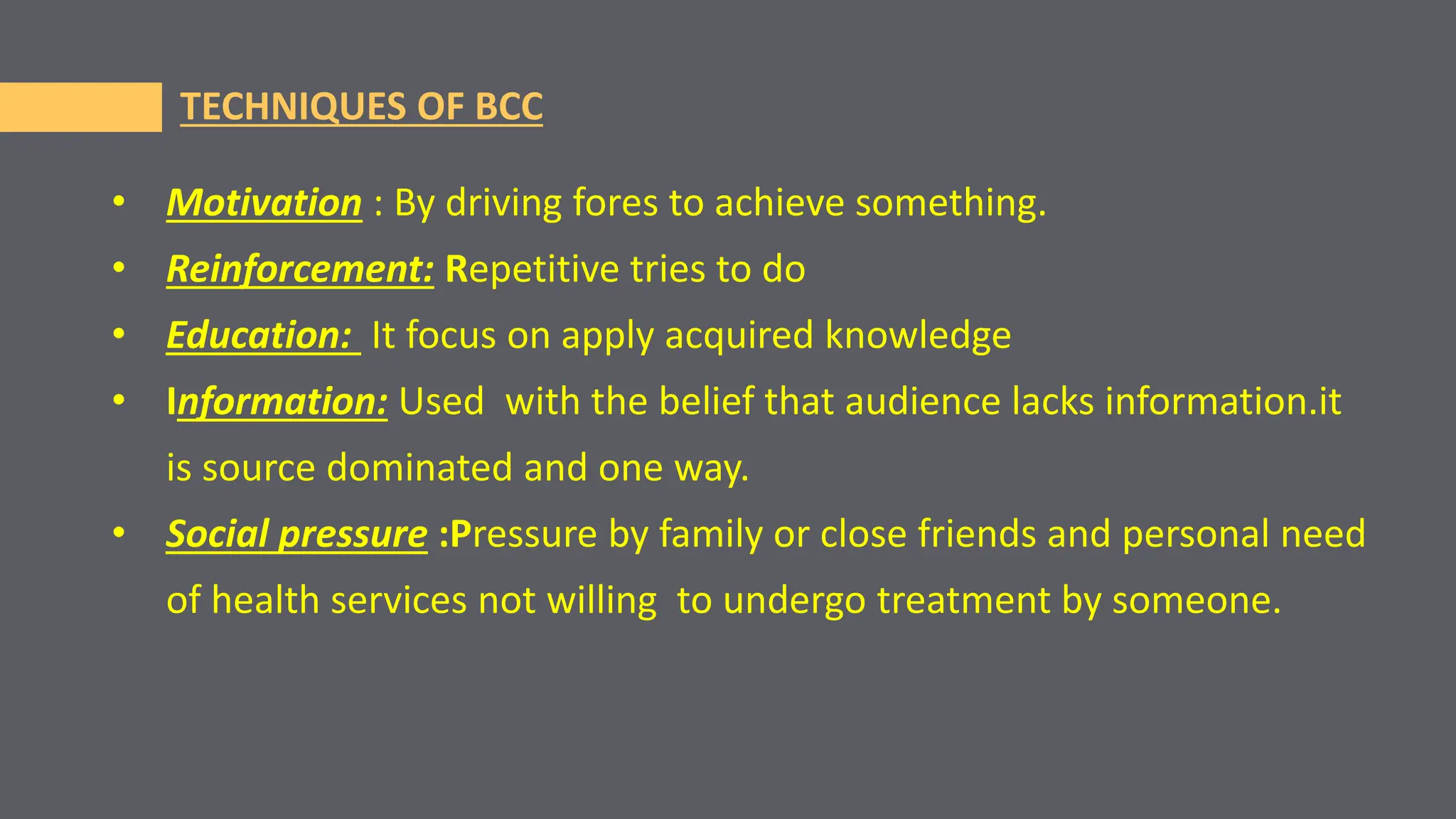
TECHNIQUES OF BCC
• Motivation : By driving fores to achieve something.
• Reinforcement: Repetitive tries to do
• Education: It focus on apply acquired knowledge
• Information: Used with the belief that audience lacks information.it
is source dominated and one way.
• Social pressure :Pressure by family or close friends and personal need
of health services not willing to undergo treatment by someone.
5
Five
SOCIAL AND
BEHAVIOUR CHANGES
STRETEGIES
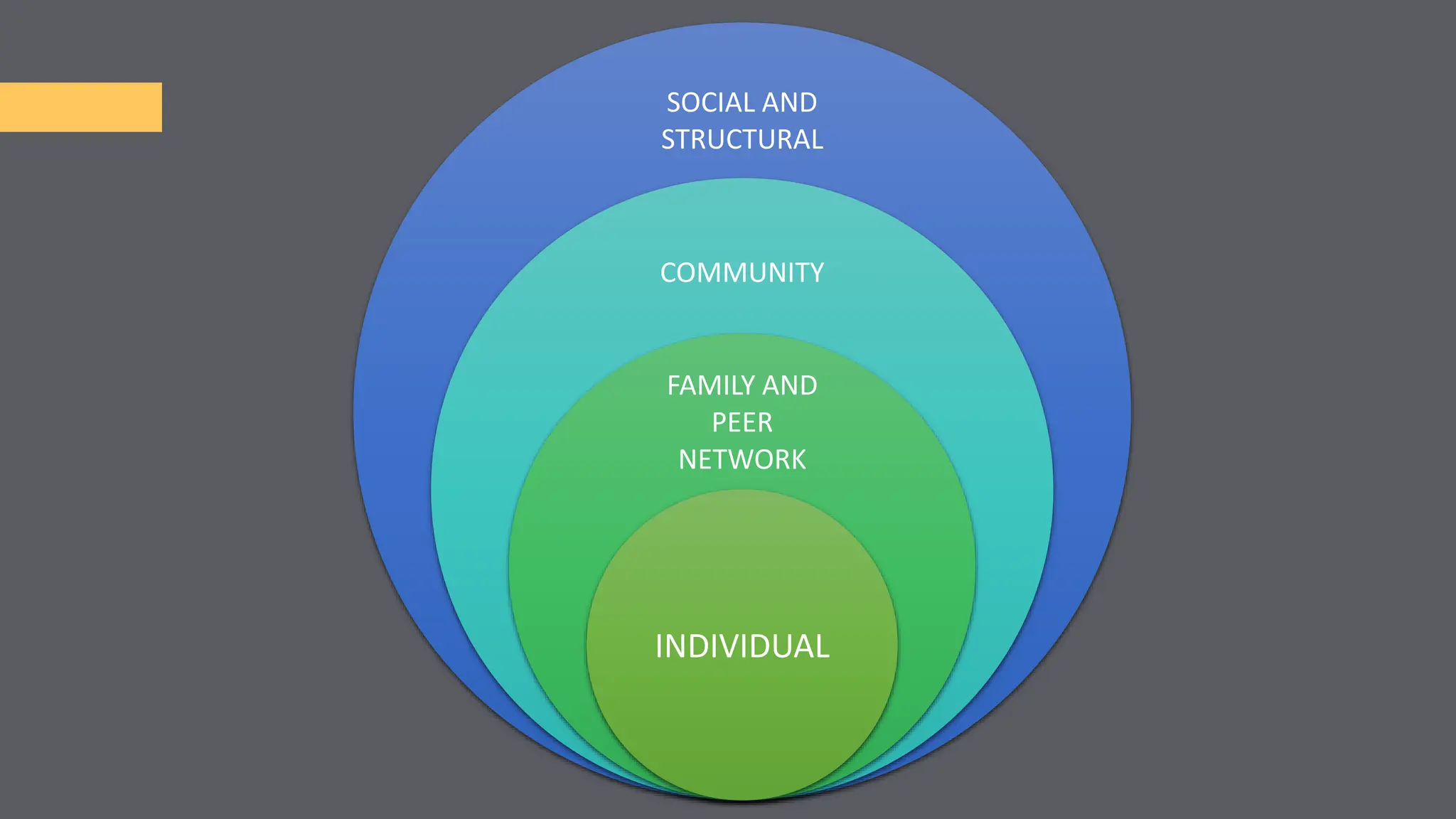
SOCIAL AND
STRUCTURAL
COMMUNITY
FAMILY AND
PEER
NETWORK
INDIVIDUAL
6
Six
BARRIER OF
COMMUNICATION
• Physical barrier
• Cultural barrier
• Language barrier
• Channel barrier
• Listening barrier
• Barrier while speaking
• Organizational barrier
•
Questionnaire
R e v i e w
WHAT DO YOU MEAN BY HUMAN RELATION?
WHAT ARE THE BARRIORS OF COMMUNICATION?
Assignment
R e v i e w
Write the method to overcome from communication
barrier?
THANK YOU
For your time & effort, your dedication is truly
appreciated.
S e e y o u t o m o r r o w

Behaviour change communication skills..

  • 1.
    KANPUR SUBJECT- COMMUNITY HEALTHNURSING TOPIC - BEHAVIOUR CHANGE COMMUNICATION SKILLS PRESENTED TO: Mr Rishabh Sharma PG Tutor (Community Health Nursing) K.I.N.S.R PRESENTED BY: Abhisikta Raikwar B.sc nursing 4th year 2020-21 Batch
  • 2.
  • 3.
    CONTENTS 1.COMMUNICATION 4. STEPS &TECHNIQUESOF BEHAVIOUR CHANGES 3. HEALTH BELIEF MODEL 2. HUMAN BEHAVIOUR 6. BARRIER OF EFFECTIVE COMMUNICATION 5.SOCIAL AND BEHAVIOUR CHANGE STRETEGIES
  • 4.
    Behaviour change interventionsare 'Coordinated sets of activities designed to change specified behaviour patterns. Behavioral change can be a temporary or permanent effect that is considered a change in an individual's behavior when compared to previous behavior. BEHAVIOUR CHANGE COMMUNICATION SKILLS INTRODUCTION
  • 6.
    DEFINITION Communication is theact of sharing or exchanging information, ideas or feelings. OR communication is a process or exchanging ideas , thoughts and information between the individual and groups.
  • 7.
    TYPE OF COMMUNICATION •Formal and informal. • verbal and nonverbal. • one way and two way. • vertical and horizontal.
  • 8.
    LEVEL OF COMMUNICATION •Intrapersonal communication. • Interpersonal communication. • Small group communication. • Mass communication.
  • 9.
    PURPOSE/IMPORTANCE OF COMMUNICATION •Exchanging ideas regarding health. • Encourage cooperation, coordination ,good interpersonal relation and motivating among health workers. • Publication of health policies ,action and activities and remove rumour. • Maintaining continuous public contact. • Maintaining health records and to receive correct report. • Obtaining feedback from community. • Making health education effective. •
  • 10.
  • 11.
  • 12.
    01 HUMAN BEHAVIOUR 1.Human behaviour as any activity undertaken for the purpose of preventing or detection disease or for improving health and well being. 2. Human behaviour is responsible for many health problems and sometimes solution of health problem. Factors affecting human behaviour: • Knowledge • Belief • Attitude • Values • Norms • self image • emotions
  • 13.
  • 14.
    3.1 The healthbelief model(HBM) • The health belief model (HBM) is a psychological health behaviour change model was developed by Rosenstoch's and Backer and Maiman's It addresses the Relationship between a person's belief and behaviour. • The health belief model (HBM)helps to understand factors influencing patients Perception, belief, and behaviour to plan care that will most effectively help patients maintain or restore health and prevent illness
  • 15.
  • 16.
    Perceived susceptibility: • Perceivedsusceptibility refers to beliefs about the likelihood of getting a disease or condition. For ex- a woman must believe there is a possibility of getting breast cancer before she will be interested in obtaining a mammogram. • Ex-corona virus. • This model predicts that individuals who perceive that they are susceptible to a particular health problem will engage in behaviors to reduce their risk of developing the health problem. COMPONENTS OF HEALTH BELIEF MODEL
  • 17.
    Perceived severity • Feelingsabout the seriousness of contract illness or of leaving it untreated include evaluations of both medical and clinical consequences. • Individuals who perceive a given health problem as serious are more likely to engage in behaviors to prevent the health problem from occurring. Eg: a person know corona virus is vary dangerous, so he can make changes in his behaviour.
  • 18.
    Perceived barrier • One’sopinion of the tangible and psychological costs of the advised action. • Ex-if he quit smoking the withdrawl symptoms are appears. Perceived benefits • The perceived effectiveness of taking action to improve a health condition or Belief in efficacy of the advised action to reduce risk or seriousness of impact ,For example, person believe to wear sunscreen to protect from skin cancer. • ex-yoga diet exercise etc to reduce risk factor of disease.
  • 19.
    Cues to action •Factors that activate "readiness to change" • This model suggests that a cue, or trigger, is necessary for prompting engagement in health promoting behaviors. • Internal cues - Physiological cues (e.g., pain, symptoms) • External cues - events or information from media, or health care providers.
  • 20.
    Self-efficacy • Self confidencein one's ability to take action Are confident in their ability to successfully perform an action. • Self-efficacy was added to better explain individual differences in health behaviors. Developers of the model recognized that confidence in one's ability to effect change in outcomes was a key component of health behavior change.
  • 21.
    For example 1. Perceivedsusceptibility -mother belief his baby is susceptible for TB ,polio ,communicable disease etc. 2. Perceived severity -she believe that these disease are high infectious. 3. Perceived benefit- then she belief that vaccination is safe and protect his child from communicable disease. 4. Perceived barrier-she identify her personal barriers like myths. 5. Cue to action- get reminder from TV/news paper.
  • 22.
    4 Four STEPS & TECHNIQUEOF BEHAVIOUR CHANGES
  • 23.
     Pre-Contemplation: Atthis stage the individual is yet to determine a problem even exists in their behaviour.  Contemplation: Acknowledgment of the problem begins, but the individual may not be ready to make a change.  Preparation/Determination: Getting ready to make a change.  Action/Willpower: Making decisive action towards changing behaviour. At this point the individual is undergoing increased awareness, education, and capacity building. STEPS OF BCC
  • 24.
     Maintenance: Herethe individual tries to consistently maintain the changed behaviour. In this regard, consistency can be linked to a cycle of information and engagement to create an environment that is conducive towards positive change.  Termination: Full change occurs at this stage, the individual does not return to old behaviour.
  • 26.
    TECHNIQUES OF BCC •Motivation : By driving fores to achieve something. • Reinforcement: Repetitive tries to do • Education: It focus on apply acquired knowledge • Information: Used with the belief that audience lacks information.it is source dominated and one way. • Social pressure :Pressure by family or close friends and personal need of health services not willing to undergo treatment by someone.
  • 27.
  • 28.
  • 29.
  • 30.
    • Physical barrier •Cultural barrier • Language barrier • Channel barrier • Listening barrier • Barrier while speaking • Organizational barrier •
  • 31.
    Questionnaire R e vi e w WHAT DO YOU MEAN BY HUMAN RELATION? WHAT ARE THE BARRIORS OF COMMUNICATION?
  • 32.
    Assignment R e vi e w Write the method to overcome from communication barrier?
  • 33.
    THANK YOU For yourtime & effort, your dedication is truly appreciated. S e e y o u t o m o r r o w