BEHAVIORAL THERAPY
Behaviour
Adaptive
Maladaptive- when it is age inappropriate, interferes with
adaptive functioning or others misunderstand it in terms of
cultural inappropriateness.
Behaviorism see psychological disorders as the result of
maladaptive learning, as people are born tabula rasa (a blank slate).
Basic assumption is that the maladaptive behaviour can be
corrected through the provision of adequate learning experiences.
DEFINITION
It is a form of treatment for problem in which a trained person
deliberately establishes a professional relationship with the
patient, with the objective of removing or modifying existing
symptoms and promoting positive personality, growth and
development.
A form of psychotherapy, the goal of which is to modify
maladaptive behaviour patterns by reinforcing more adaptive
behaviors.
PRINCIPLES
OF
BEHAVIORAL
THERAPIES
Theory of Classical conditioning:
involves learning by association and is
usually the cause of most phobias.
Theory of Operant conditioning:
involves learning by reinforcement (e.g. rewards)
and punishment, and can explain abnormal
behavior should as eating disorders.
Assumptions of Behavioral therapy
The following are the assumptions of behavior therapy.
 All behavior is learned(adaptive and maladaptive)
 Human beings are passive organisms that can be conditioned or shaped to do
anythingif correct responses are rewarded or reinforced.
 Maladaptive behavior can be unlearned and replaced by adaptive behavior if the
person receives exposure to specific stimuli and reinforcement for the desired
adaptive behavior.
 Behavior assessment is focused more on the current behavior rather than on
historical antecedents.
 Treatment strategies are individually tailored.
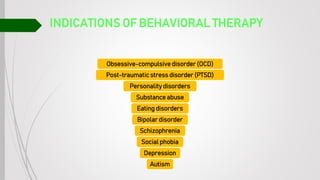
INDICATIONS OF BEHAVIORAL THERAPY
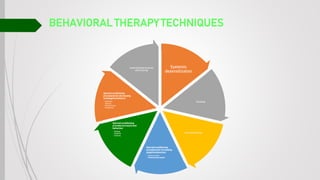
BEHAVIORAL THERAPY TECHNIQUES
Systemic
desensitization
Flooding
Aversion therapy
Operantconditioning
procedureforincreasing
adaptivebehaviour
• Token economy
• Positivereinforcement
Operantconditioning
procedureto teachnew
behaviour
• Shaping
• Modeling
• Chaining
0perantconditioning
proceduresfor decreasing
maladaptivebehavior
• Extinction
• Time out
• Reconstitution
• Punishment
Assertiveness & social
skill training
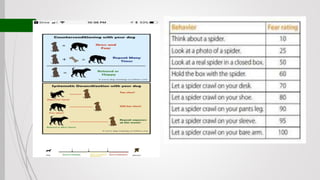
SYSTEMIC DESENSITIZATION
 It was developed by joseph wolpe, based on the behavioral principle of counter
conditioning.
 In this, patient attain a state of complete relaxation and are then exposed to the
stimulus that elicits the anxiety response.
 The negative reaction of anxiety is inhibited by the relaxed state, a process called
reciprocal inhibition.
 INDICATION
 Phobias
 Obsessions
 Compulsions
 Certain sexual disorders
It consists of three main steps:
 Relaxation training :Relaxation training There are many methods which can be used to induce relaxation. Some
of them are:
 Jacobson's progressivemuscle relaxation
 Hypnosis
 Meditation or yoga
 Mental imagery
 Biofeedback
 Hierachy construction : Hierachy construction Here the patient is asked to list all the conditions which provoke
anxiety. Then he is asked to list them in a descending order of anxiety provocation.
 Desensitizationof the stimuli: This can either be done in reality or though imagination. At first, the lowest item in
hierarchy is confronted. The patient is advised to signal whenever anxiety is produced. After a few trails, patient
is able to control his anxiety gradually.
https://youtu.be/n4m2NJlJVuc
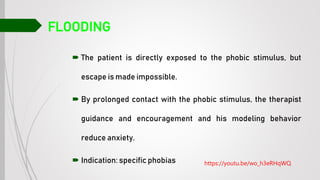
FLOODING
 The patient is directly exposed to the phobic stimulus, but
escape is made impossible.
 By prolonged contact with the phobic stimulus, the therapist
guidance and encouragement and his modeling behavior
reduce anxiety.
 Indication: specific phobias https://youtu.be/wo_h3eRHqWQ
AVERSION THERAPY
 Pairing of the pleasantwith an unpleasant response,so that even in absence
of the unpleasant response the pleasant stimulus becomes unpleasant.
 Unpleasant response is produced by electric stimulus,drugs, social
disapprovalor even fantasy.
 INDICATIONS
 Alcohol abuse
 Paraphilias
 Homosexuality
 Transvestism
OPERANT CONDITIONING PROCEDURE FOR
INCREASING ADAPTIVE BEHAVIOUR
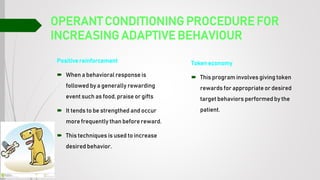
Positive reinforcement
 When a behavioral response is
followed by a generally rewarding
event such as food, praise or gifts
 It tends to be strengthed and occur
more frequently than before reward.
 This techniques is used to increase
desired behavior.
Token economy
 This program involves giving token
rewards for appropriate or desired
target behaviors performed by the
patient.
OPERANT CONDITIONING PROCEDURE TO
TEACH NEW BEHAVIOUR
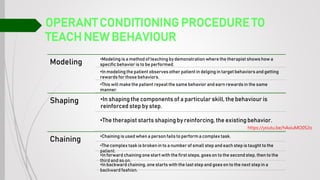
Modeling •Modeling is a method of teaching by demonstration where the therapist shows how a
specific behavior is to be performed.
•In modeling the patient observesother patient in delging in target behaviors and getting
rewards for those behaviors.
•This will make the patient repeat the same behavior and earn rewards in the same
manner.
Shaping •In shaping the components of a particular skill, the behaviour is
reinforced step by step.
•The therapist starts shaping by reinforcing, the existing behavior.
Chaining •Chaining is used when a person fails to perform a complex task.
•The complex task is broken in to a number of small step and each step is taught to the
patient.
•In forward chaining one start with the first steps, goes on to the second step, then to the
third and so on.
•In backward chaining, one starts with the last step and goes on to the next step in a
backward fashion.
https://youtu.be/hAxiuMO052o
0PERANT CONDITIONING PROCEDURES FOR
DECREASING MALADAPTIVE BEHAVIOR
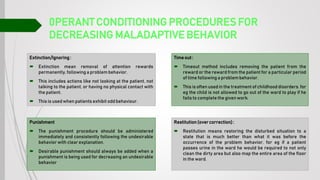
Extinction/Ignoring :
 Extinction mean removal of attention rewards
permanently, following a problem behavior.
 This includes actions like not looking at the patient, not
talking to the patient, or having no physical contact with
the patient.
 This is usedwhen patients exhibit odd behaviour.
Time out:
 Timeout method includes removing the patient from the
reward or the reward from the patient for a particular period
of time following a problembehavior.
 This is often used in the treatment of childhood disorders. for
eg the child is not allowed to go out of the ward to play if he
fails to complete the given work.
Punishment
 The punishment procedure should be administered
immediately and consistently following the undesirable
behavior with clear explanation.
 Desirable punishment should always be added when a
punishment is being used for decreasing an undesirable
behavior
Restitution(overcorrection):
 Restitution means restoring the disturbed situation to a
state that is much better than what it was before the
occurrence of the problem behavior. for eg if a patient
passes urine in the ward he would be required to not only
clean the dirty area but also map the entire area of the floor
in the ward.
ASSERTIVENESS AND SOCIAL SKILL
TRAINING
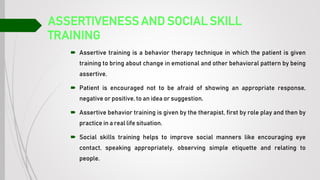
 Assertive training is a behavior therapy technique in which the patient is given
training to bring about change in emotional and other behavioral pattern by being
assertive.
 Patient is encouraged not to be afraid of showing an appropriate response,
negative or positive, to an idea or suggestion.
 Assertive behavior training is given by the therapist, first by role play and then by
practice in a real life situation.
 Social skills training helps to improve social manners like encouraging eye
contact, speaking appropriately, observing simple etiquette and relating to
people.
ADVANTAGES OF BEHAVIORAL THERAPY
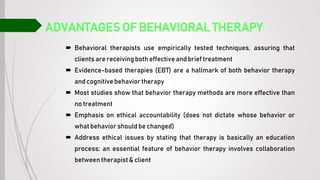
 Behavioral therapists use empirically tested techniques, assuring that
clients are receiving both effective and brief treatment
 Evidence-based therapies (EBT) are a hallmark of both behavior therapy
and cognitive behavior therapy
 Most studies show that behavior therapy methods are more effective than
no treatment
 Emphasis on ethical accountability (does not dictate whose behavior or
what behavior should be changed)
 Address ethical issues by stating that therapy is basically an education
process; an essential feature of behavior therapy involves collaboration
between therapist& client
DISADVANTAGES OF BEHAVIOURAL THERAPY
 Behavior therapy may change behaviors, but it does not change
feelings
 Behavior therapy ignores the important relational factors in
therapy
 Behavior therapy does not provide insight
 Behavior therapy treats symptoms rather than causes
 Behavior therapy involves control & manipulation by therapist

behavior therapy.pptx

  • 1.
  • 2.
    Behaviour Adaptive Maladaptive- when itis age inappropriate, interferes with adaptive functioning or others misunderstand it in terms of cultural inappropriateness. Behaviorism see psychological disorders as the result of maladaptive learning, as people are born tabula rasa (a blank slate). Basic assumption is that the maladaptive behaviour can be corrected through the provision of adequate learning experiences.
  • 3.
    DEFINITION It is aform of treatment for problem in which a trained person deliberately establishes a professional relationship with the patient, with the objective of removing or modifying existing symptoms and promoting positive personality, growth and development. A form of psychotherapy, the goal of which is to modify maladaptive behaviour patterns by reinforcing more adaptive behaviors.
  • 4.
    PRINCIPLES OF BEHAVIORAL THERAPIES Theory of Classicalconditioning: involves learning by association and is usually the cause of most phobias. Theory of Operant conditioning: involves learning by reinforcement (e.g. rewards) and punishment, and can explain abnormal behavior should as eating disorders.
  • 5.
    Assumptions of Behavioraltherapy The following are the assumptions of behavior therapy.  All behavior is learned(adaptive and maladaptive)  Human beings are passive organisms that can be conditioned or shaped to do anythingif correct responses are rewarded or reinforced.  Maladaptive behavior can be unlearned and replaced by adaptive behavior if the person receives exposure to specific stimuli and reinforcement for the desired adaptive behavior.  Behavior assessment is focused more on the current behavior rather than on historical antecedents.  Treatment strategies are individually tailored.
  • 6.
  • 7.
    BEHAVIORAL THERAPY TECHNIQUES Systemic desensitization Flooding Aversiontherapy Operantconditioning procedureforincreasing adaptivebehaviour • Token economy • Positivereinforcement Operantconditioning procedureto teachnew behaviour • Shaping • Modeling • Chaining 0perantconditioning proceduresfor decreasing maladaptivebehavior • Extinction • Time out • Reconstitution • Punishment Assertiveness & social skill training
  • 8.
    SYSTEMIC DESENSITIZATION  Itwas developed by joseph wolpe, based on the behavioral principle of counter conditioning.  In this, patient attain a state of complete relaxation and are then exposed to the stimulus that elicits the anxiety response.  The negative reaction of anxiety is inhibited by the relaxed state, a process called reciprocal inhibition.  INDICATION  Phobias  Obsessions  Compulsions  Certain sexual disorders
  • 9.
    It consists ofthree main steps:  Relaxation training :Relaxation training There are many methods which can be used to induce relaxation. Some of them are:  Jacobson's progressivemuscle relaxation  Hypnosis  Meditation or yoga  Mental imagery  Biofeedback  Hierachy construction : Hierachy construction Here the patient is asked to list all the conditions which provoke anxiety. Then he is asked to list them in a descending order of anxiety provocation.  Desensitizationof the stimuli: This can either be done in reality or though imagination. At first, the lowest item in hierarchy is confronted. The patient is advised to signal whenever anxiety is produced. After a few trails, patient is able to control his anxiety gradually. https://youtu.be/n4m2NJlJVuc
  • 11.
    FLOODING  The patientis directly exposed to the phobic stimulus, but escape is made impossible.  By prolonged contact with the phobic stimulus, the therapist guidance and encouragement and his modeling behavior reduce anxiety.  Indication: specific phobias https://youtu.be/wo_h3eRHqWQ
  • 12.
    AVERSION THERAPY  Pairingof the pleasantwith an unpleasant response,so that even in absence of the unpleasant response the pleasant stimulus becomes unpleasant.  Unpleasant response is produced by electric stimulus,drugs, social disapprovalor even fantasy.  INDICATIONS  Alcohol abuse  Paraphilias  Homosexuality  Transvestism
  • 13.
    OPERANT CONDITIONING PROCEDUREFOR INCREASING ADAPTIVE BEHAVIOUR Positive reinforcement  When a behavioral response is followed by a generally rewarding event such as food, praise or gifts  It tends to be strengthed and occur more frequently than before reward.  This techniques is used to increase desired behavior. Token economy  This program involves giving token rewards for appropriate or desired target behaviors performed by the patient.
  • 14.
    OPERANT CONDITIONING PROCEDURETO TEACH NEW BEHAVIOUR Modeling •Modeling is a method of teaching by demonstration where the therapist shows how a specific behavior is to be performed. •In modeling the patient observesother patient in delging in target behaviors and getting rewards for those behaviors. •This will make the patient repeat the same behavior and earn rewards in the same manner. Shaping •In shaping the components of a particular skill, the behaviour is reinforced step by step. •The therapist starts shaping by reinforcing, the existing behavior. Chaining •Chaining is used when a person fails to perform a complex task. •The complex task is broken in to a number of small step and each step is taught to the patient. •In forward chaining one start with the first steps, goes on to the second step, then to the third and so on. •In backward chaining, one starts with the last step and goes on to the next step in a backward fashion. https://youtu.be/hAxiuMO052o
  • 15.
    0PERANT CONDITIONING PROCEDURESFOR DECREASING MALADAPTIVE BEHAVIOR Extinction/Ignoring :  Extinction mean removal of attention rewards permanently, following a problem behavior.  This includes actions like not looking at the patient, not talking to the patient, or having no physical contact with the patient.  This is usedwhen patients exhibit odd behaviour. Time out:  Timeout method includes removing the patient from the reward or the reward from the patient for a particular period of time following a problembehavior.  This is often used in the treatment of childhood disorders. for eg the child is not allowed to go out of the ward to play if he fails to complete the given work. Punishment  The punishment procedure should be administered immediately and consistently following the undesirable behavior with clear explanation.  Desirable punishment should always be added when a punishment is being used for decreasing an undesirable behavior Restitution(overcorrection):  Restitution means restoring the disturbed situation to a state that is much better than what it was before the occurrence of the problem behavior. for eg if a patient passes urine in the ward he would be required to not only clean the dirty area but also map the entire area of the floor in the ward.
  • 16.
    ASSERTIVENESS AND SOCIALSKILL TRAINING  Assertive training is a behavior therapy technique in which the patient is given training to bring about change in emotional and other behavioral pattern by being assertive.  Patient is encouraged not to be afraid of showing an appropriate response, negative or positive, to an idea or suggestion.  Assertive behavior training is given by the therapist, first by role play and then by practice in a real life situation.  Social skills training helps to improve social manners like encouraging eye contact, speaking appropriately, observing simple etiquette and relating to people.
  • 17.
    ADVANTAGES OF BEHAVIORALTHERAPY  Behavioral therapists use empirically tested techniques, assuring that clients are receiving both effective and brief treatment  Evidence-based therapies (EBT) are a hallmark of both behavior therapy and cognitive behavior therapy  Most studies show that behavior therapy methods are more effective than no treatment  Emphasis on ethical accountability (does not dictate whose behavior or what behavior should be changed)  Address ethical issues by stating that therapy is basically an education process; an essential feature of behavior therapy involves collaboration between therapist& client
  • 18.
    DISADVANTAGES OF BEHAVIOURALTHERAPY  Behavior therapy may change behaviors, but it does not change feelings  Behavior therapy ignores the important relational factors in therapy  Behavior therapy does not provide insight  Behavior therapy treats symptoms rather than causes  Behavior therapy involves control & manipulation by therapist