IJRET: International Journal of Research in Engineering and Technology eISSN: 2319-1163 | pISSN: 2321-7308
_______________________________________________________________________________________
Volume: 03 Issue: 09 | Sep-2014, Available @ http://www.ijret.org 342
BEHAVIOR OF SELF-COMPACTING CONCRETE USING PPC AND
OPC WITH DIFFERENT PROPORTIONS OF FLY ASH
Mohammad Kamran1
, Mudit Mishra2
1
Student, Department of Civil Engineering, Jamia Millia Islamia, Jamia Nagar, New Delhi, India
2
Assistant Professor, Department of Civil Engineering, Manav Rachna International University, Delhi Surajkund
Road, Aravalli Hills, Faridabad, Haryana, India
Abstract
Self compacting concrete has been playing vital role in the mass concreting nowadays especially in the structures where
reinforcement used is very dense and in narrow tubular sections. This paper talks about its comparison in behavior using PPC
and OPC with different proportions of fly ash in the mix which were taken as 15%, 25%, and 35% in place of cement. For one
proportion, a set of 6 cubes was casted and the same was to be tested at 7 days and 28 days for strength. The temperature of
sample cubes was kept constant at 24°C for the whole period. The mix design was done for M25 grade. The W/C ratio was kept
constant at 0.45. The proportion of fine aggregates to coarse aggregates was kept at 70:30 and maximum size of aggregates was
20 mm. Total powder content was kept at 530 Kg/m3
. The quantity of super plasticizer was kept at 450 ml for the samples which
was 1% of the total volume. The properties were checked by conducting slump test, J-Ring Test, L-Box Test, V-funnel Test, and U-
Box Test with compressive strength test after 7 days and 28 days. The slump value was maximum for 35% replacement of cement
with fly ash and lowest for 25% replacement in PPC mix whereas in OPC mix this value increased with increasing proportion of
fly ash. V-funnel value was decreasing in both cases with increasing proportions of fly ash. J-ring value was highest for 25%
replacement in both cases. U-box value was maximum for 25% replacement in both cases and showed almost the same trend. L-
box value was lowest for 25% replacement in both cases and showed the same trend as in U-box test. The most important
compressive strength test showed very surprising results. Only 15% replacement samples showed characteristic strength after 7
and 28 days whereas 25 % replacement samples gained only 55% of desired strength and 35% replacement samples gained only
33% of desired strength after 7 days and gained 92% and 80% of desired strength after 28 days respectively in PPC samples. The
similar tests conducted on OPC samples showed the same pattern but overall strength gain was higher than PPC samples and the
margin was spectacularly high ranging between 40%-60%.
Keywords: Self Compacting Concrete, Fly Ash, V-Funnel, Slump Value, Compressive Strength
--------------------------------------------------------------------***------------------------------------------------------------------
1. INTRODUCTION
Self-compacting concrete (SCC) has been described as "the
most revolutionary development in concrete construction for
several decades"(efnarc,2002). Self compacting concrete, a
recent innovation has numerous advantages over
conventional concrete. it can spread and fill all corners by
means of itself weight only, thus eliminating the need of
vibration for any type of consolidation effort[1]. originating
in Japan[2] with a view to reduce the reliance on skilled
workers and to enhance productivity of construction without
compromising quality of concrete[3]. also known as self
consolidating concrete, super workable concrete, no
vibrating concrete[4]. It is flow able and deformable without
segregation[1,4]. In order to maintain deformability along
with flow ability in paste, a super plasticizer is an
indispensable ingredient for such concrete.
SCC typically has a higher content of fine particles and
different flow properties than conventional plasticized
concrete. It should have three essential properties: filling
ability, resistance to segregation and passing ability. the
mixture proportioning is based on creating a high degree of
flow ability while maintaining a low w/c ratio. This is
achieved by using water reducing admixture combined with
stabilising agents such as viscosity modifying admixture to
ensure homogeneity of mixture for reasons of achieving
better rheological properties, reduction in cost, increase in
powder content. A high amount of mineral admixture is
typically used. Use of fly ash GGBFS, limestone powder
increases fine materials in a concrete mixture[1]
Self compacting concrete can be used in different
components of structure even combined with narrow tubular
sections. It was done by using different proportions of fly
ash at constant temperature condition to see the settling by
performing different tests on the samples first by using PPC
and then by using OPC as main pozzolanic material.
Generally PPC is an obvious choice for concrete mixes
nowadays whereas OPC is being outdated despite showing
better results because of financial aspects but selection was
to be made between the two to see its behaviour in the
manufacturing of SCC[7].
2. EXPERIMENTAL STUDY
Self compacting concrete with constant w/c ratio and
quantity of super plasticizer (1%) was prepared as per the
mix design for both the cases. The percentage of 20 mm
aggregate was 30% and that of fine aggregate was 70%. The
total powder content was kept constant equal to 530 Kg/M3
IJRET: International Journal of Research in Engineering and Technology eISSN: 2319-1163 | pISSN: 2321-7308
_______________________________________________________________________________________
Volume: 03 Issue: 09 | Sep-2014, Available @ http://www.ijret.org 343
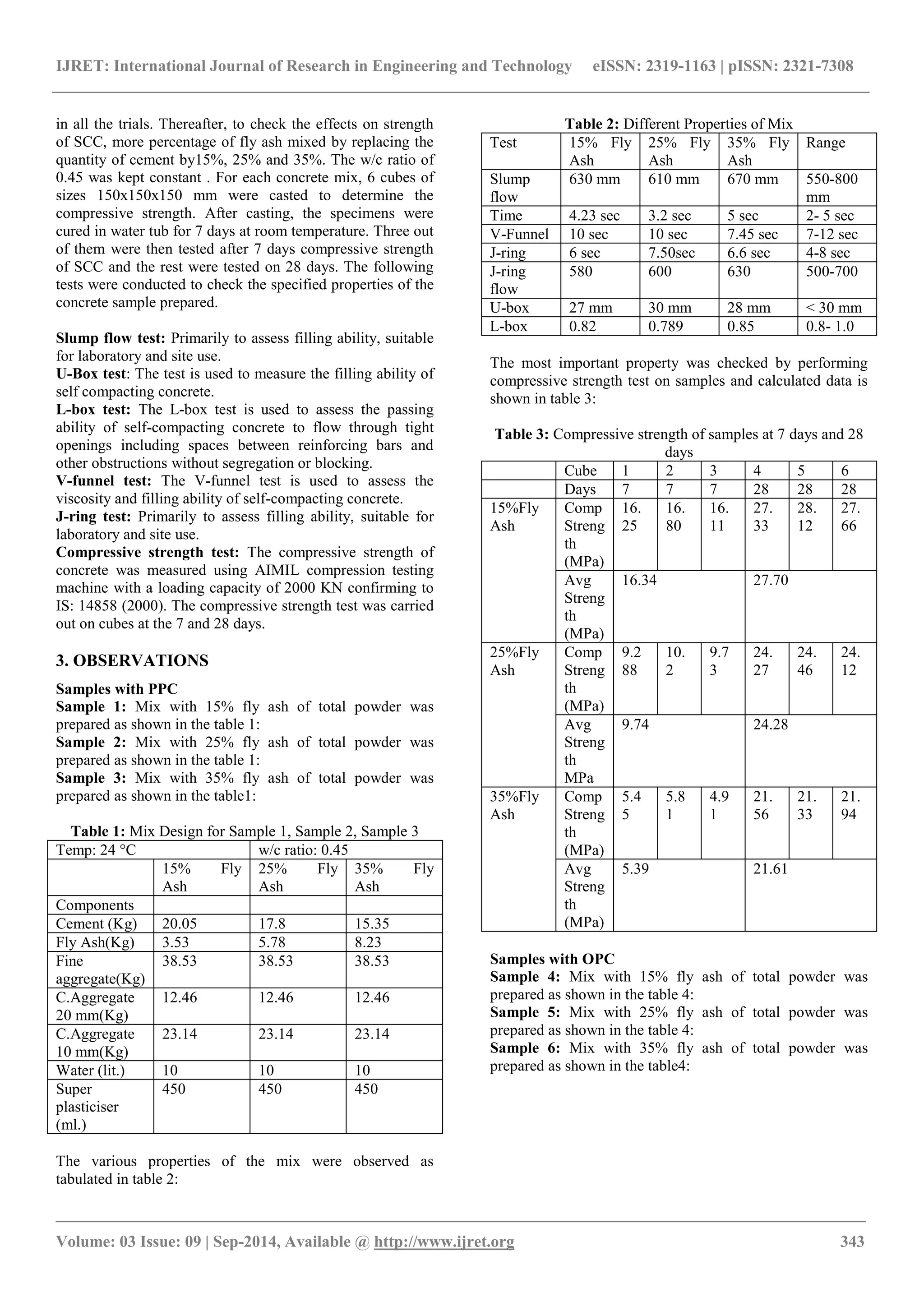
in all the trials. Thereafter, to check the effects on strength
of SCC, more percentage of fly ash mixed by replacing the
quantity of cement by15%, 25% and 35%. The w/c ratio of
0.45 was kept constant . For each concrete mix, 6 cubes of
sizes 150x150x150 mm were casted to determine the
compressive strength. After casting, the specimens were
cured in water tub for 7 days at room temperature. Three out
of them were then tested after 7 days compressive strength
of SCC and the rest were tested on 28 days. The following
tests were conducted to check the specified properties of the
concrete sample prepared.
Slump flow test: Primarily to assess filling ability, suitable
for laboratory and site use.
U-Box test: The test is used to measure the filling ability of
self compacting concrete.
L-box test: The L-box test is used to assess the passing
ability of self-compacting concrete to flow through tight
openings including spaces between reinforcing bars and
other obstructions without segregation or blocking.
V-funnel test: The V-funnel test is used to assess the
viscosity and filling ability of self-compacting concrete.
J-ring test: Primarily to assess filling ability, suitable for
laboratory and site use.
Compressive strength test: The compressive strength of
concrete was measured using AIMIL compression testing
machine with a loading capacity of 2000 KN confirming to
IS: 14858 (2000). The compressive strength test was carried
out on cubes at the 7 and 28 days.
3. OBSERVATIONS
Samples with PPC
Sample 1: Mix with 15% fly ash of total powder was
prepared as shown in the table 1:
Sample 2: Mix with 25% fly ash of total powder was
prepared as shown in the table 1:
Sample 3: Mix with 35% fly ash of total powder was
prepared as shown in the table1:
Table 1: Mix Design for Sample 1, Sample 2, Sample 3
Temp: 24 °C w/c ratio: 0.45
15% Fly
Ash
25% Fly
Ash
35% Fly
Ash
Components
Cement (Kg) 20.05 17.8 15.35
Fly Ash(Kg) 3.53 5.78 8.23
Fine
aggregate(Kg)
38.53 38.53 38.53
C.Aggregate
20 mm(Kg)
12.46 12.46 12.46
C.Aggregate
10 mm(Kg)
23.14 23.14 23.14
Water (lit.) 10 10 10
Super
plasticiser
(ml.)
450 450 450
The various properties of the mix were observed as
tabulated in table 2:
Table 2: Different Properties of Mix
Test 15% Fly
Ash
25% Fly
Ash
35% Fly
Ash
Range
Slump
flow
630 mm 610 mm 670 mm 550-800
mm
Time 4.23 sec 3.2 sec 5 sec 2- 5 sec
V-Funnel 10 sec 10 sec 7.45 sec 7-12 sec
J-ring 6 sec 7.50sec 6.6 sec 4-8 sec
J-ring
flow
580 600 630 500-700
U-box 27 mm 30 mm 28 mm < 30 mm
L-box 0.82 0.789 0.85 0.8- 1.0
The most important property was checked by performing
compressive strength test on samples and calculated data is
shown in table 3:
Table 3: Compressive strength of samples at 7 days and 28
days
Cube 1 2 3 4 5 6
Days 7 7 7 28 28 28
15%Fly
Ash
Comp
Streng
th
(MPa)
16.
25
16.
80
16.
11
27.
33
28.
12
27.
66
Avg
Streng
th
(MPa)
16.34 27.70
25%Fly
Ash
Comp
Streng
th
(MPa)
9.2
88
10.
2
9.7
3
24.
27
24.
46
24.
12
Avg
Streng
th
MPa
9.74 24.28
35%Fly
Ash
Comp
Streng
th
(MPa)
5.4
5
5.8
1
4.9
1
21.
56
21.
33
21.
94
Avg
Streng
th
(MPa)
5.39 21.61
Samples with OPC
Sample 4: Mix with 15% fly ash of total powder was
prepared as shown in the table 4:
Sample 5: Mix with 25% fly ash of total powder was
prepared as shown in the table 4:
Sample 6: Mix with 35% fly ash of total powder was
prepared as shown in the table4:
IJRET: International Journal of Research in Engineering and Technology eISSN: 2319-1163 | pISSN: 2321-7308
_______________________________________________________________________________________
Volume: 03 Issue: 09 | Sep-2014, Available @ http://www.ijret.org 344
Table 4: Mix Design for Sample 4, Sample 5, Sample 6
Temp: 24 °C w/c ratio: 0.45
15% Fly
Ash
25% Fly
Ash
35% Fly
Ash
Components
Cement (Kg) 20.05 17.8 15.35
Fly Ash(Kg) 3.53 5.78 8.23
Fine
aggregate(Kg)
38.53 38.53 38.53
C.Aggregate
20 mm(Kg)
12.46 12.46 12.46
C.Aggregate
10 mm(Kg)
23.14 23.14 23.14
Water (lit.) 10 10 10
Super
plasticiser
(ml.)
450 450 450
Table 5: Different Properties of Mix
Test 15% Fly
Ash
25% Fly
Ash
35% Fly
Ash
Range
Slump
flow
622 mm 627 mm 680 mm 550-800
mm
Time 4.41 sec 3.46 sec 4 sec 2- 5 sec
V-Funnel 9 sec 8.5 sec 7.45 sec 7-12 sec
J-ring 6 sec 7.50sec 6.6 sec 4-8 sec
J-ring
flow
595 600 620 500-700
U-box 27.5 mm 30 mm 28 mm < 30 mm
L-box 0.82 0.789 0.9 0.8- 1.0
Table 6: Compressive strength of samples at 7 days and 28
days
Cube 1 2 3 4 5 6
Days 7 7 7 28 28 28
15%F
lyAsh
Comp
Strength
(MPa)
19.
00
18.
80
18.
58
34.
53
33.
67
34.
16
Avg
Strength
(MPa)
18.79 34.12
25%F
lyAsh
Comp
Strength
(MPa)
12.
88
13.
10
12.
50
28.
27
27.
46
29.
12
Avg
Strength
MPa
12.82 28.28
35%F
lyAsh
Comp
Strength
(MPa)
8.7
6
8.1
0
9.8 23.
56
24.
13
23.
94
Avg
Strength
(MPa)
8.886 23.89
4. RESULTS AND DISCUSSIONS:
 The experimental study showed that the only
change in the mix lied with quantity of cement and
fly ash, so the results were dependent on the
compatibility of these two matters with each other.
The type of cement that was used belonged to PPC
which has some percentage of fly ash already in the
composition and OPC which has purely cement
without any addition of pozzolanic admixtures .
Any addition in fly ash content was going to result
in even higher percentage of the same actually
present in the mix.
 The observations showed that the results were
always within permissible range, anytime in any
mix, the critical value was not exceeded. Though
the results of different tests on OPC and PPC
showed different trends and patterns . The results
were randomly varied for different experiments and
different proportions.
 The compressive strength results of PPC sample
showed that after 7 days, the mix with least fly ash
content gained maximum strength which was
desired as per 67% of total characteristic strength.
The remaining samples gained very less strength in
first 7 days but started gaining after this time to 28
days time mainly because of secondary hydration
of lime which generally occurs in fly ash but the
overall strength gained even after 28 days was
maximum with least fly ash percentage content
than the rest. So it can be deduce that quantity of
fly ash should be kept around 15% of total powder
content in the given temperature and atmospheric
conditions at the above specified w/c ratio whereas
the compressive strength results of OPC samples
also showed that after 7 days and 28 days ,the mix
with least fly ash content gained maximum strength
but the average strength of OPC samples was much
higher than that of PPC samples in each
proportions of fly ash and the physical features of
PPC samples showed the evolvement of super-
plasticizers and moisture on samples which results
in reduction in strength whereas the samples casted
with OPC were dried and no moisture developed
over the surface of the samples and hence gave
higher strength.
REFERENCES
[1]. H. Okamura, Self-compacting high performance
concrete, ACI Concr Int, 19 (7) (1997), pp. 50–54
[2]. J.M. Campion, P. Jost, Self-compacting concrete:
expanding the possibility of concrete design and placement,
ACI Concr Int, 2 (4) (2000), pp. 31–34
[3]. K.W. Day, Concrete mix design, quality control and
specification, Taylor & Francis, New York (2006)
[4]. M. Kurita, T. Nomura, High-flowable steel fiber-
reinforced concrete containing fly ash, V.M. Malhotra (Ed.),
Proceedings of the sixth CANMET/ACI international
conference on fly ash, silica fume, slag, and natural
IJRET: International Journal of Research in Engineering and Technology eISSN: 2319-1163 | pISSN: 2321-7308
_______________________________________________________________________________________
Volume: 03 Issue: 09 | Sep-2014, Available @ http://www.ijret.org 345
pozzolans in concrete, SP-178, American Concrete Institute,
USA (1998), pp. 159–179
[5]. Å Skarendahl, Ö Petersson,Self-compacting concrete, Å
Skarendahl, Ö Petersson (Eds.), State-of-the-art report of
RILEM Technical Committee 174-SCC self-compacting
concrete, RILEM, Cachan Cedex, France (2001), pp. 25–39
[6]. Bartos PJM. Measurement of key properties of fresh
self-compacting concrete. In: Proceeding of CEN/STAR
PNR workshop on measurement, testing and
standardization: future needs in the field of construction
materials. Scotland: University of Paisley; 2000. (27.04.03).
[7]. http://www.differencebetween.net/object/difference-
between-opc-and-ppc/
BIOGRAPHIES
Name: Mohammad Kamran1
Pursuing M Tech in Earthquake
Engineering, Jamia Millia Islamia, New
Delhi, India
Contact no: +91-8447223179
Name: Mudit Mishra
Assistant Professor at Manavrachna
International University, Faridabad,
Haryana, India
Contact no: +91-9971898822

Behavior of self compacting concrete using ppc and opc with different proportions of fly ash

  • 1.
    IJRET: International Journalof Research in Engineering and Technology eISSN: 2319-1163 | pISSN: 2321-7308 _______________________________________________________________________________________ Volume: 03 Issue: 09 | Sep-2014, Available @ http://www.ijret.org 342 BEHAVIOR OF SELF-COMPACTING CONCRETE USING PPC AND OPC WITH DIFFERENT PROPORTIONS OF FLY ASH Mohammad Kamran1 , Mudit Mishra2 1 Student, Department of Civil Engineering, Jamia Millia Islamia, Jamia Nagar, New Delhi, India 2 Assistant Professor, Department of Civil Engineering, Manav Rachna International University, Delhi Surajkund Road, Aravalli Hills, Faridabad, Haryana, India Abstract Self compacting concrete has been playing vital role in the mass concreting nowadays especially in the structures where reinforcement used is very dense and in narrow tubular sections. This paper talks about its comparison in behavior using PPC and OPC with different proportions of fly ash in the mix which were taken as 15%, 25%, and 35% in place of cement. For one proportion, a set of 6 cubes was casted and the same was to be tested at 7 days and 28 days for strength. The temperature of sample cubes was kept constant at 24°C for the whole period. The mix design was done for M25 grade. The W/C ratio was kept constant at 0.45. The proportion of fine aggregates to coarse aggregates was kept at 70:30 and maximum size of aggregates was 20 mm. Total powder content was kept at 530 Kg/m3 . The quantity of super plasticizer was kept at 450 ml for the samples which was 1% of the total volume. The properties were checked by conducting slump test, J-Ring Test, L-Box Test, V-funnel Test, and U- Box Test with compressive strength test after 7 days and 28 days. The slump value was maximum for 35% replacement of cement with fly ash and lowest for 25% replacement in PPC mix whereas in OPC mix this value increased with increasing proportion of fly ash. V-funnel value was decreasing in both cases with increasing proportions of fly ash. J-ring value was highest for 25% replacement in both cases. U-box value was maximum for 25% replacement in both cases and showed almost the same trend. L- box value was lowest for 25% replacement in both cases and showed the same trend as in U-box test. The most important compressive strength test showed very surprising results. Only 15% replacement samples showed characteristic strength after 7 and 28 days whereas 25 % replacement samples gained only 55% of desired strength and 35% replacement samples gained only 33% of desired strength after 7 days and gained 92% and 80% of desired strength after 28 days respectively in PPC samples. The similar tests conducted on OPC samples showed the same pattern but overall strength gain was higher than PPC samples and the margin was spectacularly high ranging between 40%-60%. Keywords: Self Compacting Concrete, Fly Ash, V-Funnel, Slump Value, Compressive Strength --------------------------------------------------------------------***------------------------------------------------------------------ 1. INTRODUCTION Self-compacting concrete (SCC) has been described as "the most revolutionary development in concrete construction for several decades"(efnarc,2002). Self compacting concrete, a recent innovation has numerous advantages over conventional concrete. it can spread and fill all corners by means of itself weight only, thus eliminating the need of vibration for any type of consolidation effort[1]. originating in Japan[2] with a view to reduce the reliance on skilled workers and to enhance productivity of construction without compromising quality of concrete[3]. also known as self consolidating concrete, super workable concrete, no vibrating concrete[4]. It is flow able and deformable without segregation[1,4]. In order to maintain deformability along with flow ability in paste, a super plasticizer is an indispensable ingredient for such concrete. SCC typically has a higher content of fine particles and different flow properties than conventional plasticized concrete. It should have three essential properties: filling ability, resistance to segregation and passing ability. the mixture proportioning is based on creating a high degree of flow ability while maintaining a low w/c ratio. This is achieved by using water reducing admixture combined with stabilising agents such as viscosity modifying admixture to ensure homogeneity of mixture for reasons of achieving better rheological properties, reduction in cost, increase in powder content. A high amount of mineral admixture is typically used. Use of fly ash GGBFS, limestone powder increases fine materials in a concrete mixture[1] Self compacting concrete can be used in different components of structure even combined with narrow tubular sections. It was done by using different proportions of fly ash at constant temperature condition to see the settling by performing different tests on the samples first by using PPC and then by using OPC as main pozzolanic material. Generally PPC is an obvious choice for concrete mixes nowadays whereas OPC is being outdated despite showing better results because of financial aspects but selection was to be made between the two to see its behaviour in the manufacturing of SCC[7]. 2. EXPERIMENTAL STUDY Self compacting concrete with constant w/c ratio and quantity of super plasticizer (1%) was prepared as per the mix design for both the cases. The percentage of 20 mm aggregate was 30% and that of fine aggregate was 70%. The total powder content was kept constant equal to 530 Kg/M3
  • 2.
    IJRET: International Journalof Research in Engineering and Technology eISSN: 2319-1163 | pISSN: 2321-7308 _______________________________________________________________________________________ Volume: 03 Issue: 09 | Sep-2014, Available @ http://www.ijret.org 343 in all the trials. Thereafter, to check the effects on strength of SCC, more percentage of fly ash mixed by replacing the quantity of cement by15%, 25% and 35%. The w/c ratio of 0.45 was kept constant . For each concrete mix, 6 cubes of sizes 150x150x150 mm were casted to determine the compressive strength. After casting, the specimens were cured in water tub for 7 days at room temperature. Three out of them were then tested after 7 days compressive strength of SCC and the rest were tested on 28 days. The following tests were conducted to check the specified properties of the concrete sample prepared. Slump flow test: Primarily to assess filling ability, suitable for laboratory and site use. U-Box test: The test is used to measure the filling ability of self compacting concrete. L-box test: The L-box test is used to assess the passing ability of self-compacting concrete to flow through tight openings including spaces between reinforcing bars and other obstructions without segregation or blocking. V-funnel test: The V-funnel test is used to assess the viscosity and filling ability of self-compacting concrete. J-ring test: Primarily to assess filling ability, suitable for laboratory and site use. Compressive strength test: The compressive strength of concrete was measured using AIMIL compression testing machine with a loading capacity of 2000 KN confirming to IS: 14858 (2000). The compressive strength test was carried out on cubes at the 7 and 28 days. 3. OBSERVATIONS Samples with PPC Sample 1: Mix with 15% fly ash of total powder was prepared as shown in the table 1: Sample 2: Mix with 25% fly ash of total powder was prepared as shown in the table 1: Sample 3: Mix with 35% fly ash of total powder was prepared as shown in the table1: Table 1: Mix Design for Sample 1, Sample 2, Sample 3 Temp: 24 °C w/c ratio: 0.45 15% Fly Ash 25% Fly Ash 35% Fly Ash Components Cement (Kg) 20.05 17.8 15.35 Fly Ash(Kg) 3.53 5.78 8.23 Fine aggregate(Kg) 38.53 38.53 38.53 C.Aggregate 20 mm(Kg) 12.46 12.46 12.46 C.Aggregate 10 mm(Kg) 23.14 23.14 23.14 Water (lit.) 10 10 10 Super plasticiser (ml.) 450 450 450 The various properties of the mix were observed as tabulated in table 2: Table 2: Different Properties of Mix Test 15% Fly Ash 25% Fly Ash 35% Fly Ash Range Slump flow 630 mm 610 mm 670 mm 550-800 mm Time 4.23 sec 3.2 sec 5 sec 2- 5 sec V-Funnel 10 sec 10 sec 7.45 sec 7-12 sec J-ring 6 sec 7.50sec 6.6 sec 4-8 sec J-ring flow 580 600 630 500-700 U-box 27 mm 30 mm 28 mm < 30 mm L-box 0.82 0.789 0.85 0.8- 1.0 The most important property was checked by performing compressive strength test on samples and calculated data is shown in table 3: Table 3: Compressive strength of samples at 7 days and 28 days Cube 1 2 3 4 5 6 Days 7 7 7 28 28 28 15%Fly Ash Comp Streng th (MPa) 16. 25 16. 80 16. 11 27. 33 28. 12 27. 66 Avg Streng th (MPa) 16.34 27.70 25%Fly Ash Comp Streng th (MPa) 9.2 88 10. 2 9.7 3 24. 27 24. 46 24. 12 Avg Streng th MPa 9.74 24.28 35%Fly Ash Comp Streng th (MPa) 5.4 5 5.8 1 4.9 1 21. 56 21. 33 21. 94 Avg Streng th (MPa) 5.39 21.61 Samples with OPC Sample 4: Mix with 15% fly ash of total powder was prepared as shown in the table 4: Sample 5: Mix with 25% fly ash of total powder was prepared as shown in the table 4: Sample 6: Mix with 35% fly ash of total powder was prepared as shown in the table4:
  • 3.
    IJRET: International Journalof Research in Engineering and Technology eISSN: 2319-1163 | pISSN: 2321-7308 _______________________________________________________________________________________ Volume: 03 Issue: 09 | Sep-2014, Available @ http://www.ijret.org 344 Table 4: Mix Design for Sample 4, Sample 5, Sample 6 Temp: 24 °C w/c ratio: 0.45 15% Fly Ash 25% Fly Ash 35% Fly Ash Components Cement (Kg) 20.05 17.8 15.35 Fly Ash(Kg) 3.53 5.78 8.23 Fine aggregate(Kg) 38.53 38.53 38.53 C.Aggregate 20 mm(Kg) 12.46 12.46 12.46 C.Aggregate 10 mm(Kg) 23.14 23.14 23.14 Water (lit.) 10 10 10 Super plasticiser (ml.) 450 450 450 Table 5: Different Properties of Mix Test 15% Fly Ash 25% Fly Ash 35% Fly Ash Range Slump flow 622 mm 627 mm 680 mm 550-800 mm Time 4.41 sec 3.46 sec 4 sec 2- 5 sec V-Funnel 9 sec 8.5 sec 7.45 sec 7-12 sec J-ring 6 sec 7.50sec 6.6 sec 4-8 sec J-ring flow 595 600 620 500-700 U-box 27.5 mm 30 mm 28 mm < 30 mm L-box 0.82 0.789 0.9 0.8- 1.0 Table 6: Compressive strength of samples at 7 days and 28 days Cube 1 2 3 4 5 6 Days 7 7 7 28 28 28 15%F lyAsh Comp Strength (MPa) 19. 00 18. 80 18. 58 34. 53 33. 67 34. 16 Avg Strength (MPa) 18.79 34.12 25%F lyAsh Comp Strength (MPa) 12. 88 13. 10 12. 50 28. 27 27. 46 29. 12 Avg Strength MPa 12.82 28.28 35%F lyAsh Comp Strength (MPa) 8.7 6 8.1 0 9.8 23. 56 24. 13 23. 94 Avg Strength (MPa) 8.886 23.89 4. RESULTS AND DISCUSSIONS:  The experimental study showed that the only change in the mix lied with quantity of cement and fly ash, so the results were dependent on the compatibility of these two matters with each other. The type of cement that was used belonged to PPC which has some percentage of fly ash already in the composition and OPC which has purely cement without any addition of pozzolanic admixtures . Any addition in fly ash content was going to result in even higher percentage of the same actually present in the mix.  The observations showed that the results were always within permissible range, anytime in any mix, the critical value was not exceeded. Though the results of different tests on OPC and PPC showed different trends and patterns . The results were randomly varied for different experiments and different proportions.  The compressive strength results of PPC sample showed that after 7 days, the mix with least fly ash content gained maximum strength which was desired as per 67% of total characteristic strength. The remaining samples gained very less strength in first 7 days but started gaining after this time to 28 days time mainly because of secondary hydration of lime which generally occurs in fly ash but the overall strength gained even after 28 days was maximum with least fly ash percentage content than the rest. So it can be deduce that quantity of fly ash should be kept around 15% of total powder content in the given temperature and atmospheric conditions at the above specified w/c ratio whereas the compressive strength results of OPC samples also showed that after 7 days and 28 days ,the mix with least fly ash content gained maximum strength but the average strength of OPC samples was much higher than that of PPC samples in each proportions of fly ash and the physical features of PPC samples showed the evolvement of super- plasticizers and moisture on samples which results in reduction in strength whereas the samples casted with OPC were dried and no moisture developed over the surface of the samples and hence gave higher strength. REFERENCES [1]. H. Okamura, Self-compacting high performance concrete, ACI Concr Int, 19 (7) (1997), pp. 50–54 [2]. J.M. Campion, P. Jost, Self-compacting concrete: expanding the possibility of concrete design and placement, ACI Concr Int, 2 (4) (2000), pp. 31–34 [3]. K.W. Day, Concrete mix design, quality control and specification, Taylor & Francis, New York (2006) [4]. M. Kurita, T. Nomura, High-flowable steel fiber- reinforced concrete containing fly ash, V.M. Malhotra (Ed.), Proceedings of the sixth CANMET/ACI international conference on fly ash, silica fume, slag, and natural
  • 4.
    IJRET: International Journalof Research in Engineering and Technology eISSN: 2319-1163 | pISSN: 2321-7308 _______________________________________________________________________________________ Volume: 03 Issue: 09 | Sep-2014, Available @ http://www.ijret.org 345 pozzolans in concrete, SP-178, American Concrete Institute, USA (1998), pp. 159–179 [5]. Å Skarendahl, Ö Petersson,Self-compacting concrete, Å Skarendahl, Ö Petersson (Eds.), State-of-the-art report of RILEM Technical Committee 174-SCC self-compacting concrete, RILEM, Cachan Cedex, France (2001), pp. 25–39 [6]. Bartos PJM. Measurement of key properties of fresh self-compacting concrete. In: Proceeding of CEN/STAR PNR workshop on measurement, testing and standardization: future needs in the field of construction materials. Scotland: University of Paisley; 2000. (27.04.03). [7]. http://www.differencebetween.net/object/difference- between-opc-and-ppc/ BIOGRAPHIES Name: Mohammad Kamran1 Pursuing M Tech in Earthquake Engineering, Jamia Millia Islamia, New Delhi, India Contact no: +91-8447223179 Name: Mudit Mishra Assistant Professor at Manavrachna International University, Faridabad, Haryana, India Contact no: +91-9971898822