Becoming a Better
    Problem Solver:
    A CS Perspective

             Melvin Zhang
           melvinzhang.net
      http://www.slideshare.net/melvinzhang/
becoming-a-better-problem-solver-a-cs-perspective


            January 20, 2012
Becoming a Better Problem Solver:
A CS Perspective
Outline

  What is problem solving?

  Strategies and tactics
      Getting started (Strategies)
      Making progress (Tactics)

  Summary

  What I’m working on
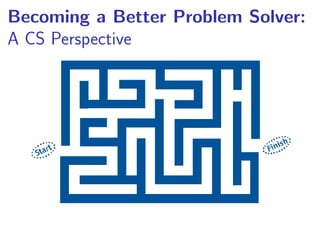
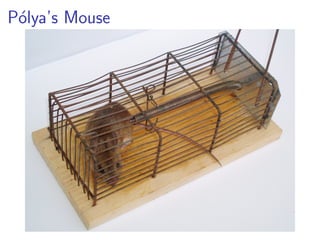
P´lya’s Mouse
 o
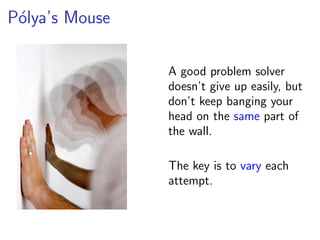
P´lya’s Mouse
 o

                A good problem solver
                doesn’t give up easily, but
                don’t keep banging your
                head on the same part of
                the wall.

                The key is to vary each
                attempt.
References
References
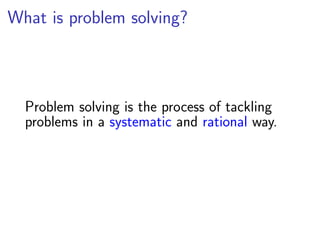
What is problem solving?


  Problem solving is the process of tackling
  problems in a systematic and rational way.
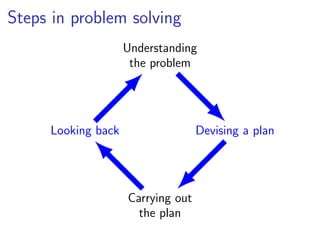
Steps in problem solving
                    Understanding
                     the problem


     Looking back                  Devising a plan


                    Carrying out
                      the plan
Outline

  What is problem solving?

  Strategies and tactics
      Getting started (Strategies)
      Making progress (Tactics)

  Summary

  What I’m working on
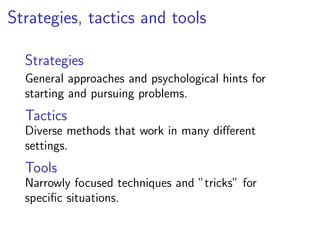
Strategies, tactics and tools

  Strategies
  General approaches and psychological hints for
  starting and pursuing problems.
  Tactics
  Diverse methods that work in many different
  settings.
  Tools
  Narrowly focused techniques and ”tricks” for
  specific situations.
Outline

  What is problem solving?

  Strategies and tactics
      Getting started (Strategies)
      Making progress (Tactics)

  Summary

  What I’m working on
Strategy 1. Get your hands dirty
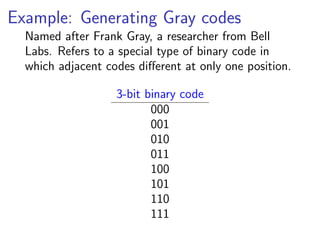
Example: Generating Gray codes
  Named after Frank Gray, a researcher from Bell
  Labs. Refers to a special type of binary code in
  which adjacent codes different at only one position.

                   3-bit binary code
                          000
                          001
                          010
                          011
                          100
                          101
                          110
                          111
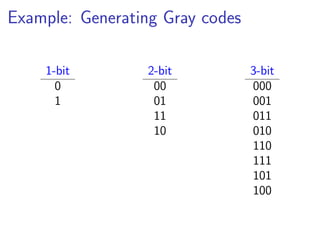
Example: Generating Gray codes

    1-bit         2-bit          3-bit
      0            00            000
      1            01            001
                   11            011
                   10            010
                                 110
                                 111
                                 101
                                 100
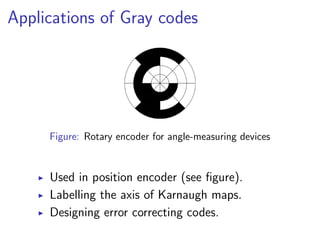
Applications of Gray codes


     Figure: Rotary encoder for angle-measuring devices


     Used in position encoder (see figure).
     Labelling the axis of Karnaugh maps.
     Designing error correcting codes.
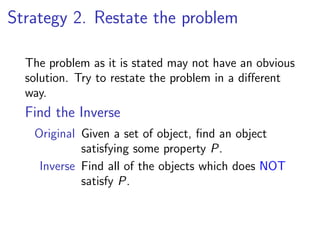
Strategy 2. Restate the problem

  The problem as it is stated may not have an obvious
  solution. Try to restate the problem in a different
  way.
  Find the Inverse
   Original Given a set of object, find an object
            satisfying some property P.
    Inverse Find all of the objects which does NOT
            satisfy P.
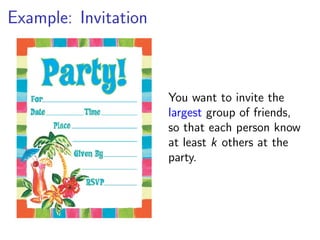
Example: Invitation


                      You want to invite the
                      largest group of friends,
                      so that each person know
                      at least k others at the
                      party.
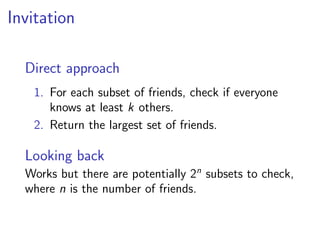
Invitation

  Direct approach
   1. For each subset of friends, check if everyone
      knows at least k others.
   2. Return the largest set of friends.

  Looking back
  Works but there are potentially 2n subsets to check,
  where n is the number of friends.
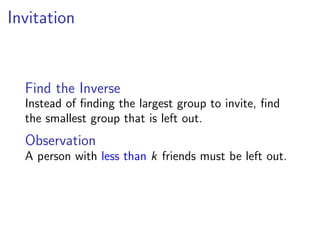
Invitation


  Find the Inverse
  Instead of finding the largest group to invite, find
  the smallest group that is left out.
  Observation
  A person with less than k friends must be left out.
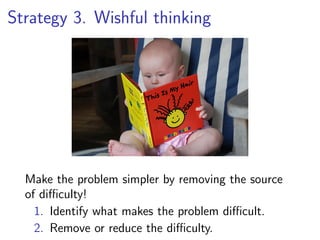
Strategy 3. Wishful thinking


  Make the problem simpler by removing the source
  of difficulty!
    1. Identify what makes the problem difficult.
    2. Remove or reduce the difficulty.
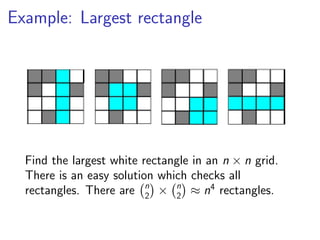
Example: Largest rectangle


  Find the largest white rectangle in an n × n grid.
  There is an easy solution which checks all
  rectangles. There are n × n ≈ n4 rectangles.
                          2    2
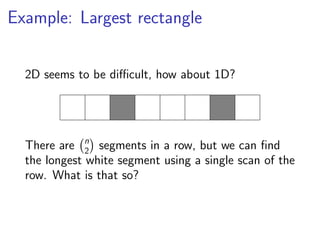
Example: Largest rectangle


  2D seems to be difficult, how about 1D?


  There are n segments in a row, but we can find
              2
  the longest white segment using a single scan of the
  row. What is that so?
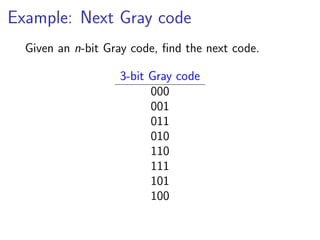
Example: Next Gray code
  Given an n-bit Gray code, find the next code.

                   3-bit Gray code
                         000
                         001
                         011
                         010
                         110
                         111
                         101
                         100
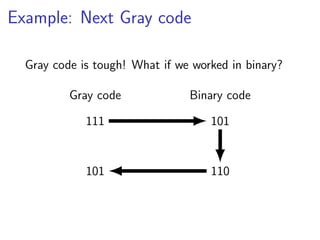
Example: Next Gray code

  Gray code is tough! What if we worked in binary?

          Gray code             Binary code

             111                    101


             101                    110
Outline

  What is problem solving?

  Strategies and tactics
      Getting started (Strategies)
      Making progress (Tactics)

  Summary

  What I’m working on
Making progress
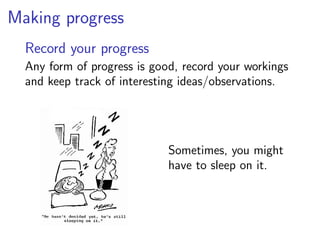
  Record your progress
  Any form of progress is good, record your workings
  and keep track of interesting ideas/observations.


                             Sometimes, you might
                             have to sleep on it.
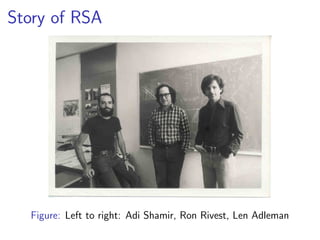
Story of RSA


  Figure: Left to right: Adi Shamir, Ron Rivest, Len Adleman
Tactic 1. Extremal principle


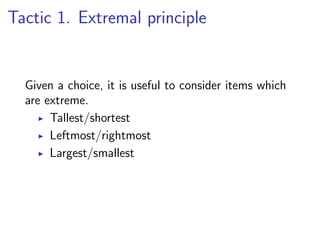
  Given a choice, it is useful to consider items which
  are extreme.
       Tallest/shortest
       Leftmost/rightmost
       Largest/smallest
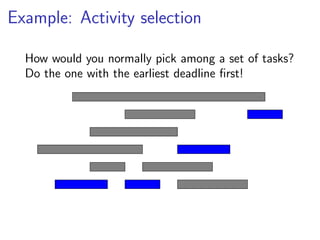
Example: Activity selection
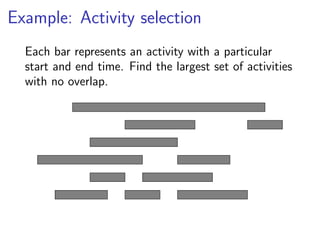
  Each bar represents an activity with a particular
  start and end time. Find the largest set of activities
  with no overlap.
Example: Activity selection
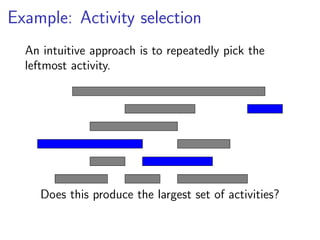
  An intuitive approach is to repeatedly pick the
  leftmost activity.


     Does this produce the largest set of activities?
Example: Activity selection

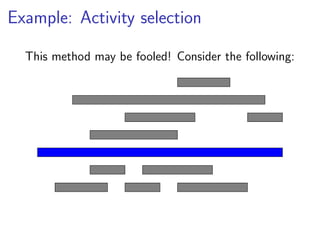
  This method may be fooled! Consider the following:
Example: Activity selection

  How would you normally pick among a set of tasks?
  Do the one with the earliest deadline first!
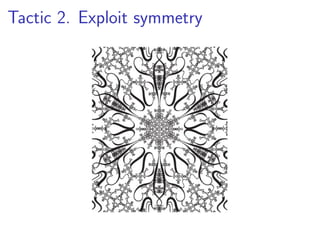
Tactic 2. Exploit symmetry
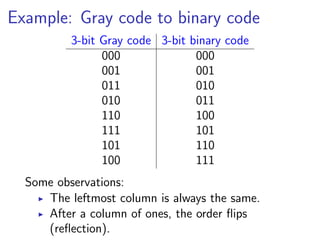
Example: Gray code to binary code
          3-bit Gray code 3-bit binary code
                000              000
                001              001
                011              010
                010              011
                110              100
                111              101
                101              110
                100              111
  Some observations:
     The leftmost column is always the same.
     After a column of ones, the order flips
     (reflection).
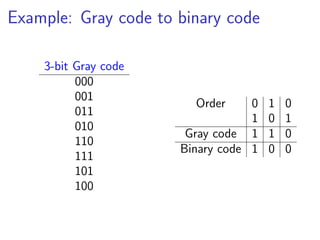
Example: Gray code to binary code

    3-bit Gray code
          000
          001
                        Order     0   1   0
          011
                                  1   0   1
          010
                       Gray code 1    1   0
          110
                      Binary code 1   0   0
          111
          101
          100
Tactic 3. Space-time tradeoff


  Trading space for time: lookup tables, caching
  Trading time for space: recalculation
Example: Computing segment sums

  Given an array A of integers, compute the sum of
  any segment A[i, j] efficiently.

               6 4 -3 0 5 1 8 7

  For example,
       A[1, 3] = 6 + 4 + −3 = 7
       A[3, 7] = −3 + 0 + 5 + 1 + 8 = 11
Example: Computing segment sums

  Wishful thinking Computing for any segment A[i, j]
             is difficult, what if we consider only
             segments of the form A[1, j]?
  Space-time tradeoff Sums for A[1, j] can be
             precomputed and stored in a another
             array P

          A 6 4 -3 0 5 1 8 7
          P 6 10 7 7 12 13 24 31
Example: Computing segment sums


          A 6 4 -3 0 5 1 8 7
          P 6 10 7 7 12 13 24 31

  Observation
  The sum for A[i, j] can be computed as
  P[j] − P[i] + A[i].
Example: Computing segment sums


  Looking back
     What is special about sum?
     Does this work with max/min? If not, can the
     idea be adapted?
Outline

  What is problem solving?

  Strategies and tactics
      Getting started (Strategies)
      Making progress (Tactics)

  Summary

  What I’m working on
Strategies and tactics


 Strategies                 Tactics
  1. Get your hands dirty    1. Extremal principle
  2. Restate the problem     2. Exploit symmetry
  3. Wishful thinking        3. Space-time tradeoff
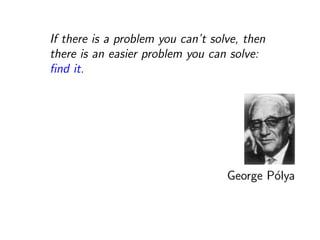
If there is a problem you can’t solve, then
there is an easier problem you can solve:
find it.


                                   George P´lya
                                           o
Outline

  What is problem solving?

  Strategies and tactics
      Getting started (Strategies)
      Making progress (Tactics)

  Summary

  What I’m working on
developer.hoiio.com
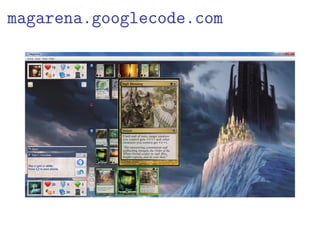
magarena.googlecode.com

Becoming a better problem solver: a CS perspective

  • 1.
    Becoming a Better Problem Solver: A CS Perspective Melvin Zhang melvinzhang.net http://www.slideshare.net/melvinzhang/ becoming-a-better-problem-solver-a-cs-perspective January 20, 2012
  • 2.
    Becoming a BetterProblem Solver: A CS Perspective
  • 3.
    Outline Whatis problem solving? Strategies and tactics Getting started (Strategies) Making progress (Tactics) Summary What I’m working on
  • 4.
  • 5.
    P´lya’s Mouse o A good problem solver doesn’t give up easily, but don’t keep banging your head on the same part of the wall. The key is to vary each attempt.
  • 6.
  • 7.
  • 8.
    What is problemsolving? Problem solving is the process of tackling problems in a systematic and rational way.
  • 9.
    Steps in problemsolving Understanding the problem Looking back Devising a plan Carrying out the plan
  • 10.
    Outline Whatis problem solving? Strategies and tactics Getting started (Strategies) Making progress (Tactics) Summary What I’m working on
  • 11.
    Strategies, tactics andtools Strategies General approaches and psychological hints for starting and pursuing problems. Tactics Diverse methods that work in many different settings. Tools Narrowly focused techniques and ”tricks” for specific situations.
  • 12.
    Outline Whatis problem solving? Strategies and tactics Getting started (Strategies) Making progress (Tactics) Summary What I’m working on
  • 13.
    Strategy 1. Getyour hands dirty
  • 14.
    Example: Generating Graycodes Named after Frank Gray, a researcher from Bell Labs. Refers to a special type of binary code in which adjacent codes different at only one position. 3-bit binary code 000 001 010 011 100 101 110 111
  • 15.
    Example: Generating Graycodes 1-bit 2-bit 3-bit 0 00 000 1 01 001 11 011 10 010 110 111 101 100
  • 16.
    Applications of Graycodes Figure: Rotary encoder for angle-measuring devices Used in position encoder (see figure). Labelling the axis of Karnaugh maps. Designing error correcting codes.
  • 17.
    Strategy 2. Restatethe problem The problem as it is stated may not have an obvious solution. Try to restate the problem in a different way. Find the Inverse Original Given a set of object, find an object satisfying some property P. Inverse Find all of the objects which does NOT satisfy P.
  • 18.
    Example: Invitation You want to invite the largest group of friends, so that each person know at least k others at the party.
  • 19.
    Invitation Directapproach 1. For each subset of friends, check if everyone knows at least k others. 2. Return the largest set of friends. Looking back Works but there are potentially 2n subsets to check, where n is the number of friends.
  • 20.
    Invitation Findthe Inverse Instead of finding the largest group to invite, find the smallest group that is left out. Observation A person with less than k friends must be left out.
  • 21.
    Strategy 3. Wishfulthinking Make the problem simpler by removing the source of difficulty! 1. Identify what makes the problem difficult. 2. Remove or reduce the difficulty.
  • 22.
    Example: Largest rectangle Find the largest white rectangle in an n × n grid. There is an easy solution which checks all rectangles. There are n × n ≈ n4 rectangles. 2 2
  • 23.
    Example: Largest rectangle 2D seems to be difficult, how about 1D? There are n segments in a row, but we can find 2 the longest white segment using a single scan of the row. What is that so?
  • 24.
    Example: Next Graycode Given an n-bit Gray code, find the next code. 3-bit Gray code 000 001 011 010 110 111 101 100
  • 25.
    Example: Next Graycode Gray code is tough! What if we worked in binary? Gray code Binary code 111 101 101 110
  • 26.
    Outline Whatis problem solving? Strategies and tactics Getting started (Strategies) Making progress (Tactics) Summary What I’m working on
  • 27.
    Making progress Record your progress Any form of progress is good, record your workings and keep track of interesting ideas/observations. Sometimes, you might have to sleep on it.
  • 28.
    Story of RSA Figure: Left to right: Adi Shamir, Ron Rivest, Len Adleman
  • 29.
    Tactic 1. Extremalprinciple Given a choice, it is useful to consider items which are extreme. Tallest/shortest Leftmost/rightmost Largest/smallest
  • 30.
    Example: Activity selection Each bar represents an activity with a particular start and end time. Find the largest set of activities with no overlap.
  • 31.
    Example: Activity selection An intuitive approach is to repeatedly pick the leftmost activity. Does this produce the largest set of activities?
  • 32.
    Example: Activity selection This method may be fooled! Consider the following:
  • 33.
    Example: Activity selection How would you normally pick among a set of tasks? Do the one with the earliest deadline first!
  • 34.
  • 35.
    Example: Gray codeto binary code 3-bit Gray code 3-bit binary code 000 000 001 001 011 010 010 011 110 100 111 101 101 110 100 111 Some observations: The leftmost column is always the same. After a column of ones, the order flips (reflection).
  • 36.
    Example: Gray codeto binary code 3-bit Gray code 000 001 Order 0 1 0 011 1 0 1 010 Gray code 1 1 0 110 Binary code 1 0 0 111 101 100
  • 37.
    Tactic 3. Space-timetradeoff Trading space for time: lookup tables, caching Trading time for space: recalculation
  • 38.
    Example: Computing segmentsums Given an array A of integers, compute the sum of any segment A[i, j] efficiently. 6 4 -3 0 5 1 8 7 For example, A[1, 3] = 6 + 4 + −3 = 7 A[3, 7] = −3 + 0 + 5 + 1 + 8 = 11
  • 39.
    Example: Computing segmentsums Wishful thinking Computing for any segment A[i, j] is difficult, what if we consider only segments of the form A[1, j]? Space-time tradeoff Sums for A[1, j] can be precomputed and stored in a another array P A 6 4 -3 0 5 1 8 7 P 6 10 7 7 12 13 24 31
  • 40.
    Example: Computing segmentsums A 6 4 -3 0 5 1 8 7 P 6 10 7 7 12 13 24 31 Observation The sum for A[i, j] can be computed as P[j] − P[i] + A[i].
  • 41.
    Example: Computing segmentsums Looking back What is special about sum? Does this work with max/min? If not, can the idea be adapted?
  • 42.
    Outline Whatis problem solving? Strategies and tactics Getting started (Strategies) Making progress (Tactics) Summary What I’m working on
  • 43.
    Strategies and tactics Strategies Tactics 1. Get your hands dirty 1. Extremal principle 2. Restate the problem 2. Exploit symmetry 3. Wishful thinking 3. Space-time tradeoff
  • 44.
    If there isa problem you can’t solve, then there is an easier problem you can solve: find it. George P´lya o
  • 45.
    Outline Whatis problem solving? Strategies and tactics Getting started (Strategies) Making progress (Tactics) Summary What I’m working on
  • 46.
  • 47.