BECOME A
SUCCESSFUL DATA
SCIENTIST. START
NOW!
Data scientists are in high demand right now because the discipline is one of the most spoken about.
Data scientists are responsible for everything from building self-driving vehicles to automatically
annotating pictures, and for good reason. Given all the fascinating applications, it seems natural that a
Master’s in Data Science can land you a job in data science, which is extremely in-demand.
In order to improve customer service and their financial results, businesses all over the world have long
gathered and analysed data about their customers. We are able to collect enormous amounts of data in
today's digital environment, necessitating the use of non-conventional software and data processing
techniques.
Who is a Data Scientist?
​​A professional with expertise in data analysis and interpretation or a Certification in Data Science is
known as a data scientist. They assist firms make better decisions and run more efficiently by utilising
their data science expertise.
Data scientists frequently come from backgrounds in computer science, statistics, and mathematics. They
evaluate huge data sets using this knowledge to look for trends or patterns. Additionally, data scientists
might create novel techniques for gathering and storing data.
Prerequisites of becoming a successful Data Scientist
Although there is no one particular path to becoming a data scientist, apart from having a Data Science Degree,
the following beneficial prerequisites or experiences can increase your chances of doing so.
• Solid knowledge of mathematics and computer science
• Working knowledge of big data sets
• Knowledge of statistical modelling and machine learning
• Powerful visualisation and communication abilities
• An eagerness to learn
Skills required to become a data scientist
To become a data scientist, you’ll need to master skills in the following areas, apart from having done an
MBA in Data Science or having any Data Science Certification.
 Skill 1: Acquire database knowledge necessary for storing and analysing data using programmes like
Oracle, Teradata, Microsoft SQL Server, MySQL, and Database.
 Skill 2: Gain knowledge of statistics, probability, and mathematical analysis to aid in the creation and
study of techniques for gathering, analysing, interpreting, and presenting empirical data. You should
also gain knowledge of the area of mathematics that deals with limits and related theories, including
differentiation, integration, measure, infinite series, and analytic functions.
 Skill 3: Be able to programme in at least one language. The use of programming languages like R,
Python, and SAS is crucial for conducting data analytics.
 Skill 4: Learn data wrangling, which is organising, cleaning, and manipulating data. R, Python,
Flume, and Scoop are well-liked data-wrangling tools.
 Skill 5: Understand the principles of machine learning. Giving systems the capacity to autonomously
learn from experience and get better without being specifically programmed to.
 Skill 6: Having practical experience with big data tools like Apache Spark, Hadoop, Talend, and
Tableau, which are used to handle huge and complex data that can't be handled with conventional
data processing applications.
 Skill 7: Improve your capacity to visualise outcomes. By combining several data sets and producing a
visual representation of the findings using diagrams, charts, and graphs, data visualisation
Careers in Data Science
Once you have acquired these skills, and you have done a PG in Data Science, a myriad of employment
options, including Data Architect and Administrators, Data Engineer, Data Analyst, Data Scientist,
Machine Learning Engineer, Statisticians and Mathematicians, Business IT Analyst, Marketing Analyst.
THANK YOU
Follow us on Social Media
Comment. Share. Inspire.
JOIN OUR COMMUNITY

Become a successful Data Scientist. Start Now!

  • 1.
  • 2.
    Data scientists arein high demand right now because the discipline is one of the most spoken about. Data scientists are responsible for everything from building self-driving vehicles to automatically annotating pictures, and for good reason. Given all the fascinating applications, it seems natural that a Master’s in Data Science can land you a job in data science, which is extremely in-demand. In order to improve customer service and their financial results, businesses all over the world have long gathered and analysed data about their customers. We are able to collect enormous amounts of data in today's digital environment, necessitating the use of non-conventional software and data processing techniques.
  • 3.
    Who is aData Scientist? ​​A professional with expertise in data analysis and interpretation or a Certification in Data Science is known as a data scientist. They assist firms make better decisions and run more efficiently by utilising their data science expertise. Data scientists frequently come from backgrounds in computer science, statistics, and mathematics. They evaluate huge data sets using this knowledge to look for trends or patterns. Additionally, data scientists might create novel techniques for gathering and storing data.
  • 4.
    Prerequisites of becominga successful Data Scientist Although there is no one particular path to becoming a data scientist, apart from having a Data Science Degree, the following beneficial prerequisites or experiences can increase your chances of doing so. • Solid knowledge of mathematics and computer science • Working knowledge of big data sets • Knowledge of statistical modelling and machine learning • Powerful visualisation and communication abilities • An eagerness to learn
  • 5.
    Skills required tobecome a data scientist To become a data scientist, you’ll need to master skills in the following areas, apart from having done an MBA in Data Science or having any Data Science Certification.  Skill 1: Acquire database knowledge necessary for storing and analysing data using programmes like Oracle, Teradata, Microsoft SQL Server, MySQL, and Database.  Skill 2: Gain knowledge of statistics, probability, and mathematical analysis to aid in the creation and study of techniques for gathering, analysing, interpreting, and presenting empirical data. You should also gain knowledge of the area of mathematics that deals with limits and related theories, including differentiation, integration, measure, infinite series, and analytic functions.
  • 6.
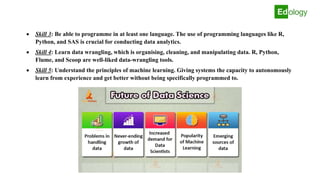
     Skill 3:Be able to programme in at least one language. The use of programming languages like R, Python, and SAS is crucial for conducting data analytics.  Skill 4: Learn data wrangling, which is organising, cleaning, and manipulating data. R, Python, Flume, and Scoop are well-liked data-wrangling tools.  Skill 5: Understand the principles of machine learning. Giving systems the capacity to autonomously learn from experience and get better without being specifically programmed to.
  • 7.
     Skill 6:Having practical experience with big data tools like Apache Spark, Hadoop, Talend, and Tableau, which are used to handle huge and complex data that can't be handled with conventional data processing applications.  Skill 7: Improve your capacity to visualise outcomes. By combining several data sets and producing a visual representation of the findings using diagrams, charts, and graphs, data visualisation
  • 8.
    Careers in DataScience Once you have acquired these skills, and you have done a PG in Data Science, a myriad of employment options, including Data Architect and Administrators, Data Engineer, Data Analyst, Data Scientist, Machine Learning Engineer, Statisticians and Mathematicians, Business IT Analyst, Marketing Analyst.
  • 9.
    THANK YOU Follow uson Social Media Comment. Share. Inspire. JOIN OUR COMMUNITY