Business Ethics and Governance 
SUBMITED BY 
D.TULASI
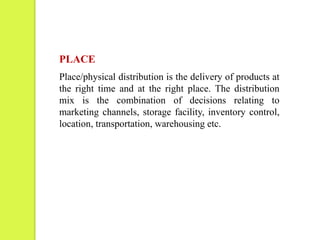
PLACE 
Place/physical distribution is the delivery of products at 
the right time and at the right place. The distribution 
mix is the combination of decisions relating to 
marketing channels, storage facility, inventory control, 
location, transportation, warehousing etc.
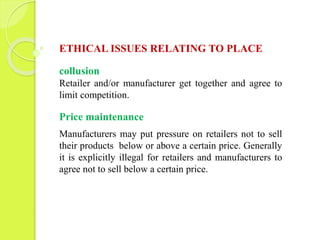
ETHICAL ISSUES RELATING TO PLACE 
collusion 
Retailer and/or manufacturer get together and agree to 
limit competition. 
Price maintenance 
Manufacturers may put pressure on retailers not to sell 
their products below or above a certain price. Generally 
it is explicitly illegal for retailers and manufacturers to 
agree not to sell below a certain price.
Territorial restrictions 
Firms may be allowed to operate only in selected territory. 
Tying 
 Here, the customer may required to buy two products even 
if he or she only wants to one. Firms may want to engage 
in this activity if they have a monopoly - like situation for 
one product but face competition for another. 
 Tying is legal under some circumstances when it is deemed 
to be reasonable but can be illegal if it is abusive and 
serves no legitimate purpose.
Dual distribution 
A producer can use two different channels to reach target 
market and put independent distributor out of business. 
Preferential treatment/ secretive behavior 
This is a situation that develops when a manufacturer has 
more than one authorized distributor in a territory. 
Manufacturer may sometimes prefer one distributor over 
the other. Those kind of actions are damaging, disruptive, 
and illegal.
Full line forcing 
This is a situation were a channel member is required to carry 
a supplier’s entire product line to obtain any of its products. 
Refusal to deal 
Suppliers can choose their distributors and refuse to deal with 
others if their decisions are not based on anti-competitive 
motives or are not part of an organized refusal to deal with 
certain channel members.
Exclusive dealing 
Forbidding an intermediary to carry products of a 
competing manufacturer is anticompetitive if: 
 It blocks competitors from 10 percent of market. 
 Sales revenues are sizable. 
 The manufacturer is larger than dealer.
busness ethics ppt

busness ethics ppt

  • 1.
    Business Ethics andGovernance SUBMITED BY D.TULASI
  • 2.
    PLACE Place/physical distributionis the delivery of products at the right time and at the right place. The distribution mix is the combination of decisions relating to marketing channels, storage facility, inventory control, location, transportation, warehousing etc.
  • 3.
    ETHICAL ISSUES RELATINGTO PLACE collusion Retailer and/or manufacturer get together and agree to limit competition. Price maintenance Manufacturers may put pressure on retailers not to sell their products below or above a certain price. Generally it is explicitly illegal for retailers and manufacturers to agree not to sell below a certain price.
  • 4.
    Territorial restrictions Firmsmay be allowed to operate only in selected territory. Tying  Here, the customer may required to buy two products even if he or she only wants to one. Firms may want to engage in this activity if they have a monopoly - like situation for one product but face competition for another.  Tying is legal under some circumstances when it is deemed to be reasonable but can be illegal if it is abusive and serves no legitimate purpose.
  • 5.
    Dual distribution Aproducer can use two different channels to reach target market and put independent distributor out of business. Preferential treatment/ secretive behavior This is a situation that develops when a manufacturer has more than one authorized distributor in a territory. Manufacturer may sometimes prefer one distributor over the other. Those kind of actions are damaging, disruptive, and illegal.
  • 6.
    Full line forcing This is a situation were a channel member is required to carry a supplier’s entire product line to obtain any of its products. Refusal to deal Suppliers can choose their distributors and refuse to deal with others if their decisions are not based on anti-competitive motives or are not part of an organized refusal to deal with certain channel members.
  • 7.
    Exclusive dealing Forbiddingan intermediary to carry products of a competing manufacturer is anticompetitive if:  It blocks competitors from 10 percent of market.  Sales revenues are sizable.  The manufacturer is larger than dealer.