36 Dressage Today December 2016
LindsayPaulsenCourtesy,SarahBabineauCourtesy,SarahBabineau
LindsayPaulsen
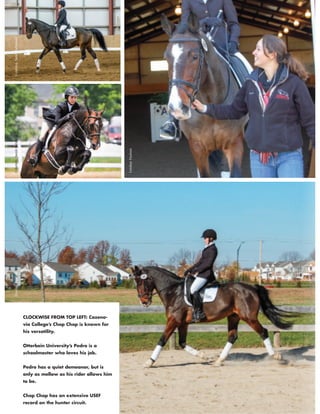
CLOCKWISE FROM TOP LEFT: Cazeno-
via College’s Chop Chop is known for
his versatility.
Otterbein University’s Pedro is a
schoolmaster who loves his job.
Pedro has a quiet demeanor, but is
only as mellow as his rider allows him
to be.
Chop Chop has an extensive USEF
record on the hunter circuit.
December 2016 Dressage Today 37
Colleges and universities reflect on their special horses
as key players in the world of Intercollegiate Dressage.
By Kimberlyn Beaudoin
I
t was a cool April morning in Hackettstown, New Jersey. The first day of the 2016 Intercollegiate
Dressage Association (IDA) National Championships was about to begin and my teammates
and I were taking the Cazenovia College horses for a walk around the grounds to stretch their
legs. As we moved past a crowd of young, eager equestrians, one of them called out to me: “Is
that Chop Chop?” It was a question that I would grow accustomed to nodding my head “yes”
to when asked throughout the weekend. I had a small notion that the horse I was handling was an
equine celebrity of sorts.
The IDA was founded in 1995, and began as an informal competition among a group of north-
eastern colleges and secondary schools. It later spread to other regions of the country as well as to
Canada. In 2003, the IDA became a college-only organization. Today it has over 500 competing
members from more than 50 colleges and universities. Intercollegiate dressage competition involves
catch-riding, and riders will travel as a team to one particular school and ride its horses for each
show. Riders get a 10-minute warm-up period with the horse and then are sent into the ring to ride
their test. Many schools actively participate in running these horse shows, as they are the backbone
The IDA School Horse:
A
of its
Breed
Own
38 Dressage Today December 2016
Courtesy,GingerHenderson
Courtesy,SarahHollander
of the IDA.
IDA horses are a breed all of their
own. They tend to be levelheaded and
patient horses, always willing to play
the game. They are good at their jobs
and show up ready to do the very best
they can. Without wonderful horses like
Chop Chop, collegiate dressage would
not be possible. Here we recognize some
of these equine athletes in the same way
that we so often recognize their riders.
Cazenovia College’s Chop Chop
Located in Cazenovia, New York, Caze-
novia College’s 240-acre Equine Educa-
tion Center houses around 70 horses
as well as the management program’s
equine business specialization and the
intercollegiate equestrian team. The
center is also home to the famed gelding
Chop Chop.
At 18 years old, the Dutch Warm-
blood still has a lot of giddy-up and go.
He does it all, from dressage and jump-
ers to participating in hunt-seat lessons
and shows. Before arriving at Cazenovia,
the 15.3-hand bay competed in the
Low Adult hunters as well as the Adult
Amateur hunters. His hefty USEF record
lists accomplishments in the ring rang-
ing from 3-Foot Pre-Green Hunter to the
United States Hunter Jumper Association
(USHJA) National Hunter Derby. Com-
petition venues on his resume include
the Winter Equestrian Festival in Wel-
lington, Florida, Hits on the Hudson and
Lake Placid, New York.
Cazenovia College senior Alex Belton
spent the 2016 spring semester riding
Chop Chop two days a week in an ad-
vanced dressage lesson. “Chops” is the
type of horse who you must continuous-
ly ride every stride in your work session.
He gets easily distracted by other horses
or things he sees in the barn aisles, but
he is always eager to please.” Belton
says that he can throw a little bit of an
attitude into his routine at times and
is always seen in the ring with one ear
forward and one ear back, always pay-
ing attention to his surroundings. “It is
customary after every ride for the horses
to get peppermints, and he definitely
knows that is coming,” says Belton. “He
gets very excited about it. He always
needs to be the first one in line for his
treat! He’s a very smart guy.” Some of
Chop Chop’s most recent accomplish-
ments include 2014 Intercollegiate
Horse Show Association (IHSA) National
Championships High Point Horse of the
Horse Show, 2015 Judges’ Choice at the
IHSA National Championships, 2015
IHSA National Championships Cac-
chione Cup Winner as well as two 2016
IDA National Championships Individual
and Team Championship wins at Upper
Training Level. Chop Chop stands out
with his versatility and personality, two
traits that make the college grateful for
this equine.
Otterbein University’s Pedro
Otterbein University, located in Wester-
ville, Ohio, is home to 35 school horses,
all vital members of the equine science
department. The university also partici-
pates in the IDA and IHSA. “The eques-
trian team at Otterbein is not part of
the academic curriculum, it is solely an
extracurricular activity,” says Otterbein
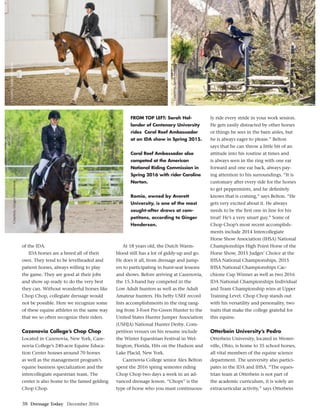
FROM TOP LEFT: Sarah Hol-
lander of Centenary University
rides Coral Reef Ambassador
at an IDA show in Spring 2015.
Coral Reef Ambassador also
competed at the American
National Riding Commission in
Spring 2016 with rider Caroline
Norton.
Romio, owned by Averett
University, is one of the most
sought-after draws at com-
petitons, according to Ginger
Henderson.
December 2016 Dressage Today 39
”
“[Pedro] is an amazingly kind
schoolmaster who loves his job...
He is the ultimate professional.
Courtesy,GingerHenderson
Equestrian Business Manager Kari Briggs.
“All riders make our teams and therefore
we need a variety of school horses to ac-
commodate all levels.”
At Otterbein, school horse Pedro, a
19-year-old, 16.2-hand, dark bay Dutch
Warmblood gelding, is an easy fan
favorite. “Pedro has a lovely personal-
ity that makes him one of the nicest
horses in the barn to take care of,” says
Briggs. “His quiet demeanor extends
into the show arena, and Pedro demands
a confident rider to get the most out
of him. His calm nature and at times
delayed reaction to his rider’s aids has
given him the reputation of being pretty
lazy. But he’s only as mellow as you let
him be—get him in front of your leg and
he is an amazingly kind schoolmaster
who loves his job.”
Before making his debut at Otterbein,
Pedro successfully campaigned at the
Prix St. Georges, Intermediaire I and II
Levels. His USEF record shows experience
at competition venues ranging from
Florida and Illinois to Ohio and Ken-
tucky, and he even has experience with
Children’s Jumper classes. While at the
university, Pedro has worked as a school-
master for Otterbein students as well as
a mount for summer camp. Says Briggs
of this unique horse: “Pedro is the ulti-
mate professional.”
Pedro has been a part of the Otter-
bein family for six years. “He is versatile
in his ability to teach all levels and
makes a yearly appearance in our IHSA
horse shows. He has competed at the
IDA National Championships and is a
dependable member of our IDA team,”
Briggs states.
Gabby Angelico, who graduated from
Otterbein in 2013, is now a working
student for Canadian dressage Olympian
Evi Strasser and leased Pedro for two
summers when she was a student at Ot-
terbein. Reflecting on her time with Pe-
dro, Angelico said that the horse taught
her many upper-level movements from
piaffe and passage to tempi changes and
pirouettes. “It was pretty amazing to
come to college and advance not only
my academics but also my riding abili-
ties.” Pedro is known for his laziness, but
Angelico says that just like any horse,
there are always a few bursts of energy in
him. One of her favorite memories of Pe-
dro still makes her laugh to this day. “He
took off with me in the cross-country
field. A friend and I had decided to take
our horses for a gallop, and we expected
Pedro to barely be able to keep up with
my friend’s Preliminary-level eventing
mount. Once we began picking up the
pace in the canter, Pedro leapt in the
air and took off to the other side of the
field, easily passing his larger, more fit
counterpart. I recall catching a glimpse
of my friend’s face as Pedro and I sped
past and her look of shock.” By the time
the ride was over, recalls Angelico, “I was
laughing so hard that I had tears stream-
ing down my face!”
Centenary University’s Coral
Reef Ambassador
Centenary University, located in Hack-
ettstown, New Jersey, is home to around
100 horses and features collegiate pro-
grams in equine business management
and equine studies.
When it comes to equine versatility,
the university’s Coral Reef Ambassador
has got it covered. Donated in 2013 by
John and Beezie Madden of John Mad-
den Sales, “Ambassador” as he is called
around the barn, knows how to be an
excellent catch-ride. This 16-year-old
Belgian Warmblood participates in all
aspects of the Centenary equestrian
program. From IHSA and IDA to the
American National Riding Commission
(ANRC) and recognized competitions,
Ambassador continually impresses with
his sweeping gaits and elegant demeanor.
Before arriving at Centenary, Ambas-
sador had an impressive USEF record.
The gelding showed all around the coun-
try, competing at the Las Vegas National,
Winter Equestrian Festival, the Hampton
Classic and the Pennsylvania National.
Donating a Horse
For many schools, horse donations are the foundation of their equine
programs. If you are interested in donating to one of the mentioned
college equestrian programs, contact:
40 Dressage Today December 2016
”
“Romio can show at First Level in
IDA and turn right around and do
the over-fences classes in IHSA.
Some of the classes on his record include
the $25,000-Plus Grand Prix, 6- and
7-Year-Old Young Jumpers and the Plati-
num Performance/USEF Show Jumping
Talent Search.
The Centenary gelding has had
many notable collegiate achievements
in the short time that he has been with
the university. He went to the IHSA
National Championships two years in
a row, was used for the IDA National
Championships this past year and
has competed at ANRC for the past
two years as well. He was also part of
the 2016 reserve champion Novice
team at ANRC with his partner Caro-
line Norton, who graduated in 2016.
“Ambassador has been a huge asset to
our collegiate program,” says dressage
team captain Sarah Hollander. “The
first year here he won the Horse of the
Year award, an award voted on by the
students and given to the most well-
rounded and well-liked equestrian part-
ner on the property.”
Although Ambassador is the ultimate
partner under saddle, students also love
his quirkiness. “He bites his tongue all
of the time! It’s like when a little kid is
chewing on his tongue and trying to
concentrate… that’s Ambassador,” says
Hollander. Centenary graduate Amanda
Defelice of the class of 2016 also elabo-
rated on all that she has learned from
this remarkable teacher. “I learned three
and two tempi’s on him. He’s so easy
that anyone can ride him, but he can
also teach some very advanced move-
ments. He has helped me improve half
passes, flying changes and pirouettes.”
Averett University’s Romio
Averett University, located in Danville,
Virginia, offers an equestrian studies
degree as a major or a minor. The uni-
versity also houses 40 horses and has
both an IHSA and IDA team. Romio, a
popular member of the Averett equine
herd, is commended for his work in the
IDA. The 22-year-old, 14.3-hand, dark
December 2016 Dressage Today 41
bay pony was discovered by his donors
at a flea market. Feeling sorry for the
pony, they purchased and took him
home, where he then became a mount
for children and actively participated in
Pony Club.
Donated in 2012 at the age of 18,
Romio quickly brought the Averett
staff up to speed on pony behavior.
“When he came to Averett we were
warned that he could be pushy and
an escape artist—both of which have
proven to be true. He can still open his
stall door and escape faster than any
horse we have ever had,” says Averett
dressage coach and Region 1 represen-
tative Ginger Henderson.
Despite his tricks, Romio has be-
come an influential collegiate horse.
“Romio has settled into school life
famously. He can show at First Level in
IDA and turn right around and do the
over-fences classes in an IHSA show. He
is by far one of the most sought-after
draws at our IDA shows!”
Amanda Arnold of the class of 2017
considers Romio her favorite school
horse and loves him for his quirks.
“He’ll eat just about anything, but he
likes brown sugar Pop-Tarts and Mike
and Ike candy the best,” says Arnold.
The pony also loves to give slobbery
kisses, particularly after a drink of
water. “Romio’s funniest trait is his un-
canny ability to get loose. One time, he
managed to jump a wheelbarrow out of
his stall and took the stall cleaners on a
jaunt down the road. Aside from that,
he’s pretty mild-mannered and will
stop at any patch of grass he can find!”
Despite his sense of humor, Romio
always steps up to the plate when it
comes time to do his job. He has been
high-point horse of the show several
times during his career in regular season
IDA shows, and Henderson reflects on
all that the pony does for his riders.
“He is patient with the incoming
freshman who are learning how to
influence their horses by asking them
to come onto the bit as well as start-
ing lateral work.” Romio also responds
well to correctness, which makes him a
versatile teacher. “He is the best kind of
teacher because when the rider is cor-
rect, he rewards them.”
Without patient, hard-working
horses, collegiate riding would be un-
heard of. Just like their riders, these
horses are all very different. However,
regardless of previous background, size
or breed, it is very clear that the IDA’s
horses all have one thing in common:
They each hold the keys to teaching
young riders how to unlock some very
valuable lessons.

Beaudoin IDA story

  • 1.
    36 Dressage TodayDecember 2016 LindsayPaulsenCourtesy,SarahBabineauCourtesy,SarahBabineau LindsayPaulsen CLOCKWISE FROM TOP LEFT: Cazeno- via College’s Chop Chop is known for his versatility. Otterbein University’s Pedro is a schoolmaster who loves his job. Pedro has a quiet demeanor, but is only as mellow as his rider allows him to be. Chop Chop has an extensive USEF record on the hunter circuit.
  • 2.
    December 2016 DressageToday 37 Colleges and universities reflect on their special horses as key players in the world of Intercollegiate Dressage. By Kimberlyn Beaudoin I t was a cool April morning in Hackettstown, New Jersey. The first day of the 2016 Intercollegiate Dressage Association (IDA) National Championships was about to begin and my teammates and I were taking the Cazenovia College horses for a walk around the grounds to stretch their legs. As we moved past a crowd of young, eager equestrians, one of them called out to me: “Is that Chop Chop?” It was a question that I would grow accustomed to nodding my head “yes” to when asked throughout the weekend. I had a small notion that the horse I was handling was an equine celebrity of sorts. The IDA was founded in 1995, and began as an informal competition among a group of north- eastern colleges and secondary schools. It later spread to other regions of the country as well as to Canada. In 2003, the IDA became a college-only organization. Today it has over 500 competing members from more than 50 colleges and universities. Intercollegiate dressage competition involves catch-riding, and riders will travel as a team to one particular school and ride its horses for each show. Riders get a 10-minute warm-up period with the horse and then are sent into the ring to ride their test. Many schools actively participate in running these horse shows, as they are the backbone The IDA School Horse: A of its Breed Own
  • 3.
    38 Dressage TodayDecember 2016 Courtesy,GingerHenderson Courtesy,SarahHollander Courtesy,SarahHollander of the IDA. IDA horses are a breed all of their own. They tend to be levelheaded and patient horses, always willing to play the game. They are good at their jobs and show up ready to do the very best they can. Without wonderful horses like Chop Chop, collegiate dressage would not be possible. Here we recognize some of these equine athletes in the same way that we so often recognize their riders. Cazenovia College’s Chop Chop Located in Cazenovia, New York, Caze- novia College’s 240-acre Equine Educa- tion Center houses around 70 horses as well as the management program’s equine business specialization and the intercollegiate equestrian team. The center is also home to the famed gelding Chop Chop. At 18 years old, the Dutch Warm- blood still has a lot of giddy-up and go. He does it all, from dressage and jump- ers to participating in hunt-seat lessons and shows. Before arriving at Cazenovia, the 15.3-hand bay competed in the Low Adult hunters as well as the Adult Amateur hunters. His hefty USEF record lists accomplishments in the ring rang- ing from 3-Foot Pre-Green Hunter to the United States Hunter Jumper Association (USHJA) National Hunter Derby. Com- petition venues on his resume include the Winter Equestrian Festival in Wel- lington, Florida, Hits on the Hudson and Lake Placid, New York. Cazenovia College senior Alex Belton spent the 2016 spring semester riding Chop Chop two days a week in an ad- vanced dressage lesson. “Chops” is the type of horse who you must continuous- ly ride every stride in your work session. He gets easily distracted by other horses or things he sees in the barn aisles, but he is always eager to please.” Belton says that he can throw a little bit of an attitude into his routine at times and is always seen in the ring with one ear forward and one ear back, always pay- ing attention to his surroundings. “It is customary after every ride for the horses to get peppermints, and he definitely knows that is coming,” says Belton. “He gets very excited about it. He always needs to be the first one in line for his treat! He’s a very smart guy.” Some of Chop Chop’s most recent accomplish- ments include 2014 Intercollegiate Horse Show Association (IHSA) National Championships High Point Horse of the Horse Show, 2015 Judges’ Choice at the IHSA National Championships, 2015 IHSA National Championships Cac- chione Cup Winner as well as two 2016 IDA National Championships Individual and Team Championship wins at Upper Training Level. Chop Chop stands out with his versatility and personality, two traits that make the college grateful for this equine. Otterbein University’s Pedro Otterbein University, located in Wester- ville, Ohio, is home to 35 school horses, all vital members of the equine science department. The university also partici- pates in the IDA and IHSA. “The eques- trian team at Otterbein is not part of the academic curriculum, it is solely an extracurricular activity,” says Otterbein FROM TOP LEFT: Sarah Hol- lander of Centenary University rides Coral Reef Ambassador at an IDA show in Spring 2015. Coral Reef Ambassador also competed at the American National Riding Commission in Spring 2016 with rider Caroline Norton. Romio, owned by Averett University, is one of the most sought-after draws at com- petitons, according to Ginger Henderson.
  • 4.
    December 2016 DressageToday 39 ” “[Pedro] is an amazingly kind schoolmaster who loves his job... He is the ultimate professional. Courtesy,GingerHenderson Equestrian Business Manager Kari Briggs. “All riders make our teams and therefore we need a variety of school horses to ac- commodate all levels.” At Otterbein, school horse Pedro, a 19-year-old, 16.2-hand, dark bay Dutch Warmblood gelding, is an easy fan favorite. “Pedro has a lovely personal- ity that makes him one of the nicest horses in the barn to take care of,” says Briggs. “His quiet demeanor extends into the show arena, and Pedro demands a confident rider to get the most out of him. His calm nature and at times delayed reaction to his rider’s aids has given him the reputation of being pretty lazy. But he’s only as mellow as you let him be—get him in front of your leg and he is an amazingly kind schoolmaster who loves his job.” Before making his debut at Otterbein, Pedro successfully campaigned at the Prix St. Georges, Intermediaire I and II Levels. His USEF record shows experience at competition venues ranging from Florida and Illinois to Ohio and Ken- tucky, and he even has experience with Children’s Jumper classes. While at the university, Pedro has worked as a school- master for Otterbein students as well as a mount for summer camp. Says Briggs of this unique horse: “Pedro is the ulti- mate professional.” Pedro has been a part of the Otter- bein family for six years. “He is versatile in his ability to teach all levels and makes a yearly appearance in our IHSA horse shows. He has competed at the IDA National Championships and is a dependable member of our IDA team,” Briggs states. Gabby Angelico, who graduated from Otterbein in 2013, is now a working student for Canadian dressage Olympian Evi Strasser and leased Pedro for two summers when she was a student at Ot- terbein. Reflecting on her time with Pe- dro, Angelico said that the horse taught her many upper-level movements from piaffe and passage to tempi changes and pirouettes. “It was pretty amazing to come to college and advance not only my academics but also my riding abili- ties.” Pedro is known for his laziness, but Angelico says that just like any horse, there are always a few bursts of energy in him. One of her favorite memories of Pe- dro still makes her laugh to this day. “He took off with me in the cross-country field. A friend and I had decided to take our horses for a gallop, and we expected Pedro to barely be able to keep up with my friend’s Preliminary-level eventing mount. Once we began picking up the pace in the canter, Pedro leapt in the air and took off to the other side of the field, easily passing his larger, more fit counterpart. I recall catching a glimpse of my friend’s face as Pedro and I sped past and her look of shock.” By the time the ride was over, recalls Angelico, “I was laughing so hard that I had tears stream- ing down my face!” Centenary University’s Coral Reef Ambassador Centenary University, located in Hack- ettstown, New Jersey, is home to around 100 horses and features collegiate pro- grams in equine business management and equine studies. When it comes to equine versatility, the university’s Coral Reef Ambassador has got it covered. Donated in 2013 by John and Beezie Madden of John Mad- den Sales, “Ambassador” as he is called around the barn, knows how to be an excellent catch-ride. This 16-year-old Belgian Warmblood participates in all aspects of the Centenary equestrian program. From IHSA and IDA to the American National Riding Commission (ANRC) and recognized competitions, Ambassador continually impresses with his sweeping gaits and elegant demeanor. Before arriving at Centenary, Ambas- sador had an impressive USEF record. The gelding showed all around the coun- try, competing at the Las Vegas National, Winter Equestrian Festival, the Hampton Classic and the Pennsylvania National. Donating a Horse For many schools, horse donations are the foundation of their equine programs. If you are interested in donating to one of the mentioned college equestrian programs, contact:
  • 5.
    40 Dressage TodayDecember 2016 ” “Romio can show at First Level in IDA and turn right around and do the over-fences classes in IHSA. Some of the classes on his record include the $25,000-Plus Grand Prix, 6- and 7-Year-Old Young Jumpers and the Plati- num Performance/USEF Show Jumping Talent Search. The Centenary gelding has had many notable collegiate achievements in the short time that he has been with the university. He went to the IHSA National Championships two years in a row, was used for the IDA National Championships this past year and has competed at ANRC for the past two years as well. He was also part of the 2016 reserve champion Novice team at ANRC with his partner Caro- line Norton, who graduated in 2016. “Ambassador has been a huge asset to our collegiate program,” says dressage team captain Sarah Hollander. “The first year here he won the Horse of the Year award, an award voted on by the students and given to the most well- rounded and well-liked equestrian part- ner on the property.” Although Ambassador is the ultimate partner under saddle, students also love his quirkiness. “He bites his tongue all of the time! It’s like when a little kid is chewing on his tongue and trying to concentrate… that’s Ambassador,” says Hollander. Centenary graduate Amanda Defelice of the class of 2016 also elabo- rated on all that she has learned from this remarkable teacher. “I learned three and two tempi’s on him. He’s so easy that anyone can ride him, but he can also teach some very advanced move- ments. He has helped me improve half passes, flying changes and pirouettes.” Averett University’s Romio Averett University, located in Danville, Virginia, offers an equestrian studies degree as a major or a minor. The uni- versity also houses 40 horses and has both an IHSA and IDA team. Romio, a popular member of the Averett equine herd, is commended for his work in the IDA. The 22-year-old, 14.3-hand, dark
  • 6.
    December 2016 DressageToday 41 bay pony was discovered by his donors at a flea market. Feeling sorry for the pony, they purchased and took him home, where he then became a mount for children and actively participated in Pony Club. Donated in 2012 at the age of 18, Romio quickly brought the Averett staff up to speed on pony behavior. “When he came to Averett we were warned that he could be pushy and an escape artist—both of which have proven to be true. He can still open his stall door and escape faster than any horse we have ever had,” says Averett dressage coach and Region 1 represen- tative Ginger Henderson. Despite his tricks, Romio has be- come an influential collegiate horse. “Romio has settled into school life famously. He can show at First Level in IDA and turn right around and do the over-fences classes in an IHSA show. He is by far one of the most sought-after draws at our IDA shows!” Amanda Arnold of the class of 2017 considers Romio her favorite school horse and loves him for his quirks. “He’ll eat just about anything, but he likes brown sugar Pop-Tarts and Mike and Ike candy the best,” says Arnold. The pony also loves to give slobbery kisses, particularly after a drink of water. “Romio’s funniest trait is his un- canny ability to get loose. One time, he managed to jump a wheelbarrow out of his stall and took the stall cleaners on a jaunt down the road. Aside from that, he’s pretty mild-mannered and will stop at any patch of grass he can find!” Despite his sense of humor, Romio always steps up to the plate when it comes time to do his job. He has been high-point horse of the show several times during his career in regular season IDA shows, and Henderson reflects on all that the pony does for his riders. “He is patient with the incoming freshman who are learning how to influence their horses by asking them to come onto the bit as well as start- ing lateral work.” Romio also responds well to correctness, which makes him a versatile teacher. “He is the best kind of teacher because when the rider is cor- rect, he rewards them.” Without patient, hard-working horses, collegiate riding would be un- heard of. Just like their riders, these horses are all very different. However, regardless of previous background, size or breed, it is very clear that the IDA’s horses all have one thing in common: They each hold the keys to teaching young riders how to unlock some very valuable lessons.