Business Economics
Chapter 1
08/13/2024 2
Introduction
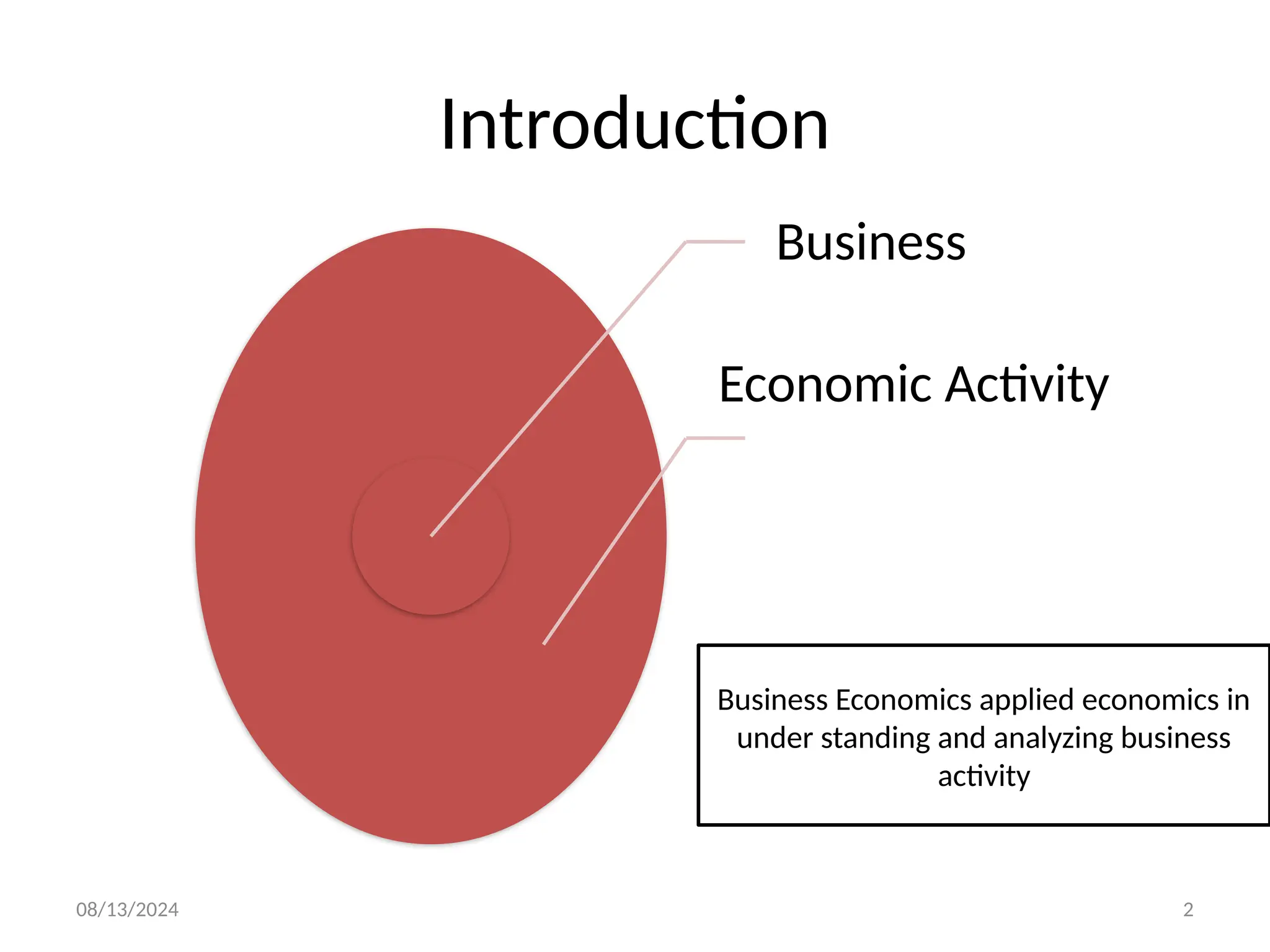
Business
Economic Activity
Business Economics applied economics in
under standing and analyzing business
activity
08/13/2024 3
Business Economics
• Logic
• Art of rational decision making
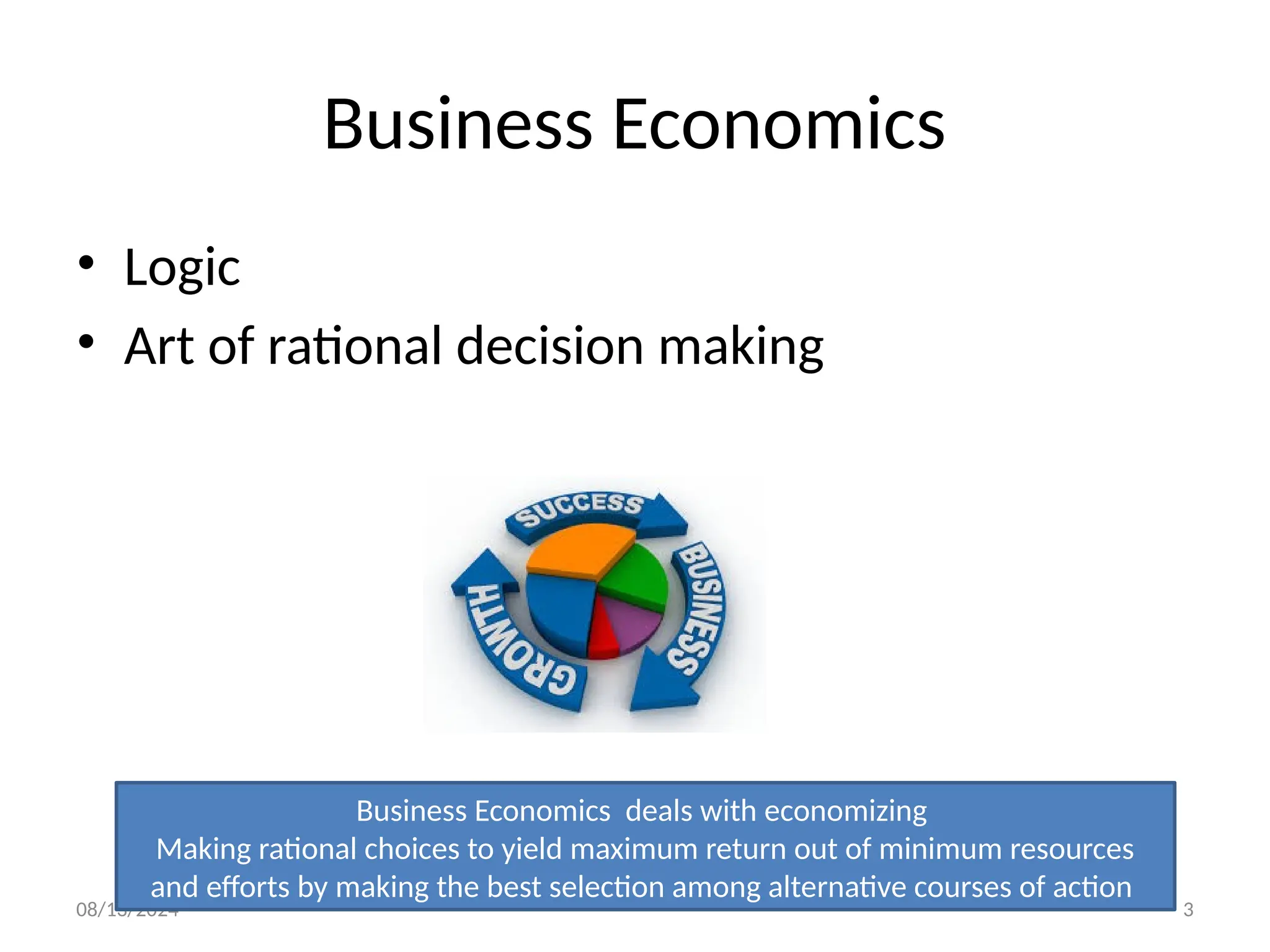
Business Economics deals with economizing
Making rational choices to yield maximum return out of minimum resources
and efforts by making the best selection among alternative courses of action
08/13/2024 4
Defination of Business Economics
Business economics is defined as ‘ the integration
of economic theory with business practice for
the purpose of facilitating decision making and
forward planning by the management’
Economics applied to decision making which is core of business
08/13/2024 5
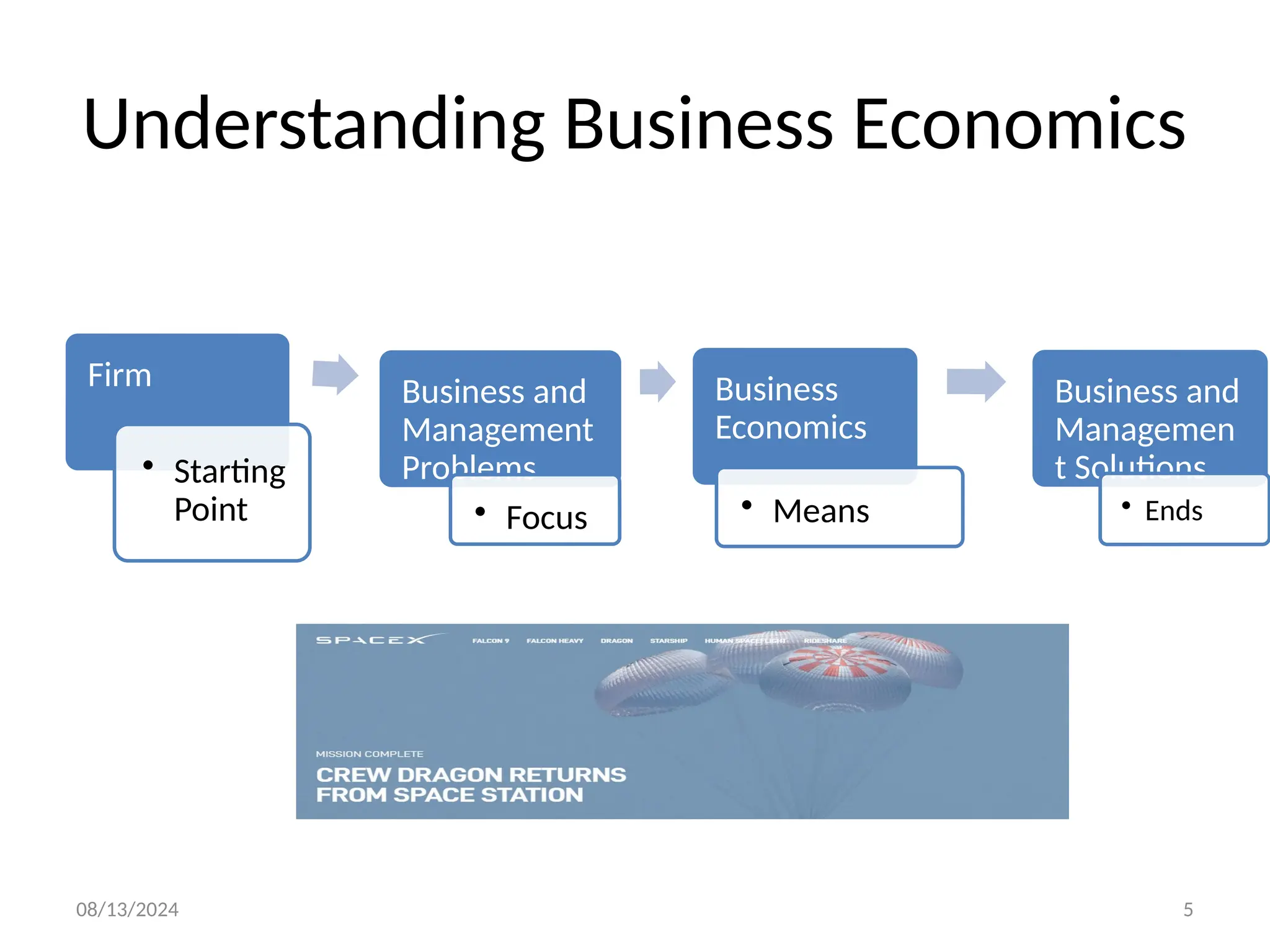
Understanding Business Economics
Firm
• Starting
Point
Business and
Management
Problems
• Focus
Business
Economics
• Means
Business and
Managemen
t Solutions
• Ends
08/13/2024 6
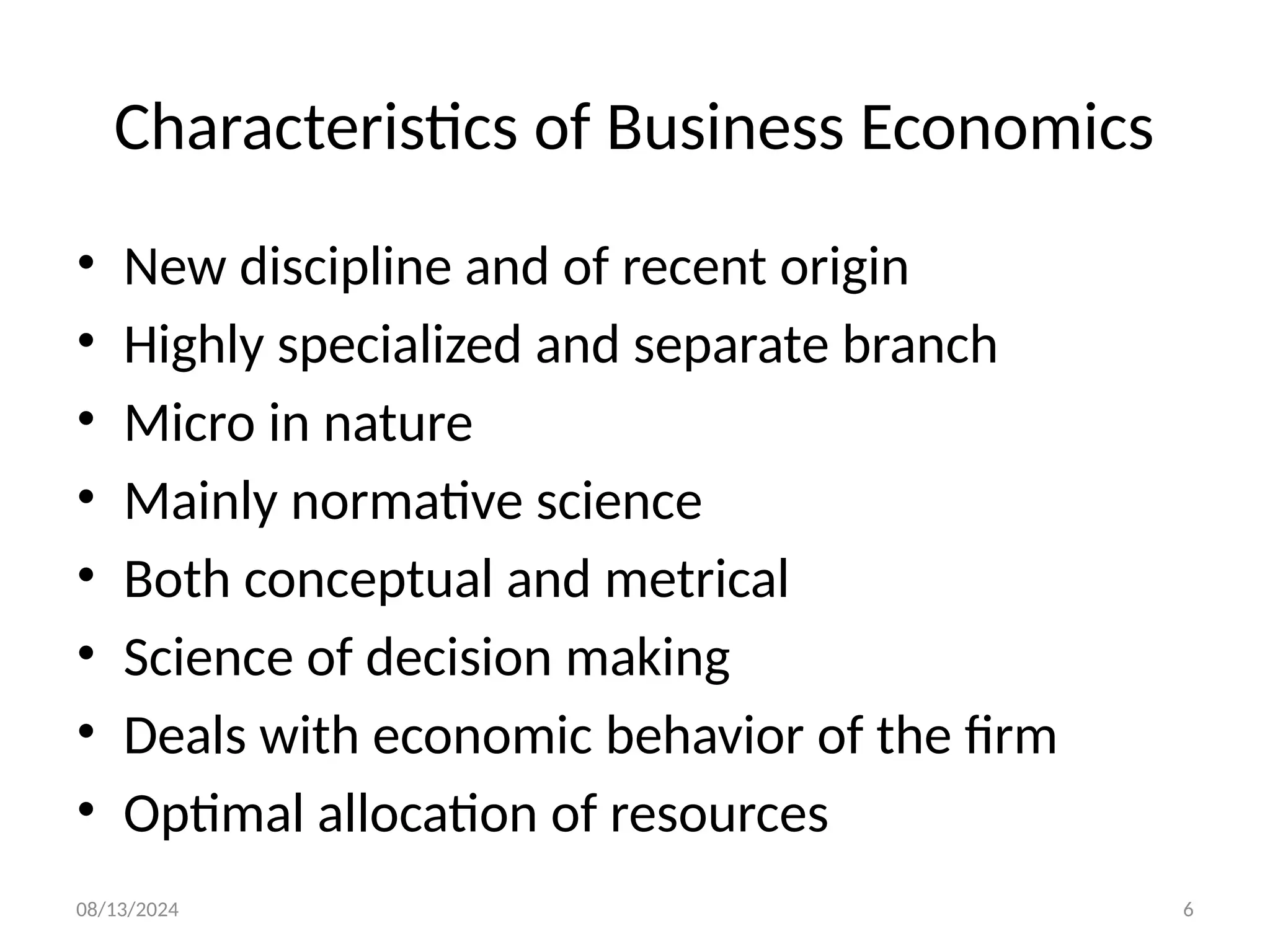
Characteristics of Business Economics
• New discipline and of recent origin
• Highly specialized and separate branch
• Micro in nature
• Mainly normative science
• Both conceptual and metrical
• Science of decision making
• Deals with economic behavior of the firm
• Optimal allocation of resources
08/13/2024 7
Characteristics of Business Economics …
CONT
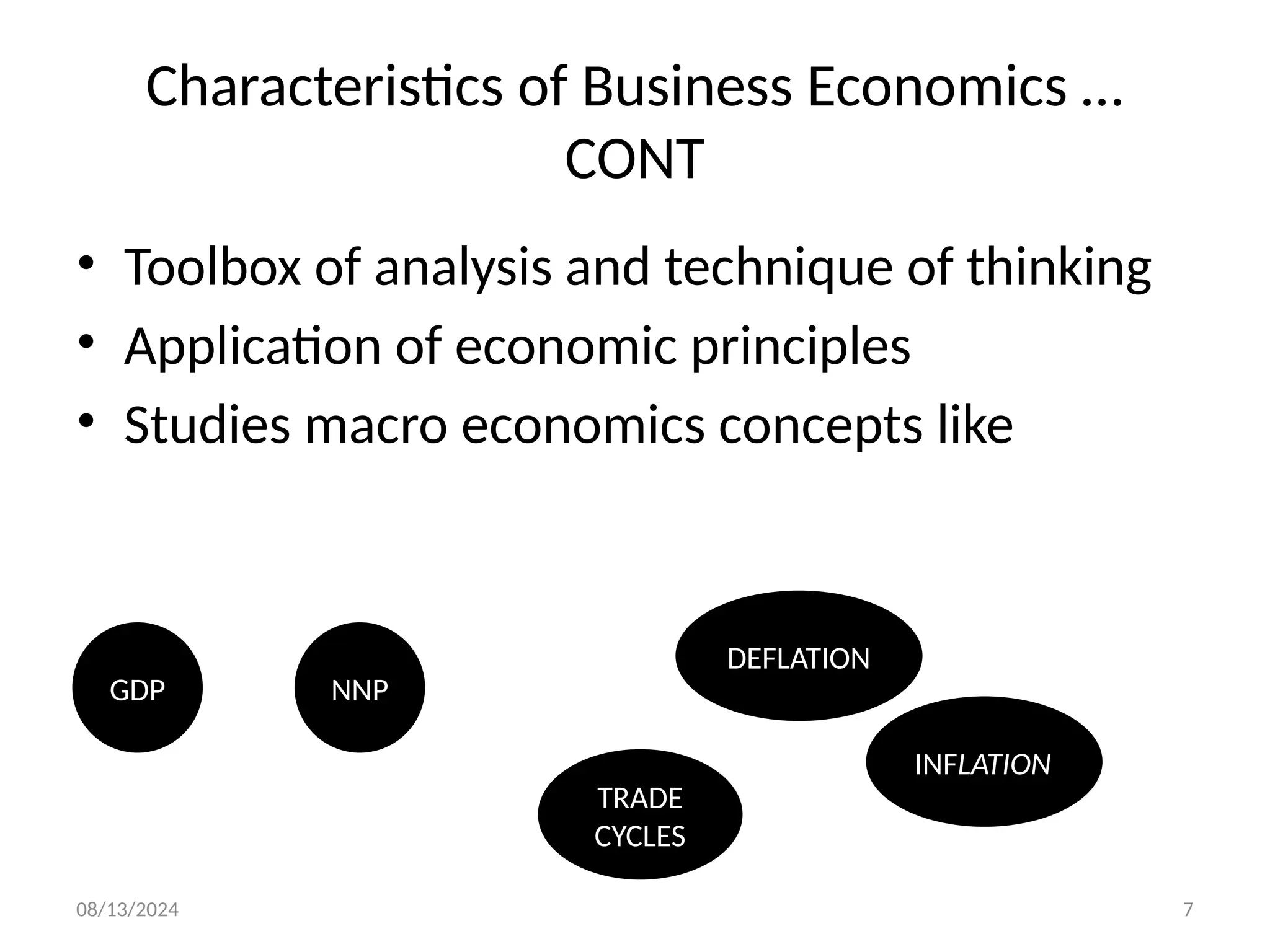
• Toolbox of analysis and technique of thinking
• Application of economic principles
• Studies macro economics concepts like
GDP
DEFLATION
INFLATION
TRADE
CYCLES
NNP
08/13/2024 8
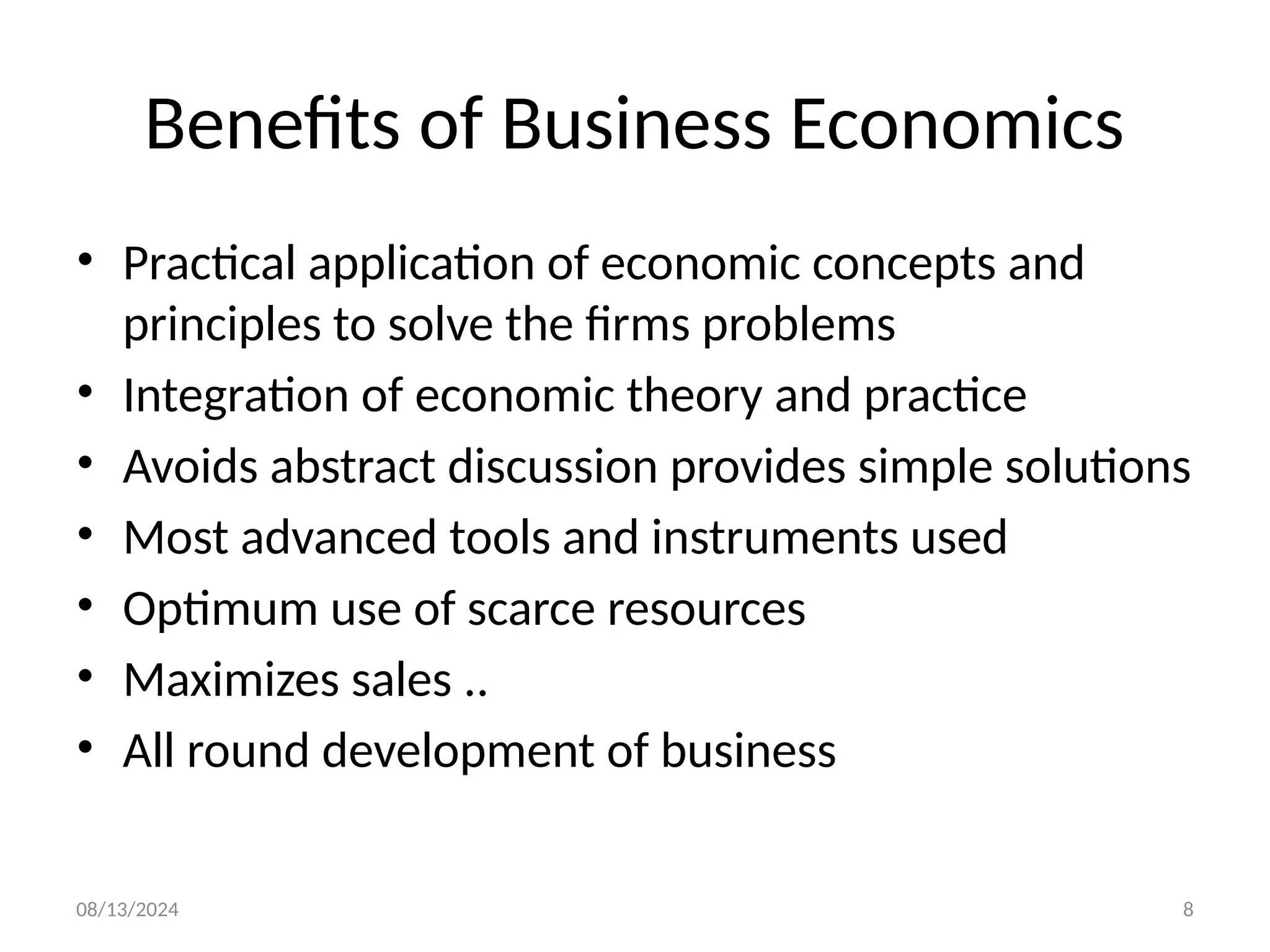
Benefits of Business Economics
• Practical application of economic concepts and
principles to solve the firms problems
• Integration of economic theory and practice
• Avoids abstract discussion provides simple solutions
• Most advanced tools and instruments used
• Optimum use of scarce resources
• Maximizes sales ..
• All round development of business
08/13/2024 9
Area of Study
SCOPE OF BUSINESS ECONOMICS
Boundaries
Subject Matter
08/13/2024 10
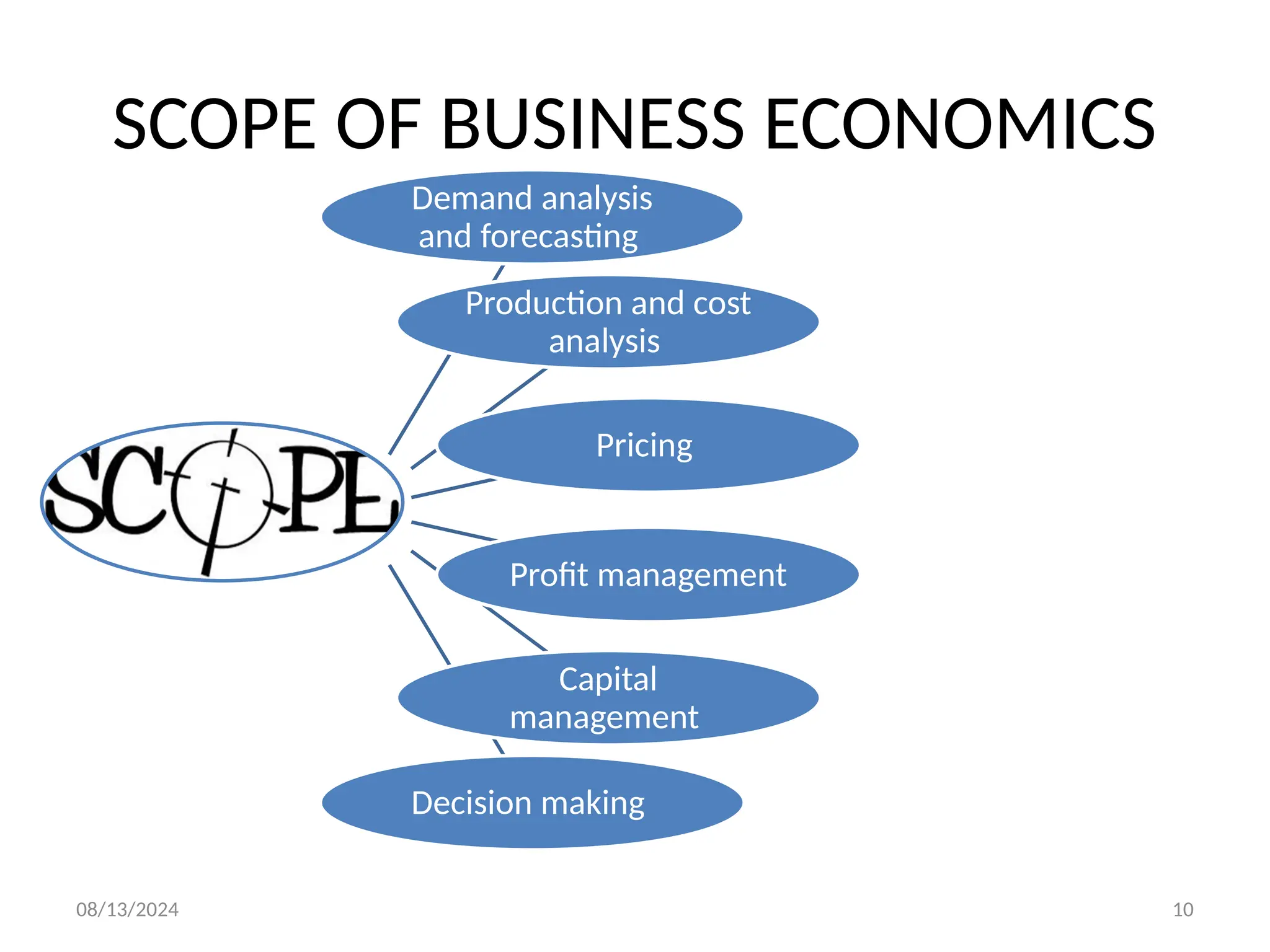
Demand analysis
and forecasting
Production and cost
analysis
Pricing
Profit management
Capital
management
Decision making
SCOPE OF BUSINESS ECONOMICS
08/13/2024 11
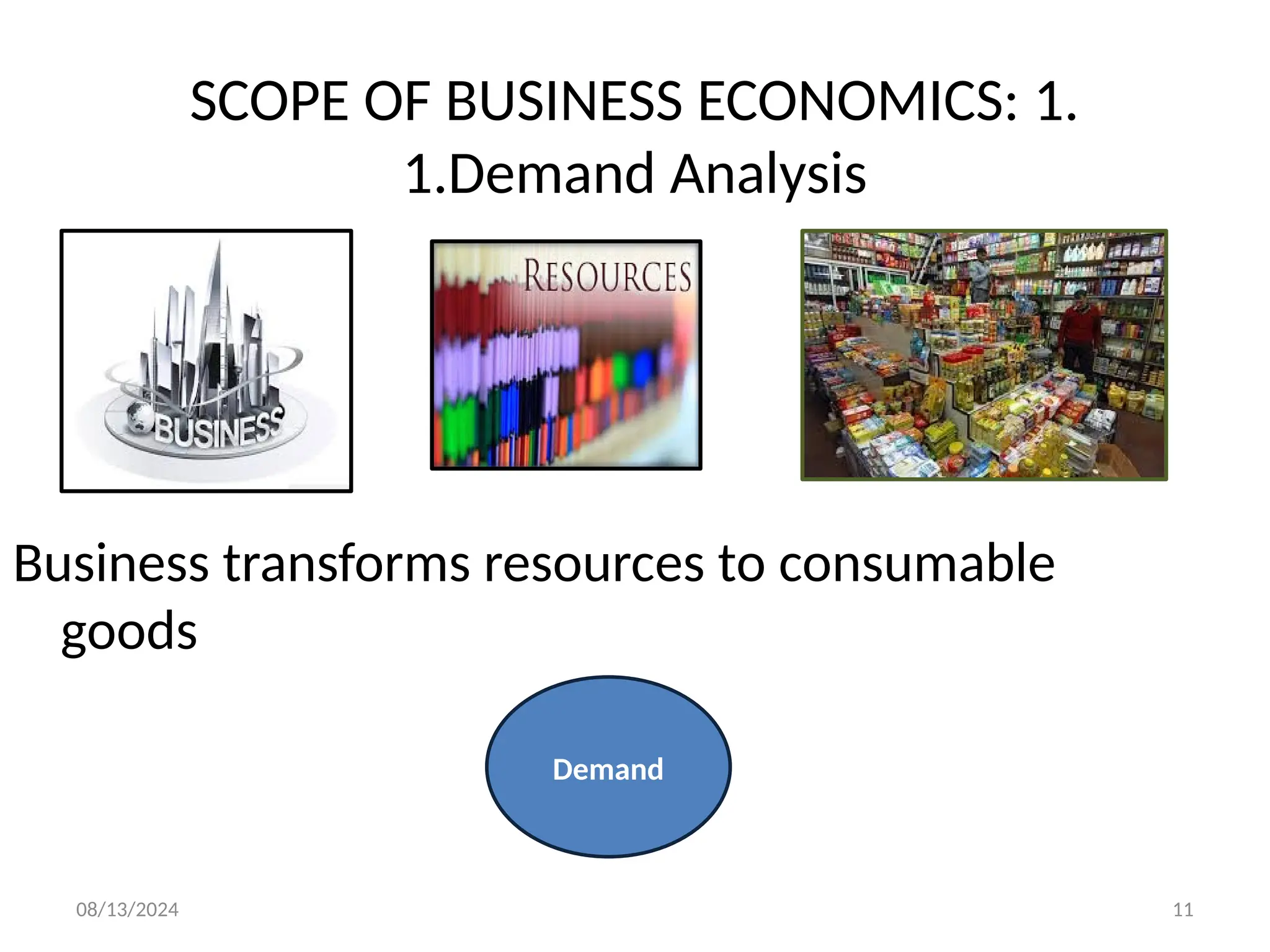
Business transforms resources to consumable
goods
SCOPE OF BUSINESS ECONOMICS: 1.
1.Demand Analysis
Demand
08/13/2024 12
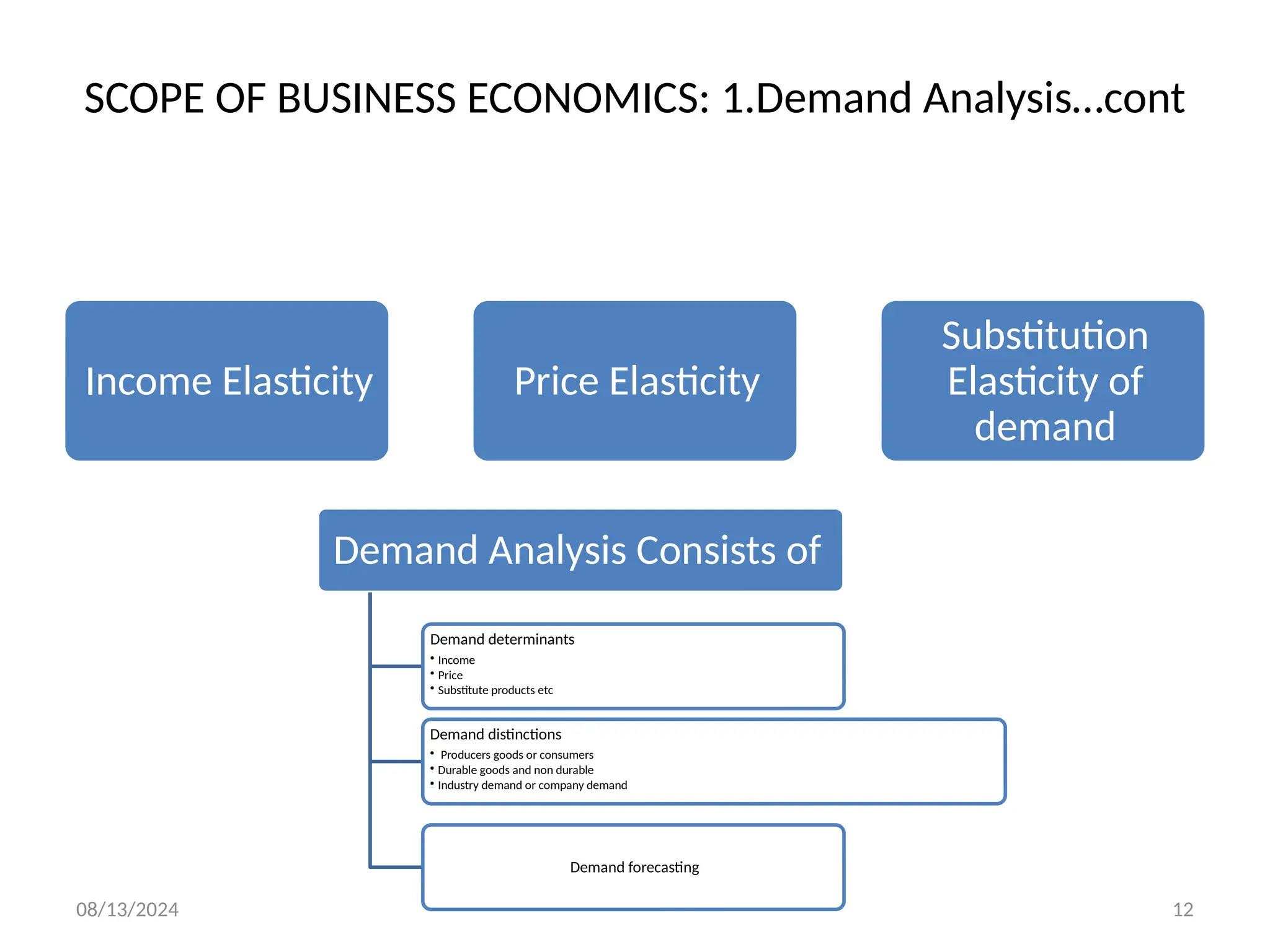
SCOPE OF BUSINESS ECONOMICS: 1.Demand Analysis…cont
Income Elasticity Price Elasticity
Substitution
Elasticity of
demand
Demand Analysis Consists of
Demand determinants
• Income
• Price
• Substitute products etc
Demand distinctions
• Producers goods or consumers
• Durable goods and non durable
• Industry demand or company demand
Demand forecasting
08/13/2024 13
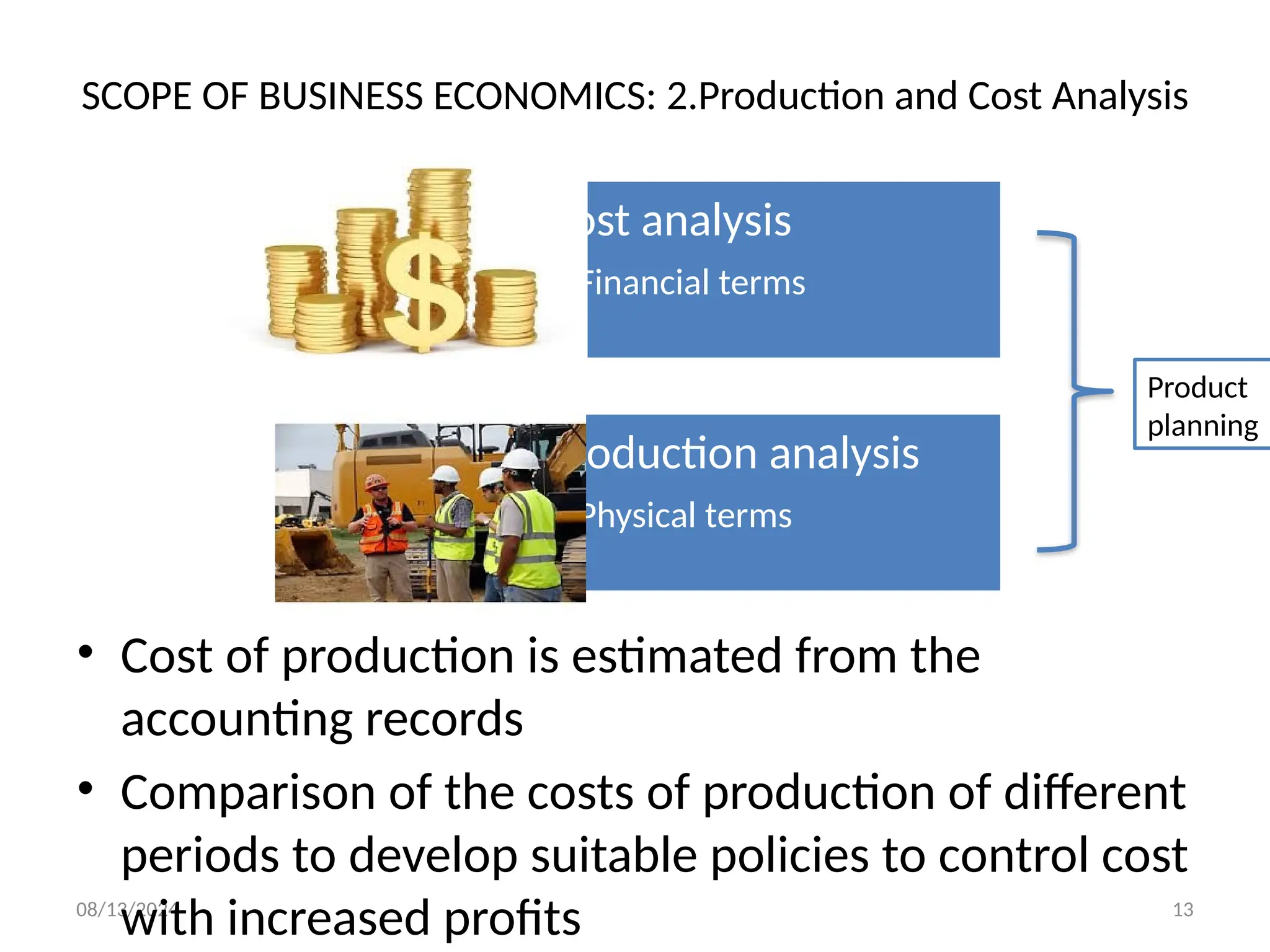
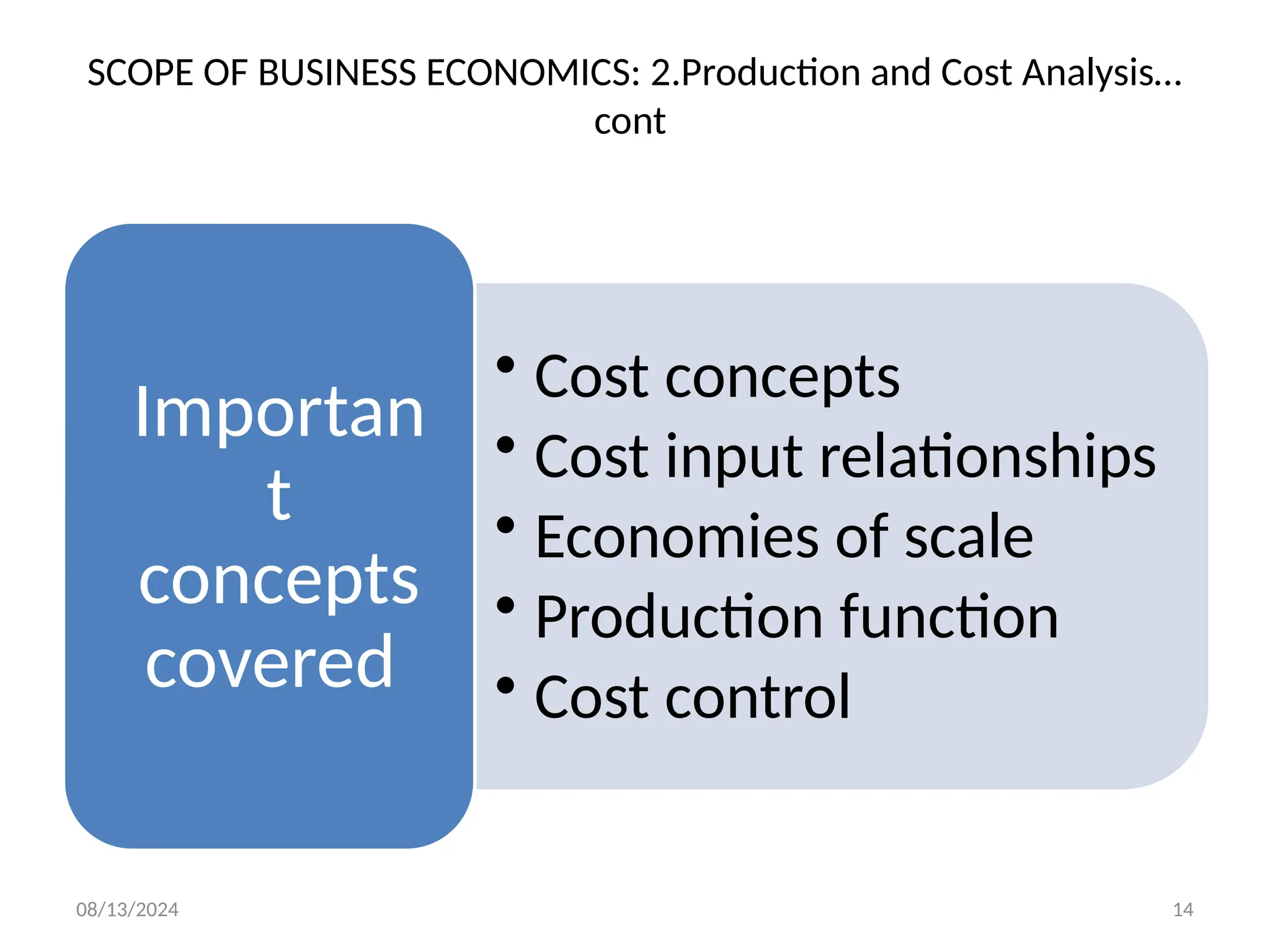
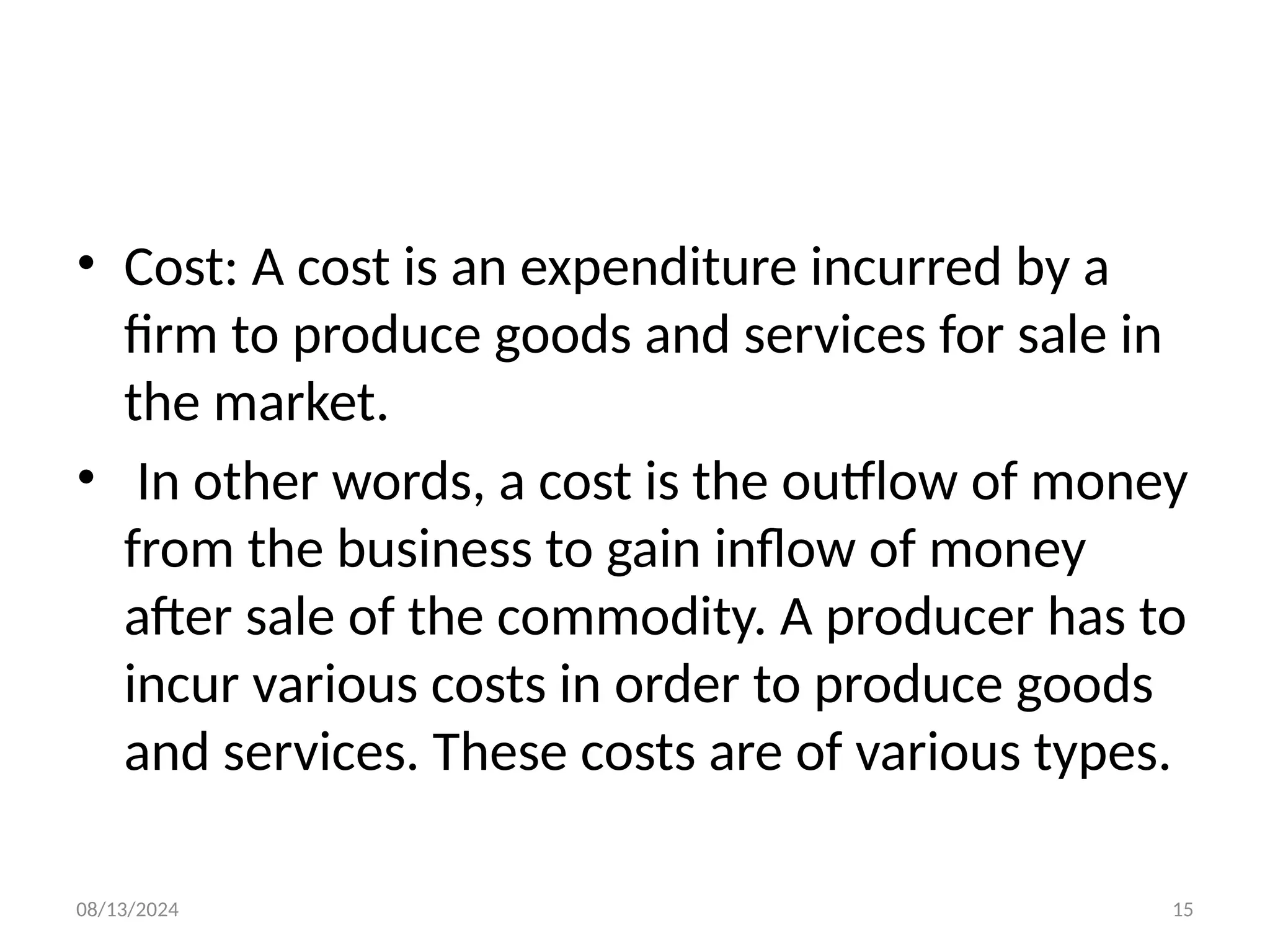
SCOPE OF BUSINESS ECONOMICS: 2.Production and Cost Analysis
• Cost of production is estimated from the
accounting records
• Comparison of the costs of production of different
periods to develop suitable policies to control cost
with increased profits
Cost analysis
• Financial terms
Production analysis
• Physical terms
Product
planning
08/13/2024 14
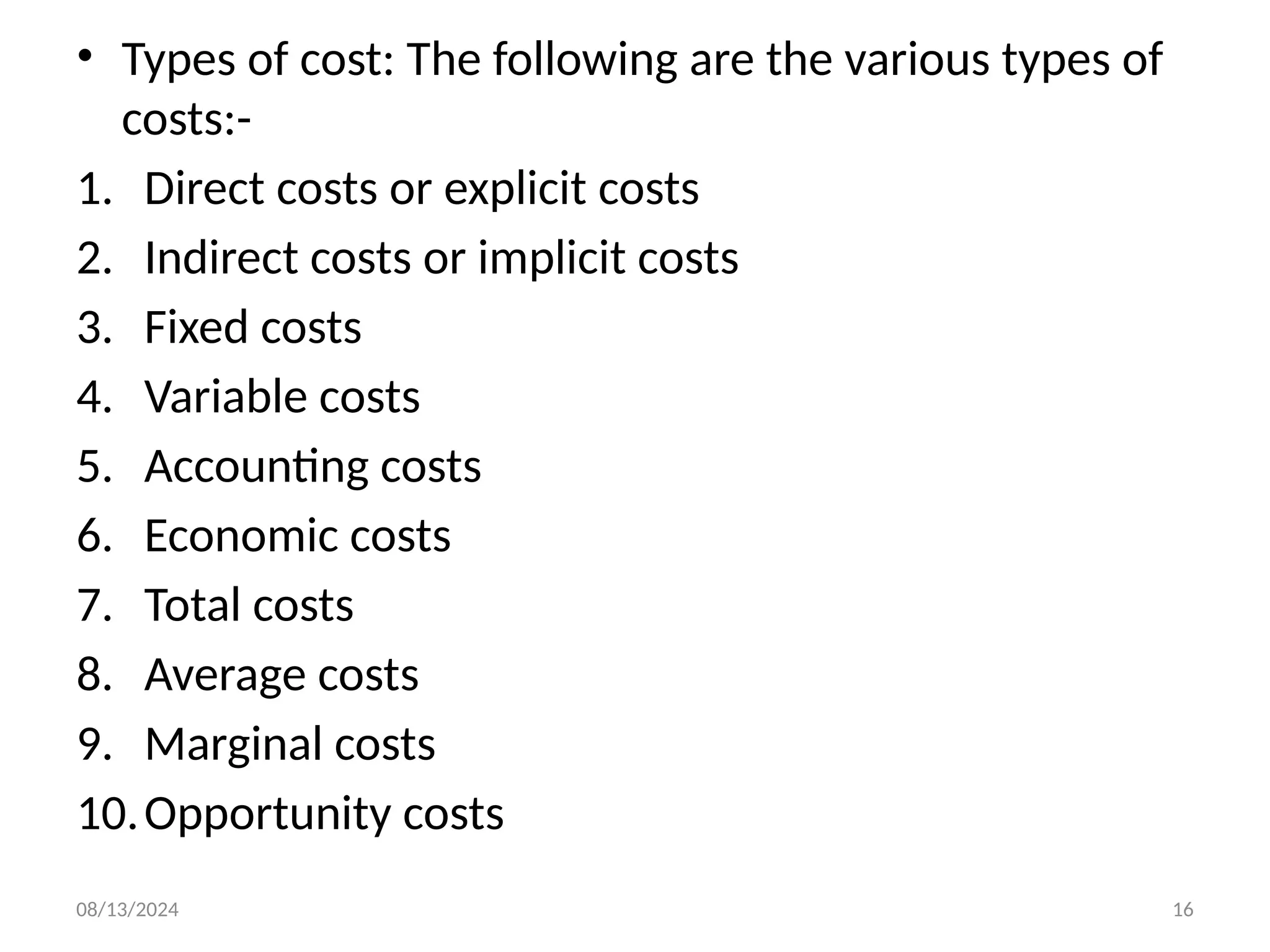
SCOPE OF BUSINESS ECONOMICS: 2.Production and Cost Analysis…
cont
• Cost concepts
• Cost input relationships
• Economies of scale
• Production function
• Cost control
Importan
t
concepts
covered
08/13/2024 15
• Cost: A cost is an expenditure incurred by a
firm to produce goods and services for sale in
the market.
• In other words, a cost is the outflow of money
from the business to gain inflow of money
after sale of the commodity. A producer has to
incur various costs in order to produce goods
and services. These costs are of various types.
08/13/2024 16
• Types of cost: The following are the various types of
costs:-
1. Direct costs or explicit costs
2. Indirect costs or implicit costs
3. Fixed costs
4. Variable costs
5. Accounting costs
6. Economic costs
7. Total costs
8. Average costs
9. Marginal costs
10.Opportunity costs
08/13/2024 17
• Explicit costs are those costs which are met by
cash payments for employing various factors of
production. The producer actually pays money to
produce his goods and services.
• A direct or explicit cost is the material, labor,
expenses, overheads, selling and distribution,
administrative cost related to production of a
commodity.
08/13/2024 18
Implicit cost is also called as imputed cost. Here cash
outflow does not happen. An implicit cost is defined as
under: “An implicit cost is the factor of production
sacrificed by the producer for an alternative factor
production. The opportunity foregone is the implicit cost.”
Fixed costs: Fixed costs are those costs that do not change
in the short run period of time. Fixed costs remain the
same regardless of the amount of production and sale of
commodities.
Variable Cost: A variable cost is that cost which changes in
short – run and long – run time period. It always keeps on
changing. These costs are incurred during production
process and thus are the costs incurred for employing
various factors of production.
08/13/2024 19
• Economic Costs: Economic costs are those costs
that an entrepreneur incurs while conducting
economic activities. For an entrepreneur an
economic activity is his business.
• Opportunity Cost: An opportunity cost is the
opportunity or choice that is let go off or sacrificed
for an alternative choice. In economics,
opportunity cost is the foregone production factor
in business for an alternative production factor.
08/13/2024
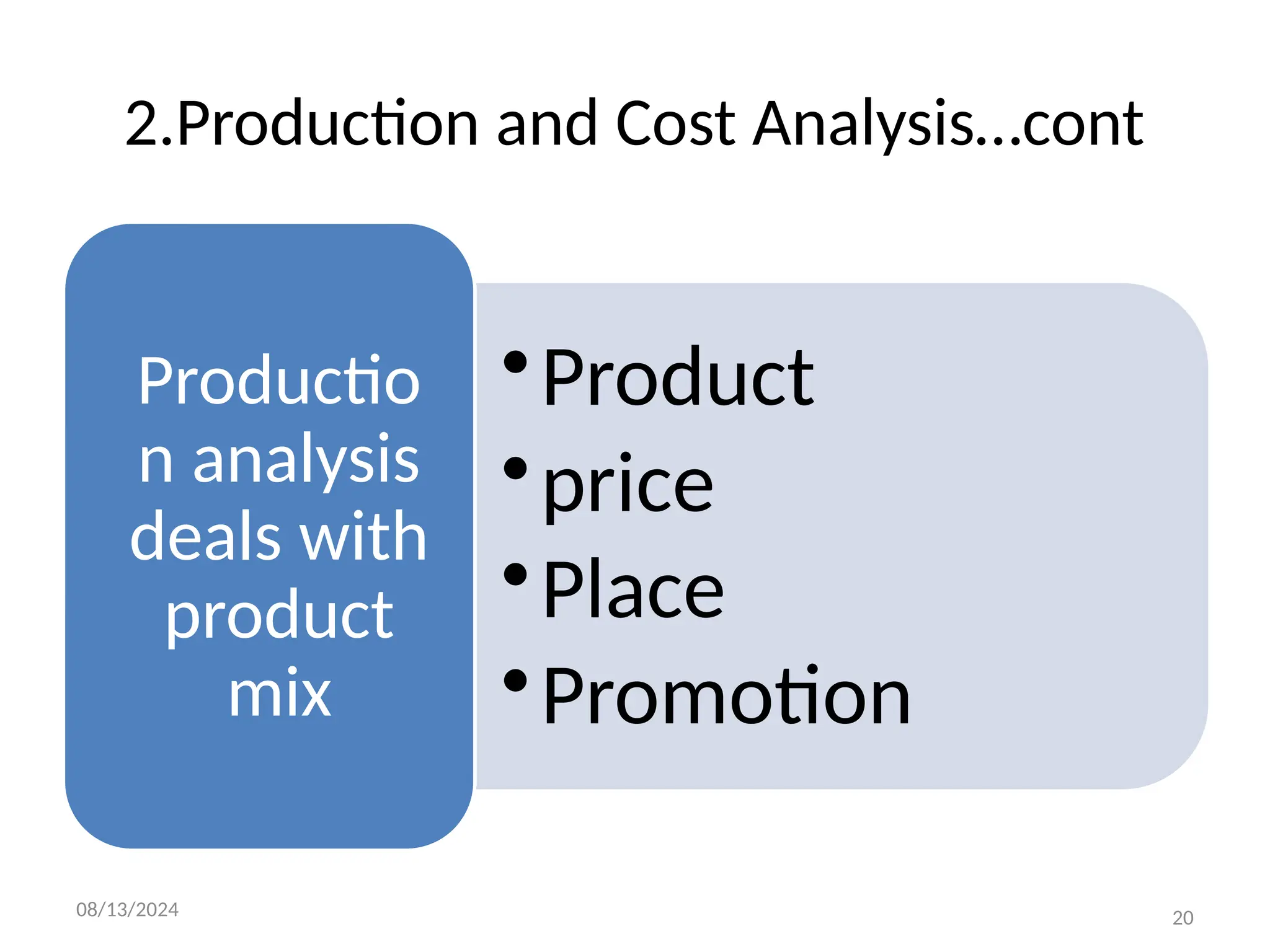
2.Production and Cost Analysis…cont
•Product
•price
•Place
•Promotion
Productio
n analysis
deals with
product
mix
20
08/13/2024 21
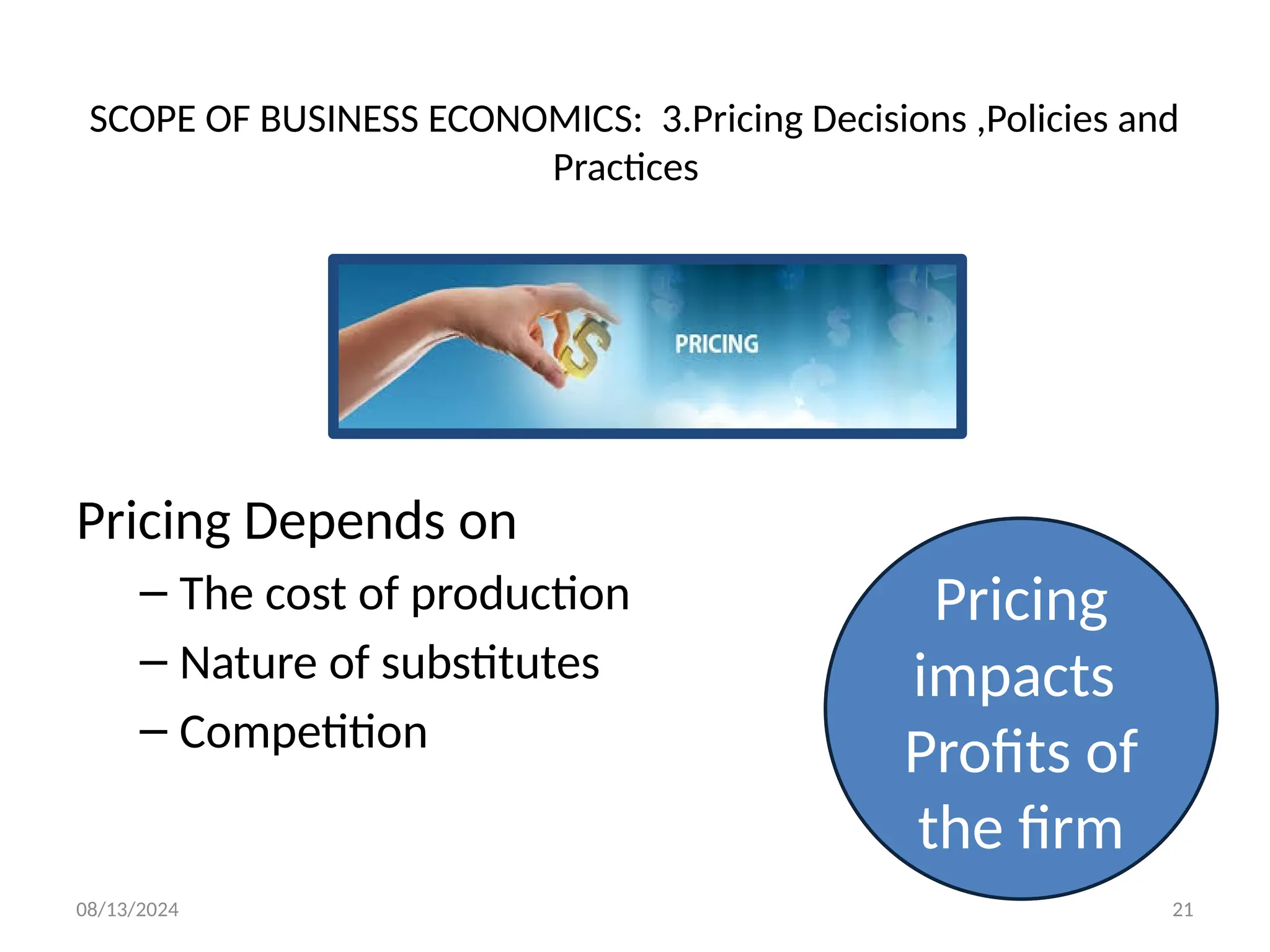
SCOPE OF BUSINESS ECONOMICS: 3.Pricing Decisions ,Policies and
Practices
Pricing Depends on
– The cost of production
– Nature of substitutes
– Competition
Pricing
impacts
Profits of
the firm
08/13/2024 22
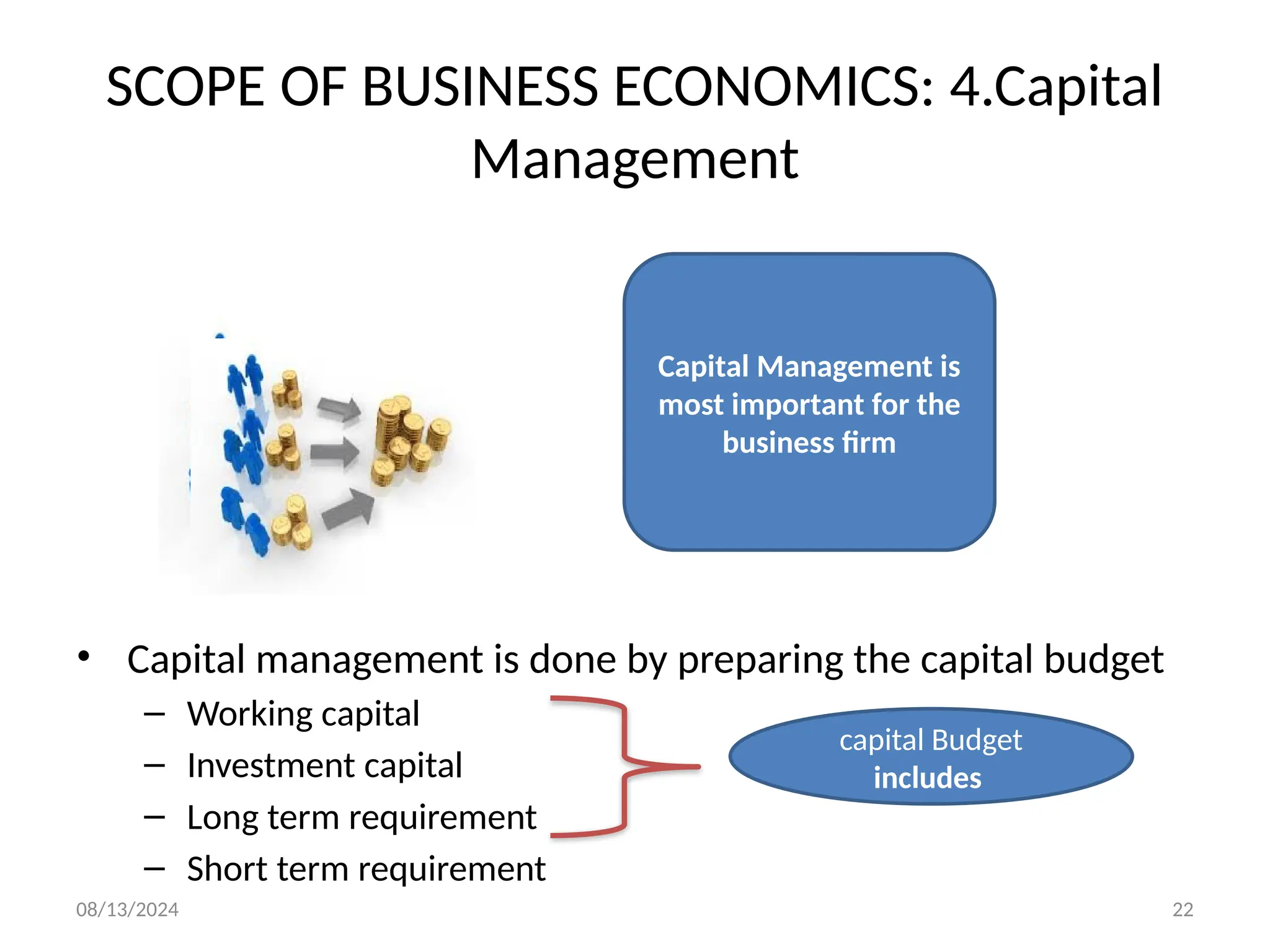
SCOPE OF BUSINESS ECONOMICS: 4.Capital
Management
• Capital management is done by preparing the capital budget
– Working capital
– Investment capital
– Long term requirement
– Short term requirement
Capital Management is
most important for the
business firm
capital Budget
includes
08/13/2024 23
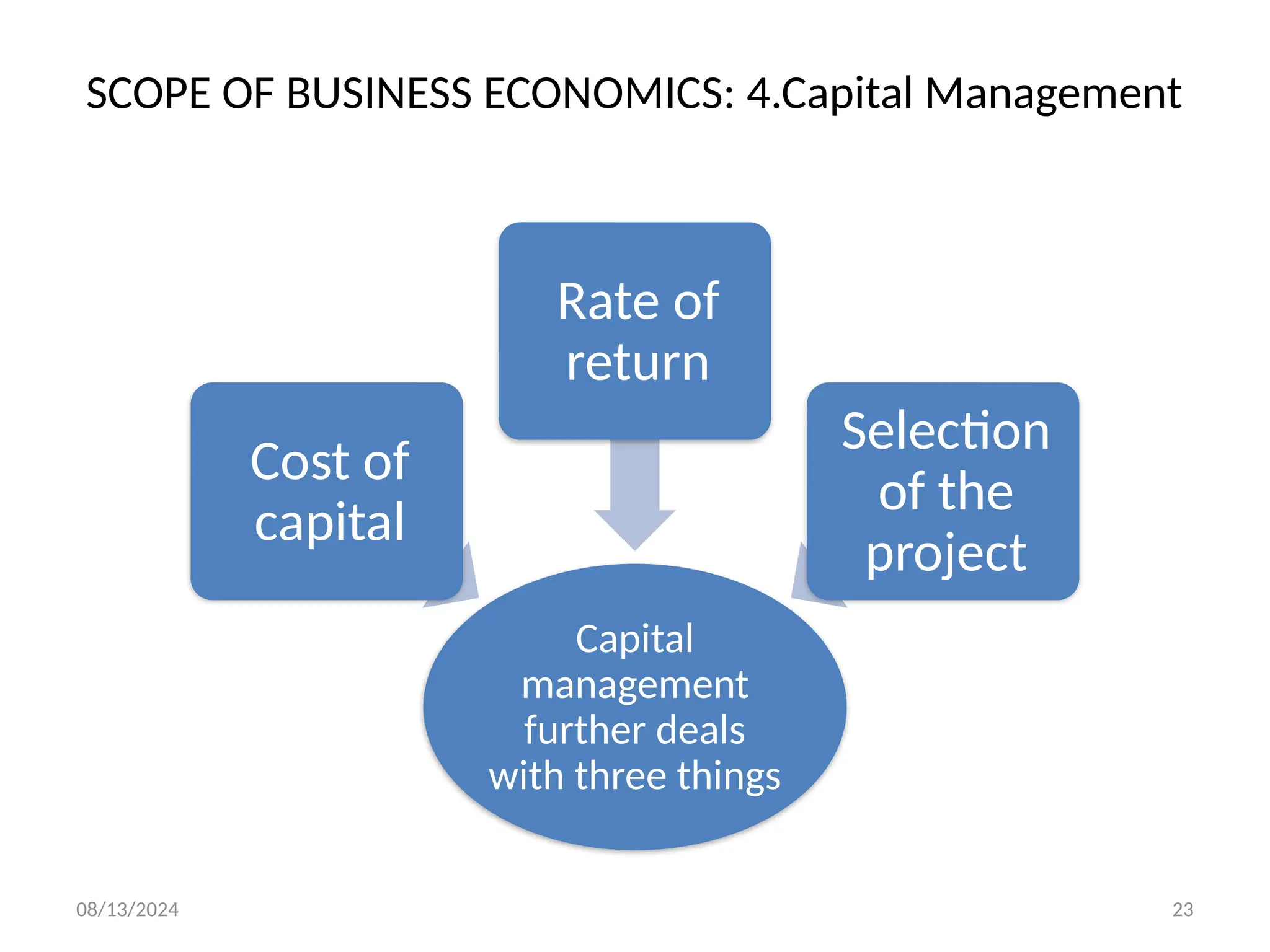
SCOPE OF BUSINESS ECONOMICS: 4.Capital Management
Capital
management
further deals
with three things
Cost of
capital
Rate of
return
Selection
of the
project
08/13/2024 24
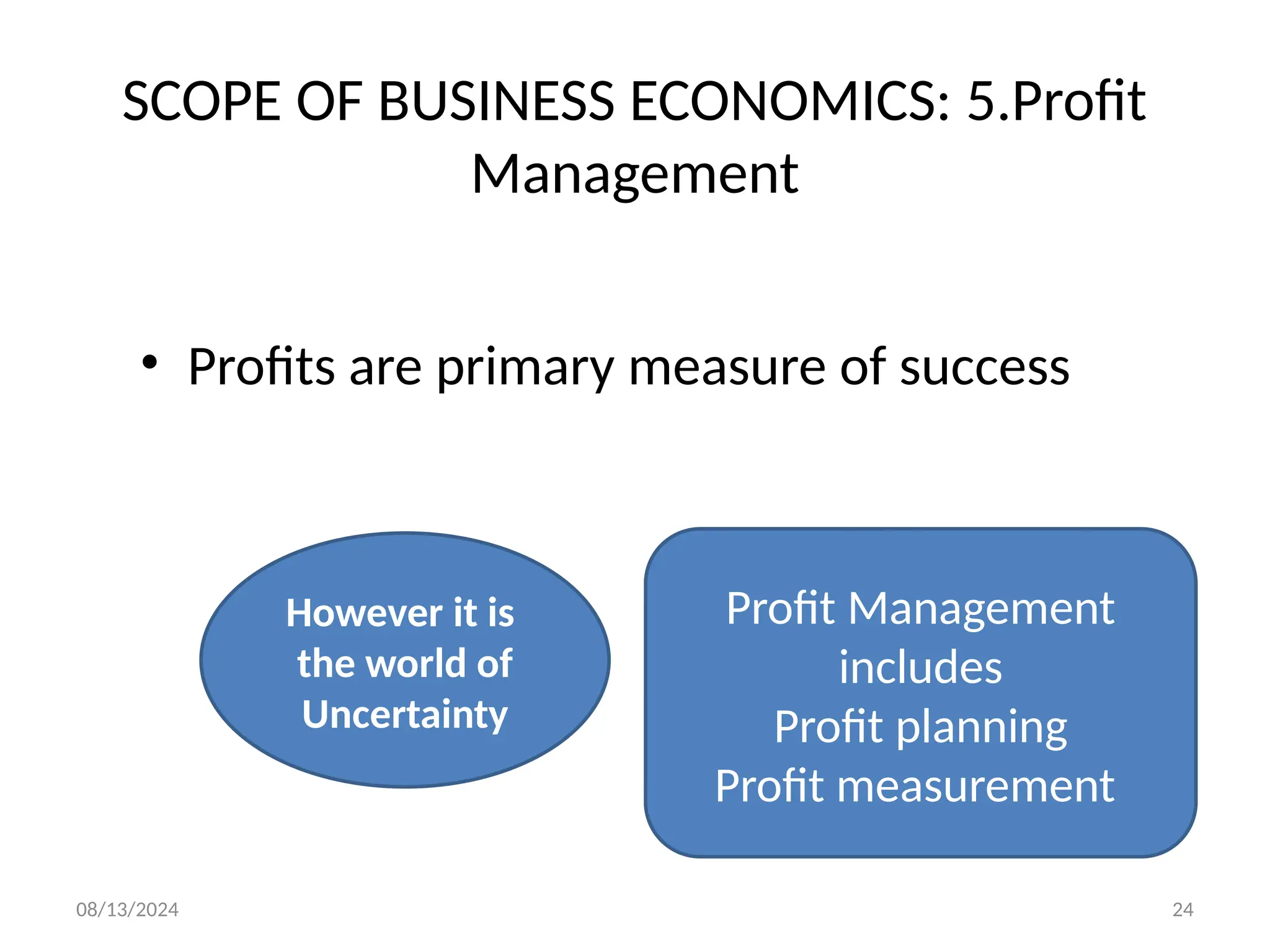
SCOPE OF BUSINESS ECONOMICS: 5.Profit
Management
• Profits are primary measure of success
However it is
the world of
Uncertainty
Profit Management
includes
Profit planning
Profit measurement
08/13/2024 25
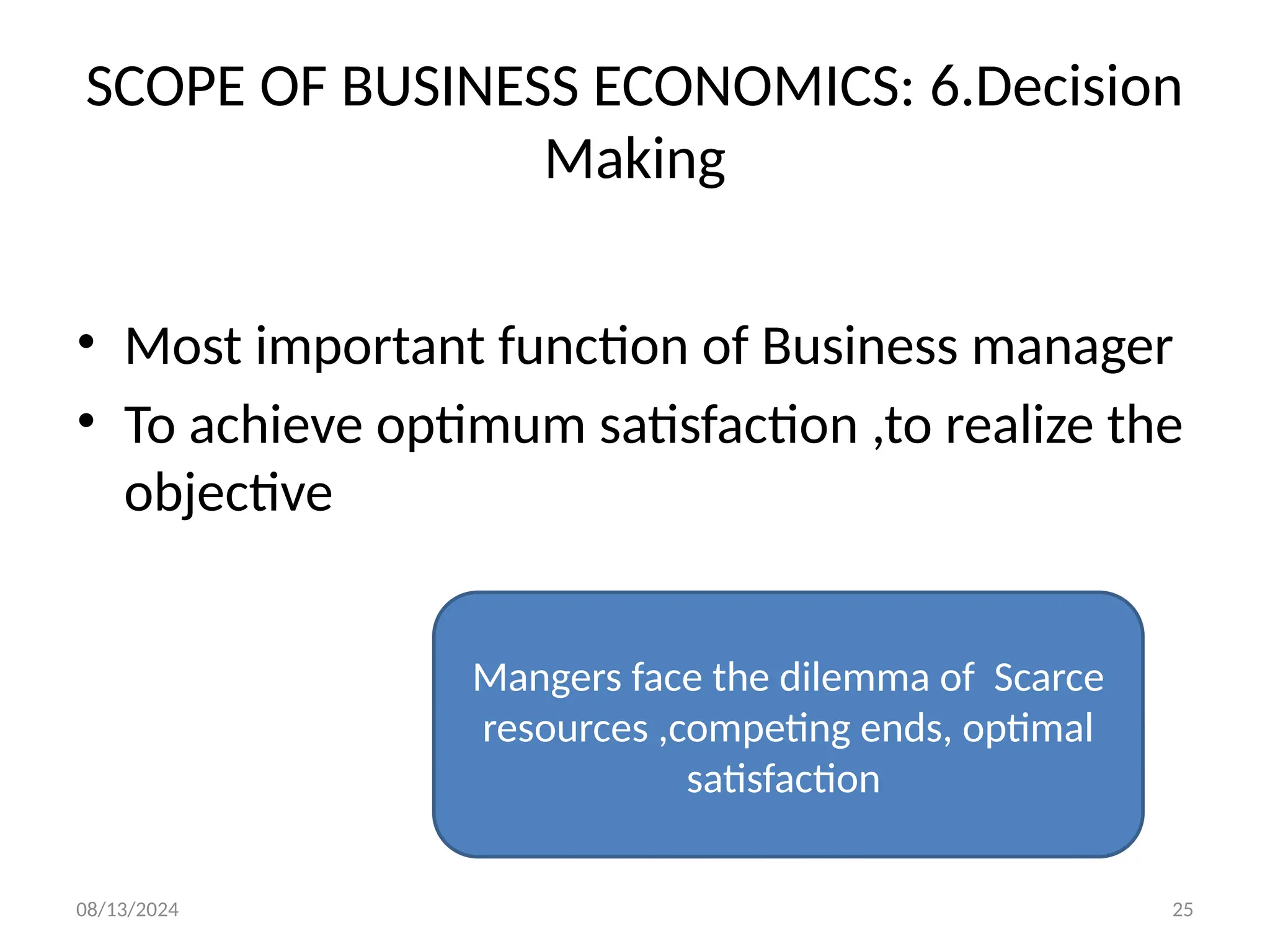
SCOPE OF BUSINESS ECONOMICS: 6.Decision
Making
• Most important function of Business manager
• To achieve optimum satisfaction ,to realize the
objective
Mangers face the dilemma of Scarce
resources ,competing ends, optimal
satisfaction
26
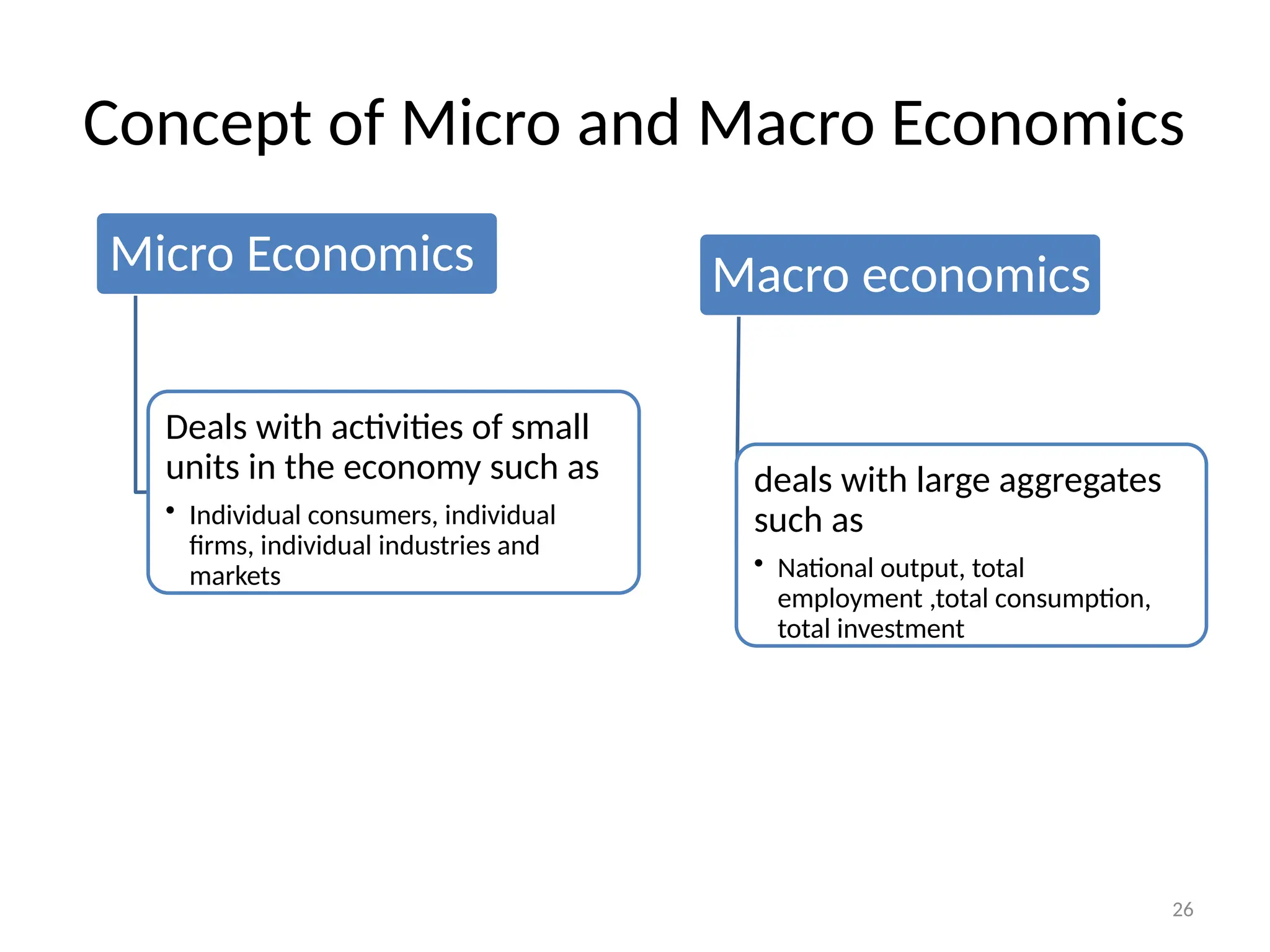
Concept of Micro and Macro Economics
Micro Economics
Deals with activities of small
units in the economy such as
• Individual consumers, individual
firms, individual industries and
markets
Macro economics
deals with large aggregates
such as
• National output, total
employment ,total consumption,
total investment
08/13/2024 27
Microeconomics
• Centers on the forces working at the individual level
(e.g. individual firms,indivdual customers,individual
workers
• Focuses on the needs, desires and buying habits of
the individual consumer
• An example: studying how firms react to
increasing costs of production by raising the price
and subsequently how consumer/household
spending is adjusted when the price rises
• Name of the game: Supply, Demand and Markets
08/13/2024 28
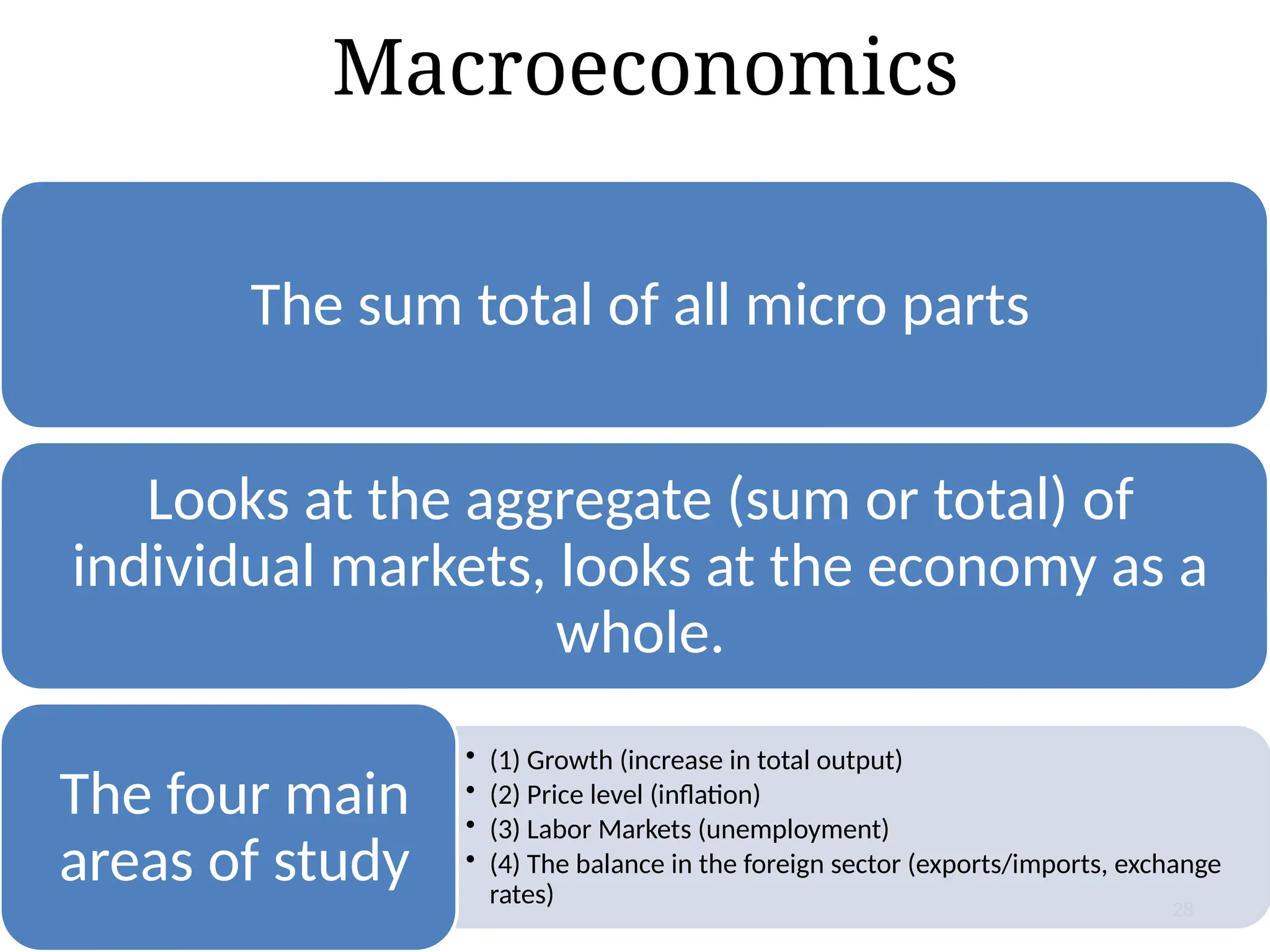
Macroeconomics
The sum total of all micro parts
Looks at the aggregate (sum or total) of
individual markets, looks at the economy as a
whole.
• (1) Growth (increase in total output)
• (2) Price level (inflation)
• (3) Labor Markets (unemployment)
• (4) The balance in the foreign sector (exports/imports, exchange
rates)
The four main
areas of study
08/13/2024 29
Let’s look at
examples of
Micro vs. Macro
08/13/2024 30
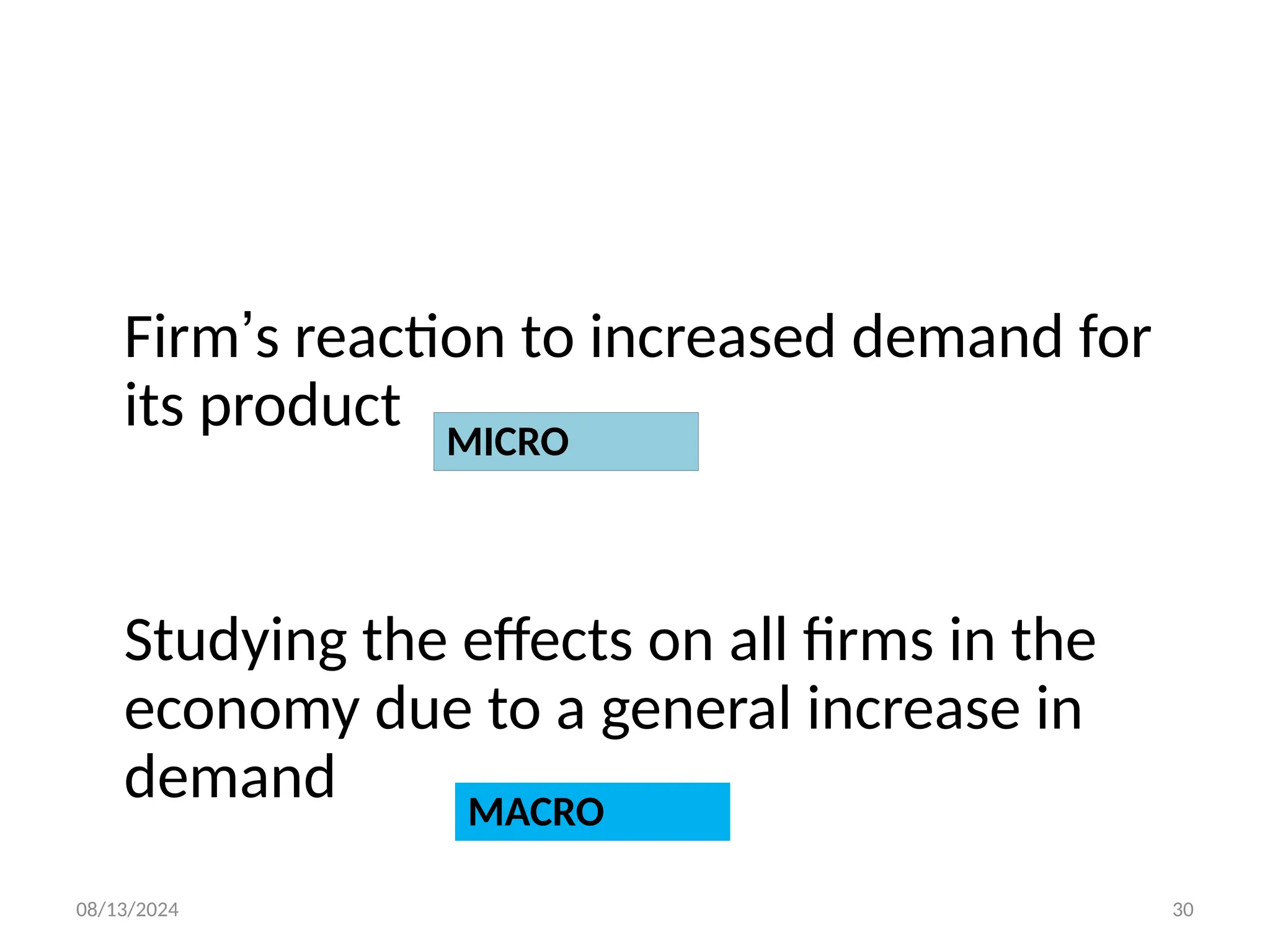
Firm’s reaction to increased demand for
its product
Studying the effects on all firms in the
economy due to a general increase in
demand
MICRO
MACRO
08/13/2024 31
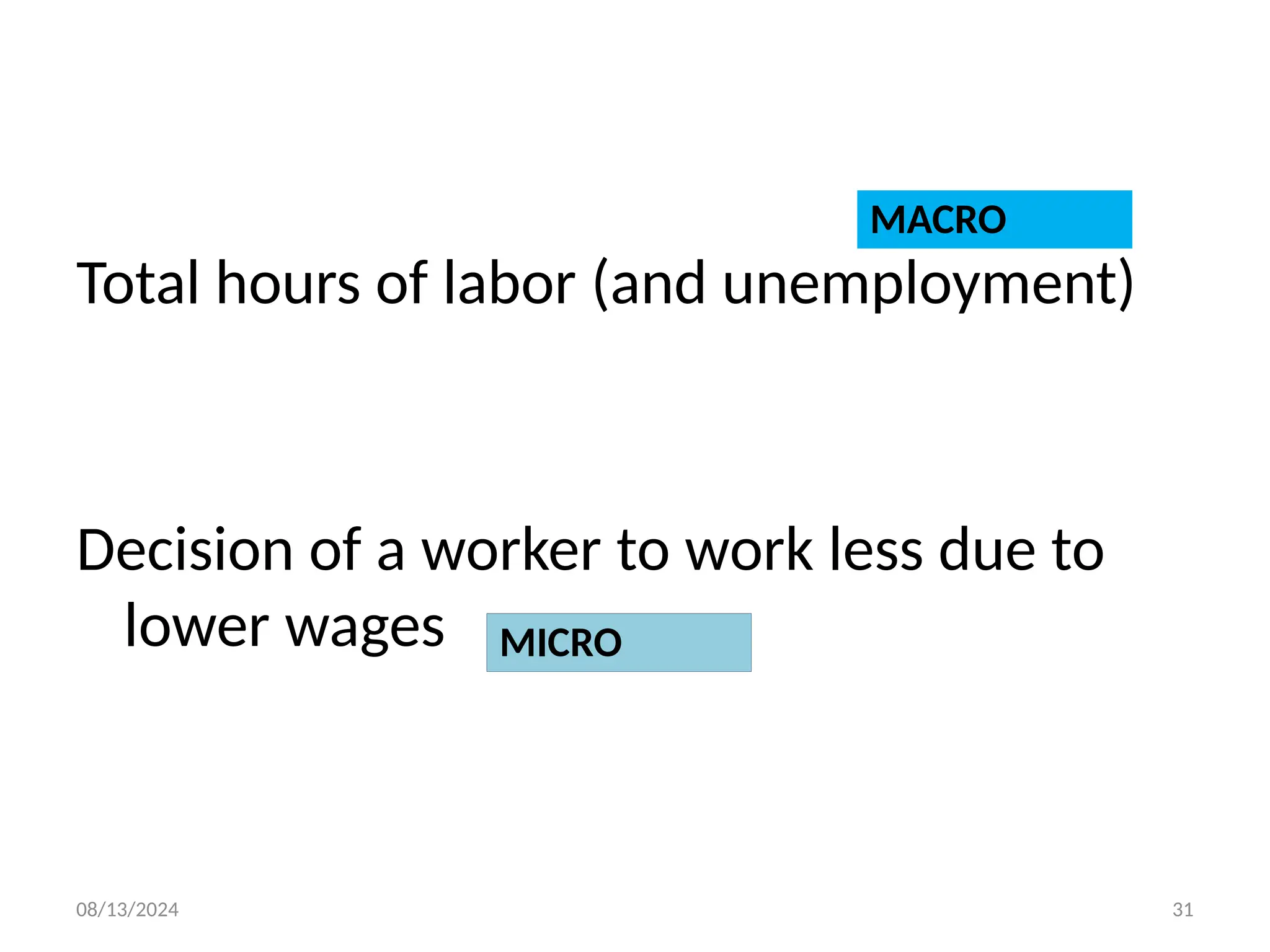
Total hours of labor (and unemployment)
Decision of a worker to work less due to
lower wages MICRO
MACRO
08/13/2024 32
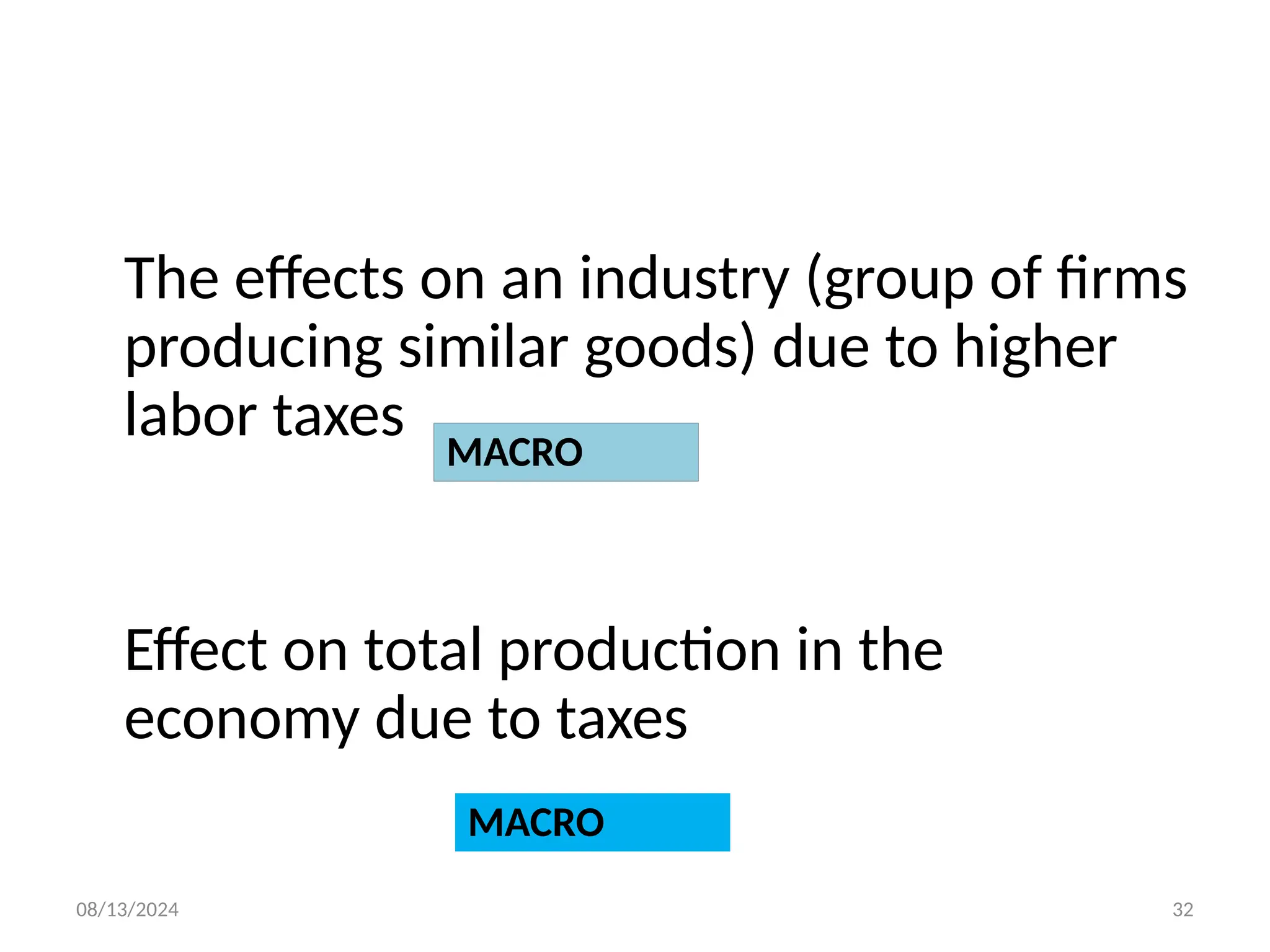
The effects on an industry (group of firms
producing similar goods) due to higher
labor taxes
Effect on total production in the
economy due to taxes
MACRO
MACRO
08/13/2024 33
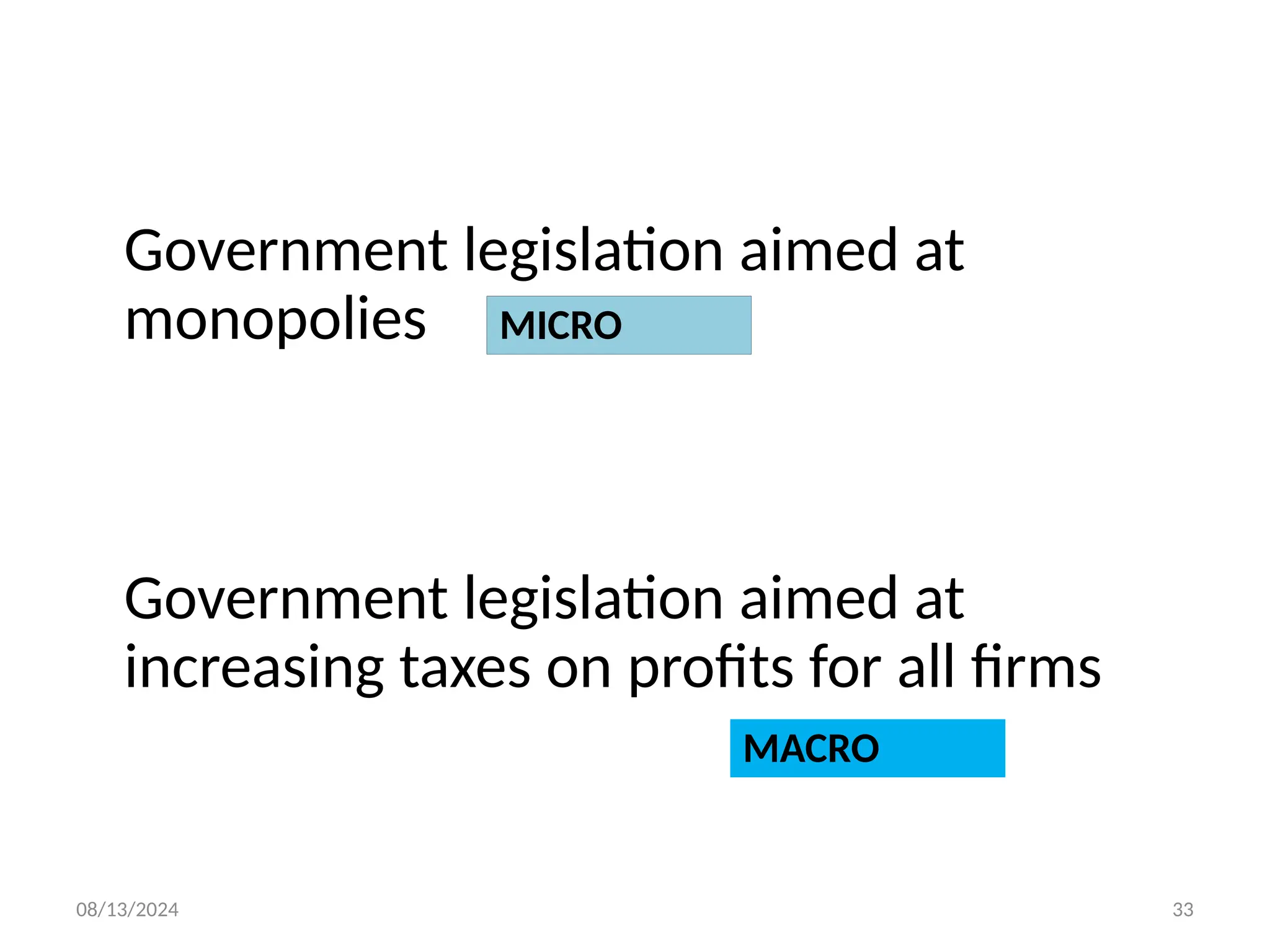
Government legislation aimed at
monopolies
Government legislation aimed at
increasing taxes on profits for all firms
MICRO
MACRO
08/13/2024 34
Goals of the Business
• Goals or objectives of the firm is concerned
with how ?
1. How to grow the business?
2. How to satisfy the customers?
3. How to compete with rivals?
4. How to respond to changing market conditions ?
5. How to manage each functional piece ?
6. How to achiieve finalcial and strategic objectives ?
08/13/2024 35
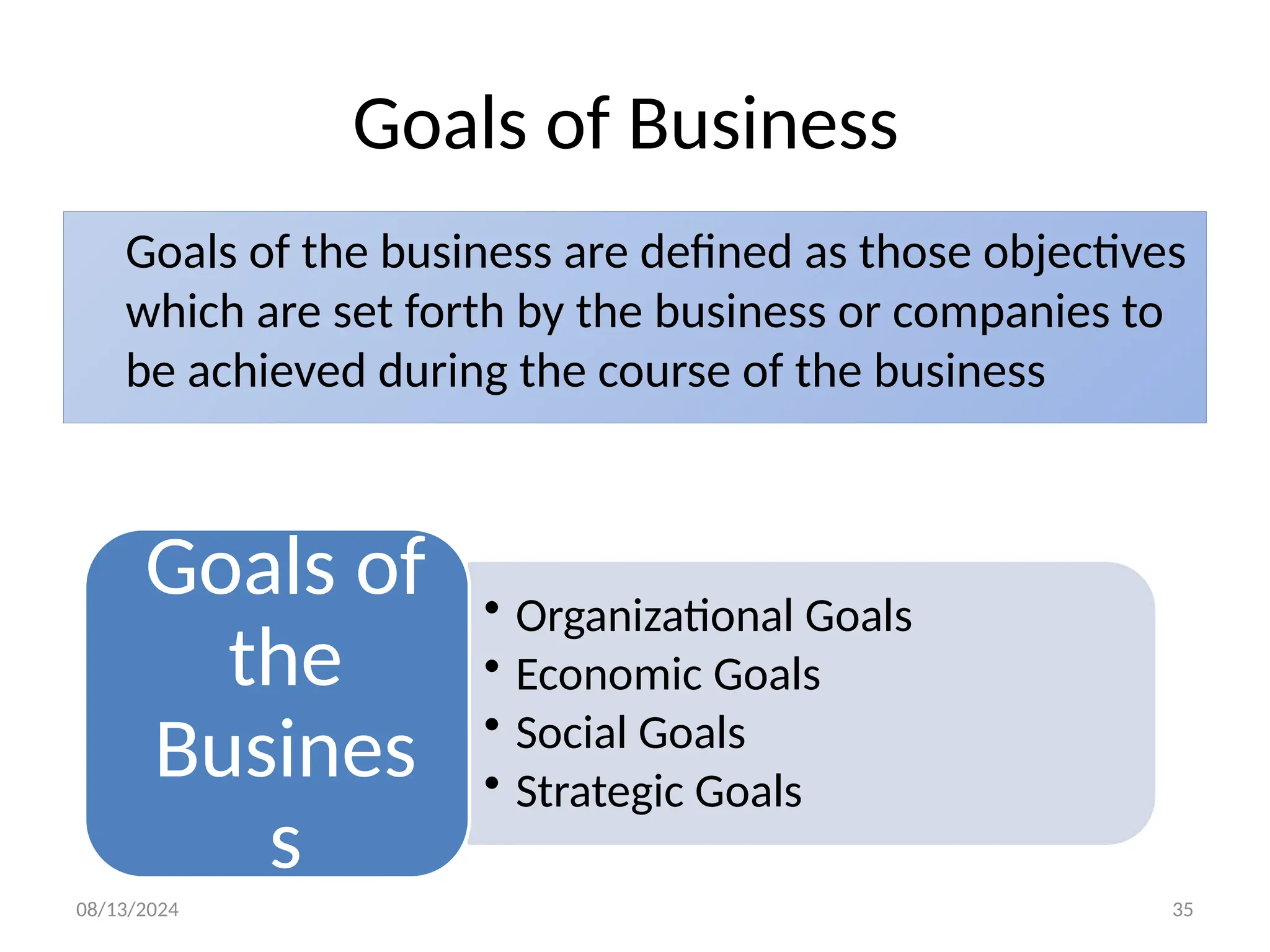
Goals of Business
Goals of the business are defined as those objectives
which are set forth by the business or companies to
be achieved during the course of the business
• Organizational Goals
• Economic Goals
• Social Goals
• Strategic Goals
Goals of
the
Busines
s
08/13/2024 36
Goals of Business
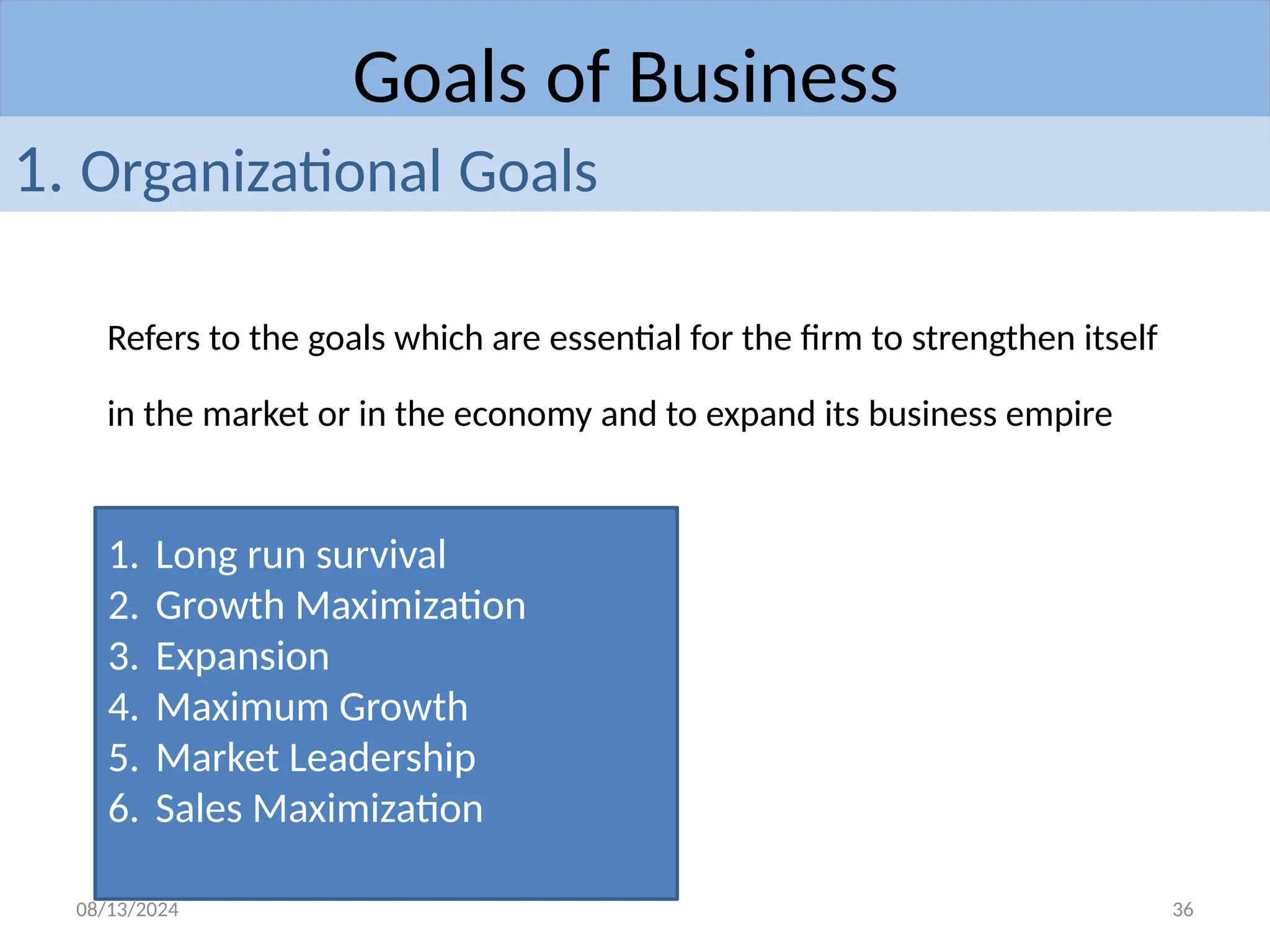
Refers to the goals which are essential for the firm to strengthen itself
in the market or in the economy and to expand its business empire
1. Organizational Goals
1. Long run survival
2. Growth Maximization
3. Expansion
4. Maximum Growth
5. Market Leadership
6. Sales Maximization
08/13/2024 37
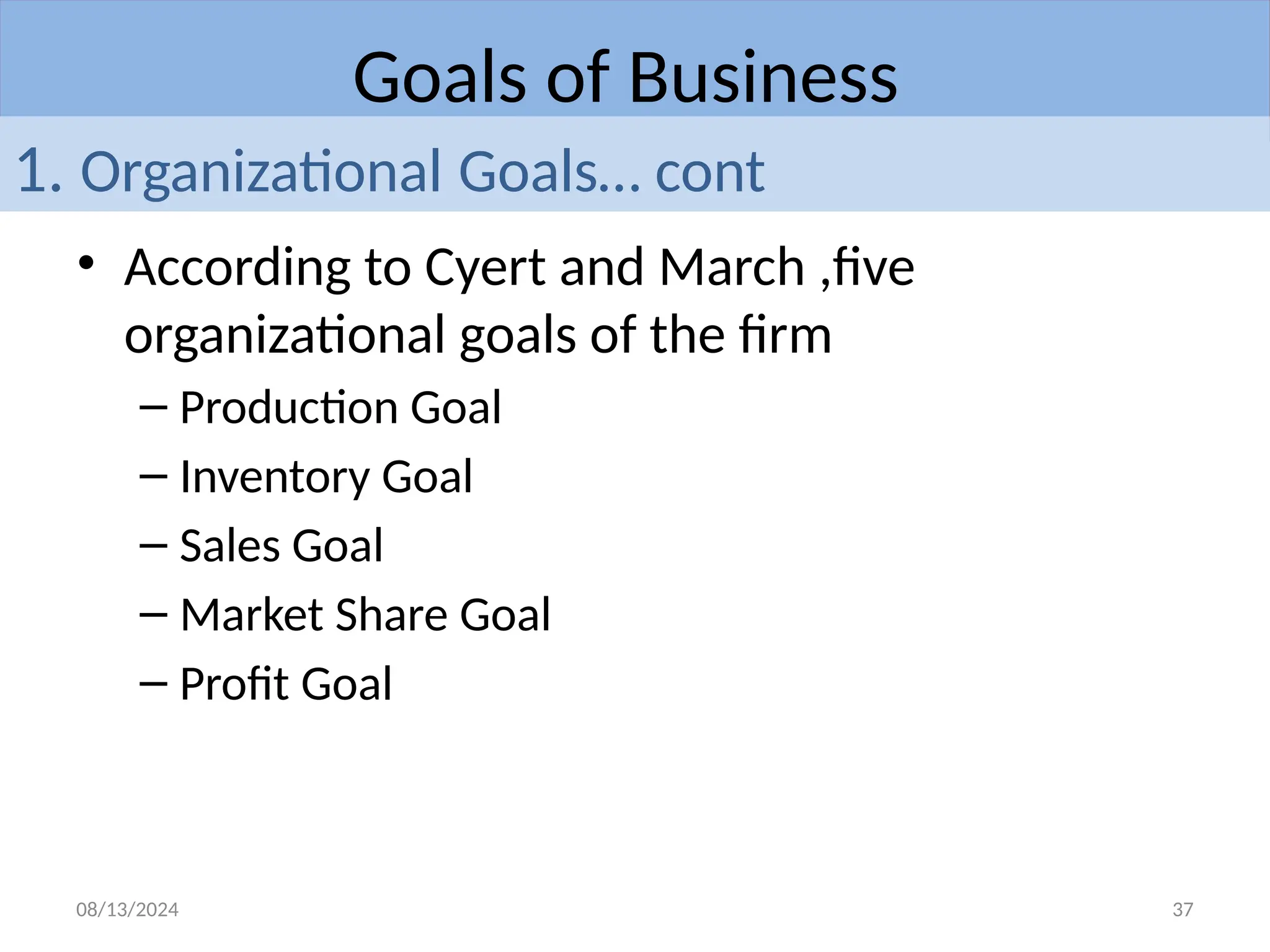
• According to Cyert and March ,five
organizational goals of the firm
– Production Goal
– Inventory Goal
– Sales Goal
– Market Share Goal
– Profit Goal
Goals of Business
1. Organizational Goals… cont
08/13/2024 38
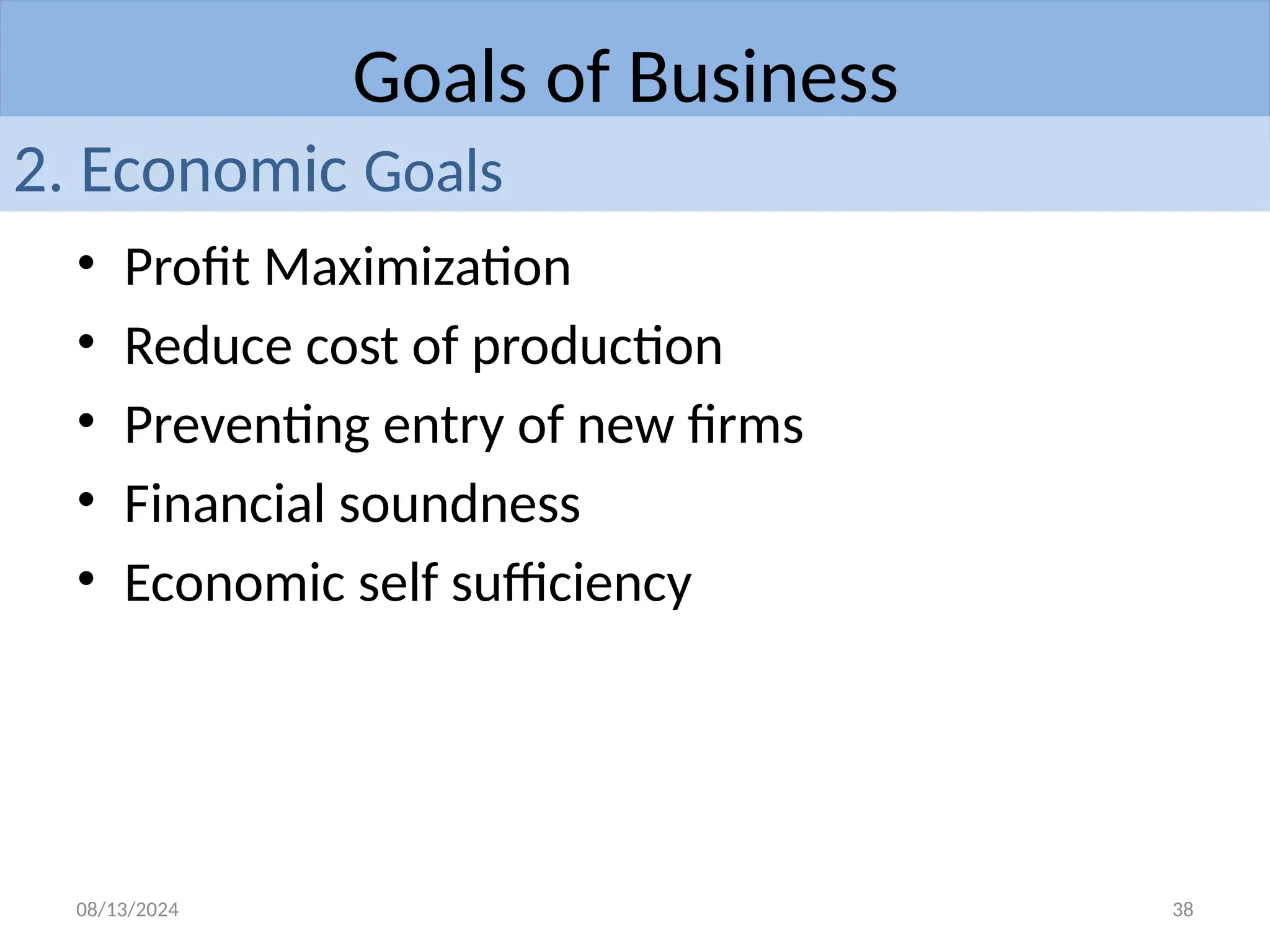
• Profit Maximization
• Reduce cost of production
• Preventing entry of new firms
• Financial soundness
• Economic self sufficiency
Goals of Business
2. Economic Goals
08/13/2024 39
• Improve the welfare of the society
• Participate in community development
program
• Provide quality products
• Not resorting to anti social practice
• Provide employment oppurtunities
Goals of Business
3.Social Goals
08/13/2024 40
• Are competitor focused …aims at unseating
the competitor
Goals of Business
4. Strategic Goals
•Bigger market share
•New product development
•Better product quality than competitors
•Wider and attractive product line etc
08/13/2024 41
• Profit as a means to an end… Growth and
development in micro and macro terms
• Facing potential competition and restriction the
new entries
• Preventing government interference
• Maintaining the consumers goodwill
• Maintain cordial industrial relations
• Liquidity preference
• Avoiding risk
Profit Maximisation and Optimisation of Profits
1.Profit constraints
08/13/2024 Anto Juliet Mary BBA 42
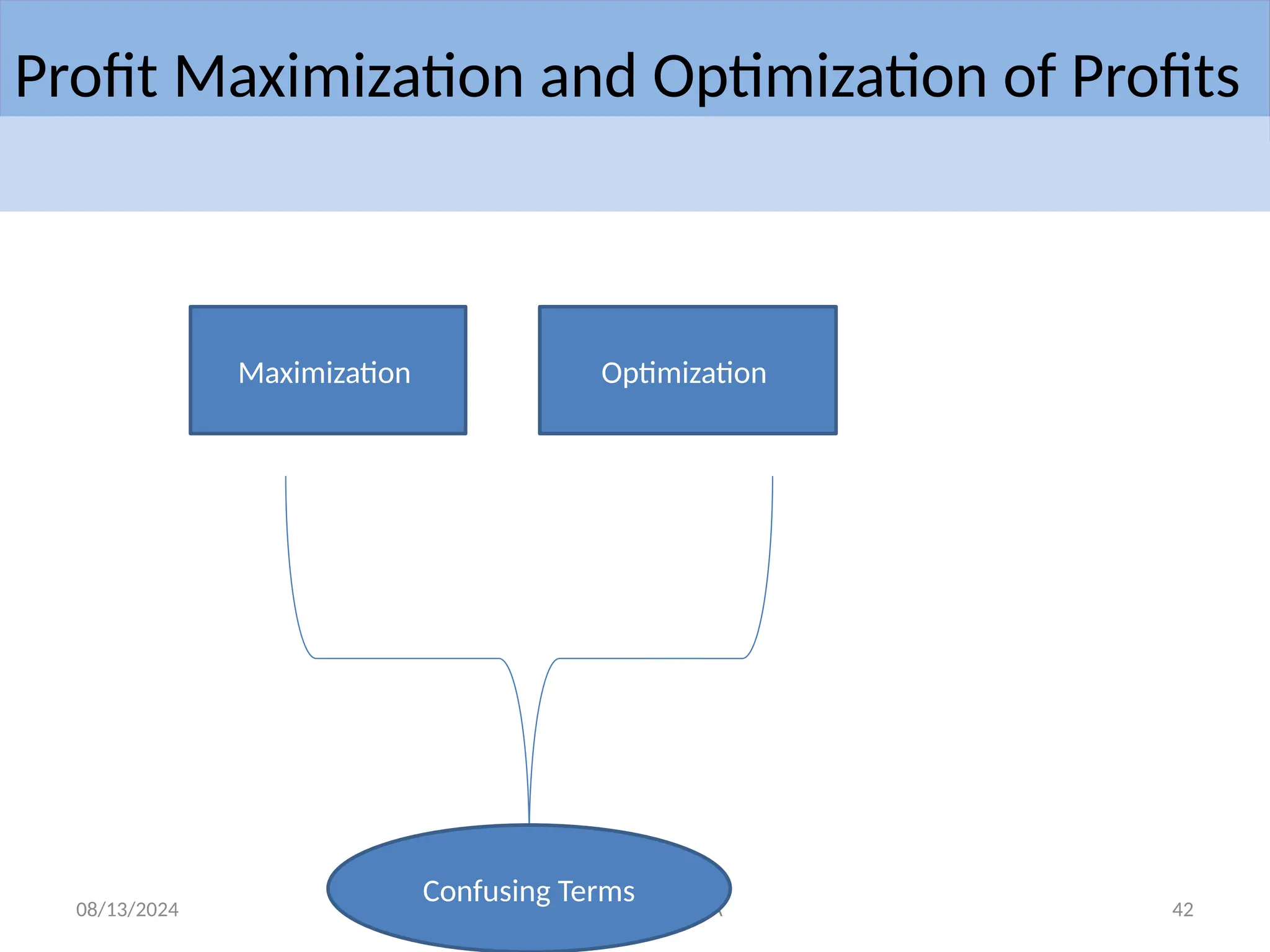
Profit Maximization and Optimization of Profits
Maximization Optimization
Confusing Terms
08/13/2024 43
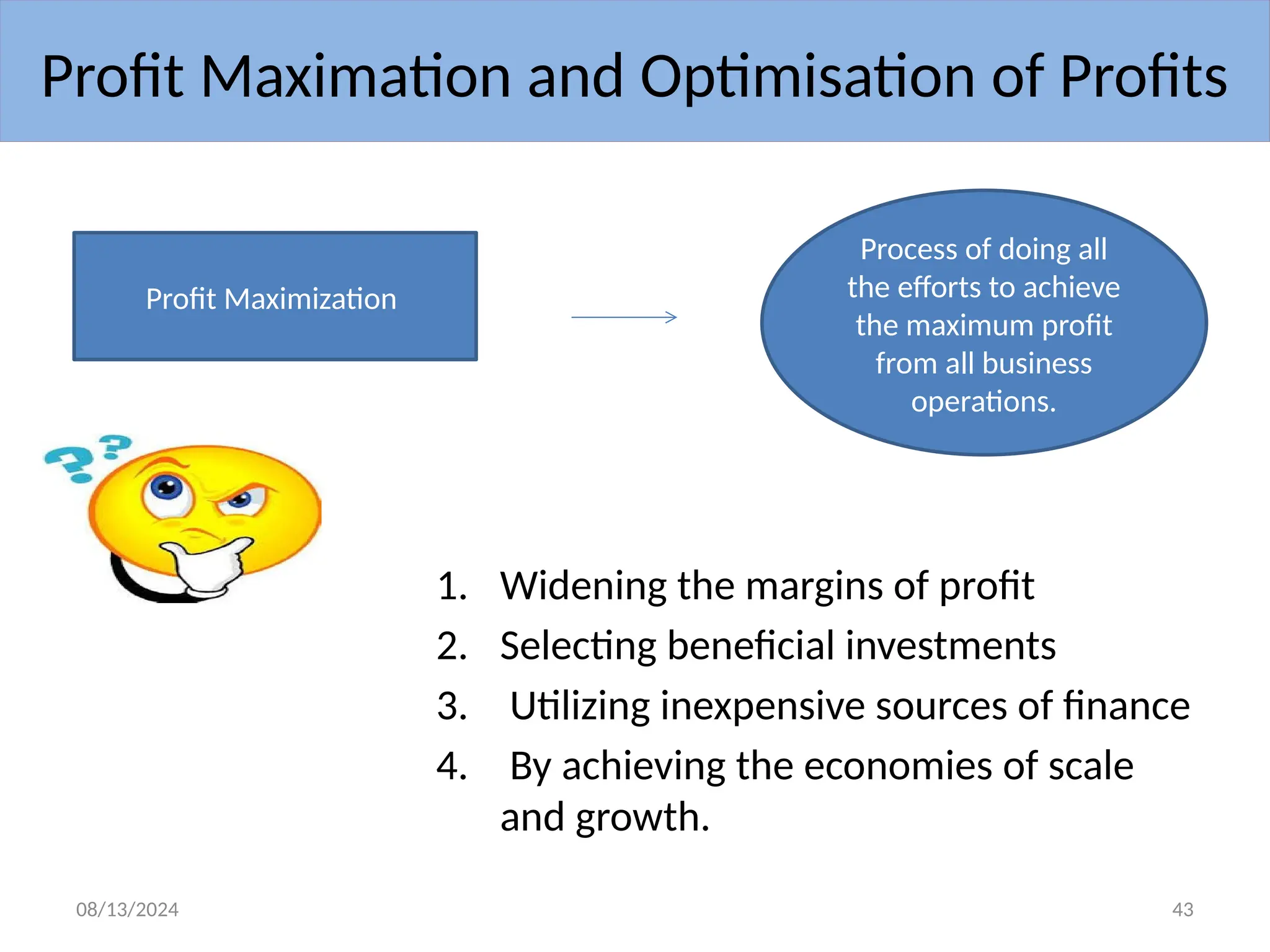
1. Widening the margins of profit
2. Selecting beneficial investments
3. Utilizing inexpensive sources of finance
4. By achieving the economies of scale
and growth.
Profit Maximation and Optimisation of Profits
Profit Maximization
Process of doing all
the efforts to achieve
the maximum profit
from all business
operations.
08/13/2024 Anto Juliet Mary BBA 44
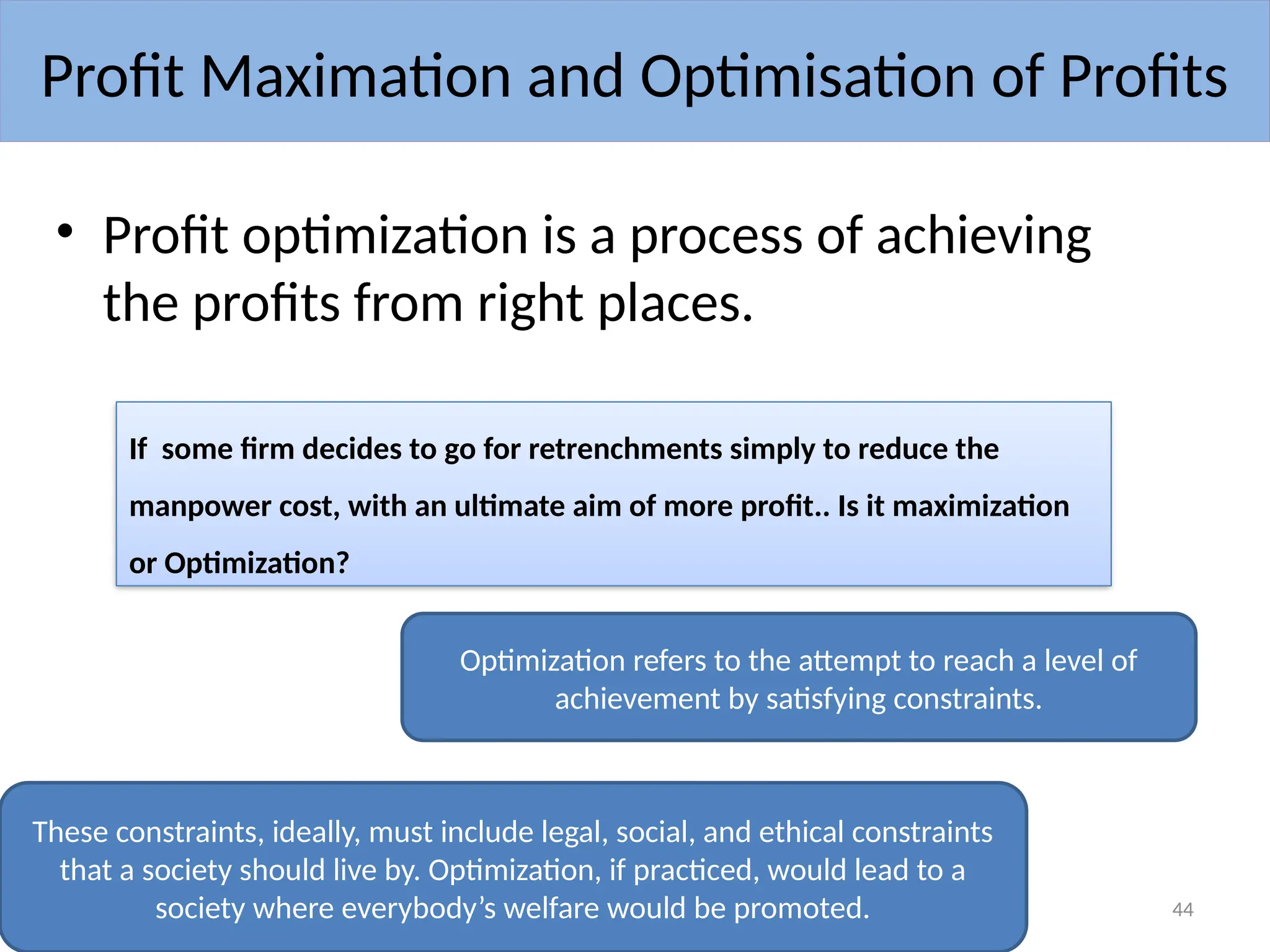
• Profit optimization is a process of achieving
the profits from right places.
Profit Maximation and Optimisation of Profits
If some firm decides to go for retrenchments simply to reduce the
manpower cost, with an ultimate aim of more profit.. Is it maximization
or Optimization?
These constraints, ideally, must include legal, social, and ethical constraints
that a society should live by. Optimization, if practiced, would lead to a
society where everybody’s welfare would be promoted.
Optimization refers to the attempt to reach a level of
achievement by satisfying constraints.
08/13/2024 45
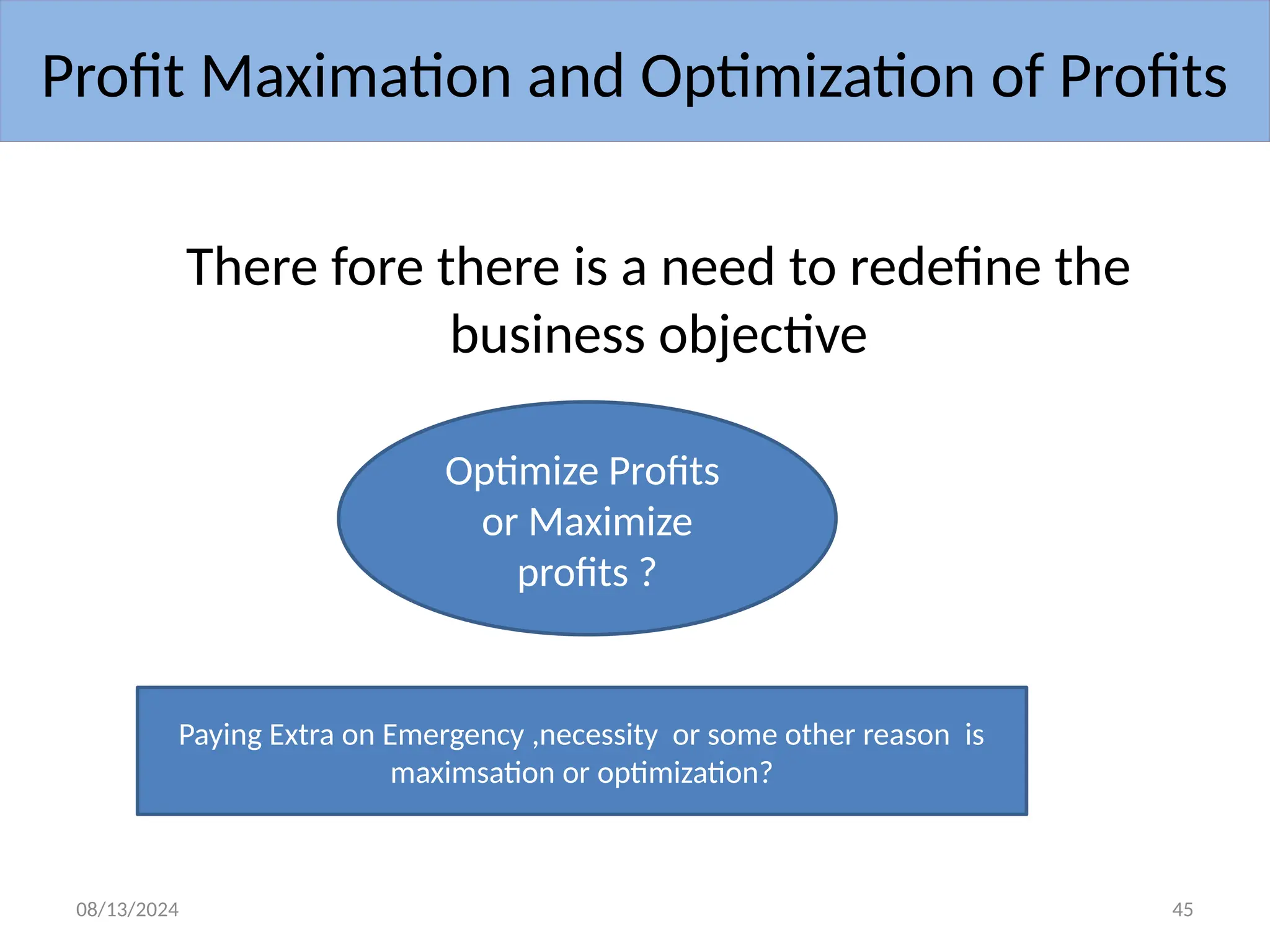
There fore there is a need to redefine the
business objective
Profit Maximation and Optimization of Profits
Optimize Profits
or Maximize
profits ?
Paying Extra on Emergency ,necessity or some other reason is
maximsation or optimization?
08/13/2024 46
Goals of Business
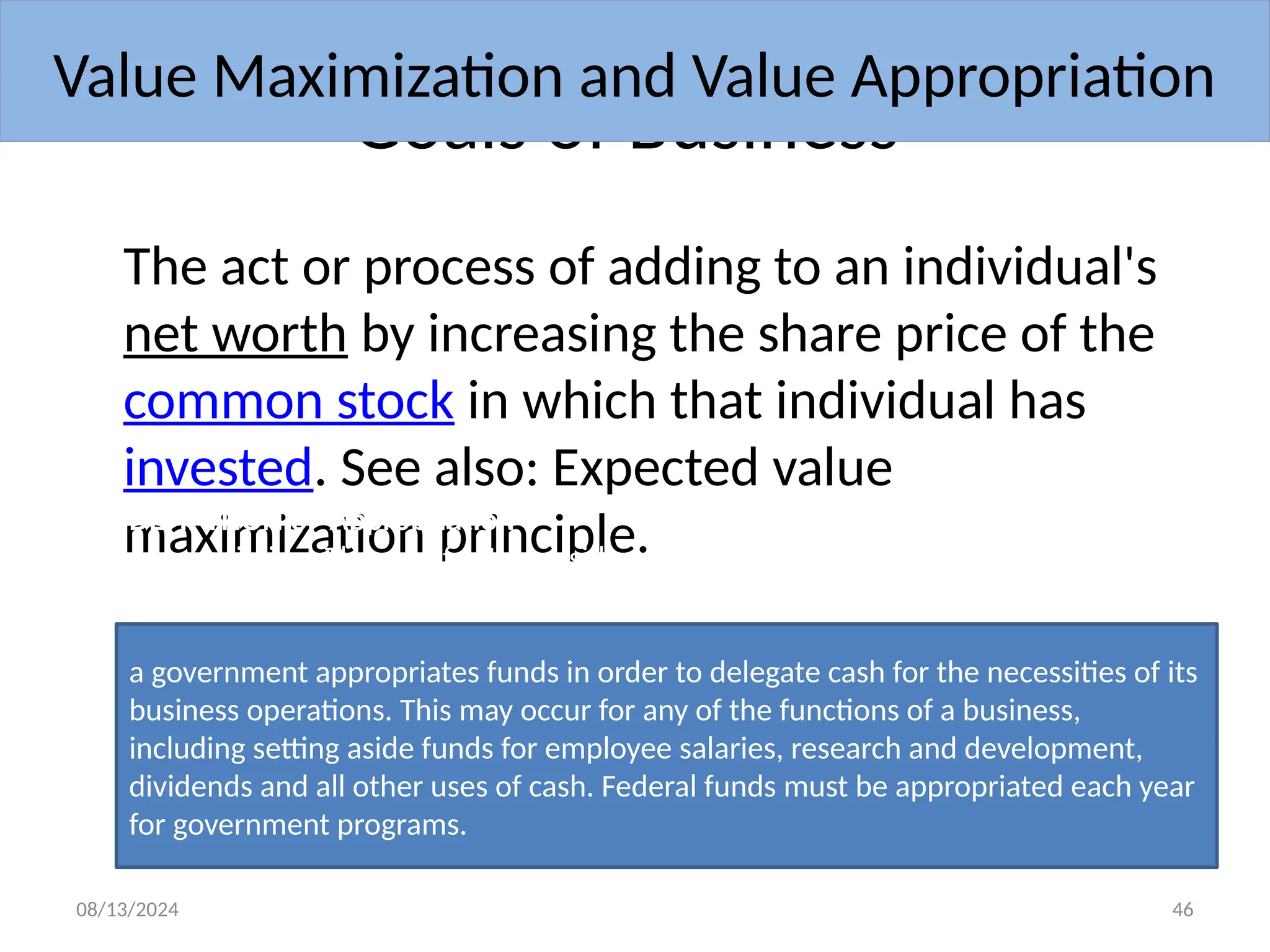
The act or process of adding to an individual's
net worth by increasing the share price of the
common stock in which that individual has
invested. See also: Expected value
maximization principle.
Value Maximization and Value Appropriation
DEFINITION of 'Appropriation'
Appropriation :The act of setting aside money for a specific purpose. A company or
a government appropriates funds in order to delegate cash for the necessities of its
business operations. This may occur for any of the functions of a business,
including setting aside funds for employee salaries, research and development,
dividends and all other uses of cash. Federal funds must be appropriated each year
for government programs.
08/13/2024 47
THE END

BE-U-1.pptx introducation and its impact of business

  • 1.
  • 2.
    08/13/2024 2 Introduction Business Economic Activity BusinessEconomics applied economics in under standing and analyzing business activity
  • 3.
    08/13/2024 3 Business Economics •Logic • Art of rational decision making Business Economics deals with economizing Making rational choices to yield maximum return out of minimum resources and efforts by making the best selection among alternative courses of action
  • 4.
    08/13/2024 4 Defination ofBusiness Economics Business economics is defined as ‘ the integration of economic theory with business practice for the purpose of facilitating decision making and forward planning by the management’ Economics applied to decision making which is core of business
  • 5.
    08/13/2024 5 Understanding BusinessEconomics Firm • Starting Point Business and Management Problems • Focus Business Economics • Means Business and Managemen t Solutions • Ends
  • 6.
    08/13/2024 6 Characteristics ofBusiness Economics • New discipline and of recent origin • Highly specialized and separate branch • Micro in nature • Mainly normative science • Both conceptual and metrical • Science of decision making • Deals with economic behavior of the firm • Optimal allocation of resources
  • 7.
    08/13/2024 7 Characteristics ofBusiness Economics … CONT • Toolbox of analysis and technique of thinking • Application of economic principles • Studies macro economics concepts like GDP DEFLATION INFLATION TRADE CYCLES NNP
  • 8.
    08/13/2024 8 Benefits ofBusiness Economics • Practical application of economic concepts and principles to solve the firms problems • Integration of economic theory and practice • Avoids abstract discussion provides simple solutions • Most advanced tools and instruments used • Optimum use of scarce resources • Maximizes sales .. • All round development of business
  • 9.
    08/13/2024 9 Area ofStudy SCOPE OF BUSINESS ECONOMICS Boundaries Subject Matter
  • 10.
    08/13/2024 10 Demand analysis andforecasting Production and cost analysis Pricing Profit management Capital management Decision making SCOPE OF BUSINESS ECONOMICS
  • 11.
    08/13/2024 11 Business transformsresources to consumable goods SCOPE OF BUSINESS ECONOMICS: 1. 1.Demand Analysis Demand
  • 12.
    08/13/2024 12 SCOPE OFBUSINESS ECONOMICS: 1.Demand Analysis…cont Income Elasticity Price Elasticity Substitution Elasticity of demand Demand Analysis Consists of Demand determinants • Income • Price • Substitute products etc Demand distinctions • Producers goods or consumers • Durable goods and non durable • Industry demand or company demand Demand forecasting
  • 13.
    08/13/2024 13 SCOPE OFBUSINESS ECONOMICS: 2.Production and Cost Analysis • Cost of production is estimated from the accounting records • Comparison of the costs of production of different periods to develop suitable policies to control cost with increased profits Cost analysis • Financial terms Production analysis • Physical terms Product planning
  • 14.
    08/13/2024 14 SCOPE OFBUSINESS ECONOMICS: 2.Production and Cost Analysis… cont • Cost concepts • Cost input relationships • Economies of scale • Production function • Cost control Importan t concepts covered
  • 15.
    08/13/2024 15 • Cost:A cost is an expenditure incurred by a firm to produce goods and services for sale in the market. • In other words, a cost is the outflow of money from the business to gain inflow of money after sale of the commodity. A producer has to incur various costs in order to produce goods and services. These costs are of various types.
  • 16.
    08/13/2024 16 • Typesof cost: The following are the various types of costs:- 1. Direct costs or explicit costs 2. Indirect costs or implicit costs 3. Fixed costs 4. Variable costs 5. Accounting costs 6. Economic costs 7. Total costs 8. Average costs 9. Marginal costs 10.Opportunity costs
  • 17.
    08/13/2024 17 • Explicitcosts are those costs which are met by cash payments for employing various factors of production. The producer actually pays money to produce his goods and services. • A direct or explicit cost is the material, labor, expenses, overheads, selling and distribution, administrative cost related to production of a commodity.
  • 18.
    08/13/2024 18 Implicit costis also called as imputed cost. Here cash outflow does not happen. An implicit cost is defined as under: “An implicit cost is the factor of production sacrificed by the producer for an alternative factor production. The opportunity foregone is the implicit cost.” Fixed costs: Fixed costs are those costs that do not change in the short run period of time. Fixed costs remain the same regardless of the amount of production and sale of commodities. Variable Cost: A variable cost is that cost which changes in short – run and long – run time period. It always keeps on changing. These costs are incurred during production process and thus are the costs incurred for employing various factors of production.
  • 19.
    08/13/2024 19 • EconomicCosts: Economic costs are those costs that an entrepreneur incurs while conducting economic activities. For an entrepreneur an economic activity is his business. • Opportunity Cost: An opportunity cost is the opportunity or choice that is let go off or sacrificed for an alternative choice. In economics, opportunity cost is the foregone production factor in business for an alternative production factor.
  • 20.
    08/13/2024 2.Production and CostAnalysis…cont •Product •price •Place •Promotion Productio n analysis deals with product mix 20
  • 21.
    08/13/2024 21 SCOPE OFBUSINESS ECONOMICS: 3.Pricing Decisions ,Policies and Practices Pricing Depends on – The cost of production – Nature of substitutes – Competition Pricing impacts Profits of the firm
  • 22.
    08/13/2024 22 SCOPE OFBUSINESS ECONOMICS: 4.Capital Management • Capital management is done by preparing the capital budget – Working capital – Investment capital – Long term requirement – Short term requirement Capital Management is most important for the business firm capital Budget includes
  • 23.
    08/13/2024 23 SCOPE OFBUSINESS ECONOMICS: 4.Capital Management Capital management further deals with three things Cost of capital Rate of return Selection of the project
  • 24.
    08/13/2024 24 SCOPE OFBUSINESS ECONOMICS: 5.Profit Management • Profits are primary measure of success However it is the world of Uncertainty Profit Management includes Profit planning Profit measurement
  • 25.
    08/13/2024 25 SCOPE OFBUSINESS ECONOMICS: 6.Decision Making • Most important function of Business manager • To achieve optimum satisfaction ,to realize the objective Mangers face the dilemma of Scarce resources ,competing ends, optimal satisfaction
  • 26.
    26 Concept of Microand Macro Economics Micro Economics Deals with activities of small units in the economy such as • Individual consumers, individual firms, individual industries and markets Macro economics deals with large aggregates such as • National output, total employment ,total consumption, total investment
  • 27.
    08/13/2024 27 Microeconomics • Centerson the forces working at the individual level (e.g. individual firms,indivdual customers,individual workers • Focuses on the needs, desires and buying habits of the individual consumer • An example: studying how firms react to increasing costs of production by raising the price and subsequently how consumer/household spending is adjusted when the price rises • Name of the game: Supply, Demand and Markets
  • 28.
    08/13/2024 28 Macroeconomics The sumtotal of all micro parts Looks at the aggregate (sum or total) of individual markets, looks at the economy as a whole. • (1) Growth (increase in total output) • (2) Price level (inflation) • (3) Labor Markets (unemployment) • (4) The balance in the foreign sector (exports/imports, exchange rates) The four main areas of study
  • 29.
    08/13/2024 29 Let’s lookat examples of Micro vs. Macro
  • 30.
    08/13/2024 30 Firm’s reactionto increased demand for its product Studying the effects on all firms in the economy due to a general increase in demand MICRO MACRO
  • 31.
    08/13/2024 31 Total hoursof labor (and unemployment) Decision of a worker to work less due to lower wages MICRO MACRO
  • 32.
    08/13/2024 32 The effectson an industry (group of firms producing similar goods) due to higher labor taxes Effect on total production in the economy due to taxes MACRO MACRO
  • 33.
    08/13/2024 33 Government legislationaimed at monopolies Government legislation aimed at increasing taxes on profits for all firms MICRO MACRO
  • 34.
    08/13/2024 34 Goals ofthe Business • Goals or objectives of the firm is concerned with how ? 1. How to grow the business? 2. How to satisfy the customers? 3. How to compete with rivals? 4. How to respond to changing market conditions ? 5. How to manage each functional piece ? 6. How to achiieve finalcial and strategic objectives ?
  • 35.
    08/13/2024 35 Goals ofBusiness Goals of the business are defined as those objectives which are set forth by the business or companies to be achieved during the course of the business • Organizational Goals • Economic Goals • Social Goals • Strategic Goals Goals of the Busines s
  • 36.
    08/13/2024 36 Goals ofBusiness Refers to the goals which are essential for the firm to strengthen itself in the market or in the economy and to expand its business empire 1. Organizational Goals 1. Long run survival 2. Growth Maximization 3. Expansion 4. Maximum Growth 5. Market Leadership 6. Sales Maximization
  • 37.
    08/13/2024 37 • Accordingto Cyert and March ,five organizational goals of the firm – Production Goal – Inventory Goal – Sales Goal – Market Share Goal – Profit Goal Goals of Business 1. Organizational Goals… cont
  • 38.
    08/13/2024 38 • ProfitMaximization • Reduce cost of production • Preventing entry of new firms • Financial soundness • Economic self sufficiency Goals of Business 2. Economic Goals
  • 39.
    08/13/2024 39 • Improvethe welfare of the society • Participate in community development program • Provide quality products • Not resorting to anti social practice • Provide employment oppurtunities Goals of Business 3.Social Goals
  • 40.
    08/13/2024 40 • Arecompetitor focused …aims at unseating the competitor Goals of Business 4. Strategic Goals •Bigger market share •New product development •Better product quality than competitors •Wider and attractive product line etc
  • 41.
    08/13/2024 41 • Profitas a means to an end… Growth and development in micro and macro terms • Facing potential competition and restriction the new entries • Preventing government interference • Maintaining the consumers goodwill • Maintain cordial industrial relations • Liquidity preference • Avoiding risk Profit Maximisation and Optimisation of Profits 1.Profit constraints
  • 42.
    08/13/2024 Anto JulietMary BBA 42 Profit Maximization and Optimization of Profits Maximization Optimization Confusing Terms
  • 43.
    08/13/2024 43 1. Wideningthe margins of profit 2. Selecting beneficial investments 3. Utilizing inexpensive sources of finance 4. By achieving the economies of scale and growth. Profit Maximation and Optimisation of Profits Profit Maximization Process of doing all the efforts to achieve the maximum profit from all business operations.
  • 44.
    08/13/2024 Anto JulietMary BBA 44 • Profit optimization is a process of achieving the profits from right places. Profit Maximation and Optimisation of Profits If some firm decides to go for retrenchments simply to reduce the manpower cost, with an ultimate aim of more profit.. Is it maximization or Optimization? These constraints, ideally, must include legal, social, and ethical constraints that a society should live by. Optimization, if practiced, would lead to a society where everybody’s welfare would be promoted. Optimization refers to the attempt to reach a level of achievement by satisfying constraints.
  • 45.
    08/13/2024 45 There forethere is a need to redefine the business objective Profit Maximation and Optimization of Profits Optimize Profits or Maximize profits ? Paying Extra on Emergency ,necessity or some other reason is maximsation or optimization?
  • 46.
    08/13/2024 46 Goals ofBusiness The act or process of adding to an individual's net worth by increasing the share price of the common stock in which that individual has invested. See also: Expected value maximization principle. Value Maximization and Value Appropriation DEFINITION of 'Appropriation' Appropriation :The act of setting aside money for a specific purpose. A company or a government appropriates funds in order to delegate cash for the necessities of its business operations. This may occur for any of the functions of a business, including setting aside funds for employee salaries, research and development, dividends and all other uses of cash. Federal funds must be appropriated each year for government programs.
  • 47.

Editor's Notes

  • #2 Business is part and parcel of economic activity.Business economies is essentially applied economicss in the field of management.Business is the economic activity and the business unit is the economic unit.It is the producing unit that converts inputs to output.Profit is the objective of business unit.
  • #4 Play the business economics video ..this gives them a peek on business economics and the application
  • #5 Play the space x … upto 3.00 mins tesla video and explain the business economics term and concepts .Ask what was the starting point ..focus area…business economics application and the solution found
  • #6 also called Normative economics which prescibes standards and norms for policy making .BE is prescriptive rather than descriptive in nature.For exaample law of demand and law of demand are theories in economic theory applied in business economics for policy planning at the firms level Micro in nature as it involves at the firms level , at a unit …firms level Science of decision making it …bridges the gap between economics and business by helping the manager to take up decisions
  • #10 Business economics is the developing science which generates the countless problems to determine its scope in a clear cut way.Even the following fields may be said to generally fall under business economics.The study of these segments constitute its subject matter as well as scope.Recently Economics is increased use of gaming ,operations research,programming etc
  • #11 TO convert resources to consumable goods ,business has to determine nature of the demand and the sales.To estimate the demand
  • #12 To estimate the demand need to consider income elasticity, price elasticity, and substitution elasticity of demand When price changes, quantity demanded will change. That is a movement along the same demand curve. When factors other than price changes, demand curve will shift. These are the determinants of the demand curve. 1. Income: A rise in a person’s income will lead to an increase in demand (shift demand curve to the right), a fall will lead to a decrease in demand for normal goods. Goods whose demand varies inversely with income are called inferior goods (e.g. Hamburger Helper). 2. Consumer Preferences: Favorable change leads to an increase in demand, unfavorable change lead to a decrease. 3. Number of Buyers: the more buyers lead to an increase in demand; fewer buyers lead to decrease. 4. Price of related goods: a. Substitute goods (those that can be used to replace each other): price of substitute and demand for the other good are directly related. Example: If the price of coffee rises, the demand for tea should increase. b. Complement goods (those that can be used together): price of complement and demand for the other good are inversely related. Example: if the price of ice cream rises, the demand for ice-cream toppings will decrease. 5. Expectation of future: a. Future price: consumers’ current demand will increase if they expect higher future prices; their demand will decrease if they expect lower future prices. b. Future income: consumers’ current demand will increase if they expect higher future income; their demand will decrease if they expect lower future income. Demand distinctions: Producers and consumers goods,durable and non durable ,industry demand or company demand ,short run demand or long run demand
  • #13 Production and cost analysis help in efficient allocation of resource which are scarce.Production and cost essential for product planning.
  • #26 Video link :https://www.youtube.com/watch?v=K6qqtAByvq8
  • #28 To understand why both microeconomic and macroeconomic perspectives are useful, consider the problem of studying a biological ecosystem like a lake. One person who sets out to study the lake might focus on specific topics: certain kinds of algae or plant life; the characteristics of particular fish or snails; or the trees surrounding the lake. Another person might take an overall view and instead consider the entire ecosystem of the lake from top to bottom; what eats what, how the system stays in a rough balance, and what environmental stresses affect this balance. Both approaches are useful, and both examine the same lake, but the viewpoints are different. In a similar way, both microeconomics and macroeconomics study the same economy, but each has a different viewpoint.
  • #41 Success of any firm is dependent on the profit making of the firm.
  • #43 How to achieve it?
  • #44 then it is not profit optimization, it is simply an activity of profit maximization. This type of maximizations eventually leads to loss in business because profit is not coming from right activities and right places. Profit of a firm can simply be termed as optimized profit if it is coming from rational operations. So, profit optimization is a process of cutting down the unnecessary or avoidable costs of production. It is extremely different from the concept of profit maximization. In profit optimization a firm that is already running in the profits, look forward to further optimize and rationalize its profit so as to win the global competition. Cost cutting is most powerful tool of profit optimization. But, in the greed of cutting costs one should always take care about mandatory and required costs, because such costs are not only costs they are just like investments for any organization whose benefits can be enjoyed over a long run. So, cost cutting is extremely helpful tool if used with proper care and concern for the growth of organization.