BASIC PATH
TESTING
HOA LE
Agenda
 Introduction
 Cyclomatic complexity
 Basic path testing approach
 Conclusion
Introduction
 A white box method
 Proposed by McCabe in 1980’s
 A hybrid of path testing and branch
testing methods.
 Based on Cyclomatic complexity and
uses control flow to establish the path
coverage criteria.
Cyclomatic Complexity
 Developed by McCabe in 1976
 Measures the number of linearly independent
paths through a program.
 The higher the number the more complex the
code.
Basic path testing approach
 Step 1: Draw a control flow graph.
 Step 2: Determine Cyclomatic complexity.
 Step 3: Find a basis set of paths.
 Step 4: Generate test cases for each path.
Draw a control flow graph
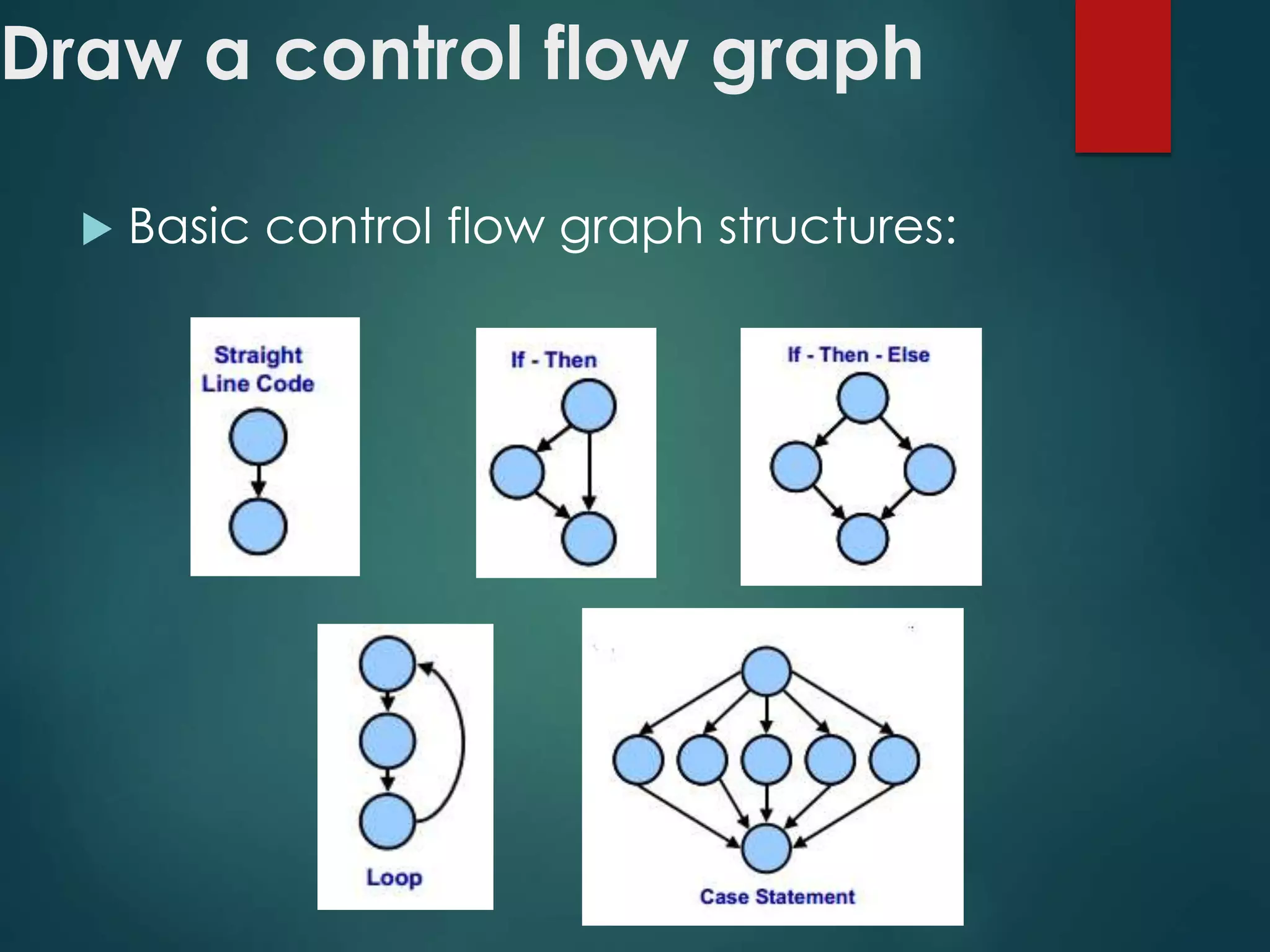
 Basic control flow graph structures:
Draw a control flow graph
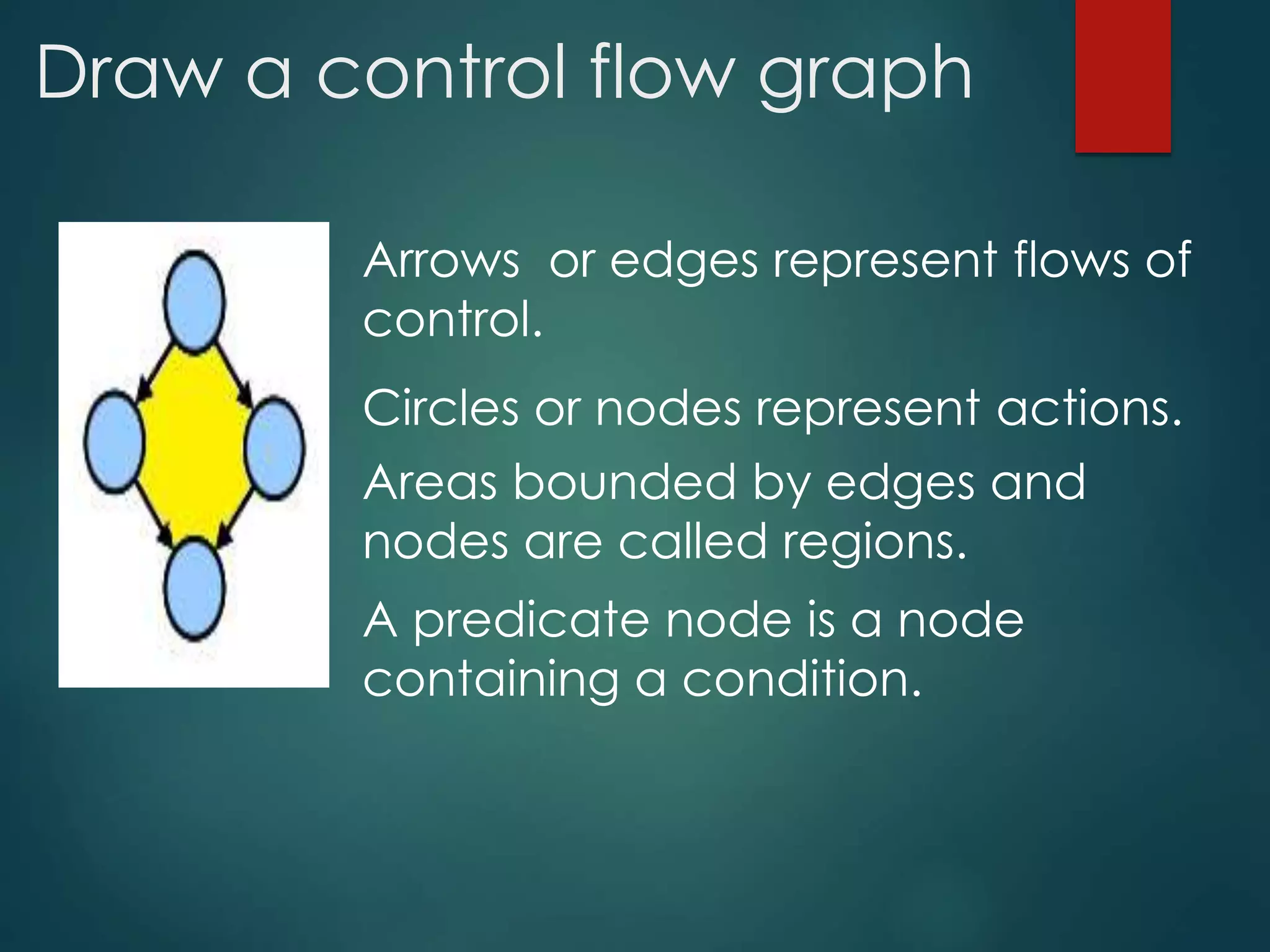
Arrows or edges represent flows of
control.
Circles or nodes represent actions.
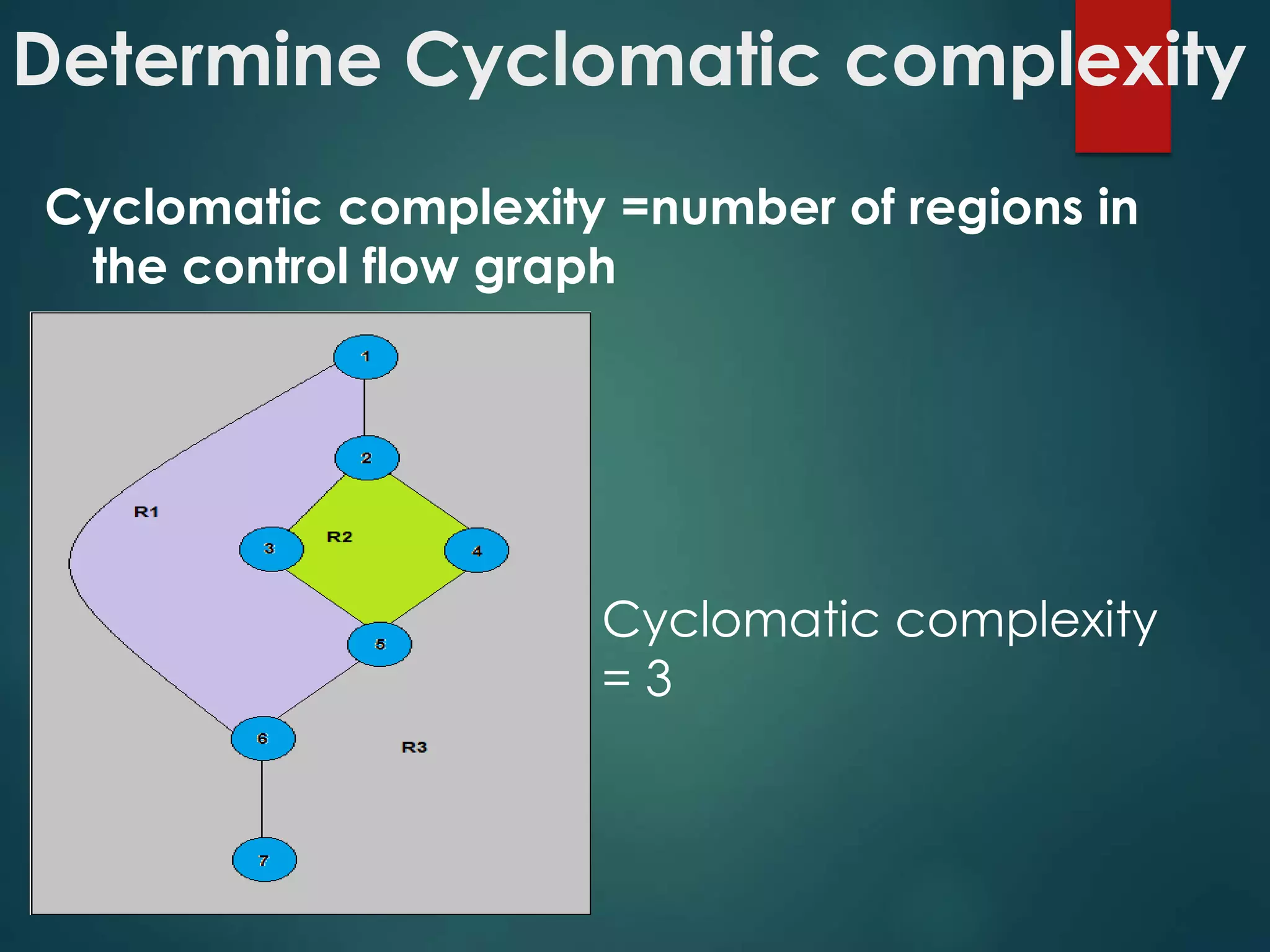
Areas bounded by edges and
nodes are called regions.
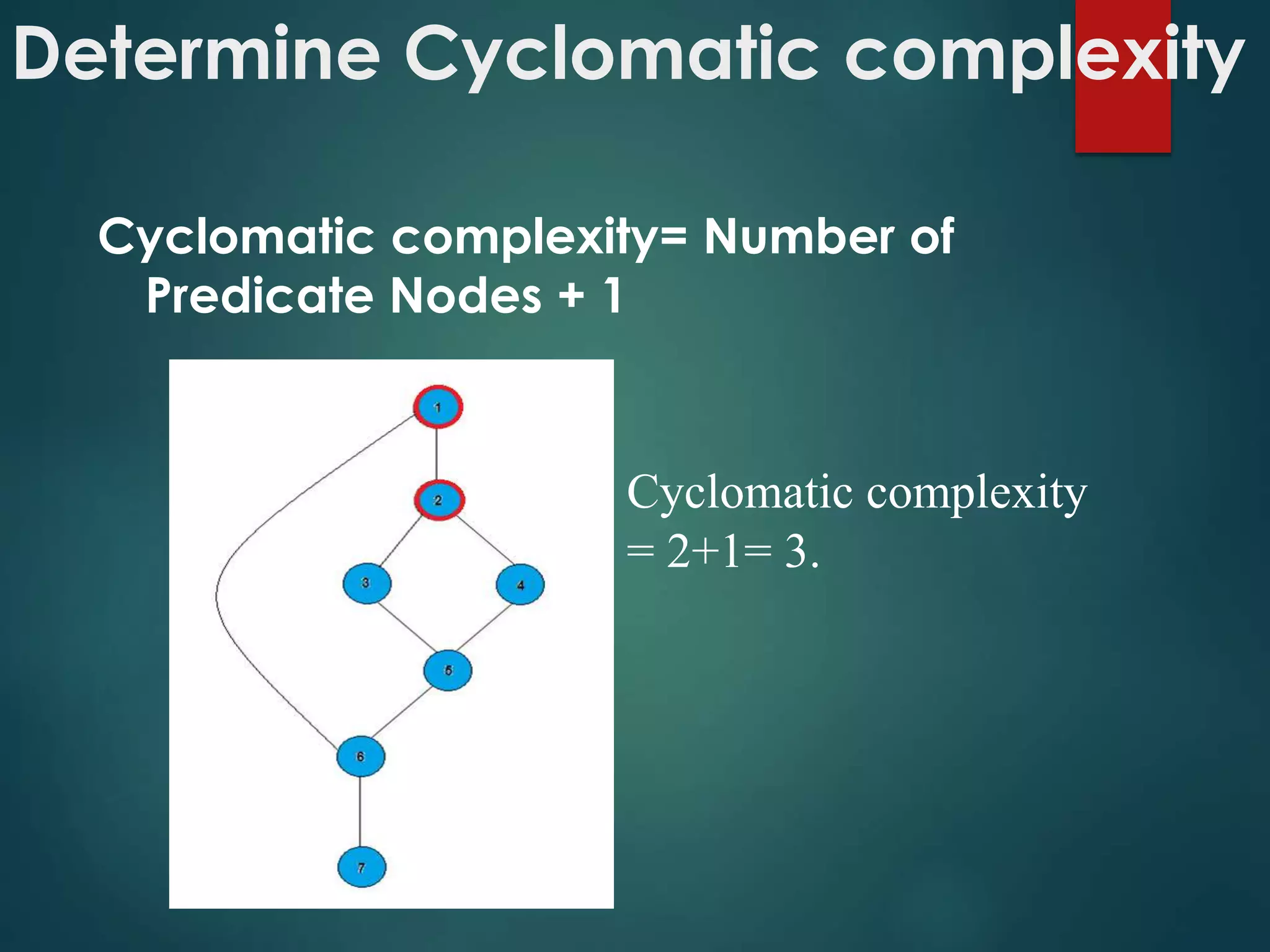
A predicate node is a node
containing a condition.
Draw a control flow graph
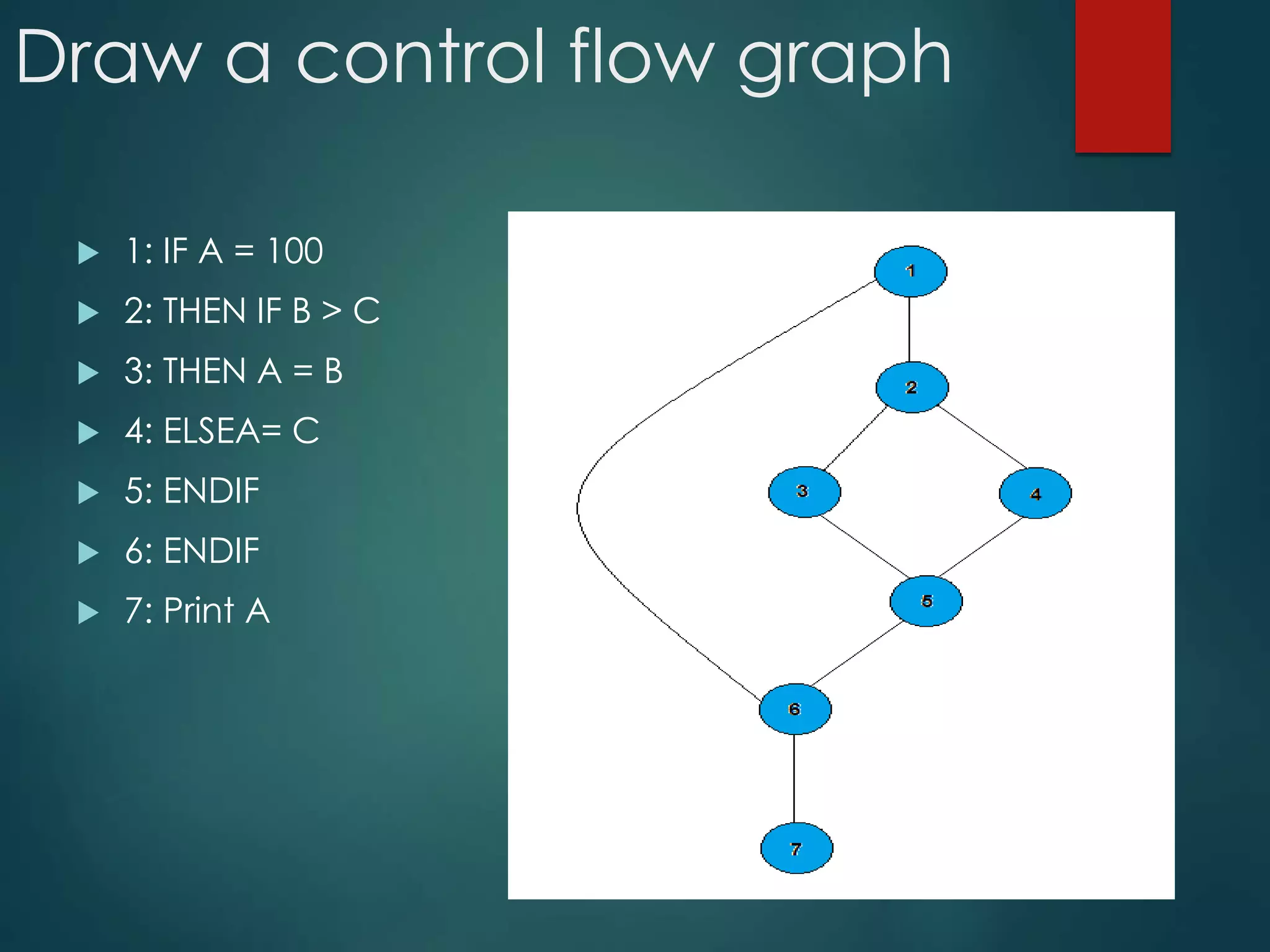
 1: IF A = 100
 2: THEN IF B > C
 3: THEN A = B
 4: ELSEA= C
 5: ENDIF
 6: ENDIF
 7: Print A
Determine Cyclomatic complexity
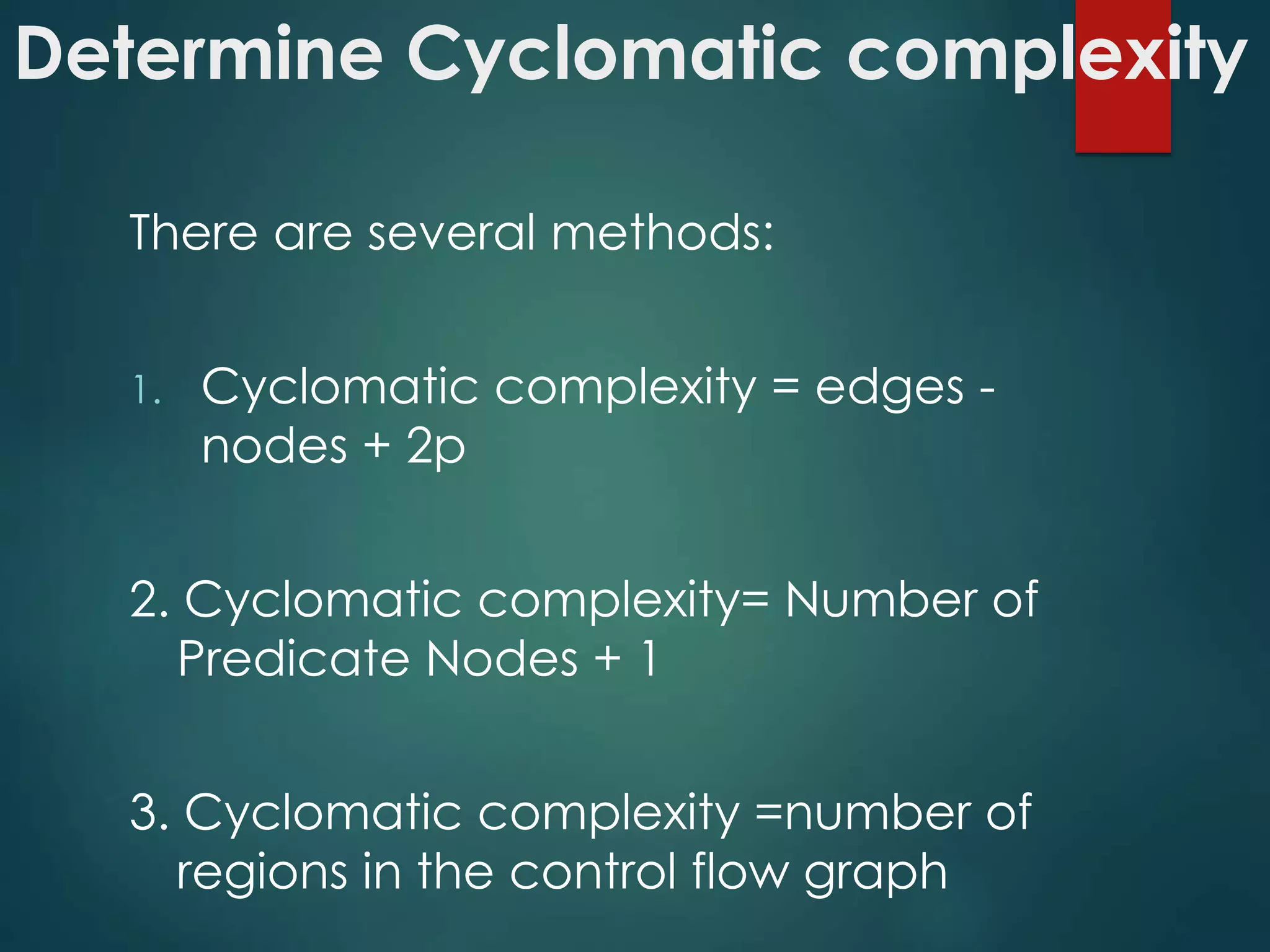
There are several methods:
1. Cyclomatic complexity = edges -
nodes + 2p
2. Cyclomatic complexity= Number of
Predicate Nodes + 1
3. Cyclomatic complexity =number of
regions in the control flow graph
Determine Cyclomatic complexity
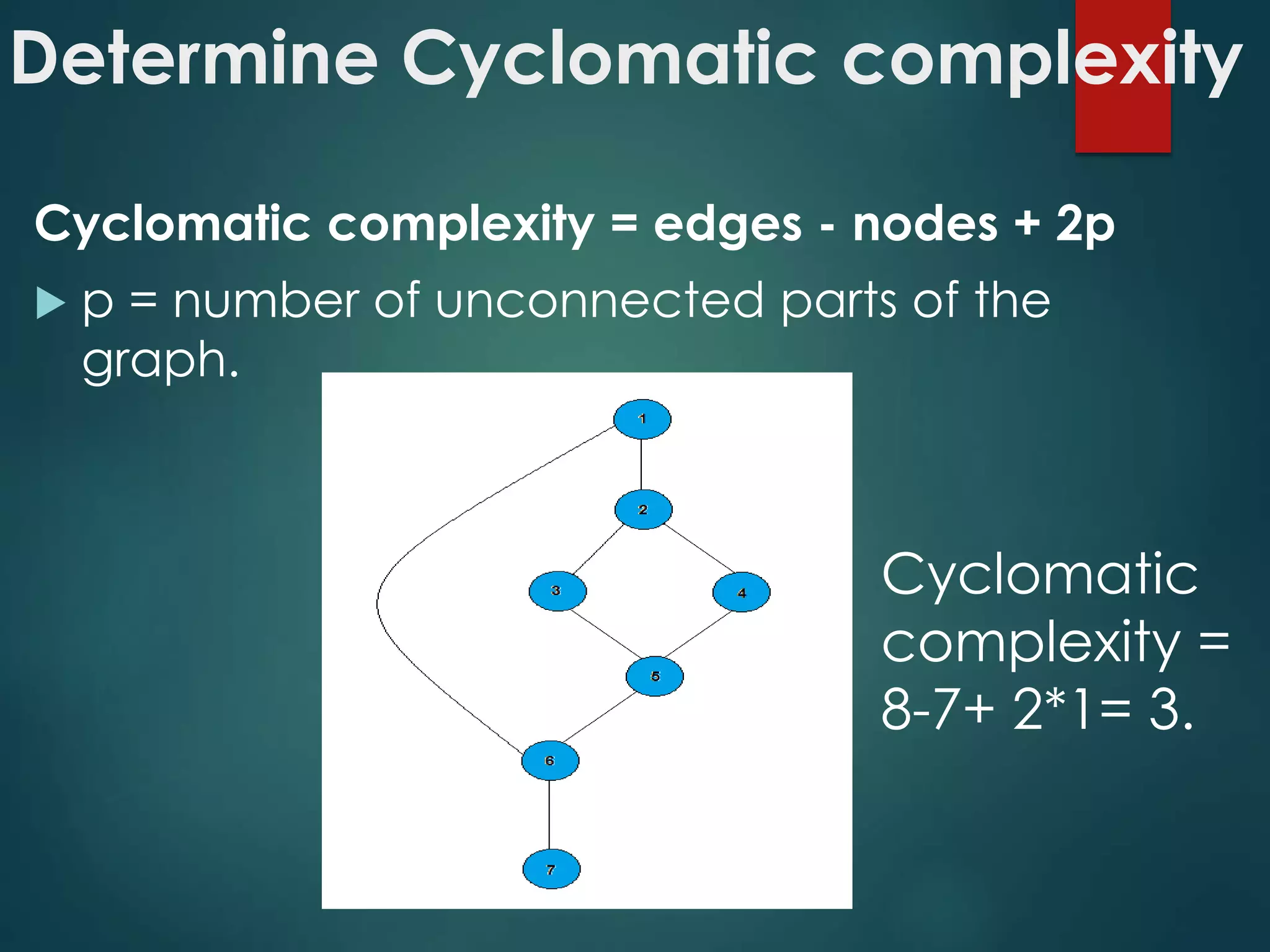
Cyclomatic complexity = edges - nodes + 2p
 p = number of unconnected parts of the
graph.
Cyclomatic
complexity =
8-7+ 2*1= 3.
Determine Cyclomatic complexity
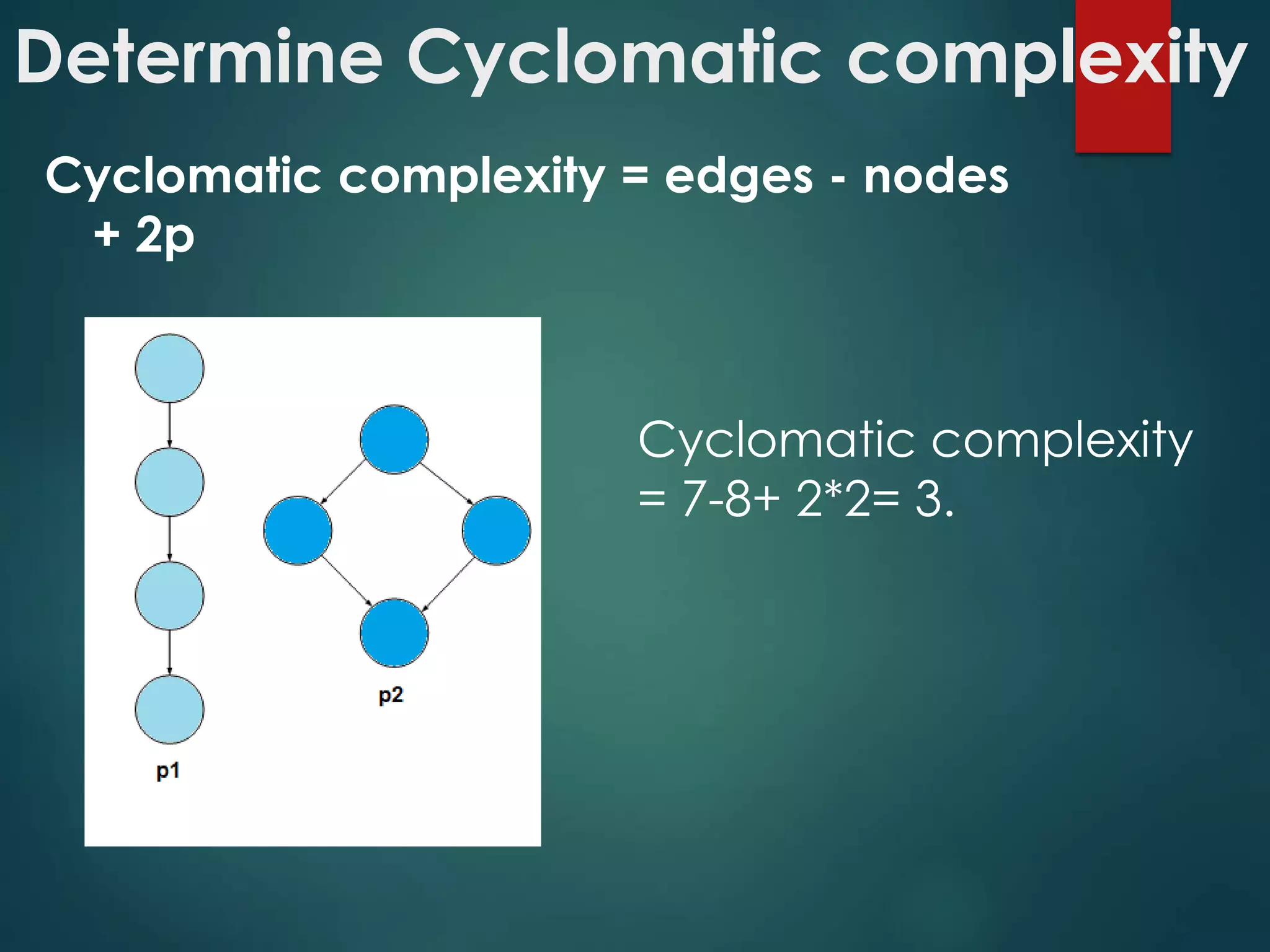
Cyclomatic complexity = edges - nodes
+ 2p
Cyclomatic complexity
= 7-8+ 2*2= 3.
Determine Cyclomatic complexity
Cyclomatic complexity= Number of
Predicate Nodes + 1
Cyclomatic complexity
= 2+1= 3.
Determine Cyclomatic complexity
Cyclomatic complexity =number of regions in
the control flow graph
Cyclomatic complexity
= 3
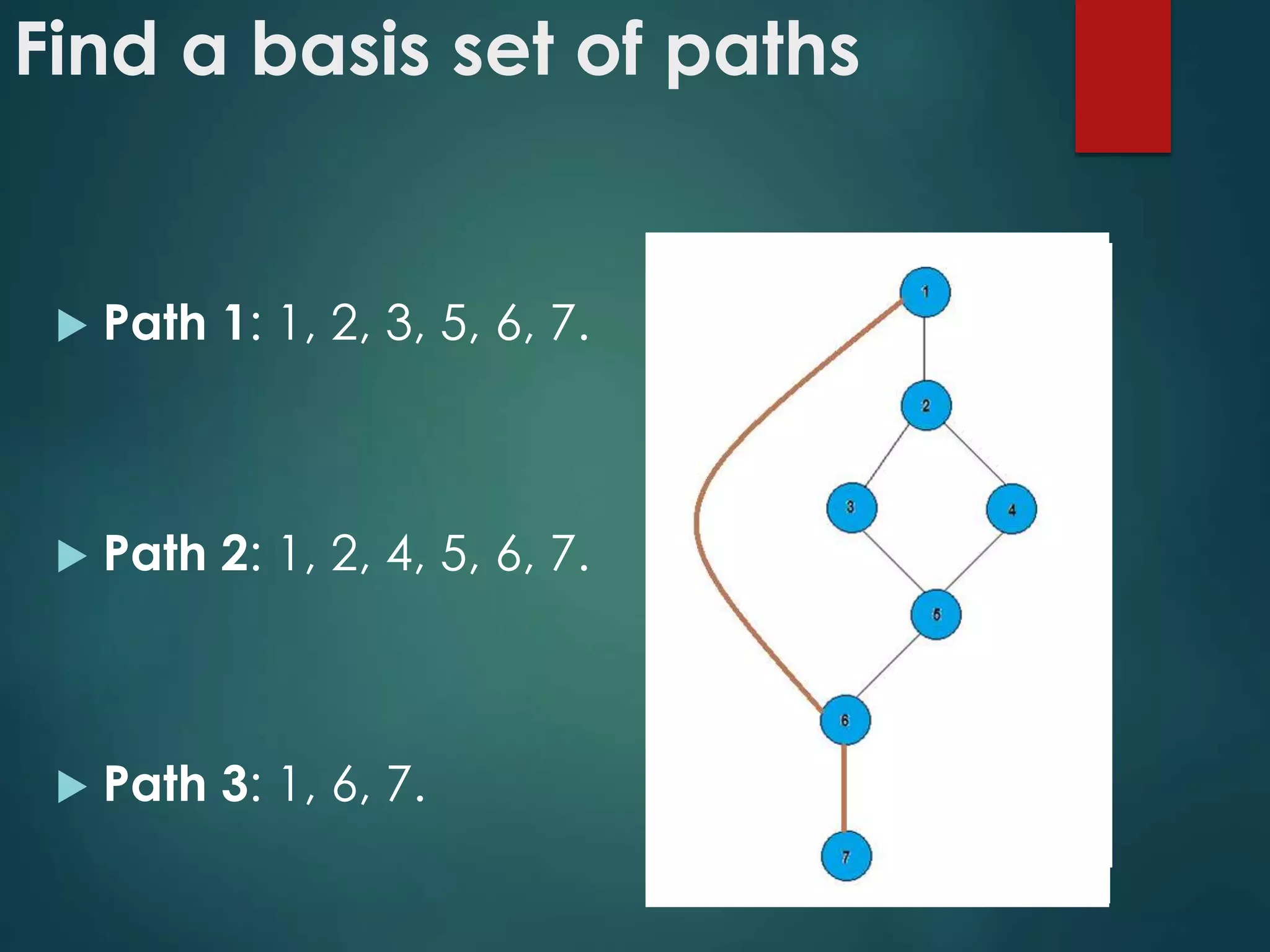
Find a basis set of paths
 Path 1: 1, 2, 3, 5, 6, 7.
 Path 2: 1, 2, 4, 5, 6, 7.
 Path 3: 1, 6, 7.
Generate test cases for each path
 We have 3 paths so we need at least one test
case to cover each path.
 Write test case for these paths .
Conclusion
 Basic path testing helps us to reduce
redundant tests.
 It suggests independent paths from which we
write test cases needed to ensure that every
statement and condition can be executed at
least one time.
References
 W. Xibo and S. Na, "Automatic test data
generation for path testing using genetic
algorithms," in Measuring Technology and
Mechatronics Automation (ICMTMA), 2011
Third International Conference on, vol. 1, pp.
596-599, IEEE, 2011..
 B. Smith and L. A. Williams, "A survey on code
coverage as a stopping criterion for unit
testing," 2008.
 E. L. Lloyd and B. A. Malloy, "A study of test
coverage adequacy in the presence of stubs,"
Journal of Object Technology, vol. 4, no. 5, pp.
117-137,2005.
Basis path testing

Basis path testing

  • 1.
  • 2.
    Agenda  Introduction  Cyclomaticcomplexity  Basic path testing approach  Conclusion
  • 3.
    Introduction  A whitebox method  Proposed by McCabe in 1980’s  A hybrid of path testing and branch testing methods.  Based on Cyclomatic complexity and uses control flow to establish the path coverage criteria.
  • 4.
    Cyclomatic Complexity  Developedby McCabe in 1976  Measures the number of linearly independent paths through a program.  The higher the number the more complex the code.
  • 5.
    Basic path testingapproach  Step 1: Draw a control flow graph.  Step 2: Determine Cyclomatic complexity.  Step 3: Find a basis set of paths.  Step 4: Generate test cases for each path.
  • 6.
    Draw a controlflow graph  Basic control flow graph structures:
  • 7.
    Draw a controlflow graph Arrows or edges represent flows of control. Circles or nodes represent actions. Areas bounded by edges and nodes are called regions. A predicate node is a node containing a condition.
  • 8.
    Draw a controlflow graph  1: IF A = 100  2: THEN IF B > C  3: THEN A = B  4: ELSEA= C  5: ENDIF  6: ENDIF  7: Print A
  • 9.
    Determine Cyclomatic complexity Thereare several methods: 1. Cyclomatic complexity = edges - nodes + 2p 2. Cyclomatic complexity= Number of Predicate Nodes + 1 3. Cyclomatic complexity =number of regions in the control flow graph
  • 10.
    Determine Cyclomatic complexity Cyclomaticcomplexity = edges - nodes + 2p  p = number of unconnected parts of the graph. Cyclomatic complexity = 8-7+ 2*1= 3.
  • 11.
    Determine Cyclomatic complexity Cyclomaticcomplexity = edges - nodes + 2p Cyclomatic complexity = 7-8+ 2*2= 3.
  • 12.
    Determine Cyclomatic complexity Cyclomaticcomplexity= Number of Predicate Nodes + 1 Cyclomatic complexity = 2+1= 3.
  • 13.
    Determine Cyclomatic complexity Cyclomaticcomplexity =number of regions in the control flow graph Cyclomatic complexity = 3
  • 14.
    Find a basisset of paths  Path 1: 1, 2, 3, 5, 6, 7.  Path 2: 1, 2, 4, 5, 6, 7.  Path 3: 1, 6, 7.
  • 15.
    Generate test casesfor each path  We have 3 paths so we need at least one test case to cover each path.  Write test case for these paths .
  • 16.
    Conclusion  Basic pathtesting helps us to reduce redundant tests.  It suggests independent paths from which we write test cases needed to ensure that every statement and condition can be executed at least one time.
  • 17.
    References  W. Xiboand S. Na, "Automatic test data generation for path testing using genetic algorithms," in Measuring Technology and Mechatronics Automation (ICMTMA), 2011 Third International Conference on, vol. 1, pp. 596-599, IEEE, 2011..  B. Smith and L. A. Williams, "A survey on code coverage as a stopping criterion for unit testing," 2008.  E. L. Lloyd and B. A. Malloy, "A study of test coverage adequacy in the presence of stubs," Journal of Object Technology, vol. 4, no. 5, pp. 117-137,2005.