Account
• It is a unit of information
that represents business records.
• There are five types of
accounts: Asset, Liability,
Equity, Revenue and Expense.
Accounting
• It is concerned with the use of which the
records are put, their analysis and
interpretation.
• It is the process of recording business
activities that make changes to accounts.
• Sales of products, Revenue from services
earned, Buying products and/or services and
so on.
Attributes of Accounting
• It is the art of recording business transactions.
• It is the art of classifying business
transactions.
• The transactions or events of a business must
be recorded in monetary terms.
• It is the art of summarizing financial
transactions.
• The results should be
communicated to users.
Functions
• Systematic record of business transactions.
• Protecting the property of business.
• Communicating results to users.
• Compliance with legal requirements.
Users of Accounting
Information
• Owners
• Creditors (Suppliers)
• Investors
• Employees
• Government
• Public
• Research Scholars / Agencies
• Managers
Branches of Accounting
Financial Accounting (Record keeping)
• Cost Accounting (Price fixation &
Operating efficiency)
• Management Accounting (Analysis
for decision making)
Advantages
• Replacement of Memory
• Evidence in court
• Tax purpose
• Comparative study
• Sale of business
• Assistance to the insolvent
• For various parties
Limitations
• Records only monetary transactions
• Effect of price level changes not considered
• No realistic information
• Personal bias of accountant affects the
accounting statements
• Permits alternative treatments (LIFO,
FIFO)
• No real test for managerial
performance
Accounting Terminology
• Business: An organization created with the objective of
making a profit from the sale of goods or services.
Book keeping: The act of systematically recording the
financial transactions affecting a business.
Book Value: The net amount (original value plus or minus
•
•
any adjustments such as depreciation) showed in the
accounts for an asset, liability, or owners' equity item.
Calendar Year: An entity's reporting year, covering 12
months.
•
• Transactions: Exchange of goods or services between
businesses or individuals. Can also be other events having
an economic impact on a business.
Basis of Accounting
.Cash basis
–Actual cash receipts and
payments are recorded.
–Credit transactions are not recorded.
Basis of Accounting
• Accrual basis
– The income whether received or not but has been
earned or accrued during the period forms
part of the total income of the period.
– The firm has taken benefit of a particular service,
but has not paid within that period, the
expenses will relates to the period in which
the service has been utilized and not to
the period in which payment for it is made.
Basis of Accounting
• Mixed basis
– Combination of cash and accrual basis.
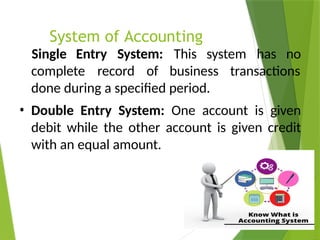
System of Accounting
Single Entry System: This system has no
complete record of business transactions
done during a specified period.
• Double Entry System: One account is given
debit while the other account is given credit
with an equal amount.
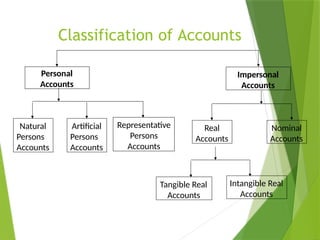
Classification of Accounts
Natural
Persons
Accounts
Personal
Accounts
Impersonal
Accounts
Artificial
Persons
Accounts
Representative
Persons
Accounts
Real
Accounts
Nominal
Accounts
Tangible Real
Accounts
Intangible Real
Accounts
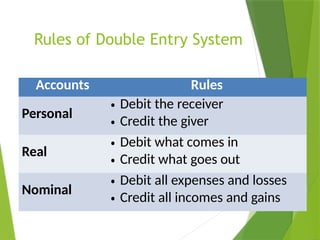
Rules of Double Entry System
Accounts Rules
Personal
• Debit the receiver
• Credit the giver
Real
• Debit what comes in
• Credit what goes out
Nominal
• Debit all expenses and losses
• Credit all incomes and gains
basicsoffinancialaccounting-131128040353-phpapp01.pptx

basicsoffinancialaccounting-131128040353-phpapp01.pptx

  • 2.
    Account • It isa unit of information that represents business records. • There are five types of accounts: Asset, Liability, Equity, Revenue and Expense.
  • 3.
    Accounting • It isconcerned with the use of which the records are put, their analysis and interpretation. • It is the process of recording business activities that make changes to accounts. • Sales of products, Revenue from services earned, Buying products and/or services and so on.
  • 4.
    Attributes of Accounting •It is the art of recording business transactions. • It is the art of classifying business transactions. • The transactions or events of a business must be recorded in monetary terms. • It is the art of summarizing financial transactions. • The results should be communicated to users.
  • 5.
    Functions • Systematic recordof business transactions. • Protecting the property of business. • Communicating results to users. • Compliance with legal requirements.
  • 6.
    Users of Accounting Information •Owners • Creditors (Suppliers) • Investors • Employees • Government • Public • Research Scholars / Agencies • Managers
  • 7.
    Branches of Accounting FinancialAccounting (Record keeping) • Cost Accounting (Price fixation & Operating efficiency) • Management Accounting (Analysis for decision making)
  • 8.
    Advantages • Replacement ofMemory • Evidence in court • Tax purpose • Comparative study • Sale of business • Assistance to the insolvent • For various parties
  • 9.
    Limitations • Records onlymonetary transactions • Effect of price level changes not considered • No realistic information • Personal bias of accountant affects the accounting statements • Permits alternative treatments (LIFO, FIFO) • No real test for managerial performance
  • 10.
    Accounting Terminology • Business:An organization created with the objective of making a profit from the sale of goods or services. Book keeping: The act of systematically recording the financial transactions affecting a business. Book Value: The net amount (original value plus or minus • • any adjustments such as depreciation) showed in the accounts for an asset, liability, or owners' equity item. Calendar Year: An entity's reporting year, covering 12 months. • • Transactions: Exchange of goods or services between businesses or individuals. Can also be other events having an economic impact on a business.
  • 11.
    Basis of Accounting .Cashbasis –Actual cash receipts and payments are recorded. –Credit transactions are not recorded.
  • 12.
    Basis of Accounting •Accrual basis – The income whether received or not but has been earned or accrued during the period forms part of the total income of the period. – The firm has taken benefit of a particular service, but has not paid within that period, the expenses will relates to the period in which the service has been utilized and not to the period in which payment for it is made.
  • 13.
    Basis of Accounting •Mixed basis – Combination of cash and accrual basis.
  • 14.
    System of Accounting SingleEntry System: This system has no complete record of business transactions done during a specified period. • Double Entry System: One account is given debit while the other account is given credit with an equal amount.
  • 15.
  • 16.
    Rules of DoubleEntry System Accounts Rules Personal • Debit the receiver • Credit the giver Real • Debit what comes in • Credit what goes out Nominal • Debit all expenses and losses • Credit all incomes and gains